

 Facebook
 X
X
 Pinterest
 Copy Link
Buyer Closing Costs in King County: What to Budget

Most first-time buyers plan hard for the down payment. Then closing day shows up with a second bill nobody warned them about. I still see buyers underestimate this number more than almost anything else in the transaction. It isn’t a hidden fee. Nobody talks about it the way they talk about the down payment, so buyers assume it’s small. It usually isn’t.
Here is the honest reality: closing costs in King County typically run 2% to 5% of your purchase price, on top of your down payment. On a $600,000 home in Kent or Auburn, that is $12,000 to $30,000 in cash you need before you get the keys. Buyers who plan for it walk into closing calm. Buyers who don’t scramble for cash in the last two weeks, and sometimes lose the house over it.
What Actually Makes Up Your King County Buyer Closing Costs
Closing costs are not one fee. They’re a stack of smaller costs from different parties in the transaction. Each one shows up on your Loan Estimate, then again on your Closing Disclosure. Here is what you are actually paying for.
Lender Fees
Run 0.5% to 1.5% of your loan amount and cover the origination fee, underwriting, and processing your loan application. This is the cost of the bank doing the work to approve and fund your mortgage. If you’re weighing a rate buydown to lower your monthly payment, that cost shows up here too. I cover the tradeoffs in my mortgage rate buydown guide.
Title Insurance and Escrow Fees
Protect you and the lender against ownership disputes and handle the neutral third party that manages your transaction. In King County, escrow and title together typically run $2,500 to $4,500, depending on your purchase price and which title company you use.
Appraisal and Inspection Fees
Run $300 to $700 each. The appraisal protects the lender by confirming the home is worth what you are paying. The inspection protects you by telling you what you are actually buying.
Prepaid Property Taxes and Insurance
The line item that surprises people most. Your lender collects the first year of insurance and a portion of your property taxes up front, sometimes $1,000 to $4,500 depending on your tax bracket and insurance premium. This isn’t really a fee. It’s money you’d owe anyway. You’re just paying it earlier than you expected.
Recording Fee
What King County charges to officially record your deed. As of the 2025 fee update, recording a deed in King County runs $303 or more depending on the document. This one is small compared to the rest, but it still needs to be in your closing funds.
Buyer Closing Costs in King County: Why the Number Changes by City
King County is not one market. The same 2% to 5% closing cost range means very different dollar amounts depending on where you are buying, and that matters for how you plan your cash to close.
In Auburn, where median prices run closer to $583,000, buyers are typically looking at $11,700 to $29,150 in closing costs (see how long homes are sitting in Auburn right now for negotiating leverage). In Kent, with a median closer to $665,000, that range moves to $13,300 to $33,250. In Renton, where single-family homes often land between $650,000 and $850,000, buyers can see $13,000 to $42,500 depending on the specific property and neighborhood.
This isn’t just a math exercise. A buyer comfortable with the down payment in Auburn might need to rethink their cash reserves entirely if they widen their search into Renton. I walk these neighborhoods for BPO work most weeks. The price gap between South King County starter markets and the closer-in cities is real, and your closing cost budget needs to move with it.
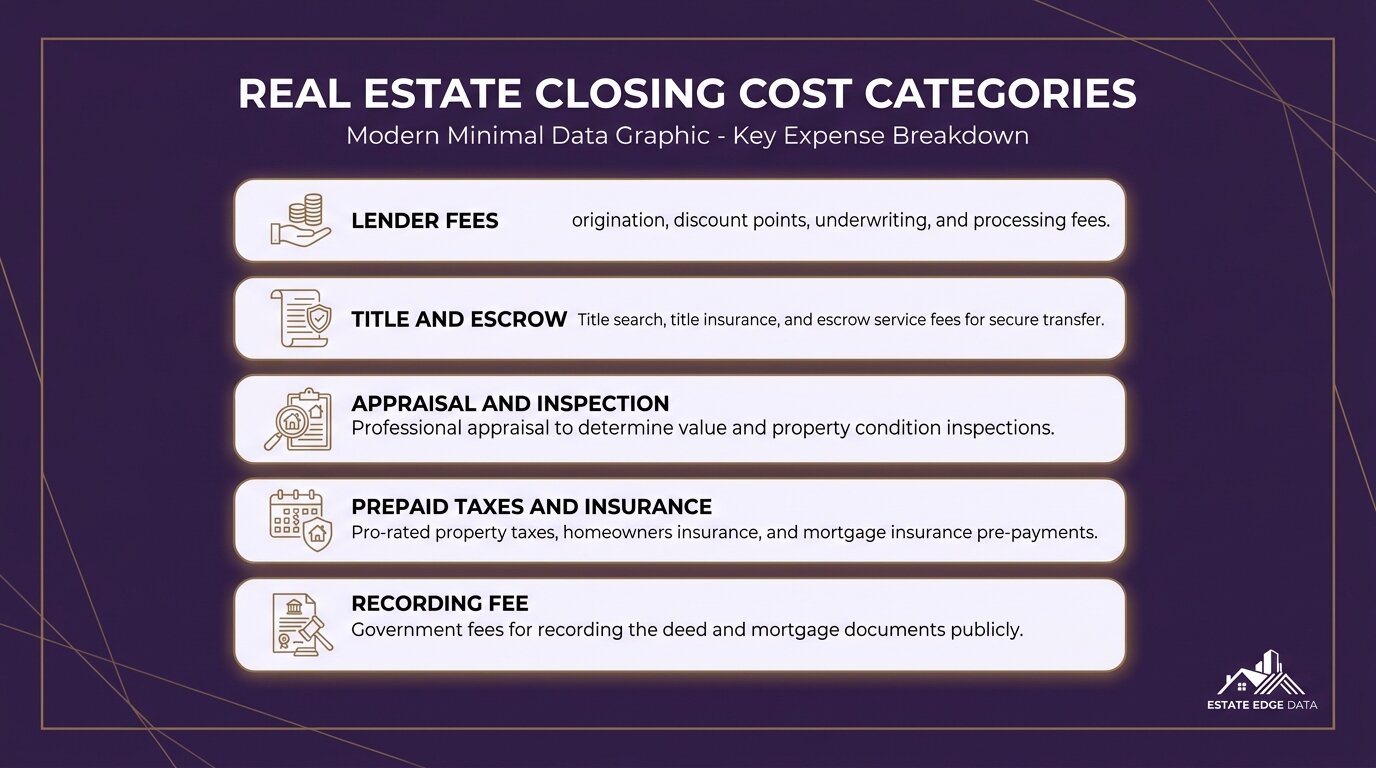
Five categories make up nearly all of your closing costs: lender fees, title and escrow, appraisal and inspection, prepaid taxes and insurance, and the recording fee.
Washington’s Real Estate Excise Tax (REET) is worth knowing about even though it is typically a seller cost, not yours. The state uses a graduated rate starting at 1.10% up to $525,000, plus King County’s local 0.50% addition. I break down the full schedule in my REET guide. Sellers pay this, but it factors into their bottom line and sometimes their willingness to negotiate concessions with you.
What This Means for You as a Buyer
Start budgeting closing costs the same week you start budgeting your down payment. Not after you’re under contract. Ask your lender for a Loan Estimate early, even before you write an offer, so you have a real number instead of a rule of thumb.
Ask about seller concessions when you write your offer. In a market where a seller is motivated, they can often credit some or all of your closing costs as part of the negotiation instead of a straight price reduction. This is common in King County right now, especially outside the tightest inner-ring neighborhoods.
Look into King County down payment assistance programs if your income qualifies. The Washington State Housing Finance Commission runs the Home Advantage program, with income limits up to $180,000 in King County, and House Key Opportunity, which can provide up to $10,000 toward your down payment or closing costs if your income is under roughly $147,400 in King County. These programs exist specifically because this gap catches so many first-time buyers. If Kent fits your budget and search area, my first-time buyer guide for Kent walks through financing options in more depth.
Keep your earnest money separate in your planning. Earnest money in King County typically runs 1% to 5% of your purchase price, with 3% being common in a competitive offer. This money is usually credited back toward your closing costs at the end, but you need it available and liquid the moment you go under contract, days before your other closing funds are due. I broke down exactly how much to set aside in my earnest money guide for King County buyers.
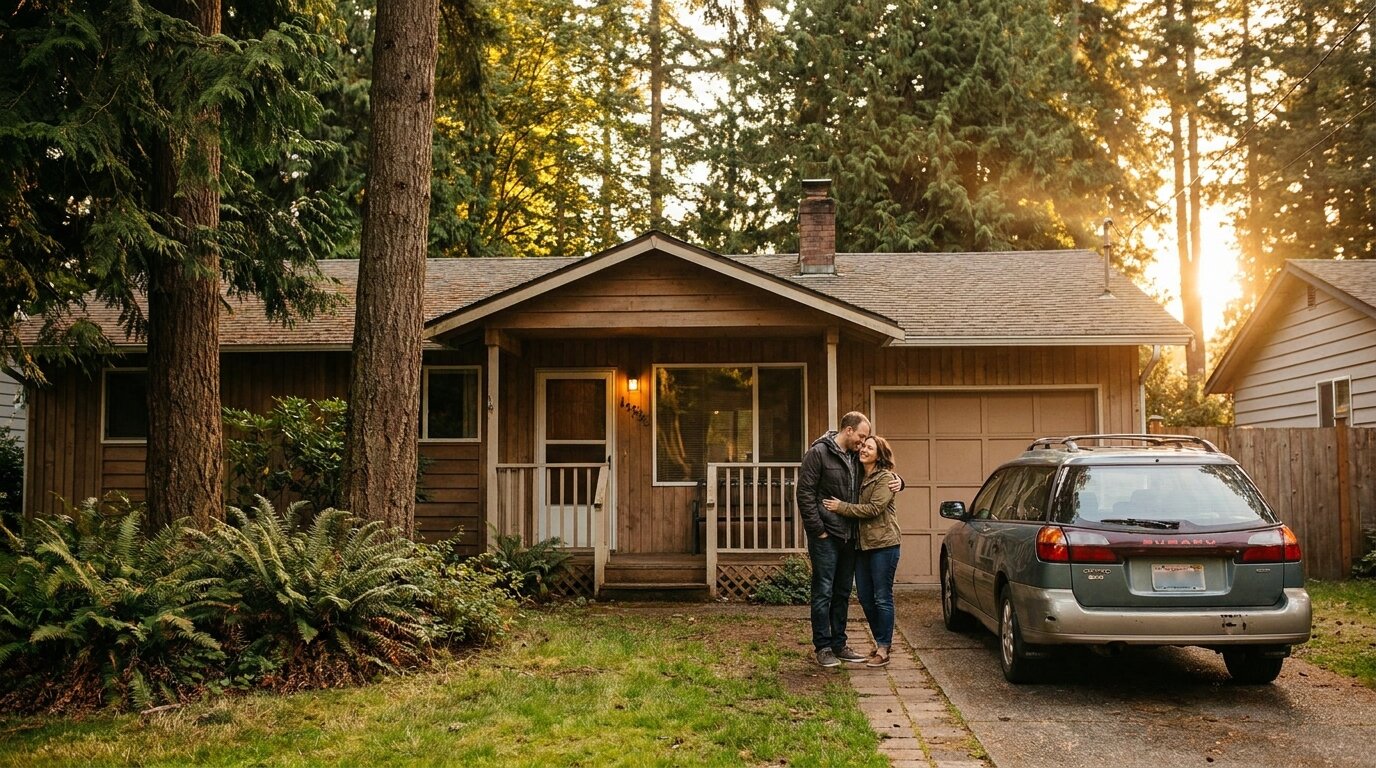
From Kent to Auburn to Covington, the closing cost math looks different in every South King County city.
FAQ
How much are closing costs on a $600,000 home in King County?
Expect roughly $12,000 to $30,000, based on the standard 2% to 5% range. Your actual number depends on your loan type, lender fees, and the title company handling your transaction.
Are closing costs separate from the down payment?
Yes. Your down payment builds equity in the home. Closing costs pay for the services and taxes required to complete the transaction, and they are due in addition to your down payment at closing.
Can a seller pay my closing costs in King County?
Often, yes. Seller concessions toward buyer closing costs are common and negotiable, particularly when a seller is motivated. Your loan type sets a cap on how much a seller can contribute.
Is earnest money part of my closing costs?
Earnest money is a separate deposit due shortly after your offer is accepted, typically 1% to 5% of the purchase price. It is usually applied toward your closing costs at the end, but you need it available well before the rest of your closing funds.
Do first-time buyer programs help with closing costs, or just the down payment?
Both, depending on the program. Washington’s House Key Opportunity and Home Advantage programs can be applied toward down payment or closing costs, which is exactly the gap that catches most first-time buyers off guard.
Your guide to life outside Seattle.
253-350-0045 ·
greg@livingoutsideseattle.com ·
www.livingoutsideseattle.com
Cost to Sell a Home in Washington State: 2026 Breakdown
Most sellers ask me one question before anything else: “How much am I actually going to walk away with?” Not the sale price. The number after everything gets paid.
I do BPO work across east and south King County almost every day, pricing homes for banks and institutional clients. That work puts me in front of real closing statements constantly, and I can tell you the gap between what sellers expect to net and what they actually net is almost always caused by the same handful of costs. None of them are secret. Most sellers just never sat down and added them up.
Here’s the honest breakdown, King County numbers included, so you can run your own math before you decide anything.
The Big Four Costs, In Order of Size
Four costs make up almost all of what comes out of your proceeds at closing. Everything else is smaller line items. Here they are, biggest to smallest.
1. Real Estate Commission
This is the largest line item, almost every time. Washington’s average total commission sits around 5.9% right now, split between the listing agent and the buyer’s agent, though that split is negotiable and varies deal to deal. On the Eastside specifically, a lot of full-service listing agents run 2.5% to 3% on their side.
On a $900,000 sale, a 5.5% total commission is $49,500. That’s real money. It’s also the single biggest reason your net check is smaller than your sale price. It buys you something, though: professional pricing, marketing, negotiation, and someone managing the transaction so an inspection issue or a lowball appraisal doesn’t blindside you. Real estate commission are and have always been negotiable and will vary from transaction to transaction.
2. Real Estate Excise Tax (REET)
Washington charges a graduated excise tax on every home sale, and King County adds its own local portion on top. Here is the state schedule for 2026:
1.10% on the portion of the price up to $525,000
1.28% on the portion between $525,001 and $1,525,000
2.75% on the portion between $1,525,001 and $3,025,000
3.00% on anything above $3,025,000
King County adds a local REET of 0.50% on top of the state rate.
Run it on a $900,000 King County home: roughly 1.10% on the first $525,000 ($5,775) plus 1.28% on the remaining $375,000 ($4,800), for a state total near $10,575. Add the county’s 0.50% ($4,500) and you land around $15,075 in excise tax alone. Most sellers don’t plan for that number. They find out on the closing statement instead. For the full rate schedule and how it’s calculated, see Washington State Real Estate Excise Tax: Complete Guide for Sellers.
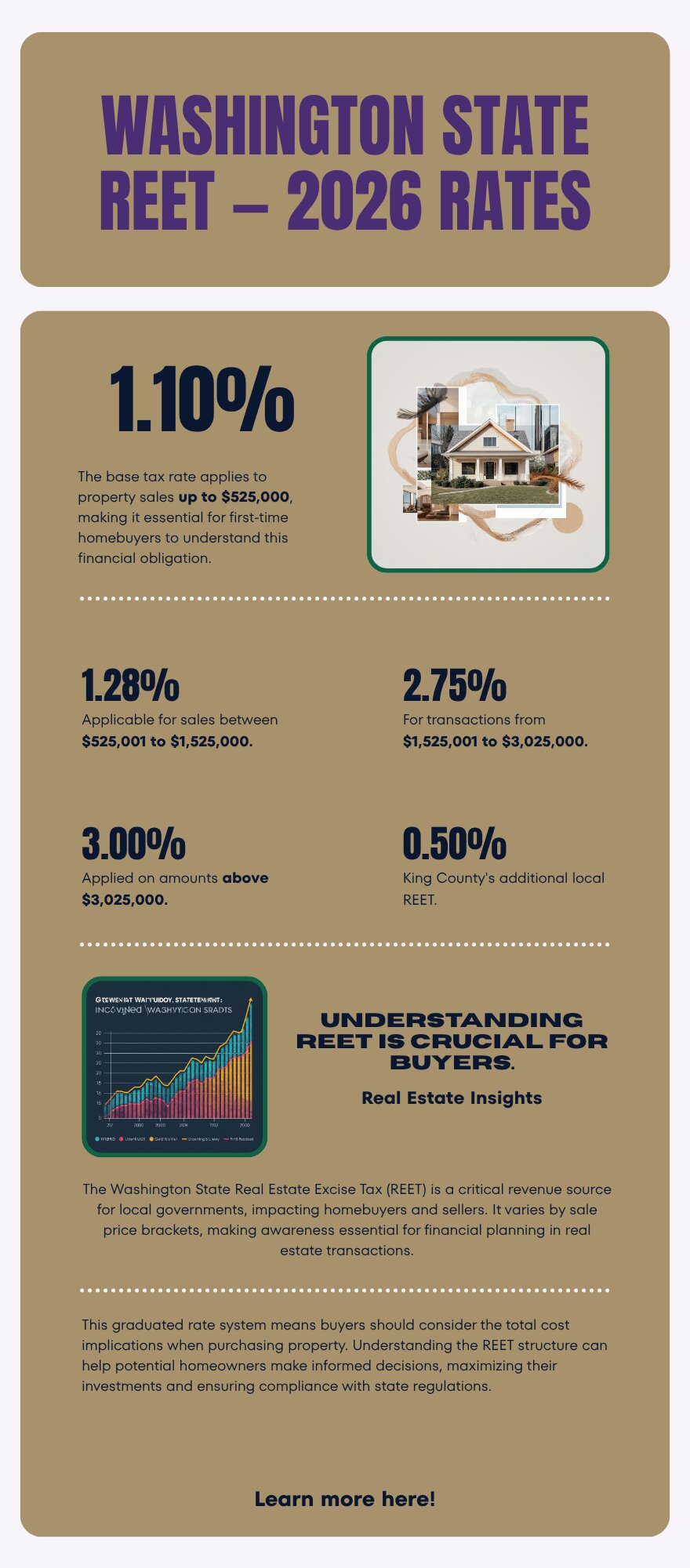
Washington’s REET is graduated. King County adds its own 0.50% on top of the state rate.
3. Title Insurance and Escrow Fees
Sellers in Washington typically pay for the owner’s title insurance policy, which protects the buyer against title defects. Escrow fees are usually split roughly in half between buyer and seller. Together these run a few thousand dollars on a typical King County sale, more on higher-priced homes since title insurance premiums scale with sale price.
Budget $2,500 to $5,000 for title and your share of escrow on a mid-range King County home. Your escrow company will give you exact numbers once you’re under contract. This range holds steady across most listings.
4. Buyer Concessions
This is the cost sellers underestimate the most, and it has become more common. Roughly 19% of recent King County sales included a seller concession, according to NWMLS data from this year. Most concessions land in the 1% to 3% range, and lenders generally cap them at 2% to 6% of the purchase price depending on loan type.
Agree to cover $10,000 to $20,000 in the buyer’s closing costs, or a rate buydown to get the deal done, and that comes straight out of your proceeds. It’s not a hidden fee. It’s a negotiated one. But it needs to be in your math from day one, not something you discover mid-negotiation. Buyers are budgeting their own closing costs at the same time. If you want to understand what they’re weighing against your ask, see Earnest Money in King County: How Much You Need in 2026.
Adding It Up: A Real Example
Here’s the full math on a $900,000 King County home, close to the current county median for single-family homes.
Sale price: $900,000
Commission (5.5%): $49,500
State + King County REET: $15,075
Title insurance + seller’s escrow share: $3,500
Buyer concession (2%): $18,000
Total selling costs: $86,075 (about 9.6% of sale price)
Estimated net before payoff of existing mortgage: $813,925
That 9.6% figure sits right in the middle of the 8% to 10% range most sellers should expect. Yours will move up or down depending on your commission rate, whether you offer a concession, and where your price lands in the excise tax brackets.
Knowing your real number before you list means no surprises at the closing table.
The Local Angle: South and East King County Specifics
Costs shift a little depending on where in King County you are selling.
In South King County cities like Kent, Auburn, Covington, and Maple Valley, home prices run below the county median, which keeps your excise tax bill lower in dollar terms even though the percentage stays close to the same. Sellers here also tend to see fewer aggressive concession requests right now, since inventory in the affordable price bands moves faster.
In East King County, Bellevue, Sammamish, and Issaquah sellers deal with higher price points. That pushes more of the sale into REET’s higher brackets once you cross $1,525,000. Sell above that threshold and your excise tax rate jumps from 1.28% to 2.75% on the portion above it. Run that difference through a calculator before you set your list price expectations.
I price homes across both sides of the county every week through my BPO work. The pattern holds. Sellers who know their real numbers going in negotiate from a position of confidence. Sellers who find out their net at the closing table are the ones who get blindsided. (Curious how that pricing work actually happens? Here’s how I price homes using BPO methodology.)
What This Means for You as a Seller
Before you list, do three things.
Run your own numbers using your actual expected sale price, not a rough guess. A $50,000 difference in price can shift which excise tax bracket you land in.
Ask your agent for a written net sheet before you sign a listing agreement. Any agent worth hiring will walk through commission, REET, title, and a realistic concession estimate with you up front, not after you get an offer.
Decide your concession tolerance before you are in a multiple-offer or slow-market negotiation. Knowing your floor ahead of time keeps you from making an emotional decision at the table.
Getting your home ready to list is its own cost and time decision. If you haven’t mapped that out yet, start with How to Prepare Your Home for Sale in King County.
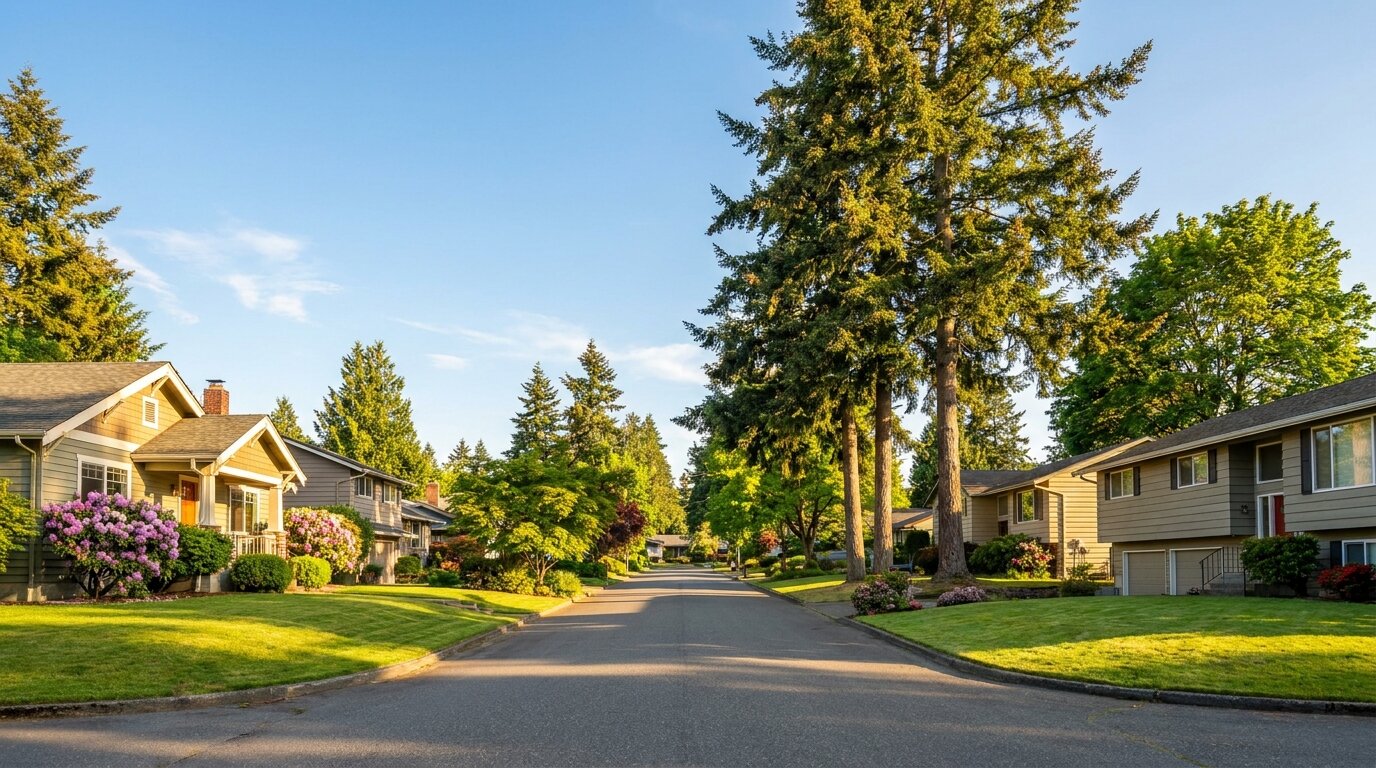
Selling costs shift depending on where in King County you list. South King County sellers see a different picture than the Eastside.
FAQ
How much does it cost to sell a house in King County, Washington?
Most King County sellers pay between 8% and 10% of their sale price in total selling costs, covering commission, real estate excise tax, title insurance, escrow fees, and any buyer concessions.
What is the real estate excise tax rate in King County?
Washington’s state REET is graduated: 1.10% up to $525,000, 1.28% from $525,001 to $1,525,000, 2.75% from $1,525,001 to $3,025,000, and 3.00% above that. King County adds a local 0.50% on top of the state rate.
Who pays closing costs when you sell a house in Washington State?
Sellers typically pay the real estate commission, the excise tax, the owner’s title insurance policy, and roughly half the escrow fee. Buyers typically pay their own lender fees, their half of escrow, and inspection costs.
Can you negotiate real estate commission in King County?
Yes. Commission is negotiable and varies by agent and by deal. Washington’s average total commission is around 5.9%, but the exact split between listing and buyer’s agent is a conversation you should have before signing a listing agreement.
Do I have to pay excise tax if I sell at a loss?
Yes. Washington’s REET is based on the sale price, not your profit or loss. Even if you sell for less than you paid, you still owe excise tax on the full sale price, with limited exceptions.
How much should I budget for seller concessions in King County?
Plan for 1% to 3% of your sale price if the market conditions or buyer financing call for it. Roughly 19% of recent King County sales included a seller concession, so it is worth building into your net sheet even if you hope not to need it.
Your guide to life outside Seattle.
253-350-0045 ·
greg@livingoutsideseattle.com ·
www.livingoutsideseattle.com
Seller Concessions in King County: A Full Guide
Give a buyer a reason to say yes without cutting your price. Here is how concessions actually work in today’s market.
I do BPO work across east and south King County every day, and lately I am seeing the same request show up in offer after offer: a concession. Not a lower price. A credit, a buydown, a repair allowance. Something that makes the deal pencil out for the buyer without touching the number on the listing.
If you are selling right now, you need to understand what a concession actually is, what it costs you, and when it works better than just dropping your price. This is not the same conversation everywhere in King County. What makes sense in a still-tight Renton starter home market is not what makes sense if you are selling a condo in a building with 3 competing listings.
What a Seller Concession Actually Is
A concession is money you agree to give back to the buyer at closing, structured a specific way in the purchase agreement. It shows up on the closing statement, not as a lower list price. The home still sells for its listed number. You are just contributing part of your proceeds toward the buyer’s costs.
Three types show up most often in King County deals right now.
Closing Cost Credit
The simplest concession. You agree to cover 2% to 3% of the buyer’s closing costs: their lender fees, title insurance, escrow charges. This helps buyers who have the income to qualify for the loan but are short on cash to actually close. First-time buyers in Kent and Auburn run into this constantly. They can afford the payment. They cannot afford to also come up with $18,000 in closing costs on top of a down payment.
Rate Buydown
Instead of paying closing costs, you deposit money into an account that temporarily or permanently lowers the buyer’s interest rate. A temporary 2-1 buydown drops the rate by 2 points in year one and 1 point in year two, then it reverts to the full note rate. A permanent buydown pays discount points at closing to lower the rate for the life of the loan. I wrote a full breakdown of how buydowns work and what they cost in the mortgage rate buydown guide if you want the mechanics. Short version here: buydowns solve a monthly payment problem, not a cash-to-close problem.
Repair Credit
Covers something the inspection turned up that you would rather pay for in cash than fix yourself. Common when you are selling an older home in Auburn or Federal Way and the inspection flags a roof with a few years left, an aging water heater, or electrical panel work. If you want to know what an inspector is actually going to flag before it becomes a negotiation, my home inspection seller guide walks through it. You give the buyer money instead of hiring a contractor and managing the repair on your own timeline.
Home Warranty
The smallest concession and often the easiest yes. A one-year policy runs $500 to $700 and gives the buyer coverage on major systems and appliances. It is a low-cost way to close a deal that is close but not quite there.
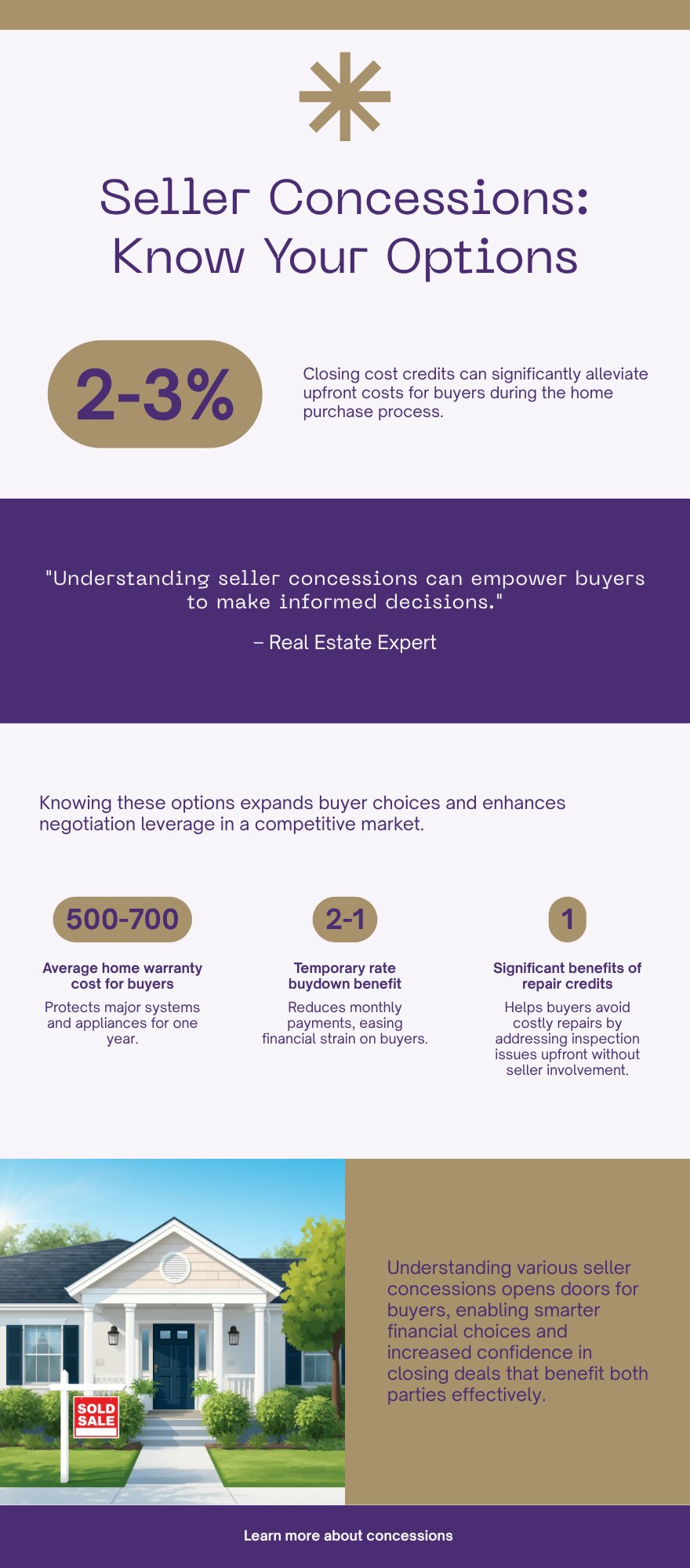
The four concession types King County sellers see most, side by side.
Concessions vs. a Price Reduction: They Solve Different Problems
This is the part sellers get backwards most often. A price reduction and a concession are not interchangeable. They fix different symptoms.
A price reduction fixes a visibility problem. If your home is not showing up in buyer searches, if you are getting almost no traffic, the number is too high for how the market is searching. Buyers filter by price range online before they ever see your listing. Drop the price and you show up to a new set of buyers who never saw the home before. If you want the full picture on getting the number right from the start, I cover that in how to price your home to sell in King County.
A concession fixes a conversion problem. If you are getting showings, even good ones, but no offers, buyers are seeing the home and still walking away. That usually means the home is priced fine but something else is stopping them: they cannot cover cash to close, the payment is a stretch at current rates, or an inspection issue is spooking them. A concession addresses that specific friction without resetting your price in the public record.
The honest reality: if your home has been sitting with almost no showings for three or four weeks, no concession fixes that. You need a price adjustment. If your home is getting showings and going under contract twice only to fall through at inspection or financing, a concession targeted at the actual reason those deals died is usually the smarter move.
How Much Does a Concession Actually Cost You
Run the math before you agree to anything. A $700,000 King County sale with a 3% closing cost credit costs you $21,000 off your net proceeds. That sounds like a lot until you compare it to a straight $21,000 price cut, which also reduces your net by $21,000 but resets the public sale price and can affect appraisal comps for every home that sells near you afterward, including your neighbors’. If you want to see how a concession fits into your full cost-to-sell picture alongside commission and excise tax, I broke down the complete math in what it costs to sell a home in Washington State.
There is a real limit here too. Conventional loans cap seller concessions based on the buyer’s down payment: buyers putting down less than 10% are typically capped around 3% of the sale price, buyers putting 10% to 25% down can usually go up to 6%, and buyers putting 25% or more down can go higher. FHA and VA loans have their own caps, generally more generous on FHA and capped differently on VA. Your agent needs to check the buyer’s loan type before you agree to a number, because a concession that exceeds the cap does not get approved by the lender. It just falls apart at underwriting after you have already accepted the offer.
The Local Angle: King County Specifics
King County is not one market right now, and that matters for this decision specifically.
Single-family inventory in tight submarkets like Renton and parts of Kent is still moving fast enough that concessions are less common. If you are selling a well-priced starter home in a walkable Renton neighborhood, you likely will not need to offer one. Multiple offers are still happening in that segment, and buyers competing against each other are not asking sellers for closing cost help.
Condos and higher price bands are a different story. Inventory has grown across King County through 2026, and condo buyers especially are negotiating harder. If you are selling a condo in Bellevue or a higher-priced single-family home in Sammamish or Issaquah, expect concession requests to be part of most serious offers. Buyers in this segment have more choices, and they know it.
South King County cities like Auburn, Federal Way, and Covington see concessions most often tied to closing cost help for first-time buyers, since that is the dominant buyer profile in those markets. East King County concessions more often show up as rate buydowns, because buyers there are stretching further on payment relative to income and a lower rate does more for their monthly budget than a closing cost credit would.
Know which buyer profile you are selling to before you decide what concession, if any, makes sense.
What This Means for You as a Seller
Do not offer a concession preemptively before you have any offers or real market feedback. Wait until you have data: showing counts, buyer agent feedback, whether offers are coming in and falling through. A concession should respond to a specific, identified problem, not a guess.
When an offer comes in asking for a concession, ask your agent what type and why. A buyer asking for a rate buydown has a monthly payment concern. A buyer asking for a closing cost credit has a cash concern. Those point to different underlying situations and tell you something about how close that buyer actually is to being able to complete the purchase.
Compare the concession cost to your next-best alternative, which is usually sitting on the market longer while carrying your mortgage, taxes, and insurance, or dropping your price instead. Run the real numbers both ways before you say yes or no.

Concessions are negotiated privately and settled at the closing table, never disclosed in public listing history.
Frequently Asked Questions
Do I have to offer a concession to sell my home in King County?
No. Whether a concession makes sense depends on your specific market segment, your showing activity, and buyer feedback. Many single-family sellers in tighter King County submarkets sell without ever offering one.
Is a concession the same as paying the buyer’s agent commission?
No, those are separate line items on the closing statement, though both come out of your net proceeds. A concession specifically covers the buyer’s closing costs, rate buydown, or repairs. Earnest money is a separate deposit entirely, from the buyer’s side — see earnest money in King County if a buyer’s offer has you wondering how that piece works.
How do I know if a buyer’s concession request is within loan limits?
Your agent should confirm the buyer’s loan type and down payment percentage before you counter or accept. Conventional loan concession caps scale with down payment size, and FHA and VA loans each have their own separate limits.
Does offering a concession make my home look desperate?
Not if it is not disclosed publicly and not offered until you have a specific reason to. Concessions are negotiated privately within an accepted offer. They do not appear as a price change in public listing history the way a price reduction does.
Can I offer a concession and still get close to full asking price?
Yes, and that is often the entire point. A concession lets you hold your list price while still closing the gap that is stopping a buyer from moving forward. That is different from a price cut, which lowers the number everyone sees.
Should I offer a concession before listing or wait for an offer?
Wait. Offering one before you have any market feedback means giving away money you might not have needed to. Let the first two to three weeks of activity tell you whether a concession is actually the problem you need to solve.
Your guide to life outside Seattle.
253-350-0045 ·
greg@livingoutsideseattle.com ·
www.livingoutsideseattle.com
East & South King County Market Update [July 2026]
What changed this week in the King County market?
Countywide activity kept cooling this week. Closings dropped to 388, the slowest week since January, and new listings fell to 743. Active inventory eased slightly to 7,647, but with fewer sales clearing, weeks of supply pushed up to 19.7, the highest reading of 2026. The county median sale price slipped to $825,000, and just 17.5% of sales closed above list, also a 2026 low.
South King County did most of the slowing. Closings fell to 77 from 107 last week, weeks of supply jumped to 19.4 from 14, and the median sale price came back to $650,000. Here is the part that headline number hides: pendings rose to 169 from 143. Buyers down south are still writing offers, they just have not reached the closing table yet.
The Eastside went the other way. Closings ticked up to 90, supply eased to 24 weeks, and pendings cooled to 148. The median sale price came down to $1,337,500, which means the value side has finally caught up with the volume slowdown I flagged last week.
The takeaway: these two markets traded places. The Eastside is settling into its price level, while South King County’s dip looks like a timing gap rather than a demand problem. Watch the South King pending count next Monday. If those close, the slow week was noise.
Looking further out than this week? Read the King County housing market forecast for 2026.
Nationally, Freddie Mac’s weekly survey put the 30-year fixed at 6.67 percent on August 13, down slightly from 6.69 percent the week before, while the National Association of Realtors reports 1.54 million homes for sale, about 4.6 months of supply, and existing home sales running at a 4.06 million annual pace. King County residential supply is still tighter than the national picture at 3.8 months on the latest monthly NWMLS data, and local closings hold far closer to full list price than the national average.
Is King County a buyer’s or seller’s market right now?
King County at a glance: July 2026 (NWMLS)
| Metric | Residential | Condo |
|---|---|---|
| Median sale price | $1,000,000 | $520,000 |
| Change vs. last month | +0.5% | +0.9% |
| Change vs. last year | +0.1% | −3.7% |
| Closed sales | 1,504 | 413 |
| New listings | 3,099 | 1,016 |
| Active listings | 5,423 | 2,540 |
| Months of supply | 3.8 | 6.0 |
| Median days on market | 11 | 28 |
| % of list price received | 100% | 99.1% |
King County, July 2026 closed-sale data. Source: NWMLS via InfoSparks.
Two different markets are hiding in that table. Single-family homes county-wide are still moving quickly at asking price. Condos are carrying nearly twice the supply, taking more than twice as long to sell, and their median price has fallen harder over the past year. If you own a condo and plan to sell, pricing honestly matters more for you than for anyone else in this report.
The table below is the heart of this page. It compares all seven cities I serve, plus the county itself, using July 2026 NWMLS closed-sale data. This month the split looks different than it has in a while: Sammamish, Issaquah, and Federal Way all posted real year-over-year price gains, while Bellevue, Renton, and Auburn slipped slightly. Supply widened almost everywhere compared to last year, giving buyers more room across the board.
City comparison: July 2026 (single-family, NWMLS)
| City | Median price | YoY | Active listings | Months of supply | Median DOM | % of list received | Closed sales |
|---|---|---|---|---|---|---|---|
| Bellevue | $1,830,000 | −1.1% | 372 | 4.9 | 13 | 97.7% | 85 |
| Sammamish | $1,725,000 | +5.3% | 253 | 5.5 | 18 | 97.3% | 57 |
| Issaquah | $1,575,000 | +7.9% | 135 | 4.4 | 9 | 97.5% | 41 |
| Renton | $810,000 | −4.7% | 317 | 3.9 | 19 | 100% | 80 |
| Kent | $700,000 | +1.4% | 270 | 3.8 | 11 | 100% | 82 |
| Auburn | $649,000 | −1.2% | 247 | 3.5 | 18 | 100% | 65 |
| Federal Way | $645,000 | +7.5% | 180 | 3.5 | 15 | 100% | 59 |
| King County (single-family) | $1,000,000 | +0.1% | 5,423 | 3.8 | 11 | 100% | 1,504 |
| King County (condo) | $520,000 | −3.7% | 2,540 | 6.0 | 28 | 99.1% | 413 |
July 2026 closed-sale data. Each city’s figures are its own true NWMLS numbers. I never average medians across cities. Source: NWMLS via InfoSparks.
How is the Bellevue housing market right now?
| Median price | YoY | Months of supply | Median DOM | % of list | Active | Closed |
|---|---|---|---|---|---|---|
| $1,830,000 | −1.1% | 4.9 | 13 | 97.7% | 372 | 85 |
Single-family, July 2026. Source: NWMLS.
Bellevue is really two markets. Move-in-ready homes under the luxury tier still draw serious competition, while the condo segment and un-staged or dated listings carry the most negotiating room in the entire county. If you are comparing renting against owning here, my Bellevue rent vs. buy breakdown runs the actual numbers.
Is the Sammamish market cooling off?
| Median price | YoY | Months of supply | Median DOM | % of list | Active | Closed |
|---|---|---|---|---|---|---|
| $1,725,000 | +5.3% | 5.5 | 18 | 97.3% | 253 | 57 |
Single-family, July 2026. Source: NWMLS.
Sammamish is almost entirely one product type, larger single-family homes, so when supply builds the whole city feels it at once. Buyers here are taking their time and looking hard at lot slope, drainage, and road noise before they write. My neighborhood guides for Sahalee and East Lake Sammamish Parkway cover the pockets buyers ask about most.
Is Issaquah still a good buy on the Eastside?
| Median price | YoY | Months of supply | Median DOM | % of list | Active | Closed |
|---|---|---|---|---|---|---|
| $1,575,000 | +7.9% | 4.4 | 9 | 97.5% | 135 | 41 |
Single-family, July 2026. Source: NWMLS.
The Issaquah Highlands keeps pulling steady showing traffic because it is the most affordable way into Eastside schools without paying Bellevue or Sammamish prices. I wrote up the full case in my Issaquah buyer opportunity guide.
What are home prices doing in Renton?
| Median price | YoY | Months of supply | Median DOM | % of list | Active | Closed |
|---|---|---|---|---|---|---|
| $810,000 | −4.7% | 3.9 | 19 | 100% | 317 | 80 |
Single-family, July 2026. Source: NWMLS.
Renton is three markets wearing one name. The Highlands, Benson Hill, and downtown each price and move differently, which is why the citywide median bounces around. It stays the top landing spot for buyers who work on the Eastside but will not pay Eastside prices. Start with my downtown Renton guide if you are new to the city.
Is Kent a good place to buy a home right now?
| Median price | YoY | Months of supply | Median DOM | % of list | Active | Closed |
|---|---|---|---|---|---|---|
| $700,000 | +1.4% | 3.8 | 11 | 100% | 270 | 82 |
Single-family, July 2026. Source: NWMLS.
East Hill family homes are the engine here, and demand for them has not let up. Steady markets punish guesswork, so pricing accuracy matters more in Kent than almost anywhere I work. If you are weighing the move, start with my guide to buying a home in Kent and the Kent family neighborhoods breakdown.
Why are Auburn homes selling so fast?
| Median price | YoY | Months of supply | Median DOM | % of list | Active | Closed |
|---|---|---|---|---|---|---|
| $649,000 | −1.2% | 3.5 | 18 | 100% | 247 | 65 |
Single-family, July 2026. Source: NWMLS.
Auburn is the most affordable single-family entry point of my seven cities, and buyers know it. When the median home goes pending in eight days, showing up without a pre-approval letter means losing the house. Lakeland Hills and the Enumclaw plateau side keep drawing families who want newer construction for less. My guide to living in Auburn covers the neighborhoods and what your budget buys in each.
Is Federal Way the best value in King County?
| Median price | YoY | Months of supply | Median DOM | % of list | Active | Closed |
|---|---|---|---|---|---|---|
| $645,000 | +7.5% | 3.5 | 15 | 100% | 180 | 59 |
Single-family, July 2026. Source: NWMLS.
Federal Way sits in the sweet spot between Seattle and Tacoma commutes, and starter homes here have stayed insulated from the cooling happening on the Eastside. My Living in Federal Way guide maps out where those values are.
What does this mean if you’re buying or selling right now?
If you’re buying: your leverage depends on which half of the county you’re shopping. On the Eastside, use the extra supply. Ask for inspection time, negotiate on homes that have sat past three weeks, and don’t chase overpriced listings. In South King County, come prepared to move fast on the good ones, because they still go in under two weeks. Either way, with rates near their best level in almost two months, it may be worth a look at a rate buydown to bring the payment down further.
If you’re selling: the market is telling sellers one thing loudly: price to the current comps, not to your neighbor’s sale from March. Hundreds of King County sellers cut their price this week alone, and every one of those cuts started with an asking price the market rejected. Condition matters more than it has in years. If you get the first two weeks right, you sell. My guide on how to price your home to sell in King County walks through exactly how I build a list price.
Frequently asked questions
Is now a good time to buy in South King County?
If the payment works for you, yes. Prices in Kent, Auburn, and Federal Way are up modestly from last year, so waiting has not been rewarding buyers there. Inventory is better than it has been in years, and rates just hit a seven-week low. The value end of the county is competitive but not frantic.
Which King County suburb has the lowest home prices?
Among my seven cities, Federal Way and Auburn are essentially tied for the lowest single-family medians in July 2026, both just under $650,000. Kent isn’t far behind. For the lowest entry point of all, condos remain the cheapest way to own in King County.
Are Eastside home prices dropping?
June medians in Bellevue, Sammamish, and Issaquah all came in below last year, and supply on the Eastside has grown faster than anywhere else in the county. That reads as a real cooling, not a collapse. Well-priced homes still sell in under two weeks. The overpriced ones are the ones sitting and cutting.
How often is this page updated?
Every Monday I refresh the “what changed this week” section with the newest NWMLS activity. Once a month, when the new monthly data lands, I rebuild every table and city capsule on this page. Bookmark it. The URL never changes.
Your guide to life outside Seattle.
253-350-0045 ·
greg@livingoutsideseattle.com ·
www.livingoutsideseattle.com
This Guide Has Moved
This article has been folded into our maintained guide: East & South King County Market Update [July 2026]. You are being taken there now.
Months of Supply in Real Estate: What It Means for You
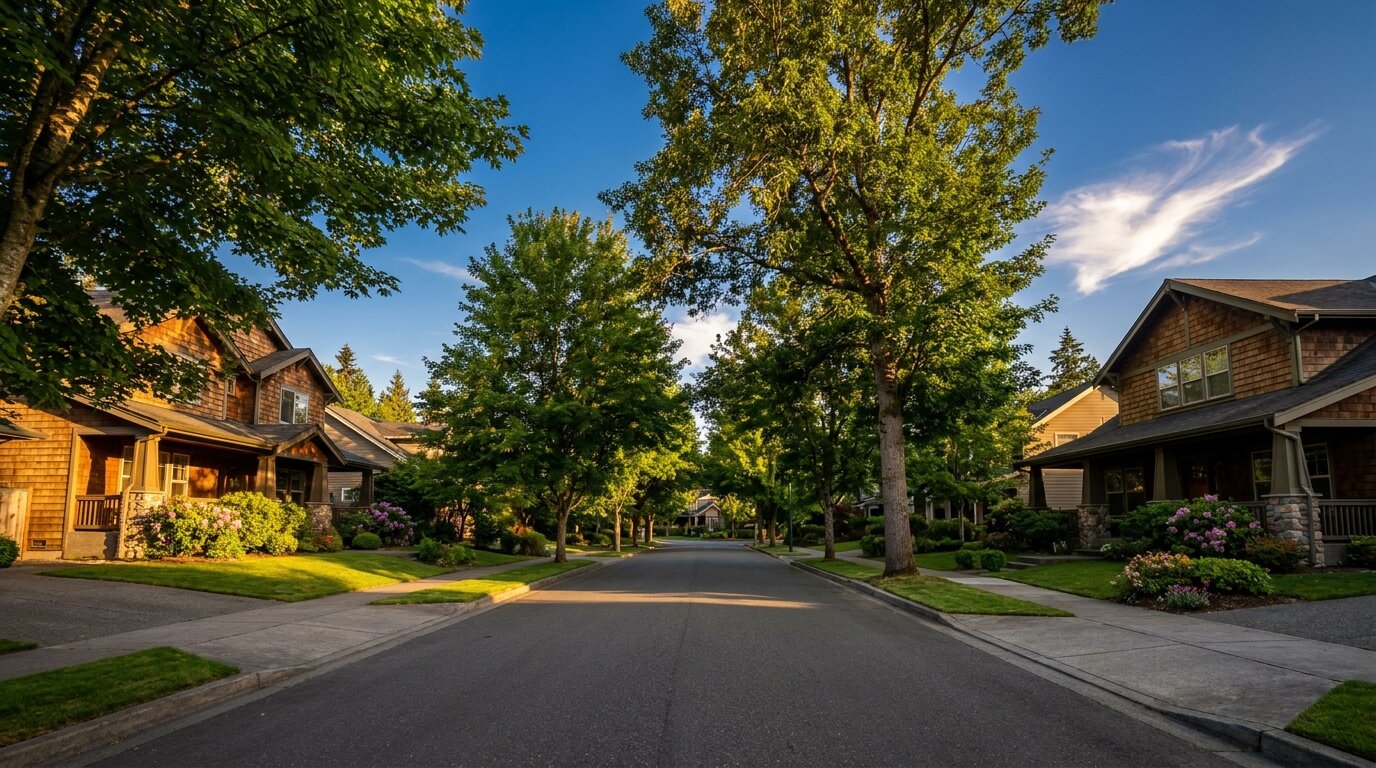
You’ll see this number in every market update, and here’s what it actually tells you and why it matters more than list price trends alone.
I look at months of supply data every single day. As a BPO field agent, I professionally price homes across east and south King County. Months of supply is one of the first numbers I pull before I put a value on a property. It tells me how much competition a seller is actually facing, how much patience a buyer needs right now, and whether the street-level conditions match what the headline market numbers suggest.
Most buyers and sellers hear this term in market update videos or agent reports and nod along without really knowing what it means in practice. That is frustrating, because this single number explains almost everything about what you can expect — whether you should push hard on price or stay patient, whether you should brace for multiple offers or expect negotiating room.
Here is the plain-English version, anchored to what is actually happening in King County right now.
How Months of Supply Is Actually Calculated
The formula is straightforward: divide the total number of active listings by the number of homes sold in the past month. The result tells you — if every house currently for sale kept selling at today’s rate and no new listings came on — how many months it would take to clear the market.
So if your city has 150 active listings and sold 50 homes last month, that is 3 months of supply. If it sold only 25 homes last month, that is 6 months of supply. Same number of homes, completely different market feel.
That math matters because it captures two things at once: how many homes are available and how fast buyers are absorbing them. List price trends can hide a lot. Months of supply does not.
The Three Zones: What Months of Supply Numbers Actually Mean
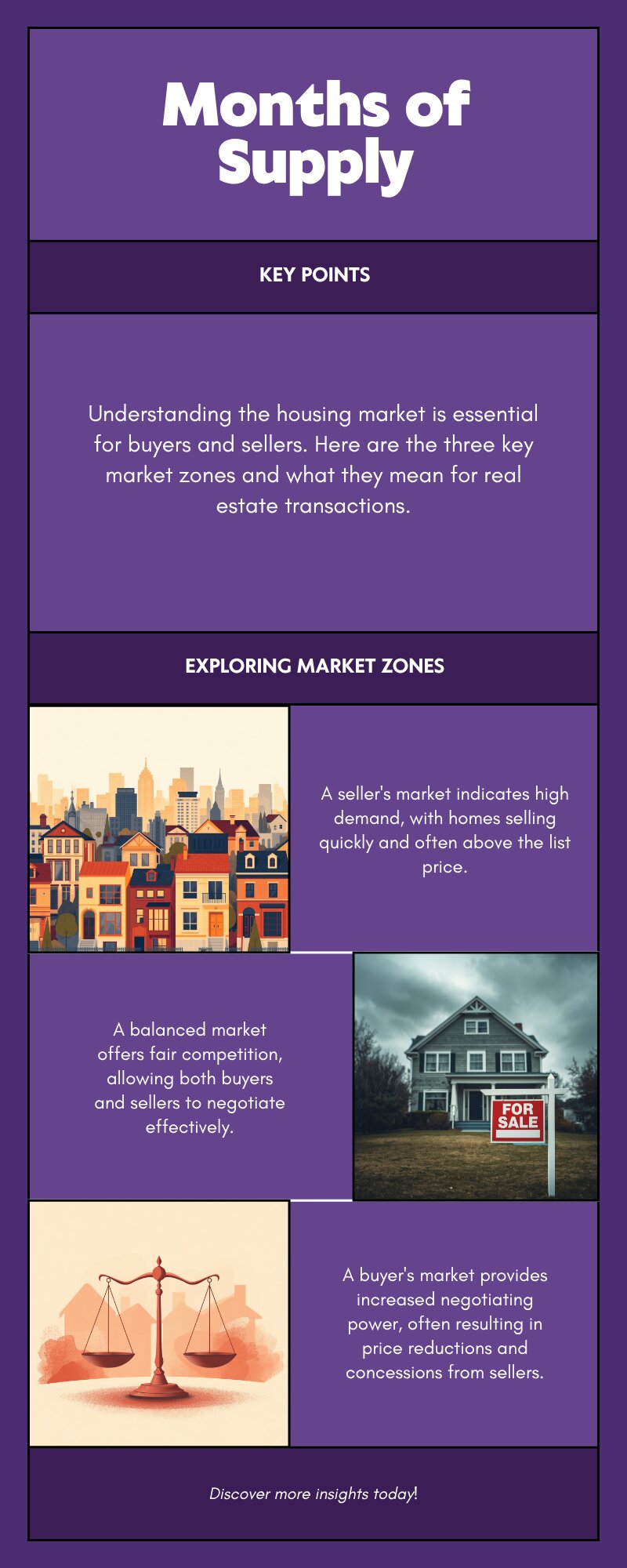
The three market zones defined by months of supply. King County sits at 3.4 months overall — seller-leaning but no longer as extreme as pandemic-era lows.
Under 3 Months: Seller’s Market
This is where most South King County single-family homes have been for years. When supply drops below 3 months, inventory moves fast. Sellers field multiple offers. Buyers often waive contingencies to compete. Homes sell at or above list price, sometimes the same week they go active. In this zone, pricing your home right from day one is critical — but pricing too low can actually cost you money if the market runs it up.
3 to 6 Months: Transitional or Balanced
This is where King County overall sits right now at roughly 3.4 months. The market is neither clearly seller-favored nor clearly buyer-favored. You will see days on market stretch a little longer. Price reductions start to appear, but mostly on overpriced homes. Sellers can still get strong results, but they cannot ignore condition or price. Buyers have a bit more room to negotiate but should not assume every deal has slack in it.
Over 6 Months: Buyer’s Market
When supply climbs above 6 months, buyers hold the cards. Sellers see price reductions, longer days on market, and homes sitting without offers. Sellers may need to offer concessions — rate buydowns, closing cost help, or repair credits — to get deals done. King County has not been in this territory broadly in years, but specific price ranges and property types have crossed into it. King County condos were sitting at roughly 4.2 months of supply in spring 2026, much closer to balanced than the single-family market.
Why King County Does Not Move as One Market
This is where months of supply becomes most useful — and where a lot of buyers and sellers get misled by county-level headlines.
King County’s overall reading of 3.4 months masks enormous variation by city, price range, and property type. Here is what I see from my BPO work:
South King County single-family homes — Renton, Kent, Auburn, Covington, Maple Valley — have consistently run tighter than the county average. Kent’s months of supply was sitting at 2.2 earlier this year, which means homes were moving fast with real competition. If you are a seller pricing a 4-bedroom house in Kent, you are in a different market than a seller pricing a condo in the same zip code.
The condo market countywide has more breathing room. At 4.2 months, King County condos are in that transitional zone where buyers can negotiate but sellers can still get decent results with smart pricing and good presentation.
New construction nationally is an outlier at 10-plus months of supply — that segment is sitting in clear buyer’s market territory. If you are weighing a new build against a resale, that supply dynamic affects your negotiating position directly.
The Eastside — Bellevue, Sammamish, Issaquah — tends to have its own rhythm. Premium pricing supports seller leverage even when supply ticks up, because demand from tech-sector buyers absorbs available homes regardless of inventory levels.

Knowing your sub-market’s months of supply changes the entire conversation with your agent — how aggressive to be on price, whether to push for concessions, and how fast to move.
For context, the national existing-home market sat at 4.5 months of supply in May 2026 — the most balanced it has been in nearly a decade. King County at 3.4 months is still tighter than the national norm. South King County single-family homes are tighter still.
The full picture across King County right now, as I see it on the ground:
King County Sub-Market Snapshot — June 2026
South KC single-family (Renton, Kent, Auburn): Still seller-leaning — under 3 months in most cities
King County condos: Transitional — around 4 months, more buyer room than many realize
Eastside luxury (Bellevue, Sammamish, Issaquah): Seller-favorable despite higher inventory
New construction (national): Buyer-favorable if you know how to negotiate
When I look at how to cross-reference months of supply data with other indicators, I use it alongside days on market and sale-to-list ratios. You can read more about how to interpret a full pricing picture in How to Read a CMA: King County Seller Guide.
What This Means If You Are Selling Right Now
If you are selling a single-family home in South King County today, you are operating in a seller-leaning market. That does not mean you can be sloppy with price or condition, but it does mean a well-prepared, correctly priced home should move.
Here is what months of supply should change about your strategy:
At under 3 months of supply: Price sharp. When inventory is low, the right price creates its own urgency. Overpricing in a low-supply market does not protect you — it just delays your sale until you cut. A home that sits in a tight market is a red flag to buyers, who assume something is wrong with it.
At 3 to 6 months of supply: Condition and presentation matter more. You cannot count on competition to bail out a house that needs work or a price that stretched too far. Budget for pre-listing repairs. Stage. Price based on true comps, not the number you want.
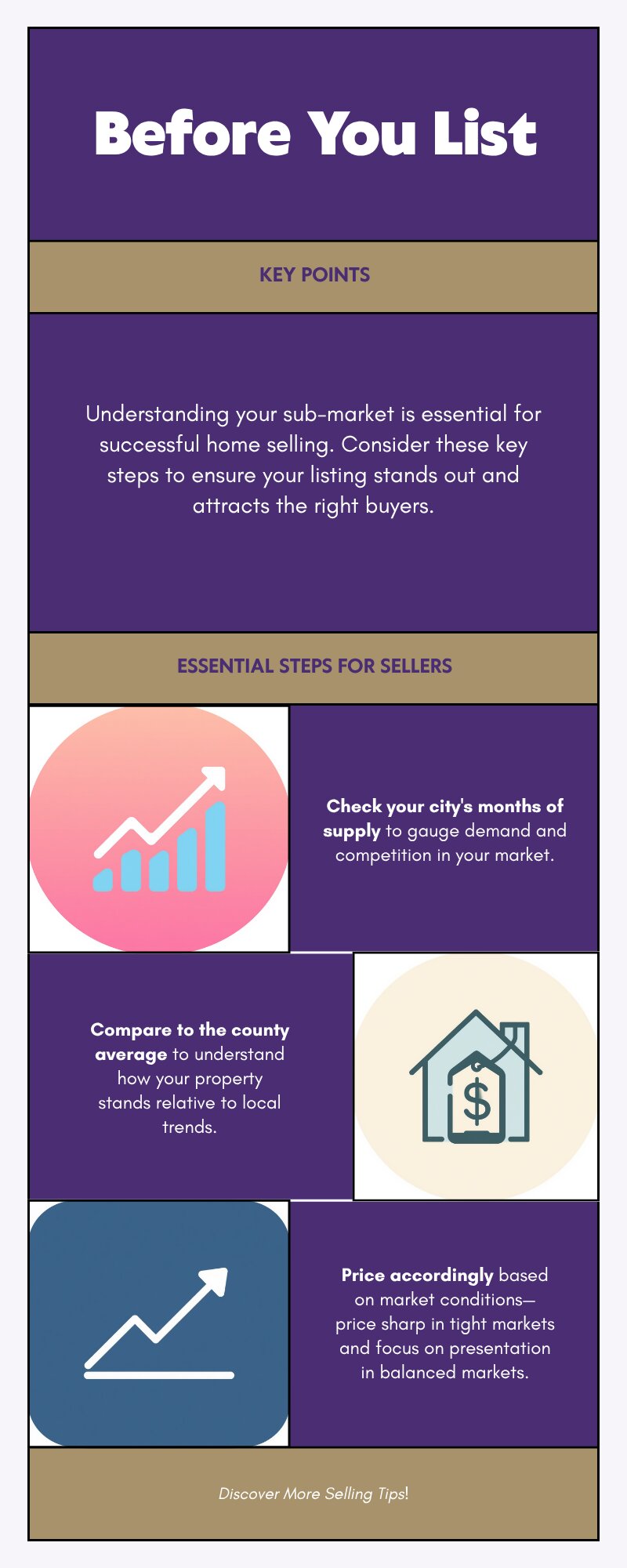
Three steps every seller should take before setting a list price. Your city’s months of supply changes everything about the right strategy.
If you want to see how these market conditions play out in a specific South KC city, the Kent inventory analysis breaks down exactly what 2.2 months of supply meant for sellers there — with real price data.
What This Means If You Are Buying Right Now
Months of supply is the first thing you should check before deciding how aggressive to be in an offer.
In a market under 3 months of supply: Go in clean and close to list price. Escalation clauses can protect you if you are competing. Waiving inspection contingencies is a risk — know what you are giving up before you do it. Waiting for a better deal often means waiting for a deal that never comes, because the next listing goes just as fast.
In a market between 3 and 6 months of supply: You have more room. Ask for closing cost help. Request an inspection without embarrassment. If a home has been on the market for three weeks, there is a real conversation to have on price. The seller knows the market has softened slightly.
If you are considering condos or new construction specifically, the supply numbers give you more leverage right now than most buyers realize. The King County condo buyer leverage guide walks through exactly how to use that supply data at the negotiating table.
The King County Housing Market Forecast for 2026 also puts these supply trends in longer-term context if you are trying to time your purchase decision.
Frequently Asked Questions
What is the difference between months of supply and days on market?
They measure related but different things. Days on market tells you how long individual homes sit before going under contract. Months of supply tells you how much total inventory exists relative to current demand. A city can have a short days on market (homes sell fast) AND a moderate months of supply (there are many homes to choose from). The combination gives you a complete picture. South King County often shows 7 to 14 days on market alongside 2 to 3 months of supply — meaning homes go fast but buyers still have reasonable selection.
Is 4.5 months of supply a buyer’s or seller’s market?
It depends on who you ask and what city you are in. Nationally, most economists call 5 to 6 months a balanced market. At 4.5 months you are near balanced, but still slightly seller-leaning. In King County specifically, 4.5 months would actually feel like significant relief for buyers compared to recent years. What matters most is how your specific sub-market compares to its own historical norms.
Can months of supply differ by price range within the same city?
Yes, and this is something I see constantly in my BPO work. A city can have 2 months of supply in the $600,000 to $800,000 range while sitting at 6 months in homes above $1.2 million. Buyers are more abundant at lower price points. When you hear an overall months-of-supply figure for a city, always ask your agent to break it down by price band for your specific budget.
How quickly can months of supply change?
Fast. A slow month of sales plus a wave of new listings can push a 2-month market to 4 months within 60 days. Seasonality matters too — winter typically adds supply without adding buyers, so months of supply can tick up in November and December even in strong markets. The data I use for BPOs is refreshed monthly, and conditions in one quarter do not guarantee the next.
Does low months of supply mean I should skip the inspection?
No. Low supply increases competition — it does not change what is inside the walls of the house. Waiving an inspection reduces your appeal to sellers, but it also eliminates your ability to negotiate repairs or walk away from a problem. In a tight market you might shorten the inspection period or offer a pre-inspection before submitting an offer. But waiving it entirely is a risk I would want every buyer to fully understand before agreeing to it.
How does King County compare to the rest of Washington State?
King County at 3.4 months of supply is tighter than most of Washington. The statewide Northwest MLS area was near 3.44 months in May 2026. Rural counties and mid-size cities across the state often carry higher supply levels, giving buyers more room. The closer you get to the Seattle metro — especially South King County — the tighter inventory gets.
Your guide to life outside Seattle.
253-350-0045 ·
greg@livingoutsideseattle.com ·
www.livingoutsideseattle.com
Home Inspection Seller Guide | King County WA 2026
Most sellers are nervous about the home inspection. Here’s what actually happens, what buyers are really looking for, and how to handle a repair request without losing your deal.
The call comes in after the inspection. Your agent says the buyer has a repair request. Your stomach drops.
I see this happen all the time. Sellers who have lived in their home for 10 or 15 years think they know every quirk of the place, and they still get surprised by what an inspector puts in a report. That’s not because something was hidden. It’s because most sellers have never seen a home inspection report before. When you see 40 items flagged in a 60-page document, it can feel catastrophic — even when 35 of those items are caulk gaps and light switch covers.
Here’s what the inspection process actually looks like from the seller’s side, what it means when a buyer sends repair requests, and how to respond without blowing up your sale. If you haven’t started prep yet, it’s worth reading our guide to preparing your home for sale in King County alongside this one.
How the Inspection Fits Into Your Sale Timeline
In King County, the buyer typically has a set window after mutual acceptance — often 7 to 10 days — to schedule and complete their inspection, review the report, and submit any requests. That window is spelled out in the purchase and sale agreement.
You don’t attend the inspection. As the seller, your job is to leave the home accessible and get out of the way. The inspection takes two to four hours depending on the size and condition of the property. Smaller condos in Renton or Auburn might be done in under two hours. A larger home in Covington or Maple Valley with a finished basement and detached garage can take closer to four.
After the inspection, the buyer gets a full written report — typically 30 to 60 pages with photos. The report goes to the buyer, not to you. You only see what the buyer chooses to share when they submit their requests.
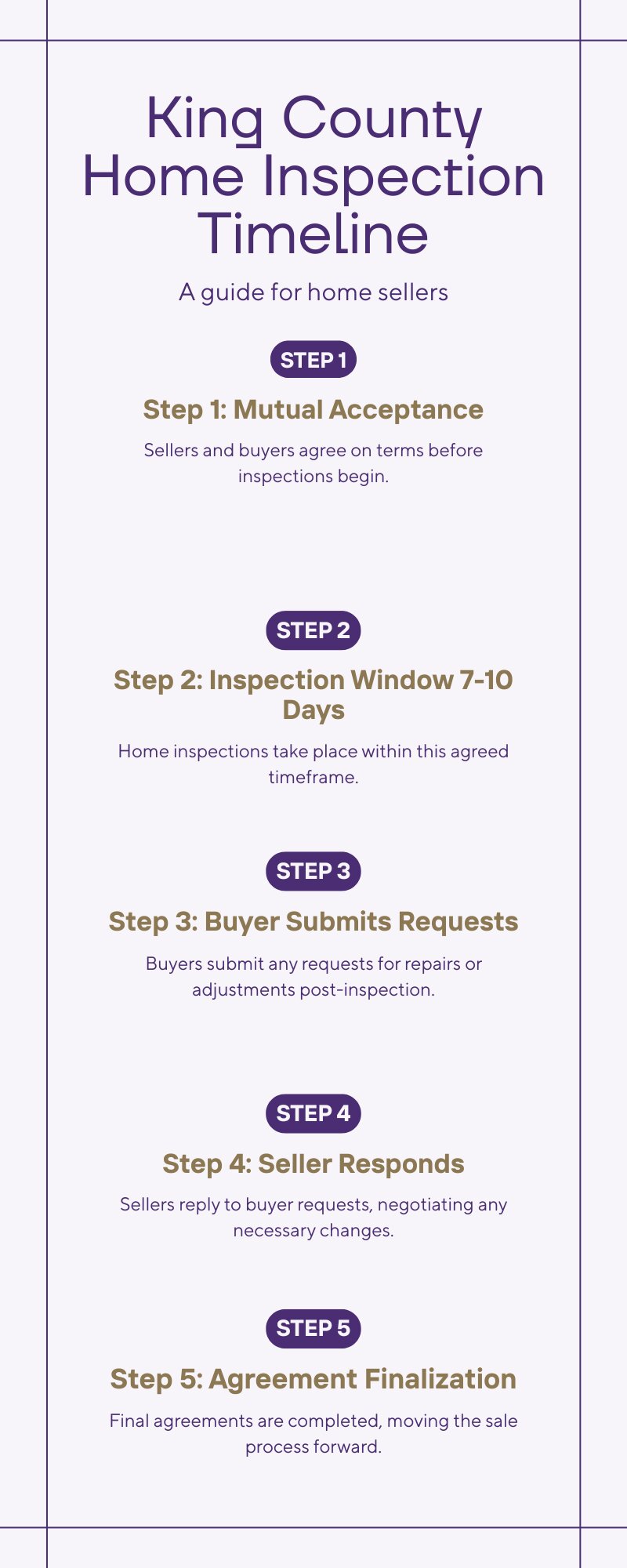
In King County, buyers typically have 7–10 days after mutual acceptance to complete their inspection and submit requests.
What the Inspector Actually Looks At
Home inspectors in Washington are licensed through the state Department of Licensing. They’re looking at the condition of the home’s systems and structure, not its cosmetic appearance. That means they won’t flag your dated kitchen tile, but they will flag a roof that’s near the end of its life.
The main areas every inspector covers are the roof and attic, the foundation and crawl space, the electrical panel and visible wiring, plumbing visible within the walls and under fixtures, the HVAC system including the furnace and any heat pumps, the water heater, windows and doors, and the exterior including drainage and grading.
In the Pacific Northwest, inspectors pay extra attention to moisture. We get a lot of rain here, and the most common serious findings in South and East King County homes come down to water — roof age, gutter condition, crawl space moisture, and signs of past leaks near windows and skylights. A good inspector is going to look hard at anywhere water could get in.
What Shows Up on a Report — and What It Actually Means
This is where sellers tend to panic. You’ll see a long list of items, many flagged with the same urgent-looking language, and it all starts to blur together.
Here’s how to read it: inspectors are trained to note everything they observe, regardless of severity. A missing dryer vent cover and a cracked heat exchanger show up in the same format — but one is a $12 fix from the hardware store and the other is a serious safety issue.
The findings that actually matter fall into a few categories.
Safety Issues
Safety issues are the ones buyers and their lenders care most about. Missing handrails on stairs, double-tapped breakers in the electrical panel, exposed wiring, carbon monoxide detector gaps — these get flagged and buyers expect them to be addressed.
In King County, older homes in Renton and Kent sometimes have Federal Pacific electrical panels, which can be an insurance problem for buyers. That’s a legitimate concern worth addressing before listing if you know about it.
Structural and Water Intrusion Issues
These are the ones that can kill deals or require significant renegotiation. Foundation cracks showing active movement, rot at the mudsill, or evidence of water in the crawl space fall here.
These aren’t always deal killers, but they need to be understood. Is this an old issue that’s been stable for years, or is water still moving? That question matters a lot to how a buyer responds.
Mechanical Systems Nearing End of Life
A furnace that’s 20 years old, a water heater at 12 years, a roof with 3 to 5 years of life left — these often show up in inspection reports. Buyers will sometimes ask for a credit here, especially in a more balanced market like we’re seeing in parts of King County in 2026.
This isn’t surprising news if you’ve owned the home for a while. Knowing the ages of your major systems before you list means you can factor them into your pricing strategy rather than scrambling to respond to them mid-contract.
Deferred Maintenance
This makes up the bulk of most reports. Caulk at tubs and windows, tree branches touching the roof, missing downspout extensions, minor gutter debris — these are normal house items that don’t represent serious problems.
Buyers sometimes include a long deferred maintenance list in their requests. That doesn’t mean you have to fix all of it. Knowing the difference between a genuine concern and a routine maintenance item is where your agent’s experience matters most.
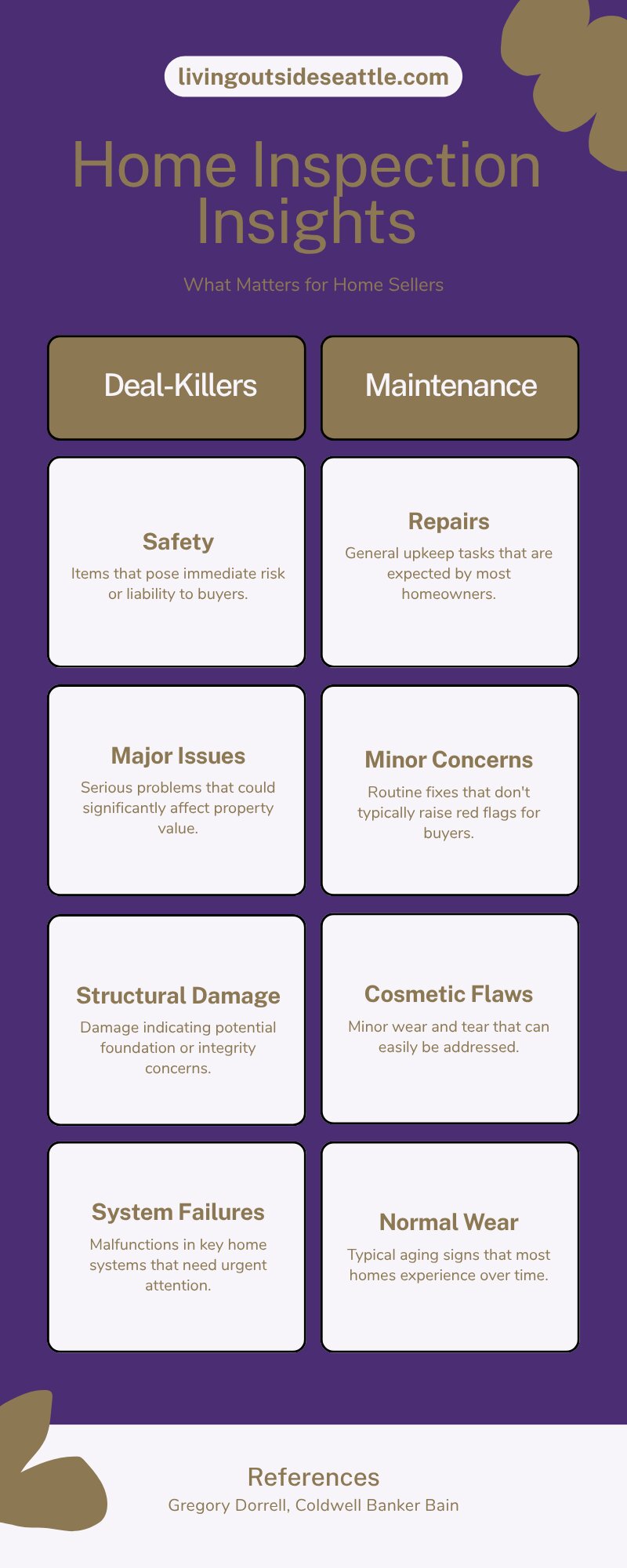
Most inspection reports are long. This is what the findings that actually matter look like compared to routine maintenance items.
Do You Have to Fix What the Buyer Asks For?
No. This surprises a lot of sellers.
Washington State does not require sellers to fix anything a buyer requests in an inspection response. The purchase and sale agreement sets up a negotiation. The buyer submits their requests. You have several options.
You can agree to the repairs and have them completed before closing, typically by licensed contractors. You can offer a dollar credit at closing instead of doing the work yourself, which buyers often prefer because it lets them choose their own contractor. You can agree to some items and decline others. Or you can decline the entire request and let the buyer decide whether to move forward or exercise their right to terminate.
The buyer’s decision has to happen within the inspection contingency window. If the timeline passes without resolution, the contingency typically expires and the sale proceeds as-is.
What you actually have to fix depends on what your contract says, not on any general legal requirement. If you’ve negotiated repairs as a condition of the sale, you’re obligated to complete them. If you respond by declining, the buyer gets to choose their path.
The Case For (and Against) a Pre-Listing Inspection
A pre-listing inspection means you hire an inspector before you go on the market. You find out what’s in the house before the buyer does.
The upside is real. A pre-listing inspection in King County typically costs $350 to 650+ depending on home size. That’s a small price to avoid being blindsided at the negotiating table. You can fix the things that matter on your own timeline and your own budget, rather than scrambling to get licensed contractors in before closing under time pressure. In a competitive market, some sellers share the pre-listing inspection report with buyers to build confidence and reduce the chance of an “inspection for information only” turning into a full renegotiation.
The downside is also real. If the inspection finds something serious, you’re now legally obligated to disclose it to buyers — even if you choose not to fix it. In Washington State, the disclosure requirements are strict. You can’t un-know what the inspector told you.
My general guidance: if the home is older than 15 to 20 years, or if you have any reason to believe there might be deferred maintenance issues in the crawl space, roof, or electrical, the pre-listing inspection is worth it. For newer homes in good condition, it’s less essential but still something that most buyers expect to see in King County.
What Kills Deals vs. What Buyers Overlook
The honest truth is that very few sales fall apart because of a home inspection. When a deal dies over inspection, it’s usually because a major undisclosed issue came to light — not because there were 40 items in the report.
The issues most likely to kill or seriously damage a deal are active roof leaks or significant roof deterioration, foundation problems showing current movement, evidence of water in the crawl space or basement that hasn’t been resolved, major plumbing failures like a failed main sewer line, and serious electrical hazards.
Buyers in King County are used to older housing stock. A 1975 Kent home or a 1985 Renton split-level is going to have some things on an inspection report. Experienced buyers and their agents know the difference between a well-maintained older home with normal findings and a house with real problems.
The things buyers most often overlook or accept as-is: cosmetic items, surface wear, minor roof maintenance items on an otherwise sound roof, single-pane windows in older homes, and deferred exterior maintenance like peeling paint or weathered decks.
What This Means for You as a Seller
Before you list, walk through your home with fresh eyes. Check the gutters. Look at what’s happening around the water heater and under sinks. Know the age of your roof and furnace. These aren’t things to hide — they’re things to understand so you can have an honest conversation with your agent about pricing and preparation.
When the inspection report comes in, read it with your agent before you react. Most items on a typical report are manageable. The ones that aren’t are the ones worth knowing about early. Understanding how pricing works in King County gives you a clearer sense of how to factor known conditions into your list price from the start.
You have more options than you think when repair requests arrive. A credit at closing is often cleaner than trying to coordinate contractors under a time crunch. Declining minor requests is completely legitimate. And pricing the home to reflect known conditions from the start — which is exactly what a BPO-trained pricing approach does — means you’re less likely to end up in a contentious renegotiation to begin with. You can also read our guide on how appraisals work in Washington State to understand the full picture of what happens between contract and closing.
Frequently Asked Questions
Does the seller have to be present during the home inspection?
No. In fact, it’s standard practice for sellers to leave during the inspection. It makes buyers and inspectors more comfortable, and it prevents awkward conversations about every item being noted.
How long does a home inspection take in King County?
Most inspections run two to four hours. A smaller condo or townhome might finish in 90 minutes. A larger single-family home with a crawl space, detached garage, and outbuildings in Covington or Maple Valley could take up to four hours or more.
What happens if I don’t agree to any repairs?
The buyer then has a choice: move forward with the purchase as-is, or exercise their right to terminate within the inspection contingency period. If they terminate, you get your home back on the market. If you’ve priced it correctly, another buyer will come.
What is a right-to-cure clause in Washington?
Washington contracts include a seller’s right to cure, which gives you the opportunity to respond to a repair request. You can agree, counter, or decline. It’s not a requirement to fix — it’s a framework for negotiation.
Should I get a pre-listing inspection in King County?
For homes older than 15 to 20 years, or any home where you have concerns about the crawl space, roof, or electrical system, a pre-listing inspection is usually worth the $350 to $550 cost. It lets you fix things on your terms and removes surprises from the process.
Can a buyer walk away after the inspection for any reason?
During the inspection contingency period, yes. The buyer can terminate for virtually any reason related to the inspection findings. Once that window closes, their options narrow significantly.
The inspection is one step in a process with a clear beginning and end. Most sellers who go through it — even with a long repair list — close. The ones who struggle are usually the ones who weren’t prepared for what they’d see. You can also review our guide to Washington State closing costs to understand the full financial picture before you list.
Your guide to life outside Seattle.
253-350-0045 ·
greg@livingoutsideseattle.com ·
www.livingoutsideseattle.com
This Guide Has Moved
This article has been folded into our maintained guide: East & South King County Market Update [July 2026]. You are being taken there now.
Living in Downtown Renton WA | 2026 Neighborhood Guide
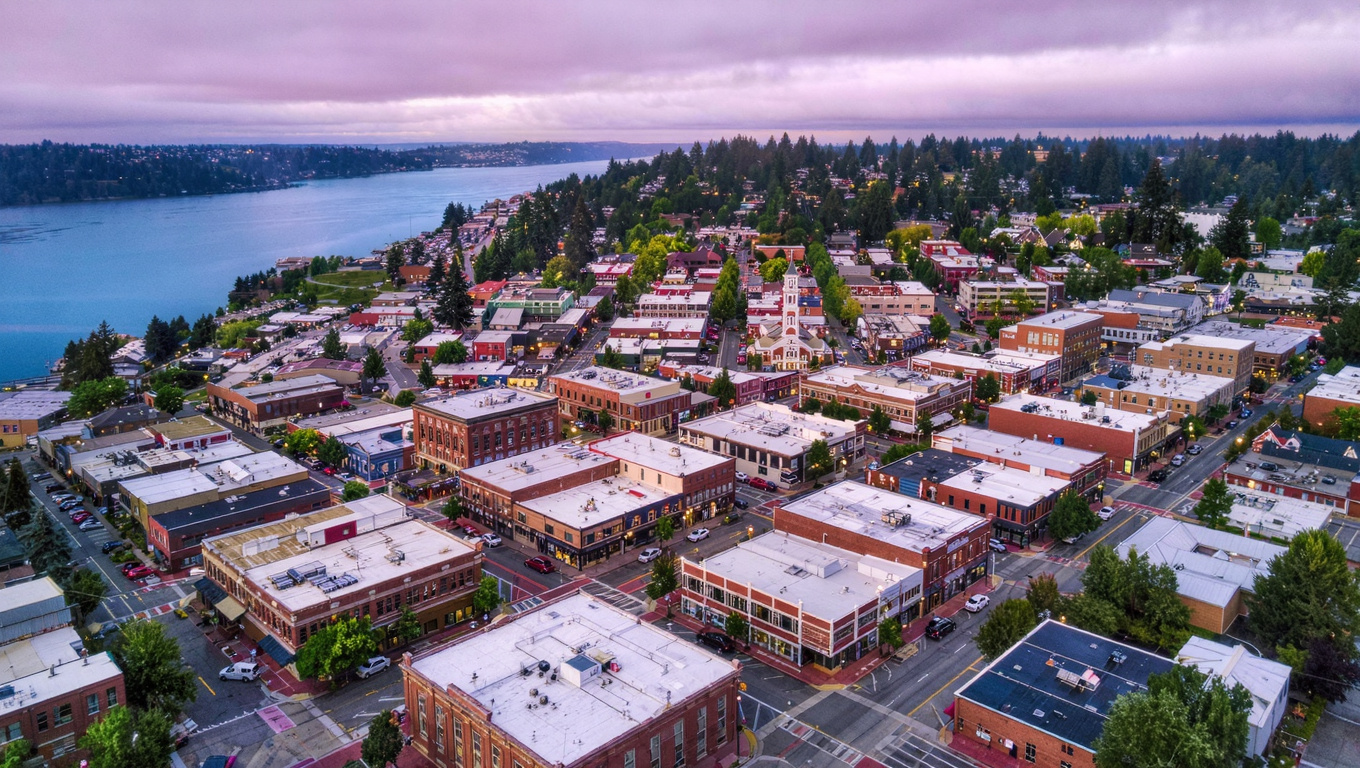
Downtown Renton has spent the last decade quietly reinventing itself. The Cedar River runs through the middle of it. Piazza Park anchors the commercial core. And a wave of new apartments and renovated storefronts along S 3rd Street has given it genuine urban energy for the first time in decades. The vibe is Walkable Urban Edge — not Seattle-dense, but walkable enough to handle daily life without a car. In 2026, it’s drawing buyers and renters who want city-style convenience at south King County prices.
What Is It Actually Like to Live in Downtown Renton in 2026?
Downtown Renton on a weekday morning is active and compact. The commercial strip on S 3rd Street has coffee, breakfast options, and a farmers market on Saturdays from May through October. The Cedar River is a five-minute walk from most residential addresses in the core. Light rail riders can reach Rainier Beach Link station in under 15 minutes by bus or bike, connecting to the broader regional system. For a south King County location, the urban connectivity here is genuinely above average.
Weekends feel like a small city coming into its own. Piazza Park fills up on summer evenings with community events and casual gatherings. The Renton Farmers Market draws a consistent crowd. Cedar River Trail is busy with cyclists and dog-walkers from early Saturday through Sunday afternoon. Restaurants on the main commercial strip give residents real dining options without driving to Bellevue or Tukwila. The revitalization here is real, not cosmetic.
Downtown Renton attracts a mix of young professionals who want walkability, older residents who’ve downsized from suburban homes, and buyers who commute to Boeing’s nearby campus. The neighborhood is also popular with investors — rental demand is strong here because of the transit access, walkability, and relatively affordable entry prices compared to Bellevue or Seattle.

Homes in Downtown Renton: What the Data Shows
Downtown Renton’s housing stock is the most varied in the city. You’ll find Craftsman bungalows from the 1920s and 1930s on small city lots, post-war ramblers from the 1950s and 1960s, mid-century apartment buildings, and newer multi-family developments from the 2010s and 2020s. Single-family home sizes typically run 800 to 1,600 sq ft on lots of 4,000 to 7,000 sq ft. Condo and apartment units range from studios to two-bedrooms. The neighborhood is denser than any other part of Renton, and buyers should expect smaller lots and closer neighbors in exchange for the walkability premium.
| Market Pulse | Downtown Renton / 98057 | King County |
|---|---|---|
| Median Sales Price (May 2026) | ~$550,000 | ~$859,000 |
| Median Days on Market | ~25 days | ~28 days |
| Active Listings Change (vs. Jan 2026) | +26% | +30% |
Figures are approximate based on zip code 98057 activity. Verify current data at NWMLS.com.
Schools Serving Downtown Renton
Downtown Renton falls entirely within Renton School District. The primary pipeline is Tiffany Park Elementary or Hazel Valley Elementary (depending on exact address), Dimmitt Middle School, and Renton High School. Renton High is the flagship high school for the district — it has a strong dual-enrollment program with Renton Technical College and a wide AP course catalog. Dimmitt’s STEM academy is well-regarded for middle schoolers with technology or engineering interests. For a dense urban neighborhood, the school pipeline here is a legitimate asset, and many families moving downtown cite it as a key factor in their decision.
Getting to Work from Downtown Renton
Downtown Renton sits at the junction of SR-169 and the I-405 corridor. From the urban core, I-405 north or south is typically 5 minutes by car. For transit riders, bus connections to the South Renton Transit Center open up Stride S2 BRT service toward Bellevue. The Cedar River Trail also provides a car-free cycling commute option toward the employment corridors along SR-169.
| Destination | Distance | 2026 Peak AM Drive | Transit Option |
|---|---|---|---|
| Downtown Seattle | 11 miles | 20 to 35 min | I-405 N to I-5 N |
| Amazon (South Lake Union) | 12 miles | 25 to 45 min | I-405 N to I-5 N |
| Microsoft (Redmond) | 18 miles | 30 to 50 min | I-405 N / Stride S2 + Transfer |
| SeaTac Airport | 9 miles | 12 to 22 min | I-405 S to SR-167 |
What I See as a Valuation Expert in Downtown Renton
Downtown Renton is an HOA-variable neighborhood. Single-family homes on city lots have no HOA. Condo and newer multi-family buildings have HOAs — fees typically run $200 to $500 per month depending on the building’s age and amenities. When I assess properties here for lenders, the biggest challenge is the wide condition and product-type range. Appraising a 1930s Craftsman bungalow and a 2018 condo in the same neighborhood requires completely different comp sets. Buyers need to make sure their agent is pulling genuinely comparable sales, not just nearby sales of different product types.
The Cedar River flood zone is a real consideration in parts of Downtown Renton. The lower-lying streets near the river can fall within FEMA’s 100-year flood zone. I flag flood zone status on every downtown property I assess for a lender. If a home looks unusually affordable for the location, check the FEMA Flood Map before going under contract. Flood insurance adds a meaningful monthly cost and complicates future resale.
Long term, Downtown Renton is the most interesting redevelopment story in south King County. The infrastructure is already there — Cedar River, I-405 access, transit center, and a walkable commercial core. As more young professionals and downsizers discover that this kind of urban environment exists outside of Seattle or Bellevue, demand should grow. The 10-year thesis is about continued revitalization narrowing the gap between downtown Renton prices and comparable urban neighborhoods in north King County. That gap is still wide in 2026. Buyers who get in now are buying into the early chapter of that story.
Frequently Asked Questions About Living in Downtown Renton
Is Downtown Renton actually walkable?
Yes, more than most people expect. The S 3rd Street commercial strip, Safeway, Piazza Park, and Cedar River Trail trailhead access are all within a 10-minute walk of most downtown residential addresses. It is not Seattle-dense, but daily errands, coffee, and outdoor access are all genuinely car-optional here.
What is the flood risk in Downtown Renton?
Some streets near the lower Cedar River corridor fall within FEMA’s 100-year flood zone. This is most relevant for properties closest to the river. Check the FEMA Flood Map Service Center with any specific address before going under contract. Flood insurance adds monthly cost and can affect future resale.
What types of homes are available in Downtown Renton?
Downtown Renton has the most varied housing stock in the city. Buyers find 1920s and 1930s Craftsman bungalows, 1950s and 1960s post-war ramblers, mid-century apartment buildings, condos, and newer 2010s and 2020s multi-family construction. Single-family homes typically run 800 to 1,600 sq ft. Condos range from studios to two bedrooms.
How does Downtown Renton compare to Kennydale or Talbot Hill for value?
Downtown Renton typically prices lower than Kennydale and Talbot Hill on a per-square-foot basis. The trade is smaller lots and a denser environment in exchange for walkability and transit access that neither Kennydale nor Talbot Hill can match. For buyers who actually use that walkability daily, the value equation strongly favors downtown.
Explore Downtown Renton Yourself
Park on S 3rd Street on a Saturday morning. Walk to Piazza Park, grab coffee, and then follow the Cedar River Trail east for a mile. Come back through the farmers market if it’s running. That two-hour loop tells you everything you need to know about what downtown Renton has become.
View Downtown Renton on Google Maps →
Your guide to life outside Seattle.
253-350-0045 ·
greg@livingoutsideseattle.com ·
www.livingoutsideseattle.com
This Guide Has Moved

This article has been folded into our maintained guide: What Is a Mortgage Rate Buydown? A Plain-English Guide for King County Buyers. You are being taken there now.
Living in May Valley, Renton WA | 2026 Neighborhood Guide

May Valley is the quietest edge of Renton. It sits in the valley between Renton and Issaquah, with Cougar Mountain Regional Wildland Park rising to the south and forested hillsides pressing in on both sides. The vibe here is unmistakably Wooded Sanctuary — larger parcels, more privacy, and a pace of life that’s genuinely different from anywhere else in the city. In 2026, it remains one of the best semi-rural options in all of King County for buyers who want space without leaving civilization behind.
What Is It Actually Like to Live in May Valley in 2026?
May Valley mornings are quiet in a way that most King County neighborhoods can’t match. Traffic on May Valley Road SE is light. There are no commercial strips, no through-traffic shortcuts, and no noise from nearby freeways. If you work from home or value a truly calm residential environment, this is one of the few places in the greater Seattle area that genuinely delivers it. The trade-off is distance — daily errands require a drive, and commute times to the tech corridor are longer than central Renton.
Weekends in May Valley are outdoor-oriented almost by default. Cougar Mountain Regional Wildland Park has over 36 miles of trails for hiking and mountain biking. The park borders the neighborhood directly, which means residents can walk from their front door to established trailheads in minutes. The Coal Creek trail corridor provides additional paved options for cyclists and families with strollers. There’s a genuine outdoor recreation culture here that draws a specific kind of buyer — one who values trail access as much as square footage.
May Valley buyers tend to be outdoor enthusiasts, families seeking Issaquah School District assignments, remote workers who value quiet over commute convenience, and long-term owners who bought here decades ago and have no reason to leave. It’s not a neighborhood for everyone. But for its buyers, it’s exactly right.

Homes in May Valley: What the Data Shows
May Valley’s housing stock spans a wide era — from 1970s split-levels to custom builds from the 2000s and 2010s. Home sizes range from 1,600 to 3,500 sq ft. Lots are significantly larger than anywhere else in Renton: a quarter-acre is common, half-acre parcels appear regularly, and some properties exceed an acre. Many homes have long driveways, detached garages or outbuildings, and mature tree coverage that creates genuine privacy. Architectural styles are varied — you’ll find everything from Pacific Northwest ramblers to newer Northwest Contemporary custom homes. The neighborhood has grown organically over 50 years and it shows in the interesting mix of properties.
| Market Pulse | May Valley / 98059 | King County |
|---|---|---|
| Median Sales Price (May 2026) | ~$820,000 | ~$859,000 |
| Median Days on Market | ~35 days | ~28 days |
| Active Listings Change (vs. Jan 2026) | +24% | +30% |
Figures are approximate based on zip code 98059 activity. Verify current data at NWMLS.com.
Schools Serving May Valley
The eastern portion of May Valley — roughly from Coal Creek Parkway east — falls within Issaquah School District, which is a major draw for families. The typical Issaquah pipeline for May Valley students is Cougar Ridge Elementary, Maywood Middle School, and Liberty High School. Cougar Ridge Elementary is a newer facility with strong parent engagement and a well-regarded STEM program. Maywood Middle offers solid arts and technology tracks. Liberty High School carries one of the most competitive AP program records in south King County.
The western edge of May Valley may assign to Renton School District. This district boundary split is not obvious from looking at a map — it runs through the valley and can change by street. Confirm your specific address assignment directly with both districts before making any school-based purchasing decisions.
If you’ve done the homework on Liberty High School’s outcomes, the Issaquah premium feels justified. The market agrees — Issaquah-assigned homes in May Valley consistently appraise above Renton-assigned homes on otherwise comparable parcels.
Getting to Work from May Valley
May Valley Road SE is the main artery. Head west to reach Renton and SR-169 north to I-405. Head east on Coal Creek Parkway SE to reach I-90 at Issaquah — the faster route for Eastside tech commuters heading to Redmond or Bellevue. No matter which direction you go, budget 10 to 15 minutes before you hit a freeway.

| Destination | Distance | 2026 Peak AM Drive | Transit Option |
|---|---|---|---|
| Downtown Seattle | 20 miles | 38 to 60 min | Coal Creek Pkwy to I-90 W |
| Amazon / Microsoft (Bellevue/Redmond) | 15 miles | 25 to 40 min | Coal Creek Pkwy to I-90 / I-405 N |
| Renton City Core | 9 miles | 18 to 28 min | May Valley Rd W to SR-169 N |
| SeaTac Airport | 18 miles | 28 to 45 min | SR-169 N to I-405 S to SR-167 |
What I See as a Valuation Expert in May Valley
May Valley is largely HOA-free. Most properties are on individual parcels with no monthly dues. In May Valley, lot size and usability are everything for valuation. A two-acre parcel that is 60% steep slope and wetland buffer has very different utility — and very different appraised value — than a flat half-acre with a usable yard and cleared building area. I pull topographic data and wetland maps on every May Valley comp. Buyers should do the same before falling in love with a parcel size on paper.
Cougar Mountain Regional Wildland Park adjacency is the single biggest premium driver here. Homes that back directly to the park boundary or have trail access from the backyard consistently command $75,000 to $150,000 above comparable non-park-adjacent homes. The park is permanent, protected land. That permanence is a long-term value anchor.
The Issaquah School District assignment is the other major value driver. An Issaquah-assigned home and a Renton-assigned home at the same price can carry meaningfully different appraised values. When I pull comps for a lender, I always match district assignments. The school premium is durable and the market price difference reflects it consistently.
Frequently Asked Questions About May Valley, Renton WA
Is May Valley a good place to live?
Yes — for the right buyer. If you want space, privacy, trail access, and a genuinely quiet lifestyle, May Valley delivers all of it. The trade-off is that daily errands and commutes require more driving than central Renton. Buyers who know what they’re signing up for tend to love it. Buyers who underestimate the commute factor often don’t stay long.
What are homes like in May Valley?
A wide mix — from 1970s split-levels to 2010s custom builds. Lots are the story here: quarter-acre to multi-acre parcels with mature trees, long driveways, and genuine privacy. Home sizes typically run 1,600 to 3,500 sq ft. No dominant builder or style — the neighborhood has grown organically over 50 years.
What schools serve May Valley?
Eastern May Valley addresses typically assign to Issaquah School District (Cougar Ridge Elementary, Maywood Middle, Liberty High). Western addresses may assign to Renton School District. The boundary runs through the valley and is not obvious from a map. Always verify your specific address with both districts before writing an offer.
How far is May Valley from Seattle?
About 20 miles, with a peak AM drive of 38 to 60 minutes via Coal Creek Parkway to I-90 west. For Bellevue and Redmond, the drive is 25 to 40 minutes — more manageable for Eastside tech commuters.
Explore May Valley Yourself
Drive May Valley Road SE from Renton east toward Issaquah on a clear morning. Turn south at any trailhead sign for Cougar Mountain. Park and walk 10 minutes into the forest. You’ll understand immediately why people choose to live here over anywhere else.
View May Valley on Google Maps →
Your guide to life outside Seattle.
253-350-0045 ·
greg@livingoutsideseattle.com ·
www.livingoutsideseattle.com
This Guide Has Moved
This article has been folded into our maintained guide: How to Prepare Your Home for Sale in King County. You are being taken there now.
King County Home Prices: What You Get at $450K–$700K
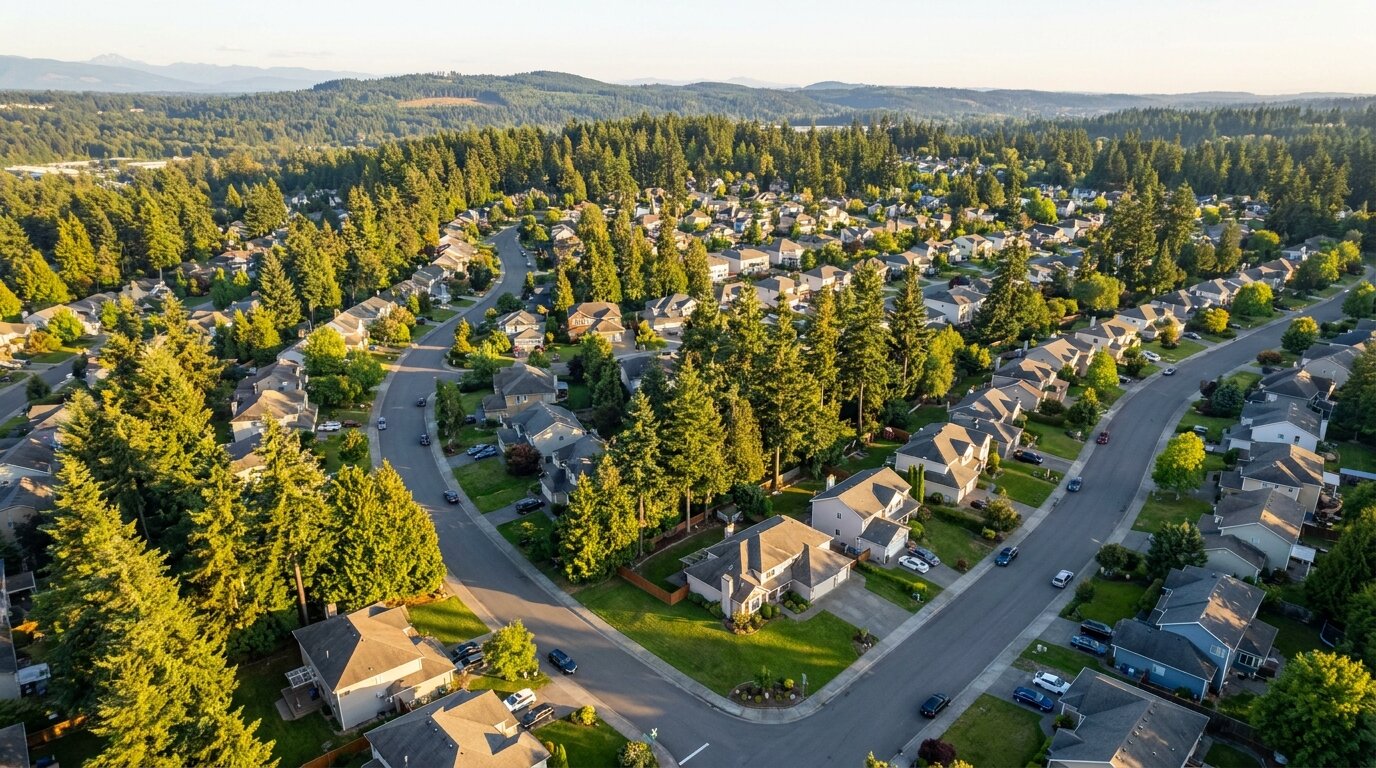
The King County median is pushing $860,000. But buyers with $450K to $700K aren’t out of the game — they’re just buying a different game. Here’s the city-by-city breakdown.
Why This Guide Exists
When I sit down with a first-time buyer, one of the first things they ask me is: “What can I actually get for my money in King County?” It’s the right question, and it deserves a real answer — not a vague “it depends.”
So here it is. This guide breaks down what buyers are realistically getting at four price points — $450K, $550K, $650K, and $700K — across the South and East King County cities where I work. I price homes in these markets every single day as a BPO field agent. I know what these dollars buy in Auburn, Kent, Federal Way, and Renton because I walk through these homes constantly.
The King County overall median is around $859,000 as of spring 2026. If your budget sits between $450K and $700K, you’re below that line — which means you’re working in South King County’s market, not the Eastside’s. That’s not a consolation prize. South King County has serious value, real neighborhoods, and in some price bands, genuine competition. Let me show you what I mean.
The Monthly Payment Reality First
Before we talk about what you get, let’s talk about what you’re paying each month. As of mid-June 2026, the 30-year fixed rate in Washington sits around 6.65%. With 10% down:
Monthly Payment Estimates at 6.65% (10% Down)
$450K purchase — ~$405K loan — roughly $2,610/month P&I
$550K purchase — ~$495K loan — roughly $3,190/month P&I
$650K purchase — ~$585K loan — roughly $3,769/month P&I
$700K purchase — ~$630K loan — roughly $4,060/month P&I
Add property taxes (roughly 0.9–1.1% annually in South KC cities), homeowner’s insurance (~$150–$200/month), and any HOA dues, and your true monthly cost is $300–$600 higher than those P&I numbers. I say this not to discourage you, but because buyers who know the full number make better decisions. If you want a deeper breakdown of total cost, the Total Cost of Homeownership in King County 2026 post does that math city by city.
$450K: Condos, Older Townhomes, and Entry-Level Single-Family
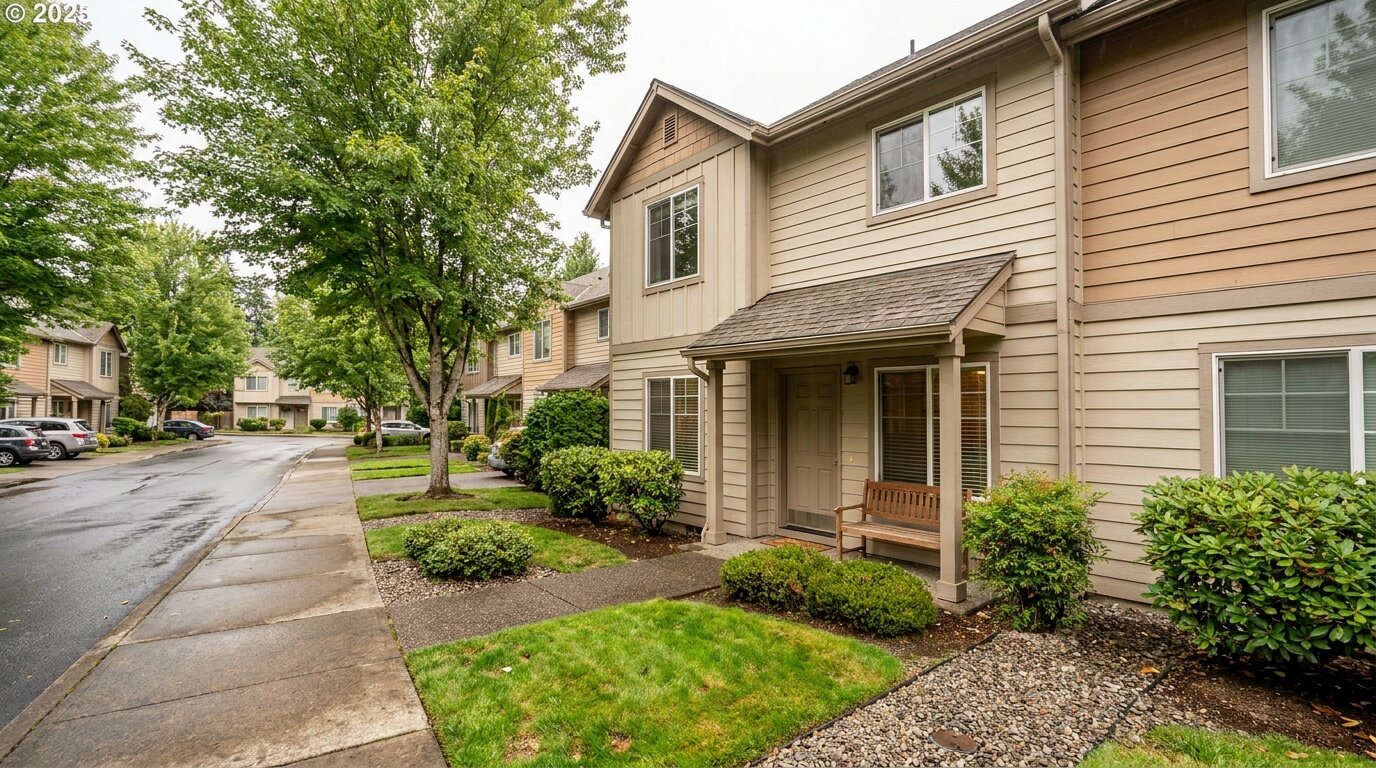
At $450K, condos and townhomes like this are your primary options in South King County — real ownership, real equity.
At $450K, you are not buying a single-family home in most of King County. You are buying into the condo and townhome market, or an older home that needs work. That’s honest, and it’s worth saying plainly.
Auburn and Federal Way Condos
This is the clearest entry point at this price. You can find 2-bedroom condos in the 900–1,100 square foot range in Auburn’s downtown corridor and Federal Way’s Twin Lakes and Steel Lake areas. These are typically 1990s–2000s construction, well-maintained, and in walkable locations. Federal Way’s coming light rail extension has kept demand steady here.
Kent Condos and Entry Townhomes
Downtown Kent has a handful of newer-ish condo buildings and townhome developments where you can get into 2-bedroom units around this price. Proximity to Kent Station (Sounder commuter rail) makes these appealing even at small square footage.
Older Single-Family in Auburn’s Core
Occasionally — especially if you’re patient and flexible — you can find a 3-bedroom, 1.5-bath from the 1960s or 70s in Auburn’s central neighborhoods. These homes need updating. They’re not turnkey. But they’re on real lots, and they’re fee-simple ownership with no HOA.
The so-what for buyers at this tier: this price point gets you into ownership and starts building equity. It is not a forever home for most families. But it is a real foothold, and in South King County, that foothold has appreciated over 5–7 year holds. If down payment is the obstacle, look at King County’s Down Payment Assistance programs — KCHA’s deferred loan and WSHFC’s Home Advantage can both help at this price tier.
$550K: Single-Family Becomes Possible
At $550K, the picture changes. This is where single-family homes start to appear in South King County — modestly, but genuinely.
Auburn
The $500K–$580K range is where Auburn’s townhome and entry single-family inventory overlaps. You can find 3-bedroom townhomes in Lakeland Hills with attached garages, HOA-managed exteriors, and good schools. Older single-family homes in West Auburn and parts of Auburn north that are move-in ready with cosmetic updates also show up here.
Federal Way
The $520K–$570K range opens up more of Federal Way’s residential neighborhoods — Twin Lakes, West Campus, and the areas closer to the Sound. You’re looking at 3-bedroom, 1-bath or 2-bath homes from the 1970s–1990s, on lots of 6,000–8,000 square feet. These aren’t large homes but they’re real houses.
Kent
Kent’s median sits around $635,000 right now, so $550K puts you below median. That doesn’t mean nothing is available — it means you’re competing for homes that need some work, or townhomes in East Hill where new construction density has been concentrated.
At $550K, you’re getting real space and real land in South King County. The financing math still works for households earning $130K–$150K+ (assuming roughly 40% DTI with standard conventional financing). If you’re using an FHA loan, the lower down payment option changes your cash requirement — FHA vs. Conventional for King County buyers has the full comparison.
$650K: The Sweet Spot for South King County
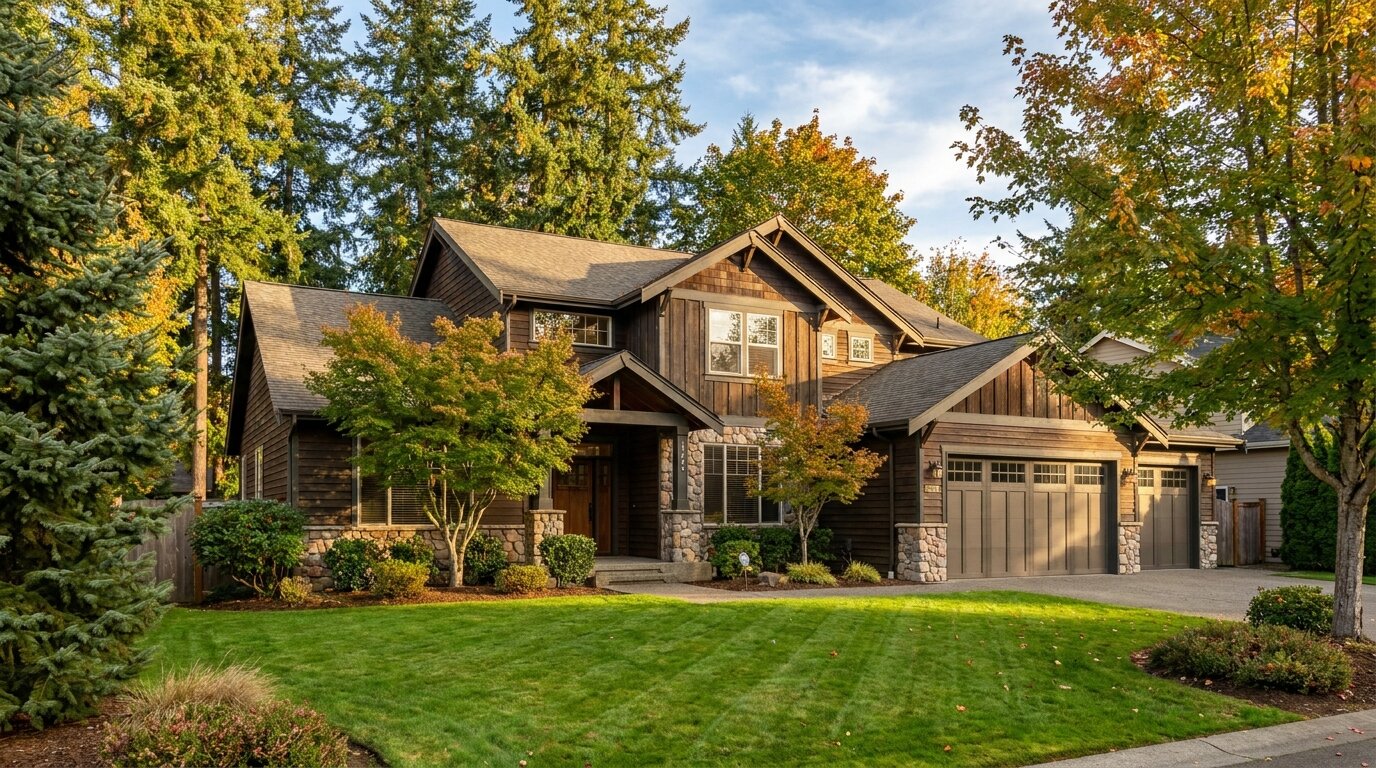
At $650K, South King County delivers 3-bedroom homes with yards and garages — the kind buyers stay in for a decade.
If I had to pick one price band where South King County buyers are getting the most for their money right now, it’s $625K–$675K. Here’s why.
Renton
Renton’s median runs around $650K. At this price, you’re in real competition for solid 3-bedroom, 2-bath homes in neighborhoods like Benson Hill, Talbot Hill, and parts of the Highlands. These are homes with garages, yards, and good bones. They’re not McMansions. They’re the kind of house where families put down roots for 10–15 years.
Kent East Hill
East Hill is Kent’s most family-oriented neighborhood, with newer construction and strong schools. At $650K you’re getting into 3-bedroom homes with 2-car garages, square footage in the 1,600–2,000 range, and HOA neighborhoods that maintain common areas well.
Auburn Lakeland Hills
Lakeland Hills continues to be one of the best pure-value plays in South KC. You can find 3–4 bedroom single-family homes in the $620K–$670K range on decent lots. The community is well-established and has held value through market cycles.
At $650K, you’re buying a home a family can actually live in for years without outgrowing. The rate environment means your monthly cost is real, but the asset you’re getting in exchange is also real. Homes in this range in South King County have shown 5-year appreciation patterns that make early ownership genuinely wealth-building.
$700K: Where the Options Widen
At $700K, you’re near or slightly above the median in most South King County cities, which means you have more choices, more leverage in negotiation, and access to some locations that were out of reach below.
Renton — Kennydale and Highlands
$700K in Renton opens up Kennydale and some pockets of the Highlands where the homes are larger, the lots more established, and the commute to both Seattle and Bellevue is genuinely good. 4-bedroom homes with finished basements become available here.
Kent and Covington Border Areas
Where Kent’s East Hill bleeds into unincorporated Covington, you’ll find homes in the $680K–$730K range that offer more space per dollar than anything inside the Seattle city limits at double the price. Lots of 10,000+ square feet, 4-bedroom layouts, and 2-car garages are realistic here.
Maple Valley
Maple Valley has been growing as buyers who need more space head south. At $700K you can find newer construction — some from the last 10 years — with modern kitchens, open floor plans, and trail access to the Maple Valley Trail system.
$700K in South King County buys a legitimately good house. It also buys a payment that requires solid household income — roughly $160K–$175K+ at current rates, depending on your other debt and down payment. If that math is tight right now, it’s worth looking at what rate buydowns can do — at this purchase price, a seller-funded 2-1 buydown can make a real difference in year-one payments.
What This Looks Like in King County Right Now
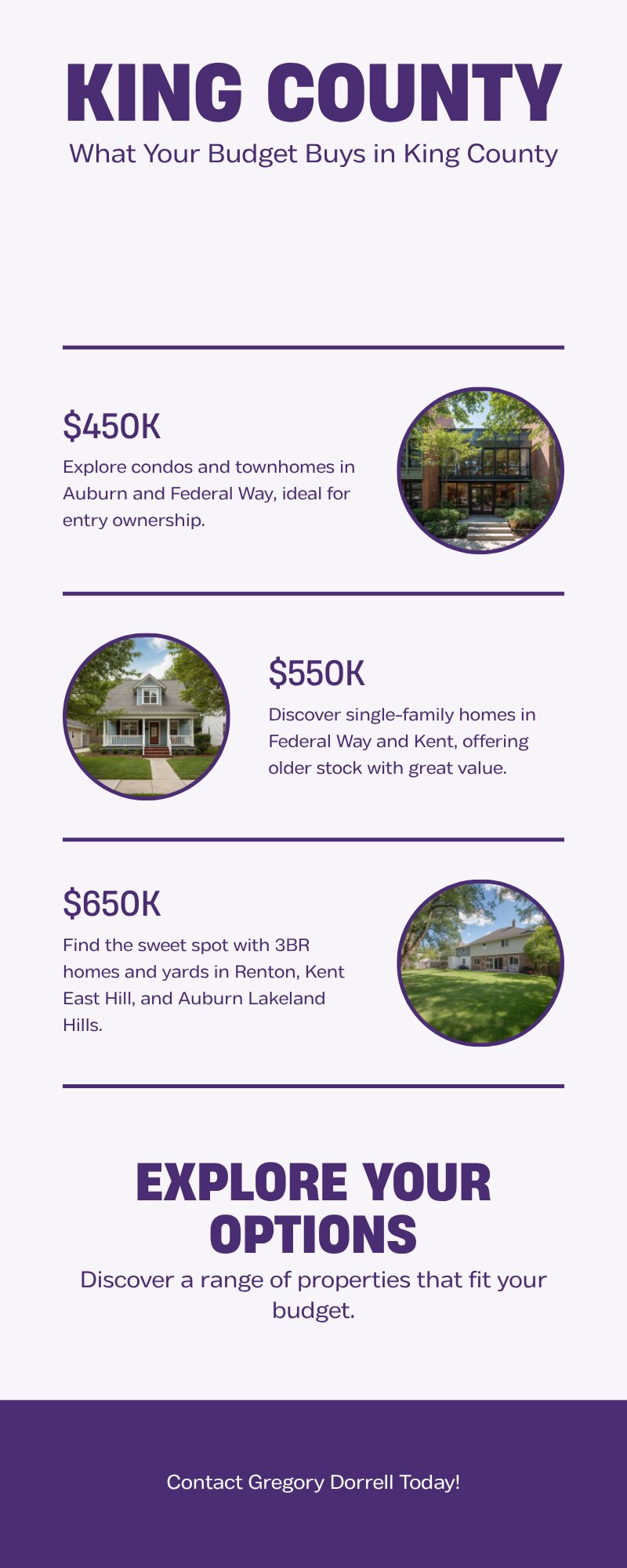
King County affordability by price tier — what each budget buys in South King County in 2026.
A few things to keep in mind as you use this guide.
Inventory across King County is up roughly 30% from a year ago. That matters. Buyers below $500K are still competing in a tight pool for limited condo and entry single-family inventory. Buyers in the $600K–$750K range have more breathing room. Days on market in South King County at this level have extended compared to 2024 — you often have time to think, inspect, and negotiate.
The pricing I’ve described reflects medians and typical ranges. Individual homes vary widely. A 1985 split-level in Federal Way at $520K might need $60K in deferred maintenance. A 2019 townhome in Auburn at $545K might be genuinely turnkey. My BPO work gives me a fast read on which is which — and that’s exactly the kind of analysis I bring to every buyer I work with.
Frequently Asked Questions
Can I buy a single-family home in King County for under $500K?
It’s possible, but uncommon. At $500K, you’re primarily in the condo and townhome market in South King County. Occasionally a distressed or estate-sale single-family home surfaces at this price, but expect deferred maintenance. Budget for updates if you’re pursuing this price point.
Which South King County city gives the most for $600K?
Right now, Auburn and Federal Way offer the most square footage and lot size for $600K. Kent is close but slightly pricier per square foot. Renton offers strong value at $600K but typically in smaller homes or older stock compared to Auburn.
How much income do I need to buy at $650K in King County?
With 10% down and a rate around 6.65%, your principal and interest is roughly $3,769/month. Add taxes, insurance, and HOA if applicable, and true housing cost approaches $4,300–$4,500/month. Most lenders want housing expense at or below 36–43% of gross monthly income, which puts the qualifying range around $125K–$150K household income.
Are these prices likely to rise or fall in the second half of 2026?
Inventory is up 30% countywide, which has softened prices at the top of the market. South King County’s sub-$700K segment has stayed relatively steady because demand from first-time buyers remains real. A meaningful rate drop could create a surge in buyer demand and push prices up. Waiting on that rate drop is a gamble — the data on buy-now vs. wait shows the math usually favors buying sooner.
What down payment do I need at these price points?
Conventional loans require 3–20% down. At $550K with 5% down, you’re bringing $27,500 plus closing costs. FHA requires 3.5% down but has loan limits to watch in King County. Down payment assistance programs from KCHA and WSHFC can help close the gap at the $450K–$600K range — see the full DPA guide.
Your guide to life outside Seattle.
253-350-0045 ·
greg@livingoutsideseattle.com ·
www.livingoutsideseattle.com
Questions to Ask a Real Estate Agent Before Listing
Most sellers interview only one agent. Here’s why that’s a mistake — and exactly what to ask when you do sit down with one.
Choosing a listing agent is one of the most financially significant decisions you’ll make in this process. The difference between an agent who prices your home correctly on day one and one who guesses — or worse, tells you what you want to hear — can easily be $20,000 to $50,000 in South King County’s current market. Sometimes more.
Most sellers pick whoever they already know, or whoever calls first. I get it. But you are about to hand someone the keys to your largest asset. Spending 90 minutes interviewing two or three agents before you sign anything is one of the highest-return things you can do.
Here are the questions that actually matter — and what a strong answer looks like versus a weak one.
Start With Pricing — It’s the Most Important Conversation You’ll Have
The single question that separates good listing agents from the rest is this: “Walk me through how you determined that list price.”
A strong agent should be able to show you exactly which comparable sales they used, why they chose those comps over others, and how they adjusted for differences in lot size, condition, and location. They should be able to tell you what the market is doing right now — not three months ago — in your specific neighborhood.
A weak answer sounds like: “Homes like yours are going for around X.” No specifics. No adjustment explanation. Just a number that landed on the page somehow.
The number itself matters less than the reasoning behind it. I’ve watched sellers get pulled in by agents who pitched an inflated price to win the listing — only to sit on the market for 60 days and end up taking less than they would have gotten with an honest price from the start. In King County, a home that goes stale gets stigmatized. Buyers start wondering what’s wrong with it. The longer it sits, the more negotiating power shifts away from you.
Ask About Their Track Record in Your Market
General experience is fine. Local experience is what moves the needle.
Ask: “How many homes have you listed in my city or price range in the past 12 months?”
Then ask: “What was your average sale-to-list price ratio on those listings?”
In King County, the overall 2026 average is hovering around 101.6% — meaning well-priced homes are still selling slightly above asking. If an agent’s numbers are consistently below 98%, that tells you something. It could mean they’re pricing too high and accepting lower offers to close. It could mean their marketing isn’t generating enough competition. Either way, it’s worth asking why.
Also ask: “What was your average days on market for listings in the past year?” County-wide, homes are sitting about 12 days on average right now. An agent consistently hitting 30+ days on market in a 12-day market has some explaining to do.
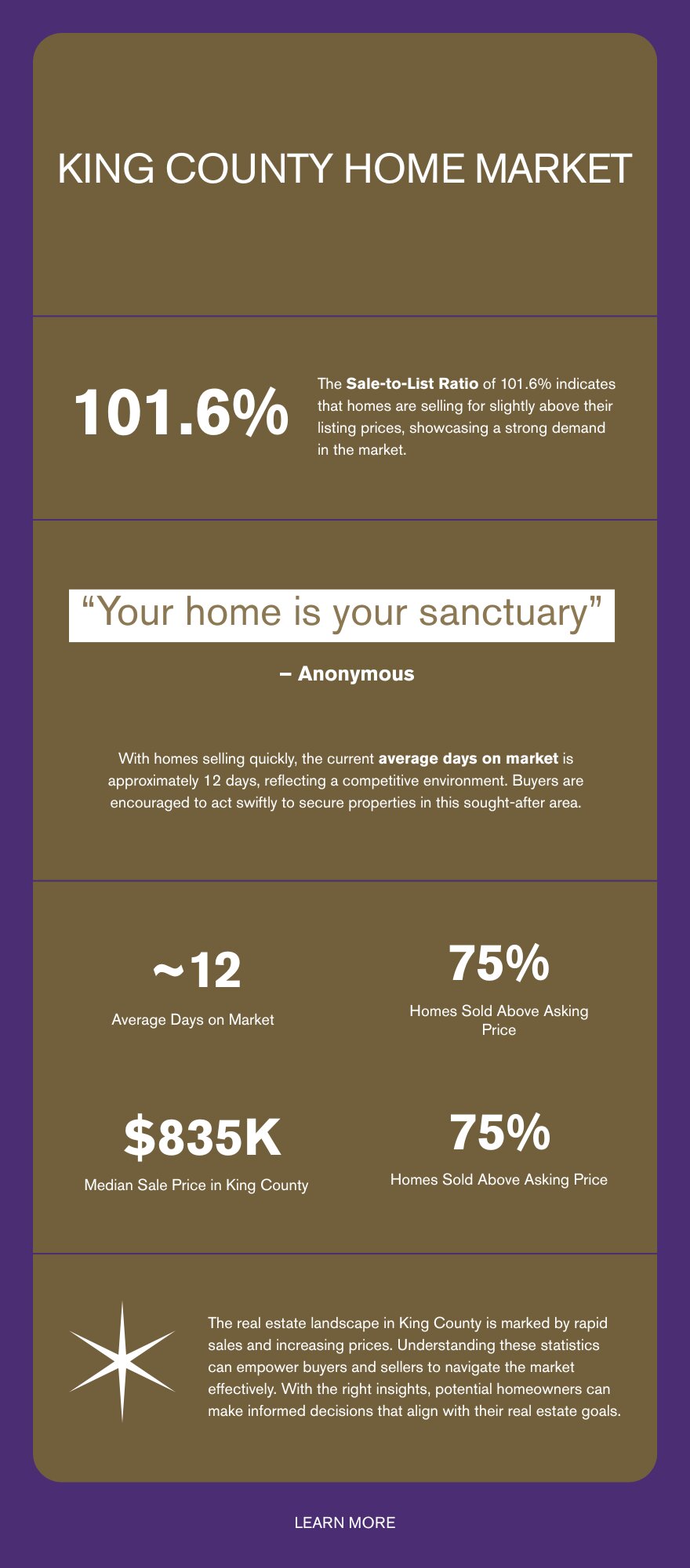
King County’s 2026 market rewards well-priced homes. A listing agent who knows these numbers — and can explain what drives them — is the one worth hiring.
Understand What the Marketing Plan Actually Covers
Ask: “What is your specific marketing plan for my home?”
This is where you’ll hear a wide range of answers. Some agents will say “we list on the MLS and put up a sign.” That’s not a marketing plan — that’s a minimum requirement.
In Washington State, NWMLS rules mean there’s no “coming soon” period — once your home goes live, it goes fully live. That makes your launch day the single most important day of your listing. An agent without a strong pre-launch preparation strategy is leaving money on the ground.
What a Strong 2026 Marketing Plan Includes
Professional photography (not the agent’s phone), a virtual tour or 3D walkthrough, targeted social media promotion, email outreach to buyer agents in your area, and a strategy for the open house weekend. Ask specifically about each of these. Ask who takes the photos. Ask whether they include a professional stager consultation.
If the plan is vague, the execution will be too.
Ask How They Handle Offers and Lowballs
Ask: “How do you manage the offer process, and how do you respond to low offers?”
You want an agent who can hold the line. Not every low offer deserves a counter — sometimes the right move is to decline and wait. But you need an agent who can read the situation and advise you on strategy, not just pass paper between the buyer’s agent and you.
Also ask: “Will you be personally handling my listing, or will it be someone on your team?”
Some high-volume agents hand listings off to junior assistants after the initial meeting. You’re not hiring the team — you’re hiring the person in front of you. Clarify who answers your calls, who shows up to negotiations, and who fields feedback from showing agents.
Ask the Uncomfortable Questions Up Front
Ask: “What’s your commission structure, and what does it cover?”
Since the NAR settlement changes took effect, the buyer’s agent compensation conversation is more upfront than it used to be. You should understand exactly what you’ll pay, what you may be asked to offer toward a buyer’s agent, and whether there are any marketing costs billed separately. Get this in writing before you sign.
Also ask: “What’s your cancellation policy if I’m not happy?”
An agent who is confident in their work will offer a reasonable cancellation clause. An agent who resists this question is telling you something important about how they handle accountability.
The Local Angle: What This Looks Like in South and East King County
Every submarket in King County has different dynamics right now. Renton, Kent, Auburn, and Covington are all behaving differently from each other — and very differently from the Eastside cities like Issaquah and Sammamish.
An agent with genuine local knowledge should be able to tell you: What’s happening with inventory in your specific city right now? Are buyer agents bringing pre-approved clients, or are showings stalling at the financing stage? Is your neighborhood drawing buyers from Seattle, from the Eastside, or primarily from within South King County?
If the agent you’re interviewing is giving you county-wide generalities when you ask about your block — that’s a signal. The agents who consistently outperform in this market know the sub-markets. They know which streets have the highest sale-to-list ratios and why.
Ask: “What’s happening with listings in my neighborhood right now — not countywide, but specifically here?”
A good agent should have an answer that surprises you with its specificity. A general answer tells you how deeply they actually know the market they’re claiming to know.
Every South King County submarket — Renton, Kent, Auburn, Covington — behaves differently. Your listing agent should know your neighborhood, not just the county.
The One Question Most Sellers Forget to Ask
Ask: “What makes your pricing different from what I’d get from another agent?”
This is where you’ll hear a range of vague claims. But it’s also where an agent who does things differently will tell you what that difference actually is.
The standard listing agent approach is a comparative market analysis (CMA) — pulling recent sales, making some adjustments, and landing on a number. That’s the baseline. A CMA is useful. But it’s a snapshot, and it’s only as good as the agent’s judgment about which comps to use. If you want to understand how to read one yourself, this breakdown of how to read a CMA as a King County seller is a good place to start.
What to Do With the Answers
Don’t go into these interviews hoping to like everyone equally. You want contrast. Talk to at least two agents — ideally three. The conversations that feel different from each other are the ones that teach you the most about what you’re actually comparing.
Take notes during each meeting. Pay attention to who asks questions about your situation before launching into their pitch. The agent who listens for the first 15 minutes and then tailors their approach to what you told them is showing you how they’ll handle your listing. The agent who delivers a canned presentation and pivots to commission before you’ve finished your coffee is showing you that too.
Before you list, it’s also worth understanding what goes into pricing your home correctly from day one — that post walks through the data side of what a strong listing agent should be doing. And if you want to get the home itself ready before those conversations even happen, this prep guide for King County sellers covers exactly what moves the needle.
FAQ: Questions to Ask Before You List
How many agents should I interview before listing my home?
Interview at least two — three is better. Most sellers talk to only one, which means they have no basis for comparison. A second or third conversation almost always surfaces something the first one didn’t.
What’s the biggest red flag when interviewing a listing agent?
An agent who quotes you the highest price without being able to explain the specific comps they used is the classic “buying the listing” move. They pitch a number you want to hear, you sign, and then three months later they’re asking you to drop the price. Ask for the CMA in writing before you decide.
Should I ask about commission upfront?
Yes — directly and early. Since the NAR commission changes, the conversation about how buyer’s agent compensation works has shifted. You want to know your total cost, what you might be asked to offer toward the buyer’s side, and what exactly is included in what you’re paying.
What if an agent won’t give me a cancellation clause?
Walk away. Any agent who is confident in their performance should be willing to let you cancel if they’re not delivering. Resistance to this question is resistance to accountability.
How do I know if an agent really knows my neighborhood?
Ask them to tell you what’s happening specifically in your neighborhood — not the county, not the city, your neighborhood. If they can tell you the most recent comparable sale, what it sold for relative to asking, and what drove that result — they know your market. If they answer with generalities, they don’t.
What does a BPO mean for sellers, and why does it matter?
A Broker Price Opinion is the pricing methodology that banks and lenders use to assess property values — more rigorous than a standard CMA. An agent who works as an active BPO field agent does this analysis daily, not just when a new client calls. For sellers, that means a list price grounded in real, current market data rather than a best-guess estimate.
Your guide to life outside Seattle.
253-350-0045 ·
greg@livingoutsideseattle.com ·
www.livingoutsideseattle.com
Living in Fairwood, Renton WA | 2026 Neighborhood Guide
Fairwood is one of the few genuinely planned communities in south King County. It was developed primarily in the 1970s and 1980s with curving streets, consistent landscaping standards, and a golf course at its center. The vibe is Quiet Cul-de-Sac Community — orderly, green, and family-oriented. In 2026, Fairwood delivers classic suburban living at a price point well below comparable communities like Sammamish or Covington.
What Is It Actually Like to Live in Fairwood in 2026?
Fairwood is quiet and consistent. The curving streets reduce through-traffic. The mature tree canopy planted in the 1970s has fully filled in, giving the neighborhood a lush green quality even in winter. On weekday mornings the streets empty quickly after the school rush. The community has a strong HOA presence that keeps the common areas maintained and the entry features clean.
Weekends in Fairwood often revolve around home, yard, and family. The golf course creates a semi-open-space buffer through the middle of the neighborhood that makes it feel airier than communities with comparable density. Many residents walk the course perimeter trails or head to Soos Creek Trail for longer outings. There’s a small commercial area on Petrovitsky with restaurants and services that covers most casual weekend needs.
Fairwood draws classic suburban buyers: dual-income families with school-age children, move-up buyers from Kent or Renton’s more affordable areas, and some retirees who want HOA-managed common spaces without the maintenance burden. It’s a neighborhood that consistently attracts people who know exactly what they want.

Homes in Fairwood: What the Data Shows
Fairwood homes were built primarily from the mid-1970s through the late 1980s, with some infill from the 1990s. Square footage typically runs 1,500 to 2,800 sq ft on lots ranging from 7,000 to 12,000 sq ft. The predominant style is Pacific Northwest Traditional — two-story designs with attached garages, brick or wood accent exteriors, and mature foundation plantings. The consistency of the community’s design era means you’ll rarely see jarring architectural contrasts between homes on the same street. Many homes have been updated with modern kitchens, new flooring, and refreshed bathrooms — but original-condition homes still appear and offer room to build equity.
| Market Pulse | Fairwood / 98058 | King County |
|---|---|---|
| Median Sales Price (May 2026) | ~$640,000 | ~$859,000 |
| Median Days on Market | ~25 days | ~28 days |
| Active Listings Change (vs. Jan 2026) | +28% | +30% |
Figures are approximate based on zip code 98058 activity. Verify current data at NWMLS.com.
Schools Serving Fairwood
Most of Fairwood falls within Kent School District. The primary pipeline is Fairwood Elementary, Northwood Middle School, and Lindbergh High School. Fairwood Elementary is a well-established neighborhood school with a long track record of strong parent participation. Northwood Middle offers solid STEM and arts pathways. Lindbergh High School is known for a competitive athletics program and strong dual-enrollment options through local colleges.
The school community in Fairwood is one of the reasons families keep choosing this neighborhood. The consistent HOA maintenance of the neighborhood’s appearance reinforces the community investment that flows through to school participation as well. That said, boundaries can shift — always verify your specific address directly with Kent School District before writing an offer.
Lindbergh High School serves a large geographic area that includes Fairwood, Soos Creek, and parts of southeast Renton. For families coming from other parts of King County, the school’s dual-enrollment options and athletics program are frequently cited as deciding factors in choosing Fairwood over comparable communities.
Getting to Work from Fairwood
SE Petrovitsky Road connects Fairwood west to SR-515, which branches north to I-405 and south to Kent and SR-167. From most of Fairwood, the Petrovitsky/515 intersection is about five minutes. Bellevue is 20 to 30 minutes north. Kent is 10 to 15 minutes south.
| Destination | Distance | 2026 Peak AM Drive | Transit Option |
|---|---|---|---|
| Downtown Seattle | 19 miles | 38 to 60 min | SR-515 N to I-405 N to I-5 N |
| Amazon (Bellevue) | 15 miles | 22 to 40 min | SR-515 N to I-405 N |
| Microsoft (Redmond) | 24 miles | 38 to 58 min | I-405 N / Drive |
| SeaTac Airport | 13 miles | 18 to 30 min | SR-515 N to SR-167 S |
What I See as a Valuation Expert in Fairwood
Fairwood has an active HOA — actually multiple sub-associations within the larger community. Fees vary by sub-association but generally run $50 to $100 per month. Most goes toward maintaining common areas, entry monuments, and the community’s landscaping consistency. In Fairwood, verifying the HOA fee and reserve fund status always matters for valuation. Well-funded HOAs protect property values by preventing the visual degradation that happens in communities with deferred maintenance. Fairwood’s HOA is generally well-managed and that shows in the neighborhood’s consistent appearance.
Golf course adjacency matters here. Homes that back to the golf course or have views of the open fairway consistently appraise above comparable interior-lot homes. That premium runs $30,000 to $60,000 depending on the specific lot position and how much of the fairway is visible. The fairway-backing lots are the first to sell and the last to reduce price.
Long term, Fairwood is a stable, defensive hold. The HOA structure keeps community quality consistent even as individual homeowners turn over. The golf course open space is a permanent amenity that can’t be developed away. For buyers who want a 10-year hold with low management complexity, Fairwood delivers that reliably.
Frequently Asked Questions About Fairwood, Renton WA
Is Fairwood a good place to live?
Yes, especially if you want a classic planned community with HOA-maintained common areas, golf course open space, and consistent neighborhood quality. The trade-off is that HOA fees add $50 to $100 per month to housing costs, and commutes to Seattle are longer than from north Renton. For the right buyer, those trade-offs are well worth it.
What are homes like in Fairwood?
Primarily 1970s to 1980s Pacific Northwest Traditional construction — two-story homes on lots of 7,000 to 12,000 sq ft. Square footage runs 1,500 to 2,800 sq ft. Many have been updated. The community’s consistent design era means neighborhood curb appeal stays cohesive. Golf course-adjacent lots command a $30,000 to $60,000 premium.
What schools serve Fairwood?
Most of Fairwood is in Kent School District with a pipeline of Fairwood Elementary, Northwood Middle School, and Lindbergh High School. Always verify your specific address with Kent School District before writing an offer, as boundaries can vary.
How far is Fairwood from Seattle?
About 19 miles, with a peak AM drive of 38 to 60 minutes via SR-515 N to I-405 N to I-5 N. For Bellevue, the drive is 22 to 40 minutes — more manageable for Eastside commuters.
Explore Fairwood Yourself
Drive the main loop through Fairwood on a weekend morning. The curving streets, mature trees, and well-maintained homes tell the story quickly. Then find one of the trail access points near the golf course perimeter. You’ll see exactly what the community is about.
View Fairwood on Google Maps →
Your guide to life outside Seattle.
253-350-0045 ·
greg@livingoutsideseattle.com ·
www.livingoutsideseattle.com
Property Tax Rates in King County Cities 2026
Buyers ask me all the time: “What are the property taxes going to be on this house?” It’s a fair question, and the answer matters more than most people realize when they’re focused on the purchase price and interest rate. On a $700,000 home, the difference between buying in Auburn and buying in Issaquah works out to roughly $2,500 a year — or about $210 a month that never shows up in a mortgage quote.
This post lays out the 2026 effective property tax rates for the eight cities I work in most across South and East King County. I also cover how the calculation works, why rates differ between cities just a few miles apart, and what this means if you’re running affordability math as a buyer or net-proceeds math as a seller.
Why King County Has No Single Tax Rate
A lot of buyers ask: “What’s the property tax rate in King County?” There isn’t one. Your bill is the sum of every taxing district whose boundary includes your property. That stack typically includes:
The Typical Levy Stack
Washington State levy — applies uniformly statewide
King County general levy — county services and administration
King County library district — public library system
City levy — varies by incorporated city; absent in unincorporated areas like Covington
School district levy — the single biggest variable between nearby cities
Fire district levy — local fire and rescue services
Emergency Medical Services (EMS) levy
Any voter-approved bond measures — school construction, parks, etc.
Two homes a mile apart — one in the Issaquah School District, one in the Kent School District — can carry meaningfully different tax bills even if their market values are identical. School district boundaries are the biggest driver of rate variation across South and East King County.
The 2026 total property tax collection in King County came in at $8.4 billion, up 10% from 2025’s $7.7 billion. That increase flows from rising assessed values, not any single rate change. But the effect on individual monthly payments is real.
2026 Property Tax Rates by City
These are median effective rates — actual tax bills divided by assessed market values — based on King County parcel data. Rates vary by ZIP code within each city, primarily because of school district boundaries. (Source: Ownwell, April 2026.)
2026 effective property tax rates for eight cities in South and East King County. Auburn carries the highest rate; Issaquah and Sammamish sit well below the county median of 0.99%. Source: Ownwell, April 2026.
| City | Effective Rate | Median Home Value | Median Annual Bill |
|---|---|---|---|
| Auburn | 1.19% | $566,000 | $6,477 |
| Maple Valley | 1.11% | $722,000 | $7,963 |
| Renton | 1.03% | $688,000 | $7,145 |
| Covington | 1.03% | $574,000 | $5,862 |
| Kent | 1.01% | $587,000 | $5,919 |
| Federal Way | 1.00% | $542,000 | $5,412 |
| Sammamish | 0.89% | $1,384,000 | $12,054 |
| Issaquah | 0.83% | $1,031,000 | $9,132 |
| King County Avg | 0.99% | $774,000 | $7,644 |
How to Calculate Your King County Tax Bill
King County uses this formula:
(Assessed Value ÷ 1,000) × Levy Rate = Annual Tax Bill
For a home assessed at $650,000 in Renton with a levy rate of approximately $10.30 per $1,000:
$650,000 ÷ 1,000 = $650
$650 × $10.30 = $6,695 per year (~$558/month in escrow)
A few important things to understand about that assessed value:
King County Reassesses Every Year
Washington has no equivalent to California’s Proposition 13. Your assessed value is adjusted annually based on market conditions. If home prices in your neighborhood rose 8% last year, your assessment likely reflects that — and your bill goes up accordingly.
Your 2026 bill is calculated from the value as of January 1, 2025. So the assessment lags the market by about a year — but it catches up.
Buying at a Higher Price Does Not Reset Your Taxes
The assessor determines value independently of your sale price. A sale at market value is data they will consider in future assessments — but it doesn’t trigger an immediate reset the way it does in some other states. So if you buy a house below assessed value, your taxes don’t automatically drop either.
For the most accurate number on any specific parcel, use the King County eReal Property lookup at blue.kingcounty.com. Search by address to see the current assessed value and the levy rate stack broken down by district. It takes about 90 seconds and gives you a far more accurate number than any city average.
Why Issaquah and Sammamish Rates Are Lower
Issaquah (0.83%) and Sammamish (0.89%) sit well below the county average — yet their median tax bills are higher in dollar terms because home values there are much larger. Lower rates in these cities generally reflect two things.
First, fewer overlapping special districts. Some areas carry smaller bond debt loads than South King County cities, which compresses the total levy stack. Second — and this is the counterintuitive part — when the total assessed value base in a school district rises, the rate needed to raise the same budget dollar amount actually falls. High home values spread the levy cost across more dollars, pushing the percentage rate down.
City-by-City: What Buyers and Sellers Should Know

Understanding your property tax rate before you make an offer helps buyers budget accurately and keeps sellers from being surprised at closing.
Auburn (1.19%)
Auburn carries the highest effective rate among the cities we track, with a $6,477 median annual bill on a $566,000 home. Rates vary by ZIP — the 98001 and 98002 ZIP codes trend higher than 98092. Buyers should ask their lender to calculate PITI based on the specific parcel, not a city average.
Maple Valley (1.11%)
Maple Valley’s rate and its growing median home value combine to produce one of the larger median bills in South King County at $7,963 per year. School construction bonds have contributed to the rate here. Strong schools drive demand for the area, and those same schools come with levy costs built into the rate.
Renton (1.03%)
Renton’s 1.03% rate on a $688,000 median home produces a $7,145 median annual bill. Rates vary within Renton by school district boundary — homes in the Issaquah School District portion of eastern Renton trend lower than those in the Renton School District. This surprises a lot of buyers who assume all of “Renton” carries one rate.
Covington (1.03%)
Covington shares Renton’s effective rate but with a lower median home value ($574,000), producing a $5,862 median bill. Covington is unincorporated King County, which means no separate city levy — one reason the total rate stays competitive. For buyers priced out of Maple Valley, Covington often offers similar inventory at lower total monthly carrying costs.
Kent (1.01%)
Kent sits nearly at the county average. The $5,919 median annual bill on a $587,000 home is one of the more affordable in this group in absolute dollar terms. Kent has one of the widest ranges of home types in South King County — condos to large single-family homes — so the actual bill on any specific purchase will vary considerably from the median.
Federal Way (1.00%)
Federal Way sits right at the county median rate and has the lowest median home value on this list at $542,000, producing a $5,412 median annual bill. For first-time buyers working with a tighter budget, Federal Way offers the lowest combined price-and-tax entry point among these eight cities.
Sammamish (0.89%)
Lower rate, but higher everything else. The $1,384,000 median home value produces a $12,054 median annual bill — over $1,000 a month in tax escrow — despite the below-average rate. Sammamish draws buyers who prioritize the Issaquah or Lake Washington school districts, newer construction, and lower density. That demand drives values, which keeps the rate lower but doesn’t lower the bill.
Issaquah (0.83%)
The lowest rate on this list. Issaquah’s 0.83% on a $1,031,000 median home means a $9,132 median annual bill. Part of the reason rates are lower is that the area’s high assessed value base spreads the levy burden across more dollars. School district quality drives demand, and demand drives values — which, counterintuitively, keeps the rate lower than South King County cities.
Important Property Tax Dates in King County
| Date | What Happens |
|---|---|
| January 1 | Assessment date — value is frozen for the year’s calculation |
| February 10 | Tax bills mailed |
| April 30 | First half payment due |
| July 1 | Appeal deadline — do not miss this |
| October 31 | Second half payment due |
The appeal window matters. If you receive your assessment notice and believe the value is too high — based on comparable sales or property condition — you have until July 1 to file with the King County Board of Equalization. Once that deadline passes, your ability to contest that year’s bill is gone.
Exemptions That Can Lower Your Bill
Washington offers several exemption programs worth knowing about, especially if you’re buying for a family member or planning long-term.
Senior/Disabled Exemption. Homeowners 61 or older — or permanently disabled — with household income under the program threshold may qualify for a significant reduction in assessed value and a freeze on future increases. This is one of the most valuable programs in the state and often goes unclaimed by people who don’t know it exists.
Veteran Exemption. Qualifying veterans with a service-connected disability may be eligible for a partial property tax reduction.
All exemptions require the home to be your primary residence. Investment properties and second homes do not qualify. To apply or check eligibility, contact the King County Assessor’s office at assessor.info@kingcounty.gov or (206) 296-7300.
What This Means for Your Buy or Sell Decision
For buyers: Your lender uses your total PITI payment — principal, interest, taxes, and insurance — to calculate affordability. Property taxes are a real monthly cost, not a closing-day item. On a $700,000 home, the difference between a 0.83% rate (Issaquah, ~$484/month) and a 1.19% rate (Auburn, ~$694/month) is $210 per month. Over a 30-year loan, that’s $75,600 in additional tax payments — more than most buyers realize when they’re focused on the interest rate.
For sellers: When a buyer’s lender calculates their debt-to-income ratio, property taxes push more buyers out of qualifying range at the higher end of pricing. In cities with higher effective rates, price sensitivity tends to be greater. Knowing your city’s rate — and being able to show the buyer the actual parcel-level calculation — is a transparency move that builds trust during negotiations.
For a broader look at all the costs of owning a home in King County, this post on total cost of homeownership in King County walks through the full monthly cost picture beyond just taxes. And if you’re a seller thinking about your net proceeds, Washington’s capital gains rules are the other tax conversation worth having before you list.
Run Your Own Numbers in 90 Seconds
To get the exact levy rate for any property you’re considering:
- Go to blue.kingcounty.com/Assessor/eRealProperty
- Search by address
- Find the “Current Year Tax” section — it shows the assessed value and the levy rate stack broken down by district
- Divide the tax bill by the assessed value to get the effective rate
This is the most accurate number you’ll find. I walk buyers and sellers through this lookup regularly — it often changes how they think about two comparable homes in different parts of the county. For where home values are heading in 2026 — which directly affects future assessed values and bills — here’s the King County housing market forecast.
Frequently Asked Questions
What is the property tax rate in King County in 2026?
The countywide median effective rate is 0.99%, but rates vary by city from 0.83% (Issaquah) to over 1.19% (Auburn). The rate for any specific property depends on all the overlapping taxing districts — state, county, city, school district, fire, EMS, and local bond measures.
When are King County property taxes due in 2026?
Half by April 30, and the other half by October 31. Tax bills are mailed in February. If your home has a mortgage, your lender typically collects taxes through escrow and pays on your behalf.
When is the King County property tax appeal deadline?
July 1 each year. If you receive your assessment notice and believe the value is too high, file with the King County Board of Equalization before that date. You’ll need supporting evidence like comparable sales or documentation of property condition issues.
Does buying at a higher price increase your property taxes right away?
Not automatically. King County reassesses independently based on market data. Your sale price is information the assessor will consider, but the assessment may not change until the next annual cycle. That said, sales well above assessed value typically result in higher assessments in subsequent years.
Where can I look up the exact property tax for a specific address?
Use the King County eReal Property portal at blue.kingcounty.com/Assessor/eRealProperty. It shows the current assessed value, each levy in the stack, and the total bill for any parcel in the county.
Are there exemptions that lower property taxes in King County?
Yes. The Senior/Disabled exemption is the most significant — qualifying homeowners 61 or older with income under the program threshold can freeze their assessed value and reduce their bill. Veteran exemptions are also available. All require the home to be your primary residence. Contact the King County Assessor at (206) 296-7300 or assessor.info@kingcounty.gov to check eligibility.
Data sourced from Ownwell (April 2026) and King County Assessor public records. Rates shown are median effective rates and will vary by specific parcel and ZIP code within each city. Verify levy rates for any specific property at blue.kingcounty.com before making financial decisions.
Your guide to life outside Seattle.
253-350-0045 ·
greg@livingoutsideseattle.com ·
www.livingoutsideseattle.com
Living in Cascade, Renton WA | 2026 Neighborhood Guide

The Cascade neighborhood wraps around the south and east slopes of Renton’s central plateau and delivers something few south Renton neighborhoods can — easy Cedar River Trail access combined with close freeway proximity. The vibe is Family-First Established with a practical, no-frills character. In 2026, Cascade is one of the best-priced neighborhoods in Renton for first-time buyers and investors who want access without paying Kennydale prices.
What Is It Actually Like to Live in Cascade in 2026?
Cascade is a practical neighborhood. It doesn’t have lake views or a dramatic hillside position, but it has solid bones — clean streets, good freeway access, and Cedar River Trail practically in the backyard for many residents. On weekday mornings it moves quickly. The 405 on-ramps are close, which means residents get on the freeway fast. The neighborhood is denser than Benson Hill or East Renton, but quieter than downtown Renton’s core.
Weekends often mean trail time. The Cedar River Trail runs from downtown Renton all the way to Maple Valley — roughly 17 miles of paved, flat trail that’s popular with cyclists, joggers, and families with strollers. Cascade residents can access it within a five-minute walk from most of the neighborhood. That’s a genuine amenity and one of the reasons this neighborhood holds appeal even at modest price points.
The buyer profile in Cascade is mixed: first-time buyers priced out of Kennydale, investors looking for rental income, and longstanding owner-occupants who bought in the 1990s and have no reason to leave. It’s a stable, no-drama neighborhood with consistent demand.

Homes in Cascade: What the Data Shows
Cascade homes were primarily built between 1960 and 1990. Square footage typically ranges from 1,100 to 1,900 sq ft on standard Renton city lots of 5,500 to 8,000 sq ft. The styles are post-war ramblers and split-levels — utilitarian floor plans that work well for small families and couples. Many homes have been updated cosmetically over the years with new roofing and vinyl windows, though kitchens and baths in some properties remain in their original condition, which creates opportunity for buyers looking to add value through improvements. The neighborhood has a mix of owner-occupied and investor-owned homes.
| Market Pulse | Cascade / 98055 | King County |
|---|---|---|
| Median Sales Price (May 2026) | ~$575,000 | ~$859,000 |
| Median Days on Market | ~26 days | ~28 days |
| Active Listings Change (vs. Jan 2026) | +27% | +30% |
Figures are approximate based on zip code 98055 activity. Verify current data at NWMLS.com.
Schools Serving Cascade
Cascade feeds into Renton School District. The typical pipeline is Cascade Elementary, Nelsen Middle School, and Renton High School. Cascade Elementary is a neighborhood anchor with a bilingual education program. Nelsen offers a STEM academy track for motivated middle schoolers. Renton High’s dual-enrollment partnership with Renton Technical College gives students a practical pathway toward technical credentials while finishing high school. The school pipeline is solid for the price point and consistently cited by residents as a strength of the neighborhood.
Getting to Work from Cascade
SR-169 runs along the neighborhood’s western edge and connects quickly to I-405. That interchange puts Bellevue about 15 minutes north and SeaTac about 15 minutes south. For downtown Seattle, 405 to I-5 north is the standard route.
| Destination | Distance | 2026 Peak AM Drive | Transit Option |
|---|---|---|---|
| Downtown Seattle | 12 miles | 22 to 38 min | I-405 N to I-5 N |
| Amazon (South Lake Union) | 13 miles | 25 to 45 min | I-405 N to I-5 N |
| Microsoft (Redmond) | 18 miles | 28 to 45 min | I-405 N / Stride S2 + Transfer |
| SeaTac Airport | 8 miles | 12 to 20 min | I-405 S to SR-167 / SR-169 |
What I See as a Valuation Expert in Cascade
Cascade has no neighborhood-wide HOA. Individual lots stand on their own. In Cascade, the key variable in valuation is condition spread. Cascade has the widest condition range of any Renton neighborhood I regularly work in. You’ll see a fully remodeled 1,400 sq ft home backing to the Cedar River corridor appraising at $580,000 right next to an unimproved 1970s original appraising at $490,000. That spread creates real opportunity for buyers who are willing to put in work, but it also means condition-blind buyers can overpay if they’re not careful. I always tell buyers here: look at what the comps are, not just the list price.
The Cedar River Trail adjacency is a genuine value driver in this neighborhood. Homes with street-end trail access or lots that back toward the riparian buffer consistently command premiums of $20,000 to $40,000 over interior lots with no trail proximity. That premium persists because the supply is limited — only a handful of streets have genuine trail-adjacent positioning.
Long term, Cascade is a steady performer. It doesn’t lead appreciation in strong markets, but it’s durable in soft ones. The freeway access and trail amenity create a floor of demand that keeps it from softening as badly as more isolated neighborhoods. For a value investor or a first-time buyer with a 7 to 10 year horizon, the numbers work consistently here.
Frequently Asked Questions About Living in Cascade, Renton
How close is the Cedar River Trail from Cascade?
Very close. Most Cascade addresses are within a five-minute walk of a Cedar River Trail street-end access point. From there, the trail runs 17 flat paved miles toward Maple Valley. Trail-adjacent homes in Cascade consistently command premiums of $20,000 to $40,000 over interior lots.
Is Cascade a good neighborhood for first-time buyers?
Yes. Cascade offers some of the best entry-level pricing in Renton with a stable, durable demand floor driven by freeway access and trail amenity. Buyers who get a thorough inspection and buy with condition awareness typically do well here over a 7 to 10 year hold.
What schools serve the Cascade neighborhood?
Cascade falls within Renton School District. The typical pipeline is Cascade Elementary, Nelsen Middle School, and Renton High School. Always verify your specific address with Renton School District before writing an offer, as boundaries can shift.
Does Cascade have an HOA?
No neighborhood-wide HOA exists in Cascade. Individual lots stand on their own with no monthly dues. This is typical for the older single-family homes built here between 1960 and 1990.
Explore Cascade Yourself
Find a street-end trail access point along the Cedar River Trail in south Renton and walk east along the water. Then drive the residential streets on the hillside above. The combination of trail access and quiet neighborhood streets explains why buyers keep coming back here.
Your guide to life outside Seattle.
253-350-0045 ·
greg@livingoutsideseattle.com ·
www.livingoutsideseattle.com
Living in Benson Hill, Renton WA | 2026 Neighborhood Guide

Benson Hill is a large, spacious neighborhood in southeastern Renton with a history that’s separate from the rest of the city — it was unincorporated King County until Renton annexed it in 2008. That history shows in the wider lots, more varied housing stock, and quieter residential streets. The vibe is Family-First Established with a suburban feel that doesn’t feel crowded. In 2026, it offers some of the best lot-size-to-price ratios in all of Renton.
What Is It Actually Like to Live in Benson Hill in 2026?
Benson Hill has a neighborhood character that’s hard to define quickly — it’s diverse, community-oriented, and genuinely suburban without feeling cookie-cutter. On weekday mornings the residential streets are quiet by 8 a.m. after the school and commute rush clears out. The commercial strip along Benson Road S handles most everyday needs: restaurants, a grocery option, and small retail. But most serious shopping happens at Fred Meyer on Petrovitsky or in Kent a few minutes south.
Weekends are active. Soos Creek Trail draws residents for walks, bike rides, and jogs year-round. The trail system is long enough to give you a serious workout without ever repeating yourself. Many Benson Hill families have made the trail part of their weekly routine. The neighborhood also has good access to Spring Glen Park and Cascade View Park for shorter outdoor outings with kids.
Benson Hill buyers tend to be families looking for space, value, and a suburban lifestyle without the premium price of Sammamish or Issaquah. There’s also a strong contingent of buyers who work in Kent or Auburn — the south King County commute is easy from here.

Homes in Benson Hill: What the Data Shows
Benson Hill homes were largely built between 1975 and 2005. Square footage typically runs from 1,400 to 2,600 sq ft. Lots range from 7,500 sq ft up to a third of an acre — noticeably larger than the Renton city core average. The housing variety here is real: you’ll find split-levels, two-story colonials, ramblers, and some newer two-story Craftsman-style builds from the 2000s. The neighborhood doesn’t have a single dominant architectural style, which gives it a less manufactured feel than planned communities like Fairwood. Most homes have attached two-car garages and mature landscaping that’s had 20 to 40 years to fill in.
| Market Pulse | Benson Hill / 98058 | King County |
|---|---|---|
| Median Sales Price (May 2026) | ~$590,000 | ~$859,000 |
| Median Days on Market | ~25 days | ~28 days |
| Active Listings Change (vs. Jan 2026) | +29% | +30% |
Figures are approximate based on zip code 98058 activity. Verify current data at NWMLS.com.
Schools Serving Benson Hill
The northern part of Benson Hill feeds into Renton School District, with Benson Hill Elementary, Nelsen Middle School, and Hazen High School as the typical pipeline. The southern portion of the neighborhood may assign to Kent School District — always verify your specific address with the relevant district before writing an offer. The boundary runs through the neighborhood and matters significantly for buyers with school-age children.
Getting to Work from Benson Hill
Benson Hill connects to the broader highway network via SE Petrovitsky Road to SR-515, which links north to I-405 (Bellevue direction) and south to Kent and SR-167. The commute to Bellevue typically runs 20 to 30 minutes. South to Kent is 10 to 15 minutes.
| Destination | Distance | 2026 Peak AM Drive | Transit Option |
|---|---|---|---|
| Downtown Seattle | 15 miles | 25 to 42 min | I-405 N to I-5 N |
| Amazon (South Lake Union) | 16 miles | 28 to 48 min | I-405 N to I-5 N |
| Microsoft (Redmond) | 19 miles | 30 to 48 min | I-405 N / Stride S2 + Transfer |
| SeaTac Airport | 9 miles | 14 to 22 min | I-405 S to I-5 S |
What I See as a Valuation Expert in Benson Hill
Benson Hill is a no-HOA neighborhood for the most part — most homes sit on individual lots with full owner control. In Benson Hill, the biggest differentiator for valuation is the school district boundary. Homes in the Renton School District north section and homes in the Kent School District south section appraise differently because buyer demand differs. Families targeting specific schools tend to be concentrated on particular streets — that demand concentration drives prices up on those particular streets. I call this out to lenders when I’m selecting comparables, and buyers should factor it into their search criteria too.
The landscaping maturity across Benson Hill is above average. Most homes have been here long enough for foundation plantings to fill in and backyard trees to reach real canopy height. That visual quality shows up in appraisals as a positive curb appeal factor. Homes that have also been updated with new roofing, windows, or exterior paint in the last decade are pulling away from the unimproved originals in this market.
Long term, Benson Hill benefits from its south King County positioning. As Kent and south Renton continue to attract investment and as the 405 corridor improves with Stride BRT, Benson Hill’s location between both centers gives it flexibility that more northern neighborhoods don’t have. I think of it as one of the underappreciated corridors in south King County.
Frequently Asked Questions About Living in Benson Hill, Renton
Which school district does Benson Hill belong to?
Benson Hill is split between Renton School District (northern portion) and Kent School District (southern portion). The boundary runs through the neighborhood. Always verify your specific address with the relevant district before writing an offer. The school district can significantly affect comparable sales values in this area.
What are the lot sizes like in Benson Hill?
Benson Hill lots run 7,500 sq ft up to a third of an acre, which is noticeably larger than the Renton city core average. Many homes have flat, usable backyards with mature tree canopy. Usable lot area is one of the most important value drivers in the neighborhood and a key reason families choose Benson Hill over more expensive suburban options.
How is Soos Creek Trail access from Benson Hill?
Very good. Soos Creek Trail is accessible within a few minutes of most Benson Hill addresses. The trail runs through mature Pacific Northwest forest and offers long paved routes for walking, running, and cycling year-round. It’s one of the top lifestyle amenities for residents and a factor in the neighborhood’s sustained demand.
Is Benson Hill a good value compared to Sammamish or Issaquah?
Yes, significantly. Benson Hill delivers comparable lot sizes and suburban character at $200,000 to $300,000 below comparable Sammamish or Issaquah addresses. The trade is a longer commute to Eastside tech campuses and a different school district profile. If you prioritize space and value, it’s one of the stronger arguments in south King County.
Explore Benson Hill Yourself
Drive SE Petrovitsky Road east from SR-515 and turn into the neighborhood streets. The lot sizes and mature trees are immediately visible. Then find the Soos Creek Trail access and walk a half-mile in either direction.
View Benson Hill on Google Maps →
Your guide to life outside Seattle.
253-350-0045 ·
greg@livingoutsideseattle.com ·
www.livingoutsideseattle.com
Bridge Loans in Washington State: 2026 Guide for Sellers
How move-up sellers in King County use bridge loans to buy their next home before selling, and when a HELOC is the smarter play.
You found the next house. Bigger yard, better layout, the right school zone. There’s just one problem: your down payment is locked up in the home you’re still living in. This is the wall almost every move-up seller in King County hits, and a bridge loan is one of the main tools for getting over it.
I work with move-up sellers across Renton, Kent, Auburn, Covington, and Maple Valley, and this question comes up in almost every planning conversation: “How do I buy before I sell?” A bridge loan is often the first answer people hear. It can be a great tool. It can also be an expensive mistake if you use it in the wrong situation. Here’s how bridge loans actually work in Washington State, what they cost in 2026, and how to know if one fits your move.
How a Bridge Loan Works in Washington State
A bridge loan does exactly what the name says. It bridges the gap between buying your next home and selling your current one.
Here’s the typical sequence. You apply with a lender who writes bridge loans. The lender looks at the equity in your current home and approves a short-term loan against it, usually up to 70 to 75 percent of your home’s value minus what you still owe. You use that money as the down payment on your next home. You move once, on your schedule. Then you list your old home, and when it sells, the sale proceeds pay off the bridge loan in full.
Most residential bridge loans in Washington are interest-only. That matters because it keeps your monthly carrying cost down while you hold two properties. You’re not paying down principal. You’re buying time. The loan comes due either when your home sells or at the end of the term, whichever comes first. In my market, that exposure window is usually short. Well-priced homes in South King County have been selling in 6 to 14 days, so most bridge borrowers here are paying interest for two to four months, not a year.
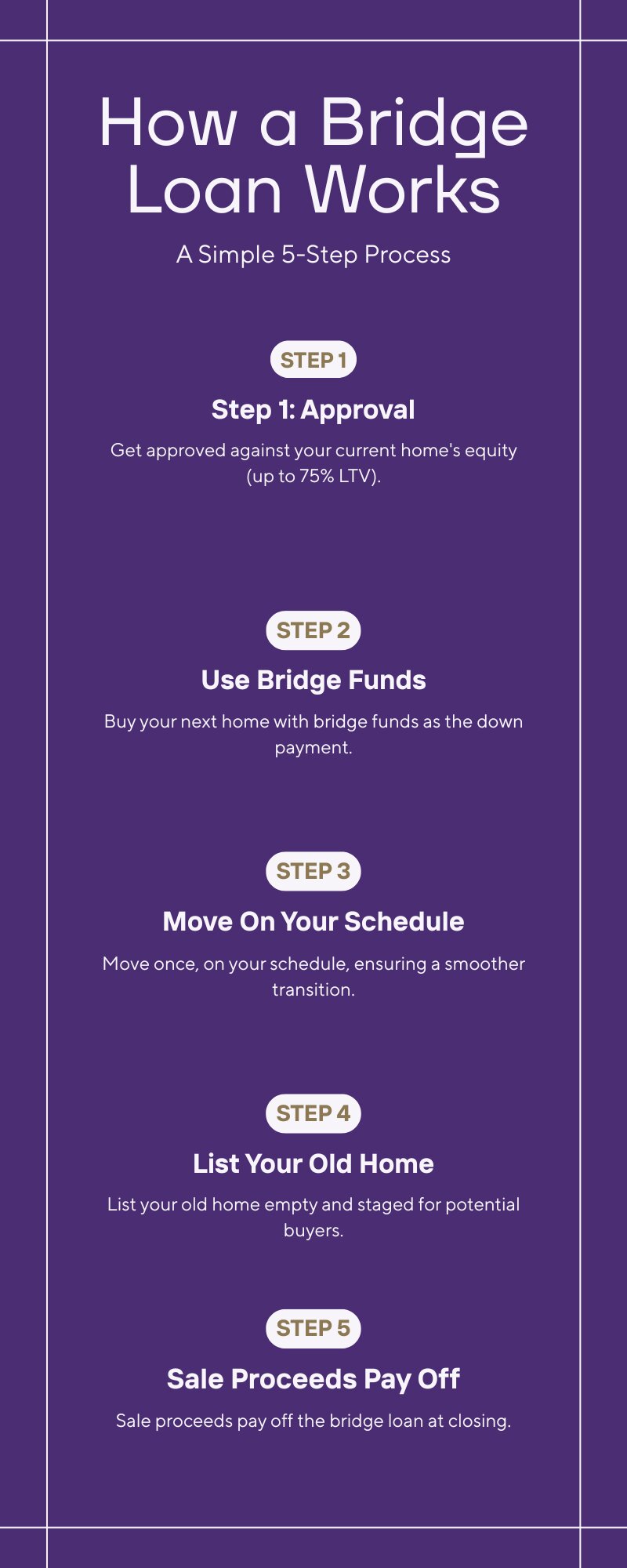
The full bridge loan cycle. In fast South King County segments, most borrowers reach payoff in two to four months.
What a Bridge Loan Costs in 2026
This is where you need to go in with clear eyes. Bridge money is more expensive than mortgage money.
In 2026, standard 30-year mortgage rates have been sitting in the mid-6 percent range. Residential bridge loans from banks and credit unions are typically running about 8 to 10 percent. Private and hard-money bridge lenders charge more, often 9 to 12 percent. On top of the rate, most lenders charge origination points, commonly 1.5 to 2.5 percent of the loan amount, plus normal closing costs.
Let’s make that real. Say you borrow $200,000 against your Kent home to put down on a house in Covington. At 9 percent interest-only, that’s $1,500 a month. If your Kent home sells in three months, you’ve paid $4,500 in interest plus roughly $3,000 to $5,000 in points and fees. Call it $8,000 to $9,500 total for the ability to buy first, move once, and sell an empty, staged home at full strength.
Is that worth it? For a lot of my sellers, yes. An empty home shows better and often sells for more than the cost of the bridge. You also skip the misery of living in a staged house with kids and dogs while strangers tour it. But the math only works if your home actually sells inside the window. That’s the whole game with a bridge loan.
Bridge Loan vs. HELOC: Which One Fits?
A home equity line of credit is the other common way to unlock your equity, and for some sellers it beats a bridge loan outright.
A HELOC is cheaper. Rates in 2026 are generally running a point or two below bridge loan rates, and most HELOCs have little or no closing costs. It’s also flexible. You draw what you need, when you need it, and there’s no balloon date forcing a payoff.
So why doesn’t everyone just use a HELOC? Timing. Here’s the trap I warn sellers about constantly: lenders will not open a HELOC on a home that’s already listed for sale, and many want it seasoned for months before you draw on it. A HELOC is a tool you set up six months to a year before your move, while you’re still just thinking about it. Once the sign is in the yard, that door is closed, and a bridge loan becomes the realistic option.
The other difference is qualification. With either tool, the lender needs to see you can carry the payments. Some bridge lenders will soften the math if your current home is already under contract. If you want to understand exactly how lenders count your income and debts, I broke that down in my guide to how mortgage qualification works in Washington State.
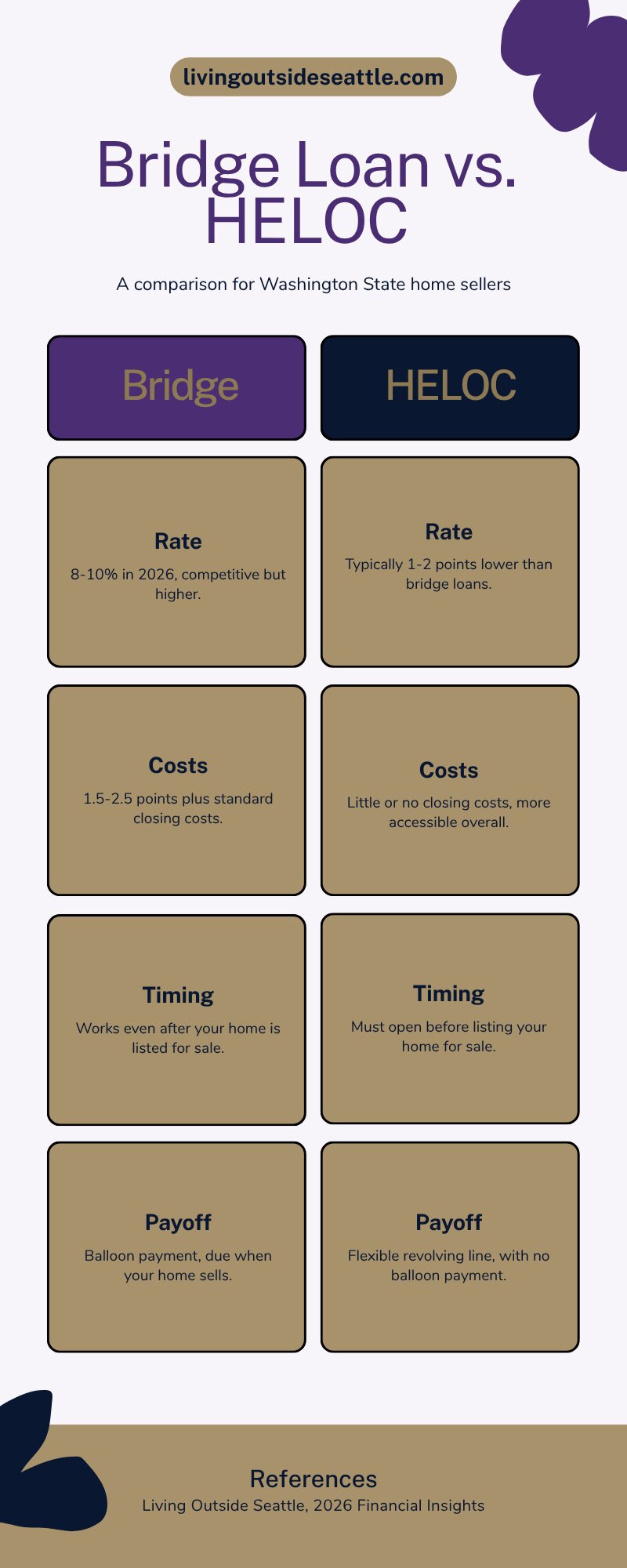
The deciding factor is usually timing: a HELOC must be opened before you list, a bridge loan works after.
Who Offers Bridge Loans in Washington State
Here’s something that surprises people: most big national banks got out of the consumer bridge loan business years ago. You won’t find one at most major retail banks.
In Washington, bridge loans come from three places. First, regional banks and credit unions. Several Washington-based institutions still write true bridge loans for their members, and this is usually the cheapest version of the product. Second, local mortgage companies. A handful of Puget Sound area lenders offer bridge programs designed specifically for buy-before-you-sell moves. Third, the newer “buy before you sell” programs. Seattle-based Flyhomes has rebuilt its whole business around this model, and national players like HomeLight offer versions of it here too. These programs package equity access, a non-contingent offer, and the sale of your old home into one product. Ask your real estate agent if they know a lender that offers this type of program.
Those programs can be slick, but read the fee structure carefully. Between program fees, loan costs, and pricing requirements on your departing home, the all-in cost can run well past what a straight bridge loan from a credit union costs. Convenience has a price tag. Sometimes it’s worth paying. Just know what it is before you sign.
The Local Angle: Why Bridge Loans Work Differently in King County
Bridge loans are unusually well-suited to South King County right now, and the reason is speed plus equity.
Start with equity. Homeowners who bought in Renton, Kent, or Auburn even six or seven years ago are sitting on six-figure equity positions. Kent’s median sale price has been running around $732,500 and Renton’s spring median hit $859,000. If you bought your Kent home for $450,000 in 2019, you likely have $300,000 or more in equity doing nothing. A bridge loan turns that trapped equity into a down payment without forcing you to sell first.
Now speed. The bridge loan’s biggest risk is a slow sale, and well-priced South King County homes simply aren’t selling slowly. Kent has been averaging about 8 days on market and Renton homes have been moving in about 6 days in spring. That means a typical bridge borrower here carries the loan for a couple of months, not a year. Compare that to a slower sub-market, like some Eastside condo segments, where months of supply are higher and a bridge gets riskier. Where your current home sits matters more than any national average.

One move, on your schedule. That convenience is what a bridge loan actually buys.
What This Means for You as a Move-Up Seller
Here’s the decision framework I walk sellers through.
A bridge loan makes sense when three things are true. You have strong equity, ideally enough to borrow your full down payment at 75 percent loan-to-value or less. Your current home sits in a fast-moving segment and will be priced to sell, not priced on hope. And you’ve found, or are about to find, a next home worth moving fast on. When all three line up, paying $8,000 to $12,000 for a clean, one-move transition is often money well spent.
A HELOC makes more sense when your move is six months or more away and you have the discipline to set it up early. Open it while your home is unlisted, let it sit at zero balance, then draw on it when you find the right house. Cheapest equity access there is.
And sometimes the answer is neither. If your equity is thinner or the numbers feel tight, a well-structured contingent offer can still win in the right situation. I wrote a full guide on how to write a contingent offer that sellers will accept in King County, and it pairs with this post. Whichever route you take, the first step is the same: know what your current home is worth and how fast it will sell. That’s a pricing question, and it’s the one I can answer with real data.
FAQ: Bridge Loans in Washington State
How long do you have to pay back a bridge loan?
Most residential bridge loans in Washington run 6 to 12 months, and the loan is paid off automatically from your sale proceeds at closing. In fast markets like Renton and Kent, most borrowers pay theirs off within two to four months. Most lenders charge no penalty for early payoff.
How much does a bridge loan cost in 2026?
Expect interest rates around 8 to 10 percent from banks and credit unions, or 9 to 12 percent from private lenders, plus origination points of roughly 1.5 to 2.5 percent of the loan amount. On a $200,000 bridge held for three months, total cost typically lands between $8,000 and $10,000.
Are bridge loans hard to get?
They’re more specialized than a standard mortgage, not necessarily harder. Lenders generally want a credit score of about 680 or better, combined loan-to-value of 75 percent or less on your current home, and a believable exit plan. The bigger challenge is finding a lender, since most national banks no longer offer them.
Can I get a bridge loan if my house is already on the market?
Usually yes, and this is a key advantage over a HELOC. Lenders won’t open a home equity line on a listed property, but bridge lenders expect your home to be listed or about to be. Some even offer better terms once you’re under contract.
Is a bridge loan better than a contingent offer?
A bridge loan makes your offer stronger because it removes the home-sale contingency, which matters in competitive segments of King County. A contingent offer costs nothing but is easier for a seller to pass over. If the home you want has multiple offers, the bridge-backed offer usually wins.
Bridge loans aren’t exotic anymore. In a market where most move-up sellers are equity-rich and good homes still move in days, buying before you sell is a real strategy, not a luxury. The key is sizing the loan against an honest number for your current home and a realistic timeline for your area.
Your guide to life outside Seattle.
253-350-0045 ·
greg@livingoutsideseattle.com ·
www.livingoutsideseattle.com
Living in East Renton WA | 2026 Neighborhood Guide
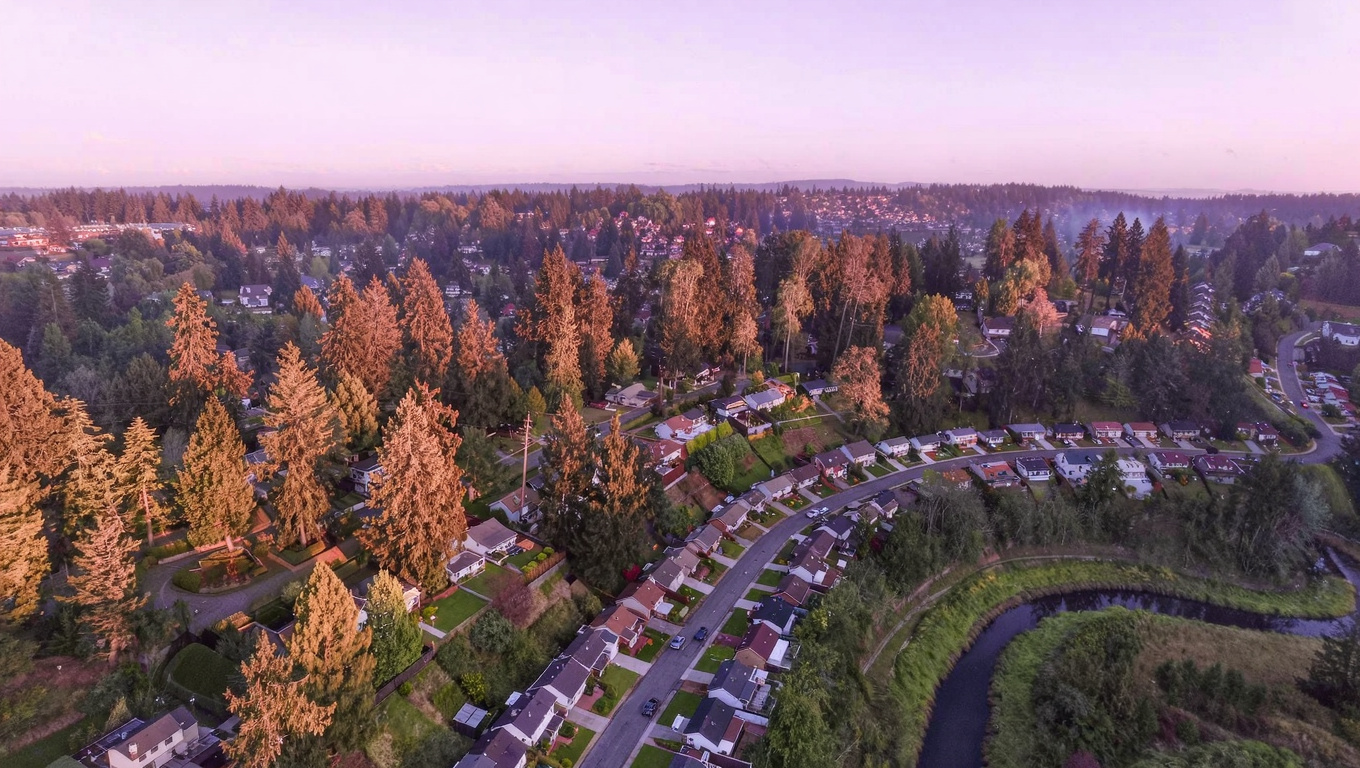
East Renton is where Renton gets quiet and spread out. This is the eastern edge of the city — bigger lots, more trees, and a semi-rural feel that’s genuinely different from the rest of Renton. The vibe is Quiet Cul-de-Sac Community. Many homes here back to wooded buffers or sit on parcels large enough to feel private. In 2026, East Renton is drawing buyers who want Renton’s location and access but don’t want to feel like they’re living in a dense suburb.
What Is It Actually Like to Live in East Renton in 2026?
East Renton mornings have a decidedly suburban edge. Most residents leave early — the drive to 405 takes about 10 minutes and there are no shortcuts. But the trade-off is real. You’re getting space, privacy, and quiet that doesn’t exist in the western parts of the city. Weekday mornings on the residential streets feel calm. The neighborhood doesn’t have the stop-and-go school traffic you find in denser areas.
Weekends pull residents onto the trail systems around Soos Creek and toward Maple Valley. The SR-169 corridor also makes it easy to reach Lake Wilderness in Maple Valley or hop down to Black Diamond for a genuinely rural day trip. The larger lots mean room for trampolines, vegetable gardens, and basketball hoops — the things that get sacrificed in urban infill neighborhoods.
East Renton buyers tend to be families — specifically those who prioritize Issaquah School District (which covers a portion of East Renton) and want more land than central Renton offers. You’ll also find a contingent of buyers who work from home and want a quieter residential environment without moving all the way to Maple Valley.

Homes in East Renton: What the Data Shows
East Renton’s housing stock is primarily 1980s and 1990s single-family construction, with some newer pockets from the 2000s and 2010s. Square footage typically runs from 1,600 to 3,000 sq ft. Lots range from 8,000 sq ft to a quarter-acre or more — meaningfully larger than the Renton city average. Architectural styles lean toward split-level and two-story Pacific Northwest Traditional designs. Garages are standard. Many homes have room for RV or boat storage, which is hard to find closer to the urban core. The general condition of the housing stock is solid — most properties have had at least one significant update over their lifetimes and are in good move-in condition.
| Market Pulse | East Renton / 98059 | King County |
|---|---|---|
| Median Sales Price (May 2026) | ~$680,000 | ~$859,000 |
| Median Days on Market | ~21 days | ~28 days |
| Active Listings Change (vs. Jan 2026) | +24% | +30% |
Figures are approximate based on zip code 98059 activity. Verify current data at NWMLS.com.
Schools Serving East Renton
School district assignment in East Renton depends on your exact address. The western portion feeds into Renton School District with Maplewood Heights Elementary, McKnight Middle School, and Hazen High School as the typical pipeline. The eastern portion may fall within Issaquah School District boundaries. For Issaquah-assigned homes, always verify your specific address with the district before going under contract. If Issaquah School District is a priority, confirm assignment early — it’s one of the most important value drivers in the neighborhood.
Getting to Work from East Renton
SR-169 (Maple Valley Highway) is the primary artery out of East Renton. Head north on 169 to reach 405 and the rest of the King County job corridor. The drive to 405 is about 10 minutes from most of East Renton. That’s the honest trade-off for the extra space and quiet.
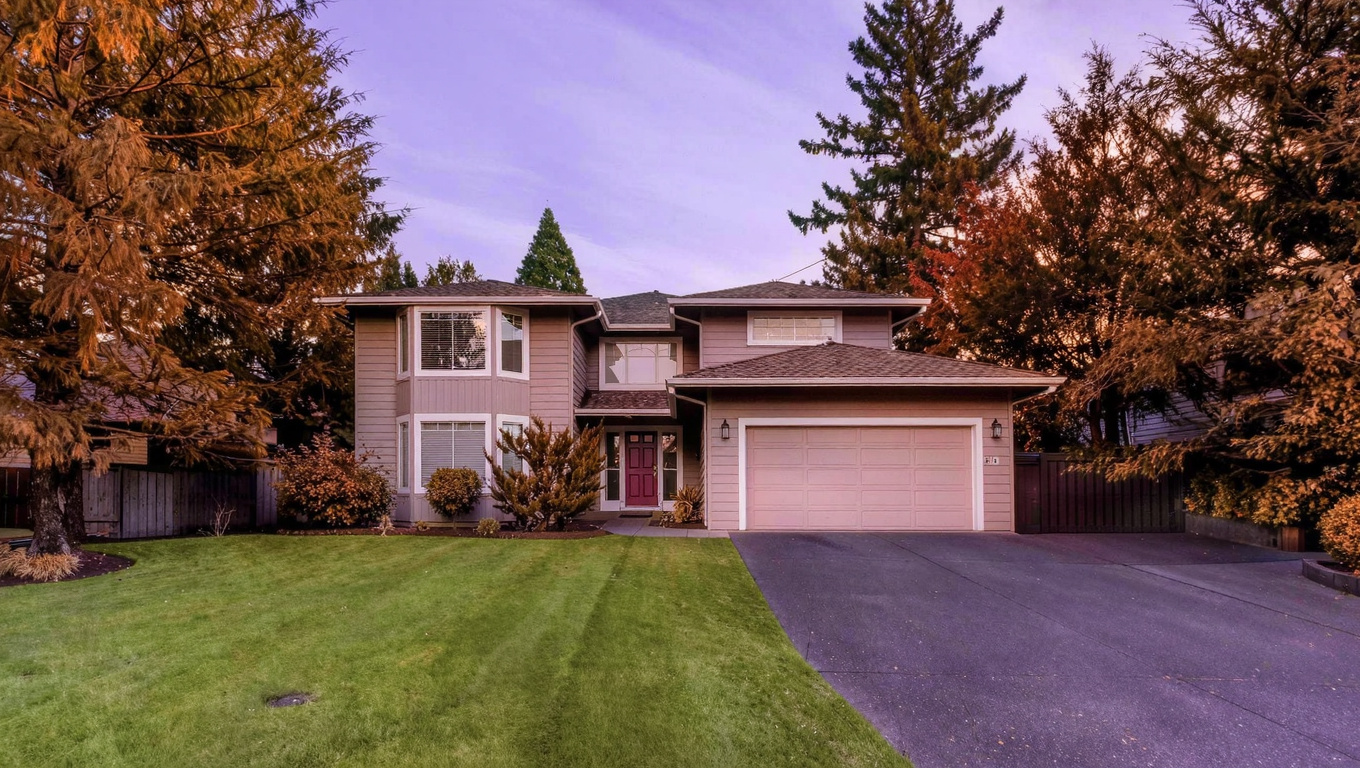
| Destination | Distance | 2026 Peak AM Drive | Transit Option |
|---|---|---|---|
| Downtown Seattle | 15 miles | 28 to 45 min | I-405 N to I-5 N |
| Amazon (South Lake Union) | 16 miles | 30 to 50 min | I-405 N to I-5 N |
| Microsoft (Redmond) | 15 miles | 22 to 38 min | I-405 N / SR-169 to I-90 |
| SeaTac Airport | 12 miles | 18 to 28 min | I-405 S to SR-167 |
What I See as a Valuation Expert in East Renton
East Renton is a mixed HOA landscape. Some subdivisions have active HOAs with fees ranging from $50 to $150 per month — mostly managing common landscaping or shared entry features. Others have no HOA at all. In East Renton, lot depth and usability carry real weight in valuation. A quarter-acre lot that’s 80% slope has very different utility — and appraisal value — than a flat quarter-acre with a usable backyard. Don’t assume lot size alone tells the story here. Always look at the topographic context.
The Issaquah School District boundary is the most important value driver in East Renton. Homes inside the Issaquah boundary consistently appraise 8 to 12% higher than comparable homes just outside it in the Renton School District zone. That premium is durable because the school quality differential is real and well-known. When I’m pulling comps for a lender on an East Renton home, the first thing I check is the district boundary before I select any comparables.
Long term, East Renton benefits from being the city’s semi-rural transition zone. As Renton densifies toward its urban core, properties with larger lots on the eastern edge hold relative scarcity value. You can’t replicate a 12,000 sq ft lot with wooded backyard in north Renton for the same price, and as the county grows, that difference should matter more, not less.
Frequently Asked Questions About Living in East Renton
Does East Renton have Issaquah School District access?
Some East Renton addresses fall within Issaquah School District — specifically the eastern portions closer to SR-169 and toward Maple Valley Highway. This matters significantly for values: Issaquah-assigned homes appraise 8 to 12% higher than comparable Renton-assigned homes nearby. Always verify your specific address with the district before writing an offer.
What are the lot sizes like in East Renton?
East Renton lots typically run 8,000 sq ft to a quarter-acre or more — meaningfully larger than Renton’s urban core average. Many homes have room for RV or boat storage. Usable lot area is critical: always verify topography and easements before assuming that lot size equals usable space.
How far is East Renton from I-405?
About 10 minutes from most East Renton addresses via SR-169 north to the 405 interchange. That’s the honest commute trade for the extra space and quiet — not zero, but manageable for buyers who prioritize lifestyle over a faster onramp.
Is East Renton a good value compared to Maple Valley?
East Renton and Maple Valley are close in price for comparable lot sizes, but East Renton sits closer to the 405 job corridor and Renton’s commercial amenities. For buyers who want a semi-rural feel without committing to the full Maple Valley distance, East Renton tends to be the stronger practical choice.
Explore East Renton Yourself
Drive SR-169 south from Renton’s urban core and turn east into the residential streets. Notice how quickly the neighborhood opens up into larger lots and longer driveways. That transition happens fast and tells you exactly what makes East Renton different.
View East Renton on Google Maps →
Your guide to life outside Seattle.
253-350-0045 ·
greg@livingoutsideseattle.com ·
www.livingoutsideseattle.com
HELOC vs. Cash-Out Refinance: King County Guide 2026
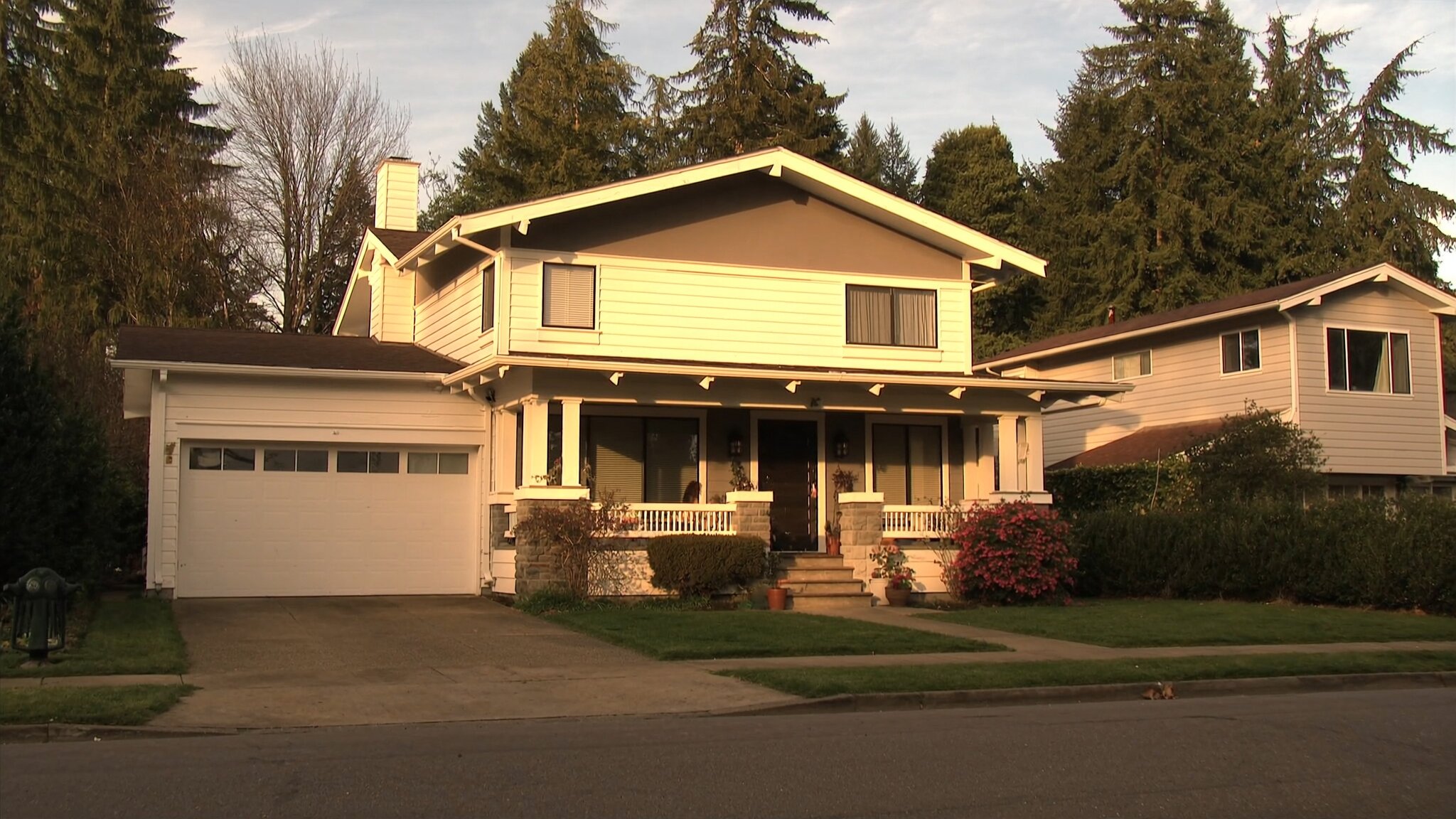
Most King County homeowners are sitting on well over six figures of equity. Here’s how to use it without giving up the mortgage rate you fought for.
If you bought your home in King County more than a few years ago, you’re probably wealthier than you think. The typical American homeowner with a mortgage is holding around $212,000 in equity they could actually borrow against. In King County, where the median home sits near $835,000, plenty of homeowners I work with in Renton, Kent, and Covington are well past that number.
The question I hear all the time: how do I get to that money without wrecking the 3% mortgage I locked in years ago? There are two main answers. A home equity line of credit, or a cash-out refinance. They sound similar. They are not. Pick the wrong one and it can cost you hundreds of dollars a month for decades.
I price homes every day as a BPO field agent, so I see what equity positions actually look like across South and East King County. Let me walk you through how each option works, what each one costs, and the simple math that tells you which one fits your situation.
How a HELOC Works (and What It Costs)
A HELOC is a line of credit secured by your house. Think of it like a credit card with a much lower rate and your home as collateral. The bank approves you for a limit, often up to 80% or 85% of your home’s value minus what you owe. You draw what you need, when you need it, and you only pay interest on what you’ve actually used.
The national average HELOC rate in June 2026 is sitting around 7.25% to 7.4%, not far off the 2026 low of 7.19% from March. HELOC rates are variable. They move with the prime rate, which is currently 6.75%. If the Fed cuts, your rate drops. If the Fed hikes, it climbs. That flexibility cuts both ways, and you need to be honest with yourself about whether your budget can handle a rate that moves.
Costs are the quiet advantage here. Most HELOCs come with low or no closing costs. Compare that to what you’ll see below for a refinance, and the gap is real money.
How a Cash-Out Refinance Works (and What It Costs)
A cash-out refinance replaces your entire existing mortgage with a new, bigger one. You owe $400,000 and want $100,000 in cash? Your new loan is $500,000, and the whole thing carries today’s rate. In 2026 that means roughly 6.8% for most borrowers, with the best-qualified getting closer to 6.25%.
That word “entire” is the trap. You’re not borrowing $100,000 at today’s rate. You’re re-borrowing all $500,000 at today’s rate, including the $400,000 you already had locked at something much lower.
Then come the closing costs. A cash-out refinance typically runs 2% to 5% of the full new loan amount. On a $500,000 loan, that’s $10,000 to $25,000. On a HELOC, you’d often pay close to nothing to open it.
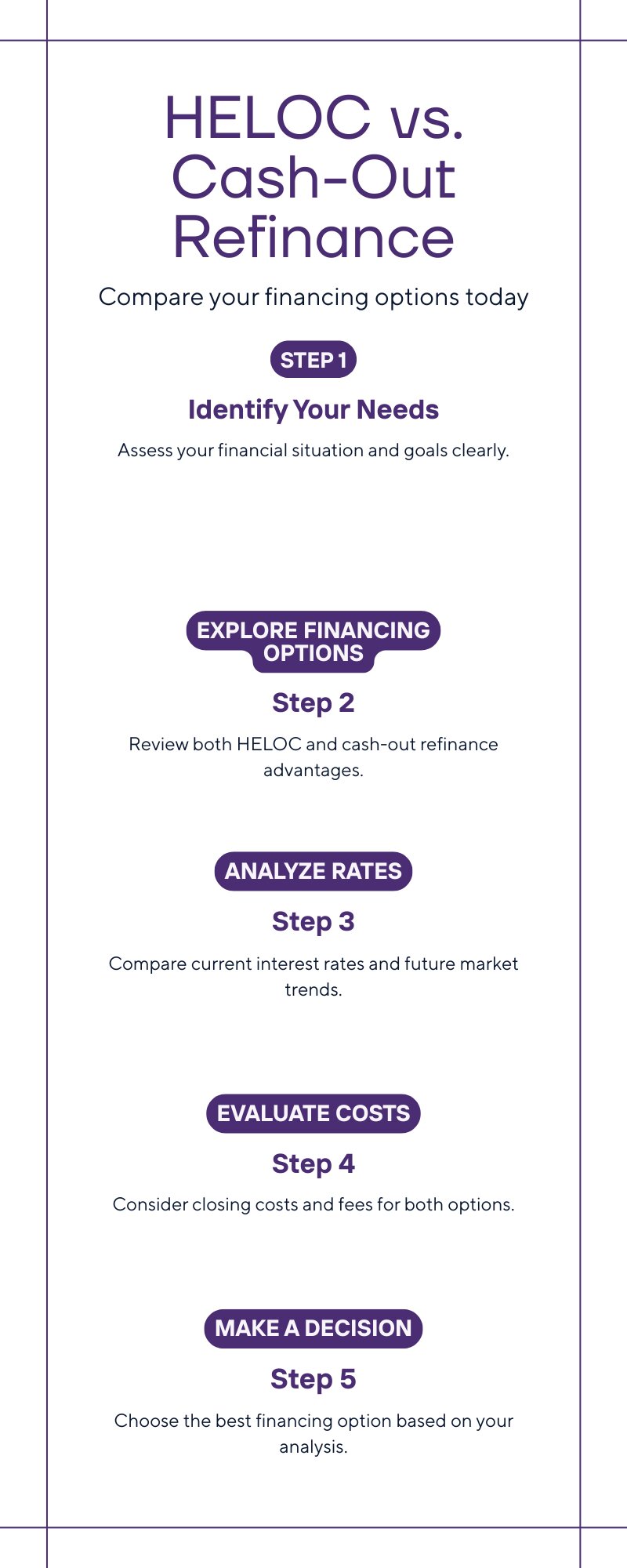
The core difference: a HELOC adds a second loan, a cash-out refinance replaces your entire mortgage at today’s rate.
HELOC vs. Cash-Out Refinance: The Math That Decides It
Here’s a real-world King County example. Say you own a home worth $850,000, you owe $400,000 at 3%, and you want $100,000 for a remodel.
Keep your mortgage and add a HELOC
Your existing payment stays around $1,686 a month in principal and interest. Interest on the full $100,000 HELOC draw at 7.4% runs about $617 a month during the draw period. Total: roughly $2,300 a month.
Cash-out refinance instead
A new $500,000 loan at 6.6% costs about $3,193 a month. That’s nearly $900 more every month than the HELOC route, plus five figures in closing costs, for the exact same $100,000 in your pocket. Over ten years that monthly gap is more than $100,000. The HELOC isn’t just a little better in this scenario. It’s not close.
So when does the refinance win? Two cases. First, if your current rate is already high. Buyers who purchased in late 2023 or 2024 at 7% or above can sometimes refinance today, pull cash out, and barely change their payment. Second, if you need one large fixed sum and you want one predictable fixed payment for 30 years. Some people sleep better with that, and that’s a legitimate reason.
The Tax Rules Most Homeowners Get Wrong
A lot of people still believe HELOC interest is automatically deductible. It isn’t. Under current IRS rules, interest on a HELOC or cash-out refinance is only deductible if the money goes toward buying, building, or substantially improving the home that secures the loan. A kitchen remodel in your Kent home can qualify. Paying off credit cards or buying a car does not.
Two more catches. You have to itemize your deductions to claim it, and most households take the standard deduction instead. And the burden of proof is on you, so keep every contractor invoice and receipt. If you’re borrowing a meaningful amount, a one-hour conversation with a CPA before you sign is worth far more than it costs. I’m a real estate agent, not a tax advisor, and this is exactly the kind of decision where the right professional pays for itself.
The Local Angle: King County Equity in 2026
King County’s median home price has come down about 7.5% from last year. I know that sounds like bad news for equity. Here’s the context that matters: if you bought in Renton or Auburn before 2021, your home is still worth dramatically more than you paid. A pullback from the peak hasn’t erased years of gains. Most long-term owners in South King County are still holding $200,000 to $400,000 or more in usable equity.
What I see in the field is homeowners using that equity three ways. Remodels are the big one, especially kitchens and primary suites in 1980s and 1990s homes in Covington and Maple Valley, where an updated home sells noticeably faster. Second is debt consolidation, which can make sense at 7.4% against credit cards charging 22%, as long as the spending that built the debt stops. Third, and growing fast, is move-up buyers using a HELOC as bridge money to buy their next home before selling their current one. If that’s your situation, I broke down how that strategy works in my contingent offer guide for King County, and I compared the keep-or-sell decision in renting out your King County home vs. selling.
One more local note. Where prices go from here affects how much cushion you have. My King County housing market forecast for 2026 covers the inventory and price trends that matter if you’re deciding whether to tap equity now or wait.
Kitchen and primary suite remodels are the most common use of equity I see across South King County.
What This Means for You
If you’re a King County homeowner with a mortgage rate under 5.5%, start with the HELOC conversation. Keeping your existing rate is worth real money every month, and the rate math above shows how much. Get quotes from at least three lenders, including a local credit union, because HELOC rates and fees vary more than first mortgage rates do.
If your rate is 6.5% or higher, run both options side by side. A cash-out refinance might lower your rate and put cash in your pocket at the same time. Current rate context is in my King County mortgage rates guide.
And before either one, get a real valuation. Every dollar of borrowing power depends on what your home is actually worth, and online estimates in our market routinely miss by tens of thousands. If you’re also weighing what a sale would net you instead, my guide to capital gains on home sales in Washington covers the tax side of that decision.
FAQ
Is a HELOC or cash-out refinance better in 2026?
For most homeowners, a HELOC. The majority of King County mortgage holders have rates between 2.5% and 5%, and a cash-out refinance would replace that low rate with today’s 6.5% to 7% on the entire balance. A HELOC charges a higher rate, but only on the smaller amount you borrow.
How much equity can I borrow against my King County home?
Most lenders let you borrow up to 80% or 85% of your home’s value, minus your current mortgage balance. On an $850,000 home with $400,000 owed, that’s roughly $280,000 to $322,000 in available credit, depending on the lender and your qualifications.
Does opening a HELOC change my current mortgage rate?
No. A HELOC is a separate second loan. Your existing mortgage, its rate, and its payment stay exactly the same. That’s the main reason HELOCs are winning in 2026.
Is HELOC interest tax deductible?
Only if the money is used to buy, build, or substantially improve the home securing the loan, and only if you itemize deductions. Home improvements can qualify. Debt payoff, tuition, and cars don’t. Confirm your situation with a tax professional.
Can I use a HELOC to buy my next house before selling my current one?
Yes, and it’s one of the most common moves I see from move-up sellers in Renton and Kent. You open the HELOC on your current home while you still live there, use the draw for the down payment on the next home, then pay the line off when your old home sells.
What credit score do I need for a HELOC?
Most lenders want 680 or higher, with the best rates going to borrowers above 740. You’ll also generally need to keep at least 15% to 20% equity in the home after the line is opened.
Your home equity is a tool. Used well, it funds the remodel, clears the expensive debt, or bridges you into your next home. Used carelessly, it puts the roof over your head at risk. The right first step is knowing your real number.
Your guide to life outside Seattle.
253-350-0045 ·
greg@livingoutsideseattle.com ·
www.livingoutsideseattle.com
Contingent Offer Guide: King County WA 2026
A step-by-step guide for move-up sellers who need to buy their next home before the current one closes — and how to make a seller say yes.
If you own a home in King County and you need to buy your next place before you sell, you already know the problem. You can’t really afford two mortgages. But sellers don’t love contingent offers. So how do you make this work?
The short answer: contingent offers do get accepted in King County — especially right now. Inventory across South and East King County has grown compared to the peak frenzy years, which means sellers are more flexible than they’ve been in a long time. But “more flexible” doesn’t mean “they’ll accept anything.” The offer still has to be structured the right way.
Here’s what actually goes into a contingent offer that a seller will take seriously, and how the current King County market shapes those decisions.
What a Home Sale Contingency Actually Is
A home sale contingency means your offer to buy a new home depends on selling your current one first. In Washington state, this is typically documented using Form 22B — the Buyer’s Sale of Property Contingency Addendum. This form is used specifically when your home is not yet under contract.
There’s an important difference between that and Form 22Q, which is used when your home is already on the market. Sellers generally prefer 22Q because your sale is actively in motion. With 22B, the seller is essentially betting that you’ll get your home under contract within a set timeframe. That’s a bigger ask.
Form 22B requires you to list your home for sale within a specific number of days stated in the addendum — often 5 to 15 days. If you miss that window without taking action, you can lose all your contingency protections, including inspection and financing. That’s a real risk, and sellers know it.
The kick-out clause (also called the bump clause) is the seller’s main protection tool. It lets the seller keep marketing the property while your contingency is active. If another qualified buyer submits an offer, the seller issues a Form 44 bump notice. You then have a short window — typically 48 to 72 hours — to either remove your contingency and proceed, or step away. You’d use Form 46 to respond.
Understanding these mechanics matters because they shape every decision you make when structuring the offer.
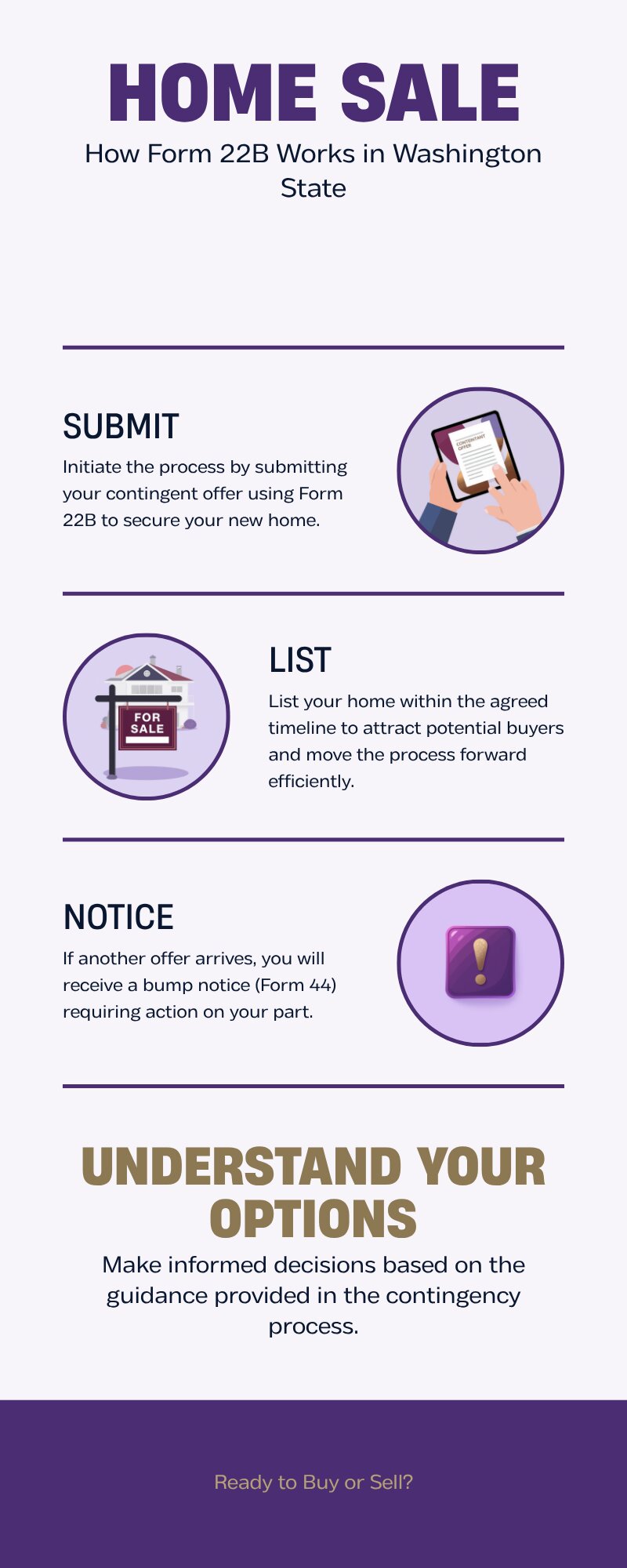
The Form 22B process in Washington state: submit your contingent offer, list your home, respond to any bump notice, and close. Understanding each step helps you structure an offer sellers will accept.
Why Sellers in King County Are More Open Right Now
This matters for timing. In 2021 and 2022, sellers in most King County markets had lines of competing buyers. A contingent offer was almost automatically rejected. That market has shifted.
In South King County — Renton, Kent, Auburn, Covington, Maple Valley — inventory has increased meaningfully. Days on market have stretched out in some price points. Sellers who aren’t priced perfectly are sitting longer than they expected. That means many sellers are now willing to consider a contingency they would have dismissed three years ago.
In East King County — Issaquah, Sammamish, Bellevue — things are still tighter. Demand holds up in those corridors because of proximity to tech employers. Contingent offers face more competition there, and the terms need to be sharper.
The key question isn’t whether a seller will accept a contingency in the abstract. It’s whether your specific offer removes enough risk for this specific seller to feel comfortable saying yes.
How to Structure a Contingent Offer Sellers Will Actually Accept
Start with your own home — before you make an offer
This sounds obvious, but a lot of buyers skip it. Before you make a contingent offer, have your home evaluated for a realistic list price. Not what you hope to get. What you will actually get in the current market.
If your agent gives you a vague range, push back. You need a real number, because their agent are going to ask the same question when reviewing your offer: does this buyer’s home actually sell? If you’re priced at a number that doesn’t clear the debt you need to carry, the contingency is a problem, not a solution. A solid CMA from a local agent is the starting point.
Get fully pre-approved, not just pre-qualified
A pre-qualification letter isn’t worth much in this context. You need a full pre-approval from a trusted lender who has verified your income, assets, and credit. In the cover letter or offer documents, make it clear when your pre-approval was issued and offer to have your lender speak directly with the listing agent.
Pre-approval shows the seller that when your home sells, there’s no question you can close. It’s one less thing for them to worry about.
Offer a tighter contingency timeline
A 90-day contingency window sends a signal: “I’m not sure my house will sell quickly.” A 30-day window sends a different signal: “I’m ready to move and I’ve priced my home to sell.”
In South King County in 2026, well-priced homes in the $600K–$800K range are still moving in under 20 days. If you’re confident in your pricing, a 21- to 30-day contingency period is realistic and reassuring to a seller. If your home has complications that will take longer to sell, be upfront with yourself about whether a contingency is the right structure at all.
Increase your earnest money
Standard earnest money in King County is typically 1% to 3% of the purchase price. In a contingent offer, going to 3% or higher tells the seller you’re serious and financially committed. Your contingency language still protects you if conditions aren’t met — the earnest money isn’t at risk if the deal falls apart because your home doesn’t sell. But the larger amount signals commitment and reduces seller anxiety.
Think of it this way: you’re asking a seller to take their home off the market while you sell yours. A meaningful earnest money deposit is how you compensate them for that risk.
Accept the kick-out clause
Some buyers resist the kick-out clause because it feels threatening. In practice, it’s almost always the right call. Sellers who won’t accept a contingency without a kick-out are simply protecting themselves. Agreeing to it upfront removes that friction entirely and shows you’re a reasonable buyer to work with.
The reality: if a seller receives another offer strong enough to trigger the bump notice, you have 48 to 72 hours to decide. If your home is under contract by then, you can typically remove the contingency and proceed. If it’s not, you can walk with your earnest money intact.
When a Contingent Offer Probably Won’t Work
There are situations where a contingent offer is the wrong tool, and it’s worth being honest about that.
If the home you want to buy is priced under $700K in South King County and has been on the market for less than a week, there may be multiple offers. A contingency puts you at a significant disadvantage. In that case, you need to think about whether you can compete without one.
If your current home is in a slower price range or has condition issues that will complicate a sale, a 30-day contingency window may not be realistic. Overpromising on your timeline and then needing an extension damages your credibility with the seller at exactly the wrong moment.
And in premium Eastside markets like Bellevue proper, Mercer Island, and Medina, contingent offers are still uncommon. If you’re buying in those price ranges and need to sell first, the alternatives below deserve serious consideration.
Alternatives to a Home Sale Contingency
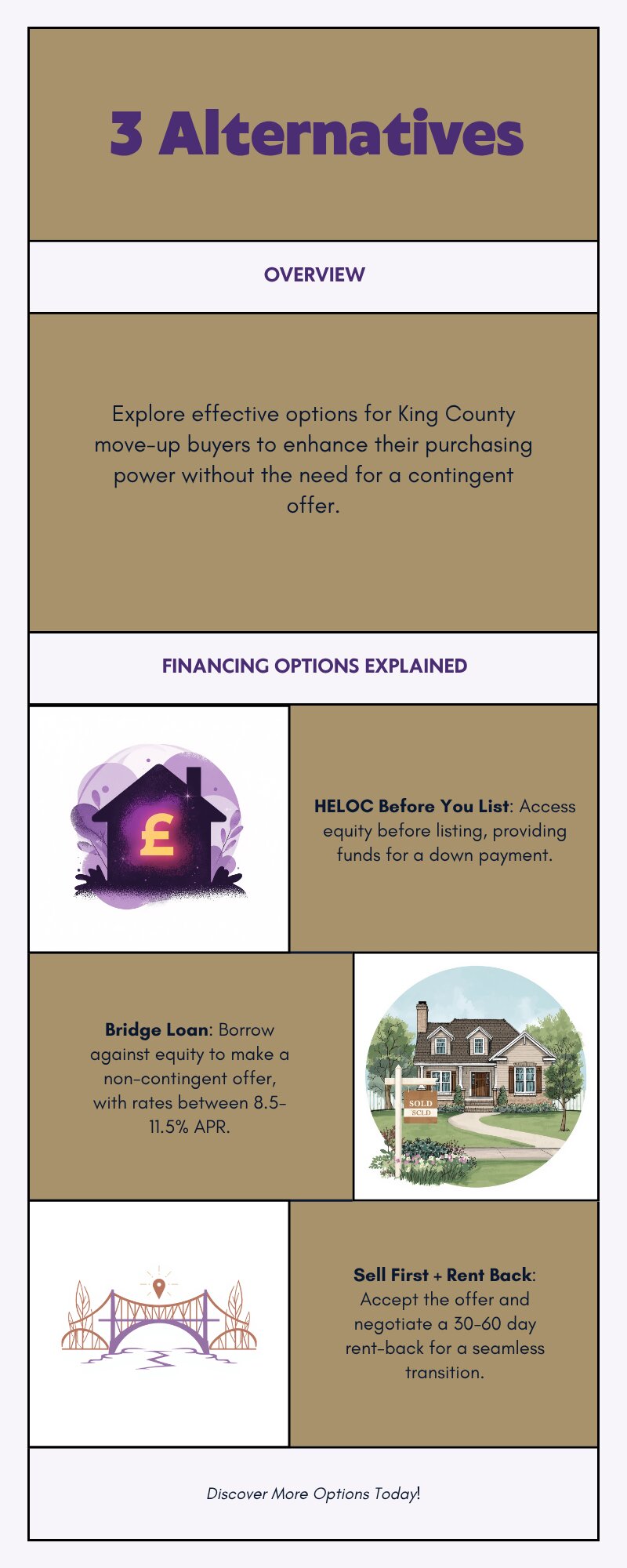
If a contingent offer won’t work in your target market, these three financing strategies let you buy without the contingency. Each has a different cost and risk profile — the right choice depends on your equity and timeline.
If a contingent offer won’t work in the market you’re buying in, there are three realistic alternatives for King County move-up buyers.
HELOC Before You List
If you have equity in your current home, opening a home equity line of credit before you put your home on the market gives you access to cash for a down payment on the new purchase. The critical timing issue: most lenders will freeze or close a HELOC once your home is actively listed. Open it before the sign goes up. This strategy works best when you have at least 25%–30% equity and a clean credit profile.
Bridge Loan
A bridge loan lets you borrow against your current home’s equity to fund the purchase of the new one, giving you a non-contingent offer. Bridge loan rates in 2026 are running 8.5% to 11.5% APR — significantly higher than a standard mortgage — so this is a short-term cost, not a long-term strategy. But if the numbers work and the new home is worth it, a non-contingent offer in a competitive market is a meaningful advantage. You’ll typically carry the bridge loan for 30 to 90 days until your current home closes.
Sell First, Then Rent Back or Short-Term Rent
Accept an offer on your current home and negotiate a 30- to 60-day rent-back period. Use that window to find and close on the next place without the contingency hanging over both deals. This approach takes the financial pressure off both transactions.
You can also explore whether renting your current home rather than selling changes your calculus entirely — though that’s a longer-term decision with its own trade-offs.
Each option has a cost and a risk profile. The right choice depends on your equity position, your risk tolerance, and how competitive the market is where you’re buying. This is worth spending real time on with both your agent and your lender before you make any offer.
The King County Sub-Market Difference
One thing I see buyers get wrong: treating King County as one market when making contingency decisions. It’s not.
In South King County — Renton, Kent, Auburn, Covington, Maple Valley — there’s more room to negotiate on contingency terms right now. Sellers in this range are seeing longer days on market in some price points and are more willing to work with a serious buyer who has structured things correctly.
In East King County near the tech corridors — Issaquah, Sammamish, the Bellevue fringes — demand holds up better and sellers have more leverage. Contingent offers face more competition and need to be tighter on timeline and earnest money.
And in premium Eastside markets like Bellevue proper, Mercer Island, and Medina, contingent offers are still rare. If you’re buying in those price ranges and need to sell first, the alternatives above deserve serious consideration.
Knowing which sub-market you’re in changes how you position every element of the offer.
What Sellers Actually Care About
When a seller reviews a contingent offer, three questions dominate: Will this buyer’s home sell? How fast? And what happens to me if it doesn’t?
Your job is to answer all three convincingly. That means a realistic list price on your current home, a tight timeline, solid pre-approval, meaningful earnest money, and a kick-out clause that gives the seller control if something better comes along.
A contingent offer structured this way isn’t a weakness. It’s a reasonable business arrangement that protects both sides. Sellers who understand that — and who aren’t getting five competing offers — will work with you.
Frequently Asked Questions
Can sellers in King County reject a contingent offer outright?
Yes, and they often do in competitive markets. Sellers are under no obligation to accept any offer. In slower segments — particularly South King County in 2026 — sellers are generally more willing to engage with contingent buyers who have structured their offer thoughtfully.
What is Form 22B in Washington state real estate?
Form 22B is the Buyer’s Sale of Property Contingency Addendum. It’s used when you need to sell your current home before closing on a new one and your home is not yet under contract. It specifies timelines for listing, sets conditions for removing the contingency, and includes kick-out clause provisions.
What is a kick-out clause and should I agree to it?
A kick-out clause (or bump clause) lets the seller keep marketing while your contingency is active. If they get another offer, they notify you and you have 48 to 72 hours to remove the contingency or step away. Agreeing to it is almost always smart — it makes your offer easier to accept and in practice rarely ends deals for well-prepared buyers.
How much earnest money should I offer on a contingent offer?
In King County, 2%–3% of the purchase price is a solid range for a contingent offer. It’s higher than the bare minimum and shows commitment. Your earnest money is still protected if the deal falls apart because your contingency conditions aren’t met.
Is a bridge loan better than a contingent offer?
It depends on your equity and risk tolerance. A bridge loan lets you make a non-contingent offer, which is stronger in competitive markets. But bridge loan rates are high (8.5%–11.5% APR in 2026) and you’re carrying two properties temporarily. A well-structured contingent offer is simpler and lower-risk if the market allows it.
How long should my contingency window be?
Shorter is better for seller confidence. In South King County, where well-priced homes move in 10–20 days, a 21- to 30-day contingency window is realistic. If you genuinely need longer, build that into your pricing strategy on your current home — a faster sale there supports a tighter window on the offer side.
Contingent offers aren’t a long shot in King County right now. They’re a normal part of how move-up buyers navigate this market. The difference between an offer that gets accepted and one that gets ignored comes down to preparation: realistic pricing on your home, tight timelines, strong financials, and terms that give the seller confidence.
Your guide to life outside Seattle.
253-350-0045 ·
greg@livingoutsideseattle.com ·
www.livingoutsideseattle.com
Living in Talbot Hill, Renton WA | 2026 Neighborhood Guide
Talbot Hill offers some of the best views in Renton at a price below what you’d pay in Kennydale. The neighborhood rises south of downtown Renton and faces north — giving most homes a direct sightline to the valley, the Olympic Mountains, and Mount Rainier on clear days. The vibe is Family-First Established with character homes and a quiet, hillside feel. In 2026, it’s an undervalued part of the city that buyers who do their homework keep finding.
What Is It Actually Like to Live in Talbot Hill in 2026?
Talbot Hill has an elevated, tucked-away feel that residents love. The streets wind up and around the hillside, away from the bustle of Renton’s valley floor. On a weekday morning it’s genuinely quiet up here. Commuters leave by 7:30 and the neighborhood settles into a peaceful mid-morning calm. The Talbot Ridge Natural Area is accessible from several street-end trails, and locals use it for dog walks and trail runs throughout the year.
Weekends on Talbot Hill tend to revolve around home and garden. The lots are generous and the gardening culture is strong — you’ll see well-maintained flower beds and vegetable gardens on nearly every block in the spring and summer. Cedar River Trail is a five-minute drive or bike ride away for those who want longer recreational routes.
Talbot Hill draws buyers who want views and quiet but don’t want to pay Kennydale prices. Many are empty nesters who’ve downsized from larger homes, professionals who work from home and value the peaceful setting, and value-oriented buyers who want the south Renton location without the Kennydale competition. It has a slower, more deliberate pace than the rest of Renton.

Homes in Talbot Hill: What the Data Shows
Talbot Hill homes were mostly built between 1960 and 1995. Square footage typically runs 1,400 to 2,400 sq ft on lots ranging from 7,500 to 12,000 sq ft — larger than the Highlands average. Architectural styles are mostly Pacific Northwest Traditional and split-level designs. The hillside lots mean many homes have walk-out lower levels, daylight basements, and multi-story decks that take advantage of the views. Homes with northern or western exposure and clear valley views consistently out-perform interior lots. Many properties have been updated over the years, though there are still plenty of original-condition homes that offer good equity upside for buyers willing to invest in improvements.
| Market Pulse | Talbot Hill / 98055 | King County |
|---|---|---|
| Median Sales Price (May 2026) | ~$650,000 | ~$859,000 |
| Median Days on Market | ~20 days | ~28 days |
| Active Listings Change (vs. Jan 2026) | +22% | +30% |
Figures are approximate based on zip code 98055 activity. Verify current data at NWMLS.com.
Schools Serving Talbot Hill
Talbot Hill is served by Renton School District. Primary school assignments are Talbot Hill Elementary, Nelsen Middle School, and Renton High School. Talbot Hill Elementary is a longstanding neighborhood anchor with a community-oriented reputation. Nelsen offers a STEM academy pathway. Renton High’s dual-enrollment program with Renton Technical College gives students practical career-ready credentials alongside their high school diploma. Families moving to this part of Renton appreciate having a true neighborhood elementary school that’s walkable from most of the hillside streets.
Getting to Work from Talbot Hill
Talbot Road S drops quickly from the hill to the 405/167 interchange. From there, Bellevue is about 15 minutes north and SeaTac is 15 minutes south. For downtown Seattle, most residents take Talbot Road to 405 north to I-5 north.
| Destination | Distance | 2026 Peak AM Drive | Transit Option |
|---|---|---|---|
| Downtown Seattle | 12 miles | 22 to 38 min | I-405 N to I-5 N |
| Amazon (South Lake Union) | 13 miles | 25 to 42 min | I-405 N to I-5 N |
| Microsoft (Redmond) | 18 miles | 28 to 45 min | I-405 N / Stride S2 + Transfer |
| SeaTac Airport | 8 miles | 12 to 20 min | I-405 S to SR-167 |
What I See as a Valuation Expert in Talbot Hill
Talbot Hill has no HOA. That’s consistent with most of Renton’s older hillside neighborhoods. In Talbot Hill, the single biggest value driver is view exposure. A home on the upper bench with a clear valley view will appraise meaningfully above a home two streets lower with no view, even if the floor plans and conditions are identical. I’ve seen that difference run $50,000 to $90,000 on a single block depending on elevation and tree encroachment. Buyers who target the upper bench streets generally get the best combination of views and lot size.
The mature landscaping here adds genuine value. Many homes have well-established foundation plantings, mature rhododendrons, and towering Douglas firs in the backyard. That visual depth and privacy buffer is something you can’t replicate in a newer neighborhood. It shows up in appraisals as a positive contribution to curb appeal and marketability.
My long-term read on Talbot Hill is that it’s undervalued relative to its view quality. Buyers regularly skip it for Kennydale without realizing the view from the upper bench here rivals what Kennydale delivers at a lower price. As more buyers do that comparison, the gap should narrow. For a 10-year hold, Talbot Hill looks like a quiet winner.
Frequently Asked Questions About Living in Talbot Hill, Renton
What are the views like from Talbot Hill?
From the upper bench streets, Talbot Hill delivers direct territorial views across the Renton valley toward the Olympic Mountains and Mount Rainier on clear days. The best view positions are above the midpoint of Talbot Road S on streets that face north and west. The view premium on these lots runs $40,000 to $80,000 above comparable interior-facing homes on the same street.
How does Talbot Hill compare to Kennydale?
Talbot Hill typically prices $50,000 to $100,000 below comparable Kennydale addresses for similar square footage and lot size. The upper bench views in Talbot Hill are genuinely competitive with Kennydale views. The main difference is that Kennydale offers lake access and Lake Washington proximity, while Talbot Hill offers valley and mountain views from a quieter hillside setting.
What schools serve Talbot Hill?
Talbot Hill is served by Renton School District. The typical pipeline is Talbot Hill Elementary, Nelsen Middle School, and Renton High School. Talbot Hill Elementary is a walkable neighborhood school — a genuine rarity in south Renton. Always verify your specific address with the district before writing an offer.
Is there an HOA in Talbot Hill?
No. Talbot Hill is a no-HOA neighborhood. Individual homeowners have full control of their properties with no monthly dues. This is consistent with most of Renton’s older hillside neighborhoods from this era.
Explore Talbot Hill Yourself
Drive Talbot Road S up to the upper bench and park. Walk toward Talbot Ridge Natural Area. The combination of quiet streets, mature trees, and valley views tells the whole story.
View Talbot Hill on Google Maps →
Your guide to life outside Seattle.
253-350-0045 ·
greg@livingoutsideseattle.com ·
www.livingoutsideseattle.com
How Mortgage Qualification Works in Washington State

A plain-English look at what lenders actually check before they hand you a loan, and how to know your real number before you start shopping homes in King County.
Most people think mortgage qualification is about one thing: your income. It is not. A lender looks at four things, and your salary is only one of them. I watch this play out every week with first-time buyers in Renton, Kent, and Auburn. Someone makes good money, assumes they will qualify for plenty, and then learns their car loan and student debt cut their buying power by a hundred grand. That surprise is avoidable.
Here is the part that matters for you. Knowing how mortgage qualification works in Washington State before you tour a single home means you shop in the right price range from day one. You write stronger offers because your pre-approval is solid. And you do not fall in love with a house you were never going to get. This guide walks through exactly what a lender measures, how they do the math, and what to do if the answer is “not yet.”
The Four Things a Lender Actually Checks
When you apply for a loan, the lender is answering one question: will this person pay us back every month? To get there, they look at four areas. Miss the mark on any one and your approval can stall, even if the other three are strong.
The first is income, but not the way you might think. Lenders use your gross monthly income, the amount before taxes come out. They also need to see that it is stable and likely to continue. A two-year track record is the standard. The second is your debt-to-income ratio, which is the single most important number in the whole process. The third is your credit score and history. The fourth is your down payment and the cash reserves you have left after closing. Each one tells the lender something different about your risk as a borrower.
So what does this mean for you? You can have a great salary and still get turned down if your debt load is too high. And you can have a modest income and qualify comfortably if you carry almost no debt. The mix matters more than any single number.
Income: What Counts and What Does Not
Lenders want income they can rely on. A steady paycheck from a W-2 job is the easiest kind to document. They average your pay over the last two years, and they want to see that you have stayed in the same line of work. Switching from nursing to nursing at a new hospital is fine. Switching from nursing to opening a food truck six months ago is a problem, because there is no track record yet.
Bonus, commission, and overtime income count too, but only if you have a history of earning it. A lender will usually average two years of bonus pay and use that figure. One big bonus last quarter does not count if the year before showed nothing. Side income from a rental property or a second job can also help, as long as you have filed taxes on it for two years.
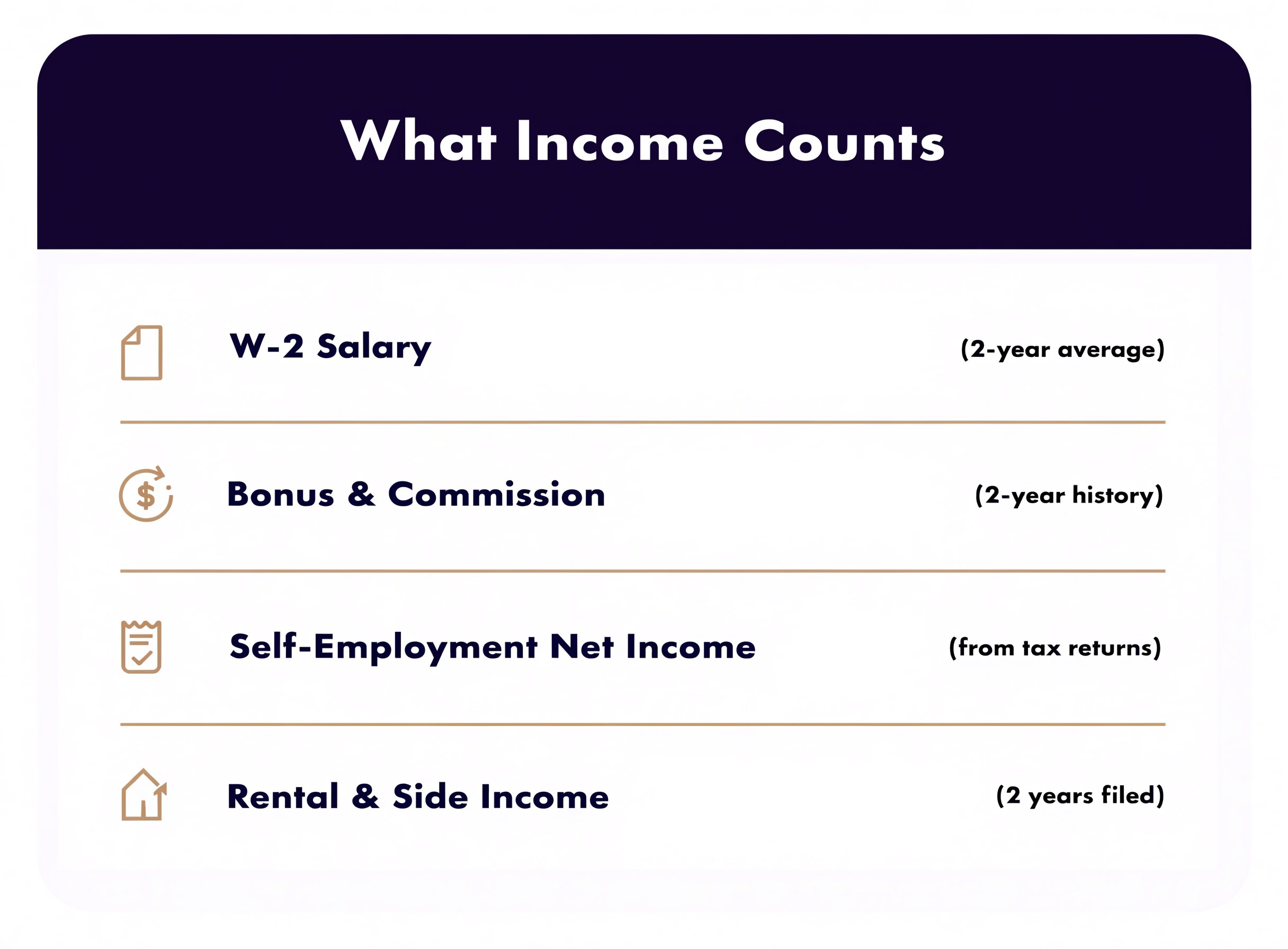
Lenders want a two-year track record on most income types before they will count it.
Self-Employed Buyers: The Rules Are Different
If you own a business or work as a 1099 contractor, the math changes. Lenders do not use the money your business brings in. They use your net income after expenses, pulled straight from your tax returns. They add up your net profit from the last two years, then divide by 24 to get a monthly figure. So if you netted $110,000 one year and $104,000 the next, that is $214,000 divided by 24, or about $8,917 a month in qualifying income.
Two wrinkles trip up self-employed buyers. First, if your second year was lower than your first, many lenders stop averaging and use only the lower year. They want to see income holding steady or rising, not falling. Second, lenders add some paper deductions back in. Depreciation, for example, is a tax write-off that never actually left your bank account, so a lender adds it back to your qualifying income. That can work in your favor.
Debt-to-Income Ratio: The Number That Decides Everything
Your debt-to-income ratio, or DTI, is the percentage of your gross monthly income that goes toward debt payments. It is the number that makes or breaks most applications, so it is worth understanding well.
There are two versions. Your front-end ratio is just your future housing payment divided by your gross monthly income. Your back-end ratio adds in everything else: car loans, student loans, credit card minimums, personal loans, and the new mortgage. Lenders care most about the back-end number.
Here is how it works in practice. Say you earn $8,000 a month before taxes. You have a $450 car payment, a $300 student loan payment, and $150 in credit card minimums. That is $900 in monthly debt before any mortgage. If a lender caps your back-end DTI at 45 percent, your total debt can be $3,600 a month. Subtract the $900 you already owe, and you have $2,700 left for a mortgage payment, including taxes and insurance. That single calculation sets your price range.
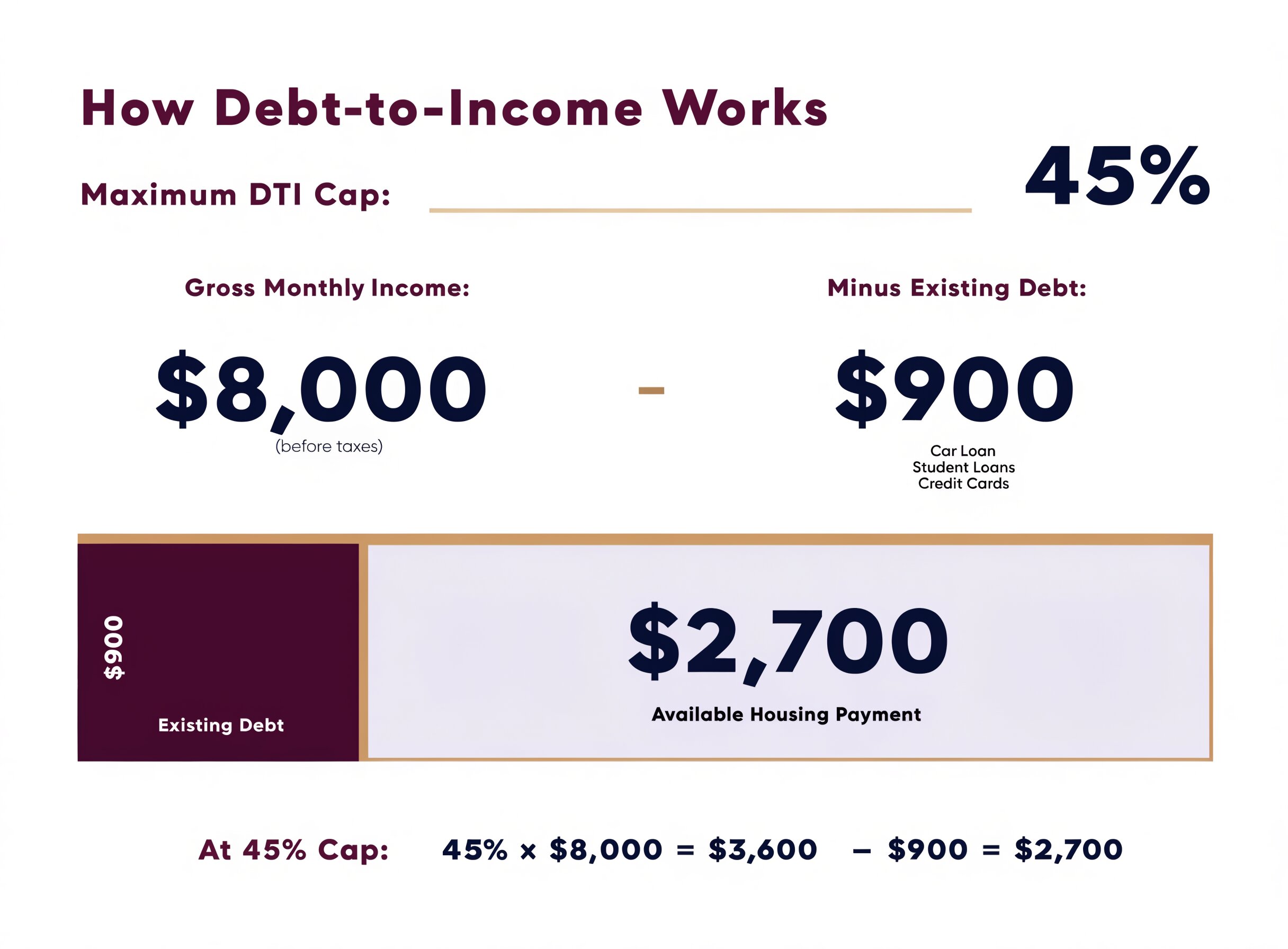
Paying off one car payment can raise your buying power by tens of thousands of dollars.
The caps vary by loan type. Conventional loans usually want a back-end DTI at or below 45 percent, though strong credit and a bigger down payment can push that to 50. FHA loans officially target 31 percent for housing and 43 percent for total debt, but with automated underwriting approval and solid compensating factors, they can stretch to nearly 57 percent. VA loans for veterans and active-duty service members do not set a hard cap at all. They use a 41 percent guideline and focus on residual income, the cash you have left each month after your big bills are paid.
What does this mean for you? Pay down a credit card or knock out a small loan before you apply, and you can free up real buying power. I have seen buyers raise their price range by $40,000 to $60,000 just by paying off one car. If you want to understand how your full monthly cost breaks down once you do buy, our guide on the total cost of homeownership in King County walks through every line item.
Credit Score: What Lenders Want to See
Your credit score tells a lender how you have handled borrowed money in the past. Each loan program has a minimum. Conventional loans generally want a 620 or higher. FHA loans can go lower, sometimes down to 580 with a 3.5 percent down payment, or even 500 with a larger down payment. VA loans do not set a federal minimum, but most lenders want around 620.
Your score does more than open the door. It also sets your interest rate. A buyer with a 760 score gets a noticeably lower rate than a buyer with a 640 score on the exact same loan. Over 30 years, that gap is tens of thousands of dollars. If your score sits in a lower tier, a few months of on-time payments and lower card balances can move you up before you lock a rate.
If you are weighing FHA against a conventional loan and wondering which fits your credit and down payment, our breakdown of FHA vs. conventional loans in King County lays out the trade-offs side by side.
Down Payment and Cash Reserves
The down payment is the cash you put toward the purchase up front. Bigger is not always required. Conventional loans can go as low as 3 percent down for first-time buyers. FHA needs 3.5 percent. VA and USDA loans can require zero down for those who qualify. So the old idea that you need 20 percent is simply not true for most buyers.
A larger down payment still helps in two ways. It lowers your monthly payment, and once you cross 20 percent on a conventional loan, you drop private mortgage insurance, which can save a couple hundred dollars a month. Lenders also like to see reserves, meaning money left in the bank after closing. A few months of mortgage payments in savings makes your application stronger.
Down payment money is also where many King County buyers find help they did not know existed. Several programs can cover part or all of your down payment, with deferred repayment in some cases. Our full guide to King County down payment assistance programs breaks down who qualifies and how to stack programs.
The Local Angle: What Qualifying Looks Like in King County
National advice only gets you so far, because qualification numbers run into local prices. King County is an expensive market, and the federal government recognizes that with a higher loan limit. For 2026, the conforming loan limit here is $1,063,750 for a single-family home, far above the national baseline. Every city in the county shares that limit, from Renton and Kent to Auburn and Federal Way.
Why does that matter for you? Loans up to that amount follow standard conforming rules. Go above it and you enter jumbo territory, where lenders want bigger down payments, higher credit scores, and more reserves. Because South King County prices generally sit below that ceiling, most first-time buyers here qualify under the easier conforming guidelines. A $700,000 home in Kent or a $668,000 home in Auburn keeps you well inside the conforming box.
The first-time buyers I work with most often are dual-income couples in their early thirties earning somewhere between $90,000 and $160,000 a household. Many also have student loans and a car payment, which is exactly why DTI, not salary, ends up being the deciding factor. The good news is that South King County still offers homes priced where those households can qualify, especially in Auburn, Kent, and parts of Renton. If you want a real picture of what payments look like at current rates, our post on King County mortgage rates and what buyers are actually paying shows the monthly math.
What This Means for You as a Buyer
Start with a real pre-approval, not an online calculator. An online estimate does not pull your credit or verify your income, so it is a guess. A lender pre-approval gives you a hard number you can shop with and an offer sellers take seriously.
Before you apply, do three things. Pull your credit and fix any errors. Pay down a card or a small loan if you can, since every dollar of monthly debt you erase frees up room for a mortgage payment. And gather two years of tax returns, recent pay stubs, and bank statements so the process moves fast. If you are early in the journey and still deciding whether buying even makes sense yet, our look at buying now versus waiting in nearby Auburn runs the real math.
One honest note. Getting pre-approved does not mean you should borrow the full amount. The lender tells you the ceiling. Your budget and your comfort level should set the actual number. A payment that looks fine on paper can feel tight once property taxes, insurance, and life show up.
What to Do If You Do Not Qualify Yet
A “not yet” is not a “no.” Most buyers who get turned down are closer than they think. If your DTI is too high, the fastest fix is paying down revolving debt and avoiding new loans before you reapply. If your credit score is the holdup, a few months of on-time payments and lower balances can move you into a better tier and a better rate.
If your income is the issue, time and documentation usually solve it. A self-employed buyer who is one year into a business often just needs to reach the two-year mark. A buyer who recently switched careers needs to build a short track record in the new field. And if the down payment is the gap, assistance programs in King County exist for exactly that reason. The point is simple: find out where you stand now, fix the one thing holding you back, and reapply with a plan.
Frequently Asked Questions
How much income do I need to qualify for a mortgage in King County?
There is no single number, because it depends on your debt, your down payment, and current rates. Lenders care about your debt-to-income ratio, not your salary alone. As a rough guide, a household with little other debt buying a median-priced South King County home often needs somewhere in the low-to-mid six figures of household income, but a buyer with no car payment or student loans can qualify on less.
What is a good debt-to-income ratio to buy a home in Washington State?
Most loan programs want your total, or back-end, DTI at or below 43 to 45 percent, though FHA and VA loans can stretch higher with strong credit and compensating factors. Below 36 percent is considered strong and gives you the most options. The lower your DTI, the more house you can qualify for at the same income.
Can I qualify for a mortgage if I am self-employed in Washington?
Yes. Lenders use your net business income from the last two years of tax returns, averaged over 24 months, and add back certain paper deductions like depreciation. The catch is that aggressive tax write-offs lower the income a lender can count, so plan ahead if you intend to buy.
What credit score do I need to buy a home in King County?
Conventional loans usually want 620 or higher. FHA loans can go down to 580 with 3.5 percent down, or 500 with a larger down payment. VA loans have no federal minimum, but most lenders look for around 620. A higher score also earns you a lower interest rate.
How much do I need for a down payment in King County?
Less than most people assume. Conventional loans can require as little as 3 percent down, FHA needs 3.5 percent, and VA and USDA loans can be zero down for those who qualify. King County down payment assistance programs can cover part of that for eligible buyers.
Does getting pre-approved guarantee I get the loan?
Pre-approval is strong, but not a final guarantee. It is based on the information you provide and a credit pull. Final approval comes after the lender verifies everything and the home appraises. Avoid taking on new debt or changing jobs between pre-approval and closing, since either can change your numbers.
Know Your Number Before You Start Looking
Mortgage qualification in Washington State is not a mystery. It is four things a lender checks: income, debt-to-income ratio, credit, and down payment. Understand those, get a real pre-approval, and you walk into the King County market knowing exactly what you can buy and writing offers that hold up.
Your guide to life outside Seattle.
253-350-0045 ·
greg@livingoutsideseattle.com ·
www.livingoutsideseattle.com
Income Needed to Buy a Home in Renton WA 2026
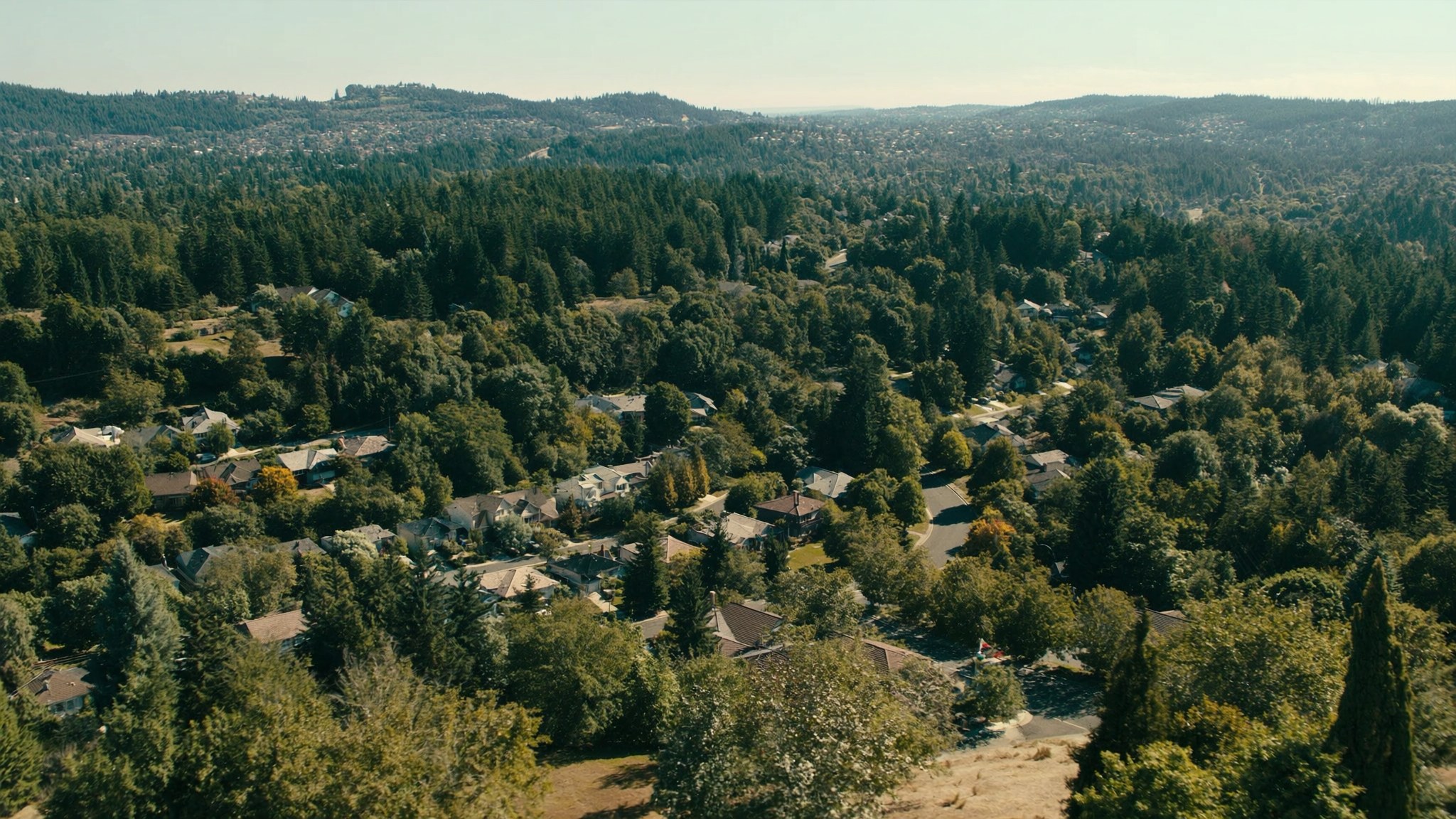
Renton is the city I price homes in more than anywhere else. I do BPO work across south and east King County every week, which means I’m pulling comps in the Highlands, Benson Hill, Talbot Hill, and Kennydale constantly. When buyers ask me what income they need to get into Renton, I don’t give them a guess — I give them the payment math.
Here’s what that math looks like in June 2026.
The short version: to buy a median-priced single-family home in Renton, most lenders want to see household income in the $130,000 to $175,000 range — significantly more accessible than Bellevue, Issaquah, or Sammamish, but still a real number that requires planning. The range shifts by $40,000 or more depending on which neighborhood you’re targeting and how much you put down.
Quick Answer
For a median-priced single-family home in Renton — around $657,000 to $700,000 in early 2026 — lenders using a standard 28% housing ratio expect household income of roughly $130,000 to $160,000 with a 20% down payment at current rates. Total monthly costs including taxes, insurance, and maintenance run between $3,800 and $4,500. Down payment assistance through WSHFC can reduce loan amounts and make lower income levels viable for first-time buyers.
The Renton Price Landscape Right Now
Renton isn’t one market. It runs from sub-$300,000 condos to $850,000-plus single-family homes on the Lake Washington waterfront side, and the income math shifts significantly across that range.
Here’s where the neighborhoods sit as of mid-2026:
Kennydale / Lake Washington
$800K – $1.1M+
Water proximity, views, larger lots. Renton’s premium tier.
Renton Highlands
$700K – $850K
Newer construction, strong school proximity, employment corridor access.
Benson Hill
~$675K avg
Absorbing demand from buyers priced out further north. Rising.
Central / South Renton
$620K – $680K
Near citywide median. Older stock, mixed conditions, price-sensitive buyers.
Talbot Hill / South Entry-Level
$550K – $620K
Most affordable detached homes. Some need work. Best entry point.
Condos (Citywide)
~$270K avg
Completely different income equation. Clearest path for buyers below single-family thresholds.
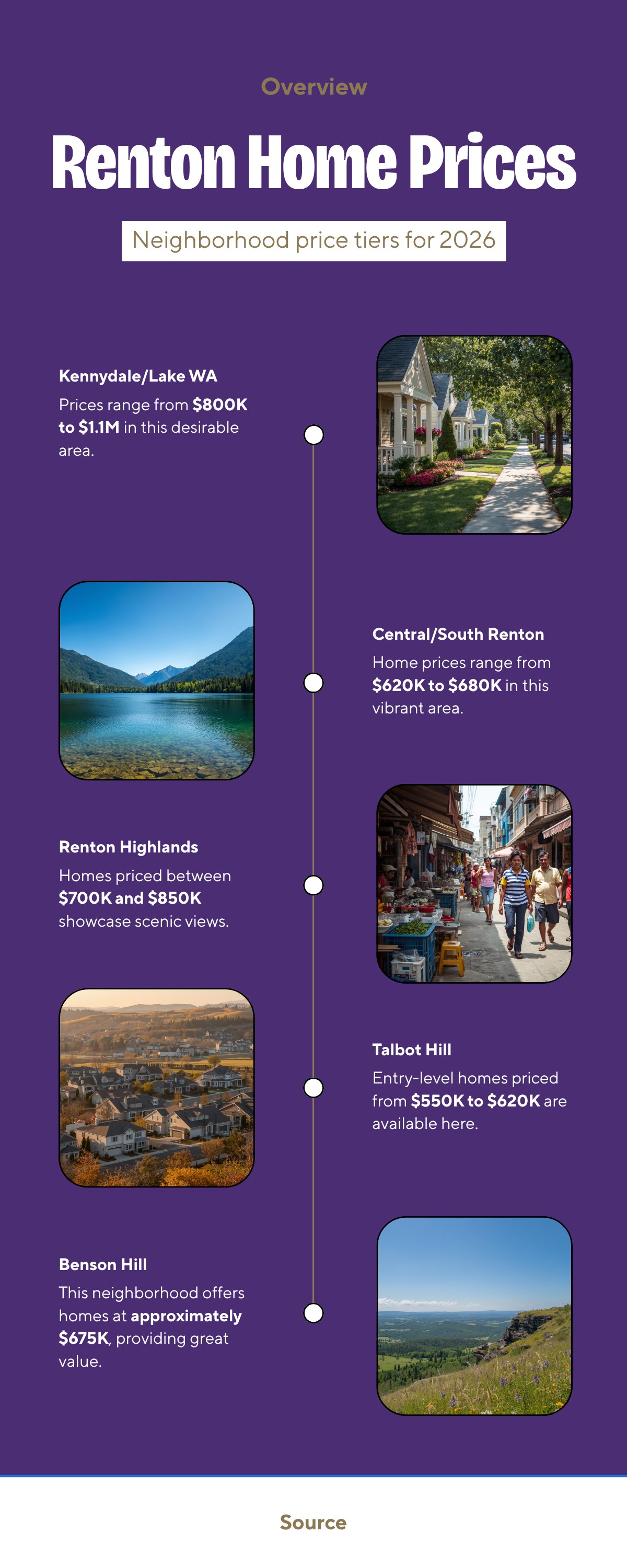
The Income Math by Price Point
I’m running these numbers at 6.5% on a 30-year fixed — right in the middle of where Washington rates have been sitting in June 2026 — and a 20% down payment. Property taxes use King County’s effective rate of about 0.83%.
$550K
Talbot Hill / entry-level
Down payment: $110,000
P&I: ~$2,781/mo
Taxes: ~$381/mo
Ins + reserve: ~$350/mo
Total monthly
~$3,512
Income needed
~$150K/yr
$660K
Citywide median
Down payment: $132,000
P&I: ~$3,338/mo
Taxes: ~$457/mo
Ins + reserve: ~$390/mo
Total monthly
~$4,185
Income needed
~$179K/yr
$750K
Highlands / Benson Hill upper
Down payment: $150,000
P&I: ~$3,793/mo
Taxes: ~$519/mo
Ins + reserve: ~$430/mo
Total monthly
~$4,742
Income needed
~$203K/yr
These are conventional lender standards using the 28% front-end housing ratio. Many buyers also qualify using a 36% to 43% total debt-to-income ratio, which can allow lower income levels if other debts are minimal.
For a full breakdown of what ownership actually costs beyond the mortgage, the Total Cost of Homeownership in King County 2026 post walks through every line item.
How Renton Compares to Kent and Auburn
Kent sits at a median around $646,000 — close to Renton’s but slightly below. The income math at Kent’s median is nearly identical to Renton’s entry-level single-family range. What Kent has going for it: slightly more inventory and a lower median price on homes in comparable condition. What Renton has: better freeway access to Bellevue and the Eastside tech corridor via I-405.
Auburn runs $450,000 to $650,000 depending heavily on neighborhood, with entry-level homes pulling the average down. For first-time buyers with household income in the $100,000 to $130,000 range, Auburn is where the payment math starts working without assistance. Auburn also has the Sounder South commuter rail, which changes the math for Seattle-bound workers.
Renton sits in the middle on price but typically beats both on commute versatility — you can reach Seattle, Bellevue, and the airport in comparable time. If your budget is tight and commute isn’t a deciding factor, Auburn’s price-per-square-foot is still the best in King County at this level. If you want commute flexibility, Renton is the answer.
Down Payment Assistance: What Renton Buyers Can Access
More Renton buyers qualify for assistance than they think. The income limits are broader than most people assume, and Renton’s price range sits squarely in the eligible zone for Washington’s main programs.
WSHFC Home Advantage is the state’s primary first-time buyer program. It provides a deferred second mortgage covering up to 5% of the loan amount at 0% interest — no payments required for 30 years. The income limit for King County is $145,000 for most household sizes. At Renton’s median price, that makes Home Advantage relevant for buyers in roughly the $100,000 to $145,000 household income band — a large portion of the market.
At the median price of $660,000 with 5% down, 5% assistance equals approximately $31,000 — enough to meaningfully reduce either the down payment burden or the loan amount.
The King County Down Payment Assistance 2026 guide walks through how to combine WSHFC and KCHA programs to maximize what you receive.
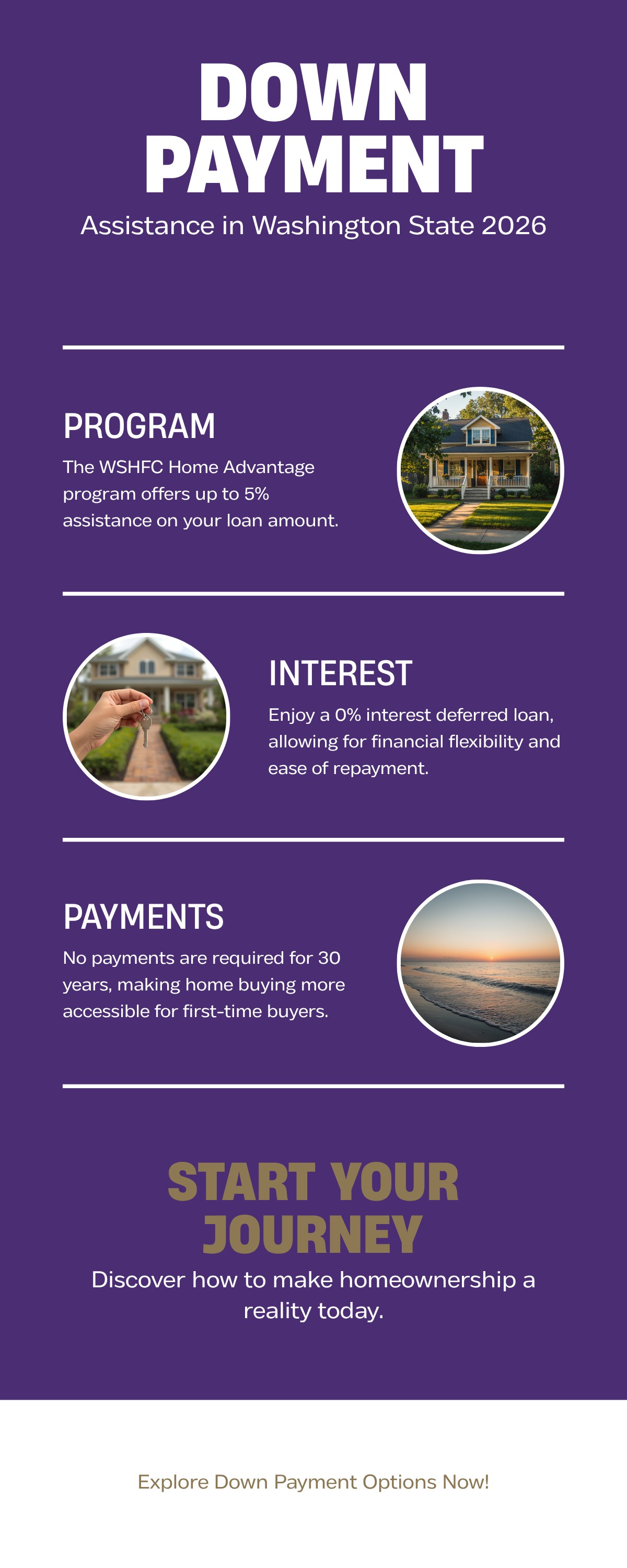
What This Means for Renton Buyers
If your household income is in the $100,000 to $130,000 range, Renton’s condo market and the entry-level south Renton single-family pockets are where the math works — especially with down payment assistance reducing the loan amount.
If your income is $130,000 to $160,000, the citywide median single-family market is within reach, though you’ll want minimal other debt to keep your total debt-to-income ratio under 43%, which is the typical conventional loan ceiling.
Above $160,000, you have access to most of Renton including Renton Highlands, Benson Hill upper, and Kennydale’s lower range — and above $200,000 you’re looking at Kennydale and the lakefront streets.
If you’re putting less than 20% down, make sure you understand whether FHA or conventional makes more sense at your credit score. The FHA vs. Conventional Loan in King County post breaks down the PMI difference and loan limit considerations.
From the Field
I price homes in Renton every week. What I see in the BPO work: the buyers who’ve already run the income math before they start shopping close faster and negotiate better. They know exactly which price tier they’re targeting, so they don’t waste time falling in love with a home that’s $80,000 above what their lender will support. In Renton right now, where the $620,000 to $680,000 range is moving in 15 to 30 days on average, that preparation gap matters.
King County Specifics: What Renton Buyers Actually Pay
Property taxes in Renton run an effective rate of about 0.80% to 0.85% — right around the King County average of 0.83%. On a $660,000 home, that’s roughly $5,300 to $5,600 per year, or $440 to $465 per month.
Current 30-year fixed rates in Washington are running 6.31% to 6.63% as of June 2026. That spread changes your payment by about $115 per month on a $528,000 loan — real money over 30 years. Shopping two or three lenders and working with a good mortgage broker typically lands buyers at the lower end of that range.
For current rate movement and what’s driving it, the King County Mortgage Rates 2026 post has the context every buyer needs before locking a rate.
Frequently Asked Questions
What income do you need to buy a home in Renton WA?
For the citywide median around $657,000 to $700,000, conventional lenders typically want household income of $130,000 to $180,000 depending on down payment size and existing debt. At Renton’s entry-level single-family range ($550,000 to $620,000), income requirements drop to $110,000 to $150,000. Down payment assistance through WSHFC can reduce loan amounts and make lower income levels viable for first-time buyers.
Is Renton more affordable than Bellevue and Issaquah?
Yes, significantly. Bellevue’s median runs around $1.45 million and Issaquah’s citywide median is approximately $1.05 million. Renton’s single-family median of $657,000 to $700,000 is roughly half of Bellevue’s price point. The trade-off is school district — Bellevue and Issaquah have consistently top-rated districts. Renton’s schools vary by neighborhood.
How much is a down payment on a home in Renton?
At the citywide median of approximately $660,000, a 20% down payment is $132,000 and a 10% down payment is $66,000. For entry-level homes around $550,000, a 20% down payment is $110,000. With WSHFC Home Advantage, eligible buyers can reduce the down payment to as low as 3% to 5% and receive up to 5% of the loan amount in assistance.
Do down payment assistance programs work in Renton?
Yes — and more buyers qualify than realize it. WSHFC Home Advantage has a $145,000 income limit for King County, which covers a large portion of first-time buyers targeting Renton’s median range. At a $660,000 purchase price with 5% down, the assistance can provide up to approximately $31,000 — a meaningful reduction in what you need to bring to closing.
How does Renton compare to Kent and Auburn for affordability?
Kent’s median is just below Renton’s at roughly $646,000 — similar income math. Auburn has a wider price range with entry-level homes in the $450,000 to $550,000 band, making it more accessible for buyers with household income under $120,000. Renton’s advantage over both is commute versatility — direct I-405 access to the Eastside is harder to replicate from Auburn or Kent.
What is Renton’s property tax rate?
Renton’s effective property tax rate runs about 0.80% to 0.85% of assessed value, close to the King County average. On a $660,000 home, that’s approximately $5,280 to $5,610 per year, or $440 to $468 per month.
Ready to Run the Real Numbers?
If you’re looking at homes in Renton and want an honest read on what you can buy in today’s market — not a calculator estimate — reach out. I can walk you through the payment math, flag which neighborhoods fit your budget, and tell you what I’m seeing in the BPO work I do here every week.
Gregory Dorrell · Coldwell Banker Bain
Renton is my market.
Living in Renton Highlands WA | 2026 Neighborhood Guide

Renton Highlands is where affordability meets Cascade views. This large plateau neighborhood sits east of downtown Renton and delivers wide mountain sightlines on clear days. The vibe is Family-First Established with working-class roots and a strong sense of community. In 2026, it’s one of the most affordable neighborhoods in north Renton, and buyers are taking notice.
What Is It Actually Like to Live in Renton Highlands in 2026?
The Highlands feels like a real neighborhood — the kind where people know their neighbors and kids still play outside. On weekday mornings the streets are busy with school traffic and commuters heading to 405. By 9 a.m. it quiets down. The commercial strip along NE 4th Street handles most daily errands without ever needing to drive to Renton’s urban core.
Weekends in the Highlands center around the parks and the community. Highlands Neighborhood Park has a community center, a spray pad for kids, and fields that host youth soccer and baseball leagues throughout the spring and summer. The Renton Farmers Market isn’t far — just a short drive downtown on Saturdays from May through October.
The Highlands draws a wide mix of buyers. You’ll find longtime owners who bought in the 1990s and have no plans to leave, first-generation homeowners, and young families priced out of Kennydale who want the plateau location without the Kennydale price tag. It’s one of the most diverse and community-oriented neighborhoods in the city.

Homes in Renton Highlands: What the Data Shows
Most Highlands homes were built between 1950 and 1980, with significant infill construction through the 2000s. Square footage typically ranges from 1,100 to 2,200 sq ft on city-standard lots of 6,000 to 8,500 sq ft. The dominant styles are post-war ramblers, split-level homes, and updated ranch-style builds. Many properties have been improved over the years with new roofs, updated kitchens, and vinyl windows. There’s also a noticeable pocket of newer construction on the eastern edges of the Highlands where infill lots were developed in the 2010s — these newer homes stand out for their energy efficiency and modern floor plans.
| Market Pulse | Renton Highlands / 98059 | King County |
|---|---|---|
| Median Sales Price (May 2026) | ~$620,000 | ~$859,000 |
| Median Days on Market | ~24 days | ~28 days |
| Active Listings Change (vs. Jan 2026) | +28% | +30% |
Figures are approximate based on zip code 98059 activity. Verify current data at NWMLS.com.
Schools Serving Renton Highlands
Renton Highlands is served by Renton School District. The main feeder schools are Highlands Elementary, McKnight Middle School, and Hazen High School. Highlands Elementary has a well-regarded after-school program and strong community ties. McKnight offers elective depth including arts and technology tracks. Hazen High carries solid AP offerings and a dual-enrollment partnership with Renton Technical College that gives seniors a head start on post-secondary credentials. For a neighborhood at this price point, the school pipeline is a real asset.
Getting to Work from Renton Highlands
The NE 4th Street corridor connects the Highlands directly to I-405 in about five minutes. From there, north to Bellevue or south to SeaTac are both straightforward. For Redmond or the Eastside tech corridor, 405 northbound is the primary route.
| Destination | Distance | 2026 Peak AM Drive | Transit Option |
|---|---|---|---|
| Downtown Seattle | 13 miles | 25 to 40 min | I-405 N to I-5 N |
| Amazon (South Lake Union) | 15 miles | 30 to 50 min | I-405 N to I-5 N |
| Microsoft (Redmond) | 16 miles | 25 to 40 min | I-405 N / Stride S2 + Transfer |
| SeaTac Airport | 11 miles | 18 to 28 min | I-405 S to SR-167 |
What I See as a Valuation Expert in Renton Highlands
The Highlands has no city-wide HOA. Most homes sit on individual fee-simple lots with no monthly dues. That’s a plus for buyers who want full control of their property and no HOA budget risk. In Renton Highlands, two things carry the most weight in valuation: condition and lot utility. The Highlands has a wide range of condition — from fully remodeled homes that compete with Kennydale to deferred-maintenance properties that need real investment. The gap between best and worst condition in a single block can be $80,000 or more on the appraisal. Buyers need to be careful not to overpay for a flip that was cosmetically updated but didn’t address the bones.
What I notice when I walk the Highlands is that the eastern edges near the newer infill construction hold value better than the original 1950s core near Sunset Blvd. The newer homes have better energy performance, larger floor plans, and less deferred maintenance risk. They also tend to be the ones that move fastest when the market softens.
The long-term case for the Highlands is about affordability persistence. As King County prices keep rising, this neighborhood functions as the entry point for buyers who want Renton but can’t reach Kennydale. That floor demand is durable. The Highlands won’t lead appreciation, but it won’t crater either. For first-time buyers and value-focused investors, it offers consistent, if modest, long-term returns.
Frequently Asked Questions About Living in Renton Highlands
Is there an HOA in Renton Highlands?
No neighborhood-wide HOA exists in Renton Highlands. Most homes sit on individual fee-simple lots with full owner control and no monthly dues. This is a plus for buyers who want to avoid HOA budget risk and restrictions on their property.
What are the Cascade views like from Renton Highlands?
On clear days, the eastern edges of Renton Highlands deliver direct sightlines to the Cascade Range. Homes on the eastern bench with unobstructed view corridors consistently command premiums of $25,000 to $50,000 over equivalent homes two streets west with no view. The best view positions are on streets closer to the eastern infill edge.
What schools serve Renton Highlands?
Renton Highlands feeds into Renton School District. The typical pipeline is Highlands Elementary, McKnight Middle School, and Hazen High School. Hazen carries solid AP offerings and a dual-enrollment partnership with Renton Technical College. Always verify your specific address with the district before writing an offer, as boundary lines can shift.
How does Renton Highlands compare to Kennydale for buyers?
Renton Highlands typically runs $100,000 to $150,000 below comparable Kennydale homes on a like-for-like basis. You get similar plateau access and freeway proximity, but without the lake views Kennydale commands. For buyers who prioritize space and value over water views, the Highlands is the smarter financial choice.
Explore Renton Highlands Yourself
Drive NE 4th Street from 405 east to the Highlands commercial strip, then wind through the residential streets on a weekend morning. The community feel is real and immediate.
View Renton Highlands on Google Maps →
Your guide to life outside Seattle.
253-350-0045 ·
greg@livingoutsideseattle.com ·
www.livingoutsideseattle.com
Living in Renton WA | 2026 Real Estate & Neighborhood Guide
Why Renton Stands Out in 2026
King County’s median home price sat at about $1 million in July 2026. Renton’s median ran closer to $810,000. That is a real gap. You get location without the Bellevue price tag, and right now inventory across King County is up about 31% from last year. Buyers in Renton have more homes to look at, more time to think, and more room to negotiate. Most people buying here are working professionals, Boeing and Amazon employees, and if you want good schools without paying for a Bellevue zip code.
Renton has a feel that is hard to find anywhere else in King County. Lake Washington sits to the northwest. The Cedar River runs through downtown. On a clear day, Mount Rainier frames itself perfectly from the Highlands. The 405 runs right through the city, so Bellevue is 15 minutes away on a good morning. Boeing’s Renton Factory, where 737s roll off the line, sits along the lake and is part of the city’s identity. So are the trail systems along the Cedar River, and a downtown that has been quietly improving for the past decade. This is a working city that has grown into something genuinely livable.
Commute Times from Renton
Renton’s transit picture improved significantly when the Stride S2 Bus Rapid Transit line launched service along the 405 corridor. The S2 connects Renton to Bellevue and Lynnwood with a stop at South Renton Transit Center. For Link Light Rail, the Rainier Beach Station on Line 1 is about 10 minutes north and gives you a car-free connection to downtown Seattle and Sea-Tac. Most Renton residents still drive to work, but the options are better now than they have ever been.
| Destination | Distance | 2026 Peak Commute (AM Drive) | Transit Option |
|---|---|---|---|
| Downtown Seattle | 12 miles | 25 to 45 min | I-405 N to I-5 N / Drive |
| Amazon (South Lake Union) | 14 miles | 30 to 50 min | I-405 N + I-5 N / Drive |
| Microsoft (Redmond) | 18 miles | 30 to 50 min | I-405 N / Stride S2 + Transfer |
| Bellevue Tech Corridor | 10 miles | 15 to 30 min | I-405 N / Stride S2 |
| SeaTac Airport | 9 miles | 15 to 25 min | I-405 S to SR-167 / Link Light Rail via Rainier Beach |
Drive times reflect typical AM peak conditions. Transit times include walk and wait. Always check Google Maps before your first commute day.

Neighborhoods in Renton: A Quick Look
Renton is a big city with a lot of distinct neighborhoods. Each one has its own price range, vibe, and school profile. Below is a quick overview of the 9 neighborhoods covered in this guide. Each summary links to a full deep-dive post.
Kennydale
Kennydale sits on a hillside above Lake Washington in north Renton and is one of the most sought-after areas in the city. Homes range from 1960s ramblers to newer two-story builds, typically 1,500 to 2,800 sq ft on lots between 6,000 and 10,000 sq ft. Many homes have territorial views of the lake and the Seattle skyline. Kennydale feeds into Renton School District, with Kennydale Elementary carrying a strong reputation for parent involvement. The neighborhood borders Gene Coulon Park, giving residents easy access to Lake Washington shoreline, swimming, and boat launches. It tends to hold value well because of the views and the lake access.
Renton Highlands
The Highlands is one of Renton’s largest and most diverse neighborhoods, sitting on a plateau east of downtown with wide Cascade views on clear days. Housing ranges from 1950s and 1960s ranchers to newer infill construction, typically 1,100 to 2,200 sq ft on mid-size lots. This is a working-class neighborhood with strong community roots and a mix of longtime owners and newer arrivals drawn by relative affordability. Renton School District serves the area with Highlands Elementary as the core school. The neighborhood has a community center, parks, and easy access to I-405. For buyers who want space and value over prestige, the Highlands delivers both.
Talbot Hill
Talbot Hill rises just south of downtown Renton and offers some of the best views in the city: Rainier, the valley, and on clear days the Olympic Mountains. This is a quiet, established neighborhood with mostly single-family homes from the 1960s through 1990s, typically 1,400 to 2,400 sq ft on generous lots. Many properties have been updated over the years, making this a solid spot for buyers who want character homes with equity upside. Renton School District serves the area with Talbot Hill Elementary as the neighborhood anchor. Talbot Ridge Natural Area gives hikers a wooded escape right in the neighborhood. Prices here often come in under Kennydale while delivering comparable city views.
East Renton
East Renton is a transitional neighborhood, part suburb and part semi-rural, sitting on the eastern edge of the city and bordering unincorporated King County and Maple Valley territory. Homes here are often larger and on bigger lots, think 1,600 to 3,000 sq ft on parcels ranging from 8,000 sq ft to a quarter-acre. Many properties were built in the 1980s and 1990s. Buyers get more land for the money here than almost anywhere else in Renton proper. Issaquah School District serves portions of East Renton, which is a major draw for families. Maple Valley Highway connects residents south to Maple Valley and north to Renton’s urban core.
Benson Hill
Benson Hill was unincorporated King County until Renton annexed it in 2008. That history shows in the housing stock: larger lots, more variety in home styles, and a quieter feel compared to the urban core. Homes typically run 1,400 to 2,600 sq ft on lots up to a third of an acre, with a strong sense of community and a diverse mix of residents. Kent School District serves the southern part of Benson Hill and Renton School District covers the northern section, so school assignment depends on your exact address. Soos Creek Trail is nearby, offering miles of paved trail for cycling and walking.
Cascade
The Cascade neighborhood wraps around the south and east slopes of Renton’s central plateau. It’s a mid-density residential area with a solid mix of 1960s to 1980s single-family homes and some attached housing, typically 1,100 to 1,900 sq ft on standard city lots. Cascade feeds into Renton School District and has good access to SR-169 and I-405. The Cedar River Trail runs near the neighborhood’s western edge, making it easy to walk or bike to downtown. Cascade tends to attract first-time buyers and investors because prices remain below Kennydale and Talbot Hill.
Fairwood
Fairwood is a planned community in the southeastern corner of Renton, developed primarily in the 1970s and 1980s with curving streets, mature trees, and a strong homeowners association presence. Homes typically run 1,500 to 2,800 sq ft on well-maintained lots, with a classic suburban feel: safe, green, and consistent. Kent School District serves most of Fairwood, with Fairwood Elementary and Lindbergh High School as the primary assignments. The Fairwood Golf Course sits in the heart of the community and gives the area an open, park-like feel. Fairwood consistently attracts families looking for a classic suburban experience at a price below Sammamish or Covington.
May Valley
May Valley is the quiet edge of Renton, sitting in the valley between Renton and Issaquah and bordered by Cougar Mountain Regional Wildland Park to the south. This is where Renton gets genuinely semi-rural. Homes are often on larger parcels, a quarter acre up to multiple acres, with privacy, trees, and room to breathe. Architectural styles range from 1970s split-levels to newer custom builds, typically 1,600 to 3,500 sq ft. Issaquah School District serves the eastern portion, which is a major pull for families. If you hike, mountain bike, or just want quiet mornings with a longer commute, May Valley is worth every minute of the drive.
Downtown Renton
Downtown Renton sits along the Cedar River and has been through a real transformation over the past 10 years. New apartments, local restaurants, farmers markets, and the renovated Piazza Park have helped shake the old industrial image. The housing stock is a mix of older single-family homes, mid-century apartments, and newer multi-family buildings. This area is best for buyers who want walkability and proximity to amenities without needing a big yard. Renton School District serves downtown with Renton High School as the main high school. The Cedar River Trail is a five-minute walk from most of downtown, connecting all the way to Maple Valley. For urban buyers who want Seattle-adjacent living without Seattle prices, downtown Renton is a real option.
Market Dynamics & Investment Value in Renton
The inventory surge across King County right now is real and it is working in buyers’ favor. As of July 2026, there are roughly 31% more active listings than there were a year ago. Less competition on individual homes. You are less likely to end up in a 10-offer bidding war. Sellers who priced aggressively are having to reduce or negotiate. If you have been on the sidelines waiting for the market to cool, this year is closer to that window than anything we have seen since 2019.
Renton’s prices have held up better than some other King County cities. The median sat around $810,000 as of July 2026, down about 5% from a year ago after a long stretch of relative stability. Kennydale and Talbot Hill, with their lake views and established character, have held value the best. Benson Hill and Fairwood have been more sensitive to interest rate changes because they serve more first-time buyers whose purchasing power moves with rates.
The homes that hold value best in Renton share a few traits: good school district assignments, usable lots, and some combination of views, trail access, or lake proximity. Properties built after 1990 or meaningfully updated also move faster. Older homes in the Highlands or Cascade on flat lots with no distinguishing features tend to sit longer in a balanced market like this one.
One honest caution: parts of Renton, particularly near the Cedar River and the lower valley areas, sit in FEMA-designated flood zones. If a home looks unusually affordable, check the FEMA Flood Map before you get attached to it. Flood insurance adds to your monthly cost and can complicate future resale. I flag this regularly in my BPO work for lenders, and buyers should too.
Explore Renton Yourself
The best way to understand Renton is to drive it. Start at Gene Coulon Memorial Beach Park on a Saturday morning, walk the waterfront, and watch the Boeing flight line across the lake. Then head up the hill to Kennydale and look out over Lake Washington. Come back down through downtown, walk the Cedar River Trail, and grab coffee on South 3rd Street. Two hours and you will understand why people keep choosing Renton over pricier alternatives.
Frequently Asked Questions About Living in Renton, WA
Is Renton WA a good place to live?
Yes. Renton gives you access to Lake Washington, a strong job corridor, and a range of neighborhoods from walkable urban to semi-rural, all at a median home price well below Bellevue or Seattle. The city has real infrastructure, improving transit, and solid schools in several areas. Traffic on I-405 can be brutal and some neighborhoods are still working through older housing stock. But for the price point, it is hard to beat in King County.
What is the cost of living in Renton, WA?
The median home price in Renton was around $810,000 in July 2026, compared to King County’s overall median of about $1 million. Single-family homes in the Highlands or Cascade often start in the $550,000 to $650,000 range. Kennydale and Talbot Hill, with lake views and strong schools, trend higher. Property taxes, utilities, and everyday costs are comparable to the rest of King County.
What neighborhoods are in Renton, WA?
Renton has 9 distinct neighborhoods covered in this guide: Kennydale, Renton Highlands, Talbot Hill, East Renton, Benson Hill, Cascade, Fairwood, May Valley, and Downtown Renton. Each has its own price range, school district assignment, and character. The deep-dive links in each neighborhood card above will give you the full picture on any one of them.
How far is Renton from Seattle?
Renton is about 12 miles south of downtown Seattle. In typical AM peak traffic on I-405 to I-5, the drive runs 25 to 45 minutes depending on your specific origin and destination. The Stride S2 BRT and connecting Link Light Rail via Rainier Beach give you a transit option, though most Renton commuters to Seattle still drive.
Your guide to life outside Seattle.
253-350-0045 ·
greg@livingoutsideseattle.com ·
www.livingoutsideseattle.com
Living in Kennydale, Renton WA | 2026 Neighborhood Guide
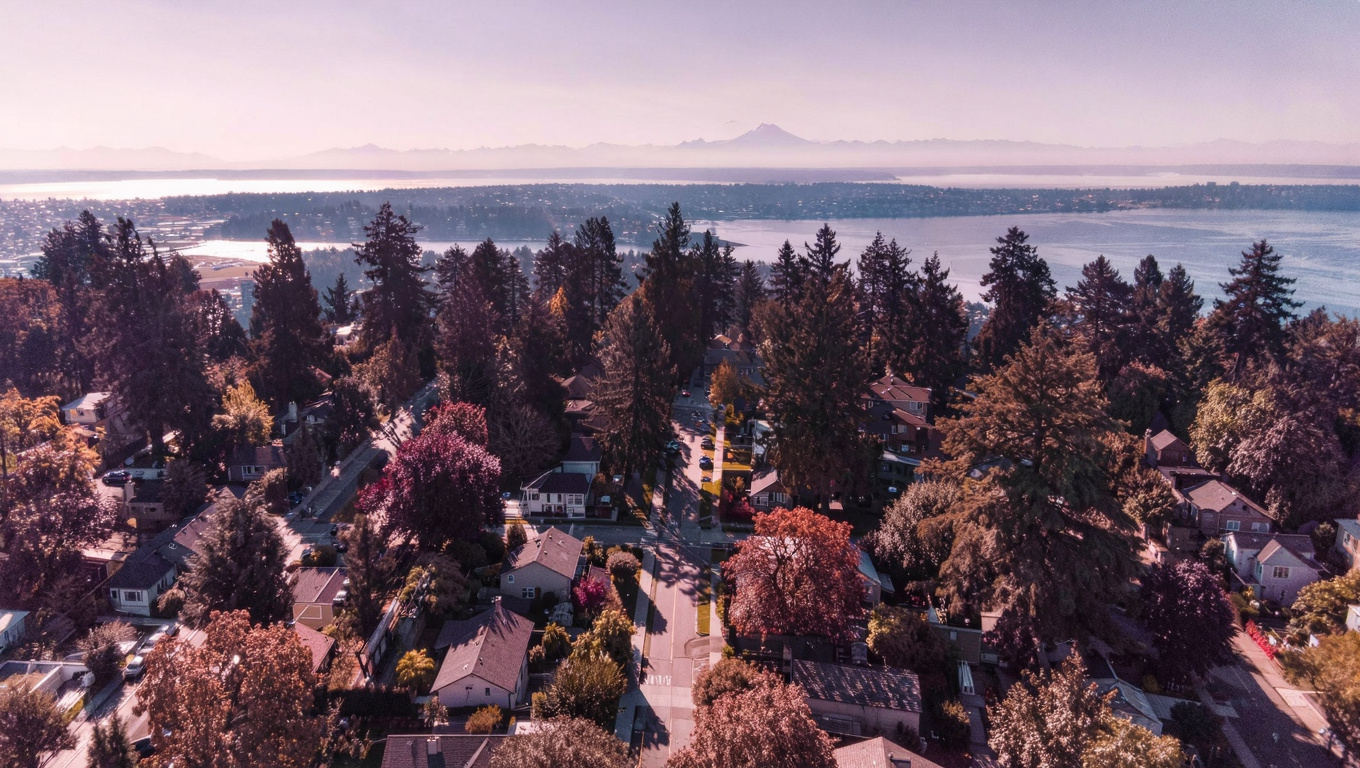
Kennydale is the best-kept secret in north Renton. It sits on a hillside above Lake Washington, and on a clear day the views reach all the way to the Seattle skyline. The vibe is Family-First Established — mature trees, quiet streets, and neighbors who have lived here for years. In 2026, it remains one of the most consistent value holds in all of King County’s south end.
What Is It Actually Like to Live in Kennydale in 2026?
A weekday morning in Kennydale is peaceful. Streets curve through the hillside, and the canopy of mature big-leaf maple and Douglas fir muffles the sound from 405 below. Most residents leave between 7 and 8 a.m. for Bellevue or Boeing. By 8:30 the streets are quiet. There’s a neighborhood feel that’s hard to manufacture — it’s been here a long time and it shows in the way people take care of their homes.
Weekends, Coulon Park is the social hub. Residents walk down, let the kids swim, and spend Sunday mornings at the water. The neighborhood is close enough to north Renton’s commercial strip on N 3rd Street for groceries or coffee, but far enough up the hill that you don’t hear it. That separation is part of what Kennydale residents pay for.
The people who live here tend to be established families — dual-income households with school-age kids, Boeing engineers, and some retirees who have been here since the 1980s. Most buyers come here because they’ve outgrown somewhere else and want to plant roots.

Homes in Kennydale: What the Data Shows
Kennydale’s housing stock runs mostly from 1960s to 1990s construction. Homes are predominantly single-family — ramblers and two-story traditional builds. Typical square footage ranges from 1,500 to 2,800 sq ft on lots between 6,000 and 10,000 sq ft. Many homes have been remodeled over the years, with updated kitchens and baths. The architectural style is Pacific Northwest Traditional — low-pitched roofs, wood or composite siding, and mature landscaping. View homes consistently command a premium here — often $50,000 to $100,000 above comparable non-view homes on the same street.
| Market Pulse | Kennydale / 98056 | King County |
|---|---|---|
| Median Sales Price (May 2026) | ~$780,000 | ~$859,000 |
| Median Days on Market | ~18 days | ~28 days |
| Active Listings Change (vs. Jan 2026) | +22% | +30% |
Figures are approximate based on zip code 98056 activity. Verify current data at NWMLS.com.
Schools Serving Kennydale
Kennydale feeds into Renton School District. The primary pipeline is Kennydale Elementary, McKnight Middle School, and Hazen High School. Kennydale Elementary is known for strong parent involvement and a community garden program. McKnight has well-regarded arts and humanities electives. Hazen High offers a strong AP course selection and a well-funded athletics program.
People who move to Kennydale often cite the school community as one of their top reasons for choosing this neighborhood. The pipeline is consistent and parent involvement at each school is above average for south King County. School boundaries in Renton can shift by street address, so always confirm your specific assignment with the district before writing an offer.
Most Kennydale kids walk or are driven to Kennydale Elementary, bus to McKnight for middle school, and drive or bus to Hazen for high school. Hazen’s dual-enrollment options through Renton Technical College give motivated students early college credit.
Getting to Work from Kennydale
Kennydale has two easy 405 on-ramps — NE 44th Street and Park Ave N — that put you on the freeway in under five minutes. Northbound 405 is your fastest path to Bellevue and Redmond. For Seattle, most residents take 405 north to I-5.
| Destination | Distance | 2026 Peak AM Drive | Transit Option |
|---|---|---|---|
| Downtown Seattle | 12 miles | 25 to 40 min | I-405 N to I-5 N |
| Amazon (South Lake Union) | 14 miles | 30 to 50 min | I-405 N to I-5 N |
| Microsoft (Redmond) | 17 miles | 25 to 40 min | I-405 N / Stride S2 + Transfer |
| SeaTac Airport | 11 miles | 18 to 30 min | I-405 S to SR-167 |
What I See as a Valuation Expert in Kennydale
In Kennydale, the first thing that stands out in valuation is the view line. A home that’s one lot off the ridge and loses the water view can appraise $60,000 to $80,000 less than an equivalent home with a clear lake sightline. That delta is significant. And it persists across market cycles.
The landscaping maturity here is real. Many properties have 30- to 50-year-old trees, established rhododendron plantings, and maintained lawns. That kind of curb appeal is hard to replicate and adds genuine appraised value. When I walk Kennydale, the homes on the upper bench streets — above roughly NE 36th Street — consistently show the strongest comps. Those streets have the best view angles and the least traffic.
Long term, Kennydale is one of the most defensible neighborhoods I work in. It has lake proximity, mature character, and Hazen High School as a school anchor. Those three factors rarely exist together at a sub-$800K median. If rates come down in 2027 and more buyers enter the market, this neighborhood will see competition fast. The 2026 window of higher inventory and less competition is a real opportunity.
Frequently Asked Questions About Kennydale, Renton WA
Is Kennydale a good place to live in Renton?
Yes, especially for if you want lake access, mature neighborhoods, and solid schools without paying Bellevue prices. The upper bench view lots command a real premium, but for what you get — hillside position, Coulon Park proximity, and the Hazen pipeline — the value holds well over time.
What are homes like in Kennydale?
Primarily 1960s to 1990s single-family construction — ramblers and two-story traditionals on lots of 6,000 to 10,000 sq ft. Most have been updated over the years. Upper bench lots with territorial or lake views add $50,000 to $100,000 in appraised value over comparable interior-lot homes.
What schools serve Kennydale?
Kennydale feeds into Renton School District: Kennydale Elementary, McKnight Middle School, and Hazen High School. Always verify your specific address with the district before writing an offer, as boundaries can shift by street.
How far is Kennydale from Seattle?
About 12 miles, with a typical peak AM drive of 25 to 40 minutes via I-405 N to I-5 N. Most residents drive. Stride S2 BRT is accessible from South Renton Transit Center for Bellevue connections.
Explore Kennydale Yourself
Drive the upper bench streets on a clear morning. Then walk down to Coulon Park and look back up the hill. You’ll understand the appeal immediately.
View Kennydale on Google Maps →
Your guide to life outside Seattle.
253-350-0045 ·
greg@livingoutsideseattle.com ·
www.livingoutsideseattle.com
This Guide Has Moved
This article has been folded into our maintained guide: King County Condo Buyer’s Guide: Due Diligence Checklist. You are being taken there now.
Relocating to King County from Out of State: 2026 Guide

A complete guide to neighborhoods, commutes, school districts, home prices, and how to buy before you move — from a local agent who knows this market by the block.
Most people moving to King County from out of state make the same mistake. They pick a city based on how close it is to downtown Seattle — and end up in a neighborhood that costs more, commutes worse, and feels nothing like what they imagined. I’ve helped enough relocators land here to know that the research most people do from a thousand miles away misses the things that actually matter once you show up.
This guide is the one I wish every out-of-state buyer had before their first house-hunting trip.
The City You Think You Want vs. the City That Actually Fits
When people tell me they’re moving to King County, they usually say “Seattle” or “Bellevue.” Those are fine places — I’m not going to talk you out of them — but they’re not the only options, and for most buyers coming from places like Phoenix, Denver, or the Bay Area, they’re not the right options either.
Here’s the honest breakdown.
Seattle
Urban neighborhoods, walkable coffee shops, quick access to Amazon and the medical corridor. Condos start around $500,000 and single-family homes run $871,000 median. If you’re working downtown and don’t have kids in public school, Seattle makes a lot of sense. If you’re working remotely or your employer is on the Eastside, the math gets harder fast.
Bellevue and the Eastside Tech Corridor
Redmond, Kirkland, and Sammamish are where most Microsoft, Google, and Amazon Eastside employees land. Schools are exceptional. Median prices are high: Bellevue runs $1.2 million and up, Sammamish hovers around $1.3 million. Issaquah sits at roughly $950,000 and still delivers top-tier school district quality for meaningfully less than its neighbors — that’s a real value play on the Eastside.
South King County
This is where I’d send most relocating families who are sticker-shocked by Eastside prices. Renton: $763,000 median, 12 miles from downtown Seattle, direct freeway access to the Boeing complex and the Amazon Renton campus. Kent: $647,000 median, the largest city in South King County, commuter rail service and one of the most diverse food scenes in the county. Auburn: $609,000 median, opening three new schools and rapidly growing. Maple Valley and Covington offer a quieter, more rural feel with large lots and 30-35 minute drives to employment centers.
None of those cities feel like settling. They feel like what most of the Pacific Northwest actually looks like — big trees, trail access, good neighbors, reasonable prices.
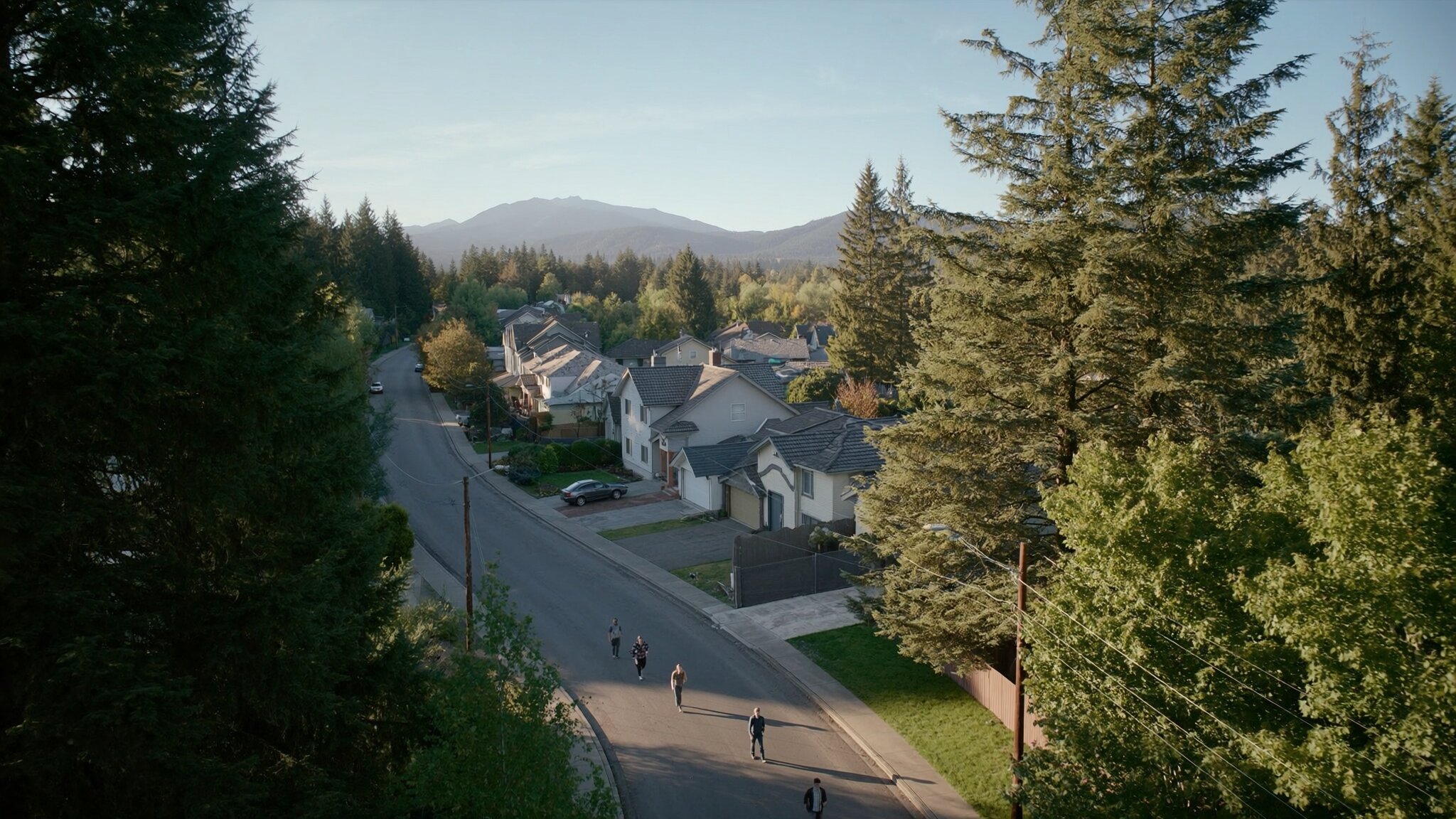
South King County neighborhoods like Renton, Kent, and Auburn offer large lots, trail access, and mountain proximity — at prices well below the Eastside.
What Surprises Relocators Most
I’ve had this conversation dozens of times. Here are the things that catch people off guard.
The gray is real, but it’s not rain. Seattle averages 92 rainy days a year — actually fewer than New York City or Miami. What people don’t expect is the persistent overcast: from October through May, the sky is more often gray than blue. It’s rarely dramatic. It’s just steady. Locals wear hoods, not umbrellas. You get used to it, but it’s worth knowing before you buy a house with a south-facing yard expecting sunshine nine months a year.
Traffic is directional and predictable. The I-405 corridor and I-5 are congested at the same times every day. If your commute runs south-to-north in the morning, you’re going the right direction. The light rail — which now reaches Federal Way and will extend further — is worth building your neighborhood choice around. I always ask relocating buyers: what’s your daily destination, and what time of day? That answer often changes which city we’re looking in.
Washington has no state income tax. This is the one that catches transplants from California off guard in the best way. Washington’s sales tax runs about 10.35% in King County, which is higher than you may be used to. But for most buyers, the absence of state income tax more than makes up for it. At a $200,000 household income, the tax savings versus California run roughly $16,000 a year.
The housing market here moves fast. South King County homes were selling in 6-14 days on average as of spring 2026. Coming from a slower market, buyers often underestimate how quickly they need to be ready to act. I’ve watched buyers from out of state lose homes they loved because they needed two more days to decide. Get pre-approved before you start touring — that’s the single biggest thing you can do to protect yourself.
School Districts: What the Rankings Don’t Tell You
If you have kids, school districts will drive a significant part of your city decision. Here’s how King County’s major districts actually stack up.
Tier 1 (Exceptional, reflected in prices): Bellevue, Mercer Island, Lake Washington, Northshore, and Issaquah school districts all carry top ratings and directly drive home values. If you’re buying in Issaquah, you’re getting Tier 1 schools at prices that are meaningfully below Bellevue and Sammamish — that’s the best value on the Eastside for school-focused families.
Tier 2 (Solid, good value): Federal Way Unified has improved significantly over the past five years and serves a growing commuter population near the new light rail station.
Tier 3 (Uneven — research by school, not just district): Renton and Kent school districts have significant internal variation. Hazen Senior High in Renton ranks #82 statewide, while other Renton high schools rank much lower. When I’m working with a relocating family buying in Renton or Kent, I always map the home address to the specific school assignment before we make an offer. The difference between two houses a mile apart can be significant.
Auburn School District is mid-tier overall but actively investing — three new schools are in development, and the district is growing alongside the city. If you’re buying in Auburn with a 10-15 year horizon, you’re buying into an improving situation.
How to Buy a Home Before You Move
This is the part most relocation guides skip over. Buying a home you’ve never stood inside, in a city you’ve never lived in, with an agent you met on Zoom — it’s genuinely stressful. Here’s how to do it right.

Buying from out of state works — but it takes the right prep. Full pre-approval, a local agent, and at least one in-person trip before closing.
Get fully pre-approved before you tour anything
Not pre-qualified — pre-approved, with income documentation verified and a real credit pull completed. Remote workers should get a Permanent Remote Work Letter from their employer in writing before applying. Verbal confirmation won’t satisfy an underwriter when you’re competing against local buyers who’ve been pre-approved for weeks.
Use virtual tours to eliminate, not to decide
Video tours are useful for crossing homes off the list. They are not reliable for choosing one. If at all possible, plan one trip to King County before your closing date — ideally to tour your top two or three candidates in person, walk the neighborhoods, and get a feel for the commute. If travel truly isn’t possible, ask your agent to do a live video walkthrough during a private showing and narrate everything the camera doesn’t capture.
Understand how Washington closings work
Washington is an escrow state. There are no real estate attorneys at the closing table — an escrow officer and title company facilitate the process. Closings can be done electronically, which makes remote buying workable. You’ll wire funds and sign documents digitally. The process is straightforward once you know what to expect. Also know that Washington’s wet western climate makes moisture intrusion, crawl space condition, and roof health the top three inspection items — do not skip the inspection to be competitive.
The Local Angle: What the King County Market Looks Like Right Now
King County inventory is up roughly 35% year over year as of spring 2026. That’s meaningful. It means relocators have more options, more negotiating leverage, and fewer situations where they need to waive every contingency to win. Inspection contingencies are back on the table in most South King County transactions. Seller concessions — including buydowns and closing cost help — are more common than at any point since 2019.
For a relocator on a tight timeline, this is a much better environment than 2022 or 2023. You’re not walking into a war. You’re walking into a real market where your offer gets read and your questions get answered.
The overall King County median was $880,000 in March 2026. But that number obscures the real value story. If your target is South King County — Renton, Kent, Auburn, Maple Valley — you’re looking at a $609,000 to $763,000 range, with growing inventory and motivated sellers.
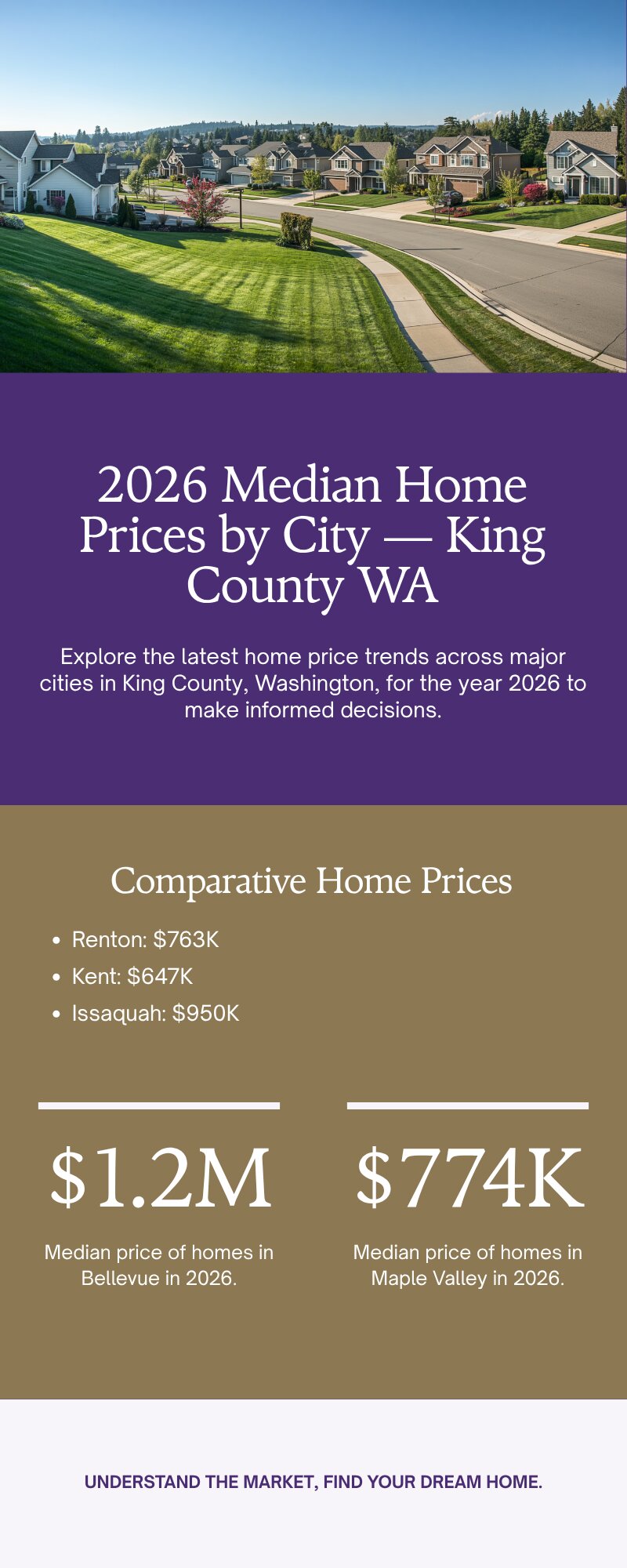
2026 median home prices across King County. South King County cities offer the best value for relocators who don’t need to be in Seattle or on the Eastside every day. Source: King County MLS, spring 2026.
For more on what’s driving these conditions, see my King County mortgage rates overview for 2026 and total cost of homeownership breakdown by city.
What This Means for You as a Relocating Buyer
Start your neighborhood research with your daily destination, not with a map of the county. Where will you spend Tuesday mornings? That question is more useful than “how far is it from downtown Seattle.”
Build your city shortlist around school district tier, commute direction, and price ceiling — in that order. Then let the neighborhoods inside those cities narrow your search.
Get pre-approved before your first house-hunting trip. In South King County, a well-priced home can go under contract in a week. Showing up financially ready is the difference between buying the house and watching it disappear.
And check the down payment assistance programs available to King County buyers. If your household income is under roughly $175,000, you may qualify for programs that put $10,000 to $55,000 toward your down payment. See the full 2026 down payment assistance guide for eligibility and how to stack programs.
If you’re also weighing where to land specifically in South King County, my guide to relocating to Auburn, Washington covers one of the county’s fastest-growing cities in detail.
Frequently Asked Questions
Is King County expensive compared to other major metros?
King County’s median home price of $880,000 puts it in the top tier nationally — roughly on par with Los Angeles and San Diego. However, the absence of Washington state income tax makes total cost of living comparisons more favorable than the home price alone suggests. At a $200,000 household income, the tax savings versus California run roughly $16,000 a year — which offsets a meaningful portion of the price premium over time.
How long does it take to buy a home in King County?
From pre-approval to closing, most transactions run 30 to 45 days. In competitive South King County neighborhoods, timelines can compress. An out-of-state buyer with full pre-approval and a clear target area can move from first showing to accepted offer in a single trip if the timing is right.
Do I need to be physically present to close?
No. Washington State allows electronic closings. You can sign documents remotely and wire funds from anywhere. Some buyers close on King County homes without ever setting foot in the state prior to moving in — though I strongly recommend at least one visit before making an offer.
What are the biggest mistakes out-of-state buyers make?
Three come up repeatedly: choosing a city based on proximity to Seattle when their actual commute destination is elsewhere; arriving without pre-approval and losing homes they loved; and skipping the inspection to strengthen an offer — a risk that almost never pays off in a western Washington climate.
What school districts are best for families relocating to South King County?
Within South King County, the answer is school-specific rather than district-specific. Renton and Kent both have high-performing individual schools alongside lower-performing ones. When I’m working with a family in those areas, we map every address to its specific school assignment before making an offer. Issaquah School District is the clearest top-tier pick on the Eastside at a relatively accessible price point.
Is now a good time to buy as a relocating buyer?
King County inventory is at its highest level in years, inspection contingencies are standard again in most areas, and seller concessions are available. For a relocating buyer with solid pre-approval and flexibility on timing, this is a more favorable environment than it’s been since before the pandemic. See the total cost of homeownership guide for the math on waiting vs. buying now.
Moving to King County is a big decision. The region is genuinely excellent — trails, mountains, water, good jobs, and communities that feel like home once you’re here. The hard part is choosing the right community before you’ve lived in any of them. That’s what I’m here for.
Your guide to life outside Seattle.
253-350-0045 ·
greg@livingoutsideseattle.com ·
www.livingoutsideseattle.com
King County Housing Market Forecast 2026
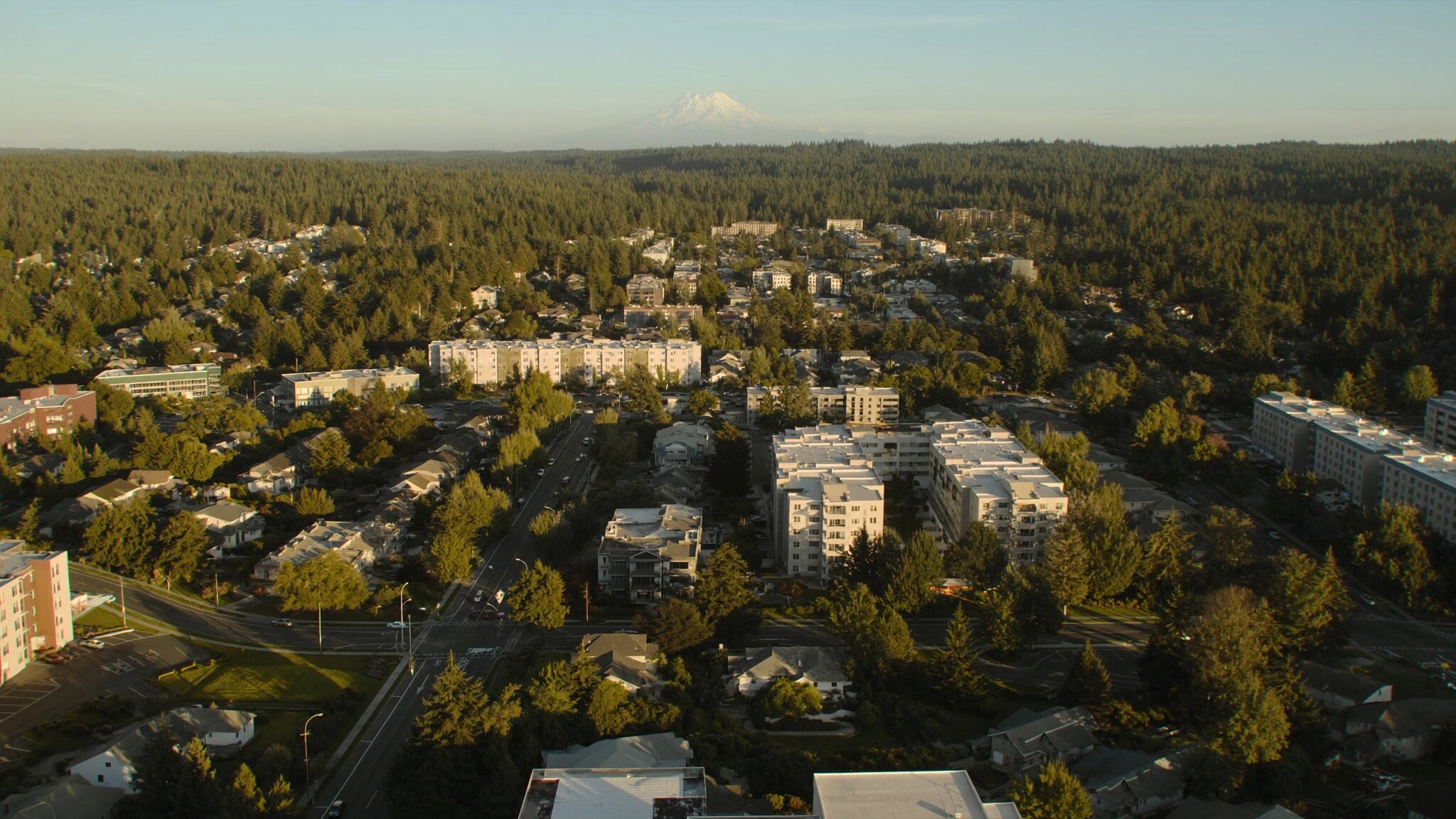
Reviewed July 2026. For this month’s actual numbers, city by city, see the live East + South King County Market Update — updated every week.
The King County housing market has shifted. After three years of near-frantic competition, rising inventory, softening prices in some sub-markets, and mortgage rates that have settled (but not dropped) are reshaping what buyers and sellers can expect in 2026. If you are trying to decide whether to buy, sell, or wait, this is the data you need to see before making that call.
I price homes professionally every day as a BPO field agent. That means I am watching this market in real time, not just reading headlines. Here is my honest read on where King County is heading through the rest of 2026 and what it means for you.
Where the King County Housing Market Stands Right Now
The headline numbers tell a story of transition. As of April 2026, the median home sale price in King County is $835,000 — down roughly 7.5% from the same period last year. Active listings have surged 39% year over year, the largest inventory increase of any major metro in the country. Days on market has stretched from 7 to 12 days countywide.
What does that mean in plain terms? Buyers who spent 2022 and 2023 losing bidding wars on homes now have time to actually look at a house before making an offer. Sellers who priced their home based on last year’s comps are finding out the hard way that the market has moved.
The months of supply figure is the cleanest measure of balance. King County is sitting at roughly 3.2 months right now. A fully balanced market is 6 months. We are not there yet — sellers still have a meaningful edge — but the trend line is clear. This is no longer a “list it and watch offers pile up” market.
See the most recent King County market update for current city-by-city numbers.
King County Housing Market Forecast: What Mortgage Rates Mean for Timing in 2026
Mortgage rates have driven more decisions in this market than any other factor since 2022. The 30-year fixed rate is sitting at roughly 6.6–7.0% as of mid-2026. Most forecasters, including Fannie Mae, project rates will drift toward the low 6% range by year end — possibly 6.0–6.2% by December.
Here is the “so what” for buyers: rates probably are not going to 5% anytime soon. If you are waiting for rates to drop dramatically before buying, you may be waiting into 2027 or beyond. A drop from 6.6% to 6.0% on a $700,000 loan saves you roughly $225 per month. That is meaningful, but it is also erased quickly if prices rebound when rates fall and competition picks back up.
For sellers, rate sensitivity explains why your buyer pool has shrunk. Every half-point increase in mortgage rates prices out a segment of buyers. At 6.6%, a buyer who qualifies for $650,000 at 5.5% now qualifies for roughly $585,000. That is not a small gap when median prices in South King County are in the $640–735K range.
Understand exactly what buyers are paying for mortgages right now in King County.
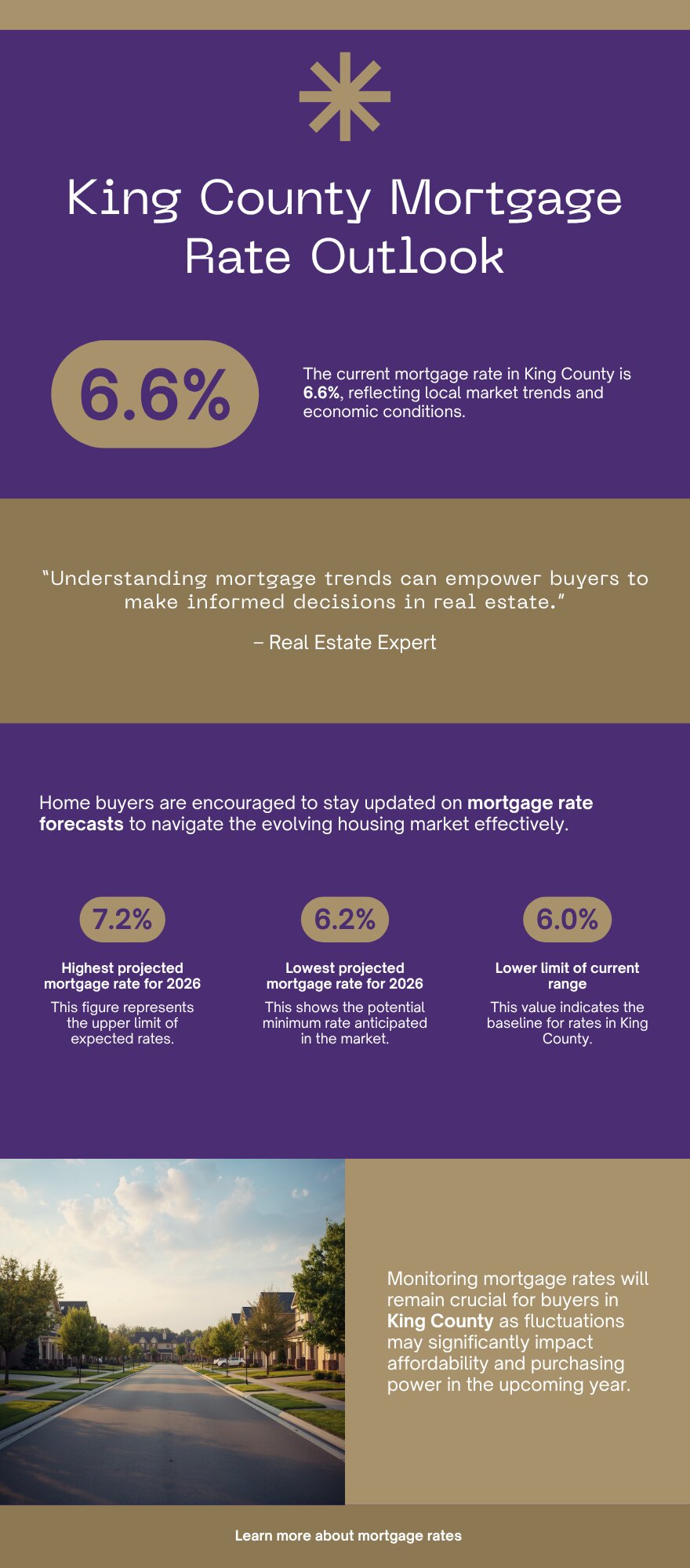
The 30-year fixed rate is at 6.6%+ in mid-2026. Most forecasters project a drift toward 6.0–6.2% by year end — meaningful relief if it holds. Source: Fannie Mae / NWMLS.
South King County: A Different Story Than the Headlines
The countywide numbers can be misleading if you are buying or selling in South King County. Renton, Kent, Auburn, and Maple Valley are holding up differently than the Eastside.
Renton
Median price around $640–671K as of early 2026, with homes selling in about 13 days on average. Prices are up roughly 2% year over year — not the decline you see at the countywide level. Renton’s relative affordability compared to Bellevue and Seattle keeps demand stable even as higher-priced markets soften.
Kent
The most varied market in South King County right now. Entry-level and mid-range homes are moving. Higher-priced homes and properties needing updates are sitting longer. If you are a Kent seller, condition and pricing precision matter more than they did two years ago.
Auburn
Holding at roughly $645K median with about 42 days on market — meaningfully longer than Renton. Auburn’s affordability attracts first-time buyers, but that segment is also the most rate-sensitive, which is slowing absorption.
Maple Valley
Continues to attract buyers who want larger homes, outdoor access, and strong schools. One of the more consistently active pockets of South King County, with new construction in Black Diamond adding adjacent supply.
The pattern across all four: price under $700,000, good condition, well-presented. These homes are still moving. The market is being selective, not frozen.
If Renton is your market, read this before you list.
What the Tech Layoffs Are Actually Doing to King County Real Estate
Amazon cut roughly 16,000 jobs company-wide, and the Puget Sound region absorbed the heaviest share. When you add Microsoft’s reductions, an estimated 16,000–17,000 tech workers in King County have been affected in 2026. That is a real demand shock at the high end of the market.
The impact is not uniform. High-end single-family homes in Bellevue, Kirkland, and parts of Renton’s Highlands that were popular with tech workers have seen price softening and longer days on market. Capital gains tax concerns are pushing some high-net-worth sellers to delay, which keeps certain inventory off the market even as lower-priced inventory rises.
South King County is less exposed to the tech demand shock. Buyers in Renton, Kent, and Auburn tend to be Boeing employees, healthcare workers, educators, and local service industry professionals — a more diversified employment base. That is part of why South KC numbers have held steadier than the Eastside.
What This Means for Sellers in 2026
If you are thinking about listing this year, here is the straight answer: you can still get a strong price, but you have to earn it now. The days of overpricing and waiting for a buyer to blink are over for most of King County.
Accurate pricing from day one
Overpriced homes are sitting. I track price reductions in my BPO work daily, and the pattern is clear — homes that start too high end up selling for less than a well-priced home would have gotten from the start. The first 10 days on market are everything.
Condition matters more than it did
Buyers have options now. If your home needs work and it is priced like it does not, buyers will skip it. Light repairs, fresh paint, and thorough cleaning move the needle far more than expensive renovations.
Timing within the season still matters
The spring selling season (March–June) still produces the best results in King County. We are in the tail end of it right now. If you are ready, there is still a motivated buyer pool. Waiting until fall means competing with another wave of listings when buyer activity historically slows.
In today’s King County market, condition and pricing accuracy matter more than ever. Sellers who prepare their home and price it right are still winning.
What This Means for Buyers in 2026
Buyers have more leverage today than at any point in the last four years. Here is how to use it.
You have time to do proper due diligence. Request inspection contingencies. You are likely to get them in markets where days on market is 12 or more. Two years ago, buyers routinely waived inspection rights to compete. That is no longer necessary in most price ranges in King County.
You can negotiate on price and concessions. With 3.2 months of supply, sellers who need to move are willing to talk. Seller-paid closing cost credits and rate buydown contributions are showing up again. I am seeing this regularly in my work.
Do not wait for rates to drop to “perfect.” Every month you wait on the sidelines is a month of rent paid with no equity building. The break-even math on buying vs. renting in most of South King County favors buying, even at today’s rates, when you factor in equity accumulation and the real likelihood that prices in sub-$700K markets do not fall meaningfully.
See where first-time buyers are finding value in King County right now.
King County Sub-Market Snapshot for the Rest of 2026
Here is my honest forecast by market tier through December 2026:
Under $700K — South KC (Renton, Kent, Auburn)
Stable to modest appreciation (1–3%). Buyer demand is steady. Rate sensitivity keeps some buyers on the sidelines but also keeps prices from running up fast. This is the most reliable segment of the market right now.
$700K–$900K — Bellevue Suburbs, Issaquah, Upper Renton
Choppy. Tech demand softening is felt here. Sellers need to price defensively. Good homes priced right will sell in 2–3 weeks; overpriced homes will sit for months.
$900K+ — Bellevue, Kirkland, Premium Eastside
The most exposed segment. Inventory has grown, demand from tech workers has pulled back, and capital gains sensitivity is keeping some equity-rich sellers hesitant. Expect continued price pressure through Q3.
New Construction
Continues adding supply in Black Diamond, Auburn’s Lakeland Hills, and parts of Maple Valley. This additional inventory matters for resale sellers in those areas — you are competing with builder incentives that individual sellers cannot match.
Frequently Asked Questions
Will home prices drop in King County in 2026?
Countywide, prices are down about 7.5% from the spring 2025 peak. In South King County sub-markets like Renton, prices are still slightly positive. A dramatic crash is not supported by the data — inventory is rising but still well below 6 months supply. Gradual softening at the high end is the more likely path through 2026.
Should I buy now or wait for rates to drop?
If you find the right home and can afford it at today’s rates, buying now is usually the smarter call. When rates drop, competition will pick up and prices will likely respond. You can always refinance into a lower rate. You cannot go back and buy at today’s prices once the market shifts.
Is it still a seller’s market in King County?
In some pockets, yes. South King County under $700K is still closer to a seller’s market. The countywide data and the Eastside above $900K are trending toward balanced. It depends heavily on your specific city, price point, and property condition.
How are tech layoffs affecting real estate in my neighborhood?
The impact is most direct within 10 miles of major tech campuses — parts of Bellevue, Kirkland, Redmond, and parts of Renton. If you are in South King County (Auburn, Kent, Federal Way, Maple Valley), the effect is indirect and more muted.
What is the biggest mistake sellers are making right now?
Overpricing based on what a neighbor sold for 18 months ago. The market has moved. Comp selection requires a skilled eye right now — a small difference in how you select comparables produces a very different number, and getting it wrong costs sellers real money through price reductions and carrying costs.
How many months of supply is King County at?
Roughly 3.2 months as of mid-2026, up from under 2 months a year ago. A balanced market is typically defined as 6 months of supply. We are not there, but the trend has shifted meaningfully toward buyers.
Your guide to life outside Seattle.
253-350-0045 ·
greg@livingoutsideseattle.com ·
www.livingoutsideseattle.com
Total Cost of Homeownership in King County 2026
Most buyers focus on the mortgage payment. That’s the number that shows up in every rate calculator, every lender pre-approval letter, every Zillow estimate. But in King County, the mortgage is often just 60–70% of what you actually pay each month to own a home. The rest — property taxes, insurance, HOA fees, PMI, and maintenance — adds up fast, and most first-time buyers get surprised by it.
I’ve worked in South and East King County for over 13 years, and I do professional property valuations every single day as a BPO field agent. One pattern I see constantly: buyers who were “pre-approved” for a purchase price they couldn’t actually afford once all the real costs hit their bank account in month two. This guide walks you through the full picture — every cost, with real numbers for King County cities — so you can make a decision you’ll still feel good about a year from now.
What Goes Into Your True Monthly Payment
The mortgage principal and interest (P&I) is the fixed part — it doesn’t change month to month on a 30-year fixed loan. Everything else does, or at least it can. Here’s the full stack of costs to run through before you make an offer.
Principal and Interest (P&I)
The core of your payment, and the number your lender leads with. At current King County rates of around 6.4–6.7% for a 30-year fixed, a $686,000 loan (10% down on a $763,000 Renton home) produces a monthly P&I payment of roughly $4,360. It’s real, but it’s not the whole story.
Property Taxes
Significant in King County — and they just went up. For the 2026 tax year, King County’s total property tax levy is $8.4 billion, a 10% jump from 2025. The average effective rate across the county runs around 0.9%–1.1% of assessed value annually. On a $763,000 home in Renton, that works out to roughly $690–$840 per month ($8,280–$10,080 per year).
Your specific parcel’s levy code determines the exact number — the King County Assessor’s eReal Property search tool will show you the breakdown for any address you’re evaluating. Renton sits on the lower end; Sammamish and Issaquah homeowners typically pay more because of school district levies and city-specific ballot measures.
Homeowners Insurance
Washington State averages $1,474–$1,596 per year — roughly $125–$133 per month. That puts Washington below the national average, which is a piece of good news. Expect to pay more if your home has a wood roof, is older than 30 years, or sits in a wildfire-adjacent zone (relevant in Maple Valley, Enumclaw, or Black Diamond).
PMI (Private Mortgage Insurance)
Applies if you put down less than 20%. PMI typically runs 0.46%–1.5% of the original loan amount annually. On a $686,000 loan at a mid-range rate of 0.7%, that’s about $400 per month.
PMI drops off once you hit 20% equity — either through price appreciation or paying down the principal. Given King County’s 5-year appreciation history of roughly 5–6% annually, some buyers reach that equity threshold in 3–4 years rather than waiting out the full amortization schedule.
HOA Fees
These vary wildly by property type. Condos in King County typically run $300–$700 per month for a mid-range building — downtown Seattle luxury high-rises can exceed $1,000. Townhomes usually fall in the $150–$350 per month range. Single-family homes in planned communities often run $75–$200 per month for landscaping and common areas.
Many single-family homes in South King County have no HOA at all — which reduces monthly cost but means you carry 100% of exterior maintenance yourself.
Maintenance Reserve
The number most first-time buyers skip — and the one that bites hardest. The commonly cited “1% rule” (set aside 1% of your home’s value per year) is a reasonable floor. Studies show the average homeowner actually spends $8,800 per year on maintenance and repairs. For an older King County home (pre-1990), budget closer to 1.5%–2%.
On a $763,000 home, 1% equals $7,630 per year — about $636 per month set aside. You won’t spend it every month. Some months nothing breaks, then your furnace goes in January.
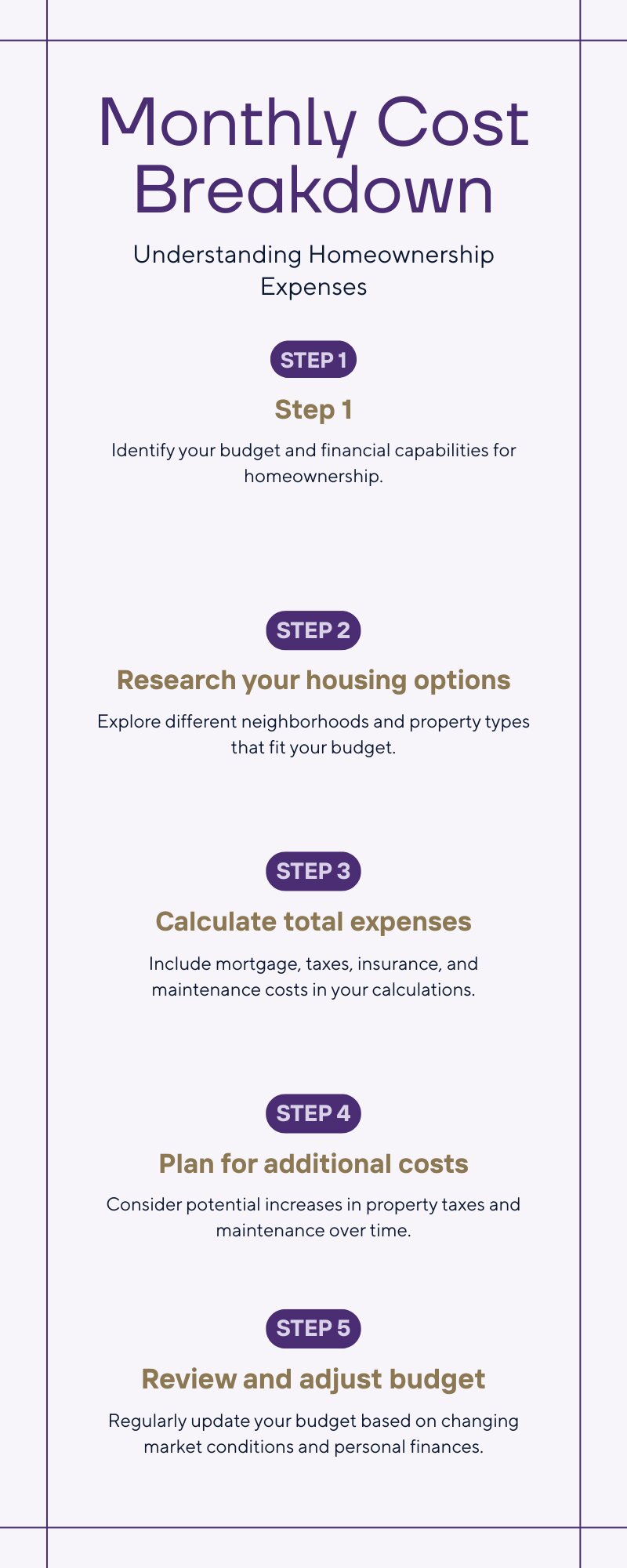
The mortgage payment is just one piece. For a Renton condo at $422K, all-in monthly costs run about $3,642. For a single-family home at $763K, expect closer to $6,224 per month. Source: King County market data, 2026.
Condo vs. Single-Family: How Total Cost Compares
This is one of the most common calculations I walk buyers through. The sticker price on a condo is lower — but the total monthly cost is often closer to a single-family home than buyers expect, once HOA fees are factored in. Here’s a real-numbers comparison using current King County data.
Condo in Southwest King County — $422,000
10% down ($42,200) / Loan: $379,800 / Rate: 6.5%
P&I: ~$2,400 | Taxes: ~$315 | Insurance: ~$80 | HOA: ~$450 | PMI: ~$222 | Maintenance: ~$175
Total: ~$3,642/month
Single-Family Home in Renton — $763,000
10% down ($76,300) / Loan: $686,700 / Rate: 6.5%
P&I: ~$4,342 | Taxes: ~$715 | Insurance: ~$130 | HOA: $0 | PMI: ~$401 | Maintenance: ~$636
Total: ~$6,224/month
The income difference this requires is significant. At a 28% front-end debt-to-income ratio (typical for conventional loan qualification), the condo scenario requires roughly $156,000 in gross household income. The single-family scenario requires roughly $267,000. Those numbers shift with your credit score, debt load, and lender — but they illustrate why the condo-vs-house decision often comes down to math rather than preference.
How King County Cities Compare on Total Cost
Property taxes are the biggest variable after the mortgage itself. Here’s a rough comparison of annual tax cost by city for a home around $700,000–$800,000.
Renton
Effective levy rate approximately 0.9%–1.0%. On an $800,000 home: ~$7,200–$8,000 per year ($600–$667/month). Renton sits on the lower end of King County cities, making it one of the better values in South KC for total monthly cost.
Kent & Auburn
Effective levy rates slightly higher than Renton, typically 1.0%–1.1%. On a $700,000 home: ~$7,000–$7,700 per year ($583–$642/month). School district and fire district renewal levies are a consistent factor in both cities.
Issaquah
Higher rates due to Issaquah School District supplemental levies — one of the highest-rated districts in the state, and that comes with a cost. On a $900,000 home: ~$9,000–$10,800 per year ($750–$900/month).
Sammamish
Among the highest effective rates in South/East King County. On a $1,000,000 home: ~$10,000–$12,000 per year ($833–$1,000/month). School district, city, and specialty district levies stack up quickly in Sammamish.
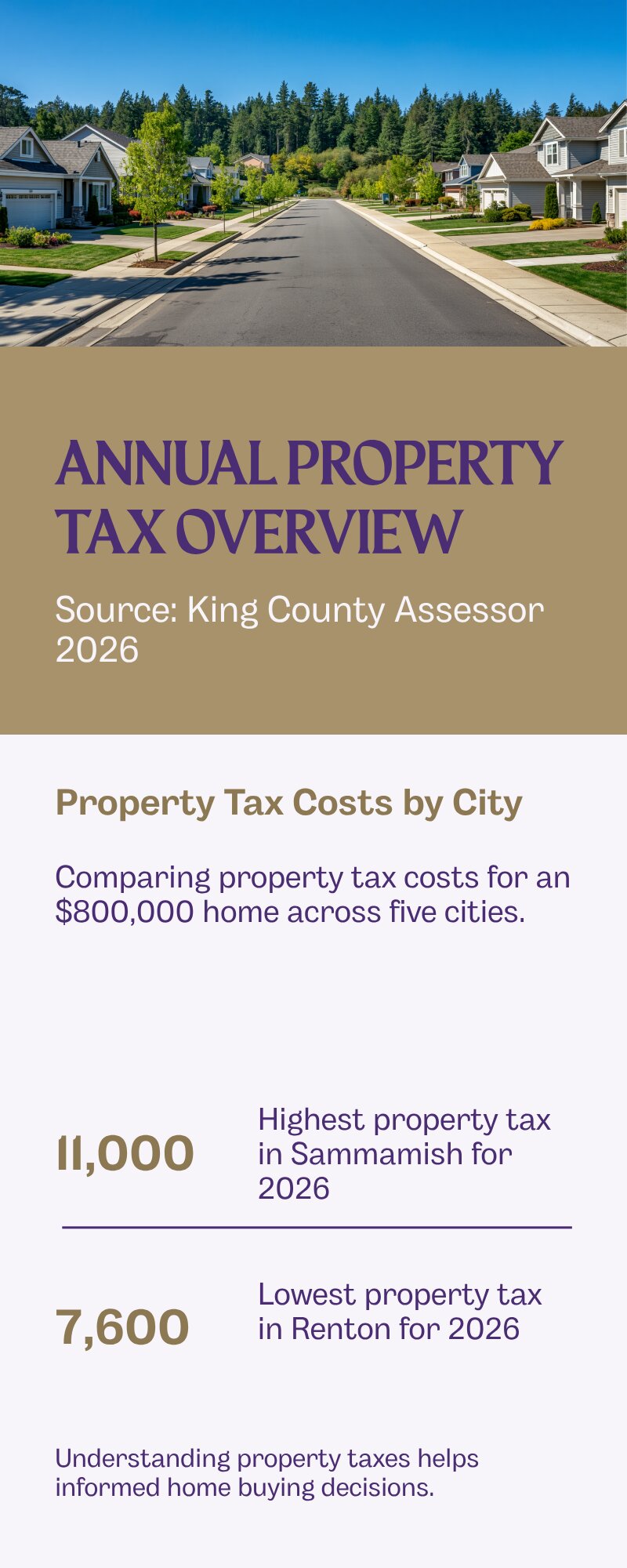
Annual property tax by city for an $800,000 home in King County. Renton and Kent are the most affordable in South KC; Issaquah and Sammamish carry higher levy rates driven by school district and specialty district measures. Source: King County Assessor 2026.
The Costs Most First-Time Buyers Underestimate
Beyond the monthly stack, a few one-time and recurring costs catch buyers off guard in year one.
Closing costs typically run 2%–3% of the purchase price. On a $763,000 home, that’s $15,260–$22,890 due at closing — on top of your down payment. This covers lender fees, title insurance, escrow, and prepaid items like the first year’s homeowners insurance and property tax reserves.
Immediate repair costs are real, especially in South King County where a lot of the housing stock was built in the 1980s and 1990s. Buyers of homes older than 30 years should budget up to $3,200 in unexpected year-one maintenance. A pre-listing inspection won’t catch everything — aging HVAC systems, older water heaters, and deck boards that just barely passed can all become your problem in year one.
HOA move-in fees and reserve contributions are easy to overlook. Some condo and townhome communities charge a one-time move-in fee ($500–$2,000) and require a contribution to the reserve fund at closing. Always request the HOA’s reserve study and financial statements before making an offer. Buildings with reserve deficits have hit some King County buyers with special assessments of $10,000–$30,000 per unit.
Utility cost changes hit harder than people expect when moving from a rental. You’re now paying for water, sewer, garbage, and often gas in addition to electricity. In South King County, expect $300–$500 per month depending on home size and season.
What This Means for Buyers in South and East King County
Running the full cost stack before making an offer is one of the most important steps a first-time buyer can take. The pre-approval letter and the real monthly budget are two different numbers.
My recommendation for buyers in Renton, Kent, and Auburn: run the full stack before falling in love with a specific home. The purchase price is a starting point. The number that actually matters for your quality of life is the total monthly outflow — and whether that leaves you enough runway to build equity, handle surprises, and not feel house-poor by month six.
For condos: the lower sticker price is real, but the HOA fee narrows the gap with single-family more than buyers expect. The King County Condo Buyer’s Guide walks through HOA due diligence in detail — including how to spot a building with a reserve fund problem before you commit.
For buyers still comparing property types, Condo vs. Townhouse vs. Single-Family in King County breaks down the full financial and lifestyle trade-offs side by side.
On the mortgage side: King County Mortgage Rates 2026 has the current rate picture and payment math, and the Mortgage Rate Buydown Guide explains how a seller-paid buydown can reduce your initial monthly cost in a way that pre-approval letters often miss.
Frequently Asked Questions
How much more than the mortgage payment is total homeownership cost in King County?
For most buyers, add $800–$1,500 per month on top of the P&I payment to get the true all-in cost. The biggest additions are property taxes ($600–$900/month on a median-priced home), insurance ($125–$135/month), and a maintenance reserve ($400–$700/month). PMI and HOA apply depending on your situation.
What is the property tax rate in Renton WA in 2026?
Renton’s effective property tax rate is approximately 0.9%–1.0% of assessed value annually, placing it on the lower end of King County cities. For a $763,000 home, expect roughly $6,900–$7,600 per year, or $575–$635 per month.
Do condos have lower total monthly costs than single-family homes in King County?
The purchase price is lower, but HOA fees close the gap. A condo at $422,000 with $450/month HOA ends up with a total monthly cost in the $3,600–$3,900 range. A single-family home at $763,000 (no HOA) runs $5,800–$6,400 per month all-in. The condo is still cheaper — but the difference is smaller than the price tags suggest.
Does PMI go away on a King County home?
Yes. Federal law requires lenders to cancel PMI automatically once your loan balance drops to 78% of the original purchase price. You can also request cancellation at 80%. Given King County’s appreciation history, some buyers hit that equity mark in 3–5 years rather than waiting out the amortization schedule.
What HOA fees should I expect for a King County townhome?
Townhome HOAs in South and East King County typically run $150–$350 per month. Lower-end communities cover exterior maintenance and landscaping only; higher-end communities include water, garbage, roof reserves, and exterior paint schedules.
What maintenance budget should I set for a King County home?
Budget 1%–1.5% of the home’s value per year. On an $800,000 home, that’s $8,000–$12,000 annually ($667–$1,000/month). For homes built before 1990, lean toward the higher end. Major systems — roof, furnace, water heater — can each cost $8,000–$15,000 when they need replacement.
Your guide to life outside Seattle.
253-350-0045 ·
greg@livingoutsideseattle.com ·
www.livingoutsideseattle.com
Empty Nester Downsizing Guide: King County WA 2026
You raised your family in that house. Now it’s time to figure out what comes next.
The kids are gone. The guest rooms sit empty most of the year. You are mowing a lawn, heating rooms, and paying property taxes on square footage you stopped using years ago. If that sounds familiar, you are in good company.
A 2026 Redfin study found that empty-nest boomers own 28% of the nation’s large homes — while millennial families with kids own just 16% of that same housing stock. In King County, that mismatch is especially sharp. Homeowners who bought in Renton, Kent, Auburn, Covington, and Maple Valley in the 1990s or early 2000s are sitting on significant equity in homes that no longer fit their day-to-day lives.
Downsizing sounds simple. Sell the big house, buy something smaller, pocket the difference. But when you actually start thinking through it — what to keep, where to land, condo vs. smaller single-family, the tax implications, the emotional weight of it — it gets complicated fast. This guide is designed to help you think it through clearly, not push you toward any particular decision.
Is This the Right Time to Downsize?
Before you think about where you are going, it helps to get honest about why you want to move. The right reasons to downsize are different from the wrong ones — and the market does not care which is driving you.
Strong reasons to move
The house genuinely does not fit your life anymore. You are paying for space you do not use. Maintenance is becoming a burden rather than a source of pride. You want to free up equity for retirement, travel, or helping your kids. You want to live somewhere more walkable or lower-maintenance. These are all clear, grounded reasons to take the next step.
Reasons to pause
You are reacting to a difficult transition — a recent empty nest, a loss, family pressure. You are hoping the market will time itself perfectly. None of these are reasons to stay forever, but they are reasons to slow down and give the decision more space before you commit.
The 2026 King County market actually gives you more room to breathe than the market of three or four years ago. Active listings across the county rose nearly 38% year over year, which means you are not scrambling in a panic-buy environment on the purchase side. That is real breathing room worth using.
The Financial Picture: What You Are Actually Working With
If you bought in South or East King County before 2015, your equity position is likely substantial. King County’s median home price has hovered around $850,000 to $900,000 for most homes over 2,000 square feet in established areas. A home you bought for $350,000 in Renton in 2005 could easily have a current market value in the $700,000 to $800,000 range, depending on condition and location.
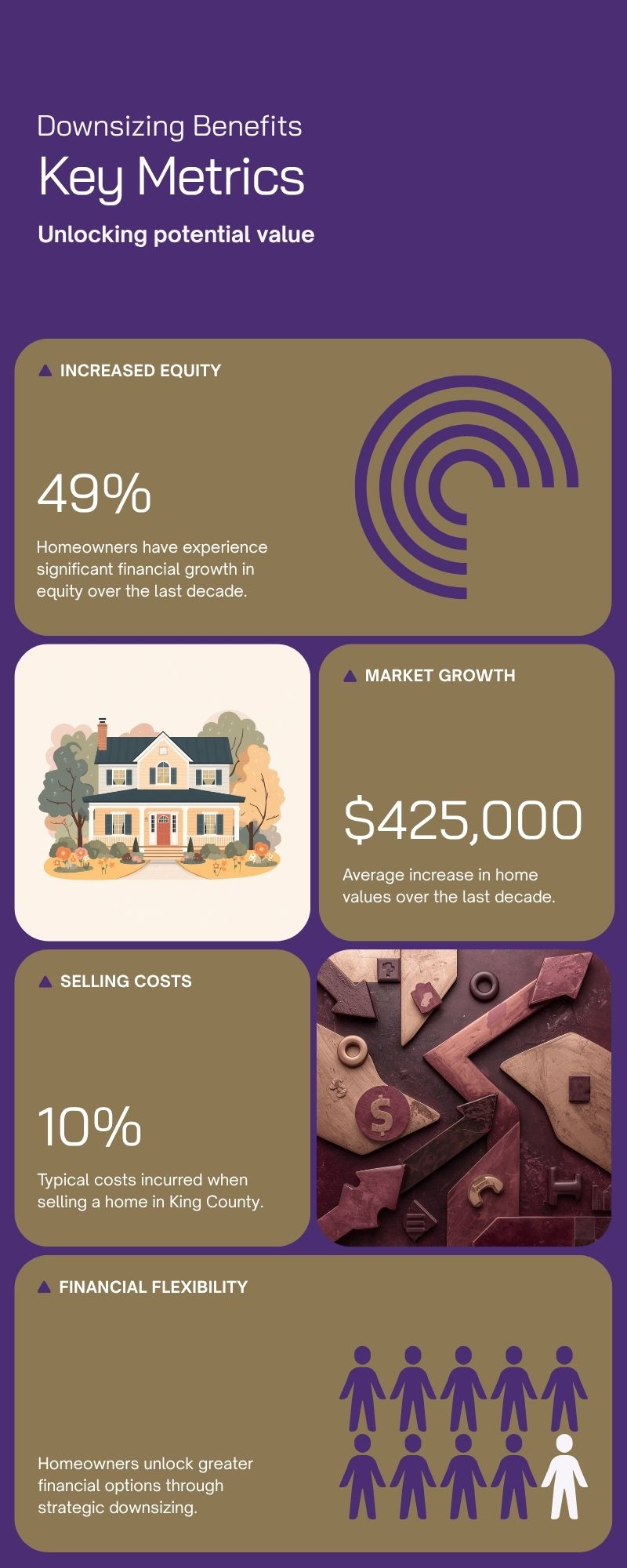
Sample equity math for a South King County homeowner who bought in 2005. Your numbers will differ — reach out for a free home value estimate.
Here is the tax piece that matters most: Washington state does not impose a capital gains tax on real estate sales. The state capital gains tax, which went through rate changes in 2025, still explicitly exempts real property. What you do need to account for is the federal exclusion: if you have lived in the home as your primary residence for at least two of the last five years, the first $500,000 in gain (for married couples filing jointly) is excluded from federal capital gains tax. For most King County empty nesters who have owned their home for 15 to 25 years, this exclusion covers the bulk or all of their gain.
You will also owe Washington’s Real Estate Excise Tax (REET) as the seller — a graduated rate that runs roughly 1.28% on the first $525,000 of the sale price and higher on amounts above that. On a $750,000 sale, budget approximately $10,000 to $12,000 for REET, plus standard seller costs like agent commission, title, and escrow. Full breakdown in the Capital Gains on Home Sales in Washington State guide.
The bottom line: for most King County empty nesters, downsizing is a significant equity event — and often a tax-advantaged one. The financial case is usually strong. The harder questions are about lifestyle, not math.
Condo vs. Smaller Single-Family: The Real Tradeoff
This is the question I hear most often from clients in this situation, and the honest answer is: it depends on which part of the hassle you are trying to escape.
If you want to eliminate maintenance entirely
A condo is the cleaner solution. No lawn, no roof, no gutters. The HOA handles exterior upkeep. The tradeoff is that you pay monthly dues — often $400 to $700 per month in South and East King County — and you give up direct control over your living space. You also need to do HOA due diligence: check the reserve fund, look at the meeting minutes, understand the rental cap rules. A condo with a thin reserve fund is a future special assessment waiting to happen.
If you want less house but still want a yard
A smaller single-family home in South King County may be the better fit. Cities like Renton, Kent, and Auburn have an inventory of well-maintained 1,100 to 1,600 square foot single-family homes that are a real step down in upkeep from a 2,500-square-foot house — without eliminating outdoor space entirely. These homes also tend to appreciate more reliably than condos over time and are easier to sell when you eventually need to.
If you want a community built for your stage of life
Consider a 55+ community. Providence Point in Issaquah is one example — a gated active adult community with strong amenities and a tight-knit neighborhood feel.
For a side-by-side breakdown of all three property types, the Condo vs. Townhouse vs. Single-Family in King County guide covers the full comparison.
King County: Where to Land
Geography matters when you are downsizing because the type of life you want in your next home often lines up with a specific part of the county.
South King County: Renton, Kent, Auburn, Covington, Maple Valley
Your dollar goes further here. Smaller single-family homes in established neighborhoods run $475,000 to $650,000 depending on city and condition. If you want to stay close to where you raised your family, keep your existing doctor and dentist, and stay within 20 minutes of your current neighborhood, South KC is the logical landing zone. Covington and Maple Valley in particular have quiet, low-maintenance pockets that work well for empty nesters who want more space than a condo but less upkeep than a large house.
East King County: Issaquah, Sammamish, Bellevue Adjacent
If the Eastside is home and walkability or trail access matters to you, the Issaquah corridor has strong options. Prices are higher — plan on $650,000 to $850,000 even for smaller homes — but the quality of life amenities are strong and the housing stock holds value well. Issaquah’s older neighborhoods have more modest footprints that work well for downsizing without going condo.
If you have already thought about this in the Sammamish context, the Should I Downsize My Sammamish Home post covers the local tradeoffs in detail.
What to Keep, What to Let Go
This part is where most people get stuck. The house itself is a straightforward financial transaction. The stuff inside carries thirty years of accumulated life, and deciding what to do with it is genuinely hard.
Starting the declutter process 12 to 18 months before you list gives you time to make good decisions without the pressure of a closing deadline.
Start 12 to 18 months before you list
This is not about the stuff — it is about your mental state. Moving from a family home to a smaller place after 20 or 30 years is a real transition. Starting early gives you time to process decisions without pressure and to let go of things gradually rather than all at once.
Measure first, then decide
Before you get sentimental about the dining table, find out if it fits in the new space. Many people hold on to things for emotional reasons only to discover the item would not have worked in the new home anyway. Get the floor plan of your target home type and measure everything you plan to keep.
Set a firm deadline with your kids
Adult children are a variable in every downsizing move. Items that belong to them, childhood memorabilia they might want, furniture they might claim — these need a hard deadline. “You have until October 1 to pick up what you want. After that, it goes.” Kindly stated, firmly enforced.
The right order
Go room by room in this sequence: living spaces, bedrooms, clothes, kitchen, office, guest rooms, garage, attic. Leave sentimental storage for last. The physical stuff builds decision-making muscle for the harder emotional items.
For high-value items, use Facebook Marketplace, Craigslist, or a local estate sale company. A well-run estate sale can move significant furniture volume in a weekend and put money in your pocket rather than requiring dump runs.
The practical goal: move only what you would buy again today if you were furnishing the new space from scratch.
What This Means for Move-Down Sellers
If you have been living in your King County family home for 15 or more years and the house no longer fits your life, 2026 is a reasonable year to act. Inventory is up, which helps you on the buy side. Your equity position is likely strong. The federal tax exclusion probably covers your gain. And the market has enough selection that you are not forced into a rushed decision on where you land.
Frequently Asked Questions
How much equity does the average King County empty nester have?
There is no universal number, but homeowners who bought in South King County before 2015 at prices between $250,000 and $450,000 are typically sitting on $300,000 to $500,000 or more in equity, depending on current value and remaining mortgage balance. Your equity is the difference between your current market value and what you owe — not what you paid.
Do I owe taxes when I downsize in Washington State?
Washington state does not tax real estate capital gains. At the federal level, married couples filing jointly can exclude up to $500,000 in gain from the sale of a primary residence they have lived in for at least two of the last five years. Most King County empty nesters fall well within this exclusion. Talk to a CPA about your specific situation before closing.
Is a condo right for a downsizing move?
It depends. Condos work well if eliminating exterior maintenance is your primary goal and you are comfortable with HOA fees and rules. They carry more financing and resale risk than single-family homes, and they require more due diligence upfront — reserve fund, rental caps, meeting minutes. Do not skip the HOA review.
How long does downsizing take?
From the first serious conversation to handing over keys, plan 12 to 18 months if you want the process to feel manageable. That includes decluttering, preparing the home for sale, selling, buying, and moving. Compressing it into three to four months is possible but stressful for most people.
What if I still have a low mortgage rate on my current home?
A 3% rate feels like a golden ticket — and it is, until you calculate what you are spending to keep that ticket. If the cost of maintaining and occupying a home larger than you need exceeds the financial cost of giving up the rate, the math usually still favors moving. It is a personal calculation worth doing carefully. I can help you run the numbers.
When is the best time of year to sell in King County?
Spring (March through June) is historically the strongest window for seller pricing in King County. Fall (September through October) is a solid second choice. If you are planning a move, working backward from a spring listing date and starting prep 12 months before gives you the best combination of market timing and preparation time.
This is not a small decision. The family home carries more than just square footage — it carries time. But there is also a real opportunity in the next chapter, and getting the move right starts with thinking it through clearly rather than rushing.
When you are ready to talk through your specific situation in Renton, Kent, Auburn, Covington, Maple Valley, or anywhere in South or East King County, reach out directly.
Your guide to life outside Seattle.
253-350-0045 ·
greg@livingoutsideseattle.com ·
www.livingoutsideseattle.com
Rent Out vs. Sell Your King County Home: The Real Math
Should you become a landlord or cash out? Here’s the real math King County homeowners need before making this call.
If you’ve been sitting on a home in Renton, Kent, Auburn, or anywhere in South or East King County, you’ve probably had this thought: what if I just rented it out instead of selling? Especially with home values still holding strong — median prices around $859,000 countywide in spring 2026 — the idea of collecting rent every month while your property appreciates sounds appealing.
But the math is more complicated than it looks on paper. And Washington’s landlord-tenant laws changed significantly in 2025, adding rules most homeowners-turned-landlords don’t know about until it’s too late.
This post walks through both sides of the decision — actual rental income projections, net sale proceeds, tax implications, cash flow math, and the real-world landlord responsibilities that don’t show up in the rosy scenarios. By the time you’re done reading, you’ll know which option makes more financial sense for your situation.
The Rental Income Side: What King County Homes Actually Rent For
Let’s start with what you could realistically collect in rent. King County single-family rental rates in 2026 vary a lot by city and home size, but here are realistic ranges for typical South and East King County homes.
Three-bedroom single-family homes in Renton are pulling $2,800 to $3,200 per month. In Kent, the range is closer to $2,400 to $2,800. Auburn runs slightly lower, typically $2,200 to $2,600 for a comparable home. Move east to Issaquah or Sammamish, and a three-bedroom can fetch $3,200 to $3,800 monthly.
Sounds like solid money. But gross rent is not your income. Your net cash flow depends on what you owe and what it costs to run the property.
Here’s a real example. Say you own a three-bedroom home in Renton worth $700,000. You bought it five years ago, your current mortgage balance is $480,000, and your rate is 4.5%. Your monthly carrying costs look something like this:
Monthly Carrying Costs — High Mortgage Scenario
Mortgage P&I at 4.5% on $480K balance: ~$2,430
Property taxes (King County ~1.0% annually): ~$583/month
Landlord insurance (~15% more than owner-occupied): ~$150/month
Maintenance reserve (1% of value per year / 12): ~$583/month
Total carrying costs: ~$3,746/month
At $3,000 rent: -$746/month before vacancy or management fees
If you hired a property manager — which handles tenant screening, rent collection, and maintenance coordination — expect to pay 8% to 10% of gross rent, or another $240 to $300 per month on top of that negative.
That scenario doesn’t cash flow. It costs you money every month to keep it.
Now flip it. Same Renton home, but you paid it down to $300,000 and your rate is 3.0% from a 2021 refinance. Monthly P&I drops to approximately $1,265. Suddenly the same $3,000 rent gives you positive cash flow after all expenses. That’s the home where keeping it as a rental makes financial sense.
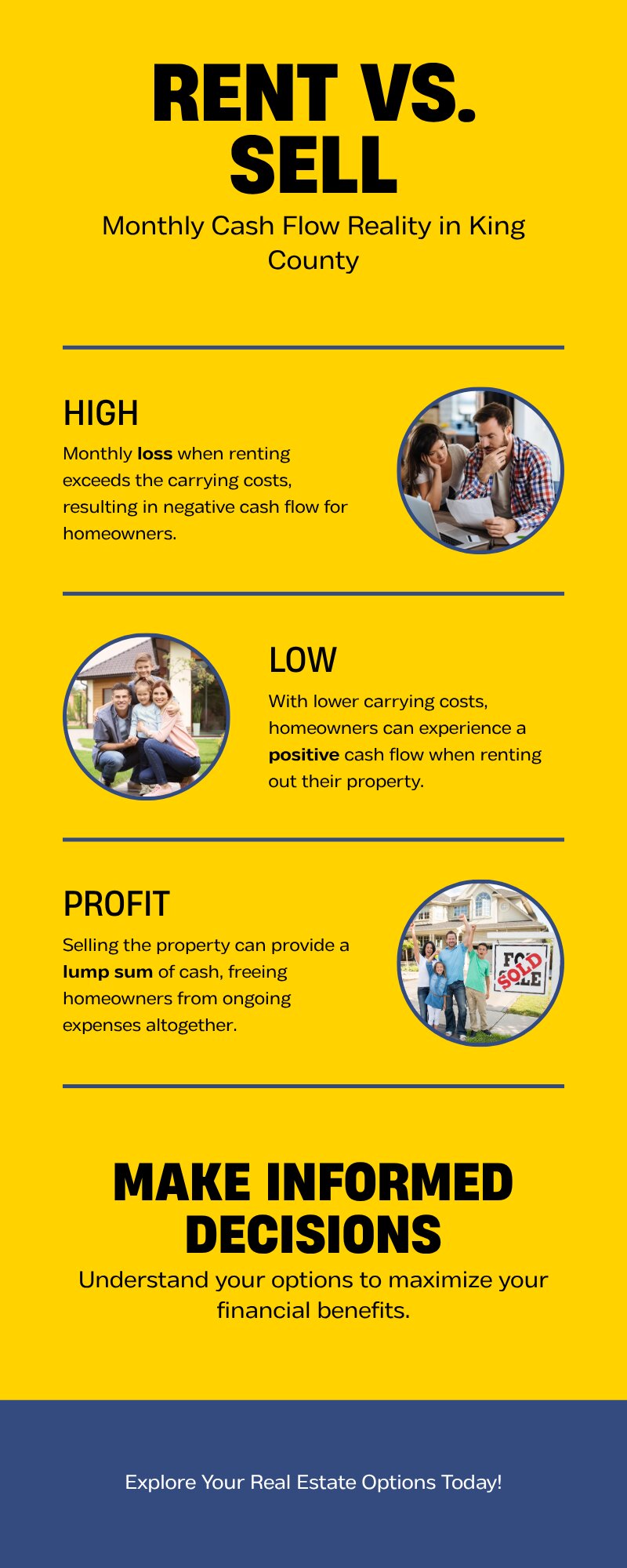
Two scenarios, same rent. The only thing that changes the outcome is what you owe. Run your actual numbers before deciding.
The Sale Side: What You Actually Walk Away With
When you sell, you get a lump sum. But net proceeds are not the same as your home’s sale price. Here’s what comes out.
Real Estate Excise Tax (REET) in King County runs approximately 1.78% of the sale price on a home in the $700,000 to $1.5 million range. On a $700,000 sale, that’s $12,460. Agent commissions typically run 5% to 6% total — on $700,000, that’s $35,000 to $42,000. Closing costs — title insurance, escrow, pro-rated taxes — add another $3,000 to $5,000.
So on a $700,000 sale, you might net $635,000 to $649,000 before any mortgage payoff. Subtract the $480,000 balance, and you walk away with roughly $155,000 to $169,000 in cash. That’s a down payment on your next home, a fully funded investment account, or two years of rental losses avoided.
If you’re in a lower-equity position — say $300,000 owed on a $700,000 home — the sale gives you approximately $355,000 to $369,000 cash in hand. Now the math shifts. Holding the property becomes more interesting because you have equity working for you every year.
Tax Implications: Where Things Get Complicated
This is the part most homeowners don’t think through carefully enough.
If you sell your primary residence, Washington’s $500,000 capital gains exclusion (for married couples; $250,000 for single filers) likely protects your gain from federal tax entirely, provided you’ve lived there two of the last five years. Washington state has no income tax, so there’s no state capital gains tax on primary residence sales either. You pay REET at closing and that’s largely it. For a full breakdown of how Washington taxes work on a home sale, see our guide to capital gains on home sales in Washington State.
If you convert to a rental and sell later, the tax picture changes. Once you stop living there as your primary residence, you start losing your exclusion eligibility. Sell after the two-year primary-residence window closes, and your gain becomes a taxable long-term capital gain at the federal level — 15% or 20% depending on your income bracket, plus potentially a 3.8% Net Investment Income Tax if your household income exceeds $250,000.
There’s also depreciation recapture to account for. Once you convert to a rental, the IRS lets you deduct depreciation each year — roughly 1/27.5 of the structure’s value annually. When you eventually sell, the IRS recaptures that depreciation at up to 25%. That can be a meaningful surprise at tax time.
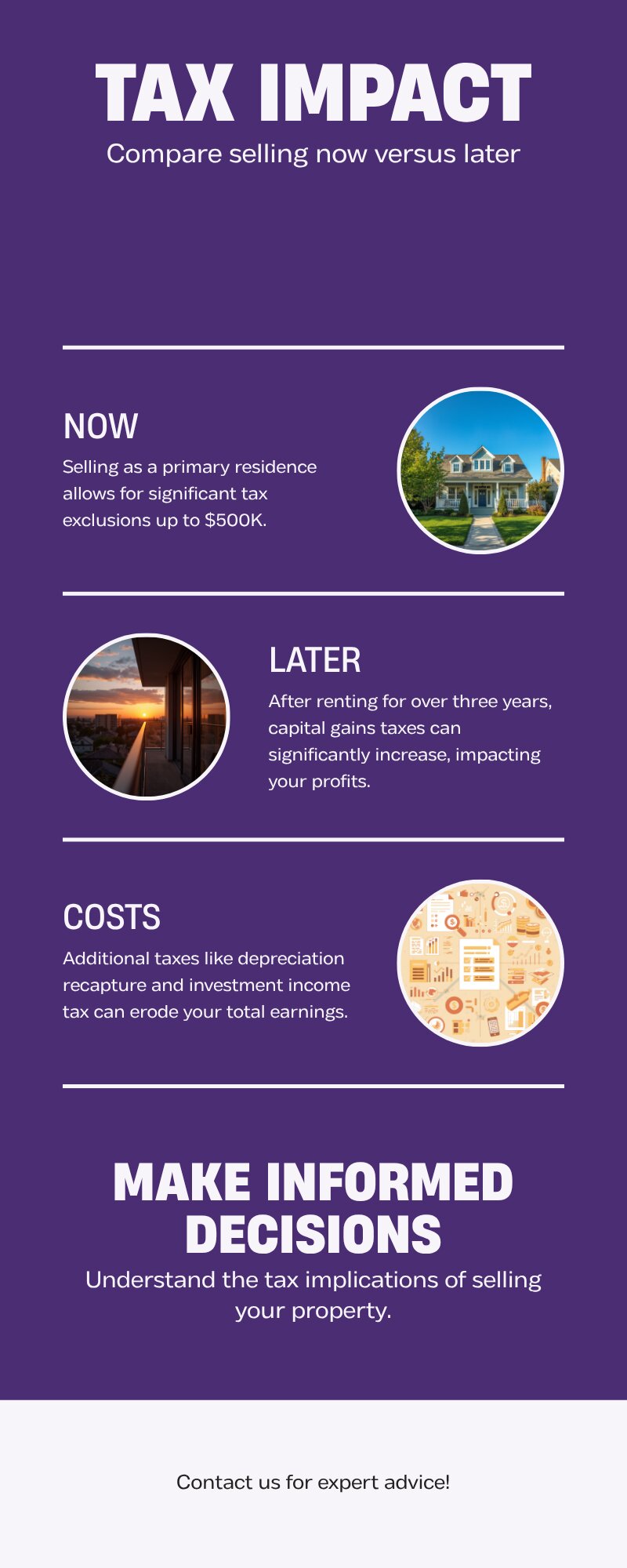
The two-year primary residence window is the biggest tax variable in this decision. Once it closes, your sale proceeds become a taxable event.
Washington Landlord Law in 2026: What Changed
Before you decide to rent, you need to know that Washington’s landlord-tenant laws shifted significantly starting in 2025. These aren’t small tweaks — they meaningfully change what it means to be a landlord here.
Rent Stabilization (HB 1217)
Effective May 2025, annual rent increases are capped at 7% plus CPI, or 10%, whichever is lower. For 2026, the maximum is 9.683%. You cannot raise rent at all during the first 12 months of a tenancy. Any increase requires 90 days written notice using a state-standardized form sent via certified mail.
What this means for you: if rents rise faster than that cap, you can’t keep pace. If a great tenant moves in at below-market rent, you’re limited in how quickly you can adjust.
Just Cause Eviction Requirements
You can’t simply decide not to renew a lease at the end of the term. You need a legally recognized reason — nonpayment, lease violation, owner move-in, or a handful of other specific grounds.
Eviction timelines are not quick. Nonpayment requires a 14-day notice before you can file. Most violations require a 10-day notice to comply. Court processes add weeks or months. Evicting a non-paying tenant in King County can realistically take three to six months — during which you carry all costs with no rent coming in.
The Local Angle: King County Specifics That Change the Math
A few things about King County shift the calculus compared to national averages.
Property taxes here are real. King County’s effective property tax rate runs around 0.93% to 1.1% depending on city and levy district. On a $700,000 home, that’s $6,500 to $7,700 per year — a cost that doesn’t go away when you become a landlord. And unlike a primary residence, you can’t homestead-exempt your way to a lower bill.
Current King County mortgage rates sit around 6.4% in mid-2026. If you bought in the last two to three years at these rates, your P&I is substantially higher than someone who refinanced in 2021. That gap is often what separates a cash-flowing rental from a money-losing one.
The rental market is competitive but not unlimited. Rents have stayed strong in South King County, but they’ve also flattened. Rent growth has run around 4% year over year in the broader Seattle metro, but Washington’s new stabilization caps limit how much future increases can catch up.
Home appreciation is still the strongest long-term argument for the rental side. If your home appreciates 3% to 4% annually from a $700,000 base, that’s $21,000 to $28,000 per year in equity gain. Even if you’re slightly cash-flow negative on rent, appreciation can still make the investment pencil out — if you’re patient and prepared for the landlord role.
South King County in particular — Renton, Kent, Auburn, Covington — remains a strong long-term hold for landlords who are disciplined about tenant selection and maintenance. These are stable demand markets with diverse employment bases. But that’s a different conversation than “I’ll rent it out for a year and see how it goes.”
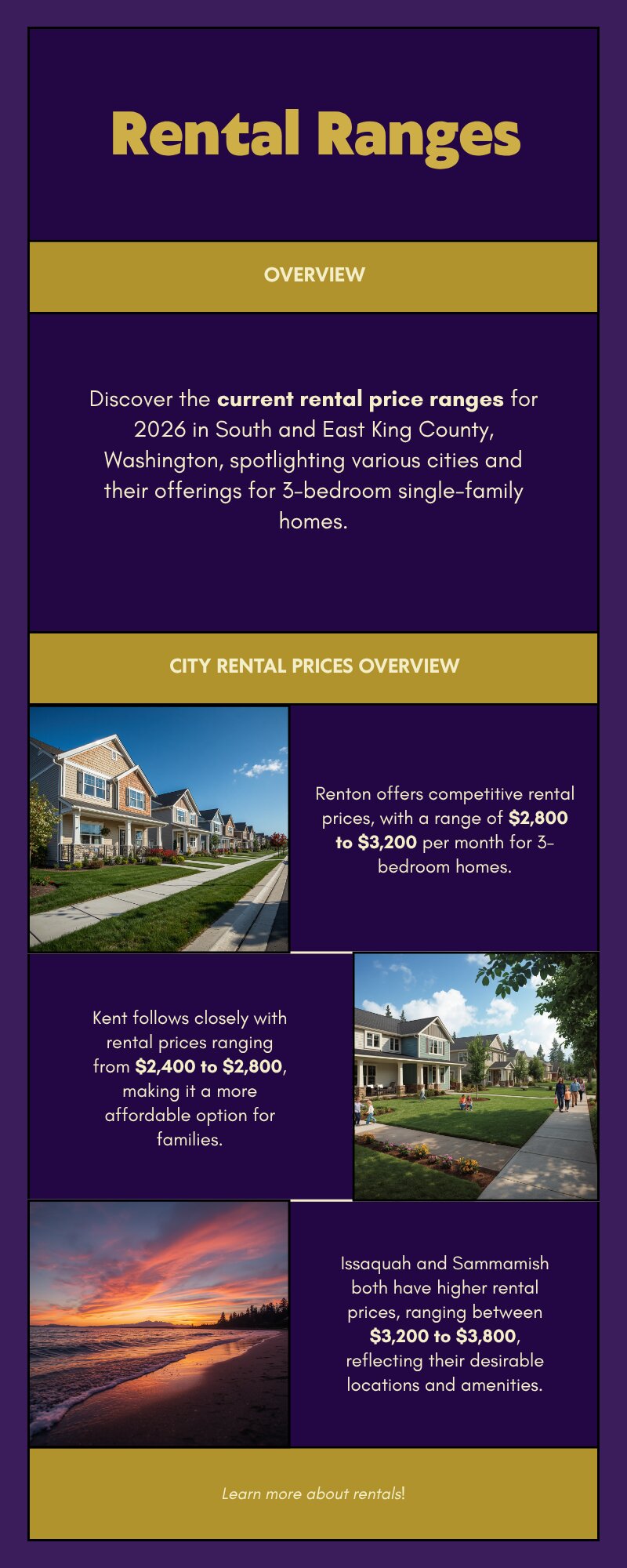
South King County rents are strong but not unlimited. Your specific city, neighborhood, and home condition determine the real number you’ll collect.
When Renting Makes Financial Sense
Based on the math and the landlord landscape, here’s when keeping the property and renting usually wins.
You have a low-rate mortgage (under 4%) that generates positive monthly cash flow after all expenses. Your principal balance is low relative to value — meaning the equity is working for you as an asset even if rent doesn’t fully cover costs. You’re planning to return and live in the home within three to five years, preserving your primary residence exclusion. Or you’re committed to building a rental portfolio long-term and understand that this first property is an investment, not passive income.
When Selling Makes More Sense
Selling wins when you have a high-rate or high-balance mortgage that won’t cash flow at current rents. When your equity is substantial and a lump sum now serves your goals better than monthly income later. When you want simplicity — no tenant calls, no maintenance surprises, no navigating the 90-day rent increase notice process. Or when you need to deploy that equity into your next home and you can’t do both.
If you decide to sell, you’ll want to prepare your home strategically and price it right from day one — two steps that consistently separate fast, full-price sales from drawn-out ones.
What This Means for You
If you’re weighing this decision right now, here’s a simple three-step filter before you call anyone.
First, run your actual monthly carry cost — mortgage P&I, taxes, insurance, and a 1% annual maintenance reserve divided by 12. Compare that to realistic rent for your specific home and neighborhood, not the top of the range.
Second, calculate your net sale proceeds. Look at your current loan payoff, subtract estimated closing costs and agent fees, and ask yourself whether that lump sum helps you more than the monthly difference between rent and expenses.
Third, get a real conversation with a tax professional about your gain and your exclusion window. If you’ve lived in the home two of the last five years, the clock is ticking on that federal exclusion. Don’t let it expire accidentally while you’re hoping the rental market improves.
I can walk you through the numbers on your specific home — no obligation, no pressure. If renting makes more sense, I’ll tell you that. If selling makes more sense, I’ll tell you that too.
FAQ: Renting Out vs. Selling Your King County Home
Can I rent out my King County home and still avoid capital gains tax when I sell later?
Only if you sell within the IRS’s primary residence window — you must have lived in the home two of the last five years when you sell. If you rent it out for more than three years before selling, you lose the $250,000/$500,000 federal exclusion. Washington state has no capital gains tax, but federal tax on investment property gains runs 15–20% plus potential Net Investment Income Tax.
What can I realistically charge for rent on a King County single-family home in 2026?
A three-bedroom home in South King County (Renton, Kent, Auburn) typically rents for $2,400 to $3,200 per month depending on condition, location, and size. East King County (Issaquah, Sammamish, Bellevue) runs higher, often $3,200 to $3,800 for a comparable home.
Does Washington state have rent control in 2026?
Yes, as of May 2025. Under HB 1217, annual rent increases are capped at 7% plus CPI, or 10%, whichever is lower. For 2026, the cap is 9.683%. You can’t raise rent in the first 12 months of a tenancy, and you must give 90 days written notice — certified mail, state-standardized form — before any increase.
How long does it take to evict a non-paying tenant in King County?
Realistically, three to six months from missed payment to vacant possession. You must issue a 14-day pay-or-vacate notice, file in court if they don’t comply, wait for a hearing, and execute the order. During that entire period you’re carrying costs with no rent. Landlord insurance with loss-of-rent coverage can offset some of this risk.
Should I hire a property manager if I rent out my King County home?
For most first-time landlords, yes. A professional property manager handles tenant screening, lease compliance under Washington’s updated laws, maintenance coordination, and the 90-day rent increase documentation process. Typical fees run 8–10% of gross rent monthly. That cost is real, but so is the protection it provides.
What’s the real estate excise tax (REET) on selling my home in King County?
REET is graduated in Washington. On homes selling between $700,000 and $1.5 million, the effective combined rate runs approximately 1.28% to 2.5% depending on the price tier. For a $700,000 sale, budget roughly $12,000 to $13,000 for REET at closing. It comes out of proceeds automatically at the title company.
The decision between renting and selling isn’t one-size-fits-all. It’s a math problem that looks different for every household depending on what you owe, what you’d net, and what you actually want your life to look like over the next three to five years. Run the numbers honestly — including the ones people usually skip — and the right answer tends to become obvious.
Your guide to life outside Seattle.
253-350-0045 ·
greg@livingoutsideseattle.com ·
www.livingoutsideseattle.com
FHA vs. Conventional Loan in King County: A Buyer’s Guide

You’ve been pre-approved. Now the lender is asking which loan type you want. Suddenly the decision feels a lot bigger than you expected.
Most first-time buyers in King County hear the words “FHA” and “conventional” and assume they’re basically the same thing with different names. They’re not. The loan type you choose affects your monthly payment, how much cash you bring to closing, how competitive your offer looks to sellers, and how much you pay over the full life of the loan. In a market where the median home price in Renton, Kent, and Auburn is pushing $600,000, those differences add up to real money.
I’ve helped buyers work through this decision dozens of times. Here’s what actually matters for King County buyers specifically, not just a generic national comparison.
What FHA and Conventional Loans Actually Are
FHA loans are insured by the Federal Housing Administration. Because the government backs them, lenders can offer them to buyers with lower credit scores and smaller down payments than they’d otherwise accept. You’re not borrowing from the government. You’re borrowing from a regular lender, but that lender has a government safety net if you default.
Conventional loans have no government backing. They’re sold to Fannie Mae or Freddie Mac after closing, which means they follow stricter underwriting rules. That strictness cuts both ways: harder to qualify for, but cheaper to carry over time if you do qualify.
The most important thing to understand is that these two loan types are not interchangeable. They’re designed for different financial situations.
The Down Payment Reality in King County
Both loan types have low down payment options, but they work differently.
FHA requires 3.5% down if your credit score is 580 or above. On a $575,000 home — a realistic entry-level price in South King County right now — that’s about $20,125 down. If your score is between 500 and 579, you need 10% down.
Conventional loans have a 3% down option through the Fannie Mae HomeReady or Freddie Mac Home Possible programs. On that same $575,000 home, 3% down is $17,250. The catch: you generally need a credit score of 620 or higher to qualify at all, and the best conventional PMI rates kick in at 700 and above.
So on paper, conventional actually asks for less at closing. But the mortgage insurance story is where the real cost difference shows up, and it’s significant.
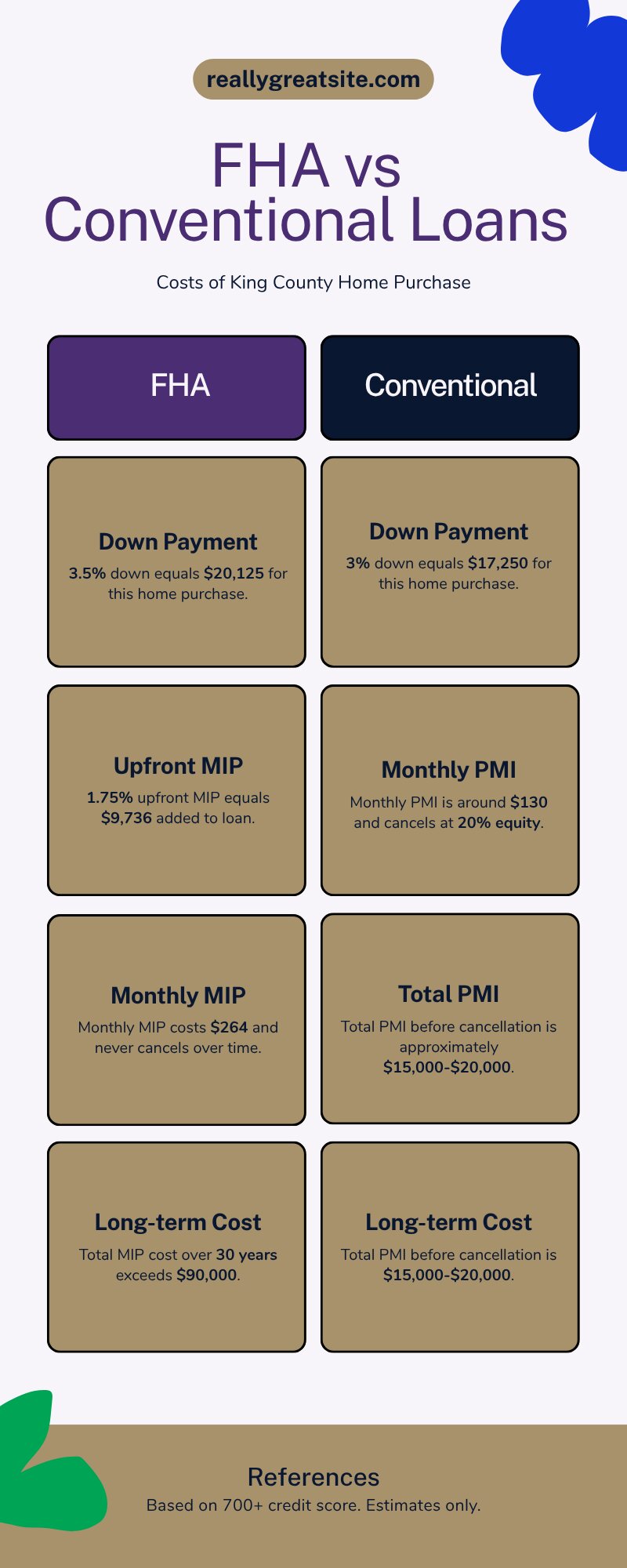
FHA mortgage insurance stays for the life of the loan. Conventional PMI cancels at 20% equity — a difference of $70,000+ over 30 years on a typical King County purchase.
Mortgage Insurance: This Is Where the Numbers Diverge
This is the part most buyers don’t understand until it’s too late to change their loan type.
FHA Mortgage Insurance
You pay two premiums. First, there’s an upfront MIP of 1.75% of the loan amount. On a $575,000 purchase with 3.5% down, that’s about $9,736 rolled into your loan balance. Then you pay a monthly MIP for the life of the loan (roughly 0.55% annually on most King County FHA loans).
It does not go away when you hit 20% equity. To eliminate it, you’d have to refinance into a conventional loan.
Conventional PMI
You only pay it if your down payment is under 20%. Once you reach 20% equity through paying down the balance, appreciation, or some combination, you can request cancellation. The lender is required to cancel it automatically at 22% equity. PMI rates for borrowers with 700+ credit scores typically run 0.25%–0.50% annually.
In King County’s appreciating market, PMI commonly cancels within 7–10 years.
Here’s what that means in real numbers on a $555,000 loan (3.5% down on a $575,000 purchase):
FHA: Total MIP over 30 years = approximately $90,000+ including upfront and monthly premiums
Conventional (5% down, 700 credit): Total PMI before cancellation = approximately $15,000–$20,000
That difference is not a rounding error. It’s a second car. It’s a college fund start. For a buyer with a 700+ credit score, conventional wins by a wide margin over any hold period longer than 5 years.
Credit Score: The Practical Dividing Line
Here’s the simplest way to frame the credit score question. For a deeper look at what your payment actually looks like at current rates, see King County Mortgage Rates 2026: What Buyers Are Actually Paying — it walks through the real payment math before you commit to either loan type.
Below 620
FHA is likely your only realistic option. Conventional lenders rarely approve below 620, and when they do, the rates and PMI costs are punishing.
620–700: The Gray Zone
You can qualify for conventional, but your PMI rate will be higher than for buyers with stronger scores. Run the actual numbers with your lender for both options. FHA may still win in the short term, but conventional saves money if you stay put.
700 and Above
Conventional wins, almost without exception. PMI rates at this tier are low (often 0.30%–0.35%), cancel within 7–10 years in King County’s appreciating market, and you avoid the permanent FHA MIP entirely.
I see this play out constantly in my BPO work. I’m assessing home values in Renton, Kent, and Covington every week, and the buyers who positioned themselves for conventional financing at purchase are the ones who refinanced without drama and built equity fastest. The upfront credit work pays off.
Loan Limits in King County: More Room Than You Think
One of the biggest misconceptions about FHA loans is that they’re only for “affordable” homes. In King County, that’s not true.
For 2026, the FHA loan limit in King County is $1,063,750 for a single-family home. That covers the vast majority of purchase prices in Renton, Kent, Auburn, Covington, Maple Valley, and most of the South King County communities I work in regularly. You don’t have to be buying a starter home to use FHA financing here.
The conventional conforming loan limit in King County for 2026 is $1,063,750, also well above the local median price. Both loan types give you plenty of room in this market.
If your loan amount exceeds either of those limits, you’re looking at jumbo financing, which is a separate conversation entirely.
Both loan types cover the vast majority of purchase prices in South and East King County. You don’t need to buy a starter home to use FHA financing here.
How Each Loan Type Plays With Sellers
This is a real consideration in King County’s competitive pockets, and I want to be honest with you about it.
FHA offers historically faced more seller skepticism than conventional offers, for two reasons. First, FHA appraisals have stricter condition requirements. The appraiser flags health and safety issues that can hold up or kill a deal. Second, FHA loan closings occasionally take longer than conventional.
In 2025 and into 2026, the market in South and East King County has moderated from the frenzy of prior years. In many neighborhoods, Kent, Auburn, Covington, and Maple Valley among them, sellers are no longer in a position to pick and choose between five cash offers. An FHA offer paired with a strong pre-approval letter, a fast lender closing commitment, and solid earnest money is competitive.
That said, if you’re targeting a specific high-demand price point where multiple offers are common (certain Renton zip codes, for example), your agent should discuss this with you before you go in with FHA. In those situations, conventional financing strengthens your position.
The King County Angle: Stacking DPA With Either Loan Type
Here’s something that can change the whole picture for South King County buyers: the Washington State Housing Finance Commission (WSHFC) offers down payment assistance programs that work with both FHA and conventional loans.
The Home Advantage DPA program provides up to 4% of the loan amount as a 0% interest, deferred second mortgage. There are no payments until you sell, refinance, or pay off the home. That’s potentially $22,000–$38,000 on a typical King County purchase, which can cover your entire down payment and a chunk of closing costs. If you’re on a conventional loan, the DPA steps up to 5% of the loan amount.
The Opportunity DPA program offers up to $15,000 at 1% interest, also deferred for 30 years.
Both programs have income limits (typically $145,000–$180,000 for King County depending on household size and program), and both require completion of a homebuyer education course.
The practical question most buyers don’t ask: if you use DPA to cover your down payment, does FHA or conventional end up cheaper on a monthly basis? The answer depends on your credit score. With DPA covering the down payment, a buyer with 700+ credit on a conventional loan still comes out ahead on monthly costs. The PMI rate is low and cancels eventually. FHA MIP doesn’t.
A buyer with a 640 credit score using DPA might find FHA keeps their monthly payment more manageable, even accounting for the longer MIP duration.
Run the numbers both ways with your lender. Ask them to show you the total cost of ownership at 5 years, 10 years, and 30 years for each scenario. That comparison will give you your answer faster than any online calculator. If you’re still deciding whether now is the right time to buy at all, First-Time Home Buyer in Kent WA: Buy Now or Wait? runs through the timing math that applies across most of South King County.
What This Means for You
Here’s the practical decision tree:
Credit score below 620
Start with FHA. Focus on improving your score if you can. Even a 40-point gain can change which loan type makes more financial sense.
Credit score 620–700
Get quotes for both FHA and conventional. Ask your lender to compare total MIP/PMI costs over your expected hold period, not just the monthly payment.
Credit score 700+
Conventional almost always wins. The monthly savings from lower PMI and eventual cancellation add up to tens of thousands of dollars over a 10–30 year hold.
Concerned about down payment
Ask about WSHFC DPA programs. They work with both loan types and can cover your entire down payment if you qualify.
Planning to stay under 5 years
Conventional makes even more sense here. You won’t reach MIP removal with FHA anyway, so you’re paying insurance the whole time you own.
Planning to put down 20% or more
Conventional is the clear choice. You pay no PMI at all and skip FHA’s upfront MIP entirely.
Frequently Asked Questions
Can I use FHA financing to buy a home in Renton, Kent, or Auburn?
Yes. The 2026 FHA loan limit in King County is $1,063,750 which covers virtually every home in South King County. FHA is fully available in all King County cities.
What credit score do I need for a conventional loan in King County?
The minimum is generally 620, though some lenders go to 580 with specific programs. For the best PMI rates and lowest long-term costs, you want 700 or above.
How much does FHA mortgage insurance cost in King County?
On a typical King County FHA loan, you’ll pay 1.75% upfront (rolled into the loan) and roughly 0.55% annually as a monthly premium. On a $575,000 purchase with 3.5% down, that’s about $810 per month all-in for principal, interest, and MIP at current rates — though your actual rate will vary.
Will an FHA offer hurt my chances in a competitive King County market?
It can in very hot price ranges. But in most South King County markets in 2026, a well-structured FHA offer with a strong pre-approval is fully competitive. Talk to your agent about the specific neighborhood and price point before worrying about this.
Can I stack down payment assistance with an FHA loan in Washington?
Yes. WSHFC’s Home Advantage and Opportunity DPA programs both work with FHA loans. The DPA is a deferred second mortgage with no payments until you sell or refinance.
When does it make sense to just wait and improve my credit before buying?
If you’re within 3–6 months of crossing from 680 to 720, and your local market isn’t moving aggressively upward, it can be worth waiting. The PMI savings over 10 years on a $550,000+ King County loan easily justify 6 months of credit work. Ask your lender to model both scenarios.
Your guide to life outside Seattle.
253-350-0045 ·
greg@livingoutsideseattle.com ·
www.livingoutsideseattle.com
King County Condo Buyer Guide 2026 | What to Know
A step-by-step guide to HOA due diligence, warrantable financing, and what to inspect — written for first-time buyers entering the King County condo market.
If you are thinking about buying a condo in King County, 2026 is an interesting time to do it. Active condo listings on the Eastside are up more than 40% compared to last year. That means more options, more time, and more leverage than buyers had just 12 months ago. But the market shifting in your favor does not mean every condo is a good deal. The wrong one can cost you your financing, your down payment flexibility, and years of headaches tied to a poorly run HOA.
I have been pricing properties in East and South King County every day for over 9 years as a BPO field agent. I walk into condos that look great on Zillow and flag problems that would not show up until after you close. This guide covers everything a first-time condo buyer in King County needs to know before making an offer.
What Makes Condos Different to Buy (and Finance)
A condo is not just a smaller version of a house. When you buy a condo, you own your individual unit — usually defined as the “airspace” inside the walls — plus a fractional share of the common areas. The hallways, the roof, the parking structure, the elevators: you own a piece of all of it, along with every other owner in the building.
That shared ownership is why lenders treat condos differently. They are not just evaluating you as a borrower. They are evaluating the entire building and its homeowners association. A lender can approve your income, your credit score, and your down payment — and still decline your loan because the HOA has financial problems.
This is the part most first-time condo buyers do not expect, and it is why starting with the right questions matters.
Warrantable vs. Non-Warrantable: The Financing Split That Changes Everything
The single most important financing question in any condo purchase is whether the building is warrantable or non-warrantable. Here is what that means in plain terms.
Warrantable condos meet the guidelines set by Fannie Mae and Freddie Mac. These are the government-sponsored enterprises that back most conventional mortgages in the United States. When a building qualifies as warrantable, buyers can use standard conventional loans, FHA loans, and VA loans. Interest rates are standard. Down payments can be as low as 3% with some programs.
Non-warrantable condos do not meet those guidelines. Buyers are pushed into portfolio loans — products held by the lender rather than sold to Fannie or Freddie. These typically require 20–30% down and carry interest rates 1–2 percentage points higher than conventional financing. On a $500,000 condo, that rate difference adds roughly $500–600 per month to your payment.
For 2026, there is a specific rule change worth knowing. By January 2027, HOAs must allocate at least 15% of their annual budgeted assessment income to their reserve fund — up from the longstanding 10% minimum. Buildings that fall short lose warrantable status. When you are shopping for a condo right now, you are evaluating buildings that may be in the middle of adjusting to this change, or ignoring it entirely.
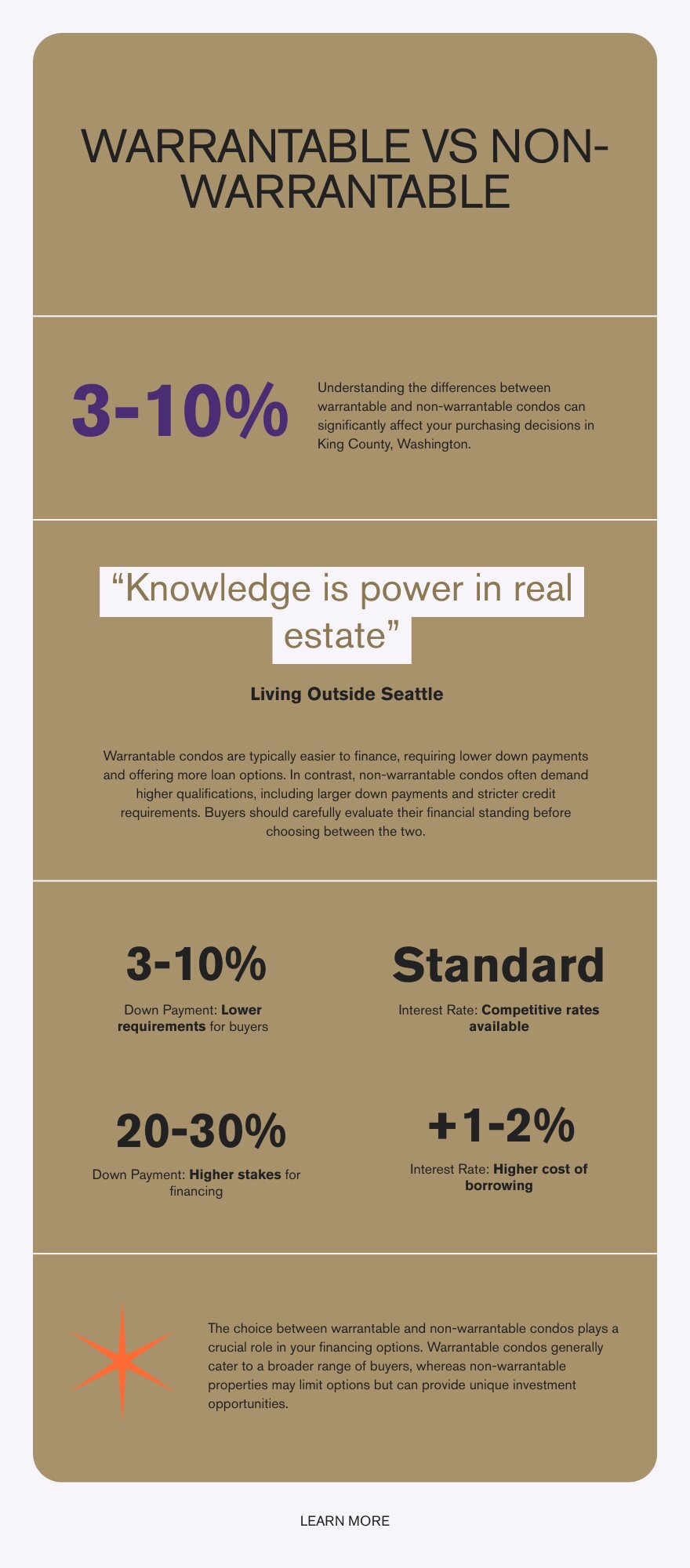
Warrantable condos open the door to conventional and FHA financing — non-warrantable buildings push buyers into portfolio loans with higher rates and larger down payments.
What disqualifies a building from warrantable status? The main triggers include: the HOA reserve fund falling below 10% of the annual budget (now moving to 15%), more than 15% of owners being delinquent on dues, a single investor owning more than 20% of the units, more than 35% of the building being used for commercial purposes, and ongoing or threatened litigation against the HOA.
Ask your agent to request the condo questionnaire — also called the HOA certification or lender questionnaire — before you write an offer. This document discloses the reserve balance, delinquency rate, pending litigation, and owner-occupancy percentage. If a seller or listing agent resists providing it, treat that as a warning sign.
HOA Due Diligence: What to Actually Read
The HOA package — sometimes called the resale certificate, disclosure packet, or condo docs — is a stack of documents you will receive after going under contract. In Washington State, sellers are required to provide it, and you typically have a review period to back out if you find something concerning.
Most buyers skim it. That is a mistake. Here is what actually matters:
The Reserve Fund Study
This is a professional assessment of the building’s major systems — roof, elevators, parking structure, plumbing, windows — and how much money the HOA should have saved to replace them on schedule. A well-run HOA commissions one every three to five years. If the building is 20 years old and there is no reserve study, or if the study shows the fund is significantly underfunded, you are looking at the possibility of special assessments in your future.
Special assessments are one-time charges that all owners must pay when the HOA does not have enough reserves to cover a major repair. These can run $5,000, $15,000, even $30,000 per unit for things like roof replacements and elevator overhauls — and they happen regularly in buildings with underfunded reserves.
Meeting Minutes from the Past Two Years
Board meeting minutes are where you find the real story. Look for repeated complaints about the same issue, deferred maintenance discussions, arguments over raising dues, or mentions of legal action. A building with the same roof leak showing up in 18 consecutive meeting minutes has a problem the financials may not fully capture.
Two years of minutes gives you a solid picture of how the board actually operates — not just what they say in the official documents.
The Budget, Dues, and Rental Rules
Check whether the HOA has raised dues recently, and whether dues cover reserves adequately. Artificially low dues often mean the HOA is avoiding necessary increases — which leads to larger special assessments later. Compare dues to similar buildings in the area. A number that looks suspiciously low usually is.
Also check rental cap rules. Some buildings limit the percentage of units that can be rented at any time. If you ever plan to rent your unit, this matters. FHA loans also require the building to be on HUD’s approved condo list — your lender can check this quickly.
For a deeper dive on what to check in the HOA docs, the King County Condo Due Diligence Checklist goes through this line by line.
What a Condo Inspection Covers (and What It Misses)
A standard home inspection is designed for a single-family house where the inspector can access the roof, crawl space, attic, and all the mechanical systems. A condo inspection is different — and more limited.
Your inspector will cover what is inside your unit: the HVAC (if it is individual to your unit), the electrical panel, plumbing fixtures, windows, doors, and visible water damage. They will typically inspect the balcony and any storage spaces assigned to your unit. What they cannot fully assess: the building’s shared systems, the roof, the structural elements, or common area mechanical equipment.
That is why the HOA documents and the reserve study matter so much. The inspection tells you about your unit. The HOA documents tell you about the building. You need both.
A few things worth flagging during your condo inspection specifically:
Soundproofing between units. This is not a safety issue, but it matters enormously to quality of life. Bring a friend, have them stomp around upstairs while you listen from below.
Water intrusion around windows and exterior walls. Condo buildings in the Pacific Northwest are prone to moisture issues. Look for staining, soft drywall near windows, or any history of water claims in the HOA meeting minutes.
HVAC type. Some older King County condo buildings use central HVAC controlled by the HOA. Others have individual mini-split or forced-air systems in each unit. If it is individual, it is your responsibility to maintain and replace. Know what you are buying before you close.
A standard home inspection covers your unit. The HOA documents cover the building. You need both before you close on a King County condo.
The King County Condo Market Right Now
King County condo prices have held more steady than single-family homes in 2026, but the market has shifted toward buyers. Active condo listings on the Eastside are up more than 40% year over year as of spring 2026. More supply means more negotiating room — on price, closing costs, and seller-paid concessions.
In South King County — Kent, Auburn, Renton — condos remain some of the most accessible entry points in the county. Depending on the city, you can find units in the $350,000–$500,000 range, well below the King County median of $835,000 for all residential property types. For buyers using down payment assistance programs, these price points make a real difference in what you can qualify for.
The current rate environment also affects condo buyers differently than house buyers. If you are using conventional financing on a non-warrantable building, your effective rate goes up significantly — which is why building status matters as much as your personal loan qualification. King County’s conforming loan limit for 2026 is $1,063,750, so most condo purchases in South King County fit comfortably within conventional limits.
First-Time Buyer Programs That Work for Condos
If you are a first-time buyer — meaning you have not owned a home in the past three years — several programs in Washington State work for condo purchases.
The WSHFC Home Advantage Program pairs a 30-year fixed-rate mortgage (conventional, FHA, VA, or USDA) with a below-market interest rate. It also offers down payment assistance up to 4% of the first mortgage amount as a 0% interest, 30-year deferred loan — repayable when you sell or refinance. Income limits apply: for King County, the cutoff is $180,000 for 2026. Minimum credit score is 620 (640 for some loan types). You must use a WSHFC-approved lender.
For a side-by-side comparison of condo versus single-family ownership costs — including what HOA dues do to your total monthly payment — the Condo vs. Townhouse vs. Single-Family guide covers the real numbers for King County buyers.
What This Means for You as a King County Condo Buyer
Buying a condo in King County in 2026 is genuinely doable — especially in South King County where price points are accessible and buyer leverage is higher than it has been in years. But it requires a different checklist than buying a house.
Start with the financing question before you fall in love with a unit. Get your agent to pull the condo questionnaire early. If the building is non-warrantable, run the math on what that does to your monthly payment before you invest time in inspections and negotiations.
Read the HOA documents yourself, not just the summary. The meeting minutes are where problems hide. If the reserve fund is below 10% of the annual budget — and especially below the new 15% target — build that risk into your offer price or walk away.
Hire an inspector who has experience with condos specifically. Ask them directly whether they check for water intrusion at the building envelope, not just inside the unit. And use state programs if you qualify — the WSHFC income limit is $180,000 for King County, which is higher than most people assume.
Frequently Asked Questions
What is the difference between a warrantable and non-warrantable condo in King County?
A warrantable condo meets Fannie Mae and Freddie Mac guidelines, which means buyers can use standard conventional or FHA financing with low down payments. A non-warrantable condo does not meet those guidelines — typically because of low HOA reserves, high investor concentration, or pending litigation — and buyers are limited to portfolio loans requiring 20–30% down at higher rates.
How much are condo HOA dues in King County?
HOA dues vary widely by building age, size, and amenities. In South King County, dues commonly run $300–$600 per month for a standard condo. Eastside buildings with more amenities often run $500–$900 or more. Always verify what dues cover — some include water, sewer, and garbage while others cover only exterior maintenance and reserves.
Can I use an FHA loan to buy a condo in King County?
Yes, but the building must be on HUD’s FHA-approved condo list, or you can apply for single-unit (spot) approval. Your lender can check FHA approval status in minutes. Not all King County condos qualify, so this is worth checking early in your search rather than after you find a unit you like.
What is a condo reserve study and why does it matter?
A reserve study is a professional assessment of a building’s major systems and how much the HOA should have saved to replace them on schedule. A well-funded reserve means lower risk of special assessments — unexpected lump-sum charges to all owners when the HOA needs money for a major repair. Ask for the most recent reserve study in the HOA documents.
Do condo buyers in King County qualify for down payment assistance?
Yes. The WSHFC Home Advantage Program works for condo purchases and offers DPA up to 4% of the loan amount as a 0% deferred loan. Income limits are $180,000 for King County buyers in 2026. The building still must meet standard financing requirements for the underlying loan type — DPA does not change warrantable status.
What should I look for in condo HOA meeting minutes?
Look for recurring complaints about the same issue, deferred maintenance discussions, disputes over raising dues, mentions of legal action against the HOA or individual owners, and references to upcoming special assessments. Two years of minutes gives you a solid picture of how the board actually operates versus what the official financials show.
A condo can be a smart first step into King County homeownership — especially in today’s market, where inventory is up and sellers are more willing to negotiate than they were two years ago. The key is knowing what you are actually buying: your unit, your share of the building, and your exposure to how the HOA is run.
Have questions before you make an offer? Reach Greg at greg@livingoutsideseattle.com or 253-350-0045.
Your guide to life outside Seattle.
253-350-0045 ·
greg@livingoutsideseattle.com ·
www.livingoutsideseattle.com
This Guide Has Moved
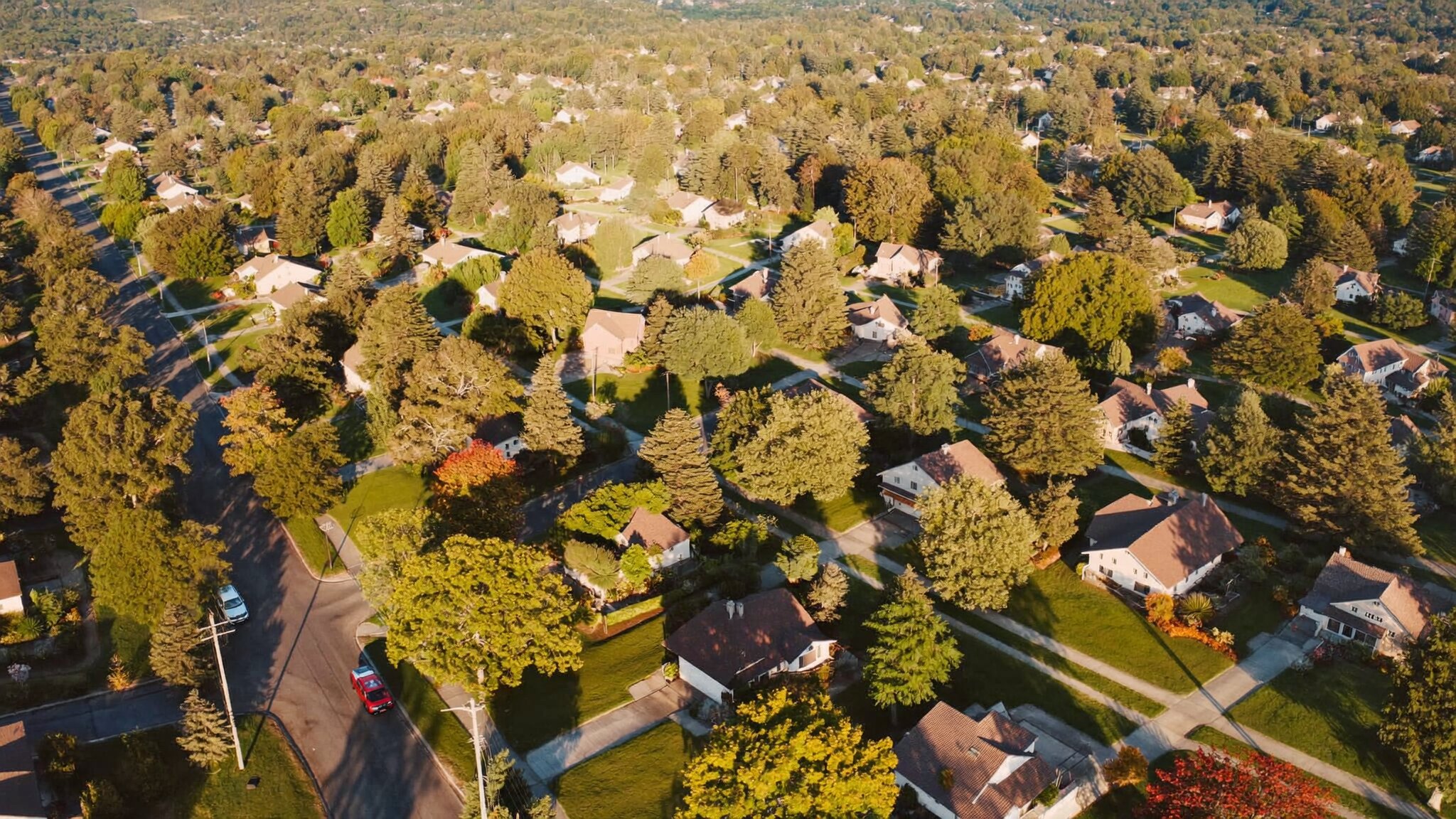
This article has been folded into our maintained guide: East & South King County Market Update [July 2026]. You are being taken there now.
King County Condo Buyer’s Guide: Due Diligence Checklist
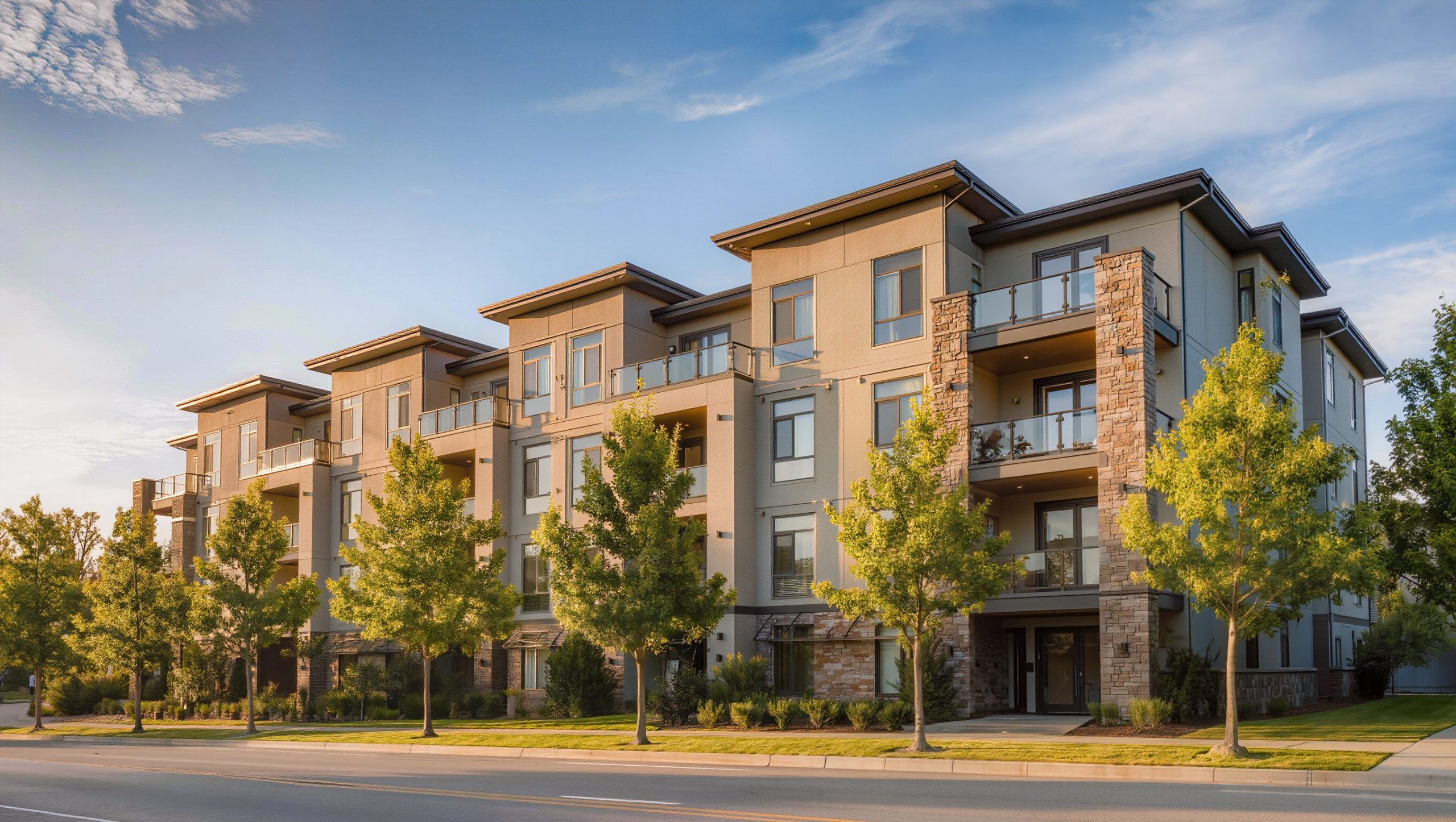
A standard home inspection only covers your unit. Here’s how to check everything else — so you don’t inherit someone else’s financial mess.
If you’re shopping for a condo in King County, you already know the appeal. The $400K to $550K price range gets you into cities like Renton, Kent, Auburn, and Federal Way where single-family homes now regularly push past $700,000. Condos let first-time buyers get into the market with a lower entry point and no yard to maintain.
But buying a condo isn’t the same as buying a house. When you buy a condo, you’re not just buying the unit. You’re buying into the association that owns everything outside your four walls — the roof, the parking structure, the elevators, the exterior siding. You’re signing on as a stakeholder in the financial health of an organization you probably know nothing about yet.
That’s where most first-time condo buyers get burned. They fall in love with the unit, get excited about the price, and skip the due diligence that would tell them whether the building is a smart buy or a costly surprise waiting to happen. I’ve done BPO assessments on condo buildings across King County for years. The difference between a well-run community and a poorly-run one shows up in the documents — if you know what to look for.
Here’s what you need to check before you write that offer.
The Reserve Study: Your Most Important Document
The reserve study is an independent engineering report that tells you two things: what major components the association owns (roof, siding, pavement, elevators, common area systems) and how much money the HOA needs to set aside right now to cover those replacements when they come due.
Think of it like a maintenance budget projected out 20 or 30 years. A well-funded reserve means the HOA has been saving consistently and won’t need to hit owners with a surprise bill when the roof fails. An underfunded reserve means the opposite.
Here’s the number that matters most: the funding percentage. Most reserve studies show this as a percentage of “full funding.” Anything above 70% is generally healthy. Below 30% is a serious red flag. According to the Community Associations Institute, more than 70% of HOAs nationally are considered underfunded. That’s not a comfort — it’s a warning about how common the problem is.
In Washington state, as of 2026, HOAs must include reserve fund information in resale certificates. Still, don’t rely on what the HOA tells you in summary form. Ask for the full reserve study report and read the section on reserve component status yourself.
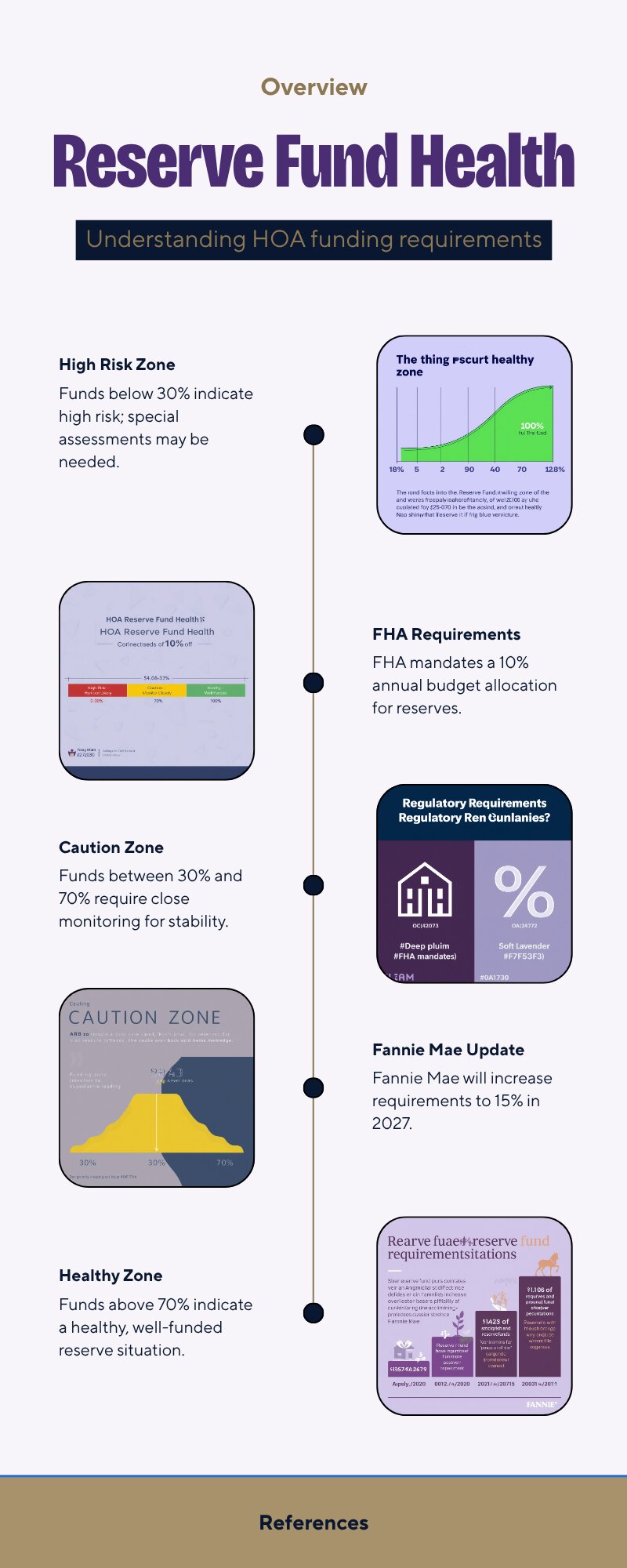
Anything above 70% is generally healthy. Below 30%, a special assessment is likely — not a matter of if, but when.
Special Assessments: What They Are and How to Spot the Risk
A special assessment is an extra charge the HOA levies on every unit owner to cover a large expense the reserve fund can’t handle. They’re not uncommon. What makes them dangerous is that they can hit without much notice and they don’t care when you bought your unit.
An older 50-unit building might face a $200,000 roof replacement with nothing saved. That works out to $4,000 per unit — potentially due in a lump sum or in payments spread over a couple of years. Special assessments in King County can run $60,000 to $80,000 per unit when major structural or mechanical work has been deferred for years.
Before you make an offer, ask for the last five years of special assessment history. If there’s been one large assessment or multiple smaller ones in that window, ask why. The answer tells you a lot about how the board manages the property. Also ask whether any special assessments have been approved but not yet levied. Washington’s WUCIOA law requires this to be disclosed in the resale certificate — but only for assessments already approved by the board. A vote that hasn’t happened yet won’t show up anywhere except in the board minutes.
Which brings me to the board minutes.
Read the Board Meeting Minutes
Board minutes are a window into everything the summary documents won’t tell you. Most buyers never ask for them. That’s a mistake.
You’re looking for a few things specifically. First, any discussion of upcoming major repairs or capital projects. Second, any mention of litigation — whether the HOA is suing a contractor or a homeowner is suing the HOA. Third, any talk of raising dues significantly, levying a special assessment, or adjusting the reserve contribution downward to balance the operating budget. That last one is a classic sign of financial stress.
Under Washington’s WUCIOA updates effective January 1, 2026, condo associations must now hold open board meetings and provide better documentation to buyers. The resale certificate that comes with any condo sale must include 26 specific items and can only cost you up to $275. You also have a 5-day cancellation right after receiving all required documents. That window is your formal due diligence period — use it.
The Warrantable vs. Non-Warrantable Problem
This is the one that trips buyers up most often, and it has nothing to do with the unit itself. It has to do with the building.
A condo building is considered “warrantable” when it meets Fannie Mae and Freddie Mac lending standards. A warrantable building means you can get a conventional mortgage, FHA financing, or a VA loan — whatever you qualify for. Normal rates, normal down payments.
A non-warrantable building doesn’t meet those standards, and you lose access to the most competitive loan products. You’re looking at higher rates and larger down payments — often 20% or more — because portfolio lenders are taking on more risk. For a $500,000 condo, the difference between a warrantable and non-warrantable rate at current levels can easily add $200 to $250 to your monthly payment.
What Makes a Building Non-Warrantable?
The most common triggers in King County:
Single entity owns 25%+ of units — often an investor who bought in bulk during slower markets.
More than 35% commercial square footage — common in mixed-use buildings in downtown Renton or Federal Way.
Short-term rental policies — buildings that allow Airbnb-style rentals trigger automatic non-warrantable status.
Active or pending litigation — even a small dispute can knock a building out of warrantable status.
Ask your lender to run a condo project approval check before you get emotionally invested in a unit.
Many King County condo buildings — especially older mid-rises in Renton, downtown Kent, and Federal Way — fall outside warrantable guidelines. Knowing this upfront shapes your financing strategy before you’re already under contract.
For a full look at what mortgage rates look like right now for King County buyers, see our King County Mortgage Rates 2026 guide. If your condo ends up in the non-warrantable category, a mortgage rate buydown negotiated into the deal can help offset the higher rate.
Rental Cap Rules: What They Mean for Your Investment and Resale
Some condo associations limit how many units can be rented out at any given time. This is a rental cap, and it matters in two ways.
First, if you’re buying as an investor or might need to rent your unit down the road, a rental cap could block you entirely if the cap is already at its limit. Second — and this affects every buyer — a tight rental cap can make your building non-warrantable, which reduces your future buyer pool when you go to sell.
In Washington state, a rental cap must be written into the Declaration (the CC&Rs), not just the rules and regulations. Washington courts have ruled that caps can’t be created by the board alone — they need a supermajority vote to amend the Declaration. Check the current governing documents to see whether a cap exists, what the limit is, and whether it’s currently at capacity.
What a Standard Inspector Won’t Check
Here’s what a lot of condo buyers don’t realize: Washington state home inspectors are not required to inspect common elements, shared structural systems, or common area amenities. The inspector looks at your unit. The roof, the parking structure, the building envelope, the elevators, the main plumbing stack — those fall outside the standard inspection scope.
That means the structural and mechanical health of the entire building you’re buying into rests entirely on the HOA documents, not on any physical inspection you can order.
This is why the reserve study and the board minutes matter as much as they do. They’re the closest thing you have to a building inspection. If the association has been commissioning regular reserve studies and following the funding plan, you can feel reasonably confident. If the last reserve study is eight years old and nobody can find the financials, that’s your answer.
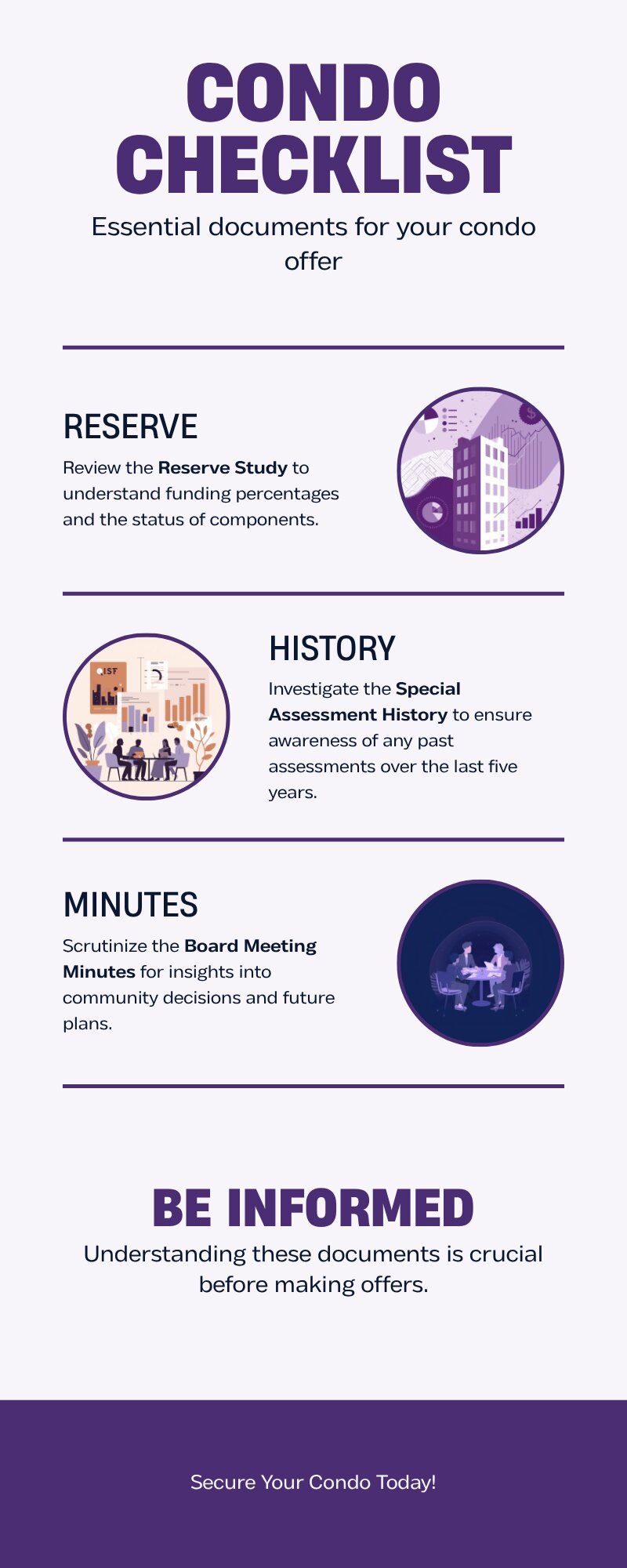
Washington’s new WUCIOA rules (effective 2026) cap the resale certificate fee at $275 and give you a 5-day cancellation window after receiving all required documents.
The Local Angle: What Makes King County Condos Different
King County’s condo market is concentrated in a handful of cities. The sub-$500K inventory you’ll find in Renton, Kent, Auburn, and Federal Way tends to be in older mid-rise buildings — think 1980s and 1990s construction. Some of these buildings have been well-maintained. Many have deferred capital work for years because the HOA fees were kept artificially low to attract owners.
As of the May 2026 King County market update, condo inventory is elevated relative to last year. That’s actually good news for buyers doing due diligence — you have more options and more negotiating room if a building’s documents reveal problems. You can move to the next building rather than feeling pressured to overlook red flags. For more on current conditions, see my East and South King County market update.
One thing I always watch from a pricing standpoint: HOA fees relative to market rates for the building’s age and amenities. An older building with fees significantly below market isn’t a deal — it’s a warning sign that the board has been cutting corners on reserves or maintenance to keep fees low. That cost shows up later. Often all at once.
If you’re weighing a condo against a townhouse or a single-family home in the same price range, the Condo vs. Townhouse vs. Single-Family Home in King County comparison guide can help you think through the tradeoffs before you commit to any one property type.
What This Means for You as a Buyer
Getting a condo offer right comes down to this: the unit is the easy part. Every agent will show you the finishes and the view. The due diligence that protects you happens in the documents.
Request the full resale certificate as soon as you’re seriously interested in a building — Washington law now limits the fee to $275 and gives you five days to review after receiving all required items. Use those five days. Read the reserve study funding percentage. Scan the last two years of board minutes for anything that sounds expensive. Pull the special assessment history. Have your lender check the project for warrantability before you fall in love with the floor plan.
If any of those documents are hard to get, incomplete, or missing entirely — that’s important information. A well-run HOA has nothing to hide.
Frequently Asked Questions
How do I get the reserve study and HOA financials as a condo buyer in Washington?
Request them in writing through your real estate agent as part of the offer or as a pre-offer document request. Under Washington’s WUCIOA law, the resale certificate is a required disclosure and must be provided within a set timeline. Your agent can request the full reserve study separately — not all associations include the full report in the standard resale package.
What reserve fund percentage should I look for when buying a condo in King County?
A funding level at or above 70% of “full funding” is generally healthy. Below 50% warrants a deeper conversation with the HOA or your agent. Below 30% is a serious red flag for near-term special assessments. FHA requires HOAs to allocate at least 10% of their annual budget to reserves — Fannie Mae is moving toward 15% effective January 2027.
What makes a condo non-warrantable in Washington state?
The most common triggers are high investor ownership (one entity owning 25%+ of units), active or pending litigation, short-term rental policies, and high commercial space concentration. Your lender can run a condo project approval check to confirm status before you’re under contract.
Can I use an FHA loan on a condo in King County?
Yes, if the building is FHA-approved or spot approval is available. FHA has its own approval process separate from conventional warrantability. Your lender will know whether the specific project is on FHA’s approved list or whether spot approval is an option for that building.
What should I look for in condo board meeting minutes?
Look for any discussion of deferred repairs, upcoming capital projects, special assessment votes (including proposed but not yet approved), litigation, significant dues increases, or decisions to reduce reserve contributions. Any of these can signal financial stress in the association.
Is a condo’s rental cap in the CC&Rs or the rules?
In Washington state, rental caps must be in the Declaration (CC&Rs) to be enforceable — not just the rules and regulations. If you see a rental cap only in the R&Rs and it’s not in the Declaration, its enforceability may be questionable under current Washington case law. Still, treat it as a real restriction until a real estate attorney tells you otherwise.
Buying a condo in King County can be a smart move. The entry-level price points in South King County are some of the last affordable options for first-time buyers in the region. But the savings on purchase price can disappear fast if you walk into a building with underfunded reserves, pending litigation, or a non-warrantable status nobody mentioned upfront.
The documents tell the story. Take the time to read them.
Your guide to life outside Seattle.
253-350-0045 ·
greg@livingoutsideseattle.com ·
www.livingoutsideseattle.com
Condo vs Townhouse vs Single-Family in King County
You’ve got three completely different products at three completely different price points. Here’s what actually separates them — and which one fits your situation in King County right now.
When most buyers start looking at homes in King County, they type a budget into Redfin and let the results decide the property type for them. That usually works fine until they’re deep into a transaction and suddenly discover that their condo doesn’t qualify for the loan they planned on, or that the townhouse HOA has a pending special assessment they didn’t know about.
The property type decision matters a lot more than most people realize. It affects what you pay every month, how quickly you can sell when the time comes, what your lender will let you borrow, and what you’re actually responsible for maintaining. I’ve walked buyers through all three, and the ones who end up happiest are almost always the ones who understood the differences before they started shopping — not after.
So here’s the full comparison. Condos, townhouses, and single-family homes. What you own, what you pay for, how they appreciate, how they finance, and who each one is actually right for in the King County market.
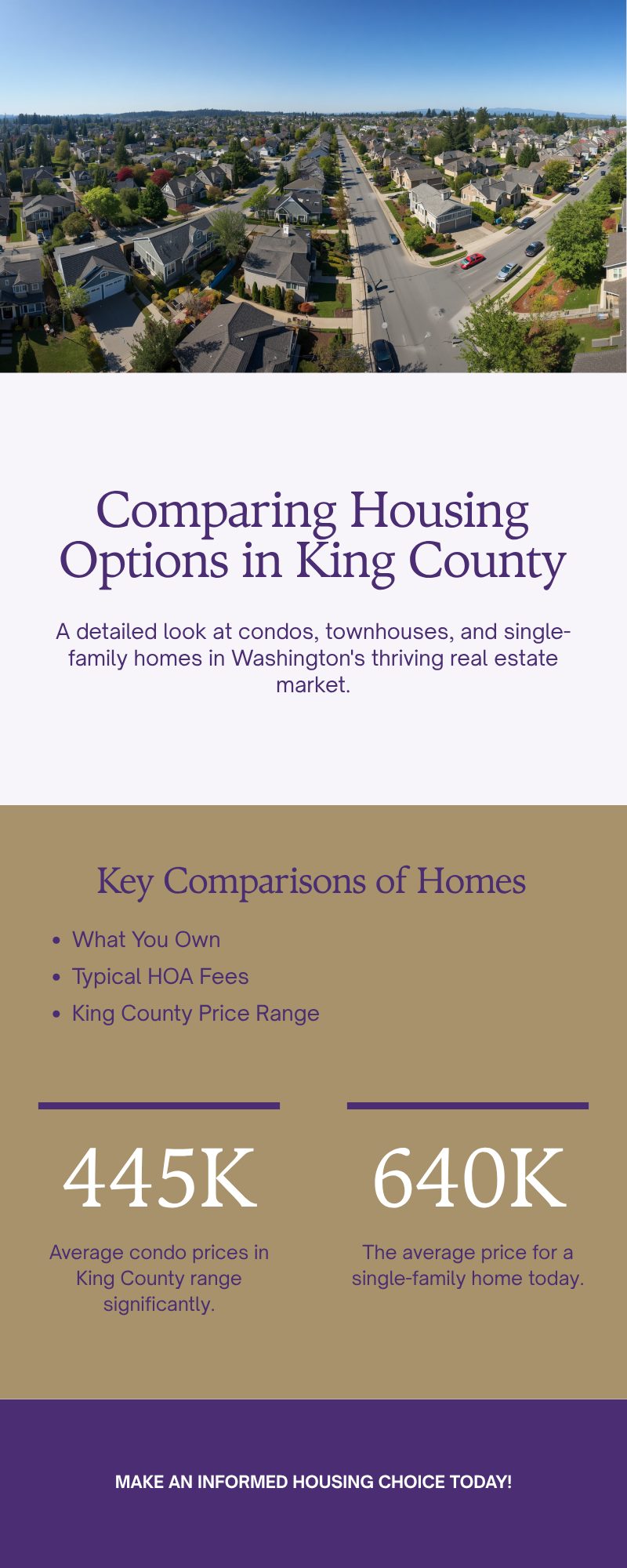
Property type comparison for King County buyers — ownership structure, HOA fees, and who each is right for.
What You Actually Own
This is where most people have fuzzy thinking, and it matters more than any other single factor.
Single-Family Home
When you buy a single-family home, you own the building and the land underneath it. Full stop. No HOA involved in most cases, though some planned neighborhoods do have one for shared amenities. If the roof leaks, that’s on you. If you want to paint the front door a different color, go for it. Your lot is yours to build a deck on or plant a garden in. That full ownership is exactly what makes SFHs appreciate the way they do. Land in King County is genuinely scarce, and land ownership transfers that value directly to you.
Townhouse
When you buy a townhouse, you typically own the structure and the land it sits on. Townhouses in King County are usually fee-simple, meaning you own your unit from the ground up. You share walls with neighbors, and there’s usually an HOA covering the common areas — shared driveways, landscaping, maybe a small courtyard. But the land is yours. That’s a meaningful difference from a condo, and it means townhouse appreciation tends to track closer to single-family than to condo over time.
Condo
When you buy a condo, you own the interior of your unit and a share of common areas. The land, the roof, the exterior walls, the lobby — all of that belongs to the HOA. Maintenance of those shared elements comes out of your monthly dues and out of a reserve fund that the HOA is supposed to be building over time. That arrangement is convenient right up until the roof needs replacing and the reserve fund is underfunded. More on that below.
The Price Gap Is Real in 2026
In King County as of early 2026, you’re looking at roughly these price ranges depending on what you’re buying and where.
Single-family homes in South King County — Renton, Kent, Auburn, Maple Valley — are running between $640,000 and $850,000 for typical resale product. The countywide median is hovering around $880,000. Anything under $600K in the SFH category tends to be smaller footprints or locations where the trade-off is commute time or school district.
Townhouses in those same South King County cities are typically coming in between $450,000 and $650,000. New construction townhomes near light rail corridors or in Kent’s East Hill area have been active in the $500K–$600K range. They’re a real path for buyers who want a two-car garage and a backyard without the $800K price tag.
Condos are the most variable. King County’s condo median dropped sharply — from around $690,000 in early 2025 to closer to $445,000–$577,000 in early 2026, depending on location. That’s a significant decline driven by a real imbalance in supply and demand for condos right now. More inventory, softer buyer demand, and a financing environment that makes condo purchases harder have all contributed. If you want to understand what current mortgage rates mean for your monthly payment across these price ranges, that post walks through the exact math.
How They Finance — This Is the Part That Surprises People
Financing a single-family home is the most straightforward of the three. Conventional loans, FHA, VA — all of these work with minimal restrictions. With strong credit and 3–5% down, you can access the full range of loan products.
Townhouses generally finance similarly to single-family homes, with one caveat. If the townhouse is part of a condo regime — meaning the ownership is structured legally as a condo even though it looks like a townhouse — lender scrutiny increases. Always ask your agent how the title is structured before assuming it finances like an SFH.
Condos are where financing gets genuinely complicated, and buyers often don’t find out until they’re already in contract.
Lenders classify condos as either warrantable or non-warrantable. A warrantable condo meets guidelines set by Fannie Mae and Freddie Mac — the HOA is financially healthy, owner-occupancy is above a certain threshold, no single entity owns too large a percentage of units, and the building isn’t in litigation. Those loans behave pretty normally. The interest rate runs about 0.125–0.375% higher than a comparable SFH purchase, and you can put as little as 3–5% down with good credit.
A non-warrantable condo is a different story. These are condos that don’t meet those standards — maybe the rental occupancy is too high, or the HOA has pending litigation, or the reserve fund is critically underfunded. Lenders who will touch these at all typically require 20–25% down and charge rates 0.5–1.5% higher than the warrantable equivalent. Some lenders won’t touch them at all.
HOA Fees and Hidden Costs: What to Actually Look For
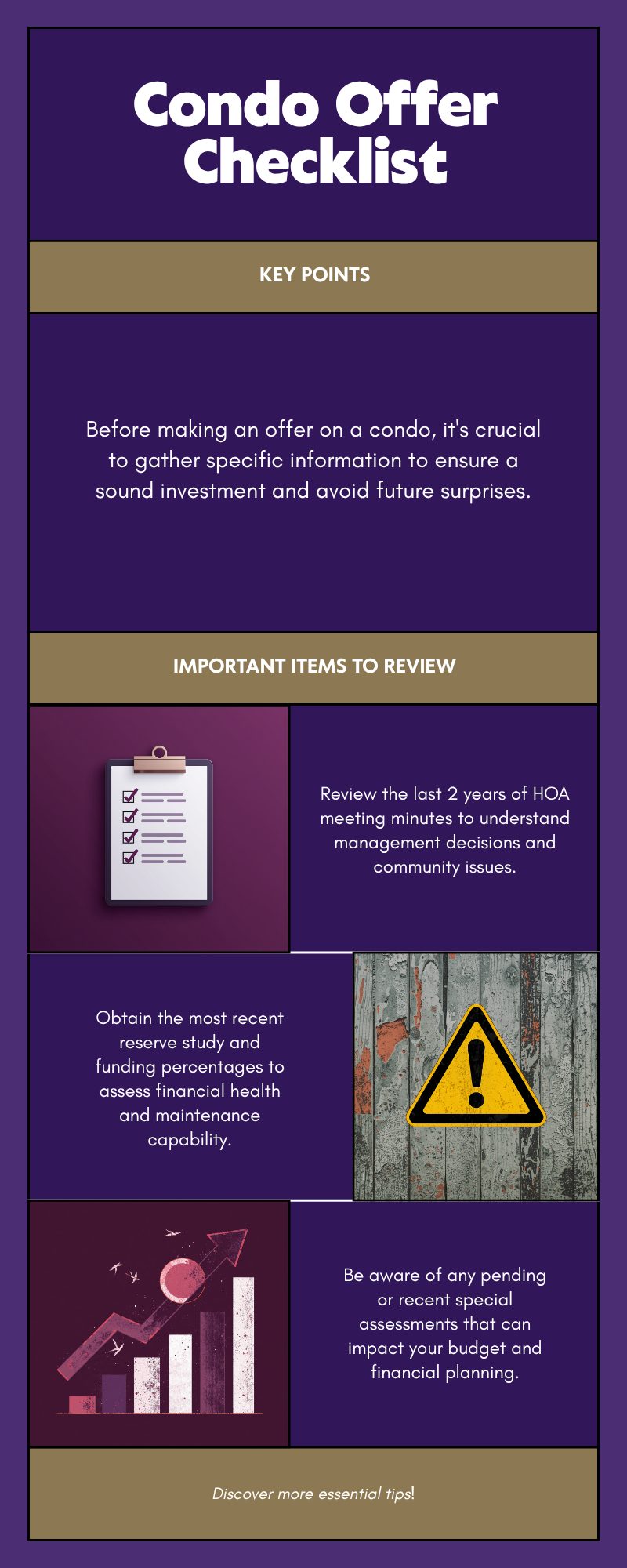
Request these documents before you make an offer on any condo in King County.
Every property type can have an HOA, but the nature and risk of HOA involvement varies considerably.
For single-family homes in planned communities, HOA fees tend to be modest — often $50–$150/month — and cover things like neighborhood common areas or a community pool. These are relatively low-risk from a special assessment standpoint as long as there aren’t major shared structures.
Townhouse HOAs typically run $200–$500/month in King County and cover shared exterior maintenance, landscaping, and common areas. The key question is: what exactly is the HOA responsible for? Some townhouse HOAs cover roof and siding; others leave the exterior entirely to you. Read the CCRs before you make an offer.
Condo HOAs carry the most complexity. Downtown Seattle condos can run $400–$1,000+/month. South King County condos tend to be lower — $250–$550/month — but can spike with age and deferred maintenance. And that brings us to the single biggest risk most condo buyers underestimate: the special assessment.
Washington State law (RCW 64.34.380 for condos) requires HOAs to conduct reserve studies and update them annually. A well-funded HOA sets aside money every month to cover large future expenses — roof replacement, elevator service, parking structure repairs. When an HOA is underfunded, it can’t pay for those repairs out of reserves. The result is a special assessment: a one-time charge to every unit owner, sometimes running $5,000–$30,000+ per unit.
Before you make an offer on a condo, request the last two years of HOA meeting minutes, the most recent reserve study, and the current percent-funded figure. If the reserve study shows less than 70% funding and the minutes mention deferred maintenance or upcoming projects, factor a special assessment into your budget. If they won’t provide these documents, that’s your answer.
Appreciation Patterns: Which One Builds Wealth Faster?
This is the question every buyer wants a clean answer to, and the honest answer is that it depends on time horizon and what you’re comparing.
Single-family homes in King County have the strongest long-term appreciation track record, driven primarily by land scarcity. As the region has grown, land in South King County has become more constrained. Homes in Renton, Maple Valley, and Auburn have all seen substantial appreciation over the last decade. In May 2026, single-family inventory in King County was tight enough at 2.8 months of supply to support pricing stability, with homes selling at 101.9% of list price on average. My East and South King County market update has the current numbers.
Townhouses tend to appreciate in line with or slightly below SFH rates, depending on the product. New construction townhomes near transit corridors have performed well as demand for lower-maintenance, urban-adjacent living has grown. Fee-simple townhouses — where you own the land — typically hold value better than leasehold or condo-regime townhouses.
Condos are the most volatile of the three. The sharp drop in King County condo prices in 2025–2026 illustrates this clearly. Condos have periods of strong appreciation, particularly during high-demand, low-inventory cycles, but they also fall harder when demand softens. The oversupply of condo inventory right now, combined with the financing friction around non-warrantable buildings, has pushed prices down in ways that SFH and townhouse buyers haven’t experienced. That said, the current condo pricing environment does present a genuine opportunity for buyers who do the due diligence. Buying at a cyclical low in a well-run building in a strong location can produce solid returns. The key word is “well-run.”
The King County Local Angle: How Each Property Type Plays Out Here
South King County gives you examples of all three property types at accessible prices, and the differences matter more in this market than national averages suggest.
In Renton, you’ll find a mix of SFH in the $650K–$850K range, townhomes clustered near the Renton Highlands and Landing area in the $450K–$600K range, and condos in the Renton downtown corridor that have come down considerably in price. The light rail connection at the Renton Transit Center has increased buyer interest in Renton townhouses specifically. If you’re buying in Renton and considering a condo, the warrantability question is especially relevant — several Renton condo buildings are older and require careful reserve fund scrutiny. The Living in Renton guide covers the full neighborhood breakdown.
In Kent, townhomes in the $450K–$550K range have been some of the more active product in 2026. The first-time buyer guide for Kent covers the buy-now-vs-wait math that many Kent buyers are working through, and townhomes tend to be the property type that makes that math work at current rates.
In Auburn and Maple Valley, single-family homes still dominate the inventory. Townhouse product exists but is more limited. If you’re drawn to these communities for the school districts and neighborhood feel, the calculus often pushes toward SFH even if it means stretching the budget a bit further.
East King County — Issaquah, Bellevue, Sammamish — has a strong townhouse market particularly in the Issaquah Highlands and Talus communities, where mixed-use development has produced a large supply of attached product. These are generally well-maintained and have active HOAs with healthy reserves, but due diligence still matters.
What This Means for You as a Buyer
If you’re a first-time buyer in South or East King County in 2026, here’s the practical framework I’d use.
Budget Under $500,000
You’re likely looking at condos or newer townhomes. Condos offer the lowest purchase price but require more due diligence. Prioritize buildings with healthy reserves and warrantable financing status. If you can get into a well-run building at today’s discounted prices, you’re buying in at a favorable point in the condo cycle.
Budget $500,000–$700,000
Townhouses become your primary option for getting into ownership with land included. New and newer construction townhomes in Kent, Renton, and Federal Way fit this range. Prioritize fee-simple structures over condo-regime townhouses, and read the HOA docs before you fall in love with a floor plan.
Budget $700,000+
Single-family homes in South King County become realistic. You’ll find the strongest appreciation track record and the simplest financing path. The trade-off is less lock-and-leave convenience and more maintenance responsibility.
Frequently Asked Questions
What is the difference between a condo and a townhouse in King County?
A condo is a unit in a shared building where you own the interior space and a share of common areas. A townhouse is usually a multi-level attached home where you own the structure and the land it sits on. This difference in land ownership typically makes townhouses appreciate more like single-family homes and finance more like them too.
Is it harder to get a loan for a condo than a house in King County?
Yes, generally. Condos face additional lender scrutiny around HOA financial health, owner-occupancy ratios, and reserve fund adequacy. If a condo is classified as non-warrantable, you’ll typically need a larger down payment and accept a higher interest rate. Single-family homes and fee-simple townhouses don’t have this additional layer of review.
Are condos a good investment right now in King County?
Condo prices dropped significantly in 2025–2026, which means buyers who do careful due diligence can potentially buy at a cyclical low. The risk is that you’re buying into a shared financial structure (the HOA), so the quality of the building’s finances matters as much as the unit itself. In a well-run building, current pricing represents a real opportunity. In a poorly funded building, you’re taking on someone else’s deferred maintenance.
How much are HOA fees for condos vs. townhouses in South King County?
Condo HOA fees in South King County typically run $250–$550/month for older and mid-range buildings. Townhouse HOAs tend to be lower — $150–$400/month — and generally cover less exterior maintenance. Downtown Seattle and Eastside condos can run $400–$1,000+/month. Always include HOA dues in your monthly payment calculation when comparing properties.
What is a reserve fund and why does it matter when buying a condo?
A reserve fund is the HOA’s savings account for large future repairs — roof replacement, elevators, structural work. Washington State requires condos to conduct reserve studies and update them annually. If the reserve fund is significantly underfunded (below 70% of what it should hold), the risk of a special assessment increases. Special assessments are one-time charges to all unit owners that can run thousands to tens of thousands of dollars.
Can I use an FHA loan to buy a condo in King County?
Yes, but the condo building must be on the FHA-approved list. FHA imposes strict requirements on owner-occupancy rates, commercial space ratios, and HOA financial health. Search the HUD database to check a specific building’s approval status before getting too far into the transaction.
The property type you choose is one of the first big decisions in the buying process, and it shapes everything that follows — financing, monthly costs, what you maintain, and what you eventually sell. Understanding the differences upfront saves a lot of mid-transaction surprises.
Your guide to life outside Seattle.
253-350-0045 ·
greg@livingoutsideseattle.com ·
www.livingoutsideseattle.com
This Guide Has Moved
This article has been folded into our maintained guide: East & South King County Market Update [July 2026]. You are being taken there now.
Living in Renton, WA — This Guide Has Moved

This guide has moved. You’re being taken to the current version: Living in Renton, WA — 2026 Real Estate & Neighborhood Guide.
