

 Facebook
 X
X
 Pinterest
 Copy Link

Most sellers are nervous about the home inspection. Here’s what actually happens, what buyers are really looking for, and how to handle a repair request without losing your deal.
The call comes in after the inspection. Your agent says the buyer has a repair request. Your stomach drops.
I see this happen all the time. Sellers who have lived in their home for 10 or 15 years think they know every quirk of the place, and they still get surprised by what an inspector puts in a report. That’s not because something was hidden. It’s because most sellers have never seen a home inspection report before. When you see 40 items flagged in a 60-page document, it can feel catastrophic — even when 35 of those items are caulk gaps and light switch covers.
Here’s what the inspection process actually looks like from the seller’s side, what it means when a buyer sends repair requests, and how to respond without blowing up your sale. If you haven’t started prep yet, it’s worth reading our guide to preparing your home for sale in King County alongside this one.
How the Inspection Fits Into Your Sale Timeline
In King County, the buyer typically has a set window after mutual acceptance — often 7 to 10 days — to schedule and complete their inspection, review the report, and submit any requests. That window is spelled out in the purchase and sale agreement.
You don’t attend the inspection. As the seller, your job is to leave the home accessible and get out of the way. The inspection takes two to four hours depending on the size and condition of the property. Smaller condos in Renton or Auburn might be done in under two hours. A larger home in Covington or Maple Valley with a finished basement and detached garage can take closer to four.
After the inspection, the buyer gets a full written report — typically 30 to 60 pages with photos. The report goes to the buyer, not to you. You only see what the buyer chooses to share when they submit their requests.
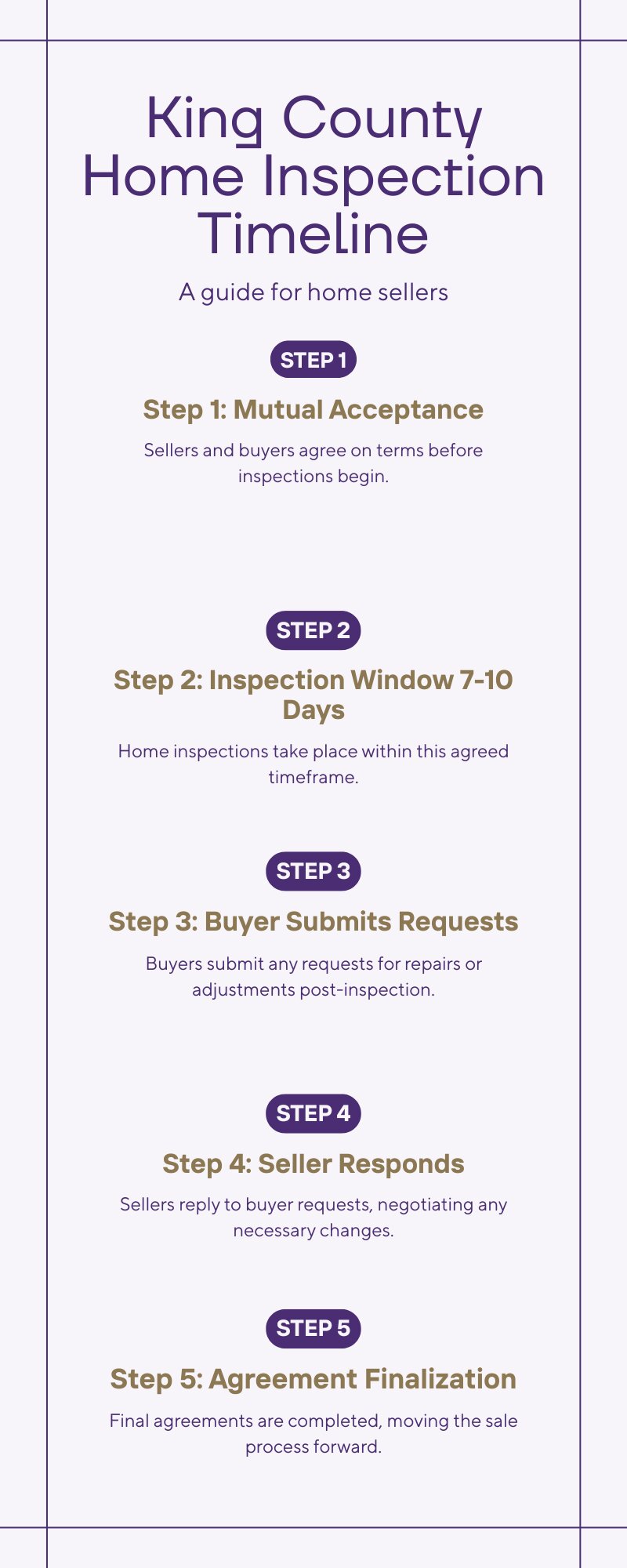
In King County, buyers typically have 7–10 days after mutual acceptance to complete their inspection and submit requests.
What the Inspector Actually Looks At
Home inspectors in Washington are licensed through the state Department of Licensing. They’re looking at the condition of the home’s systems and structure, not its cosmetic appearance. That means they won’t flag your dated kitchen tile, but they will flag a roof that’s near the end of its life.
The main areas every inspector covers are the roof and attic, the foundation and crawl space, the electrical panel and visible wiring, plumbing visible within the walls and under fixtures, the HVAC system including the furnace and any heat pumps, the water heater, windows and doors, and the exterior including drainage and grading.
In the Pacific Northwest, inspectors pay extra attention to moisture. We get a lot of rain here, and the most common serious findings in South and East King County homes come down to water — roof age, gutter condition, crawl space moisture, and signs of past leaks near windows and skylights. A good inspector is going to look hard at anywhere water could get in.
What Shows Up on a Report — and What It Actually Means
This is where sellers tend to panic. You’ll see a long list of items, many flagged with the same urgent-looking language, and it all starts to blur together.
Here’s how to read it: inspectors are trained to note everything they observe, regardless of severity. A missing dryer vent cover and a cracked heat exchanger show up in the same format — but one is a $12 fix from the hardware store and the other is a serious safety issue.
The findings that actually matter fall into a few categories.
Safety Issues
Safety issues are the ones buyers and their lenders care most about. Missing handrails on stairs, double-tapped breakers in the electrical panel, exposed wiring, carbon monoxide detector gaps — these get flagged and buyers expect them to be addressed.
In King County, older homes in Renton and Kent sometimes have Federal Pacific electrical panels, which can be an insurance problem for buyers. That’s a legitimate concern worth addressing before listing if you know about it.
Structural and Water Intrusion Issues
These are the ones that can kill deals or require significant renegotiation. Foundation cracks showing active movement, rot at the mudsill, or evidence of water in the crawl space fall here.
These aren’t always deal killers, but they need to be understood. Is this an old issue that’s been stable for years, or is water still moving? That question matters a lot to how a buyer responds.
Mechanical Systems Nearing End of Life
A furnace that’s 20 years old, a water heater at 12 years, a roof with 3 to 5 years of life left — these often show up in inspection reports. Buyers will sometimes ask for a credit here, especially in a more balanced market like we’re seeing in parts of King County in 2026.
This isn’t surprising news if you’ve owned the home for a while. Knowing the ages of your major systems before you list means you can factor them into your pricing strategy rather than scrambling to respond to them mid-contract.
Deferred Maintenance
This makes up the bulk of most reports. Caulk at tubs and windows, tree branches touching the roof, missing downspout extensions, minor gutter debris — these are normal house items that don’t represent serious problems.
Buyers sometimes include a long deferred maintenance list in their requests. That doesn’t mean you have to fix all of it. Knowing the difference between a genuine concern and a routine maintenance item is where your agent’s experience matters most.

Most inspection reports are long. This is what the findings that actually matter look like compared to routine maintenance items.
Do You Have to Fix What the Buyer Asks For?
No. This surprises a lot of sellers.
Washington State does not require sellers to fix anything a buyer requests in an inspection response. The purchase and sale agreement sets up a negotiation. The buyer submits their requests. You have several options.
You can agree to the repairs and have them completed before closing, typically by licensed contractors. You can offer a dollar credit at closing instead of doing the work yourself, which buyers often prefer because it lets them choose their own contractor. You can agree to some items and decline others. Or you can decline the entire request and let the buyer decide whether to move forward or exercise their right to terminate.
The buyer’s decision has to happen within the inspection contingency window. If the timeline passes without resolution, the contingency typically expires and the sale proceeds as-is.
What you actually have to fix depends on what your contract says, not on any general legal requirement. If you’ve negotiated repairs as a condition of the sale, you’re obligated to complete them. If you respond by declining, the buyer gets to choose their path.
The Case For (and Against) a Pre-Listing Inspection
A pre-listing inspection means you hire an inspector before you go on the market. You find out what’s in the house before the buyer does.
The upside is real. A pre-listing inspection in King County typically costs $350 to 650+ depending on home size. That’s a small price to avoid being blindsided at the negotiating table. You can fix the things that matter on your own timeline and your own budget, rather than scrambling to get licensed contractors in before closing under time pressure. In a competitive market, some sellers share the pre-listing inspection report with buyers to build confidence and reduce the chance of an “inspection for information only” turning into a full renegotiation.
The downside is also real. If the inspection finds something serious, you’re now legally obligated to disclose it to buyers — even if you choose not to fix it. In Washington State, the disclosure requirements are strict. You can’t un-know what the inspector told you.
My general guidance: if the home is older than 15 to 20 years, or if you have any reason to believe there might be deferred maintenance issues in the crawl space, roof, or electrical, the pre-listing inspection is worth it. For newer homes in good condition, it’s less essential but still something that most buyers expect to see in King County.
What Kills Deals vs. What Buyers Overlook
The honest truth is that very few sales fall apart because of a home inspection. When a deal dies over inspection, it’s usually because a major undisclosed issue came to light — not because there were 40 items in the report.
The issues most likely to kill or seriously damage a deal are active roof leaks or significant roof deterioration, foundation problems showing current movement, evidence of water in the crawl space or basement that hasn’t been resolved, major plumbing failures like a failed main sewer line, and serious electrical hazards.
Buyers in King County are used to older housing stock. A 1975 Kent home or a 1985 Renton split-level is going to have some things on an inspection report. Experienced buyers and their agents know the difference between a well-maintained older home with normal findings and a house with real problems.
The things buyers most often overlook or accept as-is: cosmetic items, surface wear, minor roof maintenance items on an otherwise sound roof, single-pane windows in older homes, and deferred exterior maintenance like peeling paint or weathered decks.
What This Means for You as a Seller
Before you list, walk through your home with fresh eyes. Check the gutters. Look at what’s happening around the water heater and under sinks. Know the age of your roof and furnace. These aren’t things to hide — they’re things to understand so you can have an honest conversation with your agent about pricing and preparation.
When the inspection report comes in, read it with your agent before you react. Most items on a typical report are manageable. The ones that aren’t are the ones worth knowing about early. Understanding how pricing works in King County gives you a clearer sense of how to factor known conditions into your list price from the start.
You have more options than you think when repair requests arrive. A credit at closing is often cleaner than trying to coordinate contractors under a time crunch. Declining minor requests is completely legitimate. And pricing the home to reflect known conditions from the start — which is exactly what a BPO-trained pricing approach does — means you’re less likely to end up in a contentious renegotiation to begin with. You can also read our guide on how appraisals work in Washington State to understand the full picture of what happens between contract and closing.
Frequently Asked Questions
Does the seller have to be present during the home inspection?
No. In fact, it’s standard practice for sellers to leave during the inspection. It makes buyers and inspectors more comfortable, and it prevents awkward conversations about every item being noted.
How long does a home inspection take in King County?
Most inspections run two to four hours. A smaller condo or townhome might finish in 90 minutes. A larger single-family home with a crawl space, detached garage, and outbuildings in Covington or Maple Valley could take up to four hours or more.
What happens if I don’t agree to any repairs?
The buyer then has a choice: move forward with the purchase as-is, or exercise their right to terminate within the inspection contingency period. If they terminate, you get your home back on the market. If you’ve priced it correctly, another buyer will come.
What is a right-to-cure clause in Washington?
Washington contracts include a seller’s right to cure, which gives you the opportunity to respond to a repair request. You can agree, counter, or decline. It’s not a requirement to fix — it’s a framework for negotiation.
Should I get a pre-listing inspection in King County?
For homes older than 15 to 20 years, or any home where you have concerns about the crawl space, roof, or electrical system, a pre-listing inspection is usually worth the $350 to $550 cost. It lets you fix things on your terms and removes surprises from the process.
Can a buyer walk away after the inspection for any reason?
During the inspection contingency period, yes. The buyer can terminate for virtually any reason related to the inspection findings. Once that window closes, their options narrow significantly.
The inspection is one step in a process with a clear beginning and end. Most sellers who go through it — even with a long repair list — close. The ones who struggle are usually the ones who weren’t prepared for what they’d see. You can also review our guide to Washington State closing costs to understand the full financial picture before you list.
Your guide to life outside Seattle.
253-350-0045 · greg@livingoutsideseattle.com · www.livingoutsideseattle.com
