

 Facebook
 X
X
 Pinterest
 Copy Link

Most agents estimate your home’s value. Here’s how I assess it — and what that difference means for your final sale price in King County.
You asked three agents what your home is worth. You got three different numbers. Maybe the spread was $40,000. Maybe it was $80,000. Now you’re trying to figure out who’s right and why the gap exists.
Here’s the honest answer: most agents build their price estimate around a handful of recent sales in their transaction history. They pull some comps from the MLS, do some quick math, and give you a number. It’s not reckless — it’s just limited. They’re working from a small sample of deals and general pattern recognition built up over time.
I do this differently. When I first moved to the Seattle area, I also trained as a BPO field agent. I still do that work today. That means I physically assess property values for banks and mortgage servicers — dozens of homes per week across Issaquah, Renton, Kent, Auburn, Maple Valley, and surrounding communities. Every assessment sharpens my pricing instincts a little more. So when I sit down to price your home, I’m not estimating. I’m applying the same methodology that lenders use when real financial decisions are on the line.
That distinction matters more than ever in today’s King County market, where the gap between a well-priced home and an overpriced one is measured in weeks and tens of thousands of dollars.
What Most Agents Do When They Price a Home
A Comparative Market Analysis — the CMA you’ll get from most agents — is an informal estimate. There’s no standardized format, no set methodology, and no external accountability behind the number. The agent pulls three to five recent sales near your property, makes some adjustments for square footage and condition, and arrives at a price.
That’s a reasonable starting point. But CMAs have limitations most sellers don’t realize. Comp selection is subjective. Two agents can look at the same MLS data and weight different factors differently — one emphasizes lot size, another emphasizes recent updates, another adjusts more aggressively for street appeal. That’s how two professionals looking at identical information arrive at numbers that are $60,000 apart.
CMAs are also built on whatever transactions the agent happens to have completed recently. An agent who primarily works in Bellevue but occasionally lists in Renton is working from secondhand knowledge of the Renton market. Their comps may be technically defensible, but they’ll miss the micro-patterns that only come from pricing properties in that specific area every week.
If you want to understand what a CMA looks like and how to evaluate one, I wrote a full breakdown at How to Read a CMA: King County Seller Guide.
What a BPO Is — and Why It’s Different
A Broker Price Opinion is a formal valuation ordered by a lender, mortgage servicer, or investor. BPOs are used for loan modifications, short sales, foreclosures, estate settlements, and portfolio valuations. The bank literally trusts this number to make a financial decision.
That accountability changes how the work gets done.
A BPO follows a standardized format. It documents the subject property’s condition, identifies comparable sales using specific criteria, makes adjustment calculations that have to be defensible, and produces a formal report. Unlike a CMA, there’s no room for gut-feel handwaving. The methodology has to hold up.
BPO field agents complete dozens of these assessments per month. They physically visit properties, photograph them, document conditions, and cross-reference against recent sales across a wide range of neighborhoods. Over time, that volume of work develops a pricing instinct that’s hard to match through occasional transactions alone.
The differences between a BPO and a CMA aren’t just procedural. BPOs are more detailed and accurate than CMAs — sitting between a casual CMA and a full certified appraisal in rigor and specificity. The formal report format, the standardized comparable criteria, and the volume of assessments that BPO agents complete all contribute to better-calibrated pricing.
How I Price Your Home
When I prepare a listing analysis for one of my sellers, I use the BPO framework as the foundation. In practice, that means:
Comparable selection with real criteria
I don’t just pull the nearest five sales. I look for comps that match your property’s footprint, condition, age, lot characteristics, and neighborhood micro-location as closely as possible. If there’s a busy road nearby, or a school district boundary running through your block, I account for that. In South King County, where prices can shift $30,000 to $50,000 from one side of a school district line to another, this specificity is not optional.
Condition-based adjustments that reflect what buyers actually pay
A dated kitchen and a remodeled kitchen in the same neighborhood are not worth the same amount. I’ve seen enough transactions to know what buyers actually pay for specific upgrades in specific sub-markets — not what the rule of thumb suggests, but what real closed sales show.
Active market awareness that comps can’t give you
Because I’m in the field pricing properties every week, I know when buyer activity is shifting before it shows up in closed sales data. Closed sales have a 30 to 60-day reporting lag. If demand softened three weeks ago, it won’t appear in the comps yet — but I’ll already know it from the assessments I’m completing on the ground.
Why This Matters for Sellers Right Now
King County’s market has shifted in 2026. Median days on market has climbed to 12 to 24 days depending on area and property type. That still sounds fast by national standards, but here’s what the data actually shows: well-priced homes are moving in 11 to 13 days and roughly 30% are closing above asking. Homes priced even 5% above where buyers are focused are sitting 40 to 60 days, collecting price reductions that signal weakness to every buyer who comes along.
Price reductions don’t just cost you time. They cost you money. Buyers who’ve watched a listing accumulate days on market know the seller is losing leverage with every passing week. They negotiate harder. The damage to your net proceeds compounds.
Getting the price right from day one is how you protect the final number. A well-priced listing generates more showings, more competing interest, and more negotiating strength. You can read more about how pricing strategy affects your outcome at How to Price Your Home to Sell in King County 2026.
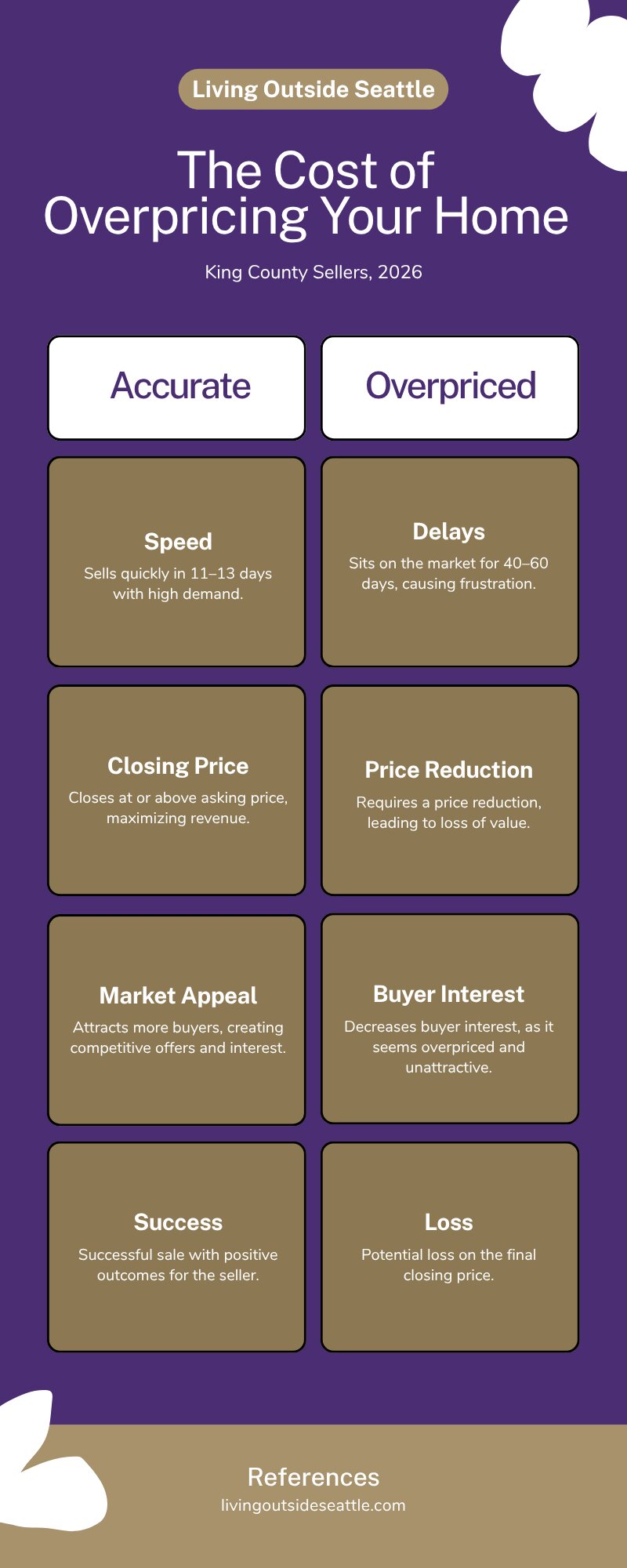
Well-priced homes in King County are moving in 11–13 days. Overpriced by 5%? Expect 40–60 days and a price cut.
The King County Angle: What I See Every Week in the Field
South and East King County is not one uniform market. It’s a collection of micro-markets with their own pricing dynamics, and they don’t always move in the same direction at the same time.
Renton’s Kennydale neighborhood commands a consistent premium over Renton Highlands, even for similar square footage, because of its proximity to Lake Washington and its commute position to Bellevue and Seattle. On Renton’s Benson Hill, a school district boundary can shift comparable values by $25,000 to $40,000 on identical floorplans, depending on which side of the line a home sits.
In Auburn, the Lakeland Hills community prices at a measurable premium over comparable homes near downtown Auburn because of its newer construction base and neighborhood feel. In Kent, homes in the East Hill school zone above the ridge tend to hold value more consistently than similar square footage in the valley floor near downtown Kent.
These patterns don’t show up cleanly in a zip-code-level CMA. They show up when you’re pricing properties in these neighborhoods every week and watching what buyers actually pay — not as a transaction observation, but as an ongoing calibration.
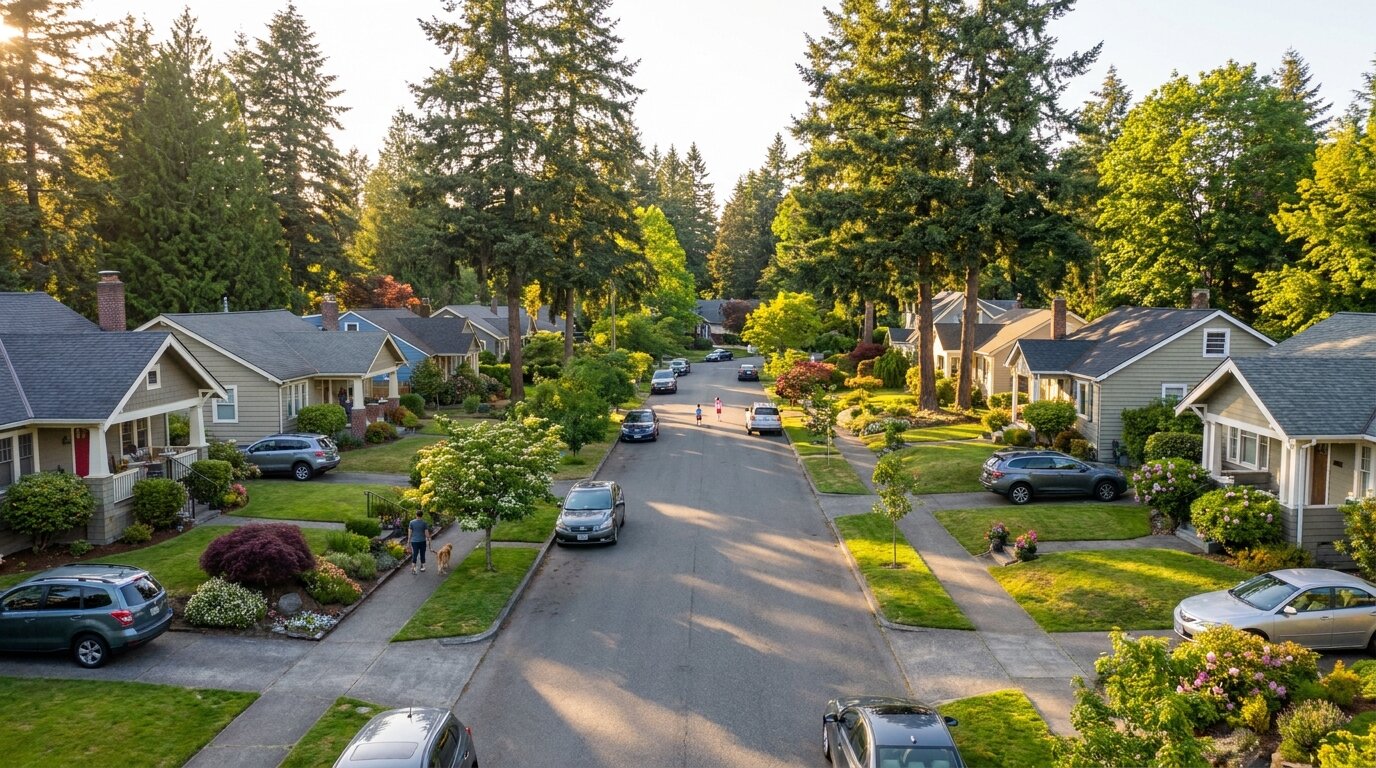
South King County isn’t one market — it’s dozens of micro-markets, each with its own pricing patterns that only show up if you’re on the ground every week.
What This Means for You as a Seller
If you’re interviewing agents to list your home in South or East King County, ask them a direct question: how did you arrive at your price recommendation? A number without a methodology is a guess. A methodology without regular field experience is stale.
You don’t need to understand the full BPO framework to benefit from it. You just need to work with an agent who’s calibrated their pricing instincts against the actual market every week — not just against their own transaction history.
If you receive two or three agent price recommendations that are far apart, that gap is telling you something important. At least one of those agents is working from incomplete information. Your job is to figure out which one — and a good place to start is asking each agent to walk you through their comparable selection and how they adjusted for condition and location.
When you’re preparing your home for listing, check out How to Prepare Your Home for Sale in King County — the condition decisions you make before listing directly affect how accurately any agent can price your home.

The right pricing conversation happens before the listing goes live — not after it sits.
Frequently Asked Questions
What is a Broker Price Opinion (BPO)?
A BPO is a formal property valuation prepared by a licensed real estate broker for a lender or financial institution. It’s used for loan modifications, foreclosures, short sales, estate settlements, and portfolio valuations. Unlike a CMA, it follows standardized methodology, produces a formal report, and carries real external accountability. BPO agents complete high volumes of assessments regularly, which calibrates their pricing accuracy over time.
How is a BPO different from a CMA?
A CMA is an informal estimate prepared by an agent to guide pricing strategy. There’s no standardized format and no external accountability — the methodology varies by agent. A BPO follows institutional standards, uses documented methodology, and is produced under formal reporting requirements. In practice, BPOs are more accurate than CMAs because they’re more rigorous and because agents who do BPO work regularly develop a calibrated pricing instinct that goes beyond occasional transaction experience.
Does having a BPO background mean my home will sell for more?
Not automatically. What it means is that your list price gets set more accurately from the start. An accurate list price attracts more qualified buyers, generates more competing interest, and reduces the risk of sitting on the market. Homes that sit accumulate days-on-market stigma that erodes your negotiating leverage. Accurate pricing is how you protect your final number — not inflated pricing.
How do I know if an agent’s price recommendation is accurate?
Ask them to walk you through their methodology. Which comparable sales did they use, and why? How did they adjust for condition differences between your home and the comps? What recent market shifts are they accounting for? An agent who can answer these questions specifically is working from a real methodology. An agent who gives you a number and pivots quickly to marketing is not.
What’s the risk of overpricing in today’s King County market?
In 2026’s market, homes priced even 5% above where buyers are focused tend to sit 40 to 60 days before needing a price reduction. That lag costs you time and negotiating position. Buyers who’ve watched a listing accumulate days on market view the price reduction as confirmation that the seller is motivated — and they negotiate accordingly. “Leaving room to negotiate” rarely works in a market where buyers have access to the same data you do.
Can I get a free home valuation from you?
Yes. If you’re thinking about listing your South or East King County home, reach out at greg@livingoutsideseattle.com or call 253-350-0045. I’ll prepare a pricing analysis using the same BPO methodology I use for institutional clients — grounded in real comps, real condition adjustments, and real current market conditions.
Most sellers only sell two or three homes in their lifetime. The price you set on day one shapes everything that follows — how quickly you sell, how much you net, and how much leverage you carry into negotiations.
I’ve spent 9+ years pricing properties in East and South King County. I do it for lenders. I do it for estate managers and investors. I do it for the homeowners who hire me to list their homes. The methodology doesn’t change based on who’s asking.
If you’re thinking about selling in King County and want to know what your home is actually worth — not what sounds good — I’d be glad to talk. Visit www.livingoutsideseattle.com to learn more about how I work.
Your guide to life outside Seattle.
253-350-0045 · greg@livingoutsideseattle.com · www.livingoutsideseattle.com
