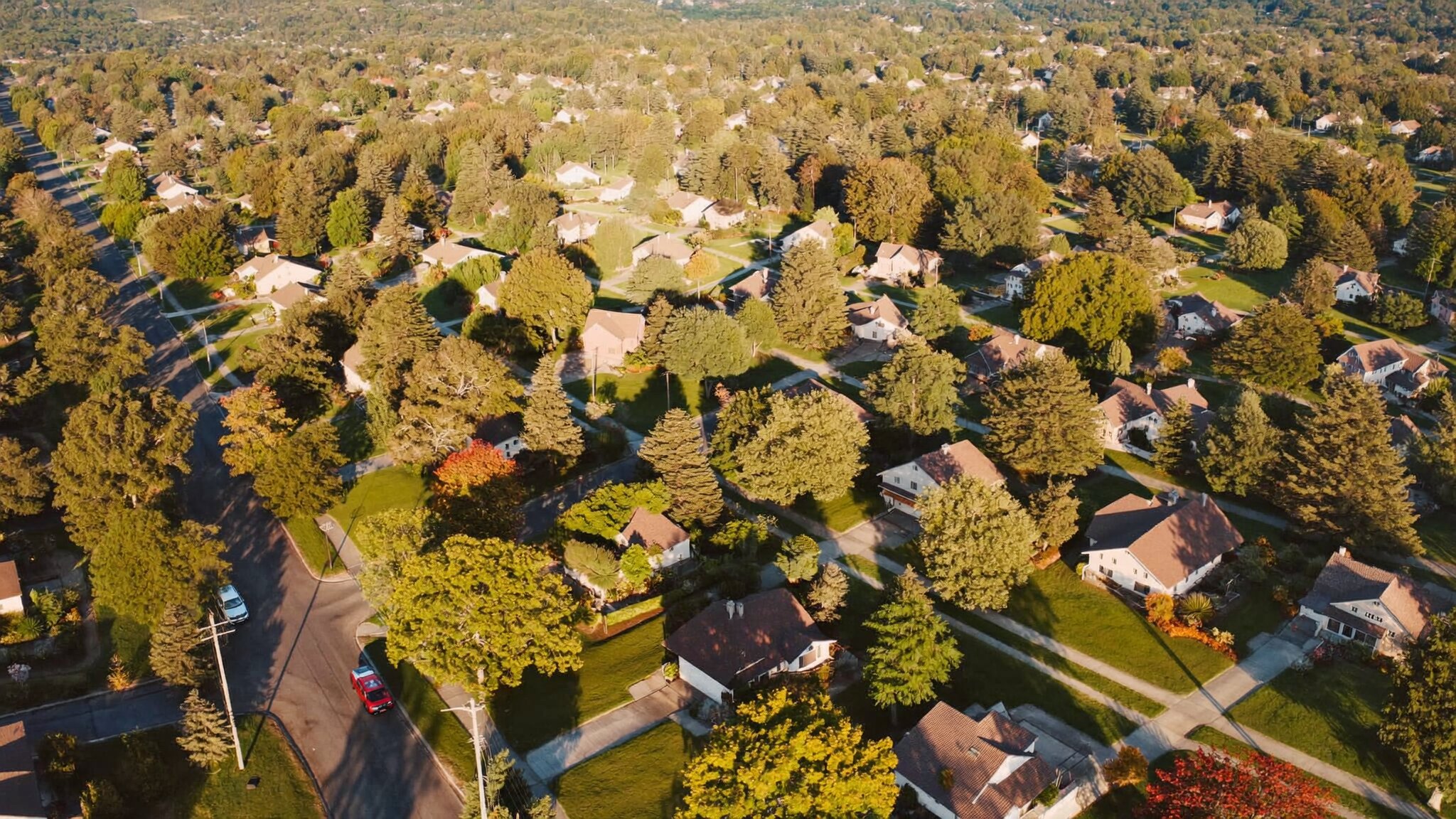
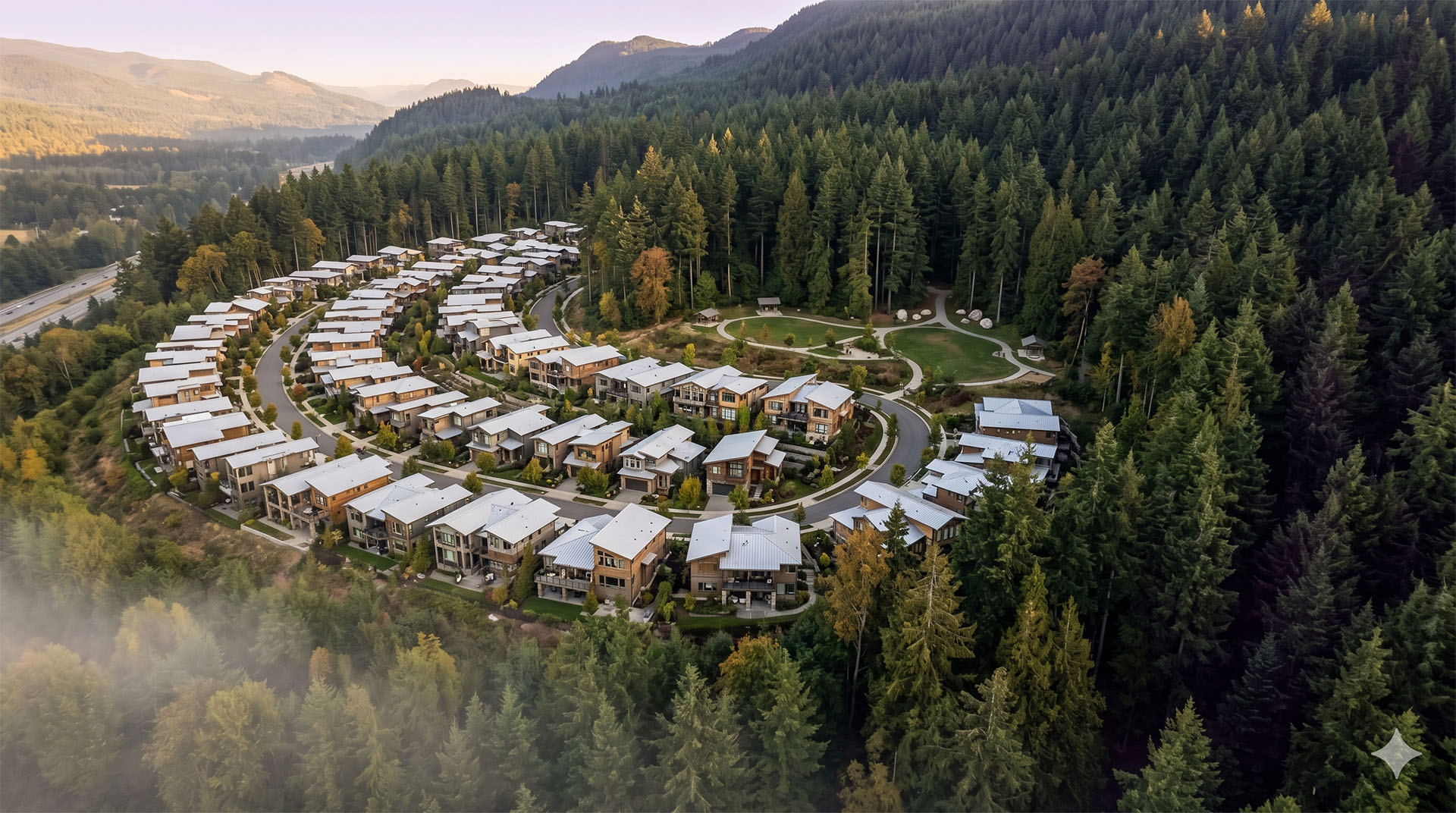
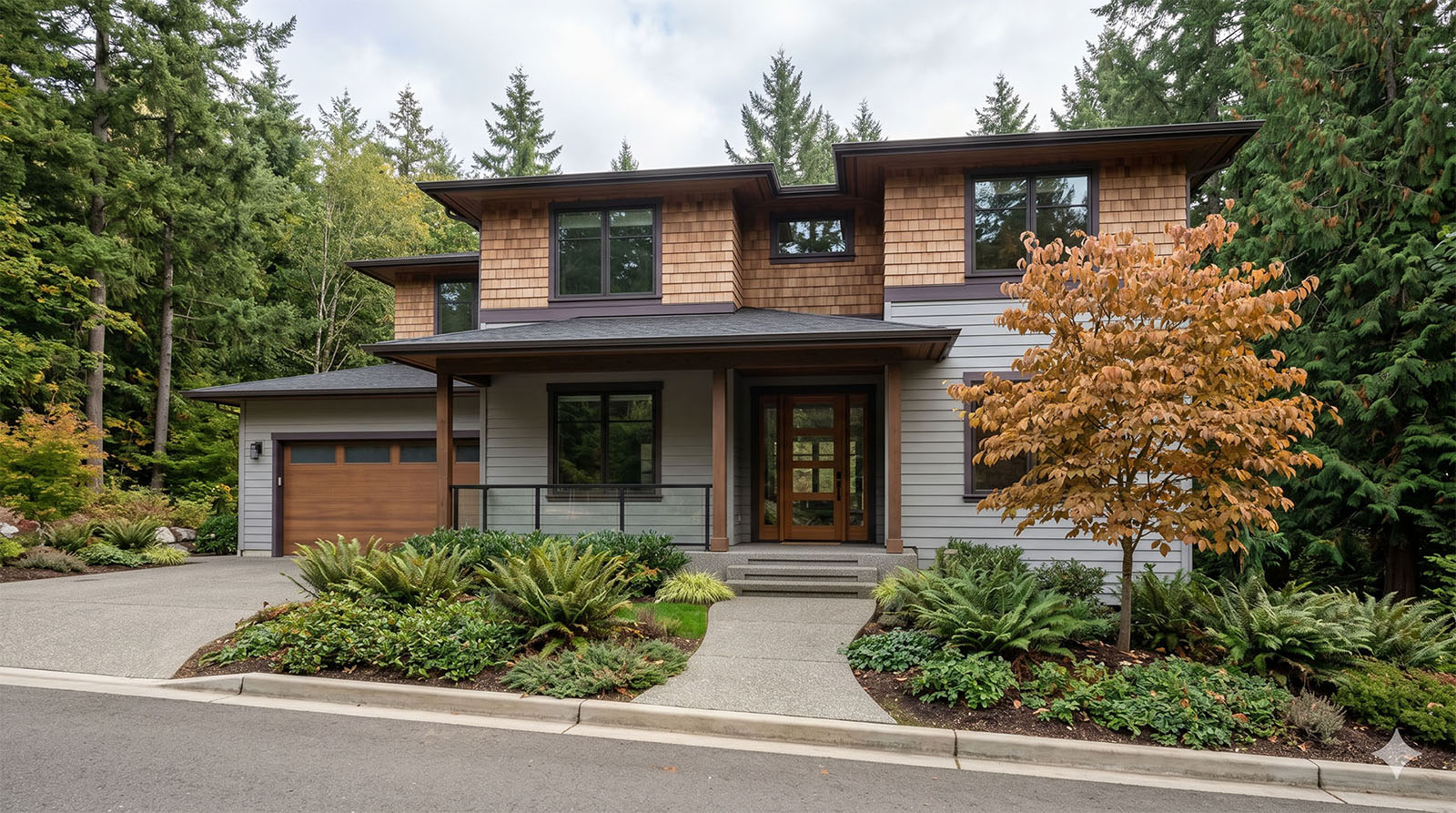
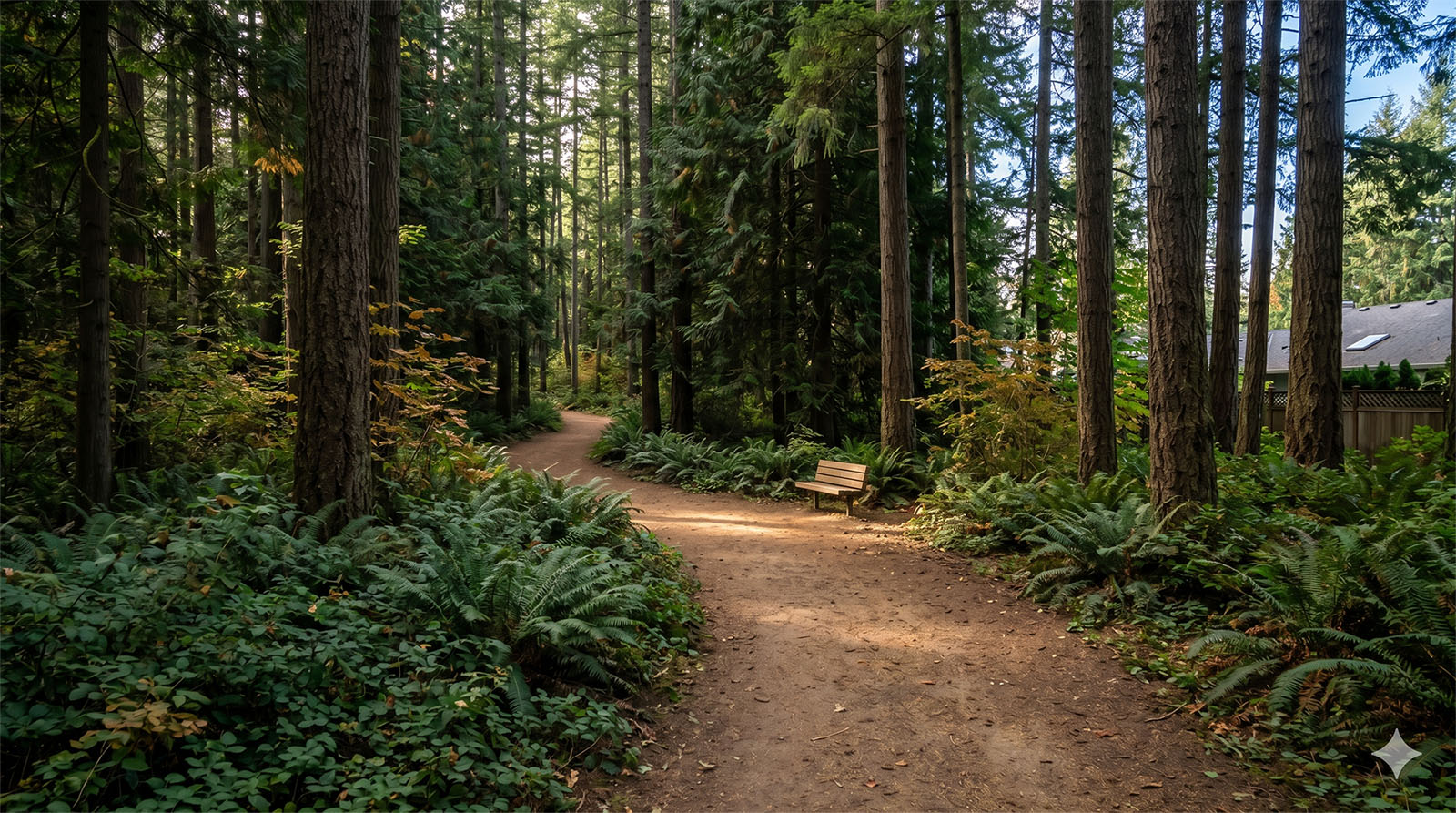
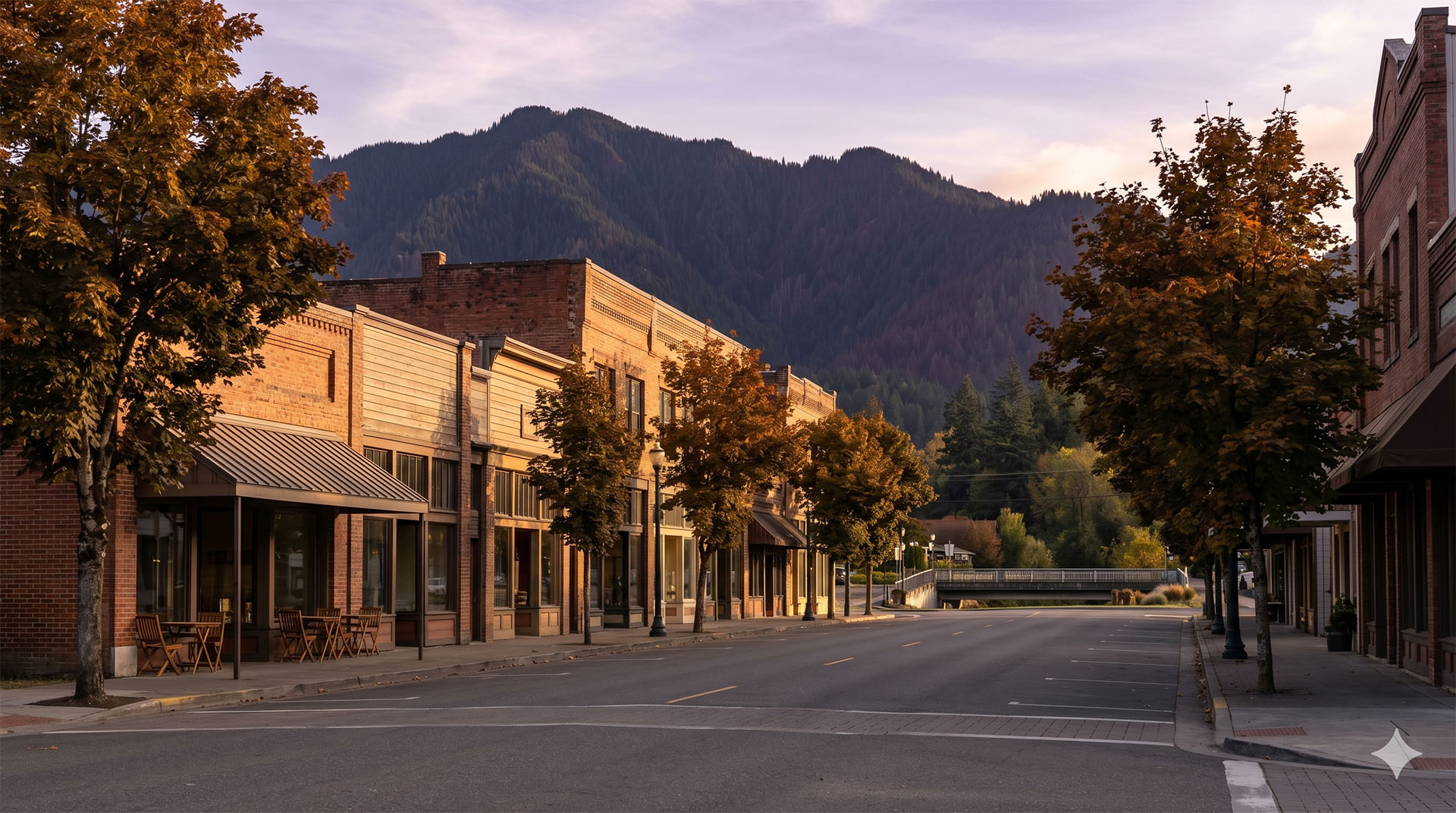
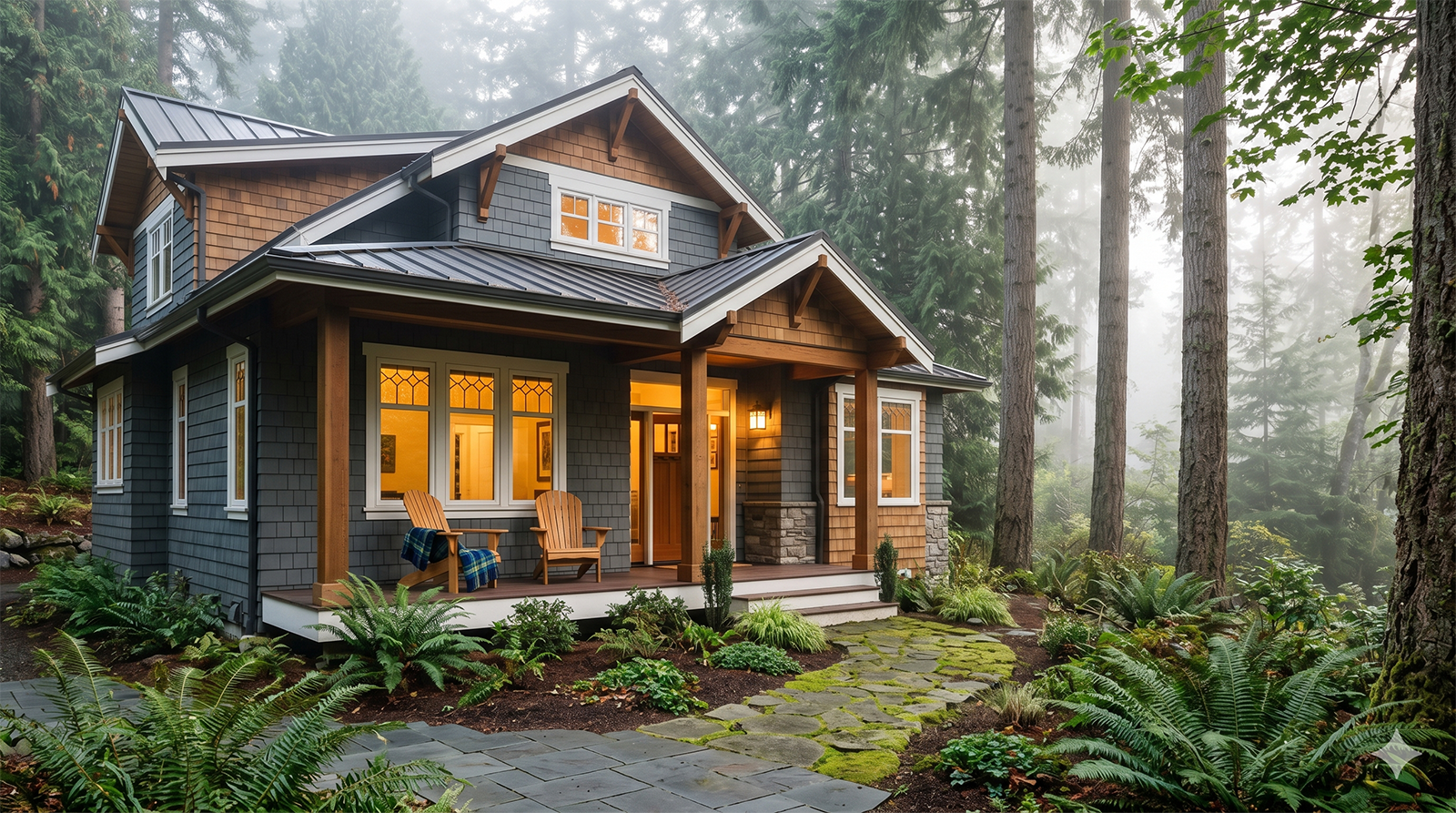
When people tell me they’re relocating to Auburn Washington, the first thing they ask is whether they’re settling. They’ve heard “South King County” and assumed it means compromise: longer commute, fewer amenities, homes that are affordable because nobody wants them.
That’s not what I see when I’m out there five to six days a week evaluating properties.
Relocating to Auburn or Federal Way means getting more house for less money in a King County market with very few affordable entry points left. Here’s what the March 2026 numbers say.
Auburn Washington Home Prices in 2026: What $668K Gets You
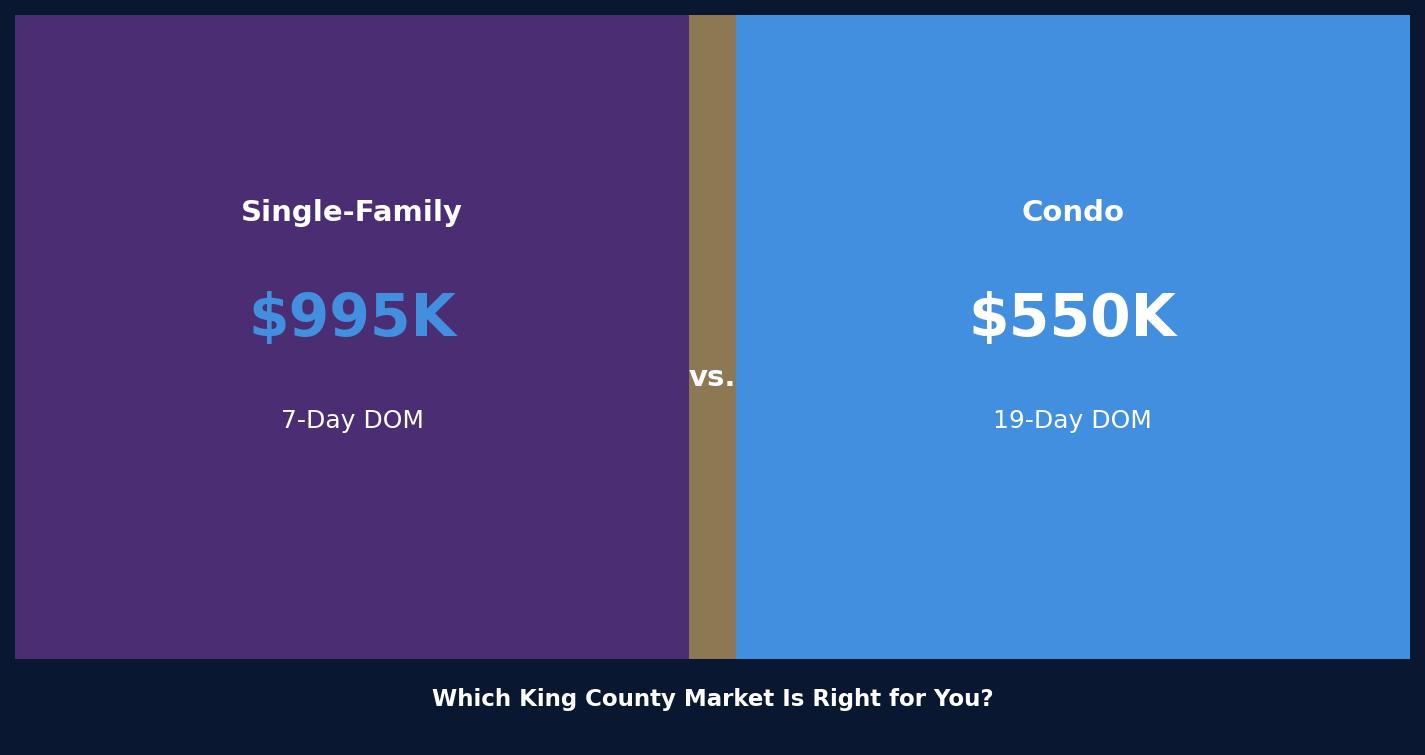
Auburn at $668K and Federal Way at $686K are the only King County cities where a family can buy a single-family home with a yard for under $700K.
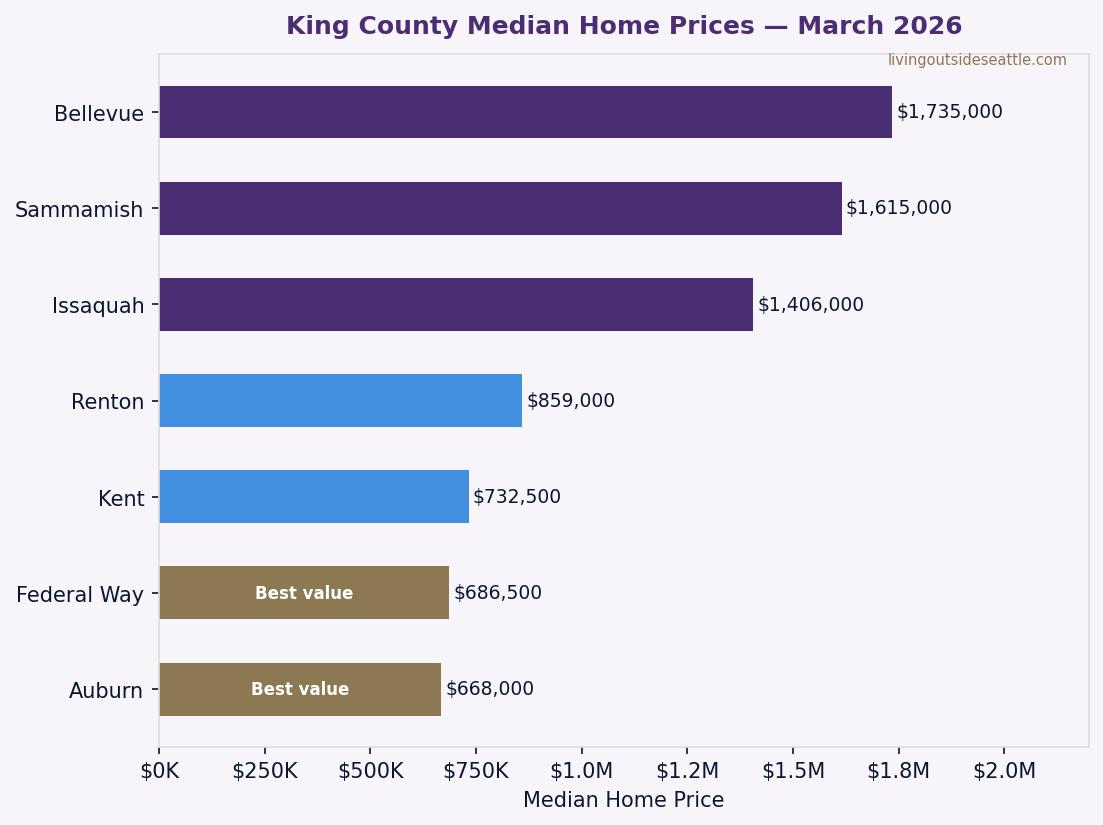
March 2026 median single-family home prices across King County’s major markets:
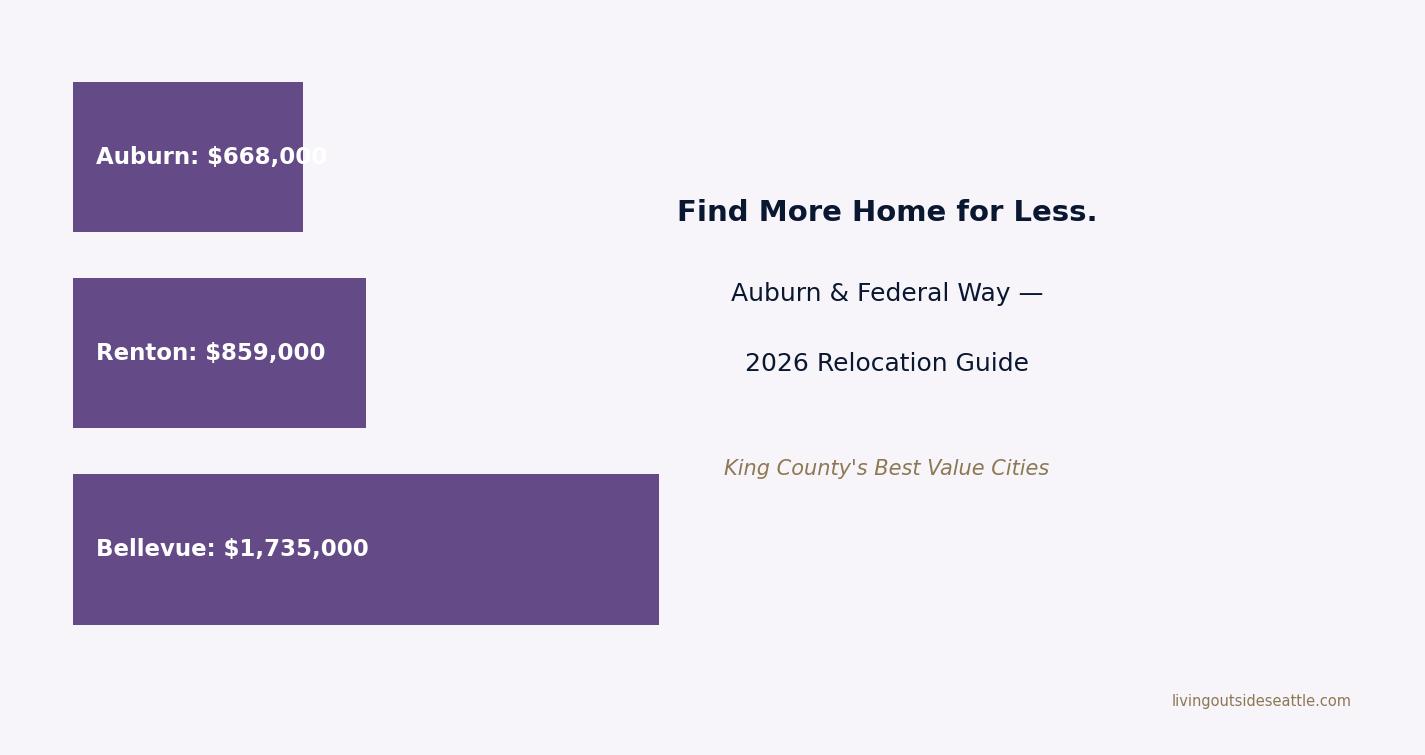
At $668,000, Auburn’s median is roughly $191,000 less than Renton and more than $1 million less than Bellevue. The price difference traces to geography, but what you get for that money is the part worth paying attention to.
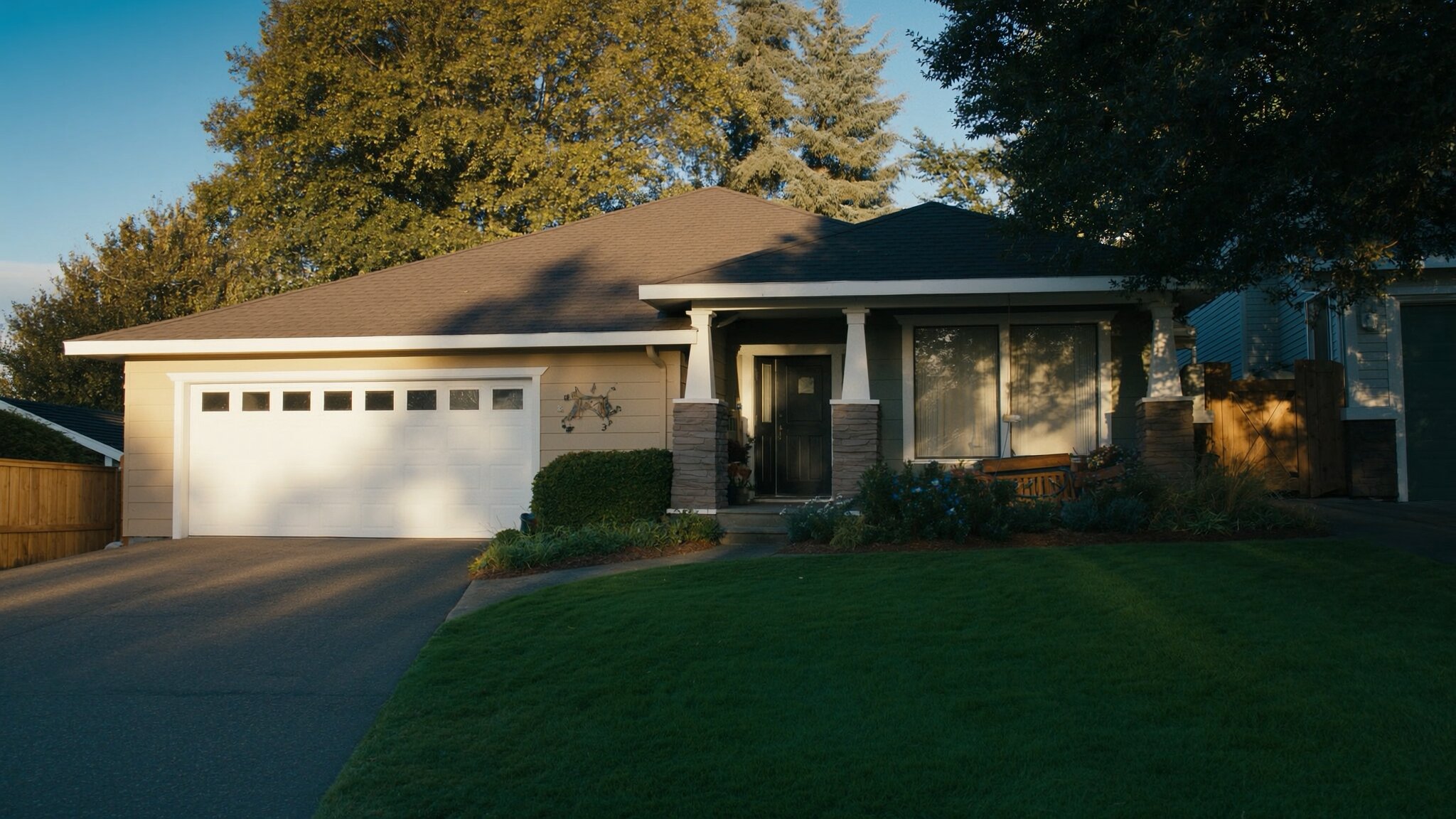
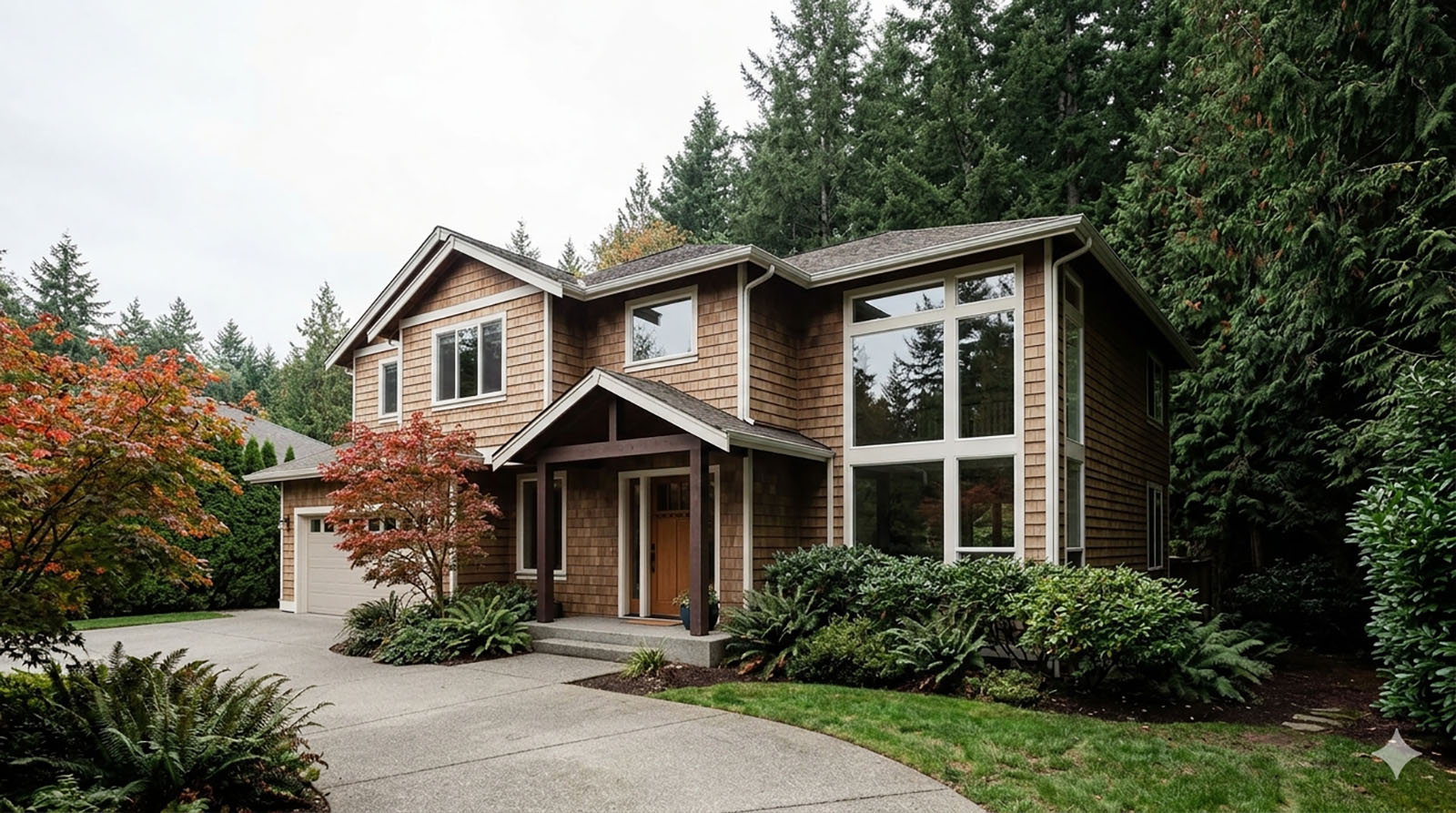
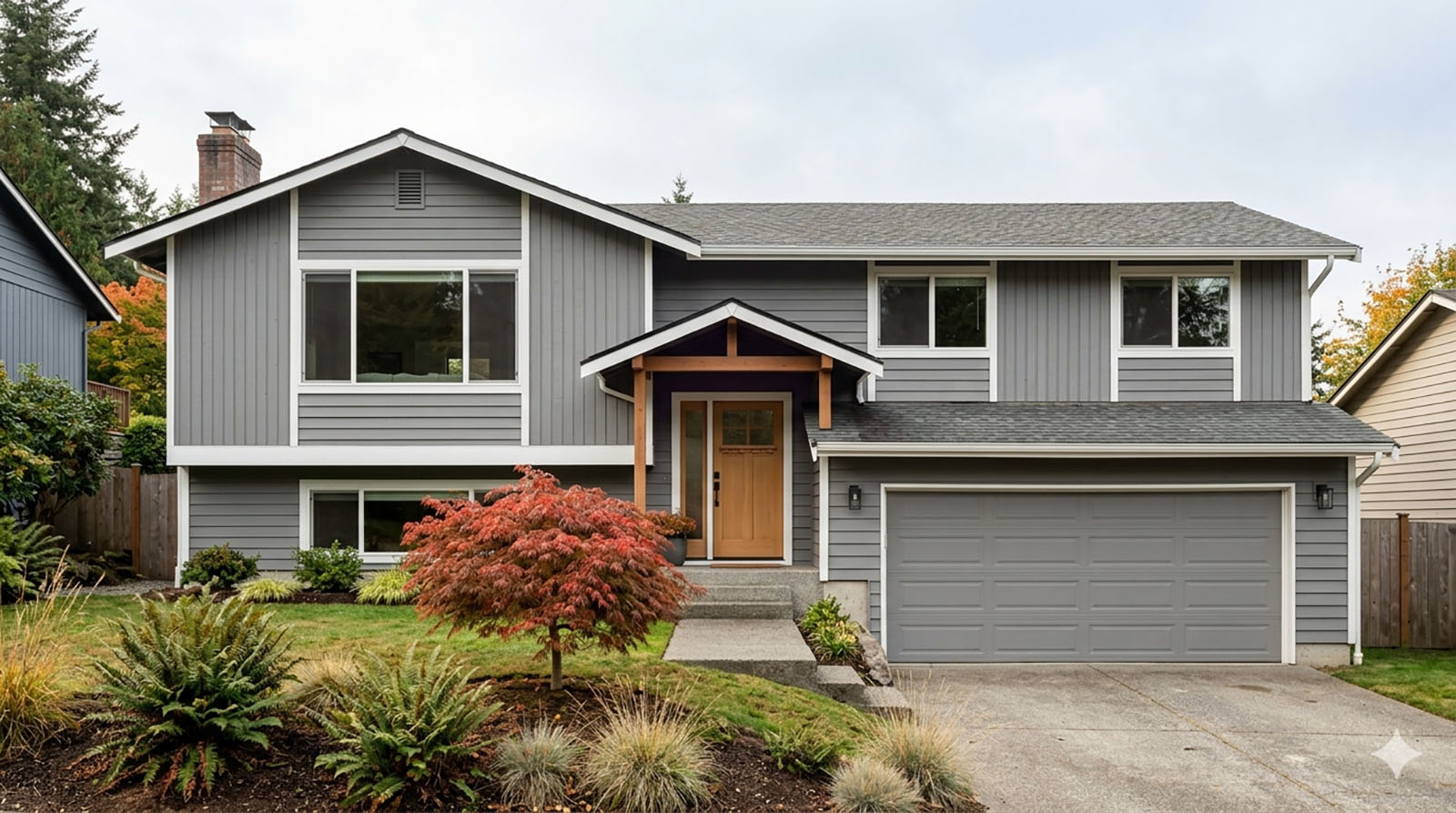
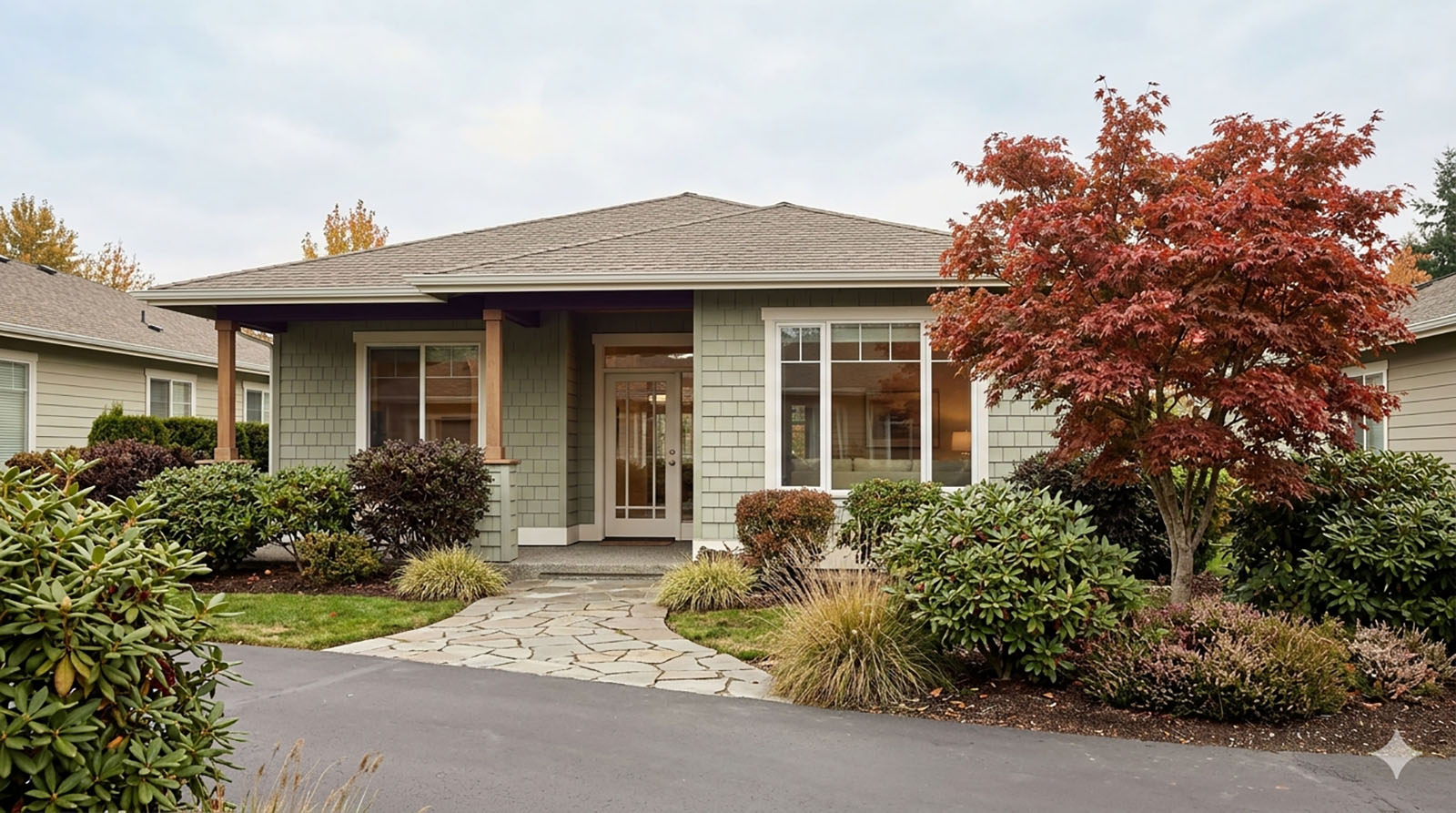
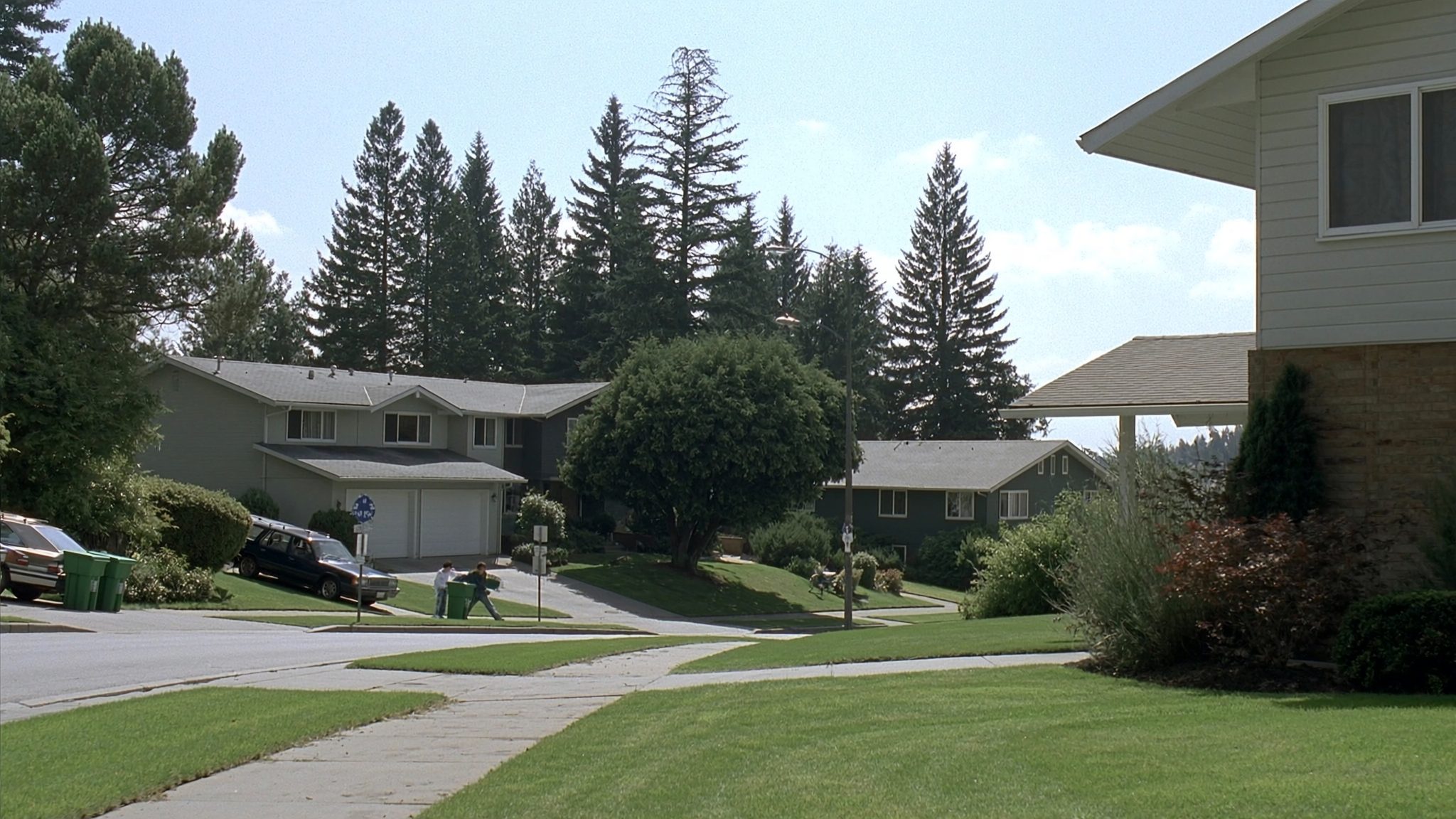
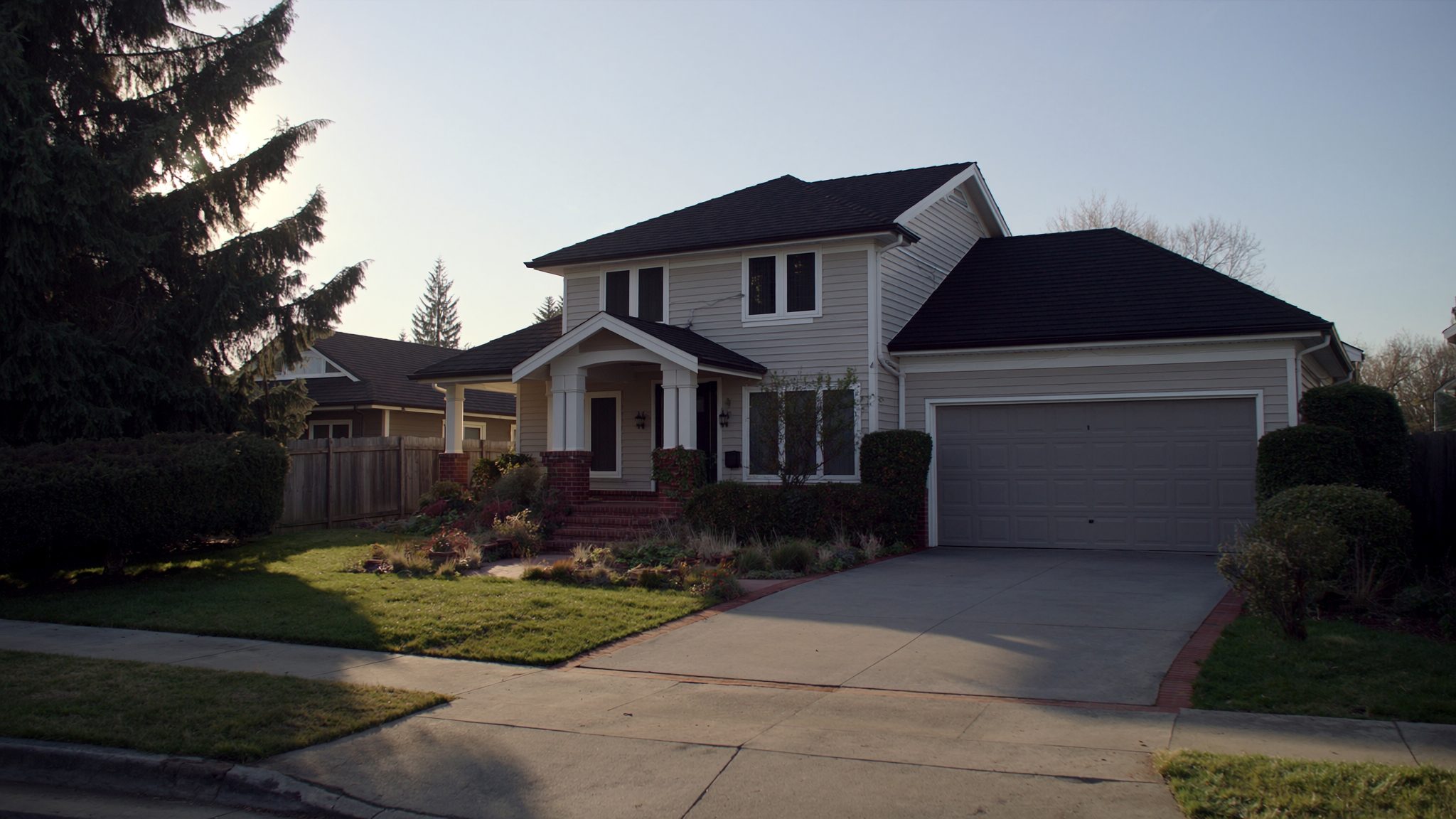
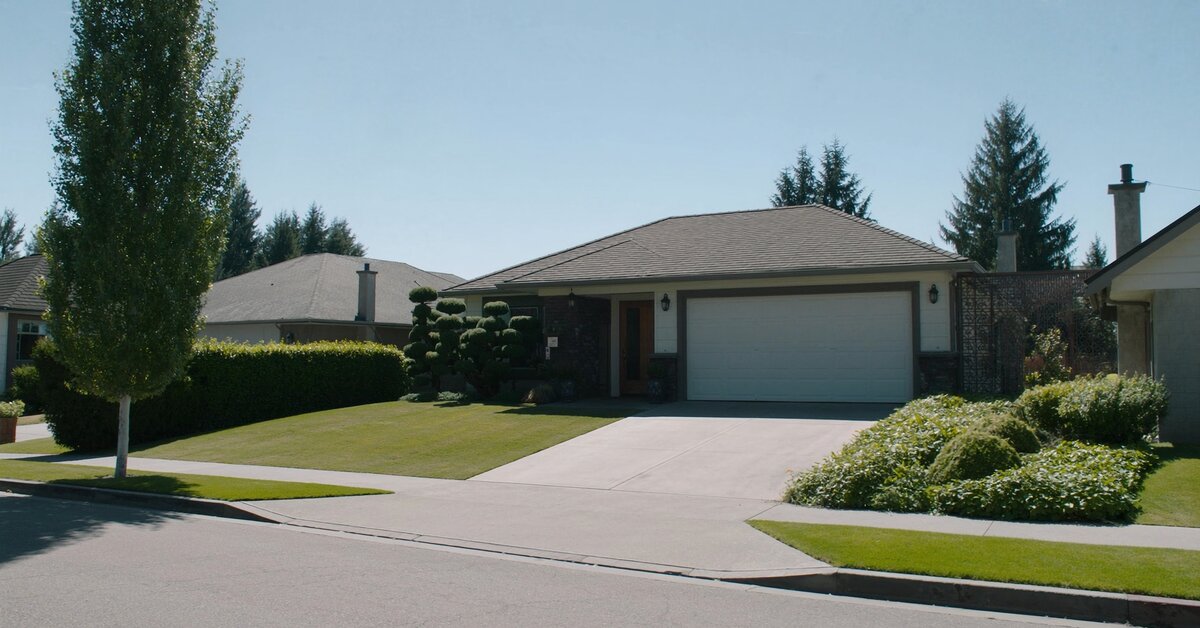
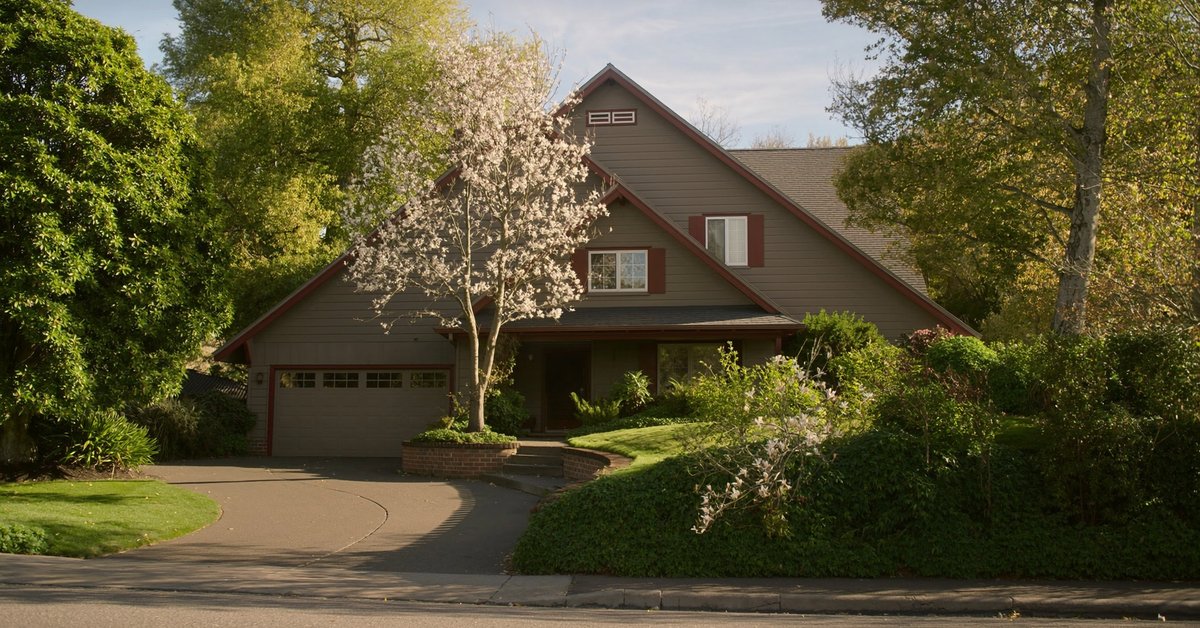
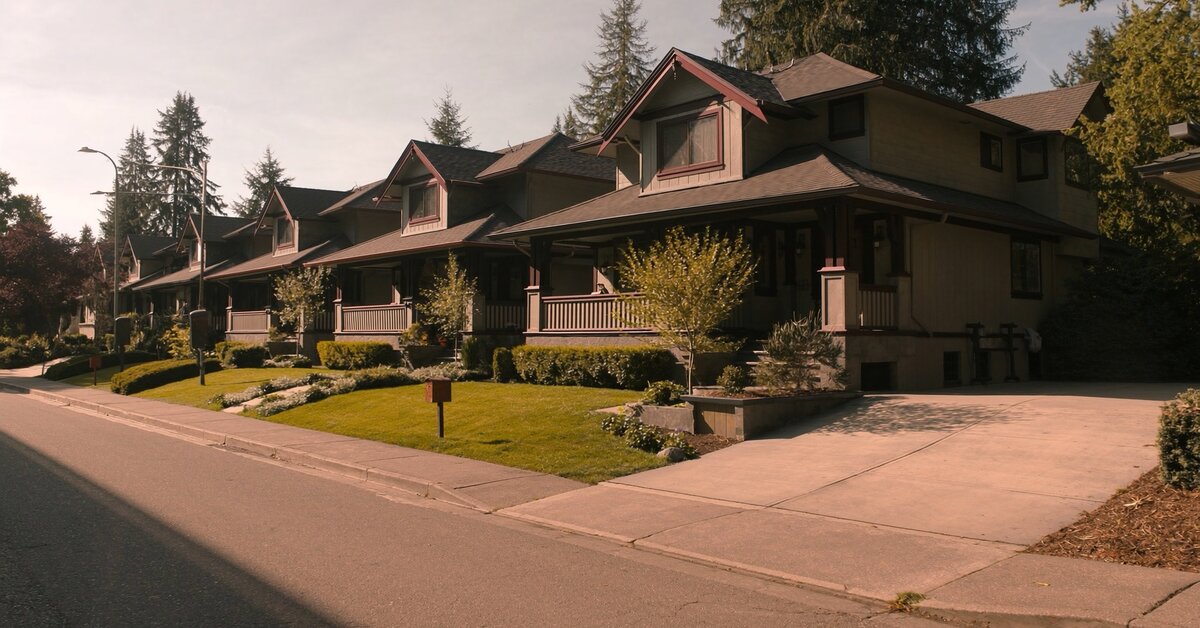
A $668,000 budget in Auburn gets you a 3-bedroom, 2-bathroom home on a quarter-acre lot. Typically 1,500 to 1,800 square feet, built in the 1980s to 2000s, with a driveway, a yard, and space to breathe. The same budget in Bellevue: a smaller condo or townhouse, no yard, competing with 20 other buyers in a market where homes sell in 5 days.
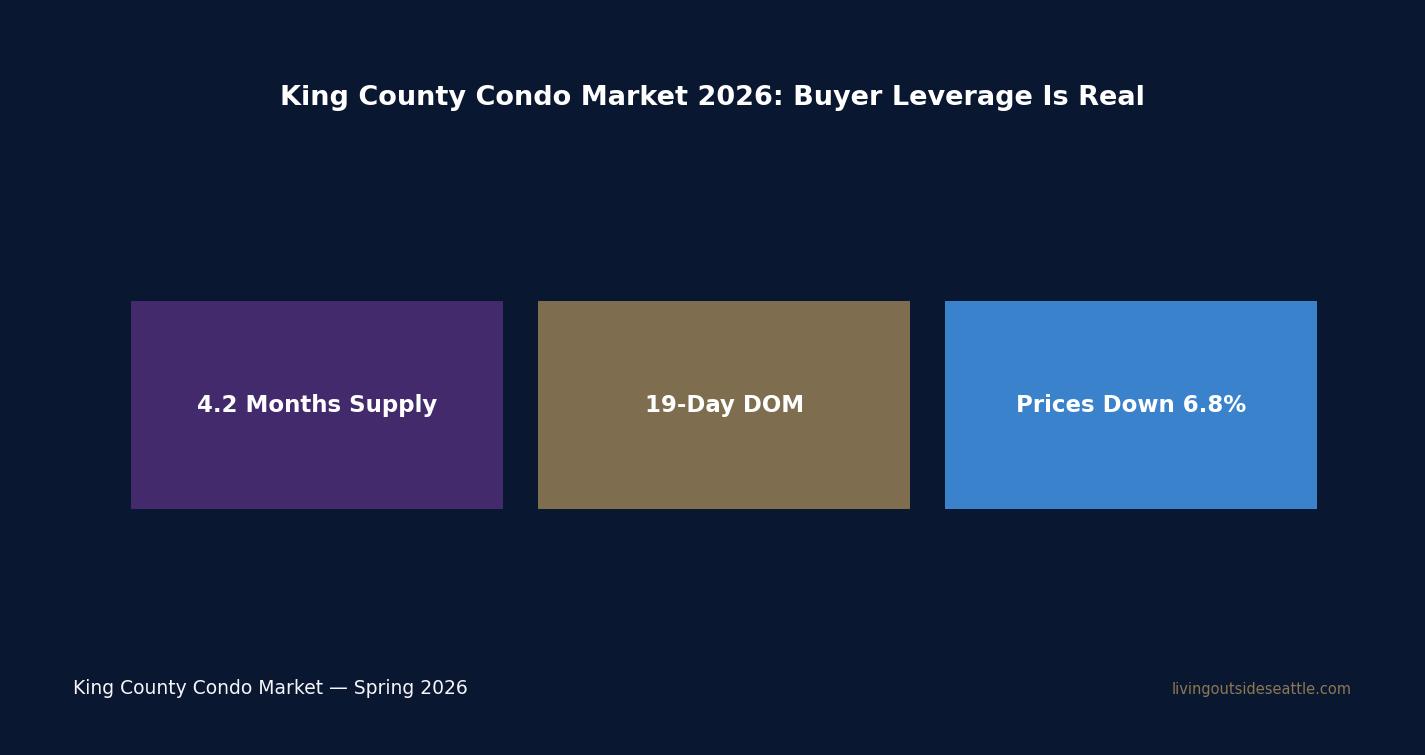
Auburn’s market is slightly softer than the county average. Homes sit for 14 days on market versus 7 days for the county. That extra week matters. You have time to inspect, negotiate, and think rather than write an offer under pressure.
Auburn WA Neighborhood and Community Overview
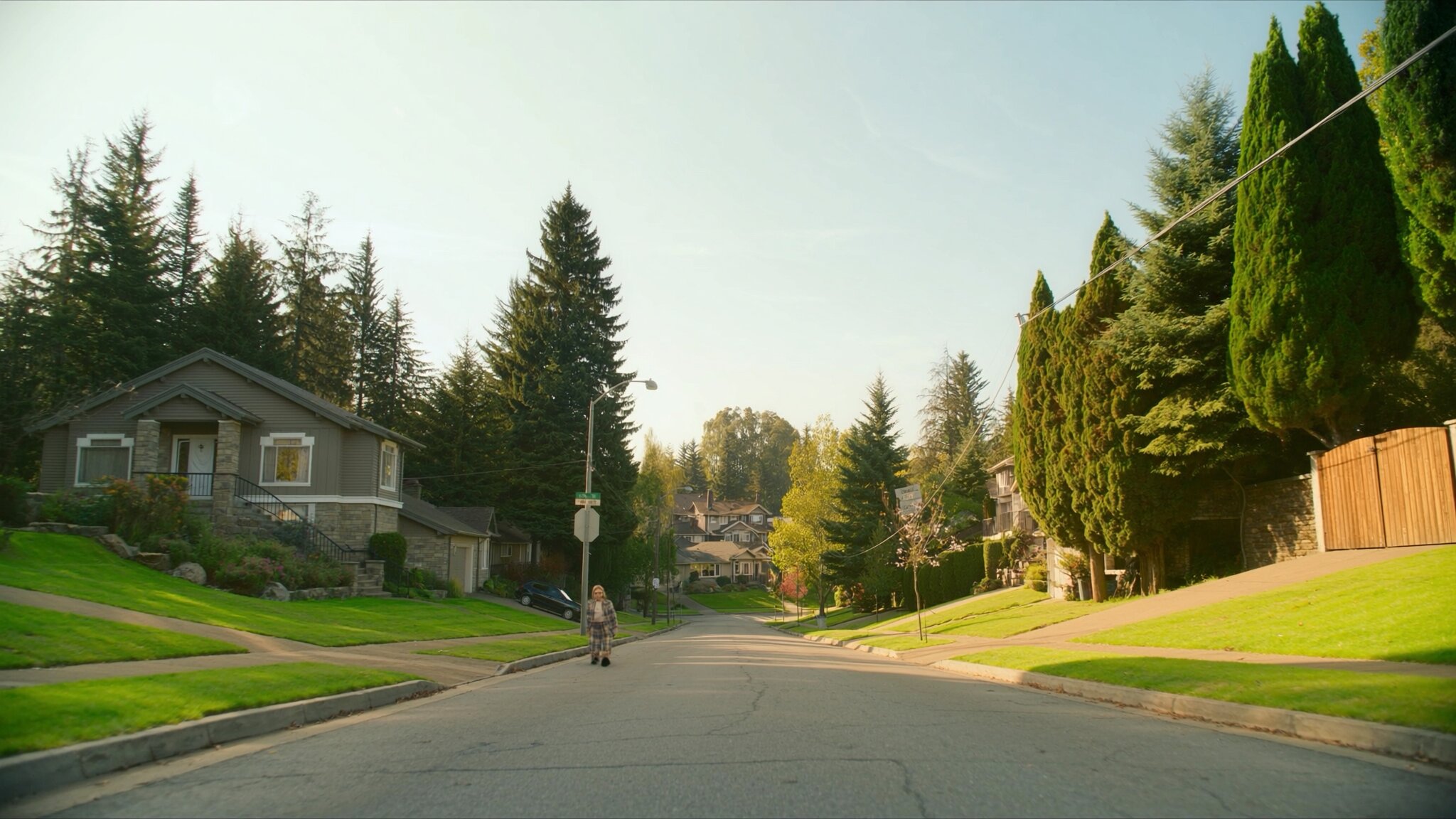
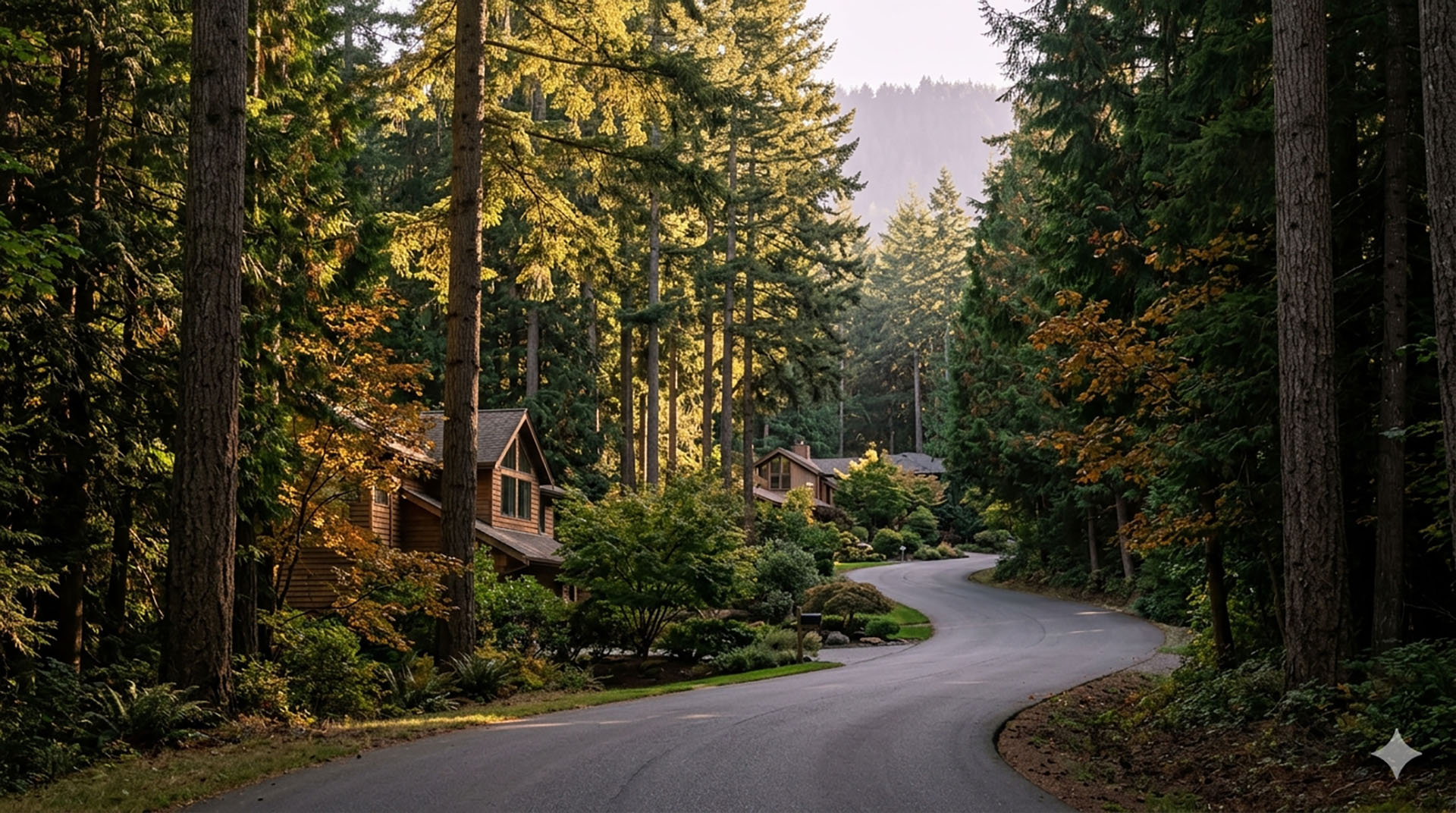
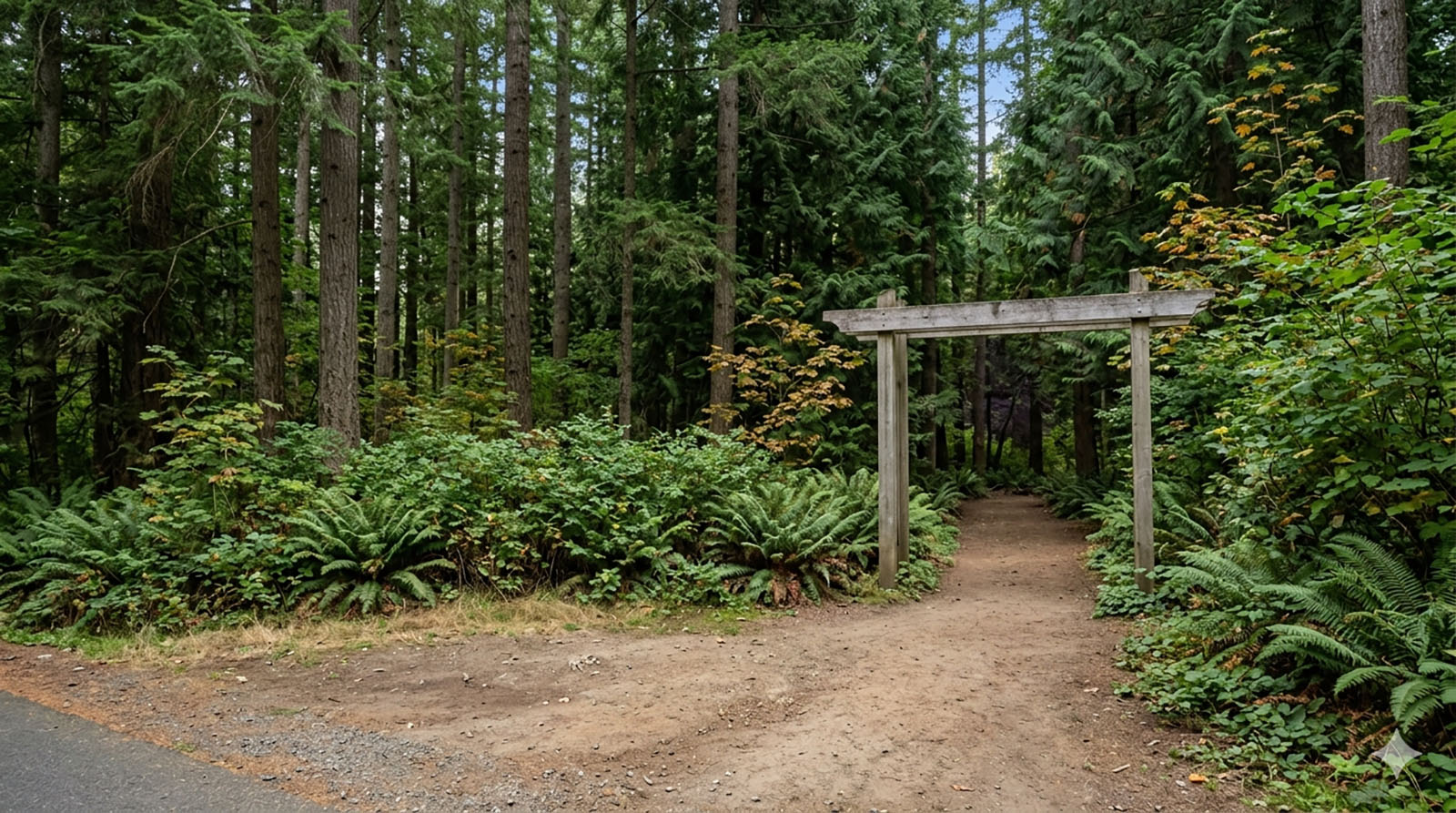
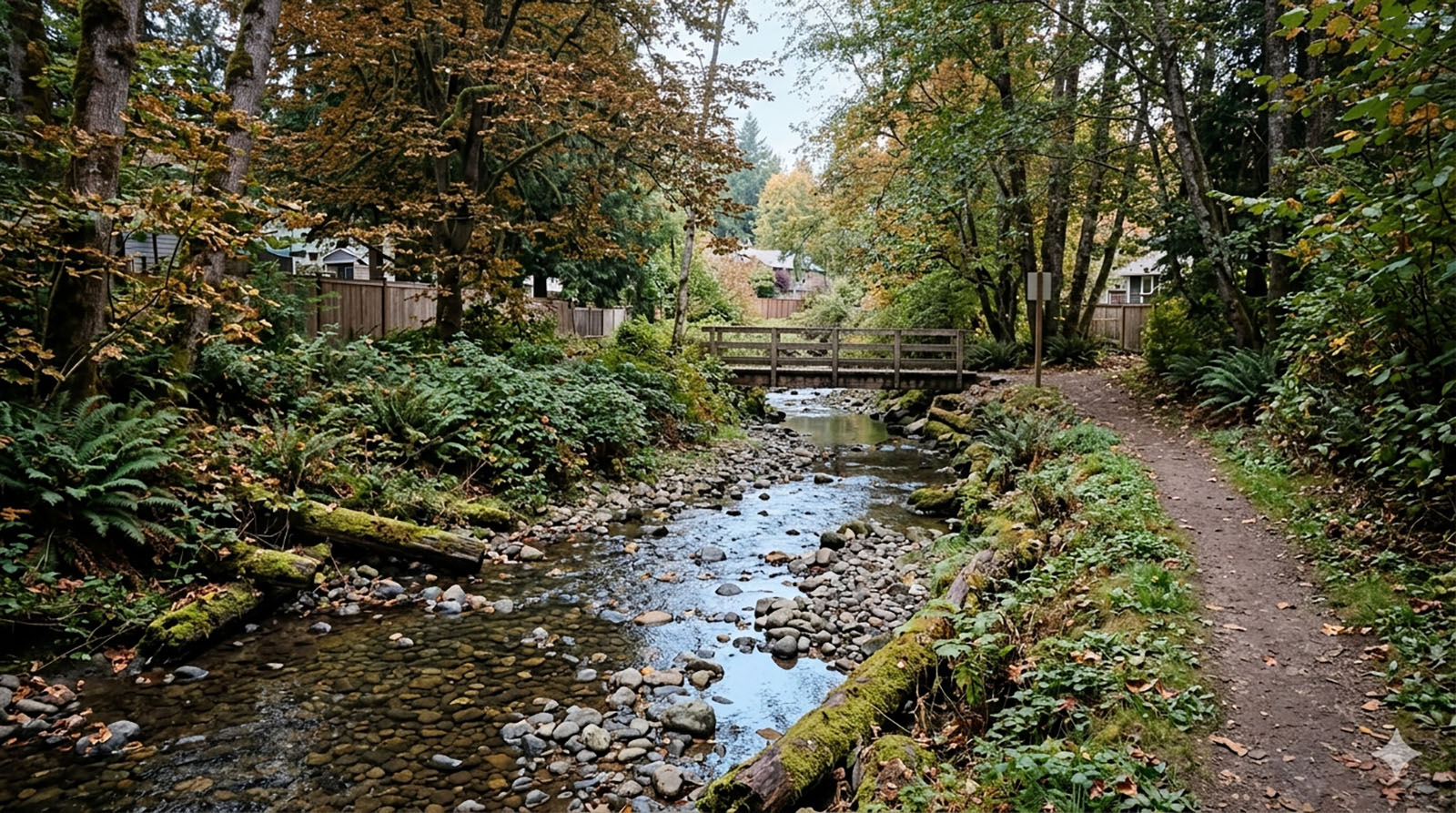
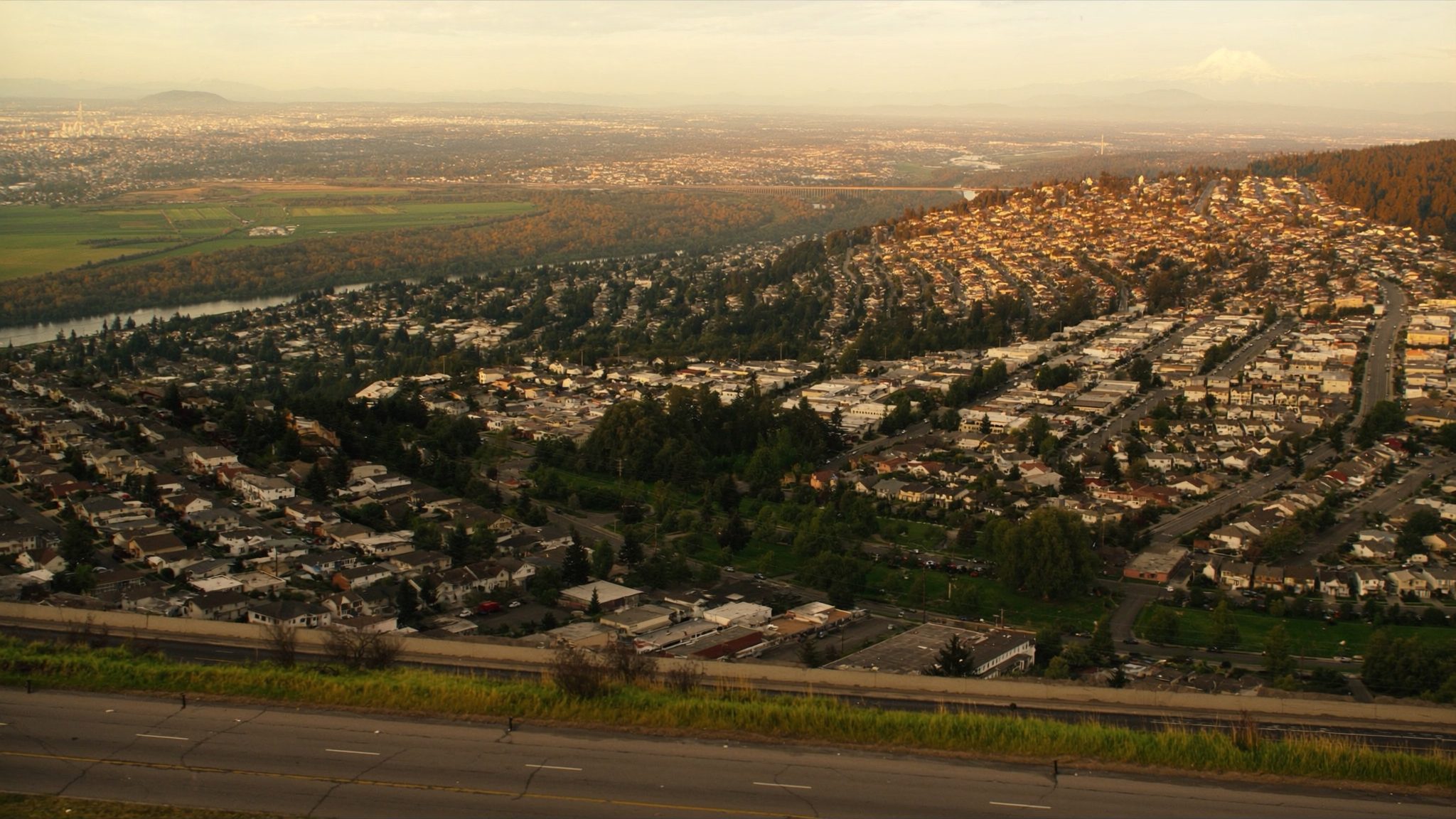
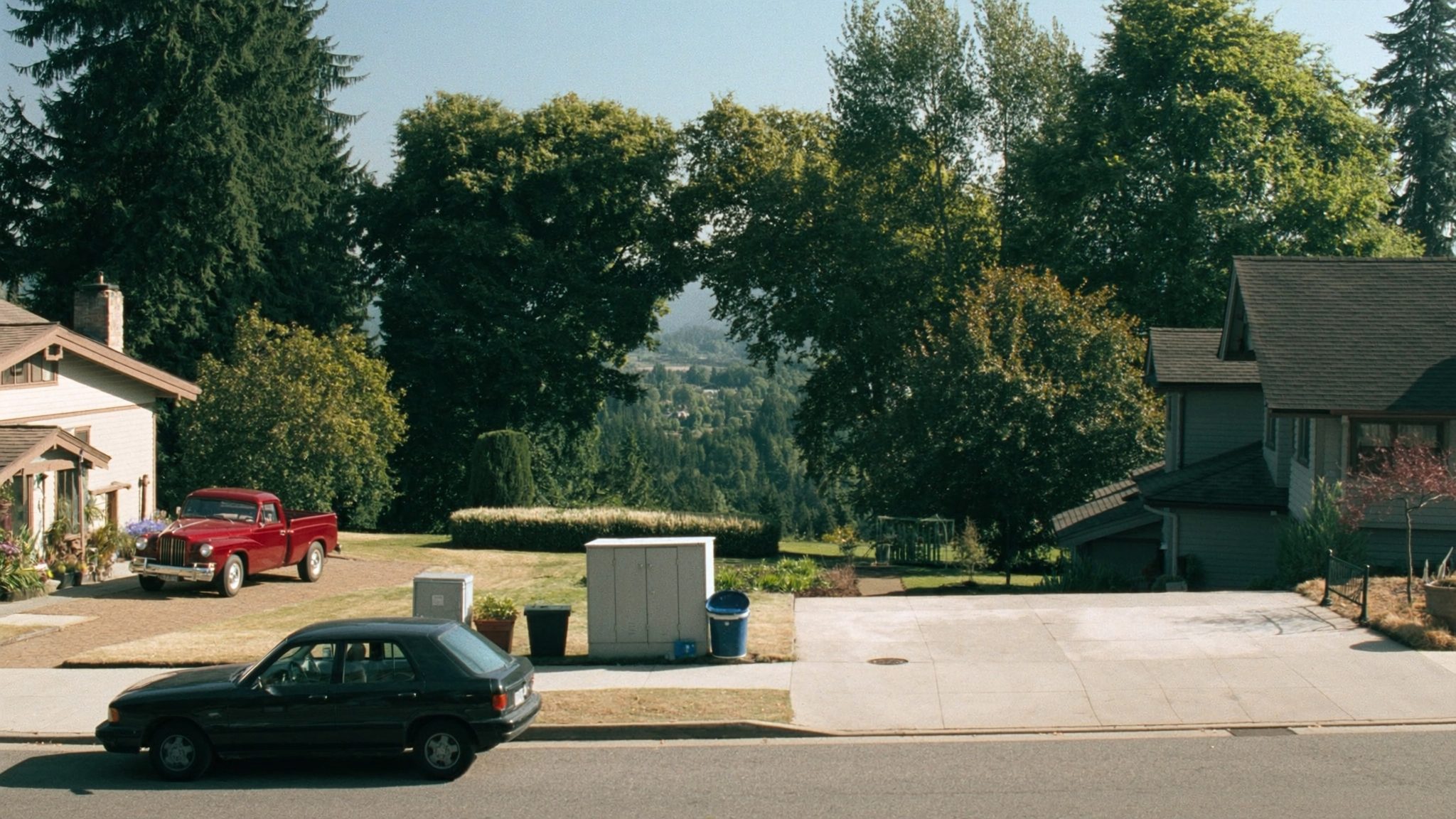
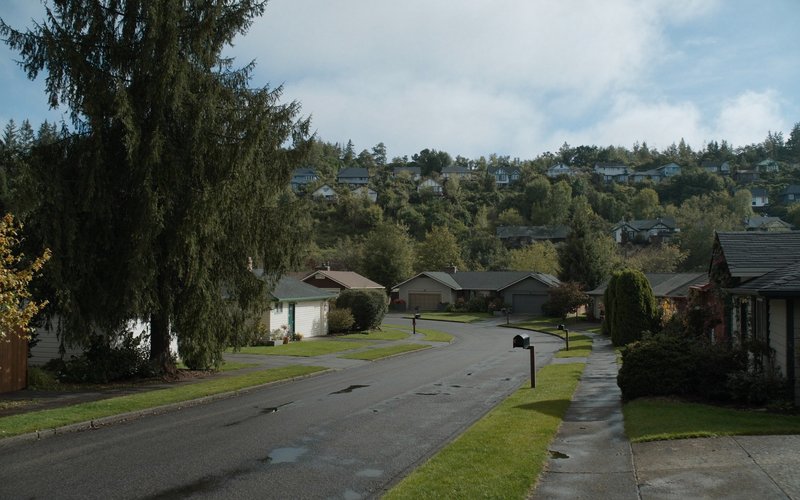
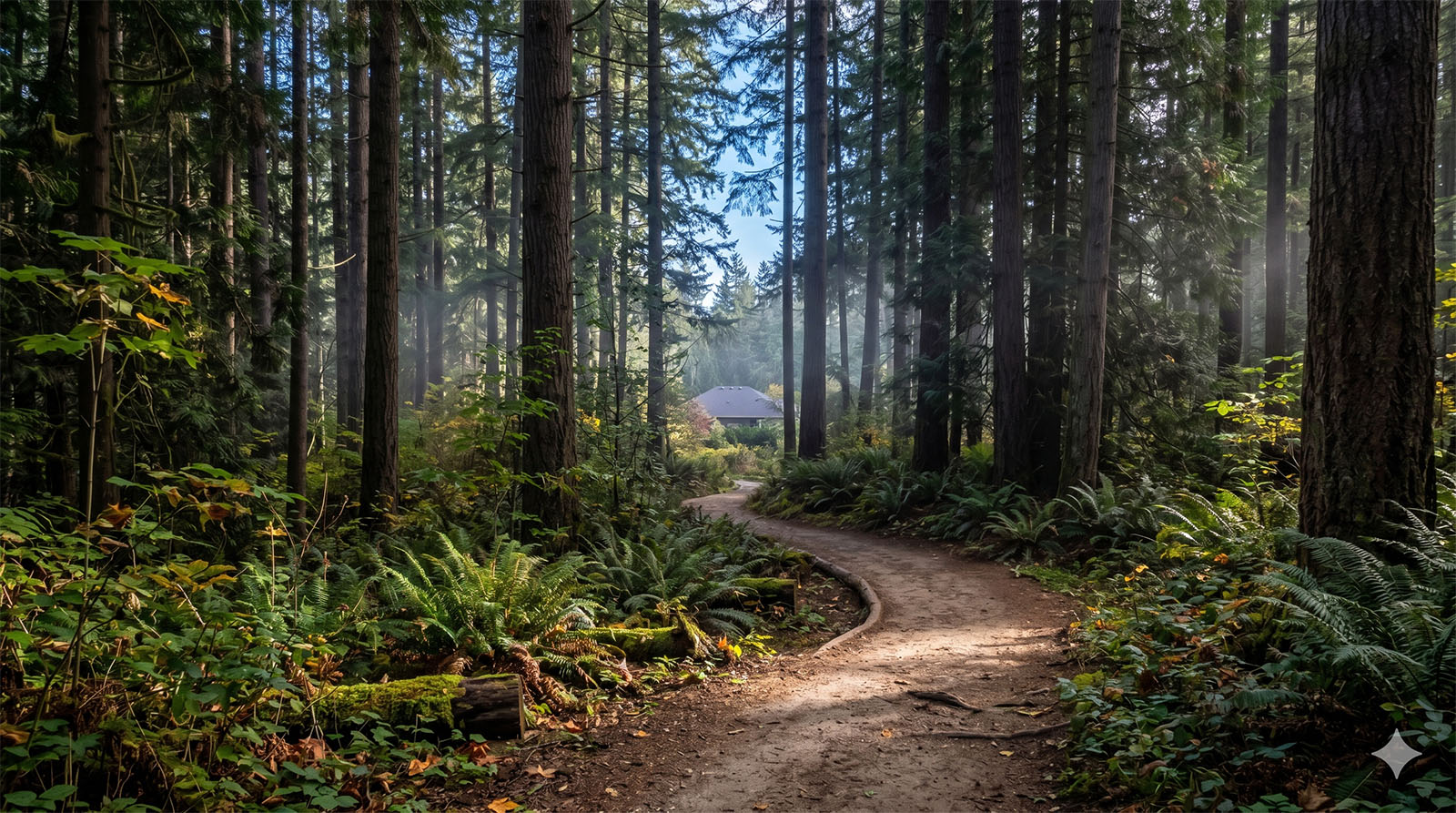
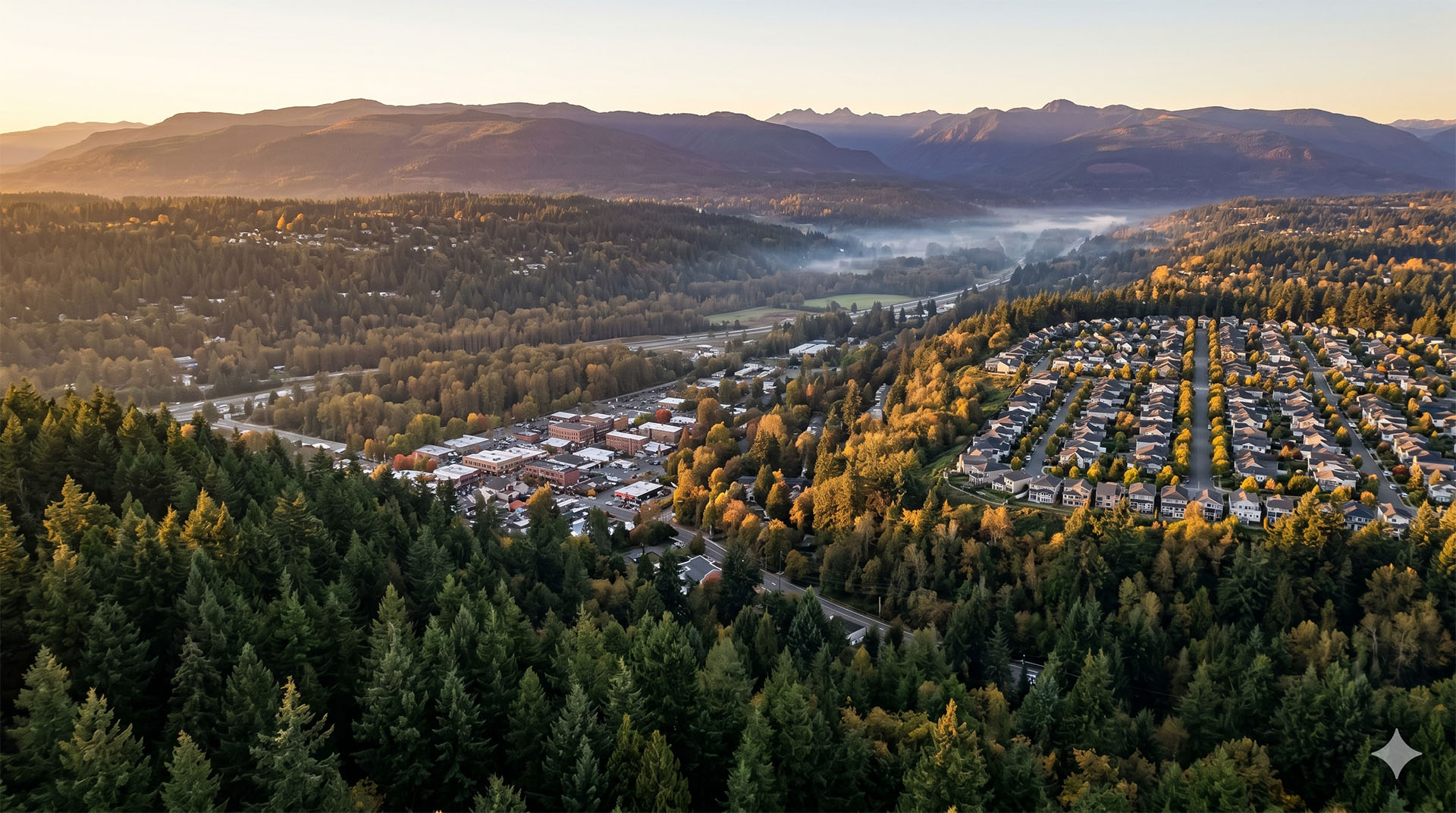
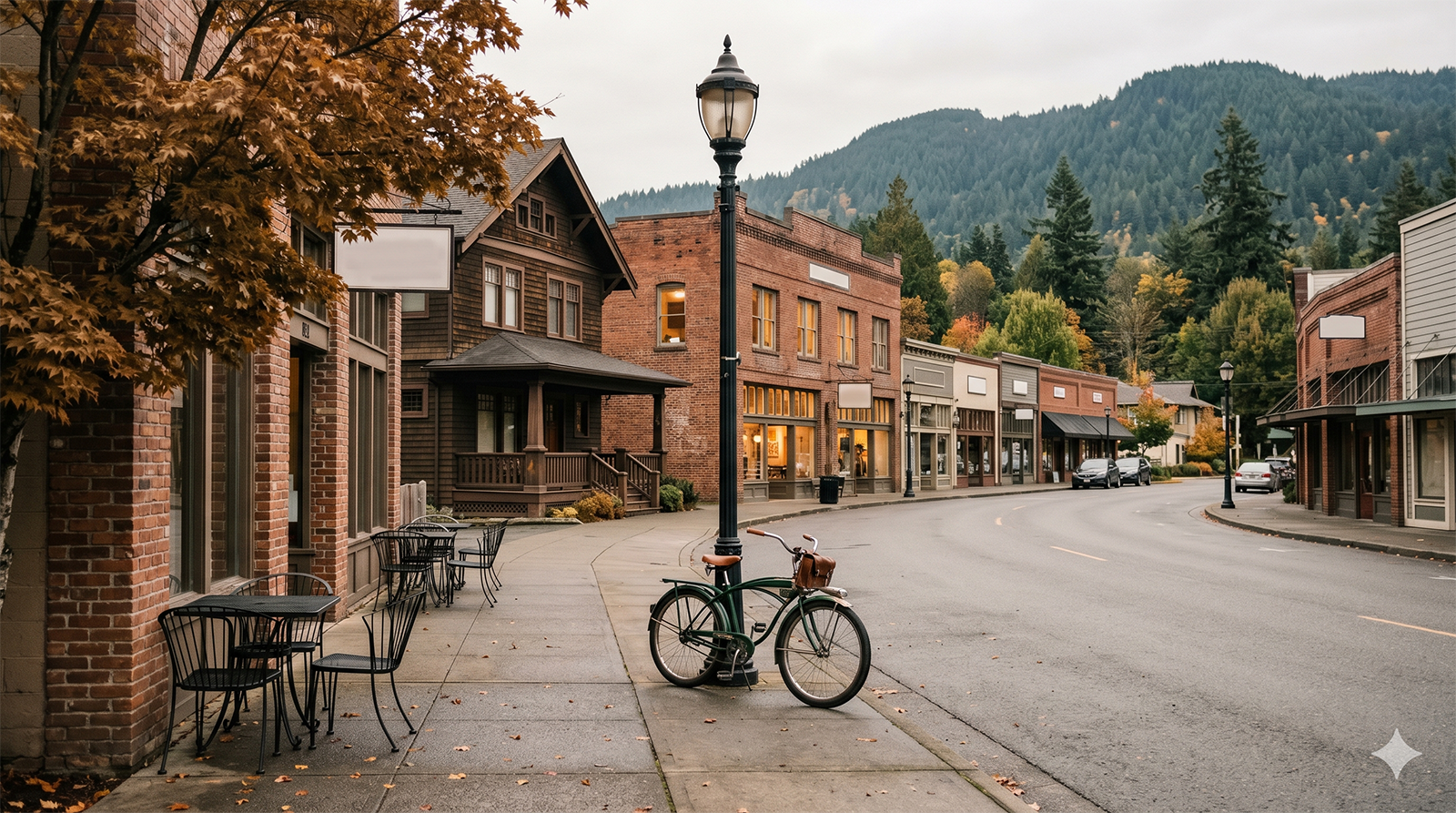
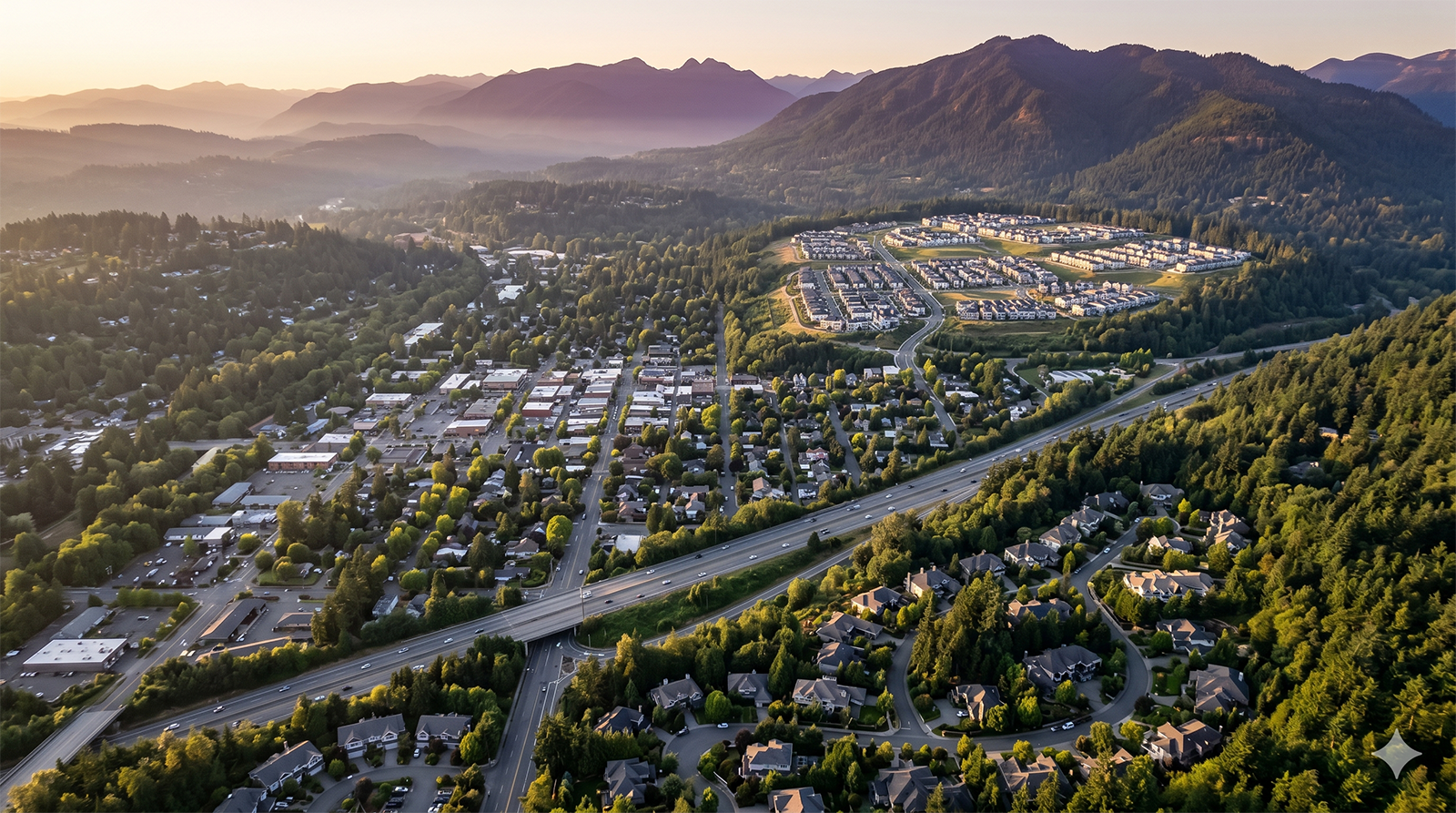
Downtown Auburn has been adding restaurants and shops for several years. The Green River Trail runs through the area, good for families who bike or walk. Schools are solid. Property taxes are lower than the Eastside. The downtown core feels like a town rather than a strip mall corridor.
The Muckleshoot area, the Green River valley, and the downtown core are drawing young families and first-time buyers who want to own a house without paying $1M for the privilege. That’s a legitimate trade.
Moving to Federal Way WA: $686,500 for Puget Sound Views and Sounder Access
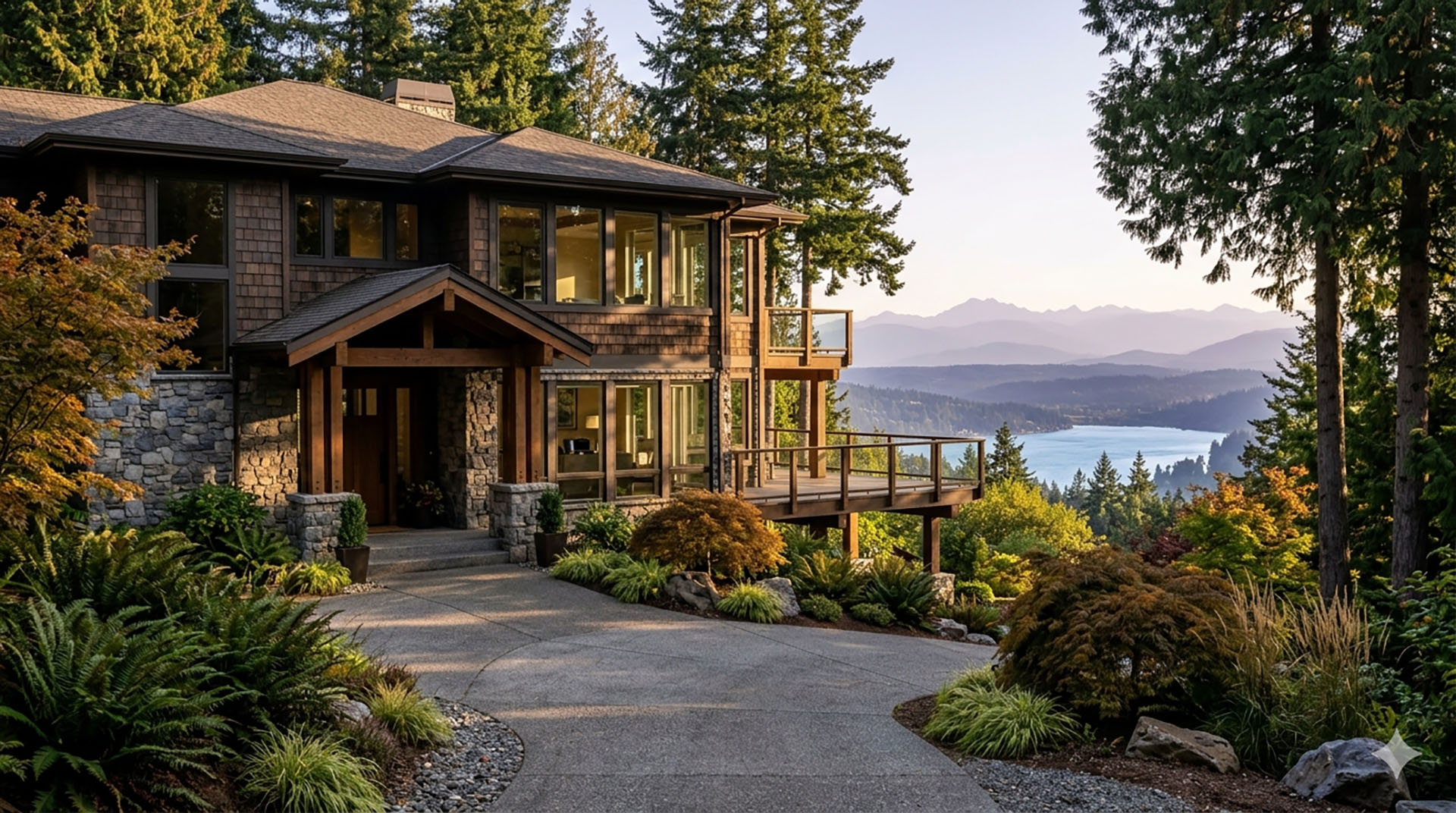
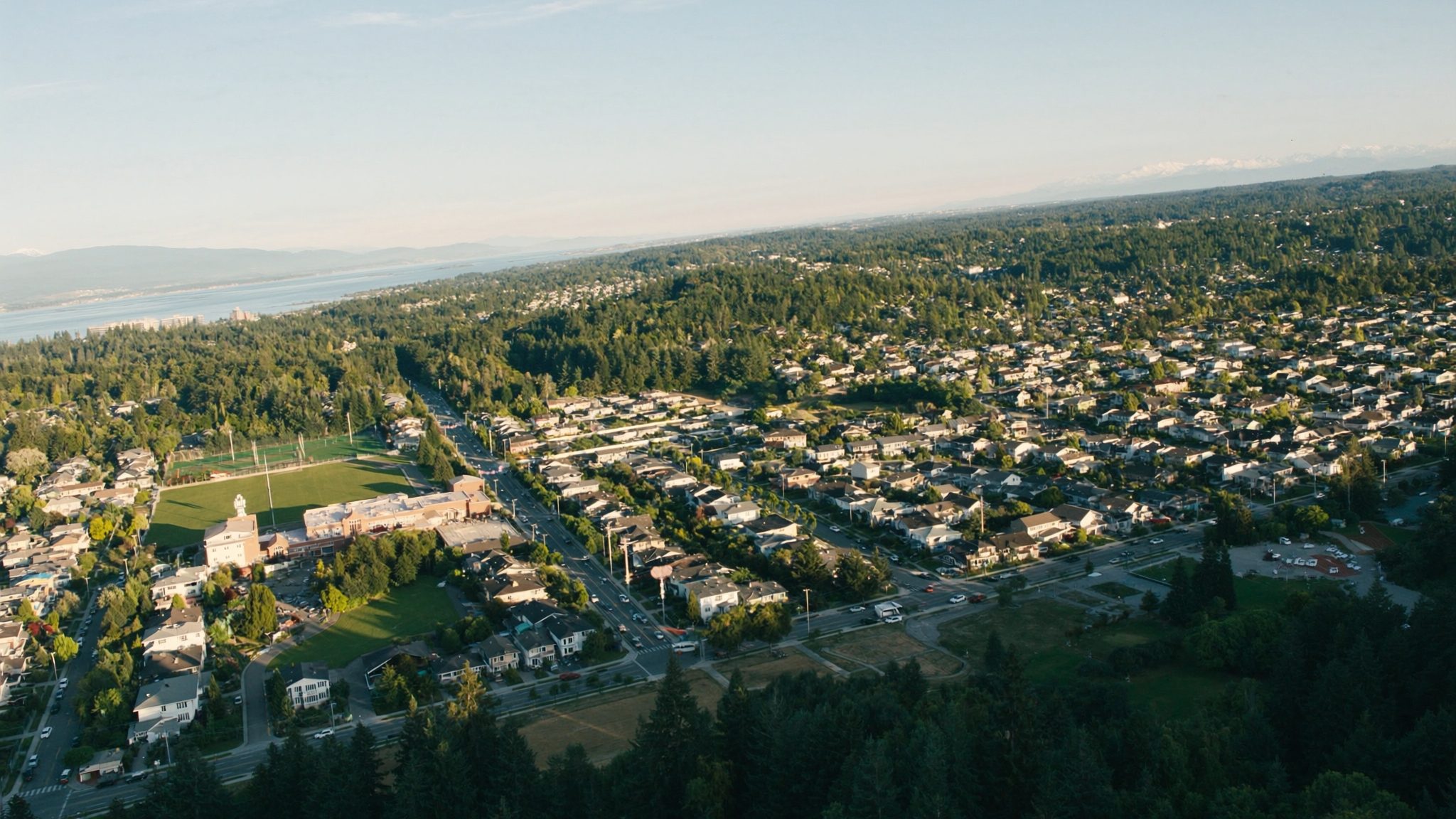
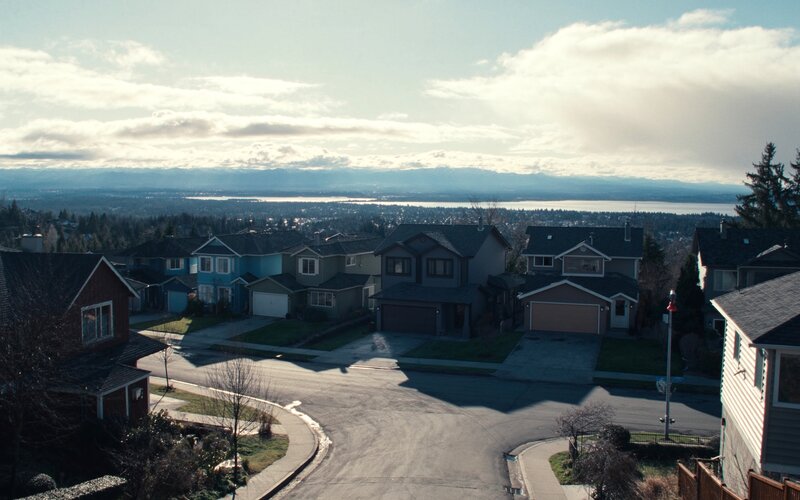
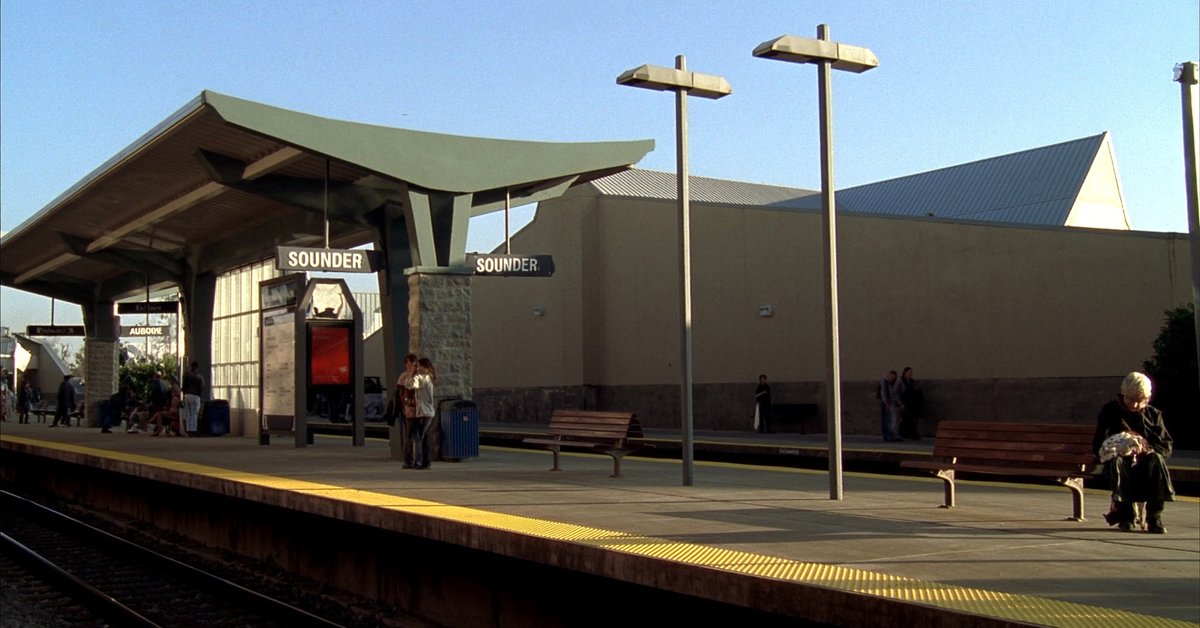
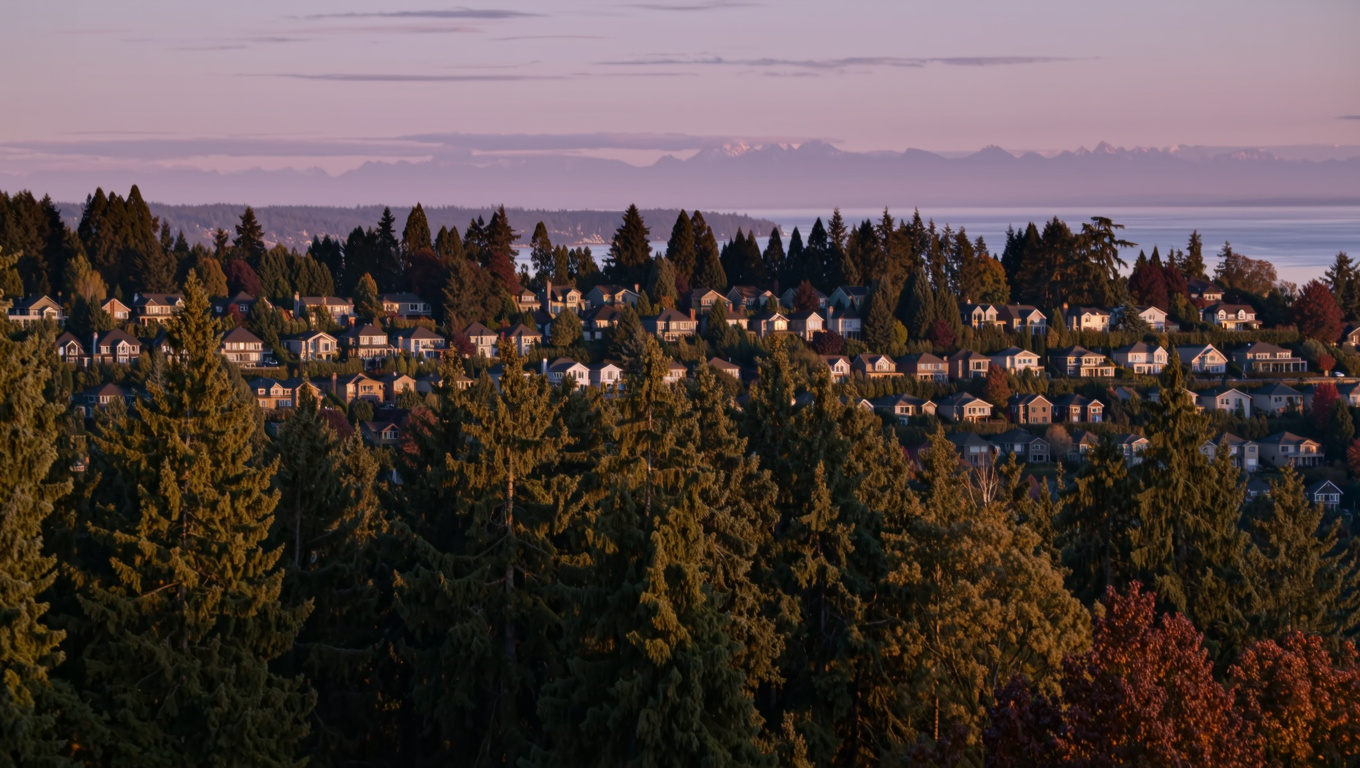
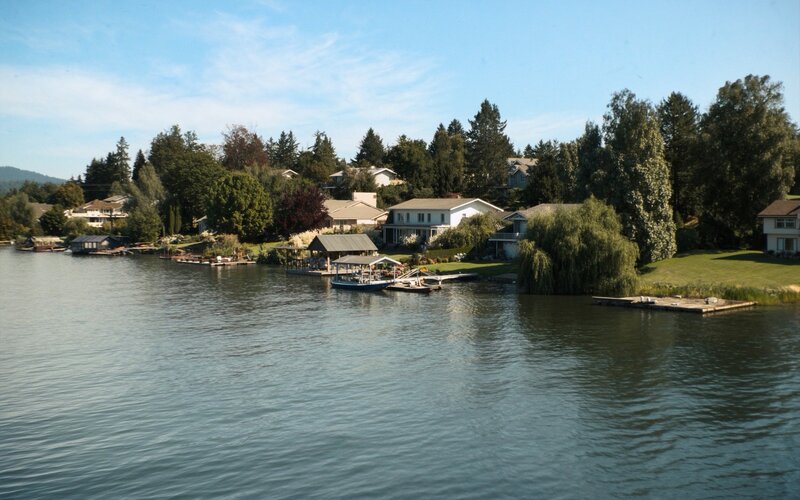
Federal Way comes in at $686,500, but offers something Auburn doesn’t at scale: Puget Sound views. In neighborhoods near the water or on elevated ground, you can see the Sound. Some homes have waterfront.
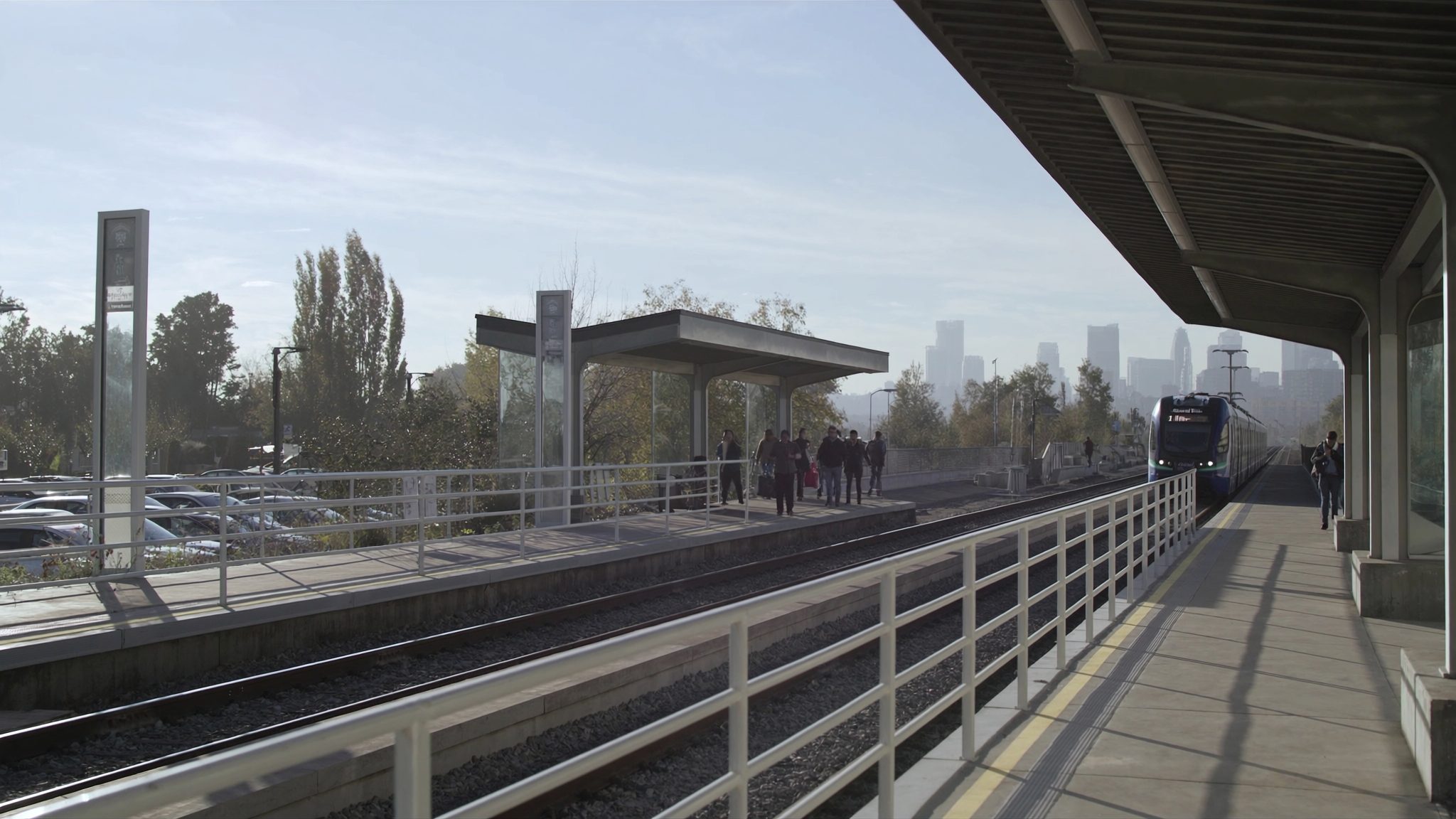
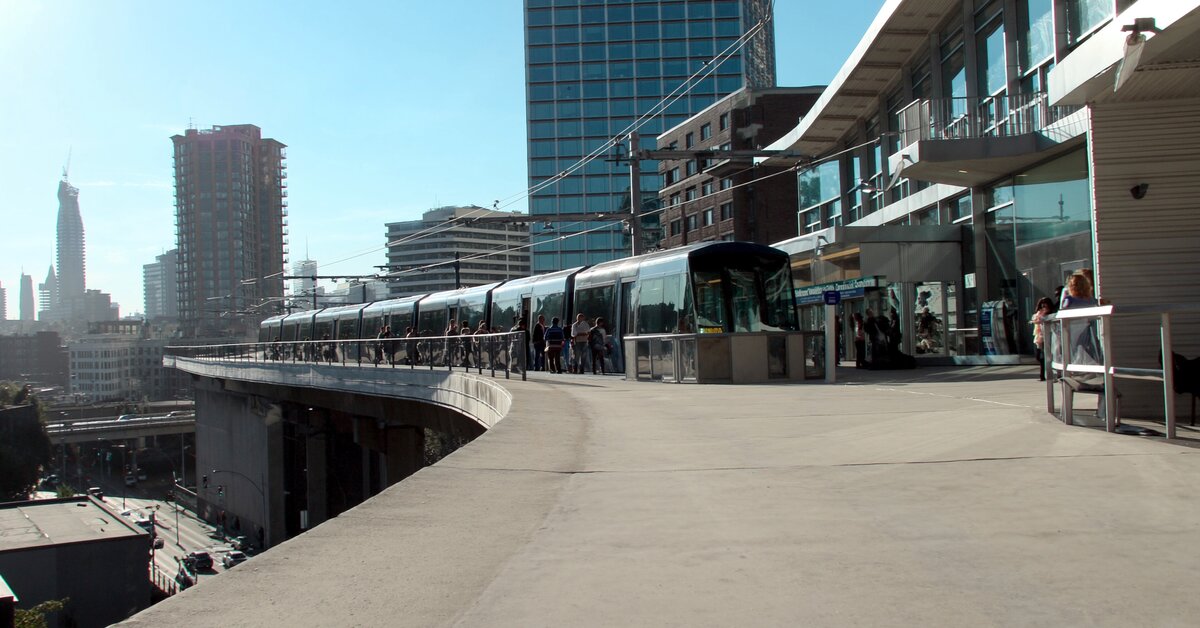
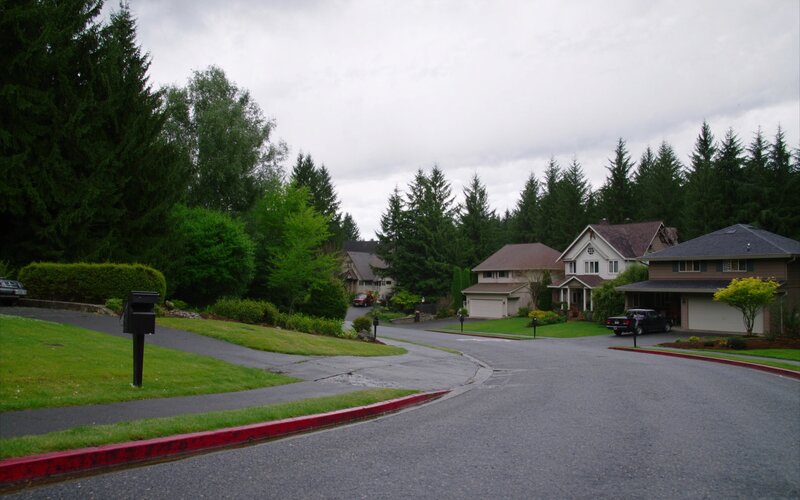
The feel is more suburban than Auburn: wider streets, larger setbacks, quieter blocks. Federal Way also added Link Light Rail in 2024 — the Federal Way Transit Center Station connects directly to SeaTac (about 20 minutes) and downtown Seattle (about 35 minutes) without touching I-5. More planned than Auburn, which comes with modestly higher property taxes.
Federal Way also sits between two large employment centers. You’re 15 to 25 minutes from the Renton tech corridor, where Boeing, Valley Medical Center, and aerospace suppliers are concentrated. You’re 15 to 30 minutes south to Joint Base Lewis-McChord, which matters for military families moving into the area.
Commute Times from Auburn and Federal Way to Seattle, Renton, and JBLM
South King County commutes deserve a straight answer.
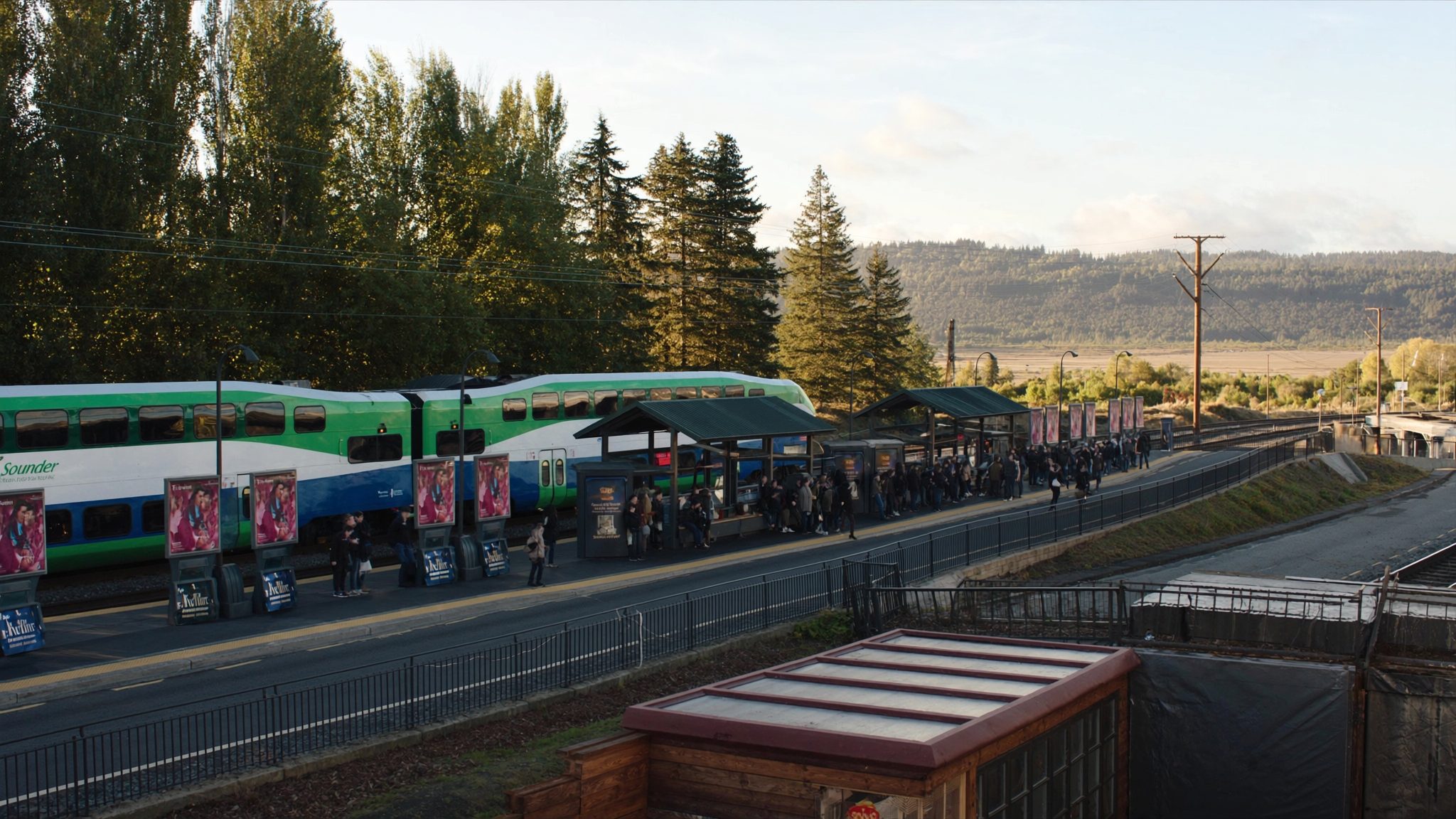
From Auburn to Seattle: 35 to 45 minutes by car on I-167 to I-5, depending on time of day. The Sounder train takes about 45 minutes and lets you work during the ride.
From Federal Way to Seattle: 35 to 50 minutes by car. Similar Sounder access.
If you work in Renton in tech, aerospace, or healthcare, you’re 15 to 25 minutes from either city. If you’re at JBLM or contracting nearby, you’re 15 to 30 minutes south. For those job centers, South King County isn’t a concession. It’s closer to work than most of the county.
Price Per Square Foot: Auburn vs. Bellevue
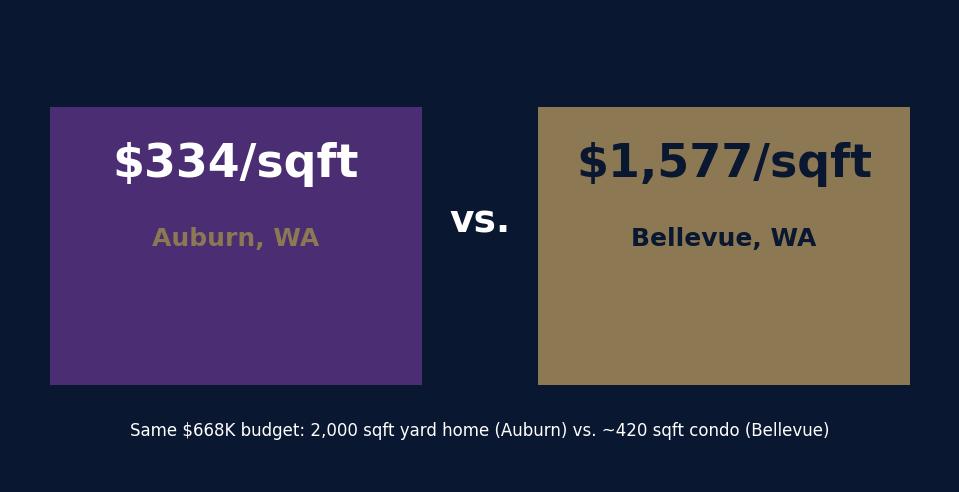
You’re paying nearly 5x more per square foot in Bellevue than Auburn. For families prioritizing space and equity over address, that math is hard to ignore.
A 2,000 square foot home in Auburn at $668,000 runs roughly $334 per square foot. In Bellevue at $1,735,000, that same budget gets you maybe 1,100 square feet at roughly $1,577 per square foot.
Nearly 5 times more per square foot for the Bellevue address. The Seattle commute from Auburn is longer, yes. You’re trading 15 extra minutes of driving for $400,000 in equity and a yard.
Auburn and Federal Way Market Conditions in 2026
King County overall sits at 2.2 months of supply, still a seller’s market. Auburn’s 14-day DOM and Federal Way’s 7-day DOM suggest more breathing room than Sammamish (4 days) or Bellevue (5 days).
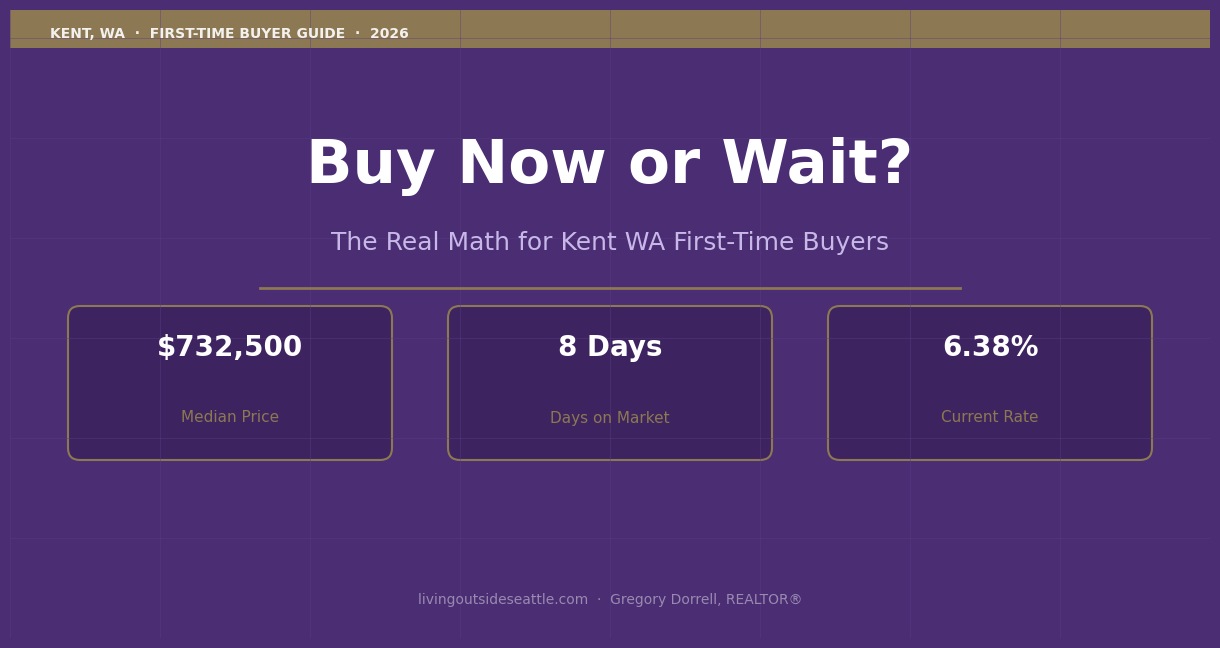
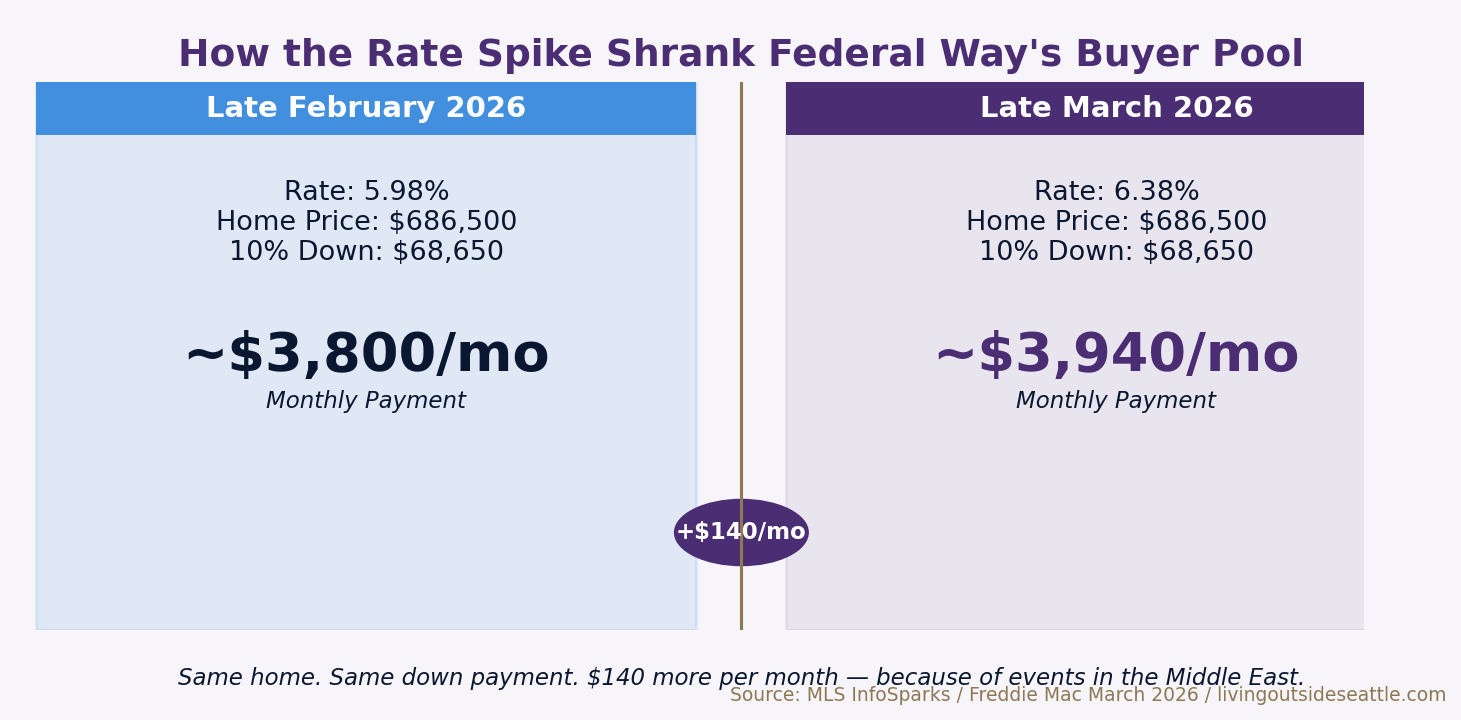
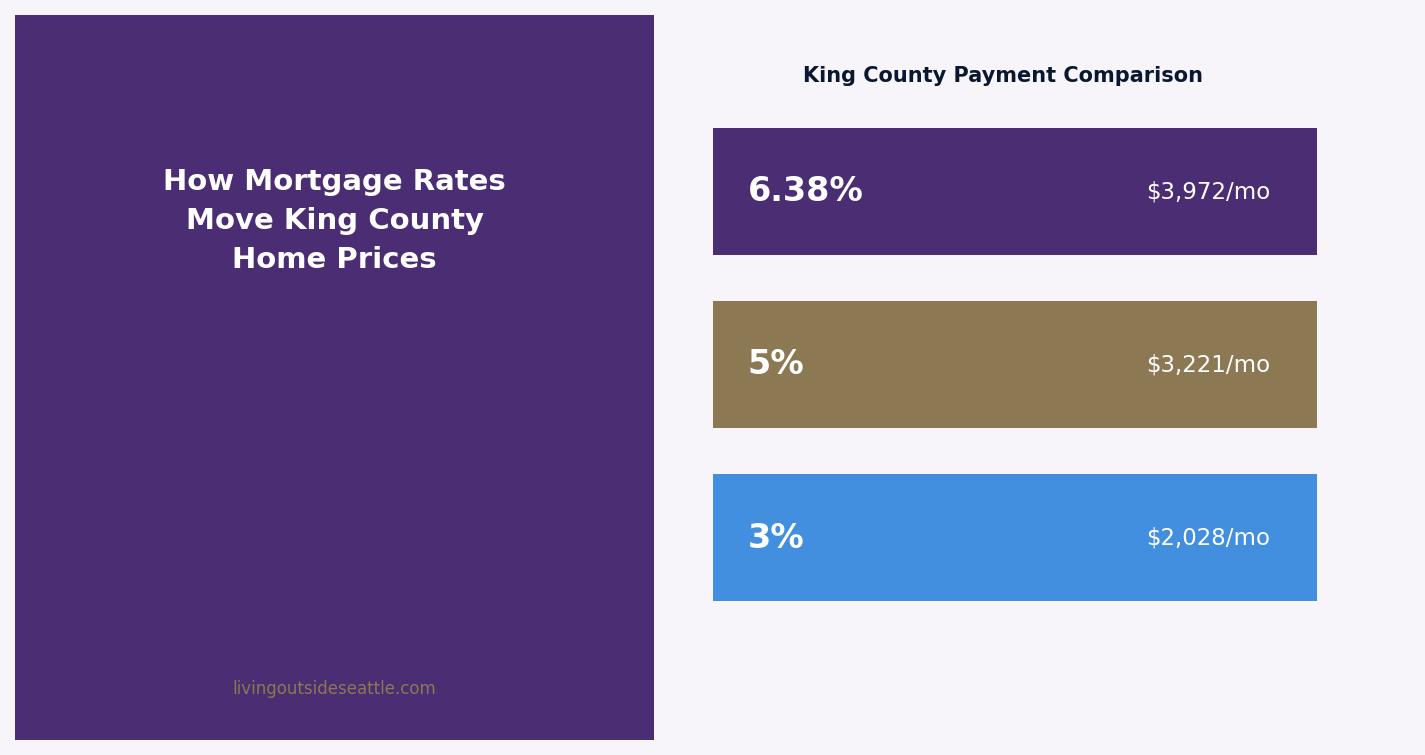
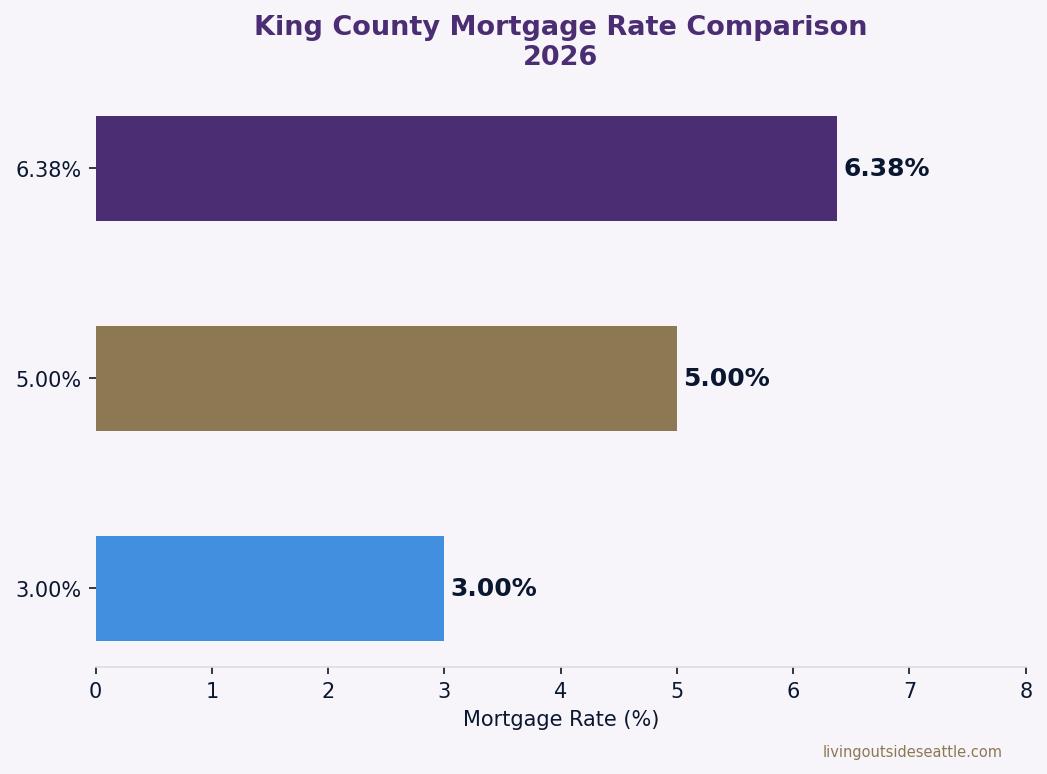
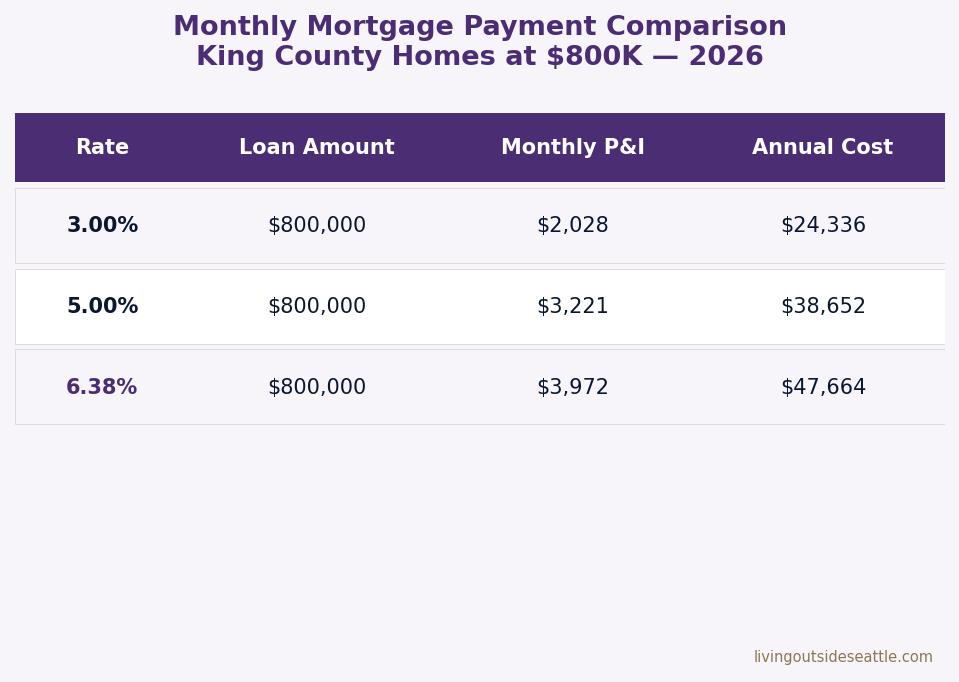
At 6.38% on a $534,400 loan (Auburn median with 20% down), principal and interest runs roughly $3,240 per month before taxes and insurance. That’s real money. It’s also roughly half what you’d carry on a Bellevue home financed at $1.4 million.
Frequently Asked Questions About Relocating to Auburn Washington
What is the median home price in Auburn Washington in 2026?
As of March 2026, the median home price in Auburn is $668,000. That buys a 3-bedroom, 2-bathroom home, typically 1,500 to 1,800 square feet with a yard. Auburn’s 14-day average DOM means less competition than Bellevue or Sammamish, giving you more time to make a clear-headed offer.
Is Auburn WA a good place to relocate for families?
Yes. Auburn has solid schools, the Green River Trail for recreation, a growing downtown, and the lowest single-family home prices in South King County. It’s not flashy, but it’s a working community where families build equity over time. If you work in Renton or south King County, the commute is short.
Is Federal Way or Auburn better for relocating to King County?
Depends on what matters to you. Choose Auburn for the lowest price, a slightly larger lot, and proximity to Renton or south King County jobs. Choose Federal Way for a more polished suburban feel, Puget Sound views, Sounder rail access, or JBLM proximity. Both beat Renton and Bellevue on value by a wide margin.
Can I get a home with a yard in King County for under $700K?
Yes, in Auburn and Federal Way. Both cities have homes under $700K with yards and 1,500 to 1,800 square feet. In Bellevue, Sammamish, or Issaquah, that budget gets a condo or townhouse without outdoor space. The trade-off is a longer Seattle commute, typically 35 to 50 minutes versus 10 to 20 minutes from closer suburbs.
What is the commute like from Auburn to Seattle?
Expect 35 to 45 minutes by car on I-167 to I-5, depending on the time of day. The Sounder commuter train runs to King Street Station in about 45 minutes and lets you work the whole way. If your job is in Renton or the south Eastside, your commute from Auburn may be shorter than from many other King County cities.
Coldwell Banker Bain does not guarantee the accuracy of square footage, lot size, year built, or other property details. All information is based on MLS data and public records as of March 2026. Local market conditions change; please confirm current pricing and inventory with your agent.
Most buyers focus on the mortgage payment. That’s the number that shows up in every rate calculator, every lender pre-approval letter, every Zillow estimate. But in King County, the mortgage is often just 60–70% of what you actually pay each month to own a home. The rest — property taxes, insurance, HOA fees, PMI, and maintenance — adds up fast, and most first-time buyers get surprised by it.
I’ve worked in South and East King County for over 13 years, and I do professional property valuations every single day as a BPO field agent. One pattern I see constantly: buyers who were “pre-approved” for a purchase price they couldn’t actually afford once all the real costs hit their bank account in month two. This guide walks you through the full picture — every cost, with real numbers for King County cities — so you can make a decision you’ll still feel good about a year from now.
What Goes Into Your True Monthly Payment
The mortgage principal and interest (P&I) is the fixed part — it doesn’t change month to month on a 30-year fixed loan. Everything else does, or at least it can. Here’s the full stack of costs to run through before you make an offer.
Principal and Interest (P&I)
The core of your payment, and the number your lender leads with. At current King County rates of around 6.4–6.7% for a 30-year fixed, a $686,000 loan (10% down on a $763,000 Renton home) produces a monthly P&I payment of roughly $4,360. It’s real, but it’s not the whole story.
Property Taxes
Significant in King County — and they just went up. For the 2026 tax year, King County’s total property tax levy is $8.4 billion, a 10% jump from 2025. The average effective rate across the county runs around 0.9%–1.1% of assessed value annually. On a $763,000 home in Renton, that works out to roughly $690–$840 per month ($8,280–$10,080 per year).
Your specific parcel’s levy code determines the exact number — the King County Assessor’s eReal Property search tool will show you the breakdown for any address you’re evaluating. Renton sits on the lower end; Sammamish and Issaquah homeowners typically pay more because of school district levies and city-specific ballot measures.
Homeowners Insurance
Washington State averages $1,474–$1,596 per year — roughly $125–$133 per month. That puts Washington below the national average, which is a piece of good news. Expect to pay more if your home has a wood roof, is older than 30 years, or sits in a wildfire-adjacent zone (relevant in Maple Valley, Enumclaw, or Black Diamond).
PMI (Private Mortgage Insurance)
Applies if you put down less than 20%. PMI typically runs 0.46%–1.5% of the original loan amount annually. On a $686,000 loan at a mid-range rate of 0.7%, that’s about $400 per month.
PMI drops off once you hit 20% equity — either through price appreciation or paying down the principal. Given King County’s 5-year appreciation history of roughly 5–6% annually, some buyers reach that equity threshold in 3–4 years rather than waiting out the full amortization schedule.
HOA Fees
These vary wildly by property type. Condos in King County typically run $300–$700 per month for a mid-range building — downtown Seattle luxury high-rises can exceed $1,000. Townhomes usually fall in the $150–$350 per month range. Single-family homes in planned communities often run $75–$200 per month for landscaping and common areas.
Many single-family homes in South King County have no HOA at all — which reduces monthly cost but means you carry 100% of exterior maintenance yourself.
Maintenance Reserve
The number most first-time buyers skip — and the one that bites hardest. The commonly cited “1% rule” (set aside 1% of your home’s value per year) is a reasonable floor. Studies show the average homeowner actually spends $8,800 per year on maintenance and repairs. For an older King County home (pre-1990), budget closer to 1.5%–2%.
On a $763,000 home, 1% equals $7,630 per year — about $636 per month set aside. You won’t spend it every month. Some months nothing breaks, then your furnace goes in January.
The mortgage payment is just one piece. For a Renton condo at $422K, all-in monthly costs run about $3,642. For a single-family home at $763K, expect closer to $6,224 per month. Source: King County market data, 2026.
Condo vs. Single-Family: How Total Cost Compares
This is one of the most common calculations I walk buyers through. The sticker price on a condo is lower — but the total monthly cost is often closer to a single-family home than buyers expect, once HOA fees are factored in. Here’s a real-numbers comparison using current King County data.
The income difference this requires is significant. At a 28% front-end debt-to-income ratio (typical for conventional loan qualification), the condo scenario requires roughly $156,000 in gross household income. The single-family scenario requires roughly $267,000. Those numbers shift with your credit score, debt load, and lender — but they illustrate why the condo-vs-house decision often comes down to math rather than preference.
How King County Cities Compare on Total Cost
Property taxes are the biggest variable after the mortgage itself. Here’s a rough comparison of annual tax cost by city for a home around $700,000–$800,000.
Renton
Effective levy rate approximately 0.9%–1.0%. On an $800,000 home: ~$7,200–$8,000 per year ($600–$667/month). Renton sits on the lower end of King County cities, making it one of the better values in South KC for total monthly cost.
Kent & Auburn
Effective levy rates slightly higher than Renton, typically 1.0%–1.1%. On a $700,000 home: ~$7,000–$7,700 per year ($583–$642/month). School district and fire district renewal levies are a consistent factor in both cities.
Issaquah
Higher rates due to Issaquah School District supplemental levies — one of the highest-rated districts in the state, and that comes with a cost. On a $900,000 home: ~$9,000–$10,800 per year ($750–$900/month).
Sammamish
Among the highest effective rates in South/East King County. On a $1,000,000 home: ~$10,000–$12,000 per year ($833–$1,000/month). School district, city, and specialty district levies stack up quickly in Sammamish.
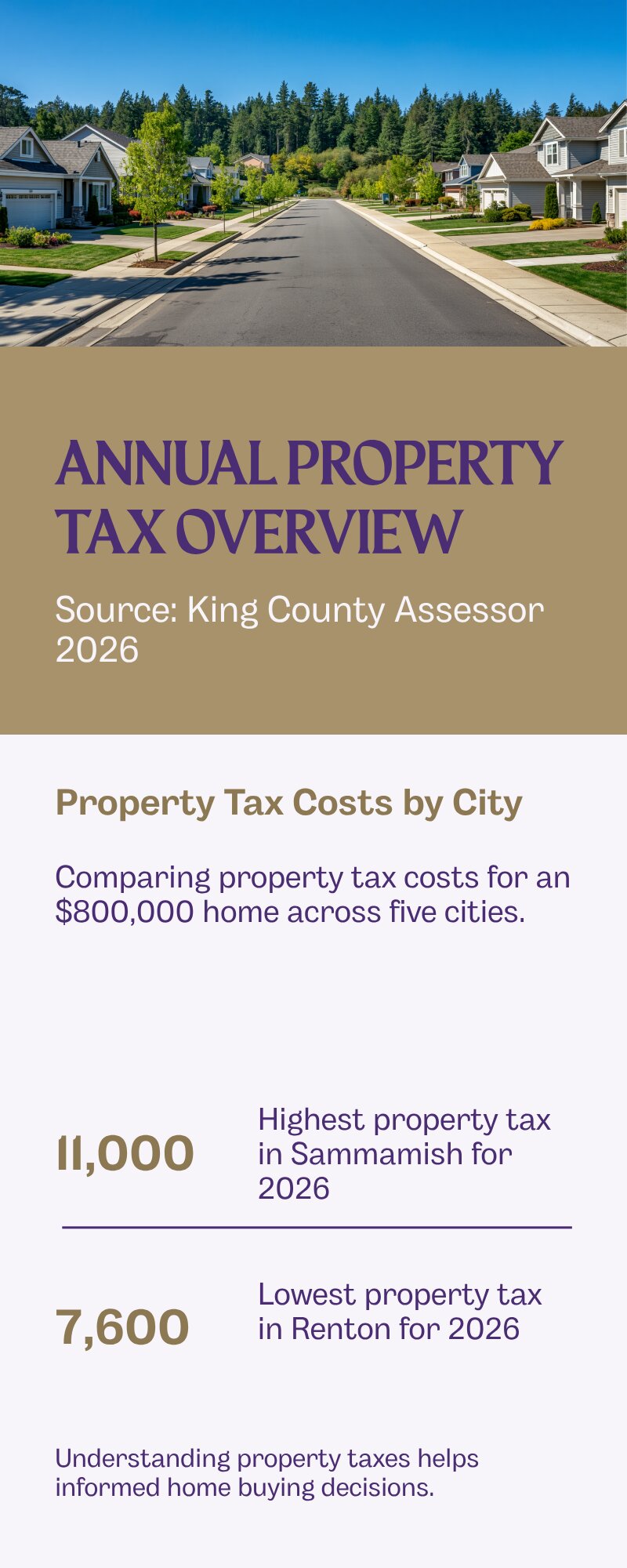
Annual property tax by city for an $800,000 home in King County. Renton and Kent are the most affordable in South KC; Issaquah and Sammamish carry higher levy rates driven by school district and specialty district measures. Source: King County Assessor 2026.
The Costs Most First-Time Buyers Underestimate
Beyond the monthly stack, a few one-time and recurring costs catch buyers off guard in year one.
Closing costs typically run 2%–3% of the purchase price. On a $763,000 home, that’s $15,260–$22,890 due at closing — on top of your down payment. This covers lender fees, title insurance, escrow, and prepaid items like the first year’s homeowners insurance and property tax reserves.
Immediate repair costs are real, especially in South King County where a lot of the housing stock was built in the 1980s and 1990s. Buyers of homes older than 30 years should budget up to $3,200 in unexpected year-one maintenance. A pre-listing inspection won’t catch everything — aging HVAC systems, older water heaters, and deck boards that just barely passed can all become your problem in year one.
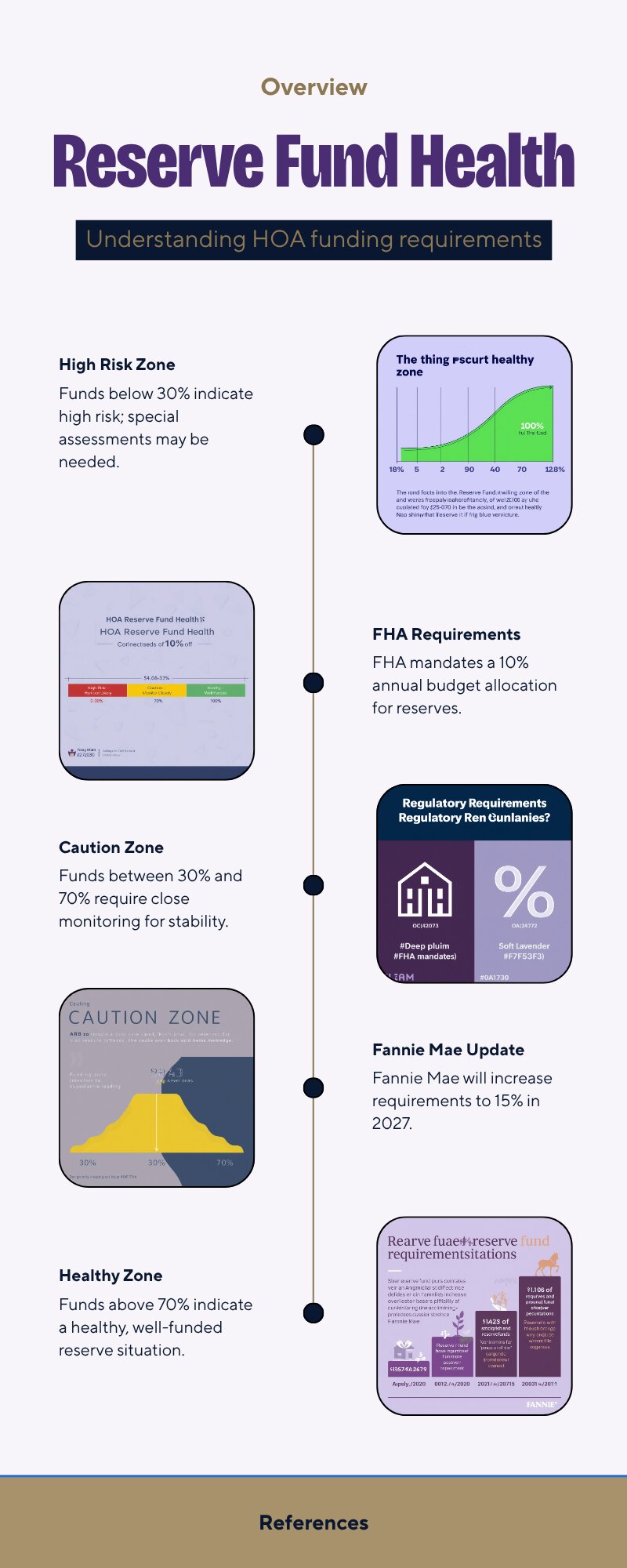
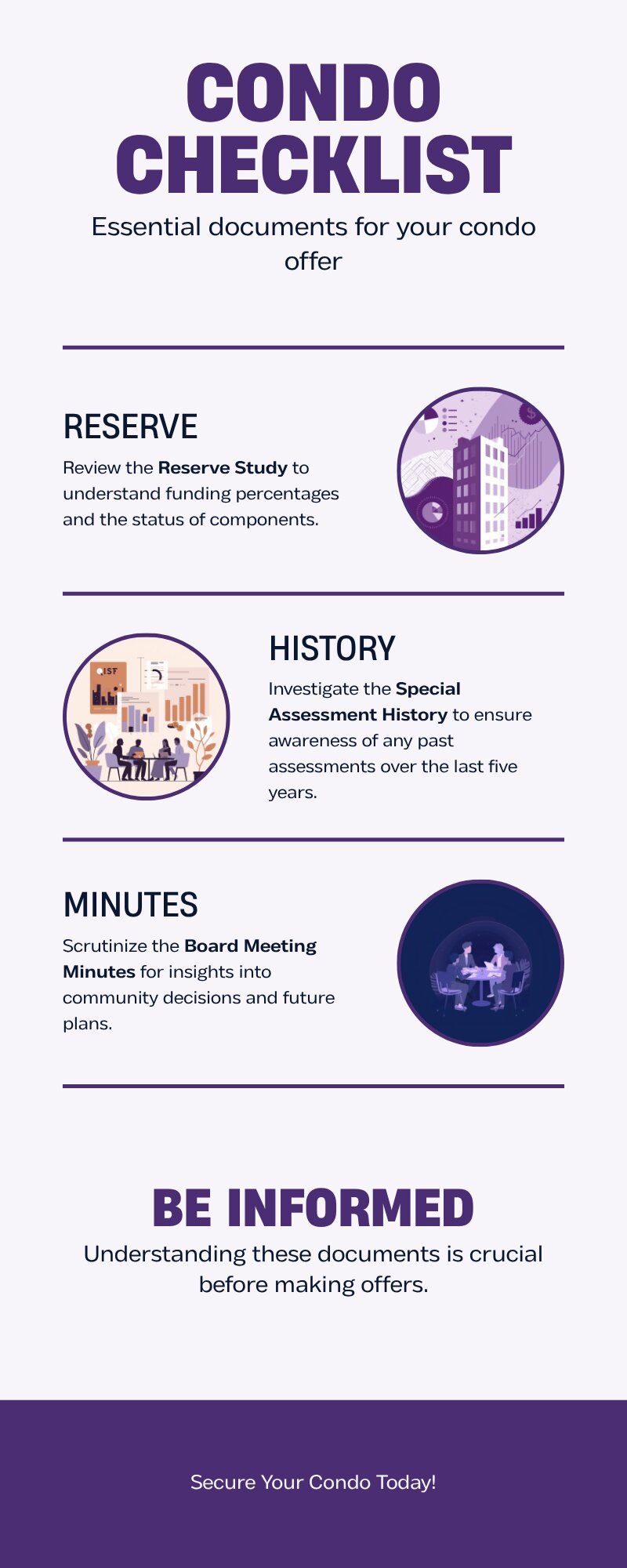
HOA move-in fees and reserve contributions are easy to overlook. Some condo and townhome communities charge a one-time move-in fee ($500–$2,000) and require a contribution to the reserve fund at closing. Always request the HOA’s reserve study and financial statements before making an offer. Buildings with reserve deficits have hit some King County buyers with special assessments of $10,000–$30,000 per unit.
Utility cost changes hit harder than people expect when moving from a rental. You’re now paying for water, sewer, garbage, and often gas in addition to electricity. In South King County, expect $300–$500 per month depending on home size and season.
What This Means for Buyers in South and East King County
Running the full cost stack before making an offer is one of the most important steps a first-time buyer can take. The pre-approval letter and the real monthly budget are two different numbers.
My recommendation for buyers in Renton, Kent, and Auburn: run the full stack before falling in love with a specific home. The purchase price is a starting point. The number that actually matters for your quality of life is the total monthly outflow — and whether that leaves you enough runway to build equity, handle surprises, and not feel house-poor by month six.
For condos: the lower sticker price is real, but the HOA fee narrows the gap with single-family more than buyers expect. The King County Condo Buyer’s Guide walks through HOA due diligence in detail — including how to spot a building with a reserve fund problem before you commit.
On the mortgage side: King County Mortgage Rates 2026 has the current rate picture and payment math, and the Mortgage Rate Buydown Guide explains how a seller-paid buydown can reduce your initial monthly cost in a way that pre-approval letters often miss.
Frequently Asked Questions
How much more than the mortgage payment is total homeownership cost in King County?
For most buyers, add $800–$1,500 per month on top of the P&I payment to get the true all-in cost. The biggest additions are property taxes ($600–$900/month on a median-priced home), insurance ($125–$135/month), and a maintenance reserve ($400–$700/month). PMI and HOA apply depending on your situation.
What is the property tax rate in Renton WA in 2026?
Renton’s effective property tax rate is approximately 0.9%–1.0% of assessed value annually, placing it on the lower end of King County cities. For a $763,000 home, expect roughly $6,900–$7,600 per year, or $575–$635 per month.
Do condos have lower total monthly costs than single-family homes in King County?
The purchase price is lower, but HOA fees close the gap. A condo at $422,000 with $450/month HOA ends up with a total monthly cost in the $3,600–$3,900 range. A single-family home at $763,000 (no HOA) runs $5,800–$6,400 per month all-in. The condo is still cheaper — but the difference is smaller than the price tags suggest.
Does PMI go away on a King County home?
Yes. Federal law requires lenders to cancel PMI automatically once your loan balance drops to 78% of the original purchase price. You can also request cancellation at 80%. Given King County’s appreciation history, some buyers hit that equity mark in 3–5 years rather than waiting out the amortization schedule.
What HOA fees should I expect for a King County townhome?
Townhome HOAs in South and East King County typically run $150–$350 per month. Lower-end communities cover exterior maintenance and landscaping only; higher-end communities include water, garbage, roof reserves, and exterior paint schedules.
What maintenance budget should I set for a King County home?
Budget 1%–1.5% of the home’s value per year. On an $800,000 home, that’s $8,000–$12,000 annually ($667–$1,000/month). For homes built before 1990, lean toward the higher end. Major systems — roof, furnace, water heater — can each cost $8,000–$15,000 when they need replacement.
You raised your family in that house. Now it’s time to figure out what comes next.
The kids are gone. The guest rooms sit empty most of the year. You are mowing a lawn, heating rooms, and paying property taxes on square footage you stopped using years ago. If that sounds familiar, you are in good company.
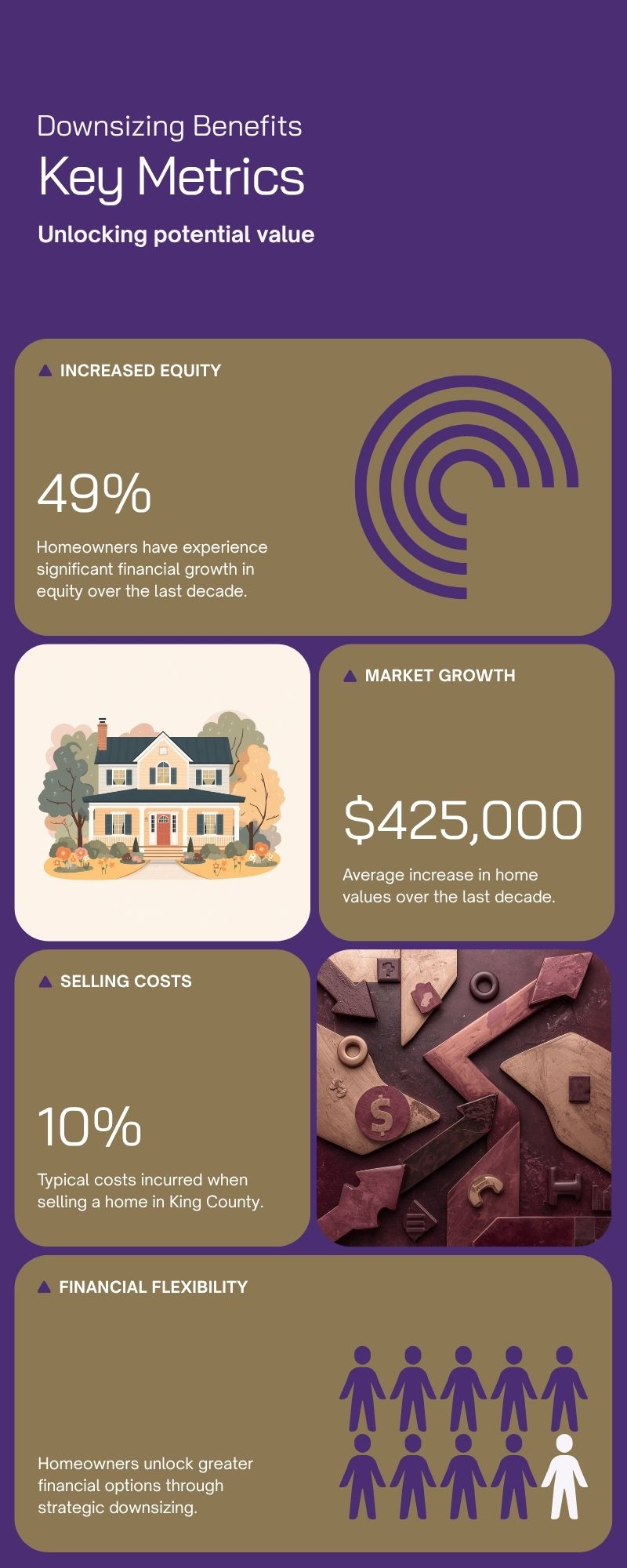
A 2026 Redfin study found that empty-nest boomers own 28% of the nation’s large homes — while millennial families with kids own just 16% of that same housing stock. In King County, that mismatch is especially sharp. Homeowners who bought in Renton, Kent, Auburn, Covington, and Maple Valley in the 1990s or early 2000s are sitting on significant equity in homes that no longer fit their day-to-day lives.
Downsizing sounds simple. Sell the big house, buy something smaller, pocket the difference. But when you actually start thinking through it — what to keep, where to land, condo vs. smaller single-family, the tax implications, the emotional weight of it — it gets complicated fast. This guide is designed to help you think it through clearly, not push you toward any particular decision.
Is This the Right Time to Downsize?
Before you think about where you are going, it helps to get honest about why you want to move. The right reasons to downsize are different from the wrong ones — and the market does not care which is driving you.
Strong reasons to move
The house genuinely does not fit your life anymore. You are paying for space you do not use. Maintenance is becoming a burden rather than a source of pride. You want to free up equity for retirement, travel, or helping your kids. You want to live somewhere more walkable or lower-maintenance. These are all clear, grounded reasons to take the next step.
Reasons to pause
You are reacting to a difficult transition — a recent empty nest, a loss, family pressure. You are hoping the market will time itself perfectly. None of these are reasons to stay forever, but they are reasons to slow down and give the decision more space before you commit.
The 2026 King County market actually gives you more room to breathe than the market of three or four years ago. Active listings across the county rose nearly 38% year over year, which means you are not scrambling in a panic-buy environment on the purchase side. That is real breathing room worth using.
The Financial Picture: What You Are Actually Working With
If you bought in South or East King County before 2015, your equity position is likely substantial. King County’s median home price has hovered around $850,000 to $900,000 for most homes over 2,000 square feet in established areas. A home you bought for $350,000 in Renton in 2005 could easily have a current market value in the $700,000 to $800,000 range, depending on condition and location.
Sample equity math for a South King County homeowner who bought in 2005. Your numbers will differ — reach out for a free home value estimate.
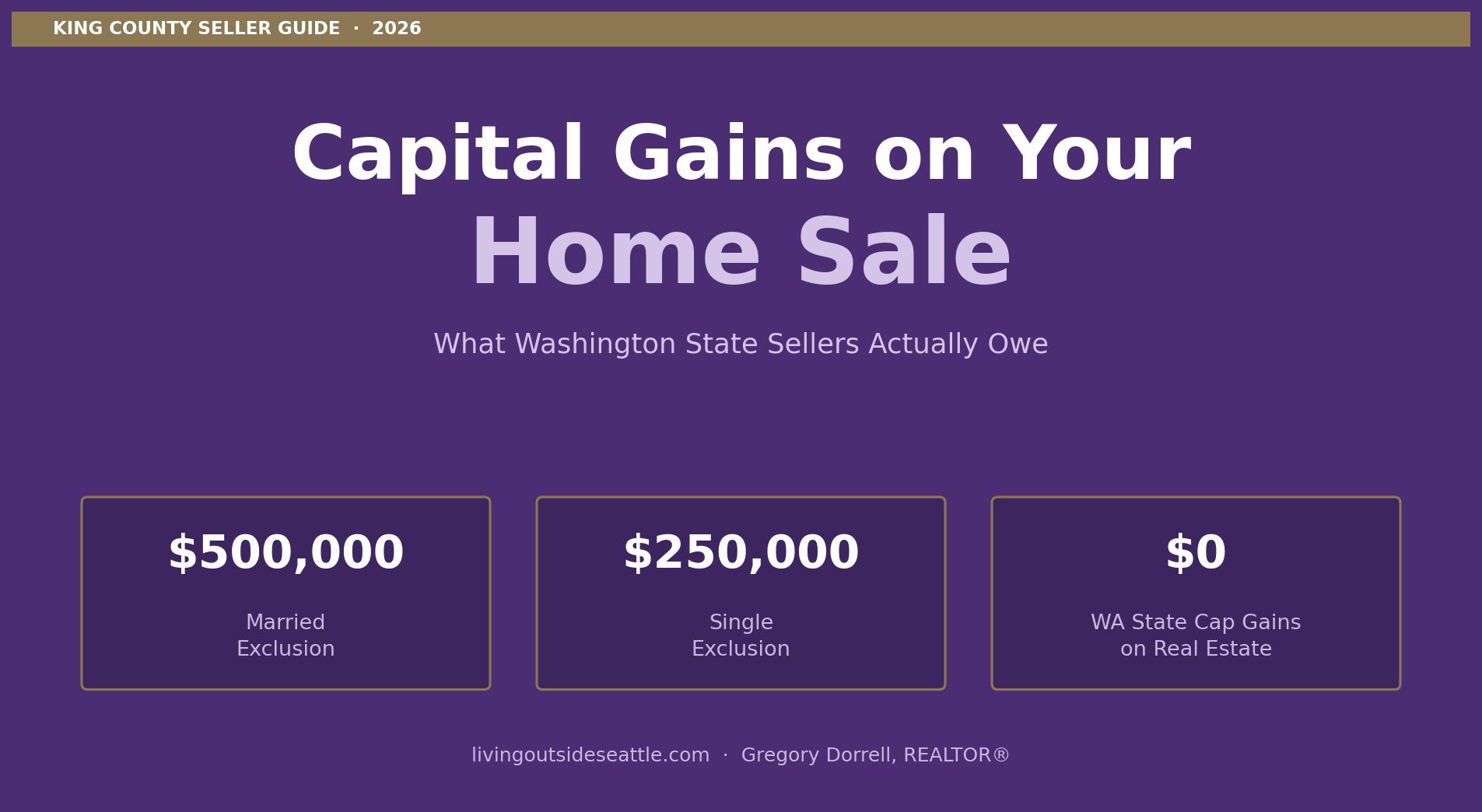
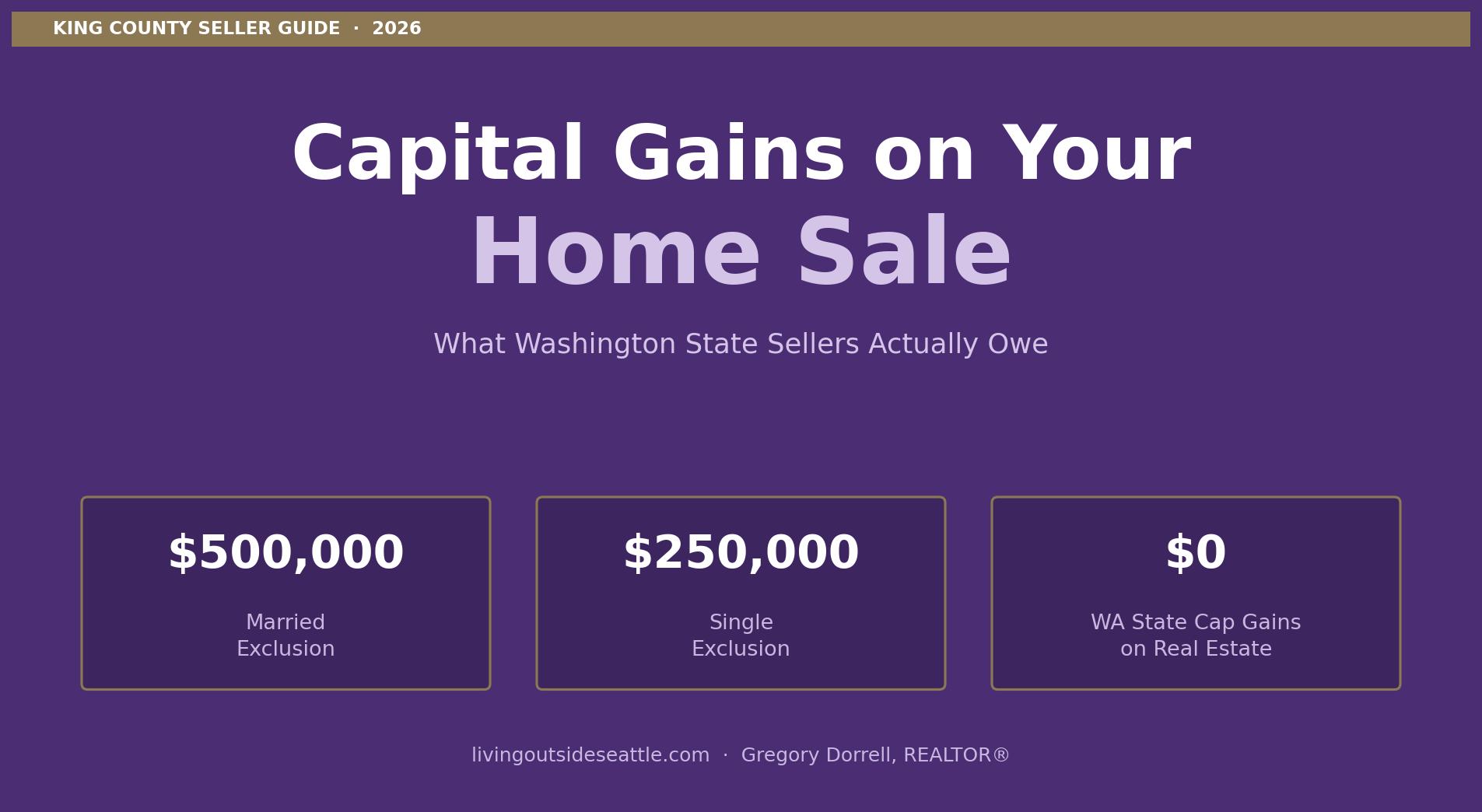
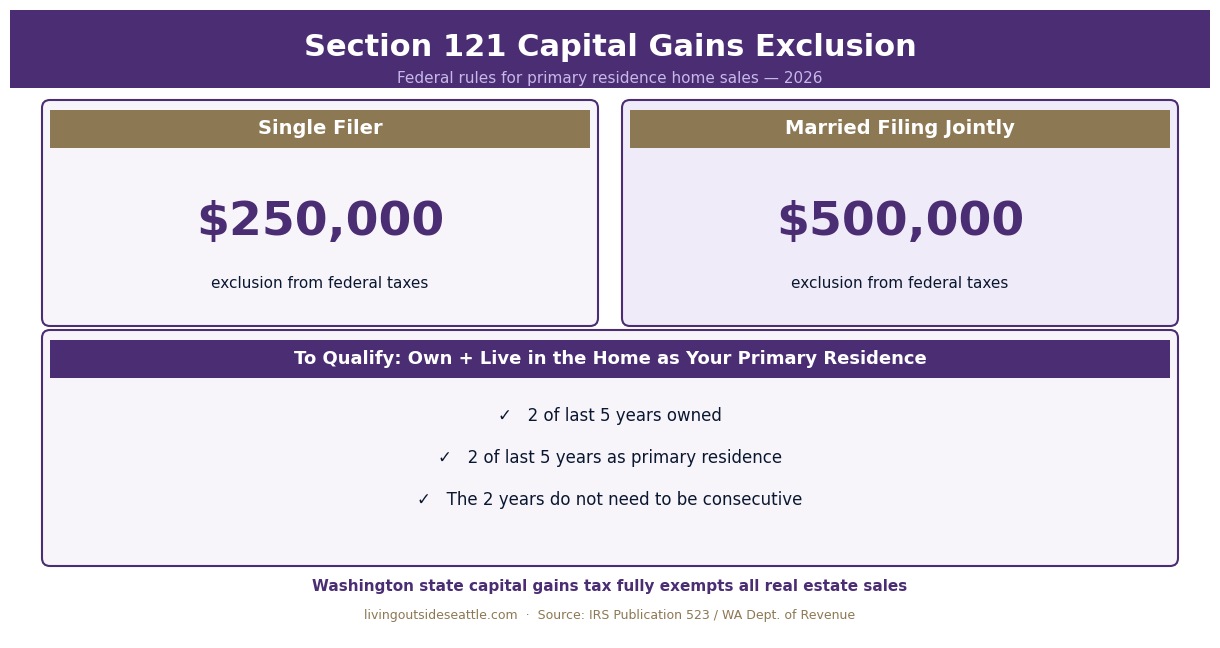
Here is the tax piece that matters most: Washington state does not impose a capital gains tax on real estate sales. The state capital gains tax, which went through rate changes in 2025, still explicitly exempts real property. What you do need to account for is the federal exclusion: if you have lived in the home as your primary residence for at least two of the last five years, the first $500,000 in gain (for married couples filing jointly) is excluded from federal capital gains tax. For most King County empty nesters who have owned their home for 15 to 25 years, this exclusion covers the bulk or all of their gain.
You will also owe Washington’s Real Estate Excise Tax (REET) as the seller — a graduated rate that runs roughly 1.28% on the first $525,000 of the sale price and higher on amounts above that. On a $750,000 sale, budget approximately $10,000 to $12,000 for REET, plus standard seller costs like agent commission, title, and escrow. Full breakdown in the Capital Gains on Home Sales in Washington State guide.
The bottom line: for most King County empty nesters, downsizing is a significant equity event — and often a tax-advantaged one. The financial case is usually strong. The harder questions are about lifestyle, not math.
Condo vs. Smaller Single-Family: The Real Tradeoff
This is the question I hear most often from clients in this situation, and the honest answer is: it depends on which part of the hassle you are trying to escape.
If you want to eliminate maintenance entirely
A condo is the cleaner solution. No lawn, no roof, no gutters. The HOA handles exterior upkeep. The tradeoff is that you pay monthly dues — often $400 to $700 per month in South and East King County — and you give up direct control over your living space. You also need to do HOA due diligence: check the reserve fund, look at the meeting minutes, understand the rental cap rules. A condo with a thin reserve fund is a future special assessment waiting to happen.
If you want less house but still want a yard
A smaller single-family home in South King County may be the better fit. Cities like Renton, Kent, and Auburn have an inventory of well-maintained 1,100 to 1,600 square foot single-family homes that are a real step down in upkeep from a 2,500-square-foot house — without eliminating outdoor space entirely. These homes also tend to appreciate more reliably than condos over time and are easier to sell when you eventually need to.
If you want a community built for your stage of life
Consider a 55+ community. Providence Point in Issaquah is one example — a gated active adult community with strong amenities and a tight-knit neighborhood feel.
Geography matters when you are downsizing because the type of life you want in your next home often lines up with a specific part of the county.
South King County: Renton, Kent, Auburn, Covington, Maple Valley
Your dollar goes further here. Smaller single-family homes in established neighborhoods run $475,000 to $650,000 depending on city and condition. If you want to stay close to where you raised your family, keep your existing doctor and dentist, and stay within 20 minutes of your current neighborhood, South KC is the logical landing zone. Covington and Maple Valley in particular have quiet, low-maintenance pockets that work well for empty nesters who want more space than a condo but less upkeep than a large house.
East King County: Issaquah, Sammamish, Bellevue Adjacent
If the Eastside is home and walkability or trail access matters to you, the Issaquah corridor has strong options. Prices are higher — plan on $650,000 to $850,000 even for smaller homes — but the quality of life amenities are strong and the housing stock holds value well. Issaquah’s older neighborhoods have more modest footprints that work well for downsizing without going condo.
If you have already thought about this in the Sammamish context, the Should I Downsize My Sammamish Home post covers the local tradeoffs in detail.
What to Keep, What to Let Go
This part is where most people get stuck. The house itself is a straightforward financial transaction. The stuff inside carries thirty years of accumulated life, and deciding what to do with it is genuinely hard.
Starting the declutter process 12 to 18 months before you list gives you time to make good decisions without the pressure of a closing deadline.
Start 12 to 18 months before you list
This is not about the stuff — it is about your mental state. Moving from a family home to a smaller place after 20 or 30 years is a real transition. Starting early gives you time to process decisions without pressure and to let go of things gradually rather than all at once.
Measure first, then decide
Before you get sentimental about the dining table, find out if it fits in the new space. Many people hold on to things for emotional reasons only to discover the item would not have worked in the new home anyway. Get the floor plan of your target home type and measure everything you plan to keep.
Set a firm deadline with your kids
Adult children are a variable in every downsizing move. Items that belong to them, childhood memorabilia they might want, furniture they might claim — these need a hard deadline. “You have until October 1 to pick up what you want. After that, it goes.” Kindly stated, firmly enforced.
The right order
Go room by room in this sequence: living spaces, bedrooms, clothes, kitchen, office, guest rooms, garage, attic. Leave sentimental storage for last. The physical stuff builds decision-making muscle for the harder emotional items.
For high-value items, use Facebook Marketplace, Craigslist, or a local estate sale company. A well-run estate sale can move significant furniture volume in a weekend and put money in your pocket rather than requiring dump runs.
The practical goal: move only what you would buy again today if you were furnishing the new space from scratch.
What This Means for Move-Down Sellers
If you have been living in your King County family home for 15 or more years and the house no longer fits your life, 2026 is a reasonable year to act. Inventory is up, which helps you on the buy side. Your equity position is likely strong. The federal tax exclusion probably covers your gain. And the market has enough selection that you are not forced into a rushed decision on where you land.
Frequently Asked Questions
How much equity does the average King County empty nester have?
There is no universal number, but homeowners who bought in South King County before 2015 at prices between $250,000 and $450,000 are typically sitting on $300,000 to $500,000 or more in equity, depending on current value and remaining mortgage balance. Your equity is the difference between your current market value and what you owe — not what you paid.
Do I owe taxes when I downsize in Washington State?
Washington state does not tax real estate capital gains. At the federal level, married couples filing jointly can exclude up to $500,000 in gain from the sale of a primary residence they have lived in for at least two of the last five years. Most King County empty nesters fall well within this exclusion. Talk to a CPA about your specific situation before closing.
Is a condo right for a downsizing move?
It depends. Condos work well if eliminating exterior maintenance is your primary goal and you are comfortable with HOA fees and rules. They carry more financing and resale risk than single-family homes, and they require more due diligence upfront — reserve fund, rental caps, meeting minutes. Do not skip the HOA review.
How long does downsizing take?
From the first serious conversation to handing over keys, plan 12 to 18 months if you want the process to feel manageable. That includes decluttering, preparing the home for sale, selling, buying, and moving. Compressing it into three to four months is possible but stressful for most people.
What if I still have a low mortgage rate on my current home?
A 3% rate feels like a golden ticket — and it is, until you calculate what you are spending to keep that ticket. If the cost of maintaining and occupying a home larger than you need exceeds the financial cost of giving up the rate, the math usually still favors moving. It is a personal calculation worth doing carefully. I can help you run the numbers.
When is the best time of year to sell in King County?
Spring (March through June) is historically the strongest window for seller pricing in King County. Fall (September through October) is a solid second choice. If you are planning a move, working backward from a spring listing date and starting prep 12 months before gives you the best combination of market timing and preparation time.
This is not a small decision. The family home carries more than just square footage — it carries time. But there is also a real opportunity in the next chapter, and getting the move right starts with thinking it through clearly rather than rushing.
When you are ready to talk through your specific situation in Renton, Kent, Auburn, Covington, Maple Valley, or anywhere in South or East King County, reach out directly.
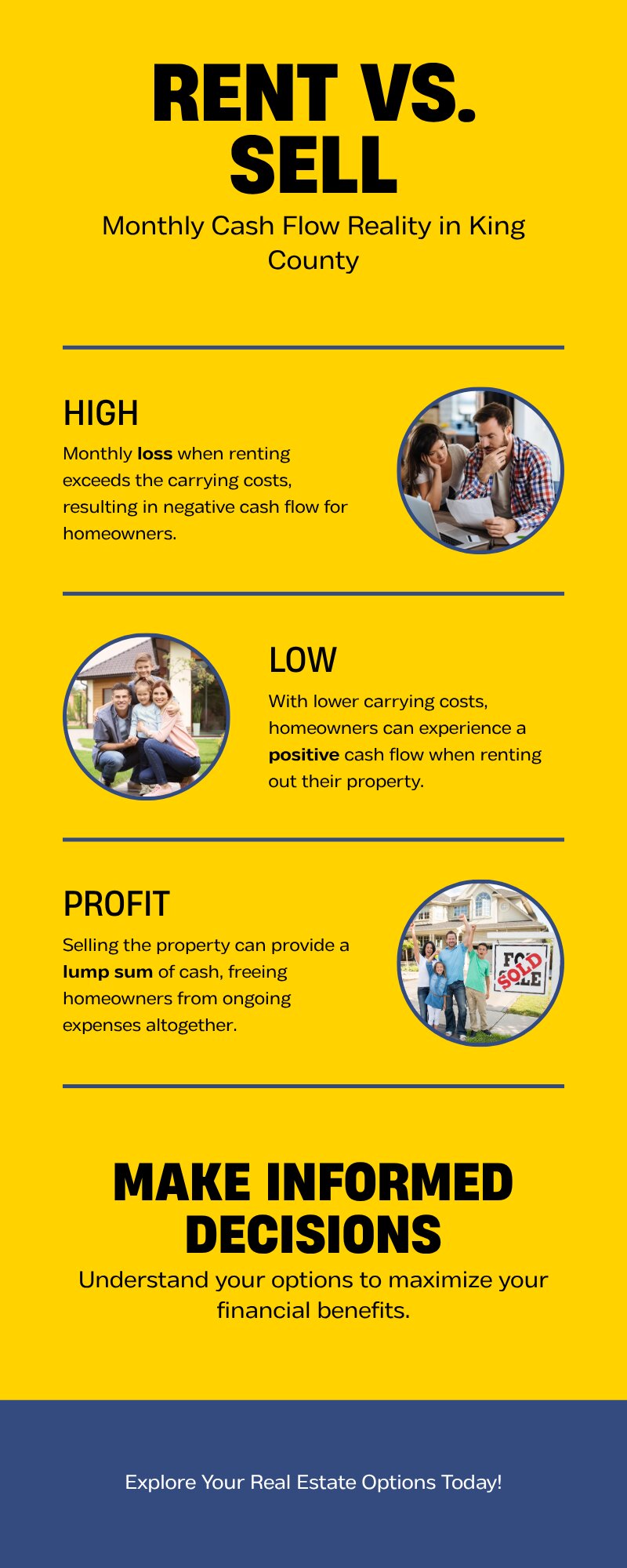
Should you become a landlord or cash out? Here’s the real math King County homeowners need before making this call.
If you’ve been sitting on a home in Renton, Kent, Auburn, or anywhere in South or East King County, you’ve probably had this thought: what if I just rented it out instead of selling? Especially with home values still holding strong — median prices around $859,000 countywide in spring 2026 — the idea of collecting rent every month while your property appreciates sounds appealing.
But the math is more complicated than it looks on paper. And Washington’s landlord-tenant laws changed significantly in 2025, adding rules most homeowners-turned-landlords don’t know about until it’s too late.
This post walks through both sides of the decision — actual rental income projections, net sale proceeds, tax implications, cash flow math, and the real-world landlord responsibilities that don’t show up in the rosy scenarios. By the time you’re done reading, you’ll know which option makes more financial sense for your situation.
The Rental Income Side: What King County Homes Actually Rent For
Let’s start with what you could realistically collect in rent. King County single-family rental rates in 2026 vary a lot by city and home size, but here are realistic ranges for typical South and East King County homes.
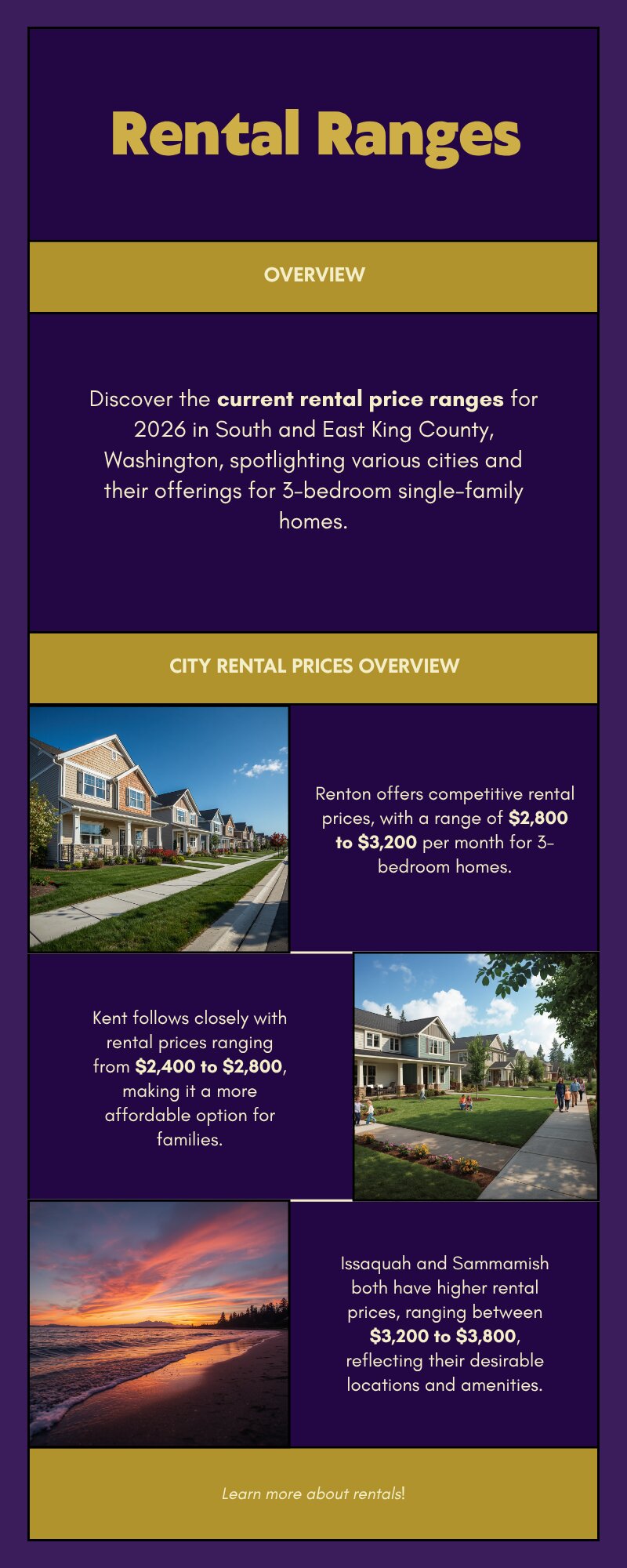
Three-bedroom single-family homes in Renton are pulling $2,800 to $3,200 per month. In Kent, the range is closer to $2,400 to $2,800. Auburn runs slightly lower, typically $2,200 to $2,600 for a comparable home. Move east to Issaquah or Sammamish, and a three-bedroom can fetch $3,200 to $3,800 monthly.
Sounds like solid money. But gross rent is not your income. Your net cash flow depends on what you owe and what it costs to run the property.
Here’s a real example. Say you own a three-bedroom home in Renton worth $700,000. You bought it five years ago, your current mortgage balance is $480,000, and your rate is 4.5%. Your monthly carrying costs look something like this:
Monthly Carrying Costs — High Mortgage Scenario
Mortgage P&I at 4.5% on $480K balance: ~$2,430
Property taxes (King County ~1.0% annually): ~$583/month
Landlord insurance (~15% more than owner-occupied): ~$150/month
Maintenance reserve (1% of value per year / 12): ~$583/month
Total carrying costs: ~$3,746/month
At $3,000 rent: -$746/month before vacancy or management fees
If you hired a property manager — which handles tenant screening, rent collection, and maintenance coordination — expect to pay 8% to 10% of gross rent, or another $240 to $300 per month on top of that negative.
That scenario doesn’t cash flow. It costs you money every month to keep it.
Now flip it. Same Renton home, but you paid it down to $300,000 and your rate is 3.0% from a 2021 refinance. Monthly P&I drops to approximately $1,265. Suddenly the same $3,000 rent gives you positive cash flow after all expenses. That’s the home where keeping it as a rental makes financial sense.
Two scenarios, same rent. The only thing that changes the outcome is what you owe. Run your actual numbers before deciding.
The Sale Side: What You Actually Walk Away With
When you sell, you get a lump sum. But net proceeds are not the same as your home’s sale price. Here’s what comes out.
Real Estate Excise Tax (REET) in King County runs approximately 1.78% of the sale price on a home in the $700,000 to $1.5 million range. On a $700,000 sale, that’s $12,460. Agent commissions typically run 5% to 6% total — on $700,000, that’s $35,000 to $42,000. Closing costs — title insurance, escrow, pro-rated taxes — add another $3,000 to $5,000.
So on a $700,000 sale, you might net $635,000 to $649,000 before any mortgage payoff. Subtract the $480,000 balance, and you walk away with roughly $155,000 to $169,000 in cash. That’s a down payment on your next home, a fully funded investment account, or two years of rental losses avoided.
If you’re in a lower-equity position — say $300,000 owed on a $700,000 home — the sale gives you approximately $355,000 to $369,000 cash in hand. Now the math shifts. Holding the property becomes more interesting because you have equity working for you every year.
Tax Implications: Where Things Get Complicated
This is the part most homeowners don’t think through carefully enough.
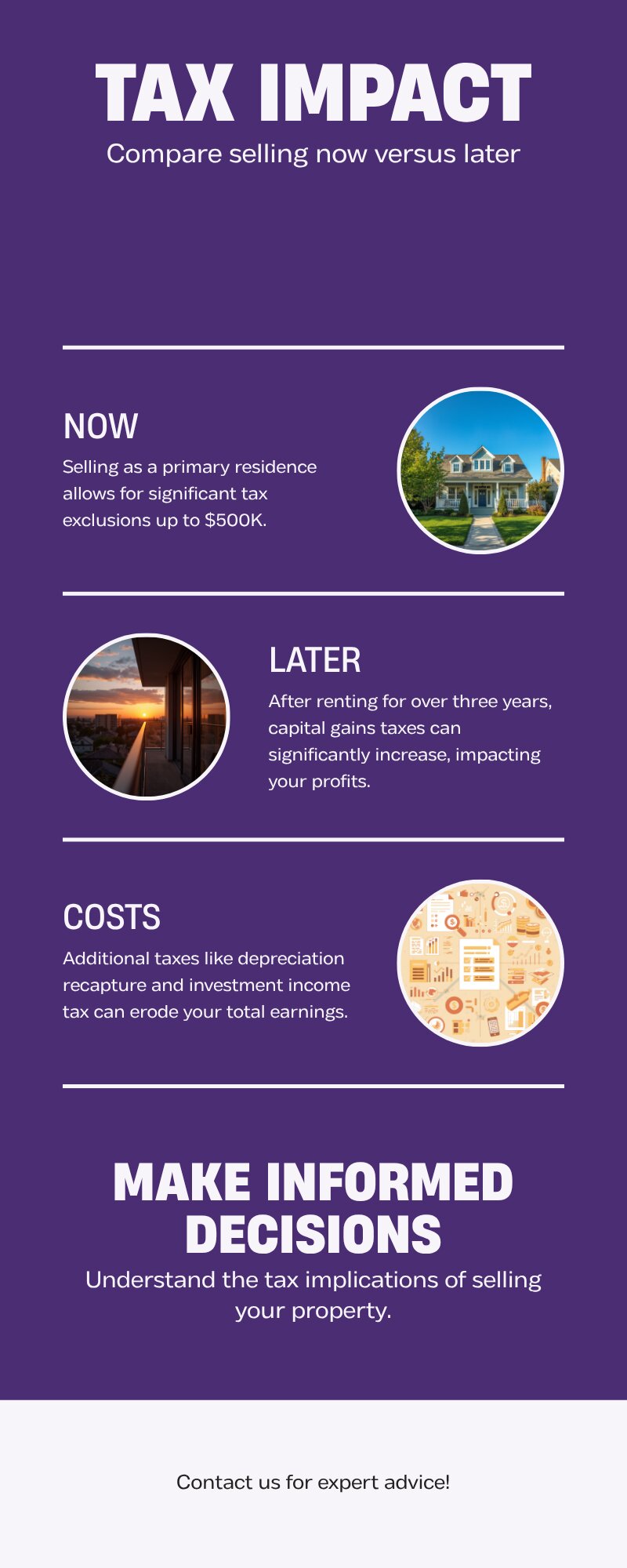
If you sell your primary residence, Washington’s $500,000 capital gains exclusion (for married couples; $250,000 for single filers) likely protects your gain from federal tax entirely, provided you’ve lived there two of the last five years. Washington state has no income tax, so there’s no state capital gains tax on primary residence sales either. You pay REET at closing and that’s largely it. For a full breakdown of how Washington taxes work on a home sale, see our guide to capital gains on home sales in Washington State.
If you convert to a rental and sell later, the tax picture changes. Once you stop living there as your primary residence, you start losing your exclusion eligibility. Sell after the two-year primary-residence window closes, and your gain becomes a taxable long-term capital gain at the federal level — 15% or 20% depending on your income bracket, plus potentially a 3.8% Net Investment Income Tax if your household income exceeds $250,000.
There’s also depreciation recapture to account for. Once you convert to a rental, the IRS lets you deduct depreciation each year — roughly 1/27.5 of the structure’s value annually. When you eventually sell, the IRS recaptures that depreciation at up to 25%. That can be a meaningful surprise at tax time.
The two-year primary residence window is the biggest tax variable in this decision. Once it closes, your sale proceeds become a taxable event.
Washington Landlord Law in 2026: What Changed
Before you decide to rent, you need to know that Washington’s landlord-tenant laws shifted significantly starting in 2025. These aren’t small tweaks — they meaningfully change what it means to be a landlord here.
Rent Stabilization (HB 1217)
Effective May 2025, annual rent increases are capped at 7% plus CPI, or 10%, whichever is lower. For 2026, the maximum is 9.683%. You cannot raise rent at all during the first 12 months of a tenancy. Any increase requires 90 days written notice using a state-standardized form sent via certified mail.
What this means for you: if rents rise faster than that cap, you can’t keep pace. If a great tenant moves in at below-market rent, you’re limited in how quickly you can adjust.
Just Cause Eviction Requirements
You can’t simply decide not to renew a lease at the end of the term. You need a legally recognized reason — nonpayment, lease violation, owner move-in, or a handful of other specific grounds.
Eviction timelines are not quick. Nonpayment requires a 14-day notice before you can file. Most violations require a 10-day notice to comply. Court processes add weeks or months. Evicting a non-paying tenant in King County can realistically take three to six months — during which you carry all costs with no rent coming in.
The Local Angle: King County Specifics That Change the Math
A few things about King County shift the calculus compared to national averages.
Property taxes here are real. King County’s effective property tax rate runs around 0.93% to 1.1% depending on city and levy district. On a $700,000 home, that’s $6,500 to $7,700 per year — a cost that doesn’t go away when you become a landlord. And unlike a primary residence, you can’t homestead-exempt your way to a lower bill.
Current King County mortgage rates sit around 6.4% in mid-2026. If you bought in the last two to three years at these rates, your P&I is substantially higher than someone who refinanced in 2021. That gap is often what separates a cash-flowing rental from a money-losing one.
The rental market is competitive but not unlimited. Rents have stayed strong in South King County, but they’ve also flattened. Rent growth has run around 4% year over year in the broader Seattle metro, but Washington’s new stabilization caps limit how much future increases can catch up.
Home appreciation is still the strongest long-term argument for the rental side. If your home appreciates 3% to 4% annually from a $700,000 base, that’s $21,000 to $28,000 per year in equity gain. Even if you’re slightly cash-flow negative on rent, appreciation can still make the investment pencil out — if you’re patient and prepared for the landlord role.
South King County in particular — Renton, Kent, Auburn, Covington — remains a strong long-term hold for landlords who are disciplined about tenant selection and maintenance. These are stable demand markets with diverse employment bases. But that’s a different conversation than “I’ll rent it out for a year and see how it goes.”
South King County rents are strong but not unlimited. Your specific city, neighborhood, and home condition determine the real number you’ll collect.
When Renting Makes Financial Sense
Based on the math and the landlord landscape, here’s when keeping the property and renting usually wins.
You have a low-rate mortgage (under 4%) that generates positive monthly cash flow after all expenses. Your principal balance is low relative to value — meaning the equity is working for you as an asset even if rent doesn’t fully cover costs. You’re planning to return and live in the home within three to five years, preserving your primary residence exclusion. Or you’re committed to building a rental portfolio long-term and understand that this first property is an investment, not passive income.
When Selling Makes More Sense
Selling wins when you have a high-rate or high-balance mortgage that won’t cash flow at current rents. When your equity is substantial and a lump sum now serves your goals better than monthly income later. When you want simplicity — no tenant calls, no maintenance surprises, no navigating the 90-day rent increase notice process. Or when you need to deploy that equity into your next home and you can’t do both.
If you’re weighing this decision right now, here’s a simple three-step filter before you call anyone.
First, run your actual monthly carry cost — mortgage P&I, taxes, insurance, and a 1% annual maintenance reserve divided by 12. Compare that to realistic rent for your specific home and neighborhood, not the top of the range.
Second, calculate your net sale proceeds. Look at your current loan payoff, subtract estimated closing costs and agent fees, and ask yourself whether that lump sum helps you more than the monthly difference between rent and expenses.
Third, get a real conversation with a tax professional about your gain and your exclusion window. If you’ve lived in the home two of the last five years, the clock is ticking on that federal exclusion. Don’t let it expire accidentally while you’re hoping the rental market improves.
I can walk you through the numbers on your specific home — no obligation, no pressure. If renting makes more sense, I’ll tell you that. If selling makes more sense, I’ll tell you that too.
FAQ: Renting Out vs. Selling Your King County Home
Can I rent out my King County home and still avoid capital gains tax when I sell later?
Only if you sell within the IRS’s primary residence window — you must have lived in the home two of the last five years when you sell. If you rent it out for more than three years before selling, you lose the $250,000/$500,000 federal exclusion. Washington state has no capital gains tax, but federal tax on investment property gains runs 15–20% plus potential Net Investment Income Tax.
What can I realistically charge for rent on a King County single-family home in 2026?
A three-bedroom home in South King County (Renton, Kent, Auburn) typically rents for $2,400 to $3,200 per month depending on condition, location, and size. East King County (Issaquah, Sammamish, Bellevue) runs higher, often $3,200 to $3,800 for a comparable home.
Does Washington state have rent control in 2026?
Yes, as of May 2025. Under HB 1217, annual rent increases are capped at 7% plus CPI, or 10%, whichever is lower. For 2026, the cap is 9.683%. You can’t raise rent in the first 12 months of a tenancy, and you must give 90 days written notice — certified mail, state-standardized form — before any increase.
How long does it take to evict a non-paying tenant in King County?
Realistically, three to six months from missed payment to vacant possession. You must issue a 14-day pay-or-vacate notice, file in court if they don’t comply, wait for a hearing, and execute the order. During that entire period you’re carrying costs with no rent. Landlord insurance with loss-of-rent coverage can offset some of this risk.
Should I hire a property manager if I rent out my King County home?
For most first-time landlords, yes. A professional property manager handles tenant screening, lease compliance under Washington’s updated laws, maintenance coordination, and the 90-day rent increase documentation process. Typical fees run 8–10% of gross rent monthly. That cost is real, but so is the protection it provides.
What’s the real estate excise tax (REET) on selling my home in King County?
REET is graduated in Washington. On homes selling between $700,000 and $1.5 million, the effective combined rate runs approximately 1.28% to 2.5% depending on the price tier. For a $700,000 sale, budget roughly $12,000 to $13,000 for REET at closing. It comes out of proceeds automatically at the title company.
The decision between renting and selling isn’t one-size-fits-all. It’s a math problem that looks different for every household depending on what you owe, what you’d net, and what you actually want your life to look like over the next three to five years. Run the numbers honestly — including the ones people usually skip — and the right answer tends to become obvious.
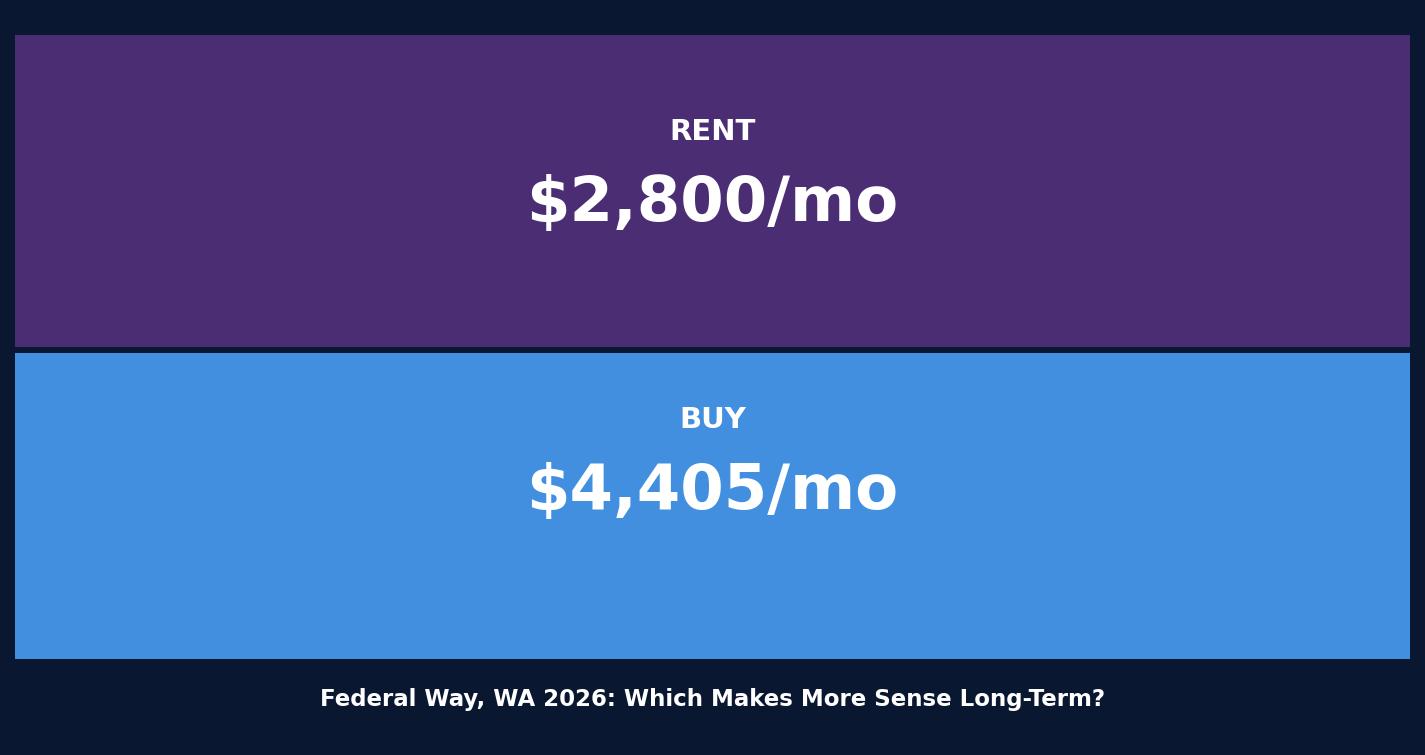
When you’re paying $2,800 a month in rent, the question gets loud: wouldn’t I be better off putting that toward a mortgage in Federal Way?
Rent disappears. A mortgage builds equity. The math should be simple.
It’s not simple. But it’s not complicated either. Here’s what the numbers actually look like, using real Federal Way prices and March 2026 mortgage rates.
Federal Way Home Prices 2026: Condo vs. Mortgage Cost Breakdown
Start with a Federal Way condo. The median price in March 2026: $637,500.
Monthly payment with 10% down, which is realistic for a first-time buyer:
Down payment: $63,750. Loan: $573,750. At 6.38% (the rate as of late March 2026), principal and interest runs roughly $3,580 per month.
That’s not your full housing cost. Add:
Property taxes: King County annual property tax runs roughly 0.94% of value. On a $637,500 condo, that’s about $5,990 per year, or $475 per month.
HOA fees: Federal Way condos typically run $300 to $400 per month. Call it $350.
Homeowners insurance: roughly $100 to $150 per month.
Total: $3,580 (P&I) + $350 (HOA) + $475 (taxes) + $125 (insurance) = approximately $4,530 per month.
Your rent: $2,800.
Month one, you’re spending more as an owner. Noticeably more.
The Common Mistake When Comparing Rent to Buy in Federal Way
Most renters stop at that monthly gap and decide buying is too expensive.
Month one, two, three — you are spending more. That part is true.
But you’re not just spending that money. You’re building something with it.
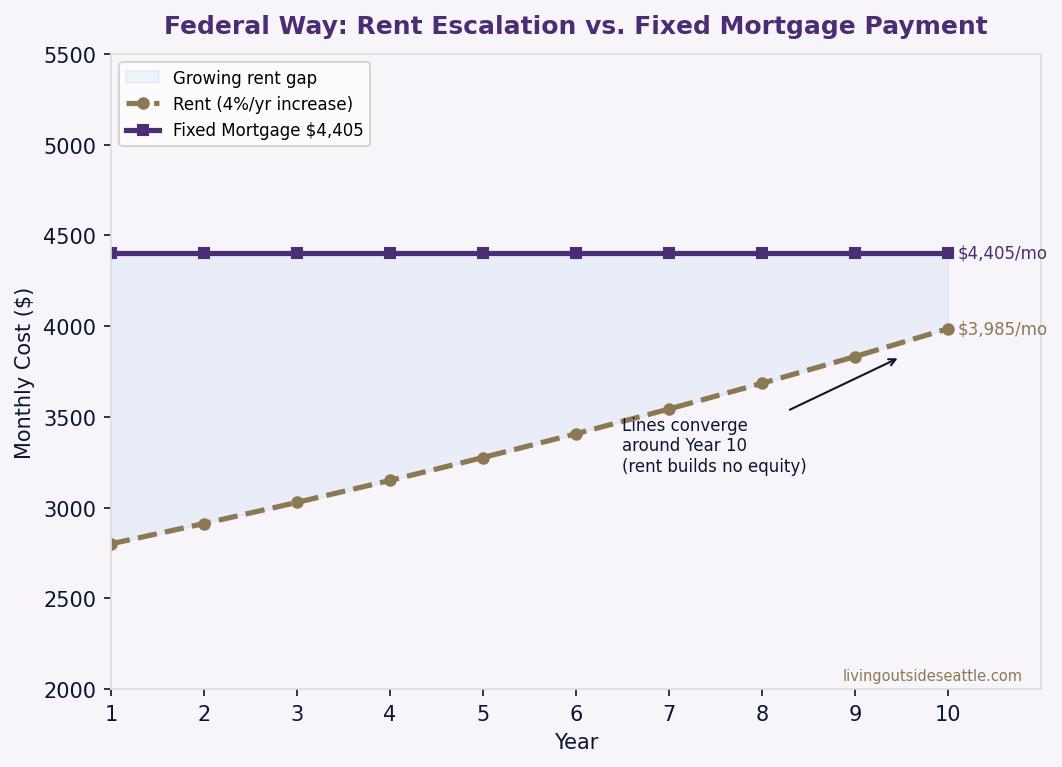
At 4% annual rent growth, a Federal Way renter paying $2,800/month today will pay $4,149/month by year 10 — while the mortgage payment stays fixed.
How Federal Way Home Equity Builds While You Pay Rent
At 6.38% on a $573,750 loan, roughly $814 of your first payment goes toward principal. By end of year one, you’ll have paid down roughly $9,768. That’s money you get back when you sell. A renter gets zero.
Over 30 years, the vast majority of that $3,580 P&I payment becomes equity. Your rent payment? Gone every month. Forever.
Federal Way Rent Increases vs. a Fixed Mortgage Payment
Here’s what actually shifts the math for long-term renters.
Federal Way rent increases 3% to 5% per year. Here’s what that looks like at 4% annually:
By year 10, you could be paying $4,149 in rent with nothing to show for it. A Federal Way homeowner at that same point has paid down roughly $80,000 in principal and owns an asset worth more than $637,500.
Buying a Single-Family Home in Federal Way: A Cheaper Path
What if you buy a house instead of a condo?
The Federal Way single-family median in March 2026: $686,500. Put 20% down to avoid PMI. That’s $137,300 down, leaving a $549,200 loan.
Principal and interest: roughly $3,425 per month. Property taxes: about $490 per month. Insurance: roughly $130 per month. No HOA. No PMI.
Total: $4,045 per month.
Cheaper than the condo path, and you get a single-family home. Still more than $2,800 rent, but the gap is narrower. The trade-off: you need $137,300 down instead of $63,750.
Should You Rent or Buy in Federal Way? Who Should Buy Now
Buying makes sense if you’re planning to stay 5 or more years, have a stable income and sufficient down payment, and want to build equity instead of paying someone else’s mortgage. The monthly gap between renting and owning narrows as rent increases each year.
Renting still makes sense if you’re moving in 3 years or less. Closing costs and transaction fees on both sides of a sale can eat your equity on a short hold.
One more comparison worth making: Seattle one-bedroom apartments in decent neighborhoods run $3,200 to $3,500 per month. Against those numbers, a $4,530 Federal Way mortgage looks a lot closer to what you’d already be paying.
Federal Way Rent vs Buy FAQs
Is it cheaper to rent or buy in Federal Way WA in 2026?
Month-to-month, renting at $2,800 is lower than the $4,045 to $4,530 mortgage payment. But rent typically increases 3% to 5% annually while your mortgage stays fixed. By year 10, Federal Way rent at 4% annual growth reaches $4,149 per month, while your mortgage hasn’t moved. And each mortgage payment builds equity. Rent builds nothing.
What is the typical mortgage payment on a Federal Way home in 2026?
Based on March 2026 rates of 6.38%, a $637,500 Federal Way condo with 10% down runs roughly $4,530 per month including principal, interest, HOA, taxes, and insurance. A single-family home at $686,500 with 20% down costs approximately $4,045 per month with no HOA. Both figures use King County property taxes of roughly 0.94% annually.
How much equity do you build in the first year of a Federal Way mortgage?
In year one, approximately $814 per month of your $3,580 P&I condo payment goes toward principal. By end of year one, you’ve paid down roughly $9,768. Renters get nothing back. Over time, equity compounds as your loan balance shrinks and home value grows.
What are the hidden costs of buying in Federal Way that renters don’t pay?
Beyond your monthly mortgage, expect property taxes (roughly $5,990 per year on a $637,500 condo), homeowners insurance ($1,200 to $1,800 per year), maintenance and repairs (budget 1% of home value annually), HOA fees for condos ($3,600 to $4,800 per year), and PMI if putting down less than 20%. Total annual costs beyond principal and interest can run $15,000 to $25,000. Renters avoid most of these, which is why the 5- to 10-year picture matters more than the monthly comparison.
What’s the median home price in Federal Way WA in 2026?
The median single-family home price in Federal Way as of March 2026 is $686,500. The median condo price is $637,500. Prices are up roughly 6.7% compared to early 2025.
Gregory Dorrell is a REALTOR® with Coldwell Banker Bain specializing in East and South King County. This post is for informational purposes and not an offer of real estate services. All market data as of March 2026.
How first-time buyers in King County can get up to $45,000 — or more — toward their down payment right now.
The number I hear most from first-time buyers in King County is not the interest rate. It is the down payment. At a $700,000 median price, even a 5% down payment is $35,000 — and that is before closing costs. That is a lot of money to save on top of rent in one of the most expensive metros in the country.
What most buyers do not know is that there are programs specifically designed to close that gap. Some are state programs. Some are regional. A few are city-specific. And in many cases, you can combine them. I work with buyers across South and East King County every week, and the down payment question comes up in almost every first conversation. This guide breaks down every major program available right now, what they actually pay, and how to get the money working for you.
What Is Down Payment Assistance and How Does It Work?
Down payment assistance — DPA for short — is money that a government agency, housing authority, or nonprofit makes available to help first-time buyers cover the upfront cash required to purchase a home. It is not a gift in most cases. Most programs are structured as a deferred second mortgage: you borrow the money at zero percent or very low interest, and you do not make payments on it. You repay it when you sell, refinance, or pay off the home.
That structure matters. It means the money costs you almost nothing while you own the home. You are essentially borrowing from your future equity instead of draining your savings account today.
To use DPA, you pair it with a regular first mortgage — FHA, conventional, VA, or USDA. The DPA funds cover part or all of the down payment and sometimes closing costs. Your lender handles the mechanics. You apply through a participating lender, not directly through the DPA program.
The Main Programs Available to King County Buyers
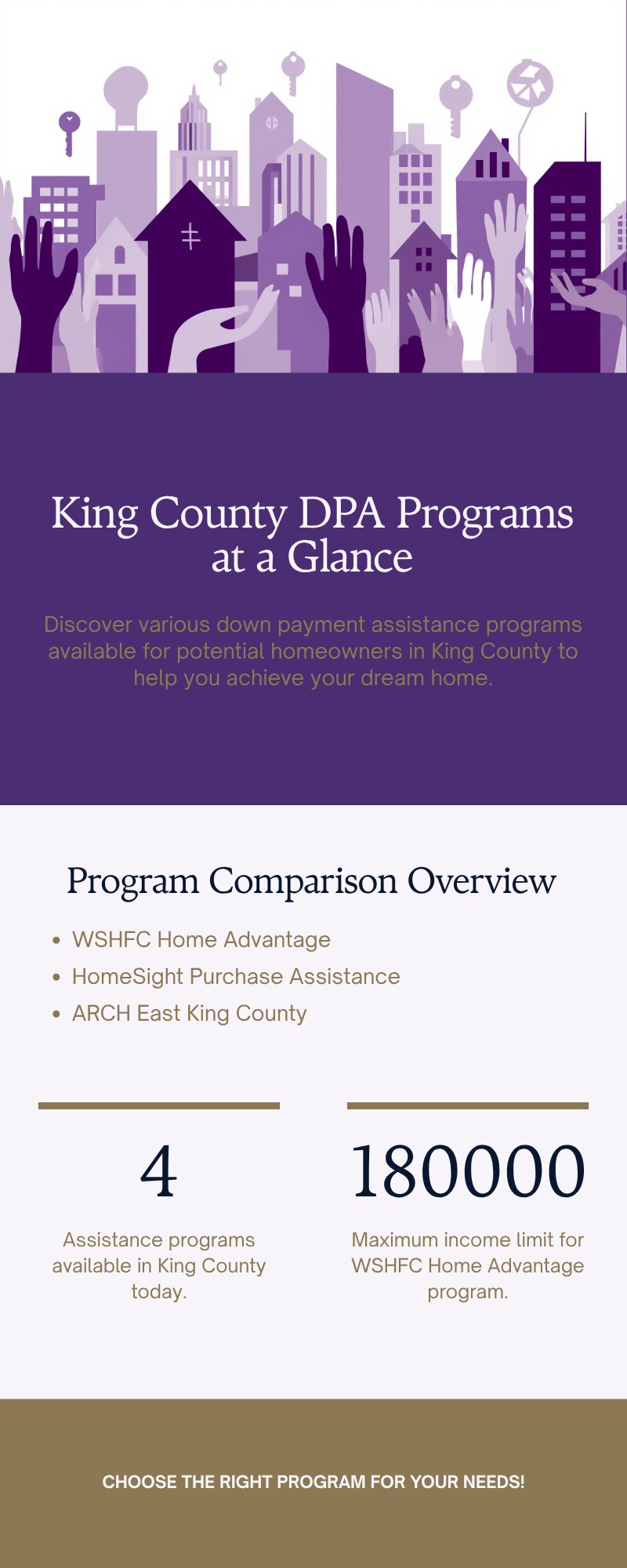
Four programs, four different income and geography profiles. Most buyers qualify for at least one — many qualify for two.
WSHFC Home Advantage
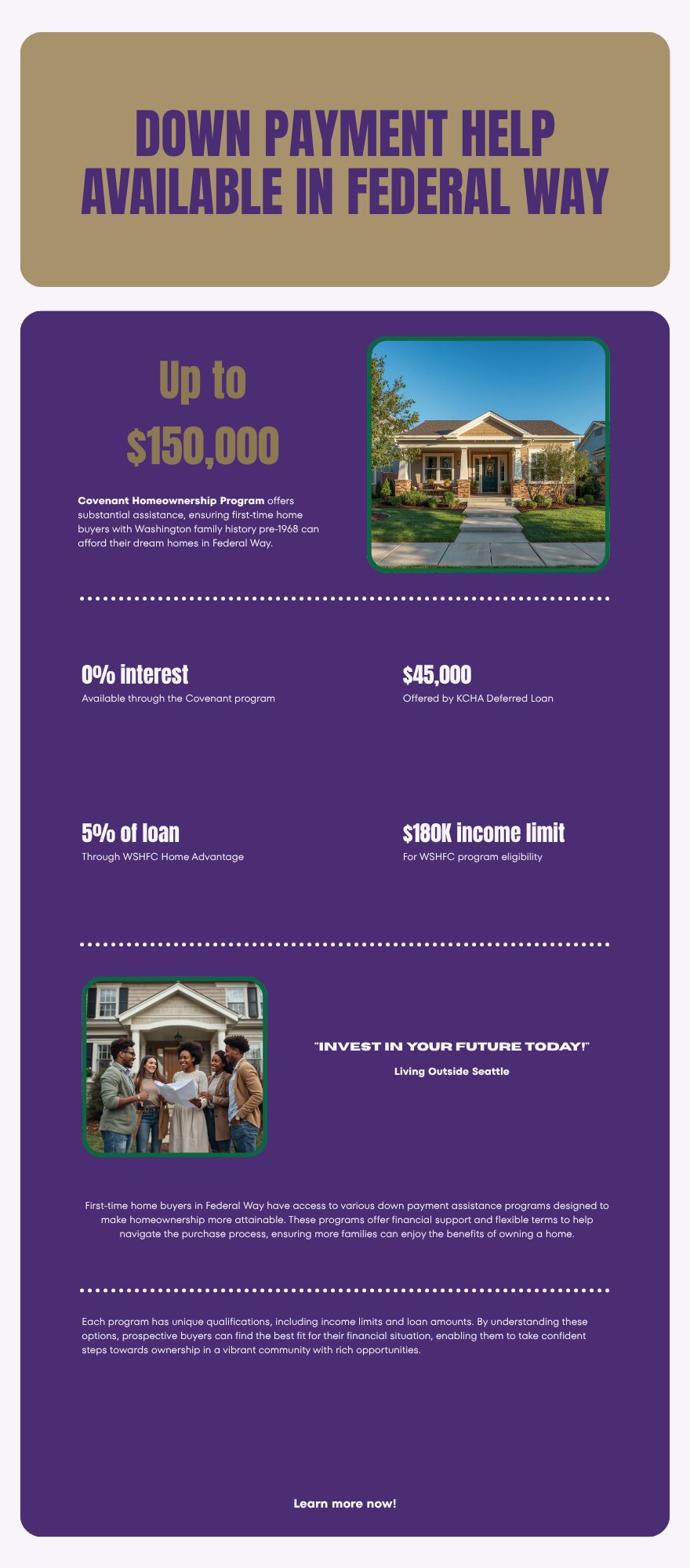
The Washington State Housing Finance Commission’s Home Advantage program is the most widely used DPA program in the state. It has the highest income limit — $180,000 for all household sizes in King County — which means a lot of buyers who assume they earn too much will actually qualify.
Here is how the down payment assistance piece works: you get up to 5% of the first mortgage loan amount as a second mortgage at 0% interest, deferred for 30 years. On a $700,000 home with a $665,000 mortgage, that is up to $33,250 toward your down payment. No monthly payment. No interest accruing. You pay it back when you sell or refinance.
The first mortgage is a 30-year fixed rate through a participating lender. You must have a credit score of at least 620 and complete a five-hour homebuyer education course through Framework or eHome America. The course can be done online in a single afternoon.
HomeSight Purchase Assistance (South King County)
HomeSight is a Seattle-based nonprofit HUD-approved housing counseling agency, and their Purchase Assistance program is the most generous option for buyers in South King County cities. If you are shopping in Auburn, Federal Way, Tukwila, or unincorporated King County, this program can provide up to $45,000 in down payment assistance structured as a 3% deferred loan for 30 years.
The income limit is 80% of Area Median Income. For a family of four in King County, 80% AMI is approximately $112,000 in 2026. That is lower than WSHFC’s ceiling, but the dollar amount is higher — so buyers who fit within the income band can access substantially more cash up front.
HomeSight also offers homebuyer education and one-on-one counseling. Reach them at 206-723-4355 or homesightwa.org. Given that this program serves the exact cities where I work most — Federal Way, Auburn, Kent — it is worth a call early in your search, not after you have found a house.
ARCH East King County Downpayment Assistance
If you are buying in East King County, the ARCH program is what to look at first. ARCH member cities include Bellevue, Issaquah, Kirkland, Redmond, Sammamish, Kenmore, Bothell, Newcastle, Woodinville, and a handful of smaller communities.
The program provides up to $30,000 as a deferred loan at 4% simple interest. The income limits range from about $50,400 for a one-person household to $95,050 for a household of eight. The purchase price limit is $373,000 for the assisted unit, which limits this program to condos and lower-priced homes in the ARCH area rather than single-family houses at current market prices.
That price limit is the honest caution with ARCH: at current East King County prices, this program works best for condo buyers or buyers in specific affordable housing units the program designates. If you are looking at a $650,000 townhouse in Sammamish, WSHFC Home Advantage will likely be more useful.
WSHFC Opportunity Downpayment Assistance
The Opportunity program pairs with WSHFC’s House Key Opportunity first mortgage, targeted to buyers in certain income bands and geographic “targeted areas” — lower-income census tracts where the first-time buyer rule is waived. The DPA here is up to $15,000 at 1% simple interest, deferred for 30 years. It is a solid option for buyers in targeted areas of Kent, Auburn, and Renton who want a slightly larger fixed dollar amount than the Needs-Based program provides.
The King County Angle: Why These Programs Matter More Here
King County median home prices sit above $700,000 as of spring 2026. At that price point, a conventional 5% down payment is $35,000 — and that figure does not include the 2% to 3% in closing costs you will also owe at the table. Combined, a buyer needs $49,000 to $56,000 in cash just to close.
DPA programs cut directly into that number. A buyer using WSHFC Home Advantage on a $665,000 loan gets roughly $33,000 in down payment assistance, which means they need to bring approximately $2,000 to $5,000 of their own cash to close rather than $49,000. That is the difference between buying in 2026 and waiting another three years.
South King County matters particularly here. In cities like Federal Way, Kent, and Auburn, median prices are lower than the county overall — often in the $550,000 to $650,000 range — which means the income limits on programs like HomeSight are more accessible and the purchase prices are within reach. These are the markets where DPA programs do their best work because buyers have realistic targets and the assistance closes the gap meaningfully.
How to Stack Multiple Programs
You can combine certain DPA programs to increase your total assistance. This is called stacking, and it is legal and common when done correctly.
The most practical stack for King County buyers is WSHFC Home Advantage (5% DPA) plus WSHFC Needs-Based assistance ($10,000 fixed) if you qualify for the lower income tier. A participating lender can structure both as simultaneous second mortgages on the same transaction.
Buyers in HomeSight’s service area may be able to combine HomeSight assistance with a first mortgage that has its own DPA feature — ask your lender specifically about this before assuming the programs can be combined, because some programs prohibit layering.
One thing to know: the more DPA you layer, the more important it is to work with a lender who has experience with these specific program combinations. A loan officer who has never done a stacked WSHFC transaction will slow everything down. Ask upfront: “Have you closed stacked WSHFC loans before?”
What Buyers Get Wrong About DPA
The biggest misconception I see is that buyers think these programs are for people in financial trouble. They are not. They are for people who have income, credit, and stable employment but have not had enough years to save a down payment at King County prices. Most DPA recipients are working professionals — nurses, teachers, city employees, tech workers at smaller firms — who earn good incomes but have been renting while prices outran their savings rate.
The second misconception is that applying for DPA slows down the purchase or makes your offer look weak to sellers. It does not affect the timeline in any significant way — DPA is financed through the same closing process as any other transaction. Sellers do not see your financing source, only your terms and your pre-approval letter.
The third thing buyers miss: the homebuyer education requirement is not a hoop to jump through. The five-hour Framework course covers budgeting, loan types, the offer process, and what happens at closing. Every first-time buyer I work with who has taken it says it reduced their stress level. Do it early in the process, before you start touring homes.
Run through this checklist before contacting a lender. Having these items ready speeds up the pre-approval and DPA approval process.
What This Means for First-Time Buyers in King County
If you are renting right now and thinking about buying in South or East King County, the first practical step is not finding a house. It is finding a WSHFC-approved lender, telling them your income and credit score, and asking which DPA programs you qualify for. That conversation takes 20 minutes and tells you exactly how much assistance you can access.
After that conversation, you will know your real buying budget: not just what you qualify to borrow, but how much cash you actually need to bring to closing. In most cases, that number is much smaller than buyers expect.
Once you know your DPA amount, you will have a much clearer picture of what you can afford and where. If you are still deciding between a condo and a house, check out Should I Buy a Condo or House in King County Right Now? — it breaks down the cost, lifestyle, and financing differences at current prices.
Frequently Asked Questions
Do I have to be a first-time buyer to use these programs?
Most DPA programs define “first-time buyer” as someone who has not owned a home in the past three years. If it has been more than three years since you last owned, you qualify. There are also exceptions for targeted geographic areas where the first-time buyer rule is waived entirely.
Can I use down payment assistance with an FHA loan?
Yes. WSHFC Home Advantage is compatible with FHA loans. FHA requires 3.5% down with a 580+ credit score, and the DPA can cover that amount. The two programs work together through the same lender and close at the same time. If you are deciding between FHA and conventional, see FHA vs. Conventional Loan in King County: Which Is Right for First-Time Buyers? for a side-by-side breakdown.
What happens to the DPA loan if I sell my home?
You repay the deferred second mortgage from your sale proceeds, just like you would repay any other lien on the property. If your home has appreciated, you are repaying a fixed dollar amount from a larger equity pool — most sellers find this is a very manageable part of the transaction.
How long does it take to get approved for a DPA program?
The DPA approval runs in parallel with your first mortgage approval — it does not add extra time as long as you are working with an experienced participating lender. The only real time commitment is the homebuyer education course, which you can complete in a single day online.
Are there income limits I need to know about?
Yes, and they vary by program. WSHFC Home Advantage has the highest limit at $180,000 for King County. HomeSight caps at 80% AMI (roughly $112,000 for a family of four). ARCH has lower limits ranging from $50,400 to $95,050 depending on household size. Your lender will check your income against each program you might qualify for.
Does using DPA affect my interest rate?
The WSHFC Home Advantage first mortgage rate is set by the Commission and is typically very close to market rates — sometimes slightly better because it is a bulk-purchased rate. The DPA second mortgage is at 0%, so it does not affect your monthly payment at all.
Starter homes in King County are more reachable than most renters think. That’s the first thing I tell people when they call me. It usually surprises them.
The county median sits above $800K. That sounds intimidating. But the median includes Bellevue at $1.7 million and Sammamish at $1.6 million. If you’re targeting South King County, your real entry points look nothing like those numbers.
Here’s what your starter home actually looks like at different price points, using March 2026 data.
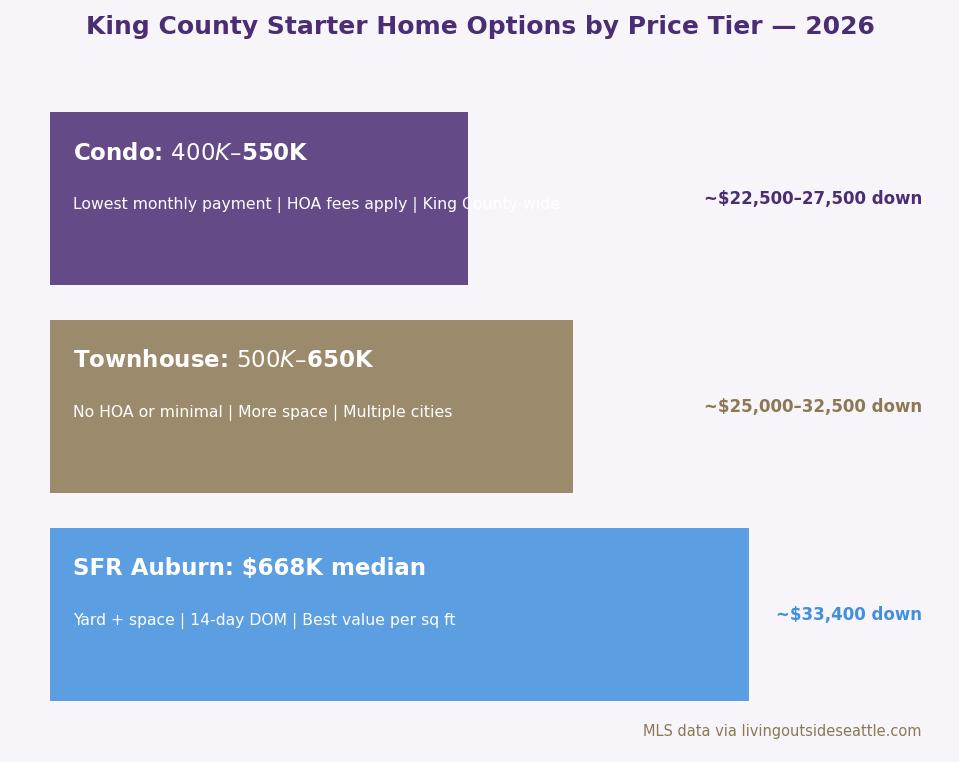
King County Condo Prices 2026: Starter Homes from $400K to $550K
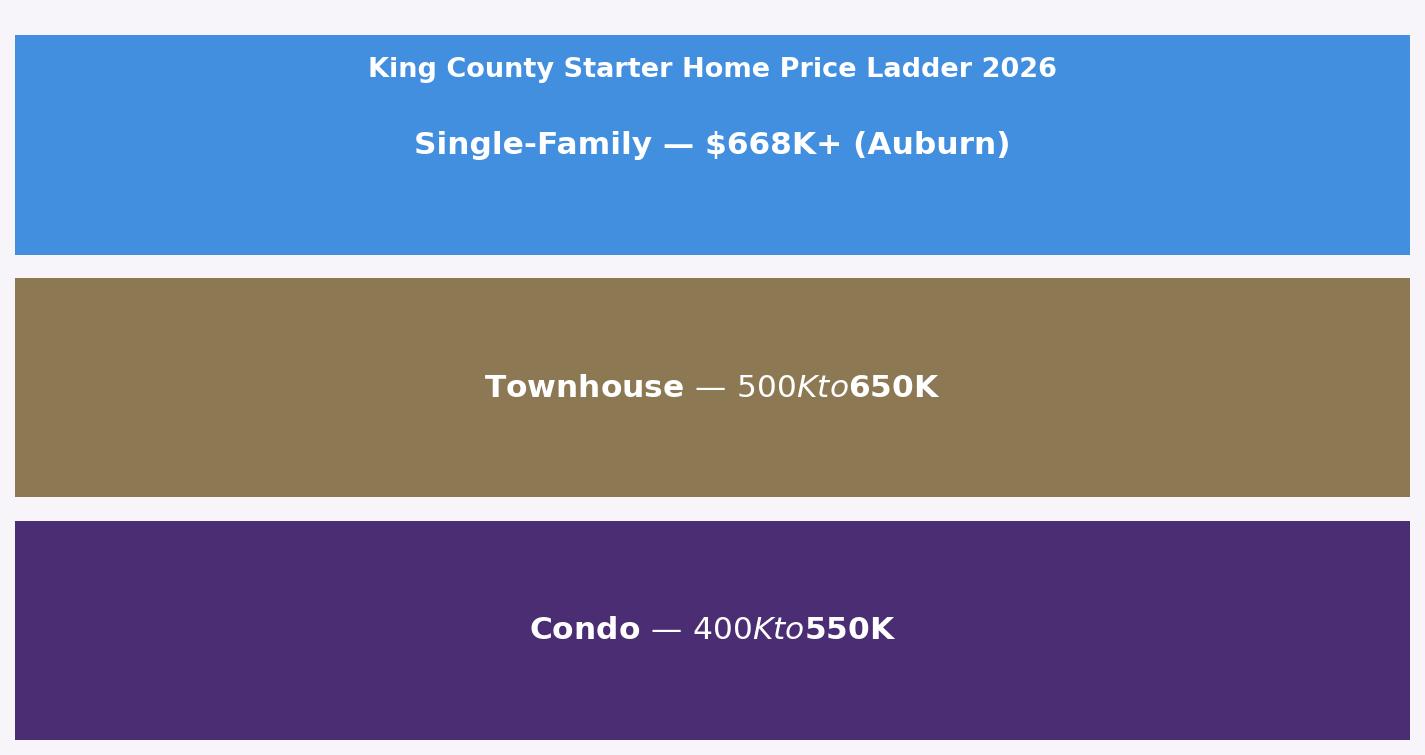
From $400K condos to $668K single-family homes — here’s what first-time buyers can realistically target across South King County in 2026.
The King County condo median as of March 2026 is $550,000. That’s across the entire county.
At the lower end, $400K to $450K gets you a 1- or 2-bedroom condo, likely built in the 1980s or 1990s, in Auburn, Kent, or Federal Way. Established HOA histories, solid locations near shopping and highways, and they’ve already absorbed the worst of any market corrections.
At $550K, you’re in a better-maintained unit. Possibly newer. Two beds, 1.5 baths, maybe outdoor space, a building with solid reserves. For more on financing options at these price points, see my King County mortgage rates and loan options guide.
The advantages of a condo: low maintenance, no yard work, no roofing or exterior repair costs, shared building insurance. You close the door and you’re done.
The trade-offs: HOA fees in the $300 to $600 per month range, no land ownership, and resale that can be tighter depending on the building.
Townhouse Starter Homes in King County: The $500K to $650K Range
Townhouses occupy good middle ground. They feel like houses. Most have a small yard or patio and a garage. You’re still next to someone, but you own land and have exterior walls without the full maintenance load of a single-family home.
At $500K to $550K, you’re in a 2- to 3-bed townhouse, probably built in the 2000s or newer, in Kent, Auburn, or the southern Eastside.
At $600K to $650K, you’re in a newer, well-maintained townhouse. Possibly 3 beds and 2.5 baths, maybe with a small finished basement.
HOA fees for townhouses typically run $150 to $300 per month. Lighter than condos. You’re responsible for your own exterior but not the roof or foundation on most buildings.
Affordable Single-Family Homes in King County: Auburn as the Entry Point
This is where first-time buyers get real. A single-family home you actually own outright.
Auburn is your strongest entry point. The Auburn median single-family price in March 2026: $668,000. Days on market: 14 days. That’s the softest DOM in the 7-city South King County area, which means you have breathing room as a buyer.
$668K in Auburn buys something real. A 1,500 to 1,800 square foot home built in the 1970s to 1990s, 3 beds, 1.5 to 2 baths, on a quarter-acre lot. Not new. Not fancy. But livable. Foundation solid. Roof not leaking. Systems working.
Move up to $700K and you get better condition, a newer kitchen or bathroom, maybe updated electrical. $750K in Auburn or nearby Kent gets you a newer-built home or a well-renovated older one.
Why Auburn? You get the most square footage per dollar in South King County. The Green River Trail runs through the area. Downtown Auburn has real community investment happening right now. Schools are solid, property taxes are reasonable, and the commute to Seattle via I-5 or 167 is manageable. For a full breakdown of the city, see my Living in Auburn WA: 2026 neighborhood and real estate guide.
This is not a fallback neighborhood. It’s a smart first buy.
Down Payment Assistance for King County First-Time Buyers
King County offers up to $45,000 as a 3% interest, 30-year deferred loan for first-time buyers purchasing in Auburn, Federal Way, Tukwila, or unincorporated areas. The WSHFC Home Advantage program also provides down payment assistance for households earning under $147,400 in King County.
These programs change the upfront math. Here’s what that looks like in practice:
Without assistance: FHA loans allow 3.5% down. On a $550K condo, that’s $19,250 down. Closing costs are another $10K to $15K. Total to move in: roughly $30K to $35K.
On a $668K Auburn home with 5% down conventional, you need $33,400 down. Closing costs another $12K to $18K. Total: roughly $45K to $50K.
What’s the Monthly Payment on a Starter Home in King County?
At today’s 6.38% rate on a $600K loan, 30 years: roughly $3,800 per month including taxes, insurance, and PMI. For a renter paying $2,200 per month for a 1-bedroom, that’s $1,600 more per month for a 3-bedroom house you own and build equity in.
PMI on that $668K Auburn home at 5% down runs about $250 to $300 per month until you hit 20% equity. Real cost. But not a dealbreaker for most first-time buyers.
Key Takeaways
King County condo median: $550,000. Entry condos start at $400K to $450K in Auburn, Kent, and Federal Way.
Townhouse sweet spot: $500K to $600K for newer, well-maintained homes.
Auburn single-family entry point: $668,000 median with a 14-day DOM and the best price-per-square-foot in South King County.
Down payment plus closing costs on a $668K Auburn home: roughly $45K to $50K with 5% down conventional. Down payment assistance programs can reduce this.
First-time buyer payment on a $600K loan at 6.38%: roughly $3,800 per month including taxes, insurance, and PMI.
Frequently Asked Questions About Starter Homes in King County WA
What is a realistic starter home price in King County WA?
In King County, starter homes range from $400K to $750K depending on property type and location. Condos and townhouses start around $400K to $550K. Entry-level single-family homes in South King County average $668K in Auburn as of March 2026. The exact price depends on location, condition, and what you qualify for with your income and down payment.
Can I buy a starter home in King County with a small down payment?
Yes. FHA loans allow 3.5% down. On a $550K condo, that’s roughly $19,250 down plus $10K to $15K in closing costs. King County also offers up to $45,000 in deferred down payment assistance for buyers in Auburn, Federal Way, Tukwila, and unincorporated areas. Check with a mortgage lender about which programs you qualify for.
Is Auburn a good city for first-time home buyers in King County?
Yes. Auburn offers the most square footage per dollar in South King County, with a $668K median single-family price and a 14-day average DOM. That extra time on market means less competition and room to negotiate. The Green River Trail, solid schools, and a manageable Seattle commute via I-5 or 167 make it a smart first buy.
What’s the monthly payment on a $668K home in Auburn WA?
At 5% down and a 6.38% 30-year rate, your principal and interest on a $634K loan is roughly $3,960 per month. Add property taxes (around $530/month), insurance ($100 to $130/month), and PMI ($250 to $300/month), and your total monthly housing cost is approximately $4,840 to $4,920. PMI drops once you reach 20% equity.
What down payment assistance is available for King County first-time buyers?
King County offers up to $45,000 as a 3% interest, 30-year deferred loan for buyers purchasing in Auburn, Federal Way, Tukwila, or unincorporated King County. The Washington State Housing Finance Commission’s Home Advantage program offers additional assistance for households earning under $147,400 in King County. A mortgage lender can help you stack programs based on your income and target city.
Gregory Dorrell is a licensed REALTOR® in Washington State (License #111862) with Coldwell Banker Bain. Market data sourced from NWMLS/MLS InfoSparks, March 2026. This content is for informational purposes and does not constitute financial or mortgage advice. Please consult with a mortgage lender regarding down payment requirements, loan programs, and qualifying rates specific to your situation.
You’ve been pre-approved. Now the lender is asking which loan type you want. Suddenly the decision feels a lot bigger than you expected.
Most first-time buyers in King County hear the words “FHA” and “conventional” and assume they’re basically the same thing with different names. They’re not. The loan type you choose affects your monthly payment, how much cash you bring to closing, how competitive your offer looks to sellers, and how much you pay over the full life of the loan. In a market where the median home price in Renton, Kent, and Auburn is pushing $600,000, those differences add up to real money.
I’ve helped buyers work through this decision dozens of times. Here’s what actually matters for King County buyers specifically, not just a generic national comparison.
What FHA and Conventional Loans Actually Are
FHA loans are insured by the Federal Housing Administration. Because the government backs them, lenders can offer them to buyers with lower credit scores and smaller down payments than they’d otherwise accept. You’re not borrowing from the government. You’re borrowing from a regular lender, but that lender has a government safety net if you default.
Conventional loans have no government backing. They’re sold to Fannie Mae or Freddie Mac after closing, which means they follow stricter underwriting rules. That strictness cuts both ways: harder to qualify for, but cheaper to carry over time if you do qualify.
The most important thing to understand is that these two loan types are not interchangeable. They’re designed for different financial situations.
The Down Payment Reality in King County
Both loan types have low down payment options, but they work differently.
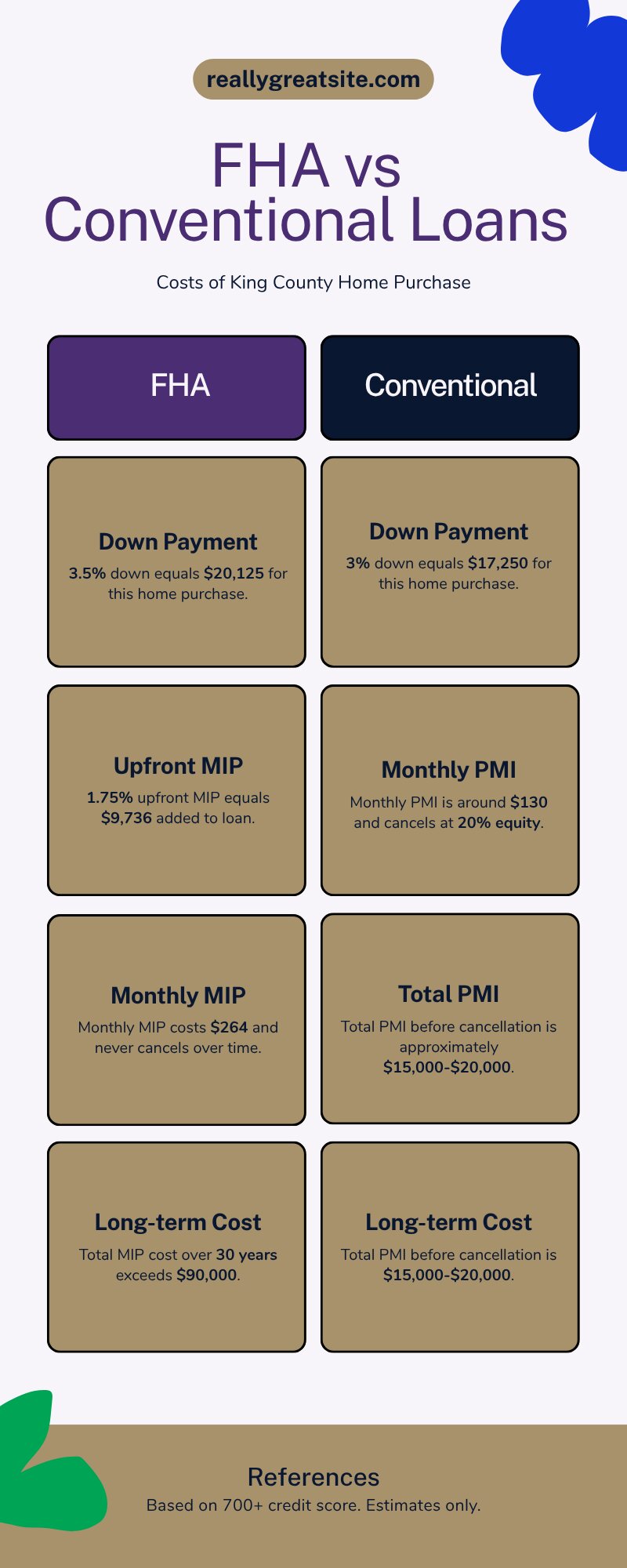
FHA requires 3.5% down if your credit score is 580 or above. On a $575,000 home — a realistic entry-level price in South King County right now — that’s about $20,125 down. If your score is between 500 and 579, you need 10% down.
Conventional loans have a 3% down option through the Fannie Mae HomeReady or Freddie Mac Home Possible programs. On that same $575,000 home, 3% down is $17,250. The catch: you generally need a credit score of 620 or higher to qualify at all, and the best conventional PMI rates kick in at 700 and above.
So on paper, conventional actually asks for less at closing. But the mortgage insurance story is where the real cost difference shows up, and it’s significant.
FHA mortgage insurance stays for the life of the loan. Conventional PMI cancels at 20% equity — a difference of $70,000+ over 30 years on a typical King County purchase.
Mortgage Insurance: This Is Where the Numbers Diverge
This is the part most buyers don’t understand until it’s too late to change their loan type.
FHA Mortgage Insurance
You pay two premiums. First, there’s an upfront MIP of 1.75% of the loan amount. On a $575,000 purchase with 3.5% down, that’s about $9,736 rolled into your loan balance. Then you pay a monthly MIP for the life of the loan (roughly 0.55% annually on most King County FHA loans).
It does not go away when you hit 20% equity. To eliminate it, you’d have to refinance into a conventional loan.
Conventional PMI
You only pay it if your down payment is under 20%. Once you reach 20% equity through paying down the balance, appreciation, or some combination, you can request cancellation. The lender is required to cancel it automatically at 22% equity. PMI rates for borrowers with 700+ credit scores typically run 0.25%–0.50% annually.
In King County’s appreciating market, PMI commonly cancels within 7–10 years.
Here’s what that means in real numbers on a $555,000 loan (3.5% down on a $575,000 purchase):
FHA: Total MIP over 30 years = approximately $90,000+ including upfront and monthly premiums
Conventional (5% down, 700 credit): Total PMI before cancellation = approximately $15,000–$20,000
That difference is not a rounding error. It’s a second car. It’s a college fund start. For a buyer with a 700+ credit score, conventional wins by a wide margin over any hold period longer than 5 years.
Credit Score: The Practical Dividing Line
Here’s the simplest way to frame the credit score question. For a deeper look at what your payment actually looks like at current rates, see King County Mortgage Rates 2026: What Buyers Are Actually Paying — it walks through the real payment math before you commit to either loan type.
Below 620
FHA is likely your only realistic option. Conventional lenders rarely approve below 620, and when they do, the rates and PMI costs are punishing.
620–700: The Gray Zone
You can qualify for conventional, but your PMI rate will be higher than for buyers with stronger scores. Run the actual numbers with your lender for both options. FHA may still win in the short term, but conventional saves money if you stay put.
700 and Above
Conventional wins, almost without exception. PMI rates at this tier are low (often 0.30%–0.35%), cancel within 7–10 years in King County’s appreciating market, and you avoid the permanent FHA MIP entirely.
I see this play out constantly in my BPO work. I’m assessing home values in Renton, Kent, and Covington every week, and the buyers who positioned themselves for conventional financing at purchase are the ones who refinanced without drama and built equity fastest. The upfront credit work pays off.
Loan Limits in King County: More Room Than You Think
One of the biggest misconceptions about FHA loans is that they’re only for “affordable” homes. In King County, that’s not true.
For 2026, the FHA loan limit in King County is $1,063,750 for a single-family home. That covers the vast majority of purchase prices in Renton, Kent, Auburn, Covington, Maple Valley, and most of the South King County communities I work in regularly. You don’t have to be buying a starter home to use FHA financing here.
The conventional conforming loan limit in King County for 2026 is $1,063,750, also well above the local median price. Both loan types give you plenty of room in this market.
If your loan amount exceeds either of those limits, you’re looking at jumbo financing, which is a separate conversation entirely.
Both loan types cover the vast majority of purchase prices in South and East King County. You don’t need to buy a starter home to use FHA financing here.
How Each Loan Type Plays With Sellers
This is a real consideration in King County’s competitive pockets, and I want to be honest with you about it.
FHA offers historically faced more seller skepticism than conventional offers, for two reasons. First, FHA appraisals have stricter condition requirements. The appraiser flags health and safety issues that can hold up or kill a deal. Second, FHA loan closings occasionally take longer than conventional.
In 2025 and into 2026, the market in South and East King County has moderated from the frenzy of prior years. In many neighborhoods, Kent, Auburn, Covington, and Maple Valley among them, sellers are no longer in a position to pick and choose between five cash offers. An FHA offer paired with a strong pre-approval letter, a fast lender closing commitment, and solid earnest money is competitive.
That said, if you’re targeting a specific high-demand price point where multiple offers are common (certain Renton zip codes, for example), your agent should discuss this with you before you go in with FHA. In those situations, conventional financing strengthens your position.
The King County Angle: Stacking DPA With Either Loan Type
Here’s something that can change the whole picture for South King County buyers: the Washington State Housing Finance Commission (WSHFC) offers down payment assistance programs that work with both FHA and conventional loans.
The Home Advantage DPA program provides up to 4% of the loan amount as a 0% interest, deferred second mortgage. There are no payments until you sell, refinance, or pay off the home. That’s potentially $22,000–$38,000 on a typical King County purchase, which can cover your entire down payment and a chunk of closing costs. If you’re on a conventional loan, the DPA steps up to 5% of the loan amount.
The Opportunity DPA program offers up to $15,000 at 1% interest, also deferred for 30 years.
Both programs have income limits (typically $145,000–$180,000 for King County depending on household size and program), and both require completion of a homebuyer education course.
The practical question most buyers don’t ask: if you use DPA to cover your down payment, does FHA or conventional end up cheaper on a monthly basis? The answer depends on your credit score. With DPA covering the down payment, a buyer with 700+ credit on a conventional loan still comes out ahead on monthly costs. The PMI rate is low and cancels eventually. FHA MIP doesn’t.
A buyer with a 640 credit score using DPA might find FHA keeps their monthly payment more manageable, even accounting for the longer MIP duration.
Run the numbers both ways with your lender. Ask them to show you the total cost of ownership at 5 years, 10 years, and 30 years for each scenario. That comparison will give you your answer faster than any online calculator. If you’re still deciding whether now is the right time to buy at all, First-Time Home Buyer in Kent WA: Buy Now or Wait? runs through the timing math that applies across most of South King County.
What This Means for You
Here’s the practical decision tree:
Credit score below 620
Start with FHA. Focus on improving your score if you can. Even a 40-point gain can change which loan type makes more financial sense.
Credit score 620–700
Get quotes for both FHA and conventional. Ask your lender to compare total MIP/PMI costs over your expected hold period, not just the monthly payment.
Credit score 700+
Conventional almost always wins. The monthly savings from lower PMI and eventual cancellation add up to tens of thousands of dollars over a 10–30 year hold.
Concerned about down payment
Ask about WSHFC DPA programs. They work with both loan types and can cover your entire down payment if you qualify.
Planning to stay under 5 years
Conventional makes even more sense here. You won’t reach MIP removal with FHA anyway, so you’re paying insurance the whole time you own.
Planning to put down 20% or more
Conventional is the clear choice. You pay no PMI at all and skip FHA’s upfront MIP entirely.
Frequently Asked Questions
Can I use FHA financing to buy a home in Renton, Kent, or Auburn?
Yes. The 2026 FHA loan limit in King County is $1,063,750 which covers virtually every home in South King County. FHA is fully available in all King County cities.
What credit score do I need for a conventional loan in King County?
The minimum is generally 620, though some lenders go to 580 with specific programs. For the best PMI rates and lowest long-term costs, you want 700 or above.
How much does FHA mortgage insurance cost in King County?
On a typical King County FHA loan, you’ll pay 1.75% upfront (rolled into the loan) and roughly 0.55% annually as a monthly premium. On a $575,000 purchase with 3.5% down, that’s about $810 per month all-in for principal, interest, and MIP at current rates — though your actual rate will vary.
Will an FHA offer hurt my chances in a competitive King County market?
It can in very hot price ranges. But in most South King County markets in 2026, a well-structured FHA offer with a strong pre-approval is fully competitive. Talk to your agent about the specific neighborhood and price point before worrying about this.
Can I stack down payment assistance with an FHA loan in Washington?
Yes. WSHFC’s Home Advantage and Opportunity DPA programs both work with FHA loans. The DPA is a deferred second mortgage with no payments until you sell or refinance.
When does it make sense to just wait and improve my credit before buying?
If you’re within 3–6 months of crossing from 680 to 720, and your local market isn’t moving aggressively upward, it can be worth waiting. The PMI savings over 10 years on a $550,000+ King County loan easily justify 6 months of credit work. Ask your lender to model both scenarios.
The Tiger Mountain Foothills cover the southeast pockets of Issaquah where the city limits give way to the West Tiger Mountain trail system and the protected forest that wraps around the eastern edge of King County. In 2026, with buyers looking for larger lots, mature trees, and direct trail access to one of the most popular hiking destinations in Washington, this part of Issaquah is a quietly strong option. If you want a home where you can walk out the door and be on the trail to Poo Poo Point in under ten minutes, with serious lot size and the calm of a neighborhood where you can hear birds before you can hear cars, the Foothills delivers.
What is it actually like to live in Tiger Mountain Foothills in 2026?
On a weekday morning, the Foothills feel genuinely quiet. Streets curve up the lower slope of Tiger Mountain with mature firs and cedars screening one home from the next. Driveways are long, lots are spread out, and most homes are not visible from the street. Residents leave for work between 7 and 8 AM, heading north toward I-90. The pace is calm, and you can hear birds and the occasional sound of trail traffic from the West Tiger trailheads.
On a weekend, the Foothills stay quiet but turn more active for residents and visitors. Hikers pour into the West Tiger Mountain trailheads on Saturday and Sunday mornings, especially during paragliding season at Poo Poo Point. Residents adapt to this pattern by hitting the trails early or by accessing them from less-used trailheads on the back side of the mountain. The Issaquah Salmon Hatchery hosts events in fall that pull people from across the Eastside, but the Foothills stay relatively buffered from that activity.
Most residents are a mix of long-time owners who bought in the 1970s and 1980s when this part of Issaquah was considered far out, plus newer buyers from Bellevue and Sammamish who specifically wanted acreage and trail access. Many residents work from home or run businesses out of detached shops on the property. What separates the Foothills from other Issaquah neighborhoods is the immediate trail access. You will not find a closer walk-to-trail neighborhood inside Issaquah city limits.
Homes in Tiger Mountain Foothills: What the Data Shows
Most homes in the Foothills were built between the 1970s and the 2000s, with a smaller share of newer 2010s and 2020s custom rebuilds where someone has torn down an aging home and replaced it. You will find Pacific Northwest contemporary homes, cedar-clad ranches, custom builds from the 1990s, and a meaningful share of newer modern transitional homes on the rebuild lots. Single-family homes typically run 2,200 to 5,000 square feet on lots between half an acre and three acres, with a few larger legacy properties on the more established streets. Many homes have detached shops, barns, or outbuildings that add real utility for owners who use the property. There is no townhome or condo inventory in the Foothills. Detached single-family homes on substantial lots are the only product type.
Market Pulse
Tiger Mountain Foothills (98027)
King County
Median Sales Price (May 2026)
~$1,395,000
~$859,000
Median Days on Market
~30 days
~28 days
Active Listings Change (vs. Jan 2026)
+16%
+30%
Estimates based on current NWMLS data for the Tiger Mountain Foothills residential pockets within the 98027 ZIP code. Inventory turnover here is lower than newer Issaquah neighborhoods because long-time owners stay put. When a property does hit the market, motivated buyers move quickly.
Schools Serving Tiger Mountain Foothills
Most Foothills kids attend Issaquah Valley Elementary, then Issaquah Middle School, then Issaquah High School. All three schools sit five to ten minutes north of the neighborhood. Always confirm your specific address with the Issaquah School District before you write an offer because a few outlier properties have been reassigned over the years.
Issaquah Valley Elementary houses the Spanish Dual Language Immersion program and serves a diverse student body. Issaquah Middle School was rebuilt and modernized in recent years and offers strong music and STEM programs. Issaquah High has a strong four-year graduation rate, multiple AP programs, and a competitive athletics presence.
The school pipeline for the Foothills involves driving or busing for nearly all families. Walking distance is essentially zero given the spread-out nature of the neighborhood and the rural-feeling roads. Most kids ride buses to elementary and middle school, then drive themselves to Issaquah High once they are old enough.
Getting to Work from Tiger Mountain Foothills
Foothills residents typically take Front Street or Issaquah-Hobart Road north to reach I-90 at exit 17. The exact route depends on which side of the mountain you live on. The southern-most properties may use SR-18 to reach I-5 or I-405 for southern destinations.
Destination
Distance
2026 Peak Drive (AM)
Transit Option
Downtown Seattle
19 miles
38 to 58 min
I-90 / ST 554 from Issaquah Transit Center
Bellevue / Amazon Bellevue
11 miles
25 to 35 min
I-90 to I-405 / ST 554
Microsoft (Redmond)
14 miles
30 to 40 min
I-90 to SR-520 / Connector Bus
SeaTac Airport
23 miles
38 to 52 min
I-405 to I-5 / Drive
What I See as a Valuation Expert in Tiger Mountain Foothills
The biggest valuation factor in the Foothills is the lot, the systems, and the immediate trail access. On a 1985 home with 3,000 square feet of living space sitting on three-quarters of an acre, the lot itself can carry 45 to 60 percent of the appraised value, depending on size, slope, usability, and trail proximity. In this area, valuation weight goes heavily to lot grade, drainage, septic system condition where applicable, well capacity where applicable, and the condition of any outbuildings. A flat usable lot with a healthy septic system, a permitted shop, and walking distance to a trailhead will appraise much stronger than a same-size home on a steep slope with a failing system.
HOAs are rare in the Foothills. Most properties are fee simple, which means no monthly dues and no master association rules. The few exceptions are some pocket subdivisions that have small road maintenance HOAs in the $20 to $80 monthly range. Always read the title commitment carefully because some properties have private road easements with cost-sharing requirements that function like an informal HOA.
Within the Foothills, certain lots and pockets carry premium pricing. Properties with direct trail access from the property line, lots backing to Tiger Mountain State Forest, properties with newer wells and recently inspected septic systems, homes with significant outbuildings, and any home within walking distance of the Poo Poo Point trailhead tend to move first when they hit the market.
Explore Tiger Mountain Foothills Yourself
The fastest way to know if the Foothills fits is to drive Issaquah-Hobart Road south past the Issaquah retail core, then turn east onto a few of the side roads to see how the lots open up.
A step-by-step guide to HOA due diligence, warrantable financing, and what to inspect — written for first-time buyers entering the King County condo market.
If you are thinking about buying a condo in King County, 2026 is an interesting time to do it. Active condo listings on the Eastside are up more than 40% compared to last year. That means more options, more time, and more leverage than buyers had just 12 months ago. But the market shifting in your favor does not mean every condo is a good deal. The wrong one can cost you your financing, your down payment flexibility, and years of headaches tied to a poorly run HOA.
I have been pricing properties in East and South King County every day for over 9 years as a BPO field agent. I walk into condos that look great on Zillow and flag problems that would not show up until after you close. This guide covers everything a first-time condo buyer in King County needs to know before making an offer.
What Makes Condos Different to Buy (and Finance)
A condo is not just a smaller version of a house. When you buy a condo, you own your individual unit — usually defined as the “airspace” inside the walls — plus a fractional share of the common areas. The hallways, the roof, the parking structure, the elevators: you own a piece of all of it, along with every other owner in the building.
That shared ownership is why lenders treat condos differently. They are not just evaluating you as a borrower. They are evaluating the entire building and its homeowners association. A lender can approve your income, your credit score, and your down payment — and still decline your loan because the HOA has financial problems.
This is the part most first-time condo buyers do not expect, and it is why starting with the right questions matters.
Warrantable vs. Non-Warrantable: The Financing Split That Changes Everything
The single most important financing question in any condo purchase is whether the building is warrantable or non-warrantable. Here is what that means in plain terms.
Warrantable condos meet the guidelines set by Fannie Mae and Freddie Mac. These are the government-sponsored enterprises that back most conventional mortgages in the United States. When a building qualifies as warrantable, buyers can use standard conventional loans, FHA loans, and VA loans. Interest rates are standard. Down payments can be as low as 3% with some programs.
Non-warrantable condos do not meet those guidelines. Buyers are pushed into portfolio loans — products held by the lender rather than sold to Fannie or Freddie. These typically require 20–30% down and carry interest rates 1–2 percentage points higher than conventional financing. On a $500,000 condo, that rate difference adds roughly $500–600 per month to your payment.
For 2026, there is a specific rule change worth knowing. By January 2027, HOAs must allocate at least 15% of their annual budgeted assessment income to their reserve fund — up from the longstanding 10% minimum. Buildings that fall short lose warrantable status. When you are shopping for a condo right now, you are evaluating buildings that may be in the middle of adjusting to this change, or ignoring it entirely.
Warrantable condos open the door to conventional and FHA financing — non-warrantable buildings push buyers into portfolio loans with higher rates and larger down payments.
What disqualifies a building from warrantable status? The main triggers include: the HOA reserve fund falling below 10% of the annual budget (now moving to 15%), more than 15% of owners being delinquent on dues, a single investor owning more than 20% of the units, more than 35% of the building being used for commercial purposes, and ongoing or threatened litigation against the HOA.
Ask your agent to request the condo questionnaire — also called the HOA certification or lender questionnaire — before you write an offer. This document discloses the reserve balance, delinquency rate, pending litigation, and owner-occupancy percentage. If a seller or listing agent resists providing it, treat that as a warning sign.
HOA Due Diligence: What to Actually Read
The HOA package — sometimes called the resale certificate, disclosure packet, or condo docs — is a stack of documents you will receive after going under contract. In Washington State, sellers are required to provide it, and you typically have a review period to back out if you find something concerning.
Most buyers skim it. That is a mistake. Here is what actually matters:
The Reserve Fund Study
This is a professional assessment of the building’s major systems — roof, elevators, parking structure, plumbing, windows — and how much money the HOA should have saved to replace them on schedule. A well-run HOA commissions one every three to five years. If the building is 20 years old and there is no reserve study, or if the study shows the fund is significantly underfunded, you are looking at the possibility of special assessments in your future.
Special assessments are one-time charges that all owners must pay when the HOA does not have enough reserves to cover a major repair. These can run $5,000, $15,000, even $30,000 per unit for things like roof replacements and elevator overhauls — and they happen regularly in buildings with underfunded reserves.
Meeting Minutes from the Past Two Years
Board meeting minutes are where you find the real story. Look for repeated complaints about the same issue, deferred maintenance discussions, arguments over raising dues, or mentions of legal action. A building with the same roof leak showing up in 18 consecutive meeting minutes has a problem the financials may not fully capture.
Two years of minutes gives you a solid picture of how the board actually operates — not just what they say in the official documents.
The Budget, Dues, and Rental Rules
Check whether the HOA has raised dues recently, and whether dues cover reserves adequately. Artificially low dues often mean the HOA is avoiding necessary increases — which leads to larger special assessments later. Compare dues to similar buildings in the area. A number that looks suspiciously low usually is.
Also check rental cap rules. Some buildings limit the percentage of units that can be rented at any time. If you ever plan to rent your unit, this matters. FHA loans also require the building to be on HUD’s approved condo list — your lender can check this quickly.
What a Condo Inspection Covers (and What It Misses)
A standard home inspection is designed for a single-family house where the inspector can access the roof, crawl space, attic, and all the mechanical systems. A condo inspection is different — and more limited.
Your inspector will cover what is inside your unit: the HVAC (if it is individual to your unit), the electrical panel, plumbing fixtures, windows, doors, and visible water damage. They will typically inspect the balcony and any storage spaces assigned to your unit. What they cannot fully assess: the building’s shared systems, the roof, the structural elements, or common area mechanical equipment.
That is why the HOA documents and the reserve study matter so much. The inspection tells you about your unit. The HOA documents tell you about the building. You need both.
A few things worth flagging during your condo inspection specifically:
Soundproofing between units. This is not a safety issue, but it matters enormously to quality of life. Bring a friend, have them stomp around upstairs while you listen from below.
Water intrusion around windows and exterior walls. Condo buildings in the Pacific Northwest are prone to moisture issues. Look for staining, soft drywall near windows, or any history of water claims in the HOA meeting minutes.
HVAC type. Some older King County condo buildings use central HVAC controlled by the HOA. Others have individual mini-split or forced-air systems in each unit. If it is individual, it is your responsibility to maintain and replace. Know what you are buying before you close.
A standard home inspection covers your unit. The HOA documents cover the building. You need both before you close on a King County condo.
The King County Condo Market Right Now
King County condo prices have held more steady than single-family homes in 2026, but the market has shifted toward buyers. Active condo listings on the Eastside are up more than 40% year over year as of spring 2026. More supply means more negotiating room — on price, closing costs, and seller-paid concessions.
In South King County — Kent, Auburn, Renton — condos remain some of the most accessible entry points in the county. Depending on the city, you can find units in the $350,000–$500,000 range, well below the King County median of $835,000 for all residential property types. For buyers using down payment assistance programs, these price points make a real difference in what you can qualify for.
The current rate environment also affects condo buyers differently than house buyers. If you are using conventional financing on a non-warrantable building, your effective rate goes up significantly — which is why building status matters as much as your personal loan qualification. King County’s conforming loan limit for 2026 is $1,063,750, so most condo purchases in South King County fit comfortably within conventional limits.
First-Time Buyer Programs That Work for Condos
If you are a first-time buyer — meaning you have not owned a home in the past three years — several programs in Washington State work for condo purchases.
The WSHFC Home Advantage Program pairs a 30-year fixed-rate mortgage (conventional, FHA, VA, or USDA) with a below-market interest rate. It also offers down payment assistance up to 4% of the first mortgage amount as a 0% interest, 30-year deferred loan — repayable when you sell or refinance. Income limits apply: for King County, the cutoff is $180,000 for 2026. Minimum credit score is 620 (640 for some loan types). You must use a WSHFC-approved lender.
For a side-by-side comparison of condo versus single-family ownership costs — including what HOA dues do to your total monthly payment — the Condo vs. Townhouse vs. Single-Family guide covers the real numbers for King County buyers.
What This Means for You as a King County Condo Buyer
Buying a condo in King County in 2026 is genuinely doable — especially in South King County where price points are accessible and buyer leverage is higher than it has been in years. But it requires a different checklist than buying a house.
Start with the financing question before you fall in love with a unit. Get your agent to pull the condo questionnaire early. If the building is non-warrantable, run the math on what that does to your monthly payment before you invest time in inspections and negotiations.
Read the HOA documents yourself, not just the summary. The meeting minutes are where problems hide. If the reserve fund is below 10% of the annual budget — and especially below the new 15% target — build that risk into your offer price or walk away.
Hire an inspector who has experience with condos specifically. Ask them directly whether they check for water intrusion at the building envelope, not just inside the unit. And use state programs if you qualify — the WSHFC income limit is $180,000 for King County, which is higher than most people assume.
Frequently Asked Questions
What is the difference between a warrantable and non-warrantable condo in King County?
A warrantable condo meets Fannie Mae and Freddie Mac guidelines, which means buyers can use standard conventional or FHA financing with low down payments. A non-warrantable condo does not meet those guidelines — typically because of low HOA reserves, high investor concentration, or pending litigation — and buyers are limited to portfolio loans requiring 20–30% down at higher rates.
How much are condo HOA dues in King County?
HOA dues vary widely by building age, size, and amenities. In South King County, dues commonly run $300–$600 per month for a standard condo. Eastside buildings with more amenities often run $500–$900 or more. Always verify what dues cover — some include water, sewer, and garbage while others cover only exterior maintenance and reserves.
Can I use an FHA loan to buy a condo in King County?
Yes, but the building must be on HUD’s FHA-approved condo list, or you can apply for single-unit (spot) approval. Your lender can check FHA approval status in minutes. Not all King County condos qualify, so this is worth checking early in your search rather than after you find a unit you like.
What is a condo reserve study and why does it matter?
A reserve study is a professional assessment of a building’s major systems and how much the HOA should have saved to replace them on schedule. A well-funded reserve means lower risk of special assessments — unexpected lump-sum charges to all owners when the HOA needs money for a major repair. Ask for the most recent reserve study in the HOA documents.
Do condo buyers in King County qualify for down payment assistance?
Yes. The WSHFC Home Advantage Program works for condo purchases and offers DPA up to 4% of the loan amount as a 0% deferred loan. Income limits are $180,000 for King County buyers in 2026. The building still must meet standard financing requirements for the underlying loan type — DPA does not change warrantable status.
What should I look for in condo HOA meeting minutes?
Look for recurring complaints about the same issue, deferred maintenance discussions, disputes over raising dues, mentions of legal action against the HOA or individual owners, and references to upcoming special assessments. Two years of minutes gives you a solid picture of how the board actually operates versus what the official financials show.
A condo can be a smart first step into King County homeownership — especially in today’s market, where inventory is up and sellers are more willing to negotiate than they were two years ago. The key is knowing what you are actually buying: your unit, your share of the building, and your exposure to how the HOA is run.
Have questions before you make an offer? Reach Greg at greg@livingoutsideseattle.com or 253-350-0045.
Federal Way just got a lot easier to get to — and a lot more interesting to buy in. Here’s everything you need to know to buy your first home there.
As of December 2025, Federal Way has a Link light rail station. That changed something real for buyers: you can live in a city where the median home price is about $597,000 — roughly 29% below Seattle’s median — and still get to downtown Seattle or SeaTac Airport by train. For first-time buyers who have been priced out further north, that math is worth taking seriously.
This guide walks you through the actual process of buying your first home in Federal Way. Not the national advice you can find anywhere — the specific steps, the specific programs, and the specific neighborhoods that matter here. If you have done the rent-vs-buy math and you are ready to move forward, this is where to start.
What Does It Actually Cost to Buy in Federal Way Right Now?
The first number most buyers want to know is the median price. As of early 2026, it sits around $597,000 to $610,000 for all property types combined. But that number hides some useful range.
Single-family homes have a median closer to $643,750. Townhouses average $351,500. Condos — which include a mix of updated units and older complexes — run from about $200,000 up to $330,000. If you are a first-time buyer whose budget tops out around $500,000, Federal Way gives you real choices: a turnkey townhouse, a move-in-ready condo in a good location, or a single-family home that needs some work.
Compare that to Seattle, where $500,000 buys you a studio condo if you are lucky. Federal Way is not the compromise a lot of buyers expect it to be.
Then there are closing costs. In Washington state, buyers typically pay 2% to 3% of the purchase price to cover lender fees, title insurance, and prepaid items. On a $600,000 home, that is $12,000 to $18,000 out of pocket on top of your down payment. This surprises a lot of first-time buyers. Plan for it early.
The Neighborhood Question: Where to Focus in Federal Way
Federal Way is bigger than most people expect — about 25 square miles, with meaningful price and quality-of-life differences by neighborhood. Getting this right matters more than buyers often realize.
Marine Hills & Twin Lakes — Premium West Side
These neighborhoods sit on the west side of the city with views toward Puget Sound and proximity to Dash Point State Park. They consistently rank highest for schools and safety. Prices here run $650,000 to $850,000 for single-family homes.
Best for: buyers who prioritize top-rated elementary schools and long-term value stability, and can stretch the budget.
Steel Lake — Family-Friendly Middle Ground
Well-regarded schools, a community park around the lake, and prices that are more accessible than the west side. Attracts families who want good schools without paying Marine Hills prices.
Best for: families prioritizing school quality who need room in the budget for a down payment.
Federal Way City Center — Transit-Connected Entry Point
Where the new light rail station is. Walk Score of 83 — the highest in the city. Condos currently near a $285,000 median, one of the lowest price points in King County for a transit-connected location. The city has a phased agreement to add 1,600 homes near the station by 2042.
Best for: commuters, single buyers, or couples who want maximum walkability and transit access at the lowest entry price.
Three programs, potentially stackable — Federal Way buyers have more down payment assistance access than most King County cities.
The School District Picture
Most of Federal Way falls within the Federal Way Public Schools district, which serves over 22,000 students across 47 schools and is one of the most diverse districts in King County, with 123 languages spoken. Top-rated schools cluster in the Marine Hills, Twin Lakes, and Steel Lake neighborhoods.
A small portion of Federal Way’s north end feeds into Highline School District. This matters if you are buying in that zone and have school-age children. Confirm the district boundary before you make an offer on any specific address.
Down Payment Help: What’s Actually Available in Federal Way
This is where Federal Way gets interesting for first-time buyers. There are more programs available here — and more ways to stack them — than most buyers realize. Here is what is active in 2026.
KCHA Deferred Loan — Up to $45,000
Federal Way is one of four cities specifically named in the King County Housing Authority program (along with Auburn, Tukwila, and unincorporated King County). First-time buyers can access up to $45,000 as a 3% interest deferred loan — no monthly payments. The balance comes due when you sell, refinance, or move.
This is one of the most accessible DPA programs in King County, and Federal Way buyers qualify by location alone.
WSHFC Home Advantage — Up to 5% of Loan
Washington’s primary first-time buyer program offers below-market 30-year fixed rates plus down payment assistance of up to 5% of the loan amount as a 0% deferred second mortgage. Income limits for King County run up to $180,000 for all household sizes. You need a 620+ credit score and a free 5-hour homebuyer education course.
If your household income is under $147,400, you may also qualify for an additional $10,000 needs-based DPA at 1% simple interest on top of Home Advantage.
Covenant Homeownership Program — Up to $150,000
This program offers up to $150,000 in down payment assistance at 0% interest for buyers with documented family history in Washington state before 1968. The program expanded in 2025, and as of April 2026 requires most documentation to be gathered before house-hunting.
Buyers who qualify describe this as life-changing. The numbers really are that significant. Contact heretohome.org/covenant or call 1-877-894-4663 to check eligibility before you do anything else.
Programs can often be layered. A buyer using WSHFC Home Advantage as the first mortgage could potentially also use the KCHA $45,000 deferred loan. Talk to a WSHFC-approved lender — not just any lender — to understand exactly which combination works for your income and purchase price.
The Buying Process Step by Step in Federal Way
Here is the actual sequence. Every market has its quirks and Federal Way is no exception.
The Federal Way buying process in seven steps — from credit check to closing keys in hand.
Step 1: Get Your Finances in Shape
You need a minimum 620 credit score for most DPA programs. Pull your credit report before you start house-hunting, not after. If your score is 580 to 619, you have FHA options, but you lose access to most DPA programs until you cross 620.
Step 2: Take the Homebuyer Education Course
WSHFC requires a free 5-hour course before you can use Home Advantage. It is genuinely useful. Do it before you start touring homes — not after you find one you love.
Step 3: Get Pre-Approved (Not Just Pre-Qualified)
Federal Way homes receive an average of 3 offers and sell in about 61 days — not frantic, but sellers still expect a real pre-approval letter. Use a WSHFC-approved lender if you plan to use any state DPA programs. The difference between pre-qualified and pre-approved matters in negotiations.
Step 4: Know Your Loan Type
The FHA loan limit for King County in 2026 is around $977,500 — well above Federal Way’s median, so FHA financing is fully available here. FHA requires 3.5% down with a 580+ score. Conventional loans require 3% to 5% down with a 620+ score.
For most Federal Way first-time buyers, a combination of conventional or FHA financing plus a DPA second mortgage is the path that makes the numbers work. Also worth exploring: rate buydowns that some sellers offer to offset today’s rates.
Step 5: Make an Offer and Negotiate
Federal Way is not the wild bidding-war market you hear about in Bellevue. Homes are sitting an average of 61 days. You have room to negotiate, especially on homes listed more than 30 days. Inspection, financing, and appraisal contingencies are all standard here — do not waive them without a very specific reason.
Step 6: Inspect Thoroughly
General home inspection in Washington runs $400 to $700. Federal Way has significant older housing stock — pay attention to the roof, electrical panels (aluminum wiring was common in 1970s homes), and exterior maintenance.
For pre-1980 homes, a seismic evaluation ($150 to $350) is worth it if the inspector flags anything. Washington is an active seismic zone.
Step 7: Close
Washington closings typically take 30 to 45 days from accepted offer. You will pay 2% to 3% of the purchase price in closing costs on the buyer side. If you are using DPA programs, some of those costs may be covered — confirm with your lender in advance so there are no surprises at the closing table.
The Light Rail Factor: What It Actually Means for First-Time Buyers
Sound Transit’s Federal Way Link Extension opened December 6, 2025, adding three stations: Kent Des Moines, Star Lake, and the Federal Way Transit Center in City Center. From Federal Way, you can now take Link directly to SeaTac Airport and downtown Seattle without sitting in I-5 traffic.
For first-time buyers, this changes the commute math. If you work for a Seattle employer, Federal Way is no longer a two-hour-drive-in-bad-traffic proposition. That matters when you are choosing where to live on a first-home budget.
One thing to be straight about: the research so far shows home prices near the new stations have not spiked the way they did around other Link expansions. Development around the Federal Way station is slower than city officials originally projected. That is actually good news for first-time buyers in 2026 — you can buy near a major transit hub before any significant price premium takes hold, rather than after. That opportunity will not last indefinitely.
What This Means for You as a First-Time Buyer in King County
Federal Way in 2026 is a market where the fundamentals are solid and the buyer advantages are real. You are paying roughly $200,000 to $250,000 less than Seattle for comparable square footage. You have access to more DPA programs than almost anywhere else in King County by name. And you now have a light rail connection that much of South King County does not have.
The things to watch: neighborhood selection matters here more than in uniform suburban markets. Get the school boundaries right before you fall in love with a house. Understand which DPA programs you qualify for before you start touring homes — this changes what you can actually afford. Take the homebuyer education course early so it does not slow your timeline when you find the right place.
For a first-time buyer in the $450,000 to $650,000 range, Federal Way deserves a serious look. I work this market every day, and the value is real.
Frequently Asked Questions
What credit score do I need to buy a home in Federal Way?
Most down payment assistance programs require a minimum 620 credit score. FHA loans allow scores as low as 580 with 3.5% down, but you lose access to most DPA programs below 620. If your score is between 600 and 619, a few months of focused credit improvement can open up a significant amount of additional assistance.
How much down payment do I actually need in Federal Way?
FHA loans require 3.5% down — about $22,000 on a $637,000 home. Conventional loans can go as low as 3% down. But with the KCHA $45,000 deferred loan and WSHFC Home Advantage’s 5% DPA available specifically in Federal Way, many buyers cover the down payment entirely through assistance programs while keeping cash reserves for closing costs and move-in expenses.
Is Federal Way a good place to buy for the first time?
Yes — especially compared to north King County and Seattle. The median is around $597,000–$610,000, which is 29% below Seattle. Homes sit on market an average of 61 days, giving buyers more negotiating room than you find in more competitive King County cities. The new light rail connection opened December 2025 makes commuting significantly more manageable.
Which neighborhoods in Federal Way are best for families?
Marine Hills and Twin Lakes have the highest-rated schools and lowest crime rates. Steel Lake is a strong middle-ground option with good schools and more accessible prices. If transit access matters most, Federal Way City Center near the Link station has a walkability score of 83 and the lowest entry prices in the city near $285,000 for condos.
What DPA programs work specifically in Federal Way?
Federal Way is one of four cities named in the KCHA deferred loan program — up to $45,000 at 3% interest deferred until you sell or refinance. You can potentially layer that with WSHFC Home Advantage (up to 5% of the loan amount as a 0% deferred second) and, if you qualify, the Covenant Homeownership Program (up to $150,000 at 0% interest). Use a WSHFC-approved lender to understand which combination fits your situation.
How long does it take to close on a home in Federal Way?
Most Washington state closings take 30 to 45 days from accepted offer. If you are using DPA programs, add time at the beginning for pre-approval through a WSHFC-approved lender and completion of the required homebuyer education course — both need to happen before you start looking at homes.
If you’re thinking about selling a home in Kent WA in 2026, you’ve probably seen the headlines. Inventory is up. Homes are sitting longer. The market is cooling.
Those headlines aren’t totally wrong. But they’re not telling you what’s actually happening in Kent right now. The March 2026 data I’m looking at tells a more specific story, and it’s one that matters if you’re deciding whether to list this year.
Kent WA Home Prices in 2026: What the March Data Actually Shows
King County inventory is up 48% year-over-year, but Kent homes are still selling at 100% of list price in 8 days.
Here’s what the March 2026 numbers show for Kent:
Median sale price: $732,500. Days on market: 8 days. List price ratio: 100%. Pending sales: 86, up 2.8% year-over-year.
Read that again. Homes in Kent are selling in 8 days at exactly what sellers ask. That’s not a market in trouble. That’s a market that’s working.
Want to know more about what makes Kent tick? Here’s a full look at living in Kent, WA in 2026 — neighborhoods, commutes, and what buyers are actually shopping for.
King County residential inventory is up 48% year-over-year, from 2,148 homes to 3,191. New listings are up 16.5%. But months of supply sits at 2.2 months across the county. Anything below 6 months is a seller’s market. At 2.2 months, you’re still in solid seller’s market territory.
Why National Inventory Headlines Don’t Apply to Kent
You’ve probably seen it: “52% of US listings sitting 60+ days on market.” The tone is always panic. But that story doesn’t describe Kent or most of King County right now.
Yes, inventory is rising. Yes, buyers have more choices than they did in 2022. But the question isn’t how many homes are for sale. It’s how fast they’re selling. And in Kent, the answer is still 8 days.
The Kent market is responding to inventory the way a healthy market should. More homes are coming on. Serious buyers are showing up. Well-priced, well-conditioned homes are still selling quickly.
Why Homes Sit 60 Days in Kent (It’s Not About Inventory)
Here’s where the national data becomes useful. Homes sitting 60+ days fall into two categories, and I see this pattern constantly across King County.
First: overpriced. A home listed at $850,000 that should be $750,000 will sit. It doesn’t matter if there are 500 homes on the market or 5,000. A bad price is a bad price.
Second: condition. A home that needs $50,000 in work but is priced like a move-in home will sit. Buyers in Kent want condition. They want to move in without worrying. Even if they plan to renovate later, they want it on their timeline.
Homes that sit 60+ days in Kent are almost always overpriced, in below-average condition, or both.
What Actually Affects Your Kent Home Sale Price
Before you list, it’s worth understanding exactly what buyers are evaluating. I put together a full guide on preparing your home for sale in King County — the condition items that move the needle versus the ones that don’t.
Here’s what I know from evaluating hundreds of Kent properties: price is driven by condition, square footage, lot size, and proximity to I-5 or downtown Kent. It’s not driven by whether there are 96 other homes for sale or 200.
A 1,500 square foot, 1990s-built home in good condition with a finished basement and updated kitchen? You’re selling fast in Kent, at list price, regardless of inventory. The same home with electrical issues and deferred maintenance will sit.
The inventory jump actually helps well-conditioned homes. More inventory brings more serious buyers out. More showings mean more competition and more offers on the right homes.
How to Price Your Home Right in Kent’s 2026 Market
If you’re selling in Kent, what matters is condition, list price, and your willingness to negotiate. Inventory is the last thing on the list.
A home sitting 14 days at the Kent median is probably not priced right, or there’s a condition issue the photos don’t show. A home sold in 8 days is in great condition, priced well, or both.
More supply means buyers have options. That means homes need to compete on something real: condition, price, location. Not hype or FOMO.
The question isn’t “Is inventory too high?” It’s “Is my home in the condition buyers expect?” If it is, and you price it fairly, 8 days to sale is still the norm in Kent.
Key Takeaways
King County inventory is up 48% year-over-year, but 2.2 months supply is still firmly a seller’s market. Buyer’s market conditions start at 6+ months.
Kent March 2026 data: $732,500 median, 8-day DOM, 100% list price ratio, 86 pending sales.
Homes sitting 60+ days are almost always overpriced or in below-average condition priced like premium homes.
More inventory helps well-conditioned homes by bringing more serious buyers to market.
Condition and price drive sales. Overall inventory levels don’t.
Frequently Asked Questions About Selling a Home in Kent WA in 2026
Is it a good time to sell a home in Kent WA in 2026?
Yes, if your home is in good condition and priced right. Kent’s market is still in seller’s market territory at 2.2 months supply. Median prices are at $732,500 and homes are selling in 8 days. A well-maintained home priced fairly will sell fast. An overpriced or poorly conditioned home will sit regardless of market conditions.
How does rising inventory affect Kent home sale prices?
Less than most sellers think. Kent’s March 2026 data shows inventory up 48% year-over-year, yet homes are still selling at 100% of list price in 8 days. The real factors are condition and pricing accuracy. Inventory matters at extremes, but in Kent’s current range of 2.2 months supply, it’s not what determines your sale price.
What’s a normal days-on-market in Kent, Washington in 2026?
The March 2026 median DOM in Kent is 8 days. Homes selling at this pace are well-conditioned and appropriately priced. If your home sits beyond 14 days at the median price point ($732,500), that’s a signal to re-evaluate condition or list price.
What is the list price ratio for homes sold in Kent WA?
In March 2026, Kent’s list price ratio was 100%, meaning homes sold for exactly what sellers asked. In a seller’s market at 2.2 months supply, that’s normal. Homes with deferred maintenance or pricing issues typically sell below ask regardless of market conditions.
How much do homes sell for in Kent WA right now?
The Kent median sale price in March 2026 is $732,500. Entry-level homes in good condition sell in the $650K–$700K range. Larger or updated homes push above the median. Condition and pricing alignment matter more than any other factor.
Gregory Dorrell is a licensed REALTOR® in Washington State (License #111862) with Coldwell Banker Bain. Market data sourced from NWMLS/MLS InfoSparks, March 2026. This content is for informational purposes only and should not be construed as financial or real estate advice specific to your situation.
A standard home inspection only covers your unit. Here’s how to check everything else — so you don’t inherit someone else’s financial mess.
If you’re shopping for a condo in King County, you already know the appeal. The $400K to $550K price range gets you into cities like Renton, Kent, Auburn, and Federal Way where single-family homes now regularly push past $700,000. Condos let first-time buyers get into the market with a lower entry point and no yard to maintain.
But buying a condo isn’t the same as buying a house. When you buy a condo, you’re not just buying the unit. You’re buying into the association that owns everything outside your four walls — the roof, the parking structure, the elevators, the exterior siding. You’re signing on as a stakeholder in the financial health of an organization you probably know nothing about yet.
That’s where most first-time condo buyers get burned. They fall in love with the unit, get excited about the price, and skip the due diligence that would tell them whether the building is a smart buy or a costly surprise waiting to happen. I’ve done BPO assessments on condo buildings across King County for years. The difference between a well-run community and a poorly-run one shows up in the documents — if you know what to look for.
Here’s what you need to check before you write that offer.
The Reserve Study: Your Most Important Document
The reserve study is an independent engineering report that tells you two things: what major components the association owns (roof, siding, pavement, elevators, common area systems) and how much money the HOA needs to set aside right now to cover those replacements when they come due.
Think of it like a maintenance budget projected out 20 or 30 years. A well-funded reserve means the HOA has been saving consistently and won’t need to hit owners with a surprise bill when the roof fails. An underfunded reserve means the opposite.
Here’s the number that matters most: the funding percentage. Most reserve studies show this as a percentage of “full funding.” Anything above 70% is generally healthy. Below 30% is a serious red flag. According to the Community Associations Institute, more than 70% of HOAs nationally are considered underfunded. That’s not a comfort — it’s a warning about how common the problem is.
In Washington state, as of 2026, HOAs must include reserve fund information in resale certificates. Still, don’t rely on what the HOA tells you in summary form. Ask for the full reserve study report and read the section on reserve component status yourself.
Anything above 70% is generally healthy. Below 30%, a special assessment is likely — not a matter of if, but when.
Special Assessments: What They Are and How to Spot the Risk
A special assessment is an extra charge the HOA levies on every unit owner to cover a large expense the reserve fund can’t handle. They’re not uncommon. What makes them dangerous is that they can hit without much notice and they don’t care when you bought your unit.
An older 50-unit building might face a $200,000 roof replacement with nothing saved. That works out to $4,000 per unit — potentially due in a lump sum or in payments spread over a couple of years. Special assessments in King County can run $60,000 to $80,000 per unit when major structural or mechanical work has been deferred for years.
Before you make an offer, ask for the last five years of special assessment history. If there’s been one large assessment or multiple smaller ones in that window, ask why. The answer tells you a lot about how the board manages the property. Also ask whether any special assessments have been approved but not yet levied. Washington’s WUCIOA law requires this to be disclosed in the resale certificate — but only for assessments already approved by the board. A vote that hasn’t happened yet won’t show up anywhere except in the board minutes.
Which brings me to the board minutes.
Read the Board Meeting Minutes
Board minutes are a window into everything the summary documents won’t tell you. Most buyers never ask for them. That’s a mistake.
You’re looking for a few things specifically. First, any discussion of upcoming major repairs or capital projects. Second, any mention of litigation — whether the HOA is suing a contractor or a homeowner is suing the HOA. Third, any talk of raising dues significantly, levying a special assessment, or adjusting the reserve contribution downward to balance the operating budget. That last one is a classic sign of financial stress.
Under Washington’s WUCIOA updates effective January 1, 2026, condo associations must now hold open board meetings and provide better documentation to buyers. The resale certificate that comes with any condo sale must include 26 specific items and can only cost you up to $275. You also have a 5-day cancellation right after receiving all required documents. That window is your formal due diligence period — use it.
The Warrantable vs. Non-Warrantable Problem
This is the one that trips buyers up most often, and it has nothing to do with the unit itself. It has to do with the building.
A condo building is considered “warrantable” when it meets Fannie Mae and Freddie Mac lending standards. A warrantable building means you can get a conventional mortgage, FHA financing, or a VA loan — whatever you qualify for. Normal rates, normal down payments.
A non-warrantable building doesn’t meet those standards, and you lose access to the most competitive loan products. You’re looking at higher rates and larger down payments — often 20% or more — because portfolio lenders are taking on more risk. For a $500,000 condo, the difference between a warrantable and non-warrantable rate at current levels can easily add $200 to $250 to your monthly payment.
What Makes a Building Non-Warrantable?
The most common triggers in King County:
Single entity owns 25%+ of units — often an investor who bought in bulk during slower markets.
More than 35% commercial square footage — common in mixed-use buildings in downtown Renton or Federal Way.
Active or pending litigation — even a small dispute can knock a building out of warrantable status.
Ask your lender to run a condo project approval check before you get emotionally invested in a unit.
Many King County condo buildings — especially older mid-rises in Renton, downtown Kent, and Federal Way — fall outside warrantable guidelines. Knowing this upfront shapes your financing strategy before you’re already under contract.
For a full look at what mortgage rates look like right now for King County buyers, see our King County Mortgage Rates 2026 guide. If your condo ends up in the non-warrantable category, a mortgage rate buydown negotiated into the deal can help offset the higher rate.
Rental Cap Rules: What They Mean for Your Investment and Resale
Some condo associations limit how many units can be rented out at any given time. This is a rental cap, and it matters in two ways.
First, if you’re buying as an investor or might need to rent your unit down the road, a rental cap could block you entirely if the cap is already at its limit. Second — and this affects every buyer — a tight rental cap can make your building non-warrantable, which reduces your future buyer pool when you go to sell.
In Washington state, a rental cap must be written into the Declaration (the CC&Rs), not just the rules and regulations. Washington courts have ruled that caps can’t be created by the board alone — they need a supermajority vote to amend the Declaration. Check the current governing documents to see whether a cap exists, what the limit is, and whether it’s currently at capacity.
What a Standard Inspector Won’t Check
Here’s what a lot of condo buyers don’t realize: Washington state home inspectors are not required to inspect common elements, shared structural systems, or common area amenities. The inspector looks at your unit. The roof, the parking structure, the building envelope, the elevators, the main plumbing stack — those fall outside the standard inspection scope.
That means the structural and mechanical health of the entire building you’re buying into rests entirely on the HOA documents, not on any physical inspection you can order.
This is why the reserve study and the board minutes matter as much as they do. They’re the closest thing you have to a building inspection. If the association has been commissioning regular reserve studies and following the funding plan, you can feel reasonably confident. If the last reserve study is eight years old and nobody can find the financials, that’s your answer.
Washington’s new WUCIOA rules (effective 2026) cap the resale certificate fee at $275 and give you a 5-day cancellation window after receiving all required documents.
The Local Angle: What Makes King County Condos Different
King County’s condo market is concentrated in a handful of cities. The sub-$500K inventory you’ll find in Renton, Kent, Auburn, and Federal Way tends to be in older mid-rise buildings — think 1980s and 1990s construction. Some of these buildings have been well-maintained. Many have deferred capital work for years because the HOA fees were kept artificially low to attract owners.
As of the May 2026 King County market update, condo inventory is elevated relative to last year. That’s actually good news for buyers doing due diligence — you have more options and more negotiating room if a building’s documents reveal problems. You can move to the next building rather than feeling pressured to overlook red flags. For more on current conditions, see my East and South King County market update.
One thing I always watch from a pricing standpoint: HOA fees relative to market rates for the building’s age and amenities. An older building with fees significantly below market isn’t a deal — it’s a warning sign that the board has been cutting corners on reserves or maintenance to keep fees low. That cost shows up later. Often all at once.
If you’re weighing a condo against a townhouse or a single-family home in the same price range, the Condo vs. Townhouse vs. Single-Family Home in King County comparison guide can help you think through the tradeoffs before you commit to any one property type.
What This Means for You as a Buyer
Getting a condo offer right comes down to this: the unit is the easy part. Every agent will show you the finishes and the view. The due diligence that protects you happens in the documents.
Request the full resale certificate as soon as you’re seriously interested in a building — Washington law now limits the fee to $275 and gives you five days to review after receiving all required items. Use those five days. Read the reserve study funding percentage. Scan the last two years of board minutes for anything that sounds expensive. Pull the special assessment history. Have your lender check the project for warrantability before you fall in love with the floor plan.
If any of those documents are hard to get, incomplete, or missing entirely — that’s important information. A well-run HOA has nothing to hide.
Frequently Asked Questions
How do I get the reserve study and HOA financials as a condo buyer in Washington?
Request them in writing through your real estate agent as part of the offer or as a pre-offer document request. Under Washington’s WUCIOA law, the resale certificate is a required disclosure and must be provided within a set timeline. Your agent can request the full reserve study separately — not all associations include the full report in the standard resale package.
What reserve fund percentage should I look for when buying a condo in King County?
A funding level at or above 70% of “full funding” is generally healthy. Below 50% warrants a deeper conversation with the HOA or your agent. Below 30% is a serious red flag for near-term special assessments. FHA requires HOAs to allocate at least 10% of their annual budget to reserves — Fannie Mae is moving toward 15% effective January 2027.
What makes a condo non-warrantable in Washington state?
The most common triggers are high investor ownership (one entity owning 25%+ of units), active or pending litigation, short-term rental policies, and high commercial space concentration. Your lender can run a condo project approval check to confirm status before you’re under contract.
Can I use an FHA loan on a condo in King County?
Yes, if the building is FHA-approved or spot approval is available. FHA has its own approval process separate from conventional warrantability. Your lender will know whether the specific project is on FHA’s approved list or whether spot approval is an option for that building.
What should I look for in condo board meeting minutes?
Look for any discussion of deferred repairs, upcoming capital projects, special assessment votes (including proposed but not yet approved), litigation, significant dues increases, or decisions to reduce reserve contributions. Any of these can signal financial stress in the association.
Is a condo’s rental cap in the CC&Rs or the rules?
In Washington state, rental caps must be in the Declaration (CC&Rs) to be enforceable — not just the rules and regulations. If you see a rental cap only in the R&Rs and it’s not in the Declaration, its enforceability may be questionable under current Washington case law. Still, treat it as a real restriction until a real estate attorney tells you otherwise.
Buying a condo in King County can be a smart move. The entry-level price points in South King County are some of the last affordable options for first-time buyers in the region. But the savings on purchase price can disappear fast if you walk into a building with underfunded reserves, pending litigation, or a non-warrantable status nobody mentioned upfront.
The documents tell the story. Take the time to read them.
The Newport Way and Cougar Mountain area covers the western edge of Issaquah, climbing up toward the Bellevue line where the city meets the Cougar Mountain Regional Wildland Park. In 2026, with buyers looking for trail access, wooded privacy, and the fastest commute to Bellevue and Microsoft from any Issaquah neighborhood, this corridor is one of the most flexible options in the city. If you want a home where you can hike from your driveway, drive to Bellevue in under twenty minutes, and have real lot size without leaving the I-90 corridor, this area delivers. There is one important wrinkle to know about: the school district line cuts through this area, which means buyers must verify the assigned schools for any specific address before writing an offer.
What is it actually like to live in Newport / Cougar Mountain in 2026?
On a weekday morning, this area feels wooded and private. Streets curve through the lower slopes of Cougar Mountain with mature firs, cedars, and big-leaf maples lining the routes. Driveways are often long and screened from the street. Most residents head west toward I-90 or I-405 for the commute, which is one of the practical advantages of living on this side of Issaquah. The pace is calm, and traffic stays light because there is no commercial core to draw outside visitors.
On a weekend, the neighborhood comes alive in a quiet way. Trail runners and hikers head into Cougar Mountain from the Wilderness Peak and Red Town trailheads. Mountain bikers use the network of trails that loop through the protected wildland. Residents head into Issaquah for sports, shopping, or a meal on Front Street. The mix of forest privacy and quick access to amenities is the defining feature of this neighborhood.
Most residents are a mix of long-time owners who bought in the 1980s and 1990s when the western edge of Issaquah was considered the country, plus newer buyers from Bellevue and Sammamish who specifically wanted trail access without leaving the Eastside. Many residents work in tech and value the short commute to Bellevue and Microsoft. What separates this area from other Issaquah neighborhoods is the geographic position. You are technically in Issaquah but five minutes from Bellevue, which gives buyers the best of both cities depending on the day.
Homes in Newport / Cougar Mountain: What the Data Shows
Housing here is genuinely mixed because the area developed organically over several decades. You will find 1980s contemporary builds with cedar siding and dramatic rooflines, 1990s and 2000s custom homes on larger lots, post-war ramblers on the older side streets, and a smaller share of newer 2010s and 2020s rebuilds where someone tore down an aging home and put up modern. Single-family homes typically run 2,000 to 4,500 square feet on lots between 8,000 square feet and a half acre, with many properties backing to greenbelt or forested borders. Lot orientation varies because the streets follow the natural topography, which means light, view, and slope conditions differ noticeably from one home to the next.
Market Pulse
Newport / Cougar Mountain (98027)
King County
Median Sales Price (May 2026)
~$1,225,000
~$859,000
Median Days on Market
~26 days
~28 days
Active Listings Change (vs. Jan 2026)
+19%
+30%
Estimates based on current NWMLS data for the Newport Way and Cougar Mountain pockets within the 98027 ZIP code. Pricing varies meaningfully by exact location, with western-most properties closer to Bellevue commanding higher prices than eastern properties closer to Olde Town.
Schools Serving Newport / Cougar Mountain
This is the area where school assignment matters most. The neighborhood sits along the boundary between the Issaquah School District and the Bellevue School District, with the line cutting through the area in ways that can change school assignments from one street to the next. Always confirm your specific address with the appropriate school district before you write an offer. Two scenarios are typical:
For most Issaquah-side addresses, kids attend either Clark Elementary or Issaquah Valley Elementary, then Issaquah Middle School, then Issaquah High School. For western-edge properties closer to the Bellevue line, addresses may feed Cougar Ridge Elementary in Bellevue (which is part of the Issaquah School District despite the geographic location), then Cougar Mountain Middle School in Talus, then either Liberty High School or Issaquah High School depending on the specific address. For Bellevue School District properties on the absolute western edge near the Bellevue city line, kids typically attend Newport Heights Elementary, then Tyee Middle School, then Newport High School in Bellevue.
Newport High is one of the top-rated public high schools in Washington with strong AP and IB programs. The bottom line: this is the one Issaquah neighborhood where a single block can change which district your kids attend, so the address verification step is genuinely important. The school pipeline for this area involves driving or busing for nearly all families. None of the schools are walking distance from most properties, which is normal for a wooded Eastside neighborhood.
Getting to Work from Newport / Cougar Mountain
Newport Way connects directly to I-90 at exit 15 (Bellevue side) or exit 17 (Issaquah side), giving residents unusually flexible commute options. Most westward commuters head to I-405 via Eastgate. Most eastward commuters head into Issaquah and beyond.
Destination
Distance
2026 Peak Drive (AM)
Transit Option
Downtown Seattle
15 miles
28 to 48 min
I-90 / ST 554 from Issaquah
Bellevue / Amazon Bellevue
6 miles
15 to 25 min
I-90 to I-405
Microsoft (Redmond)
9 miles
20 to 30 min
I-90 to SR-520
SeaTac Airport
22 miles
35 to 50 min
I-405 to I-5 / Drive
Note: This is the fastest Bellevue commute of any Issaquah neighborhood, often by 5 to 10 minutes during peak hours.
What I See as a Valuation Expert in Newport / Cougar Mountain
The biggest valuation factor in this area is the lot, the slope, and the school assignment. On a 1985 home, the lot itself can carry 40 to 55 percent of the appraised value depending on size, slope, view, and trail access. In this area, valuation weight goes first to lot grade, drainage, the condition of any retaining walls, and tree health, then to the structure. A flat lot with usable yard space and a strong school assignment will appraise much stronger than a same-size home on a steep slope with a less-desired school feeder pattern.
HOAs vary widely in this area. Some pocket subdivisions have small road maintenance HOAs in the $20 to $80 monthly range. A few newer pockets have full HOAs running $100 to $250 per month. Most older properties are fee simple with no HOA at all. Always read the title commitment carefully because some properties have private road easements with cost-sharing requirements that function like an informal HOA, even when no formal HOA exists.
Within this area, certain pockets and lots carry premium pricing. Properties backing directly to Cougar Mountain greenbelt, lots with usable flat yards, homes with a confirmed Issaquah High or Newport High assignment, and any property within walking distance of a Cougar Mountain trailhead tend to move first when they hit the market.
Explore Newport / Cougar Mountain Yourself
The fastest way to know if this area fits is to drive Newport Way from Olde Town west toward the Bellevue line, then turn into a few of the side streets to see how the housing variety opens up.
You’ve got three completely different products at three completely different price points. Here’s what actually separates them — and which one fits your situation in King County right now.
When most buyers start looking at homes in King County, they type a budget into Redfin and let the results decide the property type for them. That usually works fine until they’re deep into a transaction and suddenly discover that their condo doesn’t qualify for the loan they planned on, or that the townhouse HOA has a pending special assessment they didn’t know about.
The property type decision matters a lot more than most people realize. It affects what you pay every month, how quickly you can sell when the time comes, what your lender will let you borrow, and what you’re actually responsible for maintaining. I’ve walked buyers through all three, and the ones who end up happiest are almost always the ones who understood the differences before they started shopping — not after.
So here’s the full comparison. Condos, townhouses, and single-family homes. What you own, what you pay for, how they appreciate, how they finance, and who each one is actually right for in the King County market.
Property type comparison for King County buyers — ownership structure, HOA fees, and who each is right for.
What You Actually Own
This is where most people have fuzzy thinking, and it matters more than any other single factor.
Single-Family Home
When you buy a single-family home, you own the building and the land underneath it. Full stop. No HOA involved in most cases, though some planned neighborhoods do have one for shared amenities. If the roof leaks, that’s on you. If you want to paint the front door a different color, go for it. Your lot is yours to build a deck on or plant a garden in. That full ownership is exactly what makes SFHs appreciate the way they do. Land in King County is genuinely scarce, and land ownership transfers that value directly to you.
Townhouse
When you buy a townhouse, you typically own the structure and the land it sits on. Townhouses in King County are usually fee-simple, meaning you own your unit from the ground up. You share walls with neighbors, and there’s usually an HOA covering the common areas — shared driveways, landscaping, maybe a small courtyard. But the land is yours. That’s a meaningful difference from a condo, and it means townhouse appreciation tends to track closer to single-family than to condo over time.
Condo
When you buy a condo, you own the interior of your unit and a share of common areas. The land, the roof, the exterior walls, the lobby — all of that belongs to the HOA. Maintenance of those shared elements comes out of your monthly dues and out of a reserve fund that the HOA is supposed to be building over time. That arrangement is convenient right up until the roof needs replacing and the reserve fund is underfunded. More on that below.
The Price Gap Is Real in 2026
In King County as of early 2026, you’re looking at roughly these price ranges depending on what you’re buying and where.
Single-family homes in South King County — Renton, Kent, Auburn, Maple Valley — are running between $640,000 and $850,000 for typical resale product. The countywide median is hovering around $880,000. Anything under $600K in the SFH category tends to be smaller footprints or locations where the trade-off is commute time or school district.
Townhouses in those same South King County cities are typically coming in between $450,000 and $650,000. New construction townhomes near light rail corridors or in Kent’s East Hill area have been active in the $500K–$600K range. They’re a real path for buyers who want a two-car garage and a backyard without the $800K price tag.
Condos are the most variable. King County’s condo median dropped sharply — from around $690,000 in early 2025 to closer to $445,000–$577,000 in early 2026, depending on location. That’s a significant decline driven by a real imbalance in supply and demand for condos right now. More inventory, softer buyer demand, and a financing environment that makes condo purchases harder have all contributed. If you want to understand what current mortgage rates mean for your monthly payment across these price ranges, that post walks through the exact math.
How They Finance — This Is the Part That Surprises People
Financing a single-family home is the most straightforward of the three. Conventional loans, FHA, VA — all of these work with minimal restrictions. With strong credit and 3–5% down, you can access the full range of loan products.
Townhouses generally finance similarly to single-family homes, with one caveat. If the townhouse is part of a condo regime — meaning the ownership is structured legally as a condo even though it looks like a townhouse — lender scrutiny increases. Always ask your agent how the title is structured before assuming it finances like an SFH.
Condos are where financing gets genuinely complicated, and buyers often don’t find out until they’re already in contract.
Lenders classify condos as either warrantable or non-warrantable. A warrantable condo meets guidelines set by Fannie Mae and Freddie Mac — the HOA is financially healthy, owner-occupancy is above a certain threshold, no single entity owns too large a percentage of units, and the building isn’t in litigation. Those loans behave pretty normally. The interest rate runs about 0.125–0.375% higher than a comparable SFH purchase, and you can put as little as 3–5% down with good credit.
A non-warrantable condo is a different story. These are condos that don’t meet those standards — maybe the rental occupancy is too high, or the HOA has pending litigation, or the reserve fund is critically underfunded. Lenders who will touch these at all typically require 20–25% down and charge rates 0.5–1.5% higher than the warrantable equivalent. Some lenders won’t touch them at all.
HOA Fees and Hidden Costs: What to Actually Look For
Request these documents before you make an offer on any condo in King County.
Every property type can have an HOA, but the nature and risk of HOA involvement varies considerably.
For single-family homes in planned communities, HOA fees tend to be modest — often $50–$150/month — and cover things like neighborhood common areas or a community pool. These are relatively low-risk from a special assessment standpoint as long as there aren’t major shared structures.
Townhouse HOAs typically run $200–$500/month in King County and cover shared exterior maintenance, landscaping, and common areas. The key question is: what exactly is the HOA responsible for? Some townhouse HOAs cover roof and siding; others leave the exterior entirely to you. Read the CCRs before you make an offer.
Condo HOAs carry the most complexity. Downtown Seattle condos can run $400–$1,000+/month. South King County condos tend to be lower — $250–$550/month — but can spike with age and deferred maintenance. And that brings us to the single biggest risk most condo buyers underestimate: the special assessment.
Washington State law (RCW 64.34.380 for condos) requires HOAs to conduct reserve studies and update them annually. A well-funded HOA sets aside money every month to cover large future expenses — roof replacement, elevator service, parking structure repairs. When an HOA is underfunded, it can’t pay for those repairs out of reserves. The result is a special assessment: a one-time charge to every unit owner, sometimes running $5,000–$30,000+ per unit.
Before you make an offer on a condo, request the last two years of HOA meeting minutes, the most recent reserve study, and the current percent-funded figure. If the reserve study shows less than 70% funding and the minutes mention deferred maintenance or upcoming projects, factor a special assessment into your budget. If they won’t provide these documents, that’s your answer.
Appreciation Patterns: Which One Builds Wealth Faster?
This is the question every buyer wants a clean answer to, and the honest answer is that it depends on time horizon and what you’re comparing.
Single-family homes in King County have the strongest long-term appreciation track record, driven primarily by land scarcity. As the region has grown, land in South King County has become more constrained. Homes in Renton, Maple Valley, and Auburn have all seen substantial appreciation over the last decade. In May 2026, single-family inventory in King County was tight enough at 2.8 months of supply to support pricing stability, with homes selling at 101.9% of list price on average. My East and South King County market update has the current numbers.
Townhouses tend to appreciate in line with or slightly below SFH rates, depending on the product. New construction townhomes near transit corridors have performed well as demand for lower-maintenance, urban-adjacent living has grown. Fee-simple townhouses — where you own the land — typically hold value better than leasehold or condo-regime townhouses.
Condos are the most volatile of the three. The sharp drop in King County condo prices in 2025–2026 illustrates this clearly. Condos have periods of strong appreciation, particularly during high-demand, low-inventory cycles, but they also fall harder when demand softens. The oversupply of condo inventory right now, combined with the financing friction around non-warrantable buildings, has pushed prices down in ways that SFH and townhouse buyers haven’t experienced. That said, the current condo pricing environment does present a genuine opportunity for buyers who do the due diligence. Buying at a cyclical low in a well-run building in a strong location can produce solid returns. The key word is “well-run.”
The King County Local Angle: How Each Property Type Plays Out Here
South King County gives you examples of all three property types at accessible prices, and the differences matter more in this market than national averages suggest.
In Renton, you’ll find a mix of SFH in the $650K–$850K range, townhomes clustered near the Renton Highlands and Landing area in the $450K–$600K range, and condos in the Renton downtown corridor that have come down considerably in price. The light rail connection at the Renton Transit Center has increased buyer interest in Renton townhouses specifically. If you’re buying in Renton and considering a condo, the warrantability question is especially relevant — several Renton condo buildings are older and require careful reserve fund scrutiny. The Living in Renton guide covers the full neighborhood breakdown.
In Kent, townhomes in the $450K–$550K range have been some of the more active product in 2026. The first-time buyer guide for Kent covers the buy-now-vs-wait math that many Kent buyers are working through, and townhomes tend to be the property type that makes that math work at current rates.
In Auburn and Maple Valley, single-family homes still dominate the inventory. Townhouse product exists but is more limited. If you’re drawn to these communities for the school districts and neighborhood feel, the calculus often pushes toward SFH even if it means stretching the budget a bit further.
East King County — Issaquah, Bellevue, Sammamish — has a strong townhouse market particularly in the Issaquah Highlands and Talus communities, where mixed-use development has produced a large supply of attached product. These are generally well-maintained and have active HOAs with healthy reserves, but due diligence still matters.
What This Means for You as a Buyer
If you’re a first-time buyer in South or East King County in 2026, here’s the practical framework I’d use.
Budget Under $500,000
You’re likely looking at condos or newer townhomes. Condos offer the lowest purchase price but require more due diligence. Prioritize buildings with healthy reserves and warrantable financing status. If you can get into a well-run building at today’s discounted prices, you’re buying in at a favorable point in the condo cycle.
Budget $500,000–$700,000
Townhouses become your primary option for getting into ownership with land included. New and newer construction townhomes in Kent, Renton, and Federal Way fit this range. Prioritize fee-simple structures over condo-regime townhouses, and read the HOA docs before you fall in love with a floor plan.
Budget $700,000+
Single-family homes in South King County become realistic. You’ll find the strongest appreciation track record and the simplest financing path. The trade-off is less lock-and-leave convenience and more maintenance responsibility.
Frequently Asked Questions
What is the difference between a condo and a townhouse in King County?
A condo is a unit in a shared building where you own the interior space and a share of common areas. A townhouse is usually a multi-level attached home where you own the structure and the land it sits on. This difference in land ownership typically makes townhouses appreciate more like single-family homes and finance more like them too.
Is it harder to get a loan for a condo than a house in King County?
Yes, generally. Condos face additional lender scrutiny around HOA financial health, owner-occupancy ratios, and reserve fund adequacy. If a condo is classified as non-warrantable, you’ll typically need a larger down payment and accept a higher interest rate. Single-family homes and fee-simple townhouses don’t have this additional layer of review.
Are condos a good investment right now in King County?
Condo prices dropped significantly in 2025–2026, which means buyers who do careful due diligence can potentially buy at a cyclical low. The risk is that you’re buying into a shared financial structure (the HOA), so the quality of the building’s finances matters as much as the unit itself. In a well-run building, current pricing represents a real opportunity. In a poorly funded building, you’re taking on someone else’s deferred maintenance.
How much are HOA fees for condos vs. townhouses in South King County?
Condo HOA fees in South King County typically run $250–$550/month for older and mid-range buildings. Townhouse HOAs tend to be lower — $150–$400/month — and generally cover less exterior maintenance. Downtown Seattle and Eastside condos can run $400–$1,000+/month. Always include HOA dues in your monthly payment calculation when comparing properties.
What is a reserve fund and why does it matter when buying a condo?
A reserve fund is the HOA’s savings account for large future repairs — roof replacement, elevators, structural work. Washington State requires condos to conduct reserve studies and update them annually. If the reserve fund is significantly underfunded (below 70% of what it should hold), the risk of a special assessment increases. Special assessments are one-time charges to all unit owners that can run thousands to tens of thousands of dollars.
Can I use an FHA loan to buy a condo in King County?
Yes, but the condo building must be on the FHA-approved list. FHA imposes strict requirements on owner-occupancy rates, commercial space ratios, and HOA financial health. Search the HUD database to check a specific building’s approval status before getting too far into the transaction.
The property type you choose is one of the first big decisions in the buying process, and it shapes everything that follows — financing, monthly costs, what you maintain, and what you eventually sell. Understanding the differences upfront saves a lot of mid-transaction surprises.
Sycamore is one of Issaquah’s older established neighborhoods, tucked along the lower flank of Cougar Mountain just west of Olde Town. In 2026, with buyers looking for value, real lots, and the kind of mature neighborhood character you cannot manufacture in new construction, Sycamore is one of the most underrated options in Issaquah. If you want a solid 1970s or 1980s home with bones, room to update, and a quiet established street where neighbors actually know each other, Sycamore is worth a serious look.
What is it actually like to live in Sycamore in 2026?
On a weekday morning, Sycamore feels like a real neighborhood. Streets are lined with mature firs, cedars, and yes, some sycamore trees that gave the area its name. Kids walk or bike to Issaquah Valley Elementary or catch the bus on the corners. Commuters head east toward I-90 and the Issaquah Transit Center. The pace is calm, and the streets are quiet enough that you can hear birds even at 8 AM.
On a weekend, Sycamore stays quiet but more active for residents. People walk dogs along the loop streets, run on the Tibbetts Creek trail, and head into Olde Town for breakfast or coffee. Many residents work on their homes on weekends because the housing stock is mature enough that there is always something to do. The neighborhood holds an annual block party in summer that pulls people out and reinforces the established community feel.
Most residents are a mix of long-time owners who bought in the 1980s and 1990s when Sycamore was the affordable alternative to newer Issaquah construction, plus newer buyers who specifically wanted character, value, and walkability to Olde Town. Many residents work from home or have flexible schedules. What separates Sycamore from the master-planned communities up the hill is simple: this neighborhood was not designed in one sweep. It grew over the 1970s and 1980s, with houses set on irregular lots and streets that follow the contours of the lower mountain slope. That gives it the kind of organic character that newer neighborhoods cannot copy.
Homes in Sycamore: What the Data Shows
Most homes in Sycamore were built between the early 1970s and the late 1980s, with a smaller share of newer infill on lots where someone has torn down an aging structure and built modern. You will find classic Pacific Northwest split-levels, cedar-clad contemporaries, traditional two-story homes, and a handful of one-level ramblers tucked along the quieter streets. Single-family homes typically run 1,800 to 3,000 square feet on lots between 7,000 and 10,000 square feet, with some larger legacy lots in the upper sections of the neighborhood. Lot orientation varies because the streets follow the natural topography, which means light, view, and outdoor usability differ noticeably from one home to the next. There is no townhome or condo inventory in Sycamore. Detached single-family homes are the only product type.
Market Pulse
Sycamore (98027)
King County
Median Sales Price (May 2026)
~$995,000
~$859,000
Median Days on Market
~28 days
~28 days
Active Listings Change (vs. Jan 2026)
+21%
+30%
Estimates based on current NWMLS data for the Sycamore residential pockets within the 98027 ZIP code. Sycamore’s pricing runs above the King County median but well below newer Issaquah construction, which is exactly why value-focused buyers target this neighborhood.
Schools Serving Sycamore
Most Sycamore kids attend Issaquah Valley Elementary, then Issaquah Middle School, then Issaquah High School. All three schools sit within five to ten minutes of the neighborhood, and the bus pickup network is well-established because Sycamore has been part of the same school pipeline for decades.
Issaquah Valley Elementary houses the Spanish Dual Language Immersion program and is one of the more diverse elementary schools in the district. Issaquah Middle School was rebuilt and modernized in recent years and offers strong music and STEM programs. Issaquah High has a strong four-year graduation rate, multiple AP programs, and a competitive athletics presence.
The school pipeline for Sycamore involves driving for some families and walking for others, depending on which street you live on. The eastern end of the neighborhood is closer to Issaquah Valley and walkable for many kids. The western end requires driving or busing.
Getting to Work from Sycamore
Sycamore residents typically take Newport Way east to reach I-90 at exit 17. Some northern properties use Front Street to access I-90 at the same interchange. The neighborhood has good freeway access without being directly on a major arterial, which keeps internal traffic light.
Destination
Distance
2026 Peak Drive (AM)
Transit Option
Downtown Seattle
17 miles
35 to 55 min
I-90 / ST 554 from Issaquah Transit Center
Bellevue / Amazon Bellevue
9 miles
22 to 32 min
I-90 to I-405 / ST 554
Microsoft (Redmond)
12 miles
28 to 38 min
I-90 to SR-520 / Connector Bus
SeaTac Airport
22 miles
35 to 50 min
I-405 to I-5 / Drive
What I See as a Valuation Expert in Sycamore
The biggest valuation factor in Sycamore is honestly the home itself, not just the neighborhood. Two same-vintage homes on the same block can appraise $150,000 apart based purely on the condition of the systems, the roof, the siding, and whether the kitchen and bathrooms have been updated in the last 10 to 15 years. In Sycamore, valuation weight goes heavily to the major systems, the foundation, and the condition of any deck or outbuilding. A 1985 home with a 2018 roof, recent siding work, and an updated kitchen will appraise much stronger than a same-vintage home where deferred maintenance has been deferred.
HOAs are rare in Sycamore. Most properties are fee simple, which means no monthly dues and no master association rules to worry about. The neighborhood relies on King County code rather than private HOA rules for landscaping and architectural standards. That gives owners flexibility but also means properties vary widely in maintenance and curb appeal from one block to the next.
Within Sycamore, certain streets and pockets carry premium pricing. Lots backing directly to Tibbetts Creek or the Cougar Mountain greenbelt, properties with morning sun and afternoon shade, homes on the quieter cul-de-sacs, and any home that has been sympathetically updated tend to move first when they hit the market.
Explore Sycamore Yourself
The fastest way to know if Sycamore fits is to drive Newport Way west from Olde Town, then turn into the loop streets to see how the neighborhood opens up onto the lower slope of Cougar Mountain.
You don’t need to spend a fortune. You need to spend smart — and start early enough to do it right.
Most sellers I talk to ask me the same question: “How much do I need to do before I list?”
My answer is always the same: less than you think, but more intentionally than most people do it. The goal isn’t a full renovation. It’s presenting a home that buyers can picture themselves living in — one that feels move-in ready, honestly priced, and well cared for.
That matters more right now than it has in years. King County has about 3 months of inventory as of spring 2026, and active listings are up significantly year-over-year. Buyers have options. When they have options, they get selective. Homes that are clean, functional, and priced correctly sell. Homes that aren’t sit — and sitting costs you money.
How Long Does It Actually Take?
This is the question I wish more sellers asked me earlier.
For most single-family homes in King County — the kind of 3-bedroom, 2-bath homes common in Auburn, Kent, and Covington — plan for 4 to 6 weeks of prep if your home is in decent condition. If you have deferred maintenance that’s been piling up, or you’re looking at any contractor work, budget 6 to 10 weeks.
Condos move faster, usually 2 to 3 weeks if you’re mostly doing cosmetic updates.
Where sellers get into trouble is waiting too long to start. I’ve seen people decide in April they want to list in May and scramble through prep in two weeks. That rush shows up in the listing photos, in the details buyers catch during tours, and ultimately in the offers you receive. Start earlier than you think you need to. The prep phase is where you build your negotiating position.
A focused 6-week timeline gets most King County sellers to the market in strong condition without the last-minute scramble.
Step One: Do a Buyer Walk-Through Before Buyers Do
Walk through your home like you’re seeing it for the first time. Better yet, ask a friend who hasn’t been inside in a while to do it.
You’ve stopped noticing things. The scuff on the hallway wall. The caulk pulling away from the tub. The closet door that needs a nudge to latch. Those aren’t big issues — but every one of them registers in a buyer’s mind as “this home wasn’t taken care of.”
I do this kind of walk-through professionally every week as part of my BPO field work. The things that hurt perceived value most aren’t structural problems. They’re visible, fixable details that signal deferred maintenance. Make a list of everything. Then prioritize by what a buyer will actually see and notice.
Step Two: Fix the Deferred Maintenance First
Before paint, before staging, before anything else — fix the things that will flag on a buyer’s inspection report.
In Washington State, you’re legally required to disclose known defects on Form 17. Getting a pre-listing inspection ($296 to $424 from a licensed Washington inspector) lets you find those issues on your terms, not the buyer’s. A $2,200 roof repair you handle before listing doesn’t become a $15,000 negotiating concession after you’re already in contract.
None of these are catastrophic. All of them are cheap to fix when you find them ahead of time. All of them become expensive when a buyer’s inspector finds them first.
Step Three: Focus Your Budget on What Buyers Can See
Here’s where sellers often go wrong: they spend on what matters to them, not on what moves buyers.
A full kitchen remodel before selling almost never returns its full cost. Neither does a bathroom gut job or brand-new flooring throughout. Those projects feel significant because they are — but buyers compare your home to other homes, not to your renovation invoice.
What actually delivers return, in order of bang for your buck:
1. Deep professional cleaning — the whole house
Odors and grime kill buyer confidence faster than anything. Budget $400 to $800 and it’s done right. This is non-negotiable.
2. Fresh interior paint in neutral tones
Warm whites, soft greiges, light grays. Half of all real estate agents recommend this before listing. Budget $1,500 to $3,500 for a professional job depending on your square footage.
3. Curb appeal — lawn, front beds, front door
The first photo in your listing is almost always the exterior. A trimmed lawn, clean beds, and a freshly painted front door cost almost nothing relative to the impression they create.
4. Hardware and fixture updates
Swapping dated brass pulls for matte black or brushed nickel takes a Saturday and $200 in hardware. It makes a home feel five years newer in photos.
5. Address the obvious small repairs
Dripping faucets, cracked switch plates, broken screen doors. Every one of these is a tiny trust issue in a buyer’s mind.
What stays off the list: full remodels, new HVAC unless non-functional, new flooring throughout, or any project you can’t complete cleanly before photos.
Step Four: Declutter — More Than You Think Is Enough
This one costs nothing and it’s the move that makes the biggest visual difference.
Buyers need to mentally move themselves into your home. That’s hard to do when your countertops are full, your closets are packed, and every shelf has personal photos and collected items from the last 20 years.
The rule I give sellers: remove a third of your furniture and clear your countertops down to two or three items. If you need a storage unit for 60 days, rent one. It pays for itself in buyer perception.
Families looking at homes in Covington, Maple Valley, and Black Diamond are almost always upsizing. They’re specifically hunting for storage and space. A decluttered home signals that their life will fit. That feeling does a lot of selling before you ever negotiate a price.
Step Five: Stage It — At Least for Photos
Staged homes sell faster. The data on this is consistent. According to the Real Estate Staging Association, professionally staged homes spend 9 to 19 days on market on average, compared to 33 to 73 percent longer for unstaged homes. Nineteen percent of sellers’ agents report 1 to 5 percent higher offers — on a $750,000 home, that’s up to $37,500.
Full professional staging isn’t always necessary. Occupied staging, where a stager works with what you have and brings in accent pieces, often gets you 90 percent of the result for a fraction of the cost. The median cost of professional staging is around $1,500 according to NAR’s most recent data.
At minimum: stage it for photos. Your online listing is your first showing. In King County’s 2026 market, where 97 percent of buyers start their search online, weak listing photos will cost you tours.
Step Six: Price It Right From the First Day
You can do everything above perfectly and still leave money on the table if you price wrong.
Overpriced homes sit. Sitting homes collect days on market. Buyers see that number and start asking what’s wrong. You get lower offers, more concession requests, and sometimes no offers at all. A price reduction signals weakness to every buyer watching. The data is consistent: homes that require a price drop sell for less than they would have if they’d been priced right initially.
Pricing a home correctly requires the same process lenders use — real comparable sales data from someone who walks properties every week.
If you are triaging rooms, work in this order. The living room comes first: buyers’ agents consistently rank it the most important room to get right, and pulling about a third of the furniture out does more than any purchase. The kitchen is second: cleared counters, swapped cabinet hardware, and paint over remodel. Bathrooms third: confirm every fan actually pulls air, re-caulk anything gray, and hang fresh towels. In our damp climate, a bathroom that looks dry tells buyers the whole home was cared for.
Frequently Asked Questions
How much does it cost to prepare a home for sale in King County?
For most sellers, a focused prep budget runs $3,000 to $8,000. That covers professional cleaning ($400–$800), interior paint ($1,500–$3,500), minor repairs and hardware updates ($500–$1,500), and basic landscaping cleanup ($300–$800). Professional staging adds another $1,000 to $2,500 if you choose to go that route. You don’t need to spend more than that to list competitively.
Should I get a pre-listing inspection in Washington State?
Yes, in most cases. A pre-listing inspection runs $296 to $424 from a licensed Washington inspector and lets you find issues before a buyer’s inspector does. You control the timeline, you control the repair bids, and you don’t lose a deal over something you could have fixed for a few hundred dollars. Washington requires disclosure of known defects on Form 17 — a pre-listing inspection removes the guesswork about what you’re required to disclose.
What do buyers in King County want most in 2026?
Move-in ready condition is the top priority — 76 percent of agents say it’s the single biggest selling point in today’s market. Buyers also want functional home offices, energy-efficient features, outdoor living space, and strong online photo presentation. What they’re not willing to do is pay a premium for a home that needs work.
When is the best time to list in King County?
May and June historically deliver the best outcomes for sellers in the Seattle area — homes listed during these months sell 10 to 18 days faster and achieve 3 to 7 percent higher prices than January listings. If you’re reading this in spring, now is your window.
How long before listing should I start prep?
Plan for 4 to 6 weeks for most single-family homes in average condition. Add 2 to 4 weeks if you have significant deferred maintenance or need contractor work. The mistake most sellers make is starting too late and rushing the final two weeks — that rush shows up in photos and in the details buyers catch during tours.
Montreux is the gated luxury community perched on the northern slopes of Cougar Mountain, with views toward Lake Sammamish and quick access to I-90. In 2026, with buyers in the upper price brackets looking for privacy, custom construction, and a setting that feels like an Eastside retreat without losing tech corridor proximity, Montreux is one of the most established luxury options in the region. If you want a home with serious square footage, a real view, and the security of a gated entry without driving an hour from Bellevue, Montreux is the kind of neighborhood that delivers.
What is it actually like to live in Montreux in 2026?
On a weekday morning, Montreux feels private and quiet. The gated entry keeps outside traffic away, and the internal streets curve up the hillside with mature landscaping screening one home from the next. Tech executives and senior professionals leave for I-90 between 7 and 9 AM. The pace inside the gates stays calm even during peak commute hours, which is a real benefit for residents who work from home or run businesses with international hours.
On a weekend, Montreux turns more visible but still calm. Residents walk dogs along the internal paths, head into Issaquah for shopping or dining, or drive five minutes to Lake Sammamish for paddleboard sessions or quick day trips. The community clubhouse, pool, and sport court see steady use, and the internal walking paths are popular for early-morning and evening loops. The neighborhood does not have a commercial core, which is part of the appeal.
Most residents are senior tech executives, business owners, dual-income professionals at the top of their fields, and a meaningful share of relocators from the Bay Area and other tech corridors. Montreux has a more international demographic mix than older Issaquah luxury neighborhoods, reflecting the broader Eastside tech trend. What separates Montreux from other Issaquah neighborhoods is the combination of factors: gated access, custom construction, lake views from many homes, and the HOA-managed common amenities that buyers in this price range expect.
Homes in Montreux: What the Data Shows
Most homes in Montreux were built between the late 1990s and the mid-2000s, with a smaller share of newer custom rebuilds where owners have torn down and replaced original homes. Single-family homes typically run 3,500 to over 6,000 square feet on lots between 7,000 and 12,000 square feet, with some custom homes on larger view lots. The architectural style is mostly Northwest Contemporary and modern transitional, with high-end finishes including hardwood floors, granite or quartz counters, gourmet kitchens, and spa-style primary suites. Many homes have territorial or Lake Sammamish views, with the homes near the upper edge of the development carrying the best sight lines. Montreux also includes The Village at Montreux, a smaller condo and townhome project for buyers who want gated community access at a lower entry price.
Market Pulse
Montreux (98027)
King County
Median Sales Price (May 2026)
~$2,050,000
~$859,000
Median Days on Market
~14 days
~28 days
Active Listings Change (vs. Jan 2026)
+12%
+30%
Estimates based on current NWMLS data for the Montreux subdivision within the 98027 ZIP code. Days on market run far below the broader market average because inventory is consistently low and qualified buyers move quickly when the right home appears.
Schools Serving Montreux
Most Montreux kids attend Sunset Elementary in Bellevue, then Pacific Cascade Middle School, then Issaquah High School. All three are part of the Issaquah School District. Always confirm your specific address with the district before writing an offer because some Montreux properties have been reassigned over the years.
Sunset Elementary is one of the more diverse schools in the district and has a strong inclusive learning environment. Pacific Cascade Middle School has strong STEM and arts programs and routinely sends kids to Issaquah High prepared for AP and IB-style coursework. Issaquah High is one of the top-rated public high schools in Washington, with a 93 percent graduation rate, strong AP offerings, and a competitive athletics presence.
The school pipeline for Montreux involves driving for most families. None of the schools are walking distance, which is normal for an upscale Eastside community. Most kids ride buses to elementary and middle school, then drive themselves to Issaquah High once they are old enough.
Getting to Work from Montreux
Montreux residents typically take Newport Way to reach I-90 at exit 15 or 17. The exact route depends on which side of the hill you live on. The gated entry adds about a minute to the start of any trip but provides the privacy benefit residents value.
Destination
Distance
2026 Peak Drive (AM)
Transit Option
Downtown Seattle
16 miles
32 to 50 min
I-90 / ST 554 from Issaquah Highlands P&R
Bellevue / Amazon Bellevue
7 miles
18 to 28 min
I-90 to I-405 / ST 554
Microsoft (Redmond)
10 miles
22 to 32 min
I-90 to SR-520 / Connector Bus
SeaTac Airport
22 miles
35 to 50 min
I-405 to I-5 / Drive
What I See as a Valuation Expert in Montreux
The HOA picture in Montreux is significant and important to understand. Monthly dues typically run $400 to $700 per month, depending on the village and product type, with townhomes and condos at the higher end because they include more shared maintenance. The HOA covers gate operations, common area landscaping, the clubhouse, pool, sport court, walking paths, and exterior maintenance for the attached product types. In Montreux, the resale certificate and the most recent reserve study are the key documents for valuation. The community is now twenty-plus years old, and capital reserves are entering a critical period for major projects like clubhouse renovation, pool replacement, and road resurfacing. A weak reserve fund and a pending special assessment can change a buyer’s monthly cost picture quickly.
Curb appeal in Montreux is high because the master plan required mature landscaping, consistent architectural standards, and HOA-managed common areas. The neighborhood looks substantially the same today as when buyers first toured it years ago, which is rare. Where individual variation matters most is in the home itself. Updated kitchens, refreshed primary suites, recent roof replacement, and modern HVAC systems all add real appraised value. A 2002 build with a 2018 roof and a 2020 kitchen renovation will appraise stronger than a similar-vintage home where systems and finishes have not been updated.
Within Montreux, certain pockets and lots carry premium pricing. Lots with clear Lake Sammamish views, homes near the upper edge of the development with maximum elevation, properties backing directly to Cougar Mountain greenbelt, and any home with a flat usable backyard tend to move first when they hit the market.
Explore Montreux Yourself
The fastest way to know if Montreux fits is to drive past the gated entry on Newport Way to see the setting from the outside, then schedule a private showing to walk the internal streets and see the housing variety in person.
First-Time Home Buyer in Kent WA: Buy Now or Wait?
This is the conversation I’m having with nearly every first-time home buyer in Kent, WA right now. The mortgage rate is 6.38 percent as of late March 2026, which is high enough to sting but not high enough to stop you from buying. Should you go in now and refinance later when rates drop, or should you wait?
Let me walk you through the actual math, because the answer isn’t as obvious as it sounds.
Kent WA Housing Market: What First-Time Buyers Face Right Now
Kent is one of the most affordable single-family home markets in our region right now. In March 2026, the median sale price was $732,500 with a median days on market of 8 days. That DOM gives you breathing room, but not endless time. It’s the sweet spot where you can be thoughtful without leaving money on the table.
If you’re a first-time buyer looking at Kent, you’re probably looking at a mortgage in the $650,000-$800,000 range. At 6.38 percent, that’s a real monthly payment to think about.
So the question becomes: should you lock in now and hope rates drop so you can refinance, or should you wait and see what rates do?
The answer depends on five things: refinancing costs, break-even timeframe, price appreciation, how long you plan to stay, and your financial stress tolerance.
How Much Does It Cost to Refinance in Washington State?
Refinancing isn’t free. When you refinance, you pay closing costs again. These typically run $3,000-$5,000 depending on loan amount, lender, and your credit profile. Some of that cost gets rolled into the new loan, but you’re still out of pocket for some portion upfront.
Let’s say you buy a $732,500 home now at 6.38 percent with a 30-year mortgage. Your principal and interest payment is roughly $4,430 per month. Your property tax, insurance, and HOA (if any) add another $800-$1,200 depending on neighborhood.
If rates dropped to 5.38 percent, your new principal and interest payment would be roughly $3,970 per month. That’s a savings of about $460 per month.
Here’s where it gets real: it takes you about 6-7 months of that $460 monthly savings to break even on $3,000-$3,500 in refinancing costs. If you stay in the home for 2+ years, you’re always ahead by refinancing. If rates only drop to 5.88 percent, your break-even stretches to 10-12 months.
The key variable is how far rates actually drop. A 1-percentage-point drop makes sense. A 0.5-percentage-point drop takes longer to break even. More than 1 point is great, but nobody knows if that happens.
Does Kent Home Price Appreciation Change the Buy-Now Math?
Here’s what many people miss: the monthly payment math ignores price appreciation. If you wait and prices appreciate while you’re sitting on the sidelines, that price gain might exceed what you save on interest rate reduction.
In Kent specifically, I’ve evaluated hundreds of properties across the market as a BPO field inspector. What I see is that Kent’s price-per-square-foot has stayed relatively stable compared to higher-priced markets like Sammamish or Bellevue. That stability is good for your peace of mind but suggests modest appreciation, not explosive growth.
Let’s run a scenario. If Kent median prices appreciate 3 percent annually, that $732,500 home is worth $754,675 in a year. You’ve built $22,175 in equity through price appreciation alone (assuming you put 10 percent down and financed $659,250).
If you waited and refinanced from 6.38 percent to 5.38 percent after a one-year delay, you’d save $460 per month for the remaining 29 years of the loan, which is roughly $160,000 in total interest savings. But you lost out on the $22,175 in price appreciation equity you could have built by owning for that year.
The math gets complex fast. The point is that waiting isn’t free, either.
Will Mortgage Rates Drop in 2026? What Kent Buyers Should Know
Let me be honest: nobody knows where rates go from here. I’m looking at a 30-year fixed at 6.38 percent in late March 2026, up 40 basis points in just four weeks due to Middle East tensions and oil price volatility. That’s how unpredictable the environment is.
Rates could drop. They could stay stable. They could move higher. Betting your purchase decision on a rate forecast is a bet I wouldn’t make. Betting your purchase decision on affordability, neighborhood, and your life circumstances makes more sense.
Why Kent WA Is Still a Strong Market for First-Time Buyers
As a first-time buyer, you’re probably not in a position to wait indefinitely. You might be ready to move for a job, growing out of an apartment, or just tired of renting and building equity for someone else.
Kent is a solid first-time buyer market because it’s affordable relative to higher-priced East King County alternatives, it has decent schools, and it has real community character. Homes are priced in a range where a $75,000-$100,000 down payment (if you’ve saved that) gives you real traction.
Kent first-time buyers also have access to Washington State Housing Finance Commission programs — including Home Advantage, which offers down payment assistance that can meaningfully reduce the upfront cost. first-time buyer programs Washington state These programs don’t eliminate the rate question, but they do change the affordability math enough to be worth knowing about before you assume ownership is out of reach.
The timing question isn’t as important as the fundamentals question: is this the right home for me in the right neighborhood at a price I can afford and sustain?
Buy Now or Wait in Kent WA: The Decision Framework
If you can afford the 6.38 percent rate and a refinance in a few years won’t stress you financially, buy now. You lock in price certainty, you start building equity immediately, and you get the benefit of owning the home you actually want instead of waiting for a hypothetical rate drop.
If rates drop significantly (1+ percentage point), you refinance and you’re ahead. If rates stay flat or move higher, you’re still in a home in Kent that you wanted to be in. The worst case is rates drop modestly (0.25-0.5 percent), your break-even timeline gets longer, and you live in a home you like while waiting for that refinance window to open. That’s not a tragedy.
If you can’t afford the 6.38 percent rate right now and you’re counting on a refinance to make the numbers work, wait. Don’t overextend yourself on the assumption that rates drop. That’s how people get into trouble.
If you’re genuinely uncertain whether you want to stay in Kent for 2+ years, or if your job situation is volatile, wait. Refinancing assumes you stay in the home long enough for the savings to matter.
Kent WA Real Estate Market Advantages for First-Time Buyers
The 8-day DOM means you don’t have to rush, but you also don’t have months and months to deliberate. There’s real inventory (homes actively for sale), which means you have choices. That’s good for a buyer. You can be selective about neighborhood, condition, and price without feeling like you’re leaving deals on the table.
Homes in Kent that are priced right and in good condition are still moving fast. That tells me that buyers see value in the market right now, and that value is real.
Frequently Asked Questions: First-Time Home Buyers in Kent WA
What is the median home price in Kent WA in 2026?
As of March 2026, the median single-family home price in Kent, Washington is $732,500. The median days on market is 8 days, slightly longer than the King County average of 7 days, giving first-time buyers a bit more time to make decisions without losing competitive homes.
Should I buy a house now or wait for mortgage rates to drop?
If you can comfortably afford the current payment at 6.38% and plan to stay in the home 2+ years, buying now in Kent gives you immediate equity building and price certainty. If rates drop 1 percentage point or more, you can refinance — and with a $700K loan, that saves roughly $460/month after a break-even period of 6-12 months. If you can’t afford the current rate, waiting is smarter than overextending.
How much does it cost to refinance a mortgage in Washington state?
Refinancing in Washington state typically costs $3,000-$5,000 in closing costs depending on loan size, lender, and your credit profile. Some lenders offer “no-cost” refinances that roll fees into the rate. The break-even point — when your monthly savings exceed what you paid in closing costs — is typically 6-12 months for a 1-percentage-point rate drop.
Are there first-time buyer programs available in Kent WA?
Yes. The Washington State Housing Finance Commission (WSHFC) offers the Home Advantage program, which provides down payment assistance and competitive first mortgage rates for qualifying buyers. Some programs allow down payments as low as 3-5%. Talk to a lender about income limits and qualification requirements before assuming you don’t qualify.
Gregory Dorrell is a REALTOR® with Coldwell Banker Bain specializing in East and South King County real estate. This content is for informational purposes and does not constitute professional real estate, financial, or mortgage advice. Consult with your lender, financial advisor, and a licensed professional before making real estate decisions.
One question I hear constantly from Sammamish homeowners: “Greg, I have a 3% mortgage rate. Am I crazy to sell?” The way the question gets asked tells me everything. There’s guilt in it. Like they’re about to throw money away.
Here’s what I know from 9+ years of field work evaluating properties across King County: the math is much closer than people think. And sometimes the right answer has nothing to do with the rate.
Let me walk you through how to actually think about this.
Why Sammamish Homeowners Are Downsizing Now (Hint: It’s Not the Rate)
First, context. New listings across King County are up 16.5% year-over-year as of March 2026. That’s not random. It’s rate-locked sellers finally making a move. Why now? Life happens. Kids graduate. Retirement calls. A job changes. And at some point, the rate you’re paying becomes less important than the life you’re living.
Sammamish inventory sits at 96 homes for sale with a median price of $1,615,000. Homes are moving fast here, too: median 4 days on market. If you’re thinking about downsizing, this is a strong moment to list.
The Financial Reality: What You’ll Actually Pocket Downsizing in Sammamish
Let’s use real numbers. Say you own a Sammamish home worth $1,615,000 today, the March 2026 median. Many of you bought between $800,000 and $1,000,000 when the market was softer. You likely have $600,000 or more in equity.
Your current mortgage is $300,000 at 3%. Monthly payment: about $1,265.
Now you sell. After real estate commissions, title, escrow, and loan payoff, you pocket roughly $1,100,000. Not $1,615,000. That’s the number that matters.
You buy a downsized home in Sammamish or nearby for $900,000. You put $600,000 down. Your new mortgage is $300,000 at today’s rate of 6.38%. Monthly payment: about $1,875.
So you pay roughly $610 more per month. Over 30 years, that’s about $220,000. Sounds bad.
But wait. Your old payment was $1,265. Your new payment is $1,875. You also own a home worth $900,000 instead of $1,615,000. You have $700,000 less in property debt. Your net worth shifted, not in dollars, but in flexibility.
Downsizing for the Right Reasons: Life Changes Trump Rate Lock-In
I’ll be honest: the rate differential stings. Going from 3% to 6.38% is real. But here’s what I see when I’m out evaluating homes five or six days a week in Sammamish: people aren’t staying for the payment. They’re staying because they’re afraid to move.
The actual reasons to downsize are not financial. They’re life. You want a single-story instead of managing a second floor with a knee issue. You want less yard to maintain. You want to be closer to downtown Sammamish or Eastside activity. You want to spend your equity on travel or grandkids instead of home maintenance.
Those reasons are worth the rate trade-off more often than the spreadsheet shows.
5 Key Factors Before You Downsize in Sammamish (Beyond the Mortgage Rate)
If you do sell, know this: Sammamish homes in excellent condition are moving at list price or above. The March 2026 list price ratio for Sammamish was 100%. That means homes priced right are getting what they’re listed for. Condition matters enormously. Buyers want move-in ready, even if they plan renovations later.
You’re also looking at capital gains exclusion, which matters. If you’ve lived in your Sammamish home as your primary residence for at least two of the last five years, you can exclude up to $250,000 in gains if you’re single, or $500,000 if you’re married. After 20+ years of ownership, that’s real money.
A 1031 exchange might apply if you’re thinking about investment property, but that’s worth separate analysis with your tax advisor.
The mortgage rate lock-in has felt permanent for a long time. It’s not anymore. Inventory is up, rates are what they are, and homes are still moving. If your reason for downsizing is life, not pure spreadsheet math, the financial piece will sort itself out.
Frequently Asked Questions About Downsizing in Sammamish
At what age should I downsize my Sammamish home?
There’s no “right age.” Most downsizers I work with are 55-70, but I’ve seen 45-year-olds move to single-story homes for simplicity and families with empty nests at any age. The trigger is usually a life change — retirement, health, an empty nest, a lifestyle shift — not a calendar date. Your situation is unique.
Will downsizing to a smaller home in Sammamish actually lower my taxes?
Property tax is assessed on the new home’s value, not savings from the old home. If your new Sammamish home is appraised lower, your annual property tax bill will be lower. You’ll also gain a capital gains exclusion ($250K-$500K depending on filing status) when you sell — that’s where the real tax savings usually come in. Talk to a CPA about your specific situation.
What’s the fastest way to sell my Sammamish home before I downsize?
The fastest option is a cash sale (7 days, but usually at a lower price). The smarter route is listing with an agent — Sammamish homes priced right sell at or above list price and close in 15-30 days. Since condition matters enormously here, a traditional sale often nets more even if it takes a little longer.
Can I do a 1031 exchange when downsizing my Sammamish home?
Only if you’re selling investment property and buying investment property of the same or greater value. If you’re selling your primary residence and buying a smaller primary residence, a 1031 exchange doesn’t apply. But you get the capital gains exclusion instead — often the better deal. Check with a tax advisor for your specific case.
Gregory Dorrell is a licensed REALTOR® in Washington State (License #111862) with Coldwell Banker Bain. Market data sourced from NWMLS/MLS InfoSparks March 2026. This content is for informational purposes and not financial or tax advice. Please consult a tax advisor regarding capital gains, 1031 exchanges, or other tax implications specific to your situation.
Providence Point is the calm active adult community on the north end of Squak Mountain, restricted to residents 55 and older under federal HOPA rules. In 2026, with more buyers approaching retirement and looking for low-maintenance lifestyles, real community amenities, and a setting that delivers privacy without isolation, Providence Point is one of the most established choices in King County. If you want a home where the HOA handles the lawn, the roof, and the exterior, with a clubhouse and pool a short walk from your front door, this is the kind of neighborhood that delivers.
What is it actually like to live in Providence Point in 2026?
On a weekday morning, Providence Point feels relaxed and well-tended. Residents walk the internal paths with coffee in hand, head to the clubhouse for fitness classes or coffee with neighbors, or drive out for early appointments. The streets are quiet and the landscaping is professionally maintained, which is part of what residents pay for. The community has a steady rhythm that suits people who have moved past the rush-hour years.
On a weekend, Providence Point stays calm but more active. Residents host visitors, head into Issaquah for shopping or a meal, or use the clubhouse and pool. The community runs regular events including book clubs, holiday parties, and exercise programs. There is no commercial core inside Providence Point, which keeps outside traffic away and reinforces the calm setting.
Residents are 55 and older by community rule, so the demographic is naturally weighted toward retirees, semi-retirees, and downsizers. Many residents moved here from larger Eastside homes after their kids were grown, trading square footage and yard work for a manageable home and built-in community. What separates Providence Point from other 55-plus options on the Eastside is the established feel. The community has been around long enough that landscaping is mature, the social fabric is real, and the HOA has a long track record of management.
Homes in Providence Point: What the Data Shows
Most homes in Providence Point were built between the late 1980s and the 2000s, with the bulk of construction in the 1990s. The community is divided into multiple villages, each with its own sub-association, which means home types and HOA structures vary by village. You will find single-level detached homes, attached patio homes with no shared walls upstairs, traditional townhomes, and condo-style units. Sizes typically run 900 to 1,800 square feet on small lots, with many units designed around accessibility features like single-level living, wide doorways, and walk-in showers. The architectural style is classic Pacific Northwest with covered entries, mature landscaping, and consistent paint palettes.
Market Pulse
Providence Point (98027)
King County
Median Sales Price (May 2026)
~$695,000
~$859,000
Median Days on Market
~24 days
~28 days
Active Listings Change (vs. Jan 2026)
+22%
+30%
Estimates based on current NWMLS data for the Providence Point sub-areas within the 98027 ZIP code. Pricing varies meaningfully by village and unit type, with detached single-level homes running well above the median and condo-style units running below.
School District Context for Providence Point
Providence Point is an age-restricted community for residents 55 and older under federal HOPA rules, so most residents do not have school-age children in the home. The community sits within the Issaquah School District boundaries, which still affects long-term property values and matters for any future resale to a non-restricted buyer if the community ever changes status, or for grandchildren visiting. The district is consistently rated in the top tier of Washington school districts, which is a quiet supporting factor in the neighborhood’s resale performance.
For reference, the immediately surrounding Issaquah School District boundary covers Issaquah Valley Elementary, Issaquah Middle School, and Issaquah High School. None of these schools are walking distance from Providence Point, but they are the assigned schools for the broader area.
The district reputation matters for resale even in a 55+ community because the broader real estate market values district quality. When you eventually sell, you are competing for buyer attention against other 55+ communities in less-well-rated districts, and the Issaquah School District boundary is one of the quiet advantages Providence Point carries.
Getting Around from Providence Point
Providence Point sits just south of the Issaquah retail core, with quick access to Front Street, I-90, and the Issaquah Transit Center. The location is one of the most convenient on the Eastside for residents who still travel regularly.
Destination
Distance
2026 Peak Drive (AM)
Transit Option
Downtown Seattle
17 miles
35 to 55 min
I-90 / ST 554 from Issaquah Transit Center
Bellevue / Eastside Medical
9 miles
22 to 32 min
I-90 to I-405 / ST 554
Swedish Issaquah Hospital
3 miles
7 to 12 min
Drive
SeaTac Airport
22 miles
35 to 50 min
I-405 to I-5 / Drive
Note: Swedish Issaquah Hospital replaces Microsoft on this table because for the 55+ buyer, proximity to medical care often matters more than proximity to the tech corridor.
What I See as a Valuation Expert in Providence Point
The HOA picture in Providence Point is the single most important valuation factor in the entire community. Monthly dues vary by village and unit type but typically run $400 to $700 per month, with some larger detached homes paying $300 to $500. The HOA covers exterior maintenance, roofs, paint, landscaping, insurance for common areas, the clubhouse, the pool, and most utility allocations beyond the unit itself. That sounds like a lot, and it is, but it is exactly what residents are paying for. In Providence Point, the HOA reserve study is the first document that matters for valuation. A weak reserve fund and a pending special assessment can change a buyer’s monthly cost picture quickly. Always pull the resale certificate and the most recent reserve study before you write an offer.
Curb appeal is consistent throughout Providence Point because the HOA controls landscaping and exterior paint. That consistency supports stable property values but also means individual units do not stand out the way they might in a fee-simple neighborhood. Where individual variation matters is interior condition. A fully updated unit with new flooring, modern kitchen, and accessible bathroom features will sell faster and at a meaningful premium over a similar-vintage unit with original finishes. The interior is the only part of the property the homeowner controls, so it is also the only part where they can add or lose value.
Within Providence Point, certain villages and unit types sell faster and at the top of the price range. Single-level detached homes always move first because they are the most desired and the rarest in the community. Units with private patios backing to greenbelt or forested borders also command premiums. End units and corner units in the attached product types tend to outperform interior units.
Explore Providence Point Yourself
The fastest way to know if Providence Point fits is to drive through the perimeter loop, walk a section of the internal paths, and stop by the clubhouse to see the social rhythm in person.
King County’s median home price sits at $998,000 in June 2026, down almost 5% from a year ago. Kent moves in the opposite direction. The median here is $697,000, up nearly 3% from last June. That gap between Kent and the county median is not shrinking. It is one of the biggest reasons Kent stays the top search for first-time buyers in south King County.
Homes here are also selling a little slower than they were last summer. The average is 25 days on market right now, the longest of any city I track for clients. That is not a red flag. It means buyers get a real window to look, inspect, and think before they write an offer. With 140,000 residents, Kent is the third-largest city in King County. It has its own downtown, its own job base, and its own identity. It is not a bedroom community tacked onto Seattle.
So who buys in Kent right now? Mostly first-time buyers who got priced out of Renton or the Eastside. If you need quick access to SR-167 and I-5 for jobs at Boeing, the Port of Seattle, or the huge warehouse and logistics cluster in the Kent Valley. And a growing number of people moving in from California and other high-cost states who see Kent as a real bargain, not a compromise. The Kent Sounder Station and the Sound Transit bus network to Seattle matter a lot to buyers who do not want to drive every day. Kent is practical. It is affordable. And it stays underrated.
Kent East Hill, the most popular residential area in the city, with strong schools, parks, and the widest selection of move-in-ready homes.
Commute Times from Kent
Kent is one of the better-connected cities in south King County if you commute. The Sounder commuter train runs straight to downtown Seattle. Sound Transit express buses run out of several Kent park-and-rides. SR-167, the Valley Freeway, runs the full length of the city, connecting north to Renton and I-405 and south to Auburn and SR-18. I-5 is close by to the west, and SR-516 links East Hill to Covington and Maple Valley.
Destination
Distance
2026 Peak Drive (AM)
Transit Option
Downtown Seattle
25 miles
40 to 60 min
Sounder Train / I-5
Amazon (South Lake Union)
25 miles
45 to 65 min
Sounder + Link Transfer
Microsoft (Redmond)
25 miles
40 to 55 min
SR-167 to SR-520
Bellevue Tech Corridor
18 miles
30 to 45 min
SR-167 to I-405
SeaTac Airport
12 miles
15 to 25 min
SR-167 / I-5
Twelve miles from SeaTac is one of the most underrated perks of living in Kent. If you fly for work, 15 to 25 minutes to the airport without touching Seattle traffic is a real quality-of-life win.
The Kent Sounder Station connects residents to downtown Seattle in about 40 to 50 minutes, no freeway required.
Neighborhoods in Kent: A Quick Look
Kent is a big city with real geographic variety. There is the East Hill plateau, the valley floor, and the original downtown core, and each one has its own feel, price range, and school assignment. Every neighborhood below gets its own deep-dive post as those go live this summer.
Kent East Hill
East Hill is Kent’s most populated residential area, sitting on the plateau east of downtown. The mix is diverse and family-oriented: established 1980s and 1990s subdivisions next to newer construction from the 2000s and 2010s. Homes here typically run 1,600 to 3,200 square feet on lots from 5,000 to 9,000 square feet. The Kent School District serves this area: Meridian Elementary feeds into Mattson Middle, while Lake Youngs and Panther Lake elementaries feed into Meridian Middle, with all three continuing to Kentwood High. Kentwood runs strong academic and activity programs for a big student body. Covington Park and Lake Meridian Park anchor the recreation scene, with swimming, boat launches, and walking trails close by. Most Kent families end up here. Schools, parks, and price all line up well.
West Hill sits on the plateau west of downtown, between the valley floor and SR-99. It is older and more varied than East Hill, with homes dating from the 1960s through the 1980s and a wider spread of property condition. Expect 1,200 to 2,400 square feet on lots from 6,000 to 10,000 square feet, with a lot of ranch-style and split-level homes. The Kent School District covers this area. Soos Creek Elementary feeds into Kent-Meridian High School, which has solid vocational and technical programs. The Soos Creek Trail corridor runs through here too, good for miles of biking and walking. Buyers who want more land and a lower price than East Hill often land good deals on West Hill.
Original downtown Kent and the valley floor sit at the base of the plateaus along the Green River. This is the most urban part of the city. Close to commercial corridors, the Sounder station, and Kent Station, which has a theater and restaurants. Housing is a mix of older craftsman and mid-century homes near newer condos and townhomes by the transit center. Single-family homes run 1,000 to 1,800 square feet on smaller lots, and prices here are among the lowest in the city. The Kent School District serves this area. The Green River Trail connects straight through downtown, running north toward Renton and south toward Auburn. If you want the lowest entry price and the best Sounder access, start your search here.
Panther Lake takes its name from the small lake at the center of this quiet, semi-urban neighborhood in central East Hill. Most homes went up in the 1980s and 1990s, with some newer townhomes ringing the lake. Sizes run 1,400 to 2,600 square feet on lots from 6,000 to 9,000 square feet. Panther Lake Elementary serves the area, feeding into Meridian Middle and Kentwood High through the Kent School District. The lake itself is the neighborhood’s anchor, with a small park and a trail loop around the water. It is a solid middle-market pick for buyers who want a true neighborhood feel with a small water amenity, at an East Hill price point.
Lake Meridian is one of Kent’s premier residential areas, wrapped around the large swim lake of the same name in central-east Kent. This is the active, community-driven part of the city. Lake Meridian Park has a beach, a boat launch, and a swim area that pulls in the whole neighborhood every summer weekend. Homes closest to the water sell at a real premium. Overall, homes run 1,800 to 3,400 square feet on lots from 7,000 to 12,000 square feet, with some larger parcels backing straight onto the lake. Lake Meridian Elementary and Meridian Middle feed into Kentwood High through the Kent School District. This neighborhood consistently sells faster and holds value better than most of Kent. Lake access is a genuinely rare amenity around here.
The Soos Creek corridor runs roughly north to south through eastern Kent, and homes along it back up to, or sit near, the Soos Creek Wetlands and trail system. It feels a little more rural than the rest of East Hill, with greenbelt on most sides. Most construction is 1980s and 1990s, running 1,500 to 2,800 square feet on lots from 7,000 to 15,000 square feet, and some parcels back straight onto the greenbelt. The Kent School District serves the area. The Soos Creek Trail itself runs 12 miles from Auburn to Renton, a real asset for walkers, runners, and cyclists. If you want a backyard that feels more Pacific Northwest than typical suburb, look here first.
Midway connects Kent’s north end to the SeaTac and Des Moines corridor along SR-99 and I-5. It has historically leaned commercial and transitional, but new residential development is filling in as the region grows. Housing mixes older single-family homes on bigger lots with newer townhomes and multi-family buildings. Single-family prices are among the lowest in Kent, often starting between $475,000 and $550,000. The Kent School District serves this area. SeaTac proximity is the big practical draw here. Twelve minutes to the airport without ever touching I-5 is a real lifestyle feature, not a marketing line. Buyers focused on value and airport access tend to find their best options in Midway.
The southeast edge of Kent transitions toward Covington, and lot sizes grow along with it. The character turns semi-rural fast. Homes here tend to sit on a quarter- to half-acre, mostly built in the 1990s and early 2000s, running 1,800 to 3,500 square feet. This area is split between the Kent School District and the Tahoma School District depending on the exact street, and Tahoma High School is consistently rated one of the best in Washington State. Buyers should always confirm school assignment before writing an offer here. If you want more land without moving all the way out to Covington, the SE Kent zone is worth a close look.
Meridian Valley sits along Kent’s northern border, right where the city meets Renton. Homes run 1,800 to 3,200 square feet on lots from 6,500 to 12,000 square feet, mostly built in the 1980s and 1990s. The Kent School District serves the Kent portions of this neighborhood. SR-167 access is strong here, cutting real time off commutes to Renton and Bellevue. Lake Youngs Reservoir is a short drive away, and the Soos Creek trail network connects nearby. If you want the most convenient north Kent access to I-405 and the Eastside, put Meridian Valley on your list.
Scenic Hill is one of Kent’s oldest, most established neighborhoods. It sits on the hillside west of downtown with territorial views over the valley. Mature firs, established yards, older homes with real character, and a tight-knit community give this area its own personality. Most homes were built between 1950 and 1980, running 1,400 to 2,400 square feet on lots from 8,000 to 14,000 square feet, and plenty have partial valley and mountain views on a clear day. Kent Elementary and Mill Creek Middle feed into Kent-Meridian High through the Kent School District. Scenic Hill Park adds trail access and views of its own. If you want an older home with character, a bigger lot, and a view, this is one of the first spots I show buyers in Kent.
Well-priced Kent homes in good school zones are still selling briskly in 2026, even with days on market up a bit from last year.
Market Dynamics & Investment Value in Kent
Data as of June 2026 (NWMLS).
Kent is still the most affordable city in King County at real scale, and 2026 is proving that affordability holds up even when the rest of the county cools off. King County’s residential median dropped almost 5% year over year in June. Kent went the other way, up 2.9%. That is the clearest sign I have seen all year that Kent buyers are not waiting around for a discount. They are buying now, at prices that keep climbing a little every month.
Here is the honest trade-off. Homes are sitting a bit longer. The average is 25 days on market, the slowest pace of any city I track for clients right now. That does not mean demand dried up. It means sellers need to price carefully and buyers get a slightly longer runway to inspect and negotiate than they had a year ago. Months supply sits at 3.3, which is a balanced market, not a buyer’s market and not a feeding frenzy either.
The neighborhoods holding value best over the last year are the ones I would expect: Lake Meridian, anything near the Covington border with a Tahoma school assignment, and East Hill homes zoned for Kentwood High. Homes in those pockets have stayed flat to positive on price even as days on market stretched out. Areas that have softened a little more are parts of West Hill and the downtown valley, where older housing stock gives buyers more to think about when they have other options nearby.
Kent’s light industrial job base in the valley gives it an economic floor a lot of other south King County cities do not have. Boeing, Blue Origin, and a wide range of logistics and warehouse employers put tens of thousands of jobs within 10 miles of most Kent neighborhoods. That blue-collar demand is quieter than tech money, but it has proven more stable through every cycle I have watched.
Scenic Hill, Kent’s most established hillside neighborhood, with larger lots, mature trees, and partial valley views.
Explore Kent Yourself
Kent rewards a slow drive more than a quick Google search. Spend a Saturday on East Hill, walk a stretch of the Green River Trail, then swing through Kent Station to see the transit access up close. The city is bigger and more varied than most people expect until they actually spend time in it.
Q: Is Kent, WA a good place to live? A: Yes, especially for buyers who want affordability, real transit access, and a genuine Pacific Northwest lifestyle without Eastside prices. With 140,000 residents, Kent has the services and infrastructure of a real city, not just a suburb. First-time buyers, growing families, and people relocating from higher-cost markets all consistently rank Kent as one of the best value cities in the Seattle area.
Q: What is the average home price in Kent, WA in 2026? A: Kent’s median sales price in June 2026 was $697,000, up 2.9% from a year earlier. That compares to a King County residential median of $998,000, which is down almost 5% over the same period. Homes in Kent are averaging 25 days on market, giving buyers more time to make a decision than they had a year ago.
Q: What are the best neighborhoods in Kent, WA? A: For families, East Hill and Lake Meridian lead the way. Schools, parks, and price point all line up. Downtown Kent has the lowest prices and the best Sounder access. The Soos Creek Corridor and SE Kent near Covington offer bigger lots and more greenbelt. Scenic Hill is the pick for buyers who want character, views, and an established neighborhood feel.
Q: How far is Kent, WA from Seattle? A: Kent sits about 25 miles south of downtown Seattle. The Sounder commuter train covers that in roughly 40 to 50 minutes without any freeway driving. By car on I-5, plan on 40 to 60 minutes during the morning peak. Kent’s 12-mile proximity to SeaTac Airport is also genuinely useful if you travel for work.
What School District Serves Kent, WA?
Most of Kent falls inside the Kent School District. Part of southeast Kent, near the Covington border, falls in the Tahoma School District, home to Tahoma High School, one of the top-rated high schools in the state. Always confirm the school district for a specific address before writing an offer. It can change block by block near that border.
King County’s median home price sits around $998,000 as of June 2026. Federal Way’s median is one of the lowest in the county for a city of its size — typically running $625,000 to $675,000, though single-city monthly figures like this can swing more than countywide data, so treat it as a directional read rather than a precise mark. That makes Federal Way one of the most accessible communities in King County for buyers who need more home for their dollar. With over 100,000 residents, Federal Way is the fourth-largest city in King County. It sits right on the I-5 corridor between Seattle and Tacoma, with SeaTac Airport 12 miles to the north and the South King County job base within easy reach.
The city has had a complicated reputation, but the picture in 2026 is more nuanced than the old story suggests. Federal Way has significant natural assets — Puget Sound waterfront at Dash Point State Park, Steel Lake, and the Celebration Park athletic complex — that most people outside the city do not know about. The downtown core around The Commons is still transitional, but the I-5 corridor has seen steady commercial investment. And the Link Light Rail connection is now operational, which changes the commute math for a lot of buyers. Federal Way is not pretending to be somewhere else. It is a practical, affordable city with real amenities, and in 2026, smart buyers are paying attention.
The Federal Way Link Extension opened in 2024 — giving residents direct 1 Line light rail access to SeaTac Airport in about 20 minutes and downtown Seattle in about 50 minutes.
Commute Times from Federal Way
Federal Way’s transit situation improved significantly with the opening of the Federal Way Link Extension in 2024. The 1 Line now includes the Federal Way Transit Center Station, giving residents direct light rail access to Seattle without getting on I-5. This is a meaningful change and one of the key reasons buyer interest has picked up near the transit center. I-5 remains the primary driving corridor, while SR-99 provides a slower but practical surface alternative. SR-18 connects east toward Auburn and Covington.
Destination
Distance
2026 Peak Commute
Transit Option
Downtown Seattle
27 miles
35 to 55 min
1 Line Light Rail / I-5
Amazon (South Lake Union)
28 miles
40 to 60 min
Link Transfer at Westlake / Drive
Microsoft (Redmond)
35 miles
50 to 70 min
Drive / SR-99 to I-405
Bellevue Tech Corridor
25 miles
40 to 55 min
I-5 to I-405 / Drive
SeaTac Airport
12 miles
15 to 25 min
1 Line Light Rail (direct) / Drive
The Link Light Rail connection to SeaTac is one of the best practical advantages of living in Federal Way in 2026. The direct rail ride from Federal Way Transit Center to the airport takes about 20 minutes — no parking, no stress.
Neighborhoods in Federal Way: A Quick Look
Federal Way covers a large area with distinct communities that vary in character, price, and proximity to amenities. Here is a guide to the major neighborhoods buyers should know.
Twin Lakes — one of Federal Way’s most desirable neighborhoods, where 1970s and 1980s homes surround two small lakes with park access and trails.
Dash Point / Lakota
Dash Point is Federal Way’s most distinctive neighborhood, sitting on the Puget Sound waterfront in the northwest corner of the city. The character is genuinely coastal Pacific Northwest — bluff-top homes with Sound views, forest trails, and proximity to Dash Point State Park, which has one of the few accessible sandy beaches on this stretch of Puget Sound. Homes range from 1960s and 1970s construction to newer custom builds, typically 1,800 to 3,500 sq ft. Waterfront and view properties command significant premiums. Lakota sits immediately east with a similar wooded character. Dash Point Park trails connect directly to the neighborhood.
Twin Lakes is one of Federal Way’s most established and sought-after neighborhoods, centered on two lakes in the western-central part of the city. The character is mature and community-driven, with strong HOA governance and a consistent aesthetic. Homes were mostly built between 1972 and 1990, running 1,800 to 3,000 sq ft on lots from 7,500 to 12,000 sq ft. The Twin Lakes Community Club manages shared amenities including lake access and beach areas. Twin Lakes is consistently one of Federal Way’s fastest-selling neighborhoods because the lake access and HOA maintenance hold value in ways other areas do not always match.
The Steel Lake area and downtown Federal Way sit in the central part of the city, centered on Steel Lake Park and the commercial corridor along S 320th Street. Steel Lake Park is Federal Way’s largest community park, with a swim beach, sports fields, picnic areas, and a boat launch. Homes run 1,200 to 2,400 sq ft on lots from 6,000 to 10,000 sq ft, with prices among the most accessible in the city. The Federal Way Transit Center is nearby — direct Light Rail to Seattle and SeaTac is walking distance for some residents. For buyers who want maximum transit access and affordability, the Steel Lake corridor deserves serious attention.
North Federal Way runs along the city’s border with Des Moines and Kent, with Jovita being a specific neighborhood in the northeast corner. The character is quiet and suburban, with 1970s and 1980s construction dominating the housing stock. Homes typically run 1,400 to 2,400 sq ft on lots from 7,000 to 11,000 sq ft. Easy I-5 access makes commuting toward Seattle or Tacoma straightforward. Federal Way High School is the district’s oldest school with broad program offerings. Buyers in north Federal Way get slightly shorter commutes to SeaTac and Kent while staying in the Federal Way price bracket.
Mirror Lake is a quiet residential area in the central-west part of Federal Way, anchored by the small lake it shares its name with. The character is calm and neighborhood-oriented, with a mix of 1970s ranch homes, 1980s two-stories, and some newer infill. Homes run 1,400 to 2,600 sq ft on lots from 7,000 to 10,000 sq ft. The lake provides a pleasant green backdrop for surrounding homes. Mirror Lake Elementary is one of the district’s well-regarded schools. Prices run slightly above the Federal Way average because of the school assignments and established neighborhood feel.
The Celebration Park area sits in the southwest part of Federal Way, organized around one of the largest athletic park complexes in the region — 19 athletic fields, trails, and significant green space. Easter Lake is a small neighborhood lake nearby. Homes in this corridor run 1,500 to 2,800 sq ft on 1980s and 1990s construction, with lots from 7,000 to 12,000 sq ft. Todd Beamer High is one of the newer schools in the district and has developed a strong academic culture. Buyers with kids in youth sports often prioritize this area for obvious reasons.
Redondo sits at Federal Way’s northwest corner near Des Moines. The character here is coastal and slightly upscale for Federal Way — Redondo Beach provides Puget Sound access with a small marina, waterfront dining, and stunning Cascade and Olympic Mountain views on clear days. Marine Hills is the residential neighborhood climbing the bluff above Redondo, with homes from modest 1960s ramblers to larger view properties from the 1980s and 1990s. Home sizes run 1,400 to 2,800 sq ft on lots from 7,000 to 14,000 sq ft. Buyers who want Puget Sound access at Federal Way prices should seriously explore Redondo.
South Federal Way and the Camelot area sit near the Pierce County line, south of S 356th Street. The character is quieter and more suburban than the city core, with larger lots and a mix of older established homes and newer construction. Homes run 1,500 to 3,000 sq ft on lots from 8,000 to 14,000 sq ft. Some newer subdivisions have HOAs with maintained common areas. SR-18 provides east access toward Auburn, opening commuting options other Federal Way neighborhoods do not have. This is one of Federal Way’s most affordable sectors by square foot. Always confirm school assignment based on the specific address near the district boundary.
Schools (Federal Way School District — verify by address):
Wynstone is a planned residential community in the eastern part of Federal Way, built in the 1990s and 2000s with a consistent aesthetic and HOA management. Single-family homes run 1,800 to 3,000 sq ft on lots from 5,000 to 8,000 sq ft, with prices in the $525,000 to $650,000 range. Thomas Jefferson has strong fine arts programs and a dedicated community. Buyers who want newer construction in a managed community at Federal Way prices will find Wynstone competitive. Next door, Belmor Park offers a 55-and-over manufactured home community with its own nine-hole golf course and clubhouse.
Brittany Lane is a quiet, HOA-managed neighborhood in the far south end of Federal Way, near the Milton border along 1st Ave S, sometimes grouped with nearby development under “The Villages” label. Homes were mostly built from the mid 1990s through the 2000s, running roughly 1,600 to 2,800 sq ft on lots from 4,500 to 7,500 sq ft — Northwest suburban style with two-story floor plans and attached garages. Buyers who want an established, HOA-managed street with easy access to Celebration Park find this corner of Federal Way an easy transition.
Schools (Federal Way School District): this pocket sits close to a boundary edge, so confirm your specific address before assuming a school.
Federal Way’s median home price of $525,000 to $580,000 makes it one of the most affordable entry points into King County for buyers who need light rail access.
Market Dynamics & Investment Value in Federal Way
Federal Way’s market has been shifting in ways buyers should understand in 2026. Active listings are up roughly 26% countywide compared to a year ago (June 2026 vs. June 2025), giving buyers more time and more options than they have had since 2018. Homes that would have gone under contract in a weekend in 2022 are now sitting two to five weeks before offers come in. That shift means buyers can inspect properly, request repairs, and negotiate without the all-or-nothing sprint. That is a meaningful quality-of-life improvement for the buying process.
Federal Way’s median sale price ran about $675,000 in June 2026, firmer than earlier in the year — though a single month of city-level data can move quickly, so this is a snapshot, not a trend line on its own. Homes under $600,000 continue to draw the most consistent demand from first-time buyers. The Light Rail opening in 2024 added a specific boost to properties within one to two miles of the Federal Way Transit Center — homes in that radius have outperformed the broader Federal Way market by roughly 5% to 8% on price stability over the past 12 months.
Federal Way’s proximity to both Seattle and Tacoma gives it practical resilience that pure bedroom communities do not always have. The employment base here is diverse — Port of Tacoma, Boeing in Auburn and Renton, Joint Base Lewis-McChord to the south, and the growing South King County logistics sector. That diversity of employment reduces the single-employer risk that some Seattle-adjacent markets face when tech companies cut headcount.
Dash Point State Park — Federal Way’s hidden gem, with 3,301 acres of forest, a sandy Puget Sound beach, and Olympic Mountain views that most buyers don’t know exist until they move here.
Frequently Asked Questions: Living in Federal Way, WA
Is Federal Way, WA a good place to live?
Federal Way is a strong fit for buyers who want affordability, light rail access, and Puget Sound proximity without Seattle prices. It is not the most polished city in King County, but it offers something genuinely hard to find: Sound waterfront access, a direct rail connection to SeaTac, and home prices $300,000 below the county median. For first-time buyers, families on a budget, and frequent travelers, Federal Way delivers strong practical value.
What is the average home price in Federal Way, WA in 2026?
Federal Way’s median home price ran about $675,000 as of June 2026 for single-family homes citywide — single-city monthly figures can swing, so treat this as directional. Twin Lakes and Dash Point areas run higher — $650,000 to $800,000 depending on views and lake access. South Federal Way and parts of the downtown core offer the most affordable entry points, often starting under $550,000. Homes are averaging one to two weeks on market as of June 2026.
What are the best neighborhoods in Federal Way, WA?
For outdoor lifestyle and Puget Sound access, Dash Point and Redondo are standouts. For established neighborhood character and lake access, Twin Lakes consistently holds value the best. For transit access and affordability, Steel Lake near the Federal Way Transit Center is the smart choice. For newer construction and family-friendly parks, Wynstone and the Celebration Park area deliver well.
How does Federal Way connect to Seattle in 2026?
The Federal Way Link Extension opened in 2024, adding Federal Way Transit Center Station to the 1 Line. The direct rail ride to downtown Seattle takes about 35 minutes. SeaTac is about 20 minutes by rail — no parking, no traffic. By car on I-5, expect 35 to 55 minutes to downtown Seattle during AM peak hours depending on conditions.
What school district serves Federal Way, WA?
Most of Federal Way is served by the Federal Way School District. Parts of south Federal Way near the Pierce County line may fall near school district boundaries — always confirm the specific school assignment for any address before writing an offer. The district has multiple high schools including Decatur, Federal Way, Todd Beamer, and Thomas Jefferson.
Explore Federal Way Yourself
Start at Dash Point State Park for the Sound view and trail walk. Then drive through Twin Lakes to see the established neighborhood character. Finish at Steel Lake Park on a weekend afternoon when the community is out. You will understand what Federal Way is actually about.
Living in Bellevue, WA puts you at the center of one of the most dynamic cities in the Pacific Northwest. In March 2026, the East Link 2 Line opened across Lake Washington for the first time, connecting Bellevue Downtown Station to Seattle’s Westlake Station in about 25 minutes. That is a trip that used to mean 45 to 60 minutes in traffic on I-90. That single change transformed what it means to live in Bellevue. You now get the space, the schools, and the lifestyle of the Eastside with a fast, traffic-free ride into the city whenever you need it.
Add in the Bellevue School District — ranked the #1 school district in Washington for 2026 by Niche, for the third year in a row — and you start to understand why buyers keep choosing Bellevue even at prices that would have seemed extraordinary just a decade ago. The citywide median home price sat at about $1.83 million in July 2026. That number is real, and it reflects real demand. Bellevue is not cheap. But for if you want top schools, walkable urban amenities, tech employer proximity, and now light rail to Seattle, it continues to deliver on every front.
The feel of Bellevue depends entirely on which neighborhood you are in. Downtown has the energy of a real city — glass towers, Whole Foods, Lincoln Square, and light rail at your doorstep. Drive five minutes south into Somerset and you are on a forested hillside with Olympic Mountain views and a quiet residential feel that has nothing in common with downtown. Drive northeast into Bridle Trails and you are in a semi-rural enclave where some homeowners keep horses. Bellevue is not one city. It is several, layered on top of each other, and picking the right one requires knowing what each area actually looks like on a weekday morning.
Bellevue’s residential character varies dramatically by neighborhood — from quiet forested streets in Bridle Trails to walkable urban blocks in Downtown.
Bellevue WA Real Estate Market in 2026
The Bellevue market sits at a citywide median of approximately $1.83 million in July 2026, essentially flat from a year ago — down about 1%. The range is wide. Condos in Factoria and Crossroads start below $600,000. Single-family homes in West Bellevue and Medina run $2 million to $5 million and higher. The pricing story in Bellevue is really several different stories depending on which neighborhood and which housing type you are shopping.
What has changed in 2026 is the pace. Bellevue spent 2021 through 2023 as one of the most aggressive seller’s markets in the country — waived inspections, waived financing, offers 15% over asking. That era is not fully over, but it has cooled. Well-priced homes in strong school zones are still moving in two to three weeks. Overpriced homes or homes with condition issues are now sitting for four to six weeks, which gives buyers time to breathe, inspect, and negotiate. That is a healthy market, even if some sellers have not fully adjusted their expectations yet.
The light rail opening is worth tracking closely as a market signal. Neighborhoods within walking distance of Bellevue Downtown Station and South Bellevue Station have seen increased buyer interest since the March 2026 opening. Downtown condos and townhomes in particular have attracted buyers who previously only looked at Seattle because of the transit access.
Commute Times from Bellevue, WA
Bellevue’s commute story changed significantly in March 2026 when the 2 Line opened across Lake Washington. For the first time, you can get from Bellevue Downtown Station to Seattle’s Westlake Station in about 25 to 28 minutes by rail, with trains running every 8 to 10 minutes during peak hours. That is a genuine alternative to driving I-90, which during AM rush can run 45 to 60 minutes depending on the day. The 2 Line also runs east to Redmond Technology Station, making it useful for Microsoft commuters heading the other direction.
The 2 Line opened across Lake Washington in March 2026, connecting Bellevue Downtown Station to Seattle’s Westlake Station in about 25 minutes.
Destination
Distance
2026 Peak Commute
Transit Option
Downtown Seattle
10 miles
25 min rail / 45-60 min drive
2 Line light rail
Amazon (South Lake Union)
12 miles
30 min rail / 45-55 min drive
2 Line to Capitol Hill transfer
Microsoft (Redmond)
8 miles
15-25 min drive / 20 min rail
SR-520 or 2 Line east
Bellevue Tech Corridor
0-5 miles
5-15 min drive
Drive / 2 Line / walk
SeaTac Airport
15 miles
25-40 min drive / 45 min rail
I-405 South or 2 Line to 1 Line
The 2 Line runs every 8-10 minutes during peak hours. For anyone working in downtown Seattle or South Lake Union, this changes the calculus on living in Bellevue compared to even a year ago.
Best Neighborhoods in Bellevue, WA
Bellevue has more variety than most people realize. You can buy a condo near light rail for under $700,000, a Craftsman in Somerset for $2 million, or a waterfront estate in West Bellevue for $4 million-plus. Here is a practical breakdown of each neighborhood to help you figure out where to start looking.
West Bellevue
West Bellevue is Bellevue’s most exclusive address. This area runs between downtown and Lake Washington, and includes some of the highest-priced real estate in Washington State. Homes range from $2 million for a modest single-family to $10 million-plus for lakefront estates. The character is established, private, and tree-lined — large lots, mature landscaping, and very little turnover. Medina and Hunts Point are technically separate cities but feel like the same fabric. All are served by the Bellevue School District. Students typically attend Bellevue High School, rated 10/10 on GreatSchools. If waterfront or near-water luxury is on your list, this is the area.
Downtown Bellevue has become a genuine urban core over the last decade. Whole Foods, Lincoln Square, Bellevue Square, and a dense concentration of tech offices anchor a walkable city center that rivals any suburb in the country for amenities. Housing is predominantly condos and high-rise apartments, with prices ranging from the mid-$600,000s for a one-bedroom to $3 million-plus for a penthouse. Bellevue Downtown Station on the 2 Line makes this the most transit-connected address in the city — 25 minutes to Seattle by rail, no traffic. Buyers who want walkability, urban energy, and the fastest commute to Seattle on the Eastside will find Downtown Bellevue is now in a different conversation than it was two years ago.
Somerset sits on a hillside in southeast Bellevue with some of the best views in the city — Olympic Mountains, Puget Sound, Lake Washington, and downtown Bellevue all visible from the right lot. Homes are mostly single-family, built from the 1970s through the 1990s, ranging from 1,800 to 4,000 square feet on lots of 7,000 to 15,000 square feet. The median runs around $2 million. Somerset is served by the Bellevue School District and feeds into Newport High School, ranked #3 in Washington State by US News. Somerset Community Park and the Lakemont trail system are right at the door. This is one of the best value propositions in Bellevue for buyers who want a view, a yard, and top BSD schools at a price below West Bellevue.
Bridle Trails is one of Bellevue’s most distinctive neighborhoods — a semi-rural enclave in the northeast part of the city, built around the Bridle Trails State Park equestrian system. Homes sit on larger lots, often half an acre or more, with horses allowed in some sections. The character is quiet and wooded, a genuine contrast to the dense urban core just a few miles away. Homes range from 2,500 to 5,000 square feet, mostly built from the 1970s through the 1990s, with some newer construction on the edges. The median runs $2 million to $2.5 million. Bridle Trails is served by the Bellevue School District and feeds into Interlake High School, ranked #7 in Washington by US News. If you want acreage, privacy, and a trail system in your backyard while staying close to Bellevue and Kirkland, Bridle Trails belongs on your list.
Newport Hills is a family-oriented neighborhood in southeast Bellevue, sitting just north of the I-90 corridor and west of Lakemont. The area has an established, walkable character — tree-lined streets, a small neighborhood shopping center, and a genuine sense of community that newer master-planned areas do not always achieve. Homes are primarily single-family, built from the 1960s through the 1980s, ranging from 1,600 to 3,000 square feet on lots of 8,000 to 15,000 square feet. The median runs around $1.5 million to $1.8 million. Newport Hills is served by the Bellevue School District and feeds into Newport High School. Newport Hills Park and the Coal Creek Trail are both easily walkable from most addresses here.
Crossroads is one of Bellevue’s most diverse and accessible neighborhoods, located in the central-east part of the city around the Crossroads Shopping Center. The character is practical and community-oriented, with a well-known farmer’s market, a community center, and a shopping district that reflects the neighborhood’s genuine cultural mix. Housing ranges from condos and townhomes in the $600,000s to single-family homes in the $900,000 to $1.3 million range. This is the most affordable Bellevue option for buyers who want a single-family home with a yard and full access to the Bellevue School District. Students typically attend Sammamish Senior High School, rated 8/10 on GreatSchools. For buyers priced out of Somerset or Lakemont, Crossroads is worth a serious look.
Eastgate and Factoria sit in the southeast corner of Bellevue near I-90, making them the city’s most commuter-practical neighborhoods for anyone heading toward Issaquah or the South Sammamish Plateau. Factoria is primarily condos and townhomes — the most affordable entry point in Bellevue proper — with median condo prices starting below $600,000. Eastgate has a wider mix, with single-family medians in the $1.1 million to $1.4 million range. South Bellevue Station on the 2 Line is right in this area, connecting the neighborhood to downtown Seattle by rail in about 20 minutes. Both areas are served by the Bellevue School District. This corridor is worth serious consideration for buyers who want BSD school access at the lowest possible price of entry.
Lakemont is a newer master-planned community in southeast Bellevue, developed primarily in the 1990s and 2000s on a forested hillside above I-90. The character is clean, family-oriented, and trail-connected — the Lakemont trail network links directly to Cougar Mountain Regional Wildland Park, one of the best open-space parks on the Eastside. Homes range from 2,000 to 4,000 square feet on lots of 5,000 to 10,000 square feet, with a median around $1.4 million to $1.6 million. Lakemont is served by the Bellevue School District and feeds into Newport High School. Buyers who want a newer home, a trail-connected community, and a slightly more accessible price than Somerset will find Lakemont worth a close look.
Bellevue has more neighborhood variety than most people realize — from walkable downtown condos under $700K to West Bellevue estates above $4M.
Bellevue WA Home Values and Investment Outlook
Bellevue’s market is one of the most durable in King County over any 10-year horizon. The fundamentals are real: the #1 school district in Washington, a growing downtown employment base, and now direct light rail to Seattle. These are not marketing claims. They are the reasons buyers keep absorbing the price premium year after year.
What is different in 2026 is that the absorption of that premium is less frantic. Well-priced homes in the $1 million to $2 million range are still competitive. Above $2 million, the market has more days on market and more room to negotiate than at any point in the last five years. Luxury buyers are asking for inspections, financing contingencies, and price reductions. That is a meaningful shift. The same home that sold with 8 offers in 2022 is now selling with 2 offers and a price reduction after three weeks if the listing price was stretched.
The neighborhoods that hold value best in Bellevue consistently share these traits: Bellevue School District assignment, construction from 1990 or later, a usable yard, and access to parks or trails. Downtown condos with light rail walkability have gained a new premium since March 2026. The areas softening the most are larger older homes above $2.5 million in need of updates — buyers at that price point want turnkey and they have the negotiating room to demand it.
Well-priced Bellevue homes in the $1M-$2M range are still competitive in 2026, but the luxury market above $2.5M has more room to negotiate than at any point in the last five years.
Frequently Asked Questions: Living in Bellevue, WA
Is Bellevue, WA a good place to live?
Bellevue consistently ranks as one of the best cities to live in Washington State. The combination of the #1-ranked school district in Washington, a walkable urban downtown, light rail to Seattle, and proximity to Eastside tech employers makes it a top destination for families and professionals. The main tradeoffs are high home prices and cost of living.
What is the average home price in Bellevue, WA in 2026?
The citywide median home price in Bellevue was approximately $1.83 million in July 2026. The range is wide — condos in Factoria and Eastgate start below $600,000, while single-family homes in West Bellevue and Somerset run $2 million to $4 million and higher. The most competitive price bracket is $1 million to $1.8 million for well-located single-family homes in the Bellevue School District.
What school district is Bellevue, WA in?
Nearly all of Bellevue is served by the Bellevue School District (BSD 405), ranked the #1 school district in Washington for 2026 by Niche. The district’s high schools — Bellevue, Newport, Interlake, and Sammamish — all have strong academic profiles, with Newport and Interlake ranking in the top 10 in the state. Always confirm the specific feeder school for any address before writing an offer.
Is there light rail in Bellevue, WA?
Yes. As of March 2026, the 2 Line (East Link) opened across Lake Washington. Bellevue has two stations: Bellevue Downtown Station and South Bellevue Station. The ride to Seattle’s Westlake Station takes about 25 to 28 minutes. The line also runs east to Redmond Technology Station. Trains run every 8 to 10 minutes during peak hours.
How far is Bellevue from Seattle?
Bellevue is about 10 miles east of downtown Seattle, separated by Lake Washington. By car on I-90 during AM peak, expect 45 to 60 minutes. By the 2 Line from Bellevue Downtown Station, the trip to Westlake Station takes about 25 minutes — consistently faster than driving during rush hour.
Explore Bellevue, WA Yourself
The best way to understand Bellevue is to walk it. Start at Bellevue Downtown Park, then walk through Bellevue Square and over to the 2 Line station. Drive south to Somerset for the views, then cut through Crossroads to see the community market. Finish by looping through Bridle Trails to see what Bellevue looks like when you get off the main roads. One afternoon does more than a month of listings research.
Selling a home in Federal Way WA in 2026 requires understanding something that has nothing to do with Federal Way directly. In the last four weeks of March, mortgage rates jumped 40 basis points because of events in Iran and oil price volatility. The Federal Reserve didn’t do it. The King County market didn’t do it. But the impact on your buyer pool is immediate and real.
Federal Way’s median home price is $686,500. At the end of February, a buyer putting 10% down was looking at a monthly payment of roughly $3,800. Today, that same buyer is looking at $3,940. That’s $140 more per month for the exact same house. For some buyers, that’s the difference between qualifying and not qualifying.
Federal Way Real Estate Market Update: March 2026
Federal Way has had a softer recent history than some parts of King County. I say that based on 9+ years of field work as a BPO inspector walking Federal Way neighborhoods five to six days a week. I understand the condition spread and the pricing dynamics in this market directly.
The good news: Federal Way is recovering. The median days on market in March 2026 was 7 days, right in line with the King County average. Homes are moving at a solid pace when they’re priced right and presented well.
But that pace is now under pressure. Rate volatility has shrunk the buyer pool, and more inventory is available county-wide. Your home needs to be more competitive than it was four weeks ago.
Current market context worth knowing:
Federal Way median asking price is around $700,000, with a median sale price of $686,500 for single-family homes. Homes are averaging 7 days on market when priced accurately. King County inventory jumped 37.5% year-over-year to 5,071 homes for sale in March 2026. That means more competition for each qualified buyer.
The Payment Math: What Rising Rates Cost Your Federal Way Buyer
Let’s get specific. Federal Way median: $686,500. Here’s what happened to that buyer’s payment in four weeks.
Late February at 5.98% with 10% down: monthly payment roughly $3,800.
Late March at 6.38% with 10% down: monthly payment roughly $3,940.
Difference: $140 per month.
For buyers using debt-to-income ratios (typically 43% of gross monthly income), that $140 monthly swing means they need about $3,900 more in annual gross income to qualify for the same $686,500 home today versus four weeks ago. Some buyers in your pool have that extra qualifying income. Many don’t.
And with King County inventory up 37.5%, those buyers who can’t stretch have other options. They’ll look at the home two streets over that’s priced at $685,000 instead of $695,000.
Federal Way Home Pricing Strategy When Rates Are High
Rate volatility makes buyers more price-sensitive, not less. They’re already running tight qualification numbers. If your home is listed at $695,000 and a comparable sold recently for $680,000, you’ll feel that gap in your showing activity.
The King County list price ratio is holding at 100%, meaning homes are selling at asking price on average. But that’s an average. In Federal Way, with softer demand than Eastside markets like Sammamish (4-day median DOM), you can’t be at the top of the pricing range and expect quick results.
Sellers who are pricing right and presenting their homes well are still moving in 7 days in Federal Way. That’s the data. But it requires discipline from the start. It requires understanding your market positioning and not relying on the market to bail you out on price because rates feel temporary.
If you were planning to list at the top of your pricing range, this is the moment to recalibrate. The buyers who would have stretched to your high-end price are now stretching just to qualify at the median.
What Federal Way Sellers Still Have Going for Them
Here’s what’s working in your favor. Buyer competition is far softer than 2022. You’re unlikely to face 15 offers. Multiple-offer situations are the exception, not the rule. That’s actually good news for you, because it means the right buyer at the right price will move methodically and commit. They’re not going anywhere. They’re just more selective about which listings they pursue.
The sellers moving homes quickly in Federal Way right now are the ones priced for the actual market, not priced for hope.
You also have location. Federal Way has solid schools, real job growth, and commute access to both Seattle and Tacoma job centers. South King County buyers specifically seeking Federal Way aren’t disappearing. They’re just being more deliberate with rate pressure squeezing their monthly budgets.
Why Mortgage Rates Spiked and When They Might Come Back Down
This is useful context for your listing strategy. The rate spike isn’t Fed policy. The Fed is on pause. It’s the bond market reacting to geopolitical events and oil price concerns, and bond markets can reverse as fast as they move.
A de-escalation in the Middle East or OPEC production increase could soften rates quickly. A home that doesn’t move at $695,000 at 6.38% might move at $705,000 at 5.38% because the monthly payment would be similar.
But you can’t list for “rates might drop.” You list for where rates are today and what your market actually supports.
The data is clear. Your buyer pool has tightened. Your pricing needs to reflect that reality.
Is the Federal Way Market Recovering in 2026?
Federal Way isn’t declining. It’s stabilizing and recovering. The rate volatility we’re experiencing is temporary, and the underlying market fundamentals here are solid. The city has good schools, job growth, and real demand from buyers who specifically want South King County. That demand is genuine. It’s just temporarily squeezed by rate pressure.
That means if you’re selling, position your home to catch the buyer who is choosing Federal Way specifically, not just shopping it because it happens to have available inventory.
How to Sell a Home in Federal Way at 6.38% Mortgage Rates
Price realistically for the current rate environment. Don’t price for 5.5% rates hoping the market recovers before your listing expires.
Condition matters more than ever right now. If a buyer is already stretched on qualification, they’re not going to offer on a home that also needs work. Put in the prep work.
Marketing matters more with more inventory. Your home needs to stand out online and in person. Professional photos, accurate pricing, and clear presentation are table stakes, not differentiators.
Be flexible on terms. If a buyer needs a two-week possession and you can accommodate it, do it. If a buyer needs a rate buydown contribution and you can offer it, consider it. Buydowns are often cheaper than dropping your price and are more visible to buyers as a benefit.
Work with someone who understands Federal Way specifically. General King County trends don’t always map to Federal Way. The recovery here has been real but softer than hot Eastside markets, and that dynamic still matters even as the county rebounds.
Frequently Asked Questions: Selling a Home in Federal Way WA 2026
How do rising mortgage rates affect home sellers in Federal Way?
Higher rates reduce the number of buyers who qualify for homes in Federal Way’s price range. At the $686,500 median, the rate jump from 5.98% to 6.38% added roughly $140 per month to a buyer’s payment. Some buyers who qualified four weeks ago no longer do, which shrinks the competitive pool for your listing and makes accurate pricing more critical.
Is Federal Way a buyer’s market or seller’s market in 2026?
As of March 2026, Federal Way is still technically a seller’s market. Homes are selling in 7 days at 100% of list price on average. But rate pressure is shifting leverage toward buyers who have more options with inventory up 37.5% year-over-year. The best-positioned sellers are pricing accurately and presenting their homes in top condition from day one.
Should I lower my price to sell faster in Federal Way?
Not necessarily. Homes priced correctly for their condition and location are still moving in 7 days. The key is accurate pricing from the start, not a reduction later. Overpricing and then reducing costs you more time and typically produces a lower final price than listing right the first time.
How long does it take to sell a home in Federal Way right now?
The median days on market in Federal Way was 7 days in March 2026, right in line with the King County average. Well-priced, well-presented homes are moving quickly. Homes that sat longer were mostly cases of overpricing or condition issues, not market weakness.
What is the average home price in Federal Way WA in 2026?
The median sale price for single-family homes in Federal Way was $686,500 as of March 2026. Homes are selling at 100% of list price on average when priced correctly. Federal Way remains one of the more affordable South King County markets, which attracts buyers from both the Seattle and Tacoma corridors.
Gregory Dorrell is a licensed real estate broker (WA License #111862) with Coldwell Banker Bain. This post is provided for informational purposes and does not constitute financial or investment advice. Mortgage rates, home prices, and market conditions are subject to change. Please consult with a mortgage lender and real estate professional for current market information and personalized advice.
Most King County sellers I work with are sitting on a lot of equity. A home bought in Sammamish for $450,000 in 2015 might be worth $850,000 today. That’s $400,000 in gains. The first question I get when we start talking about selling is almost always: “How much of that do I owe in taxes?”
The answer depends on a few specific things. Here’s exactly how capital gains work on a home sale in Washington state, in plain language, including the one tax every seller pays that most people forget about.
What Capital Gains on a Home Sale Actually Means
Capital gains are the profit you make when you sell an asset for more than you paid for it. On a house, that means the sale price minus what you originally paid, minus the cost of improvements you made, minus selling costs.
If you bought your Kent home for $520,000 and sold it for $780,000, your gross gain is $260,000. But before you panic, there is a federal exclusion that wipes out most or all of that for the majority of sellers.
The Section 121 Exclusion: The $500,000 Rule
The IRS gives homeowners a major break called the Section 121 exclusion. Here’s how it works.
If you’re married filing jointly, you can exclude up to $500,000 in capital gains from your taxable income. If you’re single, the exclusion is $250,000.
To qualify, you need to meet two tests:
Ownership test — You must have owned the home for at least two of the last five years before the sale.
Use test — You must have lived in the home as your primary residence for at least two of the last five years. Those two years don’t have to be consecutive.
Most long-term King County homeowners qualify easily. If you’ve lived in your Renton home for five years, you almost certainly clear both tests.
What this means practically: if you bought your Auburn home for $400,000, made $30,000 in improvements, and sold for $750,000, your gain is $320,000. If you’re married and file jointly, you exclude all $320,000 under the $500,000 cap. You owe zero federal capital gains tax on the sale.
What Counts as Your Cost Basis
Your cost basis is not just the purchase price. It includes several things that reduce your taxable gain.
The original purchase price is the starting point. Add to that any capital improvements you made over the years. A new roof, an addition, a kitchen remodel, a finished basement, new HVAC — these all increase your basis. Routine maintenance and repairs do not count, but anything that adds value or extends the life of the home does.
You can also add your original closing costs from when you bought the house. Title insurance, loan origination fees, and legal fees paid at purchase are all part of your basis.
On the selling side, your agent commission, title and escrow fees, staging costs, and any seller-paid closing costs reduce your net proceeds, which lowers your effective gain.
Washington State Capital Gains Tax: What You Need to Know
Washington passed a 7% capital gains excise tax on long-term gains above $250,000, effective January 1, 2022. But here’s the key detail most sellers don’t realize: real estate is fully exempt from Washington’s capital gains tax.
That means when you sell your primary home in King County, you owe no Washington state capital gains tax — not just on primary residences, but on all real property. The state capital gains tax targets stocks, bonds, and other capital assets, not real estate.
This is important news for King County sellers. You do not need to factor the 7% state capital gains tax into your home sale math at all.
For more on what you’ll net from the sale after all costs: selling a home in King County — costs and net proceeds breakdown
Washington’s Real Estate Excise Tax: The Tax Every Seller Pays
Here is the one tax that often surprises sellers because it’s separate from capital gains entirely. Washington state charges a Real Estate Excise Tax (REET) on every property sale. This is a tax on the transaction itself, not on your profit.
Washington’s REET uses a graduated rate structure based on the sale price:
Sale Price Range
State REET Rate
King County Local
Up to $525,000
1.10%
+ 0.50%
$525,001 – $1,525,000
1.28%
+ 0.50%
$1,525,001 – $3,025,000
2.75%
+ 0.50%
Above $3,025,000
3.00%
+ 0.50%
Source: Washington Department of Revenue. Rates current as of 2026.
On a $800,000 home sale in King County, your combined REET bill works out to roughly $11,000 to $12,000. This comes out of your proceeds at closing. It is not optional and it does not depend on whether you made a profit.
When You Might Owe Federal Capital Gains Tax
For most King County sellers, the Section 121 exclusion eliminates the federal tax bill. But there are situations where you could owe something.
Your gains exceed the exclusion. If you’re single and your gain is $400,000, you owe tax on $150,000 — the amount above the $250,000 exclusion. In King County’s high-appreciation market, this is more common than people expect, especially for long-term owners in Bellevue, Sammamish, or Issaquah who bought in the early 2000s.
You don’t meet the use-and-ownership tests. If you haven’t lived in the home as your primary residence for at least two of the last five years, you don’t qualify for the exclusion. This comes up with rental properties that were previously a primary residence, or vacation homes.
You’re selling an investment property. The Section 121 exclusion does not apply to rentals or investment properties. You’d owe federal capital gains tax at 0%, 15%, or 20% depending on your income and holding period.
Depreciation recapture on rentals. If you converted a primary residence to a rental at some point, any depreciation you claimed gets recaptured as ordinary income when you sell. This catches people off guard.
For inherited property situations: inherited home King County — what to do with an inherited property
Short-Term vs. Long-Term Capital Gains Rates
Federal capital gains rates depend on how long you owned the property before selling.
If you owned the home for one year or less, gains are taxed as ordinary income — potentially 22%, 24%, or higher. This rarely applies to primary residence sales but matters for investors who flip quickly.
If you owned the home for more than one year, gains qualify for long-term rates: 0%, 15%, or 20% depending on your taxable income. For most middle-income King County households, the rate is 15%.
Nearly every homeowner selling a primary residence after living there for two-plus years is in long-term territory.
A Practical Example for a King County Seller
Here’s how this plays out for a scenario I see often. A couple bought their Sammamish home in 2014 for $620,000. They’ve lived there since and are now looking to downsize. The home is worth $1,100,000 today.
Item
Amount
Sale Price
$1,100,000
Cost Basis (purchase + improvements)
$665,000
Gross Gain
$435,000
Section 121 Exclusion (married filing jointly)
$500,000
Federal Capital Gains Tax Owed
$0
WA State Capital Gains Tax Owed
$0 (real estate exempt)
They will still owe REET at closing — approximately $16,000–$17,000 on a $1.1M sale in King County.
What to Do Before You Sell
Talk to your CPA or tax advisor before you list, especially if you’re near or above the exclusion thresholds, have ever rented the home, or inherited the property. Every situation is different.
What I can do is help you understand your equity position and what you’re likely to net from the sale based on current market values. I assess property values across King County every day as part of my BPO work for institutional clients — that same analysis tells me exactly where your home stands in today’s market before we set a price.
For timing guidance: best time to sell a house in King County — timing the market
Frequently Asked Questions
Do I have to pay capital gains tax when I sell my house in Washington state?
Most sellers don’t. If you’ve owned and lived in your home for at least two of the last five years and your gain is under $500,000 (married) or $250,000 (single), the Section 121 exclusion eliminates your federal capital gains tax. Washington state’s capital gains tax fully exempts real estate, so there’s no state capital gains tax on home sales regardless.
What is Washington’s Real Estate Excise Tax and do I have to pay it?
Yes. REET is a transaction tax paid by the seller on every property sale in Washington state. It is calculated on the sale price using a graduated rate structure ranging from 1.1% to 3.0% at the state level, plus a local rate in King County cities of 0.50%. There is no exemption for primary residences — every seller pays it at closing.
How do I calculate my cost basis for a home sale?
Start with your original purchase price. Add capital improvements (renovations, additions, major systems replacements) and your original closing costs from when you bought. The total is your adjusted basis. A higher basis means a lower taxable gain.
What if my home sale gain is more than $500,000?
You’d owe federal long-term capital gains tax — typically 15% for most households — on the amount above the exclusion. A married couple with a $650,000 gain would owe tax on $150,000. Talk to a CPA about strategies like documenting additional improvements to increase your basis before listing.
Does Washington’s 7% capital gains tax apply to my home sale?
No. Washington’s capital gains excise tax fully exempts all real estate transactions. It applies to stocks, bonds, and other capital assets — not to property sales of any kind.
Important Disclaimer
Gregory Dorrell is a licensed real estate broker (WA License #111862) with Coldwell Banker Bain. He is not a tax attorney, CPA, or licensed tax advisor. The information in this post is provided for general educational purposes only and does not constitute tax or legal advice.
Every seller’s tax situation is different. Before making any decisions based on the information in this post, please consult a licensed CPA or tax attorney about your specific situation — including any tax consequences of your home sale and strategies that may help minimize the amount you owe.
Tax laws change. The information above reflects general rules as of 2026 and may not account for changes in federal or state tax law, your individual income, filing status, or other factors specific to your situation.
If you’re asking whether you should wait to buy a home in Auburn, WA, you’re not alone. My inbox right now is full of some version of this question: “If rates drop six months from now, won’t I be better off waiting?” It’s a fair question, and it deserves a real answer, not just reassurance.
Auburn, Washington is where I want to focus this, because at a $668,000 median price for single-family homes, Auburn is the most affordable entry point across the seven major cities I track in King County. For first-time buyers, that matters. And the math here is closer than most people expect.
What Waiting Six Months Really Costs Auburn Home Buyers
Let me walk you through three scenarios. Check my numbers, because this is too important to just take my word for.
Scenario 1: Buy now in Auburn at $668,000 with 6.38% rate and 10% down.
Loan amount: $601,200. Monthly payment (principal and interest): about $3,840. Down payment: $66,800.
Scenario 2: Wait six months, rates drop to 5.38%, but prices rise 3%.
New price: $688,240. New loan at 10% down: $619,416. Monthly payment at 5.38%: about $3,710. Down payment: $68,824.
You save $130 per month on the payment. But you put $2,024 more upfront and spent six months paying rent or staying in a situation you wanted to leave. Plus you’re six months further from building equity.
Scenario 3: Wait six months, rates drop to 5.38%, but prices rise 5% instead.
New price: $702,400. New loan: $632,160. Monthly payment at 5.38%: about $3,795. Down payment: $70,240.
Now you’re paying $45 more per month than if you’d bought today, even with rates 1% lower. You also put down $3,440 more. You waited six months for that result.
Auburn’s current median days on market is 14 days, softer than the King County average of 7 days. That gives you more breathing room than in faster markets like Sammamish (4 days). You have time to make a thoughtful decision. You just don’t have unlimited time.
Why Lower Rates Don’t Mean Lower Home Prices in Auburn
Here’s what most buyers get wrong about the wait-for-rates strategy. They picture a world where rates fall and nobody buys anything in the meantime, so sellers get desperate and cut prices. That’s not what happens.
When rates drop, demand increases. More buyers qualify. More buyers have monthly payment headroom. That demand pushes prices up. The two forces move in opposite directions, and prices almost always outpace the benefit of the rate drop.
Look at what happened through 2024 and into 2025. Rates eased incrementally, and prices rose. There was no crash followed by a recovery. Steady appreciation as affordability improved. That’s the pattern.
King County’s March 2026 median for single-family homes is $995,000. Auburn’s is $668,000. Both have held steady or moved up despite rate pressure. A significant rate drop would likely push both numbers higher, not lower.
When Waiting to Buy a Home Actually Makes Sense
There are real scenarios where waiting is the smarter move. If rates drop significantly, say 1% or more, and stay there, you have a genuine advantage: you can refinance after buying at today’s rate. But refinancing costs money. Typically $3,000 to $5,000 in closing costs.
If you save $130 per month by refinancing, you need to stay in the home 23 to 38 months just to break even on those refinance costs. The math works if you stay long enough, but it’s not the free win it sounds like.
The better approach is to buy now with the understanding that you’ll refinance when it genuinely makes sense. That only works if you’re building equity in a home you own today. Sitting on the sidelines waiting for the perfect moment rarely produces the perfect moment.
Waiting makes genuine sense if you can’t comfortably afford the current payment, if your job situation is uncertain, or if you’re not planning to stay in the home at least five years. Those are real reasons to wait. Fear of missing a rate drop usually isn’t.
Auburn WA Housing Market: What First-Time Buyers Find Right Now
Auburn’s $668,000 median price is approachable on a South King County household income. The city has solid schools, real job growth, and reasonable commute access to both Seattle and Bellevue. If you’re a first-time buyer looking at King County and you haven’t seriously considered Auburn, run the numbers.
The inventory is there. King County had 5,071 homes for sale in March 2026, up 37.5% from March 2025. Auburn is getting its share. Monthly supply county-wide is 2.2 months, which means buyers have real choices rather than the single-shot bidding wars of late 2024.
New listings jumped 16.5% year-over-year to 3,686 county-wide in March. You’re not racing against 15 other offers on every property in Auburn right now.
How Waiting Affects Your Down Payment Strategy
One cost that doesn’t show up in the rate comparison: opportunity cost on your down payment savings. If you’re waiting for rates to drop and delaying your purchase, home prices likely keep appreciating at 2% to 4% per year in a healthy market. Every month you wait, the down payment required grows with the price.
Start saving now. Get pre-qualified now. And talk to a lender about down payment assistance before assuming you need 10% or 20%. Auburn buyers have access to Washington State Housing Finance Commission programs. Home Advantage offers up to $10,000 in down payment assistance for King County buyers earning up to $147,400. The Covenant Homeownership Program provides 0% interest assistance for qualifying first-timers. first-time buyer programs King County
These programs change the affordability math enough to be worth knowing about before you decide waiting is your only option.
The Scenario Nobody Talks About: What If Rates Go Up?
Here’s the part nobody wants to think about. Rates could go higher. Oil prices are volatile. Geopolitical situations change daily. If rates climb to 7% while you’re waiting for 5.5%, that $668,000 Auburn home costs $4,200 per month instead of $3,840. That’s $360 more. And prices won’t have come down in that environment.
Waiting is a bet on rates falling. It’s not a guaranteed strategy.
First-Time Buyer Advantages in Auburn, Washington
The price point is approachable. Inventory is available. The 14-day median days on market gives you room to think without panic buying. And at $668,000 with 10% down at 6.38%, you’re looking at about $3,840 monthly. That’s achievable on a $120K household income with solid debt-to-income ratios.
If you qualify for WSHFC assistance, the upfront cost gets meaningfully lower. That’s a strong combination for a first-time buyer entry into King County homeownership.
Frequently Asked Questions: Buying a Home in Auburn WA
Will home prices in Auburn WA go down if mortgage rates drop?
Historically, the opposite happens. When rates fall, more buyers qualify and demand increases, which pushes prices up. King County’s March 2026 median is $995,000 county-wide, with Auburn at $668,000 ‚Äî both have held despite rate pressure. A significant rate drop would likely push Auburn prices higher, not lower.
What is the median home price in Auburn, Washington in 2026?
As of March 2026, the median single-family home price in Auburn is $668,000, making it the most affordable SFR entry point among the seven major cities I track in King County. The median days on market is 14 days, which gives buyers more time than in faster markets like Sammamish (4 days).
Are there first-time buyer programs available in Auburn, WA?
Yes. Washington State Housing Finance Commission (WSHFC) offers Home Advantage, which provides up to $10,000 in down payment assistance for King County buyers earning up to $147,400. The Covenant Homeownership Program offers 0% interest down payment loans for qualifying first-timers. FHA loans with 3.5% down are also an option.
How long should I plan to stay in a home before buying makes financial sense?
Most financial advisors suggest at least five years to offset transaction costs and break even on the purchase. In Auburn specifically, if you’re planning to stay five or more years, the buy-now math almost always beats waiting for a rate drop.
What is the best neighborhood in Auburn WA for first-time buyers?
Auburn has a range of neighborhoods from near downtown to the West Hill area with views toward Puget Sound. The best fit depends on your commute patterns, school preferences, and budget. I walk these neighborhoods regularly and can walk you through where comparable homes are moving and at what prices.
Gregory Dorrell is a licensed real estate broker (WA License #111862) with Coldwell Banker Bain. This post is provided for informational purposes and does not constitute financial or investment advice. Property prices, interest rates, and market conditions are subject to change. Please consult with a mortgage lender for pre-qualification information and a real estate professional for market-specific advice.
The best time to sell a house in Renton WA is right now. I want to walk you through exactly why, because the numbers back it up clearly.
I’ve spent 9+ years evaluating property conditions and values across King County neighborhoods as a BPO field inspector. I see the data that most people miss. What I’m seeing in Renton right now is a market where sellers have real leverage, homes are moving fast, and prices are holding firm. Let me break down what that means for you.
Renton WA Home Values Spring 2026: What the Numbers Say
In March 2026, Renton had a median sale price of $859,000 for single-family homes. The median days on market hit just 6 days. That means homes are going under contract in less than a week.
For context, King County overall had 7 days median DOM in March. Renton beat that by a full day. That speed matters because it means less time carrying costs, less time in limbo, and more certainty about your close date.
In March alone, 105 homes went into pending status in Renton. The list price ratio in King County sits at exactly 100%, meaning homes are selling at asking price on average. This is the market you’re working in as a Renton seller right now.
Why Spring Is the Best Time to Sell a Home in Renton
We’re in the April-May window, which is peak spring market season. Research consistently shows May produces the fastest sales in Washington, and June delivers the highest sale prices, with homes listing in June selling 3 to 5% above the yearly median.
For Renton specifically, spring brings the most serious buyers. They’re ready to move before summer, before schools change districts, and many have spent winter getting finances in order. You’ll face more qualified buyers and fewer tire-kickers in the next 60 days than at any other point in the year.
The 6-day median DOM isn’t an outlier. It’s the current baseline in Renton. Homes priced right and in decent condition are moving now.
Why the “Seattle Exodus” Story Doesn’t Tell the Whole Picture
You may have seen headlines: 18,000 residents left the Seattle area between December 2025 and February 2026. That number is real. But here’s the contradiction that doesn’t make the headlines: despite those departures, Seattle is the third most competitive housing market in the nation according to Redfin, with Tacoma ranking first.
The exodus and the competitive market coexist because they’re describing different people. Those leaving are often priced out or choosing warmer climates. Those staying or moving in are established locals with equity, remote workers who can afford King County, and people relocating specifically to the tech corridor. Renton benefits from this dynamic because it’s more affordable than Seattle proper while staying within the region’s employment hub.
How to Price Your Renton Home to Sell in 6 Days or Less
Here’s where my field experience is directly relevant. I evaluate property conditions by walking through thousands of homes a year across King County. Condition drives pricing more than size does. Buyers in Renton right now want homes that don’t need immediate work, even if they plan to renovate later.
A well-maintained $859,000 home closes faster than an $829,000 fixer in the same neighborhood. That’s what I see consistently in the data.
The $859,000 median doesn’t mean your home should list there. You need a CMA, a comparative market analysis, that looks at actual sales of homes like yours, not just the area median. A home near I-405 with a corner lot has different comps than one two neighborhoods over near the Boeing facility. The details matter.
If your home has deferred maintenance, recent cosmetic fixes, or systems upgrades, that’s your messaging. If it needs work, price that honestly and expect more negotiation or a longer marketing window than the 6-day median.
Should You Sell Your Renton Home Now or Wait?
If you’re on the fence, here are three things to weigh.
First, buyer attention is at its peak right now. Spring brings the most active buyers in King County. Second, carrying costs are real. Every month you hold means mortgage, property tax, insurance, and utilities. Third, even modest price appreciation compounds over time. The gain from selling now in a 100% list-price-ratio market often exceeds what you’d gain by waiting for a market you can’t predict.
The only solid reasons to hold are not being ready to move, having major repairs you’re unwilling to address, or having a personal timeline that doesn’t align with spring. The market itself is not a reason to wait.
Current mortgage rates at 6.38% mean buyers are being selective. They have more inventory to consider than a year ago. Your home’s value proposition needs to be clear from the first day of listing.
Frequently Asked Questions: Selling a Home in Renton WA
How long does it take to sell a home in Renton WA right now?
As of March 2026, the median days on market for single-family homes in Renton is 6 days, one day faster than the King County average of 7 days. Homes priced accurately and in good condition are routinely going under contract within a week.
What is the average home price in Renton WA in 2026?
The median sale price for single-family homes in Renton was $859,000 in March 2026. The list price ratio is holding at 100%, meaning homes are selling at or very close to asking price.
Is Renton WA a seller’s market in 2026?
Yes. With 6-day median DOM and 2.2 months of inventory county-wide, Renton is in seller’s market territory. Balanced market conditions don’t kick in until 5 to 6 months of supply. We’re well below that threshold in Renton.
When is the best time of year to sell a house in Renton?
April and May are historically the strongest selling months in King County, including Renton. Spring brings the most qualified buyers, fastest timelines, and highest list-price ratios. May produces the fastest sales in Washington overall, and June delivers the highest sale prices. If you’re planning to list, the window to capture peak buyer traffic is right now.
How do mortgage rates at 6.38% affect home sellers in Renton?
Higher rates have reduced the number of buyers who qualify at the upper end of the price spectrum. But Renton’s 6-day DOM shows demand is still strong at the $859K median. The buyers who are in the market are serious and pre-qualified. Pricing accurately and presenting your home in top condition ensures you attract those buyers on day one rather than waiting through price reductions.
Gregory Dorrell is a REALTOR® with Coldwell Banker Bain specializing in East and South King County real estate. This content is for informational purposes and does not constitute professional real estate or investment advice. Consult with a licensed professional before making real estate decisions.
Living in Auburn, WA gives you something that is genuinely hard to find in King County right now: a real house, a real yard, and a real commute to Seattle — all at a price that does not require two tech salaries to pull off. Auburn’s residential median has run between the low $600s and the mid $700s through the first half of 2026, landing at $650,000 in June, well below the King County residential median of $998,000. That gap is real, and it is the reason Auburn is one of the most searched cities in south King County for buyers who want more space without moving to Pierce County.
Auburn is not a city that tries to be trendy. It is practical, diverse, and genuinely livable. The Green River Trail runs right through the city. The Sounder commuter rail connects you to downtown Seattle without fighting I-5. Boeing, the Port of Seattle, and a massive south King County logistics and warehouse sector all sit within 20 miles. For first-time buyers, growing families, and relocators from high-cost states, Auburn consistently shows up as one of the strongest value plays in the Seattle metro.
Auburn’s Sounder Station connects residents to downtown Seattle in about 50 minutes — no freeway required.
Auburn WA Commute Times to Seattle and Beyond
Moving to Auburn, Washington means living on one of the best-connected transit corridors in south King County. The Auburn Sounder Station is the city’s most underrated asset — it connects you to downtown Seattle without touching I-5, which is a genuine quality-of-life upgrade during rush hour. Sound Transit also runs express bus routes from multiple Auburn park-and-ride locations. Drivers have SR-167 heading north to Renton and Bellevue, and I-5 heading toward Federal Way and Tacoma.
Destination
Distance
2026 Peak Commute
Transit Option
Downtown Seattle
30 miles
45 to 65 min
Sounder Train / I-5
Amazon (South Lake Union)
30 miles
50 to 70 min
Sounder + Light Rail Transfer
Microsoft (Redmond)
35 miles
50 to 70 min
SR-167 to SR-520 / Drive
Bellevue Tech Corridor
22 miles
35 to 50 min
SR-167 North / I-405
SeaTac Airport
15 miles
20 to 30 min
SR-167 / Drive
Times reflect honest peak-hour conditions, not best-case scenarios. I drive these routes regularly for BPO inspection work, and the SR-167 corridor can back up significantly between Auburn and Renton during morning rush.
Best Neighborhoods in Auburn, WA
Auburn covers a wide geographic area with distinct neighborhoods — each with its own character, price range, and school assignment. Here is a breakdown of the main areas buyers need to understand before starting their search.
Lea Hill — Auburn’s elevated plateau neighborhood with views, newer construction, and strong school assignments.
Lea Hill
Lea Hill sits on a plateau east of Auburn’s core, overlooking the Green River valley. The vibe is suburban and quiet, with a mix of families and long-term residents who appreciate the views and the breathing room. Homes here are mostly 1990s to 2010s construction, running from 1,800 to 3,200 sq ft on lots between 5,000 and 10,000 sq ft. Median prices run $650,000 to $750,000. Most students attend Lea Hill Elementary and Auburn Mountainview High School. Sunrise Park is the main neighborhood park, and nearby Green River College adds a practical anchor.
This is the historic heart of Auburn, built around the original downtown and the Sounder rail station. The character is urban for Auburn — walkable blocks, older commercial buildings, and a mix of housing types. Single-family homes typically run 1,000 to 1,800 sq ft on compact lots, with prices often starting in the $460,000 to $530,000 range — some of the lowest in the city. Students attend Dick Scobee Elementary and Auburn High School. The Auburn Farmers Market, Game Farm Park, and the White River Amphitheatre are all close by.
Lakeland Hills is a master-planned community on the south end of Auburn straddling the King-Pierce County line. The character is clean, organized, and family-forward, with wide streets, consistent landscaping, and a central park with splash pad and sports fields. Homes are mostly 1995 to 2015 construction, ranging from 1,600 to 3,500 sq ft. Parts of Lakeland Hills fall in the Auburn School District and parts fall in the Dieringer School District — school assignment depends on your exact address, so always confirm before you make an offer. Auburn SD students typically attend Lakeland Hills Elementary and Auburn Mountainview High School. Dieringer SD students attend Dieringer Heights Elementary and North Tapps Middle School.
The Auburn Valley and East Main Street area runs along Auburn’s eastern edge, where the terrain rises toward the Covington foothills. The character is semi-rural with some suburban pockets — larger lots, older homes, and more breathing room. Homes range from 1970s to early 2000s construction, typically 1,500 to 2,800 sq ft, with lots from a quarter acre to over an acre in some pockets. Most addresses along the Auburn Way South corridor feed Chinook Elementary, Cascade Middle School, and Auburn Senior High School, though the feeder shifts toward Auburn Mountainview High closer to the eastern foothills. Always verify your exact address with the district. The Green River Trail’s eastern sections pass through here, making it popular with cyclists and walkers.
North Auburn runs between the downtown core and the Kent city line along Auburn Way North. Terrace View is one of the established neighborhoods in this corridor, with homes mostly built from the 1960s through the 1980s. Sizes run 1,200 to 2,200 sq ft on lots from 6,000 to 10,000 sq ft. Prices here are among the lowest in Auburn — a real opportunity for buyers willing to update an older home. Students typically attend Ilalko Elementary and Mt. Baker Middle School, feeding into Auburn High School. Game Farm Wilderness Park is the main neighborhood green space.
Cobble Creek and Verdana are two of Auburn’s newer planned communities near the SR-18 interchange in the southeast corner of the city. These neighborhoods were built mostly between 2005 and 2018, with homes running 2,000 to 3,500 sq ft on lots from 4,000 to 7,000 sq ft — Northwest contemporary style with open floor plans and attached garages. Verdana students typically attend Arthur Jacobsen Elementary and Cascade Middle School, feeding into Auburn Mountainview High. Easy SR-18 access toward Covington and the Outlet Collection Seattle is a practical plus.
The Bridges is Auburn’s most upscale planned community, tucked into the hills on Auburn’s northeast corner near the Kent boundary. The vibe is gated and polished — tree-lined streets, larger lots, and homes running 2,400 to 4,500 sq ft on lots from 7,000 to 14,000 sq ft. Some homes have territorial views. Students typically attend elementary schools in the Lea Hill zone, then Rainier Middle School, and Auburn Mountainview High School. If you want more home for your dollar compared to similar properties in Renton or Kent, The Bridges is consistently at the top of that list.
South Auburn runs along Auburn Way South toward the Muckleshoot Casino and the Pierce County line. The character is more commercial and transitional, but affordable residential pockets exist with solid single-family homes. Most homes are 1960s to 1990s construction, ranging from 1,000 to 2,000 sq ft on lots from 5,000 to 8,500 sq ft. Students attend Chinook Elementary and Cascade Middle School, feeding into Auburn High School. Buyers focused strictly on value and South King County employment proximity find Auburn’s lowest prices per square foot here.
Auburn’s 2026 market offers real opportunity for buyers — more inventory, more time to inspect, and honest pricing from sellers.
Auburn WA Real Estate Market in 2026
King County’s residential median sits at $998,000 as of June 2026, and Auburn’s June median of $650,000 makes it one of the most affordable cities in the county for single-family homes. Active residential listings across King County have more than doubled since January, which has brought some welcome balance to the market. The typical well-priced Auburn home went pending in about 8 days in June, quick by any standard, but with roughly 3.4 months of supply sitting on the market, buyers finally have real selection and room to negotiate on the homes that linger.
Price ranges vary significantly by neighborhood. Southeast Auburn (zip 98092), which includes Lea Hill and Lakeland Hills, runs $650,000 to $820,000 for move-in-ready homes. Downtown Auburn (zip 98002) starts closer to $460,000 to $530,000. West Auburn and North Auburn (zip 98001) are the most affordable pockets, with single-family homes often starting in the upper $400,000s. No matter which part of Auburn you are shopping in, you are still buying well below the King County average.
The inventory increase across King County has been a real shift for Auburn buyers in 2026. A year ago, a 2,000 sq ft three-bedroom in Lea Hill would go under contract in a weekend with multiple offers. Today, those same homes split fast: the sharp ones still move inside a couple of weeks while anything overpriced sits, and that split is genuinely valuable. Buyers can get a real inspection done, ask for repairs, and negotiate without panic.
For sellers, the message is clear: accurate pricing from day one matters more than it has in years. Homes that launch above where the data says they should be are the ones that sit for two and three months. Homes that were priced correctly in early 2026 are still selling — they just require patience and honest expectations.
Over the last 12 months, Auburn prices have been firming up, with the June median about 3.7% higher than a year earlier. Lakeland Hills and The Bridges have held up the best. Older homes in North Auburn and parts of South Auburn have softened more, which creates real opportunity for buyers willing to do some work.
The Bridges — Auburn’s most upscale planned community, with larger homes and territorial views near the Kent border.
Frequently Asked Questions: Living in Auburn, WA
Is Auburn, WA a good place to live?
Auburn is a strong fit for buyers who want affordability, practical highway and transit access, and a real Pacific Northwest lifestyle without paying Eastside prices. It is not the trendiest city in King County, but it offers something more valuable right now: a home you can actually afford, a yard you can use, and a commute you can manage. For first-time buyers, growing families, and relocators from high-cost markets, Auburn consistently ranks as one of the best value cities in the Seattle metro.
What is the average home price in Auburn, WA in 2026?
Auburn’s residential median was $650,000 in June 2026, with monthly medians ranging from the low $600s to the mid $700s this year. That varies significantly by area: Southeast Auburn (Lea Hill, Lakeland Hills) runs $650,000 to $820,000, while Downtown Auburn starts closer to $460,000. Well-priced homes are moving in days, but with more than three months of supply on the market, buyers have real selection and negotiating room.
What are the best neighborhoods in Auburn, WA?
The best neighborhood depends on your priorities. For newer construction and strong schools, Lea Hill and Lakeland Hills lead the pack. For the best Sounder commute access and lowest prices, Downtown Auburn and North Auburn are worth a close look. For more space and a semi-rural feel, Auburn Valley and East Main offer larger lots. For the most upscale finished product in Auburn, The Bridges delivers at a price still well below comparable Renton or Kent options.
How far is Auburn, WA from Seattle?
Auburn is about 30 miles south of downtown Seattle. By Sounder commuter train, the trip takes roughly 50 minutes without any freeway driving. By car on I-5, expect 45 to 65 minutes during AM peak hours. SR-167 to I-5 is the main driving route. For frequent Seattle commuters, the Sounder is one of Auburn’s most practical advantages.
What school district is Auburn, WA in?
Most of Auburn is served by the Auburn School District. Parts of south Auburn (Lakeland Hills) overlap with the Dieringer School District in Pierce County. Always confirm the school district for any specific address before writing an offer — it matters for both school assignment and resale value.
Explore Auburn, WA Yourself
The best way to know if living in Auburn, WA is the right fit is to come out and drive it. Hit the Green River Trail by bike, walk downtown and check out the farmer’s market, then drive out to Lea Hill for the view. The range of this city is bigger than most people expect until they see it in person.
Living in Sammamish, WA means trading a shorter commute for one of the best school systems in Washington State — and for most if you move here for the schools, that trade is worth every dollar. Sammamish sits on a plateau above Lake Sammamish, directly between the Microsoft campus in Redmond and the tech corridor in Bellevue. The city incorporated in 1999 and has grown steadily ever since, built almost entirely on master-planned communities with trails, parks, and strong HOA infrastructure. It is not a city that happened organically. It was designed for families, and it shows.
The median home price in Sammamish ran about $1.73 million in July 2026 — well above the King County median of $1 million. That premium exists for real reasons: the Issaquah and Lake Washington school districts consistently rank among the top performers in the state, the commute to Microsoft and Bellevue tech employers is 10 to 30 minutes by car, and the trail system connecting Beaver Lake Preserve, Lake Sammamish State Park, and dozens of neighborhood parks makes the outdoor lifestyle genuinely accessible. For buyers who can afford the price of entry, Sammamish delivers on what it promises.
Sammamish WA Real Estate Market in 2026
Sammamish home prices have firmed up over the last 12 months — up roughly 5% year-over-year citywide — after a softer stretch in 2025. The citywide median sat at about $1.73 million in July 2026, with meaningful differences by zip code. Zip 98075, which covers the southern and central plateau including Trossachs and Aldarra, generally runs above the citywide median. Zip 98074, covering the western and northern areas including Klahanie and Tally Ho, generally runs below it. Those are real differences for buyers working with a specific budget.
The market is still competitive by most standards — well-priced homes in strong school zones are still moving in one to three weeks with multiple offers. What has changed is the middle of the market. Homes in the $1.2 million to $1.6 million tier that have condition issues or are priced 5% to 8% above comparable sales are now sitting for four to six weeks before going under contract. That extra time is valuable. It gives buyers room to do a real inspection, review HOA documents thoroughly, and negotiate without the panic of 2021 and 2022.
One number worth knowing: the measurable school district premium in Sammamish is $50,000 to $100,000. Two otherwise identical homes — same year built, same square footage, same condition — can differ by that much based solely on whether they sit in the Issaquah School District versus outside it. Buyers should understand they are paying for that assignment, and sellers should make sure they are marketing it clearly.
Sammamish WA Commute Times to Seattle and Beyond
Sammamish is a car-dependent city in 2026. There is no light rail in Sammamish itself — the nearest stations are Redmond Technology Station on the 2 Line (about 10 miles west) or Bellevue Downtown Station on the same line. King County Metro runs several routes to the Issaquah Highlands Park and Ride and the Eastgate Park and Ride, where riders can connect to express buses toward Seattle. Most Sammamish residents drive to work or drive to a transit hub. If your job is in Redmond or Bellevue and you can flex your schedule past 9 AM, commute times drop meaningfully compared to peak-hour estimates below.
Most Sammamish commuters take SR-520 or I-90 toward Bellevue, Redmond, or Seattle. Peak-hour times vary significantly.
Destination
Distance
2026 Peak Drive (AM)
Transit Option
Downtown Seattle
24 miles
40 to 60 min
I-90 / Bus to Link
Amazon (South Lake Union)
22 miles
40 to 60 min
SR-520 / Drive or Bus Transfer
Microsoft (Redmond)
10 miles
20 to 35 min
SR-202 / Drive
Bellevue Tech Corridor
10 miles
20 to 30 min
SR-520 / I-405 / Drive
SeaTac Airport
28 miles
35 to 55 min
I-405 South / Drive
The Sammamish to Bellevue stretch on SR-520 and I-405 is one of the most congested corridors in the region during morning rush. If your job allows schedule flexibility, even shifting your start time by 30 minutes makes a real difference.
Best Neighborhoods in Sammamish, WA
Sammamish is made up almost entirely of master-planned communities built between 1990 and 2015. Each has defined boundaries, consistent character, and HOA governance. Here is a guide to the main areas buyers should understand before starting their search.
Sammamish neighborhoods are mostly master-planned communities built between 1990 and 2015, with strong HOA infrastructure and trail connectivity.
Trossachs
Trossachs is one of Sammamish’s largest and most established neighborhoods, located in the southwest part of the city. The character is leafy and well-organized, with winding streets, mature trees, and strong community infrastructure. Homes were mostly built between 1993 and 2005, ranging from 2,200 to 4,500 square feet on lots from 6,000 to 12,000 square feet. This is a high-demand neighborhood because of the school assignments and the quality of the housing stock. Students attend Sunny Hills Elementary, Pine Lake Middle School, and Skyline High School — rated 10 out of 10 on GreatSchools and consistently ranked in the top 5% of Washington high schools.
Klahanie sits on the western edge of Sammamish in unincorporated King County, but it is closely tied to the city in terms of identity and school assignment. The neighborhood is community-driven with its own amenity center, pools, tennis courts, and a small retail core with a Safeway. Homes range from 1,800 to 3,800 square feet, built mostly between 1988 and 2000. Klahanie is split between the Issaquah and Bellevue school districts depending on the specific street — always confirm the school assignment for any specific address before writing an offer.
The Pine Lake area surrounds the actual lake of the same name in the central-east part of Sammamish. The character is a mix of older lakefront properties and newer hillside developments. Lakefront homes are rare and expensive, often well above the city median. Hillside homes near Pine Lake run 2,000 to 3,500 square feet on lots from 8,000 to 15,000 square feet, with some backing to Beaver Lake Park or the Pine Lake shoreline. Students are served by the Issaquah School District, with Pine Lake Middle School as a common assignment.
The Tally Ho and Inglewood Hill area covers the central ridgeline of Sammamish, with homes that often capture views of the Cascades or the valley below. Lots run from 10,000 square feet to a half acre and home sizes span 2,000 to 5,000 square feet across a wide range of construction years. This area falls primarily in the Lake Washington School District, feeding into Eastlake High School — ranked 6th in Washington State.
The homes along East Lake Sammamish Parkway are among the most sought-after in the city. This narrow strip runs the eastern edge of Lake Sammamish and includes everything from modest mid-century lakefront cottages to modern estates on the water. Lakefront prices start around $2 million and run significantly higher for turnkey properties with dock rights. Lake Sammamish State Park is the dominant recreational anchor for this entire corridor. If waterfront living is on your list, this is the area to study first.
Sahalee is a private gated community on the western plateau of Sammamish, built around the Sahalee Country Club — one of Washington’s most prestigious private golf courses. The character is upscale, quiet, and centered on the golf and country club lifestyle. Homes range from 2,800 to over 6,000 square feet, built mostly from the late 1980s through the 2000s, on lots from 10,000 to 20,000 square feet. Sahalee is served by the Issaquah School District. HOA fees here are higher than most Sammamish neighborhoods — always request the full HOA disclosure and reserve study before removing your financing contingency.
Aldarra is a high-end planned community in the southern part of Sammamish, built around the Aldarra Golf Club. The character is refined and private, with larger lots, newer custom homes, and a consistent level of finish throughout. Homes range from 3,000 to over 5,500 square feet, built mostly between 2000 and 2015, on lots from 10,000 square feet to over half an acre. Aldarra is served by the Issaquah School District. Students here typically attend Sunny Hills Elementary, Pine Lake Middle, and Skyline High.
Plateau Communities: Vistas, Highlands, and Eastridge
The plateau communities in central and eastern Sammamish — including Vistas, Highlands, and Eastridge — represent the city’s broadest middle market. These are solid single-family neighborhoods built between 1995 and 2012, with homes typically running 2,000 to 3,800 square feet on lots from 5,000 to 9,000 square feet. These communities are served by both the Issaquah and Lake Washington school districts depending on exact location — confirm before writing an offer. Buyers who want a move-in-ready Sammamish home at a more accessible price point than Trossachs or Sahalee typically land in these plateau communities.
The inventory increase in 2026 has brought some welcome balance to a market that spent most of the last decade tilted hard toward sellers. Sammamish buyers in 2024 and 2025 often wrote offers with no inspection, waived financing contingencies, and bid 10% or more over asking. That era is not completely over, but it is fading. Well-priced, well-presented Sammamish homes are still selling in one to three weeks with competitive offers. Overpriced homes or homes with condition issues are now sitting for a month or longer — something that felt impossible here just two years ago.
Price trends show the most softening in the $1.2 million to $1.6 million tier, while homes under $1.1 million and luxury properties above $2 million have held up relatively better. If you are selling in the middle tier, pricing discipline and presentation quality matter more than they have in years.
Well-priced Sammamish homes in good school districts still sell in one to three weeks in 2026, but overpriced homes are sitting longer than they did two years ago.
Homes that hold value best in Sammamish consistently share a few traits: strong school assignment, construction from 2000 or later, open floor plan, attached garage, and a level usable yard. Homes with great school assignments but deferred maintenance are taking a pricing penalty in 2026 that they would not have taken two years ago. Buyers are not willing to absorb condition risk the way they once were.
The 12-month picture for Sammamish is steady, not flashy. Buyers who pay attention to school zones, inventory timing, and lot quality will find real opportunities over the next few months. Sellers who price honestly and present well will still see strong results.
Frequently Asked Questions: Living in Sammamish, WA
Is Sammamish, WA a good place to live?
Sammamish consistently ranks as one of the best places to live in Washington State for families. The combination of top-rated schools, low crime, excellent parks and trails, and proximity to Eastside tech employers makes it a strong choice for buyers who can meet the price of entry. The tradeoffs are high home prices, car dependency, and HOA costs that add real money to the monthly budget.
What is the average home price in Sammamish, WA in 2026?
The median home price in Sammamish was approximately $1.73 million in July 2026, up about 5% from a year ago. Zip code 98074 (western and northern Sammamish) generally runs below the citywide median, while zip 98075 (southern and central plateau) generally runs above it. Well-priced homes in strong school zones are still moving in one to three weeks.
What are the best neighborhoods in Sammamish, WA?
For top Issaquah School District assignments and established character, Trossachs and Aldarra lead the list. For waterfront access, the East Lake Sammamish Parkway corridor is in a class of its own. For a slightly more accessible price point with strong Lake Washington SD schools, Tally Ho and Inglewood Hill are worth a close look. For move-in-ready homes at the broadest range of prices, the central plateau communities cover the most ground.
What school district is Sammamish, WA in?
Sammamish is served by two school districts depending on your exact address. Most of the city falls in the Issaquah School District, which includes top-rated Skyline High School. Parts of the northern and western city are in the Lake Washington School District, home to Eastlake High School. Some neighborhoods like Klahanie overlap with the Bellevue School District. Always confirm the specific school assignment for any address before writing an offer.
How far is Sammamish, WA from Seattle?
Sammamish is about 24 miles east of downtown Seattle. By car on I-90, expect 40 to 60 minutes during AM peak hours. There is no direct light rail to Sammamish — the nearest station is Redmond Technology Station, about 10 miles away. For the Microsoft and Bellevue tech corridor, Sammamish is a 20 to 30 minute drive, which is one of its biggest draws for tech workers.
Explore Sammamish, WA Yourself
Sammamish is best understood by getting out and driving the plateau. Head to Beaver Lake Preserve for a trail walk, then drive through Trossachs or Klahanie to see what the neighborhoods actually look and feel like. Finish at Lake Sammamish State Park to understand what the waterfront lifestyle here is about. It will tell you more than any listing ever could.
Mirrormont is the acreage neighborhood that sits in unincorporated King County south of Issaquah, tied to Issaquah identity for shopping, schools, and lifestyle. In 2026, with buyers looking for lot size, room for animals, and the kind of privacy that simply does not exist on the Eastside anymore, Mirrormont is one of the strongest options in the region. If you want a home where you can have horses, chickens, a workshop, and a real garden without an HOA telling you what color to paint your trim, Mirrormont delivers.
What is it actually like to live in Mirrormont in 2026?
On a weekday morning, Mirrormont feels like real country living. Driveways are long, lots are screened by mature firs and cedars, and you can hear birds and the occasional sound of a horse from a neighbor’s pasture. Most residents leave for work between 7 and 8 AM, heading north toward Issaquah and the I-90 corridor. The roads are narrow and winding, which keeps speeds down and gives the neighborhood a real rural character.
On a weekend, Mirrormont stays quiet but turns more active for residents. People walk dogs along the loop roads, ride horses on the trail easements that connect properties, and head into Tiger Mountain State Forest for hikes. The community pool opens in the summer and becomes a real gathering spot. Annual events like the neighborhood garage sale weekend and the Easter egg hunt give residents a reason to actually meet each other, which matters in a neighborhood where you cannot see your neighbor’s house.
Most residents are a mix of long-time owners who bought in the 1970s and 1980s when Mirrormont was considered the country, plus newer buyers from Bellevue and Issaquah who specifically wanted acreage and quiet. Many residents work from home or run small businesses out of detached shops on the property. What separates Mirrormont from other Issaquah-area neighborhoods is the lot rules. Most properties allow horses, chickens, and outbuildings without the restrictions that define master-planned communities. The land is the asset, and what you can do on it is the real value.
Homes in Mirrormont: What the Data Shows
Most homes in Mirrormont were built between the 1970s and the 2000s, with the strongest concentration of construction in the late 1970s and 1980s. You will find Pacific Northwest contemporary homes, cedar-clad ranches, custom builds from the 1990s, and a smaller share of newer 2010s and 2020s rebuilds. Single-family homes typically run 2,000 to 5,000 square feet on lots between one and five acres, with a meaningful share of properties at three acres or larger. Many homes have detached shops, barns, or outbuildings that add real utility for owners who use the property. There is no townhome or condo inventory in Mirrormont. Detached single-family homes on acreage are the only product type.
Market Pulse
Mirrormont (98027)
King County
Median Sales Price (May 2026)
~$1,395,000
~$859,000
Median Days on Market
~32 days
~28 days
Active Listings Change (vs. Jan 2026)
+14%
+30%
Estimates based on current NWMLS data for the Mirrormont residential pockets within the 98027 ZIP code. Inventory turnover here is the lowest of any Issaquah-area neighborhood, mostly because long-time owners stay put. When a property does hit the market, motivated buyers move quickly.
Schools Serving Mirrormont
Mirrormont kids attend a different school pipeline than most other Issaquah neighborhoods. Most addresses feed Maple Hills Elementary in Renton, then Maywood Middle School, then Liberty High School. All three schools are part of the Issaquah School District, but the campuses sit south of I-90 in the Renton area rather than in Issaquah proper. Always confirm your specific address with the Issaquah School District before you write an offer because a few outlier properties have been reassigned over the years.
Maple Hills Elementary is one of the smaller and more community-feeling schools in the district, with strong test scores and a tight parent-teacher ratio. Maywood Middle School has solid music and STEM programs and a strong Project Lead the Way curriculum. Liberty High School is one of the top-rated public high schools in Washington, with a 96 percent graduation rate, strong AP offerings, and a state-recognized performing arts program.
The school pipeline for Mirrormont involves driving for most families. Walking distance is essentially zero given the spread-out nature of the neighborhood. Most kids ride buses to elementary and middle school, then drive themselves to Liberty High once they are old enough.
Getting to Work from Mirrormont
Mirrormont residents typically take Issaquah-Hobart Road north to reach Issaquah and I-90. Some southern properties use SR-18 to reach I-5 or I-405. The exact route depends on which loop in the neighborhood you live on.
Destination
Distance
2026 Peak Drive (AM)
Transit Option
Downtown Seattle
22 miles
45 to 65 min
Drive to I-90 / ST 554 from Issaquah
Bellevue / Amazon Bellevue
14 miles
28 to 40 min
I-90 to I-405 / ST 554 from Issaquah
Microsoft (Redmond)
17 miles
32 to 45 min
I-90 to SR-520 / Connector Bus
SeaTac Airport
24 miles
38 to 55 min
SR-18 to I-5 / Drive
What I See as a Valuation Expert in Mirrormont
The biggest valuation factor in Mirrormont is the lot, the systems, and what the property can do. On a 1985 home with 3,000 square feet of living space sitting on two acres, the lot itself can carry 50 to 60 percent of the appraised value, with another 10 to 20 percent from any usable outbuildings, fenced pasture, or detached shop. In Mirrormont, valuation weight goes heavily to lot grade, drainage, septic system condition, well capacity, and the condition of any barns or shops. A flat usable two-acre lot with a healthy septic system and a permitted detached shop will appraise much stronger than a same-size home on a steep slope with a failing system.
The HOA picture is light by Eastside standards. The Mirrormont Park Association charges a modest annual fee that covers the pool, tennis courts, and community events, but it is voluntary in some sub-areas and not a true governing HOA. Most architectural decisions, landscaping, and outbuilding additions are governed by King County code rather than by HOA rules. That gives owners flexibility but also means properties vary widely in maintenance and condition.
Within Mirrormont, certain lots and pockets carry premium pricing. Properties with usable flat acreage suitable for horse pasture or large gardens, lots backing directly to Tiger Mountain State Forest, properties with newer wells and recently inspected septic systems, and any home with significant outbuildings tend to move first when they hit the market.
Explore Mirrormont Yourself
The fastest way to know if Mirrormont fits is to drive Mirrormont Boulevard up the hill, then turn onto a few of the side loops to see how the lot sizes open up.
King County mortgage rates in 2026 have been anything but predictable. In just 11 days in late March, the 30-year fixed rate jumped from 5.98% to 6.38%. That’s 40 basis points, and I got three calls from buyers who thought I’d made a mistake when they checked the numbers twice.
I’ve spent over 9 years as a field inspector evaluating properties for banks and institutional clients across King County. When I tell you this rate move caught experienced buyers off guard, I mean it. Here’s what happened, what it costs you per month, and what to do about it.
Why King County Mortgage Rates Jumped 40 Basis Points in March 2026
The Federal Reserve didn’t cause this rate spike. The Fed has been holding steady for months. What drove Seattle area mortgage rates up was the bond market reacting to geopolitical events ‚Äî Middle East tensions, oil price volatility, and fear. The kind of volatility that reminds us mortgage rates don’t happen in a vacuum.
Mortgage rates track the 10-year Treasury bond, not the Fed’s benchmark rate directly. When investors rushed into bonds as a safe haven in late March, yields moved, and mortgage rates followed. It’s counterintuitive, but that’s how bond markets work.
The result: the 30-year fixed rate hit 6.38% as of March 26, 2026. The 15-year fixed settled around 6.03%. And the Seattle area mortgage rate environment shifted fast enough to reshape buyer budgets overnight.
How the Bond Market Controls Your Seattle Area Mortgage Rate
Most buyers assume the Fed controls mortgage rates. It doesn’t, not directly. The Fed sets the federal funds rate, which affects short-term borrowing. Mortgage rates follow the 10-year Treasury yield, which responds to inflation expectations, global risk sentiment, and economic data.
When geopolitical tension spiked in late March 2026, bond investors moved money in ways that pushed mortgage rates up even though the Fed held steady. This is why rates can move 40 basis points between Fed meetings without any Fed action at all.
The Fed’s current position is “wait and see.” They’re watching inflation data and employment before making any moves. No rate cuts are on the near-term table. The bond market is doing the talking, and bond markets respond to global events faster than any central bank can.
For King County buyers, this means rate movements are harder to predict than ever. You can’t just watch Fed announcements to know where your rate is going.
What the Rate Increase Costs King County Buyers Per Month
Let’s do the math on a real King County scenario. The median single-family home price in King County was $995,000 as of March 2026. With 10% down, that’s an $895,500 loan.
At 5.98% (late February), the monthly payment was about $5,370. At 6.38% (late March), it’s about $5,500. That’s $130 more per month on the same house.
On a $900,000 loan, each half-point rate increase costs roughly $300 to $350 per month. For buyers with a fixed budget, that $130 to $350 swing might be the difference between qualifying and not qualifying, or between a $700K range and a $650K range. In a market where King County’s median days on market is just 7 days, that payment pressure matters.
For context: the 30-year fixed rate was 6.65% this same week in March 2025. So despite the spike, you’re still borrowing at a lower rate than a year ago. That matters for perspective, even if the recent jump doesn’t feel good.
King County Housing Market Context: Inventory, Supply, and Demand in 2026
Here’s what makes this rate environment unusual. King County had 5,071 homes for sale in March 2026, up 37.5% year-over-year from 3,687 in March 2025. More inventory than we’ve seen in years. Monthly supply sits at 2.2 months for single-family homes, up from 1.4 last year. For condos, it’s 4.2 months, up from 3.3.
Buyers have more options. That’s good. But higher rates are squeezing the qualifying pool, especially at the upper end of the market. The list price ratio is holding at 100%, meaning homes sell at asking price on average. But the pool of buyers who can qualify at 6.38% is smaller than it was at 5.98%.
New listings jumped 16.5% year-over-year to 3,686 in March. That’s a market in transition. More homes, more time on market (though still fast at 7 days median), and fewer buyers who qualify per listing because of rate pressure.
Should You Lock a Mortgage Rate Now or Wait for Rates to Drop?
If you’re buying in the next 30 to 60 days, lock a rate. Here’s why: locking removes uncertainty. You know your payment. You know your deal works at that number. Rate locks typically run 30 to 45 days, so locking now protects you through closing.
Will rates drop? Maybe. But waiting for rates to fall while hoping prices stay flat has never worked consistently for buyers. If rates drop 1% but prices rise 3%, you’ve lost ground on both your monthly payment and your equity position.
Some buyers ask about rate buydowns. If a seller or builder is offering a 2-1 buydown, that’s worth evaluating. You pay less in the first year, a bit more in the second, then market rate from there. rate buydown explainer In a market with growing inventory, seller-paid buydowns are a real negotiating tool.
When Will Seattle Area Mortgage Rates Come Down?
Watch oil prices and geopolitical headlines, not just Fed announcements. That’s what’s been driving rates lately. If there’s a de-escalation in the Middle East or OPEC signals more production, rates could soften. But that’s speculation, and you can’t build a purchase timeline around it.
The Fed is on pause for the foreseeable future. Rate hikes are off the table, which brings some stability. But cuts aren’t imminent either.
For King County buyers in this environment, be realistic about budget. If your payment tolerance is $4,500 per month and rates stay at 6.38%, you’re looking at roughly a $700K purchase price with 10% down. If you were counting on rates dropping to 5.5%, your budget shifts meaningfully.
Frequently Asked Questions: King County Mortgage Rates 2026
What is the current 30-year fixed mortgage rate in the Seattle area?
As of late March 2026, the 30-year fixed rate is 6.38%, up from 5.98% just four weeks earlier. The 15-year fixed is around 6.03%. For reference, rates were at 6.65% this same week in March 2025, so you’re still borrowing at a lower rate than a year ago despite the recent increase.
Why did mortgage rates go up if the Federal Reserve didn’t raise rates?
Mortgage rates track the 10-year Treasury bond, not the Fed’s benchmark rate directly. When geopolitical tension spiked in the Middle East in late March 2026, bond market volatility pushed mortgage rates up even though the Fed held steady. This is why rates can move sharply between Fed meetings without any Fed action.
How much does a 0.5% mortgage rate increase add to a monthly payment in King County?
On a $900,000 loan, each half-point rate increase adds roughly $300 to $350 per month. On a $700K purchase with 10% down, the jump from 5.98% to 6.38% added about $130 per month.
What first-time buyer programs are available in King County?
Washington State Housing Finance Commission (WSHFC) offers programs including Home Advantage, which provides up to $10,000 in down payment assistance for buyers earning up to $147,400 in King County. The Covenant Homeownership Program also offers 0% interest down payment assistance for qualifying buyers. Talk to a lender before assuming these programs are out of reach.
Is it still a good time to buy a home in King County with rates at 6.38%?
That depends on your situation. If you’re planning to stay in the home five or more years and can afford the payment at today’s rate, buying now gives you price certainty and equity-building time. If rates drop later, you can refinance. The bigger risk is waiting for rates to fall while prices continue to rise.
Gregory Dorrell is a licensed real estate broker (WA License #111862) with Coldwell Banker Bain. This post is provided for informational purposes and does not constitute financial or investment advice. Mortgage rates, terms, and availability are subject to change and vary by lender and individual circumstances. Please consult with a mortgage lender for current rates and pre-qualification information.
You’ve probably seen it in listings: “Seller offering 2-1 rate buydown.” Most buyers scroll past it without fully understanding what it means. That’s a mistake, especially in a King County market where 6.38% is the going rate and every monthly dollar matters.
A rate buydown is one of the most useful negotiating tools available right now. Here’s how it works, what it actually costs, and when you should ask for one.
What a Mortgage Rate Buydown Actually Is
A buydown is a way to reduce your mortgage interest rate, either for a set period or permanently, by paying money upfront. Think of it as prepaying interest now to lower your payment later.
There are two main types.
A temporary buydown reduces your rate for the first one, two, or three years of the loan, then steps back up to the full rate. The most common version is the 2-1 buydown. A permanent buydown, often called paying “points,” reduces your rate for the entire life of the loan in exchange for a lump sum at closing.
Right now in King County, the 2-1 buydown is the version worth understanding because it’s the one sellers are offering.
How the 2-1 Buydown Works: The Real Numbers
The “2-1” refers to the rate reduction in each year. On a 6.38% base rate:
Year
Your Rate
Payment on $630K Loan
Savings vs. Full Rate
Year 1
4.38%
~$3,140/mo
~$780/mo
Year 2
5.38%
~$3,540/mo
~$380/mo
Year 3+
6.38%
~$3,920/mo
$0
Figures are approximate based on a $630,000 loan (10% down on $700,000 home) at a 6.38% base rate.
Over the first two years, that’s roughly $13,920 in payment savings on a $630,000 loan. The seller funds this difference upfront at closing, usually from their sale proceeds. You get lower payments for two years without doing anything extra.
The cost to the seller to fund a 2-1 buydown on a $630,000 loan is approximately $13,920. That’s what they’re crediting to you. It comes off their bottom line, not yours.
Temporary vs. Permanent Buydown: Which Makes More Sense?
A permanent buydown (paying points) costs roughly 1% of the loan amount per 0.25% rate reduction. On a $630,000 loan, buying your rate down from 6.38% to 6.13% costs about $6,300. To 5.88% costs $12,600. The rate stays lower for 30 years, so if you keep the loan long enough, it pays off.
The break-even math matters here. I run this analysis for clients regularly. If you pay $6,300 to save $95 per month, you break even in about 66 months, just over five years. If you plan to stay longer than that, a permanent buydown pencils out. If you think you’ll refinance when rates drop, a temporary buydown often makes more sense since you get the near-term relief without the permanent cost.
When to Ask for a Seller-Paid Buydown
Not every seller will offer a buydown, and not every market gives you the leverage to ask. Here’s when the conditions are right.
King County had 5,071 homes for sale in March 2026, up 37.5% year-over-year. Monthly supply sits at 2.2 months for single-family homes. That’s still a seller’s market, but it’s softer than it was. With inventory rising and buyer pools shrinking due to rate pressure, sellers have more motivation to help buyers qualify than they did two years ago.
The best candidates for a seller-paid buydown are homes that have been sitting on market longer than the median 7 days, new construction where builders frequently offer incentives, and price ranges above $800,000 where the buyer pool is thinner. If a seller has reduced their price once already, they may prefer a buydown credit over another price cut since it helps more buyers qualify without lowering the headline sale price.
You can also negotiate a buydown as part of a competitive offer structure. Instead of offering over asking, you offer asking price and request a seller credit toward a buydown. This can be more attractive to certain sellers who care about the sale price on paper.
What a Buydown Cannot Do
A buydown lowers your payment, but it does not change your qualifying rate. Lenders qualify you at the full note rate, 6.38% in this example, not the reduced Year 1 rate. This is an important distinction. If you can barely qualify at 6.38%, a 2-1 buydown makes your first two years more comfortable, but it doesn’t help you get approved. That’s a conversation to have with your lender before you start shopping.
A buydown also does not protect you if rates rise further. If rates climb to 7.5% by Year 3, your payment goes back to the 6.38% note rate regardless. You’re not getting a floating benefit; you’re getting a fixed discount on a fixed rate.
The Bottom Line for King County Buyers
If you’re purchasing in the next 60 days and the seller has any negotiating room, asking for a 2-1 buydown is worth the conversation. The worst they can say is no. The best case is $13,000 to $14,000 in payment savings during your first two years of ownership while you settle in, build equity, and wait for a refinance opportunity.
Usually the seller, though buyers can also pay for it out of pocket or roll it into closing costs if the lender allows. In today’s King County market, seller-funded buydowns are the most common scenario. The seller provides a credit at closing that the lender holds in an escrow account and draws from each month to cover the difference between your reduced payment and the full rate payment.
What happens if I refinance during the buydown period?
The unused portion of the buydown funds is typically applied to your loan payoff at refinance. You don’t lose the money, but you do lose the future payment savings. This is why the 2-1 buydown works well in a market where refinancing is likely within a few years. You use the savings in Year 1 and Year 2, then refinance when rates drop rather than reverting to 6.38% in Year 3.
Can I use a buydown with FHA or VA loans?
Yes. Both FHA and VA loans allow temporary buydowns, including the 2-1 structure. The same mechanics apply. FHA and VA borrowers are often in the first-time buyer and lower-down-payment segments where the Year 1 payment relief makes the biggest difference in monthly cash flow.
Is a permanent buydown better than a 2-1 buydown?
It depends on how long you plan to keep the loan. Run the break-even calculation: divide the cost of buying down the rate by the monthly savings. If your break-even is 5 years and you plan to stay for 10+, the permanent buydown wins. If you expect to refinance within 3 years, the 2-1 temporary buydown makes more sense.
How much does a permanent buydown cost in King County?
One point equals 1% of the loan amount. On a $630,000 loan, one point costs $6,300 and typically reduces your rate by about 0.25%. To drop from 6.38% to 5.88% would cost approximately 2 points, or $12,600. Your lender can quote you exact pricing since rates and point costs vary daily.
Gregory Dorrell is a licensed real estate broker (WA License #111862) with
Coldwell Banker Bain. This post is provided for informational purposes and does
not constitute financial or investment advice. Mortgage rates, buydown costs, and
lender policies vary and are subject to change. Consult with a licensed mortgage
lender for current pricing and qualification guidance.
Squak Mountain is the wooded sanctuary of Issaquah, the residential pockets that climb up the slopes of Squak Mountain itself between Cougar Mountain to the west and Tiger Mountain to the east. In 2026, with buyers looking for privacy, mature landscaping, and lot size that is genuinely hard to find on the Eastside, Squak Mountain is one of the strongest options in the city. If you want a home with trees, space, and direct trail access without driving an hour from Bellevue, this is the neighborhood that delivers.
What is it actually like to live in Squak Mountain in 2026?
On a weekday morning, Squak Mountain feels genuinely quiet. Streets curve up the hillside with no through traffic. You hear birds, the occasional deer, and not much else. Driveways are long, lots are screened with mature firs and cedars, and most homes are not visible from the street. People who choose Squak Mountain do so for this exact reason. It is the closest thing to country living that you can have inside Issaquah city limits.
On a weekend, the mountain stays quiet but turns more active for residents. Trail runners and hikers use the network of trails that lace through the residential streets and into Squak Mountain State Forest. Residents head down the hill for groceries, restaurants, and youth sports, then come back up. The neighborhood does not have a commercial core, which is part of the appeal. There is nothing to draw outside traffic.
Most residents are a mix of long-time owners who bought in the 1980s and 1990s when Squak Mountain was still considered far out, plus newer buyers from Bellevue and Sammamish who specifically wanted privacy and lot size. Many residents work from home, which is part of why the neighborhood holds value during shifts in commute patterns. What separates Squak Mountain from neighboring Issaquah neighborhoods is the lot itself. You will not find a 4,000 square foot lot here. The land is the asset.
Homes in Squak Mountain: What the Data Shows
Most homes on Squak Mountain were built between the 1970s and the 2000s, with a strong bias toward 1970s and 1980s construction. You will see classic Pacific Northwest contemporary homes, cedar-clad split-levels, custom builds from the 1990s, and a smaller share of newer 2010s and 2020s rebuilds where someone tore down an aging home and put up a modern replacement. Single-family homes typically run 1,800 to 5,000 square feet on lots between a quarter acre and a full acre or more, with a meaningful share of properties in the half-acre to one-acre range. There is no townhome inventory and no condo inventory. Squak Mountain is single-family detached only.
Market Pulse
Squak Mountain (98027)
King County
Median Sales Price (May 2026)
~$1,275,000
~$859,000
Median Days on Market
~25 days
~28 days
Active Listings Change (vs. Jan 2026)
+18%
+30%
Estimates based on current NWMLS data for the Squak Mountain residential pockets within the 98027 ZIP code. Inventory turnover is lower here because long-time owners stay put. When a property does hit the market, motivated buyers move on it.
Schools Serving Squak Mountain
Most Squak Mountain kids attend Issaquah Valley Elementary, then Issaquah Middle School, then Issaquah High School. Some southern Squak Mountain pockets in the Renton-Issaquah Road corridor may feed Briarwood Elementary or even Maywood Middle School depending on the exact address, so always confirm your specific school assignment with the Issaquah School District before you write an offer.
Issaquah Valley Elementary houses the Spanish Dual Language Immersion program and serves a diverse student body. Issaquah Middle School was rebuilt and modernized in recent years and has strong music and STEM programs. Issaquah High has a strong four-year graduation rate, multiple AP programs, and a competitive athletics presence.
The school pipeline for Squak Mountain involves driving for most families, since walking distance is rare given the spread-out nature of the neighborhood. Most kids ride buses to elementary and middle school, then drive themselves to high school once they are old enough.
Getting to Work from Squak Mountain
Squak Mountain residents typically take Renton-Issaquah Road (SR-900) or descend into Olde Town to reach I-90 at exit 17 or exit 15. The exact route depends on which side of the mountain you live on.
Destination
Distance
2026 Peak Drive (AM)
Transit Option
Downtown Seattle
18 miles
40 to 58 min
I-90 / ST 554 from Issaquah Transit Center
Bellevue / Amazon Bellevue
10 miles
25 to 35 min
I-90 to I-405 / ST 554
Microsoft (Redmond)
13 miles
30 to 40 min
I-90 to SR-520 / Connector Bus
SeaTac Airport
22 miles
38 to 52 min
SR-900 to I-405 to I-5
What I See as a Valuation Expert in Squak Mountain
The biggest valuation factor on Squak Mountain is the lot. On a 1985 home with 3,000 square feet of living space, the lot itself can carry 50 to 65 percent of the appraised value, depending on size, slope, and view. In Squak Mountain, valuation weight goes first to lot grade, drainage, mature tree health, and any view, then to the structure. A flat half-acre lot with western Olympic views and a tired 1980s home will appraise much stronger than a same-size home on a steep north-facing slope with limited usable yard.
HOAs are rare on Squak Mountain. Most properties are fee simple, which means no monthly dues and no master association rules. The few exceptions are some pocket subdivisions tucked along the lower slopes that have small road maintenance HOAs in the $20 to $80 monthly range. Always read the title commitment carefully because some properties have private road easements with cost-sharing requirements that function like an informal HOA.
Within Squak Mountain, certain streets and pockets carry premium pricing. South-facing lots with afternoon sun, properties with western Olympic views, lots backing directly to Squak Mountain State Forest, and any home over an acre tend to move first when they hit the market.
Explore Squak Mountain Yourself
The fastest way to know if Squak Mountain fits is to drive Mountain Park Boulevard up the hill, then turn onto a few of the side streets to see how the lots open up.
Talus is the master-planned community tucked into the south side of I-90, built into the lower slopes of Cougar Mountain. In 2026, with buyers looking for newer construction, low-maintenance lifestyles, and direct trail access, Talus is a strong fit, especially for tech families and second-time buyers from Bellevue. If you want a home that is five minutes from the freeway but feels like it backs to a forest, Talus is one of the few Eastside neighborhoods that delivers both.
What is it actually like to live in Talus in 2026?
On a weekday morning, Talus feels quiet. The internal streets curve, traffic is mostly residents heading out for the day, and you can hear birds more than cars. Parents walk kids to the bus stop. Tech workers head down the hill to I-90. Trail runners head straight from their driveways into the Cougar Mountain trail system before work. The pace is calm, which is part of why people pay to live here.
On a weekend, Talus stays calm but more visible. People are out walking dogs, running, biking, or heading to Harvey Manning Park. The Bridges at Talus area has a strong neighborhood feel because residents see each other on the trail and at the park, not just on the way out. Most weekend activity happens off-property: residents drive five minutes to Issaquah for groceries, restaurants, and shopping.
Most residents are a mix of tech families, dual-income professionals, and move-up buyers from older Bellevue and Issaquah neighborhoods who wanted newer construction without sacrificing nature access. Talus has a younger demographic skew than Olde Town and Squak Mountain, mostly because the community itself is newer. What separates Talus from Issaquah Highlands is scale and feel. The Highlands has a real downtown, more density, and more master-plan polish. Talus is smaller, quieter, more wooded, and more tucked into the mountain.
Homes in Talus: What the Data Shows
Most homes in Talus were built between 2003 and 2018, with newer infill in the Bridges at Talus and Mountain Aire areas. Single-family homes typically run 1,800 to 3,500 square feet on lots between 3,000 and 5,000 square feet. Lots are smaller than older Issaquah neighborhoods because Talus was designed around shared open space and trail buffers instead of large private yards. The architectural style is mostly Northwest Contemporary and Modern Craftsman, with mixed siding, covered porches, and rooflines that vary by sub-area. Burnstead Construction was a major builder in the Bridges at Talus pocket and is known for solid mid-tier craftsmanship. There are also townhomes throughout Talus, typically 1,400 to 2,200 square feet, which give the neighborhood housing diversity at a lower price point.
Market Pulse
Talus (98027 (Talus pocket))
King County
Median Sales Price (May 2026)
~$1,195,000
~$859,000
Median Days on Market
~36 days
~28 days
Active Listings Change (vs. Jan 2026)
+26%
+30%
Estimates based on current NWMLS data for the 98027 ZIP code Talus pocket. Days on market run a bit longer here than in Issaquah Highlands, mostly because the buyer pool is smaller and more specific.
Schools Serving Talus
Most Talus kids attend Issaquah Valley Elementary, then Issaquah Middle School, then Issaquah High School. One important note for buyers: Cougar Mountain Middle School is physically located inside Talus at 1929 NW Talus Drive. The school opened in 2022 and serves a different attendance zone than most of Talus, so do not assume your kids will attend the school in your own neighborhood. Always confirm your specific address with the Issaquah School District before you write an offer.
Issaquah Valley Elementary houses the Spanish Dual Language Immersion program and is one of the more diverse elementary schools in the district. Issaquah Middle School was rebuilt and modernized in recent years and has strong music and STEM programs. Issaquah High has a strong four-year graduation rate, multiple AP programs, and a competitive athletics presence.
The school pipeline for Talus is solid but involves some driving. The walkability of Issaquah Valley and Issaquah Middle is limited from most Talus addresses, so most families bus or drive. That is the trade-off for the quieter, more wooded setting.
Getting to Work from Talus
Talus has one main exit onto Renton-Issaquah Road (SR-900), which connects quickly to I-90 at exit 15. Most residents take I-90 east or west depending on destination.
Destination
Distance
2026 Peak Drive (AM)
Transit Option
Downtown Seattle
18 miles
38 to 55 min
I-90 / ST 554 from Issaquah Highlands P&R
Bellevue / Amazon Bellevue
9 miles
22 to 32 min
I-90 to I-405 / ST 554
Microsoft (Redmond)
12 miles
28 to 38 min
I-90 to SR-520 / Connector Bus
SeaTac Airport
22 miles
35 to 50 min
SR-900 to I-405 to I-5
What I See as a Valuation Expert in Talus
The HOA picture in Talus is straightforward but important. Most single-family homes pay around $80 to $200 per month to the master association, with townhomes running $300 to $450 per month depending on what is covered. The HOA in Talus has been generally well-managed, but as the original construction is now 20+ years old, capital reserves are getting tested. Always pull the resale certificate and the most recent reserve study before you write an offer. A weak reserve fund and a pending special assessment can change your monthly cost picture quickly.
Curb appeal in Talus is strong because the master plan required mature street trees, native landscaping, and consistent architectural standards. In Talus, established landscaping carries real weight in valuation, especially on lots that back to greenbelt or trail access. A 2008 build with original native landscaping that has matured well will appraise stronger than a same-vintage home where the yard has been removed or simplified.
Within Talus, certain pockets sell faster and at the top of the price range. The Bridges at Talus area, lots backing directly to Cougar Mountain greenbelt, and any home with a clear westerly territorial view tend to move first when they hit the market. Cul-de-sac lots and homes near Harvey Manning Park also command premiums because of the limited through traffic.
Explore Talus Yourself
The fastest way to know if Talus fits is to drive the perimeter loop, walk a section of the trail at Harvey Manning Park, and check out the Bridges at Talus pocket on the south side.
Olde Town is the historic heart of Issaquah, the part of the city that existed long before the Highlands and the master-planned communities up the hill. In 2026, with buyers looking for character, walkability, and a neighborhood that feels like a real place instead of a development, Olde Town is having a moment. If you want a home you can walk out of and grab coffee, see live salmon in the creek, and end your evening on a brewery patio, this is the part of Issaquah that delivers.
What is it actually like to live in Olde Town in 2026?
On a weekday morning, Olde Town feels like a small town that decided to keep being a small town. People walk to coffee at Issaquah Coffee Company. Kids bike to Issaquah Valley Elementary. Commuters head a few blocks over to Front Street to catch the express bus into Seattle. The streets are narrow and lined with mature trees, and a lot of homes still have their original front porches.
On a weekend, the neighborhood comes alive. Front Street fills with people moving between the bakery, the brewery, the bookstore, and the small boutique shops. The Issaquah Salmon Hatchery is busy every fall when the chinook return up the creek. The Saturday farmers market sets up at Pickering Barn just north of downtown. In October, Salmon Days takes over the entire neighborhood and pulls in people from across the Eastside.
Most residents here are a mix. You have long-time Issaquah residents who bought decades ago and stayed. You have younger buyers who wanted character and walkability over square footage. You have a growing share of empty nesters downsizing from larger Eastside homes. What separates Olde Town from Issaquah Highlands is simple: this neighborhood was not designed in one sweep. It grew over a hundred years, one block at a time. That gives it a kind of character no master-planned community can copy, but it also means lot sizes, home conditions, and street layouts vary widely from block to block.
Homes in Olde Town: What the Data Shows
Olde Town housing is a real mix. You will find early-1900s craftsman bungalows with original woodwork, mid-century cottages from the 1940s and 1950s, post-war ramblers, and newer infill builds where someone tore down an old structure and put up something modern. Single-family homes typically run 1,200 to 2,400 square feet on lots between 4,000 and 8,000 square feet, with a handful of larger legacy properties on quarter-acre lots tucked along the side streets. The architectural mix is part of the charm. There are also condos and townhomes near Front Street for buyers who want the walkability without the maintenance of an old house.
Market Pulse
Olde Town (98027)
King County
Median Sales Price (May 2026)
~$945,000
~$859,000
Median Days on Market
~30 days
~28 days
Active Listings Change (vs. Jan 2026)
+28%
+30%
Estimates based on current NWMLS data for the 98027 ZIP code. Older homes here often need updating, which is reflected in price spread. A renovated craftsman commands a strong premium over a same-size original-condition home.
Schools Serving Olde Town
Most Olde Town kids attend Issaquah Valley Elementary, then Issaquah Middle School, then Issaquah High School. All three schools sit within walking or short-driving distance of the neighborhood, which is rare in modern subdivisions.
Issaquah Valley Elementary is one of the older buildings in the district and houses the Spanish Dual Language Immersion program, which is a real draw if you want bilingual education. Issaquah Middle School was rebuilt and modernized in recent years and offers strong music and STEM programs. Issaquah High has a strong four-year graduation rate, multiple AP programs, and a competitive athletics presence.
The Olde Town pipeline has the advantage of being walkable, which is unusual. A kindergartener at Issaquah Valley can walk to school in many cases, then ride a bike to Issaquah Middle, then drive a few minutes to Issaquah High. That continuity is one of the quiet reasons families stay in Olde Town long-term.
Getting to Work from Olde Town
Olde Town has direct access to I-90 via the Front Street / Sunset Way interchange and the Newport Way exit a few blocks west. The Issaquah Transit Center sits inside the neighborhood, which is the only Issaquah neighborhood where you can walk to your bus stop instead of drive.
Destination
Distance
2026 Peak Drive (AM)
Transit Option
Downtown Seattle
17 miles
35 to 55 min
I-90 / ST 554 from walkable transit center
Bellevue / Amazon Bellevue
9 miles
22 to 32 min
I-90 to I-405 / ST 554
Microsoft (Redmond)
12 miles
28 to 38 min
I-90 to SR-520 / Connector Bus
SeaTac Airport
22 miles
35 to 50 min
I-405 to I-5 / Drive
What I See as a Valuation Expert in Olde Town
The biggest valuation factor in Olde Town is honestly the home itself, not the neighborhood. Two craftsman bungalows on the same block can appraise $200,000 apart based purely on the condition of the foundation, the wiring, the roof, and whether the kitchen and bathrooms have been touched in the last 15 years. In Olde Town, valuation weight goes mostly to the systems and the structure, not the cosmetics. An untouched 1925 craftsman with old knob-and-tube wiring and a settled foundation will appraise much lower than a same-vintage home that has been sympathetically updated.
HOAs are rare in Olde Town. Most properties are fee simple, which means no monthly dues and no master association rules to worry about. The few exceptions are the newer townhome and condo projects near Front Street. Those have HOAs in the $250 to $500 monthly range, depending on what is covered. If you are looking at one of those, always pull the resale certificate and reserve study before you write an offer.
Original-condition craftsman homes that have been well-maintained also command character premiums that newer homes simply cannot copy. Buyers who specifically value walkability and history are willing to pay 8 to 15 percent above an equivalent home in a less-walkable Issaquah neighborhood.
Explore Olde Town Yourself
The fastest way to know if Olde Town fits is to walk Front Street on a Saturday morning, then wander a few blocks east into the residential streets to see the housing variety up close.
Issaquah Highlands is the plateau community that turned a King County hilltop into one of the Eastside’s most-searched ZIP codes. In 2026, with the inventory surge giving buyers more choices, this Tech-Modernist neighborhood is back in serious demand, especially for buyers pulled in by Issaquah and Skyline schools. If you want newer construction, walkable amenities, and a real downtown core inside your own neighborhood, the Highlands is at the top of most buyer lists.
What is it actually like to live in Issaquah Highlands in 2026?
On a weekday morning, the Highlands feels like a small modern town that someone designed on purpose, because that is exactly what happened. Parents walking kids to Grand Ridge Elementary cross paths with tech workers heading down the hill to the Park & Ride or driving toward Microsoft. The streets are wide, the sidewalks are clean, and there is actually morning foot traffic in the plaza by 7 AM.
On a weekend, the place feels different again. The Saturday farmers market runs spring through fall in the central plaza. Trail runners head into Grand Ridge from the eastern edge of the neighborhood. Families fill the playgrounds at Central Park. The Regal cinema, a handful of restaurants, and the Safeway pull steady traffic, but it never feels packed the way Bellevue Square does.
Most residents are tech families, dual-income professionals, and a growing number of move-up buyers from Bellevue and Sammamish who wanted more square footage without leaving the I-90 corridor. What separates the Highlands from older Issaquah neighborhoods is the planning. This whole community was designed in one sweep starting in the late 1990s, with a real downtown plaza, parks, schools, and trails layered in from day one. Olde Town has more character, but the Highlands has more convenience.
Homes in Issaquah Highlands: What the Data Shows
Most homes in the Highlands were built between 2000 and 2018, which means modern layouts, energy efficiency, and lower repair risk than older Issaquah housing. Single-family homes typically run 2,200 to 4,000 square feet on lots between 4,000 and 7,500 square feet, with smaller lots in the earlier-built sections and larger ones in the upper Discovery Heights and Magnolia Park areas. The architectural style is mostly Northwest Contemporary and Modern Craftsman, with wide gables, mixed siding materials, covered porches, and varied rooflines that keep the streets from feeling repetitive. Several major builders worked in the Highlands over the years, including Polygon Northwest, Conner Homes, Buchan Homes, and Toll Brothers in the higher-end pockets. There are also townhomes and condos near the plaza for buyers who want walkable urban density without giving up the school district.
Market Pulse
Issaquah Highlands (98029)
King County
Median Sales Price (May 2026)
~$1,295,000
~$859,000
Median Days on Market
~22 days
~28 days
Active Listings Change (vs. Jan 2026)
+24%
+30%
Estimates based on current NWMLS data for the 98029 ZIP code. The Highlands has held value better than the broader county average.
Schools Serving Issaquah Highlands
Most Highlands kids attend Grand Ridge Elementary, then Pacific Cascade Middle, then Issaquah High School. A few northern streets feed into Skyline High in Sammamish instead of Issaquah High, so always confirm your specific address before writing an offer.
Grand Ridge Elementary is a newer building (built within the master plan) and consistently scores in the top tier of Washington elementary schools. Pacific Cascade Middle has strong STEM and arts programs and routinely sends kids to Issaquah High prepared for AP and IB-style coursework. Issaquah High has a strong four-year graduation rate, multiple AP programs, and a competitive athletics presence.
Most parents I work with cite the Issaquah School District as the single biggest reason they targeted the Highlands in the first place. The district has held its top-tier reputation for years. The school pipeline within the Highlands is one of the most cohesive in King County, because most kids stay together from elementary through high school.
Getting to Work from Issaquah Highlands
The Highlands has two main exits onto I-90, the Highlands Drive interchange and the Sunset Way / Front Street interchange a couple of minutes south. That gives you faster freeway access than older Issaquah neighborhoods on weekday mornings.
Destination
Distance
2026 Peak Drive (AM)
Transit Option
Downtown Seattle
17 miles
35 to 55 min
I-90 / ST 554 from P&R
Bellevue / Amazon Bellevue
8 miles
20 to 30 min
I-90 to I-405 / ST 554
Microsoft (Redmond)
11 miles
25 to 35 min
I-90 to SR-520 / Connector
SeaTac Airport
22 miles
35 to 50 min
I-405 to I-5 / Drive
What I See as a Valuation Expert in Issaquah Highlands
The HOA picture in the Highlands is more complicated than most neighborhoods. The whole community is governed by a master association with separate sub-associations for individual subdivisions, so monthly dues vary widely. Most single-family homeowners pay between $90 and $180 per month, but townhome and condo owners can run $300 to $500 monthly when their HOAs cover exterior maintenance, insurance, or shared amenities. Always pull the resale certificate and the most recent reserve study before you write an offer. A weak reserve fund and a pending special assessment can change your monthly cost picture fast.
Curb appeal is a real factor here. Because the master plan required street trees and landscaping standards, mature trees and established shrubs are now hitting their best years. In the Highlands, mature landscaping carries real weight in valuation, especially on lots that back to greenbelt or shared open space. A 2002 build with well-kept original landscaping and a recent paint and roof refresh will appraise stronger than a similar home where the yard has been let go.
Within the Highlands, certain streets and pockets sell faster and at the top of the price range. The Discovery Heights area at the upper elevation, the streets that back directly to Grand Ridge open space, and the homes around Central Park tend to move first when they hit the market. Cul-de-sac lots with no through traffic also see premium pricing.
Explore Issaquah Highlands Yourself
The fastest way to know if Issaquah Highlands fits is to walk the central plaza on a Saturday morning, then drive the loop streets up through Discovery Heights to see the housing variety in person.
King County’s median home price sat near $1 million in July 2026. Active listings are up about 31% from last year, which has shifted us into a more balanced market. Issaquah’s median price runs well above the county number — it was $1,575,000 in July 2026, though monthly medians here move on a relatively small number of sales. Most buyers here are tech families, dual-income professionals, and folks coming in from Bellevue or Seattle who want trail access and top-rated schools without leaving the I-90 corridor.
Issaquah feels like a wooded sanctuary that happens to have a Costco headquarters. You can hike Tiger Mountain in the morning, grab coffee on Front Street in Olde Town, and be at a Microsoft meeting in Redmond by 10. The “Issaquah Alps,” meaning Cougar, Squak, and Tiger Mountains, wrap around the city and shape every neighborhood. Salmon return to the hatchery downtown every fall, and the city actually throws a festival for it. That mix of outdoor character and tech-fueled growth is what makes Issaquah different from anywhere else on the Eastside.
Commute Times from Issaquah
In 2026, Issaquah is still primarily a car-and-bus city. The Sound Transit 2 Line opened to Redmond in 2024 and now runs through to Seattle, but the planned Issaquah Link extension is still in planning and is not expected for many years. The Stride S2 BRT line, which will connect Bellevue and Bothell, is also on the way and will improve I-405 transit. For now, most Issaquah residents either drive I-90 or use the Sound Transit 554 express bus from the Issaquah Highlands Park & Ride.
Destination
Distance
2026 Peak Drive (AM)
Transit Option
Downtown Seattle
17 miles
35 to 55 min
I-90 / ST 554 Express
Amazon (South Lake Union)
17 miles
40 to 55 min
Drive / Bus + Light Rail
Microsoft (Redmond)
10 miles
25 to 35 min
I-90 to SR-520 / Connector
Bellevue Tech Corridor
8 miles
20 to 30 min
I-90 to I-405 / ST 554
SeaTac Airport
22 miles
35 to 50 min
Drive / I-405
Times reflect honest peak-hour reality, not best-case scenarios. I drive these routes for inspections most weeks, so I see the traffic patterns up close.
Neighborhoods in Issaquah: A Quick Look
This is the hub page for Issaquah. Each neighborhood below has its own deep-dive post with photos, recent sales, and school details. Click through on any name to read more.
Issaquah Highlands
Issaquah Highlands sits up on the plateau north of I-90 and feels like its own small town. The vibe is family-forward and tech-heavy, with newer construction, walking trails, and a real downtown core around the Grand Ridge Plaza. Most homes were built between 2000 and 2020, so you get modern layouts and energy efficiency. Single-family homes typically run 2,200 to 4,000 square feet on lots between 4,000 and 7,500 square feet. There are also townhomes and condos for buyers who want lower maintenance. Issaquah Highlands feeds into the Issaquah School District, including the top-rated Issaquah High School and Skyline High. The neighborhood has its own farmers market, a Regal cinema, and direct access to the Grand Ridge trail system.
Olde Town is the historic heart of the city and runs along Front Street. The character is walkable, slightly funky, and full of small businesses, breweries, and the salmon hatchery. Housing here is a mix of early-1900s craftsman bungalows, mid-century cottages, and newer infill builds. Lot sizes vary widely, but you’ll see plenty of 4,000 to 8,000 square foot lots with homes between 1,200 and 2,400 square feet. This area feeds Issaquah Valley Elementary and Issaquah High. The big claim to fame is the Issaquah Salmon Days Festival every October. If you want to walk to dinner, drop off mail by foot, and live somewhere with real history, Olde Town is the answer.
Talus is a master-planned community on the south side of I-90, built into the hills below Cougar Mountain. The community has a quiet, tucked-away feel even though you’re five minutes from the freeway. Homes are mostly 2003 to 2015 construction, with sizes ranging from 1,800 to 3,500 square feet. Lot sizes are small, often 3,000 to 5,000 square feet, because the neighborhood was designed around shared open space and walking paths. Talus is part of the Issaquah School District. Most addresses feed Issaquah Valley Elementary, Issaquah Middle, and Issaquah High. Note that Cougar Mountain Middle School is physically located inside Talus but serves a different attendance zone, so always confirm your specific address before writing an offer. The community has its own pool, clubhouse, and miles of internal trail. It’s a strong fit for buyers who want newer construction without the higher density of the Highlands.
Squak Mountain refers to the residential pockets along the slopes of, you guessed it, Squak Mountain itself. The vibe here is wooded, private, and quieter than central Issaquah. Lots are larger, often a quarter acre to a full acre or more, and homes range from 1970s split-levels to custom builds over 4,000 square feet. Many properties have territorial or mountain views. Squak Mountain feeds the Issaquah School District. The big draw is the immediate trail access into Squak Mountain State Forest, which connects to Tiger Mountain. If you want trees, space, and a true Pacific Northwest setting without losing easy I-90 access, this is one of the best options in the city.
Mirrormont sits in the south end of the Issaquah area, technically in unincorporated King County but tied to Issaquah for schools and identity. The character is rural and large-lot, often described as semi-equestrian. Lots commonly run one to five acres, and homes range from 2,000 to 5,000 square feet, with everything from 1970s ramblers to newer custom builds. The neighborhood is part of the Issaquah School District. Mirrormont has its own community pool and tennis courts, plus direct access to the Tiger Mountain trail system. Buyers here want privacy, room for animals or hobbies, and a quieter pace, while still being 25 minutes from Bellevue.
Providence Point is an active adult community for residents 55 and older, located on the north end of Squak Mountain. The character is calm, manicured, and amenity-rich. Most homes are condos and townhomes built between the late 1980s and 2000s, sized from about 900 to 1,800 square feet. The community has a clubhouse, pools, walking paths, and full landscaping handled by the HOA. Providence Point sits within the Issaquah School District boundaries, but the community itself is age-restricted under federal HOPA rules. If you’re downsizing, want a low-maintenance lifestyle, and like having neighbors at a similar life stage, Providence Point is worth a serious look.
Montreux is a gated community on the east side of Issaquah, perched on the slope above I-90 with views toward Lake Sammamish. The character is upscale, private, and quiet. Homes are mostly custom builds from the late 1990s and 2000s, ranging from 3,500 to over 6,000 square feet on lots between 7,000 and 12,000 square feet. Many homes have territorial or lake views. Montreux feeds the Issaquah School District, including the top-rated Sunset Elementary and Issaquah High. Inside the gates you’ll find a clubhouse, pool, sport court, and walking paths. This is a strong fit for buyers who want a luxury setting with HOA-managed common areas.
Sycamore is one of Issaquah’s older established neighborhoods, located west of Olde Town and tucked along the lower flank of Cougar Mountain. The character is quiet, mature, and family-oriented, with a strong neighborhood feel because most residents have been there for years. Homes are mostly 1970s and 1980s construction, sized from 1,800 to 3,000 square feet on lots that run 7,000 to 10,000 square feet. The neighborhood feeds Issaquah Valley Elementary, Issaquah Middle, and Issaquah High. Tibbetts Creek and the connecting trail to Cougar Mountain Regional Wildland Park are right there. Sycamore offers good value compared to newer Issaquah neighborhoods, especially for buyers willing to update an older home.
The Newport Way corridor and the Cougar Mountain area sit on the western edge of Issaquah, climbing up toward the Bellevue line. The character mixes wooded privacy with quick freeway access. Housing varies a lot here, from 1980s contemporary builds to newer custom homes, with sizes from 2,000 to 4,500 square feet. Lots commonly run 8,000 square feet to a half acre, with many backing to greenbelt. This area is split between the Issaquah and Bellevue school districts depending on the exact street, so buyers should always confirm the school assignment before writing an offer. Cougar Mountain Regional Wildland Park is the headline amenity, with miles of trails right out the back door.
Tiger Mountain Foothills covers the southeast pockets of Issaquah where the city meets the forest. The character is rural-feeling, with larger lots, mature trees, and very little through traffic. Homes here range from 1970s and 1980s ramblers to newer 2010s and 2020s custom builds, typically 2,200 to 5,000 square feet on lots between half an acre and three acres. The Issaquah School District serves this area, with most kids going to Issaquah High. The headline amenity is direct access to West Tiger Mountain trails, including the popular Poo Poo Point hike. Buyers who want acreage and trail access without driving 45 minutes from Bellevue should put this area on the short list.
The 31% inventory surge across King County has changed the Issaquah market in real ways. A year ago, well-priced homes here saw multiple offers within the first weekend. Today, many homes sit for two to four weeks before going under contract, and price reductions are more common than they have been in several years. That gives buyers time to actually think, get a real inspection done, and negotiate on terms. For sellers, it means pricing has to be honest from day one. Aspirational pricing that worked in 2022 is not working in 2026.
Issaquah home values have held up better than many other parts of King County over the last 12 months. The combination of Issaquah School District ratings, proximity to Bellevue and Microsoft, and limited buildable land keeps demand steady. Newer construction in places like Issaquah Highlands and Talus has shown the strongest price stability, mostly because buyers are willing to pay for energy efficiency, modern layouts, and lower repair risk. Older homes on larger lots have also held value well, especially in Squak Mountain and Mirrormont, where the lot itself often carries most of the appraised value.
I bring that same lens to every Issaquah home I help a client evaluate, whether you are buying or selling.
The 12-month picture for Issaquah is steady, not flashy. Buyers who pay attention to inventory, school zones, and lot quality will find real opportunities over the next few months. Sellers who price honestly and present well will still see strong results. Anyone betting on a quick flip should look elsewhere.
Explore Issaquah Yourself
The best way to know if Issaquah fits is to come walk Front Street, drive up to the Highlands, and hike a section of the Tiger Mountain trail. Once you see how the neighborhoods connect, the rest makes sense.


 Facebook
 X
X
 Pinterest
 Copy Link