Most sellers ask me one question before anything else: “How much am I actually going to walk away with?” Not the sale price. The number after everything gets paid.
I do BPO work across east and south King County almost every day, pricing homes for banks and institutional clients. That work puts me in front of real closing statements constantly, and I can tell you the gap between what sellers expect to net and what they actually net is almost always caused by the same handful of costs. None of them are secret. Most sellers just never sat down and added them up.
Here’s the honest breakdown, King County numbers included, so you can run your own math before you decide anything.
The Big Four Costs, In Order of Size
Four costs make up almost all of what comes out of your proceeds at closing. Everything else is smaller line items. Here they are, biggest to smallest.
1. Real Estate Commission
This is the largest line item, almost every time. Washington’s average total commission sits around 5.9% right now, split between the listing agent and the buyer’s agent, though that split is negotiable and varies deal to deal. On the Eastside specifically, a lot of full-service listing agents run 2.5% to 3% on their side.
On a $900,000 sale, a 5.5% total commission is $49,500. That’s real money. It’s also the single biggest reason your net check is smaller than your sale price. It buys you something, though: professional pricing, marketing, negotiation, and someone managing the transaction so an inspection issue or a lowball appraisal doesn’t blindside you. Real estate commission are and have always been negotiable and will vary from transaction to transaction.
2. Real Estate Excise Tax (REET)
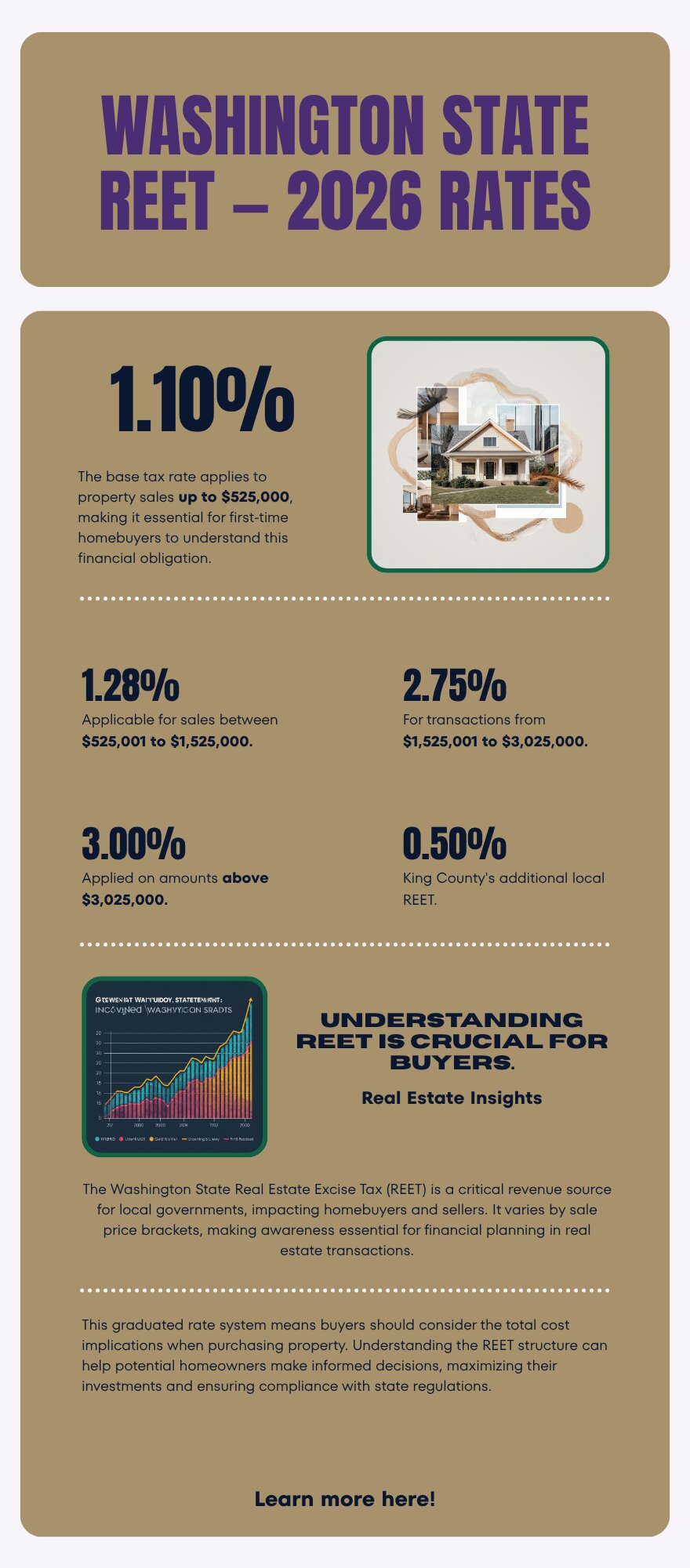
Washington charges a graduated excise tax on every home sale, and King County adds its own local portion on top. Here is the state schedule for 2026:
1.10% on the portion of the price up to $525,000
1.28% on the portion between $525,001 and $1,525,000
2.75% on the portion between $1,525,001 and $3,025,000
3.00% on anything above $3,025,000
King County adds a local REET of 0.50% on top of the state rate.
Run it on a $900,000 King County home: roughly 1.10% on the first $525,000 ($5,775) plus 1.28% on the remaining $375,000 ($4,800), for a state total near $10,575. Add the county’s 0.50% ($4,500) and you land around $15,075 in excise tax alone. Most sellers don’t plan for that number. They find out on the closing statement instead. For the full rate schedule and how it’s calculated, see Washington State Real Estate Excise Tax: Complete Guide for Sellers.
Washington’s REET is graduated. King County adds its own 0.50% on top of the state rate.
3. Title Insurance and Escrow Fees
Sellers in Washington typically pay for the owner’s title insurance policy, which protects the buyer against title defects. Escrow fees are usually split roughly in half between buyer and seller. Together these run a few thousand dollars on a typical King County sale, more on higher-priced homes since title insurance premiums scale with sale price.
Budget $2,500 to $5,000 for title and your share of escrow on a mid-range King County home. Your escrow company will give you exact numbers once you’re under contract. This range holds steady across most listings.
4. Buyer Concessions
This is the cost sellers underestimate the most, and it has become more common. Roughly 19% of recent King County sales included a seller concession, according to NWMLS data from this year. Most concessions land in the 1% to 3% range, and lenders generally cap them at 2% to 6% of the purchase price depending on loan type.
Agree to cover $10,000 to $20,000 in the buyer’s closing costs, or a rate buydown to get the deal done, and that comes straight out of your proceeds. It’s not a hidden fee. It’s a negotiated one. But it needs to be in your math from day one, not something you discover mid-negotiation. Buyers are budgeting their own closing costs at the same time. If you want to understand what they’re weighing against your ask, see Earnest Money in King County: How Much You Need in 2026.
Adding It Up: A Real Example
Here’s the full math on a $900,000 King County home, close to the current county median for single-family homes.
Sale price: $900,000
Commission (5.5%): $49,500
State + King County REET: $15,075
Title insurance + seller’s escrow share: $3,500
Buyer concession (2%): $18,000
Total selling costs: $86,075 (about 9.6% of sale price)
Estimated net before payoff of existing mortgage: $813,925
That 9.6% figure sits right in the middle of the 8% to 10% range most sellers should expect. Yours will move up or down depending on your commission rate, whether you offer a concession, and where your price lands in the excise tax brackets.
Knowing your real number before you list means no surprises at the closing table.
The Local Angle: South and East King County Specifics
Costs shift a little depending on where in King County you are selling.
In South King County cities like Kent, Auburn, Covington, and Maple Valley, home prices run below the county median, which keeps your excise tax bill lower in dollar terms even though the percentage stays close to the same. Sellers here also tend to see fewer aggressive concession requests right now, since inventory in the affordable price bands moves faster.
In East King County, Bellevue, Sammamish, and Issaquah sellers deal with higher price points. That pushes more of the sale into REET’s higher brackets once you cross $1,525,000. Sell above that threshold and your excise tax rate jumps from 1.28% to 2.75% on the portion above it. Run that difference through a calculator before you set your list price expectations.
I price homes across both sides of the county every week through my BPO work. The pattern holds. Sellers who know their real numbers going in negotiate from a position of confidence. Sellers who find out their net at the closing table are the ones who get blindsided. (Curious how that pricing work actually happens? Here’s how I price homes using BPO methodology.)
What This Means for You as a Seller
Before you list, do three things.
Run your own numbers using your actual expected sale price, not a rough guess. A $50,000 difference in price can shift which excise tax bracket you land in.
Ask your agent for a written net sheet before you sign a listing agreement. Any agent worth hiring will walk through commission, REET, title, and a realistic concession estimate with you up front, not after you get an offer.
Decide your concession tolerance before you are in a multiple-offer or slow-market negotiation. Knowing your floor ahead of time keeps you from making an emotional decision at the table.
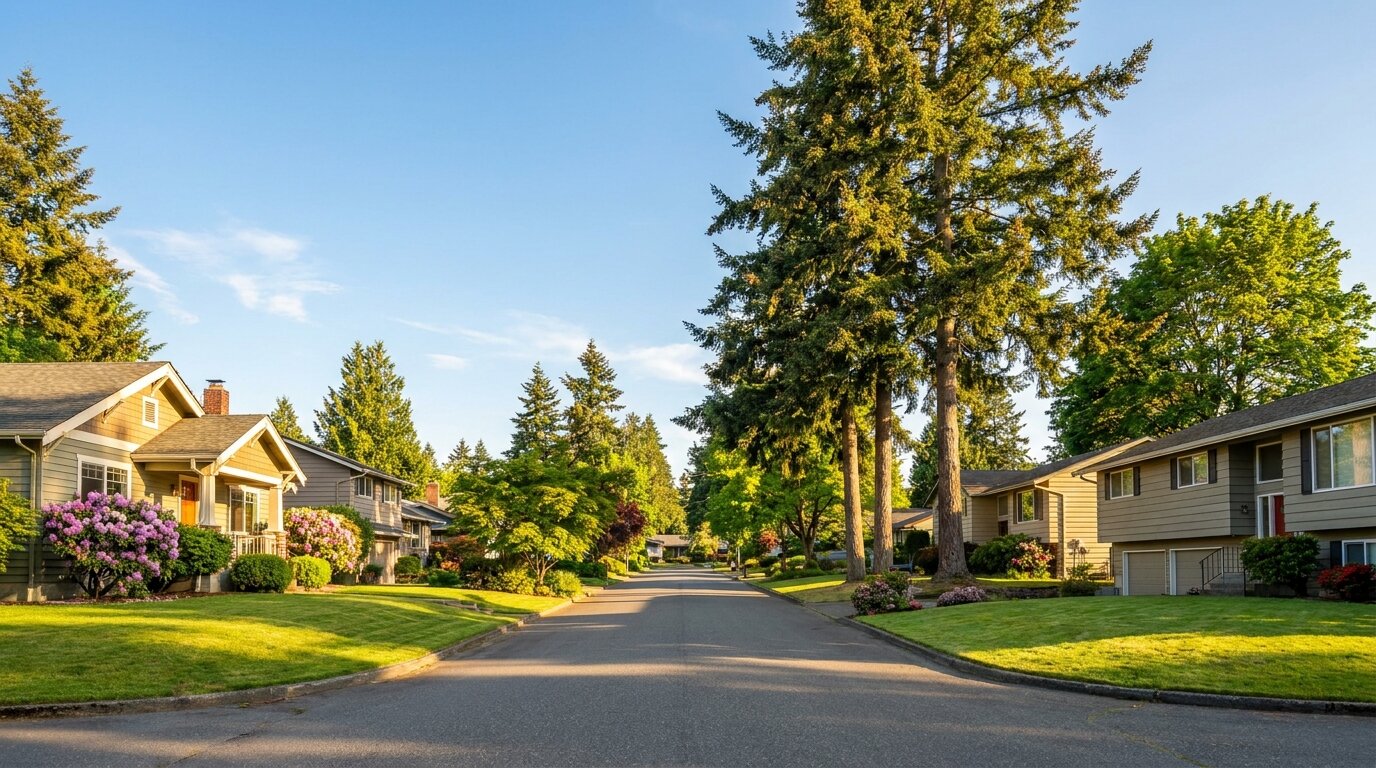
Selling costs shift depending on where in King County you list. South King County sellers see a different picture than the Eastside.
FAQ
How much does it cost to sell a house in King County, Washington?
Most King County sellers pay between 8% and 10% of their sale price in total selling costs, covering commission, real estate excise tax, title insurance, escrow fees, and any buyer concessions.
What is the real estate excise tax rate in King County?
Washington’s state REET is graduated: 1.10% up to $525,000, 1.28% from $525,001 to $1,525,000, 2.75% from $1,525,001 to $3,025,000, and 3.00% above that. King County adds a local 0.50% on top of the state rate.
Who pays closing costs when you sell a house in Washington State?
Sellers typically pay the real estate commission, the excise tax, the owner’s title insurance policy, and roughly half the escrow fee. Buyers typically pay their own lender fees, their half of escrow, and inspection costs.
Can you negotiate real estate commission in King County?
Yes. Commission is negotiable and varies by agent and by deal. Washington’s average total commission is around 5.9%, but the exact split between listing and buyer’s agent is a conversation you should have before signing a listing agreement.
Do I have to pay excise tax if I sell at a loss?
Yes. Washington’s REET is based on the sale price, not your profit or loss. Even if you sell for less than you paid, you still owe excise tax on the full sale price, with limited exceptions.
How much should I budget for seller concessions in King County?
Plan for 1% to 3% of your sale price if the market conditions or buyer financing call for it. Roughly 19% of recent King County sales included a seller concession, so it is worth building into your net sheet even if you hope not to need it.
Give a buyer a reason to say yes without cutting your price. Here is how concessions actually work in today’s market.
I do BPO work across east and south King County every day, and lately I am seeing the same request show up in offer after offer: a concession. Not a lower price. A credit, a buydown, a repair allowance. Something that makes the deal pencil out for the buyer without touching the number on the listing.
If you are selling right now, you need to understand what a concession actually is, what it costs you, and when it works better than just dropping your price. This is not the same conversation everywhere in King County. What makes sense in a still-tight Renton starter home market is not what makes sense if you are selling a condo in a building with 3 competing listings.
What a Seller Concession Actually Is
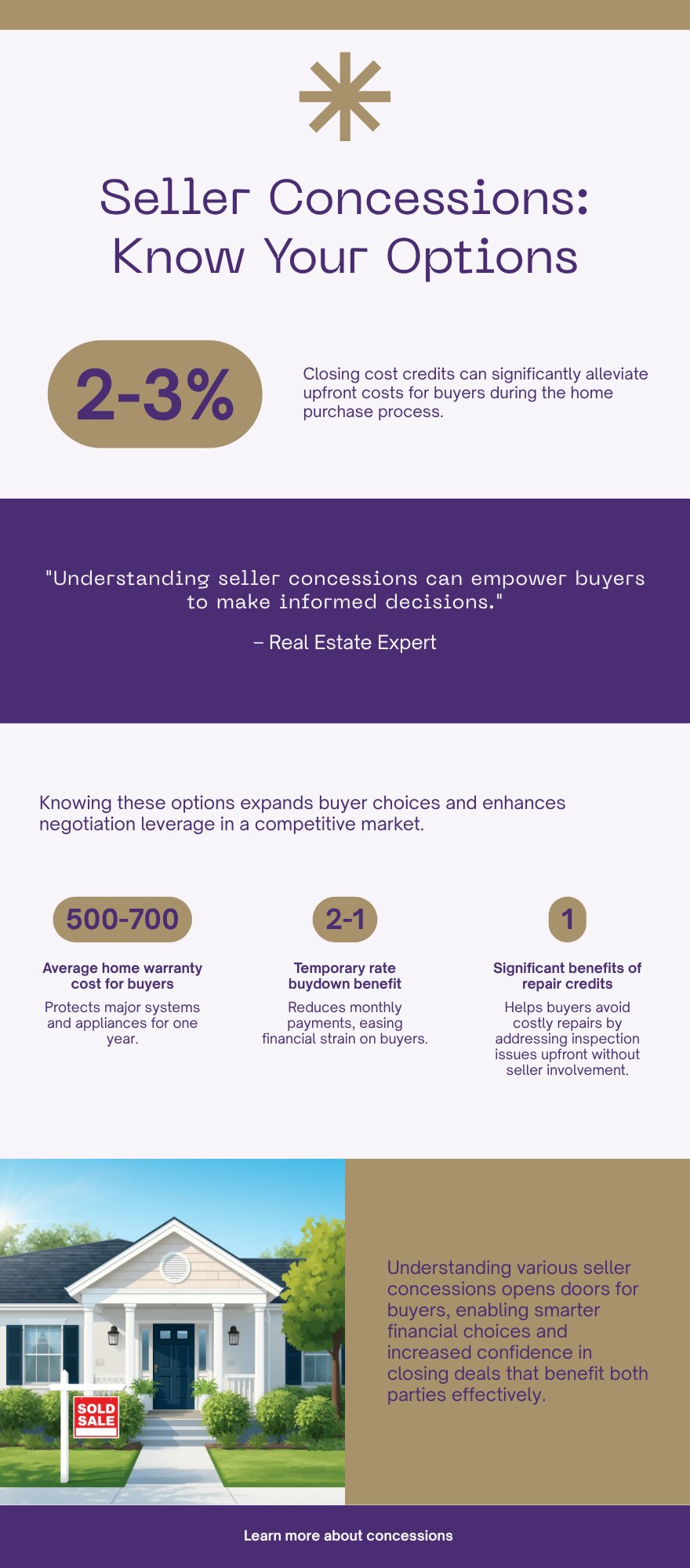
A concession is money you agree to give back to the buyer at closing, structured a specific way in the purchase agreement. It shows up on the closing statement, not as a lower list price. The home still sells for its listed number. You are just contributing part of your proceeds toward the buyer’s costs.
Three types show up most often in King County deals right now.
Closing Cost Credit
The simplest concession. You agree to cover 2% to 3% of the buyer’s closing costs: their lender fees, title insurance, escrow charges. This helps buyers who have the income to qualify for the loan but are short on cash to actually close. First-time buyers in Kent and Auburn run into this constantly. They can afford the payment. They cannot afford to also come up with $18,000 in closing costs on top of a down payment.
Rate Buydown
Instead of paying closing costs, you deposit money into an account that temporarily or permanently lowers the buyer’s interest rate. A temporary 2-1 buydown drops the rate by 2 points in year one and 1 point in year two, then it reverts to the full note rate. A permanent buydown pays discount points at closing to lower the rate for the life of the loan. I wrote a full breakdown of how buydowns work and what they cost in the mortgage rate buydown guide if you want the mechanics. Short version here: buydowns solve a monthly payment problem, not a cash-to-close problem.
Repair Credit
Covers something the inspection turned up that you would rather pay for in cash than fix yourself. Common when you are selling an older home in Auburn or Federal Way and the inspection flags a roof with a few years left, an aging water heater, or electrical panel work. If you want to know what an inspector is actually going to flag before it becomes a negotiation, my home inspection seller guide walks through it. You give the buyer money instead of hiring a contractor and managing the repair on your own timeline.
Home Warranty
The smallest concession and often the easiest yes. A one-year policy runs $500 to $700 and gives the buyer coverage on major systems and appliances. It is a low-cost way to close a deal that is close but not quite there.
The four concession types King County sellers see most, side by side.
Concessions vs. a Price Reduction: They Solve Different Problems
This is the part sellers get backwards most often. A price reduction and a concession are not interchangeable. They fix different symptoms.
A price reduction fixes a visibility problem. If your home is not showing up in buyer searches, if you are getting almost no traffic, the number is too high for how the market is searching. Buyers filter by price range online before they ever see your listing. Drop the price and you show up to a new set of buyers who never saw the home before. If you want the full picture on getting the number right from the start, I cover that in how to price your home to sell in King County.
A concession fixes a conversion problem. If you are getting showings, even good ones, but no offers, buyers are seeing the home and still walking away. That usually means the home is priced fine but something else is stopping them: they cannot cover cash to close, the payment is a stretch at current rates, or an inspection issue is spooking them. A concession addresses that specific friction without resetting your price in the public record.
The honest reality: if your home has been sitting with almost no showings for three or four weeks, no concession fixes that. You need a price adjustment. If your home is getting showings and going under contract twice only to fall through at inspection or financing, a concession targeted at the actual reason those deals died is usually the smarter move.
How Much Does a Concession Actually Cost You
Run the math before you agree to anything. A $700,000 King County sale with a 3% closing cost credit costs you $21,000 off your net proceeds. That sounds like a lot until you compare it to a straight $21,000 price cut, which also reduces your net by $21,000 but resets the public sale price and can affect appraisal comps for every home that sells near you afterward, including your neighbors’. If you want to see how a concession fits into your full cost-to-sell picture alongside commission and excise tax, I broke down the complete math in what it costs to sell a home in Washington State.
There is a real limit here too. Conventional loans cap seller concessions based on the buyer’s down payment: buyers putting down less than 10% are typically capped around 3% of the sale price, buyers putting 10% to 25% down can usually go up to 6%, and buyers putting 25% or more down can go higher. FHA and VA loans have their own caps, generally more generous on FHA and capped differently on VA. Your agent needs to check the buyer’s loan type before you agree to a number, because a concession that exceeds the cap does not get approved by the lender. It just falls apart at underwriting after you have already accepted the offer.
The Local Angle: King County Specifics
King County is not one market right now, and that matters for this decision specifically.
Single-family inventory in tight submarkets like Renton and parts of Kent is still moving fast enough that concessions are less common. If you are selling a well-priced starter home in a walkable Renton neighborhood, you likely will not need to offer one. Multiple offers are still happening in that segment, and buyers competing against each other are not asking sellers for closing cost help.
Condos and higher price bands are a different story. Inventory has grown across King County through 2026, and condo buyers especially are negotiating harder. If you are selling a condo in Bellevue or a higher-priced single-family home in Sammamish or Issaquah, expect concession requests to be part of most serious offers. Buyers in this segment have more choices, and they know it.
South King County cities like Auburn, Federal Way, and Covington see concessions most often tied to closing cost help for first-time buyers, since that is the dominant buyer profile in those markets. East King County concessions more often show up as rate buydowns, because buyers there are stretching further on payment relative to income and a lower rate does more for their monthly budget than a closing cost credit would.
Know which buyer profile you are selling to before you decide what concession, if any, makes sense.
What This Means for You as a Seller
Do not offer a concession preemptively before you have any offers or real market feedback. Wait until you have data: showing counts, buyer agent feedback, whether offers are coming in and falling through. A concession should respond to a specific, identified problem, not a guess.
When an offer comes in asking for a concession, ask your agent what type and why. A buyer asking for a rate buydown has a monthly payment concern. A buyer asking for a closing cost credit has a cash concern. Those point to different underlying situations and tell you something about how close that buyer actually is to being able to complete the purchase.
Compare the concession cost to your next-best alternative, which is usually sitting on the market longer while carrying your mortgage, taxes, and insurance, or dropping your price instead. Run the real numbers both ways before you say yes or no.
Concessions are negotiated privately and settled at the closing table, never disclosed in public listing history.
Frequently Asked Questions
Do I have to offer a concession to sell my home in King County?
No. Whether a concession makes sense depends on your specific market segment, your showing activity, and buyer feedback. Many single-family sellers in tighter King County submarkets sell without ever offering one.
Is a concession the same as paying the buyer’s agent commission?
No, those are separate line items on the closing statement, though both come out of your net proceeds. A concession specifically covers the buyer’s closing costs, rate buydown, or repairs. Earnest money is a separate deposit entirely, from the buyer’s side — see earnest money in King County if a buyer’s offer has you wondering how that piece works.
How do I know if a buyer’s concession request is within loan limits?
Your agent should confirm the buyer’s loan type and down payment percentage before you counter or accept. Conventional loan concession caps scale with down payment size, and FHA and VA loans each have their own separate limits.
Does offering a concession make my home look desperate?
Not if it is not disclosed publicly and not offered until you have a specific reason to. Concessions are negotiated privately within an accepted offer. They do not appear as a price change in public listing history the way a price reduction does.
Can I offer a concession and still get close to full asking price?
Yes, and that is often the entire point. A concession lets you hold your list price while still closing the gap that is stopping a buyer from moving forward. That is different from a price cut, which lowers the number everyone sees.
Should I offer a concession before listing or wait for an offer?
Wait. Offering one before you have any market feedback means giving away money you might not have needed to. Let the first two to three weeks of activity tell you whether a concession is actually the problem you need to solve.
Countywide activity kept cooling this week. Closings dropped to 388, the slowest week since January, and new listings fell to 743. Active inventory eased slightly to 7,647, but with fewer sales clearing, weeks of supply pushed up to 19.7, the highest reading of 2026. The county median sale price slipped to $825,000, and just 17.5% of sales closed above list, also a 2026 low.
South King County did most of the slowing. Closings fell to 77 from 107 last week, weeks of supply jumped to 19.4 from 14, and the median sale price came back to $650,000. Here is the part that headline number hides: pendings rose to 169 from 143. Buyers down south are still writing offers, they just have not reached the closing table yet.
The Eastside went the other way. Closings ticked up to 90, supply eased to 24 weeks, and pendings cooled to 148. The median sale price came down to $1,337,500, which means the value side has finally caught up with the volume slowdown I flagged last week.
The takeaway: these two markets traded places. The Eastside is settling into its price level, while South King County’s dip looks like a timing gap rather than a demand problem. Watch the South King pending count next Monday. If those close, the slow week was noise.
Nationally, Freddie Mac’s weekly survey put the 30-year fixed at 6.67 percent on August 13, down slightly from 6.69 percent the week before, while the National Association of Realtors reports 1.54 million homes for sale, about 4.6 months of supply, and existing home sales running at a 4.06 million annual pace. King County residential supply is still tighter than the national picture at 3.8 months on the latest monthly NWMLS data, and local closings hold far closer to full list price than the national average.
Is King County a buyer’s or seller’s market right now?
King County at a glance: July 2026 (NWMLS)
Metric
Residential
Condo
Median sale price
$1,000,000
$520,000
Change vs. last month
+0.5%
+0.9%
Change vs. last year
+0.1%
−3.7%
Closed sales
1,504
413
New listings
3,099
1,016
Active listings
5,423
2,540
Months of supply
3.8
6.0
Median days on market
11
28
% of list price received
100%
99.1%
King County, July 2026 closed-sale data. Source: NWMLS via InfoSparks.
Two different markets are hiding in that table. Single-family homes county-wide are still moving quickly at asking price. Condos are carrying nearly twice the supply, taking more than twice as long to sell, and their median price has fallen harder over the past year. If you own a condo and plan to sell, pricing honestly matters more for you than for anyone else in this report.
The table below is the heart of this page. It compares all seven cities I serve, plus the county itself, using July 2026 NWMLS closed-sale data. This month the split looks different than it has in a while: Sammamish, Issaquah, and Federal Way all posted real year-over-year price gains, while Bellevue, Renton, and Auburn slipped slightly. Supply widened almost everywhere compared to last year, giving buyers more room across the board.
City comparison: July 2026 (single-family, NWMLS)
City
Median price
YoY
Active listings
Months of supply
Median DOM
% of list received
Closed sales
Bellevue
$1,830,000
−1.1%
372
4.9
13
97.7%
85
Sammamish
$1,725,000
+5.3%
253
5.5
18
97.3%
57
Issaquah
$1,575,000
+7.9%
135
4.4
9
97.5%
41
Renton
$810,000
−4.7%
317
3.9
19
100%
80
Kent
$700,000
+1.4%
270
3.8
11
100%
82
Auburn
$649,000
−1.2%
247
3.5
18
100%
65
Federal Way
$645,000
+7.5%
180
3.5
15
100%
59
King County (single-family)
$1,000,000
+0.1%
5,423
3.8
11
100%
1,504
King County (condo)
$520,000
−3.7%
2,540
6.0
28
99.1%
413
July 2026 closed-sale data. Each city’s figures are its own true NWMLS numbers. I never average medians across cities. Source: NWMLS via InfoSparks.
How is the Bellevue housing market right now?
Median price
YoY
Months of supply
Median DOM
% of list
Active
Closed
$1,830,000
−1.1%
4.9
13
97.7%
372
85
Single-family, July 2026. Source: NWMLS.
Bellevue is really two markets. Move-in-ready homes under the luxury tier still draw serious competition, while the condo segment and un-staged or dated listings carry the most negotiating room in the entire county. If you are comparing renting against owning here, my Bellevue rent vs. buy breakdown runs the actual numbers.
Is the Sammamish market cooling off?
Median price
YoY
Months of supply
Median DOM
% of list
Active
Closed
$1,725,000
+5.3%
5.5
18
97.3%
253
57
Single-family, July 2026. Source: NWMLS.
Sammamish is almost entirely one product type, larger single-family homes, so when supply builds the whole city feels it at once. Buyers here are taking their time and looking hard at lot slope, drainage, and road noise before they write. My neighborhood guides for Sahalee and East Lake Sammamish Parkway cover the pockets buyers ask about most.
Is Issaquah still a good buy on the Eastside?
Median price
YoY
Months of supply
Median DOM
% of list
Active
Closed
$1,575,000
+7.9%
4.4
9
97.5%
135
41
Single-family, July 2026. Source: NWMLS.
The Issaquah Highlands keeps pulling steady showing traffic because it is the most affordable way into Eastside schools without paying Bellevue or Sammamish prices. I wrote up the full case in my Issaquah buyer opportunity guide.
What are home prices doing in Renton?
Median price
YoY
Months of supply
Median DOM
% of list
Active
Closed
$810,000
−4.7%
3.9
19
100%
317
80
Single-family, July 2026. Source: NWMLS.
Renton is three markets wearing one name. The Highlands, Benson Hill, and downtown each price and move differently, which is why the citywide median bounces around. It stays the top landing spot for buyers who work on the Eastside but will not pay Eastside prices. Start with my downtown Renton guide if you are new to the city.
Is Kent a good place to buy a home right now?
Median price
YoY
Months of supply
Median DOM
% of list
Active
Closed
$700,000
+1.4%
3.8
11
100%
270
82
Single-family, July 2026. Source: NWMLS.
East Hill family homes are the engine here, and demand for them has not let up. Steady markets punish guesswork, so pricing accuracy matters more in Kent than almost anywhere I work. If you are weighing the move, start with my guide to buying a home in Kent and the Kent family neighborhoods breakdown.
Why are Auburn homes selling so fast?
Median price
YoY
Months of supply
Median DOM
% of list
Active
Closed
$649,000
−1.2%
3.5
18
100%
247
65
Single-family, July 2026. Source: NWMLS.
Auburn is the most affordable single-family entry point of my seven cities, and buyers know it. When the median home goes pending in eight days, showing up without a pre-approval letter means losing the house. Lakeland Hills and the Enumclaw plateau side keep drawing families who want newer construction for less. My guide to living in Auburn covers the neighborhoods and what your budget buys in each.
Is Federal Way the best value in King County?
Median price
YoY
Months of supply
Median DOM
% of list
Active
Closed
$645,000
+7.5%
3.5
15
100%
180
59
Single-family, July 2026. Source: NWMLS.
Federal Way sits in the sweet spot between Seattle and Tacoma commutes, and starter homes here have stayed insulated from the cooling happening on the Eastside. My Living in Federal Way guide maps out where those values are.
What does this mean if you’re buying or selling right now?
If you’re buying: your leverage depends on which half of the county you’re shopping. On the Eastside, use the extra supply. Ask for inspection time, negotiate on homes that have sat past three weeks, and don’t chase overpriced listings. In South King County, come prepared to move fast on the good ones, because they still go in under two weeks. Either way, with rates near their best level in almost two months, it may be worth a look at a rate buydown to bring the payment down further.
If you’re selling: the market is telling sellers one thing loudly: price to the current comps, not to your neighbor’s sale from March. Hundreds of King County sellers cut their price this week alone, and every one of those cuts started with an asking price the market rejected. Condition matters more than it has in years. If you get the first two weeks right, you sell. My guide on how to price your home to sell in King County walks through exactly how I build a list price.
Frequently asked questions
Is now a good time to buy in South King County?
If the payment works for you, yes. Prices in Kent, Auburn, and Federal Way are up modestly from last year, so waiting has not been rewarding buyers there. Inventory is better than it has been in years, and rates just hit a seven-week low. The value end of the county is competitive but not frantic.
Which King County suburb has the lowest home prices?
Among my seven cities, Federal Way and Auburn are essentially tied for the lowest single-family medians in July 2026, both just under $650,000. Kent isn’t far behind. For the lowest entry point of all, condos remain the cheapest way to own in King County.
Are Eastside home prices dropping?
June medians in Bellevue, Sammamish, and Issaquah all came in below last year, and supply on the Eastside has grown faster than anywhere else in the county. That reads as a real cooling, not a collapse. Well-priced homes still sell in under two weeks. The overpriced ones are the ones sitting and cutting.
How often is this page updated?
Every Monday I refresh the “what changed this week” section with the newest NWMLS activity. Once a month, when the new monthly data lands, I rebuild every table and city capsule on this page. Bookmark it. The URL never changes.
Buyers ask me all the time: “What are the property taxes going to be on this house?” It’s a fair question, and the answer matters more than most people realize when they’re focused on the purchase price and interest rate. On a $700,000 home, the difference between buying in Auburn and buying in Issaquah works out to roughly $2,500 a year — or about $210 a month that never shows up in a mortgage quote.
This post lays out the 2026 effective property tax rates for the eight cities I work in most across South and East King County. I also cover how the calculation works, why rates differ between cities just a few miles apart, and what this means if you’re running affordability math as a buyer or net-proceeds math as a seller.
Why King County Has No Single Tax Rate
A lot of buyers ask: “What’s the property tax rate in King County?” There isn’t one. Your bill is the sum of every taxing district whose boundary includes your property. That stack typically includes:
The Typical Levy Stack
Washington State levy — applies uniformly statewide
King County general levy — county services and administration
King County library district — public library system
City levy — varies by incorporated city; absent in unincorporated areas like Covington
School district levy — the single biggest variable between nearby cities
Fire district levy — local fire and rescue services
Emergency Medical Services (EMS) levy
Any voter-approved bond measures — school construction, parks, etc.
Two homes a mile apart — one in the Issaquah School District, one in the Kent School District — can carry meaningfully different tax bills even if their market values are identical. School district boundaries are the biggest driver of rate variation across South and East King County.
The 2026 total property tax collection in King County came in at $8.4 billion, up 10% from 2025’s $7.7 billion. That increase flows from rising assessed values, not any single rate change. But the effect on individual monthly payments is real.
2026 Property Tax Rates by City
These are median effective rates — actual tax bills divided by assessed market values — based on King County parcel data. Rates vary by ZIP code within each city, primarily because of school district boundaries. (Source: Ownwell, April 2026.)
2026 effective property tax rates for eight cities in South and East King County. Auburn carries the highest rate; Issaquah and Sammamish sit well below the county median of 0.99%. Source: Ownwell, April 2026.
City
Effective Rate
Median Home Value
Median Annual Bill
Auburn
1.19%
$566,000
$6,477
Maple Valley
1.11%
$722,000
$7,963
Renton
1.03%
$688,000
$7,145
Covington
1.03%
$574,000
$5,862
Kent
1.01%
$587,000
$5,919
Federal Way
1.00%
$542,000
$5,412
Sammamish
0.89%
$1,384,000
$12,054
Issaquah
0.83%
$1,031,000
$9,132
King County Avg
0.99%
$774,000
$7,644
How to Calculate Your King County Tax Bill
King County uses this formula:
(Assessed Value ÷ 1,000) × Levy Rate = Annual Tax Bill
For a home assessed at $650,000 in Renton with a levy rate of approximately $10.30 per $1,000:
$650,000 ÷ 1,000 = $650
$650 × $10.30 = $6,695 per year (~$558/month in escrow)
A few important things to understand about that assessed value:
King County Reassesses Every Year
Washington has no equivalent to California’s Proposition 13. Your assessed value is adjusted annually based on market conditions. If home prices in your neighborhood rose 8% last year, your assessment likely reflects that — and your bill goes up accordingly.
Your 2026 bill is calculated from the value as of January 1, 2025. So the assessment lags the market by about a year — but it catches up.
Buying at a Higher Price Does Not Reset Your Taxes
The assessor determines value independently of your sale price. A sale at market value is data they will consider in future assessments — but it doesn’t trigger an immediate reset the way it does in some other states. So if you buy a house below assessed value, your taxes don’t automatically drop either.
For the most accurate number on any specific parcel, use the King County eReal Property lookup at blue.kingcounty.com. Search by address to see the current assessed value and the levy rate stack broken down by district. It takes about 90 seconds and gives you a far more accurate number than any city average.
Why Issaquah and Sammamish Rates Are Lower
Issaquah (0.83%) and Sammamish (0.89%) sit well below the county average — yet their median tax bills are higher in dollar terms because home values there are much larger. Lower rates in these cities generally reflect two things.
First, fewer overlapping special districts. Some areas carry smaller bond debt loads than South King County cities, which compresses the total levy stack. Second — and this is the counterintuitive part — when the total assessed value base in a school district rises, the rate needed to raise the same budget dollar amount actually falls. High home values spread the levy cost across more dollars, pushing the percentage rate down.
City-by-City: What Buyers and Sellers Should Know
Understanding your property tax rate before you make an offer helps buyers budget accurately and keeps sellers from being surprised at closing.
Auburn (1.19%)
Auburn carries the highest effective rate among the cities we track, with a $6,477 median annual bill on a $566,000 home. Rates vary by ZIP — the 98001 and 98002 ZIP codes trend higher than 98092. Buyers should ask their lender to calculate PITI based on the specific parcel, not a city average.
Maple Valley (1.11%)
Maple Valley’s rate and its growing median home value combine to produce one of the larger median bills in South King County at $7,963 per year. School construction bonds have contributed to the rate here. Strong schools drive demand for the area, and those same schools come with levy costs built into the rate.
Renton (1.03%)
Renton’s 1.03% rate on a $688,000 median home produces a $7,145 median annual bill. Rates vary within Renton by school district boundary — homes in the Issaquah School District portion of eastern Renton trend lower than those in the Renton School District. This surprises a lot of buyers who assume all of “Renton” carries one rate.
Covington (1.03%)
Covington shares Renton’s effective rate but with a lower median home value ($574,000), producing a $5,862 median bill. Covington is unincorporated King County, which means no separate city levy — one reason the total rate stays competitive. For buyers priced out of Maple Valley, Covington often offers similar inventory at lower total monthly carrying costs.
Kent (1.01%)
Kent sits nearly at the county average. The $5,919 median annual bill on a $587,000 home is one of the more affordable in this group in absolute dollar terms. Kent has one of the widest ranges of home types in South King County — condos to large single-family homes — so the actual bill on any specific purchase will vary considerably from the median.
Federal Way (1.00%)
Federal Way sits right at the county median rate and has the lowest median home value on this list at $542,000, producing a $5,412 median annual bill. For first-time buyers working with a tighter budget, Federal Way offers the lowest combined price-and-tax entry point among these eight cities.
Sammamish (0.89%)
Lower rate, but higher everything else. The $1,384,000 median home value produces a $12,054 median annual bill — over $1,000 a month in tax escrow — despite the below-average rate. Sammamish draws buyers who prioritize the Issaquah or Lake Washington school districts, newer construction, and lower density. That demand drives values, which keeps the rate lower but doesn’t lower the bill.
Issaquah (0.83%)
The lowest rate on this list. Issaquah’s 0.83% on a $1,031,000 median home means a $9,132 median annual bill. Part of the reason rates are lower is that the area’s high assessed value base spreads the levy burden across more dollars. School district quality drives demand, and demand drives values — which, counterintuitively, keeps the rate lower than South King County cities.
Important Property Tax Dates in King County
Date
What Happens
January 1
Assessment date — value is frozen for the year’s calculation
February 10
Tax bills mailed
April 30
First half payment due
July 1
Appeal deadline — do not miss this
October 31
Second half payment due
The appeal window matters. If you receive your assessment notice and believe the value is too high — based on comparable sales or property condition — you have until July 1 to file with the King County Board of Equalization. Once that deadline passes, your ability to contest that year’s bill is gone.
Exemptions That Can Lower Your Bill
Washington offers several exemption programs worth knowing about, especially if you’re buying for a family member or planning long-term.
Senior/Disabled Exemption. Homeowners 61 or older — or permanently disabled — with household income under the program threshold may qualify for a significant reduction in assessed value and a freeze on future increases. This is one of the most valuable programs in the state and often goes unclaimed by people who don’t know it exists.
Veteran Exemption. Qualifying veterans with a service-connected disability may be eligible for a partial property tax reduction.
All exemptions require the home to be your primary residence. Investment properties and second homes do not qualify. To apply or check eligibility, contact the King County Assessor’s office at assessor.info@kingcounty.gov or (206) 296-7300.
What This Means for Your Buy or Sell Decision
For buyers: Your lender uses your total PITI payment — principal, interest, taxes, and insurance — to calculate affordability. Property taxes are a real monthly cost, not a closing-day item. On a $700,000 home, the difference between a 0.83% rate (Issaquah, ~$484/month) and a 1.19% rate (Auburn, ~$694/month) is $210 per month. Over a 30-year loan, that’s $75,600 in additional tax payments — more than most buyers realize when they’re focused on the interest rate.
For sellers: When a buyer’s lender calculates their debt-to-income ratio, property taxes push more buyers out of qualifying range at the higher end of pricing. In cities with higher effective rates, price sensitivity tends to be greater. Knowing your city’s rate — and being able to show the buyer the actual parcel-level calculation — is a transparency move that builds trust during negotiations.
For a broader look at all the costs of owning a home in King County, this post on total cost of homeownership in King County walks through the full monthly cost picture beyond just taxes. And if you’re a seller thinking about your net proceeds, Washington’s capital gains rules are the other tax conversation worth having before you list.
Run Your Own Numbers in 90 Seconds
To get the exact levy rate for any property you’re considering:
Find the “Current Year Tax” section — it shows the assessed value and the levy rate stack broken down by district
Divide the tax bill by the assessed value to get the effective rate
This is the most accurate number you’ll find. I walk buyers and sellers through this lookup regularly — it often changes how they think about two comparable homes in different parts of the county. For where home values are heading in 2026 — which directly affects future assessed values and bills — here’s the King County housing market forecast.
Frequently Asked Questions
What is the property tax rate in King County in 2026?
The countywide median effective rate is 0.99%, but rates vary by city from 0.83% (Issaquah) to over 1.19% (Auburn). The rate for any specific property depends on all the overlapping taxing districts — state, county, city, school district, fire, EMS, and local bond measures.
When are King County property taxes due in 2026?
Half by April 30, and the other half by October 31. Tax bills are mailed in February. If your home has a mortgage, your lender typically collects taxes through escrow and pays on your behalf.
When is the King County property tax appeal deadline?
July 1 each year. If you receive your assessment notice and believe the value is too high, file with the King County Board of Equalization before that date. You’ll need supporting evidence like comparable sales or documentation of property condition issues.
Does buying at a higher price increase your property taxes right away?
Not automatically. King County reassesses independently based on market data. Your sale price is information the assessor will consider, but the assessment may not change until the next annual cycle. That said, sales well above assessed value typically result in higher assessments in subsequent years.
Where can I look up the exact property tax for a specific address?
Use the King County eReal Property portal at blue.kingcounty.com/Assessor/eRealProperty. It shows the current assessed value, each levy in the stack, and the total bill for any parcel in the county.
Are there exemptions that lower property taxes in King County?
Yes. The Senior/Disabled exemption is the most significant — qualifying homeowners 61 or older with income under the program threshold can freeze their assessed value and reduce their bill. Veteran exemptions are also available. All require the home to be your primary residence. Contact the King County Assessor at (206) 296-7300 or assessor.info@kingcounty.gov to check eligibility.
Data sourced from Ownwell (April 2026) and King County Assessor public records. Rates shown are median effective rates and will vary by specific parcel and ZIP code within each city. Verify levy rates for any specific property at blue.kingcounty.com before making financial decisions.
A complete guide to neighborhoods, commutes, school districts, home prices, and how to buy before you move — from a local agent who knows this market by the block.
Most people moving to King County from out of state make the same mistake. They pick a city based on how close it is to downtown Seattle — and end up in a neighborhood that costs more, commutes worse, and feels nothing like what they imagined. I’ve helped enough relocators land here to know that the research most people do from a thousand miles away misses the things that actually matter once you show up.
This guide is the one I wish every out-of-state buyer had before their first house-hunting trip.
The City You Think You Want vs. the City That Actually Fits
When people tell me they’re moving to King County, they usually say “Seattle” or “Bellevue.” Those are fine places — I’m not going to talk you out of them — but they’re not the only options, and for most buyers coming from places like Phoenix, Denver, or the Bay Area, they’re not the right options either.
Here’s the honest breakdown.
Seattle
Urban neighborhoods, walkable coffee shops, quick access to Amazon and the medical corridor. Condos start around $500,000 and single-family homes run $871,000 median. If you’re working downtown and don’t have kids in public school, Seattle makes a lot of sense. If you’re working remotely or your employer is on the Eastside, the math gets harder fast.
Bellevue and the Eastside Tech Corridor
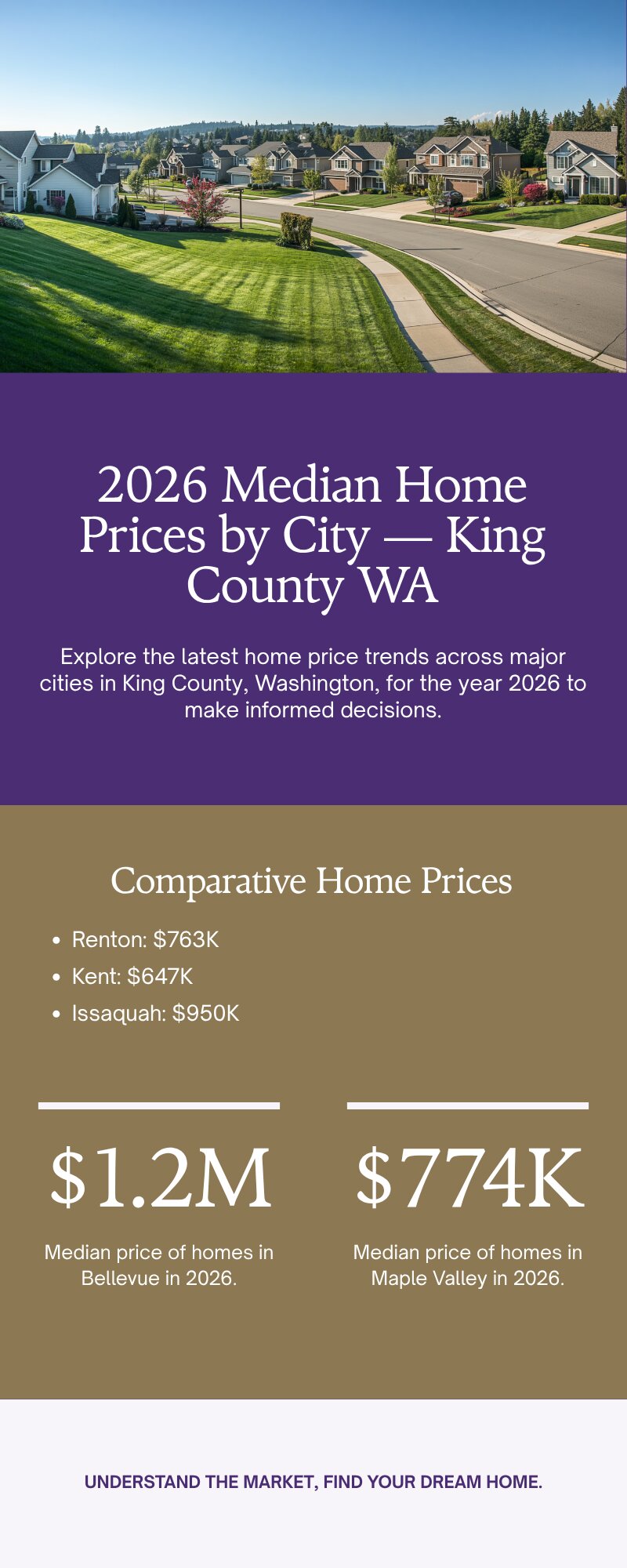
Redmond, Kirkland, and Sammamish are where most Microsoft, Google, and Amazon Eastside employees land. Schools are exceptional. Median prices are high: Bellevue runs $1.2 million and up, Sammamish hovers around $1.3 million. Issaquah sits at roughly $950,000 and still delivers top-tier school district quality for meaningfully less than its neighbors — that’s a real value play on the Eastside.
South King County
This is where I’d send most relocating families who are sticker-shocked by Eastside prices. Renton: $763,000 median, 12 miles from downtown Seattle, direct freeway access to the Boeing complex and the Amazon Renton campus. Kent: $647,000 median, the largest city in South King County, commuter rail service and one of the most diverse food scenes in the county. Auburn: $609,000 median, opening three new schools and rapidly growing. Maple Valley and Covington offer a quieter, more rural feel with large lots and 30-35 minute drives to employment centers.
None of those cities feel like settling. They feel like what most of the Pacific Northwest actually looks like — big trees, trail access, good neighbors, reasonable prices.
South King County neighborhoods like Renton, Kent, and Auburn offer large lots, trail access, and mountain proximity — at prices well below the Eastside.
What Surprises Relocators Most
I’ve had this conversation dozens of times. Here are the things that catch people off guard.
The gray is real, but it’s not rain. Seattle averages 92 rainy days a year — actually fewer than New York City or Miami. What people don’t expect is the persistent overcast: from October through May, the sky is more often gray than blue. It’s rarely dramatic. It’s just steady. Locals wear hoods, not umbrellas. You get used to it, but it’s worth knowing before you buy a house with a south-facing yard expecting sunshine nine months a year.
Traffic is directional and predictable. The I-405 corridor and I-5 are congested at the same times every day. If your commute runs south-to-north in the morning, you’re going the right direction. The light rail — which now reaches Federal Way and will extend further — is worth building your neighborhood choice around. I always ask relocating buyers: what’s your daily destination, and what time of day? That answer often changes which city we’re looking in.
Washington has no state income tax. This is the one that catches transplants from California off guard in the best way. Washington’s sales tax runs about 10.35% in King County, which is higher than you may be used to. But for most buyers, the absence of state income tax more than makes up for it. At a $200,000 household income, the tax savings versus California run roughly $16,000 a year.
The housing market here moves fast. South King County homes were selling in 6-14 days on average as of spring 2026. Coming from a slower market, buyers often underestimate how quickly they need to be ready to act. I’ve watched buyers from out of state lose homes they loved because they needed two more days to decide. Get pre-approved before you start touring — that’s the single biggest thing you can do to protect yourself.
School Districts: What the Rankings Don’t Tell You
If you have kids, school districts will drive a significant part of your city decision. Here’s how King County’s major districts actually stack up.
Tier 1 (Exceptional, reflected in prices): Bellevue, Mercer Island, Lake Washington, Northshore, and Issaquah school districts all carry top ratings and directly drive home values. If you’re buying in Issaquah, you’re getting Tier 1 schools at prices that are meaningfully below Bellevue and Sammamish — that’s the best value on the Eastside for school-focused families.
Tier 2 (Solid, good value): Federal Way Unified has improved significantly over the past five years and serves a growing commuter population near the new light rail station.
Tier 3 (Uneven — research by school, not just district): Renton and Kent school districts have significant internal variation. Hazen Senior High in Renton ranks #82 statewide, while other Renton high schools rank much lower. When I’m working with a relocating family buying in Renton or Kent, I always map the home address to the specific school assignment before we make an offer. The difference between two houses a mile apart can be significant.
Auburn School District is mid-tier overall but actively investing — three new schools are in development, and the district is growing alongside the city. If you’re buying in Auburn with a 10-15 year horizon, you’re buying into an improving situation.
How to Buy a Home Before You Move
This is the part most relocation guides skip over. Buying a home you’ve never stood inside, in a city you’ve never lived in, with an agent you met on Zoom — it’s genuinely stressful. Here’s how to do it right.
Buying from out of state works — but it takes the right prep. Full pre-approval, a local agent, and at least one in-person trip before closing.
Get fully pre-approved before you tour anything
Not pre-qualified — pre-approved, with income documentation verified and a real credit pull completed. Remote workers should get a Permanent Remote Work Letter from their employer in writing before applying. Verbal confirmation won’t satisfy an underwriter when you’re competing against local buyers who’ve been pre-approved for weeks.
Use virtual tours to eliminate, not to decide
Video tours are useful for crossing homes off the list. They are not reliable for choosing one. If at all possible, plan one trip to King County before your closing date — ideally to tour your top two or three candidates in person, walk the neighborhoods, and get a feel for the commute. If travel truly isn’t possible, ask your agent to do a live video walkthrough during a private showing and narrate everything the camera doesn’t capture.
Understand how Washington closings work
Washington is an escrow state. There are no real estate attorneys at the closing table — an escrow officer and title company facilitate the process. Closings can be done electronically, which makes remote buying workable. You’ll wire funds and sign documents digitally. The process is straightforward once you know what to expect. Also know that Washington’s wet western climate makes moisture intrusion, crawl space condition, and roof health the top three inspection items — do not skip the inspection to be competitive.
The Local Angle: What the King County Market Looks Like Right Now
King County inventory is up roughly 35% year over year as of spring 2026. That’s meaningful. It means relocators have more options, more negotiating leverage, and fewer situations where they need to waive every contingency to win. Inspection contingencies are back on the table in most South King County transactions. Seller concessions — including buydowns and closing cost help — are more common than at any point since 2019.
For a relocator on a tight timeline, this is a much better environment than 2022 or 2023. You’re not walking into a war. You’re walking into a real market where your offer gets read and your questions get answered.
The overall King County median was $880,000 in March 2026. But that number obscures the real value story. If your target is South King County — Renton, Kent, Auburn, Maple Valley — you’re looking at a $609,000 to $763,000 range, with growing inventory and motivated sellers.
2026 median home prices across King County. South King County cities offer the best value for relocators who don’t need to be in Seattle or on the Eastside every day. Source: King County MLS, spring 2026.
Start your neighborhood research with your daily destination, not with a map of the county. Where will you spend Tuesday mornings? That question is more useful than “how far is it from downtown Seattle.”
Build your city shortlist around school district tier, commute direction, and price ceiling — in that order. Then let the neighborhoods inside those cities narrow your search.
Get pre-approved before your first house-hunting trip. In South King County, a well-priced home can go under contract in a week. Showing up financially ready is the difference between buying the house and watching it disappear.
And check the down payment assistance programs available to King County buyers. If your household income is under roughly $175,000, you may qualify for programs that put $10,000 to $55,000 toward your down payment. See the full 2026 down payment assistance guide for eligibility and how to stack programs.
If you’re also weighing where to land specifically in South King County, my guide to relocating to Auburn, Washington covers one of the county’s fastest-growing cities in detail.
Frequently Asked Questions
Is King County expensive compared to other major metros?
King County’s median home price of $880,000 puts it in the top tier nationally — roughly on par with Los Angeles and San Diego. However, the absence of Washington state income tax makes total cost of living comparisons more favorable than the home price alone suggests. At a $200,000 household income, the tax savings versus California run roughly $16,000 a year — which offsets a meaningful portion of the price premium over time.
How long does it take to buy a home in King County?
From pre-approval to closing, most transactions run 30 to 45 days. In competitive South King County neighborhoods, timelines can compress. An out-of-state buyer with full pre-approval and a clear target area can move from first showing to accepted offer in a single trip if the timing is right.
Do I need to be physically present to close?
No. Washington State allows electronic closings. You can sign documents remotely and wire funds from anywhere. Some buyers close on King County homes without ever setting foot in the state prior to moving in — though I strongly recommend at least one visit before making an offer.
What are the biggest mistakes out-of-state buyers make?
Three come up repeatedly: choosing a city based on proximity to Seattle when their actual commute destination is elsewhere; arriving without pre-approval and losing homes they loved; and skipping the inspection to strengthen an offer — a risk that almost never pays off in a western Washington climate.
What school districts are best for families relocating to South King County?
Within South King County, the answer is school-specific rather than district-specific. Renton and Kent both have high-performing individual schools alongside lower-performing ones. When I’m working with a family in those areas, we map every address to its specific school assignment before making an offer. Issaquah School District is the clearest top-tier pick on the Eastside at a relatively accessible price point.
Is now a good time to buy as a relocating buyer?
King County inventory is at its highest level in years, inspection contingencies are standard again in most areas, and seller concessions are available. For a relocating buyer with solid pre-approval and flexibility on timing, this is a more favorable environment than it’s been since before the pandemic. See the total cost of homeownership guide for the math on waiting vs. buying now.
Moving to King County is a big decision. The region is genuinely excellent — trails, mountains, water, good jobs, and communities that feel like home once you’re here. The hard part is choosing the right community before you’ve lived in any of them. That’s what I’m here for.
Most buyers focus on the mortgage payment. That’s the number that shows up in every rate calculator, every lender pre-approval letter, every Zillow estimate. But in King County, the mortgage is often just 60–70% of what you actually pay each month to own a home. The rest — property taxes, insurance, HOA fees, PMI, and maintenance — adds up fast, and most first-time buyers get surprised by it.
I’ve worked in South and East King County for over 13 years, and I do professional property valuations every single day as a BPO field agent. One pattern I see constantly: buyers who were “pre-approved” for a purchase price they couldn’t actually afford once all the real costs hit their bank account in month two. This guide walks you through the full picture — every cost, with real numbers for King County cities — so you can make a decision you’ll still feel good about a year from now.
What Goes Into Your True Monthly Payment
The mortgage principal and interest (P&I) is the fixed part — it doesn’t change month to month on a 30-year fixed loan. Everything else does, or at least it can. Here’s the full stack of costs to run through before you make an offer.
Principal and Interest (P&I)
The core of your payment, and the number your lender leads with. At current King County rates of around 6.4–6.7% for a 30-year fixed, a $686,000 loan (10% down on a $763,000 Renton home) produces a monthly P&I payment of roughly $4,360. It’s real, but it’s not the whole story.
Property Taxes
Significant in King County — and they just went up. For the 2026 tax year, King County’s total property tax levy is $8.4 billion, a 10% jump from 2025. The average effective rate across the county runs around 0.9%–1.1% of assessed value annually. On a $763,000 home in Renton, that works out to roughly $690–$840 per month ($8,280–$10,080 per year).
Your specific parcel’s levy code determines the exact number — the King County Assessor’s eReal Property search tool will show you the breakdown for any address you’re evaluating. Renton sits on the lower end; Sammamish and Issaquah homeowners typically pay more because of school district levies and city-specific ballot measures.
Homeowners Insurance
Washington State averages $1,474–$1,596 per year — roughly $125–$133 per month. That puts Washington below the national average, which is a piece of good news. Expect to pay more if your home has a wood roof, is older than 30 years, or sits in a wildfire-adjacent zone (relevant in Maple Valley, Enumclaw, or Black Diamond).
PMI (Private Mortgage Insurance)
Applies if you put down less than 20%. PMI typically runs 0.46%–1.5% of the original loan amount annually. On a $686,000 loan at a mid-range rate of 0.7%, that’s about $400 per month.
PMI drops off once you hit 20% equity — either through price appreciation or paying down the principal. Given King County’s 5-year appreciation history of roughly 5–6% annually, some buyers reach that equity threshold in 3–4 years rather than waiting out the full amortization schedule.
HOA Fees
These vary wildly by property type. Condos in King County typically run $300–$700 per month for a mid-range building — downtown Seattle luxury high-rises can exceed $1,000. Townhomes usually fall in the $150–$350 per month range. Single-family homes in planned communities often run $75–$200 per month for landscaping and common areas.
Many single-family homes in South King County have no HOA at all — which reduces monthly cost but means you carry 100% of exterior maintenance yourself.
Maintenance Reserve
The number most first-time buyers skip — and the one that bites hardest. The commonly cited “1% rule” (set aside 1% of your home’s value per year) is a reasonable floor. Studies show the average homeowner actually spends $8,800 per year on maintenance and repairs. For an older King County home (pre-1990), budget closer to 1.5%–2%.
On a $763,000 home, 1% equals $7,630 per year — about $636 per month set aside. You won’t spend it every month. Some months nothing breaks, then your furnace goes in January.
The mortgage payment is just one piece. For a Renton condo at $422K, all-in monthly costs run about $3,642. For a single-family home at $763K, expect closer to $6,224 per month. Source: King County market data, 2026.
Condo vs. Single-Family: How Total Cost Compares
This is one of the most common calculations I walk buyers through. The sticker price on a condo is lower — but the total monthly cost is often closer to a single-family home than buyers expect, once HOA fees are factored in. Here’s a real-numbers comparison using current King County data.
The income difference this requires is significant. At a 28% front-end debt-to-income ratio (typical for conventional loan qualification), the condo scenario requires roughly $156,000 in gross household income. The single-family scenario requires roughly $267,000. Those numbers shift with your credit score, debt load, and lender — but they illustrate why the condo-vs-house decision often comes down to math rather than preference.
How King County Cities Compare on Total Cost
Property taxes are the biggest variable after the mortgage itself. Here’s a rough comparison of annual tax cost by city for a home around $700,000–$800,000.
Renton
Effective levy rate approximately 0.9%–1.0%. On an $800,000 home: ~$7,200–$8,000 per year ($600–$667/month). Renton sits on the lower end of King County cities, making it one of the better values in South KC for total monthly cost.
Kent & Auburn
Effective levy rates slightly higher than Renton, typically 1.0%–1.1%. On a $700,000 home: ~$7,000–$7,700 per year ($583–$642/month). School district and fire district renewal levies are a consistent factor in both cities.
Issaquah
Higher rates due to Issaquah School District supplemental levies — one of the highest-rated districts in the state, and that comes with a cost. On a $900,000 home: ~$9,000–$10,800 per year ($750–$900/month).
Sammamish
Among the highest effective rates in South/East King County. On a $1,000,000 home: ~$10,000–$12,000 per year ($833–$1,000/month). School district, city, and specialty district levies stack up quickly in Sammamish.
Annual property tax by city for an $800,000 home in King County. Renton and Kent are the most affordable in South KC; Issaquah and Sammamish carry higher levy rates driven by school district and specialty district measures. Source: King County Assessor 2026.
The Costs Most First-Time Buyers Underestimate
Beyond the monthly stack, a few one-time and recurring costs catch buyers off guard in year one.
Closing costs typically run 2%–3% of the purchase price. On a $763,000 home, that’s $15,260–$22,890 due at closing — on top of your down payment. This covers lender fees, title insurance, escrow, and prepaid items like the first year’s homeowners insurance and property tax reserves.
Immediate repair costs are real, especially in South King County where a lot of the housing stock was built in the 1980s and 1990s. Buyers of homes older than 30 years should budget up to $3,200 in unexpected year-one maintenance. A pre-listing inspection won’t catch everything — aging HVAC systems, older water heaters, and deck boards that just barely passed can all become your problem in year one.
HOA move-in fees and reserve contributions are easy to overlook. Some condo and townhome communities charge a one-time move-in fee ($500–$2,000) and require a contribution to the reserve fund at closing. Always request the HOA’s reserve study and financial statements before making an offer. Buildings with reserve deficits have hit some King County buyers with special assessments of $10,000–$30,000 per unit.
Utility cost changes hit harder than people expect when moving from a rental. You’re now paying for water, sewer, garbage, and often gas in addition to electricity. In South King County, expect $300–$500 per month depending on home size and season.
What This Means for Buyers in South and East King County
Running the full cost stack before making an offer is one of the most important steps a first-time buyer can take. The pre-approval letter and the real monthly budget are two different numbers.
My recommendation for buyers in Renton, Kent, and Auburn: run the full stack before falling in love with a specific home. The purchase price is a starting point. The number that actually matters for your quality of life is the total monthly outflow — and whether that leaves you enough runway to build equity, handle surprises, and not feel house-poor by month six.
For condos: the lower sticker price is real, but the HOA fee narrows the gap with single-family more than buyers expect. The King County Condo Buyer’s Guide walks through HOA due diligence in detail — including how to spot a building with a reserve fund problem before you commit.
On the mortgage side: King County Mortgage Rates 2026 has the current rate picture and payment math, and the Mortgage Rate Buydown Guide explains how a seller-paid buydown can reduce your initial monthly cost in a way that pre-approval letters often miss.
Frequently Asked Questions
How much more than the mortgage payment is total homeownership cost in King County?
For most buyers, add $800–$1,500 per month on top of the P&I payment to get the true all-in cost. The biggest additions are property taxes ($600–$900/month on a median-priced home), insurance ($125–$135/month), and a maintenance reserve ($400–$700/month). PMI and HOA apply depending on your situation.
What is the property tax rate in Renton WA in 2026?
Renton’s effective property tax rate is approximately 0.9%–1.0% of assessed value annually, placing it on the lower end of King County cities. For a $763,000 home, expect roughly $6,900–$7,600 per year, or $575–$635 per month.
Do condos have lower total monthly costs than single-family homes in King County?
The purchase price is lower, but HOA fees close the gap. A condo at $422,000 with $450/month HOA ends up with a total monthly cost in the $3,600–$3,900 range. A single-family home at $763,000 (no HOA) runs $5,800–$6,400 per month all-in. The condo is still cheaper — but the difference is smaller than the price tags suggest.
Does PMI go away on a King County home?
Yes. Federal law requires lenders to cancel PMI automatically once your loan balance drops to 78% of the original purchase price. You can also request cancellation at 80%. Given King County’s appreciation history, some buyers hit that equity mark in 3–5 years rather than waiting out the amortization schedule.
What HOA fees should I expect for a King County townhome?
Townhome HOAs in South and East King County typically run $150–$350 per month. Lower-end communities cover exterior maintenance and landscaping only; higher-end communities include water, garbage, roof reserves, and exterior paint schedules.
What maintenance budget should I set for a King County home?
Budget 1%–1.5% of the home’s value per year. On an $800,000 home, that’s $8,000–$12,000 annually ($667–$1,000/month). For homes built before 1990, lean toward the higher end. Major systems — roof, furnace, water heater — can each cost $8,000–$15,000 when they need replacement.
You raised your family in that house. Now it’s time to figure out what comes next.
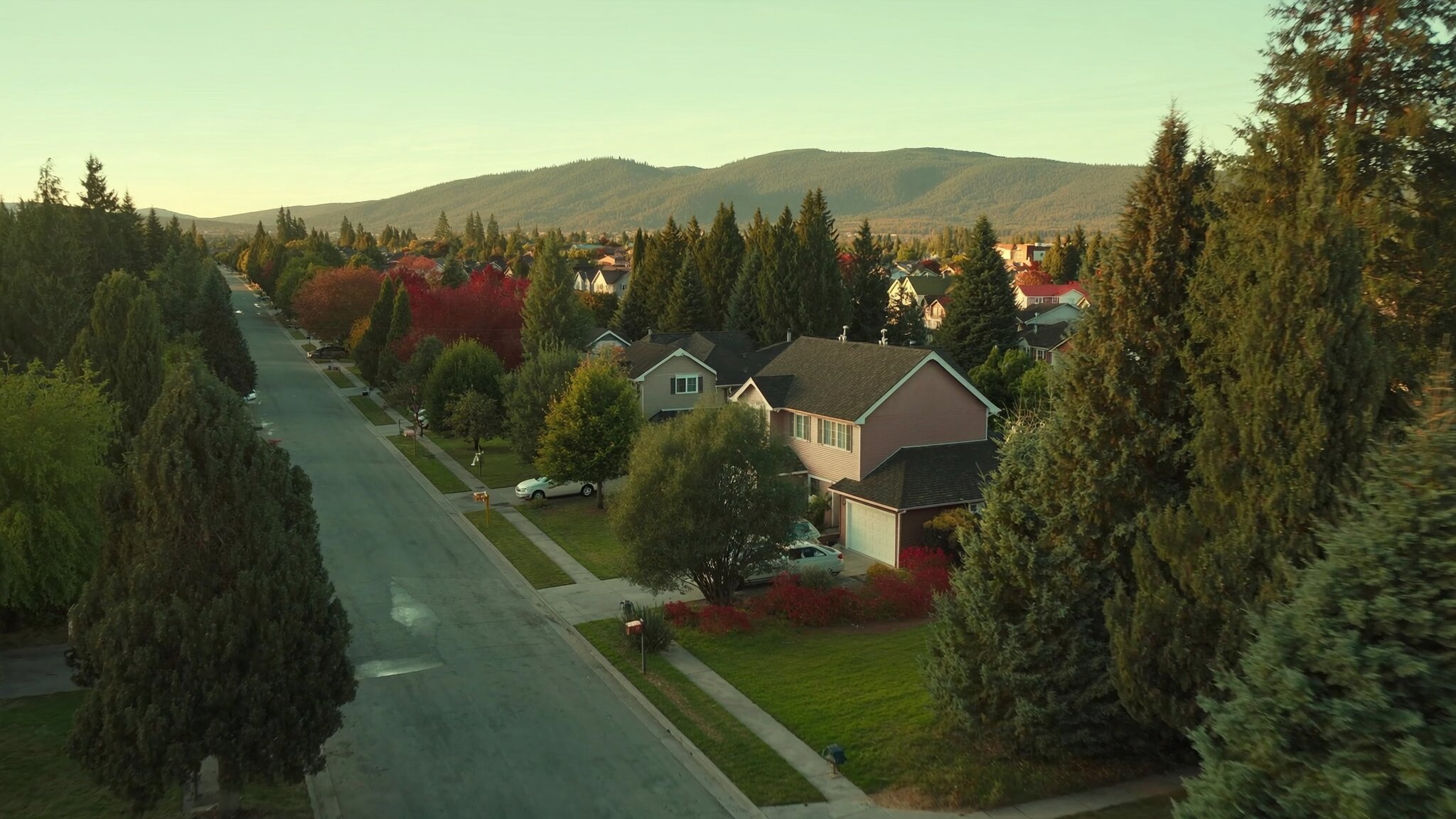
The kids are gone. The guest rooms sit empty most of the year. You are mowing a lawn, heating rooms, and paying property taxes on square footage you stopped using years ago. If that sounds familiar, you are in good company.
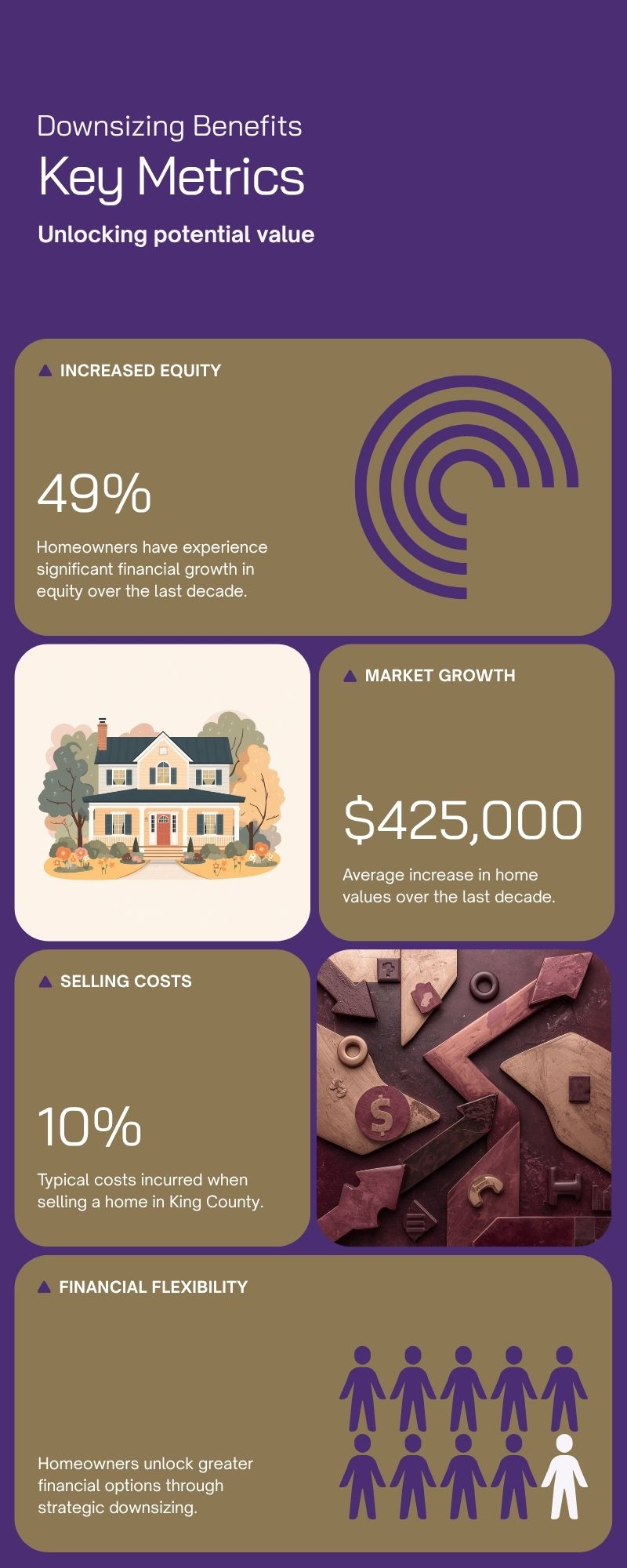
A 2026 Redfin study found that empty-nest boomers own 28% of the nation’s large homes — while millennial families with kids own just 16% of that same housing stock. In King County, that mismatch is especially sharp. Homeowners who bought in Renton, Kent, Auburn, Covington, and Maple Valley in the 1990s or early 2000s are sitting on significant equity in homes that no longer fit their day-to-day lives.
Downsizing sounds simple. Sell the big house, buy something smaller, pocket the difference. But when you actually start thinking through it — what to keep, where to land, condo vs. smaller single-family, the tax implications, the emotional weight of it — it gets complicated fast. This guide is designed to help you think it through clearly, not push you toward any particular decision.
Is This the Right Time to Downsize?
Before you think about where you are going, it helps to get honest about why you want to move. The right reasons to downsize are different from the wrong ones — and the market does not care which is driving you.
Strong reasons to move
The house genuinely does not fit your life anymore. You are paying for space you do not use. Maintenance is becoming a burden rather than a source of pride. You want to free up equity for retirement, travel, or helping your kids. You want to live somewhere more walkable or lower-maintenance. These are all clear, grounded reasons to take the next step.
Reasons to pause
You are reacting to a difficult transition — a recent empty nest, a loss, family pressure. You are hoping the market will time itself perfectly. None of these are reasons to stay forever, but they are reasons to slow down and give the decision more space before you commit.
The 2026 King County market actually gives you more room to breathe than the market of three or four years ago. Active listings across the county rose nearly 38% year over year, which means you are not scrambling in a panic-buy environment on the purchase side. That is real breathing room worth using.
The Financial Picture: What You Are Actually Working With
If you bought in South or East King County before 2015, your equity position is likely substantial. King County’s median home price has hovered around $850,000 to $900,000 for most homes over 2,000 square feet in established areas. A home you bought for $350,000 in Renton in 2005 could easily have a current market value in the $700,000 to $800,000 range, depending on condition and location.
Sample equity math for a South King County homeowner who bought in 2005. Your numbers will differ — reach out for a free home value estimate.
Here is the tax piece that matters most: Washington state does not impose a capital gains tax on real estate sales. The state capital gains tax, which went through rate changes in 2025, still explicitly exempts real property. What you do need to account for is the federal exclusion: if you have lived in the home as your primary residence for at least two of the last five years, the first $500,000 in gain (for married couples filing jointly) is excluded from federal capital gains tax. For most King County empty nesters who have owned their home for 15 to 25 years, this exclusion covers the bulk or all of their gain.
You will also owe Washington’s Real Estate Excise Tax (REET) as the seller — a graduated rate that runs roughly 1.28% on the first $525,000 of the sale price and higher on amounts above that. On a $750,000 sale, budget approximately $10,000 to $12,000 for REET, plus standard seller costs like agent commission, title, and escrow. Full breakdown in the Capital Gains on Home Sales in Washington State guide.
The bottom line: for most King County empty nesters, downsizing is a significant equity event — and often a tax-advantaged one. The financial case is usually strong. The harder questions are about lifestyle, not math.
Condo vs. Smaller Single-Family: The Real Tradeoff
This is the question I hear most often from clients in this situation, and the honest answer is: it depends on which part of the hassle you are trying to escape.
If you want to eliminate maintenance entirely
A condo is the cleaner solution. No lawn, no roof, no gutters. The HOA handles exterior upkeep. The tradeoff is that you pay monthly dues — often $400 to $700 per month in South and East King County — and you give up direct control over your living space. You also need to do HOA due diligence: check the reserve fund, look at the meeting minutes, understand the rental cap rules. A condo with a thin reserve fund is a future special assessment waiting to happen.
If you want less house but still want a yard
A smaller single-family home in South King County may be the better fit. Cities like Renton, Kent, and Auburn have an inventory of well-maintained 1,100 to 1,600 square foot single-family homes that are a real step down in upkeep from a 2,500-square-foot house — without eliminating outdoor space entirely. These homes also tend to appreciate more reliably than condos over time and are easier to sell when you eventually need to.
If you want a community built for your stage of life
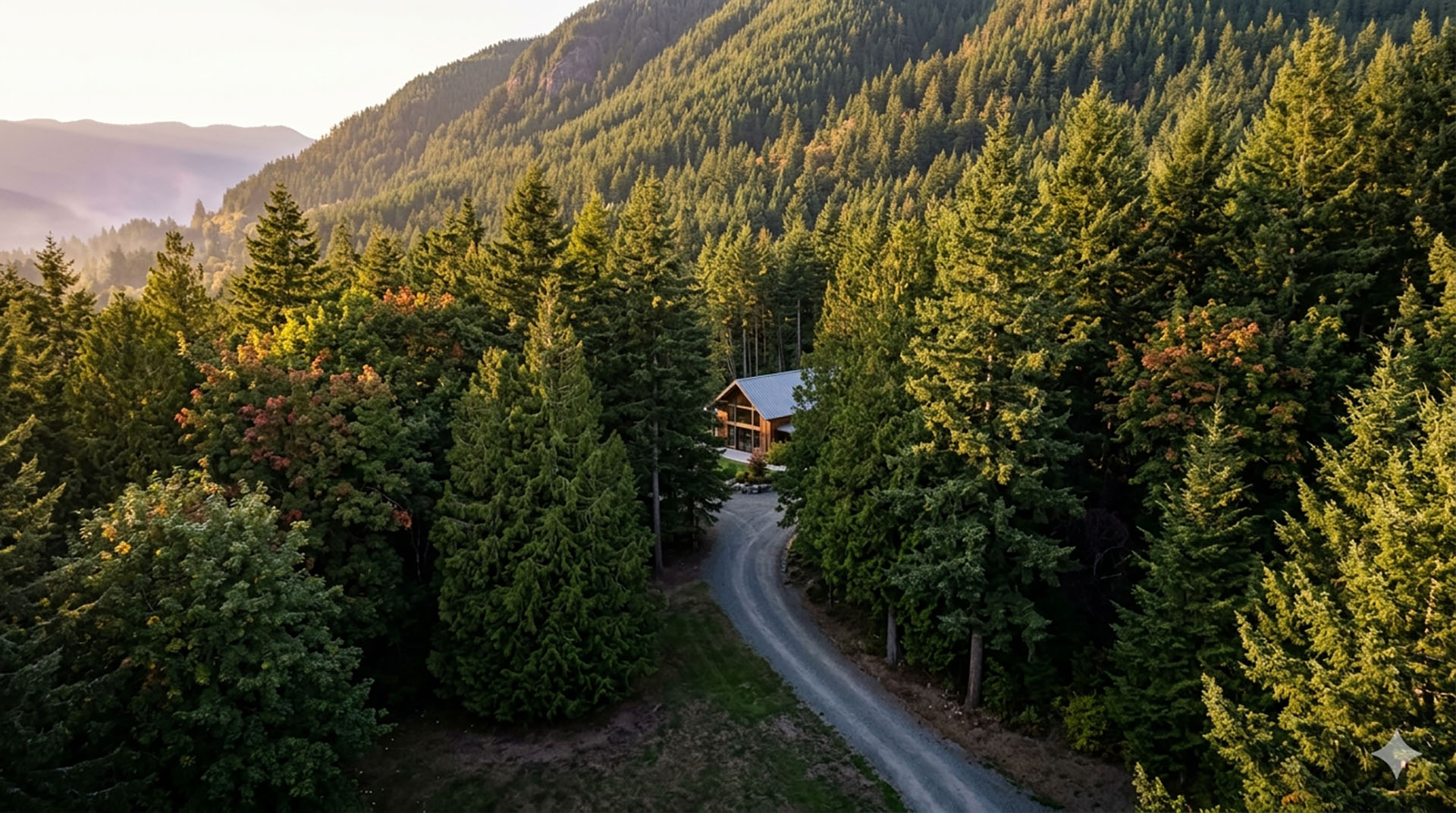
Consider a 55+ community. Providence Point in Issaquah is one example — a gated active adult community with strong amenities and a tight-knit neighborhood feel.
Geography matters when you are downsizing because the type of life you want in your next home often lines up with a specific part of the county.
South King County: Renton, Kent, Auburn, Covington, Maple Valley
Your dollar goes further here. Smaller single-family homes in established neighborhoods run $475,000 to $650,000 depending on city and condition. If you want to stay close to where you raised your family, keep your existing doctor and dentist, and stay within 20 minutes of your current neighborhood, South KC is the logical landing zone. Covington and Maple Valley in particular have quiet, low-maintenance pockets that work well for empty nesters who want more space than a condo but less upkeep than a large house.
East King County: Issaquah, Sammamish, Bellevue Adjacent
If the Eastside is home and walkability or trail access matters to you, the Issaquah corridor has strong options. Prices are higher — plan on $650,000 to $850,000 even for smaller homes — but the quality of life amenities are strong and the housing stock holds value well. Issaquah’s older neighborhoods have more modest footprints that work well for downsizing without going condo.
If you have already thought about this in the Sammamish context, the Should I Downsize My Sammamish Home post covers the local tradeoffs in detail.
What to Keep, What to Let Go
This part is where most people get stuck. The house itself is a straightforward financial transaction. The stuff inside carries thirty years of accumulated life, and deciding what to do with it is genuinely hard.
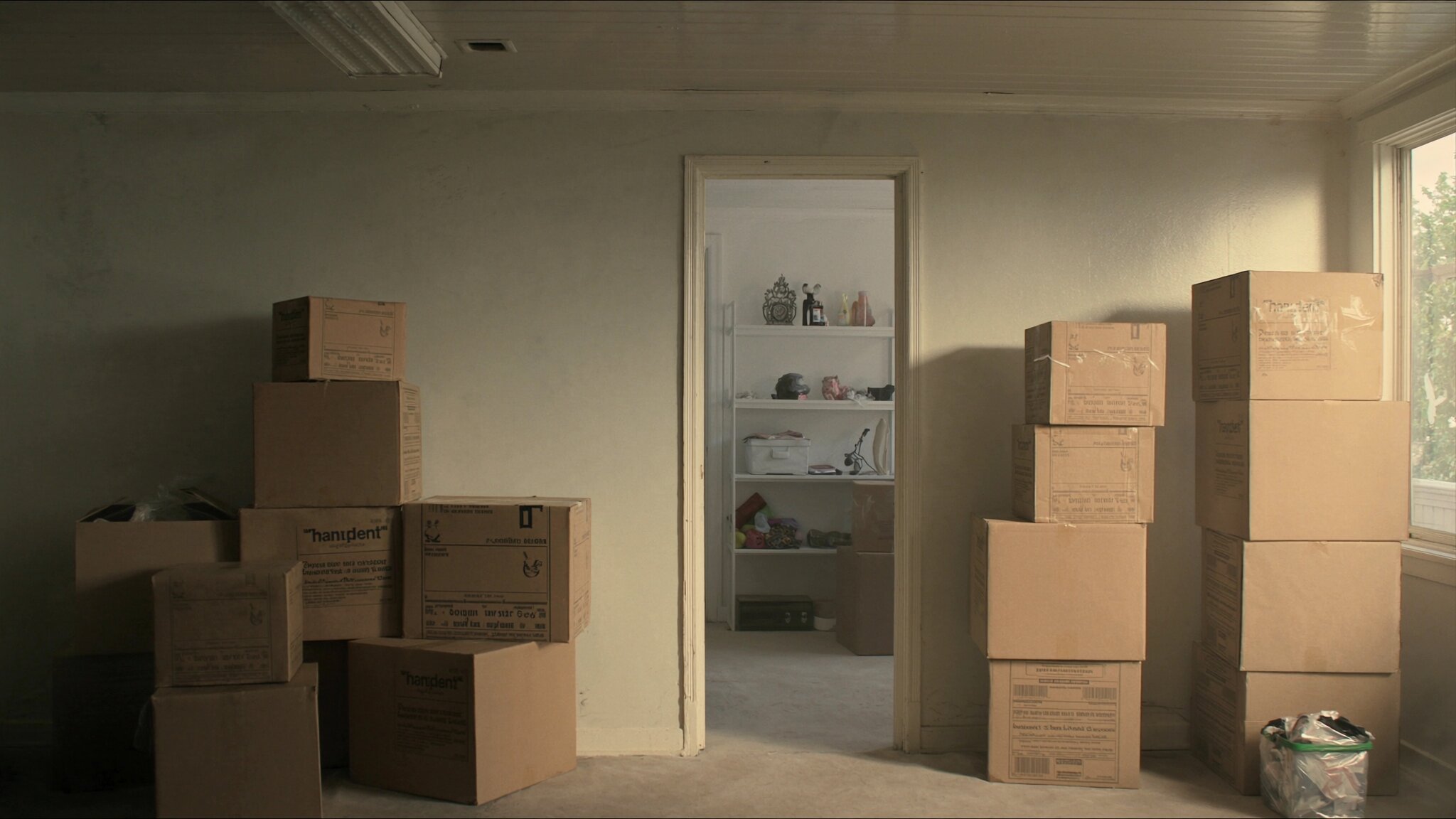
Starting the declutter process 12 to 18 months before you list gives you time to make good decisions without the pressure of a closing deadline.
Start 12 to 18 months before you list
This is not about the stuff — it is about your mental state. Moving from a family home to a smaller place after 20 or 30 years is a real transition. Starting early gives you time to process decisions without pressure and to let go of things gradually rather than all at once.
Measure first, then decide
Before you get sentimental about the dining table, find out if it fits in the new space. Many people hold on to things for emotional reasons only to discover the item would not have worked in the new home anyway. Get the floor plan of your target home type and measure everything you plan to keep.
Set a firm deadline with your kids
Adult children are a variable in every downsizing move. Items that belong to them, childhood memorabilia they might want, furniture they might claim — these need a hard deadline. “You have until October 1 to pick up what you want. After that, it goes.” Kindly stated, firmly enforced.
The right order
Go room by room in this sequence: living spaces, bedrooms, clothes, kitchen, office, guest rooms, garage, attic. Leave sentimental storage for last. The physical stuff builds decision-making muscle for the harder emotional items.
For high-value items, use Facebook Marketplace, Craigslist, or a local estate sale company. A well-run estate sale can move significant furniture volume in a weekend and put money in your pocket rather than requiring dump runs.
The practical goal: move only what you would buy again today if you were furnishing the new space from scratch.
What This Means for Move-Down Sellers
If you have been living in your King County family home for 15 or more years and the house no longer fits your life, 2026 is a reasonable year to act. Inventory is up, which helps you on the buy side. Your equity position is likely strong. The federal tax exclusion probably covers your gain. And the market has enough selection that you are not forced into a rushed decision on where you land.
Frequently Asked Questions
How much equity does the average King County empty nester have?
There is no universal number, but homeowners who bought in South King County before 2015 at prices between $250,000 and $450,000 are typically sitting on $300,000 to $500,000 or more in equity, depending on current value and remaining mortgage balance. Your equity is the difference between your current market value and what you owe — not what you paid.
Do I owe taxes when I downsize in Washington State?
Washington state does not tax real estate capital gains. At the federal level, married couples filing jointly can exclude up to $500,000 in gain from the sale of a primary residence they have lived in for at least two of the last five years. Most King County empty nesters fall well within this exclusion. Talk to a CPA about your specific situation before closing.
Is a condo right for a downsizing move?
It depends. Condos work well if eliminating exterior maintenance is your primary goal and you are comfortable with HOA fees and rules. They carry more financing and resale risk than single-family homes, and they require more due diligence upfront — reserve fund, rental caps, meeting minutes. Do not skip the HOA review.
How long does downsizing take?
From the first serious conversation to handing over keys, plan 12 to 18 months if you want the process to feel manageable. That includes decluttering, preparing the home for sale, selling, buying, and moving. Compressing it into three to four months is possible but stressful for most people.
What if I still have a low mortgage rate on my current home?
A 3% rate feels like a golden ticket — and it is, until you calculate what you are spending to keep that ticket. If the cost of maintaining and occupying a home larger than you need exceeds the financial cost of giving up the rate, the math usually still favors moving. It is a personal calculation worth doing carefully. I can help you run the numbers.
When is the best time of year to sell in King County?
Spring (March through June) is historically the strongest window for seller pricing in King County. Fall (September through October) is a solid second choice. If you are planning a move, working backward from a spring listing date and starting prep 12 months before gives you the best combination of market timing and preparation time.
This is not a small decision. The family home carries more than just square footage — it carries time. But there is also a real opportunity in the next chapter, and getting the move right starts with thinking it through clearly rather than rushing.
When you are ready to talk through your specific situation in Renton, Kent, Auburn, Covington, Maple Valley, or anywhere in South or East King County, reach out directly.
The Tiger Mountain Foothills cover the southeast pockets of Issaquah where the city limits give way to the West Tiger Mountain trail system and the protected forest that wraps around the eastern edge of King County. In 2026, with buyers looking for larger lots, mature trees, and direct trail access to one of the most popular hiking destinations in Washington, this part of Issaquah is a quietly strong option. If you want a home where you can walk out the door and be on the trail to Poo Poo Point in under ten minutes, with serious lot size and the calm of a neighborhood where you can hear birds before you can hear cars, the Foothills delivers.
What is it actually like to live in Tiger Mountain Foothills in 2026?
On a weekday morning, the Foothills feel genuinely quiet. Streets curve up the lower slope of Tiger Mountain with mature firs and cedars screening one home from the next. Driveways are long, lots are spread out, and most homes are not visible from the street. Residents leave for work between 7 and 8 AM, heading north toward I-90. The pace is calm, and you can hear birds and the occasional sound of trail traffic from the West Tiger trailheads.
On a weekend, the Foothills stay quiet but turn more active for residents and visitors. Hikers pour into the West Tiger Mountain trailheads on Saturday and Sunday mornings, especially during paragliding season at Poo Poo Point. Residents adapt to this pattern by hitting the trails early or by accessing them from less-used trailheads on the back side of the mountain. The Issaquah Salmon Hatchery hosts events in fall that pull people from across the Eastside, but the Foothills stay relatively buffered from that activity.
Most residents are a mix of long-time owners who bought in the 1970s and 1980s when this part of Issaquah was considered far out, plus newer buyers from Bellevue and Sammamish who specifically wanted acreage and trail access. Many residents work from home or run businesses out of detached shops on the property. What separates the Foothills from other Issaquah neighborhoods is the immediate trail access. You will not find a closer walk-to-trail neighborhood inside Issaquah city limits.
Homes in Tiger Mountain Foothills: What the Data Shows
Most homes in the Foothills were built between the 1970s and the 2000s, with a smaller share of newer 2010s and 2020s custom rebuilds where someone has torn down an aging home and replaced it. You will find Pacific Northwest contemporary homes, cedar-clad ranches, custom builds from the 1990s, and a meaningful share of newer modern transitional homes on the rebuild lots. Single-family homes typically run 2,200 to 5,000 square feet on lots between half an acre and three acres, with a few larger legacy properties on the more established streets. Many homes have detached shops, barns, or outbuildings that add real utility for owners who use the property. There is no townhome or condo inventory in the Foothills. Detached single-family homes on substantial lots are the only product type.
Market Pulse
Tiger Mountain Foothills (98027)
King County
Median Sales Price (May 2026)
~$1,395,000
~$859,000
Median Days on Market
~30 days
~28 days
Active Listings Change (vs. Jan 2026)
+16%
+30%
Estimates based on current NWMLS data for the Tiger Mountain Foothills residential pockets within the 98027 ZIP code. Inventory turnover here is lower than newer Issaquah neighborhoods because long-time owners stay put. When a property does hit the market, motivated buyers move quickly.
Schools Serving Tiger Mountain Foothills
Most Foothills kids attend Issaquah Valley Elementary, then Issaquah Middle School, then Issaquah High School. All three schools sit five to ten minutes north of the neighborhood. Always confirm your specific address with the Issaquah School District before you write an offer because a few outlier properties have been reassigned over the years.
Issaquah Valley Elementary houses the Spanish Dual Language Immersion program and serves a diverse student body. Issaquah Middle School was rebuilt and modernized in recent years and offers strong music and STEM programs. Issaquah High has a strong four-year graduation rate, multiple AP programs, and a competitive athletics presence.
The school pipeline for the Foothills involves driving or busing for nearly all families. Walking distance is essentially zero given the spread-out nature of the neighborhood and the rural-feeling roads. Most kids ride buses to elementary and middle school, then drive themselves to Issaquah High once they are old enough.
Getting to Work from Tiger Mountain Foothills
Foothills residents typically take Front Street or Issaquah-Hobart Road north to reach I-90 at exit 17. The exact route depends on which side of the mountain you live on. The southern-most properties may use SR-18 to reach I-5 or I-405 for southern destinations.
Destination
Distance
2026 Peak Drive (AM)
Transit Option
Downtown Seattle
19 miles
38 to 58 min
I-90 / ST 554 from Issaquah Transit Center
Bellevue / Amazon Bellevue
11 miles
25 to 35 min
I-90 to I-405 / ST 554
Microsoft (Redmond)
14 miles
30 to 40 min
I-90 to SR-520 / Connector Bus
SeaTac Airport
23 miles
38 to 52 min
I-405 to I-5 / Drive
What I See as a Valuation Expert in Tiger Mountain Foothills
The biggest valuation factor in the Foothills is the lot, the systems, and the immediate trail access. On a 1985 home with 3,000 square feet of living space sitting on three-quarters of an acre, the lot itself can carry 45 to 60 percent of the appraised value, depending on size, slope, usability, and trail proximity. In this area, valuation weight goes heavily to lot grade, drainage, septic system condition where applicable, well capacity where applicable, and the condition of any outbuildings. A flat usable lot with a healthy septic system, a permitted shop, and walking distance to a trailhead will appraise much stronger than a same-size home on a steep slope with a failing system.
HOAs are rare in the Foothills. Most properties are fee simple, which means no monthly dues and no master association rules. The few exceptions are some pocket subdivisions that have small road maintenance HOAs in the $20 to $80 monthly range. Always read the title commitment carefully because some properties have private road easements with cost-sharing requirements that function like an informal HOA.
Within the Foothills, certain lots and pockets carry premium pricing. Properties with direct trail access from the property line, lots backing to Tiger Mountain State Forest, properties with newer wells and recently inspected septic systems, homes with significant outbuildings, and any home within walking distance of the Poo Poo Point trailhead tend to move first when they hit the market.
Explore Tiger Mountain Foothills Yourself
The fastest way to know if the Foothills fits is to drive Issaquah-Hobart Road south past the Issaquah retail core, then turn east onto a few of the side roads to see how the lots open up.
The Newport Way and Cougar Mountain area covers the western edge of Issaquah, climbing up toward the Bellevue line where the city meets the Cougar Mountain Regional Wildland Park. In 2026, with buyers looking for trail access, wooded privacy, and the fastest commute to Bellevue and Microsoft from any Issaquah neighborhood, this corridor is one of the most flexible options in the city. If you want a home where you can hike from your driveway, drive to Bellevue in under twenty minutes, and have real lot size without leaving the I-90 corridor, this area delivers. There is one important wrinkle to know about: the school district line cuts through this area, which means buyers must verify the assigned schools for any specific address before writing an offer.
What is it actually like to live in Newport / Cougar Mountain in 2026?
On a weekday morning, this area feels wooded and private. Streets curve through the lower slopes of Cougar Mountain with mature firs, cedars, and big-leaf maples lining the routes. Driveways are often long and screened from the street. Most residents head west toward I-90 or I-405 for the commute, which is one of the practical advantages of living on this side of Issaquah. The pace is calm, and traffic stays light because there is no commercial core to draw outside visitors.
On a weekend, the neighborhood comes alive in a quiet way. Trail runners and hikers head into Cougar Mountain from the Wilderness Peak and Red Town trailheads. Mountain bikers use the network of trails that loop through the protected wildland. Residents head into Issaquah for sports, shopping, or a meal on Front Street. The mix of forest privacy and quick access to amenities is the defining feature of this neighborhood.
Most residents are a mix of long-time owners who bought in the 1980s and 1990s when the western edge of Issaquah was considered the country, plus newer buyers from Bellevue and Sammamish who specifically wanted trail access without leaving the Eastside. Many residents work in tech and value the short commute to Bellevue and Microsoft. What separates this area from other Issaquah neighborhoods is the geographic position. You are technically in Issaquah but five minutes from Bellevue, which gives buyers the best of both cities depending on the day.
Homes in Newport / Cougar Mountain: What the Data Shows
Housing here is genuinely mixed because the area developed organically over several decades. You will find 1980s contemporary builds with cedar siding and dramatic rooflines, 1990s and 2000s custom homes on larger lots, post-war ramblers on the older side streets, and a smaller share of newer 2010s and 2020s rebuilds where someone tore down an aging home and put up modern. Single-family homes typically run 2,000 to 4,500 square feet on lots between 8,000 square feet and a half acre, with many properties backing to greenbelt or forested borders. Lot orientation varies because the streets follow the natural topography, which means light, view, and slope conditions differ noticeably from one home to the next.
Market Pulse
Newport / Cougar Mountain (98027)
King County
Median Sales Price (May 2026)
~$1,225,000
~$859,000
Median Days on Market
~26 days
~28 days
Active Listings Change (vs. Jan 2026)
+19%
+30%
Estimates based on current NWMLS data for the Newport Way and Cougar Mountain pockets within the 98027 ZIP code. Pricing varies meaningfully by exact location, with western-most properties closer to Bellevue commanding higher prices than eastern properties closer to Olde Town.
Schools Serving Newport / Cougar Mountain
This is the area where school assignment matters most. The neighborhood sits along the boundary between the Issaquah School District and the Bellevue School District, with the line cutting through the area in ways that can change school assignments from one street to the next. Always confirm your specific address with the appropriate school district before you write an offer. Two scenarios are typical:
For most Issaquah-side addresses, kids attend either Clark Elementary or Issaquah Valley Elementary, then Issaquah Middle School, then Issaquah High School. For western-edge properties closer to the Bellevue line, addresses may feed Cougar Ridge Elementary in Bellevue (which is part of the Issaquah School District despite the geographic location), then Cougar Mountain Middle School in Talus, then either Liberty High School or Issaquah High School depending on the specific address. For Bellevue School District properties on the absolute western edge near the Bellevue city line, kids typically attend Newport Heights Elementary, then Tyee Middle School, then Newport High School in Bellevue.
Newport High is one of the top-rated public high schools in Washington with strong AP and IB programs. The bottom line: this is the one Issaquah neighborhood where a single block can change which district your kids attend, so the address verification step is genuinely important. The school pipeline for this area involves driving or busing for nearly all families. None of the schools are walking distance from most properties, which is normal for a wooded Eastside neighborhood.
Getting to Work from Newport / Cougar Mountain
Newport Way connects directly to I-90 at exit 15 (Bellevue side) or exit 17 (Issaquah side), giving residents unusually flexible commute options. Most westward commuters head to I-405 via Eastgate. Most eastward commuters head into Issaquah and beyond.
Destination
Distance
2026 Peak Drive (AM)
Transit Option
Downtown Seattle
15 miles
28 to 48 min
I-90 / ST 554 from Issaquah
Bellevue / Amazon Bellevue
6 miles
15 to 25 min
I-90 to I-405
Microsoft (Redmond)
9 miles
20 to 30 min
I-90 to SR-520
SeaTac Airport
22 miles
35 to 50 min
I-405 to I-5 / Drive
Note: This is the fastest Bellevue commute of any Issaquah neighborhood, often by 5 to 10 minutes during peak hours.
What I See as a Valuation Expert in Newport / Cougar Mountain
The biggest valuation factor in this area is the lot, the slope, and the school assignment. On a 1985 home, the lot itself can carry 40 to 55 percent of the appraised value depending on size, slope, view, and trail access. In this area, valuation weight goes first to lot grade, drainage, the condition of any retaining walls, and tree health, then to the structure. A flat lot with usable yard space and a strong school assignment will appraise much stronger than a same-size home on a steep slope with a less-desired school feeder pattern.
HOAs vary widely in this area. Some pocket subdivisions have small road maintenance HOAs in the $20 to $80 monthly range. A few newer pockets have full HOAs running $100 to $250 per month. Most older properties are fee simple with no HOA at all. Always read the title commitment carefully because some properties have private road easements with cost-sharing requirements that function like an informal HOA, even when no formal HOA exists.
Within this area, certain pockets and lots carry premium pricing. Properties backing directly to Cougar Mountain greenbelt, lots with usable flat yards, homes with a confirmed Issaquah High or Newport High assignment, and any property within walking distance of a Cougar Mountain trailhead tend to move first when they hit the market.
Explore Newport / Cougar Mountain Yourself
The fastest way to know if this area fits is to drive Newport Way from Olde Town west toward the Bellevue line, then turn into a few of the side streets to see how the housing variety opens up.
Sycamore is one of Issaquah’s older established neighborhoods, tucked along the lower flank of Cougar Mountain just west of Olde Town. In 2026, with buyers looking for value, real lots, and the kind of mature neighborhood character you cannot manufacture in new construction, Sycamore is one of the most underrated options in Issaquah. If you want a solid 1970s or 1980s home with bones, room to update, and a quiet established street where neighbors actually know each other, Sycamore is worth a serious look.
What is it actually like to live in Sycamore in 2026?
On a weekday morning, Sycamore feels like a real neighborhood. Streets are lined with mature firs, cedars, and yes, some sycamore trees that gave the area its name. Kids walk or bike to Issaquah Valley Elementary or catch the bus on the corners. Commuters head east toward I-90 and the Issaquah Transit Center. The pace is calm, and the streets are quiet enough that you can hear birds even at 8 AM.
On a weekend, Sycamore stays quiet but more active for residents. People walk dogs along the loop streets, run on the Tibbetts Creek trail, and head into Olde Town for breakfast or coffee. Many residents work on their homes on weekends because the housing stock is mature enough that there is always something to do. The neighborhood holds an annual block party in summer that pulls people out and reinforces the established community feel.
Most residents are a mix of long-time owners who bought in the 1980s and 1990s when Sycamore was the affordable alternative to newer Issaquah construction, plus newer buyers who specifically wanted character, value, and walkability to Olde Town. Many residents work from home or have flexible schedules. What separates Sycamore from the master-planned communities up the hill is simple: this neighborhood was not designed in one sweep. It grew over the 1970s and 1980s, with houses set on irregular lots and streets that follow the contours of the lower mountain slope. That gives it the kind of organic character that newer neighborhoods cannot copy.
Homes in Sycamore: What the Data Shows
Most homes in Sycamore were built between the early 1970s and the late 1980s, with a smaller share of newer infill on lots where someone has torn down an aging structure and built modern. You will find classic Pacific Northwest split-levels, cedar-clad contemporaries, traditional two-story homes, and a handful of one-level ramblers tucked along the quieter streets. Single-family homes typically run 1,800 to 3,000 square feet on lots between 7,000 and 10,000 square feet, with some larger legacy lots in the upper sections of the neighborhood. Lot orientation varies because the streets follow the natural topography, which means light, view, and outdoor usability differ noticeably from one home to the next. There is no townhome or condo inventory in Sycamore. Detached single-family homes are the only product type.
Market Pulse
Sycamore (98027)
King County
Median Sales Price (May 2026)
~$995,000
~$859,000
Median Days on Market
~28 days
~28 days
Active Listings Change (vs. Jan 2026)
+21%
+30%
Estimates based on current NWMLS data for the Sycamore residential pockets within the 98027 ZIP code. Sycamore’s pricing runs above the King County median but well below newer Issaquah construction, which is exactly why value-focused buyers target this neighborhood.
Schools Serving Sycamore
Most Sycamore kids attend Issaquah Valley Elementary, then Issaquah Middle School, then Issaquah High School. All three schools sit within five to ten minutes of the neighborhood, and the bus pickup network is well-established because Sycamore has been part of the same school pipeline for decades.
Issaquah Valley Elementary houses the Spanish Dual Language Immersion program and is one of the more diverse elementary schools in the district. Issaquah Middle School was rebuilt and modernized in recent years and offers strong music and STEM programs. Issaquah High has a strong four-year graduation rate, multiple AP programs, and a competitive athletics presence.
The school pipeline for Sycamore involves driving for some families and walking for others, depending on which street you live on. The eastern end of the neighborhood is closer to Issaquah Valley and walkable for many kids. The western end requires driving or busing.
Getting to Work from Sycamore
Sycamore residents typically take Newport Way east to reach I-90 at exit 17. Some northern properties use Front Street to access I-90 at the same interchange. The neighborhood has good freeway access without being directly on a major arterial, which keeps internal traffic light.
Destination
Distance
2026 Peak Drive (AM)
Transit Option
Downtown Seattle
17 miles
35 to 55 min
I-90 / ST 554 from Issaquah Transit Center
Bellevue / Amazon Bellevue
9 miles
22 to 32 min
I-90 to I-405 / ST 554
Microsoft (Redmond)
12 miles
28 to 38 min
I-90 to SR-520 / Connector Bus
SeaTac Airport
22 miles
35 to 50 min
I-405 to I-5 / Drive
What I See as a Valuation Expert in Sycamore
The biggest valuation factor in Sycamore is honestly the home itself, not just the neighborhood. Two same-vintage homes on the same block can appraise $150,000 apart based purely on the condition of the systems, the roof, the siding, and whether the kitchen and bathrooms have been updated in the last 10 to 15 years. In Sycamore, valuation weight goes heavily to the major systems, the foundation, and the condition of any deck or outbuilding. A 1985 home with a 2018 roof, recent siding work, and an updated kitchen will appraise much stronger than a same-vintage home where deferred maintenance has been deferred.
HOAs are rare in Sycamore. Most properties are fee simple, which means no monthly dues and no master association rules to worry about. The neighborhood relies on King County code rather than private HOA rules for landscaping and architectural standards. That gives owners flexibility but also means properties vary widely in maintenance and curb appeal from one block to the next.
Within Sycamore, certain streets and pockets carry premium pricing. Lots backing directly to Tibbetts Creek or the Cougar Mountain greenbelt, properties with morning sun and afternoon shade, homes on the quieter cul-de-sacs, and any home that has been sympathetically updated tend to move first when they hit the market.
Explore Sycamore Yourself
The fastest way to know if Sycamore fits is to drive Newport Way west from Olde Town, then turn into the loop streets to see how the neighborhood opens up onto the lower slope of Cougar Mountain.
Montreux is the gated luxury community perched on the northern slopes of Cougar Mountain, with views toward Lake Sammamish and quick access to I-90. In 2026, with buyers in the upper price brackets looking for privacy, custom construction, and a setting that feels like an Eastside retreat without losing tech corridor proximity, Montreux is one of the most established luxury options in the region. If you want a home with serious square footage, a real view, and the security of a gated entry without driving an hour from Bellevue, Montreux is the kind of neighborhood that delivers.
What is it actually like to live in Montreux in 2026?
On a weekday morning, Montreux feels private and quiet. The gated entry keeps outside traffic away, and the internal streets curve up the hillside with mature landscaping screening one home from the next. Tech executives and senior professionals leave for I-90 between 7 and 9 AM. The pace inside the gates stays calm even during peak commute hours, which is a real benefit for residents who work from home or run businesses with international hours.
On a weekend, Montreux turns more visible but still calm. Residents walk dogs along the internal paths, head into Issaquah for shopping or dining, or drive five minutes to Lake Sammamish for paddleboard sessions or quick day trips. The community clubhouse, pool, and sport court see steady use, and the internal walking paths are popular for early-morning and evening loops. The neighborhood does not have a commercial core, which is part of the appeal.
Most residents are senior tech executives, business owners, dual-income professionals at the top of their fields, and a meaningful share of relocators from the Bay Area and other tech corridors. Montreux has a more international demographic mix than older Issaquah luxury neighborhoods, reflecting the broader Eastside tech trend. What separates Montreux from other Issaquah neighborhoods is the combination of factors: gated access, custom construction, lake views from many homes, and the HOA-managed common amenities that buyers in this price range expect.
Homes in Montreux: What the Data Shows
Most homes in Montreux were built between the late 1990s and the mid-2000s, with a smaller share of newer custom rebuilds where owners have torn down and replaced original homes. Single-family homes typically run 3,500 to over 6,000 square feet on lots between 7,000 and 12,000 square feet, with some custom homes on larger view lots. The architectural style is mostly Northwest Contemporary and modern transitional, with high-end finishes including hardwood floors, granite or quartz counters, gourmet kitchens, and spa-style primary suites. Many homes have territorial or Lake Sammamish views, with the homes near the upper edge of the development carrying the best sight lines. Montreux also includes The Village at Montreux, a smaller condo and townhome project for buyers who want gated community access at a lower entry price.
Market Pulse
Montreux (98027)
King County
Median Sales Price (May 2026)
~$2,050,000
~$859,000
Median Days on Market
~14 days
~28 days
Active Listings Change (vs. Jan 2026)
+12%
+30%
Estimates based on current NWMLS data for the Montreux subdivision within the 98027 ZIP code. Days on market run far below the broader market average because inventory is consistently low and qualified buyers move quickly when the right home appears.
Schools Serving Montreux
Most Montreux kids attend Sunset Elementary in Bellevue, then Pacific Cascade Middle School, then Issaquah High School. All three are part of the Issaquah School District. Always confirm your specific address with the district before writing an offer because some Montreux properties have been reassigned over the years.
Sunset Elementary is one of the more diverse schools in the district and has a strong inclusive learning environment. Pacific Cascade Middle School has strong STEM and arts programs and routinely sends kids to Issaquah High prepared for AP and IB-style coursework. Issaquah High is one of the top-rated public high schools in Washington, with a 93 percent graduation rate, strong AP offerings, and a competitive athletics presence.
The school pipeline for Montreux involves driving for most families. None of the schools are walking distance, which is normal for an upscale Eastside community. Most kids ride buses to elementary and middle school, then drive themselves to Issaquah High once they are old enough.
Getting to Work from Montreux
Montreux residents typically take Newport Way to reach I-90 at exit 15 or 17. The exact route depends on which side of the hill you live on. The gated entry adds about a minute to the start of any trip but provides the privacy benefit residents value.
Destination
Distance
2026 Peak Drive (AM)
Transit Option
Downtown Seattle
16 miles
32 to 50 min
I-90 / ST 554 from Issaquah Highlands P&R
Bellevue / Amazon Bellevue
7 miles
18 to 28 min
I-90 to I-405 / ST 554
Microsoft (Redmond)
10 miles
22 to 32 min
I-90 to SR-520 / Connector Bus
SeaTac Airport
22 miles
35 to 50 min
I-405 to I-5 / Drive
What I See as a Valuation Expert in Montreux
The HOA picture in Montreux is significant and important to understand. Monthly dues typically run $400 to $700 per month, depending on the village and product type, with townhomes and condos at the higher end because they include more shared maintenance. The HOA covers gate operations, common area landscaping, the clubhouse, pool, sport court, walking paths, and exterior maintenance for the attached product types. In Montreux, the resale certificate and the most recent reserve study are the key documents for valuation. The community is now twenty-plus years old, and capital reserves are entering a critical period for major projects like clubhouse renovation, pool replacement, and road resurfacing. A weak reserve fund and a pending special assessment can change a buyer’s monthly cost picture quickly.
Curb appeal in Montreux is high because the master plan required mature landscaping, consistent architectural standards, and HOA-managed common areas. The neighborhood looks substantially the same today as when buyers first toured it years ago, which is rare. Where individual variation matters most is in the home itself. Updated kitchens, refreshed primary suites, recent roof replacement, and modern HVAC systems all add real appraised value. A 2002 build with a 2018 roof and a 2020 kitchen renovation will appraise stronger than a similar-vintage home where systems and finishes have not been updated.
Within Montreux, certain pockets and lots carry premium pricing. Lots with clear Lake Sammamish views, homes near the upper edge of the development with maximum elevation, properties backing directly to Cougar Mountain greenbelt, and any home with a flat usable backyard tend to move first when they hit the market.
Explore Montreux Yourself
The fastest way to know if Montreux fits is to drive past the gated entry on Newport Way to see the setting from the outside, then schedule a private showing to walk the internal streets and see the housing variety in person.
Mirrormont is the acreage neighborhood that sits in unincorporated King County south of Issaquah, tied to Issaquah identity for shopping, schools, and lifestyle. In 2026, with buyers looking for lot size, room for animals, and the kind of privacy that simply does not exist on the Eastside anymore, Mirrormont is one of the strongest options in the region. If you want a home where you can have horses, chickens, a workshop, and a real garden without an HOA telling you what color to paint your trim, Mirrormont delivers.
What is it actually like to live in Mirrormont in 2026?
On a weekday morning, Mirrormont feels like real country living. Driveways are long, lots are screened by mature firs and cedars, and you can hear birds and the occasional sound of a horse from a neighbor’s pasture. Most residents leave for work between 7 and 8 AM, heading north toward Issaquah and the I-90 corridor. The roads are narrow and winding, which keeps speeds down and gives the neighborhood a real rural character.
On a weekend, Mirrormont stays quiet but turns more active for residents. People walk dogs along the loop roads, ride horses on the trail easements that connect properties, and head into Tiger Mountain State Forest for hikes. The community pool opens in the summer and becomes a real gathering spot. Annual events like the neighborhood garage sale weekend and the Easter egg hunt give residents a reason to actually meet each other, which matters in a neighborhood where you cannot see your neighbor’s house.
Most residents are a mix of long-time owners who bought in the 1970s and 1980s when Mirrormont was considered the country, plus newer buyers from Bellevue and Issaquah who specifically wanted acreage and quiet. Many residents work from home or run small businesses out of detached shops on the property. What separates Mirrormont from other Issaquah-area neighborhoods is the lot rules. Most properties allow horses, chickens, and outbuildings without the restrictions that define master-planned communities. The land is the asset, and what you can do on it is the real value.
Homes in Mirrormont: What the Data Shows
Most homes in Mirrormont were built between the 1970s and the 2000s, with the strongest concentration of construction in the late 1970s and 1980s. You will find Pacific Northwest contemporary homes, cedar-clad ranches, custom builds from the 1990s, and a smaller share of newer 2010s and 2020s rebuilds. Single-family homes typically run 2,000 to 5,000 square feet on lots between one and five acres, with a meaningful share of properties at three acres or larger. Many homes have detached shops, barns, or outbuildings that add real utility for owners who use the property. There is no townhome or condo inventory in Mirrormont. Detached single-family homes on acreage are the only product type.
Market Pulse
Mirrormont (98027)
King County
Median Sales Price (May 2026)
~$1,395,000
~$859,000
Median Days on Market
~32 days
~28 days
Active Listings Change (vs. Jan 2026)
+14%
+30%
Estimates based on current NWMLS data for the Mirrormont residential pockets within the 98027 ZIP code. Inventory turnover here is the lowest of any Issaquah-area neighborhood, mostly because long-time owners stay put. When a property does hit the market, motivated buyers move quickly.
Schools Serving Mirrormont
Mirrormont kids attend a different school pipeline than most other Issaquah neighborhoods. Most addresses feed Maple Hills Elementary in Renton, then Maywood Middle School, then Liberty High School. All three schools are part of the Issaquah School District, but the campuses sit south of I-90 in the Renton area rather than in Issaquah proper. Always confirm your specific address with the Issaquah School District before you write an offer because a few outlier properties have been reassigned over the years.
Maple Hills Elementary is one of the smaller and more community-feeling schools in the district, with strong test scores and a tight parent-teacher ratio. Maywood Middle School has solid music and STEM programs and a strong Project Lead the Way curriculum. Liberty High School is one of the top-rated public high schools in Washington, with a 96 percent graduation rate, strong AP offerings, and a state-recognized performing arts program.
The school pipeline for Mirrormont involves driving for most families. Walking distance is essentially zero given the spread-out nature of the neighborhood. Most kids ride buses to elementary and middle school, then drive themselves to Liberty High once they are old enough.
Getting to Work from Mirrormont
Mirrormont residents typically take Issaquah-Hobart Road north to reach Issaquah and I-90. Some southern properties use SR-18 to reach I-5 or I-405. The exact route depends on which loop in the neighborhood you live on.
Destination
Distance
2026 Peak Drive (AM)
Transit Option
Downtown Seattle
22 miles
45 to 65 min
Drive to I-90 / ST 554 from Issaquah
Bellevue / Amazon Bellevue
14 miles
28 to 40 min
I-90 to I-405 / ST 554 from Issaquah
Microsoft (Redmond)
17 miles
32 to 45 min
I-90 to SR-520 / Connector Bus
SeaTac Airport
24 miles
38 to 55 min
SR-18 to I-5 / Drive
What I See as a Valuation Expert in Mirrormont
The biggest valuation factor in Mirrormont is the lot, the systems, and what the property can do. On a 1985 home with 3,000 square feet of living space sitting on two acres, the lot itself can carry 50 to 60 percent of the appraised value, with another 10 to 20 percent from any usable outbuildings, fenced pasture, or detached shop. In Mirrormont, valuation weight goes heavily to lot grade, drainage, septic system condition, well capacity, and the condition of any barns or shops. A flat usable two-acre lot with a healthy septic system and a permitted detached shop will appraise much stronger than a same-size home on a steep slope with a failing system.
The HOA picture is light by Eastside standards. The Mirrormont Park Association charges a modest annual fee that covers the pool, tennis courts, and community events, but it is voluntary in some sub-areas and not a true governing HOA. Most architectural decisions, landscaping, and outbuilding additions are governed by King County code rather than by HOA rules. That gives owners flexibility but also means properties vary widely in maintenance and condition.
Within Mirrormont, certain lots and pockets carry premium pricing. Properties with usable flat acreage suitable for horse pasture or large gardens, lots backing directly to Tiger Mountain State Forest, properties with newer wells and recently inspected septic systems, and any home with significant outbuildings tend to move first when they hit the market.
Explore Mirrormont Yourself
The fastest way to know if Mirrormont fits is to drive Mirrormont Boulevard up the hill, then turn onto a few of the side loops to see how the lot sizes open up.
Squak Mountain is the wooded sanctuary of Issaquah, the residential pockets that climb up the slopes of Squak Mountain itself between Cougar Mountain to the west and Tiger Mountain to the east. In 2026, with buyers looking for privacy, mature landscaping, and lot size that is genuinely hard to find on the Eastside, Squak Mountain is one of the strongest options in the city. If you want a home with trees, space, and direct trail access without driving an hour from Bellevue, this is the neighborhood that delivers.
What is it actually like to live in Squak Mountain in 2026?
On a weekday morning, Squak Mountain feels genuinely quiet. Streets curve up the hillside with no through traffic. You hear birds, the occasional deer, and not much else. Driveways are long, lots are screened with mature firs and cedars, and most homes are not visible from the street. People who choose Squak Mountain do so for this exact reason. It is the closest thing to country living that you can have inside Issaquah city limits.
On a weekend, the mountain stays quiet but turns more active for residents. Trail runners and hikers use the network of trails that lace through the residential streets and into Squak Mountain State Forest. Residents head down the hill for groceries, restaurants, and youth sports, then come back up. The neighborhood does not have a commercial core, which is part of the appeal. There is nothing to draw outside traffic.
Most residents are a mix of long-time owners who bought in the 1980s and 1990s when Squak Mountain was still considered far out, plus newer buyers from Bellevue and Sammamish who specifically wanted privacy and lot size. Many residents work from home, which is part of why the neighborhood holds value during shifts in commute patterns. What separates Squak Mountain from neighboring Issaquah neighborhoods is the lot itself. You will not find a 4,000 square foot lot here. The land is the asset.
Homes in Squak Mountain: What the Data Shows
Most homes on Squak Mountain were built between the 1970s and the 2000s, with a strong bias toward 1970s and 1980s construction. You will see classic Pacific Northwest contemporary homes, cedar-clad split-levels, custom builds from the 1990s, and a smaller share of newer 2010s and 2020s rebuilds where someone tore down an aging home and put up a modern replacement. Single-family homes typically run 1,800 to 5,000 square feet on lots between a quarter acre and a full acre or more, with a meaningful share of properties in the half-acre to one-acre range. There is no townhome inventory and no condo inventory. Squak Mountain is single-family detached only.
Market Pulse
Squak Mountain (98027)
King County
Median Sales Price (May 2026)
~$1,275,000
~$859,000
Median Days on Market
~25 days
~28 days
Active Listings Change (vs. Jan 2026)
+18%
+30%
Estimates based on current NWMLS data for the Squak Mountain residential pockets within the 98027 ZIP code. Inventory turnover is lower here because long-time owners stay put. When a property does hit the market, motivated buyers move on it.
Schools Serving Squak Mountain
Most Squak Mountain kids attend Issaquah Valley Elementary, then Issaquah Middle School, then Issaquah High School. Some southern Squak Mountain pockets in the Renton-Issaquah Road corridor may feed Briarwood Elementary or even Maywood Middle School depending on the exact address, so always confirm your specific school assignment with the Issaquah School District before you write an offer.
Issaquah Valley Elementary houses the Spanish Dual Language Immersion program and serves a diverse student body. Issaquah Middle School was rebuilt and modernized in recent years and has strong music and STEM programs. Issaquah High has a strong four-year graduation rate, multiple AP programs, and a competitive athletics presence.
The school pipeline for Squak Mountain involves driving for most families, since walking distance is rare given the spread-out nature of the neighborhood. Most kids ride buses to elementary and middle school, then drive themselves to high school once they are old enough.
Getting to Work from Squak Mountain
Squak Mountain residents typically take Renton-Issaquah Road (SR-900) or descend into Olde Town to reach I-90 at exit 17 or exit 15. The exact route depends on which side of the mountain you live on.
Destination
Distance
2026 Peak Drive (AM)
Transit Option
Downtown Seattle
18 miles
40 to 58 min
I-90 / ST 554 from Issaquah Transit Center
Bellevue / Amazon Bellevue
10 miles
25 to 35 min
I-90 to I-405 / ST 554
Microsoft (Redmond)
13 miles
30 to 40 min
I-90 to SR-520 / Connector Bus
SeaTac Airport
22 miles
38 to 52 min
SR-900 to I-405 to I-5
What I See as a Valuation Expert in Squak Mountain
The biggest valuation factor on Squak Mountain is the lot. On a 1985 home with 3,000 square feet of living space, the lot itself can carry 50 to 65 percent of the appraised value, depending on size, slope, and view. In Squak Mountain, valuation weight goes first to lot grade, drainage, mature tree health, and any view, then to the structure. A flat half-acre lot with western Olympic views and a tired 1980s home will appraise much stronger than a same-size home on a steep north-facing slope with limited usable yard.
HOAs are rare on Squak Mountain. Most properties are fee simple, which means no monthly dues and no master association rules. The few exceptions are some pocket subdivisions tucked along the lower slopes that have small road maintenance HOAs in the $20 to $80 monthly range. Always read the title commitment carefully because some properties have private road easements with cost-sharing requirements that function like an informal HOA.
Within Squak Mountain, certain streets and pockets carry premium pricing. South-facing lots with afternoon sun, properties with western Olympic views, lots backing directly to Squak Mountain State Forest, and any home over an acre tend to move first when they hit the market.
Explore Squak Mountain Yourself
The fastest way to know if Squak Mountain fits is to drive Mountain Park Boulevard up the hill, then turn onto a few of the side streets to see how the lots open up.
Talus is the master-planned community tucked into the south side of I-90, built into the lower slopes of Cougar Mountain. In 2026, with buyers looking for newer construction, low-maintenance lifestyles, and direct trail access, Talus is a strong fit, especially for tech families and second-time buyers from Bellevue. If you want a home that is five minutes from the freeway but feels like it backs to a forest, Talus is one of the few Eastside neighborhoods that delivers both.
What is it actually like to live in Talus in 2026?
On a weekday morning, Talus feels quiet. The internal streets curve, traffic is mostly residents heading out for the day, and you can hear birds more than cars. Parents walk kids to the bus stop. Tech workers head down the hill to I-90. Trail runners head straight from their driveways into the Cougar Mountain trail system before work. The pace is calm, which is part of why people pay to live here.
On a weekend, Talus stays calm but more visible. People are out walking dogs, running, biking, or heading to Harvey Manning Park. The Bridges at Talus area has a strong neighborhood feel because residents see each other on the trail and at the park, not just on the way out. Most weekend activity happens off-property: residents drive five minutes to Issaquah for groceries, restaurants, and shopping.
Most residents are a mix of tech families, dual-income professionals, and move-up buyers from older Bellevue and Issaquah neighborhoods who wanted newer construction without sacrificing nature access. Talus has a younger demographic skew than Olde Town and Squak Mountain, mostly because the community itself is newer. What separates Talus from Issaquah Highlands is scale and feel. The Highlands has a real downtown, more density, and more master-plan polish. Talus is smaller, quieter, more wooded, and more tucked into the mountain.
Homes in Talus: What the Data Shows
Most homes in Talus were built between 2003 and 2018, with newer infill in the Bridges at Talus and Mountain Aire areas. Single-family homes typically run 1,800 to 3,500 square feet on lots between 3,000 and 5,000 square feet. Lots are smaller than older Issaquah neighborhoods because Talus was designed around shared open space and trail buffers instead of large private yards. The architectural style is mostly Northwest Contemporary and Modern Craftsman, with mixed siding, covered porches, and rooflines that vary by sub-area. Burnstead Construction was a major builder in the Bridges at Talus pocket and is known for solid mid-tier craftsmanship. There are also townhomes throughout Talus, typically 1,400 to 2,200 square feet, which give the neighborhood housing diversity at a lower price point.
Market Pulse
Talus (98027 (Talus pocket))
King County
Median Sales Price (May 2026)
~$1,195,000
~$859,000
Median Days on Market
~36 days
~28 days
Active Listings Change (vs. Jan 2026)
+26%
+30%
Estimates based on current NWMLS data for the 98027 ZIP code Talus pocket. Days on market run a bit longer here than in Issaquah Highlands, mostly because the buyer pool is smaller and more specific.
Schools Serving Talus
Most Talus kids attend Issaquah Valley Elementary, then Issaquah Middle School, then Issaquah High School. One important note for buyers: Cougar Mountain Middle School is physically located inside Talus at 1929 NW Talus Drive. The school opened in 2022 and serves a different attendance zone than most of Talus, so do not assume your kids will attend the school in your own neighborhood. Always confirm your specific address with the Issaquah School District before you write an offer.
Issaquah Valley Elementary houses the Spanish Dual Language Immersion program and is one of the more diverse elementary schools in the district. Issaquah Middle School was rebuilt and modernized in recent years and has strong music and STEM programs. Issaquah High has a strong four-year graduation rate, multiple AP programs, and a competitive athletics presence.
The school pipeline for Talus is solid but involves some driving. The walkability of Issaquah Valley and Issaquah Middle is limited from most Talus addresses, so most families bus or drive. That is the trade-off for the quieter, more wooded setting.
Getting to Work from Talus
Talus has one main exit onto Renton-Issaquah Road (SR-900), which connects quickly to I-90 at exit 15. Most residents take I-90 east or west depending on destination.
Destination
Distance
2026 Peak Drive (AM)
Transit Option
Downtown Seattle
18 miles
38 to 55 min
I-90 / ST 554 from Issaquah Highlands P&R
Bellevue / Amazon Bellevue
9 miles
22 to 32 min
I-90 to I-405 / ST 554
Microsoft (Redmond)
12 miles
28 to 38 min
I-90 to SR-520 / Connector Bus
SeaTac Airport
22 miles
35 to 50 min
SR-900 to I-405 to I-5
What I See as a Valuation Expert in Talus
The HOA picture in Talus is straightforward but important. Most single-family homes pay around $80 to $200 per month to the master association, with townhomes running $300 to $450 per month depending on what is covered. The HOA in Talus has been generally well-managed, but as the original construction is now 20+ years old, capital reserves are getting tested. Always pull the resale certificate and the most recent reserve study before you write an offer. A weak reserve fund and a pending special assessment can change your monthly cost picture quickly.
Curb appeal in Talus is strong because the master plan required mature street trees, native landscaping, and consistent architectural standards. In Talus, established landscaping carries real weight in valuation, especially on lots that back to greenbelt or trail access. A 2008 build with original native landscaping that has matured well will appraise stronger than a same-vintage home where the yard has been removed or simplified.
Within Talus, certain pockets sell faster and at the top of the price range. The Bridges at Talus area, lots backing directly to Cougar Mountain greenbelt, and any home with a clear westerly territorial view tend to move first when they hit the market. Cul-de-sac lots and homes near Harvey Manning Park also command premiums because of the limited through traffic.
Explore Talus Yourself
The fastest way to know if Talus fits is to drive the perimeter loop, walk a section of the trail at Harvey Manning Park, and check out the Bridges at Talus pocket on the south side.
Olde Town is the historic heart of Issaquah, the part of the city that existed long before the Highlands and the master-planned communities up the hill. In 2026, with buyers looking for character, walkability, and a neighborhood that feels like a real place instead of a development, Olde Town is having a moment. If you want a home you can walk out of and grab coffee, see live salmon in the creek, and end your evening on a brewery patio, this is the part of Issaquah that delivers.
What is it actually like to live in Olde Town in 2026?
On a weekday morning, Olde Town feels like a small town that decided to keep being a small town. People walk to coffee at Issaquah Coffee Company. Kids bike to Issaquah Valley Elementary. Commuters head a few blocks over to Front Street to catch the express bus into Seattle. The streets are narrow and lined with mature trees, and a lot of homes still have their original front porches.
On a weekend, the neighborhood comes alive. Front Street fills with people moving between the bakery, the brewery, the bookstore, and the small boutique shops. The Issaquah Salmon Hatchery is busy every fall when the chinook return up the creek. The Saturday farmers market sets up at Pickering Barn just north of downtown. In October, Salmon Days takes over the entire neighborhood and pulls in people from across the Eastside.
Most residents here are a mix. You have long-time Issaquah residents who bought decades ago and stayed. You have younger buyers who wanted character and walkability over square footage. You have a growing share of empty nesters downsizing from larger Eastside homes. What separates Olde Town from Issaquah Highlands is simple: this neighborhood was not designed in one sweep. It grew over a hundred years, one block at a time. That gives it a kind of character no master-planned community can copy, but it also means lot sizes, home conditions, and street layouts vary widely from block to block.
Homes in Olde Town: What the Data Shows
Olde Town housing is a real mix. You will find early-1900s craftsman bungalows with original woodwork, mid-century cottages from the 1940s and 1950s, post-war ramblers, and newer infill builds where someone tore down an old structure and put up something modern. Single-family homes typically run 1,200 to 2,400 square feet on lots between 4,000 and 8,000 square feet, with a handful of larger legacy properties on quarter-acre lots tucked along the side streets. The architectural mix is part of the charm. There are also condos and townhomes near Front Street for buyers who want the walkability without the maintenance of an old house.
Market Pulse
Olde Town (98027)
King County
Median Sales Price (May 2026)
~$945,000
~$859,000
Median Days on Market
~30 days
~28 days
Active Listings Change (vs. Jan 2026)
+28%
+30%
Estimates based on current NWMLS data for the 98027 ZIP code. Older homes here often need updating, which is reflected in price spread. A renovated craftsman commands a strong premium over a same-size original-condition home.
Schools Serving Olde Town
Most Olde Town kids attend Issaquah Valley Elementary, then Issaquah Middle School, then Issaquah High School. All three schools sit within walking or short-driving distance of the neighborhood, which is rare in modern subdivisions.
Issaquah Valley Elementary is one of the older buildings in the district and houses the Spanish Dual Language Immersion program, which is a real draw if you want bilingual education. Issaquah Middle School was rebuilt and modernized in recent years and offers strong music and STEM programs. Issaquah High has a strong four-year graduation rate, multiple AP programs, and a competitive athletics presence.
The Olde Town pipeline has the advantage of being walkable, which is unusual. A kindergartener at Issaquah Valley can walk to school in many cases, then ride a bike to Issaquah Middle, then drive a few minutes to Issaquah High. That continuity is one of the quiet reasons families stay in Olde Town long-term.
Getting to Work from Olde Town
Olde Town has direct access to I-90 via the Front Street / Sunset Way interchange and the Newport Way exit a few blocks west. The Issaquah Transit Center sits inside the neighborhood, which is the only Issaquah neighborhood where you can walk to your bus stop instead of drive.
Destination
Distance
2026 Peak Drive (AM)
Transit Option
Downtown Seattle
17 miles
35 to 55 min
I-90 / ST 554 from walkable transit center
Bellevue / Amazon Bellevue
9 miles
22 to 32 min
I-90 to I-405 / ST 554
Microsoft (Redmond)
12 miles
28 to 38 min
I-90 to SR-520 / Connector Bus
SeaTac Airport
22 miles
35 to 50 min
I-405 to I-5 / Drive
What I See as a Valuation Expert in Olde Town
The biggest valuation factor in Olde Town is honestly the home itself, not the neighborhood. Two craftsman bungalows on the same block can appraise $200,000 apart based purely on the condition of the foundation, the wiring, the roof, and whether the kitchen and bathrooms have been touched in the last 15 years. In Olde Town, valuation weight goes mostly to the systems and the structure, not the cosmetics. An untouched 1925 craftsman with old knob-and-tube wiring and a settled foundation will appraise much lower than a same-vintage home that has been sympathetically updated.
HOAs are rare in Olde Town. Most properties are fee simple, which means no monthly dues and no master association rules to worry about. The few exceptions are the newer townhome and condo projects near Front Street. Those have HOAs in the $250 to $500 monthly range, depending on what is covered. If you are looking at one of those, always pull the resale certificate and reserve study before you write an offer.
Original-condition craftsman homes that have been well-maintained also command character premiums that newer homes simply cannot copy. Buyers who specifically value walkability and history are willing to pay 8 to 15 percent above an equivalent home in a less-walkable Issaquah neighborhood.
Explore Olde Town Yourself
The fastest way to know if Olde Town fits is to walk Front Street on a Saturday morning, then wander a few blocks east into the residential streets to see the housing variety up close.
Issaquah Highlands is the plateau community that turned a King County hilltop into one of the Eastside’s most-searched ZIP codes. In 2026, with the inventory surge giving buyers more choices, this Tech-Modernist neighborhood is back in serious demand, especially for buyers pulled in by Issaquah and Skyline schools. If you want newer construction, walkable amenities, and a real downtown core inside your own neighborhood, the Highlands is at the top of most buyer lists.
What is it actually like to live in Issaquah Highlands in 2026?
On a weekday morning, the Highlands feels like a small modern town that someone designed on purpose, because that is exactly what happened. Parents walking kids to Grand Ridge Elementary cross paths with tech workers heading down the hill to the Park & Ride or driving toward Microsoft. The streets are wide, the sidewalks are clean, and there is actually morning foot traffic in the plaza by 7 AM.
On a weekend, the place feels different again. The Saturday farmers market runs spring through fall in the central plaza. Trail runners head into Grand Ridge from the eastern edge of the neighborhood. Families fill the playgrounds at Central Park. The Regal cinema, a handful of restaurants, and the Safeway pull steady traffic, but it never feels packed the way Bellevue Square does.
Most residents are tech families, dual-income professionals, and a growing number of move-up buyers from Bellevue and Sammamish who wanted more square footage without leaving the I-90 corridor. What separates the Highlands from older Issaquah neighborhoods is the planning. This whole community was designed in one sweep starting in the late 1990s, with a real downtown plaza, parks, schools, and trails layered in from day one. Olde Town has more character, but the Highlands has more convenience.
Homes in Issaquah Highlands: What the Data Shows
Most homes in the Highlands were built between 2000 and 2018, which means modern layouts, energy efficiency, and lower repair risk than older Issaquah housing. Single-family homes typically run 2,200 to 4,000 square feet on lots between 4,000 and 7,500 square feet, with smaller lots in the earlier-built sections and larger ones in the upper Discovery Heights and Magnolia Park areas. The architectural style is mostly Northwest Contemporary and Modern Craftsman, with wide gables, mixed siding materials, covered porches, and varied rooflines that keep the streets from feeling repetitive. Several major builders worked in the Highlands over the years, including Polygon Northwest, Conner Homes, Buchan Homes, and Toll Brothers in the higher-end pockets. There are also townhomes and condos near the plaza for buyers who want walkable urban density without giving up the school district.
Market Pulse
Issaquah Highlands (98029)
King County
Median Sales Price (May 2026)
~$1,295,000
~$859,000
Median Days on Market
~22 days
~28 days
Active Listings Change (vs. Jan 2026)
+24%
+30%
Estimates based on current NWMLS data for the 98029 ZIP code. The Highlands has held value better than the broader county average.
Schools Serving Issaquah Highlands
Most Highlands kids attend Grand Ridge Elementary, then Pacific Cascade Middle, then Issaquah High School. A few northern streets feed into Skyline High in Sammamish instead of Issaquah High, so always confirm your specific address before writing an offer.
Grand Ridge Elementary is a newer building (built within the master plan) and consistently scores in the top tier of Washington elementary schools. Pacific Cascade Middle has strong STEM and arts programs and routinely sends kids to Issaquah High prepared for AP and IB-style coursework. Issaquah High has a strong four-year graduation rate, multiple AP programs, and a competitive athletics presence.
Most parents I work with cite the Issaquah School District as the single biggest reason they targeted the Highlands in the first place. The district has held its top-tier reputation for years. The school pipeline within the Highlands is one of the most cohesive in King County, because most kids stay together from elementary through high school.
Getting to Work from Issaquah Highlands
The Highlands has two main exits onto I-90, the Highlands Drive interchange and the Sunset Way / Front Street interchange a couple of minutes south. That gives you faster freeway access than older Issaquah neighborhoods on weekday mornings.
Destination
Distance
2026 Peak Drive (AM)
Transit Option
Downtown Seattle
17 miles
35 to 55 min
I-90 / ST 554 from P&R
Bellevue / Amazon Bellevue
8 miles
20 to 30 min
I-90 to I-405 / ST 554
Microsoft (Redmond)
11 miles
25 to 35 min
I-90 to SR-520 / Connector
SeaTac Airport
22 miles
35 to 50 min
I-405 to I-5 / Drive
What I See as a Valuation Expert in Issaquah Highlands
The HOA picture in the Highlands is more complicated than most neighborhoods. The whole community is governed by a master association with separate sub-associations for individual subdivisions, so monthly dues vary widely. Most single-family homeowners pay between $90 and $180 per month, but townhome and condo owners can run $300 to $500 monthly when their HOAs cover exterior maintenance, insurance, or shared amenities. Always pull the resale certificate and the most recent reserve study before you write an offer. A weak reserve fund and a pending special assessment can change your monthly cost picture fast.
Curb appeal is a real factor here. Because the master plan required street trees and landscaping standards, mature trees and established shrubs are now hitting their best years. In the Highlands, mature landscaping carries real weight in valuation, especially on lots that back to greenbelt or shared open space. A 2002 build with well-kept original landscaping and a recent paint and roof refresh will appraise stronger than a similar home where the yard has been let go.
Within the Highlands, certain streets and pockets sell faster and at the top of the price range. The Discovery Heights area at the upper elevation, the streets that back directly to Grand Ridge open space, and the homes around Central Park tend to move first when they hit the market. Cul-de-sac lots with no through traffic also see premium pricing.
Explore Issaquah Highlands Yourself
The fastest way to know if Issaquah Highlands fits is to walk the central plaza on a Saturday morning, then drive the loop streets up through Discovery Heights to see the housing variety in person.
King County’s median home price sat near $1 million in July 2026. Active listings are up about 31% from last year, which has shifted us into a more balanced market. Issaquah’s median price runs well above the county number — it was $1,575,000 in July 2026, though monthly medians here move on a relatively small number of sales. Most buyers here are tech families, dual-income professionals, and folks coming in from Bellevue or Seattle who want trail access and top-rated schools without leaving the I-90 corridor.
Issaquah feels like a wooded sanctuary that happens to have a Costco headquarters. You can hike Tiger Mountain in the morning, grab coffee on Front Street in Olde Town, and be at a Microsoft meeting in Redmond by 10. The “Issaquah Alps,” meaning Cougar, Squak, and Tiger Mountains, wrap around the city and shape every neighborhood. Salmon return to the hatchery downtown every fall, and the city actually throws a festival for it. That mix of outdoor character and tech-fueled growth is what makes Issaquah different from anywhere else on the Eastside.
Commute Times from Issaquah
In 2026, Issaquah is still primarily a car-and-bus city. The Sound Transit 2 Line opened to Redmond in 2024 and now runs through to Seattle, but the planned Issaquah Link extension is still in planning and is not expected for many years. The Stride S2 BRT line, which will connect Bellevue and Bothell, is also on the way and will improve I-405 transit. For now, most Issaquah residents either drive I-90 or use the Sound Transit 554 express bus from the Issaquah Highlands Park & Ride.
Destination
Distance
2026 Peak Drive (AM)
Transit Option
Downtown Seattle
17 miles
35 to 55 min
I-90 / ST 554 Express
Amazon (South Lake Union)
17 miles
40 to 55 min
Drive / Bus + Light Rail
Microsoft (Redmond)
10 miles
25 to 35 min
I-90 to SR-520 / Connector
Bellevue Tech Corridor
8 miles
20 to 30 min
I-90 to I-405 / ST 554
SeaTac Airport
22 miles
35 to 50 min
Drive / I-405
Times reflect honest peak-hour reality, not best-case scenarios. I drive these routes for inspections most weeks, so I see the traffic patterns up close.
Neighborhoods in Issaquah: A Quick Look
This is the hub page for Issaquah. Each neighborhood below has its own deep-dive post with photos, recent sales, and school details. Click through on any name to read more.
Issaquah Highlands
Issaquah Highlands sits up on the plateau north of I-90 and feels like its own small town. The vibe is family-forward and tech-heavy, with newer construction, walking trails, and a real downtown core around the Grand Ridge Plaza. Most homes were built between 2000 and 2020, so you get modern layouts and energy efficiency. Single-family homes typically run 2,200 to 4,000 square feet on lots between 4,000 and 7,500 square feet. There are also townhomes and condos for buyers who want lower maintenance. Issaquah Highlands feeds into the Issaquah School District, including the top-rated Issaquah High School and Skyline High. The neighborhood has its own farmers market, a Regal cinema, and direct access to the Grand Ridge trail system.
Olde Town is the historic heart of the city and runs along Front Street. The character is walkable, slightly funky, and full of small businesses, breweries, and the salmon hatchery. Housing here is a mix of early-1900s craftsman bungalows, mid-century cottages, and newer infill builds. Lot sizes vary widely, but you’ll see plenty of 4,000 to 8,000 square foot lots with homes between 1,200 and 2,400 square feet. This area feeds Issaquah Valley Elementary and Issaquah High. The big claim to fame is the Issaquah Salmon Days Festival every October. If you want to walk to dinner, drop off mail by foot, and live somewhere with real history, Olde Town is the answer.
Talus is a master-planned community on the south side of I-90, built into the hills below Cougar Mountain. The community has a quiet, tucked-away feel even though you’re five minutes from the freeway. Homes are mostly 2003 to 2015 construction, with sizes ranging from 1,800 to 3,500 square feet. Lot sizes are small, often 3,000 to 5,000 square feet, because the neighborhood was designed around shared open space and walking paths. Talus is part of the Issaquah School District. Most addresses feed Issaquah Valley Elementary, Issaquah Middle, and Issaquah High. Note that Cougar Mountain Middle School is physically located inside Talus but serves a different attendance zone, so always confirm your specific address before writing an offer. The community has its own pool, clubhouse, and miles of internal trail. It’s a strong fit for buyers who want newer construction without the higher density of the Highlands.
Squak Mountain refers to the residential pockets along the slopes of, you guessed it, Squak Mountain itself. The vibe here is wooded, private, and quieter than central Issaquah. Lots are larger, often a quarter acre to a full acre or more, and homes range from 1970s split-levels to custom builds over 4,000 square feet. Many properties have territorial or mountain views. Squak Mountain feeds the Issaquah School District. The big draw is the immediate trail access into Squak Mountain State Forest, which connects to Tiger Mountain. If you want trees, space, and a true Pacific Northwest setting without losing easy I-90 access, this is one of the best options in the city.
Mirrormont sits in the south end of the Issaquah area, technically in unincorporated King County but tied to Issaquah for schools and identity. The character is rural and large-lot, often described as semi-equestrian. Lots commonly run one to five acres, and homes range from 2,000 to 5,000 square feet, with everything from 1970s ramblers to newer custom builds. The neighborhood is part of the Issaquah School District. Mirrormont has its own community pool and tennis courts, plus direct access to the Tiger Mountain trail system. Buyers here want privacy, room for animals or hobbies, and a quieter pace, while still being 25 minutes from Bellevue.
Providence Point is an active adult community for residents 55 and older, located on the north end of Squak Mountain. The character is calm, manicured, and amenity-rich. Most homes are condos and townhomes built between the late 1980s and 2000s, sized from about 900 to 1,800 square feet. The community has a clubhouse, pools, walking paths, and full landscaping handled by the HOA. Providence Point sits within the Issaquah School District boundaries, but the community itself is age-restricted under federal HOPA rules. If you’re downsizing, want a low-maintenance lifestyle, and like having neighbors at a similar life stage, Providence Point is worth a serious look.
Montreux is a gated community on the east side of Issaquah, perched on the slope above I-90 with views toward Lake Sammamish. The character is upscale, private, and quiet. Homes are mostly custom builds from the late 1990s and 2000s, ranging from 3,500 to over 6,000 square feet on lots between 7,000 and 12,000 square feet. Many homes have territorial or lake views. Montreux feeds the Issaquah School District, including the top-rated Sunset Elementary and Issaquah High. Inside the gates you’ll find a clubhouse, pool, sport court, and walking paths. This is a strong fit for buyers who want a luxury setting with HOA-managed common areas.
Sycamore is one of Issaquah’s older established neighborhoods, located west of Olde Town and tucked along the lower flank of Cougar Mountain. The character is quiet, mature, and family-oriented, with a strong neighborhood feel because most residents have been there for years. Homes are mostly 1970s and 1980s construction, sized from 1,800 to 3,000 square feet on lots that run 7,000 to 10,000 square feet. The neighborhood feeds Issaquah Valley Elementary, Issaquah Middle, and Issaquah High. Tibbetts Creek and the connecting trail to Cougar Mountain Regional Wildland Park are right there. Sycamore offers good value compared to newer Issaquah neighborhoods, especially for buyers willing to update an older home.
The Newport Way corridor and the Cougar Mountain area sit on the western edge of Issaquah, climbing up toward the Bellevue line. The character mixes wooded privacy with quick freeway access. Housing varies a lot here, from 1980s contemporary builds to newer custom homes, with sizes from 2,000 to 4,500 square feet. Lots commonly run 8,000 square feet to a half acre, with many backing to greenbelt. This area is split between the Issaquah and Bellevue school districts depending on the exact street, so buyers should always confirm the school assignment before writing an offer. Cougar Mountain Regional Wildland Park is the headline amenity, with miles of trails right out the back door.
Tiger Mountain Foothills covers the southeast pockets of Issaquah where the city meets the forest. The character is rural-feeling, with larger lots, mature trees, and very little through traffic. Homes here range from 1970s and 1980s ramblers to newer 2010s and 2020s custom builds, typically 2,200 to 5,000 square feet on lots between half an acre and three acres. The Issaquah School District serves this area, with most kids going to Issaquah High. The headline amenity is direct access to West Tiger Mountain trails, including the popular Poo Poo Point hike. Buyers who want acreage and trail access without driving 45 minutes from Bellevue should put this area on the short list.
The 31% inventory surge across King County has changed the Issaquah market in real ways. A year ago, well-priced homes here saw multiple offers within the first weekend. Today, many homes sit for two to four weeks before going under contract, and price reductions are more common than they have been in several years. That gives buyers time to actually think, get a real inspection done, and negotiate on terms. For sellers, it means pricing has to be honest from day one. Aspirational pricing that worked in 2022 is not working in 2026.
Issaquah home values have held up better than many other parts of King County over the last 12 months. The combination of Issaquah School District ratings, proximity to Bellevue and Microsoft, and limited buildable land keeps demand steady. Newer construction in places like Issaquah Highlands and Talus has shown the strongest price stability, mostly because buyers are willing to pay for energy efficiency, modern layouts, and lower repair risk. Older homes on larger lots have also held value well, especially in Squak Mountain and Mirrormont, where the lot itself often carries most of the appraised value.
I bring that same lens to every Issaquah home I help a client evaluate, whether you are buying or selling.
The 12-month picture for Issaquah is steady, not flashy. Buyers who pay attention to inventory, school zones, and lot quality will find real opportunities over the next few months. Sellers who price honestly and present well will still see strong results. Anyone betting on a quick flip should look elsewhere.
Explore Issaquah Yourself
The best way to know if Issaquah fits is to come walk Front Street, drive up to the Highlands, and hike a section of the Tiger Mountain trail. Once you see how the neighborhoods connect, the rest makes sense.


 Facebook
 X
X
 Pinterest
 Copy Link