Buyer ResourcesFederal WayKing County CitiesSouth King County August 2, 2026

Living in Brittany Lane, Federal Way | 2026 Guide

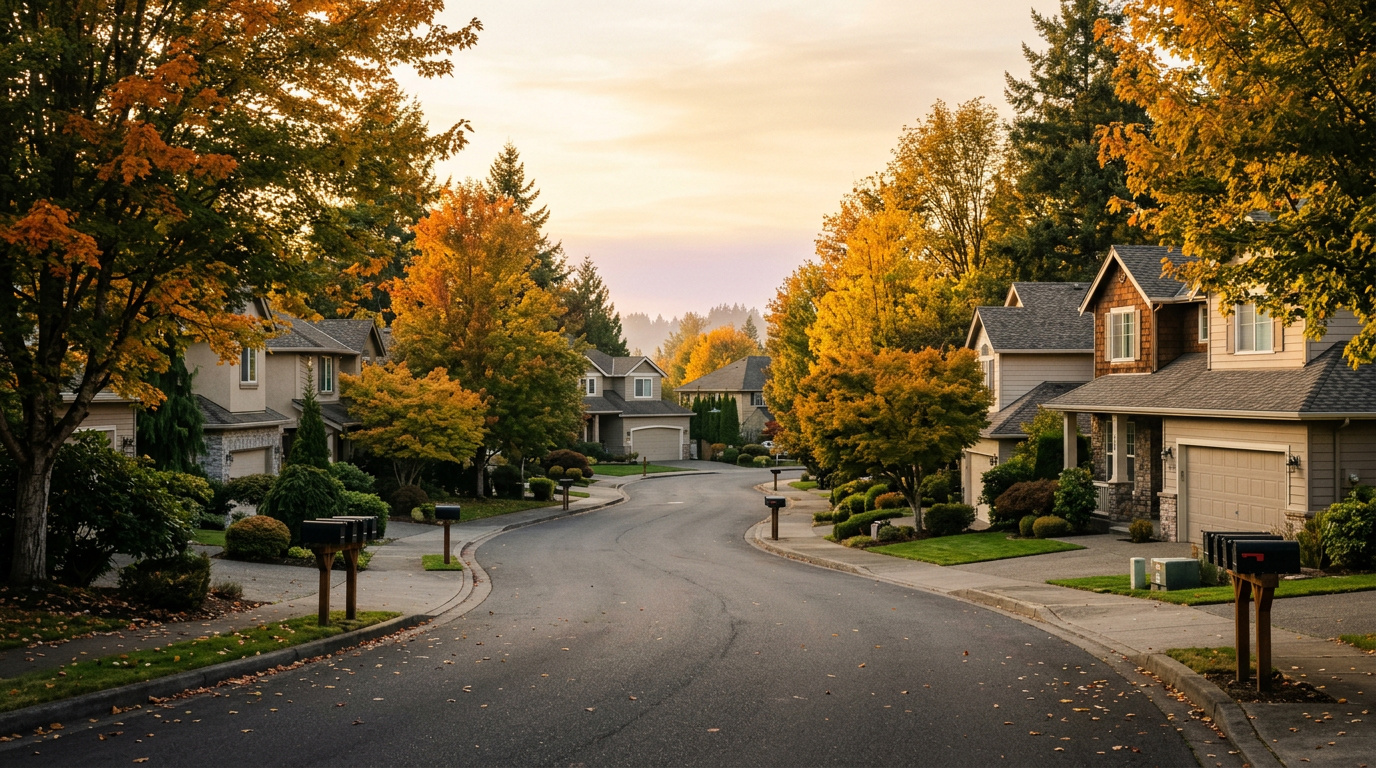
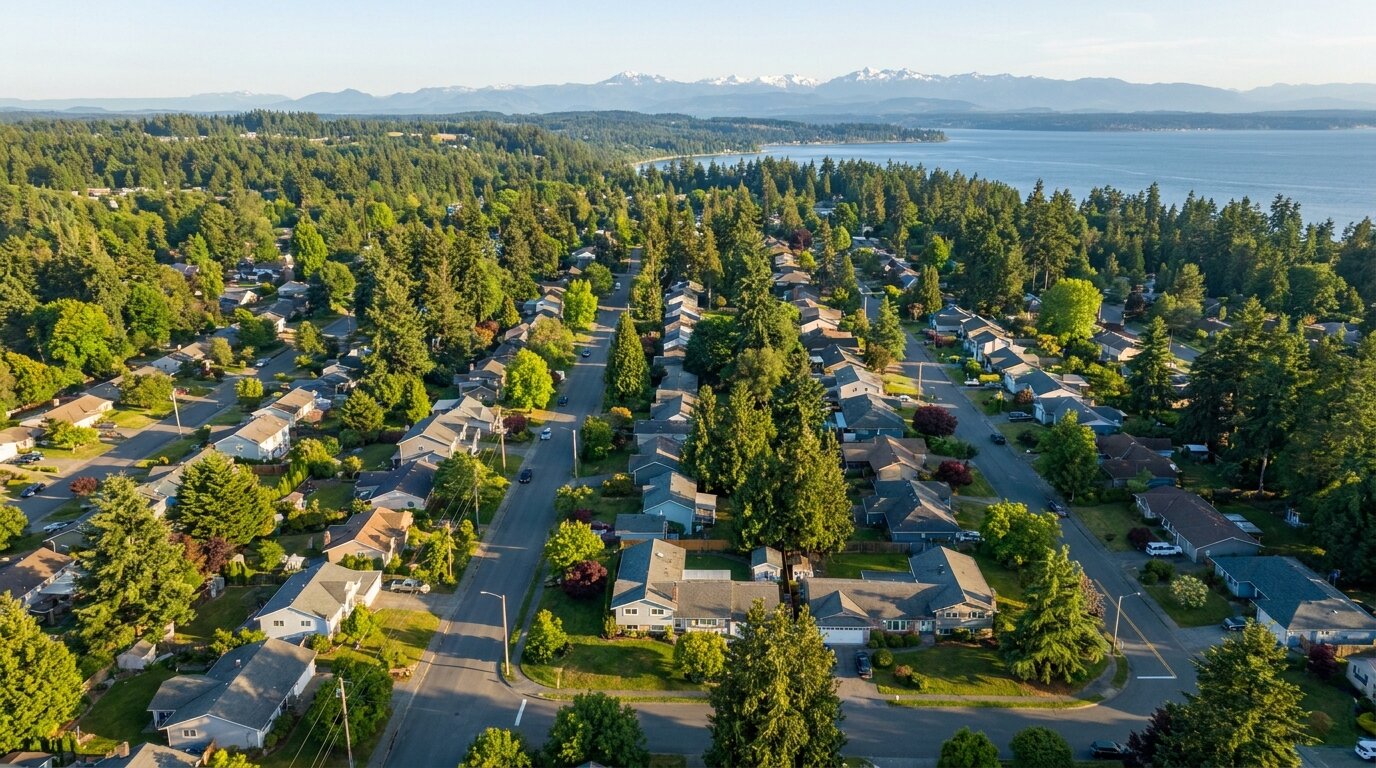
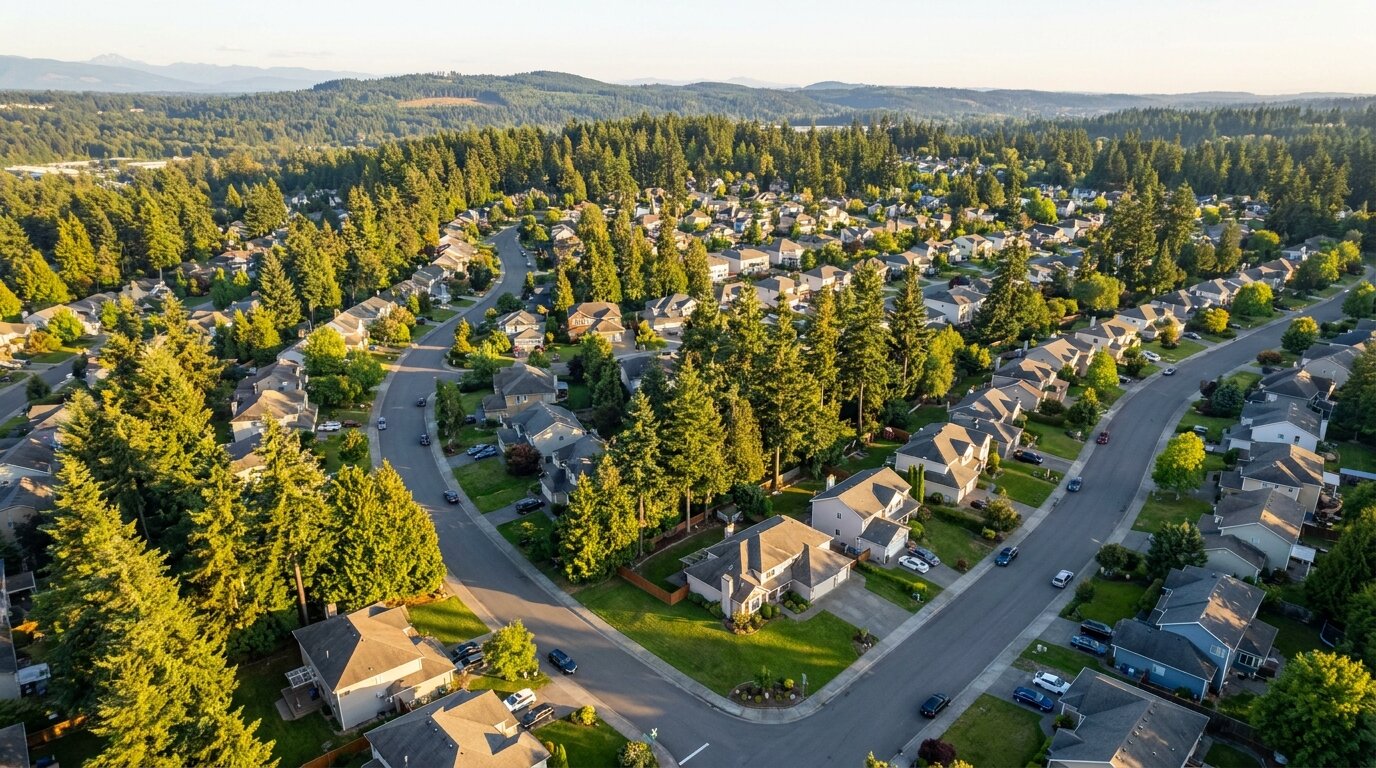
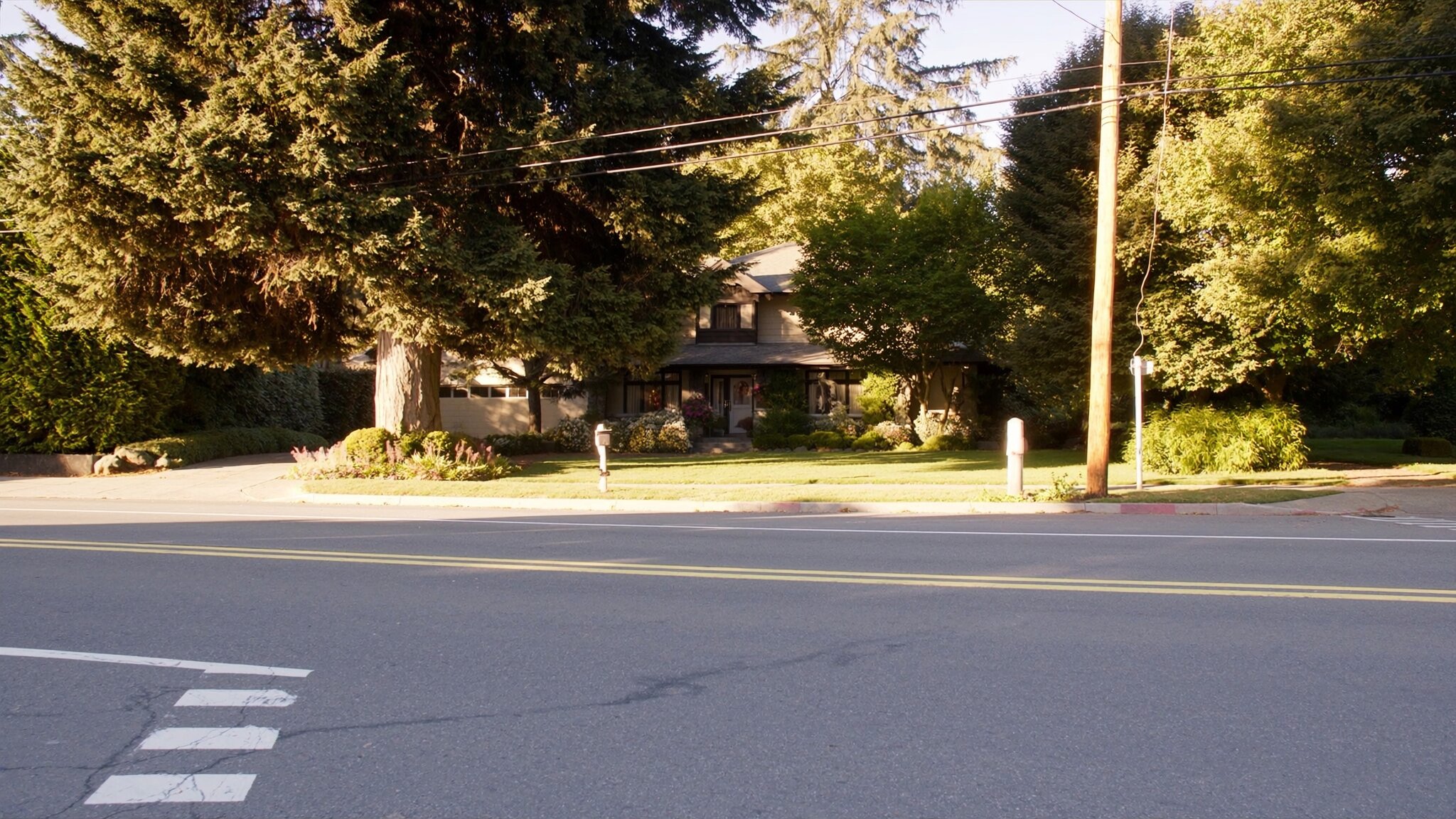
Brittany Lane sits in the far south end of Federal Way, just north of the Milton city line, in the pocket of streets around 1st Ave S and S 330th St. Local listings sometimes group this pocket with the broader “Villages” naming used by nearby developments, though Brittany Lane itself is the neighborhood with an active HOA and a name residents actually use. Homes here went in mostly from the mid 1990s through the 2000s, and the streets have that settled, established feel: mature trees, consistent setbacks, and an HOA that keeps the common areas looking the same from block to block. It is not flashy. It is the kind of neighborhood people buy into because it works, day after day, without much drama.

What is it actually like to live in Brittany Lane in 2026?

On a weekday morning, Brittany Lane moves at the pace of a working residential street. Garage doors open early, cars head north toward Military Road or west toward I-5, and the neighborhood settles into a quiet stretch by mid morning that holds through most of the day. The HOA keeps the shared landscaping consistent, so the streets look the same in February as they do in August, which is part of the appeal for buyers who want predictability over flash.

Weekends bring more visible activity. Families load up for Celebration Park a short drive north, where the sports fields stay busy most of the year with youth leagues and pickup games. Others stick closer to home, since Brittany Lane’s own streets are wide enough and quiet enough for an easy walk or bike ride without leaving the neighborhood. Being this close to the Milton border also means residents cross freely between the two cities for errands, since the practical boundary on the ground barely registers day to day.

Who lives here tends to be buyers priced out of the tighter Eastside markets but unwilling to give up an established, HOA-managed street. Brittany Lane draws a mix of first move-up buyers and longer-tenured owners who bought when prices were lower and have stayed because the neighborhood has held its character. It is a different crowd than the newer-construction pockets closer to downtown Federal Way. This is an older, settled street pattern, not a builder-fresh subdivision.
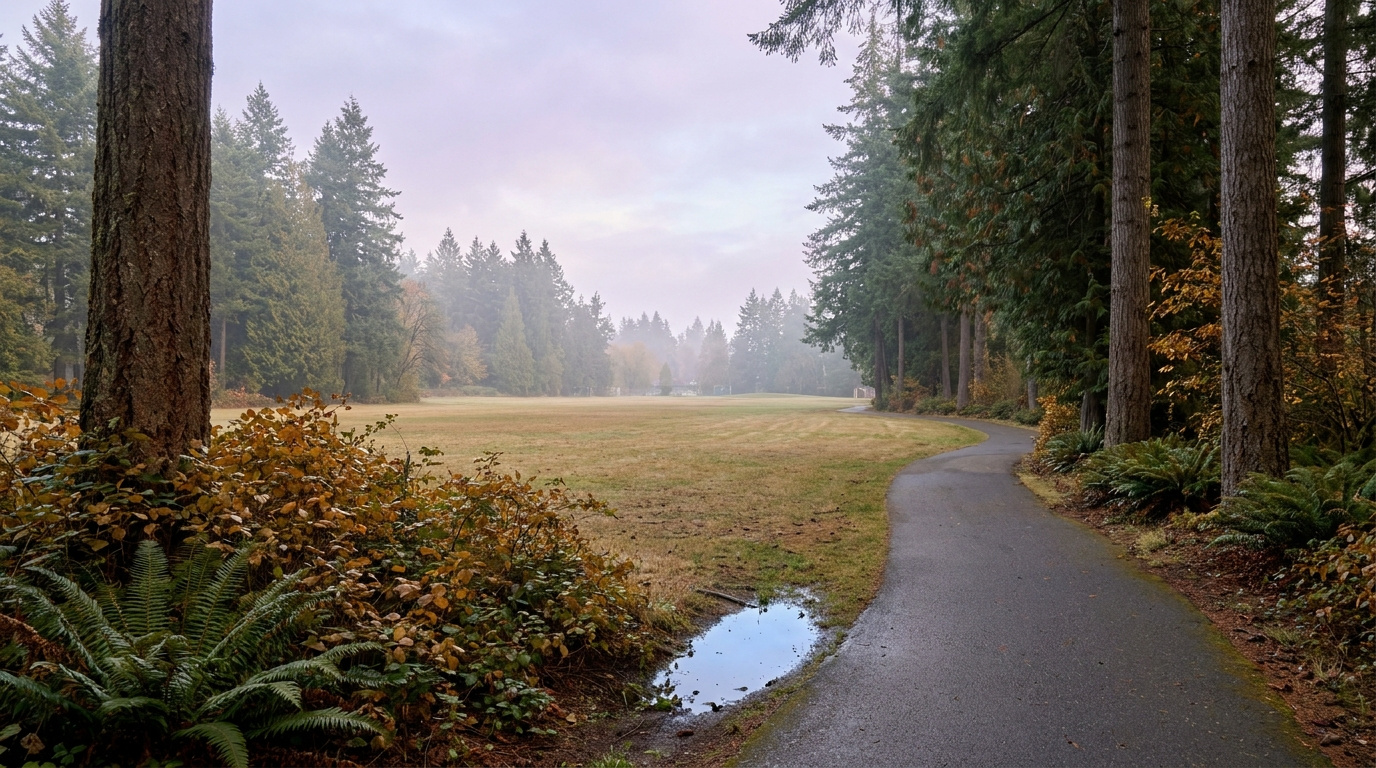
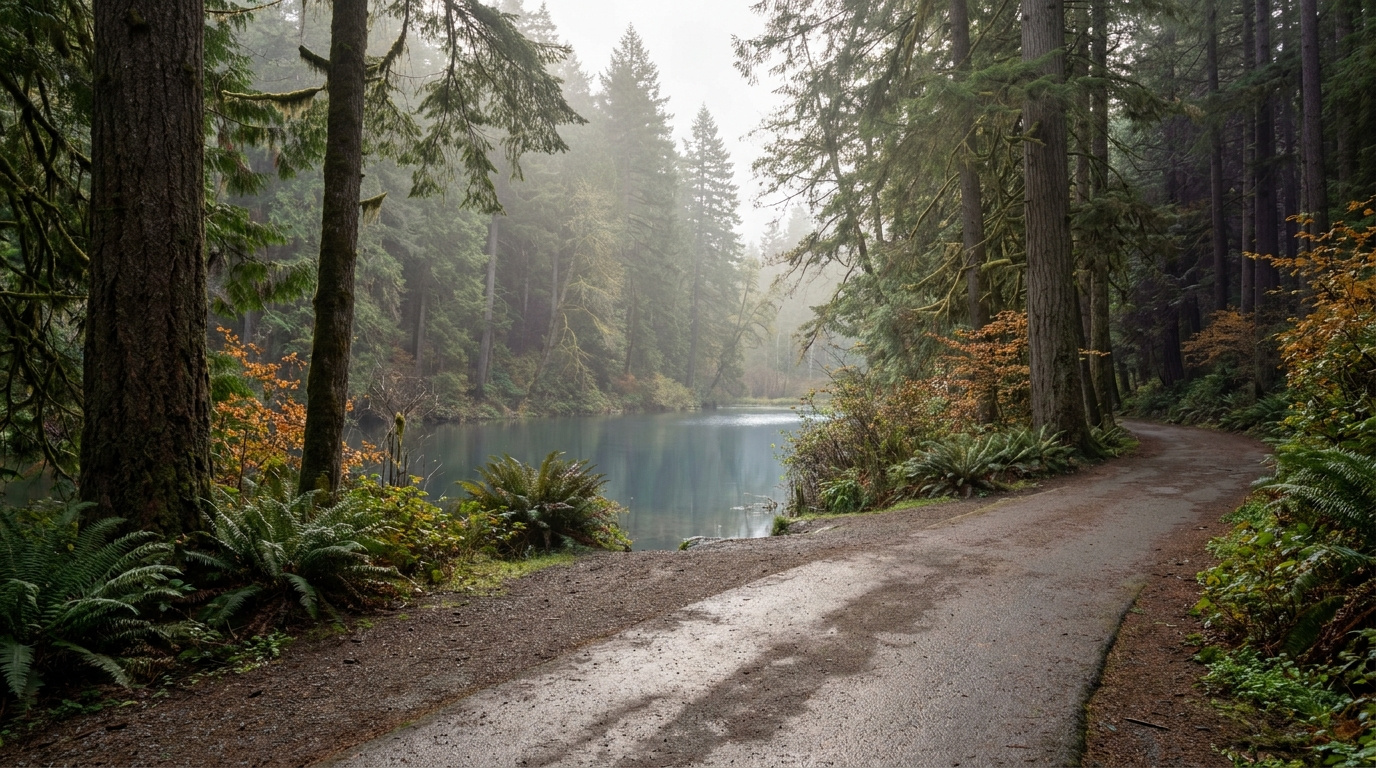
Celebration Park sports fields and trails near the Brittany Lane neighborhood of Federal Way, Washington
Celebration Park’s 83 acres of fields and trails give Brittany Lane residents a short drive to organized sports and open green space.

Homes in Brittany Lane: What the Data Shows

Brittany Lane’s homes were mostly built from the mid 1990s through the 2000s, running roughly 1,600 to 2,800 square feet on lots between 4,500 and 7,500 square feet. Construction is standard Northwest suburban: two-story floor plans, attached two-car garages, a mix of vinyl and lap siding, and modest yards the HOA keeps consistent block to block. Prices generally track Federal Way’s citywide median, with some variation depending on lot size and how recently a given home has been updated. Buyers looking for move-in-ready construction without paying for brand-new-build premiums tend to find this stretch of Federal Way an easy fit.

Data as of June 2026.

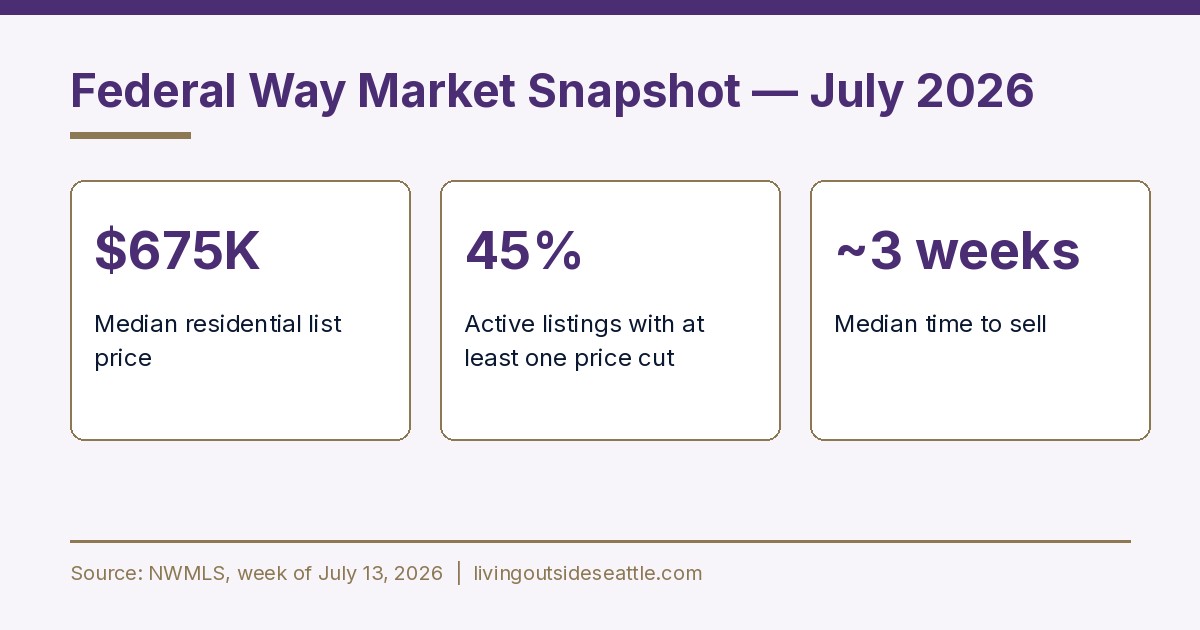
Market Pulse Federal Way (City) King County
Median Sales Price (June 2026) ~$675,000 ~$998,000
Median Days on Market ~11 days ~10 days
Active Listings Change (vs. Jan 2026) Federal Way inventory more than doubled from January to June 2026 County-wide inventory is up sharply year to date

Figures are Federal Way city-level NWMLS data for June 2026, since Brittany Lane is not tracked as a standalone MLS reporting zone. Treat these as directional for this specific pocket of south Federal Way.

Schools Serving Brittany Lane

Brittany Lane sits inside the Federal Way School District, but this pocket of the city, tucked right against the Milton border, is close enough to a boundary edge that the exact feeder school can vary from one street to the next. Panther Lake Elementary sits close by on 1st Ave S, but confirming your specific address with the district before writing an offer matters more here than in most Federal Way neighborhoods, since south-end boundary lines don’t always follow the pattern buyers expect from the rest of the city.

Federal Way Public Schools runs a district-wide Gifted and Talented program and Project Lead the Way STEM curriculum across its elementary and middle schools, so families moving into this corner of the city still have access to those tracks regardless of which specific building their address lands in. The district’s high schools, including Decatur and Federal Way High, both carry established fine arts and career-technical programs that draw students from across the south end.

For families here, the day-in-the-life pipeline runs by bus for most students, since this pocket sits far enough from the district’s core that walking to school isn’t typically practical. The safest approach for any buyer is the same one Gregory recommends everywhere near a boundary line: confirm the address before assuming a specific school, then plan the daily routine around the real answer, not the closest-sounding one.

Getting to Work from Brittany Lane

From Brittany Lane, the fastest route north to I-5 or Federal Way’s core runs up Military Road S or 1st Ave S, connecting to Pacific Highway S within a few minutes. Pierce Transit Route 501 links this corner of the city directly to Milton for residents without a car, while King County Metro service picks up further north along Pacific Highway for connections into the Federal Way Transit Center and its Link Light Rail station.

Destination Distance 2026 Drive Time (Peak AM) Transit Option
Downtown Seattle 30 miles 40 to 60 min 1 Line Light Rail / I-5
Bellevue / Amazon 28 miles 45 to 60 min I-5 to I-405 / Drive
Microsoft (Redmond) 38 miles 55 to 75 min Drive / SR-99 to I-405
SeaTac Airport 15 miles 18 to 28 min 1 Line Light Rail / Drive

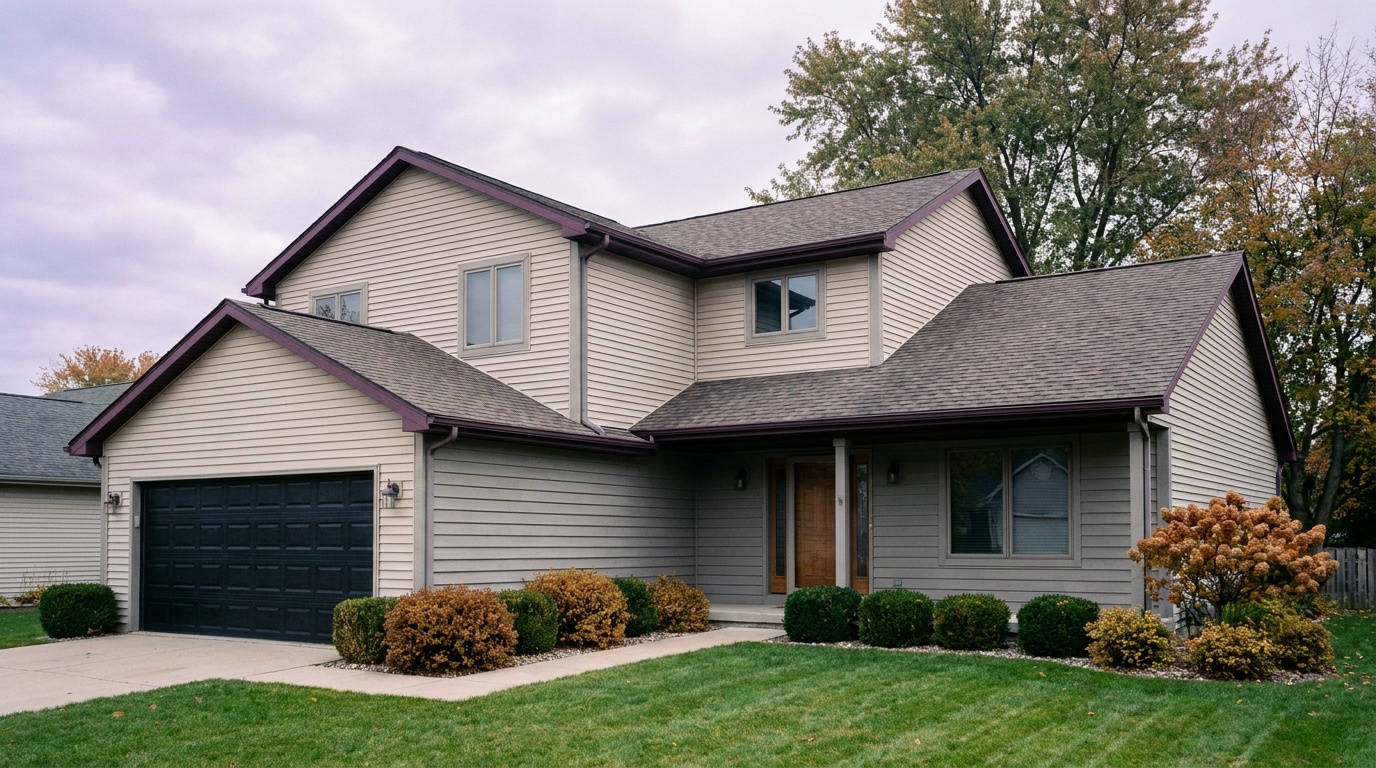
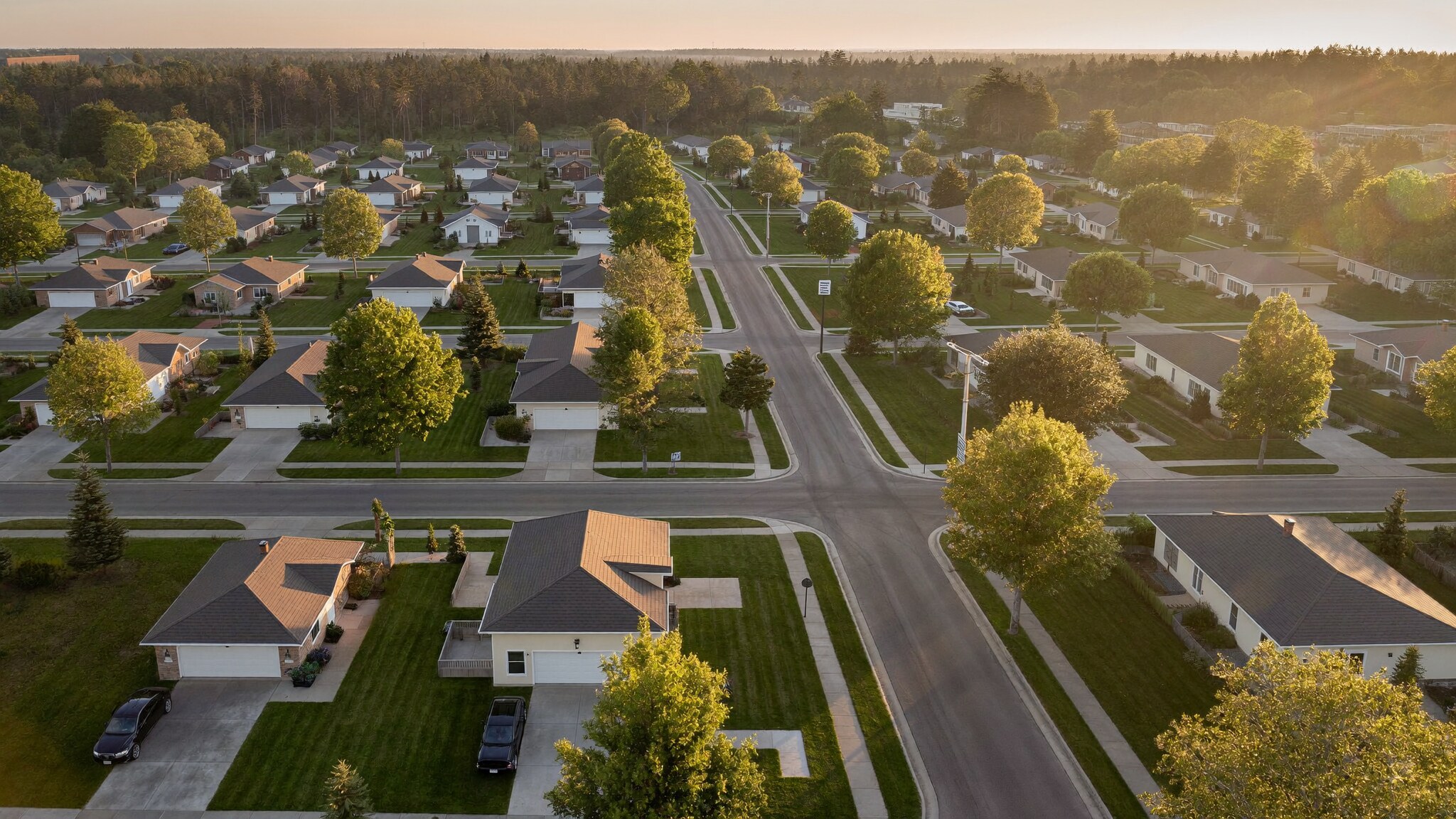
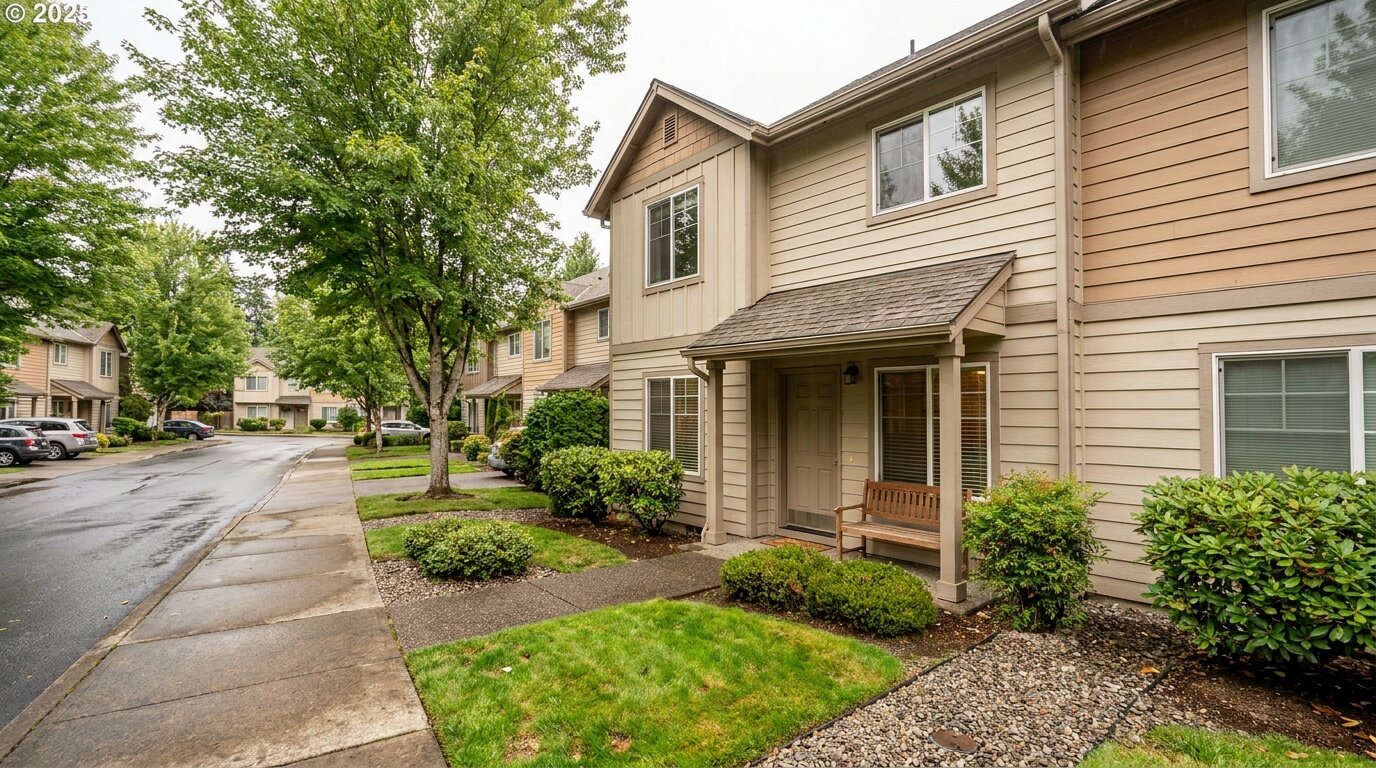
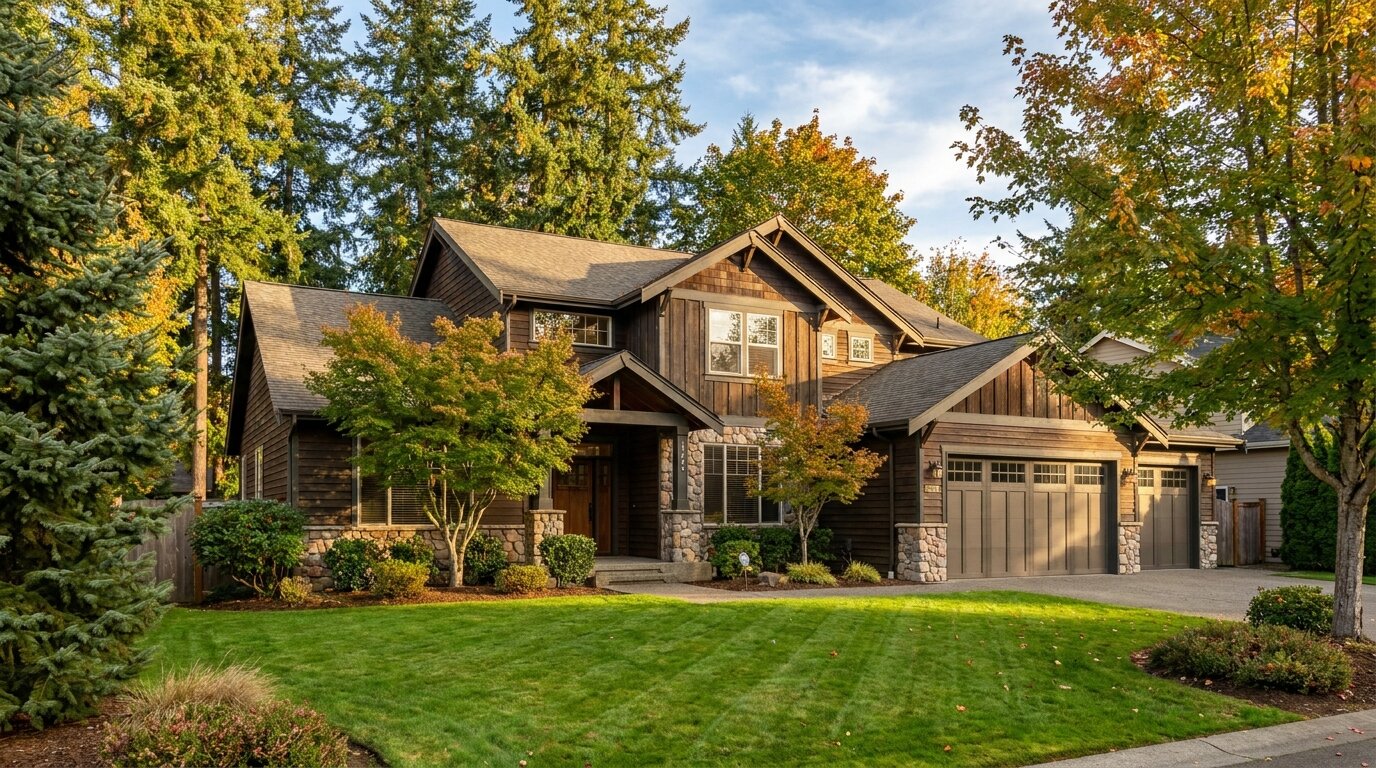
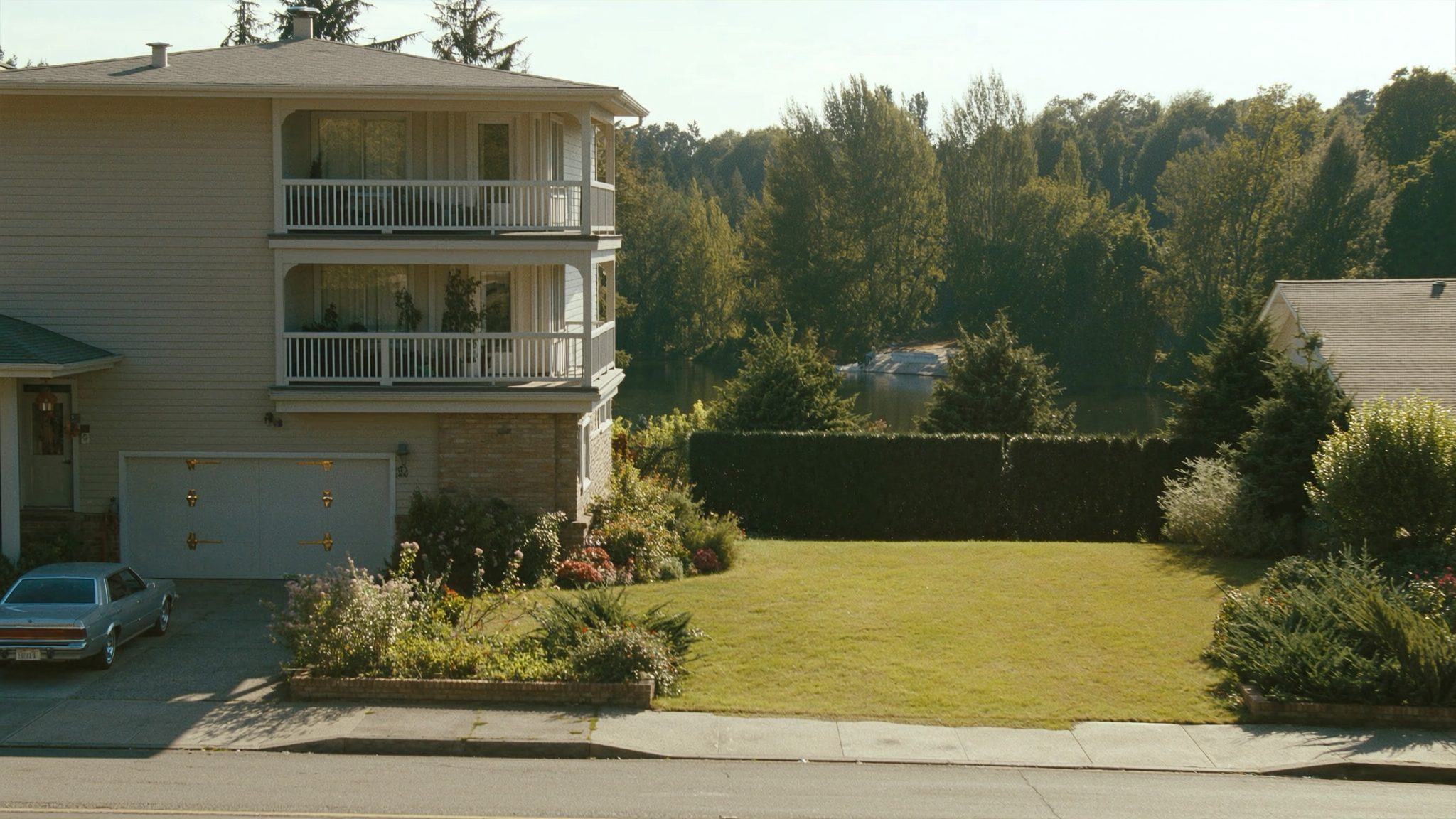
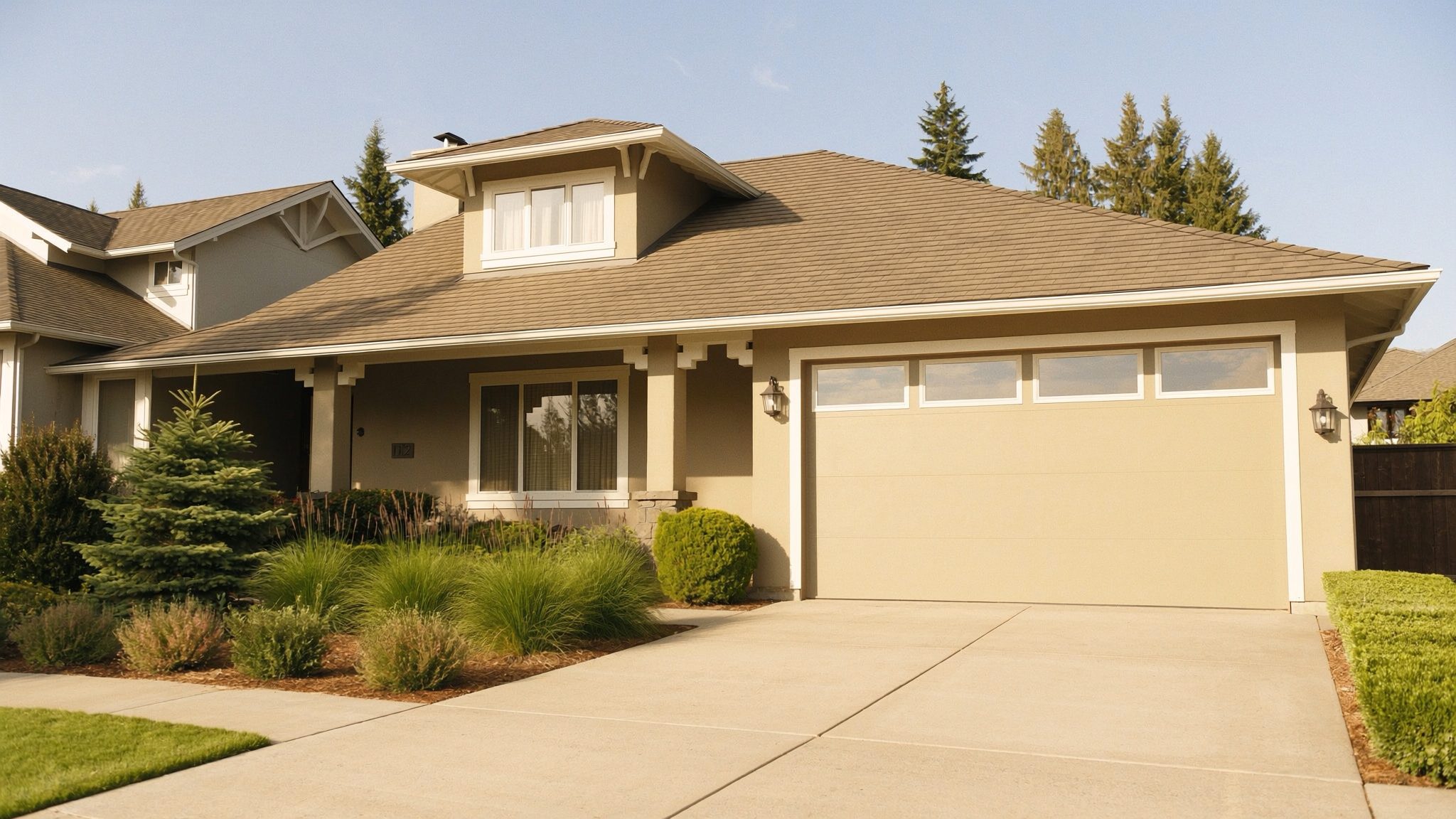
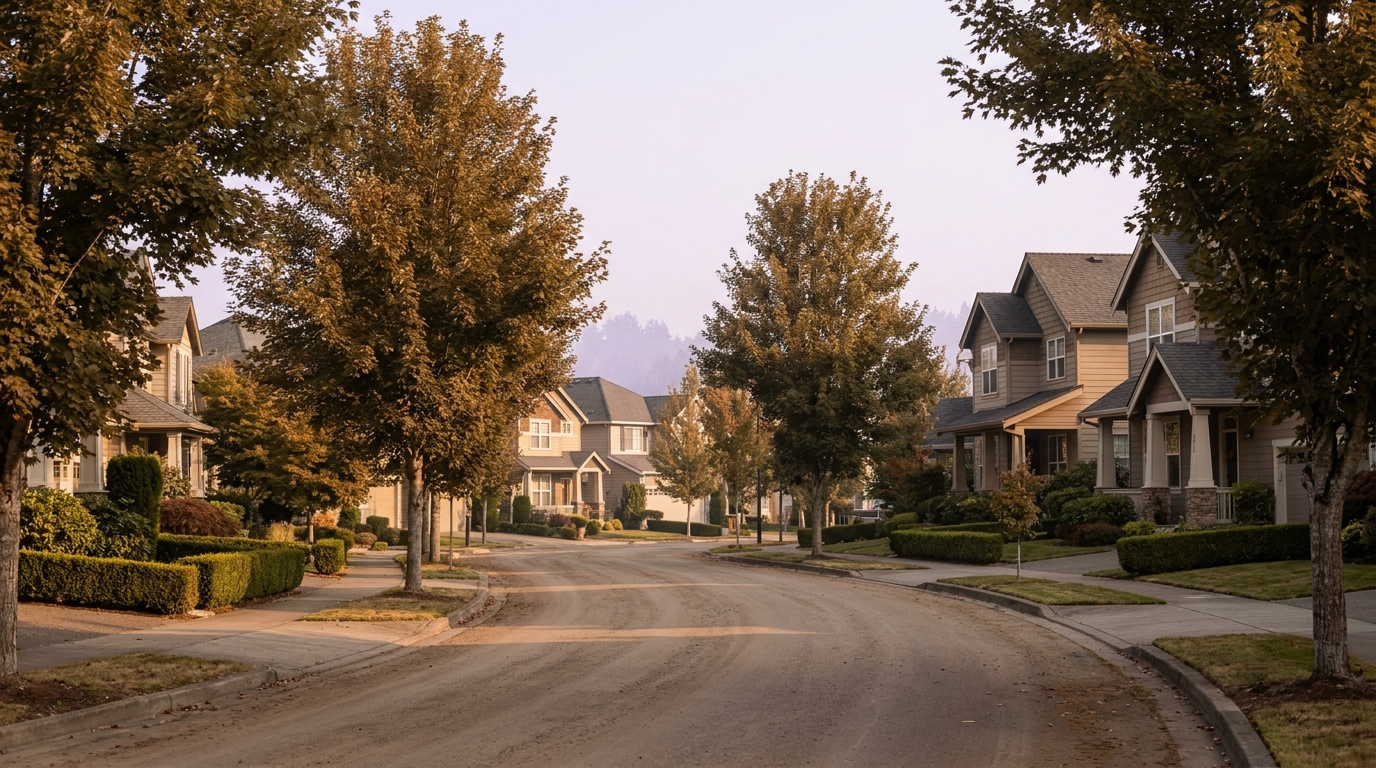
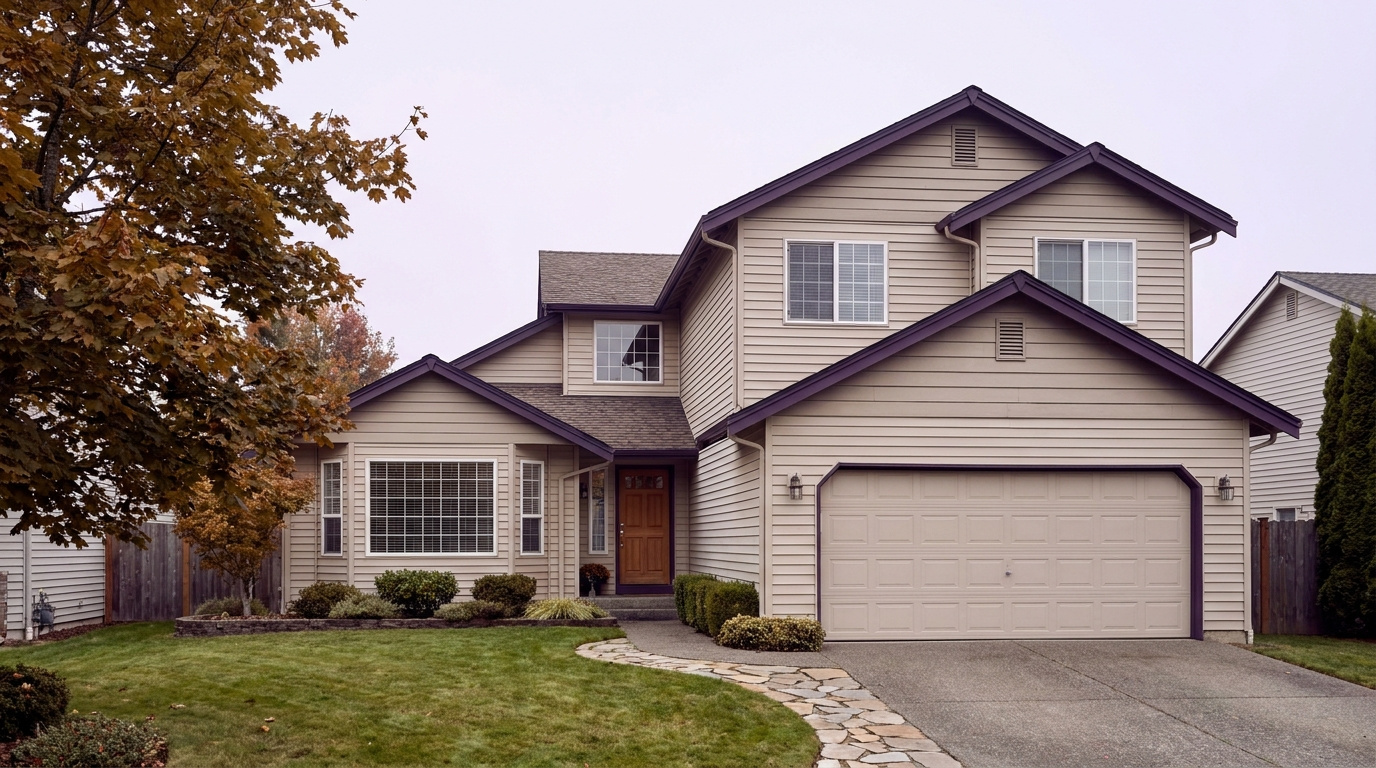
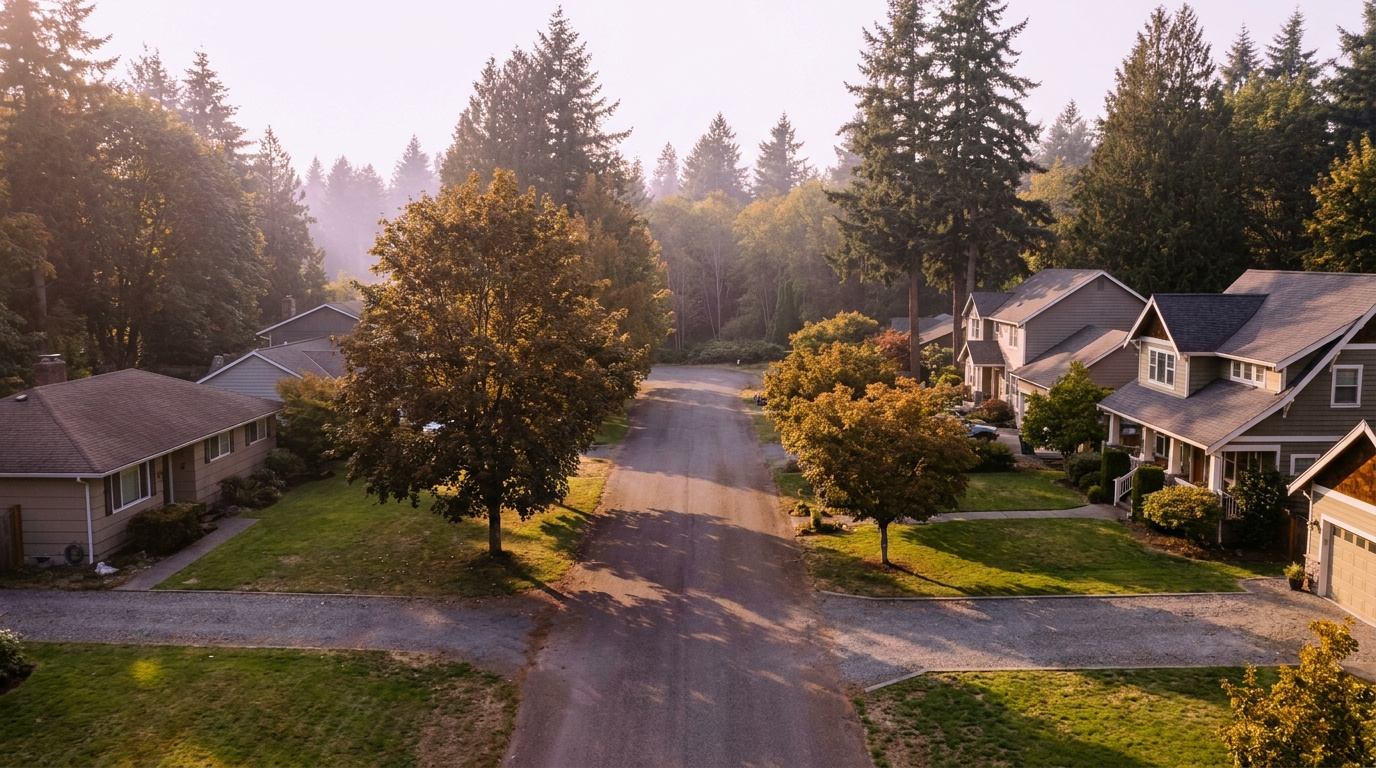
Two-story home exterior typical of the Brittany Lane neighborhood of Federal Way, Washington, built in the 1990s and 2000s
Brittany Lane’s HOA-managed streets carry a consistent look across homes built mostly from the mid 1990s through the 2000s.

What I See as a Valuation Expert in Brittany Lane

When I price homes for institutional clients, HOA condition tends to drive value in a neighborhood like Brittany Lane more than any single interior upgrade. A well-maintained HOA that keeps landscaping and exterior standards consistent holds the whole street’s value ceiling higher than a neighborhood with no oversight, because buyers are pricing the block, not just the one listing in front of them. Roof age, furnace condition, and how recently a kitchen or bath has been touched matter the way they do anywhere, but in an HOA neighborhood, the shared upkeep shows up in comps in ways buyers often miss until they compare two nearly identical homes on different streets.

Curb appeal carries real weight here too. Because Brittany Lane’s lots run smaller, from roughly 4,500 to 7,500 square feet, exterior condition and landscaping do more of the visual work than lot size alone. A home with a fresh coat of paint and a tidy front yard competes well against a larger but neglected property nearby, since buyers in this price range are often choosing between move-in-ready and a project, not between big and small.

Interior streets away from Military Road S traffic noise, and homes closer to Celebration Park, tend to move first and hold value best. Proximity to a well-maintained park amenity typically commands a premium over homes several blocks further from that kind of green space, a pattern that holds across most Federal Way neighborhoods with a comparable park anchor.

Frequently Asked Questions: Living in Brittany Lane

Q: Is Brittany Lane a good place to live in Federal Way?

A: Brittany Lane works well for buyers who want an established, HOA-managed neighborhood with a settled street pattern and easy access to Celebration Park. It sits at Federal Way prices, generally in line with the citywide median, while offering a quieter feel than neighborhoods closer to the downtown core.

Q: Is “The Villages” the same neighborhood as Brittany Lane?

A: Local listings sometimes group nearby south Federal Way development under a “Villages” label, but Brittany Lane is the name residents and the active HOA actually use for this specific neighborhood. If you see “The Villages” referenced for this area, confirm the exact address and HOA before assuming it matches Brittany Lane.

Q: What schools serve Brittany Lane?

A: Brittany Lane falls inside the Federal Way School District, but this pocket sits close enough to the Milton border and a district boundary edge that the exact feeder school can vary by address. Always confirm your specific address with the district’s boundary lookup tool before writing an offer.

Q: How far is Brittany Lane from Seattle?

A: Downtown Seattle runs about 30 miles and 40 to 60 minutes by car during peak hours, or a Link Light Rail ride from the Federal Way Transit Center a short drive north of the neighborhood.

View Brittany Lane on Google Maps

Your guide to life outside Seattle.

Gregory Dorrell | Coldwell Banker Bain | WA License #111862
253-350-0045  ·
greg@livingoutsideseattle.com  ·
www.livingoutsideseattle.com

55+ NeighborhoodBuyer ResourcesFederal WayKing County CitiesSouth King County August 1, 2026

Living in Wynstone, Federal Way | 2026 Guide

Wynstone sits in the eastern part of Federal Way, in the S 320th to S 324th Street corridor near Weyerhaeuser Way S. Lennar built most of the neighborhood in the 1990s and 2000s, and it still reads that way today: consistent rooflines, maintained landscaping, and an HOA that keeps things looking the same from one end of the neighborhood to the other. Right next door sits Belmor Park, a different kind of community entirely. Belmor Park is a 55 and over manufactured home community built in the late 1960s, with its own nine-hole golf course and a clubhouse that has hosted the same card games and potlucks for decades. Two very different housing types share the same corner of Federal Way, and that mix is exactly what makes this part of the city worth a closer look in 2026.

What is it actually like to live in Wynstone and Belmor Park in 2026?

On a weekday morning in Wynstone, the streets have the rhythm of a working neighborhood. Garage doors open around 7, cars head toward I-5 or Pacific Highway, and the HOA-maintained lawns stay green even in late summer because someone is paying attention to the shared standards. It is quiet in a managed way, not an accidental way. Over at Belmor Park, mornings move slower. Golf carts head out to the nine-hole course before the day gets warm, and the clubhouse parking lot starts filling for a morning swim or an exercise class well before most of Federal Way is awake.

Weekends split along similar lines. Wynstone families spend Saturday mornings on yard work or errands at the Safeway on S 320th, then head out to Panther Lake Trail or one of Federal Way’s larger parks in the afternoon. Belmor Park residents are more likely to stay close to home, since the community was built around the idea that everything you need, golf, a pool, a clubhouse, social clubs, is already on site. Sunday evenings in both places are quiet. This is not a nightlife corner of Federal Way, and nobody who lives here is looking for one.

Who lives here depends entirely on which side of the boundary you are talking about. Wynstone draws buyers who want newer construction and predictable HOA upkeep without paying Bellevue or Kent prices for it. Belmor Park draws people 55 and over who want to downsize into a manufactured home without giving up amenities, in a community where neighbors have often known each other for twenty or thirty years. Both groups end up in the same corner of Federal Way for related reasons: consistency, value, and a slower pace than the I-5 corridor a few miles west.

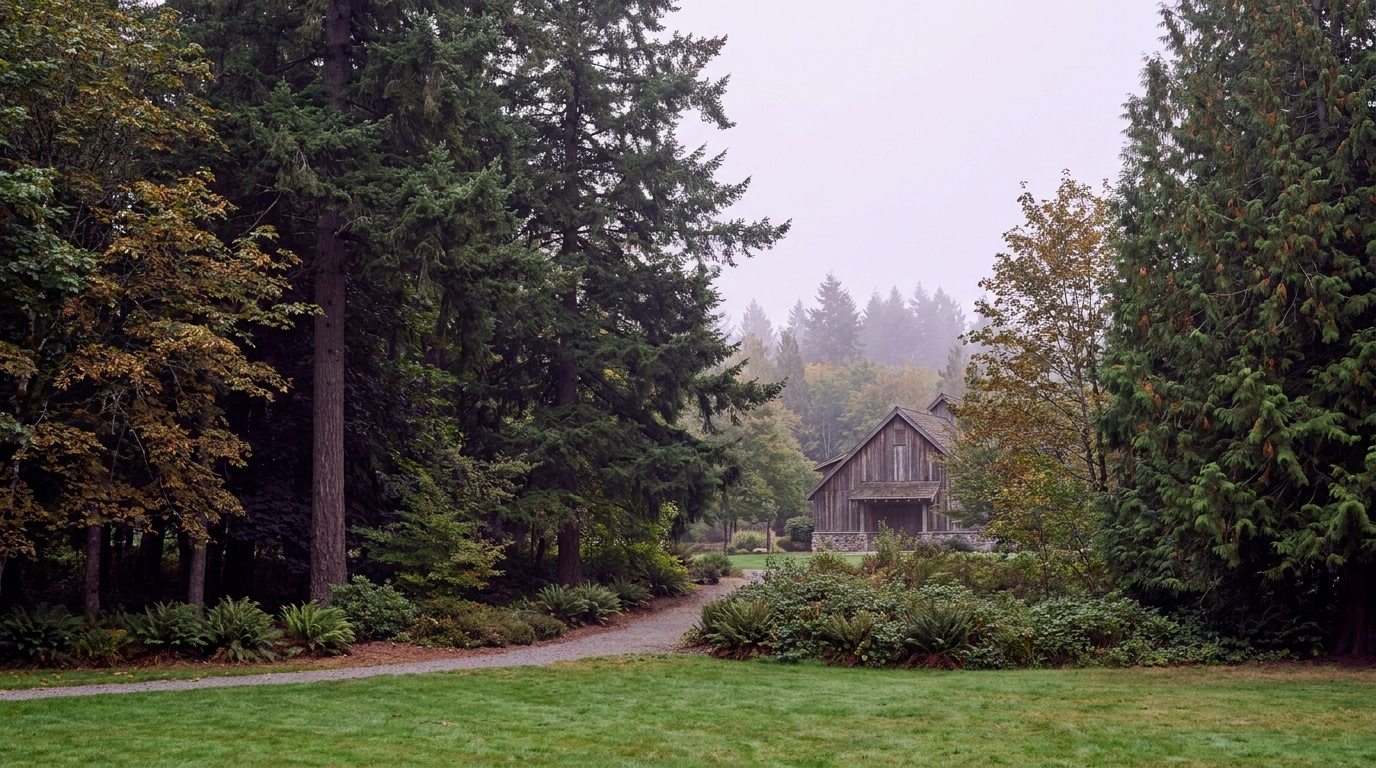
Panther Lake Trail near the Wynstone and Belmor Park area of Federal Way, Washington, a flat wooded walking loop
Panther Lake Trail’s flat, dog-friendly loop gives residents on both sides of this neighborhood an easy walk close to home.

Homes in Wynstone and Belmor Park: What the Data Shows

Wynstone’s single-family homes were mostly built between the 1990s and 2000s, running 1,800 to 3,000 square feet on lots from 5,000 to 8,000 square feet. Prices typically land between $525,000 and $650,000, which puts Wynstone right in line with Federal Way’s citywide median. Construction is standard Northwest suburban: two-story floor plans, attached two-car garages, vinyl and lap siding, and small to moderate yards that the HOA keeps looking consistent block to block. Belmor Park is a completely different product. Homes there are manufactured or mobile homes on leased or owned lots inside the 55 and over community, generally single-level and modest in size, priced well under Wynstone’s range and valued more on lot lease terms, home condition, and community amenities than on square footage alone. Anyone comparing the two needs to understand they are pricing two different housing types, not two versions of the same thing.

Data as of June 2026.

Market Pulse Federal Way (City) King County
Median Sales Price (June 2026) ~$675,000 ~$998,000
Median Days on Market ~11 days ~10 days
Active Listings Change (vs. Jan 2026) County-wide inventory is up roughly 30% year over year +30%

Figures are Federal Way city-level NWMLS data for June 2026, since Wynstone and Belmor Park are not tracked as standalone MLS reporting zones. Belmor Park manufactured homes trade on a separate basis (home value plus lot lease terms) and are not reflected in the residential median above.

Schools Serving Wynstone (and District Context for Belmor Park)

Wynstone falls inside the Federal Way School District, and students here typically attend Valhalla Elementary and Illahee Middle School before feeding into Thomas Jefferson High School. Worth knowing before you assume anything from the names alone: both Valhalla Elementary and Thomas Jefferson High School are physically located across the border in Auburn, even though they are Federal Way Public Schools facilities serving this attendance area. Illahee Middle School sits inside Federal Way proper. As always, confirm your specific address with the district before writing an offer, since boundary lines can run through a neighborhood in ways that surprise buyers.

Thomas Jefferson has a well-known fine arts program and a close-knit community feel that families in this part of Federal Way often mention. Illahee offers a Gifted and Talented program alongside Project Lead the Way, giving families an early STEM track option. None of these schools carry a Belmor Park boundary distinction, since Belmor Park is a 55 and over community and does not enroll school-age children as a matter of its age restriction. For buyers evaluating Belmor Park purely on resale and community context, the relevant fact is simply that it sits inside the Federal Way School District’s broader service area, which supports property values in the surrounding corridor even for age-restricted housing that never uses the schools directly.

For Wynstone families, the day-in-the-life pipeline usually runs by bus. Younger kids are bused to Valhalla, middle schoolers transition to Illahee, and high schoolers make the longer ride out to Thomas Jefferson in Auburn. It is a longer bus pipeline than some Federal Way neighborhoods because two of the three schools sit outside city limits, so families cross-shopping Wynstone against neighborhoods with in-city schools should factor that into their daily routine expectations.

Getting to Work from Wynstone

From Wynstone, the fastest route to I-5 runs west along S 320th St, putting you on the freeway in under ten minutes most mornings. Pacific Highway S offers a slower but reliable surface-street alternative when I-5 backs up. The Federal Way Transit Center and its Link Light Rail station sit a short drive or a longer walk away, and King County Metro routes 402 and 181 both stop at Pacific Hwy S and S 324th St, giving residents without a car a direct path into the regional transit network.

Destination Distance 2026 Drive Time (Peak AM) Transit Option
Downtown Seattle 27 miles 35 to 55 min 1 Line Light Rail / I-5
Bellevue / Amazon 25 miles 40 to 55 min I-5 to I-405 / Drive
Microsoft (Redmond) 35 miles 50 to 70 min Drive / SR-99 to I-405
SeaTac Airport 12 miles 15 to 25 min 1 Line Light Rail (direct) / Drive

For Belmor Park residents, the more relevant destination is often St. Francis Hospital in Federal Way, about 4 miles and a 10 to 15 minute drive, rather than a downtown commute, since the community skews toward retirees who are no longer commuting daily.

Two-story home exterior typical of the Wynstone neighborhood of Federal Way, Washington, built in the 1990s and 2000s
Wynstone’s HOA-managed streets keep a consistent look across homes built mostly in the 1990s and 2000s.

What I See as a Valuation Expert in Wynstone and Belmor Park

When I price homes for institutional clients, HOA condition and consistency tend to drive value more than any single upgrade inside a Wynstone home. A well-run HOA that enforces landscaping and exterior standards holds a neighborhood’s overall value ceiling higher than one that lets things slide, because buyers are pricing the whole street, not just the one listing. Roof age, furnace age, and whether a kitchen has been touched since the original build all matter here the way they do anywhere, but the HOA’s track record shows up in comps in a way a lot of buyers underestimate until they compare two nearly identical homes on different streets.

Belmor Park works on a fundamentally different valuation model. Because it involves manufactured housing inside a land-lease or age-restricted ownership structure, value depends heavily on the lot arrangement, the age and condition of the specific unit, and the health of the community’s shared amenities like the golf course and clubhouse. Curb appeal still matters, but it competes with lot terms as the primary driver of what a Belmor Park home is actually worth on resale.

In Wynstone, homes on the interior loops away from S 320th and S 324th traffic noise tend to move first and hold value best. In Belmor Park, units closest to the clubhouse and golf course frontage typically command a premium over units on the community’s outer edges, following the same logic that applies to golf-course-adjacent housing everywhere.

Frequently Asked Questions: Living in Wynstone and Belmor Park

Q: Is Wynstone a good place to live in Federal Way?

A: Wynstone works well for buyers who want newer construction, from the 1990s and 2000s, and an HOA that keeps the neighborhood looking consistent. It sits at Federal Way prices, generally $525,000 to $650,000, while offering easier freeway and transit access than more remote parts of the city.

Q: What is Belmor Park and who can live there?

A: Belmor Park is a manufactured home community built in the late 1960s for residents 55 and over. It includes a nine-hole golf course, a clubhouse, and an indoor pool, and it operates under federal HOPA rules that allow the community to restrict residency by age.

Q: What schools serve Wynstone?

A: Wynstone students typically attend Valhalla Elementary and Illahee Middle School, feeding into Thomas Jefferson High School, all part of the Federal Way School District. Valhalla and Thomas Jefferson are physically located in Auburn despite being Federal Way Public Schools facilities.

Q: How far is this part of Federal Way from Seattle?

A: Downtown Seattle runs about 27 miles and 35 to 55 minutes by car during peak hours, or a Link Light Rail ride from the Federal Way Transit Center a short drive from either community.

View Wynstone and Belmor Park on Google Maps

Your guide to life outside Seattle.

Gregory Dorrell | Coldwell Banker Bain | WA License #111862
253-350-0045  ·
greg@livingoutsideseattle.com  ·
www.livingoutsideseattle.com

Buyer ResourcesFederal WayKing County CitiesSouth King County July 31, 2026

Living in Marine Hills, Federal Way WA | 2026 Guide

Living in Marine Hills, Federal Way means living on a hillside that steps down toward Puget Sound, with the Redondo waterfront right at the bottom of the slope near the Des Moines line. Homes here date mostly to the 1960s and 1970s, split-levels and midcentury ramblers that climb the terrain in tiers, many with a real view of the water and the Olympic Mountains beyond it. This is a Family-First Established neighborhood. The median home here was built in 1974, and a lot of the people who live here have been here a long time, which says something about how the neighborhood holds up once you move in. Buyers drawn to Marine Hills in 2026 want that view and that established feel without paying Bellevue or West Seattle prices to get it.

What is it actually like to live in Marine Hills in 2026?

On a Tuesday morning, Marine Hills is quiet in the way hillside neighborhoods tend to be. Cars pull out of driveways set into the slope and head down toward Dash Point Road, the main route off the hill and into the rest of Federal Way. Marine Hills is a car-dependent neighborhood, so almost everyone is driving, whether the destination is the Federal Way Transit Center for a bus connection or straight onto Highway 99 and I-5. The homes closest to the water stay shaded longer into the morning, tucked below the ridge line that gives the upper streets their view.

Weekends bring people down the hill toward the water. Wooton Park’s boardwalk draws walkers looking out over Poverty Bay, and the Redondo waterfront, just over the line toward Des Moines, pulls people in for a walk along the water or dinner with a view. Sacajawea Park, also inside the neighborhood, hosts youth sports on its fields most Saturdays in season. It is not a neighborhood built around one single gathering spot so much as a string of small, real destinations within a few minutes of most homes.

The people who land in Marine Hills tend to want an established home with a real view, not a new build in a subdivision further from the water. Compared to newer pockets of Federal Way like the areas around Celebration Park, Marine Hills trades some of that newer-construction convenience for older homes, bigger hillside lots, and water views that are hard to find anywhere else in the city at this price point. Buyers who want more space between homes and don’t mind a steep driveway tend to do well here.

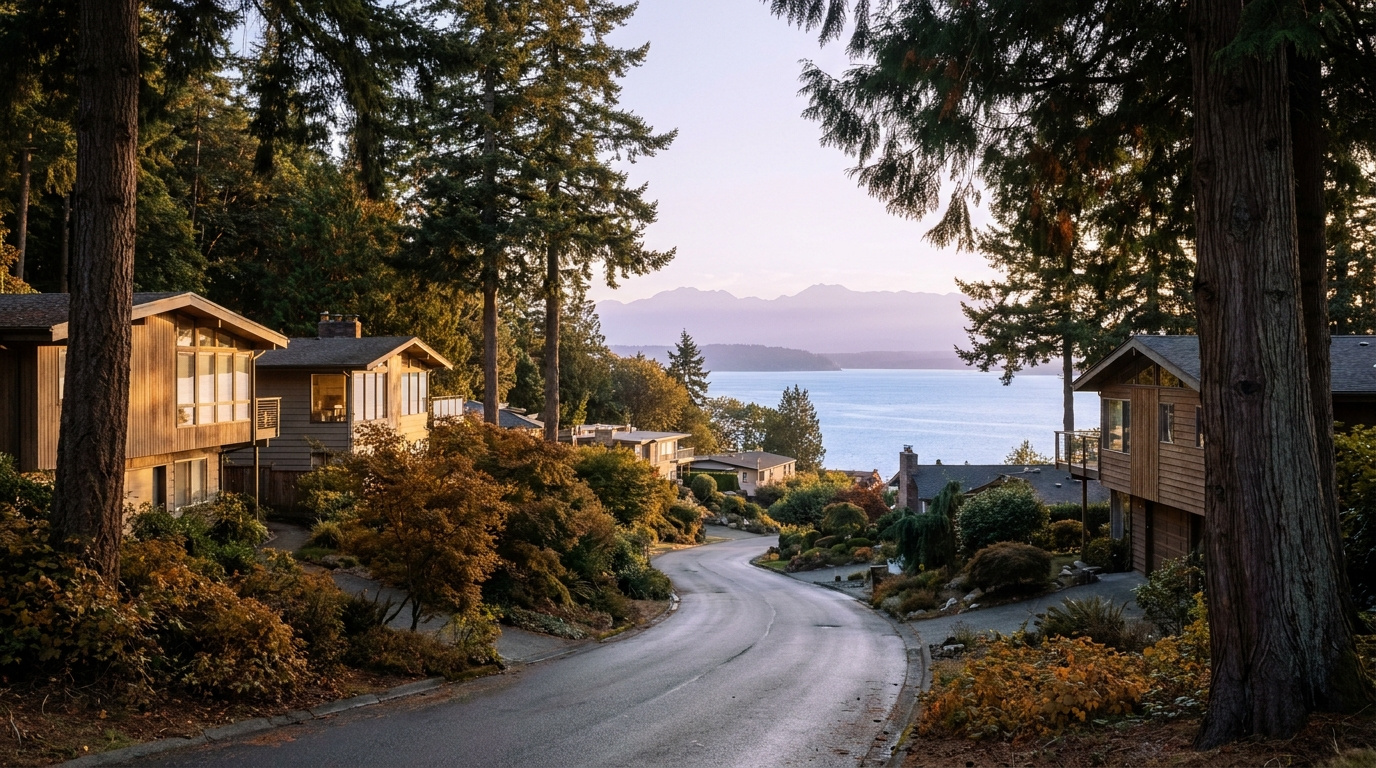
Puget Sound waterfront view near the Redondo boardwalk below the Marine Hills neighborhood of Federal Way, Washington
The Puget Sound waterfront at the base of the Marine Hills slope, near the Redondo boardwalk.

Homes in Marine Hills: What the Data Shows

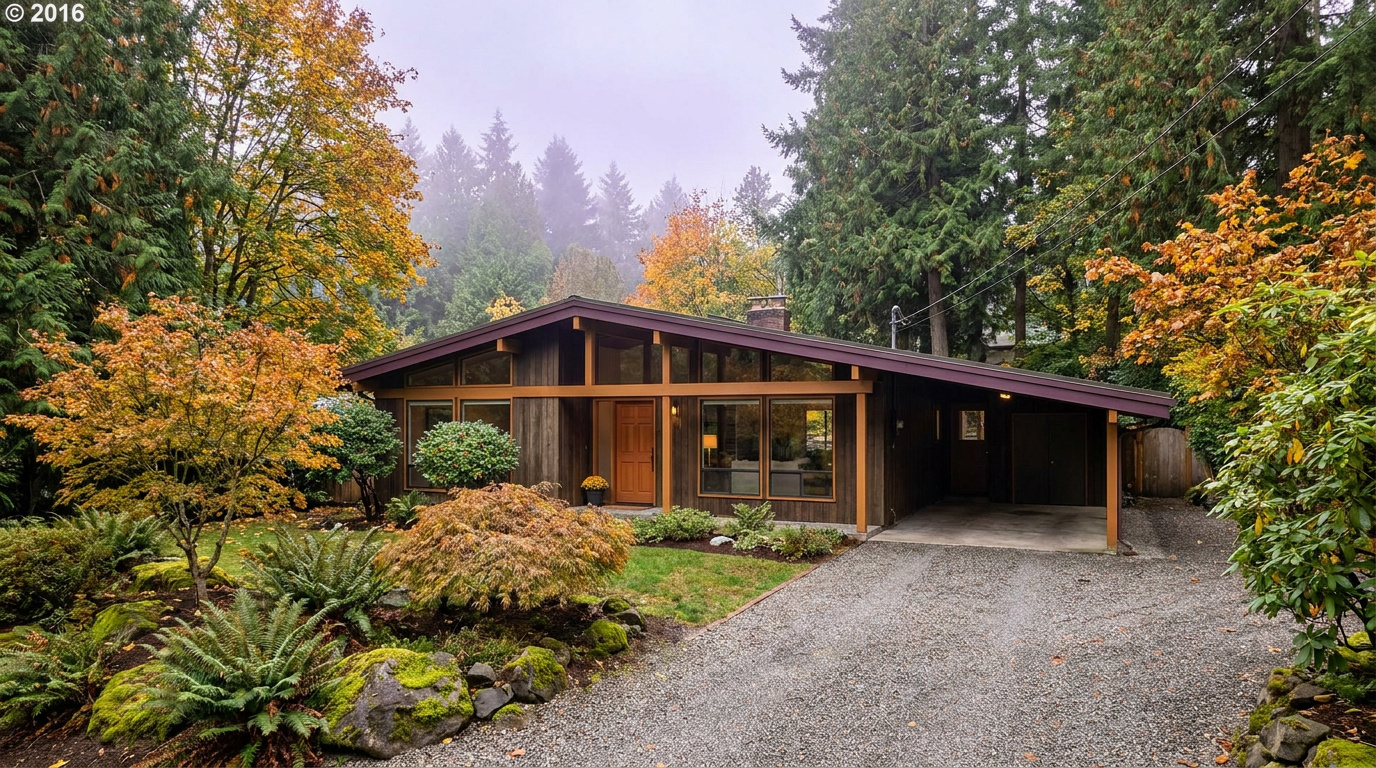
Most homes in Marine Hills date to the 1960s and 1970s, split-level and midcentury modern construction with large windows built to catch the view down the hill. Home sizes run from roughly 1,400 square feet for the smaller entry-level ramblers up toward 3,000 square feet or more for the larger view homes higher on the slope, spread across multiple levels to work with the terrain rather than fight it. Lot sizes range from about 7,000 square feet on the smaller interior lots up to 14,000 square feet or more on some of the corner and view lots. Detached single-family homes make up nearly all of the housing stock here. Entry-level ramblers typically start in the $400,000s and run up toward $800,000, while the midcentury modern homes closest to the water with a more open Sound view can push past $1 million. This is not a subdivision built out by one or two production builders. The homes are eclectic, a mix of styles built out gradually as the hillside filled in, and it shows in how different one block can look from the next.

Data as of June 2026.

Market Pulse Federal Way King County
Median Sales Price (June 2026) ~$675,000 ~$998,000
Median Days on Market ~11 days ~10 days
Active Listings Change (vs. Jan 2026) +132% +127%

Figures reflect Federal Way city-level NWMLS residential data for June 2026, the most recent complete month available. Marine Hills and Redondo are a sub-area within these city figures rather than a standalone MLS reporting zone, so treat the numbers as directional, especially since home values here vary a lot by proximity to the water.

Schools Serving Marine Hills

Marine Hills falls inside the Federal Way Public Schools district. I checked the district’s official address-based boundary lookup at three separate addresses spread across the neighborhood, from the water-view streets near the north end to the interior streets further south, and all three returned the same pipeline: Nautilus Elementary, then Sacajawea Middle School, then Federal Way High School. Both Nautilus and Sacajawea sit physically inside Marine Hills, which is not something every Federal Way neighborhood can say. One note for buyers: an older claim tied to this neighborhood names a school called Redondo Elementary feeding a different middle and high school pipeline (Lakota Middle and Decatur High). I could not find a Federal Way Public Schools campus by that name, and it does not match what the district’s own boundary tool returns for this neighborhood, so treat that older pairing as incorrect.

Nautilus, which the district also runs as a K-8 program for families who choose it, offers a STEAM-focused curriculum with Gifted and Talented options and a community garden on campus. Sacajawea Middle School offers a Gifted and Talented track, Project Lead the Way, and Cambridge International coursework. Federal Way High School added a new football stadium in 2023 and offers Advanced Placement classes alongside Project Lead the Way.

Because Nautilus and Sacajawea both sit inside the neighborhood itself, most Marine Hills kids are riding a bus or being driven a short distance for elementary and middle school rather than crossing the city, before moving on to Federal Way High School for grades nine through twelve. School assignments can still change block by block near any boundary edge, so confirm your specific address with the district before writing an offer.

Getting to Work from Marine Hills

Take Dash Point Road east off the hill to reach Highway 99 and I-5, or connect into King County Metro’s local routes for a ride to the Federal Way Transit Center, where the RapidRide A Line and the 1 Line light rail continue north. Marine Hills itself scores low for walkability and transit access, so plan on driving to most daily errands and to the transit center itself.

Destination Distance 2026 Drive Time (Peak AM) Transit Option
Downtown Seattle 22 miles 30 to 50 min 1 Line Light Rail / I-5
Amazon (South Lake Union) 24 miles 35 to 55 min Link Transfer at Westlake / Drive
Microsoft (Redmond) 32 miles 50 to 70 min Drive / SR-99 to I-405
SeaTac Airport 11 miles 20 to 30 min 1 Line Light Rail (via Federal Way Downtown Station) / Drive

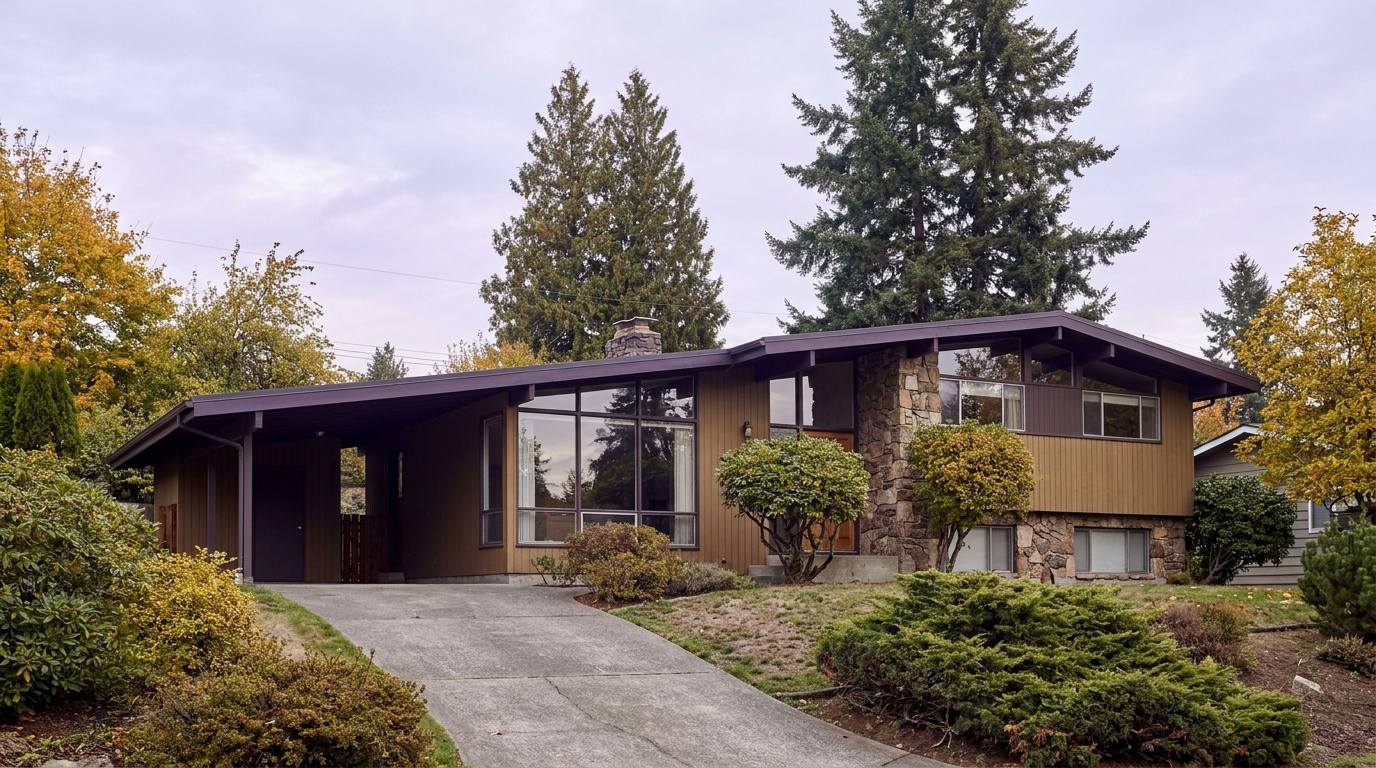
Midcentury split-level home exterior typical of the Marine Hills neighborhood of Federal Way, WA
Homes in Marine Hills are mostly 1960s and 1970s split-level and midcentury modern construction built to catch the hillside view.

What I See as a Valuation Expert in Marine Hills

When I price homes for institutional clients, a real, unobstructed water view is one of the clearest value drivers I see anywhere in Federal Way, and Marine Hills has more of that view inventory than almost any other neighborhood in the city. Two homes on the same block, same square footage, can price meaningfully differently depending on whether the view is open water and mountains or a filtered glimpse between rooflines.

Because so much of this neighborhood sits on a hillside, lot condition and drainage matter more here than in flatter parts of Federal Way. Retaining walls, drainage systems, and the condition of a steep driveway carry real weight in how I assess a property, and buyers should budget for those systems the same way they budget for a roof.

Streets closest to the water and highest on the slope, where the view opens up fully, tend to move first when priced correctly. Interior streets a block or two off the view corridor sell fine but usually take longer and command less per square foot, even with a nearly identical home.

Explore Marine Hills Yourself

View Marine Hills on Google Maps →

Is Marine Hills a good place to live? It works well if you want an established Federal Way neighborhood with real Puget Sound views and easy access to the Redondo waterfront, especially if a hillside lot and an older home don’t bother you.

What are homes like in Marine Hills? Mostly 1960s and 1970s split-level and midcentury modern homes, typically 1,400 to 3,000 square feet on lots from about 7,000 to 14,000 square feet, spread across multiple levels to fit the hillside.

What schools serve Marine Hills? The neighborhood falls in Federal Way Public Schools. Per the district’s official boundary lookup, checked at three addresses across the neighborhood, homes here feed Nautilus Elementary, then Sacajawea Middle School, then Federal Way High School. Both Nautilus and Sacajawea sit physically inside Marine Hills. Always confirm your specific address with the district before writing an offer.

How far is Marine Hills from Seattle? About 22 miles, with a 30 to 50 minute peak commute by car, or a connection to the 1 Line at Federal Way Downtown Station a short drive away.

Your guide to life outside Seattle.

Gregory Dorrell | Coldwell Banker Bain | WA License #111862
253-350-0045  ·
greg@livingoutsideseattle.com  ·
www.livingoutsideseattle.com

Buyer ResourcesFederal WayKing County CitiesSouth King County July 31, 2026

Living in South Federal Way, WA | 2026 Guide

Living in South Federal Way means trading a little city bustle for more room, both inside the house and out in the yard. This part of the city sits south of S 356th Street, close enough to the Pierce County line that some daily errands pull you toward Tacoma-area roads as often as toward downtown Federal Way. The Camelot name comes up often in conversation, though it is more of a local shorthand than an official subdivision. What you get here is a Family-First Established feel: larger lots, a mix of older homes and newer infill, and a lower price per square foot than almost anywhere else in the city. Buyers priced out of Federal Way’s core keep landing here in 2026 because the math still works.

What is it actually like to live in South Federal Way in 2026?

On a Tuesday morning, South Federal Way feels less hurried than the commercial stretch along Pacific Highway a few minutes north. Driveways here tend to be longer and traffic lighter once you turn off the main arterials onto the residential side streets. Commuters headed north toward downtown Federal Way or east toward SR-18 and Auburn make up most of the morning traffic, since this part of the city sits at a crossroads between two commute directions rather than funneling everyone one way.

Weekends bring more activity to Brooklake Park, where the restored blueberry farm draws local families during picking season. This is not a neighborhood built around one signature amenity the way some Federal Way neighborhoods are built around a lake or a beach. It is a working residential area, and the appeal is space and value rather than a single standout feature.

The people who choose South Federal Way tend to want more house and yard than they can get for the same money closer to downtown Federal Way or in Kent. Compared to a neighborhood like Wynstone, lots here run larger and the housing stock is more varied. Buyers who want SR-18 access to Auburn, something few other Federal Way neighborhoods offer as directly, notice the difference in their daily drive right away.

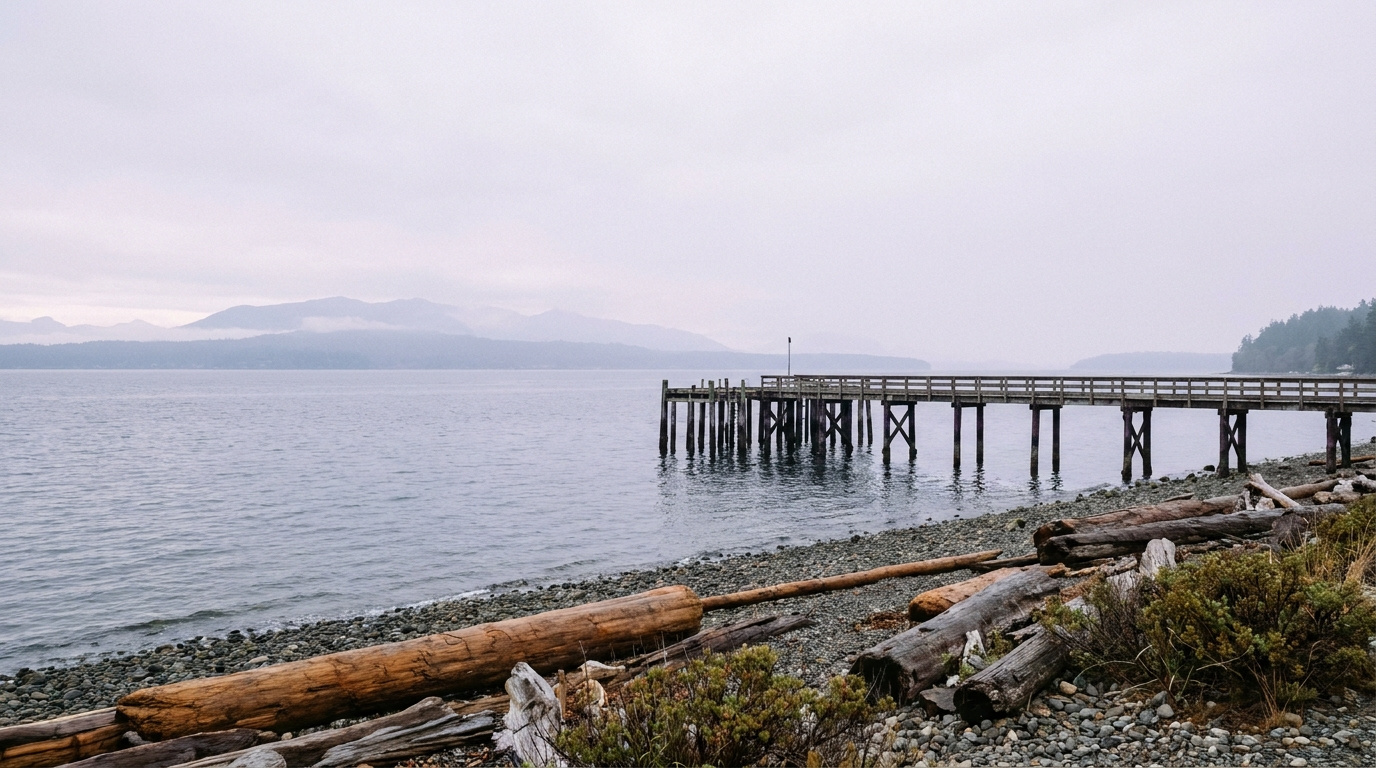
Brooklake Historic Community Center and Park Area in South Federal Way, Washington, a natural area and community gathering space on S 356th Street
Brooklake Park sits right on S 356th Street, giving South Federal Way residents a natural area and community space close to home.

Homes in South Federal Way: What the Data Shows

South Federal Way’s housing stock spans several decades, a mix of older established homes built out since the 1970s and 1980s alongside pockets of newer infill construction. Home sizes run from about 1,500 square feet on the smaller, older properties up to 3,000 square feet or more on newer builds. Lot sizes are the area’s biggest draw, ranging from 8,000 up to 14,000 square feet or larger, noticeably bigger than what buyers typically find closer to downtown Federal Way. Detached single-family homes make up nearly all of the housing here. Some newer subdivisions carry an HOA that maintains shared common areas, while the older streets have none. This is one of Federal Way’s most affordable sectors by price per square foot, which is exactly why value-focused buyers keep circling back to it.

Data as of June 2026.

Market Pulse Federal Way King County
Median Sales Price (June 2026) ~$675,000 ~$998,000
Median Days on Market ~11 days ~10 days
Active Listings Change (vs. Jan 2026) +390% +127%

Figures are Federal Way city-level NWMLS data (South Federal Way and Camelot are not a standalone MLS reporting zone), sourced through the Living Outside Seattle monthly market feed. Active listings change reflects the normal seasonal climb from January’s low-inventory winter months, not a South Federal Way-specific trend.

Schools Serving South Federal Way

South Federal Way sits inside the Federal Way Public Schools boundary, but this part of the city, especially south of S 356th Street near the Pierce County line, includes areas where the district has drawn boundary lines through more than once. I could not confirm a single elementary feeder for every address in this area from public sources alone, and I would rather tell you that plainly than guess. Depending on the exact address, families here have landed in different elementary assignments within the district.

What I can confirm is the district itself, Federal Way Public Schools, and that every home in this area feeds eventually into one of the district’s middle and high schools. The safest move if you are house hunting here is the same one I would make: pull up the district’s official boundary lookup tool for the specific address before you write an offer, not after. If you have a specific program in mind, dual language, STEM, or a gifted track, call the district enrollment office directly. Boundary lines here can split one block from the next, so a neighbor’s assignment is not a reliable stand-in for your own address.

Getting to Work from South Federal Way

Take Pacific Hwy S north to reach downtown Federal Way and I-5, or head east on S 356th St to pick up SR-18 toward Auburn, an option most other Federal Way neighborhoods do not have as directly.

Destination Distance 2026 Drive Time (Peak AM) Transit Option
Downtown Seattle 27 miles 40 to 60 min I-5 / ST Link light rail from Federal Way Downtown Station
Bellevue / Amazon 24 miles 35 to 55 min SR-18 to I-405 north
Microsoft (Redmond) 30 miles 45 to 65 min SR-18 to I-405 to SR-520
SeaTac Airport 14 miles 20 to 30 min I-5 north

Single-family home exterior typical of the South Federal Way and Camelot area near the Pierce County line
South Federal Way homes sit on some of the larger lots in the city, a mix of older established construction and newer infill.

What I See as a Valuation Expert in South Federal Way

When I assess homes here for institutional lenders, lot size carries more of the value story than it does in Federal Way’s denser neighborhoods. A larger, usable lot with room to add a shop or expand the driveway tends to command a real premium over a similarly sized home on a tight interior lot, even a few blocks away.

HOA presence swings value in both directions here. Newer subdivisions with an HOA see well-maintained common areas support price, while on the older, non-HOA streets, curb appeal and deferred maintenance carry more weight since there is no shared standard pulling every yard toward the same baseline.

Streets closer to Brooklake Park and the quieter interior blocks away from Pacific Hwy S traffic noise tend to move first and hold value best. Corner lots with usable side yard, not just a wider setback, are the other feature buyers compete hardest for here.

Frequently Asked Questions

Q: Is South Federal Way a good place to live?
A: It works well if you want more lot size and a lower price per square foot than the rest of Federal Way, and you don’t mind a longer drive to some amenities. It suits buyers who prioritize space and value over walkability to a downtown core.

Q: What are homes like in South Federal Way?
A: A mix of older established homes from the 1970s and 1980s and newer infill construction, typically 1,500 to 3,000+ square feet on lots from 8,000 to 14,000 square feet or larger. Some newer subdivisions have an HOA, while older streets do not.

Q: What schools serve South Federal Way?
A: Federal Way Public Schools serves this area, but the specific elementary assignment can vary block to block near the Pierce County line. Always confirm your exact address with the district’s official boundary lookup before making an offer.

Q: How far is South Federal Way from Seattle?
A: About 27 miles, typically a 40 to 60 minute drive during peak morning traffic, or a drive to Federal Way Downtown Station to catch the Link light rail.

Explore South Federal Way Yourself

View South Federal Way on Google Maps →

Your guide to life outside Seattle.

Gregory Dorrell | Coldwell Banker Bain | WA License #111862
253-350-0045  ·
greg@livingoutsideseattle.com  ·
www.livingoutsideseattle.com

Buyer ResourcesFederal WayKing County NeighborhoodsSouth King County July 30, 2026

Living in Celebration Park, Federal Way WA | 2026 Guide

Living in Celebration Park, Federal Way means living within a few minutes of the city’s biggest recreational asset. This corner of southwest Federal Way built up through the 1980s and 1990s around what became an 83.5 acre park with four lighted baseball fields, four lighted soccer fields, a playground, and trails that connect into the regional BPA Trail. Easter Lake, a small neighborhood lake a short distance away, gives the surrounding streets a quieter, more residential feel once you turn off the main corridors. This is a Family-First Established neighborhood, and it shows in the number of families who chose it specifically for the park at the center of it.

What is it actually like to live in Celebration Park in 2026?

On a Tuesday morning, the streets around Celebration Park and Easter Lake carry the ordinary rhythm of a settled residential pocket. Cars head out toward S 320th Street or Pacific Highway South, some continuing to the RapidRide A Line stop for a commute north or south, others turning toward I-5. The park itself sits quiet on weekday mornings, its eight lighted fields empty until practice season ramps up in the afternoon.

Weekends look different. Celebration Park is one of the busiest recreational spots in Federal Way, and on a Saturday in spring or fall the parking lots fill with families dropping kids at baseball and soccer games across the park’s eight fields. Others use the trail system that threads through the park and connects to the BPA Trail for a walk or a run. Easter Lake, tucked into the surrounding streets, offers a calmer contrast, a small lake that residents pass on quiet walks rather than a destination in its own right.

The people who land in this part of Federal Way tend to have kids in organized sports, or simply want an established home within walking or short driving distance of a serious recreational amenity. Compared to Mirror Lake or Twin Lakes elsewhere in the city, Celebration Park and Easter Lake trade a bit of that quieter lake-focused character for direct proximity to the park complex itself. Buyers who coach a team or spend their weekends at practice notice the difference in convenience right away.

Celebration Park athletic fields and walking trail in Federal Way, Washington, the anchor amenity for the surrounding neighborhood
Celebration Park’s lighted fields and trail system anchor the neighborhood that shares its name.

Homes in Celebration Park: What the Data Shows

Most homes in the Celebration Park and Easter Lake area date to the 1980s and 1990s, running 1,500 to 2,800 square feet on lots between 7,000 and 12,000 square feet, some of the larger lots in this part of the city. Detached single-family homes dominate the housing stock, mostly two-story construction with attached garages, typical of Federal Way’s suburban buildout during that era. It is not a neighborhood built around a single architectural style so much as a practical, family-oriented housing stock that has held up well, especially the homes closest to the park and to Easter Lake.

Data as of June 2026.

Market Pulse Federal Way King County
Median Sales Price (June 2026) ~$675,000 ~$998,000
Median Days on Market ~11 days ~10 days
Active Listings Change (vs. Jan 2026) +132% +127%

Figures reflect Federal Way city-level NWMLS residential data for June 2026, the most recent complete month available. Celebration Park and Easter Lake are a sub-area within these city figures rather than a standalone MLS reporting zone, so treat the numbers as directional for this specific pocket of the city.

Schools Serving Celebration Park

Celebration Park and Easter Lake fall inside the Federal Way Public Schools district. According to the district’s official address-based boundary lookup, homes in this pocket of the city, checked at addresses near Celebration Park, along S 320th Street, and near Easter Lake itself, feed into Mirror Lake Elementary, then Sequoyah Middle School, then Todd Beamer High School. One quirk worth knowing: Sequoyah Middle School carries an Auburn mailing address even though it is a Federal Way Public Schools campus, since district lines in south King County do not always follow city limits. Always confirm your specific address with the district before writing an offer, since boundary lines can shift block by block near any neighborhood edge.

Mirror Lake Elementary offers a Gifted and Talented program and Project Lead the Way curriculum for grades K through 5. Sequoyah Middle School also runs a Gifted and Talented track and Project Lead the Way for grades 6 through 8. Todd Beamer High School, established in 2003, offers Advanced Placement coursework alongside Project Lead the Way and a Gifted and Talented program for grades 9 through 12.

The day-in-the-life pipeline runs from an elementary school a short drive north of the neighborhood to a middle school with an out-of-city address to a high school back in Federal Way, which is a slightly more complex path than some other Federal Way neighborhoods. Elementary-age kids typically bus or are driven given the distance, while middle and high schoolers also typically bus. Given the address quirk at the middle school level, and the fact that Mirror Lake Elementary’s attendance area splits into more than one middle school depending on the specific street, this is a pipeline worth double-checking directly with the district for any specific home you are considering.

Getting to Work from Celebration Park

Take S 320th Street east to reach I-5, or catch the RapidRide A Line at S 320th St and 11th Pl S for a direct connection to Federal Way Downtown Station, where the 1 Line light rail continues north toward Seattle. Both options cover most of the commute story for this part of the city, and residents without a car in the household still have a real transit path to the rest of the region.

Destination Distance 2026 Drive Time (Peak AM) Transit Option
Downtown Seattle 26 miles 35 to 55 min 1 Line Light Rail / I-5
Amazon (South Lake Union) 27 miles 40 to 60 min Link Transfer at Westlake / Drive
Microsoft (Redmond) 34 miles 50 to 70 min Drive / SR-99 to I-405
SeaTac Airport 11 miles 15 to 25 min 1 Line Light Rail (direct) / Drive

Two-story home exterior typical of the Celebration Park and Easter Lake area of Federal Way, WA
Homes near Celebration Park are mostly 1980s and 1990s two-story construction on larger, established lots.

What I See as a Valuation Expert in Celebration Park

When I price homes for institutional clients, proximity to Celebration Park tends to drive real value in this pocket of Federal Way, particularly for buyers with kids in year round travel sports who want a short drive to practice rather than a long one. A home within a few blocks of the park typically commands a premium over a comparable home ten minutes away, even when the floor plans are nearly identical.

Lot size and curb appeal matter more here than in some tighter Federal Way subdivisions, since this pocket of the city carries some of the larger lots in town. A well-maintained yard on a 10,000 square foot lot tends to draw more attention than a similar home on a smaller lot, and buyers notice the difference between original 1980s and 1990s systems and homes that have been updated.

Streets closest to Easter Lake and the park’s trail entrances tend to move first when they are priced correctly. Buyers who prioritize the park’s fields and trails over a lake view specifically will pay up for that convenience, and it shows in shorter days on market for well-priced listings in the immediate area.

Explore Celebration Park Yourself

View Celebration Park on Google Maps →

Is Celebration Park a good place to live? It works well if you want an established Federal Way neighborhood built around one of the city’s biggest recreational amenities, with larger lots and easy trail access, especially if you have kids in organized sports.

What are homes like near Celebration Park? Mostly 1980s and 1990s two-story homes, typically 1,500 to 2,800 square feet on lots between 7,000 and 12,000 square feet, some of the larger lots in this part of the city.

What schools serve this area? The area falls in Federal Way Public Schools. Per the district’s official boundary lookup, Mirror Lake Elementary feeds into Sequoyah Middle School, which carries an Auburn address despite being a Federal Way Public Schools campus, then Todd Beamer High School. Always confirm your specific address with the district before writing an offer.

How far is Celebration Park from Seattle? About 26 miles, with a 35 to 55 minute peak commute by car, or a ride on the 1 Line from Federal Way Downtown Station a short RapidRide A Line trip away.

Your guide to life outside Seattle.

Gregory Dorrell | Coldwell Banker Bain | WA License #111862
253-350-0045  ·
greg@livingoutsideseattle.com  ·
www.livingoutsideseattle.com

Buyer ResourcesKing County CitiesSouth King County July 28, 2026

Living in North Federal Way, WA | 2026 Guide

North Federal Way sits along the city’s northern edge, tucked between Military Road South and I-5, with the Jovita area extending toward the Auburn and Lakeland border to the east. This is a Quiet Cul-de-Sac Community in the truest sense: older, settled streets, mature trees, and a housing stock that has not changed much in fifty years. What has changed is the transit picture. The Star Lake Link light rail station opened here in December 2025, and that is pulling new attention to a part of Federal Way that used to be an afterthought for buyers focused on downtown.

What is it actually like to live in North Federal Way in 2026?

On a Tuesday morning, North Federal Way moves at a slower pace than the city’s downtown core. Traffic on Military Road South picks up as commuters head for I-5, and a steady trickle of cars turns into the Star Lake park and ride garage for the light rail platform. It is a practical, unglamorous rhythm. Nobody is performing for anybody here. People are getting to work.

Weekends look different. The Safeway parking lot fills up Saturday late morning, and North Lake sees its steadiest foot traffic from anglers using the WDFW access point, especially once the gate opens for the season in late April. It is not a destination lake with swimming beaches or picnic shelters. It is a working neighborhood amenity, quiet and a little overlooked, which is exactly what draws people who live near it.

The people who choose North Federal Way tend to want space and quiet over walkability to shops and restaurants. Lots here run bigger than what you find in denser parts of the city, and the housing stock skews older, which means buyers are often comfortable with some updating in exchange for a lower price point and more land. It is a different crowd than you would find near the Commons or downtown Federal Way. Less foot traffic, more driveway.

North Lake fishing and boat launch access point near North Federal Way, Washington, the neighborhood's anchor natural feature
North Lake offers a quiet Washington Department of Fish and Wildlife boat launch and fishing access point in North Federal Way.

Homes in North Federal Way: What the Data Shows

Most of the housing stock in North Federal Way dates to the 1970s and 1980s, when developers built out this corridor with straightforward ramblers and split-level homes. You will see plenty of single-story ramblers with attached garages, along with split-entry designs that were standard suburban construction for that era. Square footage typically runs 1,300 to 2,200 square feet, with lots between 7,000 and 10,000 square feet, larger than what you find in newer, denser Federal Way developments. Detached single-family homes dominate here. There is very little condo or townhome inventory in this specific corridor. Newer construction is scattered rather than concentrated, mostly infill on larger original lots. It is not a flashy housing stock, but it is a durable one, and that matters to buyers looking for value per square foot.

Data as of June 2026.

Market Pulse Federal Way King County
Median Sales Price (June 2026) ~$675,000 ~$998,000
Median Days on Market ~11 days ~10 days
Active Listings Change (vs. Jan 2026) +132% +127%

Figures reflect Federal Way city-level NWMLS residential data for June 2026, the most recent complete month available. North Federal Way is a sub-area within these city figures rather than a standalone MLS reporting zone, so treat the numbers as directional for this specific pocket of the city.

Schools Serving North Federal Way

North Federal Way falls inside the Federal Way Public Schools district, but the feeder pattern here is different from what you will find on the city hub’s general summary, so it is worth double-checking your specific address. For the Military Road South and North Lake corridor, the closest documented elementary school is Star Lake Elementary, which feeds into Evergreen Middle School. Evergreen was known as Totem Middle School until a 2021 renaming (the district retired the old name and mascot under state law), so if you see “Totem” referenced anywhere, it means the same building and the same program, just under its current name.

Evergreen Middle School runs Gifted and Talented, International Baccalaureate, and Project Lead the Way programming, which gives families some depth of options once kids move past elementary. Star Lake Elementary is a straightforward neighborhood elementary school, Pre-K through 5th grade, serving the immediate area around Military Road South.

Beyond middle school, I was not able to confirm a single, address-specific high school assignment for this stretch of North Federal Way through publicly available sources. Federal Way High School, Todd Beamer High School, and Thomas Jefferson High School all serve different zones of the district, and boundary lines shift close to the city’s edges. Verify your specific address with the district before writing an offer, especially if a particular high school assignment matters to your decision.

Getting to Work from North Federal Way

North Federal Way’s biggest advantage is direct access to I-5 without cutting through downtown traffic. Most residents pick up I-5 at the Military Road South on-ramp or drive a few minutes to the Star Lake park and ride for light rail.

Destination Distance 2026 Drive Time (Peak AM) Transit Option
Downtown Seattle 22 miles 40 to 55 min 1 Line from Star Lake Station
Bellevue / Amazon 23 miles 35 to 50 min I-5 to I-405
Microsoft (Redmond) 28 miles 45 to 60 min I-5 to I-405 to SR-520
SeaTac Airport 9 miles 15 to 25 min I-5 north or 1 Line from Star Lake

Rambler-style home exterior typical of the North Federal Way / Jovita neighborhood of Federal Way, WA
North Federal Way homes are mostly 1970s to 1980s ramblers and split-levels on larger-than-average lots.

What I See as a Valuation Expert in North Federal Way

When I price homes for institutional clients, lot size tends to drive more of the value story in North Federal Way than it does in denser parts of the city. Buyers here are paying for space, so a 9,000-square-foot lot with room for a shop or RV parking typically commands a premium over a comparable home on a standard 7,000-square-foot lot, even when the house itself is similar.

Curb appeal and deferred maintenance matter more than usual in a neighborhood built out fifty years ago. Roofs, siding, and windows on original 1970s construction are aging into replacement territory, and buyers notice. A home with updated systems and a fresh exterior tends to move faster and closer to list price than an identical floor plan that still shows its age.

Proximity to the Star Lake light rail station is becoming a real factor in what moves first. Streets within easy walking or short driving distance of the station are starting to draw more buyer interest than similar homes farther from I-5 access, and that gap is likely to widen as the light rail line matures.

Explore North Federal Way Yourself

View North Federal Way on Google Maps →

Is North Federal Way a good place to live? It works well if you want a quiet, established neighborhood with more land than you would find closer to downtown Federal Way, and you do not mind an older housing stock. Direct I-5 access and the new Star Lake light rail station are real advantages for commuters.

What are homes like in North Federal Way? Mostly 1970s and 1980s ramblers and split-level homes, typically 1,300 to 2,200 square feet on lots between 7,000 and 10,000 square feet. Detached single-family homes dominate, with very little condo or townhome inventory.

What schools serve North Federal Way? The area falls in Federal Way Public Schools. For the Military Road South corridor, Star Lake Elementary feeds into Evergreen Middle School (formerly Totem Middle School, renamed in 2021). Confirm your specific high school assignment with the district, since boundary lines shift near the edge of the city.

How far is North Federal Way from Seattle? About 22 miles, with a 40 to 55 minute peak commute by car, or a direct ride on the 1 Line from the Star Lake light rail station.

Your guide to life outside Seattle.

Gregory Dorrell | Coldwell Banker Bain | WA License #111862
253-350-0045  ·
greg@livingoutsideseattle.com  ·
www.livingoutsideseattle.com

Buyer ResourcesKing County CitiesSouth King County July 27, 2026

Living in Steel Lake, Federal Way WA | 2026 Guide

Steel Lake and downtown Federal Way sit at the center of the city, and in 2026 that location is worth more than it used to be. The Federal Way Downtown Station opened in December 2025, putting light rail within walking distance of parts of this neighborhood for the first time. Add Steel Lake Park, the city’s largest community park, and the S 320th Street corridor anchored by The Commons, and you get a neighborhood that trades postcard scenery for real day-to-day convenience. This is Federal Way’s walkable urban edge, and buyers who want transit and affordability over acreage are paying attention.

What is it actually like to live in Steel Lake in 2026?

On a Tuesday morning, S 320th Street carries most of the neighborhood’s traffic toward I-5, while the residential streets around the lake stay quieter under mature trees that have shaded these blocks for decades. Dog walkers and joggers use the paved path around Steel Lake Park before the corridor picks up for the day, and walking to the Federal Way Downtown Station is genuinely practical for some of the closer-in addresses, a new enough option that residents are still getting used to it.

Weekends center on Steel Lake Park. The swim beach draws families in summer, the picnic shelters and horseshoe pits stay busy on clear afternoons, and permitted anglers fish for stocked rainbow trout and bass. The Commons and the surrounding S 320th corridor handle shopping and errands without much of a drive, which matters in a neighborhood built for convenience rather than seclusion.

Steel Lake tends to attract buyers who prioritize transit access, walkability, and price over lot size or newer construction. Long-time owners are common in the older ramblers closer to the lake, while the area near the transit station is starting to see turnover as buyers price in the new light rail connection. Compared to a golf-course community like Twin Lakes, Steel Lake reads as more urban, more transit-oriented, and more affordable.

Steel Lake Park swim beach and picnic area in Federal Way, WA, the neighborhood's anchor green space
Steel Lake Park is Federal Way’s largest community park, with a swim beach, picnic shelters, and a boat launch for non-motorized watercraft.

Homes in Steel Lake: What the Data Shows

Homes in Steel Lake and the downtown core typically run 1,200 to 2,400 sq ft on lots from 6,000 to 10,000 sq ft, among the most accessible price points in Federal Way. Most single-family homes date from the 1960s through the 1980s, with ramblers and split-levels dominant closer to the lake. Nearer downtown and the transit station, the stock skews toward smaller lots, older multifamily buildings, and newer townhome and apartment construction responding to the light rail arrival. This isn’t a neighborhood defined by one builder or era. It’s defined by its central location.

Market data as of June 2026, from NWMLS-sourced monthly exports. Figures reflect Federal Way citywide residential data, since NWMLS does not separately track neighborhood-level pricing, days on market, or inventory trend for Steel Lake specifically.

Market Pulse Steel Lake (Federal Way citywide) King County
Median Sales Price (June 2026) ~$675,000 ~$998,000
Median Days on Market ~11 days ~10 days
Active Listings Change (vs. Jan 2026) +132% (Federal Way citywide) +127%

Schools Serving Steel Lake

Wildwood Elementary, located inside the Steel Lake neighborhood itself, serves as the closest elementary option for many addresses here, followed by Sacajawea Middle School and Todd Beamer High School. All three are part of the Federal Way School District. Because downtown Federal Way sits close to several attendance boundaries, always verify your exact address against the district’s boundary map before writing an offer, since addresses on opposite sides of S 320th Street or the lake can fall into different assignments.

Wildwood Elementary is a smaller PK through 5 school serving the immediate Steel Lake area. Sacajawea Middle School continues into grades 6 through 8 with a Gifted and Talented program and a Cambridge International option, then feeds Todd Beamer High School for grades 9 through 12. The typical pipeline runs Wildwood within a short walk or bus ride for most Steel Lake addresses, then on to Sacajawea on S Dash Point Road, then Todd Beamer on 16th Avenue S. Confirm your exact attendance zone with the district before making an offer, since this central part of Federal Way sits close enough to other boundaries that assignment can shift block by block.

Getting to Work from Steel Lake

Take S 320th Street west to I-5 at exit 143, a few minutes from most Steel Lake addresses, then head north toward Seattle or south toward Tacoma. The bigger change in 2026 is the Federal Way Downtown Station, putting 1 Line light rail and RapidRide A Line bus service within walking distance of some closer-in blocks, a genuinely new option for commuters who used to be entirely car-dependent here.

Destination Distance 2026 Drive Time (Peak AM) Transit Option
Downtown Seattle 25 miles 30 to 50 min 1 Line direct from Federal Way Downtown Station
Bellevue / Amazon 23 miles 35 to 50 min I-5 to I-405 / Drive
Microsoft (Redmond) 30 miles 45 to 65 min I-5 to I-405 to SR-520
SeaTac Airport 9 miles 12 to 20 min 1 Line direct from Federal Way Downtown Station

Drive times assume the S 320th Street corridor to I-5, the fastest route from most Steel Lake addresses. Light rail travel times will settle in as ridership patterns mature following the station’s December 2025 opening.

Rambler-style home exterior typical of the Steel Lake / Downtown Core neighborhood of Federal Way, WA
Steel Lake homes are mostly 1960s to 1980s ramblers and split-levels, with newer construction concentrated closer to downtown.

What I See as a Valuation Expert in Steel Lake

When I assess homes here for institutional clients, proximity to Steel Lake Park and updated systems typically drive more of the value swing than square footage alone. A home within easy walking distance of the park tends to price above a comparable home a half-mile away, even before accounting for updates. Because so much of the stock here dates to the 1960s through 1980s, the condition of the roof, furnace, and electrical panel matters more here than in a neighborhood with newer, more uniform construction.

The arrival of the Federal Way Downtown Station has started to show up in how buyers talk about this area, even though the data hasn’t fully caught up yet. Homes within a genuine walk of the station tend to draw more interest than the raw square footage suggests, and that gap typically widens as more riders settle into using the line. HOA-free streets here also mean individual home condition and yard upkeep carry more weight than in a managed community.

Homes near Steel Lake Park, homes with updated major systems, and homes closest to the new transit station tend to move first and price strongest. Interior lots farther from both the lake and the station price more predictably and offer the most accessible entry point into Federal Way homeownership.

Explore Steel Lake Yourself

View Steel Lake on Google Maps →

Q: Is Steel Lake a good place to live?

A: Steel Lake works well if you want maximum transit access, walkable shopping along S 320th Street, and one of the more accessible price points in Federal Way. It suits buyers who value convenience and connectivity over lot size or newer construction.

Q: What are homes like in Steel Lake?

A: Most single-family homes run 1,200 to 2,400 sq ft on lots from 6,000 to 10,000 sq ft, built mostly between the 1960s and 1980s. Closer to downtown, the housing stock includes older multifamily buildings and newer townhome and apartment construction responding to the light rail arrival.

Q: What schools serve Steel Lake?

A: Wildwood Elementary, Sacajawea Middle School, and Todd Beamer High School typically serve this area, all part of the Federal Way School District. Always verify your specific address, since this central part of the city sits close to several attendance boundaries.

Q: How far is Steel Lake from Seattle?

A: Steel Lake is about 25 miles from downtown Seattle. The Federal Way Downtown Station puts 1 Line light rail within walking distance of some addresses, making the trip roughly 30 to 50 minutes depending on connections and time of day.

Your guide to life outside Seattle.

Gregory Dorrell | Coldwell Banker Bain | WA License #111862
253-350-0045  ·
greg@livingoutsideseattle.com  ·
www.livingoutsideseattle.com

Buyer ResourcesKing County CitiesSouth King County July 26, 2026

Living in Twin Lakes, Federal Way WA | 2026 Guide

Twin Lakes sits in the western-central part of Federal Way, and it has held its identity since the community was first built out in 1966. This is one of the few Federal Way neighborhoods organized entirely around a shared amenity, in this case a private golf course and three man-made lakes, and that structure shapes everything from the HOA rules to the resale pattern. If you want a mature, well-kept neighborhood with real community infrastructure behind it, this is where to start looking in Federal Way.

What is it actually like to live in Twin Lakes in 2026?

On a Tuesday morning, the streets inside Twin Lakes are quiet well past the hour most Federal Way neighborhoods are already busy with school drop-off traffic. Mature trees planted decades ago now shade most of the interior streets, and the golf course frontage means a good share of homes back onto open green space instead of a neighbor’s fence line. Commuters heading out toward I-5 or SR-99 budget a few extra minutes to clear the neighborhood’s internal streets before picking up speed on the arterials.

Weekends center on the community’s own infrastructure. Residents walk the paths around the three lakes, and permitted anglers fish for catch and release on Lake Jeane and the other lakes under the HOA’s own rules. Twin Lakes Golf & Country Club draws golfers to the 18-hole course, and the club’s dining room and banquet space host neighborhood events and private parties throughout the year.

Twin Lakes tends to attract buyers who want an established, low-turnover community with real amenities already built in, rather than a newer subdivision still finding its identity. Long-tenured owners are common, and the HOA’s active role in maintaining parks, lakes, and common areas gives the neighborhood a more managed feel than most of Federal Way. Compared to newer-build areas like Wynstone or The Villages, Twin Lakes reads as older, greener, and more settled.

Golf course fairway and walking path beside a man-made lake in the Twin Lakes neighborhood of Federal Way, WA
Twin Lakes is built around a private 18-hole golf course and three man-made lakes, with walking paths and parks maintained by the HOA.

Homes in Twin Lakes: What the Data Shows

Twin Lakes is a planned community of about 1,356 homes, and most were built between 1972 and 1990. Typical homes run 1,800 to 3,000 sq ft on lots from 7,500 to 12,000 sq ft, with a mix of split-level, rambler, and two-story designs common to that build era. Golf course frontage and lake-view lots make up a smaller share of the total inventory and carry a real premium over interior lots. The HOA’s consistent aesthetic standards and long tenure of ownership mean turnover here tends to run lower than in newer Federal Way subdivisions.

Market data as of June 2026, from NWMLS-sourced monthly exports. Figures reflect Federal Way citywide residential data, since NWMLS does not separately track neighborhood-level pricing, days on market, or inventory trend for Twin Lakes specifically.

Market Pulse Twin Lakes (Federal Way citywide) King County
Median Sales Price (June 2026) ~$675,000 ~$998,000
Median Days on Market ~11 days ~10 days
Active Listings Change (vs. Jan 2026) +132% (Federal Way citywide) +127%

Schools Serving Twin Lakes

Most Twin Lakes addresses feed into Twin Lakes Elementary School, followed by Lakota Middle School and Decatur High School. All three are part of the Federal Way School District. Because the neighborhood spans a fairly wide footprint around the golf course and lakes, always verify your exact address against the district’s boundary map before writing an offer, since a small number of addresses near the neighborhood edge can fall into a different elementary assignment.

Twin Lakes Elementary is a smaller PK through 5 school serving roughly 370 students. Lakota Middle School continues into grades 6 through 8 with a Gifted and Talented program, Project Lead The Way curriculum, and a Cambridge International option. Decatur High School serves grades 9 through 12 with Advanced Placement coursework, a Gifted and Talented program, and an average graduating GPA of 3.34.

The typical pipeline runs Twin Lakes Elementary within a short bus ride for most addresses in the neighborhood, then on to Lakota Middle School on SW 314th Street, then Decatur High School on SW 320th Street. Families should confirm their exact attendance zone with the district, since addresses near the neighborhood’s outer boundary sometimes bus to a different elementary school.

Getting to Work from Twin Lakes

Twin Lakes sits close enough to SW 320th Street and SW 336th Street to reach I-5 or SR-99 in a few minutes once you clear the neighborhood’s internal streets. King County Metro’s Route 903 DART service connects Twin Lakes to the Federal Way Transit Center, where RapidRide A Line and the 1 Line light rail extend service north to Seattle and south to Tacoma.

Destination Distance 2026 Drive Time (Peak AM) Transit Option
Downtown Seattle 26 miles 35 to 55 min Route 903 to RapidRide A to 1 Line
Bellevue / Amazon 24 miles 40 to 55 min I-5 to I-405 / Drive
Microsoft (Redmond) 33 miles 50 to 70 min I-5 to I-405
SeaTac Airport 11 miles 15 to 25 min Route 903 to RapidRide A to 1 Line

Twin Lakes’ internal streets add a few minutes to any trip before reaching the arterials, a tradeoff most residents accept for the quieter, more established setting inside the neighborhood.

1970s and 1980s split-level home exterior typical of the Twin Lakes neighborhood in Federal Way, WA
Twin Lakes homes are mostly split-level and rambler designs built between 1972 and 1990, set on mature, tree-lined lots.

What I See as a Valuation Expert in Twin Lakes

When I assess homes here for institutional lenders, golf course frontage and lake proximity typically drive more of the value swing than square footage alone. A home backing directly onto the fairway or facing one of the three lakes tends to price above a comparable interior-lot home nearby, even when the finish level and layout are close to identical. HOA-maintained curb appeal across the neighborhood also means individual home condition stands out more clearly here than in areas with less consistent upkeep.

Because Twin Lakes has carried the same HOA structure and community identity since the 1960s, deferred maintenance on an individual home reads as more of an outlier here than in a newer subdivision where uneven quality is more common across the board. Updated kitchens and baths on an otherwise well-kept split-level or rambler tend to move the needle more here than a full remodel would in a less consistent neighborhood, since buyers are already paying for the setting and infrastructure.

Homes with confirmed golf course or lake frontage, homes on quieter interior loop streets away from SW 320th and SW 336th, and homes with updated systems tend to move first and price strongest. Interior lots without a view or fairway backdrop price more predictably and offer a lower entry point for buyers who want the neighborhood’s community infrastructure without the premium.

Explore Twin Lakes Yourself

View Twin Lakes on Google Maps →

Q: Is Twin Lakes a good place to live?

A: Twin Lakes works well if you want an established, community-driven neighborhood with a private golf course, lakes, and parks already built into the HOA structure. It suits buyers who value long-term stability and shared amenities over newer construction or a lower HOA cost.

Q: What are homes like in Twin Lakes?

A: Most homes were built between 1972 and 1990, typically 1,800 to 3,000 sq ft on lots from 7,500 to 12,000 sq ft. Golf course frontage and lake-view lots make up a smaller share of the roughly 1,356 total homes and carry a real premium over interior lots.

Q: What schools serve Twin Lakes?

A: Most Twin Lakes addresses feed into Twin Lakes Elementary, Lakota Middle School, and Decatur High School, all part of the Federal Way School District. Always verify your specific address, since assignment can vary near the neighborhood’s edges.

Q: How far is Twin Lakes from Seattle?

A: Twin Lakes is about 26 miles from downtown Seattle. King County Metro’s Route 903 connects to RapidRide A Line and the 1 Line light rail at the Federal Way Transit Center, making the trip in roughly 35 to 55 minutes depending on connections and time of day.

Your guide to life outside Seattle.

Gregory Dorrell | Coldwell Banker Bain | WA License #111862
253-350-0045  ·
greg@livingoutsideseattle.com  ·
www.livingoutsideseattle.com

Buyer ResourcesKing County CitiesSouth King County July 25, 2026

Living in Dash Point, Federal Way WA | 2026 Guide

Dash Point sits in the northwest corner of Federal Way, and it does not look or feel like the rest of the city. This is the neighborhood with the Sound views, the forest canopy, and the sandy beach most people do not expect to find in Federal Way at all. Lakota sits just inland, sharing the same wooded, unhurried character without the waterfront premium. If you want coastal Pacific Northwest living at Federal Way prices, this corner of the city is where you start looking.

What is it actually like to live in Dash Point in 2026?

On a Tuesday morning, Dash Point Road winds through tall fir trees before the trees open up and the Sound comes into view. Traffic is light this far from the I-5 corridor, and most of what you hear driving through is wind in the trees rather than highway noise. Commuters here budget extra time to get out to Pacific Highway South or SR-509 before picking up speed, since the roads in the neighborhood itself are narrow and residential by design.

Weekends center on the park. Dash Point State Park’s beach draws walkers, kayakers, and beachcombers looking for starfish and crabs at low tide, and the trail network sees steady use from both hikers and mountain bikers. Lakota residents a few blocks inland get the same forested feel without the beach traffic, which is part of why some buyers prefer it.

Dash Point tends to attract buyers who want privacy, trees, and water views without paying Seattle or Bellevue waterfront prices. Lakota draws a similar buyer who wants the wooded setting and good school assignment without the view premium. Compared to the rest of Federal Way, this corner of the city reads as quieter, greener, and more removed from the commercial corridors that define neighborhoods like Steel Lake or South Federal Way.

Puget Sound beach and forested trails at Dash Point State Park in Federal Way, WA
Dash Point State Park gives the neighborhood 398 acres of forest, 11 miles of trails, and 3,301 feet of Puget Sound shoreline.

Homes in Dash Point: What the Data Shows

Homes in Dash Point and Lakota span a wider range of eras than most Federal Way neighborhoods, from 1960s and 1970s ramblers to newer custom builds on view lots. Most homes run 1,800 to 3,500 sq ft, with lot sizes and setbacks varying more here than in a planned subdivision, since the neighborhood grew up around the terrain rather than a single builder’s site plan. Waterfront and view-lot properties command a real premium over interior lots a few blocks inland. Lakota’s housing stock leans slightly newer and more uniform, with fewer view premiums and a more consistent price band.

Market data as of June 2026, from NWMLS-sourced monthly exports. Figures reflect Federal Way citywide residential data, since NWMLS does not separately track neighborhood-level pricing, days on market, or inventory trend for Dash Point or Lakota specifically.

Market Pulse Dash Point / Lakota (Federal Way citywide) King County
Median Sales Price (June 2026) ~$675,000 ~$899,000
Median Days on Market ~11 days ~12 days
Active Listings Change (vs. Jan 2026) +132% (Federal Way citywide) +102%

Schools Serving Dash Point

Most Dash Point and Lakota addresses attend Lake Grove Elementary School, followed by Lakota Middle School and Decatur High School. All three are part of the Federal Way School District. Because Dash Point spans a large geographic area along the waterfront, school assignment can vary by specific address, so always verify against the district’s boundary map before writing an offer.

Lake Grove Elementary offers a Gifted and Talented program and Project Lead The Way curriculum for grades PK through 5. Lakota Middle School continues both programs into grades 6 through 8, plus a Cambridge International curriculum option. Decatur High School serves grades 9 through 12 with Advanced Placement coursework, a Gifted and Talented program, and an average graduating GPA of 3.34.

The typical pipeline runs Lake Grove Elementary within a short bus ride for most Dash Point and Lakota addresses, then a bus to Lakota Middle School on SW 314th Street, then Decatur High School on SW 320th Street. Families should confirm their exact attendance zone with the district, since the waterfront and inland sections of this neighborhood can fall into slightly different bus routes.

Getting to Work from Dash Point

Dash Point’s location in the northwest corner of Federal Way means most commutes start with a drive out to Pacific Highway South or SR-509 before picking up I-5. The RapidRide A Line stops at Pacific Highway South and Dash Point Road and runs every 10 to 15 minutes toward the Federal Way Downtown transit center, where the 1 Line light rail connects north to Seattle and SeaTac.

Destination Distance 2026 Drive Time (Peak AM) Transit Option
Downtown Seattle 30 miles 40 to 60 min RapidRide A to 1 Line Light Rail
Bellevue / Amazon 28 miles 45 to 60 min I-5 to I-405 / Drive
Microsoft (Redmond) 37 miles 55 to 75 min SR-509 to I-405
SeaTac Airport 14 miles 20 to 30 min RapidRide A to 1 Line Light Rail

Dash Point sits further from the freeway than most Federal Way neighborhoods, which trades a few extra minutes of drive time for the wooded, low-traffic setting residents choose it for.

Wooded lot home exterior typical of Dash Point and Lakota neighborhoods in Federal Way, WA
Dash Point and Lakota homes range from 1960s and 1970s ramblers to newer custom builds on wooded and view lots.

What I See as a Valuation Expert in Dash Point

When I assess homes here for institutional lenders, view and waterfront proximity carry more of the value swing than in almost any other Federal Way neighborhood. A home on the bluff with a clear Sound view can price meaningfully above a comparable home two streets inland with no view at all, even when the square footage and finish level are similar. Lot size and tree cover also matter more here than in a flat, uniform subdivision, since the terrain itself varies block to block.

Curb appeal and basic maintenance matter, but in Dash Point the site itself often does more of the work than the house. A well-maintained interior-lot home a few blocks from the water typically commands a smaller premium than a modest home with an unobstructed view, which surprises some buyers used to thinking about value in square-foot terms alone.

Homes with confirmed Sound views, homes closest to Dash Point State Park, and homes with updated systems on larger wooded lots tend to move first and price strongest. Lakota’s interior, view-free lots price more predictably and offer a lower entry point for buyers who want the neighborhood’s character without the waterfront premium.

Explore Dash Point Yourself

View Dash Point on Google Maps →

Q: Is Dash Point a good place to live?

A: Dash Point works well if you want Puget Sound views, forest trails, and a quieter, wooded setting without leaving Federal Way’s price range. It is not the most convenient neighborhood for quick freeway access, so it suits buyers who prioritize setting and views over a short commute.

Q: What are homes like in Dash Point?

A: Homes range from 1960s and 1970s ramblers to newer custom builds, typically 1,800 to 3,500 sq ft. Waterfront and view lots command a real premium over interior lots a few blocks inland, and Lakota’s housing stock runs slightly newer and more consistent in price.

Q: What schools serve Dash Point?

A: Most Dash Point and Lakota addresses feed into Lake Grove Elementary, Lakota Middle School, and Decatur High School, all part of the Federal Way School District. Always verify your specific address, since assignment can vary by street.

Q: How far is Dash Point from Seattle?

A: Dash Point is about 30 miles from downtown Seattle. The RapidRide A Line connects to the 1 Line light rail at the Federal Way Downtown transit center, making the trip in roughly 40 to 60 minutes depending on connections and time of day.

Your guide to life outside Seattle.

Gregory Dorrell | Coldwell Banker Bain | WA License #111862
253-350-0045  ·
greg@livingoutsideseattle.com  ·
www.livingoutsideseattle.com
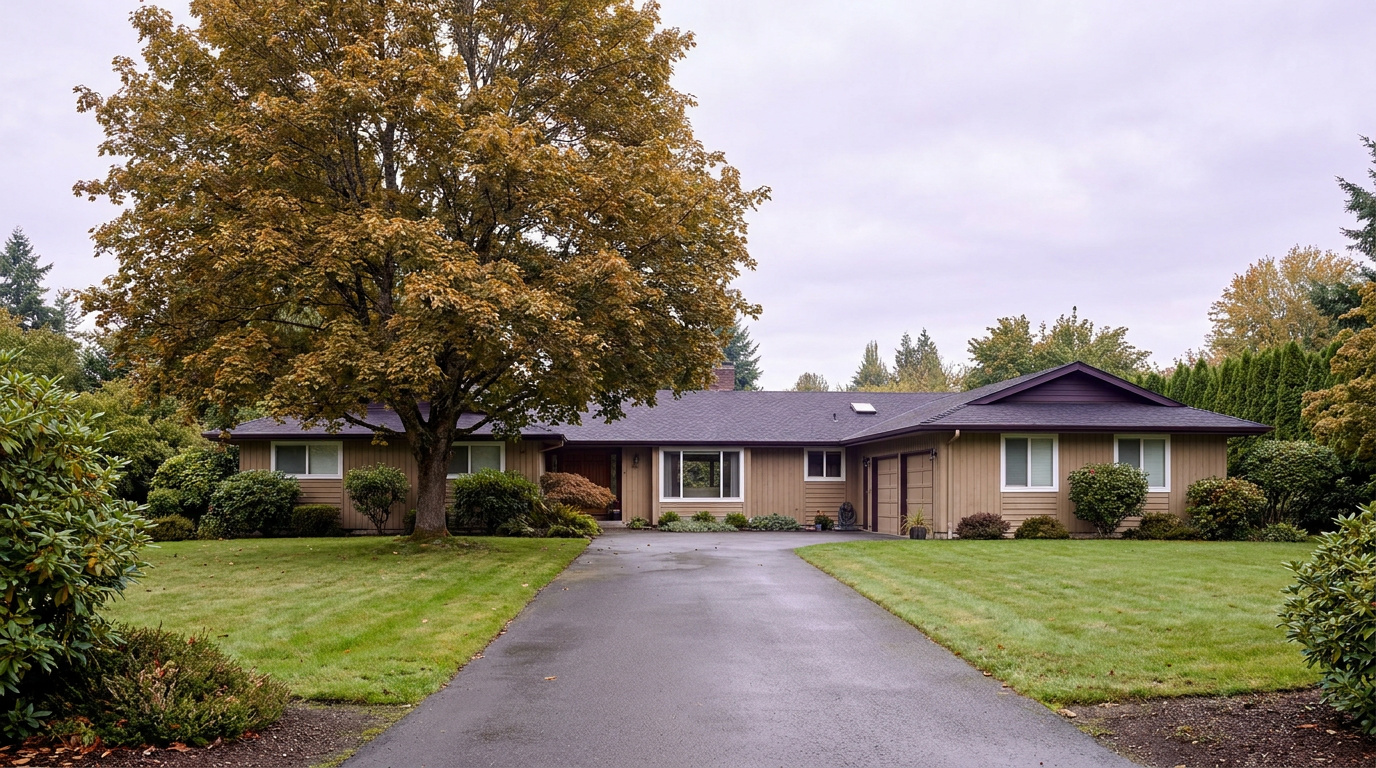

Seller ResourcesSouth King County July 22, 2026

Sell As-Is or Repair First? Federal Way Seller Guide 2026

I walk through Federal Way homes almost every week doing professional property valuations for banks. And the question I hear most from sellers here isn’t about price. It’s about repairs. Fix the place up first, or just sell it as-is?

The honest answer: it depends on which repairs. Most cosmetic projects won’t pay you back. A few specific fixes almost always will. Here’s how to tell the difference in the current Federal Way market.

What the Federal Way Market Says Right Now

Numbers first. As of mid-July, the median list price for a Federal Way house is running around $675,000. Almost half the active listings in the city, about 45 percent, have already taken at least one price cut. Homes that do sell are going in roughly three weeks. Full market picture in my Living in Federal Way guide.

Federal Way WA housing market July 2026, median list price, price cuts, days on market

NWMLS data, week of July 13, 2026: $675K median residential list price, 45% of actives with a price cut, sales closing in roughly three weeks.

What does that mean for your repair decision? Buyers have choices right now. When buyers have choices, condition matters more. A home that shows well sells. A home with visible problems joins the 45 percent taking price cuts.

Repairs That Usually Pay You Back

Water is the big one. Fix any active leak before you list. Roof, plumbing, gutters, all of it. Buyers in the Pacific Northwest are trained to sniff out moisture problems, and one water stain on a ceiling can cost you more in negotiation than the repair ever would.

Same with safety items. Bad electrical. A failing water heater. Broken railings, missing smoke detectors. These are the things a home inspector flags in bold, and they’re cheap to handle now versus expensive to argue about later. I cover what that inspection looks like in my seller’s guide to home inspections.

Then there’s the cheap stuff that’s really about presentation. Deep cleaning, fresh neutral paint in the main rooms, yard cleanup and moss treatment. None of that is technically a repair. It’s still the highest-return money you can spend before listing.

Repairs That Usually Don’t Pay Back

Big remodels rarely return their cost at sale. A $60,000 kitchen renovation doesn’t add $60,000 to your Federal Way sale price. Buyers here shop in a specific price band, and the neighborhood puts a ceiling on what they’ll pay. I price homes in this city every week, and remodeled homes and original homes settle a lot closer together than most sellers expect.

New flooring throughout, full bathroom gut jobs, finishing unfinished spaces. Usually the same story. If the money won’t come back, it’s often smarter to price the home for its condition and let the buyer make those choices.

What Selling As-Is Actually Means in Washington

Here’s where first-time sellers get tripped up. Selling as-is doesn’t let you skip disclosure. Washington still requires the Form 17 seller disclosure statement, and you still have to answer honestly about what you know. As-is tells buyers up front you won’t be making repairs. It doesn’t make problems disappear.

How I Run the Math With Sellers

The question isn’t whether to fix everything. It’s whether a specific repair returns more than it costs, after the time and stress of doing it. Sometimes a $4,000 fix protects $15,000 of price. Sometimes a $30,000 project returns $12,000. You want the first kind. The only way to know which is which is to run real numbers on your house against real Federal Way comps. Pricing it right matters either way, and my guide to pricing your home to sell in King County walks through how that works.

A Simple Decision Checklist

Before you spend a dollar on pre-listing work, run through this list:

  1. Fix anything involving water, active leaks, drainage, or moisture damage
  2. Fix safety items an inspector will flag: electrical, railings, smoke detectors
  3. Budget for cleaning, paint, and yard work before any bigger project
  4. Skip major remodels unless the numbers prove the return
  5. If selling as-is, complete the Form 17 disclosure honestly and price for condition
  6. Ask your agent for an as-is value and an after-repair value before deciding

Frequently Asked Questions

Can I sell my house as-is in Washington state?

Yes. Selling as-is is legal and common in Washington. You still have to complete the Form 17 seller disclosure statement honestly, and buyers can still inspect the home. As-is simply tells buyers up front that you don’t plan to make repairs.

Do I lose money selling a house as-is in Federal Way?

You typically net less than a comparable move-in-clean home, but not always less than the cost of major repairs plus months of project time. The right comparison is your as-is value against your after-repair value minus repair costs. Sometimes as-is wins that math, especially when the needed work is cosmetic or the repairs are large remodels that don’t return their cost.

What repairs are required to sell a house with an FHA or VA buyer?

FHA and VA appraisers flag health and safety items: peeling paint in older homes, missing handrails, broken windows, roof or water damage, and non-working systems. The lender can require those repairs before closing even on an as-is sale, so at Federal Way price points it’s smart to handle obvious safety items before listing.

Your guide to life outside Seattle.

Gregory Dorrell | Coldwell Banker Bain | WA License #111862
253-350-0045  ·  greg@livingoutsideseattle.com  ·  www.livingoutsideseattle.com
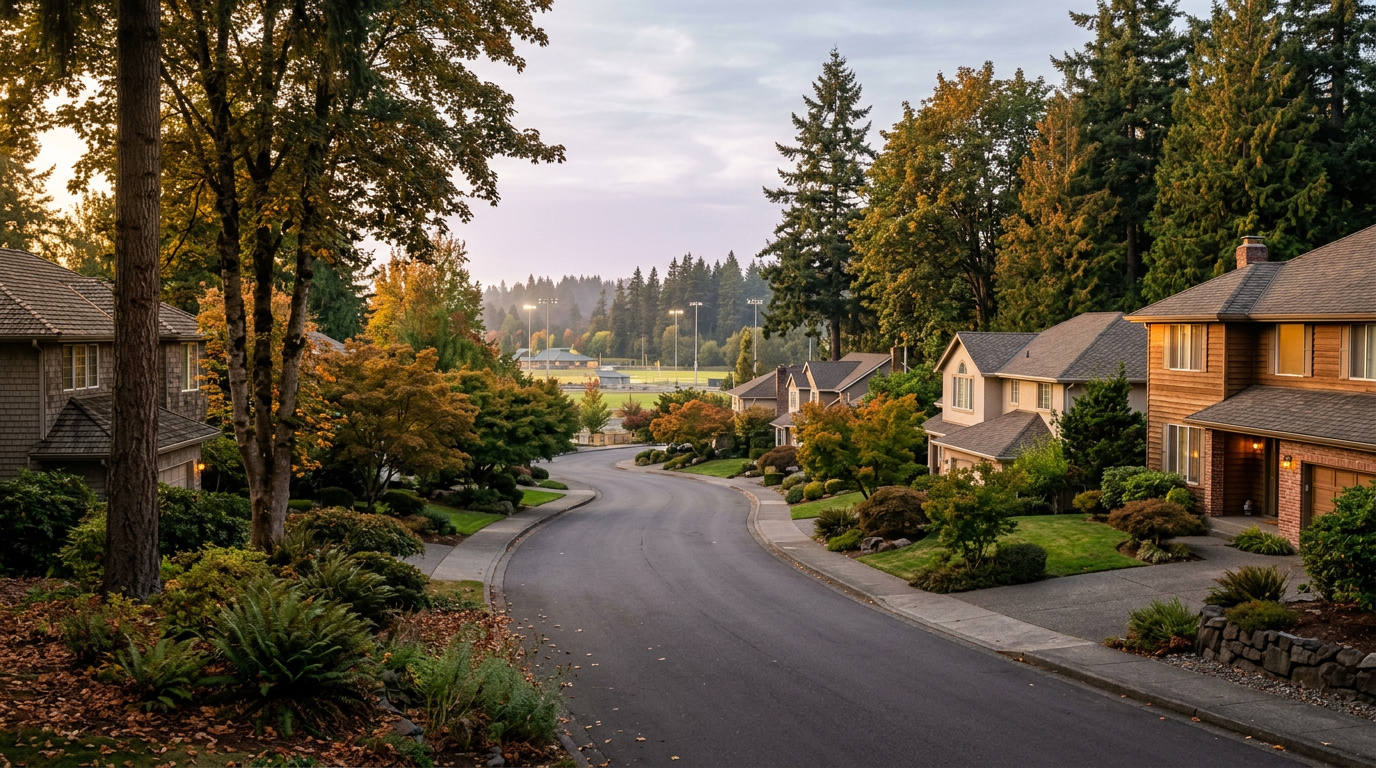
Gregory Dorrell is a licensed real estate broker (WA License #111862) with Coldwell Banker Bain. Market data from NWMLS, week of July 13, 2026. Statistics are market-wide and not a guarantee of any individual outcome. This post is provided for informational purposes and does not constitute financial or legal advice.

King County Market Update July 14, 2026

East & South King County Market Update [July 2026]

What changed this week in the King County market?

Countywide activity kept cooling this week. Closings dropped to 388, the slowest week since January, and new listings fell to 743. Active inventory eased slightly to 7,647, but with fewer sales clearing, weeks of supply pushed up to 19.7, the highest reading of 2026. The county median sale price slipped to $825,000, and just 17.5% of sales closed above list, also a 2026 low.

South King County did most of the slowing. Closings fell to 77 from 107 last week, weeks of supply jumped to 19.4 from 14, and the median sale price came back to $650,000. Here is the part that headline number hides: pendings rose to 169 from 143. Buyers down south are still writing offers, they just have not reached the closing table yet.

The Eastside went the other way. Closings ticked up to 90, supply eased to 24 weeks, and pendings cooled to 148. The median sale price came down to $1,337,500, which means the value side has finally caught up with the volume slowdown I flagged last week.

The takeaway: these two markets traded places. The Eastside is settling into its price level, while South King County’s dip looks like a timing gap rather than a demand problem. Watch the South King pending count next Monday. If those close, the slow week was noise.

Looking further out than this week? Read the King County housing market forecast for 2026.

Nationally, Freddie Mac’s weekly survey put the 30-year fixed at 6.67 percent on August 13, down slightly from 6.69 percent the week before, while the National Association of Realtors reports 1.54 million homes for sale, about 4.6 months of supply, and existing home sales running at a 4.06 million annual pace. King County residential supply is still tighter than the national picture at 3.8 months on the latest monthly NWMLS data, and local closings hold far closer to full list price than the national average.

Is King County a buyer’s or seller’s market right now?

King County at a glance: July 2026 (NWMLS)

Metric Residential Condo
Median sale price $1,000,000 $520,000
Change vs. last month +0.5% +0.9%
Change vs. last year +0.1% −3.7%
Closed sales 1,504 413
New listings 3,099 1,016
Active listings 5,423 2,540
Months of supply 3.8 6.0
Median days on market 11 28
% of list price received 100% 99.1%

King County, July 2026 closed-sale data. Source: NWMLS via InfoSparks.

Two different markets are hiding in that table. Single-family homes county-wide are still moving quickly at asking price. Condos are carrying nearly twice the supply, taking more than twice as long to sell, and their median price has fallen harder over the past year. If you own a condo and plan to sell, pricing honestly matters more for you than for anyone else in this report.

The table below is the heart of this page. It compares all seven cities I serve, plus the county itself, using July 2026 NWMLS closed-sale data. This month the split looks different than it has in a while: Sammamish, Issaquah, and Federal Way all posted real year-over-year price gains, while Bellevue, Renton, and Auburn slipped slightly. Supply widened almost everywhere compared to last year, giving buyers more room across the board.

City comparison: July 2026 (single-family, NWMLS)

City Median price YoY Active listings Months of supply Median DOM % of list received Closed sales
Bellevue $1,830,000 −1.1% 372 4.9 13 97.7% 85
Sammamish $1,725,000 +5.3% 253 5.5 18 97.3% 57
Issaquah $1,575,000 +7.9% 135 4.4 9 97.5% 41
Renton $810,000 −4.7% 317 3.9 19 100% 80
Kent $700,000 +1.4% 270 3.8 11 100% 82
Auburn $649,000 −1.2% 247 3.5 18 100% 65
Federal Way $645,000 +7.5% 180 3.5 15 100% 59
King County (single-family) $1,000,000 +0.1% 5,423 3.8 11 100% 1,504
King County (condo) $520,000 −3.7% 2,540 6.0 28 99.1% 413

July 2026 closed-sale data. Each city’s figures are its own true NWMLS numbers. I never average medians across cities. Source: NWMLS via InfoSparks.

How is the Bellevue housing market right now?

Median price YoY Months of supply Median DOM % of list Active Closed
$1,830,000 −1.1% 4.9 13 97.7% 372 85

Single-family, July 2026. Source: NWMLS.

Bellevue is really two markets. Move-in-ready homes under the luxury tier still draw serious competition, while the condo segment and un-staged or dated listings carry the most negotiating room in the entire county. If you are comparing renting against owning here, my Bellevue rent vs. buy breakdown runs the actual numbers.

Is the Sammamish market cooling off?

Median price YoY Months of supply Median DOM % of list Active Closed
$1,725,000 +5.3% 5.5 18 97.3% 253 57

Single-family, July 2026. Source: NWMLS.

Sammamish is almost entirely one product type, larger single-family homes, so when supply builds the whole city feels it at once. Buyers here are taking their time and looking hard at lot slope, drainage, and road noise before they write. My neighborhood guides for Sahalee and East Lake Sammamish Parkway cover the pockets buyers ask about most.

Is Issaquah still a good buy on the Eastside?

Median price YoY Months of supply Median DOM % of list Active Closed
$1,575,000 +7.9% 4.4 9 97.5% 135 41

Single-family, July 2026. Source: NWMLS.

The Issaquah Highlands keeps pulling steady showing traffic because it is the most affordable way into Eastside schools without paying Bellevue or Sammamish prices. I wrote up the full case in my Issaquah buyer opportunity guide.

What are home prices doing in Renton?

Median price YoY Months of supply Median DOM % of list Active Closed
$810,000 −4.7% 3.9 19 100% 317 80

Single-family, July 2026. Source: NWMLS.

Renton is three markets wearing one name. The Highlands, Benson Hill, and downtown each price and move differently, which is why the citywide median bounces around. It stays the top landing spot for buyers who work on the Eastside but will not pay Eastside prices. Start with my downtown Renton guide if you are new to the city.

Is Kent a good place to buy a home right now?

Median price YoY Months of supply Median DOM % of list Active Closed
$700,000 +1.4% 3.8 11 100% 270 82

Single-family, July 2026. Source: NWMLS.

East Hill family homes are the engine here, and demand for them has not let up. Steady markets punish guesswork, so pricing accuracy matters more in Kent than almost anywhere I work. If you are weighing the move, start with my guide to buying a home in Kent and the Kent family neighborhoods breakdown.

Why are Auburn homes selling so fast?

Median price YoY Months of supply Median DOM % of list Active Closed
$649,000 −1.2% 3.5 18 100% 247 65

Single-family, July 2026. Source: NWMLS.

Auburn is the most affordable single-family entry point of my seven cities, and buyers know it. When the median home goes pending in eight days, showing up without a pre-approval letter means losing the house. Lakeland Hills and the Enumclaw plateau side keep drawing families who want newer construction for less. My guide to living in Auburn covers the neighborhoods and what your budget buys in each.

Is Federal Way the best value in King County?

Median price YoY Months of supply Median DOM % of list Active Closed
$645,000 +7.5% 3.5 15 100% 180 59

Single-family, July 2026. Source: NWMLS.

Federal Way sits in the sweet spot between Seattle and Tacoma commutes, and starter homes here have stayed insulated from the cooling happening on the Eastside. My Living in Federal Way guide maps out where those values are.

What does this mean if you’re buying or selling right now?

If you’re buying: your leverage depends on which half of the county you’re shopping. On the Eastside, use the extra supply. Ask for inspection time, negotiate on homes that have sat past three weeks, and don’t chase overpriced listings. In South King County, come prepared to move fast on the good ones, because they still go in under two weeks. Either way, with rates near their best level in almost two months, it may be worth a look at a rate buydown to bring the payment down further.

If you’re selling: the market is telling sellers one thing loudly: price to the current comps, not to your neighbor’s sale from March. Hundreds of King County sellers cut their price this week alone, and every one of those cuts started with an asking price the market rejected. Condition matters more than it has in years. If you get the first two weeks right, you sell. My guide on how to price your home to sell in King County walks through exactly how I build a list price.

Frequently asked questions

Is now a good time to buy in South King County?

If the payment works for you, yes. Prices in Kent, Auburn, and Federal Way are up modestly from last year, so waiting has not been rewarding buyers there. Inventory is better than it has been in years, and rates just hit a seven-week low. The value end of the county is competitive but not frantic.

Which King County suburb has the lowest home prices?

Among my seven cities, Federal Way and Auburn are essentially tied for the lowest single-family medians in July 2026, both just under $650,000. Kent isn’t far behind. For the lowest entry point of all, condos remain the cheapest way to own in King County.

Are Eastside home prices dropping?

June medians in Bellevue, Sammamish, and Issaquah all came in below last year, and supply on the Eastside has grown faster than anywhere else in the county. That reads as a real cooling, not a collapse. Well-priced homes still sell in under two weeks. The overpriced ones are the ones sitting and cutting.

How often is this page updated?

Every Monday I refresh the “what changed this week” section with the newest NWMLS activity. Once a month, when the new monthly data lands, I rebuild every table and city capsule on this page. Bookmark it. The URL never changes.

Your guide to life outside Seattle.

Gregory Dorrell | Coldwell Banker Bain | WA License #111862
253-350-0045  ·
greg@livingoutsideseattle.com  ·
www.livingoutsideseattle.com
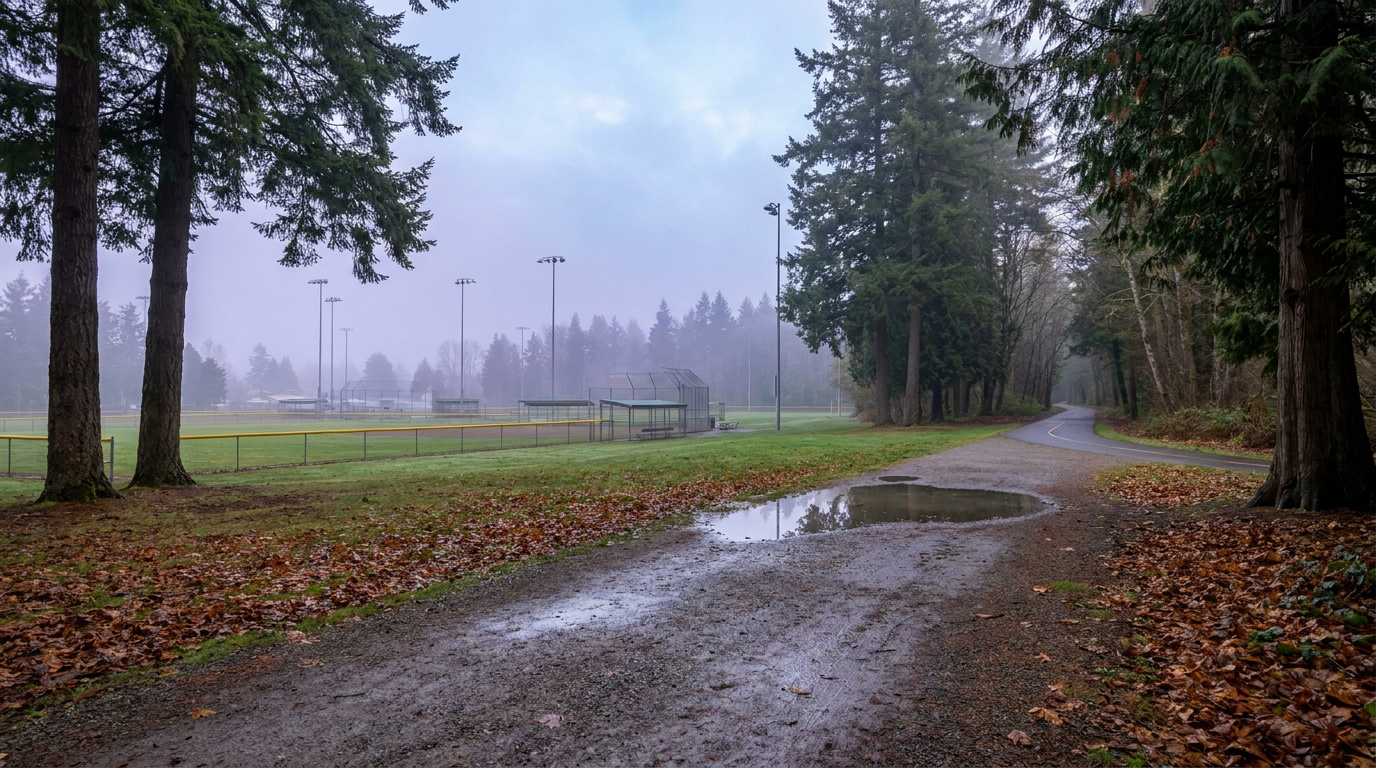
King County Market Update June 29, 2026

This Guide Has Moved

This article has been folded into our maintained guide: East & South King County Market Update [July 2026]. You are being taken there now.

Uncategorized June 22, 2026

This Guide Has Moved

This article has been folded into our maintained guide: East & South King County Market Update [July 2026]. You are being taken there now.

Buyer ResourcesSouth King County June 20, 2026

This Guide Has Moved

This article has been folded into our maintained guide: Living in Federal Way, WA | 2026 Real Estate & Lifestyle Guide. You are being taken there now.

Buyer Resources June 18, 2026

King County Home Prices: What You Get at $450K–$700K

The King County median is pushing $860,000. But buyers with $450K to $700K aren’t out of the game — they’re just buying a different game. Here’s the city-by-city breakdown.

Why This Guide Exists

When I sit down with a first-time buyer, one of the first things they ask me is: “What can I actually get for my money in King County?” It’s the right question, and it deserves a real answer — not a vague “it depends.”

So here it is. This guide breaks down what buyers are realistically getting at four price points — $450K, $550K, $650K, and $700K — across the South and East King County cities where I work. I price homes in these markets every single day as a BPO field agent. I know what these dollars buy in Auburn, Kent, Federal Way, and Renton because I walk through these homes constantly.

The King County overall median is around $859,000 as of spring 2026. If your budget sits between $450K and $700K, you’re below that line — which means you’re working in South King County’s market, not the Eastside’s. That’s not a consolation prize. South King County has serious value, real neighborhoods, and in some price bands, genuine competition. Let me show you what I mean.

The Monthly Payment Reality First

Before we talk about what you get, let’s talk about what you’re paying each month. As of mid-June 2026, the 30-year fixed rate in Washington sits around 6.65%. With 10% down:

Monthly Payment Estimates at 6.65% (10% Down)

$450K purchase — ~$405K loan — roughly $2,610/month P&I

$550K purchase — ~$495K loan — roughly $3,190/month P&I

$650K purchase — ~$585K loan — roughly $3,769/month P&I

$700K purchase — ~$630K loan — roughly $4,060/month P&I

Add property taxes (roughly 0.9–1.1% annually in South KC cities), homeowner’s insurance (~$150–$200/month), and any HOA dues, and your true monthly cost is $300–$600 higher than those P&I numbers. I say this not to discourage you, but because buyers who know the full number make better decisions. If you want a deeper breakdown of total cost, the Total Cost of Homeownership in King County 2026 post does that math city by city.

$450K: Condos, Older Townhomes, and Entry-Level Single-Family

Exterior of a two-story townhome in Auburn or Federal Way Washington State, entry-level South King County real estate

At $450K, condos and townhomes like this are your primary options in South King County — real ownership, real equity.

At $450K, you are not buying a single-family home in most of King County. You are buying into the condo and townhome market, or an older home that needs work. That’s honest, and it’s worth saying plainly.

Auburn and Federal Way Condos

This is the clearest entry point at this price. You can find 2-bedroom condos in the 900–1,100 square foot range in Auburn’s downtown corridor and Federal Way’s Twin Lakes and Steel Lake areas. These are typically 1990s–2000s construction, well-maintained, and in walkable locations. Federal Way’s coming light rail extension has kept demand steady here.

Kent Condos and Entry Townhomes

Downtown Kent has a handful of newer-ish condo buildings and townhome developments where you can get into 2-bedroom units around this price. Proximity to Kent Station (Sounder commuter rail) makes these appealing even at small square footage.

Older Single-Family in Auburn’s Core

Occasionally — especially if you’re patient and flexible — you can find a 3-bedroom, 1.5-bath from the 1960s or 70s in Auburn’s central neighborhoods. These homes need updating. They’re not turnkey. But they’re on real lots, and they’re fee-simple ownership with no HOA.

The so-what for buyers at this tier: this price point gets you into ownership and starts building equity. It is not a forever home for most families. But it is a real foothold, and in South King County, that foothold has appreciated over 5–7 year holds. If down payment is the obstacle, look at King County’s Down Payment Assistance programs — KCHA’s deferred loan and WSHFC’s Home Advantage can both help at this price tier.

$550K: Single-Family Becomes Possible

At $550K, the picture changes. This is where single-family homes start to appear in South King County — modestly, but genuinely.

Auburn

The $500K–$580K range is where Auburn’s townhome and entry single-family inventory overlaps. You can find 3-bedroom townhomes in Lakeland Hills with attached garages, HOA-managed exteriors, and good schools. Older single-family homes in West Auburn and parts of Auburn north that are move-in ready with cosmetic updates also show up here.

Federal Way

The $520K–$570K range opens up more of Federal Way’s residential neighborhoods — Twin Lakes, West Campus, and the areas closer to the Sound. You’re looking at 3-bedroom, 1-bath or 2-bath homes from the 1970s–1990s, on lots of 6,000–8,000 square feet. These aren’t large homes but they’re real houses.

Kent

Kent’s median sits around $635,000 right now, so $550K puts you below median. That doesn’t mean nothing is available — it means you’re competing for homes that need some work, or townhomes in East Hill where new construction density has been concentrated.

At $550K, you’re getting real space and real land in South King County. The financing math still works for households earning $130K–$150K+ (assuming roughly 40% DTI with standard conventional financing). If you’re using an FHA loan, the lower down payment option changes your cash requirement — FHA vs. Conventional for King County buyers has the full comparison.

$650K: The Sweet Spot for South King County

Charming Pacific Northwest single-family home with two-car garage and green lawn in King County Washington suburb

At $650K, South King County delivers 3-bedroom homes with yards and garages — the kind buyers stay in for a decade.

If I had to pick one price band where South King County buyers are getting the most for their money right now, it’s $625K–$675K. Here’s why.

Renton

Renton’s median runs around $650K. At this price, you’re in real competition for solid 3-bedroom, 2-bath homes in neighborhoods like Benson Hill, Talbot Hill, and parts of the Highlands. These are homes with garages, yards, and good bones. They’re not McMansions. They’re the kind of house where families put down roots for 10–15 years.

Kent East Hill

East Hill is Kent’s most family-oriented neighborhood, with newer construction and strong schools. At $650K you’re getting into 3-bedroom homes with 2-car garages, square footage in the 1,600–2,000 range, and HOA neighborhoods that maintain common areas well.

Auburn Lakeland Hills

Lakeland Hills continues to be one of the best pure-value plays in South KC. You can find 3–4 bedroom single-family homes in the $620K–$670K range on decent lots. The community is well-established and has held value through market cycles.

At $650K, you’re buying a home a family can actually live in for years without outgrowing. The rate environment means your monthly cost is real, but the asset you’re getting in exchange is also real. Homes in this range in South King County have shown 5-year appreciation patterns that make early ownership genuinely wealth-building.

$700K: Where the Options Widen

At $700K, you’re near or slightly above the median in most South King County cities, which means you have more choices, more leverage in negotiation, and access to some locations that were out of reach below.

Renton — Kennydale and Highlands

$700K in Renton opens up Kennydale and some pockets of the Highlands where the homes are larger, the lots more established, and the commute to both Seattle and Bellevue is genuinely good. 4-bedroom homes with finished basements become available here.

Kent and Covington Border Areas

Where Kent’s East Hill bleeds into unincorporated Covington, you’ll find homes in the $680K–$730K range that offer more space per dollar than anything inside the Seattle city limits at double the price. Lots of 10,000+ square feet, 4-bedroom layouts, and 2-car garages are realistic here.

Maple Valley

Maple Valley has been growing as buyers who need more space head south. At $700K you can find newer construction — some from the last 10 years — with modern kitchens, open floor plans, and trail access to the Maple Valley Trail system.

$700K in South King County buys a legitimately good house. It also buys a payment that requires solid household income — roughly $160K–$175K+ at current rates, depending on your other debt and down payment. If that math is tight right now, it’s worth looking at what rate buydowns can do — at this purchase price, a seller-funded 2-1 buydown can make a real difference in year-one payments.

What This Looks Like in King County Right Now

Infographic showing what King County buyers get at $450K, $550K, $650K, and $700K — Auburn, Kent, Federal Way, Renton

King County affordability by price tier — what each budget buys in South King County in 2026.

A few things to keep in mind as you use this guide.

Inventory across King County is up roughly 30% from a year ago. That matters. Buyers below $500K are still competing in a tight pool for limited condo and entry single-family inventory. Buyers in the $600K–$750K range have more breathing room. Days on market in South King County at this level have extended compared to 2024 — you often have time to think, inspect, and negotiate.

The pricing I’ve described reflects medians and typical ranges. Individual homes vary widely. A 1985 split-level in Federal Way at $520K might need $60K in deferred maintenance. A 2019 townhome in Auburn at $545K might be genuinely turnkey. My BPO work gives me a fast read on which is which — and that’s exactly the kind of analysis I bring to every buyer I work with.

Frequently Asked Questions

Can I buy a single-family home in King County for under $500K?

It’s possible, but uncommon. At $500K, you’re primarily in the condo and townhome market in South King County. Occasionally a distressed or estate-sale single-family home surfaces at this price, but expect deferred maintenance. Budget for updates if you’re pursuing this price point.

Which South King County city gives the most for $600K?

Right now, Auburn and Federal Way offer the most square footage and lot size for $600K. Kent is close but slightly pricier per square foot. Renton offers strong value at $600K but typically in smaller homes or older stock compared to Auburn.

How much income do I need to buy at $650K in King County?

With 10% down and a rate around 6.65%, your principal and interest is roughly $3,769/month. Add taxes, insurance, and HOA if applicable, and true housing cost approaches $4,300–$4,500/month. Most lenders want housing expense at or below 36–43% of gross monthly income, which puts the qualifying range around $125K–$150K household income.

Are these prices likely to rise or fall in the second half of 2026?

Inventory is up 30% countywide, which has softened prices at the top of the market. South King County’s sub-$700K segment has stayed relatively steady because demand from first-time buyers remains real. A meaningful rate drop could create a surge in buyer demand and push prices up. Waiting on that rate drop is a gamble — the data on buy-now vs. wait shows the math usually favors buying sooner.

What down payment do I need at these price points?

Conventional loans require 3–20% down. At $550K with 5% down, you’re bringing $27,500 plus closing costs. FHA requires 3.5% down but has loan limits to watch in King County. Down payment assistance programs from KCHA and WSHFC can help close the gap at the $450K–$600K range — see the full DPA guide.

Your guide to life outside Seattle.

Gregory Dorrell | Coldwell Banker Bain | WA License #111862
253-350-0045  ·
greg@livingoutsideseattle.com  ·
www.livingoutsideseattle.com
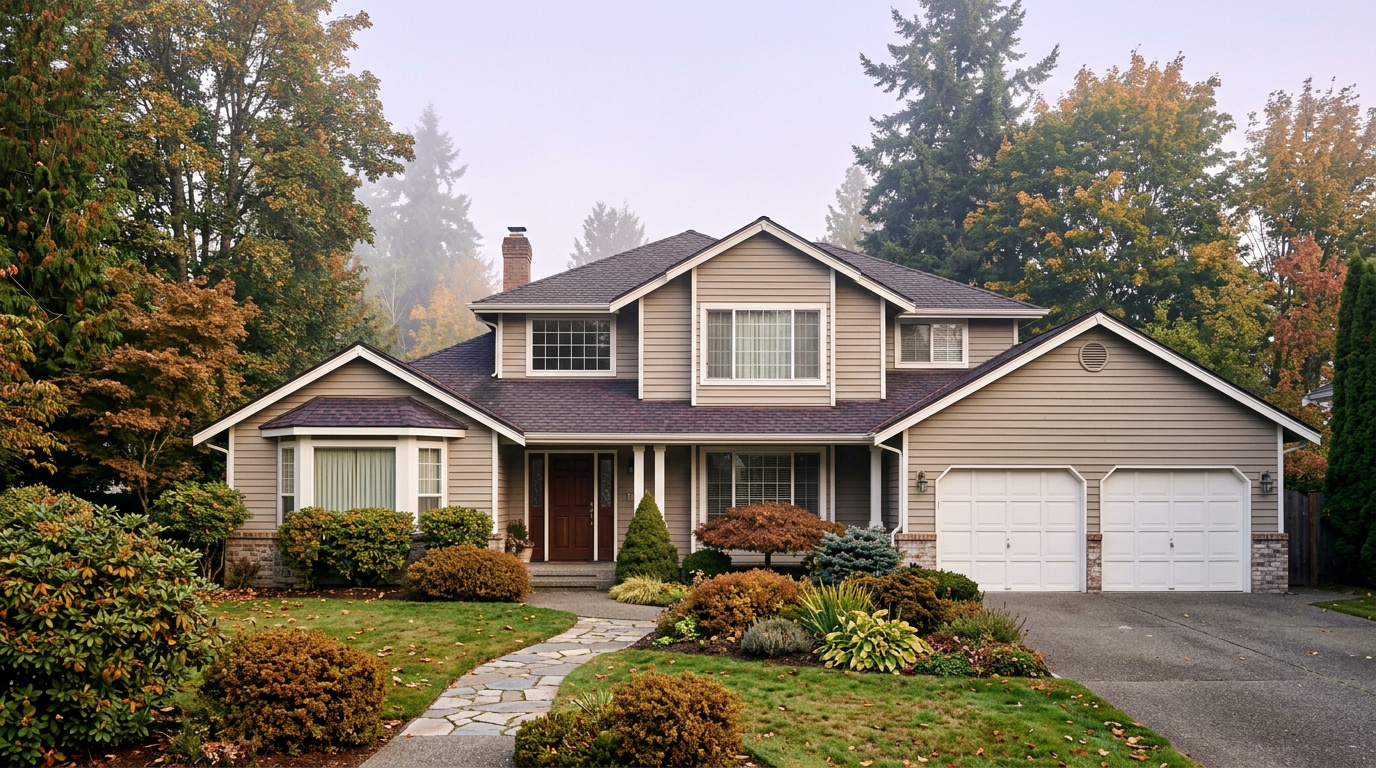
Buyer ResourcesSeller Resources June 16, 2026

Property Tax Rates in King County Cities 2026

Buyers ask me all the time: “What are the property taxes going to be on this house?” It’s a fair question, and the answer matters more than most people realize when they’re focused on the purchase price and interest rate. On a $700,000 home, the difference between buying in Auburn and buying in Issaquah works out to roughly $2,500 a year — or about $210 a month that never shows up in a mortgage quote.

This post lays out the 2026 effective property tax rates for the eight cities I work in most across South and East King County. I also cover how the calculation works, why rates differ between cities just a few miles apart, and what this means if you’re running affordability math as a buyer or net-proceeds math as a seller.

Why King County Has No Single Tax Rate

A lot of buyers ask: “What’s the property tax rate in King County?” There isn’t one. Your bill is the sum of every taxing district whose boundary includes your property. That stack typically includes:

The Typical Levy Stack

Washington State levy — applies uniformly statewide

King County general levy — county services and administration

King County library district — public library system

City levy — varies by incorporated city; absent in unincorporated areas like Covington

School district levy — the single biggest variable between nearby cities

Fire district levy — local fire and rescue services

Emergency Medical Services (EMS) levy

Any voter-approved bond measures — school construction, parks, etc.

Two homes a mile apart — one in the Issaquah School District, one in the Kent School District — can carry meaningfully different tax bills even if their market values are identical. School district boundaries are the biggest driver of rate variation across South and East King County.

The 2026 total property tax collection in King County came in at $8.4 billion, up 10% from 2025’s $7.7 billion. That increase flows from rising assessed values, not any single rate change. But the effect on individual monthly payments is real.

2026 Property Tax Rates by City

These are median effective rates — actual tax bills divided by assessed market values — based on King County parcel data. Rates vary by ZIP code within each city, primarily because of school district boundaries. (Source: Ownwell, April 2026.)


Bar chart comparing 2026 property tax rates by city in King County Washington — Auburn highest at 1.19%, Issaquah lowest at 0.83%

2026 effective property tax rates for eight cities in South and East King County. Auburn carries the highest rate; Issaquah and Sammamish sit well below the county median of 0.99%. Source: Ownwell, April 2026.

City Effective Rate Median Home Value Median Annual Bill
Auburn 1.19% $566,000 $6,477
Maple Valley 1.11% $722,000 $7,963
Renton 1.03% $688,000 $7,145
Covington 1.03% $574,000 $5,862
Kent 1.01% $587,000 $5,919
Federal Way 1.00% $542,000 $5,412
Sammamish 0.89% $1,384,000 $12,054
Issaquah 0.83% $1,031,000 $9,132
King County Avg 0.99% $774,000 $7,644

How to Calculate Your King County Tax Bill

King County uses this formula:

(Assessed Value ÷ 1,000) × Levy Rate = Annual Tax Bill

For a home assessed at $650,000 in Renton with a levy rate of approximately $10.30 per $1,000:

$650,000 ÷ 1,000 = $650
$650 × $10.30 = $6,695 per year (~$558/month in escrow)

A few important things to understand about that assessed value:

King County Reassesses Every Year

Washington has no equivalent to California’s Proposition 13. Your assessed value is adjusted annually based on market conditions. If home prices in your neighborhood rose 8% last year, your assessment likely reflects that — and your bill goes up accordingly.

Your 2026 bill is calculated from the value as of January 1, 2025. So the assessment lags the market by about a year — but it catches up.

Buying at a Higher Price Does Not Reset Your Taxes

The assessor determines value independently of your sale price. A sale at market value is data they will consider in future assessments — but it doesn’t trigger an immediate reset the way it does in some other states. So if you buy a house below assessed value, your taxes don’t automatically drop either.

For the most accurate number on any specific parcel, use the King County eReal Property lookup at blue.kingcounty.com. Search by address to see the current assessed value and the levy rate stack broken down by district. It takes about 90 seconds and gives you a far more accurate number than any city average.

Why Issaquah and Sammamish Rates Are Lower

Issaquah (0.83%) and Sammamish (0.89%) sit well below the county average — yet their median tax bills are higher in dollar terms because home values there are much larger. Lower rates in these cities generally reflect two things.

First, fewer overlapping special districts. Some areas carry smaller bond debt loads than South King County cities, which compresses the total levy stack. Second — and this is the counterintuitive part — when the total assessed value base in a school district rises, the rate needed to raise the same budget dollar amount actually falls. High home values spread the levy cost across more dollars, pushing the percentage rate down.

City-by-City: What Buyers and Sellers Should Know


Homeowner reviewing property tax documents at kitchen table with laptop in Pacific Northwest home, King County Washington

Understanding your property tax rate before you make an offer helps buyers budget accurately and keeps sellers from being surprised at closing.

Auburn (1.19%)

Auburn carries the highest effective rate among the cities we track, with a $6,477 median annual bill on a $566,000 home. Rates vary by ZIP — the 98001 and 98002 ZIP codes trend higher than 98092. Buyers should ask their lender to calculate PITI based on the specific parcel, not a city average.

Maple Valley (1.11%)

Maple Valley’s rate and its growing median home value combine to produce one of the larger median bills in South King County at $7,963 per year. School construction bonds have contributed to the rate here. Strong schools drive demand for the area, and those same schools come with levy costs built into the rate.

Renton (1.03%)

Renton’s 1.03% rate on a $688,000 median home produces a $7,145 median annual bill. Rates vary within Renton by school district boundary — homes in the Issaquah School District portion of eastern Renton trend lower than those in the Renton School District. This surprises a lot of buyers who assume all of “Renton” carries one rate.

Covington (1.03%)

Covington shares Renton’s effective rate but with a lower median home value ($574,000), producing a $5,862 median bill. Covington is unincorporated King County, which means no separate city levy — one reason the total rate stays competitive. For buyers priced out of Maple Valley, Covington often offers similar inventory at lower total monthly carrying costs.

Kent (1.01%)

Kent sits nearly at the county average. The $5,919 median annual bill on a $587,000 home is one of the more affordable in this group in absolute dollar terms. Kent has one of the widest ranges of home types in South King County — condos to large single-family homes — so the actual bill on any specific purchase will vary considerably from the median.

Federal Way (1.00%)

Federal Way sits right at the county median rate and has the lowest median home value on this list at $542,000, producing a $5,412 median annual bill. For first-time buyers working with a tighter budget, Federal Way offers the lowest combined price-and-tax entry point among these eight cities.

Sammamish (0.89%)

Lower rate, but higher everything else. The $1,384,000 median home value produces a $12,054 median annual bill — over $1,000 a month in tax escrow — despite the below-average rate. Sammamish draws buyers who prioritize the Issaquah or Lake Washington school districts, newer construction, and lower density. That demand drives values, which keeps the rate lower but doesn’t lower the bill.

Issaquah (0.83%)

The lowest rate on this list. Issaquah’s 0.83% on a $1,031,000 median home means a $9,132 median annual bill. Part of the reason rates are lower is that the area’s high assessed value base spreads the levy burden across more dollars. School district quality drives demand, and demand drives values — which, counterintuitively, keeps the rate lower than South King County cities.

Important Property Tax Dates in King County

Date What Happens
January 1 Assessment date — value is frozen for the year’s calculation
February 10 Tax bills mailed
April 30 First half payment due
July 1 Appeal deadline — do not miss this
October 31 Second half payment due

The appeal window matters. If you receive your assessment notice and believe the value is too high — based on comparable sales or property condition — you have until July 1 to file with the King County Board of Equalization. Once that deadline passes, your ability to contest that year’s bill is gone.

Exemptions That Can Lower Your Bill

Washington offers several exemption programs worth knowing about, especially if you’re buying for a family member or planning long-term.

Senior/Disabled Exemption. Homeowners 61 or older — or permanently disabled — with household income under the program threshold may qualify for a significant reduction in assessed value and a freeze on future increases. This is one of the most valuable programs in the state and often goes unclaimed by people who don’t know it exists.

Veteran Exemption. Qualifying veterans with a service-connected disability may be eligible for a partial property tax reduction.

All exemptions require the home to be your primary residence. Investment properties and second homes do not qualify. To apply or check eligibility, contact the King County Assessor’s office at assessor.info@kingcounty.gov or (206) 296-7300.

What This Means for Your Buy or Sell Decision

For buyers: Your lender uses your total PITI payment — principal, interest, taxes, and insurance — to calculate affordability. Property taxes are a real monthly cost, not a closing-day item. On a $700,000 home, the difference between a 0.83% rate (Issaquah, ~$484/month) and a 1.19% rate (Auburn, ~$694/month) is $210 per month. Over a 30-year loan, that’s $75,600 in additional tax payments — more than most buyers realize when they’re focused on the interest rate.

For sellers: When a buyer’s lender calculates their debt-to-income ratio, property taxes push more buyers out of qualifying range at the higher end of pricing. In cities with higher effective rates, price sensitivity tends to be greater. Knowing your city’s rate — and being able to show the buyer the actual parcel-level calculation — is a transparency move that builds trust during negotiations.

For a broader look at all the costs of owning a home in King County, this post on total cost of homeownership in King County walks through the full monthly cost picture beyond just taxes. And if you’re a seller thinking about your net proceeds, Washington’s capital gains rules are the other tax conversation worth having before you list.

Run Your Own Numbers in 90 Seconds

To get the exact levy rate for any property you’re considering:

  1. Go to blue.kingcounty.com/Assessor/eRealProperty
  2. Search by address
  3. Find the “Current Year Tax” section — it shows the assessed value and the levy rate stack broken down by district
  4. Divide the tax bill by the assessed value to get the effective rate

This is the most accurate number you’ll find. I walk buyers and sellers through this lookup regularly — it often changes how they think about two comparable homes in different parts of the county. For where home values are heading in 2026 — which directly affects future assessed values and bills — here’s the King County housing market forecast.

Frequently Asked Questions

What is the property tax rate in King County in 2026?

The countywide median effective rate is 0.99%, but rates vary by city from 0.83% (Issaquah) to over 1.19% (Auburn). The rate for any specific property depends on all the overlapping taxing districts — state, county, city, school district, fire, EMS, and local bond measures.

When are King County property taxes due in 2026?

Half by April 30, and the other half by October 31. Tax bills are mailed in February. If your home has a mortgage, your lender typically collects taxes through escrow and pays on your behalf.

When is the King County property tax appeal deadline?

July 1 each year. If you receive your assessment notice and believe the value is too high, file with the King County Board of Equalization before that date. You’ll need supporting evidence like comparable sales or documentation of property condition issues.

Does buying at a higher price increase your property taxes right away?

Not automatically. King County reassesses independently based on market data. Your sale price is information the assessor will consider, but the assessment may not change until the next annual cycle. That said, sales well above assessed value typically result in higher assessments in subsequent years.

Where can I look up the exact property tax for a specific address?

Use the King County eReal Property portal at blue.kingcounty.com/Assessor/eRealProperty. It shows the current assessed value, each levy in the stack, and the total bill for any parcel in the county.

Are there exemptions that lower property taxes in King County?

Yes. The Senior/Disabled exemption is the most significant — qualifying homeowners 61 or older with income under the program threshold can freeze their assessed value and reduce their bill. Veteran exemptions are also available. All require the home to be your primary residence. Contact the King County Assessor at (206) 296-7300 or assessor.info@kingcounty.gov to check eligibility.

Data sourced from Ownwell (April 2026) and King County Assessor public records. Rates shown are median effective rates and will vary by specific parcel and ZIP code within each city. Verify levy rates for any specific property at blue.kingcounty.com before making financial decisions.

Your guide to life outside Seattle.

Gregory Dorrell | Coldwell Banker Bain | WA License #111862
253-350-0045  ·
greg@livingoutsideseattle.com  ·
www.livingoutsideseattle.com
Buyer Resources June 5, 2026

This Guide Has Moved

This article has been folded into our maintained guide: King County Condo Buyer’s Guide: Due Diligence Checklist. You are being taken there now.

AuburnBuyer ResourcesKing County CitiesSouth King County May 31, 2026

Relocating to Auburn Washington: Affordable Homes and What You Actually Get


When people tell me they’re relocating to Auburn Washington, the first thing they ask is whether they’re settling. They’ve heard “South King County” and assumed it means compromise: longer commute, fewer amenities, homes that are affordable because nobody wants them.

That’s not what I see when I’m out there five to six days a week evaluating properties.

Relocating to Auburn or Federal Way means getting more house for less money in a King County market with very few affordable entry points left. Here’s what the March 2026 numbers say.

Auburn Washington Home Prices in 2026: What $668K Gets You

King County median home price comparison all cities March 2026 — Auburn Federal Way Renton Bellevue
Auburn at $668K and Federal Way at $686K are the only King County cities where a family can buy a single-family home with a yard for under $700K.

March 2026 median single-family home prices across King County’s major markets:

Bellevue: $1,735,000. Sammamish: $1,615,000. Issaquah: $1,406,000. Renton: $859,000. Kent: $732,500. Federal Way: $686,500. Auburn: $668,000.

At $668,000, Auburn’s median is roughly $191,000 less than Renton and more than $1 million less than Bellevue. The price difference traces to geography, but what you get for that money is the part worth paying attention to.

A $668,000 budget in Auburn gets you a 3-bedroom, 2-bathroom home on a quarter-acre lot. Typically 1,500 to 1,800 square feet, built in the 1980s to 2000s, with a driveway, a yard, and space to breathe. The same budget in Bellevue: a smaller condo or townhouse, no yard, competing with 20 other buyers in a market where homes sell in 5 days.

Auburn’s market is slightly softer than the county average. Homes sit for 14 days on market versus 7 days for the county. That extra week matters. You have time to inspect, negotiate, and think rather than write an offer under pressure.

Auburn WA Neighborhood and Community Overview

Downtown Auburn has been adding restaurants and shops for several years. The Green River Trail runs through the area, good for families who bike or walk. Schools are solid. Property taxes are lower than the Eastside. The downtown core feels like a town rather than a strip mall corridor.

For a neighborhood-by-neighborhood breakdown, see the Living in Auburn, WA: 2026 Neighborhood & Real Estate Guide.

The Muckleshoot area, the Green River valley, and the downtown core are drawing young families and first-time buyers who want to own a house without paying $1M for the privilege. That’s a legitimate trade.

Moving to Federal Way WA: $686,500 for Puget Sound Views and Sounder Access

Federal Way comes in at $686,500, but offers something Auburn doesn’t at scale: Puget Sound views. In neighborhoods near the water or on elevated ground, you can see the Sound. Some homes have waterfront.

The feel is more suburban than Auburn: wider streets, larger setbacks, quieter blocks. Federal Way also added Link Light Rail in 2024 — the Federal Way Transit Center Station connects directly to SeaTac (about 20 minutes) and downtown Seattle (about 35 minutes) without touching I-5. More planned than Auburn, which comes with modestly higher property taxes.

For a full look at Federal Way neighborhoods and amenities, see the Living in Federal Way, WA: 2026 Real Estate & Lifestyle Guide.

Federal Way also sits between two large employment centers. You’re 15 to 25 minutes from the Renton tech corridor, where Boeing, Valley Medical Center, and aerospace suppliers are concentrated. You’re 15 to 30 minutes south to Joint Base Lewis-McChord, which matters for military families moving into the area.

Commute Times from Auburn and Federal Way to Seattle, Renton, and JBLM

South King County commutes deserve a straight answer.

From Auburn to Seattle: 35 to 45 minutes by car on I-167 to I-5, depending on time of day. The Sounder train takes about 45 minutes and lets you work during the ride.

From Federal Way to Seattle: 35 to 50 minutes by car. Similar Sounder access.

If you work in Renton in tech, aerospace, or healthcare, you’re 15 to 25 minutes from either city. If you’re at JBLM or contracting nearby, you’re 15 to 30 minutes south. For those job centers, South King County isn’t a concession. It’s closer to work than most of the county.

Price Per Square Foot: Auburn vs. Bellevue

Auburn WA vs Bellevue WA price per square foot comparison 2026 — $334 vs $1,577 per sqft
You’re paying nearly 5x more per square foot in Bellevue than Auburn. For families prioritizing space and equity over address, that math is hard to ignore.

A 2,000 square foot home in Auburn at $668,000 runs roughly $334 per square foot. In Bellevue at $1,735,000, that same budget gets you maybe 1,100 square feet at roughly $1,577 per square foot.

Nearly 5 times more per square foot for the Bellevue address. The Seattle commute from Auburn is longer, yes. You’re trading 15 extra minutes of driving for $400,000 in equity and a yard.

Auburn and Federal Way Market Conditions in 2026

King County overall sits at 2.2 months of supply, still a seller’s market. Auburn’s 14-day DOM and Federal Way’s 7-day DOM suggest more breathing room than Sammamish (4 days) or Bellevue (5 days).

At 6.38% on a $534,400 loan (Auburn median with 20% down), principal and interest runs roughly $3,240 per month before taxes and insurance. That’s real money. It’s also roughly half what you’d carry on a Bellevue home financed at $1.4 million.

For current market conditions across King County, see my East and South King County market update.

Frequently Asked Questions About Relocating to Auburn Washington

What is the median home price in Auburn Washington in 2026?

As of March 2026, the median home price in Auburn is $668,000. That buys a 3-bedroom, 2-bathroom home, typically 1,500 to 1,800 square feet with a yard. Auburn’s 14-day average DOM means less competition than Bellevue or Sammamish, giving you more time to make a clear-headed offer.

Is Auburn WA a good place to relocate for families?

Yes. Auburn has solid schools, the Green River Trail for recreation, a growing downtown, and the lowest single-family home prices in South King County. It’s not flashy, but it’s a working community where families build equity over time. If you work in Renton or south King County, the commute is short.

Is Federal Way or Auburn better for relocating to King County?

Depends on what matters to you. Choose Auburn for the lowest price, a slightly larger lot, and proximity to Renton or south King County jobs. Choose Federal Way for a more polished suburban feel, Puget Sound views, Sounder rail access, or JBLM proximity. Both beat Renton and Bellevue on value by a wide margin.

Can I get a home with a yard in King County for under $700K?

Yes, in Auburn and Federal Way. Both cities have homes under $700K with yards and 1,500 to 1,800 square feet. In Bellevue, Sammamish, or Issaquah, that budget gets a condo or townhouse without outdoor space. The trade-off is a longer Seattle commute, typically 35 to 50 minutes versus 10 to 20 minutes from closer suburbs.

What is the commute like from Auburn to Seattle?

Expect 35 to 45 minutes by car on I-167 to I-5, depending on the time of day. The Sounder commuter train runs to King Street Station in about 45 minutes and lets you work the whole way. If your job is in Renton or the south Eastside, your commute from Auburn may be shorter than from many other King County cities.

Your guide to life outside Seattle.

Gregory Dorrell |
Coldwell Banker Bain | WA License #111862
253-350-0045
·

greg@livingoutsideseattle.com

·

www.livingoutsideseattle.com
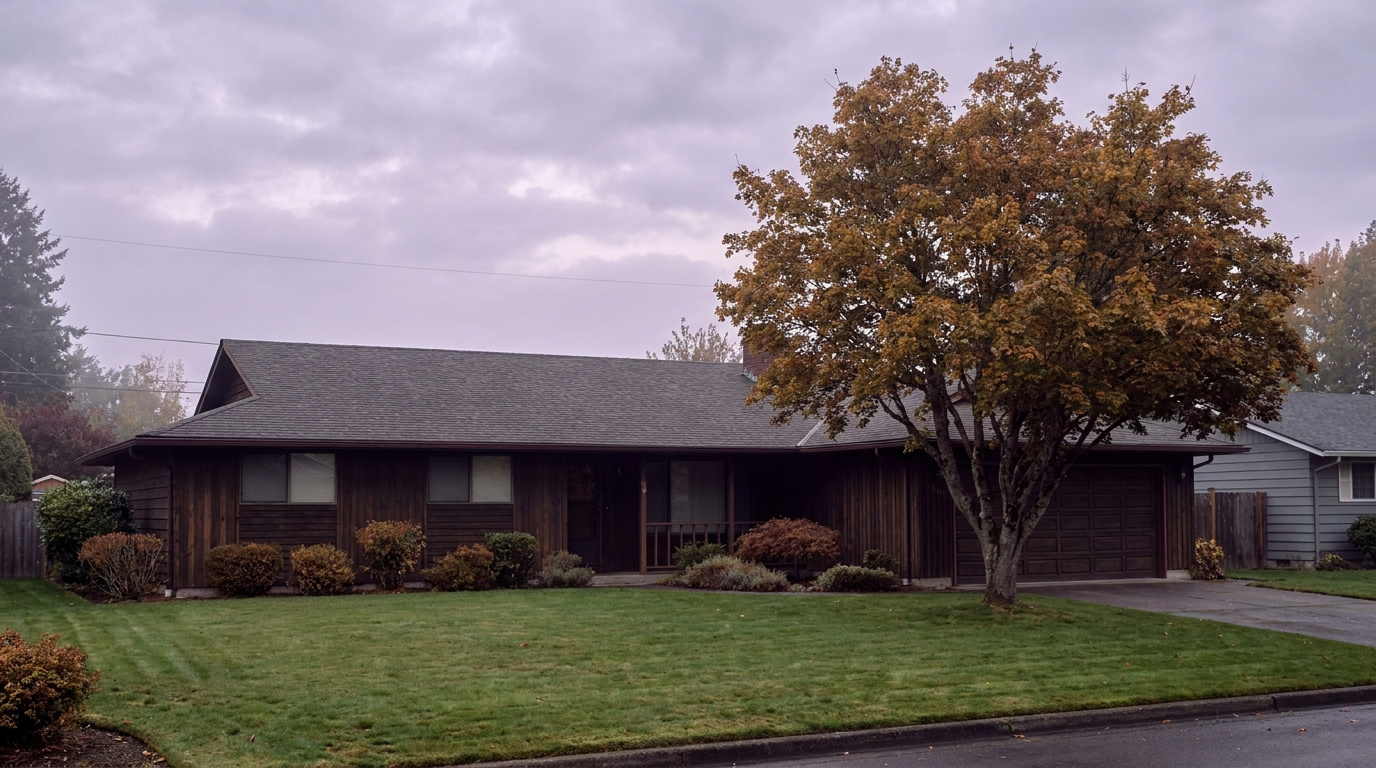
Coldwell Banker Bain does not guarantee the accuracy of square footage, lot size, year built, or other property details. All information is based on MLS data and public records as of March 2026. Local market conditions change; please confirm current pricing and inventory with your agent.


Buyer Resources May 29, 2026

Rent vs Buy in Federal Way WA 2026: The Real Cost Breakdown


When you’re paying $2,800 a month in rent, the question gets loud: wouldn’t I be better off putting that toward a mortgage in Federal Way?

Rent disappears. A mortgage builds equity. The math should be simple.

It’s not simple. But it’s not complicated either. Here’s what the numbers actually look like, using real Federal Way prices and March 2026 mortgage rates.

Federal Way Home Prices 2026: Condo vs. Mortgage Cost Breakdown

Start with a Federal Way condo. The median price in March 2026: $637,500.

Monthly payment with 10% down, which is realistic for a first-time buyer:

Down payment: $63,750. Loan: $573,750. At 6.38% (the rate as of late March 2026), principal and interest runs roughly $3,580 per month.

That’s not your full housing cost. Add:

Property taxes: King County annual property tax runs roughly 0.94% of value. On a $637,500 condo, that’s about $5,990 per year, or $475 per month.

HOA fees: Federal Way condos typically run $300 to $400 per month. Call it $350.

Homeowners insurance: roughly $100 to $150 per month.

Total: $3,580 (P&I) + $350 (HOA) + $475 (taxes) + $125 (insurance) = approximately $4,530 per month.

Your rent: $2,800.

Month one, you’re spending more as an owner. Noticeably more.

The Common Mistake When Comparing Rent to Buy in Federal Way

Most renters stop at that monthly gap and decide buying is too expensive.

Month one, two, three — you are spending more. That part is true.

But you’re not just spending that money. You’re building something with it.

10-year rent escalation vs fixed mortgage payment Federal Way WA 2026 — rent vs buy long-term cost comparison
At 4% annual rent growth, a Federal Way renter paying $2,800/month today will pay $4,149/month by year 10 — while the mortgage payment stays fixed.

How Federal Way Home Equity Builds While You Pay Rent

At 6.38% on a $573,750 loan, roughly $814 of your first payment goes toward principal. By end of year one, you’ll have paid down roughly $9,768. That’s money you get back when you sell. A renter gets zero.

Over 30 years, the vast majority of that $3,580 P&I payment becomes equity. Your rent payment? Gone every month. Forever.

Federal Way Rent Increases vs. a Fixed Mortgage Payment

Here’s what actually shifts the math for long-term renters.

Federal Way rent increases 3% to 5% per year. Here’s what that looks like at 4% annually:

By year 10, you could be paying $4,149 in rent with nothing to show for it. A Federal Way homeowner at that same point has paid down roughly $80,000 in principal and owns an asset worth more than $637,500.

Buying a Single-Family Home in Federal Way: A Cheaper Path

What if you buy a house instead of a condo?

The Federal Way single-family median in March 2026: $686,500. Put 20% down to avoid PMI. That’s $137,300 down, leaving a $549,200 loan.

Principal and interest: roughly $3,425 per month. Property taxes: about $490 per month. Insurance: roughly $130 per month. No HOA. No PMI.

Total: $4,045 per month.

Cheaper than the condo path, and you get a single-family home. Still more than $2,800 rent, but the gap is narrower. The trade-off: you need $137,300 down instead of $63,750.

For a full picture of Federal Way neighborhoods and what each area offers buyers, see the Living in Federal Way WA: 2026 real estate and lifestyle guide.

Should You Rent or Buy in Federal Way? Who Should Buy Now

Buying makes sense if you’re planning to stay 5 or more years, have a stable income and sufficient down payment, and want to build equity instead of paying someone else’s mortgage. The monthly gap between renting and owning narrows as rent increases each year.

Renting still makes sense if you’re moving in 3 years or less. Closing costs and transaction fees on both sides of a sale can eat your equity on a short hold.

One more comparison worth making: Seattle one-bedroom apartments in decent neighborhoods run $3,200 to $3,500 per month. Against those numbers, a $4,530 Federal Way mortgage looks a lot closer to what you’d already be paying.

Federal Way Rent vs Buy FAQs

Is it cheaper to rent or buy in Federal Way WA in 2026?

Month-to-month, renting at $2,800 is lower than the $4,045 to $4,530 mortgage payment. But rent typically increases 3% to 5% annually while your mortgage stays fixed. By year 10, Federal Way rent at 4% annual growth reaches $4,149 per month, while your mortgage hasn’t moved. And each mortgage payment builds equity. Rent builds nothing.

What is the typical mortgage payment on a Federal Way home in 2026?

Based on March 2026 rates of 6.38%, a $637,500 Federal Way condo with 10% down runs roughly $4,530 per month including principal, interest, HOA, taxes, and insurance. A single-family home at $686,500 with 20% down costs approximately $4,045 per month with no HOA. Both figures use King County property taxes of roughly 0.94% annually.

How much equity do you build in the first year of a Federal Way mortgage?

In year one, approximately $814 per month of your $3,580 P&I condo payment goes toward principal. By end of year one, you’ve paid down roughly $9,768. Renters get nothing back. Over time, equity compounds as your loan balance shrinks and home value grows.

What are the hidden costs of buying in Federal Way that renters don’t pay?

Beyond your monthly mortgage, expect property taxes (roughly $5,990 per year on a $637,500 condo), homeowners insurance ($1,200 to $1,800 per year), maintenance and repairs (budget 1% of home value annually), HOA fees for condos ($3,600 to $4,800 per year), and PMI if putting down less than 20%. Total annual costs beyond principal and interest can run $15,000 to $25,000. Renters avoid most of these, which is why the 5- to 10-year picture matters more than the monthly comparison.

What’s the median home price in Federal Way WA in 2026?

The median single-family home price in Federal Way as of March 2026 is $686,500. The median condo price is $637,500. Prices are up roughly 6.7% compared to early 2025.

Your guide to life outside Seattle.

Gregory Dorrell |
Coldwell Banker Bain | WA License #111862
253-350-0045
·

greg@livingoutsideseattle.com

·

www.livingoutsideseattle.com
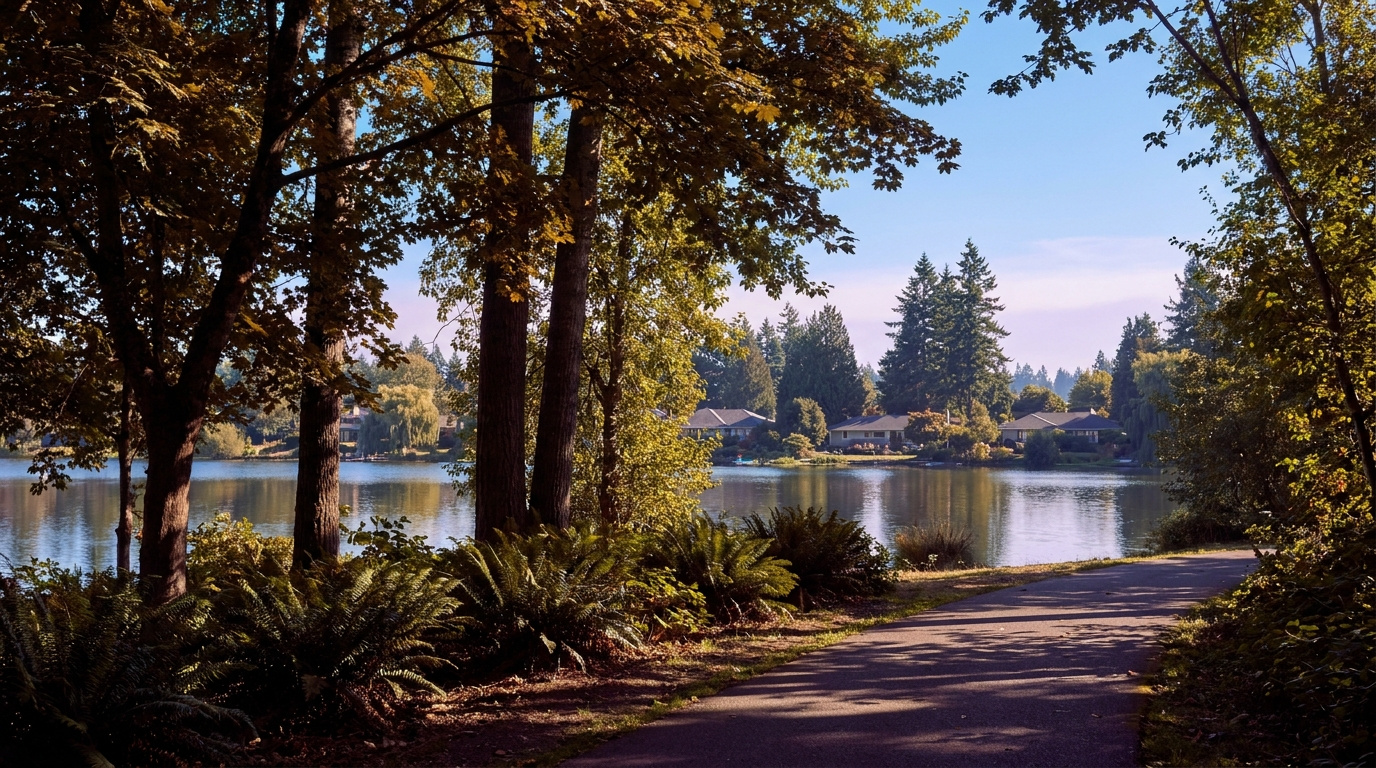
Gregory Dorrell is a REALTOR® with Coldwell Banker Bain specializing in East and South King County. This post is for informational purposes and not an offer of real estate services. All market data as of March 2026.


Buyer Resources May 28, 2026

King County Down Payment Assistance Programs 2026

How first-time buyers in King County can get up to $45,000 — or more — toward their down payment right now.

The number I hear most from first-time buyers in King County is not the interest rate. It is the down payment. At a $700,000 median price, even a 5% down payment is $35,000 — and that is before closing costs. That is a lot of money to save on top of rent in one of the most expensive metros in the country.

What most buyers do not know is that there are programs specifically designed to close that gap. Some are state programs. Some are regional. A few are city-specific. And in many cases, you can combine them. I work with buyers across South and East King County every week, and the down payment question comes up in almost every first conversation. This guide breaks down every major program available right now, what they actually pay, and how to get the money working for you.

Understanding your financing options is the foundation. If you want to see how King County mortgage rates affect your monthly payment alongside these programs, read King County Mortgage Rates 2026: What Buyers Are Actually Paying first.

What Is Down Payment Assistance and How Does It Work?

Down payment assistance — DPA for short — is money that a government agency, housing authority, or nonprofit makes available to help first-time buyers cover the upfront cash required to purchase a home. It is not a gift in most cases. Most programs are structured as a deferred second mortgage: you borrow the money at zero percent or very low interest, and you do not make payments on it. You repay it when you sell, refinance, or pay off the home.

That structure matters. It means the money costs you almost nothing while you own the home. You are essentially borrowing from your future equity instead of draining your savings account today.

To use DPA, you pair it with a regular first mortgage — FHA, conventional, VA, or USDA. The DPA funds cover part or all of the down payment and sometimes closing costs. Your lender handles the mechanics. You apply through a participating lender, not directly through the DPA program.

The Main Programs Available to King County Buyers

King County down payment assistance programs comparison chart 2026 — WSHFC Home Advantage, HomeSight, ARCH, and Needs-Based programs

Four programs, four different income and geography profiles. Most buyers qualify for at least one — many qualify for two.

WSHFC Home Advantage

The Washington State Housing Finance Commission’s Home Advantage program is the most widely used DPA program in the state. It has the highest income limit — $180,000 for all household sizes in King County — which means a lot of buyers who assume they earn too much will actually qualify.

Here is how the down payment assistance piece works: you get up to 5% of the first mortgage loan amount as a second mortgage at 0% interest, deferred for 30 years. On a $700,000 home with a $665,000 mortgage, that is up to $33,250 toward your down payment. No monthly payment. No interest accruing. You pay it back when you sell or refinance.

The first mortgage is a 30-year fixed rate through a participating lender. You must have a credit score of at least 620 and complete a five-hour homebuyer education course through Framework or eHome America. The course can be done online in a single afternoon.

HomeSight Purchase Assistance (South King County)

HomeSight is a Seattle-based nonprofit HUD-approved housing counseling agency, and their Purchase Assistance program is the most generous option for buyers in South King County cities. If you are shopping in Auburn, Federal Way, Tukwila, or unincorporated King County, this program can provide up to $45,000 in down payment assistance structured as a 3% deferred loan for 30 years.

The income limit is 80% of Area Median Income. For a family of four in King County, 80% AMI is approximately $112,000 in 2026. That is lower than WSHFC’s ceiling, but the dollar amount is higher — so buyers who fit within the income band can access substantially more cash up front.

HomeSight also offers homebuyer education and one-on-one counseling. Reach them at 206-723-4355 or homesightwa.org. Given that this program serves the exact cities where I work most — Federal Way, Auburn, Kent — it is worth a call early in your search, not after you have found a house.

ARCH East King County Downpayment Assistance

If you are buying in East King County, the ARCH program is what to look at first. ARCH member cities include Bellevue, Issaquah, Kirkland, Redmond, Sammamish, Kenmore, Bothell, Newcastle, Woodinville, and a handful of smaller communities.

The program provides up to $30,000 as a deferred loan at 4% simple interest. The income limits range from about $50,400 for a one-person household to $95,050 for a household of eight. The purchase price limit is $373,000 for the assisted unit, which limits this program to condos and lower-priced homes in the ARCH area rather than single-family houses at current market prices.

That price limit is the honest caution with ARCH: at current East King County prices, this program works best for condo buyers or buyers in specific affordable housing units the program designates. If you are looking at a $650,000 townhouse in Sammamish, WSHFC Home Advantage will likely be more useful.

WSHFC Opportunity Downpayment Assistance

The Opportunity program pairs with WSHFC’s House Key Opportunity first mortgage, targeted to buyers in certain income bands and geographic “targeted areas” — lower-income census tracts where the first-time buyer rule is waived. The DPA here is up to $15,000 at 1% simple interest, deferred for 30 years. It is a solid option for buyers in targeted areas of Kent, Auburn, and Renton who want a slightly larger fixed dollar amount than the Needs-Based program provides.

The King County Angle: Why These Programs Matter More Here

King County median home prices sit above $700,000 as of spring 2026. At that price point, a conventional 5% down payment is $35,000 — and that figure does not include the 2% to 3% in closing costs you will also owe at the table. Combined, a buyer needs $49,000 to $56,000 in cash just to close.

DPA programs cut directly into that number. A buyer using WSHFC Home Advantage on a $665,000 loan gets roughly $33,000 in down payment assistance, which means they need to bring approximately $2,000 to $5,000 of their own cash to close rather than $49,000. That is the difference between buying in 2026 and waiting another three years.

South King County matters particularly here. In cities like Federal Way, Kent, and Auburn, median prices are lower than the county overall — often in the $550,000 to $650,000 range — which means the income limits on programs like HomeSight are more accessible and the purchase prices are within reach. These are the markets where DPA programs do their best work because buyers have realistic targets and the assistance closes the gap meaningfully.

How to Stack Multiple Programs

You can combine certain DPA programs to increase your total assistance. This is called stacking, and it is legal and common when done correctly.

The most practical stack for King County buyers is WSHFC Home Advantage (5% DPA) plus WSHFC Needs-Based assistance ($10,000 fixed) if you qualify for the lower income tier. A participating lender can structure both as simultaneous second mortgages on the same transaction.

Buyers in HomeSight’s service area may be able to combine HomeSight assistance with a first mortgage that has its own DPA feature — ask your lender specifically about this before assuming the programs can be combined, because some programs prohibit layering.

One thing to know: the more DPA you layer, the more important it is to work with a lender who has experience with these specific program combinations. A loan officer who has never done a stacked WSHFC transaction will slow everything down. Ask upfront: “Have you closed stacked WSHFC loans before?”

What Buyers Get Wrong About DPA

The biggest misconception I see is that buyers think these programs are for people in financial trouble. They are not. They are for people who have income, credit, and stable employment but have not had enough years to save a down payment at King County prices. Most DPA recipients are working professionals — nurses, teachers, city employees, tech workers at smaller firms — who earn good incomes but have been renting while prices outran their savings rate.

The second misconception is that applying for DPA slows down the purchase or makes your offer look weak to sellers. It does not affect the timeline in any significant way — DPA is financed through the same closing process as any other transaction. Sellers do not see your financing source, only your terms and your pre-approval letter.

The third thing buyers miss: the homebuyer education requirement is not a hoop to jump through. The five-hour Framework course covers budgeting, loan types, the offer process, and what happens at closing. Every first-time buyer I work with who has taken it says it reduced their stress level. Do it early in the process, before you start touring homes.

DPA readiness checklist for King County first-time homebuyers — 6 steps before applying for down payment assistance

Run through this checklist before contacting a lender. Having these items ready speeds up the pre-approval and DPA approval process.

What This Means for First-Time Buyers in King County

If you are renting right now and thinking about buying in South or East King County, the first practical step is not finding a house. It is finding a WSHFC-approved lender, telling them your income and credit score, and asking which DPA programs you qualify for. That conversation takes 20 minutes and tells you exactly how much assistance you can access.

After that conversation, you will know your real buying budget: not just what you qualify to borrow, but how much cash you actually need to bring to closing. In most cases, that number is much smaller than buyers expect.

Once you know your DPA amount, you will have a much clearer picture of what you can afford and where. If you are still deciding between a condo and a house, check out Should I Buy a Condo or House in King County Right Now? — it breaks down the cost, lifestyle, and financing differences at current prices.

Frequently Asked Questions

Do I have to be a first-time buyer to use these programs?

Most DPA programs define “first-time buyer” as someone who has not owned a home in the past three years. If it has been more than three years since you last owned, you qualify. There are also exceptions for targeted geographic areas where the first-time buyer rule is waived entirely.

Can I use down payment assistance with an FHA loan?

Yes. WSHFC Home Advantage is compatible with FHA loans. FHA requires 3.5% down with a 580+ credit score, and the DPA can cover that amount. The two programs work together through the same lender and close at the same time. If you are deciding between FHA and conventional, see FHA vs. Conventional Loan in King County: Which Is Right for First-Time Buyers? for a side-by-side breakdown.

What happens to the DPA loan if I sell my home?

You repay the deferred second mortgage from your sale proceeds, just like you would repay any other lien on the property. If your home has appreciated, you are repaying a fixed dollar amount from a larger equity pool — most sellers find this is a very manageable part of the transaction.

How long does it take to get approved for a DPA program?

The DPA approval runs in parallel with your first mortgage approval — it does not add extra time as long as you are working with an experienced participating lender. The only real time commitment is the homebuyer education course, which you can complete in a single day online.

Are there income limits I need to know about?

Yes, and they vary by program. WSHFC Home Advantage has the highest limit at $180,000 for King County. HomeSight caps at 80% AMI (roughly $112,000 for a family of four). ARCH has lower limits ranging from $50,400 to $95,050 depending on household size. Your lender will check your income against each program you might qualify for.

Does using DPA affect my interest rate?

The WSHFC Home Advantage first mortgage rate is set by the Commission and is typically very close to market rates — sometimes slightly better because it is a bulk-purchased rate. The DPA second mortgage is at 0%, so it does not affect your monthly payment at all.

Your guide to life outside Seattle.

Gregory Dorrell | Coldwell Banker Bain | WA License #111862
253-350-0045  ·
greg@livingoutsideseattle.com  ·
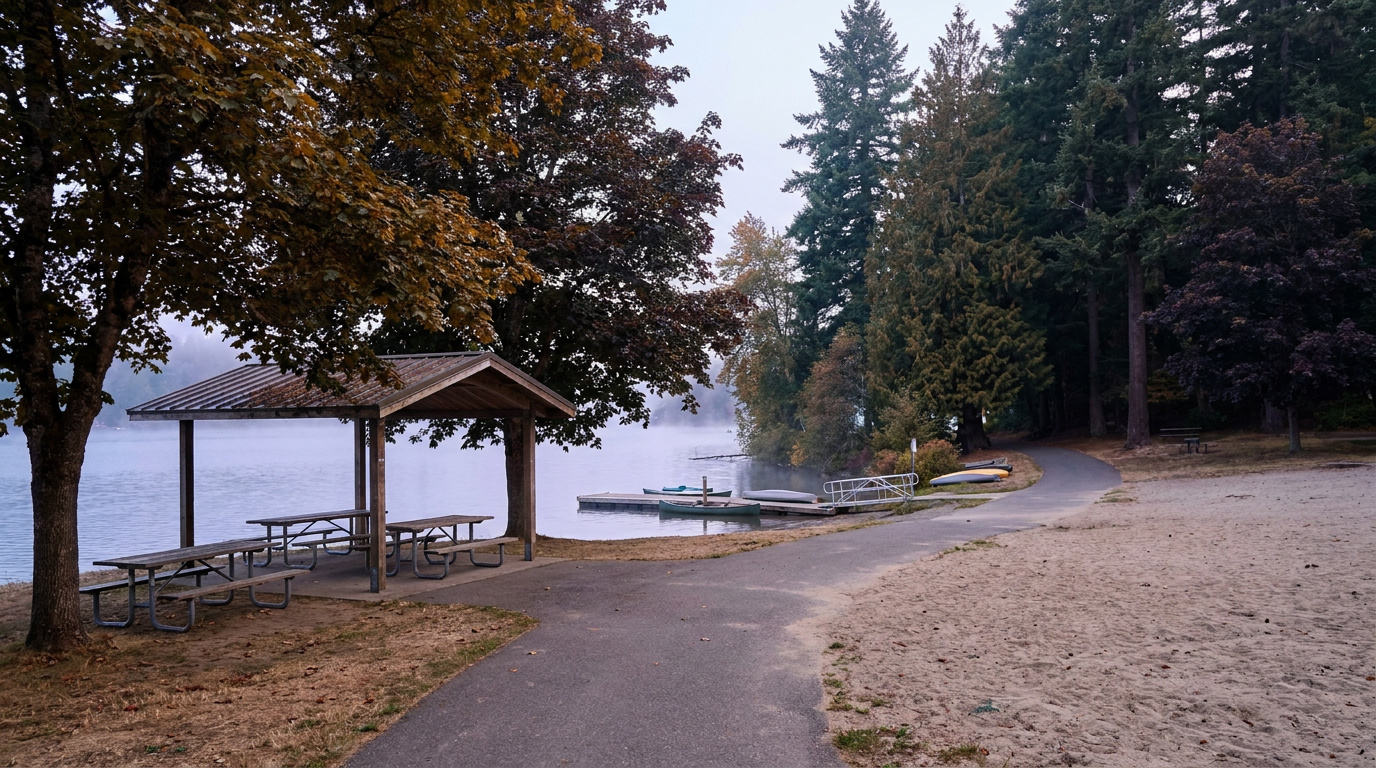
www.livingoutsideseattle.com
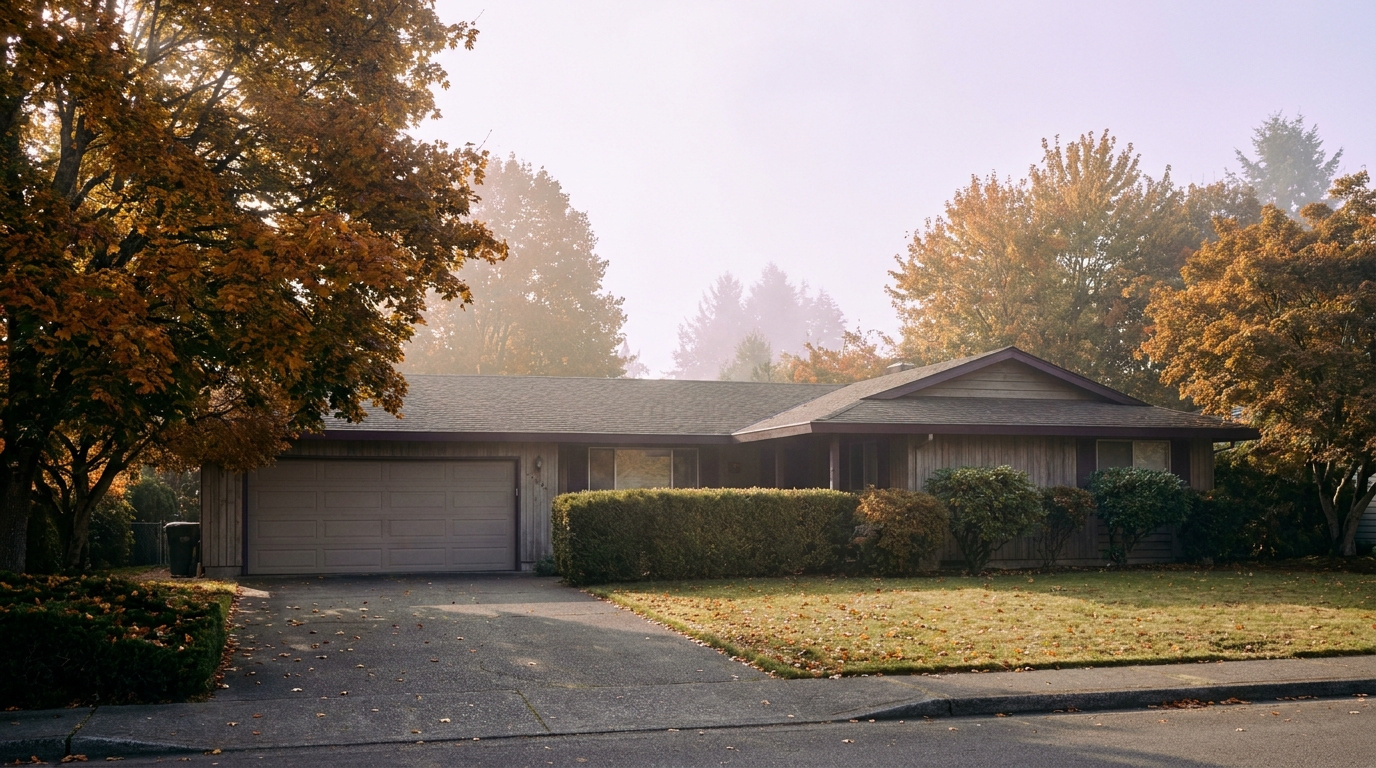
King County Market Update May 25, 2026

This Guide Has Moved

This article has been folded into our maintained guide: East & South King County Market Update [July 2026]. You are being taken there now.

Buyer Resources May 25, 2026

First-Time Home Buyer Guide: Federal Way WA 2026

Federal Way just got a lot easier to get to — and a lot more interesting to buy in. Here’s everything you need to know to buy your first home there.

As of December 2025, Federal Way has a Link light rail station. That changed something real for buyers: you can live in a city where the median home price is about $597,000 — roughly 29% below Seattle’s median — and still get to downtown Seattle or SeaTac Airport by train. For first-time buyers who have been priced out further north, that math is worth taking seriously.

This guide walks you through the actual process of buying your first home in Federal Way. Not the national advice you can find anywhere — the specific steps, the specific programs, and the specific neighborhoods that matter here. If you have done the rent-vs-buy math and you are ready to move forward, this is where to start.

What Does It Actually Cost to Buy in Federal Way Right Now?

The first number most buyers want to know is the median price. As of early 2026, it sits around $597,000 to $610,000 for all property types combined. But that number hides some useful range.

Single-family homes have a median closer to $643,750. Townhouses average $351,500. Condos — which include a mix of updated units and older complexes — run from about $200,000 up to $330,000. If you are a first-time buyer whose budget tops out around $500,000, Federal Way gives you real choices: a turnkey townhouse, a move-in-ready condo in a good location, or a single-family home that needs some work.

Compare that to Seattle, where $500,000 buys you a studio condo if you are lucky. Federal Way is not the compromise a lot of buyers expect it to be.

Then there are closing costs. In Washington state, buyers typically pay 2% to 3% of the purchase price to cover lender fees, title insurance, and prepaid items. On a $600,000 home, that is $12,000 to $18,000 out of pocket on top of your down payment. This surprises a lot of first-time buyers. Plan for it early.

The Neighborhood Question: Where to Focus in Federal Way

Federal Way is bigger than most people expect — about 25 square miles, with meaningful price and quality-of-life differences by neighborhood. Getting this right matters more than buyers often realize.

Marine Hills & Twin Lakes — Premium West Side

These neighborhoods sit on the west side of the city with views toward Puget Sound and proximity to Dash Point State Park. They consistently rank highest for schools and safety. Prices here run $650,000 to $850,000 for single-family homes.

Best for: buyers who prioritize top-rated elementary schools and long-term value stability, and can stretch the budget.

Steel Lake — Family-Friendly Middle Ground

Well-regarded schools, a community park around the lake, and prices that are more accessible than the west side. Attracts families who want good schools without paying Marine Hills prices.

Best for: families prioritizing school quality who need room in the budget for a down payment.

Federal Way City Center — Transit-Connected Entry Point

Where the new light rail station is. Walk Score of 83 — the highest in the city. Condos currently near a $285,000 median, one of the lowest price points in King County for a transit-connected location. The city has a phased agreement to add 1,600 homes near the station by 2042.

Best for: commuters, single buyers, or couples who want maximum walkability and transit access at the lowest entry price.

Down payment assistance programs for first-time home buyers in Federal Way WA 2026 — KCHA, WSHFC Home Advantage, Covenant Program

Three programs, potentially stackable — Federal Way buyers have more down payment assistance access than most King County cities.

The School District Picture

Most of Federal Way falls within the Federal Way Public Schools district, which serves over 22,000 students across 47 schools and is one of the most diverse districts in King County, with 123 languages spoken. Top-rated schools cluster in the Marine Hills, Twin Lakes, and Steel Lake neighborhoods.

A small portion of Federal Way’s north end feeds into Highline School District. This matters if you are buying in that zone and have school-age children. Confirm the district boundary before you make an offer on any specific address.

Down Payment Help: What’s Actually Available in Federal Way

This is where Federal Way gets interesting for first-time buyers. There are more programs available here — and more ways to stack them — than most buyers realize. Here is what is active in 2026.

KCHA Deferred Loan — Up to $45,000

Federal Way is one of four cities specifically named in the King County Housing Authority program (along with Auburn, Tukwila, and unincorporated King County). First-time buyers can access up to $45,000 as a 3% interest deferred loan — no monthly payments. The balance comes due when you sell, refinance, or move.

This is one of the most accessible DPA programs in King County, and Federal Way buyers qualify by location alone.

WSHFC Home Advantage — Up to 5% of Loan

Washington’s primary first-time buyer program offers below-market 30-year fixed rates plus down payment assistance of up to 5% of the loan amount as a 0% deferred second mortgage. Income limits for King County run up to $180,000 for all household sizes. You need a 620+ credit score and a free 5-hour homebuyer education course.

If your household income is under $147,400, you may also qualify for an additional $10,000 needs-based DPA at 1% simple interest on top of Home Advantage.

Covenant Homeownership Program — Up to $150,000

This program offers up to $150,000 in down payment assistance at 0% interest for buyers with documented family history in Washington state before 1968. The program expanded in 2025, and as of April 2026 requires most documentation to be gathered before house-hunting.

Buyers who qualify describe this as life-changing. The numbers really are that significant. Contact heretohome.org/covenant or call 1-877-894-4663 to check eligibility before you do anything else.

Programs can often be layered. A buyer using WSHFC Home Advantage as the first mortgage could potentially also use the KCHA $45,000 deferred loan. Talk to a WSHFC-approved lender — not just any lender — to understand exactly which combination works for your income and purchase price.

The Buying Process Step by Step in Federal Way

Here is the actual sequence. Every market has its quirks and Federal Way is no exception.

7-step home buying roadmap for first-time buyers in Federal Way WA King County — from credit check to closing

The Federal Way buying process in seven steps — from credit check to closing keys in hand.

Step 1: Get Your Finances in Shape

You need a minimum 620 credit score for most DPA programs. Pull your credit report before you start house-hunting, not after. If your score is 580 to 619, you have FHA options, but you lose access to most DPA programs until you cross 620.

Step 2: Take the Homebuyer Education Course

WSHFC requires a free 5-hour course before you can use Home Advantage. It is genuinely useful. Do it before you start touring homes — not after you find one you love.

Step 3: Get Pre-Approved (Not Just Pre-Qualified)

Federal Way homes receive an average of 3 offers and sell in about 61 days — not frantic, but sellers still expect a real pre-approval letter. Use a WSHFC-approved lender if you plan to use any state DPA programs. The difference between pre-qualified and pre-approved matters in negotiations.

Step 4: Know Your Loan Type

The FHA loan limit for King County in 2026 is around $977,500 — well above Federal Way’s median, so FHA financing is fully available here. FHA requires 3.5% down with a 580+ score. Conventional loans require 3% to 5% down with a 620+ score.

For most Federal Way first-time buyers, a combination of conventional or FHA financing plus a DPA second mortgage is the path that makes the numbers work. Also worth exploring: rate buydowns that some sellers offer to offset today’s rates.

Step 5: Make an Offer and Negotiate

Federal Way is not the wild bidding-war market you hear about in Bellevue. Homes are sitting an average of 61 days. You have room to negotiate, especially on homes listed more than 30 days. Inspection, financing, and appraisal contingencies are all standard here — do not waive them without a very specific reason.

Step 6: Inspect Thoroughly

General home inspection in Washington runs $400 to $700. Federal Way has significant older housing stock — pay attention to the roof, electrical panels (aluminum wiring was common in 1970s homes), and exterior maintenance.

For pre-1980 homes, a seismic evaluation ($150 to $350) is worth it if the inspector flags anything. Washington is an active seismic zone.

Step 7: Close

Washington closings typically take 30 to 45 days from accepted offer. You will pay 2% to 3% of the purchase price in closing costs on the buyer side. If you are using DPA programs, some of those costs may be covered — confirm with your lender in advance so there are no surprises at the closing table.

The Light Rail Factor: What It Actually Means for First-Time Buyers

Sound Transit’s Federal Way Link Extension opened December 6, 2025, adding three stations: Kent Des Moines, Star Lake, and the Federal Way Transit Center in City Center. From Federal Way, you can now take Link directly to SeaTac Airport and downtown Seattle without sitting in I-5 traffic.

For first-time buyers, this changes the commute math. If you work for a Seattle employer, Federal Way is no longer a two-hour-drive-in-bad-traffic proposition. That matters when you are choosing where to live on a first-home budget.

One thing to be straight about: the research so far shows home prices near the new stations have not spiked the way they did around other Link expansions. Development around the Federal Way station is slower than city officials originally projected. That is actually good news for first-time buyers in 2026 — you can buy near a major transit hub before any significant price premium takes hold, rather than after. That opportunity will not last indefinitely.

What This Means for You as a First-Time Buyer in King County

Federal Way in 2026 is a market where the fundamentals are solid and the buyer advantages are real. You are paying roughly $200,000 to $250,000 less than Seattle for comparable square footage. You have access to more DPA programs than almost anywhere else in King County by name. And you now have a light rail connection that much of South King County does not have.

The things to watch: neighborhood selection matters here more than in uniform suburban markets. Get the school boundaries right before you fall in love with a house. Understand which DPA programs you qualify for before you start touring homes — this changes what you can actually afford. Take the homebuyer education course early so it does not slow your timeline when you find the right place.

If you want to see how Federal Way compares to buying in a nearby city like Kent, that post walks through similar math from a different angle.

For a first-time buyer in the $450,000 to $650,000 range, Federal Way deserves a serious look. I work this market every day, and the value is real.

Frequently Asked Questions

What credit score do I need to buy a home in Federal Way?

Most down payment assistance programs require a minimum 620 credit score. FHA loans allow scores as low as 580 with 3.5% down, but you lose access to most DPA programs below 620. If your score is between 600 and 619, a few months of focused credit improvement can open up a significant amount of additional assistance.

How much down payment do I actually need in Federal Way?

FHA loans require 3.5% down — about $22,000 on a $637,000 home. Conventional loans can go as low as 3% down. But with the KCHA $45,000 deferred loan and WSHFC Home Advantage’s 5% DPA available specifically in Federal Way, many buyers cover the down payment entirely through assistance programs while keeping cash reserves for closing costs and move-in expenses.

Is Federal Way a good place to buy for the first time?

Yes — especially compared to north King County and Seattle. The median is around $597,000–$610,000, which is 29% below Seattle. Homes sit on market an average of 61 days, giving buyers more negotiating room than you find in more competitive King County cities. The new light rail connection opened December 2025 makes commuting significantly more manageable.

Which neighborhoods in Federal Way are best for families?

Marine Hills and Twin Lakes have the highest-rated schools and lowest crime rates. Steel Lake is a strong middle-ground option with good schools and more accessible prices. If transit access matters most, Federal Way City Center near the Link station has a walkability score of 83 and the lowest entry prices in the city near $285,000 for condos.

What DPA programs work specifically in Federal Way?

Federal Way is one of four cities named in the KCHA deferred loan program — up to $45,000 at 3% interest deferred until you sell or refinance. You can potentially layer that with WSHFC Home Advantage (up to 5% of the loan amount as a 0% deferred second) and, if you qualify, the Covenant Homeownership Program (up to $150,000 at 0% interest). Use a WSHFC-approved lender to understand which combination fits your situation.

How long does it take to close on a home in Federal Way?

Most Washington state closings take 30 to 45 days from accepted offer. If you are using DPA programs, add time at the beginning for pre-approval through a WSHFC-approved lender and completion of the required homebuyer education course — both need to happen before you start looking at homes.

Your guide to life outside Seattle.

Gregory Dorrell | Coldwell Banker Bain | WA License #111862
253-350-0045  ·
greg@livingoutsideseattle.com  ·
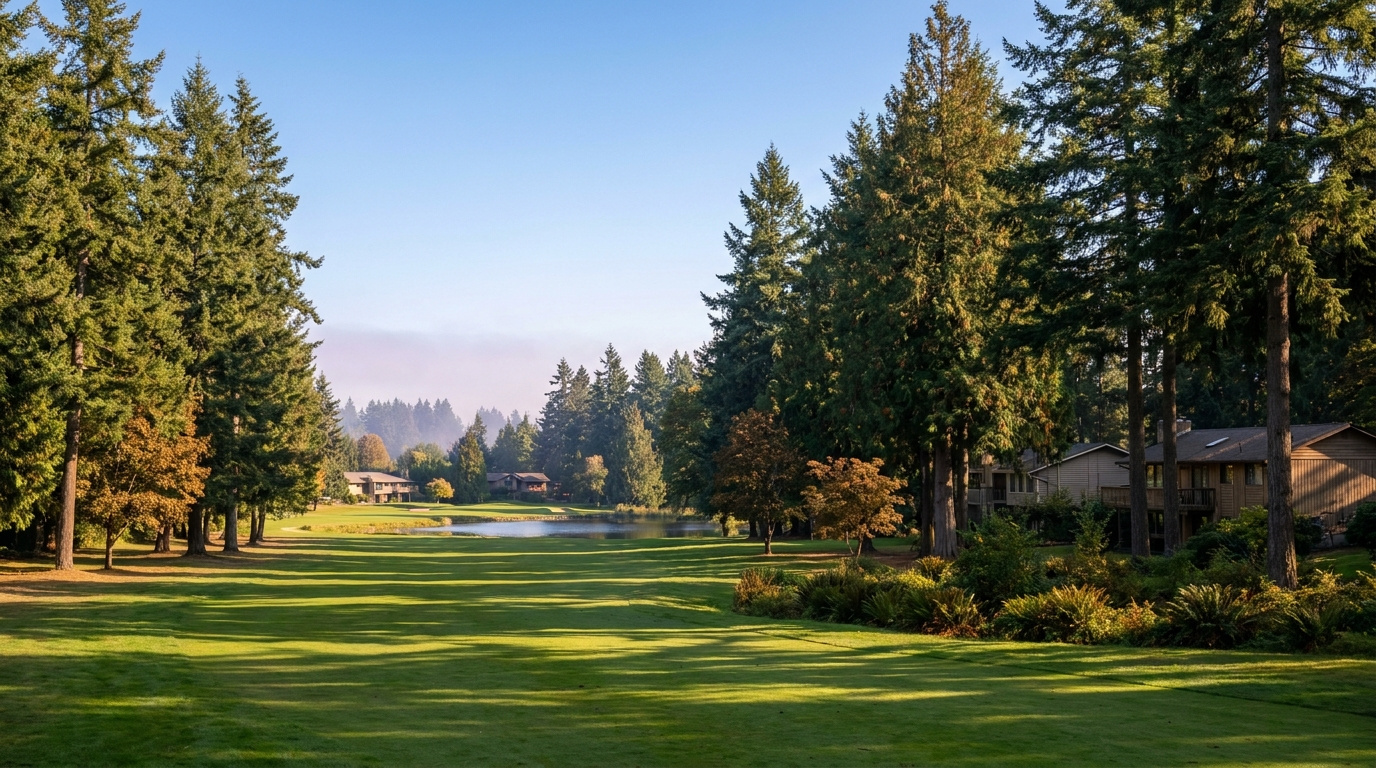
www.livingoutsideseattle.com
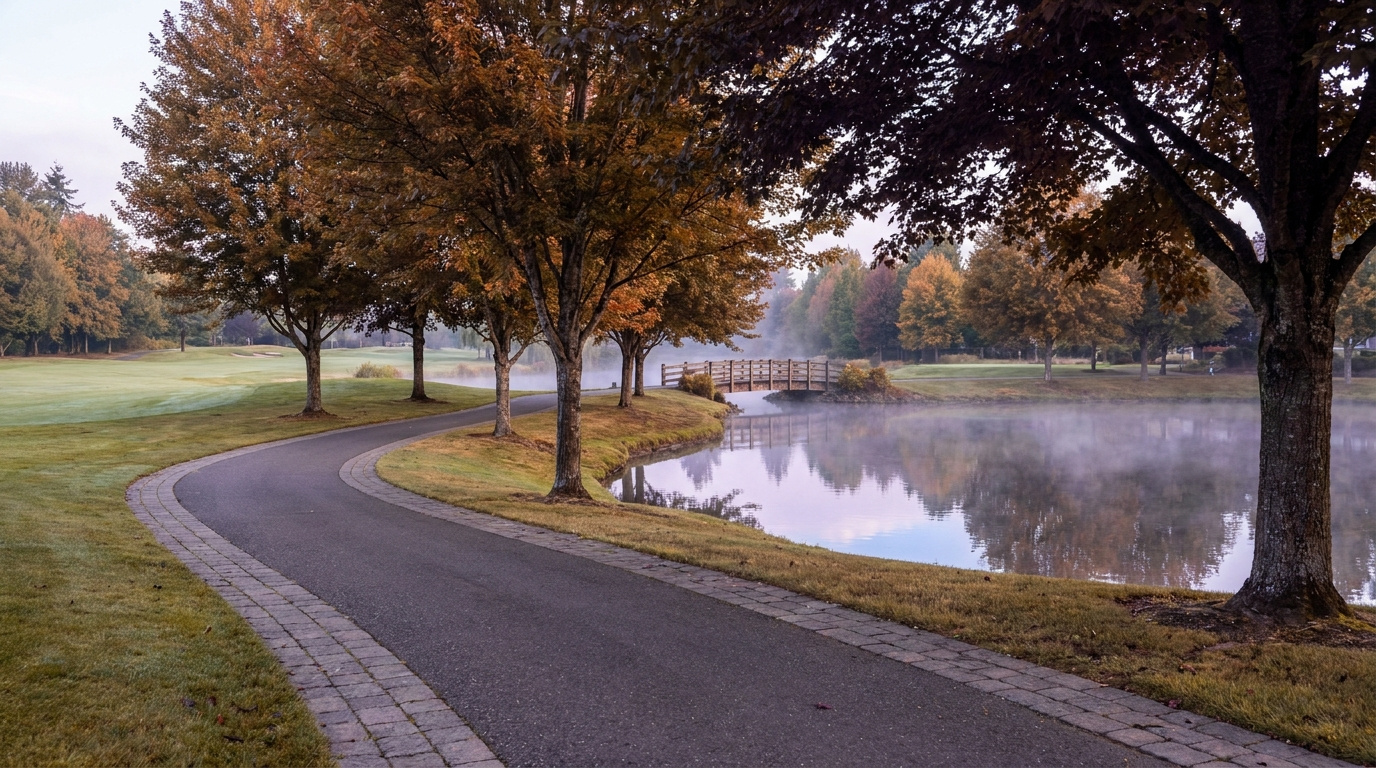
Buyer Resources May 24, 2026

King County Condo Buyer’s Guide: Due Diligence Checklist

A standard home inspection only covers your unit. Here’s how to check everything else — so you don’t inherit someone else’s financial mess.

If you’re shopping for a condo in King County, you already know the appeal. The $400K to $550K price range gets you into cities like Renton, Kent, Auburn, and Federal Way where single-family homes now regularly push past $700,000. Condos let first-time buyers get into the market with a lower entry point and no yard to maintain.

But buying a condo isn’t the same as buying a house. When you buy a condo, you’re not just buying the unit. You’re buying into the association that owns everything outside your four walls — the roof, the parking structure, the elevators, the exterior siding. You’re signing on as a stakeholder in the financial health of an organization you probably know nothing about yet.

That’s where most first-time condo buyers get burned. They fall in love with the unit, get excited about the price, and skip the due diligence that would tell them whether the building is a smart buy or a costly surprise waiting to happen. I’ve done BPO assessments on condo buildings across King County for years. The difference between a well-run community and a poorly-run one shows up in the documents — if you know what to look for.

Here’s what you need to check before you write that offer.

The Reserve Study: Your Most Important Document

The reserve study is an independent engineering report that tells you two things: what major components the association owns (roof, siding, pavement, elevators, common area systems) and how much money the HOA needs to set aside right now to cover those replacements when they come due.

Think of it like a maintenance budget projected out 20 or 30 years. A well-funded reserve means the HOA has been saving consistently and won’t need to hit owners with a surprise bill when the roof fails. An underfunded reserve means the opposite.

Here’s the number that matters most: the funding percentage. Most reserve studies show this as a percentage of “full funding.” Anything above 70% is generally healthy. Below 30% is a serious red flag. According to the Community Associations Institute, more than 70% of HOAs nationally are considered underfunded. That’s not a comfort — it’s a warning about how common the problem is.

In Washington state, as of 2026, HOAs must include reserve fund information in resale certificates. Still, don’t rely on what the HOA tells you in summary form. Ask for the full reserve study report and read the section on reserve component status yourself.

Infographic showing HOA reserve study funding health scale for King County condo buyers, from underfunded at 0% to healthy at 100%

Anything above 70% is generally healthy. Below 30%, a special assessment is likely — not a matter of if, but when.

Special Assessments: What They Are and How to Spot the Risk

A special assessment is an extra charge the HOA levies on every unit owner to cover a large expense the reserve fund can’t handle. They’re not uncommon. What makes them dangerous is that they can hit without much notice and they don’t care when you bought your unit.

An older 50-unit building might face a $200,000 roof replacement with nothing saved. That works out to $4,000 per unit — potentially due in a lump sum or in payments spread over a couple of years. Special assessments in King County can run $60,000 to $80,000 per unit when major structural or mechanical work has been deferred for years.

Before you make an offer, ask for the last five years of special assessment history. If there’s been one large assessment or multiple smaller ones in that window, ask why. The answer tells you a lot about how the board manages the property. Also ask whether any special assessments have been approved but not yet levied. Washington’s WUCIOA law requires this to be disclosed in the resale certificate — but only for assessments already approved by the board. A vote that hasn’t happened yet won’t show up anywhere except in the board minutes.

Which brings me to the board minutes.

Read the Board Meeting Minutes

Board minutes are a window into everything the summary documents won’t tell you. Most buyers never ask for them. That’s a mistake.

You’re looking for a few things specifically. First, any discussion of upcoming major repairs or capital projects. Second, any mention of litigation — whether the HOA is suing a contractor or a homeowner is suing the HOA. Third, any talk of raising dues significantly, levying a special assessment, or adjusting the reserve contribution downward to balance the operating budget. That last one is a classic sign of financial stress.

Under Washington’s WUCIOA updates effective January 1, 2026, condo associations must now hold open board meetings and provide better documentation to buyers. The resale certificate that comes with any condo sale must include 26 specific items and can only cost you up to $275. You also have a 5-day cancellation right after receiving all required documents. That window is your formal due diligence period — use it.

The Warrantable vs. Non-Warrantable Problem

This is the one that trips buyers up most often, and it has nothing to do with the unit itself. It has to do with the building.

A condo building is considered “warrantable” when it meets Fannie Mae and Freddie Mac lending standards. A warrantable building means you can get a conventional mortgage, FHA financing, or a VA loan — whatever you qualify for. Normal rates, normal down payments.

A non-warrantable building doesn’t meet those standards, and you lose access to the most competitive loan products. You’re looking at higher rates and larger down payments — often 20% or more — because portfolio lenders are taking on more risk. For a $500,000 condo, the difference between a warrantable and non-warrantable rate at current levels can easily add $200 to $250 to your monthly payment.

What Makes a Building Non-Warrantable?

The most common triggers in King County:

Single entity owns 25%+ of units — often an investor who bought in bulk during slower markets.

More than 35% commercial square footage — common in mixed-use buildings in downtown Renton or Federal Way.

Short-term rental policies — buildings that allow Airbnb-style rentals trigger automatic non-warrantable status.

Active or pending litigation — even a small dispute can knock a building out of warrantable status.

Ask your lender to run a condo project approval check before you get emotionally invested in a unit.

Many King County condo buildings — especially older mid-rises in Renton, downtown Kent, and Federal Way — fall outside warrantable guidelines. Knowing this upfront shapes your financing strategy before you’re already under contract.

For a full look at what mortgage rates look like right now for King County buyers, see our King County Mortgage Rates 2026 guide. If your condo ends up in the non-warrantable category, a mortgage rate buydown negotiated into the deal can help offset the higher rate.

Rental Cap Rules: What They Mean for Your Investment and Resale

Some condo associations limit how many units can be rented out at any given time. This is a rental cap, and it matters in two ways.

First, if you’re buying as an investor or might need to rent your unit down the road, a rental cap could block you entirely if the cap is already at its limit. Second — and this affects every buyer — a tight rental cap can make your building non-warrantable, which reduces your future buyer pool when you go to sell.

In Washington state, a rental cap must be written into the Declaration (the CC&Rs), not just the rules and regulations. Washington courts have ruled that caps can’t be created by the board alone — they need a supermajority vote to amend the Declaration. Check the current governing documents to see whether a cap exists, what the limit is, and whether it’s currently at capacity.

What a Standard Inspector Won’t Check

Here’s what a lot of condo buyers don’t realize: Washington state home inspectors are not required to inspect common elements, shared structural systems, or common area amenities. The inspector looks at your unit. The roof, the parking structure, the building envelope, the elevators, the main plumbing stack — those fall outside the standard inspection scope.

That means the structural and mechanical health of the entire building you’re buying into rests entirely on the HOA documents, not on any physical inspection you can order.

This is why the reserve study and the board minutes matter as much as they do. They’re the closest thing you have to a building inspection. If the association has been commissioning regular reserve studies and following the funding plan, you can feel reasonably confident. If the last reserve study is eight years old and nobody can find the financials, that’s your answer.

Checklist infographic of 6 documents King County condo buyers should request before making an offer, including reserve study and warrantability status

Washington’s new WUCIOA rules (effective 2026) cap the resale certificate fee at $275 and give you a 5-day cancellation window after receiving all required documents.

The Local Angle: What Makes King County Condos Different

King County’s condo market is concentrated in a handful of cities. The sub-$500K inventory you’ll find in Renton, Kent, Auburn, and Federal Way tends to be in older mid-rise buildings — think 1980s and 1990s construction. Some of these buildings have been well-maintained. Many have deferred capital work for years because the HOA fees were kept artificially low to attract owners.

As of the May 2026 King County market update, condo inventory is elevated relative to last year. That’s actually good news for buyers doing due diligence — you have more options and more negotiating room if a building’s documents reveal problems. You can move to the next building rather than feeling pressured to overlook red flags. For more on current conditions, see my East and South King County market update.

One thing I always watch from a pricing standpoint: HOA fees relative to market rates for the building’s age and amenities. An older building with fees significantly below market isn’t a deal — it’s a warning sign that the board has been cutting corners on reserves or maintenance to keep fees low. That cost shows up later. Often all at once.

If you’re weighing a condo against a townhouse or a single-family home in the same price range, the Condo vs. Townhouse vs. Single-Family Home in King County comparison guide can help you think through the tradeoffs before you commit to any one property type.

What This Means for You as a Buyer

Getting a condo offer right comes down to this: the unit is the easy part. Every agent will show you the finishes and the view. The due diligence that protects you happens in the documents.

Request the full resale certificate as soon as you’re seriously interested in a building — Washington law now limits the fee to $275 and gives you five days to review after receiving all required items. Use those five days. Read the reserve study funding percentage. Scan the last two years of board minutes for anything that sounds expensive. Pull the special assessment history. Have your lender check the project for warrantability before you fall in love with the floor plan.

If any of those documents are hard to get, incomplete, or missing entirely — that’s important information. A well-run HOA has nothing to hide.

Frequently Asked Questions

How do I get the reserve study and HOA financials as a condo buyer in Washington?

Request them in writing through your real estate agent as part of the offer or as a pre-offer document request. Under Washington’s WUCIOA law, the resale certificate is a required disclosure and must be provided within a set timeline. Your agent can request the full reserve study separately — not all associations include the full report in the standard resale package.

What reserve fund percentage should I look for when buying a condo in King County?

A funding level at or above 70% of “full funding” is generally healthy. Below 50% warrants a deeper conversation with the HOA or your agent. Below 30% is a serious red flag for near-term special assessments. FHA requires HOAs to allocate at least 10% of their annual budget to reserves — Fannie Mae is moving toward 15% effective January 2027.

What makes a condo non-warrantable in Washington state?

The most common triggers are high investor ownership (one entity owning 25%+ of units), active or pending litigation, short-term rental policies, and high commercial space concentration. Your lender can run a condo project approval check to confirm status before you’re under contract.

Can I use an FHA loan on a condo in King County?

Yes, if the building is FHA-approved or spot approval is available. FHA has its own approval process separate from conventional warrantability. Your lender will know whether the specific project is on FHA’s approved list or whether spot approval is an option for that building.

What should I look for in condo board meeting minutes?

Look for any discussion of deferred repairs, upcoming capital projects, special assessment votes (including proposed but not yet approved), litigation, significant dues increases, or decisions to reduce reserve contributions. Any of these can signal financial stress in the association.

Is a condo’s rental cap in the CC&Rs or the rules?

In Washington state, rental caps must be in the Declaration (CC&Rs) to be enforceable — not just the rules and regulations. If you see a rental cap only in the R&Rs and it’s not in the Declaration, its enforceability may be questionable under current Washington case law. Still, treat it as a real restriction until a real estate attorney tells you otherwise.

Buying a condo in King County can be a smart move. The entry-level price points in South King County are some of the last affordable options for first-time buyers in the region. But the savings on purchase price can disappear fast if you walk into a building with underfunded reserves, pending litigation, or a non-warrantable status nobody mentioned upfront.

The documents tell the story. Take the time to read them.

Your guide to life outside Seattle.

Gregory Dorrell | Coldwell Banker Bain | WA License #111862
253-350-0045  ·
greg@livingoutsideseattle.com  ·
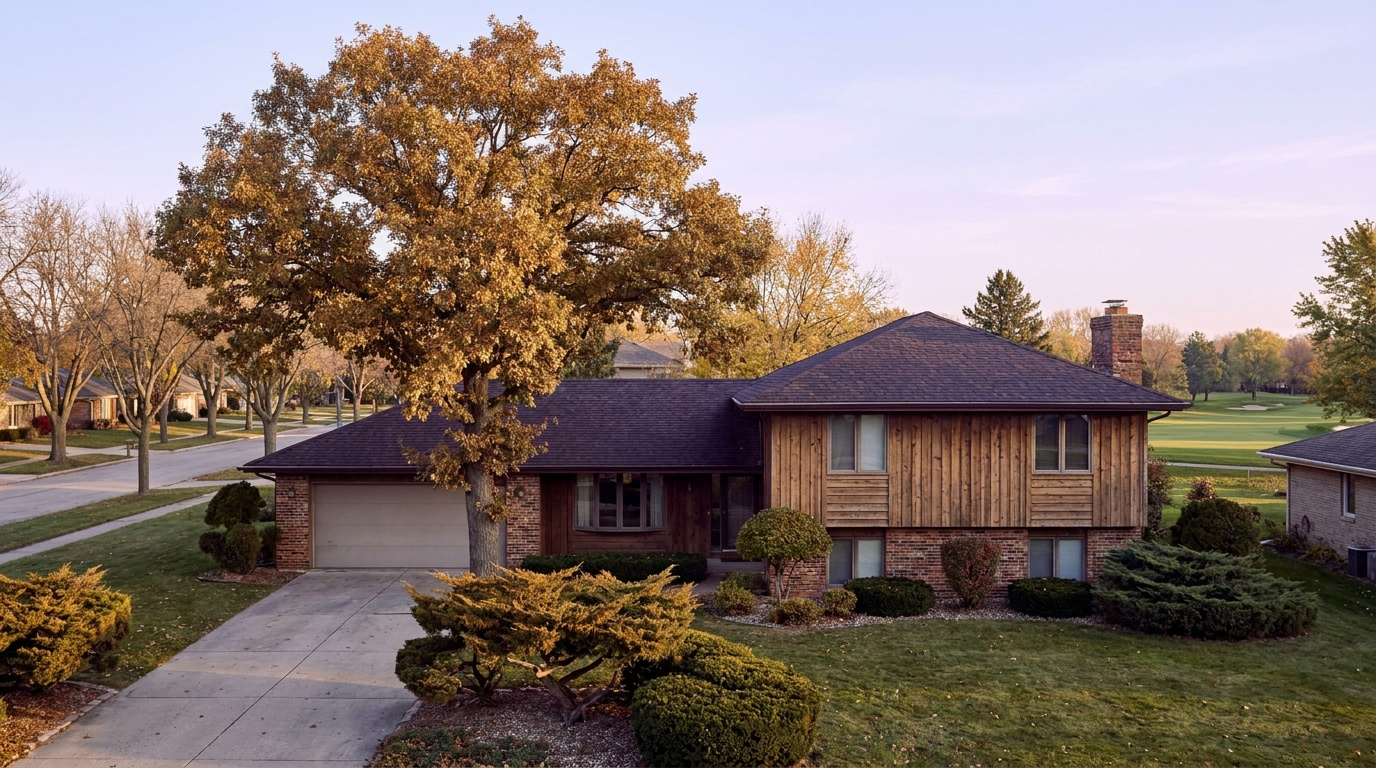
www.livingoutsideseattle.com
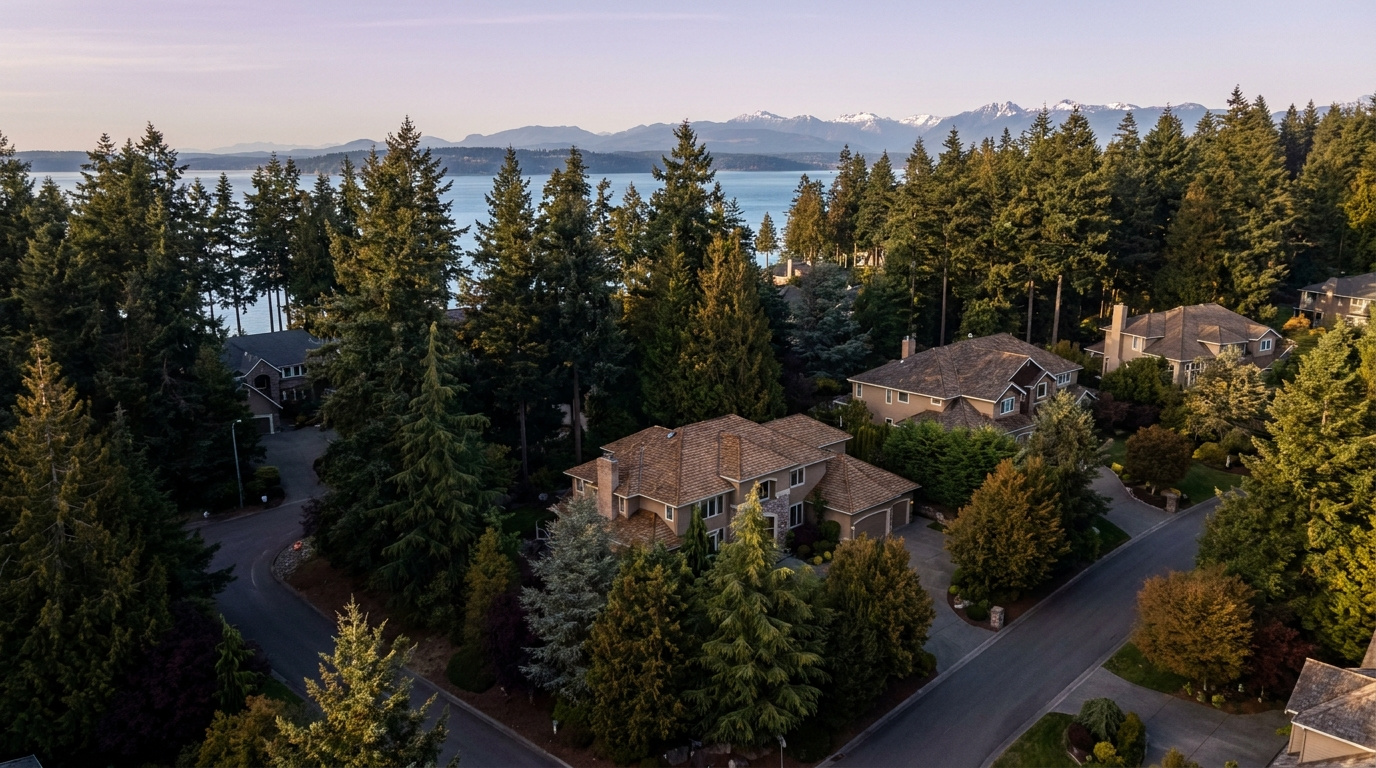
King County Market Update May 20, 2026

This Guide Has Moved

This article has been folded into our maintained guide: East & South King County Market Update [July 2026]. You are being taken there now.

King County CitiesSouth King County May 18, 2026

Living in Federal Way, WA | 2026 Real Estate & Lifestyle Guide

Why Federal Way Stands Out in 2026

King County’s median home price sits around $998,000 as of June 2026. Federal Way’s median is one of the lowest in the county for a city of its size — typically running $625,000 to $675,000, though single-city monthly figures like this can swing more than countywide data, so treat it as a directional read rather than a precise mark. That makes Federal Way one of the most accessible communities in King County for buyers who need more home for their dollar. With over 100,000 residents, Federal Way is the fourth-largest city in King County. It sits right on the I-5 corridor between Seattle and Tacoma, with SeaTac Airport 12 miles to the north and the South King County job base within easy reach.

The city has had a complicated reputation, but the picture in 2026 is more nuanced than the old story suggests. Federal Way has significant natural assets — Puget Sound waterfront at Dash Point State Park, Steel Lake, and the Celebration Park athletic complex — that most people outside the city do not know about. The downtown core around The Commons is still transitional, but the I-5 corridor has seen steady commercial investment. And the Link Light Rail connection is now operational, which changes the commute math for a lot of buyers. Federal Way is not pretending to be somewhere else. It is a practical, affordable city with real amenities, and in 2026, smart buyers are paying attention.

Federal Way Transit Center with Sound Transit Link light rail station connecting Federal Way to Seattle and SeaTac Airport
The Federal Way Link Extension opened in 2024 — giving residents direct 1 Line light rail access to SeaTac Airport in about 20 minutes and downtown Seattle in about 50 minutes.

Commute Times from Federal Way

Federal Way’s transit situation improved significantly with the opening of the Federal Way Link Extension in 2024. The 1 Line now includes the Federal Way Transit Center Station, giving residents direct light rail access to Seattle without getting on I-5. This is a meaningful change and one of the key reasons buyer interest has picked up near the transit center. I-5 remains the primary driving corridor, while SR-99 provides a slower but practical surface alternative. SR-18 connects east toward Auburn and Covington.

Destination Distance 2026 Peak Commute Transit Option
Downtown Seattle 27 miles 35 to 55 min 1 Line Light Rail / I-5
Amazon (South Lake Union) 28 miles 40 to 60 min Link Transfer at Westlake / Drive
Microsoft (Redmond) 35 miles 50 to 70 min Drive / SR-99 to I-405
Bellevue Tech Corridor 25 miles 40 to 55 min I-5 to I-405 / Drive
SeaTac Airport 12 miles 15 to 25 min 1 Line Light Rail (direct) / Drive

The Link Light Rail connection to SeaTac is one of the best practical advantages of living in Federal Way in 2026. The direct rail ride from Federal Way Transit Center to the airport takes about 20 minutes — no parking, no stress.

Neighborhoods in Federal Way: A Quick Look

Federal Way covers a large area with distinct communities that vary in character, price, and proximity to amenities. Here is a guide to the major neighborhoods buyers should know.

Twin Lakes neighborhood in Federal Way Washington with Pacific Northwest homes surrounding the lake and mature trees
Twin Lakes — one of Federal Way’s most desirable neighborhoods, where 1970s and 1980s homes surround two small lakes with park access and trails.

Dash Point / Lakota

Dash Point is Federal Way’s most distinctive neighborhood, sitting on the Puget Sound waterfront in the northwest corner of the city. The character is genuinely coastal Pacific Northwest — bluff-top homes with Sound views, forest trails, and proximity to Dash Point State Park, which has one of the few accessible sandy beaches on this stretch of Puget Sound. Homes range from 1960s and 1970s construction to newer custom builds, typically 1,800 to 3,500 sq ft. Waterfront and view properties command significant premiums. Lakota sits immediately east with a similar wooded character. Dash Point Park trails connect directly to the neighborhood.

Schools (Federal Way School District):

Lake Grove Elementary  ·
Lakota Middle School  ·
Decatur High School

Deep Dive: Dash Point →

Twin Lakes

Twin Lakes is one of Federal Way’s most established and sought-after neighborhoods, centered on two lakes in the western-central part of the city. The character is mature and community-driven, with strong HOA governance and a consistent aesthetic. Homes were mostly built between 1972 and 1990, running 1,800 to 3,000 sq ft on lots from 7,500 to 12,000 sq ft. The Twin Lakes Community Club manages shared amenities including lake access and beach areas. Twin Lakes is consistently one of Federal Way’s fastest-selling neighborhoods because the lake access and HOA maintenance hold value in ways other areas do not always match.

Schools (Federal Way School District):

Twin Lakes Elementary  ·
Lakeland Elementary  ·
Lakota Middle School  ·
Decatur High School

Deep Dive: Twin Lakes →

Steel Lake / Downtown Core

The Steel Lake area and downtown Federal Way sit in the central part of the city, centered on Steel Lake Park and the commercial corridor along S 320th Street. Steel Lake Park is Federal Way’s largest community park, with a swim beach, sports fields, picnic areas, and a boat launch. Homes run 1,200 to 2,400 sq ft on lots from 6,000 to 10,000 sq ft, with prices among the most accessible in the city. The Federal Way Transit Center is nearby — direct Light Rail to Seattle and SeaTac is walking distance for some residents. For buyers who want maximum transit access and affordability, the Steel Lake corridor deserves serious attention.

Schools (Federal Way School District):

Steel Lake Elementary  ·
Sacajawea Middle School  ·
Federal Way High School

Deep Dive: Steel Lake →

North Federal Way / Jovita

North Federal Way runs along the city’s border with Des Moines and Kent, with Jovita being a specific neighborhood in the northeast corner. The character is quiet and suburban, with 1970s and 1980s construction dominating the housing stock. Homes typically run 1,400 to 2,400 sq ft on lots from 7,000 to 11,000 sq ft. Easy I-5 access makes commuting toward Seattle or Tacoma straightforward. Federal Way High School is the district’s oldest school with broad program offerings. Buyers in north Federal Way get slightly shorter commutes to SeaTac and Kent while staying in the Federal Way price bracket.

Schools (Federal Way School District):

Sunnycrest Elementary  ·
Totem Middle School  ·
Federal Way High School

Deep Dive: North Federal Way →

Mirror Lake

Mirror Lake is a quiet residential area in the central-west part of Federal Way, anchored by the small lake it shares its name with. The character is calm and neighborhood-oriented, with a mix of 1970s ranch homes, 1980s two-stories, and some newer infill. Homes run 1,400 to 2,600 sq ft on lots from 7,000 to 10,000 sq ft. The lake provides a pleasant green backdrop for surrounding homes. Mirror Lake Elementary is one of the district’s well-regarded schools. Prices run slightly above the Federal Way average because of the school assignments and established neighborhood feel.

Schools (Federal Way School District):

Mirror Lake Elementary  ·
Lakota Middle School  ·
Decatur High School

Deep Dive: Mirror Lake →

Celebration Park / Easter Lake

The Celebration Park area sits in the southwest part of Federal Way, organized around one of the largest athletic park complexes in the region — 19 athletic fields, trails, and significant green space. Easter Lake is a small neighborhood lake nearby. Homes in this corridor run 1,500 to 2,800 sq ft on 1980s and 1990s construction, with lots from 7,000 to 12,000 sq ft. Todd Beamer High is one of the newer schools in the district and has developed a strong academic culture. Buyers with kids in youth sports often prioritize this area for obvious reasons.

Schools (Federal Way School District):

Wildwood Elementary  ·
Sequoyah Middle School  ·
Todd Beamer High School

Deep Dive: Celebration Park →

Redondo / Marine Hills

Redondo sits at Federal Way’s northwest corner near Des Moines. The character here is coastal and slightly upscale for Federal Way — Redondo Beach provides Puget Sound access with a small marina, waterfront dining, and stunning Cascade and Olympic Mountain views on clear days. Marine Hills is the residential neighborhood climbing the bluff above Redondo, with homes from modest 1960s ramblers to larger view properties from the 1980s and 1990s. Home sizes run 1,400 to 2,800 sq ft on lots from 7,000 to 14,000 sq ft. Buyers who want Puget Sound access at Federal Way prices should seriously explore Redondo.

Schools (Federal Way School District):

Redondo Elementary  ·
Lakota Middle School  ·
Decatur High School

Deep Dive: Redondo →

South Federal Way / Camelot

South Federal Way and the Camelot area sit near the Pierce County line, south of S 356th Street. The character is quieter and more suburban than the city core, with larger lots and a mix of older established homes and newer construction. Homes run 1,500 to 3,000 sq ft on lots from 8,000 to 14,000 sq ft. Some newer subdivisions have HOAs with maintained common areas. SR-18 provides east access toward Auburn, opening commuting options other Federal Way neighborhoods do not have. This is one of Federal Way’s most affordable sectors by square foot. Always confirm school assignment based on the specific address near the district boundary.

Schools (Federal Way School District — verify by address):

Camelot Elementary  ·
Sequoyah Middle School  ·
Todd Beamer High School

Deep Dive: South Federal Way →

Wynstone / Belmor Park

Wynstone is a planned residential community in the eastern part of Federal Way, built in the 1990s and 2000s with a consistent aesthetic and HOA management. Single-family homes run 1,800 to 3,000 sq ft on lots from 5,000 to 8,000 sq ft, with prices in the $525,000 to $650,000 range. Thomas Jefferson has strong fine arts programs and a dedicated community. Buyers who want newer construction in a managed community at Federal Way prices will find Wynstone competitive. Next door, Belmor Park offers a 55-and-over manufactured home community with its own nine-hole golf course and clubhouse.

Schools (Federal Way School District):

Valhalla Elementary  ·
Illahee Middle School  ·
Thomas Jefferson High School

Deep Dive: Wynstone / Belmor Park →

Brittany Lane / The Villages

Brittany Lane is a quiet, HOA-managed neighborhood in the far south end of Federal Way, near the Milton border along 1st Ave S, sometimes grouped with nearby development under “The Villages” label. Homes were mostly built from the mid 1990s through the 2000s, running roughly 1,600 to 2,800 sq ft on lots from 4,500 to 7,500 sq ft — Northwest suburban style with two-story floor plans and attached garages. Buyers who want an established, HOA-managed street with easy access to Celebration Park find this corner of Federal Way an easy transition.

Schools (Federal Way School District): this pocket sits close to a boundary edge, so confirm your specific address before assuming a school.

FWPS Boundary Lookup  ·
FWPS Boundary Info

Deep Dive: Brittany Lane →

Federal Way Washington real estate market 2026 -- well-maintained Pacific Northwest home representing affordable King County housing values
Federal Way’s median home price of $525,000 to $580,000 makes it one of the most affordable entry points into King County for buyers who need light rail access.

Market Dynamics & Investment Value in Federal Way

Federal Way’s market has been shifting in ways buyers should understand in 2026. Active listings are up roughly 26% countywide compared to a year ago (June 2026 vs. June 2025), giving buyers more time and more options than they have had since 2018. Homes that would have gone under contract in a weekend in 2022 are now sitting two to five weeks before offers come in. That shift means buyers can inspect properly, request repairs, and negotiate without the all-or-nothing sprint. That is a meaningful quality-of-life improvement for the buying process.

Federal Way’s median sale price ran about $675,000 in June 2026, firmer than earlier in the year — though a single month of city-level data can move quickly, so this is a snapshot, not a trend line on its own. Homes under $600,000 continue to draw the most consistent demand from first-time buyers. The Light Rail opening in 2024 added a specific boost to properties within one to two miles of the Federal Way Transit Center — homes in that radius have outperformed the broader Federal Way market by roughly 5% to 8% on price stability over the past 12 months.

Federal Way’s proximity to both Seattle and Tacoma gives it practical resilience that pure bedroom communities do not always have. The employment base here is diverse — Port of Tacoma, Boeing in Auburn and Renton, Joint Base Lewis-McChord to the south, and the growing South King County logistics sector. That diversity of employment reduces the single-employer risk that some Seattle-adjacent markets face when tech companies cut headcount.

Dash Point State Park beach in Federal Way Washington with Puget Sound and Olympic Mountains view
Dash Point State Park — Federal Way’s hidden gem, with 3,301 acres of forest, a sandy Puget Sound beach, and Olympic Mountain views that most buyers don’t know exist until they move here.

Frequently Asked Questions: Living in Federal Way, WA

Is Federal Way, WA a good place to live?

Federal Way is a strong fit for buyers who want affordability, light rail access, and Puget Sound proximity without Seattle prices. It is not the most polished city in King County, but it offers something genuinely hard to find: Sound waterfront access, a direct rail connection to SeaTac, and home prices $300,000 below the county median. For first-time buyers, families on a budget, and frequent travelers, Federal Way delivers strong practical value.

What is the average home price in Federal Way, WA in 2026?

Federal Way’s median home price ran about $675,000 as of June 2026 for single-family homes citywide — single-city monthly figures can swing, so treat this as directional. Twin Lakes and Dash Point areas run higher — $650,000 to $800,000 depending on views and lake access. South Federal Way and parts of the downtown core offer the most affordable entry points, often starting under $550,000. Homes are averaging one to two weeks on market as of June 2026.

What are the best neighborhoods in Federal Way, WA?

For outdoor lifestyle and Puget Sound access, Dash Point and Redondo are standouts. For established neighborhood character and lake access, Twin Lakes consistently holds value the best. For transit access and affordability, Steel Lake near the Federal Way Transit Center is the smart choice. For newer construction and family-friendly parks, Wynstone and the Celebration Park area deliver well.

How does Federal Way connect to Seattle in 2026?

The Federal Way Link Extension opened in 2024, adding Federal Way Transit Center Station to the 1 Line. The direct rail ride to downtown Seattle takes about 35 minutes. SeaTac is about 20 minutes by rail — no parking, no traffic. By car on I-5, expect 35 to 55 minutes to downtown Seattle during AM peak hours depending on conditions.

What school district serves Federal Way, WA?

Most of Federal Way is served by the Federal Way School District. Parts of south Federal Way near the Pierce County line may fall near school district boundaries — always confirm the specific school assignment for any address before writing an offer. The district has multiple high schools including Decatur, Federal Way, Todd Beamer, and Thomas Jefferson.

Explore Federal Way Yourself

Start at Dash Point State Park for the Sound view and trail walk. Then drive through Twin Lakes to see the established neighborhood character. Finish at Steel Lake Park on a weekend afternoon when the community is out. You will understand what Federal Way is actually about.

View Federal Way on Google Maps

Your guide to life outside Seattle.

Gregory Dorrell | Coldwell Banker Bain | WA License #111862
253-350-0045 ·
greg@livingoutsideseattle.com ·
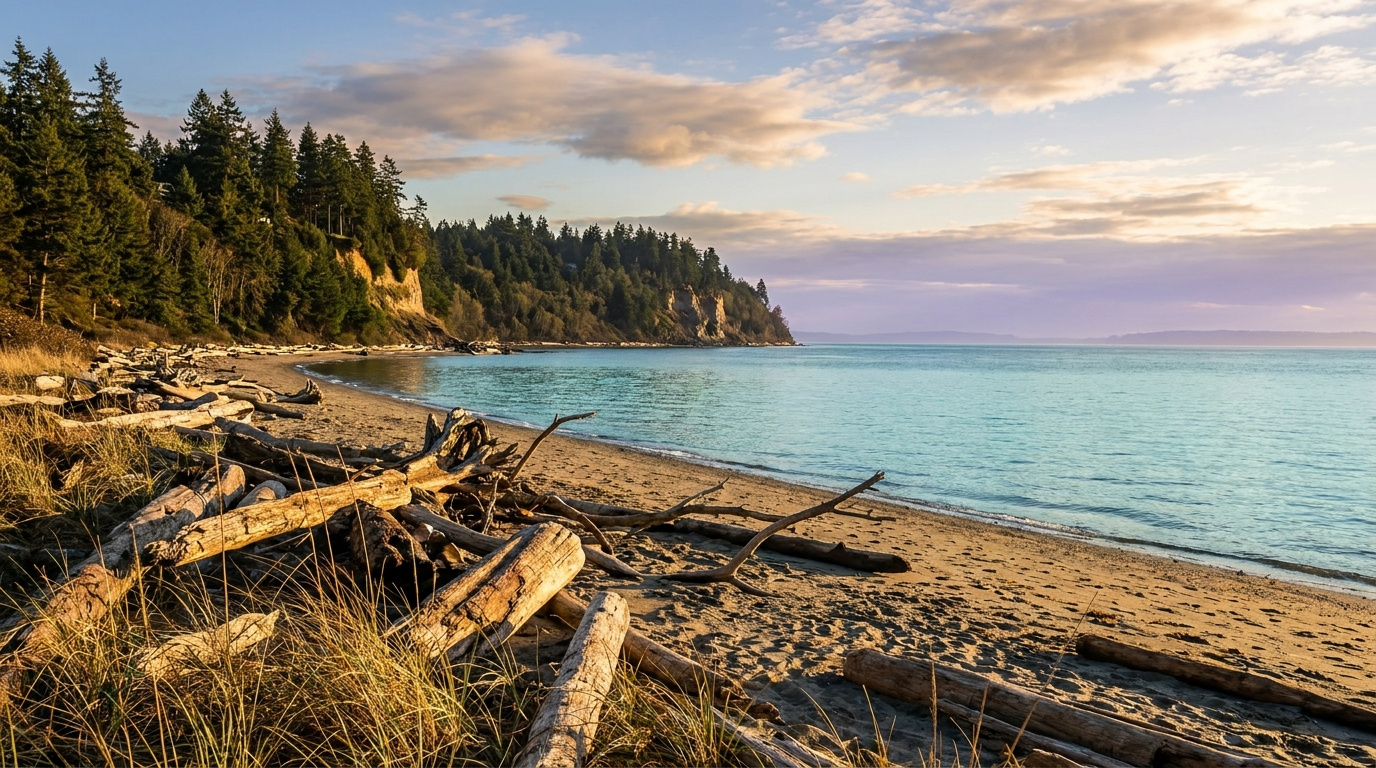
www.livingoutsideseattle.com