
King County Market Update May 25, 2026

King County Real Estate Market Update — May 25, 2026


41% of Renton Sellers Just Cut Their Price. Here’s What That Means for You.

South King County buyers finally have leverage — and most sellers don’t know it yet.

The number that caught my attention this week was 41%. That’s the share of active listings in Renton where sellers have reduced their price in the last 14 days. Nearly half. In a market where the median home still sells in 12 days and buyers are committing at full asking price on average, that gap tells a very specific story — and it’s one worth understanding before you make your next move.

This is not a market in freefall. King County is still a seller-leaning balanced market. But the sellers who are winning right now are the ones who priced with current data from day one. The ones who guessed — or who are still thinking it’s 2022 — are the ones cutting their prices two weeks in. That divergence is the story of this week’s market, and it matters whether you’re buying or selling.

Here’s what the data is showing across King County this week.

The Big Picture: King County at a Glance

The county-level numbers are holding steady. Inventory has plateaued after the big spring surge, mortgage rates have been stable, and homes are still moving — just more selectively than before.
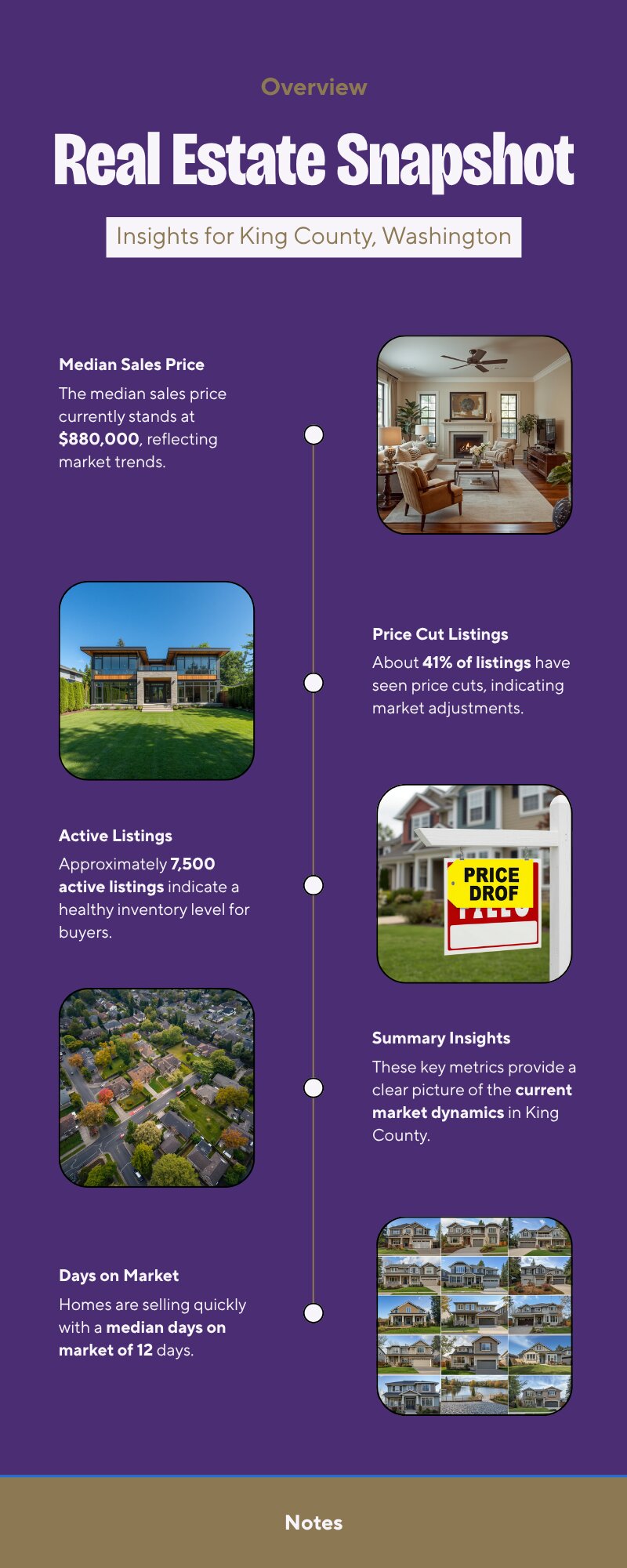
King County real estate market snapshot May 25 2026 — median price $880K, 12 days on market, 41% price reductions in South County

Source: NWMLS | May 2026

The 12-day median days on market tells you demand is still real. But the price reduction number tells you that demand has a sharp edge — it shows up fast for homes that are priced right, and it stays away entirely from homes that are not. That split is wider right now than it has been in years.

Mortgage rates have held a tight band between 6.0% and 6.3% all month. That’s not exciting news, but it’s actually good news for anyone trying to plan. Buyers know what their payment will be. Sellers know what their buyer pool looks like. Predictability at 6% is a lot more useful than volatility at 5.5%. If you want to understand what rates are actually doing to purchasing power right now, I broke that down in detail in my King County mortgage rates guide for 2026.

Neighborhood Breakdown

Renton

Renton is the clearest example of the price-drop divergence playing out in real time. The median price is holding at $788,000, but that number masks what’s happening beneath it. Over 41% of active listings have cut their prices in the past two weeks. That’s not a sign of a collapsing market — it’s a sign that a lot of sellers came in hot and the market pushed back.

For buyers, this is exactly the kind of data that creates real negotiating room. If you’re looking in Renton and a home has been sitting for more than two weeks, there’s a real chance that seller is ready to talk. If you’re a seller in Renton and you haven’t listed yet, this data tells you one thing clearly: price it right on day one, or join the 41%.

If you’re thinking about listing in Renton this spring, I put together a detailed breakdown of when and how to sell in Renton that’s worth reading before you set your number.
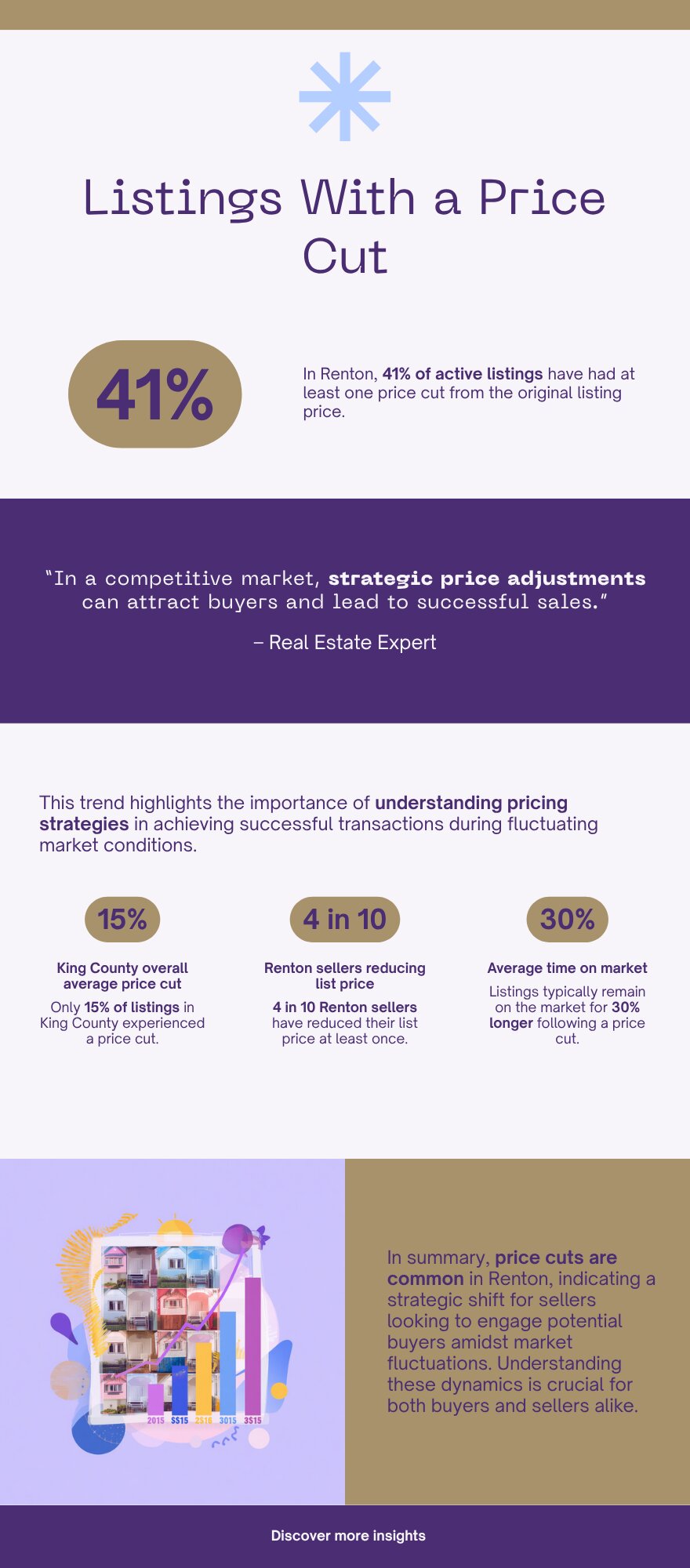
Bar chart showing 41% price reduction share in Renton vs King County average — May 2026 real estate market

Source: NWMLS | May 2026

Kent

Kent’s median price sits at $695,000 with healthy active inventory. Homes that aren’t staged or priced strictly to current comps are sliding past the 30-day mark quickly. That’s a meaningful threshold — once a home hits 30 days on market, buyers start wondering what’s wrong with it even when nothing is.

The buyers who are winning in Kent right now are the ones who have done their homework and know what the real comps support. If you’re a first-time buyer trying to figure out whether now is the right time to buy in Kent, I worked through the actual math in this post: First-Time Home Buyer in Kent WA — Buy Now or Wait?

Federal Way & Auburn

These two cities are carrying a lot of buyer traffic right now, and for good reason. Federal Way is holding 8.9% year-over-year price growth with a $615,000 median. Auburn is running competitive under $650,000, with well-priced homes moving in about 10 days. The flight to affordability south of Seattle is far from over — these cities are absorbing buyers who got priced out of Renton and Kent, and the demand is showing up in the numbers.

For first-time buyers, this is where your dollar goes furthest in King County right now. For sellers in Federal Way and Auburn, the traffic is real — but so is the competition. Presentation and pricing still decide everything.

The Eastside: Bellevue, Sammamish & Issaquah

The Eastside continues to move at a different speed. Bellevue’s turnkey homes under $2 million are averaging 6 days on market, driven in large part by the OpenAI expansion pulling in high-income relocating buyers. Sammamish sits at a $1.62 million median and remains your lowest-inventory Eastside market — move-in-ready homes there are still vanishing in 5 days. Issaquah is running around $904,000 median with strong showing activity, particularly in the Issaquah Highlands.

If you’re tracking luxury inventory, the one note is that Bellevue homes over $3 million are starting to accumulate. High-end buyers there are getting more options than they’ve seen in a while.

What This Means If You’re Buying

The market right now rewards buyers who are prepared. Here’s what that looks like in practice.

In South King County, especially Renton and Kent, the price reduction data is telling you something important: there is negotiating room on a meaningful number of active listings. If a home has been sitting for two weeks or more and carries a price cut, that seller has already signaled they are willing to move. Going in with a well-supported offer below asking is not aggressive — it’s logical, and the data backs it up.

Rate stability at 6.0–6.3% also gives you something buyers haven’t had for a while: the ability to plan. You can calculate your actual payment with confidence right now. That predictability is a tool — use it. Lock your pre-approval, know your number, and be ready to move when the right home comes up.

What This Means If You’re Selling

If you are thinking about listing, the most important thing I can tell you this week is this: the market will give you a fast, clean sale — but only if you price for 2026, not 2022.

The homes in the top 10% of the market right now — turnkey, well-staged, priced to current comps — are still getting multiple offers. The homes with minor deferred maintenance or aggressive pricing are sitting and collecting price cuts. There is almost no middle ground this week.

Homeowner walking through staged King County home interior with warm Pacific Northwest lighting for spring 2026 home sale

Staging and pricing from day one are the two decisions that separate fast sales from price cuts right now.

Staging matters more than it did two years ago. When buyers have more choices than they did in 2022, the bar for “good enough” goes up. A home that might have gone under contract in a weekend in 2022 now needs to actually compete.

If you’re not sure how to find your real number in this market, I put together a full breakdown of how to price your home to sell in King County in 2026. It covers exactly what the comps process looks like and where most sellers make the mistake.

The BPO Advantage

Here’s why this specific market moment makes pricing precision so critical.

Right now, 4 out of 10 sellers in South King County guessed wrong on price. They listed, sat, and cut. Every day a home sits on market, it loses negotiating leverage. Buyers start asking what’s wrong with it. The final sale price ends up lower than it would have been on day one with the right number.

My BPO work — professionally assessing property values for banks and lenders every single day — means I don’t guess. I know what the banks think a home is worth because I run those same calculations constantly. When I tell you what your home should list at, it’s not an opinion built on what you hope to net. It’s an institutional-grade assessment built on the same methodology that lenders use to protect their money.

Gregory Dorrell BPO pricing advantage — bank-grade home valuation accuracy for King County sellers May 2026

Institutional-grade pricing analysis — the same methodology banks and lenders use.

In a market where the difference between a week-one sale and a 30-day price cut can be $20,000 to $40,000, that kind of precision isn’t a nice-to-have. It’s the job.

What to Watch Next Week

Keep an eye on how the 41% price reduction figure moves in South County. If it climbs toward 50%, that’s a signal that the buyer pool is thinning in Renton and Kent and sellers will need to adjust more aggressively. If it starts coming back down, it means the market is self-correcting and properly priced homes are getting absorbed.

The rate window at 6.0–6.3% has been unusually stable. Any movement in bond markets could shift that, so if you’re a buyer who has been waiting for the right moment to lock a pre-approval, this week is as good a moment as you’ve had all spring.

Your guide to life outside Seattle.

Gregory Dorrell | Coldwell Banker Bain | WA License #111862
253-350-0045  ·
greg@livingoutsideseattle.com  ·
www.livingoutsideseattle.com
Buyer Resources May 25, 2026

First-Time Home Buyer Guide: Federal Way WA 2026

First-Time Home Buyer Guide for Federal Way WA 2026

Federal Way just got a lot easier to get to — and a lot more interesting to buy in. Here’s everything you need to know to buy your first home there.

As of December 2025, Federal Way has a Link light rail station. That changed something real for buyers: you can live in a city where the median home price is about $597,000 — roughly 29% below Seattle’s median — and still get to downtown Seattle or SeaTac Airport by train. For first-time buyers who have been priced out further north, that math is worth taking seriously.

This guide walks you through the actual process of buying your first home in Federal Way. Not the national advice you can find anywhere — the specific steps, the specific programs, and the specific neighborhoods that matter here. If you have done the rent-vs-buy math and you are ready to move forward, this is where to start.

What Does It Actually Cost to Buy in Federal Way Right Now?

The first number most buyers want to know is the median price. As of early 2026, it sits around $597,000 to $610,000 for all property types combined. But that number hides some useful range.

Single-family homes have a median closer to $643,750. Townhouses average $351,500. Condos — which include a mix of updated units and older complexes — run from about $200,000 up to $330,000. If you are a first-time buyer whose budget tops out around $500,000, Federal Way gives you real choices: a turnkey townhouse, a move-in-ready condo in a good location, or a single-family home that needs some work.

Compare that to Seattle, where $500,000 buys you a studio condo if you are lucky. Federal Way is not the compromise a lot of buyers expect it to be.

Then there are closing costs. In Washington state, buyers typically pay 2% to 3% of the purchase price to cover lender fees, title insurance, and prepaid items. On a $600,000 home, that is $12,000 to $18,000 out of pocket on top of your down payment. This surprises a lot of first-time buyers. Plan for it early.

The Neighborhood Question: Where to Focus in Federal Way

Federal Way is bigger than most people expect — about 25 square miles, with meaningful price and quality-of-life differences by neighborhood. Getting this right matters more than buyers often realize.

Marine Hills & Twin Lakes — Premium West Side

These neighborhoods sit on the west side of the city with views toward Puget Sound and proximity to Dash Point State Park. They consistently rank highest for schools and safety. Prices here run $650,000 to $850,000 for single-family homes.

Best for: buyers who prioritize top-rated elementary schools and long-term value stability, and can stretch the budget.

Steel Lake — Family-Friendly Middle Ground

Well-regarded schools, a community park around the lake, and prices that are more accessible than the west side. Attracts families who want good schools without paying Marine Hills prices.

Best for: families prioritizing school quality who need room in the budget for a down payment.

Federal Way City Center — Transit-Connected Entry Point

Where the new light rail station is. Walk Score of 83 — the highest in the city. Condos currently near a $285,000 median, one of the lowest price points in King County for a transit-connected location. The city has a phased agreement to add 1,600 homes near the station by 2042.

Best for: commuters, single buyers, or couples who want maximum walkability and transit access at the lowest entry price.

Down payment assistance programs for first-time home buyers in Federal Way WA 2026 — KCHA, WSHFC Home Advantage, Covenant Program

Three programs, potentially stackable — Federal Way buyers have more down payment assistance access than most King County cities.

The School District Picture

Most of Federal Way falls within the Federal Way Public Schools district, which serves over 22,000 students across 47 schools and is one of the most diverse districts in King County, with 123 languages spoken. Top-rated schools cluster in the Marine Hills, Twin Lakes, and Steel Lake neighborhoods.

A small portion of Federal Way’s north end feeds into Highline School District. This matters if you are buying in that zone and have school-age children. Confirm the district boundary before you make an offer on any specific address.

Down Payment Help: What’s Actually Available in Federal Way

This is where Federal Way gets interesting for first-time buyers. There are more programs available here — and more ways to stack them — than most buyers realize. Here is what is active in 2026.

KCHA Deferred Loan — Up to $45,000

Federal Way is one of four cities specifically named in the King County Housing Authority program (along with Auburn, Tukwila, and unincorporated King County). First-time buyers can access up to $45,000 as a 3% interest deferred loan — no monthly payments. The balance comes due when you sell, refinance, or move.

This is one of the most accessible DPA programs in King County, and Federal Way buyers qualify by location alone.

WSHFC Home Advantage — Up to 5% of Loan

Washington’s primary first-time buyer program offers below-market 30-year fixed rates plus down payment assistance of up to 5% of the loan amount as a 0% deferred second mortgage. Income limits for King County run up to $180,000 for all household sizes. You need a 620+ credit score and a free 5-hour homebuyer education course.

If your household income is under $147,400, you may also qualify for an additional $10,000 needs-based DPA at 1% simple interest on top of Home Advantage.

Covenant Homeownership Program — Up to $150,000

This program offers up to $150,000 in down payment assistance at 0% interest for buyers with documented family history in Washington state before 1968. The program expanded in 2025, and as of April 2026 requires most documentation to be gathered before house-hunting.

Buyers who qualify describe this as life-changing. The numbers really are that significant. Contact heretohome.org/covenant or call 1-877-894-4663 to check eligibility before you do anything else.

Programs can often be layered. A buyer using WSHFC Home Advantage as the first mortgage could potentially also use the KCHA $45,000 deferred loan. Talk to a WSHFC-approved lender — not just any lender — to understand exactly which combination works for your income and purchase price.

The Buying Process Step by Step in Federal Way

Here is the actual sequence. Every market has its quirks and Federal Way is no exception.

7-step home buying roadmap for first-time buyers in Federal Way WA King County — from credit check to closing

The Federal Way buying process in seven steps — from credit check to closing keys in hand.

Step 1: Get Your Finances in Shape

You need a minimum 620 credit score for most DPA programs. Pull your credit report before you start house-hunting, not after. If your score is 580 to 619, you have FHA options, but you lose access to most DPA programs until you cross 620.

Step 2: Take the Homebuyer Education Course

WSHFC requires a free 5-hour course before you can use Home Advantage. It is genuinely useful. Do it before you start touring homes — not after you find one you love.

Step 3: Get Pre-Approved (Not Just Pre-Qualified)

Federal Way homes receive an average of 3 offers and sell in about 61 days — not frantic, but sellers still expect a real pre-approval letter. Use a WSHFC-approved lender if you plan to use any state DPA programs. The difference between pre-qualified and pre-approved matters in negotiations.

Step 4: Know Your Loan Type

The FHA loan limit for King County in 2026 is around $977,500 — well above Federal Way’s median, so FHA financing is fully available here. FHA requires 3.5% down with a 580+ score. Conventional loans require 3% to 5% down with a 620+ score.

For most Federal Way first-time buyers, a combination of conventional or FHA financing plus a DPA second mortgage is the path that makes the numbers work. Also worth exploring: rate buydowns that some sellers offer to offset today’s rates.

Step 5: Make an Offer and Negotiate

Federal Way is not the wild bidding-war market you hear about in Bellevue. Homes are sitting an average of 61 days. You have room to negotiate, especially on homes listed more than 30 days. Inspection, financing, and appraisal contingencies are all standard here — do not waive them without a very specific reason.

Step 6: Inspect Thoroughly

General home inspection in Washington runs $400 to $700. Federal Way has significant older housing stock — pay attention to the roof, electrical panels (aluminum wiring was common in 1970s homes), and exterior maintenance.

For pre-1980 homes, a seismic evaluation ($150 to $350) is worth it if the inspector flags anything. Washington is an active seismic zone.

Step 7: Close

Washington closings typically take 30 to 45 days from accepted offer. You will pay 2% to 3% of the purchase price in closing costs on the buyer side. If you are using DPA programs, some of those costs may be covered — confirm with your lender in advance so there are no surprises at the closing table.

The Light Rail Factor: What It Actually Means for First-Time Buyers

Sound Transit’s Federal Way Link Extension opened December 6, 2025, adding three stations: Kent Des Moines, Star Lake, and the Federal Way Transit Center in City Center. From Federal Way, you can now take Link directly to SeaTac Airport and downtown Seattle without sitting in I-5 traffic.

For first-time buyers, this changes the commute math. If you work for a Seattle employer, Federal Way is no longer a two-hour-drive-in-bad-traffic proposition. That matters when you are choosing where to live on a first-home budget.

One thing to be straight about: the research so far shows home prices near the new stations have not spiked the way they did around other Link expansions. Development around the Federal Way station is slower than city officials originally projected. That is actually good news for first-time buyers in 2026 — you can buy near a major transit hub before any significant price premium takes hold, rather than after. That opportunity will not last indefinitely.

What This Means for You as a First-Time Buyer in King County

Federal Way in 2026 is a market where the fundamentals are solid and the buyer advantages are real. You are paying roughly $200,000 to $250,000 less than Seattle for comparable square footage. You have access to more DPA programs than almost anywhere else in King County by name. And you now have a light rail connection that much of South King County does not have.

The things to watch: neighborhood selection matters here more than in uniform suburban markets. Get the school boundaries right before you fall in love with a house. Understand which DPA programs you qualify for before you start touring homes — this changes what you can actually afford. Take the homebuyer education course early so it does not slow your timeline when you find the right place.

If you want to see how Federal Way compares to buying in a nearby city like Kent, that post walks through similar math from a different angle.

For a first-time buyer in the $450,000 to $650,000 range, Federal Way deserves a serious look. I work this market every day, and the value is real.

Frequently Asked Questions

What credit score do I need to buy a home in Federal Way?

Most down payment assistance programs require a minimum 620 credit score. FHA loans allow scores as low as 580 with 3.5% down, but you lose access to most DPA programs below 620. If your score is between 600 and 619, a few months of focused credit improvement can open up a significant amount of additional assistance.

How much down payment do I actually need in Federal Way?

FHA loans require 3.5% down — about $22,000 on a $637,000 home. Conventional loans can go as low as 3% down. But with the KCHA $45,000 deferred loan and WSHFC Home Advantage’s 5% DPA available specifically in Federal Way, many buyers cover the down payment entirely through assistance programs while keeping cash reserves for closing costs and move-in expenses.

Is Federal Way a good place to buy for the first time?

Yes — especially compared to north King County and Seattle. The median is around $597,000–$610,000, which is 29% below Seattle. Homes sit on market an average of 61 days, giving buyers more negotiating room than you find in more competitive King County cities. The new light rail connection opened December 2025 makes commuting significantly more manageable.

Which neighborhoods in Federal Way are best for families?

Marine Hills and Twin Lakes have the highest-rated schools and lowest crime rates. Steel Lake is a strong middle-ground option with good schools and more accessible prices. If transit access matters most, Federal Way City Center near the Link station has a walkability score of 83 and the lowest entry prices in the city near $285,000 for condos.

What DPA programs work specifically in Federal Way?

Federal Way is one of four cities named in the KCHA deferred loan program — up to $45,000 at 3% interest deferred until you sell or refinance. You can potentially layer that with WSHFC Home Advantage (up to 5% of the loan amount as a 0% deferred second) and, if you qualify, the Covenant Homeownership Program (up to $150,000 at 0% interest). Use a WSHFC-approved lender to understand which combination fits your situation.

How long does it take to close on a home in Federal Way?

Most Washington state closings take 30 to 45 days from accepted offer. If you are using DPA programs, add time at the beginning for pre-approval through a WSHFC-approved lender and completion of the required homebuyer education course — both need to happen before you start looking at homes.

Your guide to life outside Seattle.

Gregory Dorrell | Coldwell Banker Bain | WA License #111862
253-350-0045  ·
greg@livingoutsideseattle.com  ·
www.livingoutsideseattle.com

Seller Resources May 25, 2026

Selling a Home in Kent WA in 2026: What Inventory Really Means for Your Price

Selling a Home in Kent WA in 2026: What Inventory Really Means for Your Price

If you’re thinking about selling a home in Kent WA in 2026, you’ve probably seen the headlines. Inventory is up. Homes are sitting longer. The market is cooling.

Those headlines aren’t totally wrong. But they’re not telling you what’s actually happening in Kent right now. The March 2026 data I’m looking at tells a more specific story, and it’s one that matters if you’re deciding whether to list this year.

Kent WA Home Prices in 2026: What the March Data Actually Shows

Kent WA inventory vs list price ratio chart 2026 — rising inventory, stable seller prices
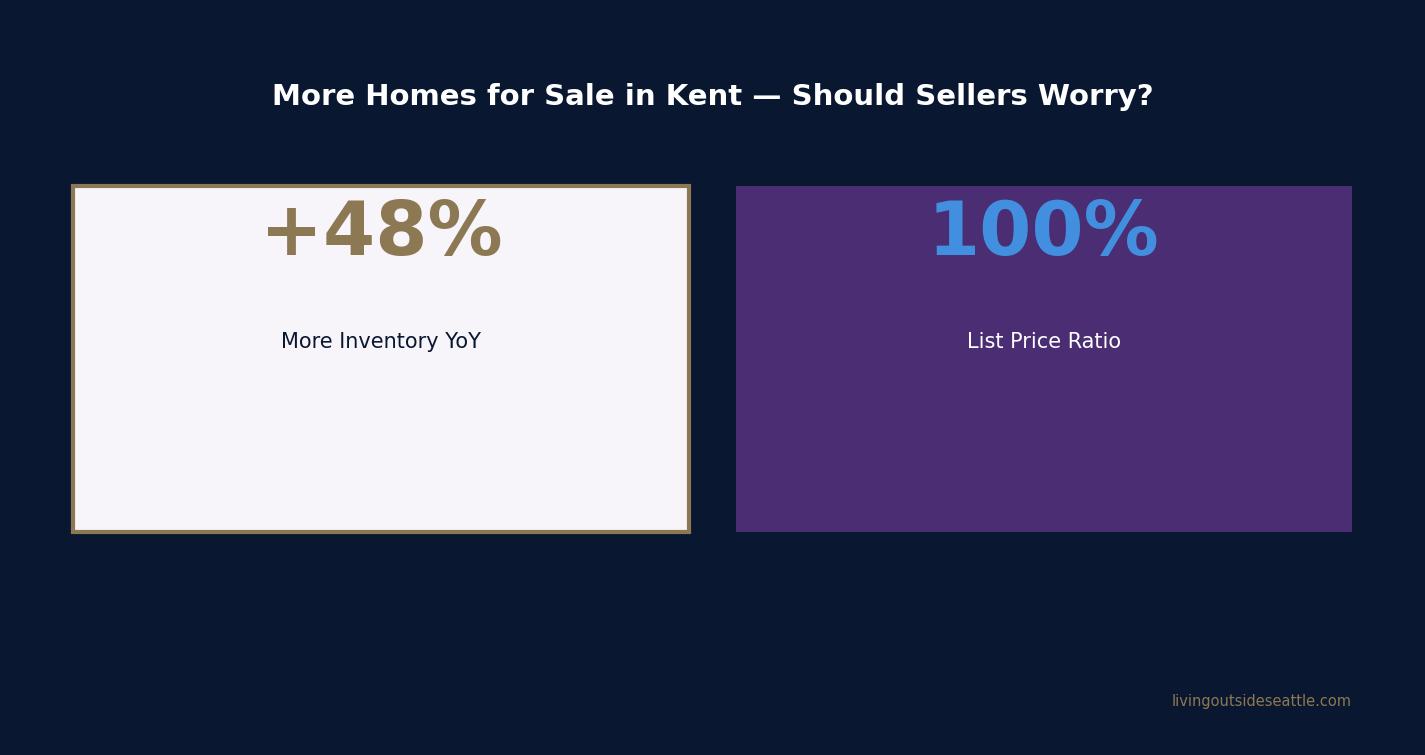
King County inventory is up 48% year-over-year, but Kent homes are still selling at 100% of list price in 8 days.

Here’s what the March 2026 numbers show for Kent:

Median sale price: $732,500. Days on market: 8 days. List price ratio: 100%. Pending sales: 86, up 2.8% year-over-year.

Read that again. Homes in Kent are selling in 8 days at exactly what sellers ask. That’s not a market in trouble. That’s a market that’s working.

Want to know more about what makes Kent tick? Here’s a full look at living in Kent, WA in 2026 — neighborhoods, commutes, and what buyers are actually shopping for.

King County residential inventory is up 48% year-over-year, from 2,148 homes to 3,191. New listings are up 16.5%. But months of supply sits at 2.2 months across the county. Anything below 6 months is a seller’s market. At 2.2 months, you’re still in solid seller’s market territory.

Why National Inventory Headlines Don’t Apply to Kent

You’ve probably seen it: “52% of US listings sitting 60+ days on market.” The tone is always panic. But that story doesn’t describe Kent or most of King County right now.

Yes, inventory is rising. Yes, buyers have more choices than they did in 2022. But the question isn’t how many homes are for sale. It’s how fast they’re selling. And in Kent, the answer is still 8 days.

The Kent market is responding to inventory the way a healthy market should. More homes are coming on. Serious buyers are showing up. Well-priced, well-conditioned homes are still selling quickly.

Why Homes Sit 60 Days in Kent (It’s Not About Inventory)

Here’s where the national data becomes useful. Homes sitting 60+ days fall into two categories, and I see this pattern constantly across King County.

First: overpriced. A home listed at $850,000 that should be $750,000 will sit. It doesn’t matter if there are 500 homes on the market or 5,000. A bad price is a bad price.

Second: condition. A home that needs $50,000 in work but is priced like a move-in home will sit. Buyers in Kent want condition. They want to move in without worrying. Even if they plan to renovate later, they want it on their timeline.

Homes that sit 60+ days in Kent are almost always overpriced, in below-average condition, or both.

What Actually Affects Your Kent Home Sale Price

Before you list, it’s worth understanding exactly what buyers are evaluating. I put together a full guide on preparing your home for sale in King County — the condition items that move the needle versus the ones that don’t.

Here’s what I know from evaluating hundreds of Kent properties: price is driven by condition, square footage, lot size, and proximity to I-5 or downtown Kent. It’s not driven by whether there are 96 other homes for sale or 200.

A 1,500 square foot, 1990s-built home in good condition with a finished basement and updated kitchen? You’re selling fast in Kent, at list price, regardless of inventory. The same home with electrical issues and deferred maintenance will sit.

The inventory jump actually helps well-conditioned homes. More inventory brings more serious buyers out. More showings mean more competition and more offers on the right homes.

How to Price Your Home Right in Kent’s 2026 Market

If you’re selling in Kent, what matters is condition, list price, and your willingness to negotiate. Inventory is the last thing on the list.

A home sitting 14 days at the Kent median is probably not priced right, or there’s a condition issue the photos don’t show. A home sold in 8 days is in great condition, priced well, or both.

More supply means buyers have options. That means homes need to compete on something real: condition, price, location. Not hype or FOMO.

The question isn’t “Is inventory too high?” It’s “Is my home in the condition buyers expect?” If it is, and you price it fairly, 8 days to sale is still the norm in Kent.

Key Takeaways

King County inventory is up 48% year-over-year, but 2.2 months supply is still firmly a seller’s market. Buyer’s market conditions start at 6+ months.

Kent March 2026 data: $732,500 median, 8-day DOM, 100% list price ratio, 86 pending sales.

Homes sitting 60+ days are almost always overpriced or in below-average condition priced like premium homes.

More inventory helps well-conditioned homes by bringing more serious buyers to market.

Condition and price drive sales. Overall inventory levels don’t.

For a broader look at where King County is headed this spring, see the King County Real Estate Market Update for May 2026. And if you want context on how Kent timing compares to neighboring markets, here’s my breakdown of the best time to sell in Renton — the same pricing dynamics apply across South King County.


Frequently Asked Questions About Selling a Home in Kent WA in 2026

Is it a good time to sell a home in Kent WA in 2026?

Yes, if your home is in good condition and priced right. Kent’s market is still in seller’s market territory at 2.2 months supply. Median prices are at $732,500 and homes are selling in 8 days. A well-maintained home priced fairly will sell fast. An overpriced or poorly conditioned home will sit regardless of market conditions.

How does rising inventory affect Kent home sale prices?

Less than most sellers think. Kent’s March 2026 data shows inventory up 48% year-over-year, yet homes are still selling at 100% of list price in 8 days. The real factors are condition and pricing accuracy. Inventory matters at extremes, but in Kent’s current range of 2.2 months supply, it’s not what determines your sale price.

What’s a normal days-on-market in Kent, Washington in 2026?

The March 2026 median DOM in Kent is 8 days. Homes selling at this pace are well-conditioned and appropriately priced. If your home sits beyond 14 days at the median price point ($732,500), that’s a signal to re-evaluate condition or list price.

What is the list price ratio for homes sold in Kent WA?

In March 2026, Kent’s list price ratio was 100%, meaning homes sold for exactly what sellers asked. In a seller’s market at 2.2 months supply, that’s normal. Homes with deferred maintenance or pricing issues typically sell below ask regardless of market conditions.

How much do homes sell for in Kent WA right now?

The Kent median sale price in March 2026 is $732,500. Entry-level homes in good condition sell in the $650K–$700K range. Larger or updated homes push above the median. Condition and pricing alignment matter more than any other factor.

Your guide to life outside Seattle.

Gregory Dorrell | Coldwell Banker Bain | WA License #111862
253-350-0045  ·
greg@livingoutsideseattle.com  ·
www.livingoutsideseattle.com

Gregory Dorrell is a licensed REALTOR® in Washington State (License #111862) with Coldwell Banker Bain. Market data sourced from NWMLS/MLS InfoSparks, March 2026. This content is for informational purposes only and should not be construed as financial or real estate advice specific to your situation.

Buyer Resources May 24, 2026

King County Condo Buyer’s Guide: Due Diligence Checklist

King County Condo Buyer’s Guide: What to Check Before You Make an Offer

A standard home inspection only covers your unit. Here’s how to check everything else — so you don’t inherit someone else’s financial mess.

If you’re shopping for a condo in King County, you already know the appeal. The $400K to $550K price range gets you into cities like Renton, Kent, Auburn, and Federal Way where single-family homes now regularly push past $700,000. Condos let first-time buyers get into the market with a lower entry point and no yard to maintain.

But buying a condo isn’t the same as buying a house. When you buy a condo, you’re not just buying the unit. You’re buying into the association that owns everything outside your four walls — the roof, the parking structure, the elevators, the exterior siding. You’re signing on as a stakeholder in the financial health of an organization you probably know nothing about yet.

That’s where most first-time condo buyers get burned. They fall in love with the unit, get excited about the price, and skip the due diligence that would tell them whether the building is a smart buy or a costly surprise waiting to happen. I’ve done BPO assessments on condo buildings across King County for years. The difference between a well-run community and a poorly-run one shows up in the documents — if you know what to look for.

Here’s what you need to check before you write that offer.

The Reserve Study: Your Most Important Document

The reserve study is an independent engineering report that tells you two things: what major components the association owns (roof, siding, pavement, elevators, common area systems) and how much money the HOA needs to set aside right now to cover those replacements when they come due.

Think of it like a maintenance budget projected out 20 or 30 years. A well-funded reserve means the HOA has been saving consistently and won’t need to hit owners with a surprise bill when the roof fails. An underfunded reserve means the opposite.

Here’s the number that matters most: the funding percentage. Most reserve studies show this as a percentage of “full funding.” Anything above 70% is generally healthy. Below 30% is a serious red flag. According to the Community Associations Institute, more than 70% of HOAs nationally are considered underfunded. That’s not a comfort — it’s a warning about how common the problem is.

In Washington state, as of 2026, HOAs must include reserve fund information in resale certificates. Still, don’t rely on what the HOA tells you in summary form. Ask for the full reserve study report and read the section on reserve component status yourself.

Infographic showing HOA reserve study funding health scale for King County condo buyers, from underfunded at 0% to healthy at 100%

Anything above 70% is generally healthy. Below 30%, a special assessment is likely — not a matter of if, but when.

Special Assessments: What They Are and How to Spot the Risk

A special assessment is an extra charge the HOA levies on every unit owner to cover a large expense the reserve fund can’t handle. They’re not uncommon. What makes them dangerous is that they can hit without much notice and they don’t care when you bought your unit.

An older 50-unit building might face a $200,000 roof replacement with nothing saved. That works out to $4,000 per unit — potentially due in a lump sum or in payments spread over a couple of years. Special assessments in King County can run $60,000 to $80,000 per unit when major structural or mechanical work has been deferred for years.

Before you make an offer, ask for the last five years of special assessment history. If there’s been one large assessment or multiple smaller ones in that window, ask why. The answer tells you a lot about how the board manages the property. Also ask whether any special assessments have been approved but not yet levied. Washington’s WUCIOA law requires this to be disclosed in the resale certificate — but only for assessments already approved by the board. A vote that hasn’t happened yet won’t show up anywhere except in the board minutes.

Which brings me to the board minutes.

Read the Board Meeting Minutes

Board minutes are a window into everything the summary documents won’t tell you. Most buyers never ask for them. That’s a mistake.

You’re looking for a few things specifically. First, any discussion of upcoming major repairs or capital projects. Second, any mention of litigation — whether the HOA is suing a contractor or a homeowner is suing the HOA. Third, any talk of raising dues significantly, levying a special assessment, or adjusting the reserve contribution downward to balance the operating budget. That last one is a classic sign of financial stress.

Under Washington’s WUCIOA updates effective January 1, 2026, condo associations must now hold open board meetings and provide better documentation to buyers. The resale certificate that comes with any condo sale must include 26 specific items and can only cost you up to $275. You also have a 5-day cancellation right after receiving all required documents. That window is your formal due diligence period — use it.

The Warrantable vs. Non-Warrantable Problem

This is the one that trips buyers up most often, and it has nothing to do with the unit itself. It has to do with the building.

A condo building is considered “warrantable” when it meets Fannie Mae and Freddie Mac lending standards. A warrantable building means you can get a conventional mortgage, FHA financing, or a VA loan — whatever you qualify for. Normal rates, normal down payments.

A non-warrantable building doesn’t meet those standards, and you lose access to the most competitive loan products. You’re looking at higher rates and larger down payments — often 20% or more — because portfolio lenders are taking on more risk. For a $500,000 condo, the difference between a warrantable and non-warrantable rate at current levels can easily add $200 to $250 to your monthly payment.

What Makes a Building Non-Warrantable?

The most common triggers in King County:

Single entity owns 25%+ of units — often an investor who bought in bulk during slower markets.

More than 35% commercial square footage — common in mixed-use buildings in downtown Renton or Federal Way.

Short-term rental policies — buildings that allow Airbnb-style rentals trigger automatic non-warrantable status.

Active or pending litigation — even a small dispute can knock a building out of warrantable status.

Ask your lender to run a condo project approval check before you get emotionally invested in a unit.

Many King County condo buildings — especially older mid-rises in Renton, downtown Kent, and Federal Way — fall outside warrantable guidelines. Knowing this upfront shapes your financing strategy before you’re already under contract.

For a full look at what mortgage rates look like right now for King County buyers, see our King County Mortgage Rates 2026 guide. If your condo ends up in the non-warrantable category, a mortgage rate buydown negotiated into the deal can help offset the higher rate.

Rental Cap Rules: What They Mean for Your Investment and Resale

Some condo associations limit how many units can be rented out at any given time. This is a rental cap, and it matters in two ways.

First, if you’re buying as an investor or might need to rent your unit down the road, a rental cap could block you entirely if the cap is already at its limit. Second — and this affects every buyer — a tight rental cap can make your building non-warrantable, which reduces your future buyer pool when you go to sell.

In Washington state, a rental cap must be written into the Declaration (the CC&Rs), not just the rules and regulations. Washington courts have ruled that caps can’t be created by the board alone — they need a supermajority vote to amend the Declaration. Check the current governing documents to see whether a cap exists, what the limit is, and whether it’s currently at capacity.

What a Standard Inspector Won’t Check

Here’s what a lot of condo buyers don’t realize: Washington state home inspectors are not required to inspect common elements, shared structural systems, or common area amenities. The inspector looks at your unit. The roof, the parking structure, the building envelope, the elevators, the main plumbing stack — those fall outside the standard inspection scope.

That means the structural and mechanical health of the entire building you’re buying into rests entirely on the HOA documents, not on any physical inspection you can order.

This is why the reserve study and the board minutes matter as much as they do. They’re the closest thing you have to a building inspection. If the association has been commissioning regular reserve studies and following the funding plan, you can feel reasonably confident. If the last reserve study is eight years old and nobody can find the financials, that’s your answer.

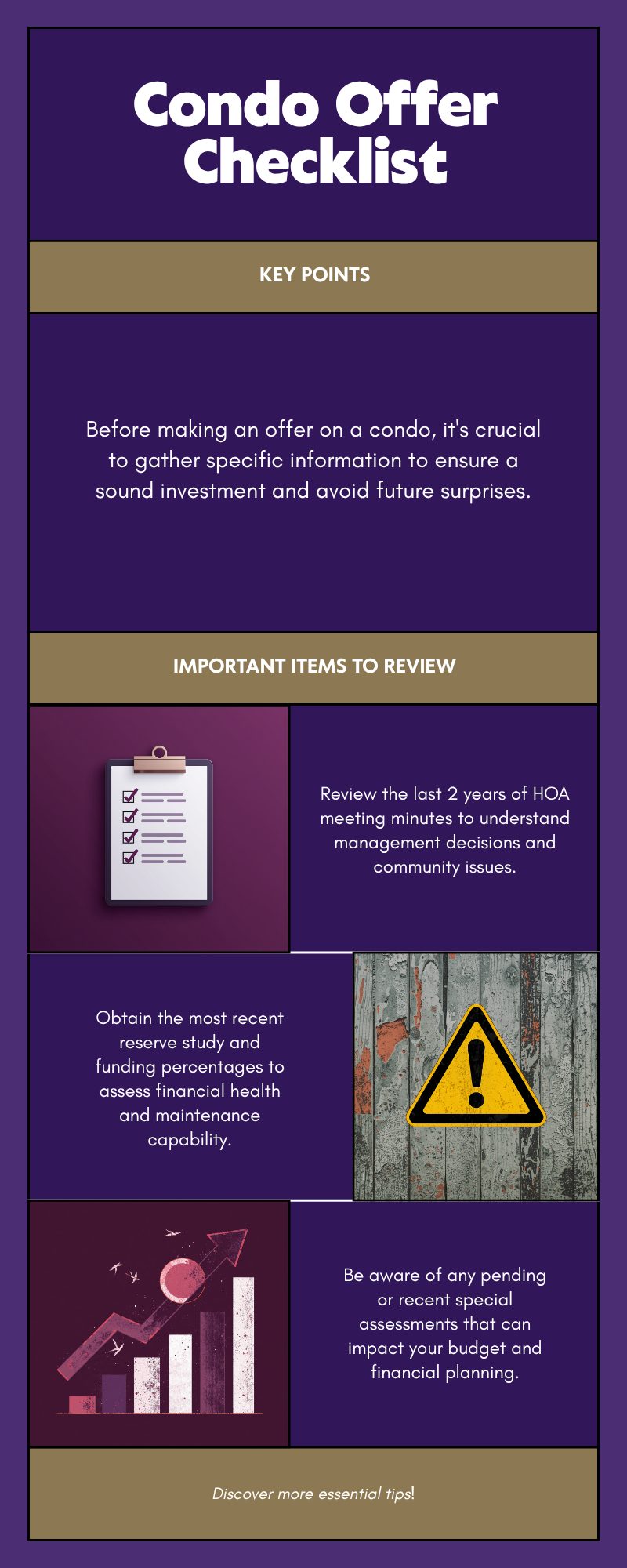
Checklist infographic of 6 documents King County condo buyers should request before making an offer, including reserve study and warrantability status

Washington’s new WUCIOA rules (effective 2026) cap the resale certificate fee at $275 and give you a 5-day cancellation window after receiving all required documents.

The Local Angle: What Makes King County Condos Different

King County’s condo market is concentrated in a handful of cities. The sub-$500K inventory you’ll find in Renton, Kent, Auburn, and Federal Way tends to be in older mid-rise buildings — think 1980s and 1990s construction. Some of these buildings have been well-maintained. Many have deferred capital work for years because the HOA fees were kept artificially low to attract owners.

As of the May 2026 King County market update, condo inventory is elevated relative to last year. That’s actually good news for buyers doing due diligence — you have more options and more negotiating room if a building’s documents reveal problems. You can move to the next building rather than feeling pressured to overlook red flags. For more on current conditions, see the King County Real Estate Market Update May 2026.

One thing I always watch from a pricing standpoint: HOA fees relative to market rates for the building’s age and amenities. An older building with fees significantly below market isn’t a deal — it’s a warning sign that the board has been cutting corners on reserves or maintenance to keep fees low. That cost shows up later. Often all at once.

If you’re weighing a condo against a townhouse or a single-family home in the same price range, the Condo vs. Townhouse vs. Single-Family Home in King County comparison guide can help you think through the tradeoffs before you commit to any one property type.

What This Means for You as a Buyer

Getting a condo offer right comes down to this: the unit is the easy part. Every agent will show you the finishes and the view. The due diligence that protects you happens in the documents.

Request the full resale certificate as soon as you’re seriously interested in a building — Washington law now limits the fee to $275 and gives you five days to review after receiving all required items. Use those five days. Read the reserve study funding percentage. Scan the last two years of board minutes for anything that sounds expensive. Pull the special assessment history. Have your lender check the project for warrantability before you fall in love with the floor plan.

If any of those documents are hard to get, incomplete, or missing entirely — that’s important information. A well-run HOA has nothing to hide.

Frequently Asked Questions

How do I get the reserve study and HOA financials as a condo buyer in Washington?

Request them in writing through your real estate agent as part of the offer or as a pre-offer document request. Under Washington’s WUCIOA law, the resale certificate is a required disclosure and must be provided within a set timeline. Your agent can request the full reserve study separately — not all associations include the full report in the standard resale package.

What reserve fund percentage should I look for when buying a condo in King County?

A funding level at or above 70% of “full funding” is generally healthy. Below 50% warrants a deeper conversation with the HOA or your agent. Below 30% is a serious red flag for near-term special assessments. FHA requires HOAs to allocate at least 10% of their annual budget to reserves — Fannie Mae is moving toward 15% effective January 2027.

What makes a condo non-warrantable in Washington state?

The most common triggers are high investor ownership (one entity owning 25%+ of units), active or pending litigation, short-term rental policies, and high commercial space concentration. Your lender can run a condo project approval check to confirm status before you’re under contract.

Can I use an FHA loan on a condo in King County?

Yes, if the building is FHA-approved or spot approval is available. FHA has its own approval process separate from conventional warrantability. Your lender will know whether the specific project is on FHA’s approved list or whether spot approval is an option for that building.

What should I look for in condo board meeting minutes?

Look for any discussion of deferred repairs, upcoming capital projects, special assessment votes (including proposed but not yet approved), litigation, significant dues increases, or decisions to reduce reserve contributions. Any of these can signal financial stress in the association.

Is a condo’s rental cap in the CC&Rs or the rules?

In Washington state, rental caps must be in the Declaration (CC&Rs) to be enforceable — not just the rules and regulations. If you see a rental cap only in the R&Rs and it’s not in the Declaration, its enforceability may be questionable under current Washington case law. Still, treat it as a real restriction until a real estate attorney tells you otherwise.

Buying a condo in King County can be a smart move. The entry-level price points in South King County are some of the last affordable options for first-time buyers in the region. But the savings on purchase price can disappear fast if you walk into a building with underfunded reserves, pending litigation, or a non-warrantable status nobody mentioned upfront.

The documents tell the story. Take the time to read them.

Your guide to life outside Seattle.

Gregory Dorrell | Coldwell Banker Bain | WA License #111862
253-350-0045  ·
greg@livingoutsideseattle.com  ·
www.livingoutsideseattle.com
Buyer Resources May 24, 2026

Should I Buy a Condo or House in King County Right Now?

Should I Buy a Condo or House in King County Right Now?

If you’re trying to decide whether to buy a condo or a house in King County right now, the market data will give you a clear answer. The King County housing market right now has a split personality. Single-family homes and condos are operating in almost completely different markets. Understanding which bucket your home falls into, or which you’re buying in, is critical.

Let me show you the data, because it tells a story that contradicts most of what you hear about Seattle.

Why the “Seattle Exodus” Headlines Don’t Match King County’s Market Data

You’ve probably seen the headlines: Seattle is the third-largest city for net outflow in America. Between December 2025 and February 2026, 18,000 residents left the Seattle metro area. That’s real data, and it matters to some people’s decisions.

But here’s the contradiction that nobody talks about. According to Redfin, Seattle is also the third most competitive housing market in the nation right now. Tied with that outflow narrative is this reality: homes are still selling fast, at list price, and inventory is still tight for single-family residences.

The exodus story and the competitive market story are both true. They’re just pointing at different people. The people leaving are often those who got priced out of tech sector jobs, remote workers who decided they could live anywhere and picked somewhere warmer, or folks who realized they didn’t love the rain. The people staying or moving in are typically established locals with equity, people whose jobs anchor them here, and folks relocating specifically to the King County corridor because they know the market.

That split explains why the market itself has split into two distinct tiers.

King County Single-Family Homes in 2026: Speed, Price, and Seller Leverage

King County condo vs single-family home comparison table March 2026 — price, DOM, supply, competition

In March 2026, King County single-family homes had these metrics:

  • Median sale price: $995,000
  • Median days on market: 7 days
  • Months supply of inventory: 2.2 months
  • List price ratio: 100 percent (homes selling at asking price)
  • Homes for sale: 3,191
  • Pending sales: Strong activity across all price points

Seven days is fast. Months supply of 2.2 is still a seller’s advantage (balanced market is 5-6 months). Homes priced correctly and in decent condition are selling at list price. This is not a buyer’s market for single-family homes.

The reason is simple: supply and demand. Buyers who want single-family homes still outnumber available inventory. Even with the outflow, the people staying in King County tend to want houses, not condos.

King County Condo Market 2026: More Inventory, More Buyer Power

Now look at condos in the same March period:

  • Median sale price: $550,000
  • Median days on market: 19 days
  • Months supply of inventory: 4.2 months
  • Median price down 6.8 percent year-over-year (from $590,000 March 2025)
  • Condos for sale: 1,880
  • Condo market approaching balance

Most King County condo buildings also carry HOA fees ranging from $300 to $700 per month, which adds materially to the total monthly cost of ownership compared to a single-family home.

Nineteen days is almost three times longer than single-family homes. Months supply of 4.2 is approaching balanced territory (5-6 months). Prices are down from a year ago, and they’re down from the peak in early 2025 when condos were trading in the $615,000-$625,000 range.

The condo market is softening. It’s not crashing, but it’s moving in a different direction than single-family homes.

Why King County’s Housing Market Split Into Two Different Markets

The story here is about who wants what. Single-family homes represent space, privacy, and land. They appeal to families, remote workers who want home office space, and anyone who values outdoor living. Condos appeal to downsizers, people who value low maintenance, and buyers who can’t afford a house but can afford a condo.

When the market tightens and people have to make choices, they prioritize differently. If you’re a young family or a mid-career professional, you’re willing to pay list price and close in a week to get a house. If you’re shopping condos, you have more inventory to choose from, longer to decide, and less urgency competing against you.

I’ve spent 13+ years walking through King County properties as a BPO field inspector, evaluating homes for Wall Street institutional clients. The physical difference I see is this: buyers want condition above everything. A clean, move-in ready single-family home moves fast. A condo with deferred maintenance sits longer because the pool of willing buyers shrinks.

Should You Sell Your King County Home or Condo in 2026?

If you own a single-family home, you’re in a strong position. Your market has genuine momentum. Speed, list price, and multiple offers are still realistic expectations, assuming your home is priced accurately and in decent shape.

If you own a condo, you need to be more strategic. Your market is patient. That means pricing matters more. A $575,000 condo priced at $550,000 might sell in 12-15 days. That same condo priced at $585,000 might sit 35-45 days. The gap between “move it fast” and “struggle for months” is narrower in condo land than it is for single-family homes.

Buying a Condo vs. House in King County: What to Expect in 2026

If you’re shopping for a single-family home, expect speed and certainty. Homes get multiple offers. You need financing pre-approved, a strong offer, and realistic expectations about contingencies. The market will test you.

If you’re shopping for a condo, you have time. You can be pickier. You can negotiate harder on price. You can make contingencies that a single-family buyer can’t. The 19-day DOM means there’s less urgency, so there’s less reason to overpay.

The risk for condo buyers is becoming so thoughtful that you miss good deals. With more inventory, more time, and less competition, you can actually make sound decisions instead of reactive ones.

King County Real Estate Market Outlook: What the Split Means Long-Term

This bifurcated market is a direct result of the tension between the outflow narrative and the competitive reality. King County is losing some residents, but the housing market is still strong because the people who are here are investing in it, and the people who are moving here are trading up into single-family homes.

Condos are absorbing some of the supply that would normally flow into the single-family market. That’s healthy market function, not a sign of crisis. It means the market is sorting itself: some people want the security of land and privacy, and they’re willing to pay and move fast for it. Other people want the convenience of condo living, and they have more leverage to negotiate.

Frequently Asked Questions: Condo vs. House in King County

Are King County condo prices going up or down in 2026?

Condo prices in King County are down 6.8% year-over-year as of March 2026, falling from $590,000 to $550,000 median. They’re also down from the early 2025 peak of $615,000-$625,000. The condo market has softened meaningfully while single-family home prices have held steady at $995,000 median.

How long does it take to sell a condo in King County?

The median days on market for condos in King County is 19 days as of March 2026 — nearly three times the 7-day median for single-family homes. Condos that are priced accurately and in top condition still move reasonably quickly, but the pool of competing listings is larger than it was a year ago.

What are typical HOA fees for condos in King County?

HOA fees for King County condos typically range from $300 to $700 per month depending on the building, amenities, and age of the complex. Higher-end Bellevue condo buildings often run $500-$900 per month. These fees add significantly to the total cost of condo ownership and should factor into your affordability calculation.

Is it a better investment to buy a house or condo in King County right now?

Single-family homes have appreciated more steadily and command stronger resale demand. Condos currently offer more buyer leverage — more negotiating room, more time to decide, and prices that have come down from their 2025 peaks. Which is the better “investment” depends on your timeline, budget, and whether you’re buying primarily to live in the home or for investment return.

Your guide to life outside Seattle.

Gregory Dorrell | Coldwell Banker Bain | WA License #111862
253-350-0045  ·
greg@livingoutsideseattle.com  ·
www.livingoutsideseattle.com

Gregory Dorrell is a REALTOR® with Coldwell Banker Bain specializing in East and South King County real estate. This content is for informational purposes and does not constitute professional real estate or investment advice. Consult with a licensed professional before making real estate decisions.


EastsideIssaquahKing County Cities May 24, 2026

Living in Newport – Cougar Mountain Issaquah

Living in Newport / Cougar Mountain, Issaquah: What You Need to Know in 2026

The Newport Way and Cougar Mountain area covers the western edge of Issaquah, climbing up toward the Bellevue line where the city meets the Cougar Mountain Regional Wildland Park. In 2026, with buyers looking for trail access, wooded privacy, and the fastest commute to Bellevue and Microsoft from any Issaquah neighborhood, this corridor is one of the most flexible options in the city. If you want a home where you can hike from your driveway, drive to Bellevue in under twenty minutes, and have real lot size without leaving the I-90 corridor, this area delivers. There is one important wrinkle to know about: the school district line cuts through this area, which means buyers must verify the assigned schools for any specific address before writing an offer.

What is it actually like to live in Newport / Cougar Mountain in 2026?

On a weekday morning, this area feels wooded and private. Streets curve through the lower slopes of Cougar Mountain with mature firs, cedars, and big-leaf maples lining the routes. Driveways are often long and screened from the street. Most residents head west toward I-90 or I-405 for the commute, which is one of the practical advantages of living on this side of Issaquah. The pace is calm, and traffic stays light because there is no commercial core to draw outside visitors.

On a weekend, the neighborhood comes alive in a quiet way. Trail runners and hikers head into Cougar Mountain from the Wilderness Peak and Red Town trailheads. Mountain bikers use the network of trails that loop through the protected wildland. Families with kids head into Issaquah for sports, shopping, or a meal on Front Street. The mix of forest privacy and quick access to amenities is the defining feature of this neighborhood.

Most residents are a mix of long-time owners who bought in the 1980s and 1990s when the western edge of Issaquah was considered the country, plus newer buyers from Bellevue and Sammamish who specifically wanted trail access without leaving the Eastside. Many residents work in tech and value the short commute to Bellevue and Microsoft. What separates this area from other Issaquah neighborhoods is the geographic position. You are technically in Issaquah but five minutes from Bellevue, which gives buyers the best of both cities depending on the day.

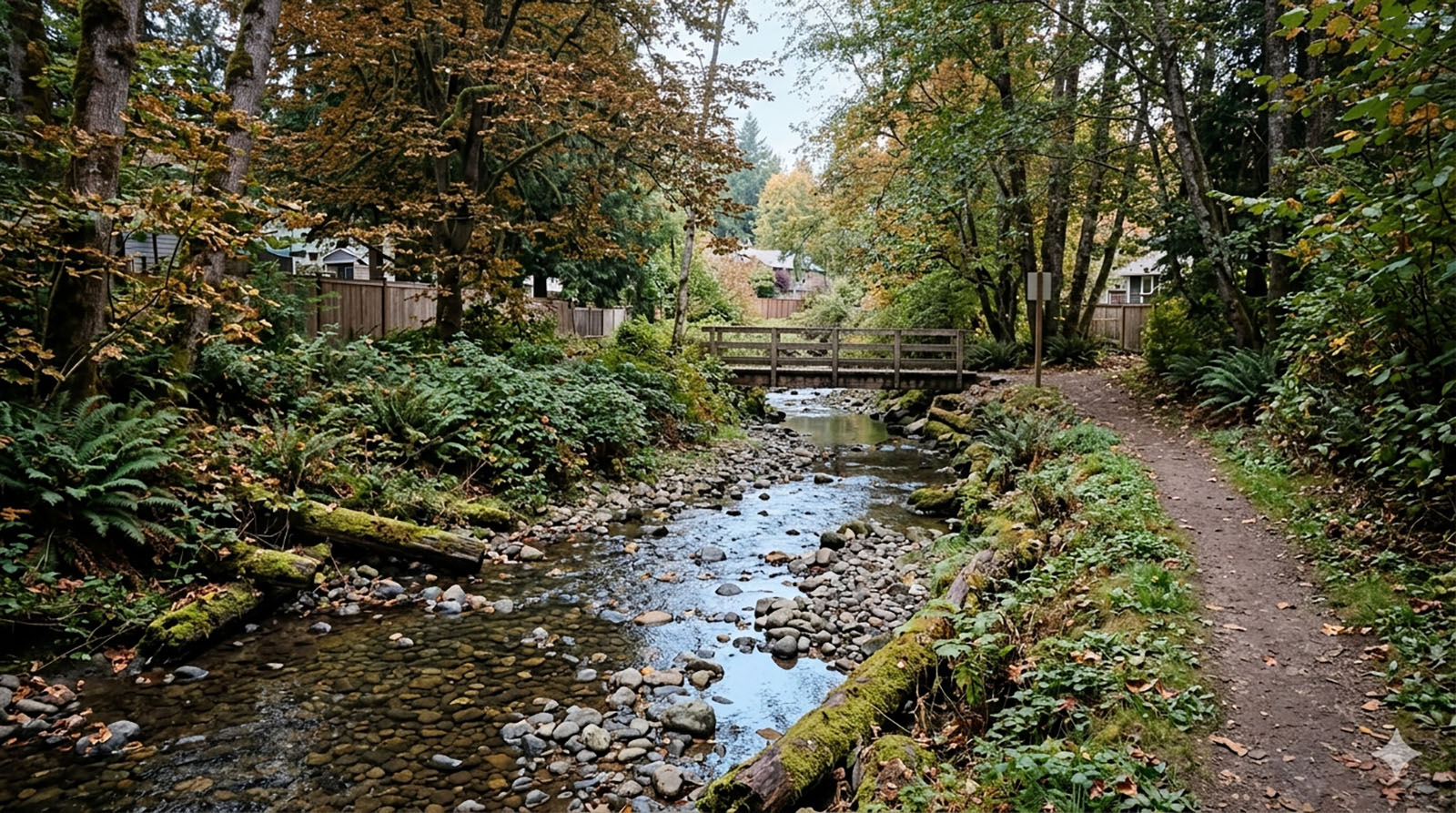
A Cougar Mountain trailhead at the edge of the Newport Way and Cougar Mountain area of Issaquah.

Homes in Newport / Cougar Mountain: What the Data Shows

Housing here is genuinely mixed because the area developed organically over several decades. You will find 1980s contemporary builds with cedar siding and dramatic rooflines, 1990s and 2000s custom homes on larger lots, post-war ramblers on the older side streets, and a smaller share of newer 2010s and 2020s rebuilds where someone tore down an aging home and put up modern. Single-family homes typically run 2,000 to 4,500 square feet on lots between 8,000 square feet and a half acre, with many properties backing to greenbelt or forested borders. Lot orientation varies because the streets follow the natural topography, which means light, view, and slope conditions differ noticeably from one home to the next.

Market Pulse Newport / Cougar Mountain (98027) King County
Median Sales Price (May 2026) ~$1,225,000 ~$859,000
Median Days on Market ~26 days ~28 days
Active Listings Change (vs. Jan 2026) +19% +30%

Estimates based on current NWMLS data for the Newport Way and Cougar Mountain pockets within the 98027 ZIP code. Pricing varies meaningfully by exact location, with western-most properties closer to Bellevue commanding higher prices than eastern properties closer to Olde Town.

Schools Serving Newport / Cougar Mountain

This is the area where school assignment matters most. The neighborhood sits along the boundary between the Issaquah School District and the Bellevue School District, with the line cutting through the area in ways that can change school assignments from one street to the next. Always confirm your specific address with the appropriate school district before you write an offer. Two scenarios are typical:

For most Issaquah-side addresses, kids attend either Clark Elementary or Issaquah Valley Elementary, then Issaquah Middle School, then Issaquah High School. For western-edge properties closer to the Bellevue line, addresses may feed Cougar Ridge Elementary in Bellevue (which is part of the Issaquah School District despite the geographic location), then Cougar Mountain Middle School in Talus, then either Liberty High School or Issaquah High School depending on the specific address. For Bellevue School District properties on the absolute western edge near the Bellevue city line, kids typically attend Newport Heights Elementary, then Tyee Middle School, then Newport High School in Bellevue.

Newport High is one of the top-rated public high schools in Washington with strong AP and IB programs. The bottom line: this is the one Issaquah neighborhood where a single block can change which district your kids attend, so the address verification step is genuinely important. The school pipeline for this area involves driving or busing for nearly all families. None of the schools are walking distance from most properties, which is normal for a wooded Eastside neighborhood.

Getting to Work from Newport / Cougar Mountain

Newport Way connects directly to I-90 at exit 15 (Bellevue side) or exit 17 (Issaquah side), giving residents unusually flexible commute options. Most westward commuters head to I-405 via Eastgate. Most eastward commuters head into Issaquah and beyond.

Destination Distance 2026 Peak Drive (AM) Transit Option
Downtown Seattle 15 miles 28 to 48 min I-90 / ST 554 from Issaquah
Bellevue / Amazon Bellevue 6 miles 15 to 25 min I-90 to I-405
Microsoft (Redmond) 9 miles 20 to 30 min I-90 to SR-520
SeaTac Airport 22 miles 35 to 50 min I-405 to I-5 / Drive

Note: This is the fastest Bellevue commute of any Issaquah neighborhood, often by 5 to 10 minutes during peak hours.

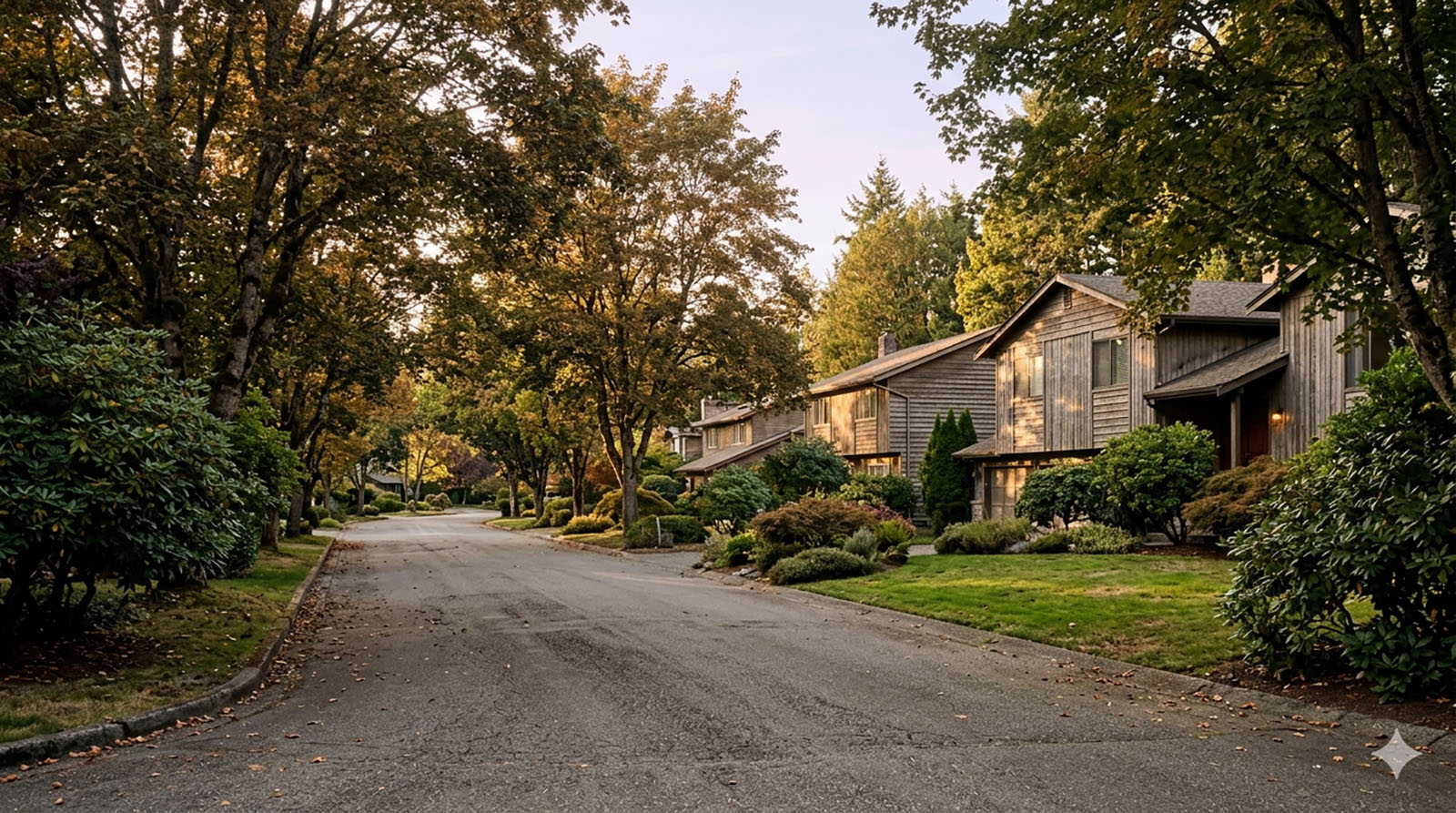
A contemporary home in the Newport Way and Cougar Mountain area of Issaquah, backing to a wooded greenbelt.

What I See as a Valuation Expert in Newport / Cougar Mountain

The biggest valuation factor in this area is the lot, the slope, and the school assignment. On a 1985 home, the lot itself can carry 40 to 55 percent of the appraised value depending on size, slope, view, and trail access. When I assess homes here for institutional lenders, I look at lot grade, drainage, the condition of any retaining walls, and tree health first, then the structure second. A flat lot with usable yard space and a strong school assignment will appraise much stronger than a same-size home on a steep slope with a less-desired school feeder pattern.

HOAs vary widely in this area. Some pocket subdivisions have small road maintenance HOAs in the $20 to $80 monthly range. A few newer pockets have full HOAs running $100 to $250 per month. Most older properties are fee simple with no HOA at all. Always read the title commitment carefully because some properties have private road easements with cost-sharing requirements that function like an informal HOA, even when no formal HOA exists.

Within this area, certain pockets and lots carry premium pricing. Properties backing directly to Cougar Mountain greenbelt, lots with usable flat yards, homes with a confirmed Issaquah High or Newport High assignment, and any property within walking distance of a Cougar Mountain trailhead tend to move first when they hit the market.

Explore Newport / Cougar Mountain Yourself

The fastest way to know if this area fits is to drive Newport Way from Olde Town west toward the Bellevue line, then turn into a few of the side streets to see how the housing variety opens up.

View Newport / Cougar Mountain on Google Maps →

Your guide to life outside Seattle.

Gregory Dorrell | Coldwell Banker Bain | WA License #111862
253-350-0045  ·
greg@livingoutsideseattle.com  ·
www.livingoutsideseattle.com
Buyer Resources May 23, 2026

Condo vs Townhouse vs Single-Family in King County


Condo vs. Townhouse vs. Single-Family Home in King County: How to Choose

You’ve got three completely different products at three completely different price points. Here’s what actually separates them — and which one fits your situation in King County right now.

When most buyers start looking at homes in King County, they type a budget into Redfin and let the results decide the property type for them. That usually works fine until they’re deep into a transaction and suddenly discover that their condo doesn’t qualify for the loan they planned on, or that the townhouse HOA has a pending special assessment they didn’t know about.

The property type decision matters a lot more than most people realize. It affects what you pay every month, how quickly you can sell when the time comes, what your lender will let you borrow, and what you’re actually responsible for maintaining. I’ve walked buyers through all three, and the ones who end up happiest are almost always the ones who understood the differences before they started shopping — not after.

So here’s the full comparison. Condos, townhouses, and single-family homes. What you own, what you pay for, how they appreciate, how they finance, and who each one is actually right for in the King County market.


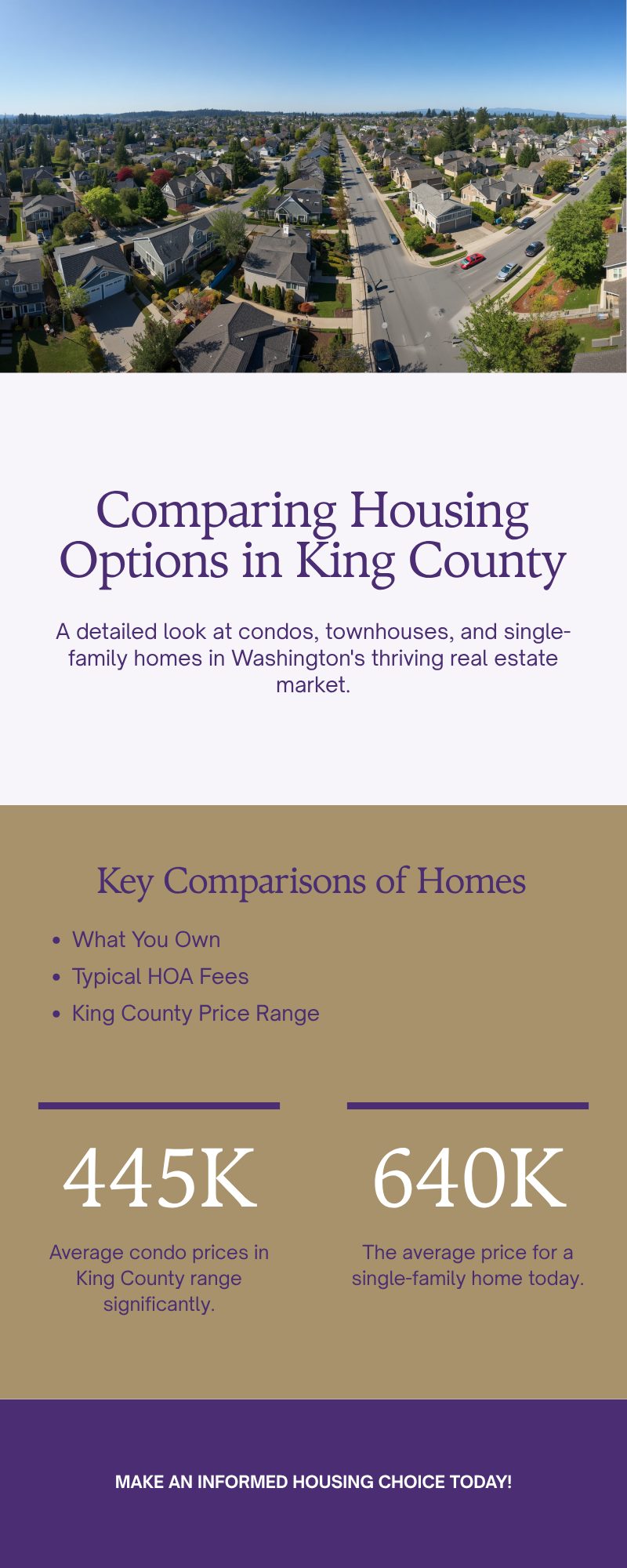
Side-by-side comparison of condo, townhouse, and single-family home ownership, HOA fees, and price ranges in King County

Property type comparison for King County buyers — ownership structure, HOA fees, and who each is right for.

What You Actually Own

This is where most people have fuzzy thinking, and it matters more than any other single factor.

Single-Family Home

When you buy a single-family home, you own the building and the land underneath it. Full stop. No HOA involved in most cases, though some planned neighborhoods do have one for shared amenities. If the roof leaks, that’s on you. If you want to paint the front door a different color, go for it. Your lot is yours to build a deck on or plant a garden in. That full ownership is exactly what makes SFHs appreciate the way they do. Land in King County is genuinely scarce, and land ownership transfers that value directly to you.

Townhouse

When you buy a townhouse, you typically own the structure and the land it sits on. Townhouses in King County are usually fee-simple, meaning you own your unit from the ground up. You share walls with neighbors, and there’s usually an HOA covering the common areas — shared driveways, landscaping, maybe a small courtyard. But the land is yours. That’s a meaningful difference from a condo, and it means townhouse appreciation tends to track closer to single-family than to condo over time.

Condo

When you buy a condo, you own the interior of your unit and a share of common areas. The land, the roof, the exterior walls, the lobby — all of that belongs to the HOA. Maintenance of those shared elements comes out of your monthly dues and out of a reserve fund that the HOA is supposed to be building over time. That arrangement is convenient right up until the roof needs replacing and the reserve fund is underfunded. More on that below.

The Price Gap Is Real in 2026

In King County as of early 2026, you’re looking at roughly these price ranges depending on what you’re buying and where.

Single-family homes in South King County — Renton, Kent, Auburn, Maple Valley — are running between $640,000 and $850,000 for typical resale product. The countywide median is hovering around $880,000. Anything under $600K in the SFH category tends to be smaller footprints or locations where the trade-off is commute time or school district.

Townhouses in those same South King County cities are typically coming in between $450,000 and $650,000. New construction townhomes near light rail corridors or in Kent’s East Hill area have been active in the $500K–$600K range. They’re a real path for buyers who want a two-car garage and a backyard without the $800K price tag.

Condos are the most variable. King County’s condo median dropped sharply — from around $690,000 in early 2025 to closer to $445,000–$577,000 in early 2026, depending on location. That’s a significant decline driven by a real imbalance in supply and demand for condos right now. More inventory, softer buyer demand, and a financing environment that makes condo purchases harder have all contributed. If you want to understand what current mortgage rates mean for your monthly payment across these price ranges, that post walks through the exact math.

How They Finance — This Is the Part That Surprises People

Financing a single-family home is the most straightforward of the three. Conventional loans, FHA, VA — all of these work with minimal restrictions. With strong credit and 3–5% down, you can access the full range of loan products.

Townhouses generally finance similarly to single-family homes, with one caveat. If the townhouse is part of a condo regime — meaning the ownership is structured legally as a condo even though it looks like a townhouse — lender scrutiny increases. Always ask your agent how the title is structured before assuming it finances like an SFH.

Condos are where financing gets genuinely complicated, and buyers often don’t find out until they’re already in contract.

Lenders classify condos as either warrantable or non-warrantable. A warrantable condo meets guidelines set by Fannie Mae and Freddie Mac — the HOA is financially healthy, owner-occupancy is above a certain threshold, no single entity owns too large a percentage of units, and the building isn’t in litigation. Those loans behave pretty normally. The interest rate runs about 0.125–0.375% higher than a comparable SFH purchase, and you can put as little as 3–5% down with good credit.

A non-warrantable condo is a different story. These are condos that don’t meet those standards — maybe the rental occupancy is too high, or the HOA has pending litigation, or the reserve fund is critically underfunded. Lenders who will touch these at all typically require 20–25% down and charge rates 0.5–1.5% higher than the warrantable equivalent. Some lenders won’t touch them at all.

HOA Fees and Hidden Costs: What to Actually Look For


HOA reserve fund red flags for condo buyers in King County — what to check before making an offer

Request these documents before you make an offer on any condo in King County.

Every property type can have an HOA, but the nature and risk of HOA involvement varies considerably.

For single-family homes in planned communities, HOA fees tend to be modest — often $50–$150/month — and cover things like neighborhood common areas or a community pool. These are relatively low-risk from a special assessment standpoint as long as there aren’t major shared structures.

Townhouse HOAs typically run $200–$500/month in King County and cover shared exterior maintenance, landscaping, and common areas. The key question is: what exactly is the HOA responsible for? Some townhouse HOAs cover roof and siding; others leave the exterior entirely to you. Read the CCRs before you make an offer.

Condo HOAs carry the most complexity. Downtown Seattle condos can run $400–$1,000+/month. South King County condos tend to be lower — $250–$550/month — but can spike with age and deferred maintenance. And that brings us to the single biggest risk most condo buyers underestimate: the special assessment.

Washington State law (RCW 64.34.380 for condos) requires HOAs to conduct reserve studies and update them annually. A well-funded HOA sets aside money every month to cover large future expenses — roof replacement, elevator service, parking structure repairs. When an HOA is underfunded, it can’t pay for those repairs out of reserves. The result is a special assessment: a one-time charge to every unit owner, sometimes running $5,000–$30,000+ per unit.

Before you make an offer on a condo, request the last two years of HOA meeting minutes, the most recent reserve study, and the current percent-funded figure. If the reserve study shows less than 70% funding and the minutes mention deferred maintenance or upcoming projects, factor a special assessment into your budget. If they won’t provide these documents, that’s your answer.

Appreciation Patterns: Which One Builds Wealth Faster?

This is the question every buyer wants a clean answer to, and the honest answer is that it depends on time horizon and what you’re comparing.

Single-family homes in King County have the strongest long-term appreciation track record, driven primarily by land scarcity. As the region has grown, land in South King County has become more constrained. Homes in Renton, Maple Valley, and Auburn have all seen substantial appreciation over the last decade. The King County market as of May 2026 still shows SFH inventory tight enough at 2.8 months of supply to support pricing stability, with homes selling at 101.9% of list price on average.

Townhouses tend to appreciate in line with or slightly below SFH rates, depending on the product. New construction townhomes near transit corridors have performed well as demand for lower-maintenance, urban-adjacent living has grown. Fee-simple townhouses — where you own the land — typically hold value better than leasehold or condo-regime townhouses.

Condos are the most volatile of the three. The sharp drop in King County condo prices in 2025–2026 illustrates this clearly. Condos have periods of strong appreciation, particularly during high-demand, low-inventory cycles, but they also fall harder when demand softens. The oversupply of condo inventory right now, combined with the financing friction around non-warrantable buildings, has pushed prices down in ways that SFH and townhouse buyers haven’t experienced. That said, the current condo pricing environment does present a genuine opportunity for buyers who do the due diligence. Buying at a cyclical low in a well-run building in a strong location can produce solid returns. The key word is “well-run.”

The King County Local Angle: How Each Property Type Plays Out Here

South King County gives you examples of all three property types at accessible prices, and the differences matter more in this market than national averages suggest.

In Renton, you’ll find a mix of SFH in the $650K–$850K range, townhomes clustered near the Renton Highlands and Landing area in the $450K–$600K range, and condos in the Renton downtown corridor that have come down considerably in price. The light rail connection at the Renton Transit Center has increased buyer interest in Renton townhouses specifically. If you’re buying in Renton and considering a condo, the warrantability question is especially relevant — several Renton condo buildings are older and require careful reserve fund scrutiny. The Living in Renton guide covers the full neighborhood breakdown.

In Kent, townhomes in the $450K–$550K range have been some of the more active product in 2026. The first-time buyer guide for Kent covers the buy-now-vs-wait math that many Kent buyers are working through, and townhomes tend to be the property type that makes that math work at current rates.

In Auburn and Maple Valley, single-family homes still dominate the inventory. Townhouse product exists but is more limited. If you’re drawn to these communities for the school districts and neighborhood feel, the calculus often pushes toward SFH even if it means stretching the budget a bit further.

East King County — Issaquah, Bellevue, Sammamish — has a strong townhouse market particularly in the Issaquah Highlands and Talus communities, where mixed-use development has produced a large supply of attached product. These are generally well-maintained and have active HOAs with healthy reserves, but due diligence still matters.

What This Means for You as a Buyer

If you’re a first-time buyer in South or East King County in 2026, here’s the practical framework I’d use.

Budget Under $500,000

You’re likely looking at condos or newer townhomes. Condos offer the lowest purchase price but require more due diligence. Prioritize buildings with healthy reserves and warrantable financing status. If you can get into a well-run building at today’s discounted prices, you’re buying in at a favorable point in the condo cycle.

Budget $500,000–$700,000

Townhouses become your primary option for getting into ownership with land included. New and newer construction townhomes in Kent, Renton, and Federal Way fit this range. Prioritize fee-simple structures over condo-regime townhouses, and read the HOA docs before you fall in love with a floor plan.

Budget $700,000+

Single-family homes in South King County become realistic. You’ll find the strongest appreciation track record and the simplest financing path. The trade-off is less lock-and-leave convenience and more maintenance responsibility.

Frequently Asked Questions

What is the difference between a condo and a townhouse in King County?

A condo is a unit in a shared building where you own the interior space and a share of common areas. A townhouse is usually a multi-level attached home where you own the structure and the land it sits on. This difference in land ownership typically makes townhouses appreciate more like single-family homes and finance more like them too.

Is it harder to get a loan for a condo than a house in King County?

Yes, generally. Condos face additional lender scrutiny around HOA financial health, owner-occupancy ratios, and reserve fund adequacy. If a condo is classified as non-warrantable, you’ll typically need a larger down payment and accept a higher interest rate. Single-family homes and fee-simple townhouses don’t have this additional layer of review.

Are condos a good investment right now in King County?

Condo prices dropped significantly in 2025–2026, which means buyers who do careful due diligence can potentially buy at a cyclical low. The risk is that you’re buying into a shared financial structure (the HOA), so the quality of the building’s finances matters as much as the unit itself. In a well-run building, current pricing represents a real opportunity. In a poorly funded building, you’re taking on someone else’s deferred maintenance.

How much are HOA fees for condos vs. townhouses in South King County?

Condo HOA fees in South King County typically run $250–$550/month for older and mid-range buildings. Townhouse HOAs tend to be lower — $150–$400/month — and generally cover less exterior maintenance. Downtown Seattle and Eastside condos can run $400–$1,000+/month. Always include HOA dues in your monthly payment calculation when comparing properties.

What is a reserve fund and why does it matter when buying a condo?

A reserve fund is the HOA’s savings account for large future repairs — roof replacement, elevators, structural work. Washington State requires condos to conduct reserve studies and update them annually. If the reserve fund is significantly underfunded (below 70% of what it should hold), the risk of a special assessment increases. Special assessments are one-time charges to all unit owners that can run thousands to tens of thousands of dollars.

Can I use an FHA loan to buy a condo in King County?

Yes, but the condo building must be on the FHA-approved list. FHA imposes strict requirements on owner-occupancy rates, commercial space ratios, and HOA financial health. Search the HUD database to check a specific building’s approval status before getting too far into the transaction.

The property type you choose is one of the first big decisions in the buying process, and it shapes everything that follows — financing, monthly costs, what you maintain, and what you eventually sell. Understanding the differences upfront saves a lot of mid-transaction surprises.

Your guide to life outside Seattle.

Gregory Dorrell | Coldwell Banker Bain | WA License #111862
253-350-0045  · 
greg@livingoutsideseattle.com  · 
www.livingoutsideseattle.com
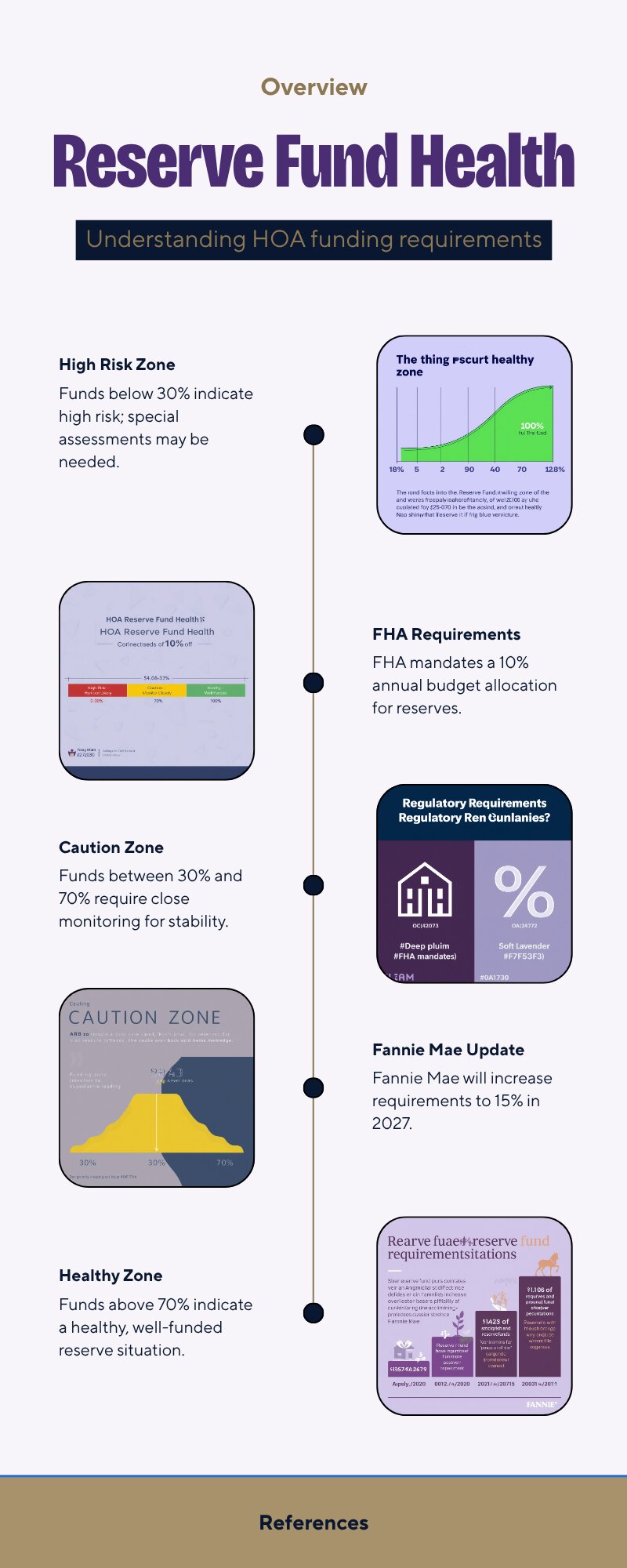
EastsideIssaquahKing County Cities May 23, 2026

Living in Sycamore Issaquah

Living in Sycamore, Issaquah: What You Need to Know in 2026

Sycamore is one of Issaquah’s older established neighborhoods, tucked along the lower flank of Cougar Mountain just west of Olde Town. In 2026, with buyers looking for value, real lots, and the kind of mature neighborhood character you cannot manufacture in new construction, Sycamore is one of the most underrated options in Issaquah. If you want a solid 1970s or 1980s home with bones, room to update, and a quiet established street where neighbors actually know each other, Sycamore is worth a serious look.

What is it actually like to live in Sycamore in 2026?

On a weekday morning, Sycamore feels like a real neighborhood. Streets are lined with mature firs, cedars, and yes, some sycamore trees that gave the area its name. Kids walk or bike to Issaquah Valley Elementary or catch the bus on the corners. Commuters head east toward I-90 and the Issaquah Transit Center. The pace is calm, and the streets are quiet enough that you can hear birds even at 8 AM.

On a weekend, Sycamore stays quiet but more active for residents. People walk dogs along the loop streets, run on the Tibbetts Creek trail, and head into Olde Town for breakfast or coffee. Many residents work on their homes on weekends because the housing stock is mature enough that there is always something to do. The neighborhood holds an annual block party in summer that pulls people out and reinforces the established community feel.

Most residents are a mix of long-time owners who bought in the 1980s and 1990s when Sycamore was the affordable alternative to newer Issaquah construction, plus newer buyers who specifically wanted character, value, and walkability to Olde Town. Many residents work from home or have flexible schedules. What separates Sycamore from the master-planned communities up the hill is simple: this neighborhood was not designed in one sweep. It grew over the 1970s and 1980s, with houses set on irregular lots and streets that follow the contours of the lower mountain slope. That gives it the kind of organic character that newer neighborhoods cannot copy.

Tibbetts Creek running through the Sycamore neighborhood in Issaquah, with native plants and a walking trail.

Homes in Sycamore: What the Data Shows

Most homes in Sycamore were built between the early 1970s and the late 1980s, with a smaller share of newer infill on lots where someone has torn down an aging structure and built modern. You will find classic Pacific Northwest split-levels, cedar-clad contemporaries, traditional two-story homes, and a handful of one-level ramblers tucked along the quieter streets. Single-family homes typically run 1,800 to 3,000 square feet on lots between 7,000 and 10,000 square feet, with some larger legacy lots in the upper sections of the neighborhood. Lot orientation varies because the streets follow the natural topography, which means light, view, and outdoor usability differ noticeably from one home to the next. There is no townhome or condo inventory in Sycamore. Detached single-family homes are the only product type.

Market Pulse Sycamore (98027) King County
Median Sales Price (May 2026) ~$995,000 ~$859,000
Median Days on Market ~28 days ~28 days
Active Listings Change (vs. Jan 2026) +21% +30%

Estimates based on current NWMLS data for the Sycamore residential pockets within the 98027 ZIP code. Sycamore’s pricing runs above the King County median but well below newer Issaquah construction, which is exactly why value-focused buyers target this neighborhood.

Schools Serving Sycamore

Most Sycamore kids attend Issaquah Valley Elementary, then Issaquah Middle School, then Issaquah High School. All three schools sit within five to ten minutes of the neighborhood, and the bus pickup network is well-established because Sycamore has been part of the same school pipeline for decades.

Issaquah Valley Elementary houses the Spanish Dual Language Immersion program and is one of the more diverse elementary schools in the district. Issaquah Middle School was rebuilt and modernized in recent years and offers strong music and STEM programs. Issaquah High has a strong four-year graduation rate, multiple AP programs, and a competitive athletics presence.

The school pipeline for Sycamore involves driving for some families and walking for others, depending on which street you live on. The eastern end of the neighborhood is closer to Issaquah Valley and walkable for many kids. The western end requires driving or busing.

Getting to Work from Sycamore

Sycamore residents typically take Newport Way east to reach I-90 at exit 17. Some northern properties use Front Street to access I-90 at the same interchange. The neighborhood has good freeway access without being directly on a major arterial, which keeps internal traffic light.

Destination Distance 2026 Peak Drive (AM) Transit Option
Downtown Seattle 17 miles 35 to 55 min I-90 / ST 554 from Issaquah Transit Center
Bellevue / Amazon Bellevue 9 miles 22 to 32 min I-90 to I-405 / ST 554
Microsoft (Redmond) 12 miles 28 to 38 min I-90 to SR-520 / Connector Bus
SeaTac Airport 22 miles 35 to 50 min I-405 to I-5 / Drive

A sympathetically updated 1980s split-level home in the Sycamore neighborhood of Issaquah.

What I See as a Valuation Expert in Sycamore

The biggest valuation factor in Sycamore is honestly the home itself, not just the neighborhood. Two same-vintage homes on the same block can appraise $150,000 apart based purely on the condition of the systems, the roof, the siding, and whether the kitchen and bathrooms have been updated in the last 10 to 15 years. When I assess homes in Sycamore for institutional lenders, I spend serious time on the major systems, the foundation, and the condition of any deck or outbuilding. A 1985 home with a 2018 roof, recent siding work, and an updated kitchen will appraise much stronger than a same-vintage home where deferred maintenance has been deferred.

HOAs are rare in Sycamore. Most properties are fee simple, which means no monthly dues and no master association rules to worry about. The neighborhood relies on King County code rather than private HOA rules for landscaping and architectural standards. That gives owners flexibility but also means properties vary widely in maintenance and curb appeal from one block to the next.

Within Sycamore, certain streets and pockets carry premium pricing. Lots backing directly to Tibbetts Creek or the Cougar Mountain greenbelt, properties with morning sun and afternoon shade, homes on the quieter cul-de-sacs, and any home that has been sympathetically updated tend to move first when they hit the market.

Explore Sycamore Yourself

The fastest way to know if Sycamore fits is to drive Newport Way west from Olde Town, then turn into the loop streets to see how the neighborhood opens up onto the lower slope of Cougar Mountain.

View Sycamore on Google Maps →

Your guide to life outside Seattle.

Gregory Dorrell | Coldwell Banker Bain | WA License #111862
253-350-0045  ·
greg@livingoutsideseattle.com  ·
www.livingoutsideseattle.com
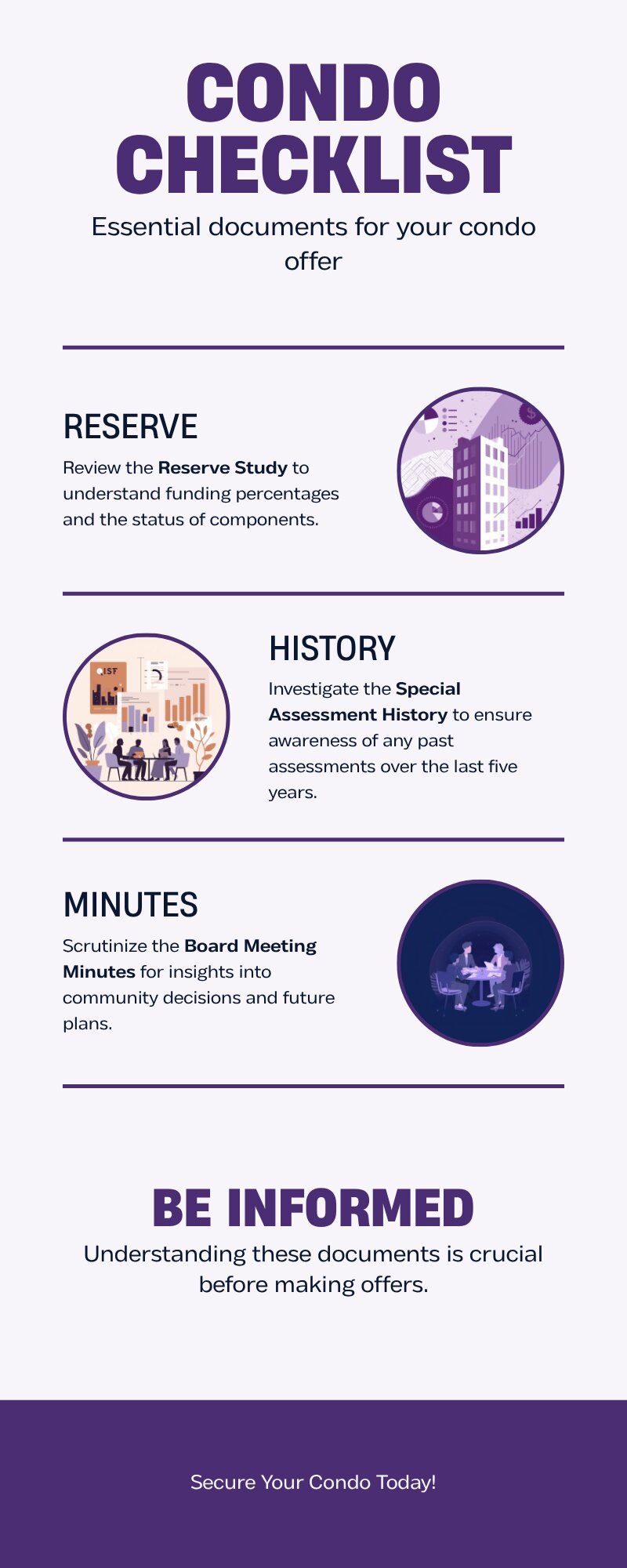
Uncategorized May 22, 2026

How to Price Your Home to Sell in King County 2026

Getting the price right from day one is the single biggest decision you will make as a seller. Here’s exactly how to do it in today’s King County market.

The Market Has Shifted — And Pricing Has to Shift With It

A few years ago, you could price a King County home at the top of the range, sit back, and let competing buyers push the number up for you. That strategy worked because there were almost no homes to choose from and buyers were desperate. That market is gone.

As of May 2026, active listings across King County are up roughly 31% year over year. Days on market in King County 2026 have nearly doubled — from 7 days a year ago to an average of 12 days now. That is not catastrophic — this is still not a buyer’s market in the traditional sense — but it is a fundamentally different environment than what sellers experienced in 2022 and 2023. Buyers today are walking a home twice, requesting inspections, and waiting to see what comes up next weekend before they write an offer.

In that environment, your list price is not just a number. It is a signal. And if you send the wrong signal, you will pay for it in ways that are hard to recover from.

Why Overpricing Costs You More Than You Think

This is the part most sellers don’t believe until they’ve lived through it. The instinct to price high makes sense emotionally — you love your home, you’ve put money into it, and you want to leave room to negotiate. But the math does not support it.

Here is what actually happens when a home is overpriced in King County right now. It sits. After 10 to 14 days with no offers, buyers start asking why. They can see the listing history. They know when a home has been on the market too long, and they start to assume something is wrong with it — even when the only problem is the price. The longer it sits, the more that perception hardens.

Then comes the price reduction. When you drop the price after three weeks on market, you do not get a fresh start. You get buyers who feel validated in their suspicion and who are now motivated to negotiate even harder. Research shows that homes requiring a price reduction in King County typically sell for less than they would have if they’d been priced correctly from day one. You gave up both time and money.

The irony is that a correctly priced home in 2026 is your best shot at a bidding situation. When buyers see a home priced at market — not above it — they move with more urgency. Because they know another buyer might too.

Home pricing cascade effect — overpriced vs correctly priced in King County 2026

Overpricing creates a cascade. Pricing right from day one nets you more.

How to Build the Right List Price: What Comps Tell King County Sellers

The foundation of any good pricing decision is comparable sales — homes that have actually closed, not homes currently listed. Active listings are your competition. Closed sales tell you what buyers in King County are actually paying right now.

What a Useful Comp Set Looks Like in 2026

Recency: Sales closed within the past 60 to 90 days only. Anything older is telling you what the market was, not what it is today.

Geography: Same neighborhood or school district boundary, not just the same city. A home in Covington’s Tahoma School District zone is a different product than one outside it, even if they’re a mile apart.

Size and condition: Similar square footage (within about 200 sq ft), similar lot size, similar age, and — critically — similar condition. A home with original 1990s finishes is not the same product as one with a remodeled kitchen and new bathrooms.

Once you have your comp set, focus on two numbers: the list-to-sale ratio and days on market. King County’s county-wide sale-to-list ratio is running around 101.6% right now — but that average includes many well-priced homes pulling it up. Look specifically at homes that sold without a price reduction. Those are the ones worth modeling.

What the 2026 King County Market Means for Your Strategy

The rate environment adds another layer to this. Mortgage rates are sitting around 6.5% to 6.7% as of late May 2026, and they’ve been creeping up. At that rate, every $50,000 you add to your asking price adds roughly $300 per month to a buyer’s payment. That is not a small number for the families moving through Renton, Kent, Auburn, and Maple Valley — the buyers who make up the bulk of transaction volume in your neighborhoods.

Rate-sensitive buyers are doing the math carefully. They have a payment ceiling, and they are not going to stretch past it for a home that doesn’t feel worth it. That means a home priced $25,000 to $50,000 above market will often not even get shown to the right buyers — because their lender-qualified search range doesn’t reach it.

King County’s inventory increase also means your home is being compared against more options than it was a year ago. When a buyer in Covington has five homes to look at in their price range instead of two, your home has to earn its keep. Pricing is how you get them in the door.

The communities in South King County — Kent, Auburn, Covington, Maple Valley — are still seeing solid demand, especially at the entry-level and move-up price points. But the tolerance for overpricing has shrunk considerably. For the full market picture, see the King County Real Estate Market Update May 2026.

The BPO Advantage: Why Professional-Grade Pricing Matters

Most agents price a home by pulling a few comps and applying general intuition. I do it differently.

As an active BPO (Broker Price Opinion) field agent, I assess property values professionally — not just for my own listings, but on behalf of lenders, banks, and servicers across the county, every single day. That means when I look at your home, I am applying the same methodology that financial institutions use when they need to know exactly what a property is worth in the current market.

I know which condition adjustments to make and which ones buyers will actually pay for. I know how to weight a comp that is slightly outside your neighborhood. I know when inventory is absorbing slowly in a specific price band and how that should affect your initial pricing position. This is not a guess — it is a professional assessment built on hundreds of valuations a year.

When You Should Consider Pricing Slightly Below Market

There is one scenario where pricing a touch below the comp average makes strategic sense — when your goal is to create urgency and maximize final sale price through multiple offers.

This works best when inventory in your price band is low, your home shows exceptionally well, and you have a realistic expectation of where offers will land. You are essentially setting the stage for buyers to compete rather than negotiate. A $10,000 to $15,000 under-ask on a well-presented home can result in multiple offers and a final price above what you would have gotten listing at market.

Before listing, also read How to Prepare Your Home for Sale in King County — presentation and pricing work together, and you can’t separate the two.

King County seller pricing strategy guide 2026 — price it right vs price too high

The choice is simple. The execution is where sellers need help.

What This Means If You’re Thinking About Selling

If you’re weighing whether to list this spring or summer, here is the straightforward version: pricing correctly in 2026 is more important than it has been in years, and the margin for error is smaller.

Start with an honest CMA from an agent who knows your specific neighborhood — not just your zip code. Get a condition assessment. Look at what is competing with you right now, and look at what sold in the past 60 days. If you are thinking about pricing above that range because of what you “need” from the sale or what a neighbor got two years ago, that is a conversation worth having before you list, not after.

The sellers who do well in the current King County market are the ones who commit to accurate pricing from the start, present their home well, and trust the process. They are still getting strong results. The sellers who struggle are the ones treating 2026 like it’s 2022.

Frequently Asked Questions About Pricing Your Home in King County

How do I know if my King County home is priced right?

If you have had 10 to 15 showings in the first two weeks and no offer, the price is almost certainly off. In the current King County market, a correctly priced, well-presented home generates activity in the first week. No traffic is a price signal, not bad luck.

Should I price high and leave room to negotiate?

In most situations in King County right now, no. Buyers are not offering above a price they believe is already above market. Pricing high typically means fewer showings, longer days on market, and a price reduction that draws lower offers than you would have gotten with accurate pricing from the start.

What happens if I need to reduce my price?

A reduction is not the end of the world, but go in with your eyes open. The first reduction should happen no later than three weeks in if you are getting no offer activity. Each week that passes without an offer makes the next buyer less likely to pay full price for the reduced number. Early and decisive is better than slow and small.

How much does condition affect price in King County?

More than most sellers expect. In the current market, buyers have options and they are comparing. A home with an updated kitchen and baths, fresh paint, and clean landscaping will outperform an equivalent home in dated condition at the same price — every time. If you are not prepared to update, price accordingly.

How do mortgage rates affect what I should ask for my home?

Directly. At 6.5%, every $10,000 on your asking price costs a buyer about $60 per month. That sounds small until you realize your buyer is already at their payment ceiling. Rate-sensitive buyers in Kent, Auburn, and Renton are working with lender-qualified search ranges. If your price puts you outside that range, they never see your home at all.

Do I need an agent to price my home, or can I do it myself?

You can research comps yourself, but pricing is an interpretation skill, not just a data skill. Knowing which comps to weight, how to adjust for condition, and how to read current absorption trends for your specific price band takes experience and local knowledge. An error of 3% to 5% on a $700,000 home is $21,000 to $35,000.

Your guide to life outside Seattle.

Gregory Dorrell | Coldwell Banker Bain | WA License #111862
253-350-0045  ·
greg@livingoutsideseattle.com  ·
www.livingoutsideseattle.com
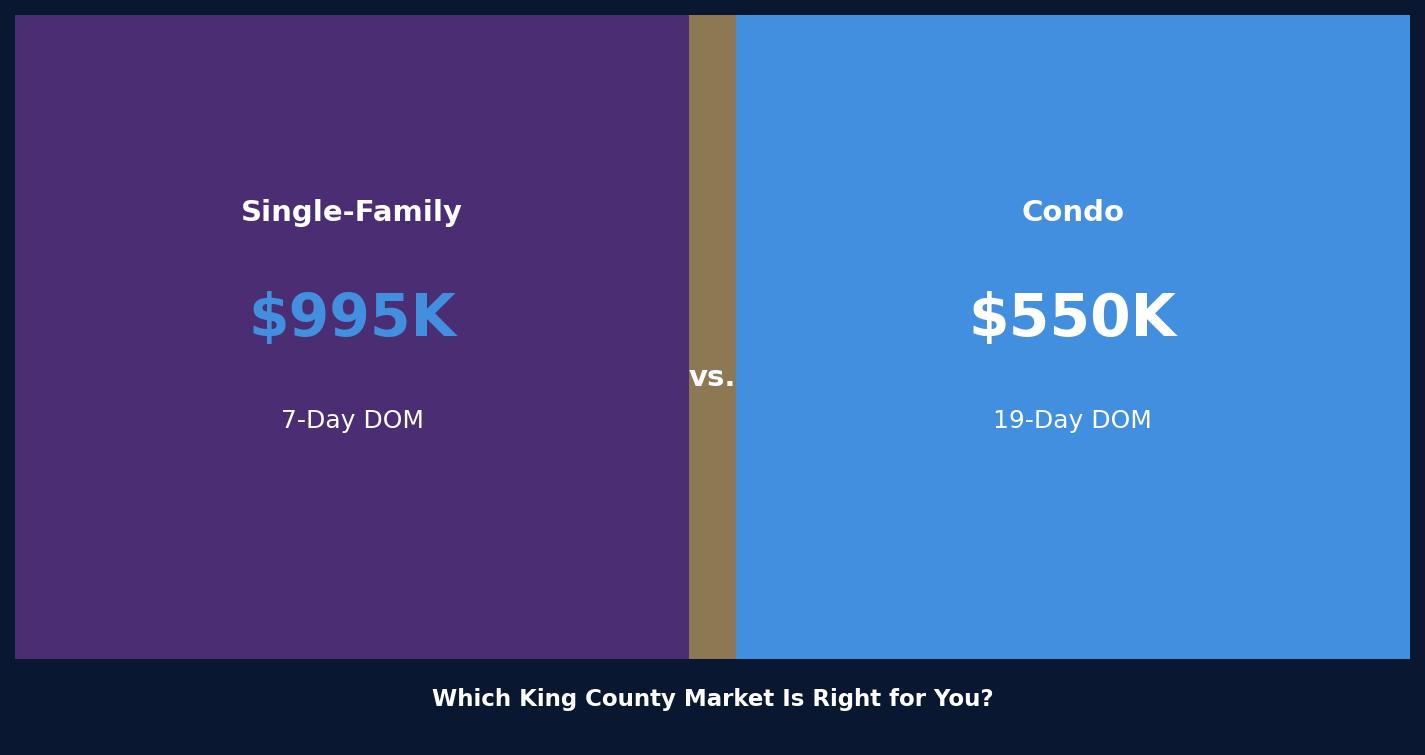
Seller ResourcesUncategorized May 22, 2026

How to Prepare Your Home for Sale in King County

How to Prepare Your Home for Sale in King County

You don’t need to spend a fortune. You need to spend smart — and start early enough to do it right.

Most sellers I talk to ask me the same question: “How much do I need to do before I list?”

My answer is always the same: less than you think, but more intentionally than most people do it. The goal isn’t a full renovation. It’s presenting a home that buyers can picture themselves living in — one that feels move-in ready, honestly priced, and well cared for.

That matters more right now than it has in years. King County has about 3 months of inventory as of spring 2026, and active listings are up significantly year-over-year. Buyers have options. When they have options, they get selective. Homes that are clean, functional, and priced correctly sell. Homes that aren’t sit — and sitting costs you money.

How Long Does It Actually Take?

This is the question I wish more sellers asked me earlier.

For most single-family homes in King County — the kind of 3-bedroom, 2-bath homes common in Auburn, Kent, and Covington — plan for 4 to 6 weeks of prep if your home is in decent condition. If you have deferred maintenance that’s been piling up, or you’re looking at any contractor work, budget 6 to 10 weeks.

Condos move faster, usually 2 to 3 weeks if you’re mostly doing cosmetic updates.

Where sellers get into trouble is waiting too long to start. I’ve seen people decide in April they want to list in May and scramble through prep in two weeks. That rush shows up in the listing photos, in the details buyers catch during tours, and ultimately in the offers you receive. Start earlier than you think you need to. The prep phase is where you build your negotiating position.


6-week home prep timeline for King County sellers — from assessment to photography and launch

A focused 6-week timeline gets most King County sellers to the market in strong condition without the last-minute scramble.

Step One: Do a Buyer Walk-Through Before Buyers Do

Walk through your home like you’re seeing it for the first time. Better yet, ask a friend who hasn’t been inside in a while to do it.

You’ve stopped noticing things. The scuff on the hallway wall. The caulk pulling away from the tub. The closet door that needs a nudge to latch. Those aren’t big issues — but every one of them registers in a buyer’s mind as “this home wasn’t taken care of.”

I do this kind of walk-through professionally every week as part of my BPO field work. The things that hurt perceived value most aren’t structural problems. They’re visible, fixable details that signal deferred maintenance. Make a list of everything. Then prioritize by what a buyer will actually see and notice.

Step Two: Fix the Deferred Maintenance First

Before paint, before staging, before anything else — fix the things that will flag on a buyer’s inspection report.

In Washington State, you’re legally required to disclose known defects on Form 17. Getting a pre-listing inspection ($296 to $424 from a licensed Washington inspector) lets you find those issues on your terms, not the buyer’s. A $2,200 roof repair you handle before listing doesn’t become a $15,000 negotiating concession after you’re already in contract.

None of these are catastrophic. All of them are cheap to fix when you find them ahead of time. All of them become expensive when a buyer’s inspector finds them first.

Step Three: Focus Your Budget on What Buyers Can See

Here’s where sellers often go wrong: they spend on what matters to them, not on what moves buyers.

A full kitchen remodel before selling almost never returns its full cost. Neither does a bathroom gut job or brand-new flooring throughout. Those projects feel significant because they are — but buyers compare your home to other homes, not to your renovation invoice.

What actually delivers return, in order of bang for your buck:

1. Deep professional cleaning — the whole house

Odors and grime kill buyer confidence faster than anything. Budget $400 to $800 and it’s done right. This is non-negotiable.

2. Fresh interior paint in neutral tones

Warm whites, soft greiges, light grays. Half of all real estate agents recommend this before listing. Budget $1,500 to $3,500 for a professional job depending on your square footage.

3. Curb appeal — lawn, front beds, front door

The first photo in your listing is almost always the exterior. A trimmed lawn, clean beds, and a freshly painted front door cost almost nothing relative to the impression they create.

4. Hardware and fixture updates

Swapping dated brass pulls for matte black or brushed nickel takes a Saturday and $200 in hardware. It makes a home feel five years newer in photos.

5. Address the obvious small repairs

Dripping faucets, cracked switch plates, broken screen doors. Every one of these is a tiny trust issue in a buyer’s mind.

What stays off the list: full remodels, new HVAC unless non-functional, new flooring throughout, or any project you can’t complete cleanly before photos.

Step Four: Declutter — More Than You Think Is Enough

This one costs nothing and it’s the move that makes the biggest visual difference.

Buyers need to mentally move themselves into your home. That’s hard to do when your countertops are full, your closets are packed, and every shelf has personal photos and collected items from the last 20 years.

The rule I give sellers: remove a third of your furniture and clear your countertops down to two or three items. If you need a storage unit for 60 days, rent one. It pays for itself in buyer perception.

Families looking at homes in Covington, Maple Valley, and Black Diamond are almost always upsizing. They’re specifically hunting for storage and space. A decluttered home signals that their life will fit. That feeling does a lot of selling before you ever negotiate a price.

Step Five: Stage It — At Least for Photos

Staged homes sell faster. The data on this is consistent. According to the Real Estate Staging Association, professionally staged homes spend 9 to 19 days on market on average, compared to 33 to 73 percent longer for unstaged homes. Nineteen percent of sellers’ agents report 1 to 5 percent higher offers — on a $750,000 home, that’s up to $37,500.

Full professional staging isn’t always necessary. Occupied staging, where a stager works with what you have and brings in accent pieces, often gets you 90 percent of the result for a fraction of the cost. The median cost of professional staging is around $1,500 according to NAR’s most recent data.

At minimum: stage it for photos. Your online listing is your first showing. In King County’s 2026 market, where 97 percent of buyers start their search online, weak listing photos will cost you tours.

Step Six: Price It Right From the First Day

You can do everything above perfectly and still leave money on the table if you price wrong.

Overpriced homes sit. Sitting homes collect days on market. Buyers see that number and start asking what’s wrong. You get lower offers, more concession requests, and sometimes no offers at all. A price reduction signals weakness to every buyer watching. The data is consistent: homes that require a price drop sell for less than they would have if they’d been priced right initially.

For a current read on what’s happening in the King County market right now, check out my King County Real Estate Market Update.


Real estate agent conducting professional home valuation walkthrough in King County Washington

Pricing a home correctly requires the same process lenders use — real comparable sales data from someone who walks properties every week.

Frequently Asked Questions

How much does it cost to prepare a home for sale in King County?

For most sellers, a focused prep budget runs $3,000 to $8,000. That covers professional cleaning ($400–$800), interior paint ($1,500–$3,500), minor repairs and hardware updates ($500–$1,500), and basic landscaping cleanup ($300–$800). Professional staging adds another $1,000 to $2,500 if you choose to go that route. You don’t need to spend more than that to list competitively.

Should I get a pre-listing inspection in Washington State?

Yes, in most cases. A pre-listing inspection runs $296 to $424 from a licensed Washington inspector and lets you find issues before a buyer’s inspector does. You control the timeline, you control the repair bids, and you don’t lose a deal over something you could have fixed for a few hundred dollars. Washington requires disclosure of known defects on Form 17 — a pre-listing inspection removes the guesswork about what you’re required to disclose.

What do buyers in King County want most in 2026?

Move-in ready condition is the top priority — 76 percent of agents say it’s the single biggest selling point in today’s market. Buyers also want functional home offices, energy-efficient features, outdoor living space, and strong online photo presentation. What they’re not willing to do is pay a premium for a home that needs work.

When is the best time to list in King County?

May and June historically deliver the best outcomes for sellers in the Seattle area — homes listed during these months sell 10 to 18 days faster and achieve 3 to 7 percent higher prices than January listings. If you’re reading this in spring, now is your window.

How long before listing should I start prep?

Plan for 4 to 6 weeks for most single-family homes in average condition. Add 2 to 4 weeks if you have significant deferred maintenance or need contractor work. The mistake most sellers make is starting too late and rushing the final two weeks — that rush shows up in photos and in the details buyers catch during tours.

Your guide to life outside Seattle.

Gregory Dorrell | Coldwell Banker Bain | WA License #111862
253-350-0045  ·
greg@livingoutsideseattle.com  ·
www.livingoutsideseattle.com
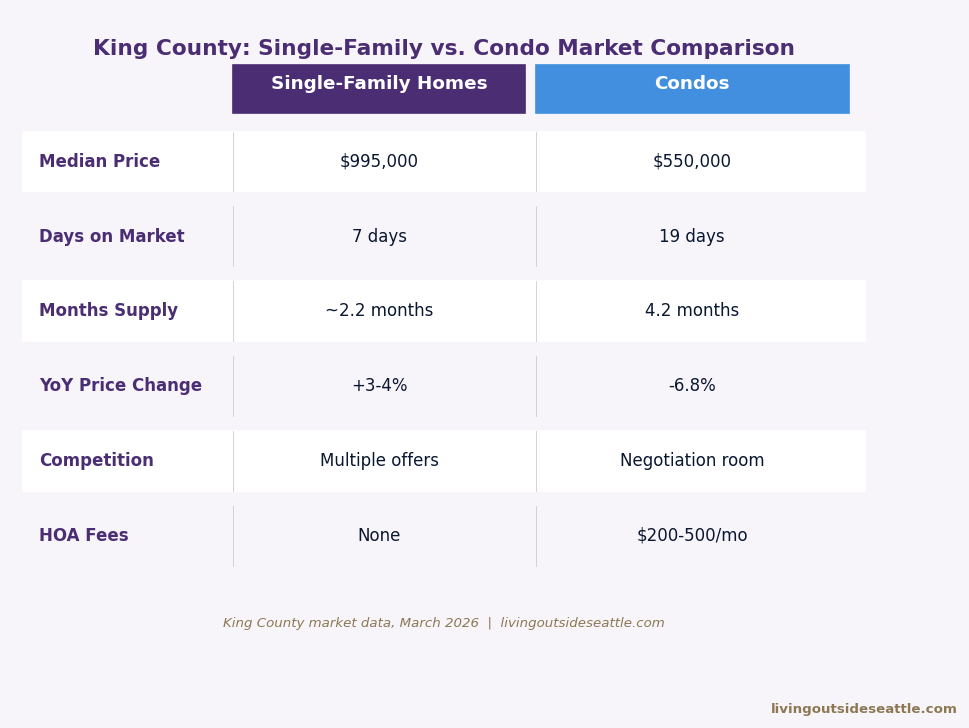
Gregory Dorrell is a REALTOR® with Coldwell Banker Bain specializing in East and South King County. WA License #111862.