

 Facebook
 X
 Pinterest
 Copy Link
Pre-Approval vs. Pre-Qualification in King County: What Sellers Actually Trust

A plain-English look at the three kinds of lender letters, which one a King County seller will take seriously, and how to get the strong one before you tour a single home.
Most buyers think a pre-approval letter is a pre-approval letter. It is not. Lenders hand out three different documents that sound almost the same, and sellers and their agents rank them very differently. I see these letters from both sides of the table across Renton, Kent, and Auburn, and I can usually tell in about ten seconds which offers are real.
Here is why it matters right now. With mortgage rates above 7% this fall, sellers are watching for buyers who can actually close. A weak letter will not lose you the house on its own. But when two offers are close, the buyer with the stronger letter wins more often than not.
Pre-Qualification: A Conversation, Not a Commitment
A pre-qualification is the lightest version. You tell a lender, or an online tool, your income, your debts, and your savings. They run the numbers and give you a range. Sometimes there is a soft credit check. Often there is not.
Nobody verifies anything. Your pay stubs stay in the drawer. That is why it takes ten minutes.
So what? A pre-qualification is useful for one thing: getting a rough price range before you start the real process. It tells you whether $550,000 or $750,000 is even in the neighborhood. It does not tell a seller anything they can rely on, because nothing in it has been checked.
Pre-Approval: The Letter Most Offers Are Written With
A true pre-approval means you applied. The lender pulls your credit and collects documents: recent pay stubs, W-2s or tax returns, and bank statements. A loan officer reviews them and issues a letter saying you are approved up to a stated amount, subject to conditions.
That last phrase matters. A standard pre-approval is a conditional commitment. The lender has looked at your file, but an underwriter has not yet gone line by line through it. Final approval still depends on the appraisal, the title work, and your finances staying the same until closing.
So what? This is the letter sellers expect to see attached to an offer in King County. It shows you are serious, and it shows a real person at a real lender looked at your numbers. For most buyers, this is the right letter to have in hand before the first showing.
Underwritten Pre-Approval: The Strongest Letter You Can Carry
Some lenders will take your pre-approval one step further. Your full file goes to an underwriter before you ever find a house. The underwriter reviews income, assets, debts, and credit, and issues a conditional approval that is mostly done. What is left is the property itself: the appraisal, title, and insurance.
This version goes by different names depending on the lender, including pre-underwritten, fully underwritten, or verified approval. Ask your lender what they call theirs and what has actually been reviewed.
So what? Fewer unknowns means a faster, calmer close. Sellers like that, especially when they are choosing between offers with similar prices. If a seller is also buying a home, a smoother closing can matter as much as a few thousand dollars.
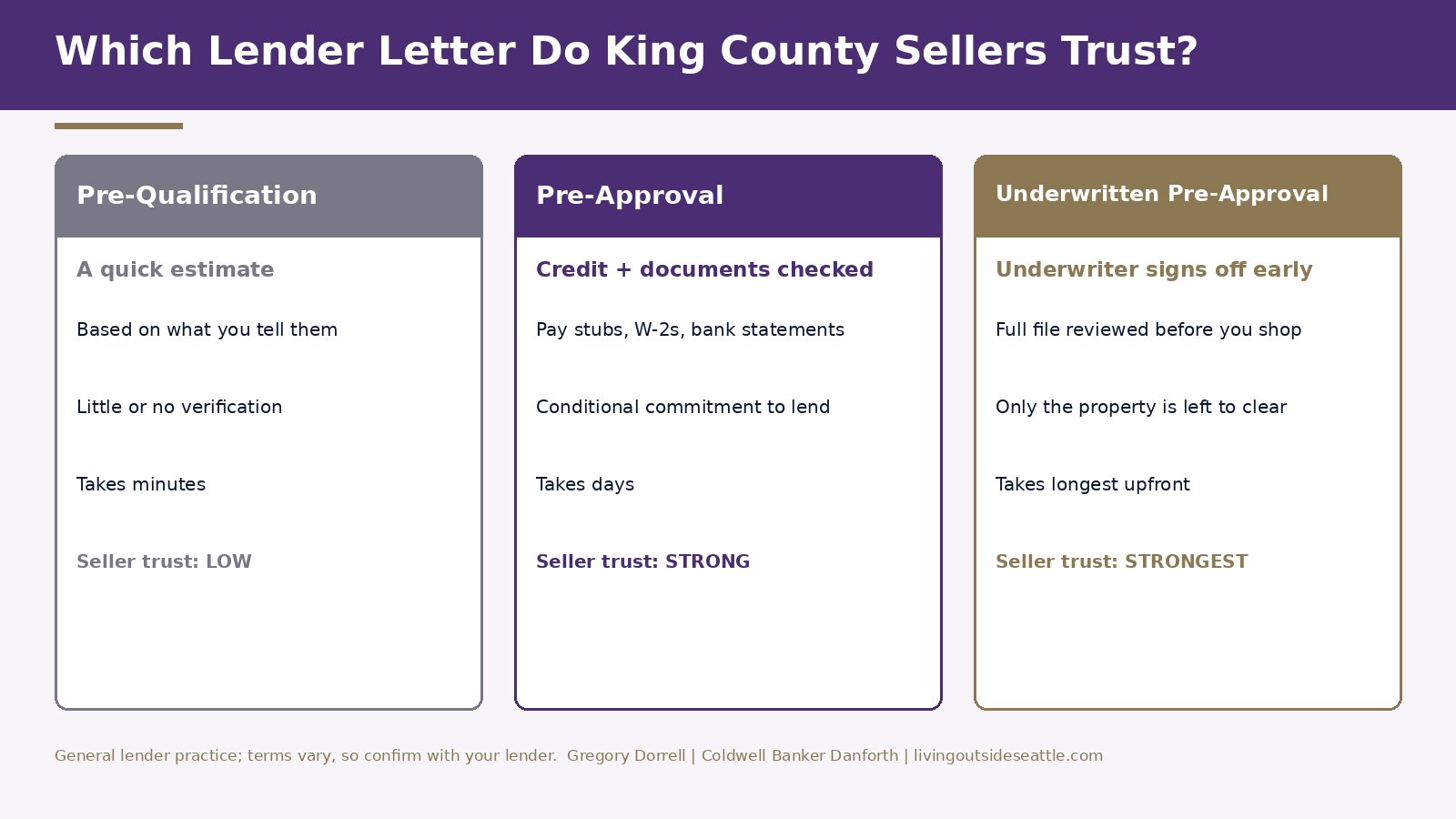
What each lender letter verifies, and how much weight King County sellers give it.
The Local Angle: What King County Sellers Are Looking For
King County is not one market. A seller in Sammamish and a seller in Kent are reading offers differently, because their buyers and their timelines are different.
Take price. The median single-family home in Kent sold for about $697,725 over the 12 months through August 2026, and in Renton it was about $783,750. Those are single-family medians, not blended with condos. At those prices, a buyer putting 5% down is still borrowing roughly $660,000 to $745,000. Sellers read the dollar figure on your letter closely. Make sure it covers the price you are offering, not the price you hope to pay.
Now timing. In a softer fall market, some sellers are willing to wait a little for the right buyer. But the offers they like best are still the ones that look easy to close. A verified letter makes that case before you say a word.
What Makes a Letter Look Strong to a Seller
Sellers and their agents check a few simple things. First, the letter is on the lender’s letterhead and names the buyer. Second, the approval amount covers your offer price with room to spare. Third, the date is recent. Letters commonly expire after 60 to 90 days, so ask your lender how long yours is good for. Fourth, the loan type matches the offer: if you are using an FHA loan, the letter should say so.
Fifth, and this one gets missed, the lender is someone the listing agent can call. Local lenders with a track record in King County close deals sellers have seen before. An unfamiliar online lender is not disqualifying, but it raises questions. I would rather you answer those questions in advance than during a negotiation.
So what? You do not need a perfect letter. You need one that answers the seller’s questions before they ask.

Get the letter before you need it. Offers move fast once the right home lists.
What This Means for You as a Buyer
If you are two or more months from buying, start with a pre-qualification. It costs nothing and sets your range. Then move on to a real application.
If you are within a few months, get the full pre-approval. Do not wait until you find the house. I have watched buyers lose a weekend gathering documents while another offer went in.
If you expect multiple offers on a home, or you are buying while selling, ask your lender about an underwritten pre-approval. It takes more upfront work, and it may cost you a few extra days. In return, you carry a letter that looks a lot like cash to a seller.
If you want to see how lenders reach the number, my guide on how mortgage qualification works in Washington State walks through income, debt-to-income, credit, and down payment. Once you have a letter and a house, the next question is timing, so read how a mortgage rate lock works in Washington. And for the cash side of an offer, see earnest money in King County and buyer closing costs in King County. If you are weighing a program to lower your rate, rate buydowns are covered here.
Frequently Asked Questions
What is the difference between pre-approval and pre-qualification?
A pre-qualification is an estimate based on information you provide, with little or no verification. A pre-approval means the lender pulled your credit and reviewed documents like pay stubs and bank statements. Sellers rely on pre-approvals. They treat pre-qualifications as a rough guide.
Do King County sellers accept a pre-qualification letter with an offer?
Most listing agents will not treat a pre-qualification as proof of financing. Because nothing has been verified, it carries little weight, especially when other offers include a full pre-approval. Get the pre-approval before you write an offer.
Does a pre-approval hurt my credit score?
A pre-approval usually involves a hard credit inquiry, which can lower your score by a small amount for a short time. Multiple mortgage inquiries within a short window are generally treated as one for scoring purposes. Ask your lender how that works with the scoring model they use.
How long does a pre-approval letter last?
Most letters are good for roughly 60 to 90 days, though it varies by lender. If your search runs longer, ask for an updated letter. Lenders may need fresh pay stubs and bank statements.
Is a pre-approval a guarantee I will get the loan?
No. It is a conditional commitment. Final approval depends on the appraisal, the title work, and your finances staying the same through closing. An underwritten pre-approval removes more of the unknowns, but the property still has to qualify.
Should I get pre-approved with more than one lender?
It is worth comparing at least two or three lenders on rate, fees, and how well they communicate. Doing it within a short span keeps the credit impact small. Pick the lender you trust to answer the phone the day an offer is due.
Get the Letter Before You Need It
A pre-qualification gets you a number. A pre-approval gets you taken seriously. An underwritten pre-approval gets you the benefit of the doubt when offers are close. In King County, the buyers who get the keys are usually the ones who did the boring paperwork first.
Whether you are a first-time buyer in Kent or Auburn, or moving up in Renton, I am happy to walk through the real numbers with you and introduce you to lenders I trust. No pressure, no sales pitch. Reach me at greg@livingoutsideseattle.com or 253-350-0045, or find more guides at www.livingoutsideseattle.com.
Your guide to life outside Seattle.
253-350-0045 ·
greg@livingoutsideseattle.com ·
www.livingoutsideseattle.com
The 30 Days Between Accepted Offer and Closing in King County

What happens after the seller says yes, who has to do what each week, and the dates that can quietly break your closing.
Most buyers think the hard part ends when the seller accepts the offer. It does not. That is when the clock starts, and a handful of dates in your contract decide whether you close on time or scramble.
I see this from the field every week. I do BPO work across east and south King County, and I am usually in the neighborhood when a deal is in the middle of its 30 days. The deals that go smoothly are not luckier. The buyers simply knew what was coming each week and had their paperwork ready before they were asked.
This is the week-by-week map. It assumes a typical financed purchase of a single-family home, closing in roughly 30 to 45 days. Cash deals move faster. Condos and new construction add steps. Your purchase and sale agreement controls every date, so treat the numbers below as the usual pattern, not a promise.
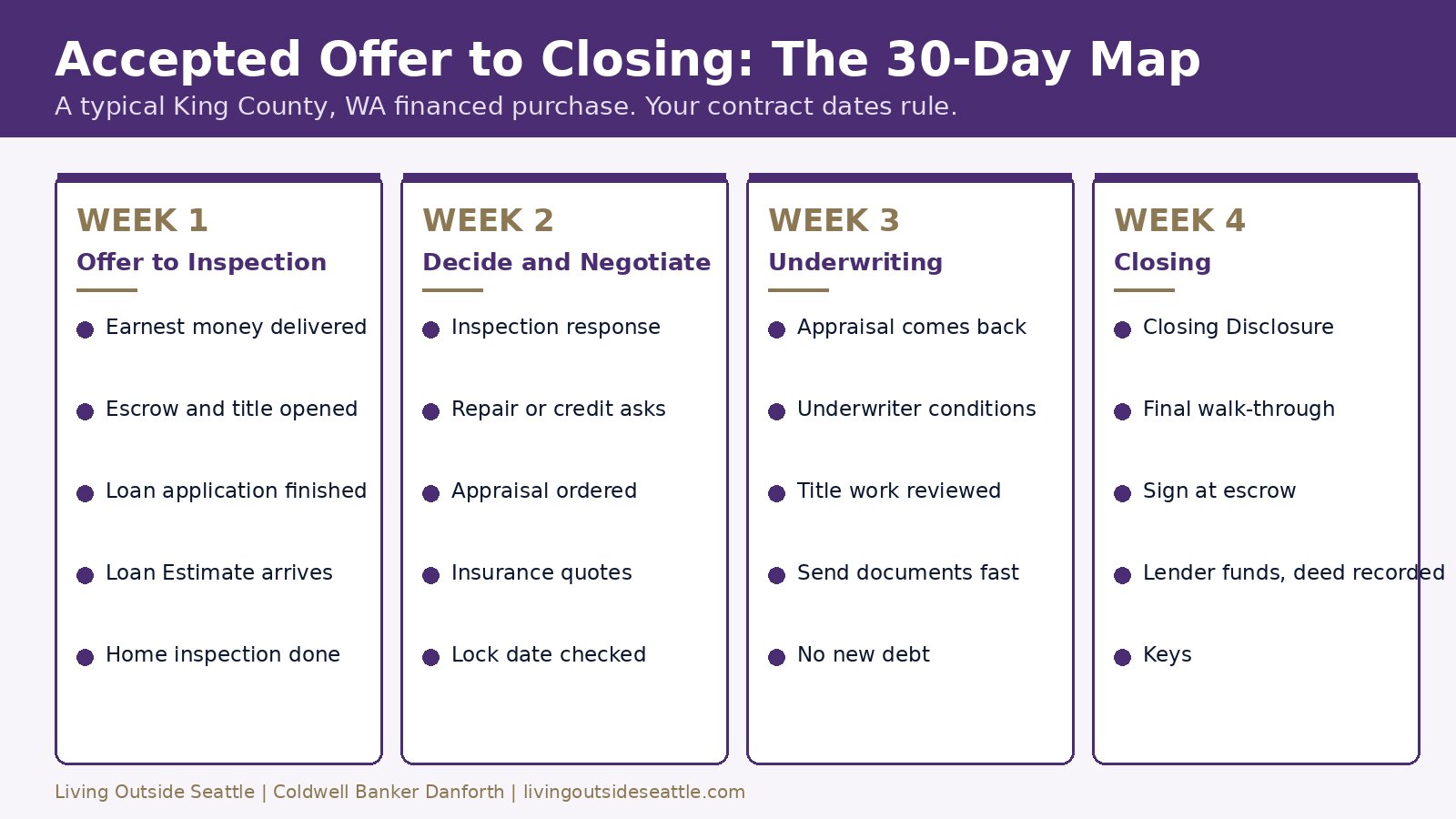
The four weeks between accepted offer and keys, at a glance.
The 30-Day Timeline, Week by Week
Week 1: Get Everything Opened and Inspected
The first few days are about paperwork landing in the right hands. Your earnest money goes to escrow, and the escrow officer opens your file. Escrow is the neutral third party that holds the money and documents until closing. I cover the deposit rules in my earnest money guide, and the short version is this: deliver it on the date in your contract, not the day you remember.
Your lender has work to do too. If you have not finished the full loan application, finish it now. Within three business days of a complete application, federal rules require the lender to send you a Loan Estimate that shows your rate, payment, and cash to close. Read it the day it arrives. So what? It is the first real look at your closing numbers, and errors are easiest to fix early.
The home inspection also usually happens this week. Washington contracts set an inspection deadline, and it is often only about a week out. Book your inspector the same day your offer is accepted. In the Auburn, Kent, and Renton neighborhoods I work in, good inspectors can be booked a week out, and that wait can eat your whole window.

Book the inspector the day your offer is accepted. Good ones fill up.
Week 2: Decide What the Inspection Means
The inspection report lands, and now you have a decision. Under the contract you can accept the home as is, ask for repairs or credits, or in some cases walk away within your inspection period. The deadline matters more than the report. Miss it and you may lose the right to negotiate at all.
My advice is to sort the findings into three piles: safety and major systems, things that are inexpensive to fix, and cosmetic items. Ask for the first pile. Skip the third. I wrote about how sellers see this side in my home inspection seller guide, and knowing how they think helps you ask for things that actually get a yes.
This is also the week your lender orders the appraisal. The appraiser visits the home, compares it to recent sales, and reports a value to the lender. If you are watching a rate lock, check the lock expiration against your closing date now. My rate lock guide explains what extensions cost if closing slips.
Week 3: Underwriting and the Appraisal
Week three is where deals get quiet, and quiet is dangerous. Your file sits with an underwriter, who verifies income, assets, and the property. You may get a list of conditions, which are extra documents or explanations. Answer every one within a day if you can.
The appraisal usually comes back this week. If the value matches or beats your price, nothing changes. If it comes in low, the lender will only loan against the appraised value. Under the usual Washington contract terms, you generally have a short window, often three days, to respond with a notice, so know your date before the report lands. Your options are to renegotiate the price, bring more cash, challenge the appraisal with better comparable sales, or end the deal if your contract allows.
One rule matters more than the rest. Do not open new credit, change jobs, or move large sums of money. A new car loan in week three can change your debt ratio and stall your approval. So what? The lender checks your file again right before closing, and anything new gets noticed.
Week 4: Closing Disclosure, Walk-Through, and Keys
At least three business days before you sign, your lender must deliver the Closing Disclosure. This is the final version of your loan terms and cash to close. Compare it line by line with your Loan Estimate. My buyer closing costs guide lists what each fee is, so you know what to question.
Next comes the final walk-through, usually within a day or two of closing. You are not re-inspecting the home. You are confirming that it is in the agreed condition, that any repairs were done, and that the seller left what they were supposed to leave. Run the faucets, test the outlets, and open the garage door.
Then you sign at escrow. In Washington the lender wires the funds, escrow confirms everything, and the deed is recorded with King County. Possession and keys follow the terms of your contract, which is often the day of recording or the day after. Plan for the keys to arrive later in the day than you hope, and do not schedule movers for early morning.
The Local Angle: What Slows King County Closings
In King County the common delays are not exotic. Inspector calendars fill up. Appraisers in busy stretches of Renton, Kent, and Auburn can take longer to get on the schedule. Condos add a resale certificate and HOA documents. And with mortgage rates above 7% this fall, as I covered in my fall market and mortgage rate post, lock dates and monthly payment limits leave less room for surprises. A month with little slack is a month where one late document matters.
If your closing date is tight, ask your agent and lender to build the plan backward from it. Every deadline in the contract should be on one calendar the day you go under contract.
What This Means for You
If you are about to make an offer, get your pre-approval documents together now, so week one starts fast. If you are already under contract, put every date from your agreement on a single calendar today, including the inspection deadline, the appraisal timeline, the financing dates, and the closing date. Then call your lender and ask what they still need from you. That one call prevents more delays than anything else on this list. If you are a first-time buyer in Kent or nearby, my Kent first-time buyer guide covers the financing side in more depth, and my contingent offer guide explains what changes if you are selling a home to buy this one.
Frequently Asked Questions
How long does it take to close on a house in King County?
Most financed purchases close about 30 to 45 days after the accepted offer. Cash purchases can close in two to three weeks. Your contract sets the closing date, and lenders, appraisers, and inspectors all have to fit inside it.
What happens right after my offer is accepted in Washington?
Your earnest money goes to escrow, escrow opens a file, you finish your loan application, and you schedule the home inspection. Do all four in the first few days, because the inspection and financing deadlines start running from the accepted offer.
What is the most common reason a King County closing is delayed?
Slow documents and calendar conflicts. A late inspection, a late response to an underwriter, an appraisal that takes longer to schedule, or a rate lock that expires before closing can each push a closing date back.
What happens if the appraisal comes in low?
The lender will only loan based on the appraised value. You can usually negotiate the price down, bring extra cash to cover the gap, challenge the appraisal with stronger comparable sales, or end the deal if your contract allows. Watch the notice deadline in your agreement.
Can I get the keys the day I sign?
Not always. Possession follows your contract, and in many Washington deals the deed must be recorded first. That is often the same day or the next day. Ask your agent for the exact possession terms before you book movers.
What should I avoid doing while I wait to close?
Do not open new credit, change jobs, or move large sums between accounts. The lender checks your file again before closing, and a new debt or unexplained deposit can slow or stop your approval.
The 30 days feel long, but they are very manageable when you know the week. Whether you are about to write an offer or you are already in the middle of one, I am happy to walk through your dates and the real numbers with you. No pressure, no sales pitch.
Your guide to life outside Seattle.
253-350-0045 ·
greg@livingoutsideseattle.com ·
www.livingoutsideseattle.com
Rates Hit 7.5%: Does My Payment Change If I’m Already Under Contract?
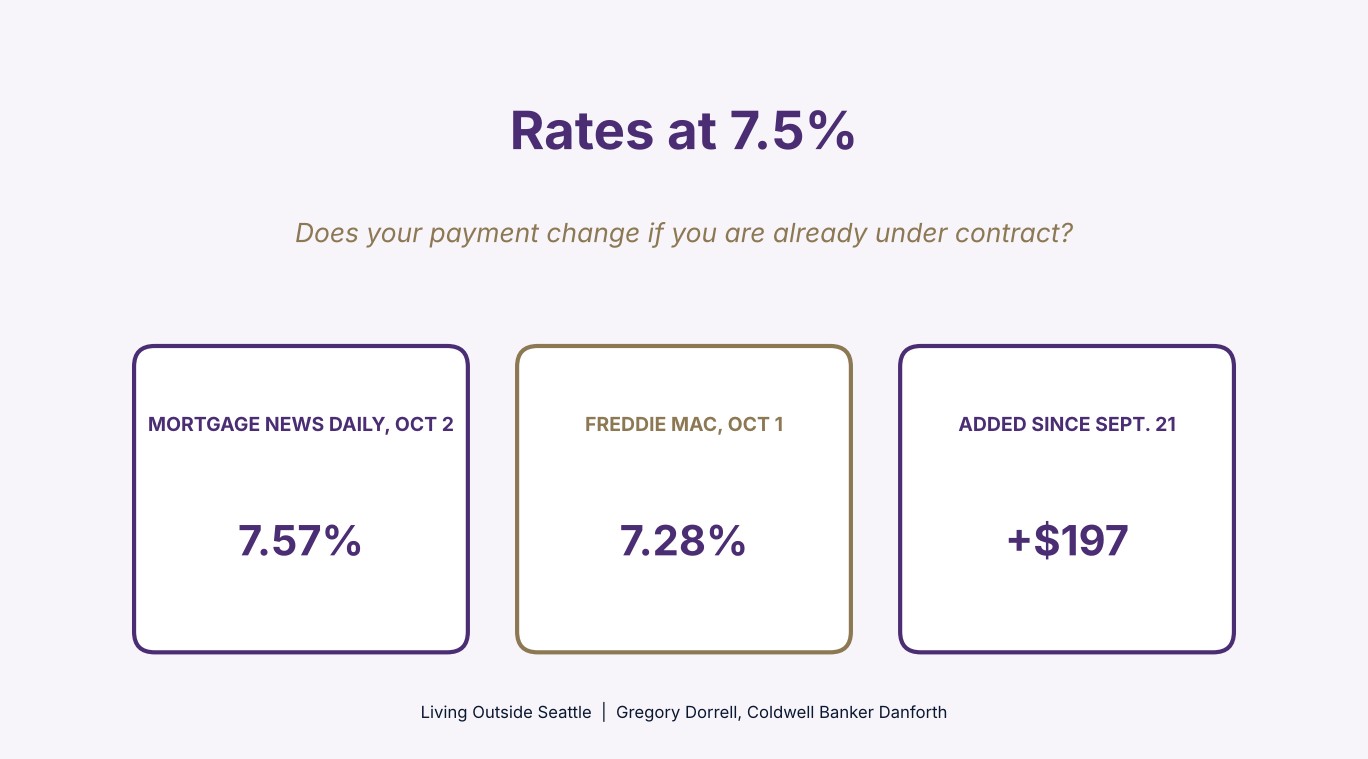
What Happened to Mortgage Rates This Month
Rates moved fast. Mortgage News Daily tracks a 30-year fixed rate every day. It closed at 7.57% on October 2, after peaking at 7.60% on September 30. On September 21 it was 7.19%. That is a jump of about 0.4 points in under two weeks.
Freddie Mac’s weekly survey says 7.28% for the week of October 1. That number runs behind because it is a weekly average. The Fed also raised its rate on September 16, the first hike since 2023. So the rate buyers are seeing on quotes this week is closer to 7.5%. I broke down the bigger picture in my guide on what 7%+ mortgage rates mean for King County buyers and sellers.
Does My Payment Change If I Am Already Under Contract?
Not if your rate is locked. A rate lock is a promise from your lender to hold a specific rate for a set number of days. Lock periods are often 30, 45, or 60 days, and longer locks can cost more. Ask your lender what yours is. My rate lock guide for Washington buyers explains how locks work in more detail.
In my experience, buyers usually lock around the time the offer is made. That means a rate jump after the offer does not touch them. I want to be clear about this because a lot of the news makes it sound like every buyer is getting hit. They are not.
Who Is Exposed to the Rate Jump
The jump hits buyers in four spots:
- Buyers who are under contract but have not locked. Their rate floats until they lock, so today’s quote is the one that counts.
- Buyers whose lock runs out before closing. If closing slips past the lock date, an extension can cost money.
- Buyers who have not made an offer yet. Every quote they get now reflects the higher rate.
- Buyers who switch lenders or loan types after locking. A new loan usually means a new rate.
What the Jump Costs on a $950,000 Home
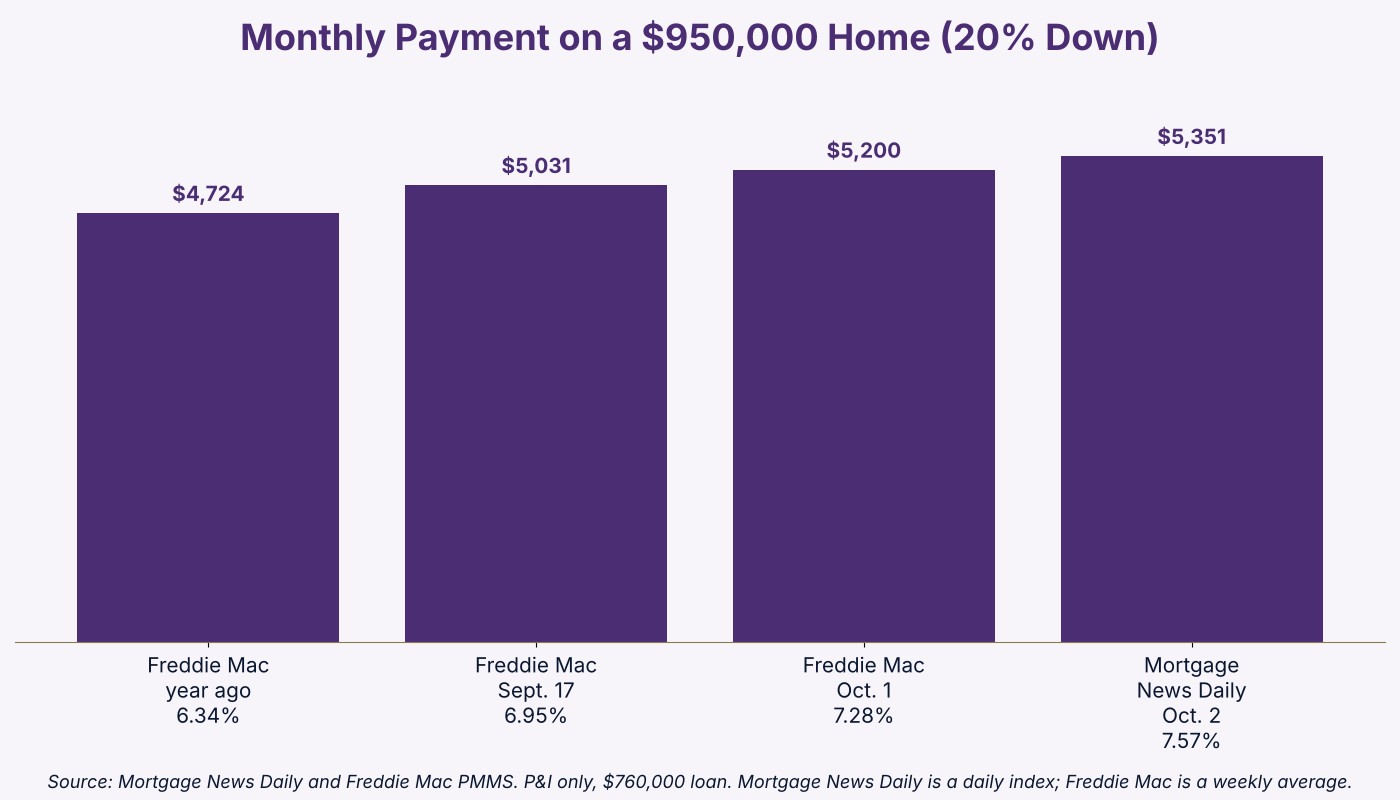
I ran the numbers on a $950,000 home with 20% down. That is a $760,000 loan, which is close to the county single-family median of $945,000. These figures are principal and interest only. Taxes and insurance come on top.
| Date and source | Rate | Monthly payment |
|---|---|---|
| Freddie Mac, a year ago | 6.34% | $4,724 |
| Freddie Mac, Sept. 17 | 6.95% | $5,031 |
| Mortgage News Daily, Sept. 21 | 7.19% | $5,154 |
| Freddie Mac, Oct. 1 | 7.28% | $5,200 |
| Mortgage News Daily, Oct. 2 | 7.57% | $5,351 |
Source: Mortgage News Daily and Freddie Mac PMMS. Principal and interest only, 30-year fixed, $760,000 loan.
Look at the two daily index rows. From September 21 to October 2, the payment rose by about $197 a month. Compared with a year ago on Freddie Mac’s weekly numbers, today’s payment is about $476 a month higher. Those are real dollars, and they are why this matters for anyone who has not locked.
What To Do This Week, Based on Where You Are
You are under contract and locked
Do nothing about the rate. Check two dates instead: your lock expiration and your closing date. If closing could slip, ask your lender today what an extension costs.
You are under contract and not locked
Call your lender today. Ask what it costs to lock now and for how long. Waiting for rates to fall is a guess, and the Fed just raised its rate, not cut it.
You are still shopping
Set your budget at today’s rate, not last month’s. Get a written quote. Then look at what the seller can do for you. About 26% of King County sales in the latest data included seller concessions, which can pay for part of a rate buydown. My guide to mortgage rate buydowns shows how that works.
Frequently Asked Questions
Does my payment change if rates go up after my offer is accepted?
Not if you have locked your rate. A lock holds your rate for a set number of days, often 30 to 60. If you have not locked, your rate can still move, so ask your lender when to lock.
When should I lock my mortgage rate?
It depends on your lender and your timeline. Many buyers lock around the time the offer is made or accepted. Ask your lender what lock periods they offer and what a longer lock costs.
What happens if my rate lock expires before closing?
Your lender may charge a fee to extend the lock, or you may get the current market rate. Ask about extension costs before you need one.
Should I wait for rates to drop before buying?
Nobody can promise that. The Fed raised its rate in September, and rates have gone up, not down. If you find the right home, a payment you can handle today beats guessing. My cost of waiting guide walks through the math.
Your guide to life outside Seattle.
253-350-0045 · greg@livingoutsideseattle.com · www.livingoutsideseattle.com
Rates from Mortgage News Daily (Oct. 2, 2026) and Freddie Mac PMMS (week of Oct. 1, 2026). Market data from NWMLS, week of October 5, 2026. Gregory Dorrell is a licensed real estate broker (WA License #111862) with Coldwell Banker Danforth. This post is provided for informational purposes and does not constitute financial or investment advice.
How a Mortgage Rate Lock Works in Washington
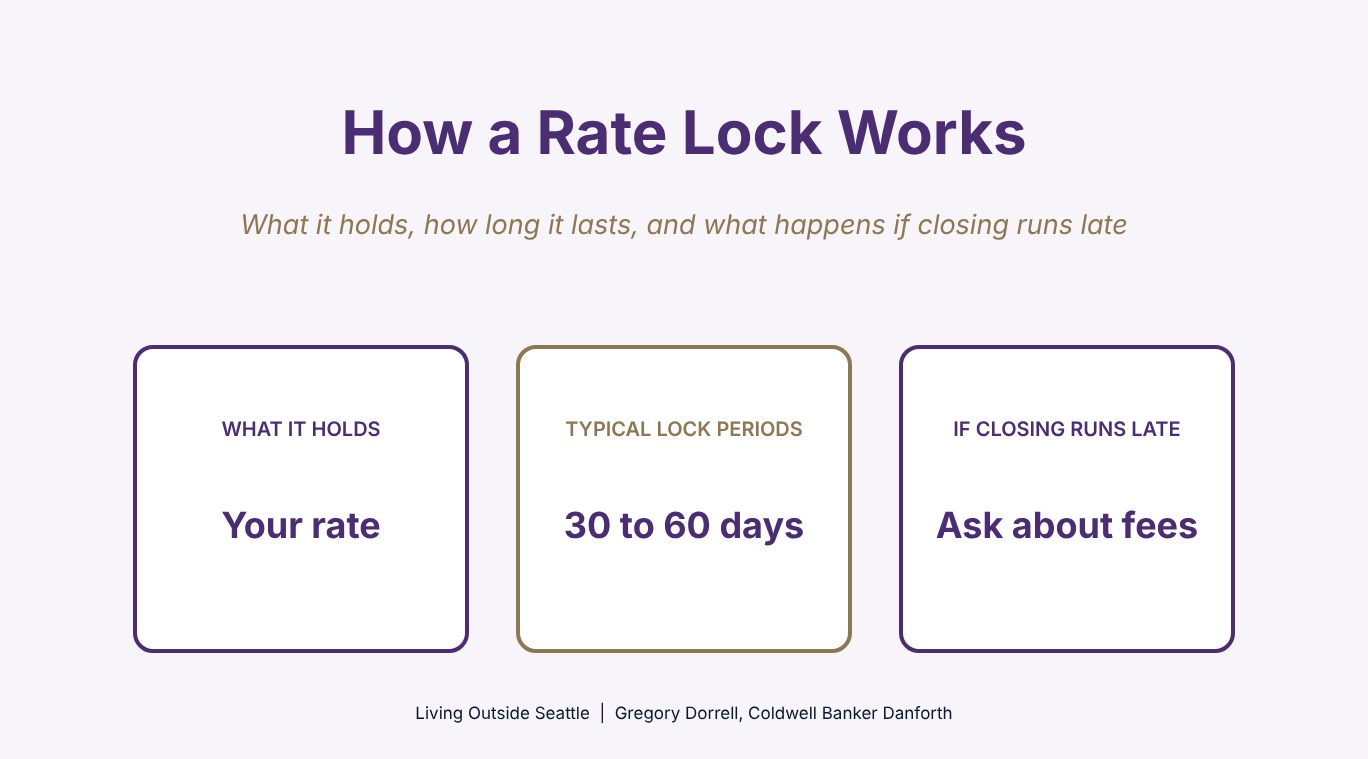
A rate lock holds your mortgage rate until closing. Learn lock periods, what it costs, what a late closing does, and when Washington buyers should lock.
What 7%+ Mortgage Rates Mean for King County Buyers and Sellers This Fall
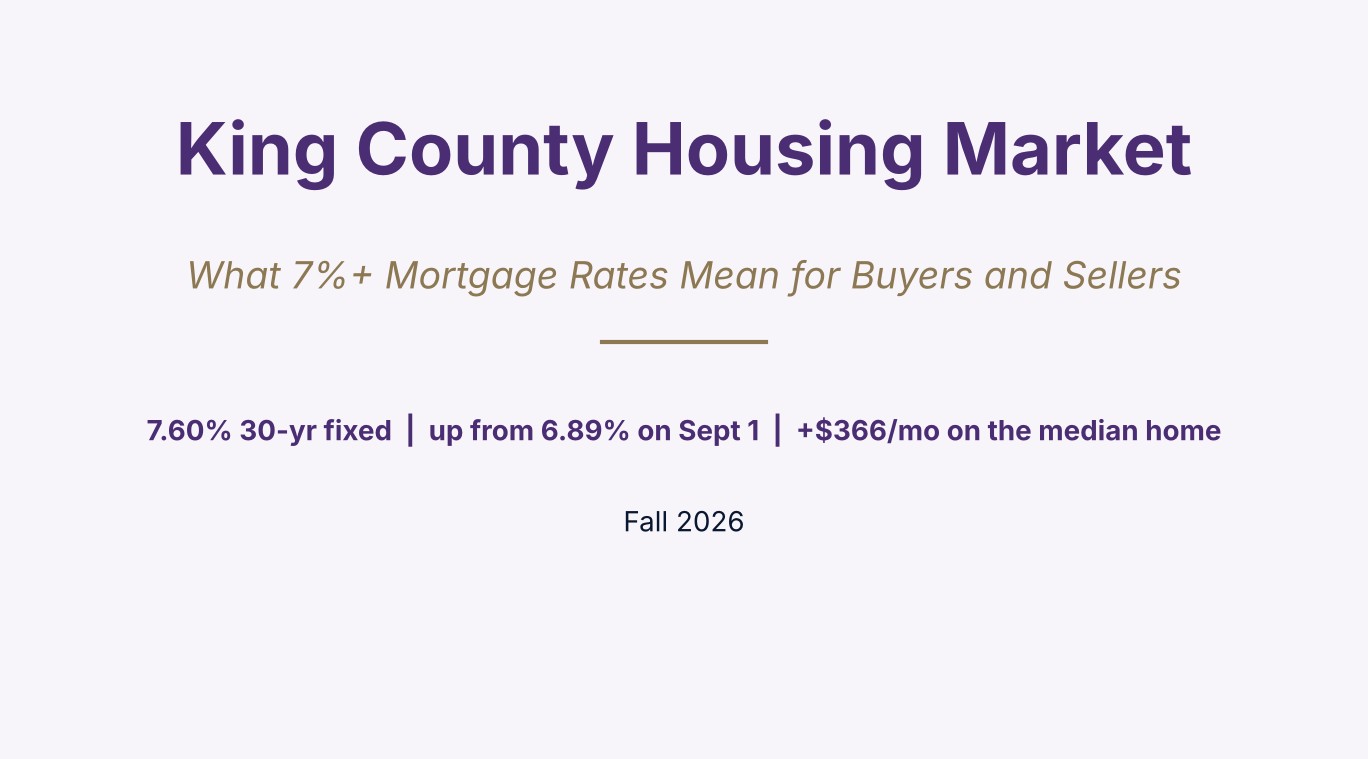
What actually changes in the King County housing market after Labor Day? Here’s what buyers should know this fall, with current data.
Bridge Loan vs. HELOC vs. Buy-First: King County Guide

You have three ways to buy your next home before your current one sells. Here’s the real math on each, so you pick the one that fits your equity, your timeline, and your risk tolerance.
I run BPOs on King County homes for banks and institutional clients almost every day. Most of that work is pricing homes that are about to sell, not homes that already have a next home lined up. But the sellers I talk to who are also buying always ask me the same question: how do I get into my next house without selling this one first?
There are three real answers. A bridge loan. A HELOC. Or a formal buy-first program from a company like Knock, Orchard, or HomeLight. Each one solves the same timing problem in a different way, and each one costs you something different. This post walks through what each option actually costs, when each one makes sense, and when none of them are worth it. If you want the bigger picture on structuring a double move, I cover the full framework in Sell and Buy a House at the Same Time in King County.
Most people think this decision is about finding the cheapest option. It is not. It is about matching the option to your specific equity position and your timeline, because the cheapest option on paper can be the wrong one if your current home takes longer to sell than you planned.
The Real Cost of a Bridge Loan
A bridge loan is short-term financing that uses your current home as collateral. The lender gives you cash, usually enough to cover the down payment and closing costs on the new house, and you pay it off in full once your old home sells.
Right now, bridge loan rates run 8.5% to 12%, with most King County borrowers landing around 9.5%. That is roughly prime plus 2 to 4 points. On top of the rate, expect an origination fee of 1% to 3% of the loan amount. Most bridge loans are interest-only, which keeps the monthly payment lower while you are carrying two properties, but you still need to qualify for both that payment and your new mortgage at the same time.
So what does this mean for you? On a $150,000 bridge loan at 9.5% interest-only, you are looking at roughly $1,188 a month just in interest, plus a $3,000 to $4,500 origination fee upfront. If your old home sells in 60 days, that is manageable. If it sits for six months because you priced it wrong or picked a slow season, the math gets a lot less comfortable.
Lenders typically require at least 20% equity in your current home before they will approve a bridge loan. If you bought in 2020 or earlier, most South and East King County sellers clear that bar easily. If you bought in the last two years, run the numbers before you assume this is available to you.
The HELOC Alternative
A home equity line of credit does something similar to a bridge loan, but through a different structure. Instead of a lump-sum bridge loan tied specifically to your purchase, a HELOC gives you a line of credit against your current home’s equity that you can draw on for the down payment.
The advantage is cost. HELOC rates are running around 7.3% nationally as of this month, well below bridge loan rates, and the repayment terms stretch out over 10 to 20 years instead of 6 to 12 months. That gives you breathing room if your home takes longer to sell than expected. You are not racing a short clock.
The tradeoff is timing. A HELOC application, appraisal, and underwriting process usually takes two to four weeks, sometimes longer if your lender is backed up. A bridge loan, especially through a specialty lender, can sometimes close faster because the underwriting is built around exactly this scenario. If you found your next house last week and the sellers want an answer, a HELOC you have not started yet will not save you.
The other catch: once you sell your current home, you are paying off that HELOC balance, which means less net proceeds landing in your pocket at closing. Budget for that the same way you would budget for a bridge loan payoff.

A HELOC costs less than a bridge loan but takes two to four weeks to set up.
Buy-First Programs: Paying for Certainty
The third option skips borrowing against your equity entirely. Companies like Knock, Orchard, and HomeLight will unlock a portion of your home’s equity in cash and, in most versions of these programs, guarantee they will buy your old home if it has not sold on the open market within a set window, usually 90 to 180 days.
Knock charges a fixed 2.25% fee on your new home’s purchase price plus roughly $1,850 in closing costs. Orchard charges around 6% (similar to a normal listing commission) plus a program fee starting near 1.9%. HomeLight charges 2.4% of your sale price, or 1.7% if you also use their in-house lending and closing services.
Here is the honest tradeoff: you are paying 2% to 2.4% of your home’s value, which on a $750,000 King County sale is $15,000 to $18,000, for the certainty that you will not be stuck holding two mortgages. For some sellers, especially those without 20% equity to qualify for a bridge loan or HELOC, that certainty is worth every dollar. For sellers sitting on strong Eastside equity who could clear a bridge loan qualification easily, it is an expensive way to solve a problem you could solve more cheaply.
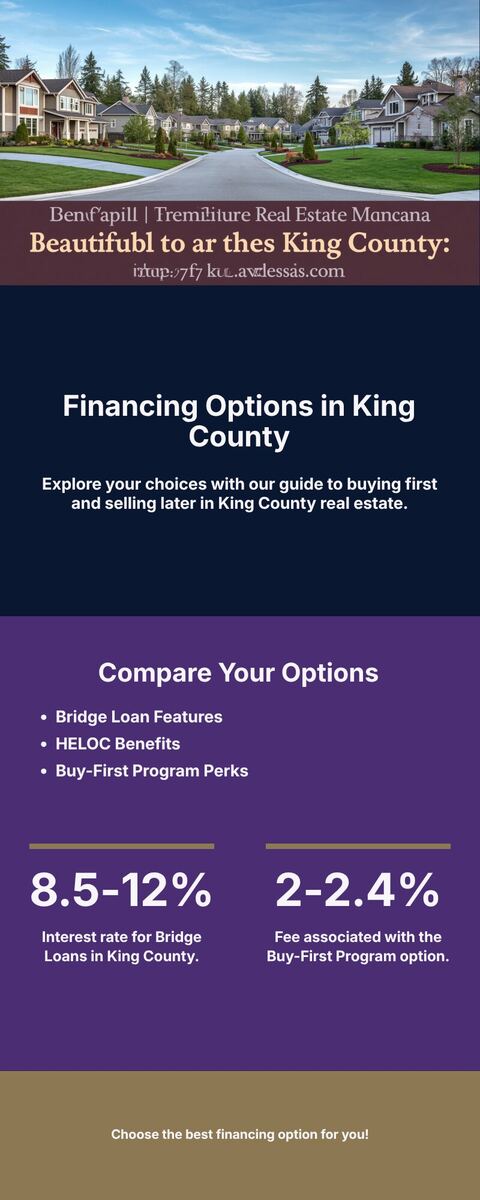
Rates, terms, and equity requirements side by side.
Which Option Fits Your Situation
If you have strong equity, at least 20%, and confidence your home will sell within a normal King County timeline, a bridge loan or HELOC will almost always cost less than a buy-first program’s 2%-plus fee. Between those two, choose the HELOC if you have a few weeks before you need to close, and the bridge loan if you found your next house faster than your equity access can move.
If your equity position is thinner, or if you cannot stomach the idea of two mortgage payments even for two or three months, a buy-first program’s fee buys you real peace of mind. That is not a bad trade. It is just a different trade than the cheapest option on paper.
If none of these fit, a contingent offer, making your purchase dependent on your current home selling, is still the lowest-cost option, though it is the weakest offer in a competitive situation. I cover how to structure a contingent offer sellers will actually accept in a separate guide.
The Local Angle: King County Timing Matters
King County’s market right now sits at 3.9 months of supply, with a median days-on-market of 21 days and homes selling at 99% of list price on average. That is a market where a well-priced home in Renton, Kent, or Auburn typically moves inside a bridge loan’s six-month window without much drama. But “well-priced” is doing a lot of work in that sentence. An overpriced home in this same market can sit two or three times as long, and that gap is exactly what turns an affordable bridge loan into an expensive one.
East King County (Bellevue, Sammamish, Issaquah) sellers generally carry more equity relative to their loan balance, which makes bridge loans and HELOCs more accessible there. South King County sellers (Kent, Auburn, Federal Way, Covington) sometimes have less room, which is where a buy-first program’s lower equity bar can matter more.
One more King County-specific wrinkle: NWMLS Form 22B governs contingent offers here, and lenders reviewing your bridge loan or HELOC application will want to see your current home either listed or under a firm timeline. Get your listing strategy locked down before you start any of these applications, not after.
What This Means for You
Before you pick a financing path, get a real number on your home’s value from someone who prices homes for a living, not an automated estimate. The gap between what a Zestimate says and what your home actually sells for changes every calculation in this post. If your equity estimate is off by $50,000, your options change.
Then talk to a lender about pre-qualifying for a bridge loan or HELOC before you fall in love with a house. Knowing your real number ahead of time means you are not scrambling to compare three financing options in the 48 hours after an offer gets accepted.
FAQ
Do I need 20% equity to qualify for a bridge loan?
Most bridge loan lenders require at least 20% equity in your current home. If you are below that threshold, a HELOC may also be difficult to secure at a meaningful amount, and a buy-first program becomes a more realistic option since those companies typically unlock equity at lower thresholds.
Is a HELOC always cheaper than a bridge loan?
On interest rate alone, usually yes. HELOC rates are running around 7.3% versus 8.5% to 12% for bridge loans. But a HELOC takes longer to set up, typically two to four weeks, so if your timeline is tight, the faster bridge loan process can be worth the higher rate.
How much do buy-first programs actually cost?
Expect 2% to 2.4% of your home’s sale price for programs like Knock or HomeLight, or around 6% plus a 1.9% program fee for Orchard’s Move First option. On a $750,000 King County home, that is $15,000 to $18,000 beyond a typical commission structure.
What happens if my home doesn’t sell within the bridge loan term?
Most bridge loans run six to twelve months. If your home has not sold by the end of the term, you will need to refinance the bridge loan, extend it if your lender allows, or in a worst case, face default since your current home is the collateral. This is exactly why realistic pricing matters more than anything else in this equation.
Can I combine a contingent offer with one of these financing options?
Yes, and some buyers do this as a backup. You can pursue a bridge loan or HELOC as financing while still writing a contingent offer to reduce risk, though in competitive King County listings a financing-backed non-contingent offer is usually the stronger one.
Is a buy-first program worth it if I have plenty of equity?
Usually not on cost alone. If you comfortably qualify for a bridge loan or HELOC, you will almost always pay less than the 2% or more that buy-first programs charge. Their value is in eliminating uncertainty, which matters most to sellers without much equity cushion or without patience for carrying two mortgages.
Whether you are sitting on solid Eastside equity or working with a tighter number in South King County, the right financing path depends on your actual numbers, not a generic rule of thumb. I’m happy to walk through the real numbers with you, including what your home is actually worth right now based on my daily BPO work across the county. No pressure, no sales pitch.
Your guide to life outside Seattle.
253-350-0045 ·
greg@livingoutsideseattle.com ·
www.livingoutsideseattle.com
