

 Facebook
 X
X
 Pinterest
 Copy Link

What happens after the seller says yes, who has to do what each week, and the dates that can quietly break your closing.
Most buyers think the hard part ends when the seller accepts the offer. It does not. That is when the clock starts, and a handful of dates in your contract decide whether you close on time or scramble.
I see this from the field every week. I do BPO work across east and south King County, and I am usually in the neighborhood when a deal is in the middle of its 30 days. The deals that go smoothly are not luckier. The buyers simply knew what was coming each week and had their paperwork ready before they were asked.
This is the week-by-week map. It assumes a typical financed purchase of a single-family home, closing in roughly 30 to 45 days. Cash deals move faster. Condos and new construction add steps. Your purchase and sale agreement controls every date, so treat the numbers below as the usual pattern, not a promise.
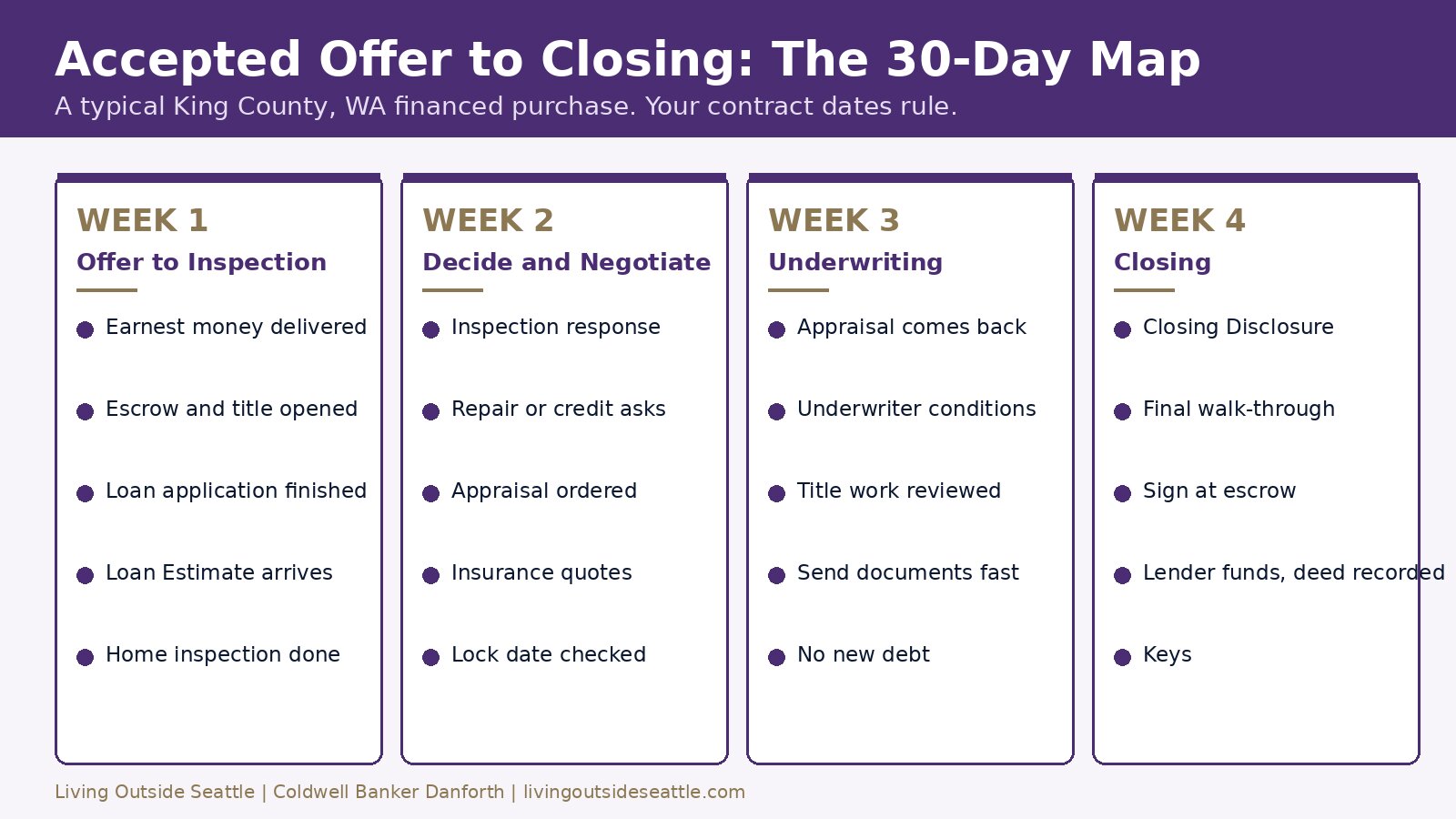
The four weeks between accepted offer and keys, at a glance.
The 30-Day Timeline, Week by Week
Week 1: Get Everything Opened and Inspected
The first few days are about paperwork landing in the right hands. Your earnest money goes to escrow, and the escrow officer opens your file. Escrow is the neutral third party that holds the money and documents until closing. I cover the deposit rules in my earnest money guide, and the short version is this: deliver it on the date in your contract, not the day you remember.
Your lender has work to do too. If you have not finished the full loan application, finish it now. Within three business days of a complete application, federal rules require the lender to send you a Loan Estimate that shows your rate, payment, and cash to close. Read it the day it arrives. So what? It is the first real look at your closing numbers, and errors are easiest to fix early.
The home inspection also usually happens this week. Washington contracts set an inspection deadline, and it is often only about a week out. Book your inspector the same day your offer is accepted. In the Auburn, Kent, and Renton neighborhoods I work in, good inspectors can be booked a week out, and that wait can eat your whole window.

Book the inspector the day your offer is accepted. Good ones fill up.
Week 2: Decide What the Inspection Means
The inspection report lands, and now you have a decision. Under the contract you can accept the home as is, ask for repairs or credits, or in some cases walk away within your inspection period. The deadline matters more than the report. Miss it and you may lose the right to negotiate at all.
My advice is to sort the findings into three piles: safety and major systems, things that are inexpensive to fix, and cosmetic items. Ask for the first pile. Skip the third. I wrote about how sellers see this side in my home inspection seller guide, and knowing how they think helps you ask for things that actually get a yes.
This is also the week your lender orders the appraisal. The appraiser visits the home, compares it to recent sales, and reports a value to the lender. If you are watching a rate lock, check the lock expiration against your closing date now. My rate lock guide explains what extensions cost if closing slips.
Week 3: Underwriting and the Appraisal
Week three is where deals get quiet, and quiet is dangerous. Your file sits with an underwriter, who verifies income, assets, and the property. You may get a list of conditions, which are extra documents or explanations. Answer every one within a day if you can.
The appraisal usually comes back this week. If the value matches or beats your price, nothing changes. If it comes in low, the lender will only loan against the appraised value. Under the usual Washington contract terms, you generally have a short window, often three days, to respond with a notice, so know your date before the report lands. Your options are to renegotiate the price, bring more cash, challenge the appraisal with better comparable sales, or end the deal if your contract allows.
One rule matters more than the rest. Do not open new credit, change jobs, or move large sums of money. A new car loan in week three can change your debt ratio and stall your approval. So what? The lender checks your file again right before closing, and anything new gets noticed.
Week 4: Closing Disclosure, Walk-Through, and Keys
At least three business days before you sign, your lender must deliver the Closing Disclosure. This is the final version of your loan terms and cash to close. Compare it line by line with your Loan Estimate. My buyer closing costs guide lists what each fee is, so you know what to question.
Next comes the final walk-through, usually within a day or two of closing. You are not re-inspecting the home. You are confirming that it is in the agreed condition, that any repairs were done, and that the seller left what they were supposed to leave. Run the faucets, test the outlets, and open the garage door.
Then you sign at escrow. In Washington the lender wires the funds, escrow confirms everything, and the deed is recorded with King County. Possession and keys follow the terms of your contract, which is often the day of recording or the day after. Plan for the keys to arrive later in the day than you hope, and do not schedule movers for early morning.
The Local Angle: What Slows King County Closings
In King County the common delays are not exotic. Inspector calendars fill up. Appraisers in busy stretches of Renton, Kent, and Auburn can take longer to get on the schedule. Condos add a resale certificate and HOA documents. And with mortgage rates above 7% this fall, as I covered in my fall market and mortgage rate post, lock dates and monthly payment limits leave less room for surprises. A month with little slack is a month where one late document matters.
If your closing date is tight, ask your agent and lender to build the plan backward from it. Every deadline in the contract should be on one calendar the day you go under contract.
What This Means for You
If you are about to make an offer, get your pre-approval documents together now, so week one starts fast. If you are already under contract, put every date from your agreement on a single calendar today, including the inspection deadline, the appraisal timeline, the financing dates, and the closing date. Then call your lender and ask what they still need from you. That one call prevents more delays than anything else on this list. If you are a first-time buyer in Kent or nearby, my Kent first-time buyer guide covers the financing side in more depth, and my contingent offer guide explains what changes if you are selling a home to buy this one.
Frequently Asked Questions
How long does it take to close on a house in King County?
Most financed purchases close about 30 to 45 days after the accepted offer. Cash purchases can close in two to three weeks. Your contract sets the closing date, and lenders, appraisers, and inspectors all have to fit inside it.
What happens right after my offer is accepted in Washington?
Your earnest money goes to escrow, escrow opens a file, you finish your loan application, and you schedule the home inspection. Do all four in the first few days, because the inspection and financing deadlines start running from the accepted offer.
What is the most common reason a King County closing is delayed?
Slow documents and calendar conflicts. A late inspection, a late response to an underwriter, an appraisal that takes longer to schedule, or a rate lock that expires before closing can each push a closing date back.
What happens if the appraisal comes in low?
The lender will only loan based on the appraised value. You can usually negotiate the price down, bring extra cash to cover the gap, challenge the appraisal with stronger comparable sales, or end the deal if your contract allows. Watch the notice deadline in your agreement.
Can I get the keys the day I sign?
Not always. Possession follows your contract, and in many Washington deals the deed must be recorded first. That is often the same day or the next day. Ask your agent for the exact possession terms before you book movers.
What should I avoid doing while I wait to close?
Do not open new credit, change jobs, or move large sums between accounts. The lender checks your file again before closing, and a new debt or unexplained deposit can slow or stop your approval.
The 30 days feel long, but they are very manageable when you know the week. Whether you are about to write an offer or you are already in the middle of one, I am happy to walk through your dates and the real numbers with you. No pressure, no sales pitch.
Your guide to life outside Seattle.
253-350-0045 ·
greg@livingoutsideseattle.com ·
www.livingoutsideseattle.com
