BellevueBuyer ResourcesEastsideKing County Cities August 11, 2026

Living in Bridle Trails, Bellevue | 2026 Guide

What is it actually like to live in Bridle Trails in 2026?

Bridle Trails carries an Equestrian-Leaning feel no other Bellevue neighborhood matches. This is Bellevue’s designated equestrian community, a heavily wooded pocket where nearly two-thirds of the land is still second-growth timber. Large single-family lots dominate, many a half acre or more, with horse pastures tucked behind tree lines a few miles from Microsoft’s front door. It is a real contrast to the dense, glass-tower core of downtown Bellevue, and that contrast is the whole reason buyers seek it out.

On a Tuesday morning, Bridle Trails stays quiet. There is no retail strip humming with foot traffic, just winding, tree-shaded streets and the occasional horse trailer pulling out toward the state park. Most residents commute by car, since the low density and forested layout were never built around transit. The pace here has more in common with a rural county road than a typical Bellevue address.

Weekends bring people out to the trail system. Bridle Trails State Park sees steady use from hikers, dog walkers, and equestrians alike, and it hosts organized horse shows throughout the year. Residents tend to be established professionals and multi-generational families who value privacy and space over walkability, a different draw than the light rail access pulling buyers toward Downtown Bellevue or Crossroads.

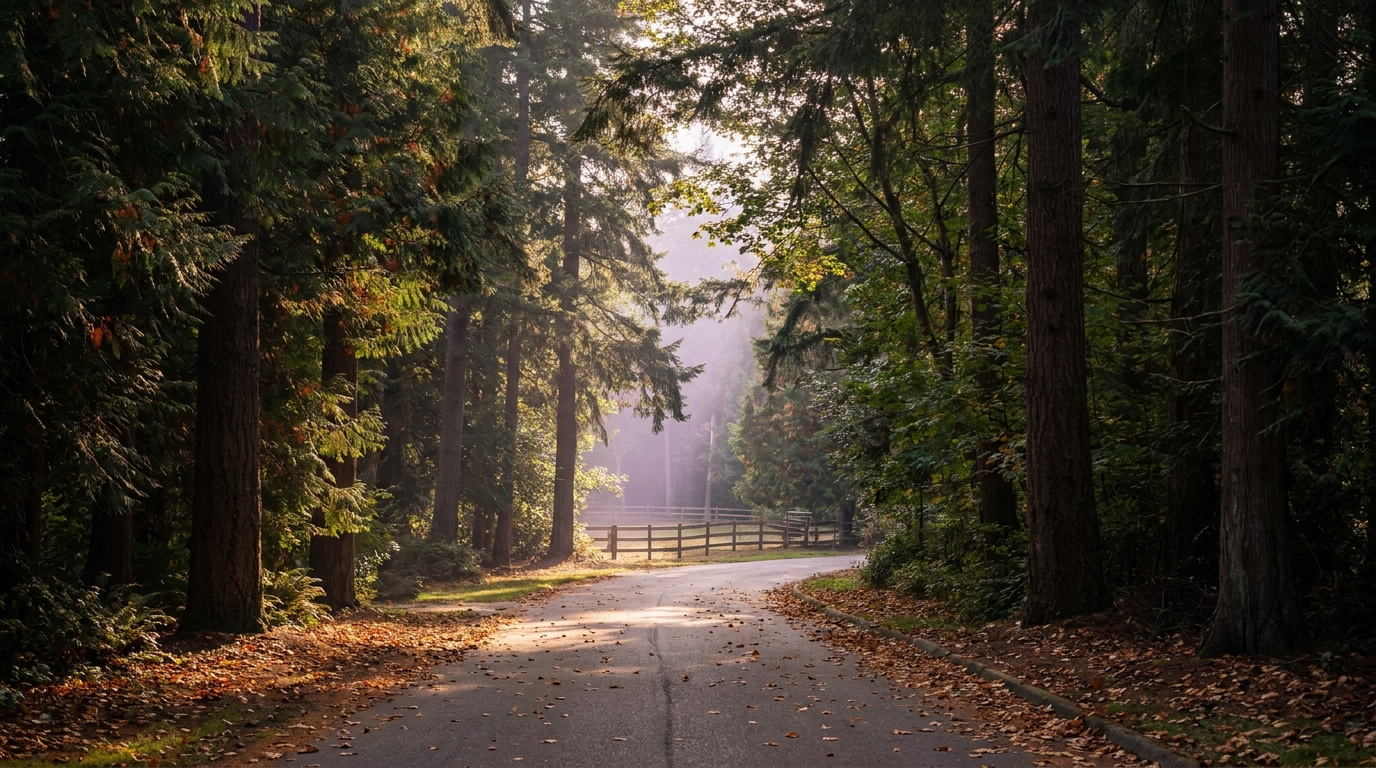
Forested equestrian trail through Bridle Trails State Park in Bellevue, Washington
Bridle Trails State Park gives the neighborhood 28 miles of forested trails shared by hikers, dog walkers, and equestrians.

Homes in Bridle Trails: What the Data Shows

Housing in Bridle Trails is almost entirely detached single-family, with very little condo or townhome inventory in the neighborhood’s core. Lots run large by Bellevue standards, often a half acre or more, and some parcels still accommodate horses under the neighborhood’s semi-rural zoning. Most homes were built from the 1970s through the 1990s, ranging from about 2,500 to 5,000 square feet, though newer construction has filled in some larger subdivided lots along the edges. A narrow strip of apartments and condos sits along 148th Avenue NE across from the Microsoft campus, but that stretch is the exception in an otherwise low-density neighborhood.

Data as of July 2026.

Market Pulse Bellevue (city) King County
Average Sales Price (July 2026) ~$2,131,947 ~$1,000,000 (median)
Median Days on Market ~13 days ~11 days
Active Listings Change (vs. Jan 2026) +215% +144%

Figures reflect city-level Bellevue residential data from the NWMLS-sourced monthly feed (InfoSparks, August 2026 pull, July 2026 data), since Bridle Trails does not have its own separate MLS reporting area. Bellevue’s citywide figure is an average sales price, not median, because that is what the monthly feed reports at the city level. Bridle Trails typically prices at or above the citywide figure given its larger lot sizes. Active listings change measures citywide inventory growth since January 2026, not a Bridle Trails-specific count.

Schools Serving Bridle Trails

The City of Bellevue’s own Bridle Trails Neighborhood Area Profile names Cherry Crest Elementary School as the school serving this area. Cherry Crest sits at 12400 NE 32nd Street and carries a 9 out of 10 rating on GreatSchools, with 94 percent of students proficient in both math and reading. From there, students move into the district’s standard pipeline for this part of the city, running through Chinook Middle School to Interlake High School. Attendance boundaries can shift year to year, so I always confirm the specific assignment with the district before a client writes an offer here.

Interlake High School ranks in the top 5 percent of Washington schools for overall test scores, with a 9 out of 10 GreatSchools rating and a 73 percent AP participation rate. Chinook Middle School carries an 8 out of 10 GreatSchools rating and offers a Gifted and Talented program. Both draw families to Bridle Trails for the academic track record, on top of the acreage and privacy the neighborhood already offers.

In practical terms, most Bridle Trails families drive their kids to Cherry Crest given the neighborhood’s spread-out street pattern. Middle and high schoolers typically bus or drive to Chinook and Interlake, both closer to the center of Bellevue’s school geography than out on Bridle Trails’ wooded edges.

Getting to Work from Bridle Trails

Bridle Trails sits close to the 148th Avenue NE corridor, which feeds directly into SR-520 toward Redmond and Microsoft, or west across the Evergreen Point Floating Bridge into Seattle. There is no light rail station inside the neighborhood, so most residents drive to work or drive first to a 2 Line station in downtown Bellevue.

Destination Distance 2026 Peak Commute Transit Option
Downtown Seattle 10 miles 25-40 min drive SR-520 direct, or drive to 2 Line
Amazon (South Lake Union) 11 miles 25-40 min drive SR-520 direct
Microsoft (Redmond) 4 miles 10-15 min drive SR-520 east, direct
Downtown Bellevue Tech Corridor 4-6 miles 12-20 min drive Drive, then 2 Line if desired
SeaTac Airport 22 miles 40-55 min drive I-405 South via Bellevue

Bridle Trails is a driving neighborhood. If a car-free commute is a priority, Downtown Bellevue or a neighborhood closer to a 2 Line station will serve you better than Bridle Trails’ wooded, low-density streets.

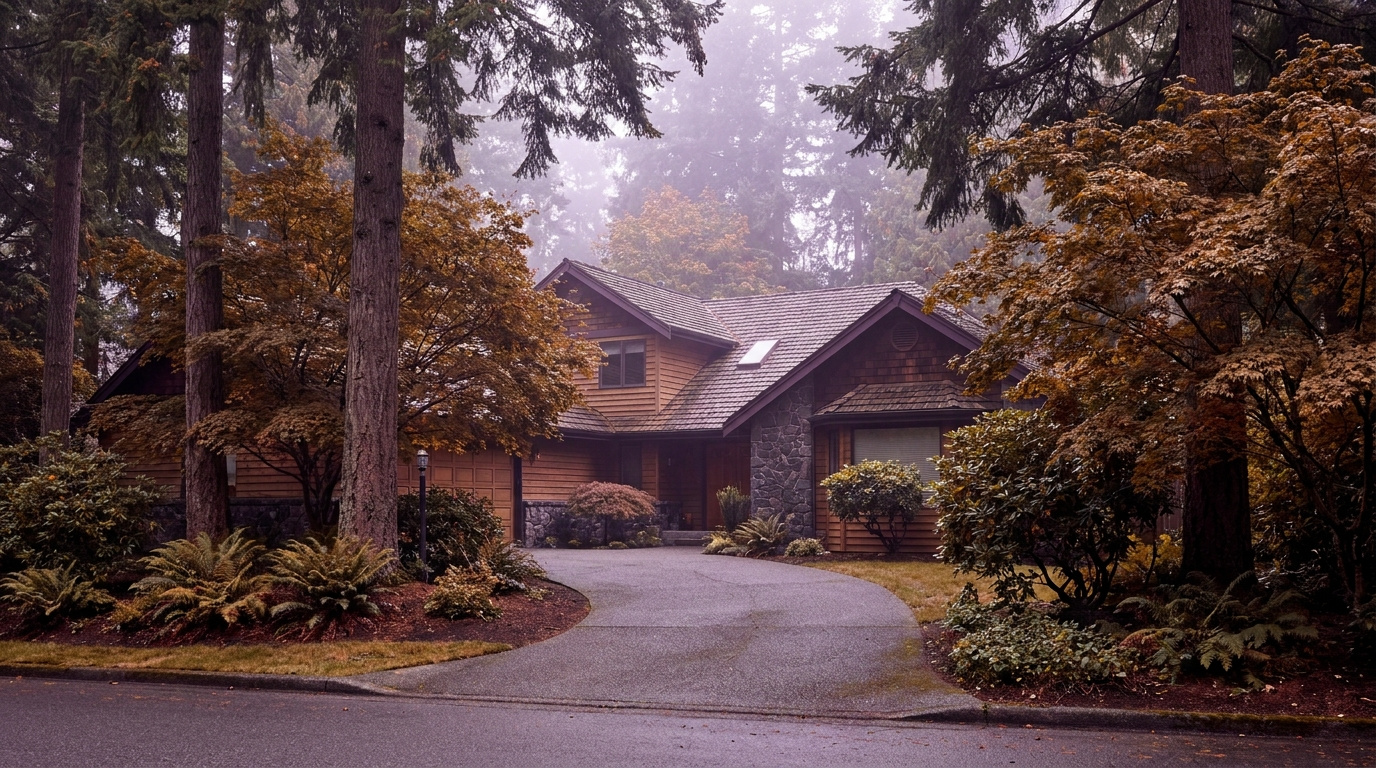
Large-lot single-family home exterior in Bridle Trails, Bellevue, Washington, representing 2026 real estate
Bridle Trails housing runs from 1970s through 1990s single-family homes on large wooded lots to newer custom builds on the neighborhood’s edges.

What I See as a Valuation Expert in Bridle Trails

When I price homes for institutional clients in Bridle Trails, lot size and usable flat acreage tend to drive value more than square footage alone. A half-acre or larger lot with level, buildable ground carries a real premium over a similarly priced home on a smaller or steeply sloped parcel, especially for buyers who want the option of horses or a future addition.

Tree cover and privacy matter here in a way they do not in Bellevue’s denser neighborhoods, but they cut both ways. Mature second-growth timber is part of the appeal, and I factor in how much of it a buyer would actually keep versus clear for usable yard. Homes with updated systems still command more than a comparable property needing work, but the lot itself carries more of the value equation here than in a typical suburban subdivision.

The properties that move first combine a larger, level lot with a confirmed Cherry Crest Elementary assignment and reasonable proximity to SR-520. Homes on smaller or heavily sloped lots, or with deferred maintenance and no path to expanded usable yard, tend to sit longer, since the buyer pool here specifically wants the acreage and privacy that define this neighborhood.

Frequently Asked Questions: Living in Bridle Trails, Bellevue

Q: Is Bridle Trails a good place to live?
A: Yes, especially if you want acreage, privacy, and direct access to a 28-mile trail system without leaving Bellevue. It is the city’s most wooded, semi-rural neighborhood, built around Bridle Trails State Park, with strong Bellevue School District schools throughout.

Q: What are homes like in Bridle Trails?
A: Almost entirely detached single-family homes on half-acre-plus lots, mostly built from the 1970s through the 1990s and ranging from about 2,500 to 5,000 square feet, with some newer construction on the edges. Very little condo or townhome inventory exists in the neighborhood’s core.

Q: What schools serve Bridle Trails?
A: The City of Bellevue names Cherry Crest Elementary School, rated 9/10 on GreatSchools, feeding into Chinook Middle School and then Interlake High School, ranked in the top 5 percent of Washington schools for test scores. Always confirm your specific address with the district.

Q: Is Bridle Trails the same as Rose Hill?
A: No. Rose Hill is a separate neighborhood in Kirkland, just north of Bridle Trails across the Bellevue city line. The two share a border and a state park, but Rose Hill sits in the Lake Washington School District, not the Bellevue School District that serves Bridle Trails.

Q: How far is Bridle Trails from Seattle?
A: About 10 miles. By car via SR-520, expect 25 to 40 minutes depending on traffic. There is no light rail station inside Bridle Trails, so a car-free commute means driving to a 2 Line station in downtown Bellevue first.

Explore Bridle Trails Yourself

Start at Bridle Trails State Park to walk the trail system that gives this neighborhood its name, then drive the surrounding streets to see the lot sizes and tree cover up close. Swing by the Bridle Trails Shopping Center on 116th Avenue NE for a sense of the commercial core, then loop toward 148th Avenue NE to see the SR-520 access connecting this wooded pocket to Seattle and Redmond. One slow drive tells you more than a stack of listing photos.


View Bridle Trails on Google Maps →

Your guide to life outside Seattle.

Gregory Dorrell | Coldwell Banker Bain | WA License #111862
253-350-0045  ·
greg@livingoutsideseattle.com  ·
www.livingoutsideseattle.com

BellevueBuyer ResourcesEastsideKing County Cities August 10, 2026

Living in West Bellevue, WA | 2026 Neighborhood Guide

What is it actually like to live in West Bellevue in 2026?

West Bellevue carries a Gated Luxury feel without the actual gates. This area runs between downtown Bellevue and the shore of Lake Washington, and it covers the towns of Medina, Clyde Hill, and Hunts Point. Some of the most expensive real estate in Washington State sits here, and the character reflects it. Large lots, mature landscaping, and long private driveways are the norm, not the exception. Medina and Hunts Point are technically their own incorporated cities, and Clyde Hill is too, but all three feel like one continuous neighborhood fabric that most locals just call West Bellevue.

On a Tuesday morning, the streets here stay quiet. There is no retail strip or transit crowd, just tree-lined lanes and the occasional dog walker heading toward Medina Beach Park. Commuters heading into downtown Bellevue or across SR-520 into Seattle tend to leave by car, since this area has no light rail station of its own. The pace is unhurried, which is part of the appeal for people who already spend their weekdays in a fast-moving tech job a few miles away.

Weekends center on the water and the yard. Medina Beach Park sees steady use for swimming and picnics in summer, and the 17-acre Medina Park draws families for its trails, playground, and ponds. Residents here skew toward established professionals, executives, and multi-generational families who have owned property in the area for decades. That is a different rhythm than Downtown Bellevue’s condo towers a few miles east, where the draw is walkability and a fast rail ride to Seattle rather than acreage and lake frontage.

Medina Beach Park sandy shoreline on Lake Washington in West Bellevue with a dock and swim float
Medina Beach Park gives West Bellevue residents walk-in access to Lake Washington, with a dock, swim float, and views toward Mt. Rainier and the Seattle skyline.

Homes in West Bellevue: What the Data Shows

Housing in West Bellevue is almost entirely detached single-family, with very little condo or townhome inventory anywhere in Medina, Clyde Hill, or Hunts Point. Lots run large by Bellevue standards, often a quarter acre to a full acre or more, and many properties on the water side have direct or near-direct Lake Washington frontage. Homes range from a modest $2 million entry point for an older single-family property up to $10 million or more for a rebuilt lakefront estate. The architectural mix spans mid-century ramblers that have not yet been redeveloped alongside newer custom builds, and teardown-and-rebuild activity has been steady here for years given how little vacant land remains.

Data as of July 2026.

Market Pulse Bellevue (city) King County
Median Sales Price (July 2026) ~$1,830,000 ~$1,000,000
Median Days on Market ~13 days ~11 days
Active Listings Change (vs. Jan 2026) +215% +144%

Figures reflect city-level Bellevue residential data from the NWMLS-sourced monthly feed (InfoSparks, July 2026 pull) since Medina, Clyde Hill, and Hunts Point do not have their own separate MLS reporting areas. West Bellevue’s actual median runs well above the citywide figure shown here, since this table blends in more affordable Bellevue neighborhoods. Active listings change measures citywide inventory growth since January 2026, not a West Bellevue-specific count.

Schools Serving West Bellevue

West Bellevue sits inside the Bellevue School District’s West Zone, which the district defines as covering Medina, Clyde Hill, Hunts Point, Yarrow Point, and Beaux Arts along with the Enatai, Woodridge, and Wilburton areas closer to downtown. Elementary assignment splits by exact address between Medina Elementary School, at 8001 NE 8th Street in Medina, and Clyde Hill Elementary School, at 9601 NE 24th Street in Bellevue. Both are self-contained Advanced Learning schools, one of only four in the district, which is a genuine draw for families here.

From either elementary school, students move on to Chinook Middle School, physically located inside Clyde Hill at 2001 98th Avenue NE, before finishing at Bellevue High School, rated 10/10 on GreatSchools with a 91% graduation rate. The West Zone assignment to Bellevue High is consistent across Medina, Clyde Hill, and Hunts Point, but the elementary split between Medina and Clyde Hill Elementary does vary block by block, so I always confirm the specific elementary with the district before a client makes an offer.

In practical terms, most West Bellevue families drive or bus their kids to elementary school given the spread-out, low-density street pattern here. Middle and high schoolers have a straightforward trip to Chinook and Bellevue High, both sitting closer to the geographic center of the West Zone than out on its edges.

Getting to Work from West Bellevue

There is no direct freeway interchange inside Medina or Hunts Point, so most trips start with local streets before reaching SR-520 at the 92nd Avenue NE half-diamond interchange between Yarrow Point and Clyde Hill. From there, SR-520 carries you west across the Evergreen Point Floating Bridge into Seattle or east into downtown Bellevue in a few minutes. There is no light rail station inside West Bellevue itself, so anyone wanting the 2 Line needs to drive to Bellevue Downtown Station or South Bellevue Station first.

Destination Distance 2026 Peak Commute Transit Option
Downtown Seattle 8 miles 20-35 min drive SR-520 direct, or drive to 2 Line
Amazon (South Lake Union) 9 miles 20-35 min drive SR-520 direct
Microsoft (Redmond) 6 miles 12-20 min drive SR-520 east
Bellevue Tech Corridor 3-5 miles 10-15 min drive Drive, then 2 Line if desired
SeaTac Airport 20 miles 35-50 min drive I-405 South via Bellevue

West Bellevue is a driving neighborhood. If a car-free commute matters to you, Downtown Bellevue or a neighborhood closer to a 2 Line station will serve you better than Medina, Clyde Hill, or Hunts Point.

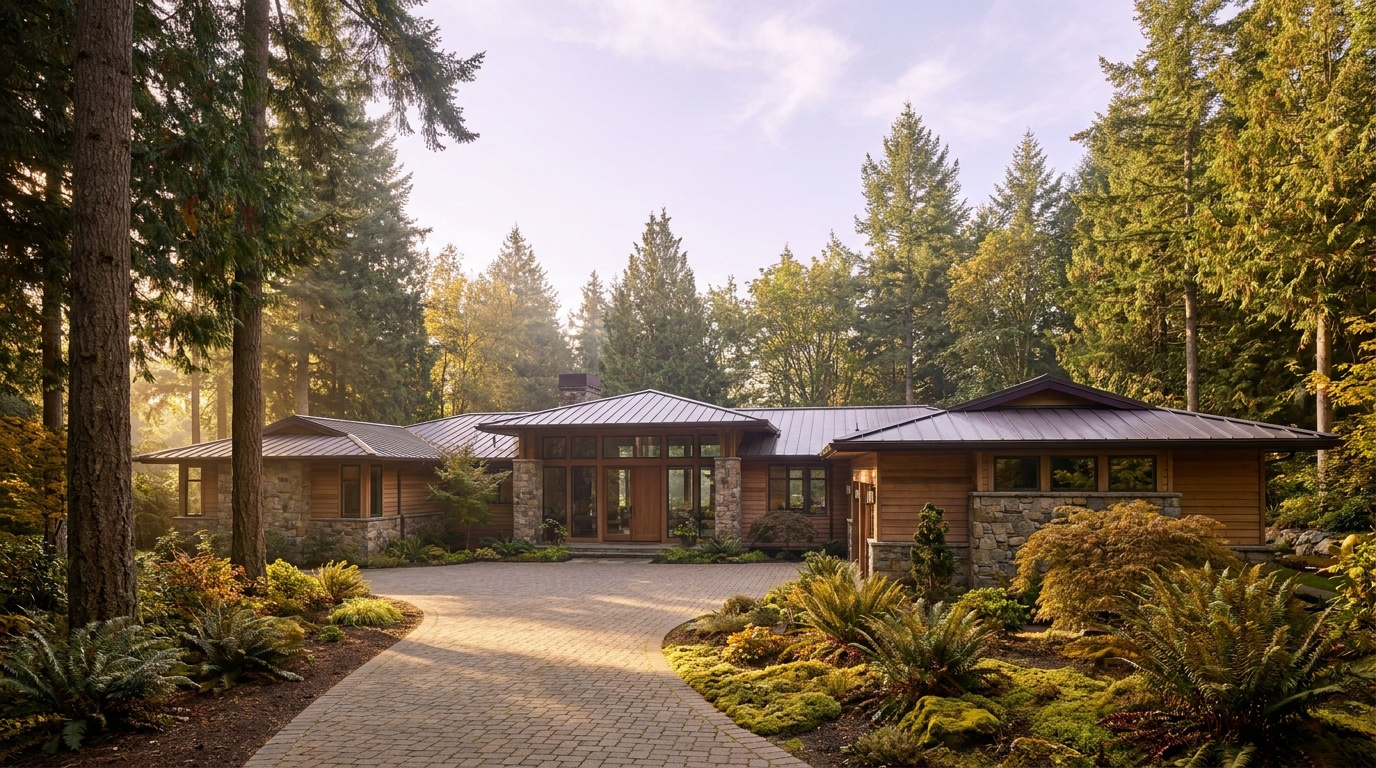
West Bellevue single-family lakefront-area home exterior representing 2026 real estate in Medina and Clyde Hill
West Bellevue’s housing stock runs from established mid-century homes to newer custom rebuilds on large, mature lots.

What I See as a Valuation Expert in West Bellevue

When I price homes for institutional clients in West Bellevue, lot size and lake proximity drive value more than almost any other factor. Direct waterfront and lake view lots command a premium that has little to do with the house sitting on them, since so many buyers here plan to rebuild anyway. Lot shape, southern exposure, and how much usable flat yard exists after accounting for setbacks all factor into how I assess a parcel here.

Condition and systems matter less than in most neighborhoods, simply because a large share of purchases in Medina and Clyde Hill are effectively land value plays with an eventual teardown in mind. Curb appeal still counts, especially for buyers who plan to live in the existing home for a while before rebuilding, but I weight the lot itself heavily when I am assessing what a property is really worth here.

The properties that move first in West Bellevue combine a larger, flatter lot with either lake proximity or a confirmed Medina Elementary or Clyde Hill Elementary assignment. Smaller lots on busier streets, or homes with significant deferred maintenance and no clear rebuild upside, tend to sit longer even at a discounted price, because the buyer pool here is narrower and more selective than in Bellevue’s more typical neighborhoods.

Frequently Asked Questions: Living in West Bellevue, WA

Q: Is West Bellevue a good place to live?
A: Yes, especially if you want privacy, a large lot, and lake proximity within a short drive of downtown Bellevue and Seattle. West Bellevue covers Medina, Clyde Hill, and Hunts Point, three of the most established and expensive residential areas in King County, with top-ranked Bellevue School District schools throughout.

Q: What are homes like in West Bellevue?
A: Almost entirely detached single-family homes on quarter-acre-plus lots, ranging from around $2 million for an older, unrenovated property up to $10 million or more for a rebuilt lakefront estate. There is very little condo or townhome inventory anywhere in Medina, Clyde Hill, or Hunts Point.

Q: What schools serve West Bellevue?
A: The Bellevue School District’s West Zone serves Medina, Clyde Hill, and Hunts Point. Elementary assignment splits between Medina Elementary and Clyde Hill Elementary depending on exact address, both feeding into Chinook Middle School and then Bellevue High School, rated 10/10 on GreatSchools.

Q: How far is West Bellevue from Seattle?
A: About 8 miles. By car via SR-520 across the Evergreen Point Floating Bridge, expect 20 to 35 minutes depending on traffic. There is no light rail station inside West Bellevue itself, so a car-free commute means driving to a 2 Line station in downtown Bellevue first.

Explore West Bellevue Yourself

Start at Medina Beach Park to see the lake access that makes this area what it is, then drive the quiet streets of Clyde Hill to get a feel for the lot sizes and setbacks. Loop past Medina Park for the trails and playground, and finish along Evergreen Point Road to see the SR-520 access that connects this neighborhood to both Seattle and downtown Bellevue. One slow drive tells you more than a stack of listing photos ever will.


View West Bellevue on Google Maps →

Your guide to life outside Seattle.

Gregory Dorrell | Coldwell Banker Bain | WA License #111862
253-350-0045  ·
greg@livingoutsideseattle.com  ·
www.livingoutsideseattle.com

BellevueBuyer ResourcesEastsideKing County Cities August 4, 2026

Living in Downtown Bellevue, WA | 2026 Neighborhood Guide

What is it actually like to live in Downtown Bellevue in 2026?

Downtown Bellevue carries a Walkable Urban Edge feel that is genuinely rare on the Eastside. This is the neighborhood inside Downtown Bellevue, the city’s high-rise core built around Bellevue Way and NE 8th Street, and 2026 has been a turning point for it. The 2 Line light rail opened here in March, connecting the neighborhood to downtown Seattle in about 25 minutes without a car. That single change has pulled in buyers who used to look only at Seattle condos because they wanted transit and gave up on the space and schools that come with the Eastside. Now they do not have to choose.

On a Tuesday morning, the sidewalks along Bellevue Way fill up early. Commuters walk toward the light rail entrance near City Hall, coffee in hand, while others head the opposite direction toward the tech offices that anchor the neighborhood’s daytime population. Bellevue Downtown Park opens half an hour before sunrise and the loop around the promenade gets steady foot traffic before the workday starts. It is a different rhythm than the rest of Bellevue. Nobody is warming up a car in a driveway here. People are walking.

Weekends shift the neighborhood’s center of gravity toward Lincoln Square and Bellevue Square, both a few blocks apart with restaurants, shops, and a movie theater that draw people in from across the Eastside. Downtown Park hosts farmers markets and community events through the summer. The residents here skew toward professionals and empty nesters who have traded a yard for an elevator, plus a growing number of remote and hybrid workers who picked the neighborhood specifically for the light rail option. That is different from Bellevue’s residential neighborhoods like Somerset or Bridle Trails, where the draw is space and schools rather than walkability.

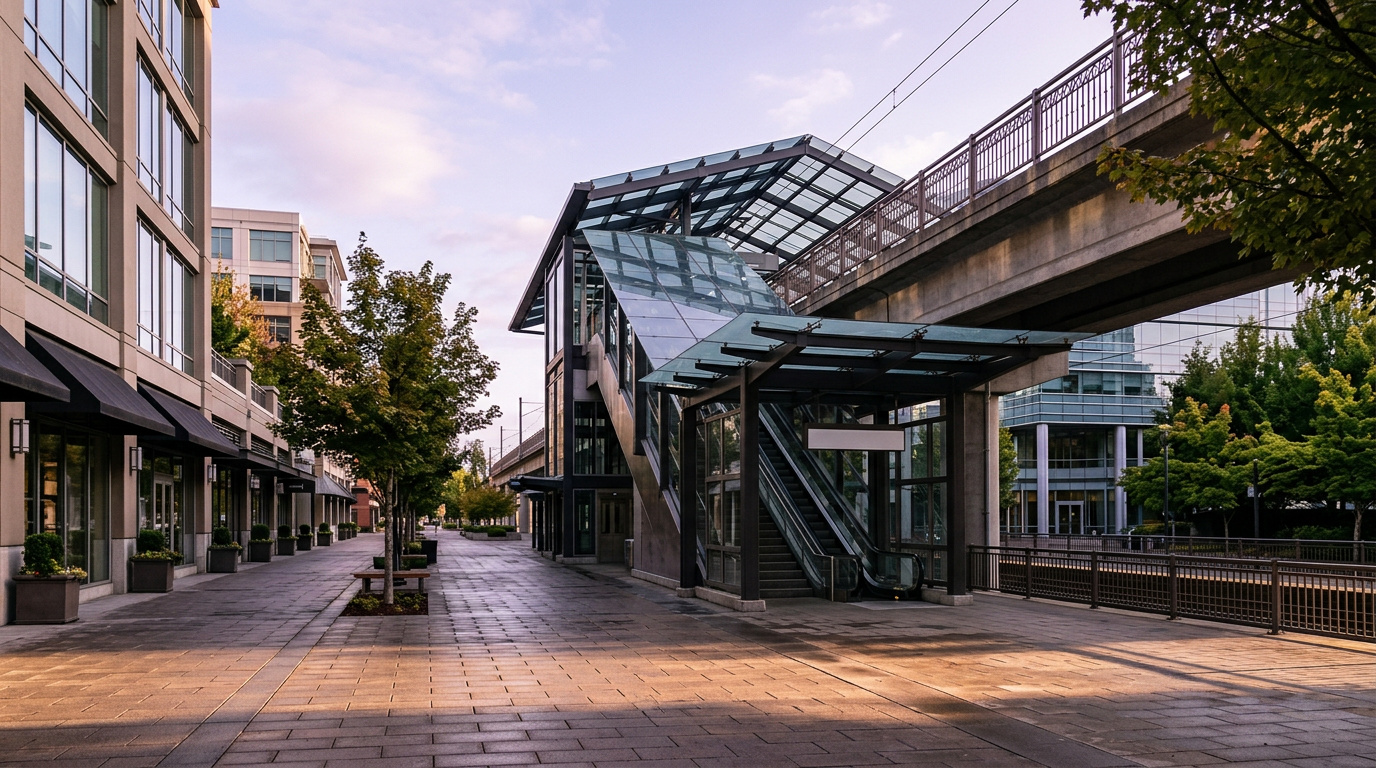
Downtown Bellevue light rail station entrance near Bellevue City Hall with pedestrians walking to the platform
The Bellevue Downtown Station opened in March 2026, putting a 25-minute rail ride to Seattle within walking distance of most Downtown Bellevue addresses.

Homes in Downtown Bellevue: What the Data Shows

Housing in Downtown Bellevue is overwhelmingly condos and high-rise apartments, with a handful of townhomes on the edges near Wilburton. Units range from studio and one-bedroom layouts in the mid-$600,000s up to penthouse-level homes at $3 million and above. Buildings here run from older 1990s and 2000s mid-rises to newer towers built in the last five years with amenity floors, concierge service, and secure parking. Square footage tends to run 700 to 2,000 square feet, smaller than what you would find in Bellevue’s single-family neighborhoods, but the tradeoff is location. This is the only part of Bellevue where you can walk to a light rail platform, a grocery store, and a park all inside ten minutes.

Data as of July 2026.

Market Pulse Bellevue (city) King County
Median Sales Price (July 2026) ~$1,830,000 ~$1,000,000
Median Days on Market ~13 days ~11 days
Active Listings Change (vs. Jan 2026) +215% +144%

Figures reflect city-level Bellevue residential data from the NWMLS-sourced monthly feed (InfoSparks, July 2026 pull) since Downtown Bellevue does not have its own separate MLS reporting area. Condo-specific pricing in the neighborhood itself tends to run below the citywide single-family median shown here. Active listings change measures city inventory growth since January 2026, not a Downtown-specific count.

Schools Serving Downtown Bellevue

Downtown Bellevue sits inside the Bellevue School District, and the middle and high school assignment is consistent across the neighborhood. Students attend Chinook Middle School, then move on to Bellevue High School, rated 10/10 on GreatSchools. The elementary assignment is the one piece that genuinely varies by exact address here. The district has been actively redrawing elementary boundaries around downtown, Wilburton, and the Spring District as new development adds households to the area, so the specific elementary school for a given address can differ block to block and can change again as those boundary lines get finalized.

Chinook Middle School consistently ranks in the top 20% of Washington middle schools and sends the large majority of its students on to Bellevue High, which posts a 91% graduation rate and an average SAT score of 1360. Because the elementary boundary is in motion, I never guess at a specific elementary name for a Downtown Bellevue address. I check the district’s own School Locator tool for every client, every time, because a wrong assumption here is worse than an honest “let’s verify.”

In practical terms, families with elementary-age kids in Downtown Bellevue are typically within a short drive or a district bus ride of their assigned school, whichever one that turns out to be. Middle and high schoolers walk or bike to Chinook and Bellevue High from most Downtown Bellevue addresses, both being a reasonable distance from the neighborhood’s core.

Getting to Work from Downtown Bellevue

Take the 2 Line from Bellevue Downtown Station and Seattle is about 25 minutes away with no traffic to worry about. That is the headline change for this neighborhood in 2026. For anyone not using rail, NE 8th Street and 112th Avenue NE both connect quickly to I-405, putting the rest of the Eastside within easy reach.

Destination Distance 2026 Peak Commute Transit Option
Downtown Seattle 10 miles 25 min rail / 45-60 min drive 2 Line light rail, walk to station
Amazon (South Lake Union) 12 miles 30 min rail / 45-55 min drive 2 Line to Capitol Hill transfer
Microsoft (Redmond) 8 miles 15-25 min drive / 20 min rail SR-520 or 2 Line east
SeaTac Airport 15 miles 25-40 min drive / 45 min rail I-405 South or 2 Line to 1 Line

Trains run every 8 to 10 minutes during peak hours. Downtown Bellevue is the only neighborhood in the city where most addresses are within walking distance of the platform itself, no drive or bus connection needed.

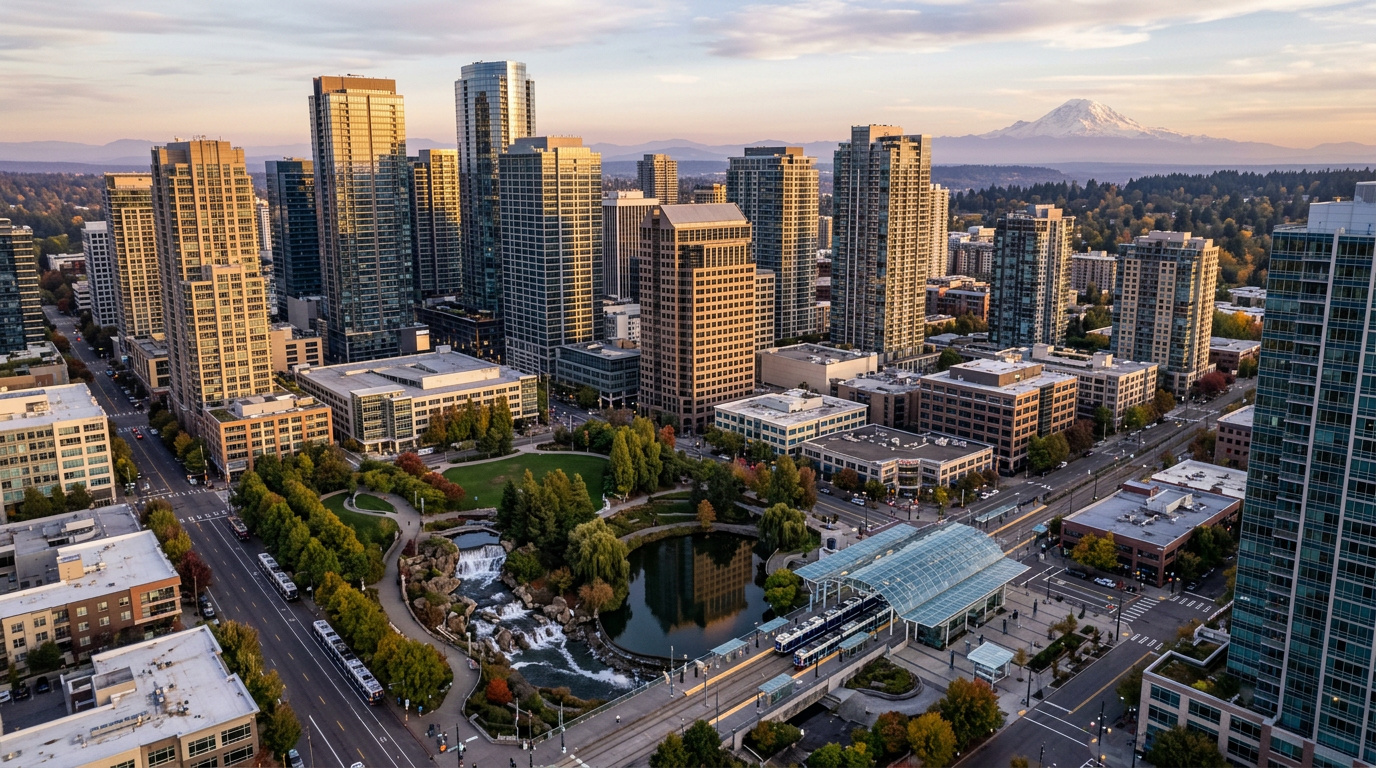
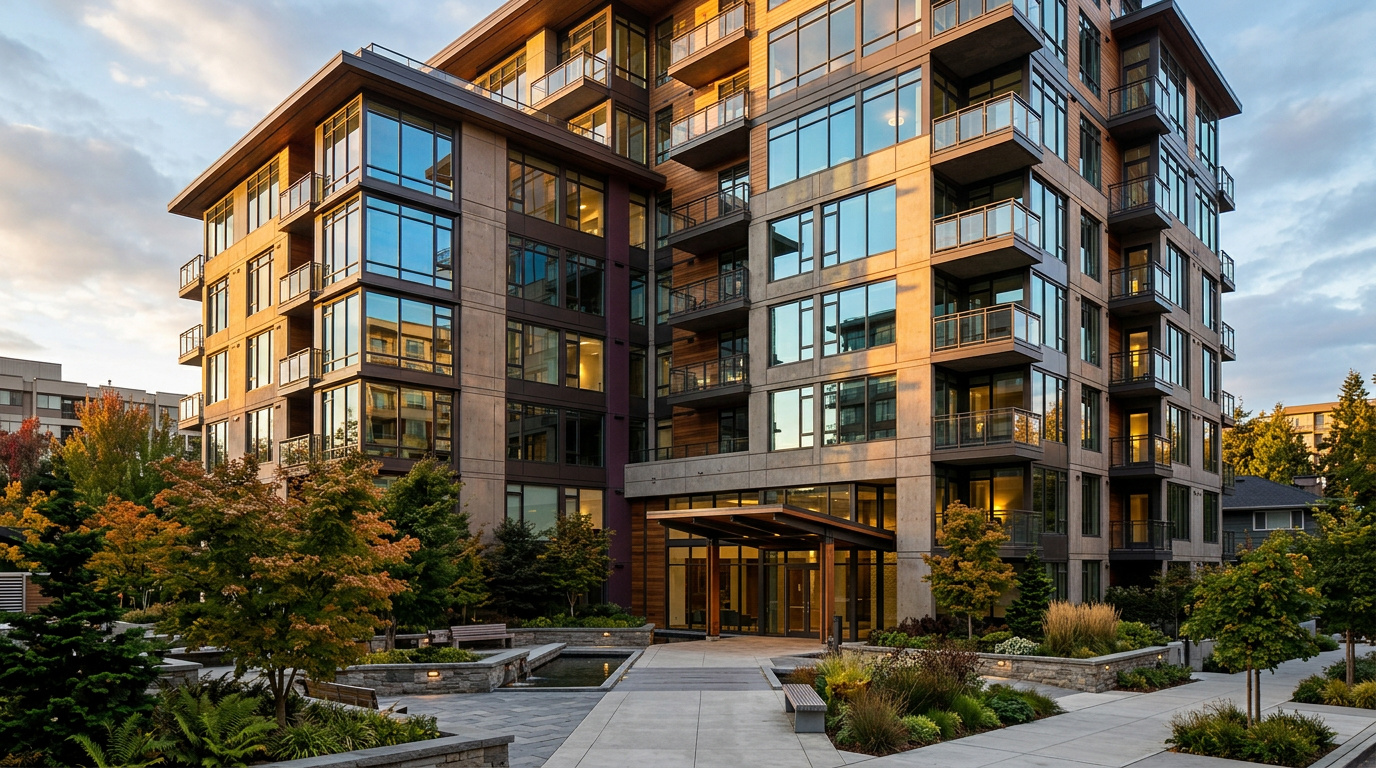
Downtown Bellevue high-rise condominium building exterior representing 2026 real estate in the neighborhood
Downtown Bellevue’s housing stock runs from established mid-rises to newer towers with amenity floors and secure parking.

What I See as a Valuation Expert in Downtown Bellevue

When I assess condos here for institutional lenders, floor level and view corridor drive value more than almost anything else in the building. A unit on floor 12 with an unobstructed view toward the Cascades or Lake Washington typically commands a real premium over an identical floor plan two floors down facing another building. HOA dues and reserve fund health matter just as much as square footage in this neighborhood, since you are buying into a shared building, not just a unit.

Buildings with strong reserve funds and recent capital improvements hold value better through a soft patch in the market than buildings deferring maintenance to keep dues low. I always pull the HOA financials and recent meeting minutes before pricing a unit here. A low monthly due on paper can mean a large special assessment is coming, and that changes the real cost of ownership.

The units that move first in this neighborhood combine a walkable location to the light rail station, a healthy HOA, and updated interior finishes. Older buildings with dated kitchens and baths sit longer, even at a lower price per square foot, because buyers here are often willing to pay more for turnkey rather than take on a renovation inside an HOA-governed building.

Frequently Asked Questions: Living in Downtown Bellevue, WA

Q: Is Downtown Bellevue a good place to live?
A: Yes, especially if you want a walkable urban lifestyle with direct light rail access to Seattle. Downtown Bellevue combines shopping, dining, and a 21-acre park with the fastest transit commute of any Bellevue neighborhood, though homes here are almost all condos rather than single-family houses.

Q: What are homes like in Downtown Bellevue?
A: Mostly condos and high-rise units ranging from 700 to 2,000 square feet, priced from the mid-$600,000s to $3 million and up for penthouse-level units. Buildings range from established 1990s and 2000s mid-rises to newer towers with amenity floors and concierge service.

Q: What schools serve Downtown Bellevue?
A: The Bellevue School District serves this neighborhood. Middle and high school assignment is consistent (Chinook Middle School, then Bellevue High School), but elementary assignment varies by exact address as the district redraws boundaries around downtown and the Spring District. Always verify with the district’s School Locator tool.

Q: How far is Downtown Bellevue from Seattle?
A: About 10 miles. By car on I-90 during peak hours, expect 45 to 60 minutes. By the 2 Line from Bellevue Downtown Station, the ride to Seattle’s Westlake Station takes about 25 minutes, consistently faster than driving at rush hour.

Explore Downtown Bellevue Yourself

Walk Bellevue Way from Lincoln Square to Bellevue Square, then cut through Downtown Park to see the waterfall and the promenade. Finish at the Bellevue Downtown Station to see the platform that changed this neighborhood’s commute story in 2026. One walk covers most of what makes this area different from the rest of the city.


View Downtown Bellevue on Google Maps →

Your guide to life outside Seattle.

Gregory Dorrell | Coldwell Banker Bain | WA License #111862
253-350-0045  ·
greg@livingoutsideseattle.com  ·
www.livingoutsideseattle.com

Seller Resources July 25, 2026

Cost to Sell a Home in Washington State: 2026 Breakdown

Most sellers ask me one question before anything else: “How much am I actually going to walk away with?” Not the sale price. The number after everything gets paid.

I do BPO work across east and south King County almost every day, pricing homes for banks and institutional clients. That work puts me in front of real closing statements constantly, and I can tell you the gap between what sellers expect to net and what they actually net is almost always caused by the same handful of costs. None of them are secret. Most sellers just never sat down and added them up.

Here’s the honest breakdown, King County numbers included, so you can run your own math before you decide anything.

The Big Four Costs, In Order of Size

Four costs make up almost all of what comes out of your proceeds at closing. Everything else is smaller line items. Here they are, biggest to smallest.

1. Real Estate Commission

This is the largest line item, almost every time. Washington’s average total commission sits around 5.9% right now, split between the listing agent and the buyer’s agent, though that split is negotiable and varies deal to deal. On the Eastside specifically, a lot of full-service listing agents run 2.5% to 3% on their side.

On a $900,000 sale, a 5.5% total commission is $49,500. That’s real money. It’s also the single biggest reason your net check is smaller than your sale price. It buys you something, though: professional pricing, marketing, negotiation, and someone managing the transaction so an inspection issue or a lowball appraisal doesn’t blindside you. Real estate commission are and have always been negotiable and will vary from transaction to transaction.

2. Real Estate Excise Tax (REET)

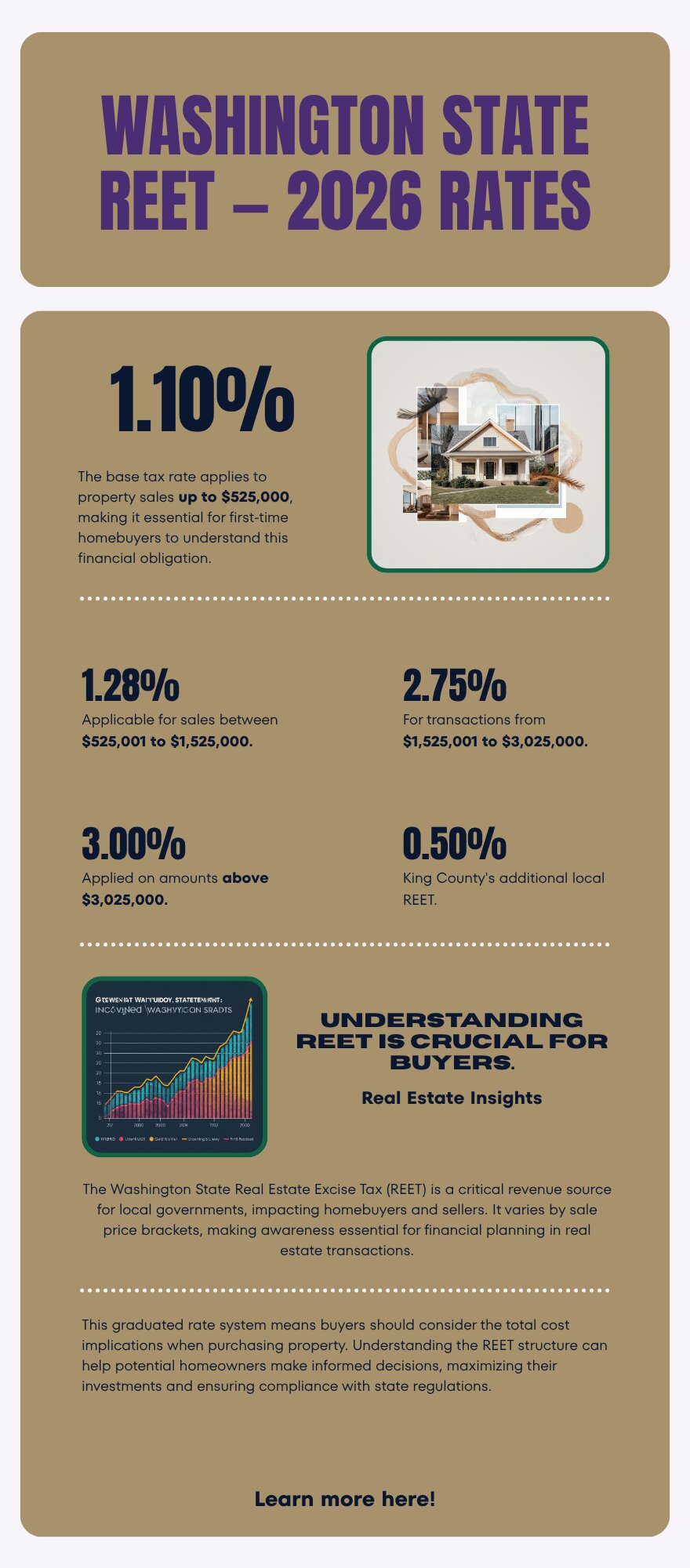
Washington charges a graduated excise tax on every home sale, and King County adds its own local portion on top. Here is the state schedule for 2026:

1.10% on the portion of the price up to $525,000

1.28% on the portion between $525,001 and $1,525,000

2.75% on the portion between $1,525,001 and $3,025,000

3.00% on anything above $3,025,000

King County adds a local REET of 0.50% on top of the state rate.

Run it on a $900,000 King County home: roughly 1.10% on the first $525,000 ($5,775) plus 1.28% on the remaining $375,000 ($4,800), for a state total near $10,575. Add the county’s 0.50% ($4,500) and you land around $15,075 in excise tax alone. Most sellers don’t plan for that number. They find out on the closing statement instead. For the full rate schedule and how it’s calculated, see Washington State Real Estate Excise Tax: Complete Guide for Sellers.

Washington State real estate excise tax bracket schedule King County 2026

Washington’s REET is graduated. King County adds its own 0.50% on top of the state rate.

3. Title Insurance and Escrow Fees

Sellers in Washington typically pay for the owner’s title insurance policy, which protects the buyer against title defects. Escrow fees are usually split roughly in half between buyer and seller. Together these run a few thousand dollars on a typical King County sale, more on higher-priced homes since title insurance premiums scale with sale price.

Budget $2,500 to $5,000 for title and your share of escrow on a mid-range King County home. Your escrow company will give you exact numbers once you’re under contract. This range holds steady across most listings.

4. Buyer Concessions

This is the cost sellers underestimate the most, and it has become more common. Roughly 19% of recent King County sales included a seller concession, according to NWMLS data from this year. Most concessions land in the 1% to 3% range, and lenders generally cap them at 2% to 6% of the purchase price depending on loan type.

Agree to cover $10,000 to $20,000 in the buyer’s closing costs, or a rate buydown to get the deal done, and that comes straight out of your proceeds. It’s not a hidden fee. It’s a negotiated one. But it needs to be in your math from day one, not something you discover mid-negotiation. Buyers are budgeting their own closing costs at the same time. If you want to understand what they’re weighing against your ask, see Earnest Money in King County: How Much You Need in 2026.

Adding It Up: A Real Example

Here’s the full math on a $900,000 King County home, close to the current county median for single-family homes.

Sale price: $900,000

Commission (5.5%): $49,500

State + King County REET: $15,075

Title insurance + seller’s escrow share: $3,500

Buyer concession (2%): $18,000

Total selling costs: $86,075 (about 9.6% of sale price)

Estimated net before payoff of existing mortgage: $813,925

That 9.6% figure sits right in the middle of the 8% to 10% range most sellers should expect. Yours will move up or down depending on your commission rate, whether you offer a concession, and where your price lands in the excise tax brackets.

Homeowner reviewing home sale net proceeds worksheet King County WA

Knowing your real number before you list means no surprises at the closing table.

The Local Angle: South and East King County Specifics

Costs shift a little depending on where in King County you are selling.

In South King County cities like Kent, Auburn, Covington, and Maple Valley, home prices run below the county median, which keeps your excise tax bill lower in dollar terms even though the percentage stays close to the same. Sellers here also tend to see fewer aggressive concession requests right now, since inventory in the affordable price bands moves faster.

In East King County, Bellevue, Sammamish, and Issaquah sellers deal with higher price points. That pushes more of the sale into REET’s higher brackets once you cross $1,525,000. Sell above that threshold and your excise tax rate jumps from 1.28% to 2.75% on the portion above it. Run that difference through a calculator before you set your list price expectations.

I price homes across both sides of the county every week through my BPO work. The pattern holds. Sellers who know their real numbers going in negotiate from a position of confidence. Sellers who find out their net at the closing table are the ones who get blindsided. (Curious how that pricing work actually happens? Here’s how I price homes using BPO methodology.)

What This Means for You as a Seller

Before you list, do three things.

Run your own numbers using your actual expected sale price, not a rough guess. A $50,000 difference in price can shift which excise tax bracket you land in.

Ask your agent for a written net sheet before you sign a listing agreement. Any agent worth hiring will walk through commission, REET, title, and a realistic concession estimate with you up front, not after you get an offer.

Decide your concession tolerance before you are in a multiple-offer or slow-market negotiation. Knowing your floor ahead of time keeps you from making an emotional decision at the table.

Getting your home ready to list is its own cost and time decision. If you haven’t mapped that out yet, start with How to Prepare Your Home for Sale in King County.

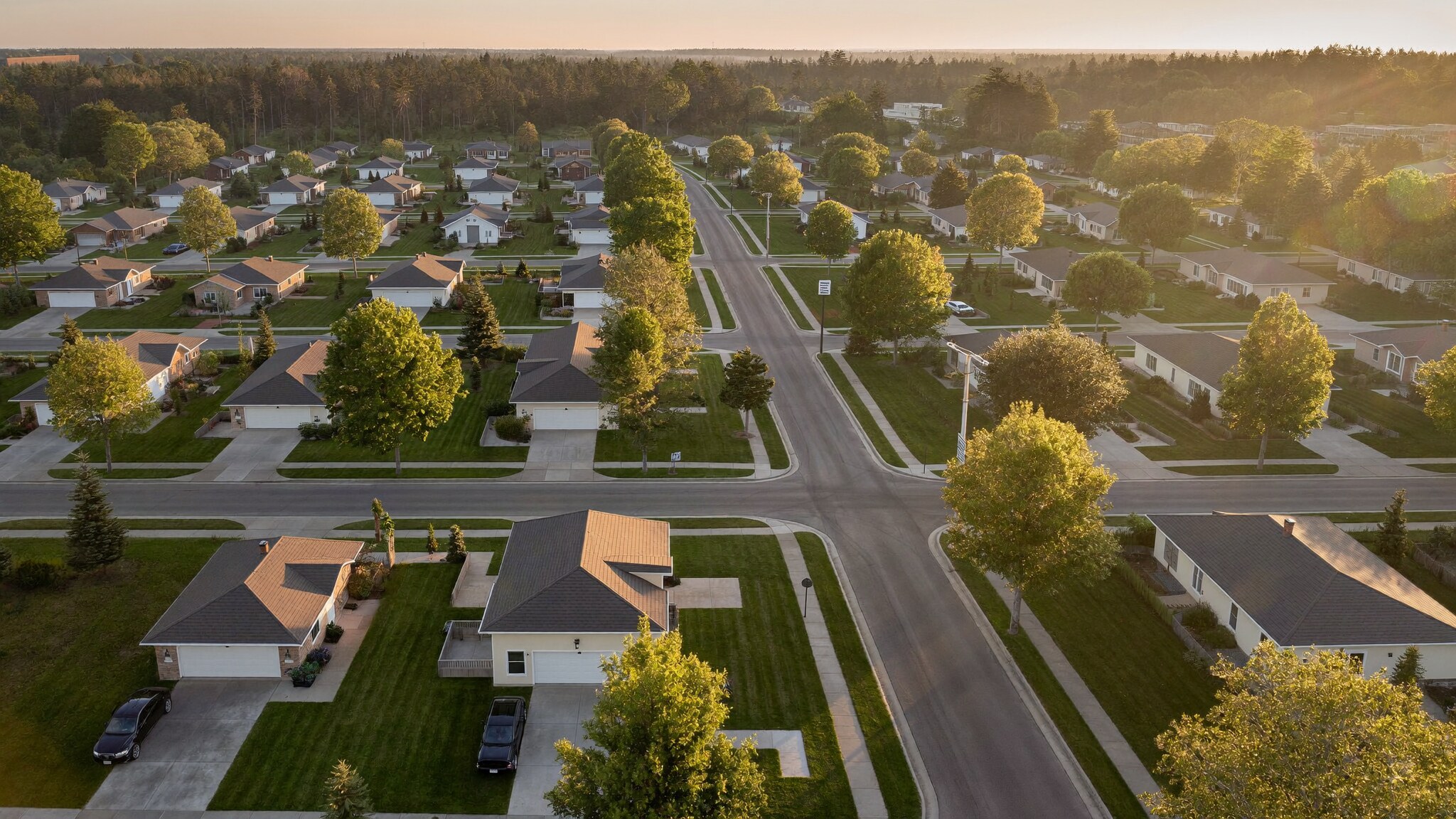
South King County neighborhood street view Kent Auburn Covington WA

Selling costs shift depending on where in King County you list. South King County sellers see a different picture than the Eastside.

FAQ

How much does it cost to sell a house in King County, Washington?

Most King County sellers pay between 8% and 10% of their sale price in total selling costs, covering commission, real estate excise tax, title insurance, escrow fees, and any buyer concessions.

What is the real estate excise tax rate in King County?

Washington’s state REET is graduated: 1.10% up to $525,000, 1.28% from $525,001 to $1,525,000, 2.75% from $1,525,001 to $3,025,000, and 3.00% above that. King County adds a local 0.50% on top of the state rate.

Who pays closing costs when you sell a house in Washington State?

Sellers typically pay the real estate commission, the excise tax, the owner’s title insurance policy, and roughly half the escrow fee. Buyers typically pay their own lender fees, their half of escrow, and inspection costs.

Can you negotiate real estate commission in King County?

Yes. Commission is negotiable and varies by agent and by deal. Washington’s average total commission is around 5.9%, but the exact split between listing and buyer’s agent is a conversation you should have before signing a listing agreement.

Do I have to pay excise tax if I sell at a loss?

Yes. Washington’s REET is based on the sale price, not your profit or loss. Even if you sell for less than you paid, you still owe excise tax on the full sale price, with limited exceptions.

How much should I budget for seller concessions in King County?

Plan for 1% to 3% of your sale price if the market conditions or buyer financing call for it. Roughly 19% of recent King County sales included a seller concession, so it is worth building into your net sheet even if you hope not to need it.

Your guide to life outside Seattle.

Gregory Dorrell | Coldwell Banker Bain | WA License #111862
253-350-0045  ·
greg@livingoutsideseattle.com  ·
www.livingoutsideseattle.com

King County Market Update July 14, 2026

East & South King County Market Update [July 2026]

What changed this week in the King County market?

Countywide activity kept cooling this week. Closings dropped to 388, the slowest week since January, and new listings fell to 743. Active inventory eased slightly to 7,647, but with fewer sales clearing, weeks of supply pushed up to 19.7, the highest reading of 2026. The county median sale price slipped to $825,000, and just 17.5% of sales closed above list, also a 2026 low.

South King County did most of the slowing. Closings fell to 77 from 107 last week, weeks of supply jumped to 19.4 from 14, and the median sale price came back to $650,000. Here is the part that headline number hides: pendings rose to 169 from 143. Buyers down south are still writing offers, they just have not reached the closing table yet.

The Eastside went the other way. Closings ticked up to 90, supply eased to 24 weeks, and pendings cooled to 148. The median sale price came down to $1,337,500, which means the value side has finally caught up with the volume slowdown I flagged last week.

The takeaway: these two markets traded places. The Eastside is settling into its price level, while South King County’s dip looks like a timing gap rather than a demand problem. Watch the South King pending count next Monday. If those close, the slow week was noise.

Looking further out than this week? Read the King County housing market forecast for 2026.

Nationally, Freddie Mac’s weekly survey put the 30-year fixed at 6.67 percent on August 13, down slightly from 6.69 percent the week before, while the National Association of Realtors reports 1.54 million homes for sale, about 4.6 months of supply, and existing home sales running at a 4.06 million annual pace. King County residential supply is still tighter than the national picture at 3.8 months on the latest monthly NWMLS data, and local closings hold far closer to full list price than the national average.

Is King County a buyer’s or seller’s market right now?

King County at a glance: July 2026 (NWMLS)

Metric Residential Condo
Median sale price $1,000,000 $520,000
Change vs. last month +0.5% +0.9%
Change vs. last year +0.1% −3.7%
Closed sales 1,504 413
New listings 3,099 1,016
Active listings 5,423 2,540
Months of supply 3.8 6.0
Median days on market 11 28
% of list price received 100% 99.1%

King County, July 2026 closed-sale data. Source: NWMLS via InfoSparks.

Two different markets are hiding in that table. Single-family homes county-wide are still moving quickly at asking price. Condos are carrying nearly twice the supply, taking more than twice as long to sell, and their median price has fallen harder over the past year. If you own a condo and plan to sell, pricing honestly matters more for you than for anyone else in this report.

The table below is the heart of this page. It compares all seven cities I serve, plus the county itself, using July 2026 NWMLS closed-sale data. This month the split looks different than it has in a while: Sammamish, Issaquah, and Federal Way all posted real year-over-year price gains, while Bellevue, Renton, and Auburn slipped slightly. Supply widened almost everywhere compared to last year, giving buyers more room across the board.

City comparison: July 2026 (single-family, NWMLS)

City Median price YoY Active listings Months of supply Median DOM % of list received Closed sales
Bellevue $1,830,000 −1.1% 372 4.9 13 97.7% 85
Sammamish $1,725,000 +5.3% 253 5.5 18 97.3% 57
Issaquah $1,575,000 +7.9% 135 4.4 9 97.5% 41
Renton $810,000 −4.7% 317 3.9 19 100% 80
Kent $700,000 +1.4% 270 3.8 11 100% 82
Auburn $649,000 −1.2% 247 3.5 18 100% 65
Federal Way $645,000 +7.5% 180 3.5 15 100% 59
King County (single-family) $1,000,000 +0.1% 5,423 3.8 11 100% 1,504
King County (condo) $520,000 −3.7% 2,540 6.0 28 99.1% 413

July 2026 closed-sale data. Each city’s figures are its own true NWMLS numbers. I never average medians across cities. Source: NWMLS via InfoSparks.

How is the Bellevue housing market right now?

Median price YoY Months of supply Median DOM % of list Active Closed
$1,830,000 −1.1% 4.9 13 97.7% 372 85

Single-family, July 2026. Source: NWMLS.

Bellevue is really two markets. Move-in-ready homes under the luxury tier still draw serious competition, while the condo segment and un-staged or dated listings carry the most negotiating room in the entire county. If you are comparing renting against owning here, my Bellevue rent vs. buy breakdown runs the actual numbers.

Is the Sammamish market cooling off?

Median price YoY Months of supply Median DOM % of list Active Closed
$1,725,000 +5.3% 5.5 18 97.3% 253 57

Single-family, July 2026. Source: NWMLS.

Sammamish is almost entirely one product type, larger single-family homes, so when supply builds the whole city feels it at once. Buyers here are taking their time and looking hard at lot slope, drainage, and road noise before they write. My neighborhood guides for Sahalee and East Lake Sammamish Parkway cover the pockets buyers ask about most.

Is Issaquah still a good buy on the Eastside?

Median price YoY Months of supply Median DOM % of list Active Closed
$1,575,000 +7.9% 4.4 9 97.5% 135 41

Single-family, July 2026. Source: NWMLS.

The Issaquah Highlands keeps pulling steady showing traffic because it is the most affordable way into Eastside schools without paying Bellevue or Sammamish prices. I wrote up the full case in my Issaquah buyer opportunity guide.

What are home prices doing in Renton?

Median price YoY Months of supply Median DOM % of list Active Closed
$810,000 −4.7% 3.9 19 100% 317 80

Single-family, July 2026. Source: NWMLS.

Renton is three markets wearing one name. The Highlands, Benson Hill, and downtown each price and move differently, which is why the citywide median bounces around. It stays the top landing spot for buyers who work on the Eastside but will not pay Eastside prices. Start with my downtown Renton guide if you are new to the city.

Is Kent a good place to buy a home right now?

Median price YoY Months of supply Median DOM % of list Active Closed
$700,000 +1.4% 3.8 11 100% 270 82

Single-family, July 2026. Source: NWMLS.

East Hill family homes are the engine here, and demand for them has not let up. Steady markets punish guesswork, so pricing accuracy matters more in Kent than almost anywhere I work. If you are weighing the move, start with my guide to buying a home in Kent and the Kent family neighborhoods breakdown.

Why are Auburn homes selling so fast?

Median price YoY Months of supply Median DOM % of list Active Closed
$649,000 −1.2% 3.5 18 100% 247 65

Single-family, July 2026. Source: NWMLS.

Auburn is the most affordable single-family entry point of my seven cities, and buyers know it. When the median home goes pending in eight days, showing up without a pre-approval letter means losing the house. Lakeland Hills and the Enumclaw plateau side keep drawing families who want newer construction for less. My guide to living in Auburn covers the neighborhoods and what your budget buys in each.

Is Federal Way the best value in King County?

Median price YoY Months of supply Median DOM % of list Active Closed
$645,000 +7.5% 3.5 15 100% 180 59

Single-family, July 2026. Source: NWMLS.

Federal Way sits in the sweet spot between Seattle and Tacoma commutes, and starter homes here have stayed insulated from the cooling happening on the Eastside. My Living in Federal Way guide maps out where those values are.

What does this mean if you’re buying or selling right now?

If you’re buying: your leverage depends on which half of the county you’re shopping. On the Eastside, use the extra supply. Ask for inspection time, negotiate on homes that have sat past three weeks, and don’t chase overpriced listings. In South King County, come prepared to move fast on the good ones, because they still go in under two weeks. Either way, with rates near their best level in almost two months, it may be worth a look at a rate buydown to bring the payment down further.

If you’re selling: the market is telling sellers one thing loudly: price to the current comps, not to your neighbor’s sale from March. Hundreds of King County sellers cut their price this week alone, and every one of those cuts started with an asking price the market rejected. Condition matters more than it has in years. If you get the first two weeks right, you sell. My guide on how to price your home to sell in King County walks through exactly how I build a list price.

Frequently asked questions

Is now a good time to buy in South King County?

If the payment works for you, yes. Prices in Kent, Auburn, and Federal Way are up modestly from last year, so waiting has not been rewarding buyers there. Inventory is better than it has been in years, and rates just hit a seven-week low. The value end of the county is competitive but not frantic.

Which King County suburb has the lowest home prices?

Among my seven cities, Federal Way and Auburn are essentially tied for the lowest single-family medians in July 2026, both just under $650,000. Kent isn’t far behind. For the lowest entry point of all, condos remain the cheapest way to own in King County.

Are Eastside home prices dropping?

June medians in Bellevue, Sammamish, and Issaquah all came in below last year, and supply on the Eastside has grown faster than anywhere else in the county. That reads as a real cooling, not a collapse. Well-priced homes still sell in under two weeks. The overpriced ones are the ones sitting and cutting.

How often is this page updated?

Every Monday I refresh the “what changed this week” section with the newest NWMLS activity. Once a month, when the new monthly data lands, I rebuild every table and city capsule on this page. Bookmark it. The URL never changes.

Your guide to life outside Seattle.

Gregory Dorrell | Coldwell Banker Bain | WA License #111862
253-350-0045  ·
greg@livingoutsideseattle.com  ·
www.livingoutsideseattle.com

Buyer Resources June 23, 2026

Bellevue Condo Buyer’s Guide 2026: What to Know

The condo you can afford in Bellevue depends far more on the building’s paperwork than on the unit itself. Here is how to read both before you write an offer.

Bellevue is the one Eastside market where a condo can be the smart buy and the risky buy at the same time. The unit looks great. The view is real. Then you pull the HOA documents and find a reserve account that cannot cover the next roof, or a building that no lender will finance with a normal loan. I see this pattern constantly in my valuation work, and it is the single biggest reason Bellevue condo deals fall apart.

This Bellevue condo buyer guide walks you through what actually matters when you buy here in 2026: what you will pay by neighborhood, how to vet an HOA so you do not inherit someone else’s deferred maintenance, the financing trap that catches first-time buyers, and what to inspect that a standard home inspector will skip. The goal is simple. By the end, you should be able to look at a listing and a document packet and know whether it is a deal or a problem dressed up as a deal.

What You Will Actually Pay: Bellevue Condo Prices by Neighborhood

The first thing to understand is that “Bellevue condo prices” is almost a meaningless phrase. The spread between neighborhoods is enormous, and where you shop sets your budget more than anything else you decide.

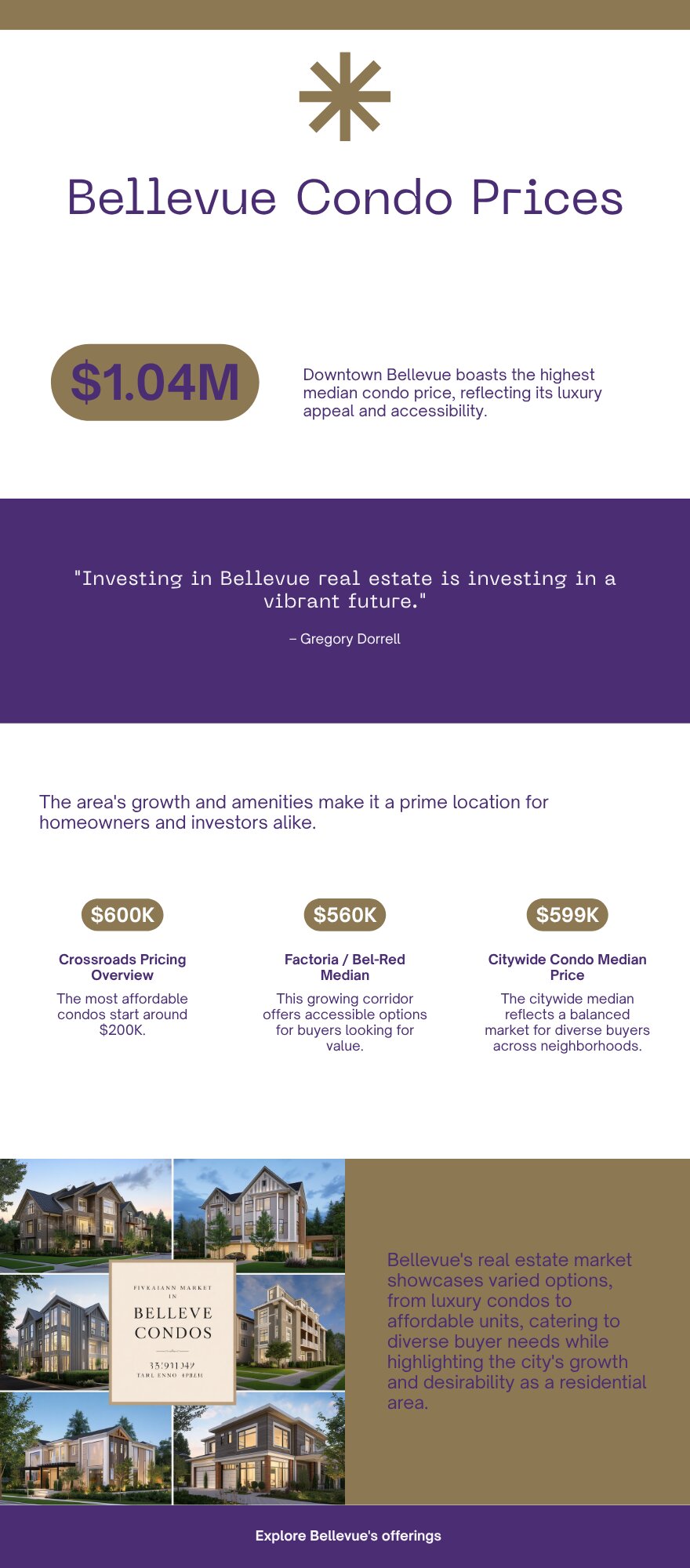
The citywide median condo list price sits around $599,000 in 2026, with roughly 38 days on the market. That number hides a wide range. Here is how the main areas break down.

Downtown Bellevue (98004)

Downtown is the premium play. Median condo list prices here run around $1.04 million, with one-bedroom luxury units near $874,000 and two-bedrooms around $1.65 million. You are paying for walkability, towers with concierge service, and being steps from the new light rail. The 2 Line is opening through downtown Bellevue in 2026, and buildings near the Bellevue Downtown and East Main stations are pricing that access in. What this means for you: downtown is where you go for lifestyle and transit, not for value.

Crossroads

Crossroads is the affordability story in Bellevue. Condos here start under $600,000, and you can still find units in the $200,000s through the $500,000s. For a first-time buyer who wants a Bellevue address and a Bellevue School District zone without a million-dollar mortgage, this is the most realistic entry point. What this means for you: if your budget is under $500,000, Crossroads is probably where your search starts and ends.

Factoria / Bel-Red

Factoria’s condo market starts around $560,000, which makes it another accessible door into the city. The Bel-Red corridor is changing fast as light rail and new development reshape the area, so this is a neighborhood where buying in early could pay off. What this means for you: Bel-Red and Factoria give you a middle path, more space than downtown for less money, with upside as the corridor builds out.

Bellevue condo prices by neighborhood 2026: downtown, Crossroads, Factoria, citywide median

Where you shop sets your budget. Downtown runs near $1M while Crossroads starts under $600K.

One more number that matters: across all closed sales, the average Bellevue condo trades around $496,000. Listings often start higher than they close, especially downtown and in Crossroads where there is more room to negotiate and units sit longer. So do not treat a list price as the price. There is often room to work.

The HOA Is Buying You, Too: How to Vet the Association

Here is the part most first-time condo buyers underestimate. When you buy a condo, you are not just buying a unit. You are buying a share of a small business called the homeowners association, and that business has a balance sheet, debts, and risks. A beautiful unit inside a poorly run HOA is a bad buy.

In Washington, the law is now firmly on your side when it comes to information. Under RCW 64.90, every condo association that is not exempt must maintain a reserve study, update it annually, and get a full professional site inspection at least every third year. The reserve study has to include a 30-year projection, and reserve funds must sit in a segregated account. That is not optional. It is statutory. So if a seller or HOA cannot produce a current reserve study, that itself is a red flag.

When you go under contract, you receive a resale certificate package. Read it like your money depends on it, because it does. Here is what to pull and what to look for.

The reserve study

Confirm it was updated within the last three years and includes the 30-year projection. A reserve study that shows the account is badly underfunded is telling you a special assessment is coming. Someone is going to pay for that roof, those elevators, and that siding. If the reserves are not there, that someone is you.

Twelve to twenty-four months of meeting minutes

This is where the truth lives. Minutes reveal pending litigation, deferred maintenance the board keeps postponing, owner conflict, and any special assessment being discussed. A building can look pristine and still have a lawsuit or a six-figure repair hiding in the minutes.

The budget and delinquency rate

Look at how many owners are behind on dues. If more than 15 percent of owners are over 60 days past due, that alone can make the building hard to finance. High delinquency also means the working budget is stretched thin.

The master insurance policy

Confirm the building carries adequate hazard and liability coverage. Insurance costs have climbed across Washington, and underinsured buildings can face sudden dues increases or assessments.

Checklist of HOA documents to review before buying a Bellevue condo in 2026

The paperwork is the deal. Pull all of this before you write an offer.

There is also new protection worth knowing. Senate Bill 5686, effective January 1, 2026, added safeguards around special assessments and assessment-lien foreclosures, including a 30-day notice, a standstill period, and access to a meet-and-confer process. That is good news if you ever fall behind, but it does not change the basic homework. You still want to buy into a building that will never need to lean on those protections.

The Financing Trap: Warrantable vs. Non-Warrantable

This is the one that catches people off guard, and it can blow up a deal at the last minute. Not every condo can be bought with a normal loan.

A warrantable condo is a building that meets Fannie Mae and Freddie Mac standards. When a building is warrantable, you can use a standard conventional loan, including 3 percent down options, plus FHA and VA financing, at normal interest rates. A non-warrantable condo fails one of those tests. When that happens, conventional, FHA, VA, and USDA loans are off the table, and you are pushed into a specialty portfolio loan with a higher rate and usually a bigger down payment.

What makes a building non-warrantable? The common triggers are: a single owner or entity controlling more than 10 percent of the units; too many units owned by investors rather than occupied by owners, since lenders generally want at least 51 percent owner-occupied; reserves that are too thin; more than 15 percent of owners more than 60 days behind on dues; active litigation involving the association, which is common in newer buildings with construction defect claims; or too much of the building’s square footage used for commercial space.

So what this means for you is concrete: before you fall in love with a unit, ask your lender to confirm the building is warrantable. A good loan officer can check the project against Fannie Mae’s Condo Project Manager database quickly. If it comes back non-warrantable, you are not necessarily out, but you need to know going in that your financing, rate, and down payment all change. Walking into that surprise three weeks before closing is how people lose earnest money and homes.

What to Inspect That a Standard Inspector Will Miss

A normal home inspection covers your unit. It does not cover the building, and the building is where the expensive problems live. So your due diligence has to look in two directions at once.

Inside the unit, you want the usual: plumbing, electrical, appliances, windows, and signs of water intrusion, which matters more in our wet climate than almost anywhere. But the bigger questions are about the shared systems you are buying a fraction of. How old is the roof, and is it funded in the reserve study? What is the condition of the siding and the building envelope, which is the single most expensive thing a Pacific Northwest condo can face? When were the elevators, boilers, and shared HVAC last serviced or replaced?

The Local Angle: How Bellevue Condos Differ from the Rest of King County

If you have shopped condos in Kent, Renton, or Auburn, Bellevue will feel like a different sport. A few things set it apart.

First, the price floor is higher. The same dollars that buy a comfortable condo in South King County buy you a smaller unit, or a Crossroads or Factoria address, in Bellevue. That is the tradeoff for the schools, the jobs, and the Eastside location.

Second, HOA dues run higher, especially downtown. A luxury downtown building can charge anywhere from $800 to more than $1,500 a month once you factor in elevators, concierge staff, garages, and amenities. That dues figure is part of your real monthly cost, and it affects how much loan you qualify for. A $1,200 monthly HOA payment is the equivalent of carrying a much larger mortgage. So when you compare a Bellevue condo to a South King County townhome, compare the all-in monthly number, not just the price.

Third, light rail is reshaping value right now. With the 2 Line opening through downtown Bellevue in 2026 and the Bel-Red corridor building out, location relative to a station is becoming a bigger price driver than it has ever been on the Eastside. That cuts both ways. Transit-adjacent units may cost more today, but they also tend to hold value better. If you are buying to stay five to ten years, proximity to a station is worth paying attention to.

What This Means for You as a Buyer

Buying a Bellevue condo in 2026 comes down to three decisions, in this order.

Pick your neighborhood by budget first. If you are under $500,000, you are realistically looking at Crossroads or Factoria, and that is fine. Those are real Bellevue addresses with real Bellevue schools. Downtown is a lifestyle and transit decision, not a value one.

Vet the HOA before you vet the view. Get the reserve study, the minutes, the budget, and the insurance policy, and read them or have someone read them for you. A great unit in a broken HOA is the most common expensive mistake I see.

Confirm financing on the building, not just on you. Get your lender to verify the project is warrantable early. If it is not, decide whether the specialty loan terms still make the deal work before you are emotionally committed.

Do those three things in order and you will avoid almost every condo horror story out there. Skip them and you are gambling.

Couple reviewing HOA documents in a Bellevue condo before making an offer

Read the reserve study before you fall for the view.

Frequently Asked Questions

How much do you need to buy a condo in Bellevue in 2026?

Plan around the citywide median of roughly $599,000, but your real number depends on neighborhood. Crossroads and Factoria condos start in the $500,000s and below, while downtown high-rises run near or above $1 million. Remember to budget monthly HOA dues, which range from a few hundred dollars to more than $1,500, into what you can actually afford.

What is a non-warrantable condo and why does it matter?

A non-warrantable condo is a building that fails Fannie Mae and Freddie Mac standards, often because of too many investor-owned units, thin reserves, high dues delinquency, or active litigation. It matters because you cannot use a standard conventional, FHA, or VA loan to buy one. You would need a specialty loan with a higher rate and larger down payment, so always confirm warrantability before you make an offer.

What HOA documents should I review before buying a Bellevue condo?

Pull the reserve study (updated within the last three years with a 30-year projection), 12 to 24 months of meeting minutes, the operating budget and delinquency rate, the master insurance policy, and any pending special assessments. Washington law requires associations to maintain a current reserve study, so a missing one is a warning sign.

Are Bellevue condos a good investment in 2026?

It depends on the building and the location. Transit-adjacent units near the new 2 Line stations and in the developing Bel-Red corridor are positioned to hold value well. A unit in a financially healthy, warrantable building is a reasonable buy. A cheaper unit in a building with thin reserves or pending litigation can cost you far more later through special assessments.

How much are HOA dues for a Bellevue condo?

Dues vary widely by building. Smaller, simpler buildings charge a few hundred dollars a month, while downtown luxury high-rises with elevators, concierge service, and amenities can run from $800 to more than $1,500 monthly. Always factor the dues into your total monthly housing cost, because lenders count them when calculating what you qualify for.

Should I buy a condo or a townhome in Bellevue?

Condos usually cost less up front and come with shared-building risk through the HOA. Townhomes often have lower or simpler dues but cost more. The right answer depends on your budget, how long you plan to stay, and how much shared maintenance risk you are comfortable taking on. Run the all-in monthly cost on both before deciding.

Your guide to life outside Seattle.

Gregory Dorrell | Coldwell Banker Bain | WA License #111862
253-350-0045  ·
greg@livingoutsideseattle.com  ·
www.livingoutsideseattle.com

Uncategorized June 22, 2026

This Guide Has Moved

This article has been folded into our maintained guide: East & South King County Market Update [July 2026]. You are being taken there now.

Buyer Resources June 9, 2026

Rent vs. Buy in Bellevue WA 2026: The Real Numbers

Is staying a Bellevue renter actually costing you more than a mortgage? The math is more complicated than your landlord thinks — here’s the honest breakdown.

If you’re renting in Bellevue right now, someone has probably told you that you’re throwing money away. And someone else has probably told you that buying a $1.5 million home at 6.5% is financial suicide. Both arguments have merit. Neither one gives you a complete picture.

I work in King County real estate every single day, and the rent vs. buy question in Bellevue is one of the most nuanced I get. The city has some of the highest home prices in Washington — and some of the highest rents too. That changes the math compared to a typical analysis. What I’ll walk you through here is the actual 2026 cost comparison: what you’re paying as a renter, what you’d pay as a buyer, where the break-even point actually sits, and what DPA programs exist for buyers at Bellevue price points.

What Bellevue Renters Are Actually Paying in 2026

Bellevue rents have softened slightly from their peak — but they’re still among the highest in Washington State. Here’s where the market sits right now:

A one-bedroom apartment in Bellevue runs roughly $2,485–$2,889/month depending on the neighborhood and building. A two-bedroom ranges from $3,135 to $4,389/month. The city-wide average across all unit types is around $2,717/month, down about 1.25% from last year.

Downtown Bellevue and the Bel-Red corridor sit at the top of that range. You’ll find more affordable options on the Bellevue-Redmond border or near Factoria, but even those aren’t cheap. Bellevue rents run roughly 54% above the U.S. average.

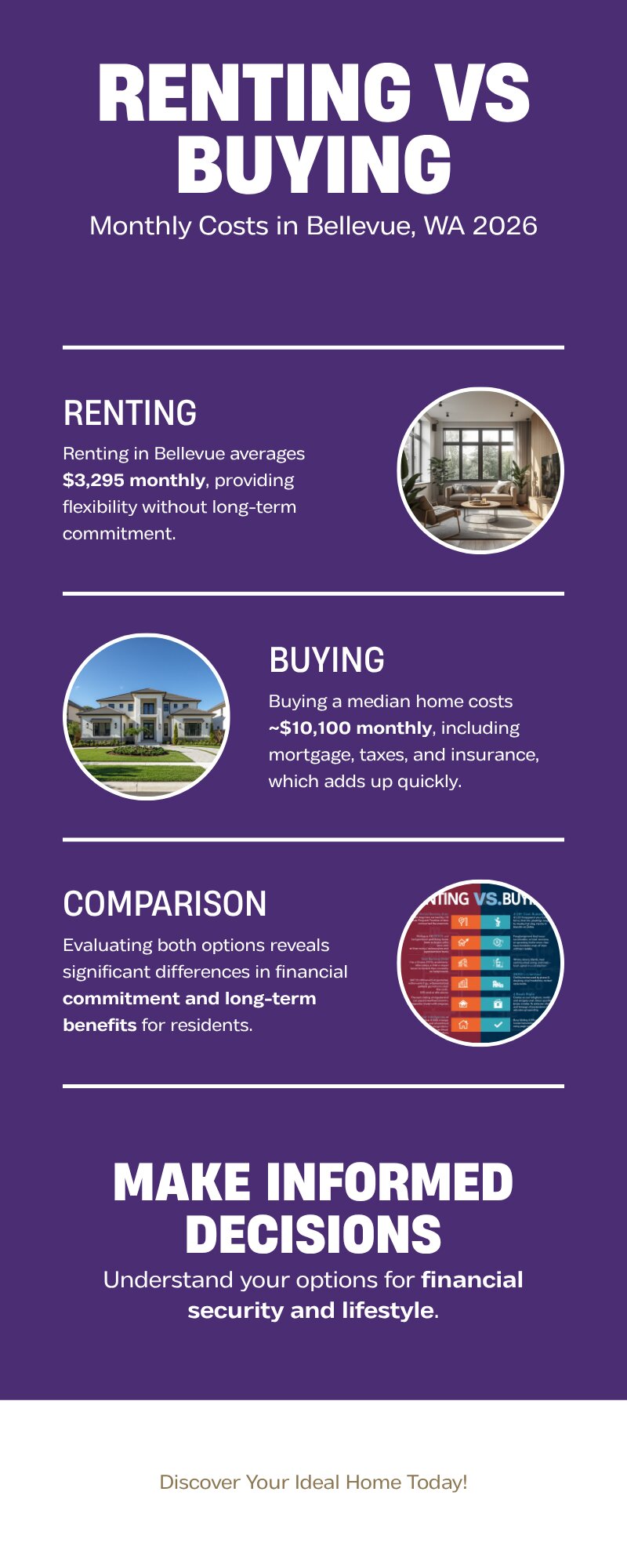
For a renter in a two-bedroom apartment paying $3,295/month, that’s $39,540 per year going to a landlord. Over five years, that’s $197,700. Over ten years, that’s $395,400 — and rent almost certainly increases at least 2–3% per year, so the real ten-year number is closer to $440,000–$460,000.

That number sounds alarming. But before you run out and make an offer, let’s look at what ownership actually costs.

What Buying in Bellevue Actually Costs in 2026

The median sale price in Bellevue is approximately $1.45–$1.6 million depending on the data source and month. For this comparison, I’ll use $1.5 million as a workable midpoint — which is consistent with recent Redfin data.

Here’s the monthly ownership math on a $1.5M home with 20% down ($300,000):

Monthly Cost Breakdown: Owning a $1.5M Bellevue Home

Loan amount: $1,200,000 (after 20% down)

Principal + Interest at 6.5%: ~$7,585/month

Property taxes (0.75–1.0% effective rate): $937–$1,250/month

Homeowner’s insurance: ~$200–$250/month

Maintenance reserve (1% of value/year): ~$1,250/month

Total estimated monthly cost: $9,972–$10,335/month

Monthly cost comparison chart showing renting vs buying in Bellevue WA 2026 — $3,295/month rent vs $10,100/month ownership costs

Monthly cost breakdown based on $1.5M median home, 20% down, 6.5% 30-year fixed rate, plus property taxes and maintenance reserve. Source: Redfin, King County Assessor, 2026.

That’s a significant gap from what most two-bedroom Bellevue renters are paying. Even if you’re in a premium $4,400/month two-bedroom, you’re looking at nearly $6,000 less per month than full ownership costs on the median Bellevue home.

What If You Put Less Down?

Most first-time buyers in Bellevue can’t put $300,000 down. If you put 10% down ($150,000) instead, your loan becomes $1,350,000 and your P+I payment climbs to approximately $8,534/month — plus you’d pay PMI (roughly $200–$300/month) until you reach 20% equity. Total monthly cost: $10,200–$10,800+.

The 5% down scenario is even more expensive on a monthly basis, which is why a lot of Bellevue renters who could technically qualify for a mortgage decide to keep renting while they save.

The Break-Even Question: When Does Buying Win?

Here’s the honest answer: at current Bellevue prices and mortgage rates, the break-even horizon is long.

The price-to-rent ratio in Bellevue tells a lot of the story. Take the median home price of $1.5M and divide it by annual rent for a comparable space — say $48,000/year for a two-bedroom. That’s a price-to-rent ratio of about 31. Financial analysts generally say ratios above 25 favor renting. Bellevue is well above that.

Studies of comparable high-cost West Coast markets (Seattle, Portland, Los Angeles) put the typical break-even timeline at 16–23 years when factoring in total costs — mortgage interest, property taxes, maintenance, transaction costs on both ends, and lost investment returns on the down payment. In Bellevue, where prices are higher even than broader Seattle, the honest break-even is likely on the longer end of that range for buyers who aren’t putting at least 20% down.

Down Payment Assistance for Bellevue Buyers

One factor that changes the math: down payment assistance. Bellevue buyers have access to real programs — though at Bellevue price points, most DPA programs hit their purchase price limits quickly.

Here’s what’s available right now:

ARCH East King County DPA

The most Bellevue-specific program available. Provides up to $50,000 in deferred-loan down payment assistance for first-time buyers in East King County — including Bellevue and Kirkland. Income limits are set at 80% of Area Median Income. Given Bellevue’s high AMI, many buyers qualify on income even with solid salaries.

WSHFC Home Advantage

Washington State’s primary DPA program offers up to 4% of the loan amount as a second mortgage for down payment and closing costs. On a $1.2M loan, that’s up to $48,000 — meaningful, but it doesn’t close the gap on a 20% down payment.

WSHFC Opportunity DPA

Up to $15,000 for buyers under the income limits. More targeted toward the $400K–$750K purchase price range; income limits may restrict eligibility at median Bellevue prices.

Down payment assistance programs for Bellevue WA buyers 2026 — ARCH East King County up to $50K, WSHFC Home Advantage up to 4%, WSHFC Opportunity DPA up to $15K

Down payment assistance programs available to Bellevue-area buyers as of June 2026. Income and purchase price limits apply. Contact a WSHFC-approved lender for current eligibility.

The honest reality: most DPA programs work best in the $400K–$750K purchase price range. Bellevue’s median is double that. But for buyers targeting condos or smaller attached homes in the $650K–$900K range — which do exist in Bellevue — DPA can be a genuine option. Check out our full breakdown of King County down payment assistance programs for current eligibility details.

The King County Angle: Condo Entry Points in Bellevue

If the $1.5M median feels out of reach, Bellevue condos are a different conversation. The King County condo median sits around $550,000–$650,000 citywide, and Bellevue has options in that range — particularly in the Bel-Red corridor and parts of East Bellevue.

At $650,000 with 10% down ($65,000), the monthly P+I at 6.5% is approximately $3,700. Add property taxes (~$406/month), insurance (~$100/month), HOA (varies — budget $400–$700/month for a newer building), and you’re looking at roughly $4,600–$5,000/month total. That compares much more closely to what a two-bedroom apartment costs in Bellevue.

The break-even timeline on a Bellevue condo is shorter — likely in the 6–10 year range depending on appreciation — and DPA programs are more likely to apply at this price point.

Understanding what rates are doing right now is important to this math. If you haven’t looked at current King County mortgage rates, that post walks through what buyers are actually paying in 2026. Before committing to either path, it’s also worth running through the total cost of homeownership breakdown — most buyers underestimate the non-mortgage costs by 20–30%.

What the Right Answer Actually Looks Like

The rent vs. buy decision in Bellevue isn’t one-size-fits-all. Here’s a practical framework based on what I see working for buyers in this market:

Lean Toward Continuing to Rent If:

You expect to move within 5 years. You haven’t saved at least 10% down plus closing costs (3–4% of the purchase price). Your debt-to-income ratio would be stretched at current payment levels. You’re not fully qualified yet — understanding mortgage qualification requirements first is a good use of 20 minutes.

Lean Toward Buying If:

You’re planning to stay 10+ years. You have at least $150K–$300K saved for a down payment (or can qualify with DPA assistance at a lower price point). The monthly payment fits comfortably — no more than 28–30% of gross income. You want stability: a fixed mortgage doesn’t go up every year the way rent tends to.

One variable that tilts the analysis more toward buying than the raw monthly numbers suggest: rent inflation. Bellevue rents have historically increased 3–5% per year over time. A fixed-rate mortgage, by contrast, locks your P+I payment permanently. The gap between renting and owning narrows significantly over 10–15 years when you factor in rent escalation.

FAQ: Rent vs. Buy in Bellevue 2026

How much does it cost to buy a home in Bellevue WA in 2026?

The median sale price is approximately $1.45M–$1.6M. A 20% down payment on a $1.5M home is $300,000. At 6.5% on a 30-year fixed, monthly principal and interest is approximately $7,585. Total monthly costs including taxes, insurance, and maintenance typically run $9,500–$10,500/month for a median Bellevue home.

Is it cheaper to rent or buy in Bellevue right now?

Renting is cheaper on a monthly basis for most buyers at current prices and rates. A two-bedroom Bellevue apartment averages roughly $3,100–$4,400/month, compared to $9,500–$10,500/month to own the median home. The ownership case is built on equity accumulation and rate stability over a long horizon, not short-term payment savings.

How long do you need to stay in Bellevue for buying to make financial sense?

In high-cost markets like Bellevue, the break-even timeline is typically 10–16 years when factoring in transaction costs, maintenance, and the opportunity cost of the down payment. If you’re planning a 5-year stay or less, renting likely wins financially.

Are there down payment assistance programs for Bellevue buyers?

Yes. The ARCH East King County DPA program provides up to $50,000 in deferred-loan assistance for eligible buyers. WSHFC Home Advantage offers up to 4% of the loan amount. These programs work best for buyers targeting the lower end of the Bellevue price range — condos and attached homes in the $600K–$800K range.

What’s the price-to-rent ratio in Bellevue?

Bellevue’s price-to-rent ratio is approximately 30–35 based on current median home prices and average rents. Ratios above 25 generally favor renting over buying from a pure monthly-cost perspective.

Should I buy a condo in Bellevue instead of renting?

Bellevue condos in the $600K–$750K range have a more favorable rent-vs-buy comparison than single-family homes. Total monthly costs can be $4,500–$5,200/month — much closer to what two-bedroom apartments cost. If you’re a first-time buyer in Bellevue, this price point deserves a serious look before ruling out homeownership entirely.

Here’s what I tell Bellevue renters who come to me with this question: run your own numbers, not a national average. The right answer depends on your savings, your timeline, your income stability, and how much the idea of a fixed housing cost for 30 years is worth to you. The financial case isn’t as clean as either side makes it sound.

Your guide to life outside Seattle.

Gregory Dorrell | Coldwell Banker Bain | WA License #111862
253-350-0045  ·
greg@livingoutsideseattle.com  ·
www.livingoutsideseattle.com
Buyer ResourcesMarket InsightsSeller Resources June 5, 2026

King County Housing Market Forecast 2026

Reviewed July 2026. For this month’s actual numbers, city by city, see the live East + South King County Market Update — updated every week.

The King County housing market has shifted. After three years of near-frantic competition, rising inventory, softening prices in some sub-markets, and mortgage rates that have settled (but not dropped) are reshaping what buyers and sellers can expect in 2026. If you are trying to decide whether to buy, sell, or wait, this is the data you need to see before making that call.

I price homes professionally every day as a BPO field agent. That means I am watching this market in real time, not just reading headlines. Here is my honest read on where King County is heading through the rest of 2026 and what it means for you.

Where the King County Housing Market Stands Right Now

The headline numbers tell a story of transition. As of April 2026, the median home sale price in King County is $835,000 — down roughly 7.5% from the same period last year. Active listings have surged 39% year over year, the largest inventory increase of any major metro in the country. Days on market has stretched from 7 to 12 days countywide.

What does that mean in plain terms? Buyers who spent 2022 and 2023 losing bidding wars on homes now have time to actually look at a house before making an offer. Sellers who priced their home based on last year’s comps are finding out the hard way that the market has moved.

The months of supply figure is the cleanest measure of balance. King County is sitting at roughly 3.2 months right now. A fully balanced market is 6 months. We are not there yet — sellers still have a meaningful edge — but the trend line is clear. This is no longer a “list it and watch offers pile up” market.

See the most recent King County market update for current city-by-city numbers.

King County Housing Market Forecast: What Mortgage Rates Mean for Timing in 2026

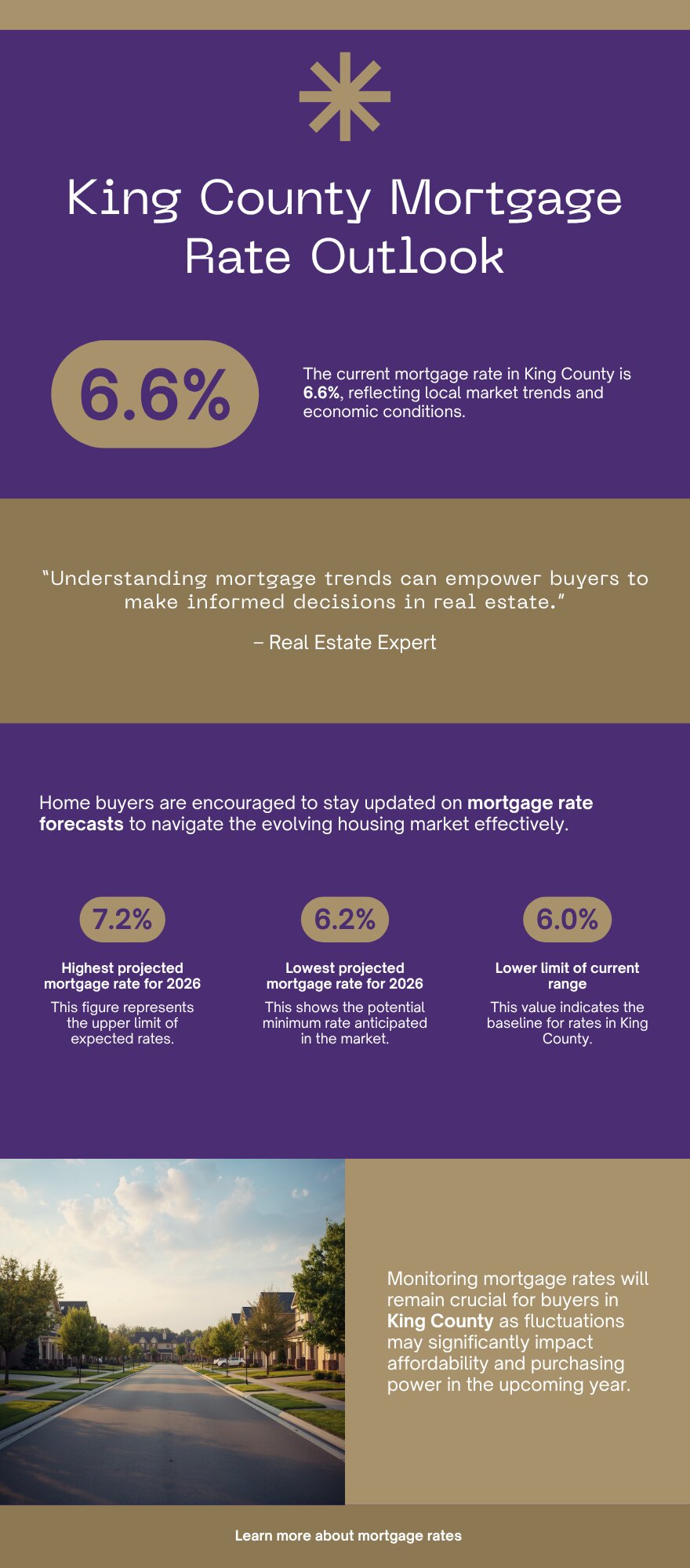
Mortgage rates have driven more decisions in this market than any other factor since 2022. The 30-year fixed rate is sitting at roughly 6.6–7.0% as of mid-2026. Most forecasters, including Fannie Mae, project rates will drift toward the low 6% range by year end — possibly 6.0–6.2% by December.

Here is the “so what” for buyers: rates probably are not going to 5% anytime soon. If you are waiting for rates to drop dramatically before buying, you may be waiting into 2027 or beyond. A drop from 6.6% to 6.0% on a $700,000 loan saves you roughly $225 per month. That is meaningful, but it is also erased quickly if prices rebound when rates fall and competition picks back up.

For sellers, rate sensitivity explains why your buyer pool has shrunk. Every half-point increase in mortgage rates prices out a segment of buyers. At 6.6%, a buyer who qualifies for $650,000 at 5.5% now qualifies for roughly $585,000. That is not a small gap when median prices in South King County are in the $640–735K range.

Understand exactly what buyers are paying for mortgages right now in King County.

King County 2026 mortgage rate outlook infographic showing 30-year fixed rate forecast declining from 6.5% toward 6.0% in Washington State

The 30-year fixed rate is at 6.6%+ in mid-2026. Most forecasters project a drift toward 6.0–6.2% by year end — meaningful relief if it holds. Source: Fannie Mae / NWMLS.

South King County: A Different Story Than the Headlines

The countywide numbers can be misleading if you are buying or selling in South King County. Renton, Kent, Auburn, and Maple Valley are holding up differently than the Eastside.

Renton

Median price around $640–671K as of early 2026, with homes selling in about 13 days on average. Prices are up roughly 2% year over year — not the decline you see at the countywide level. Renton’s relative affordability compared to Bellevue and Seattle keeps demand stable even as higher-priced markets soften.

Kent

The most varied market in South King County right now. Entry-level and mid-range homes are moving. Higher-priced homes and properties needing updates are sitting longer. If you are a Kent seller, condition and pricing precision matter more than they did two years ago.

Auburn

Holding at roughly $645K median with about 42 days on market — meaningfully longer than Renton. Auburn’s affordability attracts first-time buyers, but that segment is also the most rate-sensitive, which is slowing absorption.

Maple Valley

Continues to attract buyers who want larger homes, outdoor access, and strong schools. One of the more consistently active pockets of South King County, with new construction in Black Diamond adding adjacent supply.

The pattern across all four: price under $700,000, good condition, well-presented. These homes are still moving. The market is being selective, not frozen.

If Renton is your market, read this before you list.

What the Tech Layoffs Are Actually Doing to King County Real Estate

Amazon cut roughly 16,000 jobs company-wide, and the Puget Sound region absorbed the heaviest share. When you add Microsoft’s reductions, an estimated 16,000–17,000 tech workers in King County have been affected in 2026. That is a real demand shock at the high end of the market.

The impact is not uniform. High-end single-family homes in Bellevue, Kirkland, and parts of Renton’s Highlands that were popular with tech workers have seen price softening and longer days on market. Capital gains tax concerns are pushing some high-net-worth sellers to delay, which keeps certain inventory off the market even as lower-priced inventory rises.

South King County is less exposed to the tech demand shock. Buyers in Renton, Kent, and Auburn tend to be Boeing employees, healthcare workers, educators, and local service industry professionals — a more diversified employment base. That is part of why South KC numbers have held steadier than the Eastside.

What This Means for Sellers in 2026

If you are thinking about listing this year, here is the straight answer: you can still get a strong price, but you have to earn it now. The days of overpricing and waiting for a buyer to blink are over for most of King County.

Accurate pricing from day one

Overpriced homes are sitting. I track price reductions in my BPO work daily, and the pattern is clear — homes that start too high end up selling for less than a well-priced home would have gotten from the start. The first 10 days on market are everything.

Condition matters more than it did

Buyers have options now. If your home needs work and it is priced like it does not, buyers will skip it. Light repairs, fresh paint, and thorough cleaning move the needle far more than expensive renovations.

Timing within the season still matters

The spring selling season (March–June) still produces the best results in King County. We are in the tail end of it right now. If you are ready, there is still a motivated buyer pool. Waiting until fall means competing with another wave of listings when buyer activity historically slows.

Well-maintained Pacific Northwest home exterior with spring curb appeal representing a prepared King County listing in 2026

In today’s King County market, condition and pricing accuracy matter more than ever. Sellers who prepare their home and price it right are still winning.

What This Means for Buyers in 2026

Buyers have more leverage today than at any point in the last four years. Here is how to use it.

You have time to do proper due diligence. Request inspection contingencies. You are likely to get them in markets where days on market is 12 or more. Two years ago, buyers routinely waived inspection rights to compete. That is no longer necessary in most price ranges in King County.

You can negotiate on price and concessions. With 3.2 months of supply, sellers who need to move are willing to talk. Seller-paid closing cost credits and rate buydown contributions are showing up again. I am seeing this regularly in my work.

Do not wait for rates to drop to “perfect.” Every month you wait on the sidelines is a month of rent paid with no equity building. The break-even math on buying vs. renting in most of South King County favors buying, even at today’s rates, when you factor in equity accumulation and the real likelihood that prices in sub-$700K markets do not fall meaningfully.

See where first-time buyers are finding value in King County right now.

King County Sub-Market Snapshot for the Rest of 2026

Here is my honest forecast by market tier through December 2026:

Under $700K — South KC (Renton, Kent, Auburn)

Stable to modest appreciation (1–3%). Buyer demand is steady. Rate sensitivity keeps some buyers on the sidelines but also keeps prices from running up fast. This is the most reliable segment of the market right now.

$700K–$900K — Bellevue Suburbs, Issaquah, Upper Renton

Choppy. Tech demand softening is felt here. Sellers need to price defensively. Good homes priced right will sell in 2–3 weeks; overpriced homes will sit for months.

$900K+ — Bellevue, Kirkland, Premium Eastside

The most exposed segment. Inventory has grown, demand from tech workers has pulled back, and capital gains sensitivity is keeping some equity-rich sellers hesitant. Expect continued price pressure through Q3.

New Construction

Continues adding supply in Black Diamond, Auburn’s Lakeland Hills, and parts of Maple Valley. This additional inventory matters for resale sellers in those areas — you are competing with builder incentives that individual sellers cannot match.

Frequently Asked Questions

Will home prices drop in King County in 2026?

Countywide, prices are down about 7.5% from the spring 2025 peak. In South King County sub-markets like Renton, prices are still slightly positive. A dramatic crash is not supported by the data — inventory is rising but still well below 6 months supply. Gradual softening at the high end is the more likely path through 2026.

Should I buy now or wait for rates to drop?

If you find the right home and can afford it at today’s rates, buying now is usually the smarter call. When rates drop, competition will pick up and prices will likely respond. You can always refinance into a lower rate. You cannot go back and buy at today’s prices once the market shifts.

Is it still a seller’s market in King County?

In some pockets, yes. South King County under $700K is still closer to a seller’s market. The countywide data and the Eastside above $900K are trending toward balanced. It depends heavily on your specific city, price point, and property condition.

How are tech layoffs affecting real estate in my neighborhood?

The impact is most direct within 10 miles of major tech campuses — parts of Bellevue, Kirkland, Redmond, and parts of Renton. If you are in South King County (Auburn, Kent, Federal Way, Maple Valley), the effect is indirect and more muted.

What is the biggest mistake sellers are making right now?

Overpricing based on what a neighbor sold for 18 months ago. The market has moved. Comp selection requires a skilled eye right now — a small difference in how you select comparables produces a very different number, and getting it wrong costs sellers real money through price reductions and carrying costs.

How many months of supply is King County at?

Roughly 3.2 months as of mid-2026, up from under 2 months a year ago. A balanced market is typically defined as 6 months of supply. We are not there, but the trend has shifted meaningfully toward buyers.

Your guide to life outside Seattle.

Gregory Dorrell | Coldwell Banker Bain | WA License #111862
253-350-0045  ·
greg@livingoutsideseattle.com  ·
www.livingoutsideseattle.com

King County Market Update May 25, 2026

This Guide Has Moved

This article has been folded into our maintained guide: East & South King County Market Update [July 2026]. You are being taken there now.

EastsideKing County Cities May 18, 2026

Living in Bellevue, WA – Your 2026 Real Estate & Lifestyle Guide

Is Bellevue, WA a Good Place to Live?

Living in Bellevue, WA puts you at the center of one of the most dynamic cities in the Pacific Northwest. In March 2026, the East Link 2 Line opened across Lake Washington for the first time, connecting Bellevue Downtown Station to Seattle’s Westlake Station in about 25 minutes. That is a trip that used to mean 45 to 60 minutes in traffic on I-90. That single change transformed what it means to live in Bellevue. You now get the space, the schools, and the lifestyle of the Eastside with a fast, traffic-free ride into the city whenever you need it.

Add in the Bellevue School District — ranked the #1 school district in Washington for 2026 by Niche, for the third year in a row — and you start to understand why buyers keep choosing Bellevue even at prices that would have seemed extraordinary just a decade ago. The citywide median home price sat at about $1.83 million in July 2026. That number is real, and it reflects real demand. Bellevue is not cheap. But for if you want top schools, walkable urban amenities, tech employer proximity, and now light rail to Seattle, it continues to deliver on every front.

The feel of Bellevue depends entirely on which neighborhood you are in. Downtown has the energy of a real city — glass towers, Whole Foods, Lincoln Square, and light rail at your doorstep. Drive five minutes south into Somerset and you are on a forested hillside with Olympic Mountain views and a quiet residential feel that has nothing in common with downtown. Drive northeast into Bridle Trails and you are in a semi-rural enclave where some homeowners keep horses. Bellevue is not one city. It is several, layered on top of each other, and picking the right one requires knowing what each area actually looks like on a weekday morning.
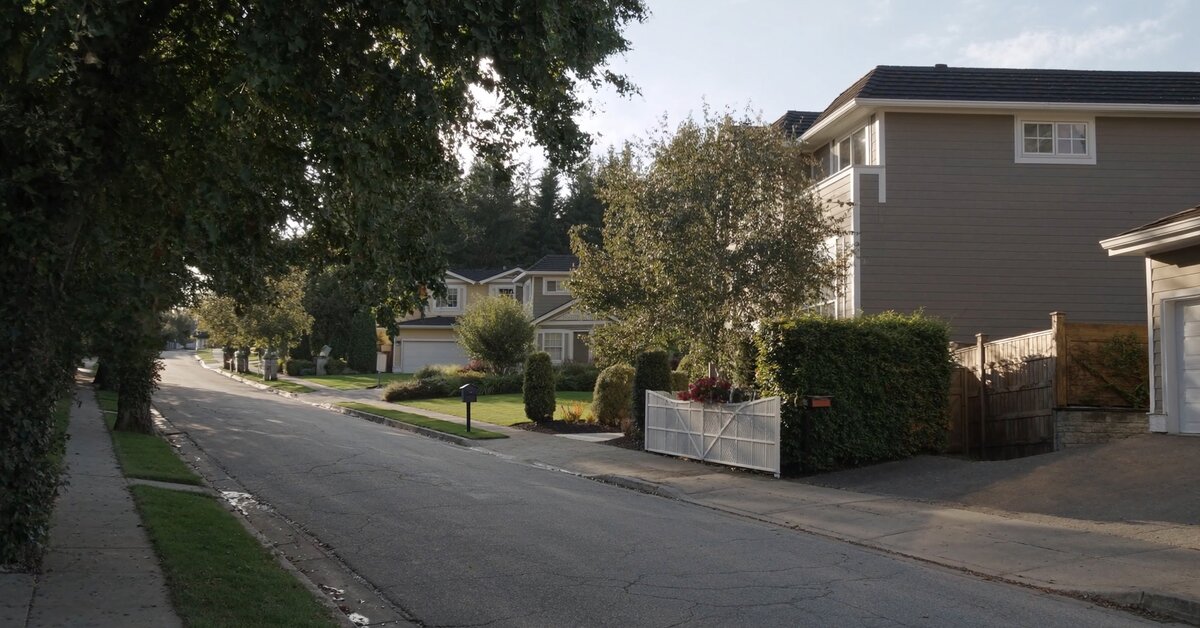
Bellevue Washington residential street with mature trees and Pacific Northwest homes
Bellevue’s residential character varies dramatically by neighborhood — from quiet forested streets in Bridle Trails to walkable urban blocks in Downtown.

Bellevue WA Real Estate Market in 2026

The Bellevue market sits at a citywide median of approximately $1.83 million in July 2026, essentially flat from a year ago — down about 1%. The range is wide. Condos in Factoria and Crossroads start below $600,000. Single-family homes in West Bellevue and Medina run $2 million to $5 million and higher. The pricing story in Bellevue is really several different stories depending on which neighborhood and which housing type you are shopping.

What has changed in 2026 is the pace. Bellevue spent 2021 through 2023 as one of the most aggressive seller’s markets in the country — waived inspections, waived financing, offers 15% over asking. That era is not fully over, but it has cooled. Well-priced homes in strong school zones are still moving in two to three weeks. Overpriced homes or homes with condition issues are now sitting for four to six weeks, which gives buyers time to breathe, inspect, and negotiate. That is a healthy market, even if some sellers have not fully adjusted their expectations yet.

The light rail opening is worth tracking closely as a market signal. Neighborhoods within walking distance of Bellevue Downtown Station and South Bellevue Station have seen increased buyer interest since the March 2026 opening. Downtown condos and townhomes in particular have attracted buyers who previously only looked at Seattle because of the transit access.

Commute Times from Bellevue, WA

Bellevue’s commute story changed significantly in March 2026 when the 2 Line opened across Lake Washington. For the first time, you can get from Bellevue Downtown Station to Seattle’s Westlake Station in about 25 to 28 minutes by rail, with trains running every 8 to 10 minutes during peak hours. That is a genuine alternative to driving I-90, which during AM rush can run 45 to 60 minutes depending on the day. The 2 Line also runs east to Redmond Technology Station, making it useful for Microsoft commuters heading the other direction.
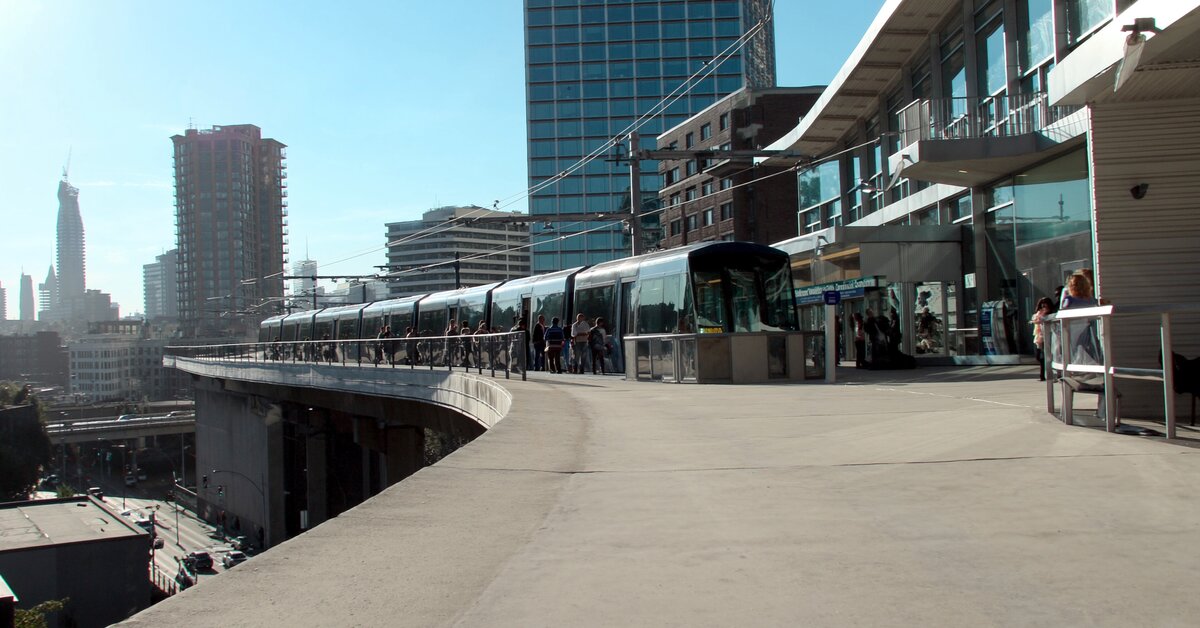
Bellevue Washington East Link 2 Line light rail station opened March 2026
The 2 Line opened across Lake Washington in March 2026, connecting Bellevue Downtown Station to Seattle’s Westlake Station in about 25 minutes.
Destination Distance 2026 Peak Commute Transit Option
Downtown Seattle 10 miles 25 min rail / 45-60 min drive 2 Line light rail
Amazon (South Lake Union) 12 miles 30 min rail / 45-55 min drive 2 Line to Capitol Hill transfer
Microsoft (Redmond) 8 miles 15-25 min drive / 20 min rail SR-520 or 2 Line east
Bellevue Tech Corridor 0-5 miles 5-15 min drive Drive / 2 Line / walk
SeaTac Airport 15 miles 25-40 min drive / 45 min rail I-405 South or 2 Line to 1 Line

The 2 Line runs every 8-10 minutes during peak hours. For anyone working in downtown Seattle or South Lake Union, this changes the calculus on living in Bellevue compared to even a year ago.

Best Neighborhoods in Bellevue, WA

Bellevue has more variety than most people realize. You can buy a condo near light rail for under $700,000, a Craftsman in Somerset for $2 million, or a waterfront estate in West Bellevue for $4 million-plus. Here is a practical breakdown of each neighborhood to help you figure out where to start looking.

West Bellevue

West Bellevue is Bellevue’s most exclusive address. This area runs between downtown and Lake Washington, and includes some of the highest-priced real estate in Washington State. Homes range from $2 million for a modest single-family to $10 million-plus for lakefront estates. The character is established, private, and tree-lined — large lots, mature landscaping, and very little turnover. Medina and Hunts Point are technically separate cities but feel like the same fabric. All are served by the Bellevue School District. Students typically attend Bellevue High School, rated 10/10 on GreatSchools. If waterfront or near-water luxury is on your list, this is the area.

Deep Dive: West Bellevue →

Downtown Bellevue

Downtown Bellevue has become a genuine urban core over the last decade. Whole Foods, Lincoln Square, Bellevue Square, and a dense concentration of tech offices anchor a walkable city center that rivals any suburb in the country for amenities. Housing is predominantly condos and high-rise apartments, with prices ranging from the mid-$600,000s for a one-bedroom to $3 million-plus for a penthouse. Bellevue Downtown Station on the 2 Line makes this the most transit-connected address in the city — 25 minutes to Seattle by rail, no traffic. Buyers who want walkability, urban energy, and the fastest commute to Seattle on the Eastside will find Downtown Bellevue is now in a different conversation than it was two years ago.

Deep Dive: Downtown Bellevue →

Somerset

Somerset sits on a hillside in southeast Bellevue with some of the best views in the city — Olympic Mountains, Puget Sound, Lake Washington, and downtown Bellevue all visible from the right lot. Homes are mostly single-family, built from the 1970s through the 1990s, ranging from 1,800 to 4,000 square feet on lots of 7,000 to 15,000 square feet. The median runs around $2 million. Somerset is served by the Bellevue School District and feeds into Newport High School, ranked #3 in Washington State by US News. Somerset Community Park and the Lakemont trail system are right at the door. This is one of the best value propositions in Bellevue for buyers who want a view, a yard, and top BSD schools at a price below West Bellevue.

Deep Dive: Somerset →

Bridle Trails

Bridle Trails is one of Bellevue’s most distinctive neighborhoods — a semi-rural enclave in the northeast part of the city, built around the Bridle Trails State Park equestrian system. Homes sit on larger lots, often half an acre or more, with horses allowed in some sections. The character is quiet and wooded, a genuine contrast to the dense urban core just a few miles away. Homes range from 2,500 to 5,000 square feet, mostly built from the 1970s through the 1990s, with some newer construction on the edges. The median runs $2 million to $2.5 million. Bridle Trails is served by the Bellevue School District and feeds into Interlake High School, ranked #7 in Washington by US News. If you want acreage, privacy, and a trail system in your backyard while staying close to Bellevue and Kirkland, Bridle Trails belongs on your list.

Deep Dive: Bridle Trails →

Newport Hills

Newport Hills is a family-oriented neighborhood in southeast Bellevue, sitting just north of the I-90 corridor and west of Lakemont. The area has an established, walkable character — tree-lined streets, a small neighborhood shopping center, and a genuine sense of community that newer master-planned areas do not always achieve. Homes are primarily single-family, built from the 1960s through the 1980s, ranging from 1,600 to 3,000 square feet on lots of 8,000 to 15,000 square feet. The median runs around $1.5 million to $1.8 million. Newport Hills is served by the Bellevue School District and feeds into Newport High School. Newport Hills Park and the Coal Creek Trail are both easily walkable from most addresses here.

Deep Dive: Newport Hills →

Crossroads

Crossroads is one of Bellevue’s most diverse and accessible neighborhoods, located in the central-east part of the city around the Crossroads Shopping Center. The character is practical and community-oriented, with a well-known farmer’s market, a community center, and a shopping district that reflects the neighborhood’s genuine cultural mix. Housing ranges from condos and townhomes in the $600,000s to single-family homes in the $900,000 to $1.3 million range. This is the most affordable Bellevue option for buyers who want a single-family home with a yard and full access to the Bellevue School District. Students typically attend Sammamish Senior High School, rated 8/10 on GreatSchools. For buyers priced out of Somerset or Lakemont, Crossroads is worth a serious look.

Deep Dive: Crossroads →

Eastgate / Factoria

Eastgate and Factoria sit in the southeast corner of Bellevue near I-90, making them the city’s most commuter-practical neighborhoods for anyone heading toward Issaquah or the South Sammamish Plateau. Factoria is primarily condos and townhomes — the most affordable entry point in Bellevue proper — with median condo prices starting below $600,000. Eastgate has a wider mix, with single-family medians in the $1.1 million to $1.4 million range. South Bellevue Station on the 2 Line is right in this area, connecting the neighborhood to downtown Seattle by rail in about 20 minutes. Both areas are served by the Bellevue School District. This corridor is worth serious consideration for buyers who want BSD school access at the lowest possible price of entry.

Deep Dive: Eastgate / Factoria →

Lakemont

Lakemont is a newer master-planned community in southeast Bellevue, developed primarily in the 1990s and 2000s on a forested hillside above I-90. The character is clean, family-oriented, and trail-connected — the Lakemont trail network links directly to Cougar Mountain Regional Wildland Park, one of the best open-space parks on the Eastside. Homes range from 2,000 to 4,000 square feet on lots of 5,000 to 10,000 square feet, with a median around $1.4 million to $1.6 million. Lakemont is served by the Bellevue School District and feeds into Newport High School. Buyers who want a newer home, a trail-connected community, and a slightly more accessible price than Somerset will find Lakemont worth a close look.
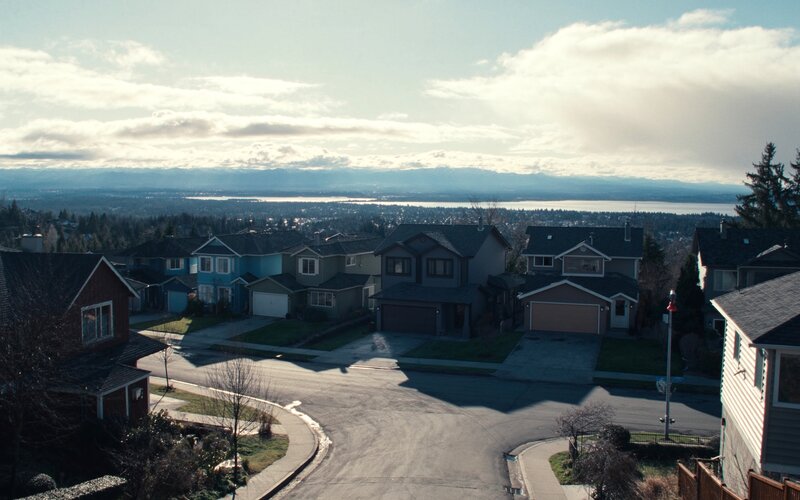
Deep Dive: Lakemont →

West Bellevue Washington luxury residential homes representing the Eastside's premium real estate market
Bellevue has more neighborhood variety than most people realize — from walkable downtown condos under $700K to West Bellevue estates above $4M.

Bellevue WA Home Values and Investment Outlook

Bellevue’s market is one of the most durable in King County over any 10-year horizon. The fundamentals are real: the #1 school district in Washington, a growing downtown employment base, and now direct light rail to Seattle. These are not marketing claims. They are the reasons buyers keep absorbing the price premium year after year.

What is different in 2026 is that the absorption of that premium is less frantic. Well-priced homes in the $1 million to $2 million range are still competitive. Above $2 million, the market has more days on market and more room to negotiate than at any point in the last five years. Luxury buyers are asking for inspections, financing contingencies, and price reductions. That is a meaningful shift. The same home that sold with 8 offers in 2022 is now selling with 2 offers and a price reduction after three weeks if the listing price was stretched.

The neighborhoods that hold value best in Bellevue consistently share these traits: Bellevue School District assignment, construction from 1990 or later, a usable yard, and access to parks or trails. Downtown condos with light rail walkability have gained a new premium since March 2026. The areas softening the most are larger older homes above $2.5 million in need of updates — buyers at that price point want turnkey and they have the negotiating room to demand it.
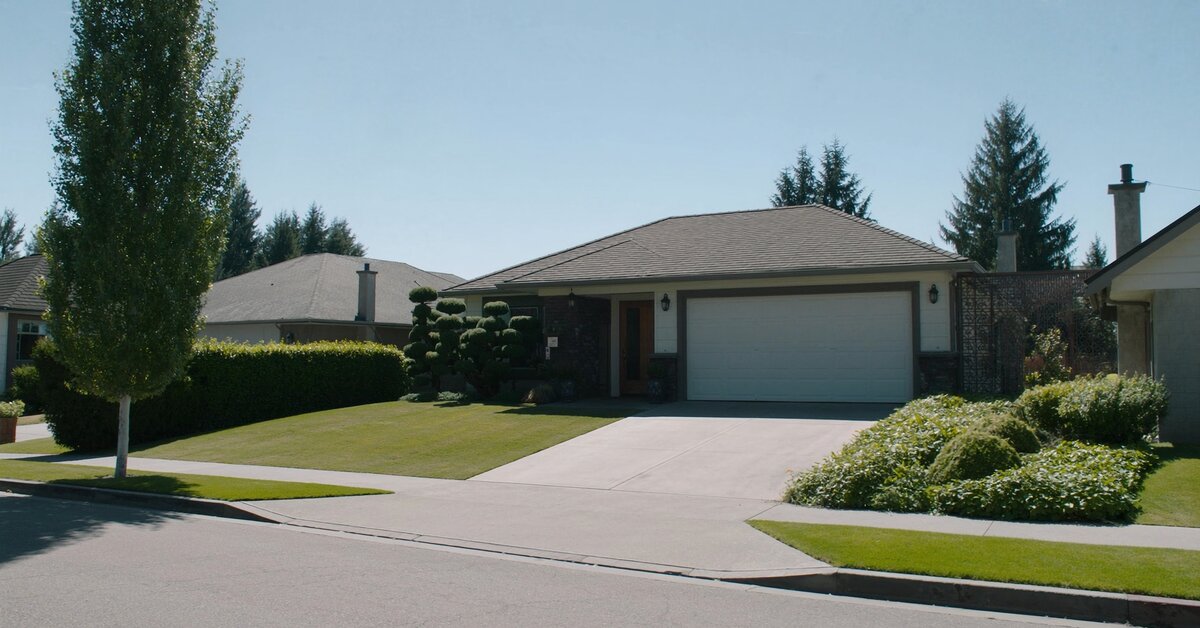
Bellevue Washington modern Craftsman home exterior representing 2026 real estate market values
Well-priced Bellevue homes in the $1M-$2M range are still competitive in 2026, but the luxury market above $2.5M has more room to negotiate than at any point in the last five years.

Frequently Asked Questions: Living in Bellevue, WA

Is Bellevue, WA a good place to live?

Bellevue consistently ranks as one of the best cities to live in Washington State. The combination of the #1-ranked school district in Washington, a walkable urban downtown, light rail to Seattle, and proximity to Eastside tech employers makes it a top destination for families and professionals. The main tradeoffs are high home prices and cost of living.

What is the average home price in Bellevue, WA in 2026?

The citywide median home price in Bellevue was approximately $1.83 million in July 2026. The range is wide — condos in Factoria and Eastgate start below $600,000, while single-family homes in West Bellevue and Somerset run $2 million to $4 million and higher. The most competitive price bracket is $1 million to $1.8 million for well-located single-family homes in the Bellevue School District.

What school district is Bellevue, WA in?

Nearly all of Bellevue is served by the Bellevue School District (BSD 405), ranked the #1 school district in Washington for 2026 by Niche. The district’s high schools — Bellevue, Newport, Interlake, and Sammamish — all have strong academic profiles, with Newport and Interlake ranking in the top 10 in the state. Always confirm the specific feeder school for any address before writing an offer.

Is there light rail in Bellevue, WA?

Yes. As of March 2026, the 2 Line (East Link) opened across Lake Washington. Bellevue has two stations: Bellevue Downtown Station and South Bellevue Station. The ride to Seattle’s Westlake Station takes about 25 to 28 minutes. The line also runs east to Redmond Technology Station. Trains run every 8 to 10 minutes during peak hours.

How far is Bellevue from Seattle?

Bellevue is about 10 miles east of downtown Seattle, separated by Lake Washington. By car on I-90 during AM peak, expect 45 to 60 minutes. By the 2 Line from Bellevue Downtown Station, the trip to Westlake Station takes about 25 minutes — consistently faster than driving during rush hour.

Explore Bellevue, WA Yourself

The best way to understand Bellevue is to walk it. Start at Bellevue Downtown Park, then walk through Bellevue Square and over to the 2 Line station. Drive south to Somerset for the views, then cut through Crossroads to see the community market. Finish by looping through Bridle Trails to see what Bellevue looks like when you get off the main roads. One afternoon does more than a month of listings research.


View Bellevue on Google Maps →

Your guide to life outside Seattle.

Gregory Dorrell | Coldwell Banker Bain | WA License #111862
253-350-0045  ·
greg@livingoutsideseattle.com  ·
www.livingoutsideseattle.com