
Seller Resources May 18, 2026

Capital Gains on Home Sales in Washington State: What King County Sellers Need to Know


Capital Gains on Home Sales in Washington State: What King County Sellers Need to Know

Most King County sellers I work with are sitting on a lot of equity. A home bought in Sammamish for $450,000 in 2015 might be worth $850,000 today. That’s $400,000 in gains. The first question I get when we start talking about selling is almost always: “How much of that do I owe in taxes?”

The answer depends on a few specific things. Here’s exactly how capital gains work on a home sale in Washington state, in plain language, including the one tax every seller pays that most people forget about.

What Capital Gains on a Home Sale Actually Means

Capital gains are the profit you make when you sell an asset for more than you paid for it. On a house, that means the sale price minus what you originally paid, minus the cost of improvements you made, minus selling costs.

If you bought your Kent home for $520,000 and sold it for $780,000, your gross gain is $260,000. But before you panic, there is a federal exclusion that wipes out most or all of that for the majority of sellers.

The Section 121 Exclusion: The $500,000 Rule
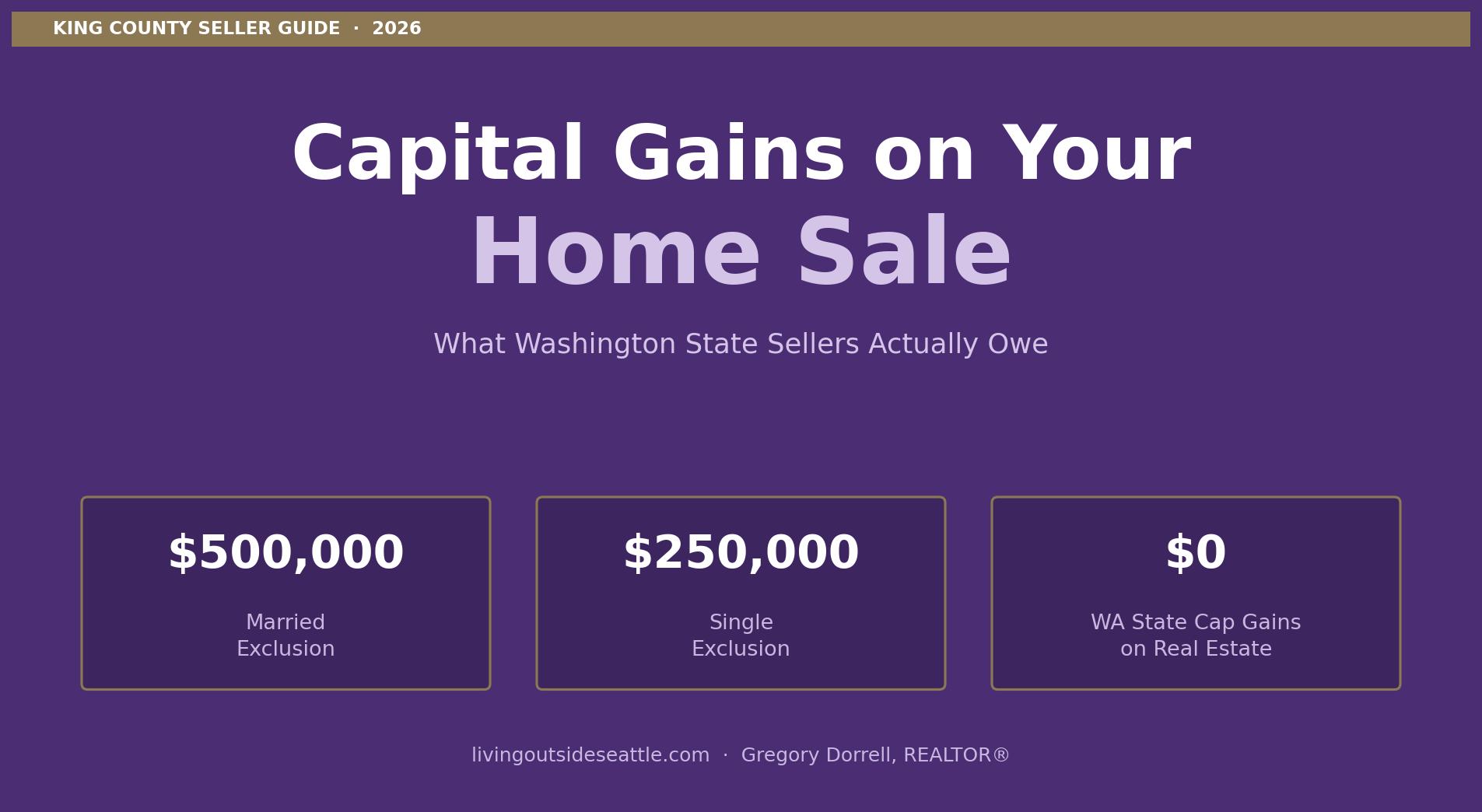
Section 121 capital gains exclusion breakdown — $250K single filer, $500K married filing jointly, King County 2026

The IRS gives homeowners a major break called the Section 121 exclusion. Here’s how it works.

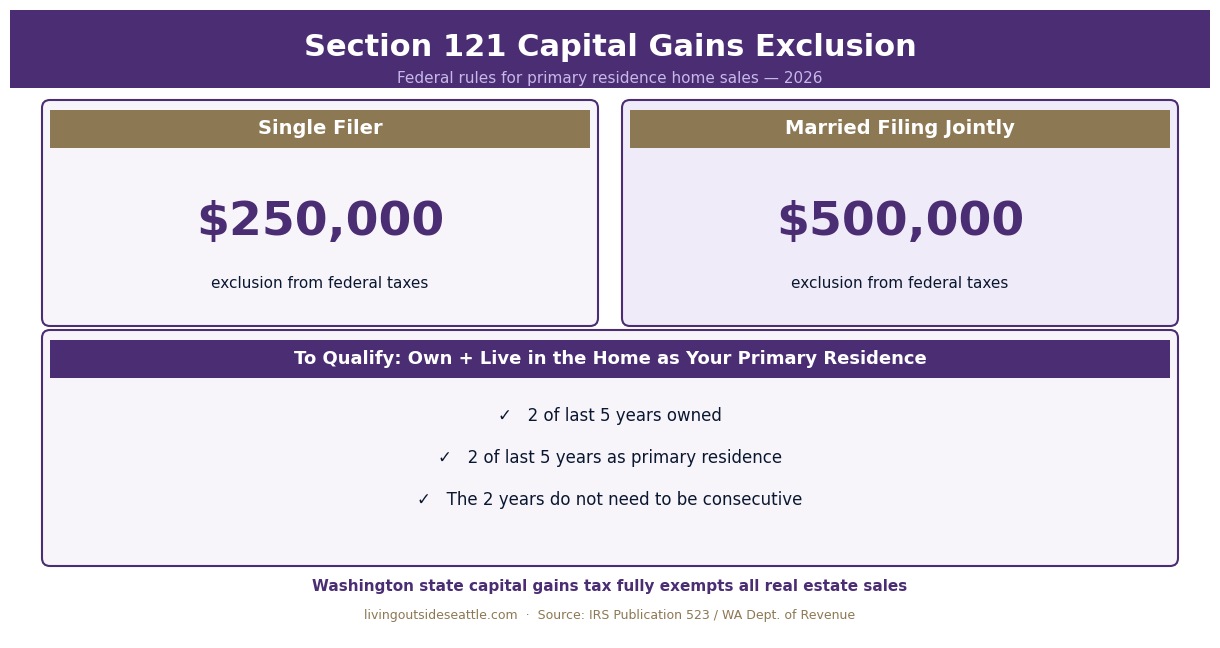
If you’re married filing jointly, you can exclude up to $500,000 in capital gains from your taxable income. If you’re single, the exclusion is $250,000.

To qualify, you need to meet two tests:

  1. Ownership test — You must have owned the home for at least two of the last five years before the sale.
  2. Use test — You must have lived in the home as your primary residence for at least two of the last five years. Those two years don’t have to be consecutive.

Most long-term King County homeowners qualify easily. If you’ve lived in your Renton home for five years, you almost certainly clear both tests.

What this means practically: if you bought your Auburn home for $400,000, made $30,000 in improvements, and sold for $750,000, your gain is $320,000. If you’re married and file jointly, you exclude all $320,000 under the $500,000 cap. You owe zero federal capital gains tax on the sale.

What Counts as Your Cost Basis

Your cost basis is not just the purchase price. It includes several things that reduce your taxable gain.

The original purchase price is the starting point. Add to that any capital improvements you made over the years. A new roof, an addition, a kitchen remodel, a finished basement, new HVAC — these all increase your basis. Routine maintenance and repairs do not count, but anything that adds value or extends the life of the home does.

You can also add your original closing costs from when you bought the house. Title insurance, loan origination fees, and legal fees paid at purchase are all part of your basis.

On the selling side, your agent commission, title and escrow fees, staging costs, and any seller-paid closing costs reduce your net proceeds, which lowers your effective gain.

Washington State Capital Gains Tax: What You Need to Know

Washington passed a 7% capital gains excise tax on long-term gains above $250,000, effective January 1, 2022. But here’s the key detail most sellers don’t realize: real estate is fully exempt from Washington’s capital gains tax.

That means when you sell your primary home in King County, you owe no Washington state capital gains tax — not just on primary residences, but on all real property. The state capital gains tax targets stocks, bonds, and other capital assets, not real estate.

This is important news for King County sellers. You do not need to factor the 7% state capital gains tax into your home sale math at all.

For more on what you’ll net from the sale after all costs: selling a home in King County — costs and net proceeds breakdown

Washington’s Real Estate Excise Tax: The Tax Every Seller Pays
Washington state real estate excise tax REET rate table — King County seller costs 2026

Here is the one tax that often surprises sellers because it’s separate from capital gains entirely. Washington state charges a Real Estate Excise Tax (REET) on every property sale. This is a tax on the transaction itself, not on your profit.

Washington’s REET uses a graduated rate structure based on the sale price:

Sale Price Range State REET Rate King County Local
Up to $525,000 1.10% + 0.50%
$525,001 – $1,525,000 1.28% + 0.50%
$1,525,001 – $3,025,000 2.75% + 0.50%
Above $3,025,000 3.00% + 0.50%

Source: Washington Department of Revenue. Rates current as of 2026.

On a $800,000 home sale in King County, your combined REET bill works out to roughly $11,000 to $12,000. This comes out of your proceeds at closing. It is not optional and it does not depend on whether you made a profit.

When You Might Owe Federal Capital Gains Tax

For most King County sellers, the Section 121 exclusion eliminates the federal tax bill. But there are situations where you could owe something.

Your gains exceed the exclusion. If you’re single and your gain is $400,000, you owe tax on $150,000 — the amount above the $250,000 exclusion. In King County’s high-appreciation market, this is more common than people expect, especially for long-term owners in Bellevue, Sammamish, or Issaquah who bought in the early 2000s.

You don’t meet the use-and-ownership tests. If you haven’t lived in the home as your primary residence for at least two of the last five years, you don’t qualify for the exclusion. This comes up with rental properties that were previously a primary residence, or vacation homes.

You’re selling an investment property. The Section 121 exclusion does not apply to rentals or investment properties. You’d owe federal capital gains tax at 0%, 15%, or 20% depending on your income and holding period.

Depreciation recapture on rentals. If you converted a primary residence to a rental at some point, any depreciation you claimed gets recaptured as ordinary income when you sell. This catches people off guard.

For inherited property situations: inherited home King County — what to do with an inherited property

Short-Term vs. Long-Term Capital Gains Rates

Federal capital gains rates depend on how long you owned the property before selling.

If you owned the home for one year or less, gains are taxed as ordinary income — potentially 22%, 24%, or higher. This rarely applies to primary residence sales but matters for investors who flip quickly.

If you owned the home for more than one year, gains qualify for long-term rates: 0%, 15%, or 20% depending on your taxable income. For most middle-income King County households, the rate is 15%.

Nearly every homeowner selling a primary residence after living there for two-plus years is in long-term territory.

A Practical Example for a King County Seller

Here’s how this plays out for a scenario I see often. A couple bought their Sammamish home in 2014 for $620,000. They’ve lived there since and are now looking to downsize. The home is worth $1,100,000 today.

Item Amount
Sale Price $1,100,000
Cost Basis (purchase + improvements) $665,000
Gross Gain $435,000
Section 121 Exclusion (married filing jointly) $500,000
Federal Capital Gains Tax Owed $0
WA State Capital Gains Tax Owed $0 (real estate exempt)

They will still owe REET at closing — approximately $16,000–$17,000 on a $1.1M sale in King County.

What to Do Before You Sell

Talk to your CPA or tax advisor before you list, especially if you’re near or above the exclusion thresholds, have ever rented the home, or inherited the property. Every situation is different.

What I can do is help you understand your equity position and what you’re likely to net from the sale based on current market values. I assess property values across King County every day as part of my BPO work for institutional clients — that same analysis tells me exactly where your home stands in today’s market before we set a price.

For timing guidance: best time to sell a house in King County — timing the market

Frequently Asked Questions

Do I have to pay capital gains tax when I sell my house in Washington state?

Most sellers don’t. If you’ve owned and lived in your home for at least two of the last five years and your gain is under $500,000 (married) or $250,000 (single), the Section 121 exclusion eliminates your federal capital gains tax. Washington state’s capital gains tax fully exempts real estate, so there’s no state capital gains tax on home sales regardless.

What is Washington’s Real Estate Excise Tax and do I have to pay it?

Yes. REET is a transaction tax paid by the seller on every property sale in Washington state. It is calculated on the sale price using a graduated rate structure ranging from 1.1% to 3.0% at the state level, plus a local rate in King County cities of 0.50%. There is no exemption for primary residences — every seller pays it at closing.

How do I calculate my cost basis for a home sale?

Start with your original purchase price. Add capital improvements (renovations, additions, major systems replacements) and your original closing costs from when you bought. The total is your adjusted basis. A higher basis means a lower taxable gain.

What if my home sale gain is more than $500,000?

You’d owe federal long-term capital gains tax — typically 15% for most households — on the amount above the exclusion. A married couple with a $650,000 gain would owe tax on $150,000. Talk to a CPA about strategies like documenting additional improvements to increase your basis before listing.

Does Washington’s 7% capital gains tax apply to my home sale?

No. Washington’s capital gains excise tax fully exempts all real estate transactions. It applies to stocks, bonds, and other capital assets — not to property sales of any kind.

Important Disclaimer

Gregory Dorrell is a licensed real estate broker (WA License #111862) with Coldwell Banker Bain. He is not a tax attorney, CPA, or licensed tax advisor. The information in this post is provided for general educational purposes only and does not constitute tax or legal advice.

Every seller’s tax situation is different. Before making any decisions based on the information in this post, please consult a licensed CPA or tax attorney about your specific situation — including any tax consequences of your home sale and strategies that may help minimize the amount you owe.

Tax laws change. The information above reflects general rules as of 2026 and may not account for changes in federal or state tax law, your individual income, filing status, or other factors specific to your situation.

Your guide to life outside Seattle.

Gregory Dorrell |
Coldwell Banker Bain | WA License #111862
253-350-0045
greg@livingoutsideseattle.com

www.livingoutsideseattle.com
 

Buyer Resources May 18, 2026

Should I Wait to Buy a Home in Auburn WA? The Real Math.


Should I Wait to Buy a Home in Auburn WA? The Real Math

If you’re asking whether you should wait to buy a home in Auburn, WA, you’re not alone. My inbox right now is full of some version of this question: “If rates drop six months from now, won’t I be better off waiting?” It’s a fair question, and it deserves a real answer, not just reassurance.

Auburn, Washington is where I want to focus this, because at a $668,000 median price for single-family homes, Auburn is the most affordable entry point across the seven major cities I track in King County. For first-time buyers, that matters. And the math here is closer than most people expect.

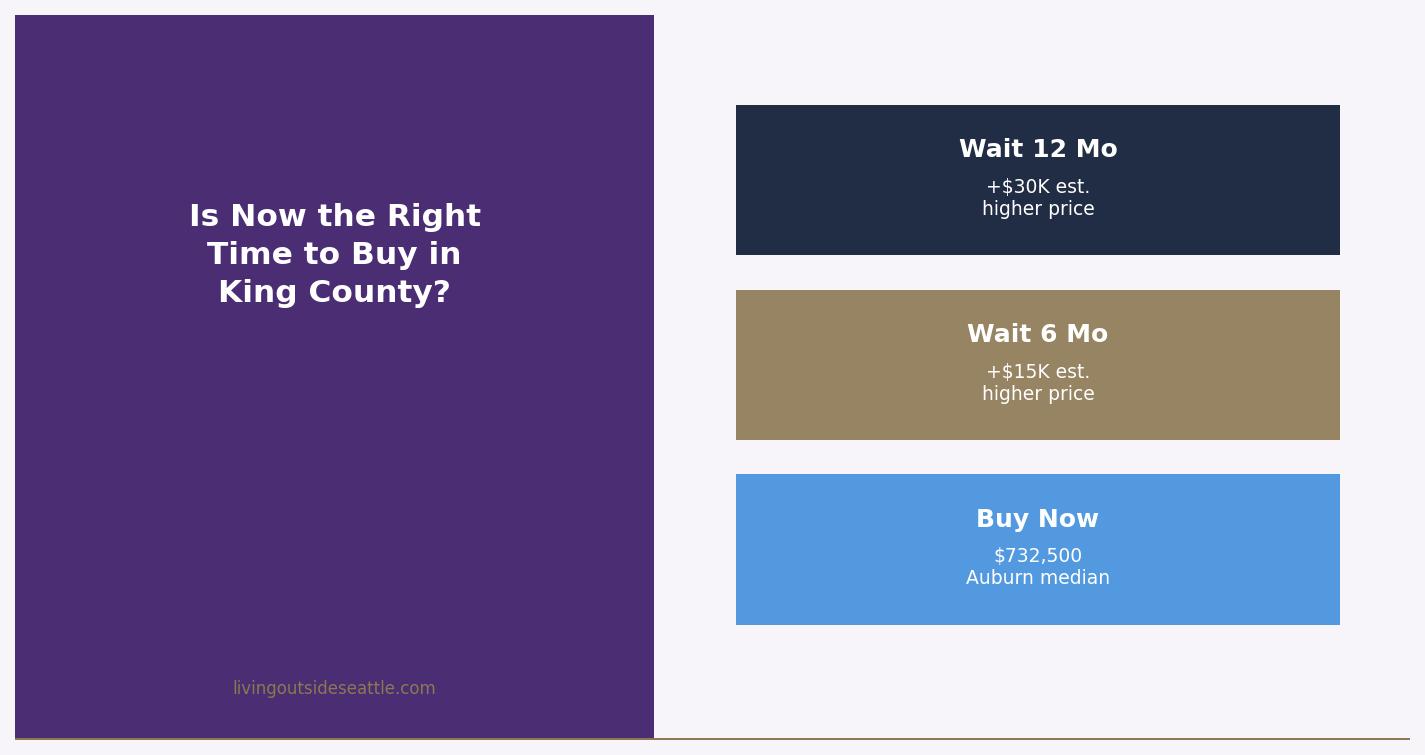
What Waiting Six Months Really Costs Auburn Home Buyers

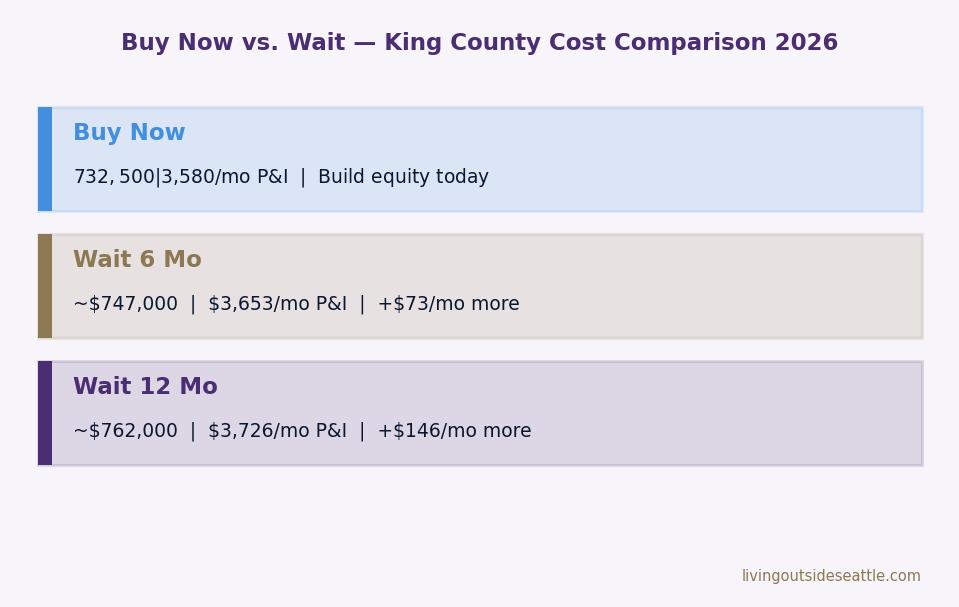
Buy now vs wait 6 months vs wait 12 months — King County home buyer cost comparison 2026

Let me walk you through three scenarios. Check my numbers, because this is too important to just take my word for.

Scenario 1: Buy now in Auburn at $668,000 with 6.38% rate and 10% down.
Loan amount: $601,200. Monthly payment (principal and interest): about $3,840. Down payment: $66,800.

Scenario 2: Wait six months, rates drop to 5.38%, but prices rise 3%.
New price: $688,240. New loan at 10% down: $619,416. Monthly payment at 5.38%: about $3,710. Down payment: $68,824.

You save $130 per month on the payment. But you put $2,024 more upfront and spent six months paying rent or staying in a situation you wanted to leave. Plus you’re six months further from building equity.

Scenario 3: Wait six months, rates drop to 5.38%, but prices rise 5% instead.
New price: $702,400. New loan: $632,160. Monthly payment at 5.38%: about $3,795. Down payment: $70,240.

Now you’re paying $45 more per month than if you’d bought today, even with rates 1% lower. You also put down $3,440 more. You waited six months for that result.

Auburn’s current median days on market is 14 days, softer than the King County average of 7 days. That gives you more breathing room than in faster markets like Sammamish (4 days). You have time to make a thoughtful decision. You just don’t have unlimited time.

Why Lower Rates Don’t Mean Lower Home Prices in Auburn

Here’s what most buyers get wrong about the wait-for-rates strategy. They picture a world where rates fall and nobody buys anything in the meantime, so sellers get desperate and cut prices. That’s not what happens.

When rates drop, demand increases. More buyers qualify. More buyers have monthly payment headroom. That demand pushes prices up. The two forces move in opposite directions, and prices almost always outpace the benefit of the rate drop.

Look at what happened through 2024 and into 2025. Rates eased incrementally, and prices rose. There was no crash followed by a recovery. Steady appreciation as affordability improved. That’s the pattern.

King County’s March 2026 median for single-family homes is $995,000. Auburn’s is $668,000. Both have held steady or moved up despite rate pressure. A significant rate drop would likely push both numbers higher, not lower.

When Waiting to Buy a Home Actually Makes Sense

There are real scenarios where waiting is the smarter move. If rates drop significantly, say 1% or more, and stay there, you have a genuine advantage: you can refinance after buying at today’s rate. But refinancing costs money. Typically $3,000 to $5,000 in closing costs.

If you save $130 per month by refinancing, you need to stay in the home 23 to 38 months just to break even on those refinance costs. The math works if you stay long enough, but it’s not the free win it sounds like.

The better approach is to buy now with the understanding that you’ll refinance when it genuinely makes sense. That only works if you’re building equity in a home you own today. Sitting on the sidelines waiting for the perfect moment rarely produces the perfect moment.

Waiting makes genuine sense if you can’t comfortably afford the current payment, if your job situation is uncertain, or if you’re not planning to stay in the home at least five years. Those are real reasons to wait. Fear of missing a rate drop usually isn’t.

Auburn WA Housing Market: What First-Time Buyers Find Right Now

Auburn’s $668,000 median price is approachable on a South King County household income. The city has solid schools, real job growth, and reasonable commute access to both Seattle and Bellevue. If you’re a first-time buyer looking at King County and you haven’t seriously considered Auburn, run the numbers.

The inventory is there. King County had 5,071 homes for sale in March 2026, up 37.5% from March 2025. Auburn is getting its share. Monthly supply county-wide is 2.2 months, which means buyers have real choices rather than the single-shot bidding wars of late 2024.

New listings jumped 16.5% year-over-year to 3,686 county-wide in March. You’re not racing against 15 other offers on every property in Auburn right now.

How Waiting Affects Your Down Payment Strategy

One cost that doesn’t show up in the rate comparison: opportunity cost on your down payment savings. If you’re waiting for rates to drop and delaying your purchase, home prices likely keep appreciating at 2% to 4% per year in a healthy market. Every month you wait, the down payment required grows with the price.

Start saving now. Get pre-qualified now. And talk to a lender about down payment assistance before assuming you need 10% or 20%. Auburn buyers have access to Washington State Housing Finance Commission programs. Home Advantage offers up to $10,000 in down payment assistance for King County buyers earning up to $147,400. The Covenant Homeownership Program provides 0% interest assistance for qualifying first-timers. first-time buyer programs King County

These programs change the affordability math enough to be worth knowing about before you decide waiting is your only option.

The Scenario Nobody Talks About: What If Rates Go Up?

Here’s the part nobody wants to think about. Rates could go higher. Oil prices are volatile. Geopolitical situations change daily. If rates climb to 7% while you’re waiting for 5.5%, that $668,000 Auburn home costs $4,200 per month instead of $3,840. That’s $360 more. And prices won’t have come down in that environment.

Waiting is a bet on rates falling. It’s not a guaranteed strategy.

First-Time Buyer Advantages in Auburn, Washington

The price point is approachable. Inventory is available. The 14-day median days on market gives you room to think without panic buying. And at $668,000 with 10% down at 6.38%, you’re looking at about $3,840 monthly. That’s achievable on a $120K household income with solid debt-to-income ratios.

If you qualify for WSHFC assistance, the upfront cost gets meaningfully lower. That’s a strong combination for a first-time buyer entry into King County homeownership.

Frequently Asked Questions: Buying a Home in Auburn WA

Will home prices in Auburn WA go down if mortgage rates drop?

Historically, the opposite happens. When rates fall, more buyers qualify and demand increases, which pushes prices up. King County’s March 2026 median is $995,000 county-wide, with Auburn at $668,000 ‚Äî both have held despite rate pressure. A significant rate drop would likely push Auburn prices higher, not lower.

What is the median home price in Auburn, Washington in 2026?

As of March 2026, the median single-family home price in Auburn is $668,000, making it the most affordable SFR entry point among the seven major cities I track in King County. The median days on market is 14 days, which gives buyers more time than in faster markets like Sammamish (4 days).

Are there first-time buyer programs available in Auburn, WA?

Yes. Washington State Housing Finance Commission (WSHFC) offers Home Advantage, which provides up to $10,000 in down payment assistance for King County buyers earning up to $147,400. The Covenant Homeownership Program offers 0% interest down payment loans for qualifying first-timers. FHA loans with 3.5% down are also an option.

How long should I plan to stay in a home before buying makes financial sense?

Most financial advisors suggest at least five years to offset transaction costs and break even on the purchase. In Auburn specifically, if you’re planning to stay five or more years, the buy-now math almost always beats waiting for a rate drop.

What is the best neighborhood in Auburn WA for first-time buyers?

Auburn has a range of neighborhoods from near downtown to the West Hill area with views toward Puget Sound. The best fit depends on your commute patterns, school preferences, and budget. I walk these neighborhoods regularly and can walk you through where comparable homes are moving and at what prices.

Your guide to life outside Seattle.

Gregory Dorrell | Coldwell Banker Bain | WA License #111862
253-350-0045  ·
greg@livingoutsideseattle.com  ·
www.livingoutsideseattle.com

Gregory Dorrell is a licensed real estate broker (WA License #111862) with Coldwell Banker Bain. This post is provided for informational purposes and does not constitute financial or investment advice. Property prices, interest rates, and market conditions are subject to change. Please consult with a mortgage lender for pre-qualification information and a real estate professional for market-specific advice.


RentonSeller Resources May 18, 2026

Best Time to Sell a House in Renton WA: Spring 2026

Best Time to Sell a House in Renton WA: Spring 2026 Data

The best time to sell a house in Renton WA is right now. I want to walk you through exactly why, because the numbers back it up clearly.

I’ve spent 13+ years evaluating property conditions and values across King County neighborhoods as a BPO field inspector. I see the data that most people miss. What I’m seeing in Renton right now is a market where sellers have real leverage, homes are moving fast, and prices are holding firm. Let me break down what that means for you.

Renton WA Home Values Spring 2026: What the Numbers Say

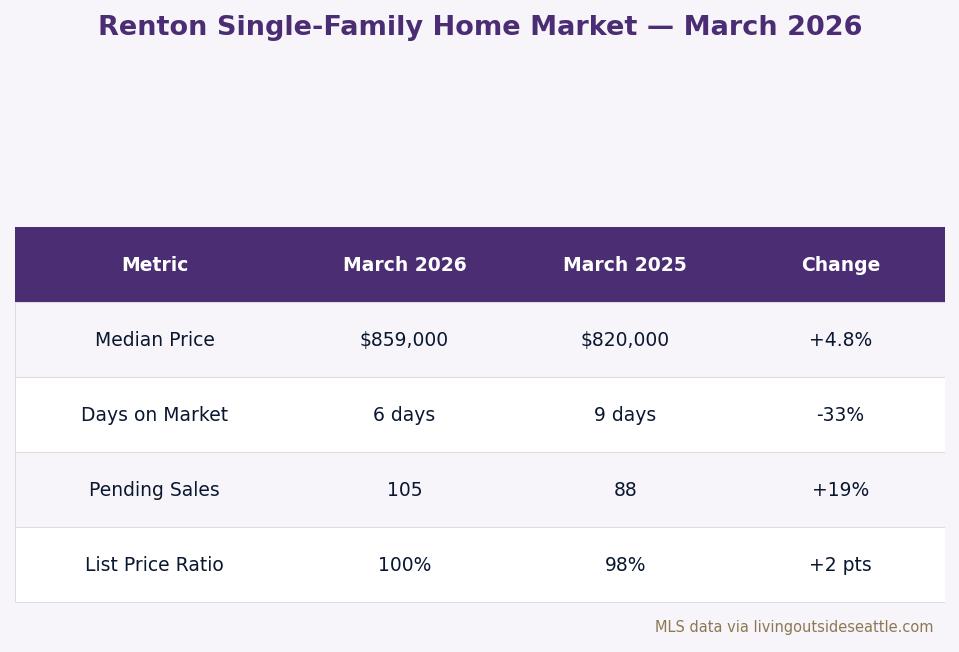
Renton real estate market data table March 2026 — median price, DOM, pending sales, list price ratio

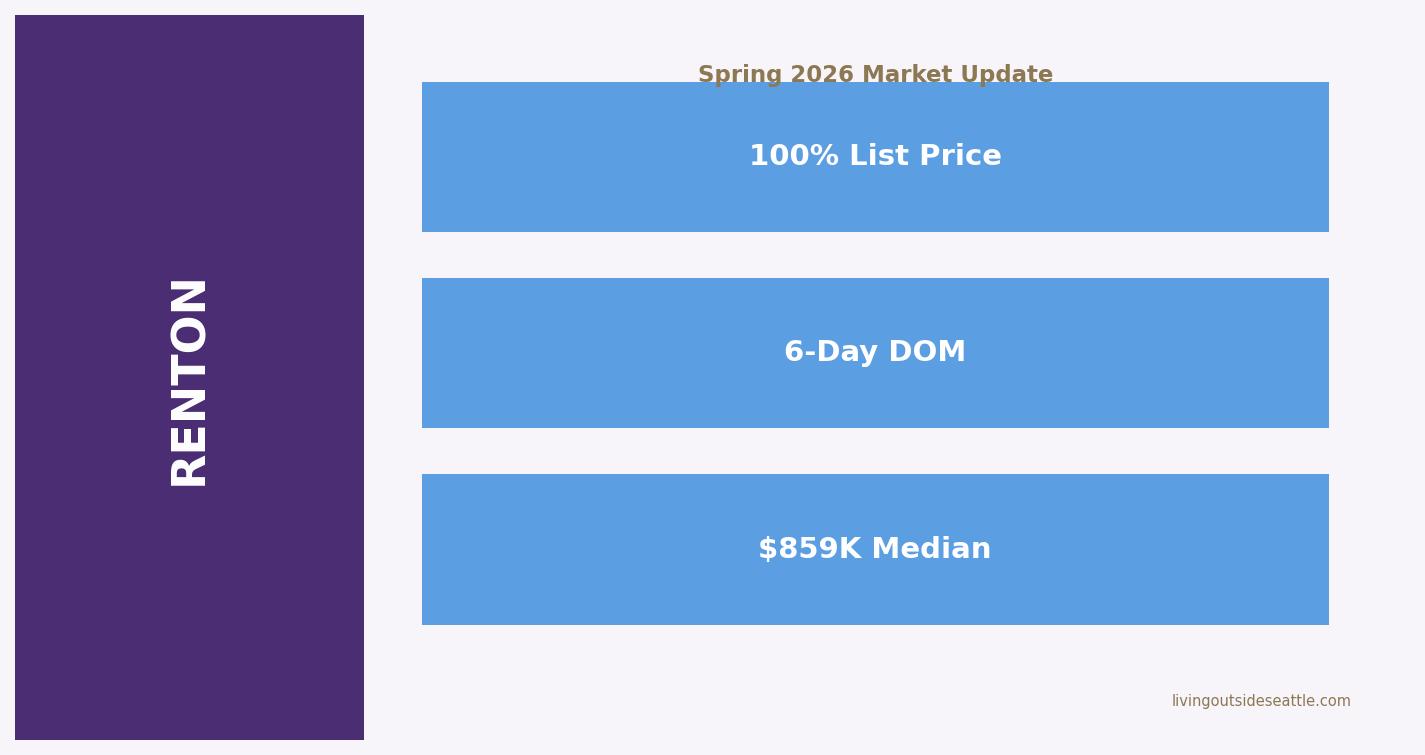
In March 2026, Renton had a median sale price of $859,000 for single-family homes. The median days on market hit just 6 days. That means homes are going under contract in less than a week.

For context, King County overall had 7 days median DOM in March. Renton beat that by a full day. That speed matters because it means less time carrying costs, less time in limbo, and more certainty about your close date.

In March alone, 105 homes went into pending status in Renton. The list price ratio in King County sits at exactly 100%, meaning homes are selling at asking price on average. This is the market you’re working in as a Renton seller right now.

Why Spring Is the Best Time to Sell a Home in Renton

We’re in the April-May window, which is peak spring market season. Research consistently shows May produces the fastest sales in Washington, and June delivers the highest sale prices, with homes listing in June selling 3 to 5% above the yearly median.

For Renton specifically, spring brings the most serious buyers. They’re ready to move before summer, before schools change districts, and many have spent winter getting finances in order. You’ll face more qualified buyers and fewer tire-kickers in the next 60 days than at any other point in the year.

The 6-day median DOM isn’t an outlier. It’s the current baseline in Renton. Homes priced right and in decent condition are moving now.

Why the “Seattle Exodus” Story Doesn’t Tell the Whole Picture

You may have seen headlines: 18,000 residents left the Seattle area between December 2025 and February 2026. That number is real. But here’s the contradiction that doesn’t make the headlines: despite those departures, Seattle is the third most competitive housing market in the nation according to Redfin, with Tacoma ranking first.

The exodus and the competitive market coexist because they’re describing different people. Those leaving are often priced out or choosing warmer climates. Those staying or moving in are established locals with equity, remote workers who can afford King County, and people relocating specifically to the tech corridor. Renton benefits from this dynamic because it’s more affordable than Seattle proper while staying within the region’s employment hub.

How to Price Your Renton Home to Sell in 6 Days or Less

Here’s where my field experience is directly relevant. I evaluate property conditions by walking through thousands of homes a year across King County. Condition drives pricing more than size does. Buyers in Renton right now want homes that don’t need immediate work, even if they plan to renovate later.

A well-maintained $859,000 home closes faster than an $829,000 fixer in the same neighborhood. That’s what I see consistently in the data.

The $859,000 median doesn’t mean your home should list there. You need a CMA, a comparative market analysis, that looks at actual sales of homes like yours, not just the area median. A home near I-405 with a corner lot has different comps than one two neighborhoods over near the Boeing facility. The details matter.

If your home has deferred maintenance, recent cosmetic fixes, or systems upgrades, that’s your messaging. If it needs work, price that honestly and expect more negotiation or a longer marketing window than the 6-day median.

Should You Sell Your Renton Home Now or Wait?

If you’re on the fence, here are three things to weigh.

First, buyer attention is at its peak right now. Spring brings the most active buyers in King County. Second, carrying costs are real. Every month you hold means mortgage, property tax, insurance, and utilities. Third, even modest price appreciation compounds over time. The gain from selling now in a 100% list-price-ratio market often exceeds what you’d gain by waiting for a market you can’t predict.

The only solid reasons to hold are not being ready to move, having major repairs you’re unwilling to address, or having a personal timeline that doesn’t align with spring. The market itself is not a reason to wait.

Current mortgage rates at 6.38% mean buyers are being selective. They have more inventory to consider than a year ago. Your home’s value proposition needs to be clear from the first day of listing.

Frequently Asked Questions: Selling a Home in Renton WA

How long does it take to sell a home in Renton WA right now?

As of March 2026, the median days on market for single-family homes in Renton is 6 days, one day faster than the King County average of 7 days. Homes priced accurately and in good condition are routinely going under contract within a week.

What is the average home price in Renton WA in 2026?

The median sale price for single-family homes in Renton was $859,000 in March 2026. The list price ratio is holding at 100%, meaning homes are selling at or very close to asking price.

Is Renton WA a seller’s market in 2026?

Yes. With 6-day median DOM and 2.2 months of inventory county-wide, Renton is in seller’s market territory. Balanced market conditions don’t kick in until 5 to 6 months of supply. We’re well below that threshold in Renton.

When is the best time of year to sell a house in Renton?

April and May are historically the strongest selling months in King County, including Renton. Spring brings the most qualified buyers, fastest timelines, and highest list-price ratios. May produces the fastest sales in Washington overall, and June delivers the highest sale prices. If you’re planning to list, the window to capture peak buyer traffic is right now.

How do mortgage rates at 6.38% affect home sellers in Renton?

Higher rates have reduced the number of buyers who qualify at the upper end of the price spectrum. But Renton’s 6-day DOM shows demand is still strong at the $859K median. The buyers who are in the market are serious and pre-qualified. Pricing accurately and presenting your home in top condition ensures you attract those buyers on day one rather than waiting through price reductions.

Your guide to life outside Seattle.

Gregory Dorrell | Coldwell Banker Bain | WA License #111862
253-350-0045  ·
greg@livingoutsideseattle.com  ·
www.livingoutsideseattle.com
Gregory Dorrell is a REALTOR® with Coldwell Banker Bain specializing in East and South King County real estate. This content is for informational purposes and does not constitute professional real estate or investment advice. Consult with a licensed professional before making real estate decisions.


South King County May 18, 2026

Living in Auburn, WA: 2026 Neighborhood & Real Estate Guide

Living in Auburn, WA: 2026 Neighborhood & Real Estate Guide

Is Auburn, WA a Good Place to Live?

Living in Auburn, WA gives you something that is genuinely hard to find in King County right now: a real house, a real yard, and a real commute to Seattle — all at a price that does not require two tech salaries to pull off. Auburn’s median home price in 2026 runs around $577,000 to $587,000, well below the King County median of $880,000. That gap is real, and it is the reason Auburn is one of the most searched cities in south King County for buyers who want more space without moving to Pierce County.

Auburn is not a city that tries to be trendy. It is practical, diverse, and genuinely livable. The Green River Trail runs right through the city. The Sounder commuter rail connects you to downtown Seattle without fighting I-5. Boeing, the Port of Seattle, and a massive south King County logistics and warehouse sector all sit within 20 miles. For first-time buyers, growing families, and relocators from high-cost states, Auburn consistently shows up as one of the strongest value plays in the Seattle metro.

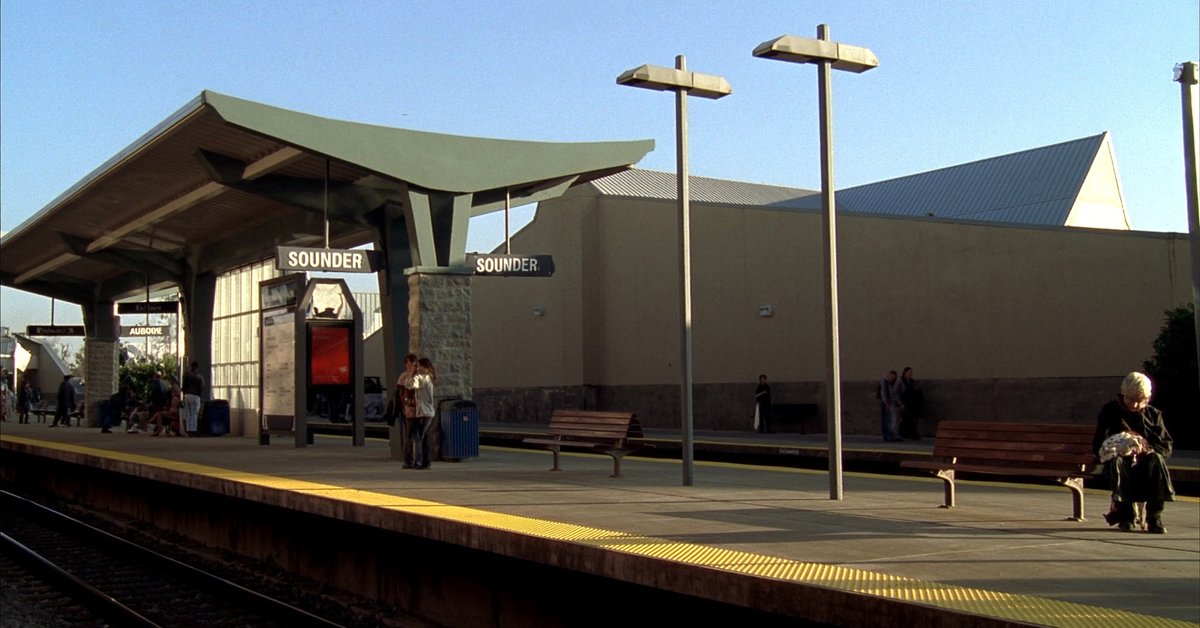
Auburn Washington Sounder commuter train station providing direct rail access to downtown Seattle from King County
Auburn’s Sounder Station connects residents to downtown Seattle in about 50 minutes — no freeway required.

Auburn WA Commute Times to Seattle and Beyond

Moving to Auburn, Washington means living on one of the best-connected transit corridors in south King County. The Auburn Sounder Station is the city’s most underrated asset — it connects you to downtown Seattle without touching I-5, which is a genuine quality-of-life upgrade during rush hour. Sound Transit also runs express bus routes from multiple Auburn park-and-ride locations. Drivers have SR-167 heading north to Renton and Bellevue, and I-5 heading toward Federal Way and Tacoma.

Destination Distance 2026 Peak Commute Transit Option
Downtown Seattle 30 miles 45 to 65 min Sounder Train / I-5
Amazon (South Lake Union) 30 miles 50 to 70 min Sounder + Light Rail Transfer
Microsoft (Redmond) 35 miles 50 to 70 min SR-167 to SR-520 / Drive
Bellevue Tech Corridor 22 miles 35 to 50 min SR-167 North / I-405
SeaTac Airport 15 miles 20 to 30 min SR-167 / Drive

Times reflect honest peak-hour conditions, not best-case scenarios. I drive these routes regularly for BPO inspection work, and the SR-167 corridor can back up significantly between Auburn and Renton during morning rush.

Best Neighborhoods in Auburn, WA

Auburn covers a wide geographic area with distinct neighborhoods — each with its own character, price range, and school assignment. Here is a breakdown of the main areas buyers need to understand before starting their search.

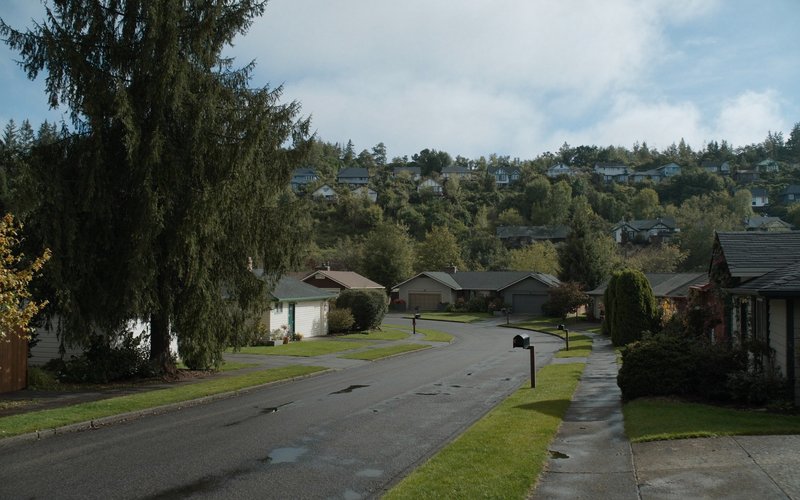
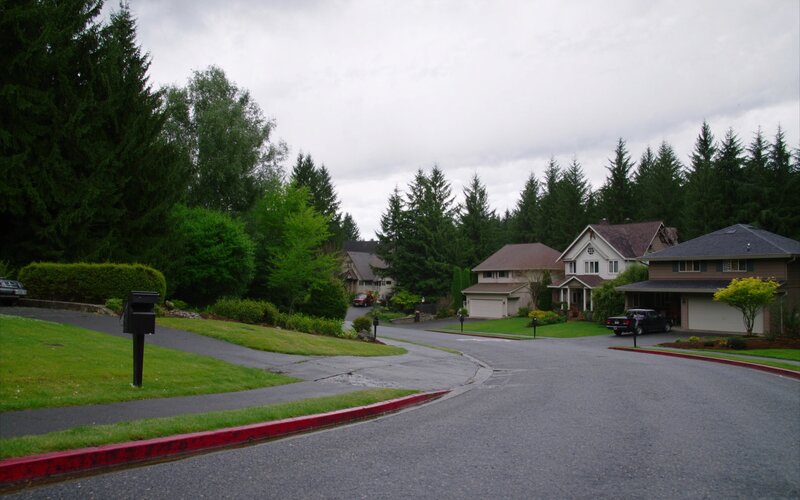
Lea Hill neighborhood in Auburn WA featuring suburban homes on the plateau with Pacific Northwest mountain views
Lea Hill — Auburn’s elevated plateau neighborhood with views, newer construction, and strong school assignments.

Lea Hill

Lea Hill sits on a plateau east of Auburn’s core, overlooking the Green River valley. The vibe is suburban and quiet, with a mix of families and long-term residents who appreciate the views and the breathing room. Homes here are mostly 1990s to 2010s construction, running from 1,800 to 3,200 sq ft on lots between 5,000 and 10,000 sq ft. Median prices run $650,000 to $750,000. Most students attend Lea Hill Elementary and Auburn Mountainview High School. Sunrise Park is the main neighborhood park, and nearby Green River College adds a practical anchor.

Deep Dive: Lea Hill →

West Auburn / Downtown Corridor

This is the historic heart of Auburn, built around the original downtown and the Sounder rail station. The character is urban for Auburn — walkable blocks, older commercial buildings, and a mix of housing types. Single-family homes typically run 1,000 to 1,800 sq ft on compact lots, with prices often starting in the $460,000 to $530,000 range — some of the lowest in the city. Students attend Dick Scobee Elementary and Auburn High School. The Auburn Farmers Market, Game Farm Park, and the White River Amphitheatre are all close by.

Deep Dive: West Auburn →

Lakeland Hills

Lakeland Hills is a master-planned community on the south end of Auburn straddling the King-Pierce County line. The character is clean, organized, and family-forward, with wide streets, consistent landscaping, and a central park with splash pad and sports fields. Homes are mostly 1995 to 2015 construction, ranging from 1,600 to 3,500 sq ft. Parts of Lakeland Hills fall in the Auburn School District and parts fall in the Dieringer School District — school assignment depends on your exact address, so always confirm before you make an offer. Auburn SD students typically attend Lakeland Hills Elementary and Auburn Mountainview High School. Dieringer SD students attend Dieringer Heights Elementary and Lake Tapps Middle School.

Deep Dive: Lakeland Hills →

Auburn Valley / East Main

The Auburn Valley and East Main Street area runs along Auburn’s eastern edge, where the terrain rises toward the Covington foothills. The character is semi-rural with some suburban pockets — larger lots, older homes, and more breathing room. Homes range from 1970s to early 2000s construction, typically 1,500 to 2,800 sq ft, with lots from a quarter acre to over an acre in some pockets. Students typically attend Auburndale Elementary and Auburn Mountainview High. The Green River Trail’s eastern sections pass through here, making it popular with cyclists and walkers.

Deep Dive: Auburn Valley →

Terrace View / North Auburn

North Auburn runs between the downtown core and the Kent city line along Auburn Way North. Terrace View is one of the established neighborhoods in this corridor, with homes mostly built from the 1960s through the 1980s. Sizes run 1,200 to 2,200 sq ft on lots from 6,000 to 10,000 sq ft. Prices here are among the lowest in Auburn — a real opportunity for buyers willing to update an older home. Students typically attend Ilalko Elementary and Mt. Baker Middle School, feeding into Auburn High School. Game Farm Wilderness Park is the main neighborhood green space.

Deep Dive: North Auburn →

Cobble Creek / Verdana

Cobble Creek and Verdana are two of Auburn’s newer planned communities near the SR-18 interchange in the southeast corner of the city. These neighborhoods were built mostly between 2005 and 2018, with homes running 2,000 to 3,500 sq ft on lots from 4,000 to 7,000 sq ft — Northwest contemporary style with open floor plans and attached garages. Verdana students typically attend Arthur Jacobsen Elementary and Cascade Middle School, feeding into Auburn Mountainview High. Easy SR-18 access toward Covington and the Outlet Collection Seattle is a practical plus.

Deep Dive: Cobble Creek / Verdana →

The Bridges

The Bridges is Auburn’s most upscale planned community, tucked into the hills on Auburn’s northeast corner near the Kent boundary. The vibe is gated and polished — tree-lined streets, larger lots, and homes running 2,400 to 4,500 sq ft on lots from 7,000 to 14,000 sq ft. Some homes have territorial views. Students typically attend elementary schools in the Lea Hill zone, then Rainier Middle School, and Auburn Mountainview High School. If you want more home for your dollar compared to similar properties in Renton or Kent, The Bridges is consistently at the top of that list.

Deep Dive: The Bridges →

South Auburn / Muckleshoot Area

South Auburn runs along Auburn Way South toward the Muckleshoot Casino and the Pierce County line. The character is more commercial and transitional, but affordable residential pockets exist with solid single-family homes. Most homes are 1960s to 1990s construction, ranging from 1,000 to 2,000 sq ft on lots from 5,000 to 8,500 sq ft. Students attend Chinook Elementary and Cascade Middle School, feeding into Auburn High School. Buyers focused strictly on value and South King County employment proximity find Auburn’s lowest prices per square foot here.

Deep Dive: South Auburn →

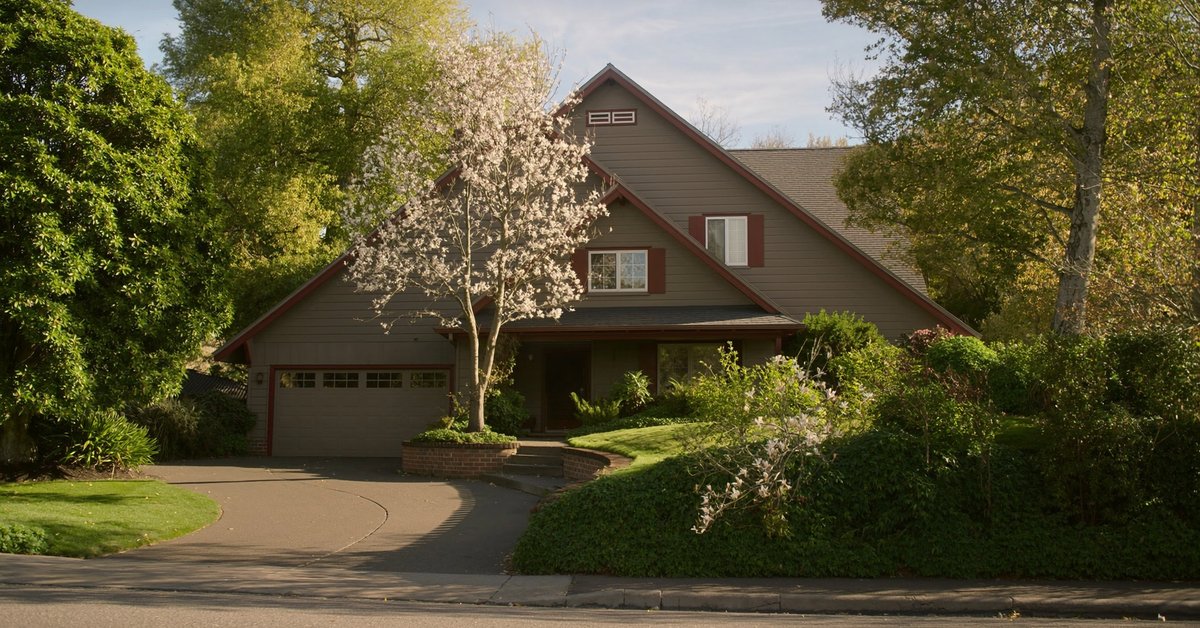
Auburn Washington real estate market 2026 -- suburban home with green lawn representing home values and investment opportunity in King County
Auburn’s 2026 market offers real opportunity for buyers — more inventory, more time to inspect, and honest pricing from sellers.

Auburn WA Real Estate Market in 2026

King County’s median home price sits near $880,000 as of May 2026 — and Auburn’s median of $577,000 to $587,000 makes it one of the most affordable cities in the county for single-family homes. Active listings across King County are up about 30% from last year, which has brought some welcome balance to the market. Homes in Auburn are taking around 58 days to sell on average in 2026, compared to the frantic two-to-five-day pace of 2021 and 2022. That extra time means buyers can inspect properly, ask for repairs, and negotiate without panic.

Price ranges vary significantly by neighborhood. Southeast Auburn (zip 98092), which includes Lea Hill and Lakeland Hills, runs $650,000 to $820,000 for move-in-ready homes. Downtown Auburn (zip 98002) starts closer to $460,000 to $530,000. West Auburn and North Auburn (zip 98001) are the most affordable pockets, with single-family homes often starting in the upper $400,000s. No matter which part of Auburn you are shopping in, you are still buying well below the King County average.

The inventory increase across King County has been a real shift for Auburn buyers in 2026. A year ago, a 2,000 sq ft three-bedroom in Lea Hill would go under contract in a weekend with multiple offers. Today, those same homes sit for four to eight weeks before going under contract — and that extra time is genuinely valuable. Buyers can get a real inspection done, ask for repairs, and negotiate without panic.

For sellers, the message is clear: accurate pricing from day one matters more than it has in years. I see homes in Auburn sitting 60 to 90 days because they launched 5% to 8% above where the data says they should be. Homes that were priced correctly in early 2026 are still selling — they just require patience and honest expectations.

Over the last 12 months, Auburn prices have been essentially flat to slightly down — about 3.8% lower year-over-year for the city as a whole. Lakeland Hills and The Bridges have held up the best. Older homes in North Auburn and parts of South Auburn have softened more, which creates real opportunity for buyers willing to do some work.

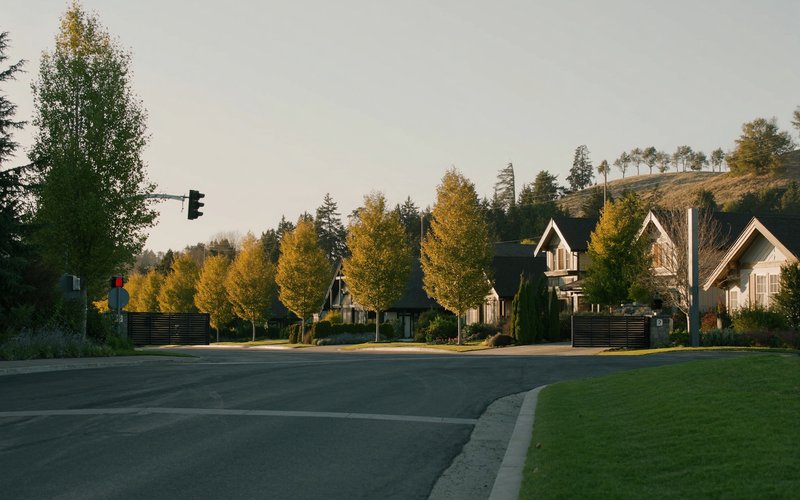
The Bridges upscale neighborhood in Auburn WA with larger craftsman homes and tree-lined streets in King County
The Bridges — Auburn’s most upscale planned community, with larger homes and territorial views near the Kent border.

Frequently Asked Questions: Living in Auburn, WA

Is Auburn, WA a good place to live?

Auburn is a strong fit for buyers who want affordability, practical highway and transit access, and a real Pacific Northwest lifestyle without paying Eastside prices. It is not the trendiest city in King County, but it offers something more valuable right now: a home you can actually afford, a yard you can use, and a commute you can manage. For first-time buyers, growing families, and relocators from high-cost markets, Auburn consistently ranks as one of the best value cities in the Seattle metro.

What is the average home price in Auburn, WA in 2026?

Auburn’s median home price in 2026 runs between $577,000 and $587,000 for single-family homes citywide. That varies significantly by area — Southeast Auburn (Lea Hill, Lakeland Hills) runs $650,000 to $820,000, while Downtown Auburn starts closer to $460,000. Homes are averaging about 58 days on market in 2026, which gives buyers meaningful time to inspect and negotiate compared to prior years.

What are the best neighborhoods in Auburn, WA?

The best neighborhood depends on your priorities. For newer construction and strong schools, Lea Hill and Lakeland Hills lead the pack. For the best Sounder commute access and lowest prices, Downtown Auburn and North Auburn are worth a close look. For more space and a semi-rural feel, Auburn Valley and East Main offer larger lots. For the most upscale finished product in Auburn, The Bridges delivers at a price still well below comparable Renton or Kent options.

How far is Auburn, WA from Seattle?

Auburn is about 30 miles south of downtown Seattle. By Sounder commuter train, the trip takes roughly 50 minutes without any freeway driving. By car on I-5, expect 45 to 65 minutes during AM peak hours. SR-167 to I-5 is the main driving route. For frequent Seattle commuters, the Sounder is one of Auburn’s most practical advantages.

What school district is Auburn, WA in?

Most of Auburn is served by the Auburn School District. Parts of south Auburn (Lakeland Hills) overlap with the Dieringer School District in Pierce County. Always confirm the school district for any specific address before writing an offer — it matters for both school assignment and resale value.

Explore Auburn, WA Yourself

The best way to know if living in Auburn, WA is the right fit is to come out and drive it. Hit the Green River Trail by bike, walk downtown and check out the farmer’s market, then drive out to Lea Hill for the view. The range of this city is bigger than most people expect until they see it in person.

View Auburn on Google Maps

Your guide to life outside Seattle.

Gregory Dorrell | Coldwell Banker Bain | WA License #111862
253-350-0045 ·
greg@livingoutsideseattle.com ·
www.livingoutsideseattle.com
EastsideKing County Cities May 17, 2026

Living in Sammamish, WA | 2026 Real Estate & Lifestyle Guide


Living in Sammamish, WA: Your 2026 Real Estate & Lifestyle Guide

Is Sammamish, WA a Good Place to Live?

Living in Sammamish, WA means trading a shorter commute for one of the best school systems in Washington State — and for most families who move here, that trade is worth every dollar. Sammamish sits on a plateau above Lake Sammamish, directly between the Microsoft campus in Redmond and the tech corridor in Bellevue. The city incorporated in 1999 and has grown steadily ever since, built almost entirely on master-planned communities with trails, parks, and strong HOA infrastructure. It is not a city that happened organically. It was designed for families, and it shows.

The median home price in Sammamish runs around $1.6 million as of May 2026 — well above the King County median of $880,000. That premium exists for real reasons: the Issaquah and Lake Washington school districts consistently rank among the top performers in the state, the commute to Microsoft and Bellevue tech employers is 10 to 30 minutes by car, and the trail system connecting Beaver Lake Preserve, Lake Sammamish State Park, and dozens of neighborhood parks makes the outdoor lifestyle genuinely accessible. For buyers who can afford the price of entry, Sammamish delivers on what it promises.

Sammamish WA Real Estate Market in 2026

Sammamish home prices have softened modestly over the last 12 months — down roughly 3.5% year-over-year citywide — after years of rapid appreciation. The citywide median sits around $1.6 million in spring 2026, with meaningful differences by zip code. Zip 98075, which covers the southern and central plateau including Trossachs and Aldarra, runs closer to $1.63 million. Zip 98074, covering the western and northern areas including Klahanie and Tally Ho, runs closer to $1.43 million. Those are real differences for buyers working with a specific budget.

The market is still competitive by most standards — well-priced homes in strong school zones are still moving in one to three weeks with multiple offers. What has changed is the middle of the market. Homes in the $1.2 million to $1.6 million tier that have condition issues or are priced 5% to 8% above comparable sales are now sitting for four to six weeks before going under contract. That extra time is valuable. It gives buyers room to do a real inspection, review HOA documents thoroughly, and negotiate without the panic of 2021 and 2022.

One number worth knowing: the measurable school district premium in Sammamish is $50,000 to $100,000. Two otherwise identical homes — same year built, same square footage, same condition — can differ by that much based solely on whether they sit in the Issaquah School District versus outside it. Buyers should understand they are paying for that assignment, and sellers should make sure they are marketing it clearly.

Sammamish WA Commute Times to Seattle and Beyond

Sammamish is a car-dependent city in 2026. There is no light rail in Sammamish itself — the nearest stations are Redmond Technology Station on the 2 Line (about 10 miles west) or Bellevue Downtown Station on the same line. King County Metro runs several routes to the Issaquah Highlands Park and Ride and the Eastgate Park and Ride, where riders can connect to express buses toward Seattle. Most Sammamish residents drive to work or drive to a transit hub. If your job is in Redmond or Bellevue and you can flex your schedule past 9 AM, commute times drop meaningfully compared to peak-hour estimates below.

SR-520 floating bridge commute route from Sammamish to Seattle across Lake Washington
Most Sammamish commuters take SR-520 or I-90 toward Bellevue, Redmond, or Seattle. Peak-hour times vary significantly.

Destination Distance 2026 Peak Drive (AM) Transit Option
Downtown Seattle 24 miles 40 to 60 min I-90 / Bus to Link
Amazon (South Lake Union) 22 miles 40 to 60 min SR-520 / Drive or Bus Transfer
Microsoft (Redmond) 10 miles 20 to 35 min SR-202 / Drive
Bellevue Tech Corridor 10 miles 20 to 30 min SR-520 / I-405 / Drive
SeaTac Airport 28 miles 35 to 55 min I-405 South / Drive

The Sammamish to Bellevue stretch on SR-520 and I-405 is one of the most congested corridors in the region during morning rush. If your job allows schedule flexibility, even shifting your start time by 30 minutes makes a real difference.

Best Neighborhoods in Sammamish, WA

Sammamish is made up almost entirely of master-planned communities built between 1990 and 2015. Each has defined boundaries, consistent character, and HOA governance. Here is a guide to the main areas buyers should understand before starting their search.

Sammamish Washington plateau streetscape with Craftsman homes and tree-lined residential street
Sammamish neighborhoods are mostly master-planned communities built between 1990 and 2015, with strong HOA infrastructure and trail connectivity.

Trossachs

Trossachs is one of Sammamish’s largest and most established neighborhoods, located in the southwest part of the city. The character is leafy and well-organized, with winding streets, mature trees, and strong community infrastructure. Homes were mostly built between 1993 and 2005, ranging from 2,200 to 4,500 square feet on lots from 6,000 to 12,000 square feet. This is a high-demand neighborhood because of the school assignments and the quality of the housing stock. Students attend Sunny Hills Elementary, Pine Lake Middle School, and Skyline High School — rated 10 out of 10 on GreatSchools and consistently ranked in the top 5% of Washington high schools.

Trossachs neighborhood Sammamish WA with two-story Craftsman homes and mature trees

Klahanie

Klahanie sits on the western edge of Sammamish in unincorporated King County, but it is closely tied to the city in terms of identity and school assignment. The neighborhood is community-driven with its own amenity center, pools, tennis courts, and a small retail core with a Safeway. Homes range from 1,800 to 3,800 square feet, built mostly between 1988 and 2000. Klahanie is split between the Issaquah and Bellevue school districts depending on the specific street — always confirm the school assignment for any specific address before writing an offer.

Pine Lake

The Pine Lake area surrounds the actual lake of the same name in the central-east part of Sammamish. The character is a mix of older lakefront properties and newer hillside developments. Lakefront homes are rare and expensive, often well above the city median. Hillside homes near Pine Lake run 2,000 to 3,500 square feet on lots from 8,000 to 15,000 square feet, with some backing to Beaver Lake Park or the Pine Lake shoreline. Students are served by the Issaquah School District, with Pine Lake Middle School as a common assignment.

Tally Ho / Inglewood Hill

The Tally Ho and Inglewood Hill area covers the central ridgeline of Sammamish, with homes that often capture views of the Cascades or the valley below. Lots run from 10,000 square feet to a half acre and home sizes span 2,000 to 5,000 square feet across a wide range of construction years. This area falls primarily in the Lake Washington School District, feeding into Eastlake High School — ranked 6th in Washington State.

East Lake Sammamish Parkway

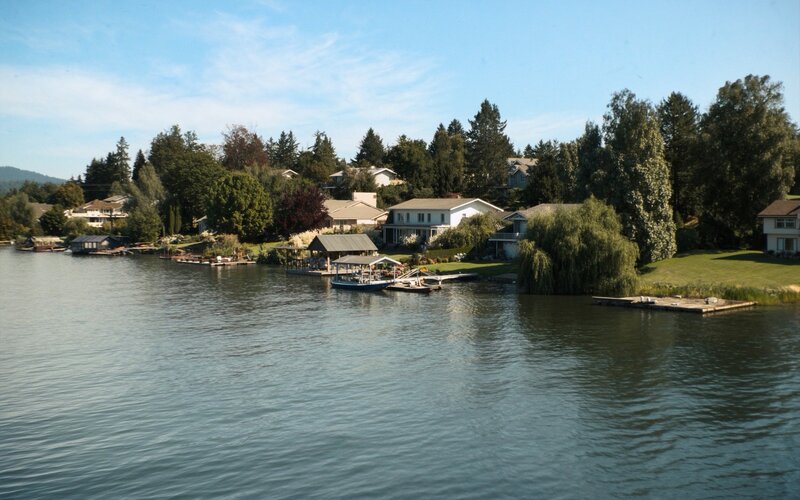
The homes along East Lake Sammamish Parkway are among the most sought-after in the city. This narrow strip runs the eastern edge of Lake Sammamish and includes everything from modest mid-century lakefront cottages to modern estates on the water. Lakefront prices start around $2 million and run significantly higher for turnkey properties with dock rights. Lake Sammamish State Park is the dominant recreational anchor for this entire corridor. If waterfront living is on your list, this is the area to study first.

East Lake Sammamish Parkway waterfront homes with Lake Sammamish shoreline and residential docks

Sahalee

Sahalee is a private gated community on the western plateau of Sammamish, built around the Sahalee Country Club — one of Washington’s most prestigious private golf courses. The character is upscale, quiet, and centered on the golf and country club lifestyle. Homes range from 2,800 to over 6,000 square feet, built mostly from the late 1980s through the 2000s, on lots from 10,000 to 20,000 square feet. Sahalee is served by the Issaquah School District. HOA fees here are higher than most Sammamish neighborhoods — always request the full HOA disclosure and reserve study before removing your financing contingency.

Sahalee Country Club community Sammamish WA with golf course views and luxury single-family homes

Aldarra

Aldarra is a high-end planned community in the southern part of Sammamish, built around the Aldarra Golf Club. The character is refined and private, with larger lots, newer custom homes, and a consistent level of finish throughout. Homes range from 3,000 to over 5,500 square feet, built mostly between 2000 and 2015, on lots from 10,000 square feet to over half an acre. Aldarra is served by the Issaquah School District. Students here typically attend Sunny Hills Elementary, Pine Lake Middle, and Skyline High.

Plateau Communities: Vistas, Highlands, and Eastridge

The plateau communities in central and eastern Sammamish — including Vistas, Highlands, and Eastridge — represent the city’s broadest middle market. These are solid single-family neighborhoods built between 1995 and 2012, with homes typically running 2,000 to 3,800 square feet on lots from 5,000 to 9,000 square feet. These communities are served by both the Issaquah and Lake Washington school districts depending on exact location — confirm before writing an offer. Buyers who want a move-in-ready Sammamish home at a more accessible price point than Trossachs or Sahalee typically land in these plateau communities.

Sammamish WA Home Values and Investment Outlook

The inventory increase in 2026 has brought some welcome balance to a market that spent most of the last decade tilted hard toward sellers. Sammamish buyers in 2024 and 2025 often wrote offers with no inspection, waived financing contingencies, and bid 10% or more over asking. That era is not completely over, but it is fading. Well-priced, well-presented Sammamish homes are still selling in one to three weeks with competitive offers. Overpriced homes or homes with condition issues are now sitting for a month or longer — something that felt impossible here just two years ago.

Price trends show the most softening in the $1.2 million to $1.6 million tier, while homes under $1.1 million and luxury properties above $2 million have held up relatively better. If you are selling in the middle tier, pricing discipline and presentation quality matter more than they have in years.

Sammamish Washington real estate 2026 -- Craftsman home on plateau street with Cascade Mountain views
Well-priced Sammamish homes in good school districts still sell in one to three weeks in 2026, but overpriced homes are sitting longer than they did two years ago.

Homes that hold value best in Sammamish consistently share a few traits: strong school assignment, construction from 2000 or later, open floor plan, attached garage, and a level usable yard. Homes with great school assignments but deferred maintenance are taking a pricing penalty in 2026 that they would not have taken two years ago. Buyers are not willing to absorb condition risk the way they once were.

The 12-month picture for Sammamish is steady, not flashy. Buyers who pay attention to school zones, inventory timing, and lot quality will find real opportunities over the next few months. Sellers who price honestly and present well will still see strong results.

Frequently Asked Questions: Living in Sammamish, WA

Is Sammamish, WA a good place to live?

Sammamish consistently ranks as one of the best places to live in Washington State for families. The combination of top-rated schools, low crime, excellent parks and trails, and proximity to Eastside tech employers makes it a strong choice for buyers who can meet the price of entry. The tradeoffs are high home prices, car dependency, and HOA costs that add real money to the monthly budget.

What is the average home price in Sammamish, WA in 2026?

The median home price in Sammamish is approximately $1.6 million as of spring 2026, down about 3.5% from a year ago. Zip code 98074 (western and northern Sammamish) runs closer to $1.43 million, while zip 98075 (southern and central plateau) runs closer to $1.63 million. Well-priced homes in strong school zones are still moving in one to three weeks.

What are the best neighborhoods in Sammamish, WA?

For top Issaquah School District assignments and established character, Trossachs and Aldarra lead the list. For waterfront access, the East Lake Sammamish Parkway corridor is in a class of its own. For a slightly more accessible price point with strong Lake Washington SD schools, Tally Ho and Inglewood Hill are worth a close look. For move-in-ready homes at the broadest range of prices, the central plateau communities cover the most ground.

What school district is Sammamish, WA in?

Sammamish is served by two school districts depending on your exact address. Most of the city falls in the Issaquah School District, which includes top-rated Skyline High School. Parts of the northern and western city are in the Lake Washington School District, home to Eastlake High School. Some neighborhoods like Klahanie overlap with the Bellevue School District. Always confirm the specific school assignment for any address before writing an offer.

How far is Sammamish, WA from Seattle?

Sammamish is about 24 miles east of downtown Seattle. By car on I-90, expect 40 to 60 minutes during AM peak hours. There is no direct light rail to Sammamish — the nearest station is Redmond Technology Station, about 10 miles away. For the Microsoft and Bellevue tech corridor, Sammamish is a 20 to 30 minute drive, which is one of its biggest draws for tech workers.

Explore Sammamish, WA Yourself

Sammamish is best understood by getting out and driving the plateau. Head to Beaver Lake Preserve for a trail walk, then drive through Trossachs or Klahanie to see what the neighborhoods actually look and feel like. Finish at Lake Sammamish State Park to understand what the waterfront lifestyle here is about. It will tell you more than any listing ever could.

View Sammamish on Google Maps →

Your guide to life outside Seattle.

Gregory Dorrell | Coldwell Banker Bain | WA License #111862
253-350-0045  ·
greg@livingoutsideseattle.com  ·
www.livingoutsideseattle.com
EastsideIssaquahKing County Cities May 17, 2026

Living in Mirrormont Issaquah

Living in Mirrormont, Issaquah: What You Need to Know in 2026

Mirrormont is the acreage neighborhood that sits in unincorporated King County south of Issaquah, tied to Issaquah identity for shopping, schools, and lifestyle. In 2026, with buyers looking for lot size, room for animals, and the kind of privacy that simply does not exist on the Eastside anymore, Mirrormont is one of the strongest options in the region. If you want a home where you can have horses, chickens, a workshop, and a real garden without an HOA telling you what color to paint your trim, Mirrormont delivers.

What is it actually like to live in Mirrormont in 2026?

On a weekday morning, Mirrormont feels like real country living. Driveways are long, lots are screened by mature firs and cedars, and you can hear birds and the occasional sound of a horse from a neighbor’s pasture. Most residents leave for work between 7 and 8 AM, heading north toward Issaquah and the I-90 corridor. The roads are narrow and winding, which keeps speeds down and gives the neighborhood a real rural character.

On a weekend, Mirrormont stays quiet but turns more active for residents. People walk dogs along the loop roads, ride horses on the trail easements that connect properties, and head into Tiger Mountain State Forest for hikes. The community pool opens in the summer and becomes a real gathering spot. Annual events like the neighborhood garage sale weekend and the Easter egg hunt give residents a reason to actually meet each other, which matters in a neighborhood where you cannot see your neighbor’s house.

Most residents are a mix of long-time owners who bought in the 1970s and 1980s when Mirrormont was considered the country, plus newer buyers from Bellevue and Issaquah who specifically wanted acreage and quiet. Many residents work from home or run small businesses out of detached shops on the property. What separates Mirrormont from other Issaquah-area neighborhoods is the lot rules. Most properties allow horses, chickens, and outbuildings without the restrictions that define master-planned communities. The land is the asset, and what you can do on it is the real value.

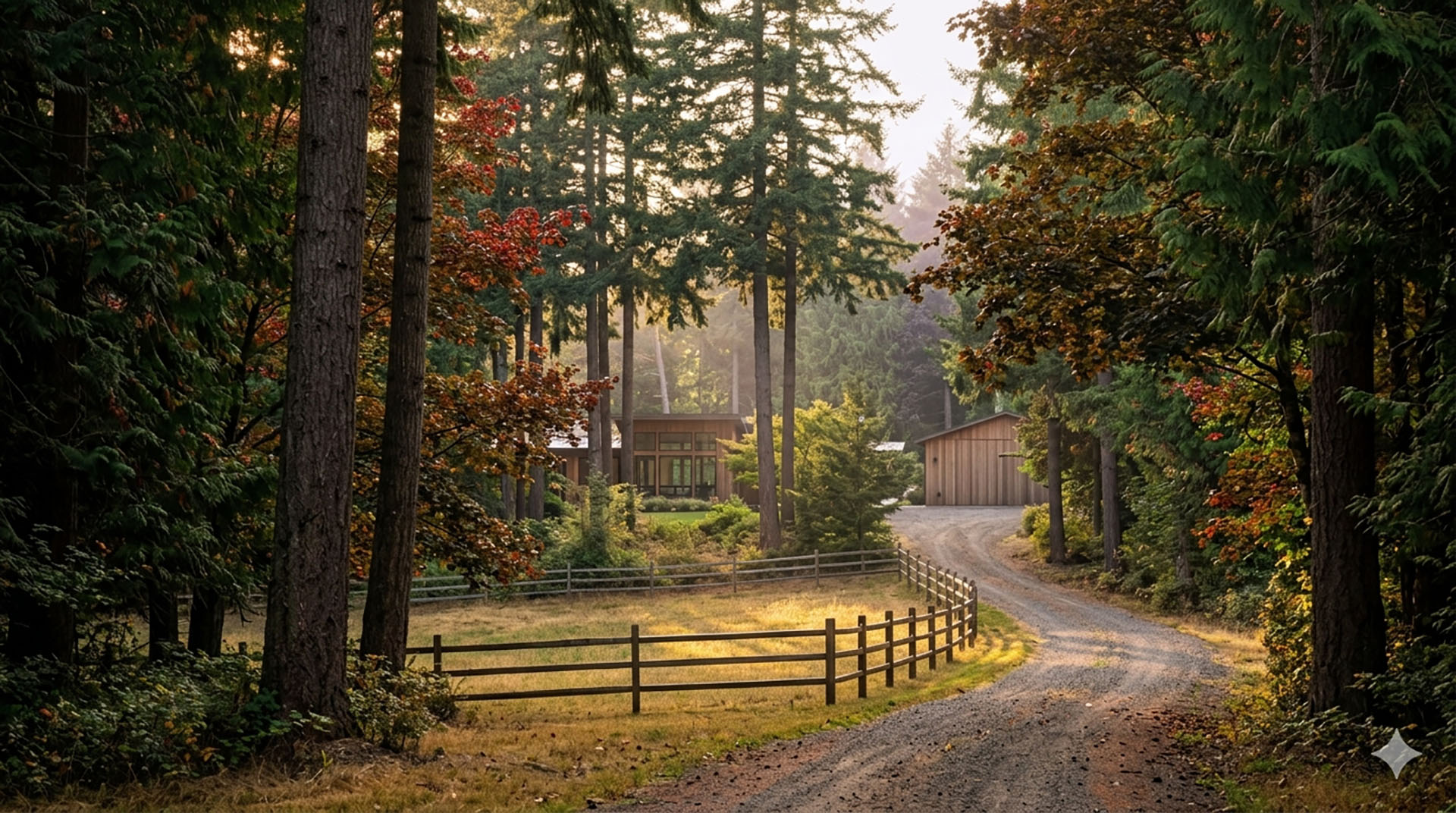
A country lane through the wooded Mirrormont neighborhood near Issaquah, with split-rail fencing along the right side.

Homes in Mirrormont: What the Data Shows

Most homes in Mirrormont were built between the 1970s and the 2000s, with the strongest concentration of construction in the late 1970s and 1980s. You will find Pacific Northwest contemporary homes, cedar-clad ranches, custom builds from the 1990s, and a smaller share of newer 2010s and 2020s rebuilds. Single-family homes typically run 2,000 to 5,000 square feet on lots between one and five acres, with a meaningful share of properties at three acres or larger. Many homes have detached shops, barns, or outbuildings that add real utility for owners who use the property. There is no townhome or condo inventory in Mirrormont. Detached single-family homes on acreage are the only product type.

Market Pulse Mirrormont (98027) King County
Median Sales Price (May 2026) ~$1,395,000 ~$859,000
Median Days on Market ~32 days ~28 days
Active Listings Change (vs. Jan 2026) +14% +30%

Estimates based on current NWMLS data for the Mirrormont residential pockets within the 98027 ZIP code. Inventory turnover here is the lowest of any Issaquah-area neighborhood, mostly because long-time owners stay put. When a property does hit the market, motivated buyers move quickly.

Schools Serving Mirrormont

Mirrormont kids attend a different school pipeline than most other Issaquah neighborhoods. Most addresses feed Maple Hills Elementary in Renton, then Maywood Middle School, then Liberty High School. All three schools are part of the Issaquah School District, but the campuses sit south of I-90 in the Renton area rather than in Issaquah proper. Always confirm your specific address with the Issaquah School District before you write an offer because a few outlier properties have been reassigned over the years.

Maple Hills Elementary is one of the smaller and more community-feeling schools in the district, with strong test scores and a tight parent-teacher ratio. Maywood Middle School has solid music and STEM programs and a strong Project Lead the Way curriculum. Liberty High School is one of the top-rated public high schools in Washington, with a 96 percent graduation rate, strong AP offerings, and a state-recognized performing arts program.

The school pipeline for Mirrormont involves driving for most families. Walking distance is essentially zero given the spread-out nature of the neighborhood. Most kids ride buses to elementary and middle school, then drive themselves to Liberty High once they are old enough.

Getting to Work from Mirrormont

Mirrormont residents typically take Issaquah-Hobart Road north to reach Issaquah and I-90. Some southern properties use SR-18 to reach I-5 or I-405. The exact route depends on which loop in the neighborhood you live on.

Destination Distance 2026 Peak Drive (AM) Transit Option
Downtown Seattle 22 miles 45 to 65 min Drive to I-90 / ST 554 from Issaquah
Bellevue / Amazon Bellevue 14 miles 28 to 40 min I-90 to I-405 / ST 554 from Issaquah
Microsoft (Redmond) 17 miles 32 to 45 min I-90 to SR-520 / Connector Bus
SeaTac Airport 24 miles 38 to 55 min SR-18 to I-5 / Drive

A maintained forest trail at the edge of the Mirrormont neighborhood near Issaquah, suitable for hikers and equestrians.

What I See as a Valuation Expert in Mirrormont

The biggest valuation factor in Mirrormont is the lot, the systems, and what the property can do. On a 1985 home with 3,000 square feet of living space sitting on two acres, the lot itself can carry 50 to 60 percent of the appraised value, with another 10 to 20 percent from any usable outbuildings, fenced pasture, or detached shop. When I assess homes here for institutional lenders, I spend serious time on lot grade, drainage, septic system condition, well capacity, and the condition of any barns or shops. A flat usable two-acre lot with a healthy septic system and a permitted detached shop will appraise much stronger than a same-size home on a steep slope with a failing system.

The HOA picture is light by Eastside standards. The Mirrormont Park Association charges a modest annual fee that covers the pool, tennis courts, and community events, but it is voluntary in some sub-areas and not a true governing HOA. Most architectural decisions, landscaping, and outbuilding additions are governed by King County code rather than by HOA rules. That gives owners flexibility but also means properties vary widely in maintenance and condition.

Within Mirrormont, certain lots and pockets carry premium pricing. Properties with usable flat acreage suitable for horse pasture or large gardens, lots backing directly to Tiger Mountain State Forest, properties with newer wells and recently inspected septic systems, and any home with significant outbuildings tend to move first when they hit the market.

Explore Mirrormont Yourself

The fastest way to know if Mirrormont fits is to drive Mirrormont Boulevard up the hill, then turn onto a few of the side loops to see how the lot sizes open up.

View Mirrormont on Google Maps →

Your guide to life outside Seattle.

Gregory Dorrell | Coldwell Banker Bain | WA License #111862
253-350-0045  ·
greg@livingoutsideseattle.com  ·
www.livingoutsideseattle.com
Buyer Resources May 16, 2026

King County Mortgage Rates 2026: What Buyers Are Actually Paying


King County Mortgage Rates 2026: What Buyers Are Actually Paying Now

King County mortgage rates in 2026 have been anything but predictable. In just 11 days in late March, the 30-year fixed rate jumped from 5.98% to 6.38%. That’s 40 basis points, and I got three calls from buyers who thought I’d made a mistake when they checked the numbers twice.

I’ve spent over 13 years as a field inspector evaluating properties for institutional clients across King County. When I tell you this rate move caught experienced buyers off guard, I mean it. Here’s what happened, what it costs you per month, and what to do about it.

Why King County Mortgage Rates Jumped 40 Basis Points in March 2026

Bar chart showing King County mortgage rates at 3%, 5%, and 6.38% — 2026 comparison

The Federal Reserve didn’t cause this rate spike. The Fed has been holding steady for months. What drove Seattle area mortgage rates up was the bond market reacting to geopolitical events ‚Äî Middle East tensions, oil price volatility, and fear. The kind of volatility that reminds us mortgage rates don’t happen in a vacuum.

Mortgage rates track the 10-year Treasury bond, not the Fed’s benchmark rate directly. When investors rushed into bonds as a safe haven in late March, yields moved, and mortgage rates followed. It’s counterintuitive, but that’s how bond markets work.

The result: the 30-year fixed rate hit 6.38% as of March 26, 2026. The 15-year fixed settled around 6.03%. And the Seattle area mortgage rate environment shifted fast enough to reshape buyer budgets overnight.

How the Bond Market Controls Your Seattle Area Mortgage Rate

Most buyers assume the Fed controls mortgage rates. It doesn’t, not directly. The Fed sets the federal funds rate, which affects short-term borrowing. Mortgage rates follow the 10-year Treasury yield, which responds to inflation expectations, global risk sentiment, and economic data.

When geopolitical tension spiked in late March 2026, bond investors moved money in ways that pushed mortgage rates up even though the Fed held steady. This is why rates can move 40 basis points between Fed meetings without any Fed action at all.

The Fed’s current position is “wait and see.” They’re watching inflation data and employment before making any moves. No rate cuts are on the near-term table. The bond market is doing the talking, and bond markets respond to global events faster than any central bank can.

For King County buyers, this means rate movements are harder to predict than ever. You can’t just watch Fed announcements to know where your rate is going.

What the Rate Increase Costs King County Buyers Per Month

Monthly mortgage payment comparison table for King County homes at different interest rates 2026

Let’s do the math on a real King County scenario. The median single-family home price in King County was $995,000 as of March 2026. With 10% down, that’s an $895,500 loan.

At 5.98% (late February), the monthly payment was about $5,370. At 6.38% (late March), it’s about $5,500. That’s $130 more per month on the same house.

On a $900,000 loan, each half-point rate increase costs roughly $300 to $350 per month. For buyers with a fixed budget, that $130 to $350 swing might be the difference between qualifying and not qualifying, or between a $700K range and a $650K range. In a market where King County’s median days on market is just 7 days, that payment pressure matters.

For context: the 30-year fixed rate was 6.65% this same week in March 2025. So despite the spike, you’re still borrowing at a lower rate than a year ago. That matters for perspective, even if the recent jump doesn’t feel good.

King County Housing Market Context: Inventory, Supply, and Demand in 2026

Here’s what makes this rate environment unusual. King County had 5,071 homes for sale in March 2026, up 37.5% year-over-year from 3,687 in March 2025. More inventory than we’ve seen in years. Monthly supply sits at 2.2 months for single-family homes, up from 1.4 last year. For condos, it’s 4.2 months, up from 3.3.

Buyers have more options. That’s good. But higher rates are squeezing the qualifying pool, especially at the upper end of the market. The list price ratio is holding at 100%, meaning homes sell at asking price on average. But the pool of buyers who can qualify at 6.38% is smaller than it was at 5.98%.

New listings jumped 16.5% year-over-year to 3,686 in March. That’s a market in transition. More homes, more time on market (though still fast at 7 days median), and fewer buyers who qualify per listing because of rate pressure.

Should You Lock a Mortgage Rate Now or Wait for Rates to Drop?

If you’re buying in the next 30 to 60 days, lock a rate. Here’s why: locking removes uncertainty. You know your payment. You know your deal works at that number. Rate locks typically run 30 to 45 days, so locking now protects you through closing.

Will rates drop? Maybe. But waiting for rates to fall while hoping prices stay flat has never worked consistently for buyers. If rates drop 1% but prices rise 3%, you’ve lost ground on both your monthly payment and your equity position.

Some buyers ask about rate buydowns. If a seller or builder is offering a 2-1 buydown, that’s worth evaluating. You pay less in the first year, a bit more in the second, then market rate from there. rate buydown explainer In a market with growing inventory, seller-paid buydowns are a real negotiating tool.

When Will Seattle Area Mortgage Rates Come Down?

Watch oil prices and geopolitical headlines, not just Fed announcements. That’s what’s been driving rates lately. If there’s a de-escalation in the Middle East or OPEC signals more production, rates could soften. But that’s speculation, and you can’t build a purchase timeline around it.

The Fed is on pause for the foreseeable future. Rate hikes are off the table, which brings some stability. But cuts aren’t imminent either.

For King County buyers in this environment, be realistic about budget. If your payment tolerance is $4,500 per month and rates stay at 6.38%, you’re looking at roughly a $700K purchase price with 10% down. If you were counting on rates dropping to 5.5%, your budget shifts meaningfully.


Frequently Asked Questions: King County Mortgage Rates 2026

What is the current 30-year fixed mortgage rate in the Seattle area?

As of late March 2026, the 30-year fixed rate is 6.38%, up from 5.98% just four weeks earlier. The 15-year fixed is around 6.03%. For reference, rates were at 6.65% this same week in March 2025, so you’re still borrowing at a lower rate than a year ago despite the recent increase.

Why did mortgage rates go up if the Federal Reserve didn’t raise rates?

Mortgage rates track the 10-year Treasury bond, not the Fed’s benchmark rate directly. When geopolitical tension spiked in the Middle East in late March 2026, bond market volatility pushed mortgage rates up even though the Fed held steady. This is why rates can move sharply between Fed meetings without any Fed action.

How much does a 0.5% mortgage rate increase add to a monthly payment in King County?

On a $900,000 loan, each half-point rate increase adds roughly $300 to $350 per month. On a $700K purchase with 10% down, the jump from 5.98% to 6.38% added about $130 per month.

What first-time buyer programs are available in King County?

Washington State Housing Finance Commission (WSHFC) offers programs including Home Advantage, which provides up to $10,000 in down payment assistance for buyers earning up to $147,400 in King County. The Covenant Homeownership Program also offers 0% interest down payment assistance for qualifying buyers. Talk to a lender before assuming these programs are out of reach.

Is it still a good time to buy a home in King County with rates at 6.38%?

That depends on your situation. If you’re planning to stay in the home five or more years and can afford the payment at today’s rate, buying now gives you price certainty and equity-building time. If rates drop later, you can refinance. The bigger risk is waiting for rates to fall while prices continue to rise.

Your guide to life outside Seattle.

Gregory Dorrell | Coldwell Banker Bain | WA License #111862
253-350-0045  ·
greg@livingoutsideseattle.com  ·
www.livingoutsideseattle.com
Gregory Dorrell is a licensed real estate broker (WA License #111862) with Coldwell Banker Bain. This post is provided for informational purposes and does not constitute financial or investment advice. Mortgage rates, terms, and availability are subject to change and vary by lender and individual circumstances. Please consult with a mortgage lender for current rates and pre-qualification information.


Buyer Resources May 16, 2026

What Is a Mortgage Rate Buydown? A Plain-English Guide for King County Buyers


What Is a Mortgage Rate Buydown? A King County Buyer’s Guide

You’ve probably seen it in listings: “Seller offering 2-1 rate buydown.” Most buyers scroll past it without fully understanding what it means. That’s a mistake, especially in a King County market where 6.38% is the going rate and every monthly dollar matters.

A rate buydown is one of the most useful negotiating tools available right now. Here’s how it works, what it actually costs, and when you should ask for one.

What a Mortgage Rate Buydown Actually Is

A buydown is a way to reduce your mortgage interest rate, either for a set period or permanently, by paying money upfront. Think of it as prepaying interest now to lower your payment later.

There are two main types.

A temporary buydown reduces your rate for the first one, two, or three years of the loan, then steps back up to the full rate. The most common version is the 2-1 buydown. A permanent buydown, often called paying “points,” reduces your rate for the entire life of the loan in exchange for a lump sum at closing.

Right now in King County, the 2-1 buydown is the version worth understanding because it’s the one sellers are offering.

How the 2-1 Buydown Works: The Real Numbers

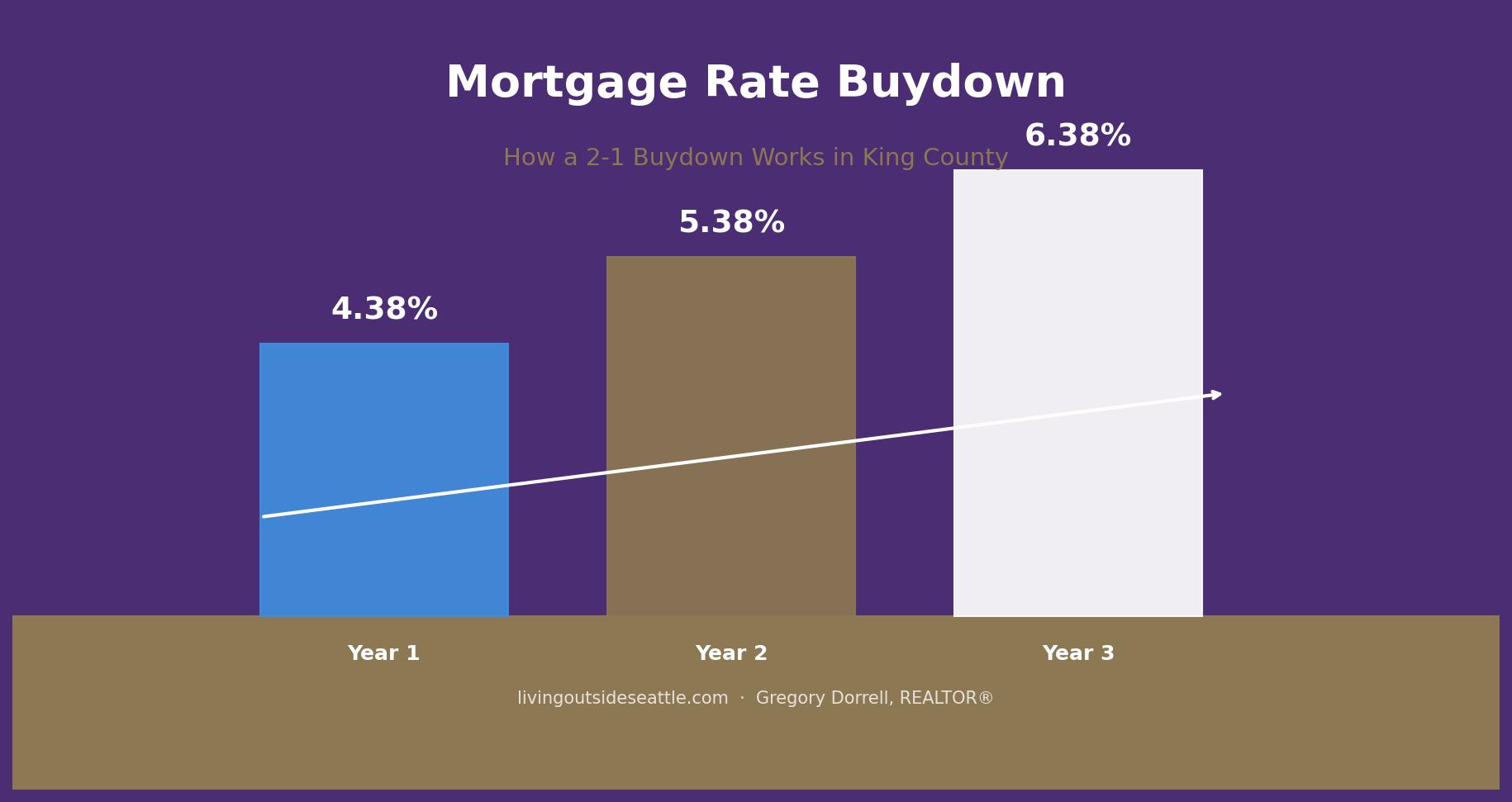
2-1 rate buydown payment schedule King County 2026 — year one 4.38%, year two 5.38%, year three 6.38% on $630K loan

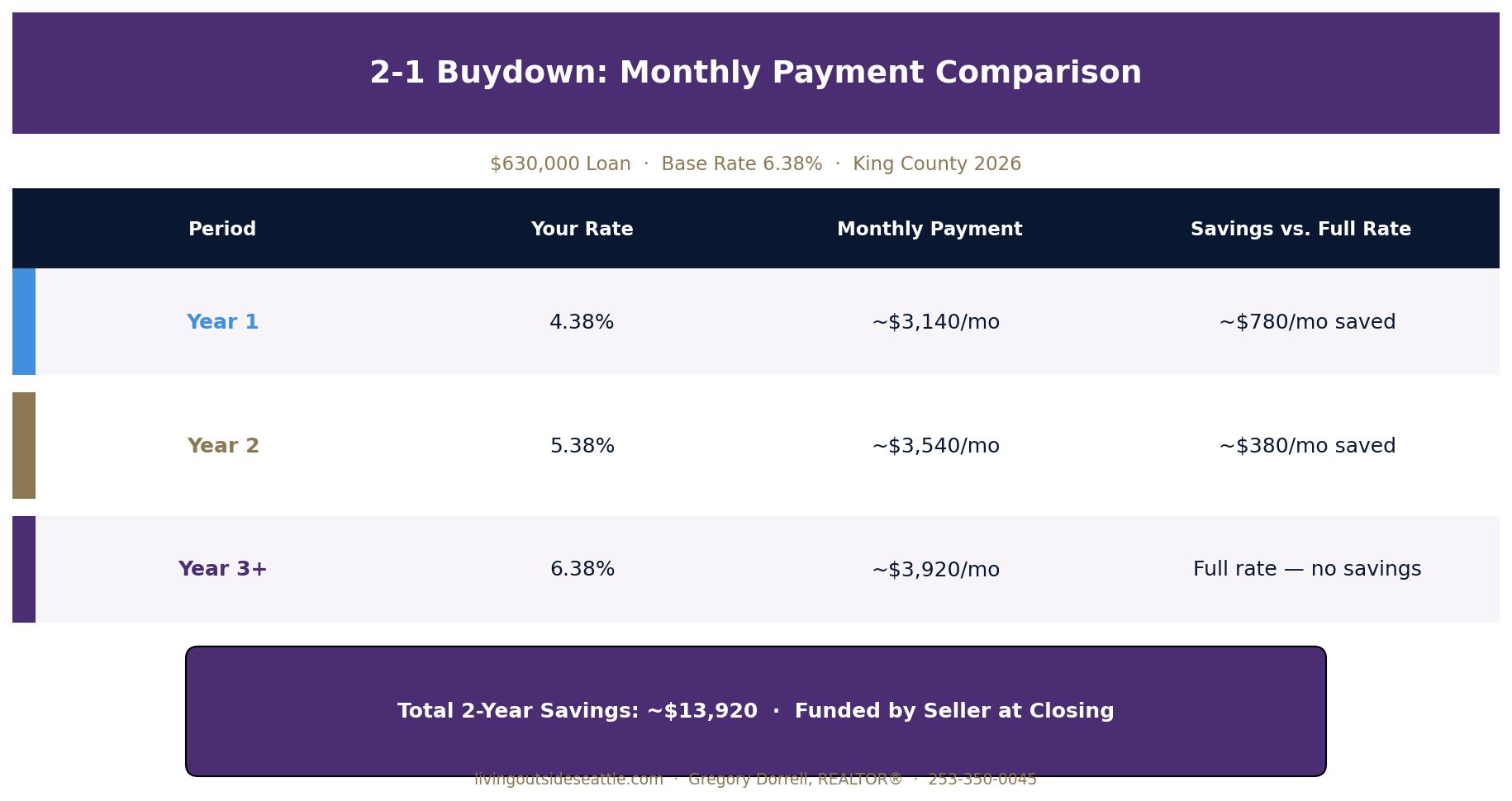
The “2-1” refers to the rate reduction in each year. On a 6.38% base rate:

Year Your Rate Payment on $630K Loan Savings vs. Full Rate
Year 1 4.38% ~$3,140/mo ~$780/mo
Year 2 5.38% ~$3,540/mo ~$380/mo
Year 3+ 6.38% ~$3,920/mo $0

Figures are approximate based on a $630,000 loan (10% down on $700,000 home) at a 6.38% base rate.

Over the first two years, that’s roughly $13,920 in payment savings on a $630,000 loan. The seller funds this difference upfront at closing, usually from their sale proceeds. You get lower payments for two years without doing anything extra.

The cost to the seller to fund a 2-1 buydown on a $630,000 loan is approximately $13,920. That’s what they’re crediting to you. It comes off their bottom line, not yours.

Temporary vs. Permanent Buydown: Which Makes More Sense?

A permanent buydown (paying points) costs roughly 1% of the loan amount per 0.25% rate reduction. On a $630,000 loan, buying your rate down from 6.38% to 6.13% costs about $6,300. To 5.88% costs $12,600. The rate stays lower for 30 years, so if you keep the loan long enough, it pays off.

The break-even math matters here. I run this analysis for clients regularly. If you pay $6,300 to save $95 per month, you break even in about 66 months, just over five years. If you plan to stay longer than that, a permanent buydown pencils out. If you think you’ll refinance when rates drop, a temporary buydown often makes more sense since you get the near-term relief without the permanent cost.

When to Ask for a Seller-Paid Buydown

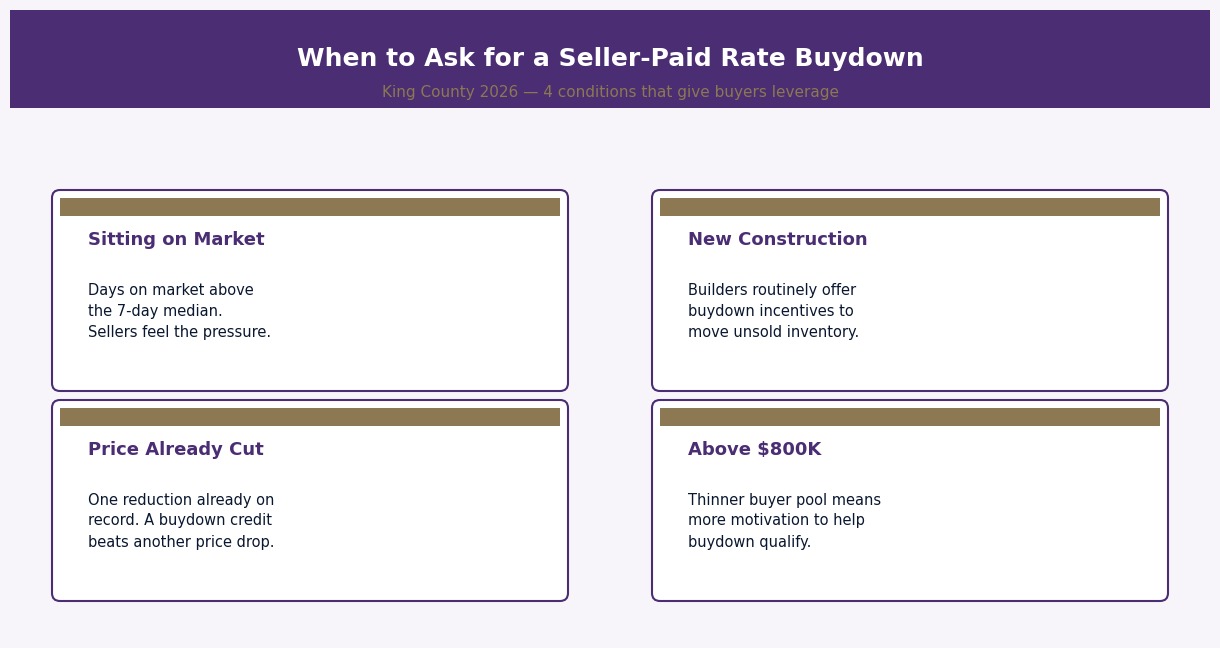
When to ask seller for 2-1 rate buydown King County — inventory rising, days on market increasing, seller negotiating room 2026

Not every seller will offer a buydown, and not every market gives you the leverage to ask. Here’s when the conditions are right.

King County had 5,071 homes for sale in March 2026, up 37.5% year-over-year. Monthly supply sits at 2.2 months for single-family homes. That’s still a seller’s market, but it’s softer than it was. With inventory rising and buyer pools shrinking due to rate pressure, sellers have more motivation to help buyers qualify than they did two years ago.

The best candidates for a seller-paid buydown are homes that have been sitting on market longer than the median 7 days, new construction where builders frequently offer incentives, and price ranges above $800,000 where the buyer pool is thinner. If a seller has reduced their price once already, they may prefer a buydown credit over another price cut since it helps more buyers qualify without lowering the headline sale price.

You can also negotiate a buydown as part of a competitive offer structure. Instead of offering over asking, you offer asking price and request a seller credit toward a buydown. This can be more attractive to certain sellers who care about the sale price on paper.

What a Buydown Cannot Do

A buydown lowers your payment, but it does not change your qualifying rate. Lenders qualify you at the full note rate, 6.38% in this example, not the reduced Year 1 rate. This is an important distinction. If you can barely qualify at 6.38%, a 2-1 buydown makes your first two years more comfortable, but it doesn’t help you get approved. That’s a conversation to have with your lender before you start shopping.

A buydown also does not protect you if rates rise further. If rates climb to 7.5% by Year 3, your payment goes back to the 6.38% note rate regardless. You’re not getting a floating benefit; you’re getting a fixed discount on a fixed rate.

The Bottom Line for King County Buyers

If you’re purchasing in the next 60 days and the seller has any negotiating room, asking for a 2-1 buydown is worth the conversation. The worst they can say is no. The best case is $13,000 to $14,000 in payment savings during your first two years of ownership while you settle in, build equity, and wait for a refinance opportunity.

Frequently Asked Questions: Mortgage Rate Buydowns

Who pays for a 2-1 buydown?

Usually the seller, though buyers can also pay for it out of pocket or roll it into closing costs if the lender allows. In today’s King County market, seller-funded buydowns are the most common scenario. The seller provides a credit at closing that the lender holds in an escrow account and draws from each month to cover the difference between your reduced payment and the full rate payment.

What happens if I refinance during the buydown period?

The unused portion of the buydown funds is typically applied to your loan payoff at refinance. You don’t lose the money, but you do lose the future payment savings. This is why the 2-1 buydown works well in a market where refinancing is likely within a few years. You use the savings in Year 1 and Year 2, then refinance when rates drop rather than reverting to 6.38% in Year 3.

Can I use a buydown with FHA or VA loans?

Yes. Both FHA and VA loans allow temporary buydowns, including the 2-1 structure. The same mechanics apply. FHA and VA borrowers are often in the first-time buyer and lower-down-payment segments where the Year 1 payment relief makes the biggest difference in monthly cash flow.

Is a permanent buydown better than a 2-1 buydown?

It depends on how long you plan to keep the loan. Run the break-even calculation: divide the cost of buying down the rate by the monthly savings. If your break-even is 5 years and you plan to stay for 10+, the permanent buydown wins. If you expect to refinance within 3 years, the 2-1 temporary buydown makes more sense.

How much does a permanent buydown cost in King County?

One point equals 1% of the loan amount. On a $630,000 loan, one point costs $6,300 and typically reduces your rate by about 0.25%. To drop from 6.38% to 5.88% would cost approximately 2 points, or $12,600. Your lender can quote you exact pricing since rates and point costs vary daily.

Your guide to life outside Seattle.

Gregory Dorrell |
Coldwell Banker Bain | WA License #111862
253-350-0045
·

greg@livingoutsideseattle.com
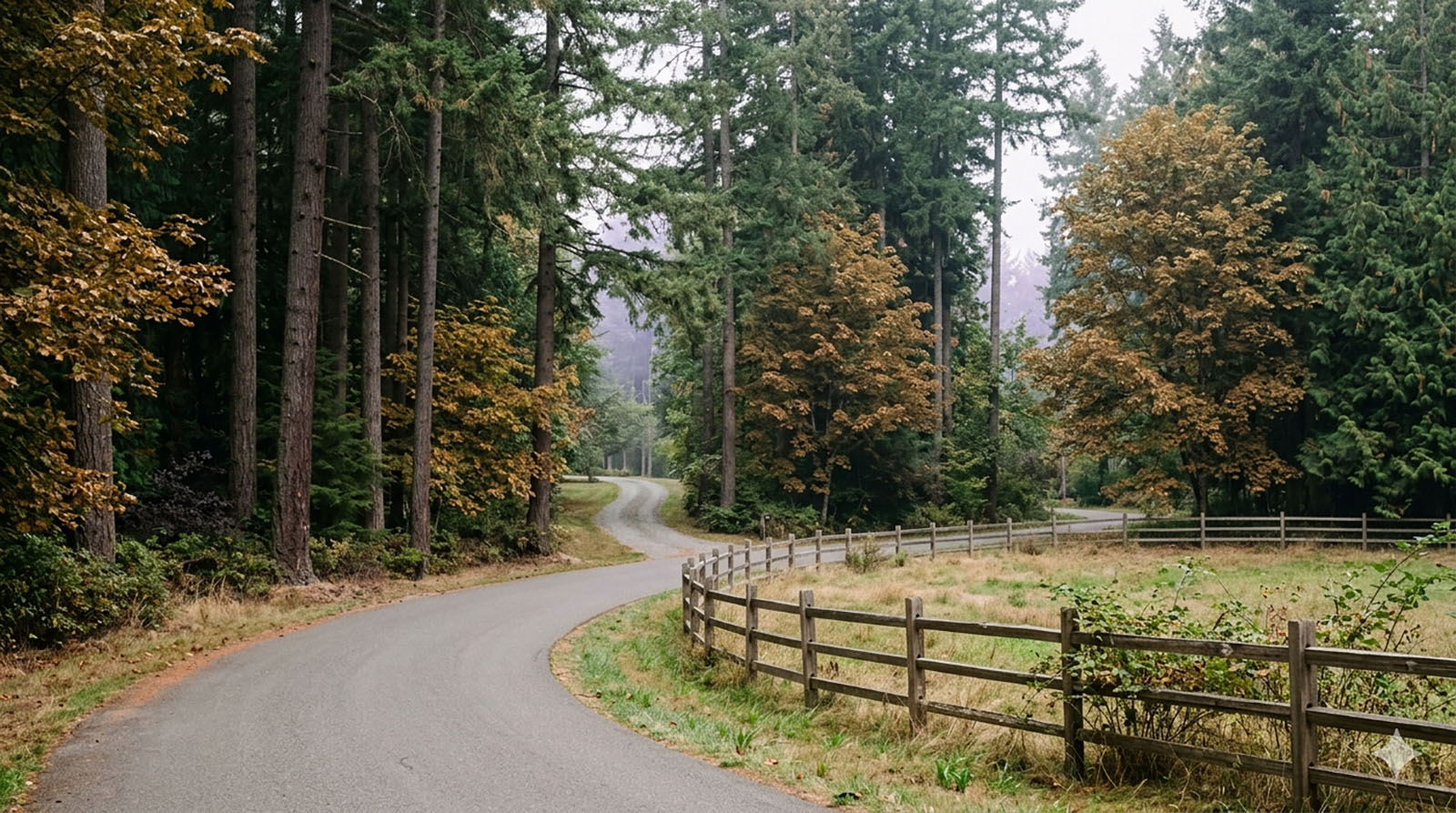
·

www.livingoutsideseattle.com
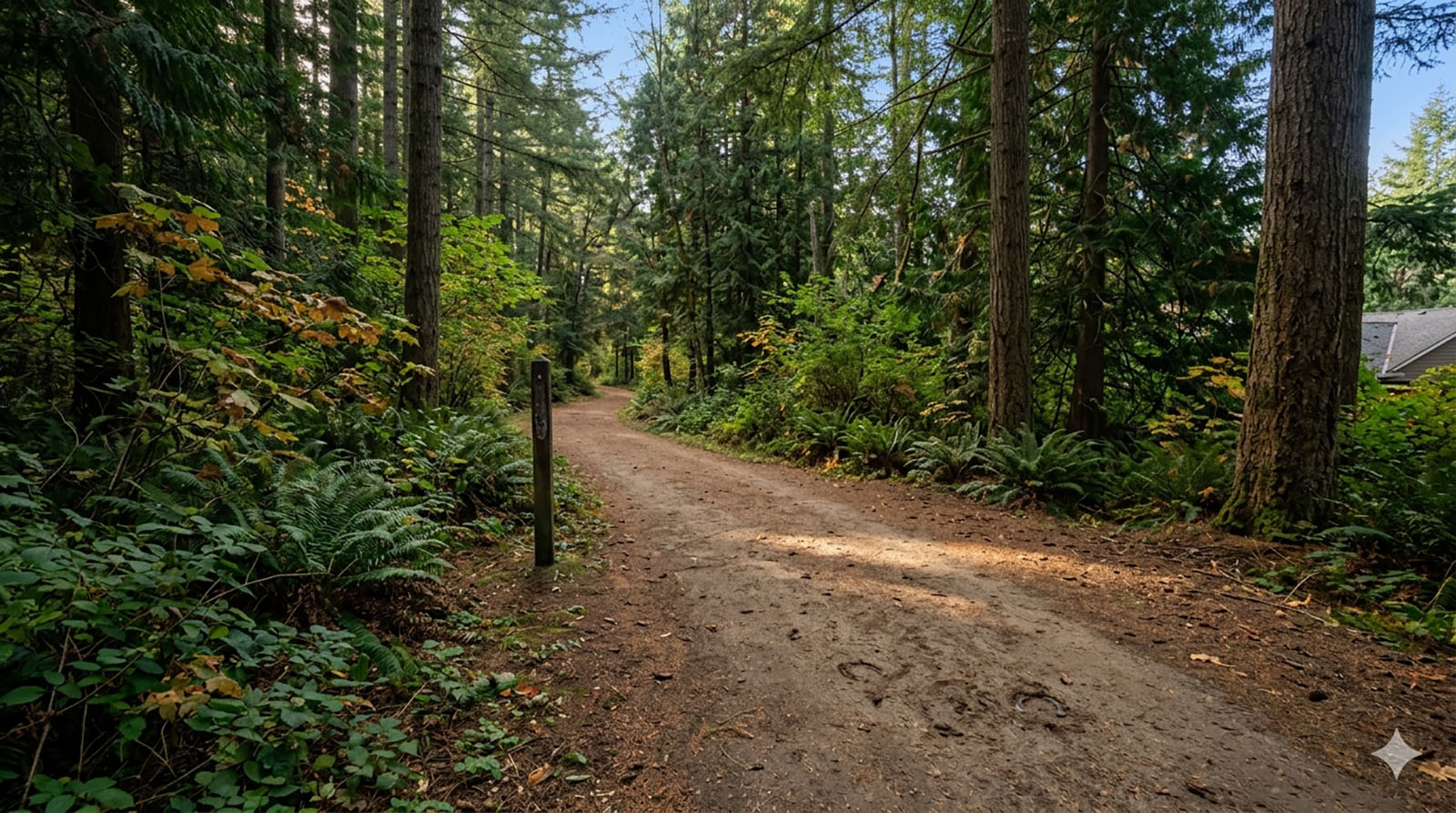
Gregory Dorrell is a licensed real estate broker (WA License #111862) with
Coldwell Banker Bain. This post is provided for informational purposes and does
not constitute financial or investment advice. Mortgage rates, buydown costs, and
lender policies vary and are subject to change. Consult with a licensed mortgage
lender for current pricing and qualification guidance.


EastsideIssaquahKing County Cities May 15, 2026

Living in Squak Mountain Issaquah

Living in Squak Mountain, Issaquah: What You Need to Know in 2026

Squak Mountain is the wooded sanctuary of Issaquah, the residential pockets that climb up the slopes of Squak Mountain itself between Cougar Mountain to the west and Tiger Mountain to the east. In 2026, with buyers looking for privacy, mature landscaping, and lot size that is genuinely hard to find on the Eastside, Squak Mountain is one of the strongest options in the city. If you want a home with trees, space, and direct trail access without driving an hour from Bellevue, this is the neighborhood that delivers.

What is it actually like to live in Squak Mountain in 2026?

On a weekday morning, Squak Mountain feels genuinely quiet. Streets curve up the hillside with no through traffic. You hear birds, the occasional deer, and not much else. Driveways are long, lots are screened with mature firs and cedars, and most homes are not visible from the street. People who choose Squak Mountain do so for this exact reason. It is the closest thing to country living that you can have inside Issaquah city limits.

On a weekend, the mountain stays quiet but turns more active for residents. Trail runners and hikers use the network of trails that lace through the residential streets and into Squak Mountain State Forest. Families with kids head down the hill for groceries, restaurants, and youth sports, then come back up. The neighborhood does not have a commercial core, which is part of the appeal. There is nothing to draw outside traffic.

Most residents are a mix of long-time owners who bought in the 1980s and 1990s when Squak Mountain was still considered far out, plus newer buyers from Bellevue and Sammamish who specifically wanted privacy and lot size. Many residents work from home, which is part of why the neighborhood holds value during shifts in commute patterns. What separates Squak Mountain from neighboring Issaquah neighborhoods is the lot itself. You will not find a 4,000 square foot lot here. The land is the asset.

A territorial view from a Squak Mountain residential property in Issaquah, looking out toward distant ridges.

Homes in Squak Mountain: What the Data Shows

Most homes on Squak Mountain were built between the 1970s and the 2000s, with a strong bias toward 1970s and 1980s construction. You will see classic Pacific Northwest contemporary homes, cedar-clad split-levels, custom builds from the 1990s, and a smaller share of newer 2010s and 2020s rebuilds where someone tore down an aging home and put up a modern replacement. Single-family homes typically run 1,800 to 5,000 square feet on lots between a quarter acre and a full acre or more, with a meaningful share of properties in the half-acre to one-acre range. There is no townhome inventory and no condo inventory. Squak Mountain is single-family detached only.

Market Pulse Squak Mountain (98027) King County
Median Sales Price (May 2026) ~$1,275,000 ~$859,000
Median Days on Market ~25 days ~28 days
Active Listings Change (vs. Jan 2026) +18% +30%

Estimates based on current NWMLS data for the Squak Mountain residential pockets within the 98027 ZIP code. Inventory turnover is lower here because long-time owners stay put. When a property does hit the market, motivated buyers move on it.

Schools Serving Squak Mountain

Most Squak Mountain kids attend Issaquah Valley Elementary, then Issaquah Middle School, then Issaquah High School. Some southern Squak Mountain pockets in the Renton-Issaquah Road corridor may feed Briarwood Elementary or even Maywood Middle School depending on the exact address, so always confirm your specific school assignment with the Issaquah School District before you write an offer.

Issaquah Valley Elementary houses the Spanish Dual Language Immersion program and serves a diverse student body. Issaquah Middle School was rebuilt and modernized in recent years and has strong music and STEM programs. Issaquah High has a strong four-year graduation rate, multiple AP programs, and a competitive athletics presence.

The school pipeline for Squak Mountain involves driving for most families, since walking distance is rare given the spread-out nature of the neighborhood. Most kids ride buses to elementary and middle school, then drive themselves to high school once they are old enough.

Getting to Work from Squak Mountain

Squak Mountain residents typically take Renton-Issaquah Road (SR-900) or descend into Olde Town to reach I-90 at exit 17 or exit 15. The exact route depends on which side of the mountain you live on.

Destination Distance 2026 Peak Drive (AM) Transit Option
Downtown Seattle 18 miles 40 to 58 min I-90 / ST 554 from Issaquah Transit Center
Bellevue / Amazon Bellevue 10 miles 25 to 35 min I-90 to I-405 / ST 554
Microsoft (Redmond) 13 miles 30 to 40 min I-90 to SR-520 / Connector Bus
SeaTac Airport 22 miles 38 to 52 min SR-900 to I-405 to I-5

A wooded Pacific Northwest forest trail near a Squak Mountain residential property in Issaquah.

What I See as a Valuation Expert in Squak Mountain

The biggest valuation factor on Squak Mountain is the lot. On a 1985 home with 3,000 square feet of living space, the lot itself can carry 50 to 65 percent of the appraised value, depending on size, slope, and view. When I assess homes here for institutional lenders, I look at lot grade, drainage, mature tree health, and any view first, then the structure second. A flat half-acre lot with western Olympic views and a tired 1980s home will appraise much stronger than a same-size home on a steep north-facing slope with limited usable yard.

HOAs are rare on Squak Mountain. Most properties are fee simple, which means no monthly dues and no master association rules. The few exceptions are some pocket subdivisions tucked along the lower slopes that have small road maintenance HOAs in the $20 to $80 monthly range. Always read the title commitment carefully because some properties have private road easements with cost-sharing requirements that function like an informal HOA.

Within Squak Mountain, certain streets and pockets carry premium pricing. South-facing lots with afternoon sun, properties with western Olympic views, lots backing directly to Squak Mountain State Forest, and any home over an acre tend to move first when they hit the market.

Explore Squak Mountain Yourself

The fastest way to know if Squak Mountain fits is to drive Mountain Park Boulevard up the hill, then turn onto a few of the side streets to see how the lots open up.

View Squak Mountain on Google Maps →

Your guide to life outside Seattle.

Gregory Dorrell | Coldwell Banker Bain | WA License #111862
253-350-0045  ·
greg@livingoutsideseattle.com  ·
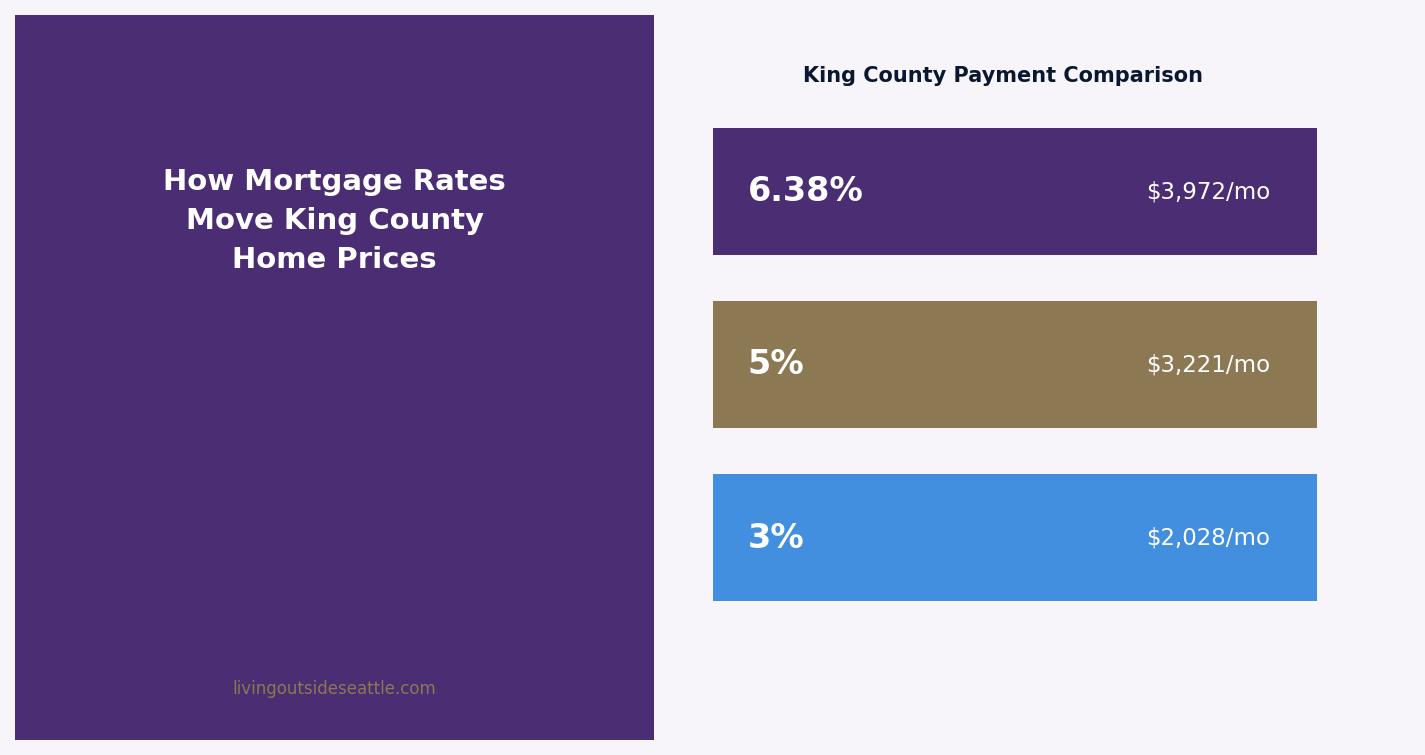
www.livingoutsideseattle.com
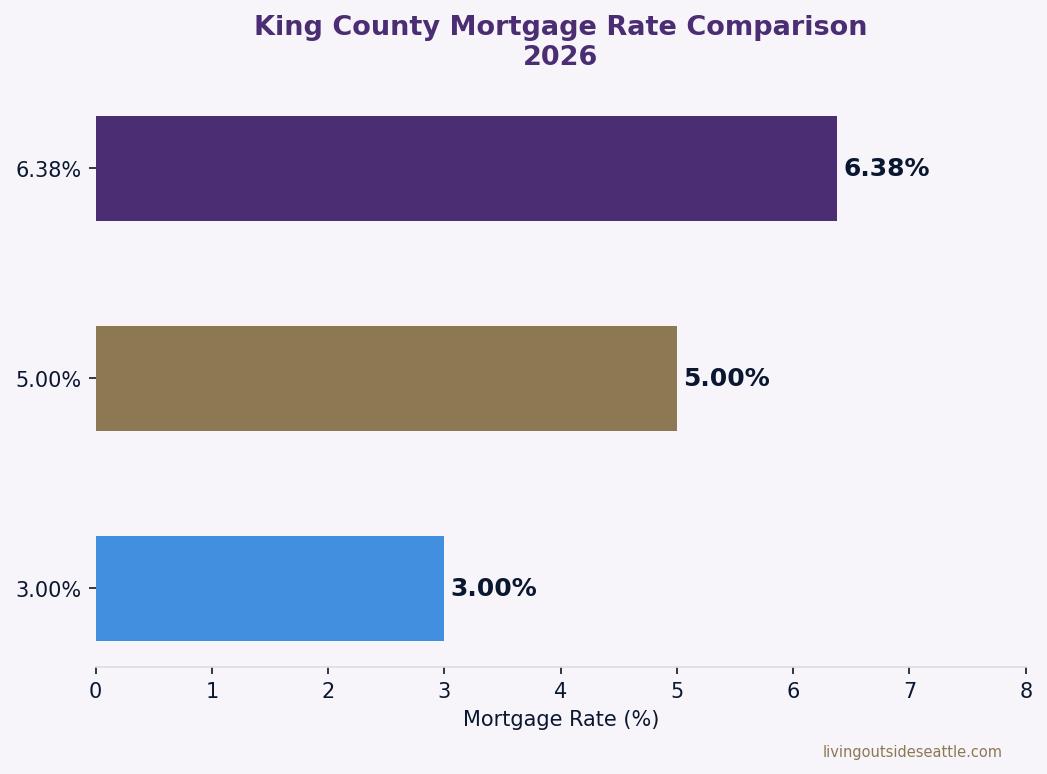
EastsideKing County Cities May 12, 2026

Living in Talus, Issaquah WA | 2026 Neighborhood Guide

Living in Talus, Issaquah: What You Need to Know in 2026

Talus is the master-planned community tucked into the south side of I-90, built into the lower slopes of Cougar Mountain. In 2026, with buyers looking for newer construction, low-maintenance lifestyles, and direct trail access, Talus is a strong fit, especially for tech families and second-time buyers from Bellevue. If you want a home that is five minutes from the freeway but feels like it backs to a forest, Talus is one of the few Eastside neighborhoods that delivers both.

What is it actually like to live in Talus in 2026?

On a weekday morning, Talus feels quiet. The internal streets curve, traffic is mostly residents heading out for the day, and you can hear birds more than cars. Parents walk kids to the bus stop. Tech workers head down the hill to I-90. Trail runners head straight from their driveways into the Cougar Mountain trail system before work. The pace is calm, which is part of why people pay to live here.

On a weekend, Talus stays calm but more visible. People are out walking dogs, running, biking, or heading to Harvey Manning Park. The Bridges at Talus area has a strong neighborhood feel because residents see each other on the trail and at the park, not just on the way out. Most weekend activity happens off-property: residents drive five minutes to Issaquah for groceries, restaurants, and shopping.

Most residents are a mix of tech families, dual-income professionals, and move-up buyers from older Bellevue and Issaquah neighborhoods who wanted newer construction without sacrificing nature access. Talus has a younger demographic skew than Olde Town and Squak Mountain, mostly because the community itself is newer. What separates Talus from Issaquah Highlands is scale and feel. The Highlands has a real downtown, more density, and more master-plan polish. Talus is smaller, quieter, more wooded, and more tucked into the mountain.

A Northwest Contemporary home with native landscaping in Talus, Issaquah.

Homes in Talus: What the Data Shows

Most homes in Talus were built between 2003 and 2018, with newer infill in the Bridges at Talus and Mountain Aire areas. Single-family homes typically run 1,800 to 3,500 square feet on lots between 3,000 and 5,000 square feet. Lots are smaller than older Issaquah neighborhoods because Talus was designed around shared open space and trail buffers instead of large private yards. The architectural style is mostly Northwest Contemporary and Modern Craftsman, with mixed siding, covered porches, and rooflines that vary by sub-area. Burnstead Construction was a major builder in the Bridges at Talus pocket and is known for solid mid-tier craftsmanship. There are also townhomes throughout Talus, typically 1,400 to 2,200 square feet, which give the neighborhood housing diversity at a lower price point.

Market Pulse Talus (98027 (Talus pocket)) King County
Median Sales Price (May 2026) ~$1,195,000 ~$859,000
Median Days on Market ~36 days ~28 days
Active Listings Change (vs. Jan 2026) +26% +30%

Estimates based on current NWMLS data for the 98027 ZIP code Talus pocket. Days on market run a bit longer here than in Issaquah Highlands, mostly because the buyer pool is smaller and more specific.

Schools Serving Talus

Most Talus kids attend Issaquah Valley Elementary, then Issaquah Middle School, then Issaquah High School. One important note for buyers: Cougar Mountain Middle School is physically located inside Talus at 1929 NW Talus Drive. The school opened in 2022 and serves a different attendance zone than most of Talus, so do not assume your kids will attend the school in your own neighborhood. Always confirm your specific address with the Issaquah School District before you write an offer.

Issaquah Valley Elementary houses the Spanish Dual Language Immersion program and is one of the more diverse elementary schools in the district. Issaquah Middle School was rebuilt and modernized in recent years and has strong music and STEM programs. Issaquah High has a strong four-year graduation rate, multiple AP programs, and a competitive athletics presence.

The school pipeline for Talus is solid but involves some driving. The walkability of Issaquah Valley and Issaquah Middle is limited from most Talus addresses, so most families bus or drive. That is the trade-off for the quieter, more wooded setting.

Getting to Work from Talus

Talus has one main exit onto Renton-Issaquah Road (SR-900), which connects quickly to I-90 at exit 15. Most residents take I-90 east or west depending on destination.

Destination Distance 2026 Peak Drive (AM) Transit Option
Downtown Seattle 18 miles 38 to 55 min I-90 / ST 554 from Issaquah Highlands P&R
Bellevue / Amazon Bellevue 9 miles 22 to 32 min I-90 to I-405 / ST 554
Microsoft (Redmond) 12 miles 28 to 38 min I-90 to SR-520 / Connector Bus
SeaTac Airport 22 miles 35 to 50 min SR-900 to I-405 to I-5

A Cougar Mountain trail in Talus, Issaquah, showing the neighborhood's immediate trail access.

What I See as a Valuation Expert in Talus

The HOA picture in Talus is straightforward but important. Most single-family homes pay around $80 to $200 per month to the master association, with townhomes running $300 to $450 per month depending on what is covered. The HOA in Talus has been generally well-managed, but as the original construction is now 20+ years old, capital reserves are getting tested. Always pull the resale certificate and the most recent reserve study before you write an offer. A weak reserve fund and a pending special assessment can change your monthly cost picture quickly.

Curb appeal in Talus is strong because the master plan required mature street trees, native landscaping, and consistent architectural standards. When I assess homes in Talus for institutional lenders, I weight the established landscaping into the appraised value, especially on lots that back to greenbelt or trail access. A 2008 build with original native landscaping that has matured well will appraise stronger than a same-vintage home where the yard has been removed or simplified.

Within Talus, certain pockets sell faster and at the top of the price range. The Bridges at Talus area, lots backing directly to Cougar Mountain greenbelt, and any home with a clear westerly territorial view tend to move first when they hit the market. Cul-de-sac lots and homes near Harvey Manning Park also command premiums because of the limited through traffic.

Explore Talus Yourself

The fastest way to know if Talus fits is to drive the perimeter loop, walk a section of the trail at Harvey Manning Park, and check out the Bridges at Talus pocket on the south side.

View Talus on Google Maps →

Your guide to life outside Seattle.

Gregory Dorrell | Coldwell Banker Bain | WA License #111862
253-350-0045  ·
greg@livingoutsideseattle.com  ·
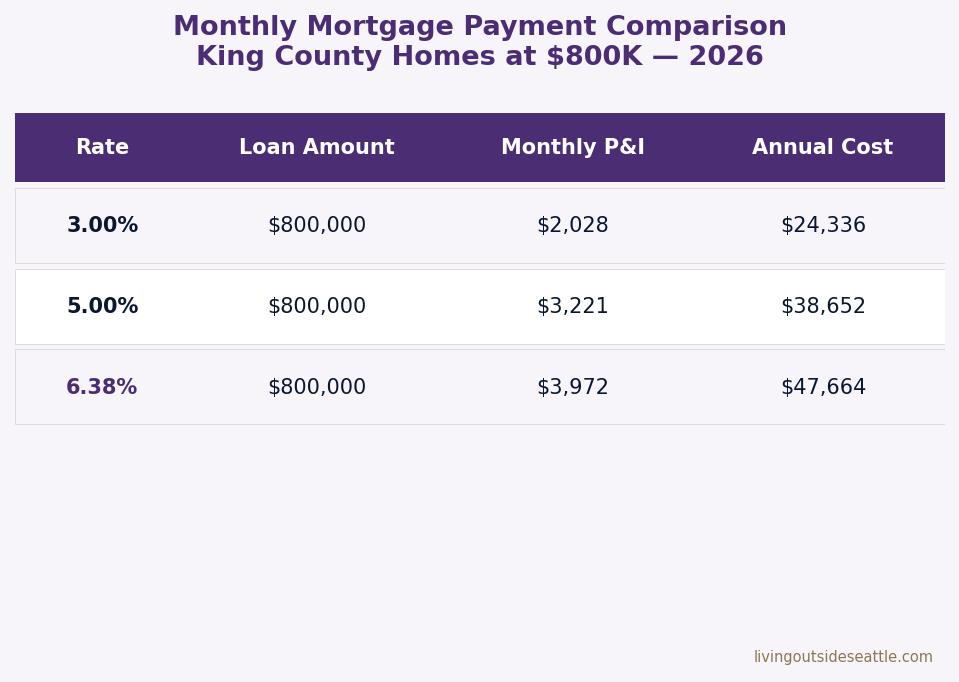
www.livingoutsideseattle.com