

 Facebook
 X
X
 Pinterest
 Copy Link
Cost to Sell a Home in Washington State: 2026 Breakdown
Most sellers ask me one question before anything else: “How much am I actually going to walk away with?” Not the sale price. The number after everything gets paid.
I do BPO work across east and south King County almost every day, pricing homes for banks and institutional clients. That work puts me in front of real closing statements constantly, and I can tell you the gap between what sellers expect to net and what they actually net is almost always caused by the same handful of costs. None of them are secret. Most sellers just never sat down and added them up.
Here’s the honest breakdown, King County numbers included, so you can run your own math before you decide anything.
The Big Four Costs, In Order of Size
Four costs make up almost all of what comes out of your proceeds at closing. Everything else is smaller line items. Here they are, biggest to smallest.
1. Real Estate Commission
This is the largest line item, almost every time. Washington’s average total commission sits around 5.9% right now, split between the listing agent and the buyer’s agent, though that split is negotiable and varies deal to deal. On the Eastside specifically, a lot of full-service listing agents run 2.5% to 3% on their side.
On a $900,000 sale, a 5.5% total commission is $49,500. That’s real money. It’s also the single biggest reason your net check is smaller than your sale price. It buys you something, though: professional pricing, marketing, negotiation, and someone managing the transaction so an inspection issue or a lowball appraisal doesn’t blindside you. Real estate commission are and have always been negotiable and will vary from transaction to transaction.
2. Real Estate Excise Tax (REET)
Washington charges a graduated excise tax on every home sale, and King County adds its own local portion on top. Here is the state schedule for 2026:
1.10% on the portion of the price up to $525,000
1.28% on the portion between $525,001 and $1,525,000
2.75% on the portion between $1,525,001 and $3,025,000
3.00% on anything above $3,025,000
King County adds a local REET of 0.50% on top of the state rate.
Run it on a $900,000 King County home: roughly 1.10% on the first $525,000 ($5,775) plus 1.28% on the remaining $375,000 ($4,800), for a state total near $10,575. Add the county’s 0.50% ($4,500) and you land around $15,075 in excise tax alone. Most sellers don’t plan for that number. They find out on the closing statement instead. For the full rate schedule and how it’s calculated, see Washington State Real Estate Excise Tax: Complete Guide for Sellers.
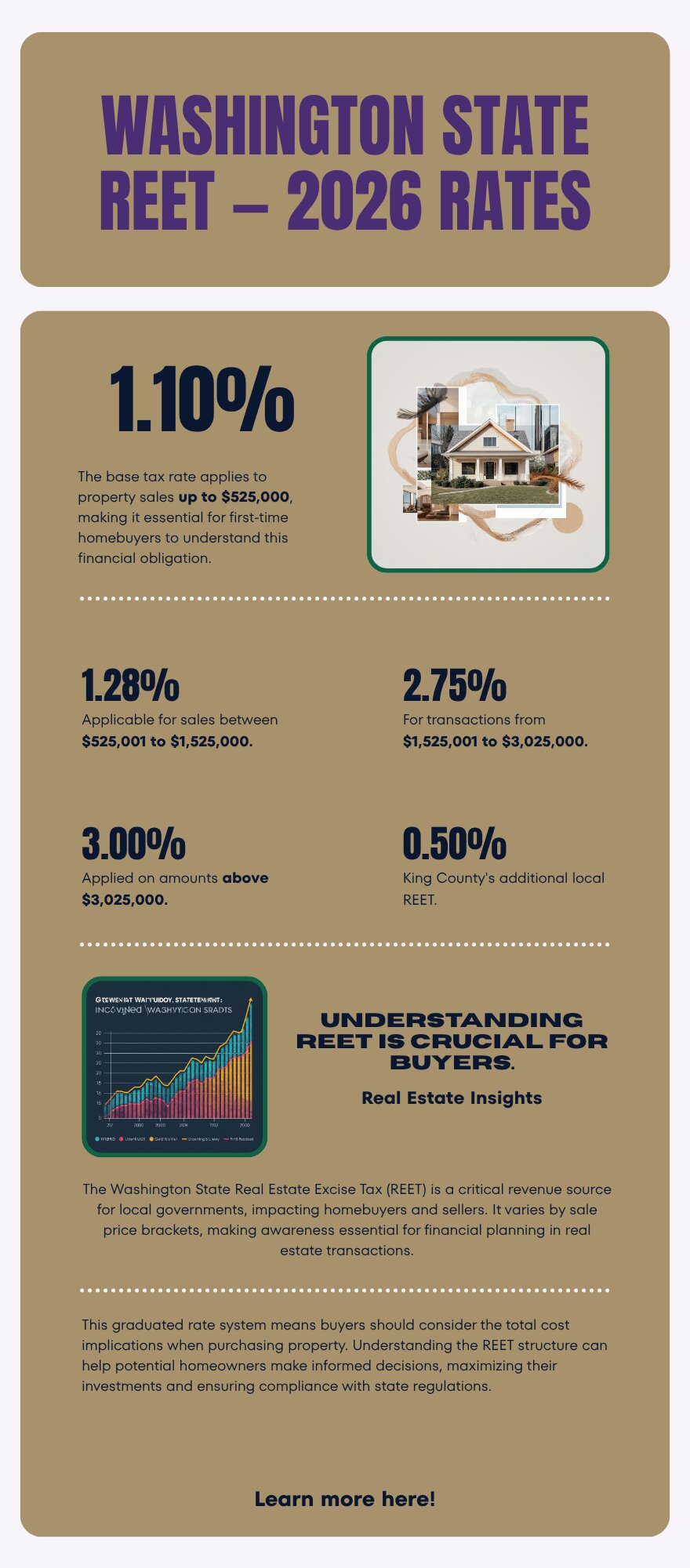
Washington’s REET is graduated. King County adds its own 0.50% on top of the state rate.
3. Title Insurance and Escrow Fees
Sellers in Washington typically pay for the owner’s title insurance policy, which protects the buyer against title defects. Escrow fees are usually split roughly in half between buyer and seller. Together these run a few thousand dollars on a typical King County sale, more on higher-priced homes since title insurance premiums scale with sale price.
Budget $2,500 to $5,000 for title and your share of escrow on a mid-range King County home. Your escrow company will give you exact numbers once you’re under contract. This range holds steady across most listings.
4. Buyer Concessions
This is the cost sellers underestimate the most, and it has become more common. Roughly 19% of recent King County sales included a seller concession, according to NWMLS data from this year. Most concessions land in the 1% to 3% range, and lenders generally cap them at 2% to 6% of the purchase price depending on loan type.
Agree to cover $10,000 to $20,000 in the buyer’s closing costs, or a rate buydown to get the deal done, and that comes straight out of your proceeds. It’s not a hidden fee. It’s a negotiated one. But it needs to be in your math from day one, not something you discover mid-negotiation. Buyers are budgeting their own closing costs at the same time. If you want to understand what they’re weighing against your ask, see Earnest Money in King County: How Much You Need in 2026.
Adding It Up: A Real Example
Here’s the full math on a $900,000 King County home, close to the current county median for single-family homes.
Sale price: $900,000
Commission (5.5%): $49,500
State + King County REET: $15,075
Title insurance + seller’s escrow share: $3,500
Buyer concession (2%): $18,000
Total selling costs: $86,075 (about 9.6% of sale price)
Estimated net before payoff of existing mortgage: $813,925
That 9.6% figure sits right in the middle of the 8% to 10% range most sellers should expect. Yours will move up or down depending on your commission rate, whether you offer a concession, and where your price lands in the excise tax brackets.

Knowing your real number before you list means no surprises at the closing table.
The Local Angle: South and East King County Specifics
Costs shift a little depending on where in King County you are selling.
In South King County cities like Kent, Auburn, Covington, and Maple Valley, home prices run below the county median, which keeps your excise tax bill lower in dollar terms even though the percentage stays close to the same. Sellers here also tend to see fewer aggressive concession requests right now, since inventory in the affordable price bands moves faster.
In East King County, Bellevue, Sammamish, and Issaquah sellers deal with higher price points. That pushes more of the sale into REET’s higher brackets once you cross $1,525,000. Sell above that threshold and your excise tax rate jumps from 1.28% to 2.75% on the portion above it. Run that difference through a calculator before you set your list price expectations.
I price homes across both sides of the county every week through my BPO work. The pattern holds. Sellers who know their real numbers going in negotiate from a position of confidence. Sellers who find out their net at the closing table are the ones who get blindsided. (Curious how that pricing work actually happens? Here’s how I price homes using BPO methodology.)
What This Means for You as a Seller
Before you list, do three things.
Run your own numbers using your actual expected sale price, not a rough guess. A $50,000 difference in price can shift which excise tax bracket you land in.
Ask your agent for a written net sheet before you sign a listing agreement. Any agent worth hiring will walk through commission, REET, title, and a realistic concession estimate with you up front, not after you get an offer.
Decide your concession tolerance before you are in a multiple-offer or slow-market negotiation. Knowing your floor ahead of time keeps you from making an emotional decision at the table.
Getting your home ready to list is its own cost and time decision. If you haven’t mapped that out yet, start with How to Prepare Your Home for Sale in King County.
Selling costs shift depending on where in King County you list. South King County sellers see a different picture than the Eastside.
FAQ
How much does it cost to sell a house in King County, Washington?
Most King County sellers pay between 8% and 10% of their sale price in total selling costs, covering commission, real estate excise tax, title insurance, escrow fees, and any buyer concessions.
What is the real estate excise tax rate in King County?
Washington’s state REET is graduated: 1.10% up to $525,000, 1.28% from $525,001 to $1,525,000, 2.75% from $1,525,001 to $3,025,000, and 3.00% above that. King County adds a local 0.50% on top of the state rate.
Who pays closing costs when you sell a house in Washington State?
Sellers typically pay the real estate commission, the excise tax, the owner’s title insurance policy, and roughly half the escrow fee. Buyers typically pay their own lender fees, their half of escrow, and inspection costs.
Can you negotiate real estate commission in King County?
Yes. Commission is negotiable and varies by agent and by deal. Washington’s average total commission is around 5.9%, but the exact split between listing and buyer’s agent is a conversation you should have before signing a listing agreement.
Do I have to pay excise tax if I sell at a loss?
Yes. Washington’s REET is based on the sale price, not your profit or loss. Even if you sell for less than you paid, you still owe excise tax on the full sale price, with limited exceptions.
How much should I budget for seller concessions in King County?
Plan for 1% to 3% of your sale price if the market conditions or buyer financing call for it. Roughly 19% of recent King County sales included a seller concession, so it is worth building into your net sheet even if you hope not to need it.
Your guide to life outside Seattle.
253-350-0045 ·
greg@livingoutsideseattle.com ·
www.livingoutsideseattle.com
How Real Estate Agents Price Homes in King County

Most agents estimate your home’s value. Here’s how I assess it — and what that difference means for your final sale price in King County.
You asked three agents what your home is worth. You got three different numbers. Maybe the spread was $40,000. Maybe it was $80,000. Now you’re trying to figure out who’s right and why the gap exists.
Here’s the honest answer: most agents build their price estimate around a handful of recent sales in their transaction history. They pull some comps from the MLS, do some quick math, and give you a number. It’s not reckless — it’s just limited. They’re working from a small sample of deals and general pattern recognition built up over time.
I do this differently. When I first moved to the Seattle area, I also trained as a BPO field agent. I still do that work today. That means I physically assess property values for banks and mortgage servicers — dozens of homes per week across Issaquah, Renton, Kent, Auburn, Maple Valley, and surrounding communities. Every assessment sharpens my pricing instincts a little more. So when I sit down to price your home, I’m not estimating. I’m applying the same methodology that lenders use when real financial decisions are on the line.
That distinction matters more than ever in today’s King County market, where the gap between a well-priced home and an overpriced one is measured in weeks and tens of thousands of dollars.
What Most Agents Do When They Price a Home
A Comparative Market Analysis — the CMA you’ll get from most agents — is an informal estimate. There’s no standardized format, no set methodology, and no external accountability behind the number. The agent pulls three to five recent sales near your property, makes some adjustments for square footage and condition, and arrives at a price.
That’s a reasonable starting point. But CMAs have limitations most sellers don’t realize. Comp selection is subjective. Two agents can look at the same MLS data and weight different factors differently — one emphasizes lot size, another emphasizes recent updates, another adjusts more aggressively for street appeal. That’s how two professionals looking at identical information arrive at numbers that are $60,000 apart.
CMAs are also built on whatever transactions the agent happens to have completed recently. An agent who primarily works in Bellevue but occasionally lists in Renton is working from secondhand knowledge of the Renton market. Their comps may be technically defensible, but they’ll miss the micro-patterns that only come from pricing properties in that specific area every week.
If you want to understand what a CMA looks like and how to evaluate one, I wrote a full breakdown at How to Read a CMA: King County Seller Guide.
What a BPO Is — and Why It’s Different
A Broker Price Opinion is a formal valuation ordered by a lender, mortgage servicer, or investor. BPOs are used for loan modifications, short sales, foreclosures, estate settlements, and portfolio valuations. The bank literally trusts this number to make a financial decision.
That accountability changes how the work gets done.
A BPO follows a standardized format. It documents the subject property’s condition, identifies comparable sales using specific criteria, makes adjustment calculations that have to be defensible, and produces a formal report. Unlike a CMA, there’s no room for gut-feel handwaving. The methodology has to hold up.
BPO field agents complete dozens of these assessments per month. They physically visit properties, photograph them, document conditions, and cross-reference against recent sales across a wide range of neighborhoods. Over time, that volume of work develops a pricing instinct that’s hard to match through occasional transactions alone.
The differences between a BPO and a CMA aren’t just procedural. BPOs are more detailed and accurate than CMAs — sitting between a casual CMA and a full certified appraisal in rigor and specificity. The formal report format, the standardized comparable criteria, and the volume of assessments that BPO agents complete all contribute to better-calibrated pricing.
How I Price Your Home
When I prepare a listing analysis for one of my sellers, I use the BPO framework as the foundation. In practice, that means:
Comparable selection with real criteria
I don’t just pull the nearest five sales. I look for comps that match your property’s footprint, condition, age, lot characteristics, and neighborhood micro-location as closely as possible. If there’s a busy road nearby, or a school district boundary running through your block, I account for that. In South King County, where prices can shift $30,000 to $50,000 from one side of a school district line to another, this specificity is not optional.
Condition-based adjustments that reflect what buyers actually pay
A dated kitchen and a remodeled kitchen in the same neighborhood are not worth the same amount. I’ve seen enough transactions to know what buyers actually pay for specific upgrades in specific sub-markets — not what the rule of thumb suggests, but what real closed sales show.
Active market awareness that comps can’t give you
Because I’m in the field pricing properties every week, I know when buyer activity is shifting before it shows up in closed sales data. Closed sales have a 30 to 60-day reporting lag. If demand softened three weeks ago, it won’t appear in the comps yet — but I’ll already know it from the assessments I’m completing on the ground.
Why This Matters for Sellers Right Now
King County’s market has shifted in 2026. Median days on market has climbed to 12 to 24 days depending on area and property type. That still sounds fast by national standards, but here’s what the data actually shows: well-priced homes are moving in 11 to 13 days and roughly 30% are closing above asking. Homes priced even 5% above where buyers are focused are sitting 40 to 60 days, collecting price reductions that signal weakness to every buyer who comes along.
Price reductions don’t just cost you time. They cost you money. Buyers who’ve watched a listing accumulate days on market know the seller is losing leverage with every passing week. They negotiate harder. The damage to your net proceeds compounds.
Getting the price right from day one is how you protect the final number. A well-priced listing generates more showings, more competing interest, and more negotiating strength. You can read more about how pricing strategy affects your outcome at How to Price Your Home to Sell in King County 2026.
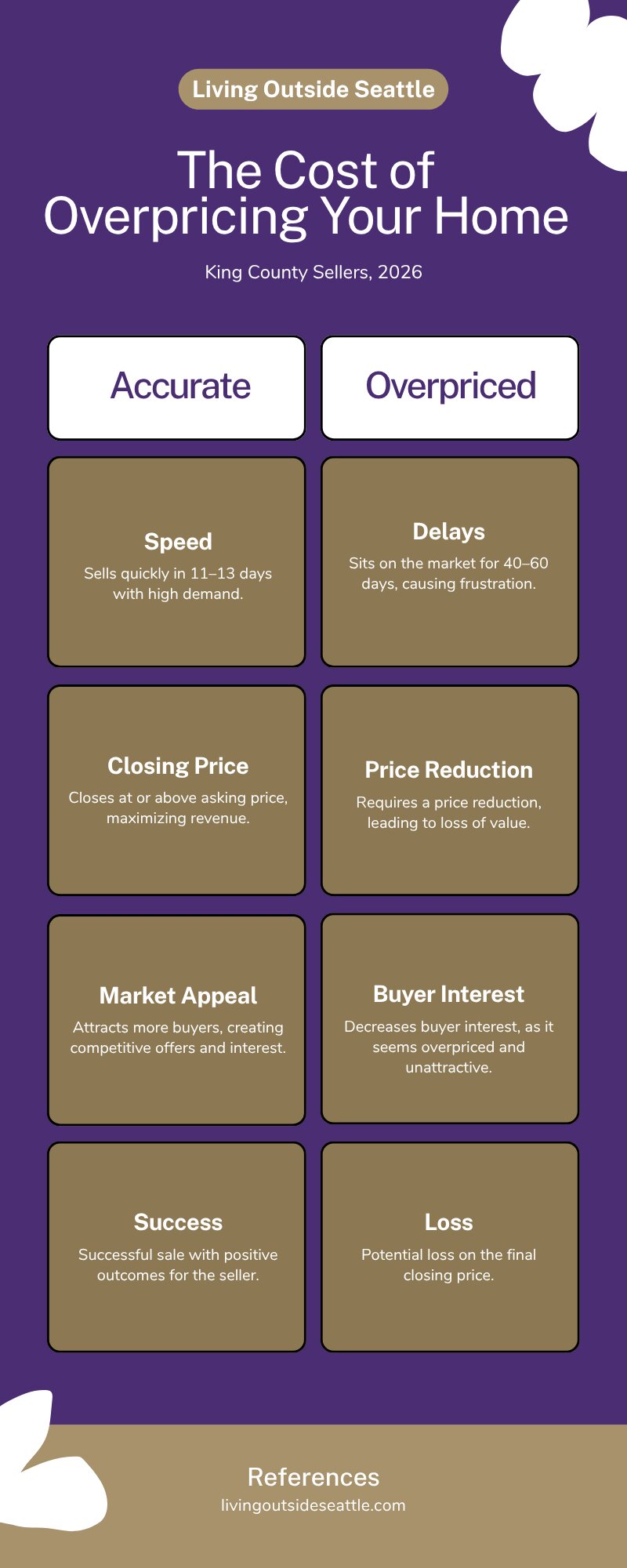
Well-priced homes in King County are moving in 11–13 days. Overpriced by 5%? Expect 40–60 days and a price cut.
The King County Angle: What I See Every Week in the Field
South and East King County is not one uniform market. It’s a collection of micro-markets with their own pricing dynamics, and they don’t always move in the same direction at the same time.
Renton’s Kennydale neighborhood commands a consistent premium over Renton Highlands, even for similar square footage, because of its proximity to Lake Washington and its commute position to Bellevue and Seattle. On Renton’s Benson Hill, a school district boundary can shift comparable values by $25,000 to $40,000 on identical floorplans, depending on which side of the line a home sits.
In Auburn, the Lakeland Hills community prices at a measurable premium over comparable homes near downtown Auburn because of its newer construction base and neighborhood feel. In Kent, homes in the East Hill school zone above the ridge tend to hold value more consistently than similar square footage in the valley floor near downtown Kent.
These patterns don’t show up cleanly in a zip-code-level CMA. They show up when you’re pricing properties in these neighborhoods every week and watching what buyers actually pay — not as a transaction observation, but as an ongoing calibration.
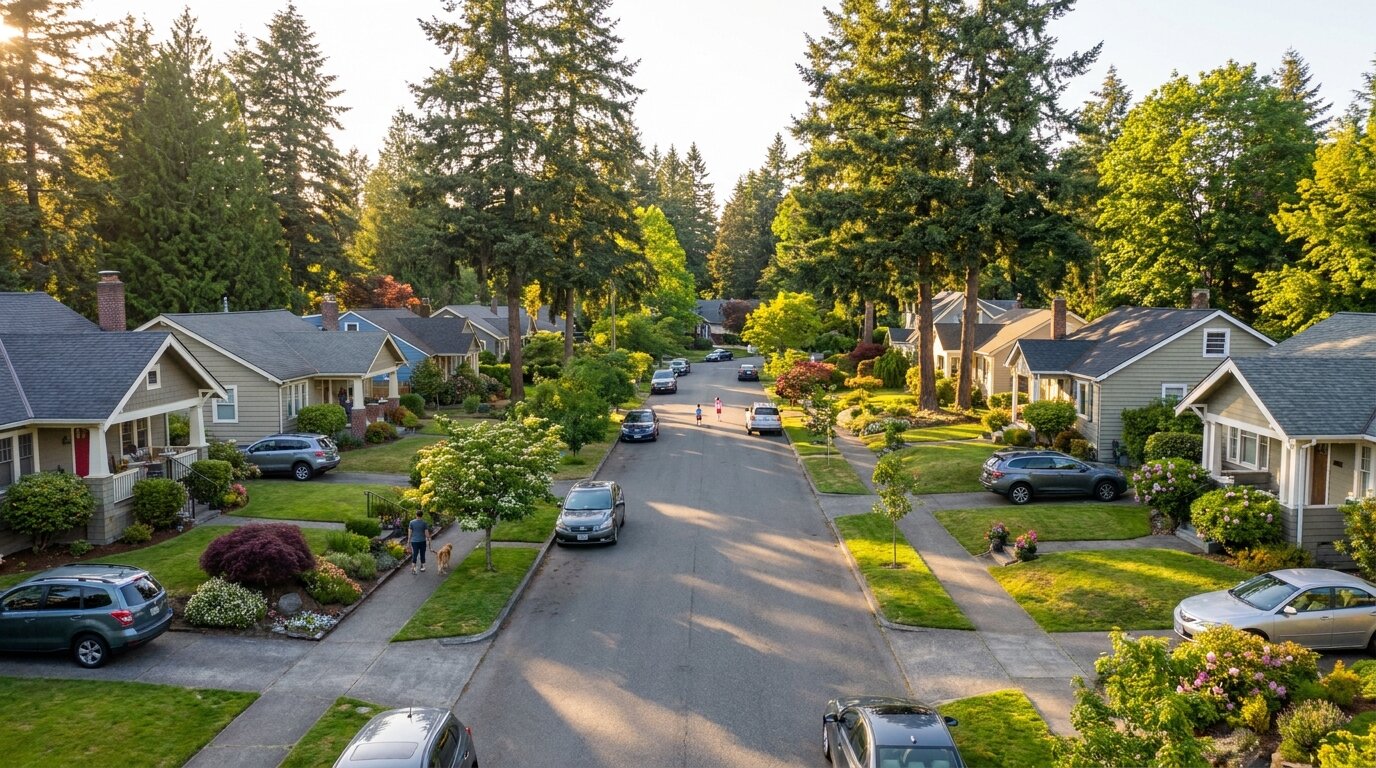
South King County isn’t one market — it’s dozens of micro-markets, each with its own pricing patterns that only show up if you’re on the ground every week.
What This Means for You as a Seller
If you’re interviewing agents to list your home in South or East King County, ask them a direct question: how did you arrive at your price recommendation? A number without a methodology is a guess. A methodology without regular field experience is stale.
You don’t need to understand the full BPO framework to benefit from it. You just need to work with an agent who’s calibrated their pricing instincts against the actual market every week — not just against their own transaction history.
If you receive two or three agent price recommendations that are far apart, that gap is telling you something important. At least one of those agents is working from incomplete information. Your job is to figure out which one — and a good place to start is asking each agent to walk you through their comparable selection and how they adjusted for condition and location.
When you’re preparing your home for listing, check out How to Prepare Your Home for Sale in King County — the condition decisions you make before listing directly affect how accurately any agent can price your home.

The right pricing conversation happens before the listing goes live — not after it sits.
Frequently Asked Questions
What is a Broker Price Opinion (BPO)?
A BPO is a formal property valuation prepared by a licensed real estate broker for a lender or financial institution. It’s used for loan modifications, foreclosures, short sales, estate settlements, and portfolio valuations. Unlike a CMA, it follows standardized methodology, produces a formal report, and carries real external accountability. BPO agents complete high volumes of assessments regularly, which calibrates their pricing accuracy over time.
How is a BPO different from a CMA?
A CMA is an informal estimate prepared by an agent to guide pricing strategy. There’s no standardized format and no external accountability — the methodology varies by agent. A BPO follows institutional standards, uses documented methodology, and is produced under formal reporting requirements. In practice, BPOs are more accurate than CMAs because they’re more rigorous and because agents who do BPO work regularly develop a calibrated pricing instinct that goes beyond occasional transaction experience.
Does having a BPO background mean my home will sell for more?
Not automatically. What it means is that your list price gets set more accurately from the start. An accurate list price attracts more qualified buyers, generates more competing interest, and reduces the risk of sitting on the market. Homes that sit accumulate days-on-market stigma that erodes your negotiating leverage. Accurate pricing is how you protect your final number — not inflated pricing.
How do I know if an agent’s price recommendation is accurate?
Ask them to walk you through their methodology. Which comparable sales did they use, and why? How did they adjust for condition differences between your home and the comps? What recent market shifts are they accounting for? An agent who can answer these questions specifically is working from a real methodology. An agent who gives you a number and pivots quickly to marketing is not.
What’s the risk of overpricing in today’s King County market?
In 2026’s market, homes priced even 5% above where buyers are focused tend to sit 40 to 60 days before needing a price reduction. That lag costs you time and negotiating position. Buyers who’ve watched a listing accumulate days on market view the price reduction as confirmation that the seller is motivated — and they negotiate accordingly. “Leaving room to negotiate” rarely works in a market where buyers have access to the same data you do.
Can I get a free home valuation from you?
Yes. If you’re thinking about listing your South or East King County home, reach out at greg@livingoutsideseattle.com or call 253-350-0045. I’ll prepare a pricing analysis using the same BPO methodology I use for institutional clients — grounded in real comps, real condition adjustments, and real current market conditions.
Most sellers only sell two or three homes in their lifetime. The price you set on day one shapes everything that follows — how quickly you sell, how much you net, and how much leverage you carry into negotiations.
I’ve spent 9+ years pricing properties in East and South King County. I do it for lenders. I do it for estate managers and investors. I do it for the homeowners who hire me to list their homes. The methodology doesn’t change based on who’s asking.
If you’re thinking about selling in King County and want to know what your home is actually worth — not what sounds good — I’d be glad to talk. Visit www.livingoutsideseattle.com to learn more about how I work.
Your guide to life outside Seattle.
253-350-0045 ·
greg@livingoutsideseattle.com ·
www.livingoutsideseattle.com
Months of Supply in Real Estate: What It Means for You
You’ll see this number in every market update, and here’s what it actually tells you and why it matters more than list price trends alone.
I look at months of supply data every single day. As a BPO field agent, I professionally price homes across east and south King County. Months of supply is one of the first numbers I pull before I put a value on a property. It tells me how much competition a seller is actually facing, how much patience a buyer needs right now, and whether the street-level conditions match what the headline market numbers suggest.
Most buyers and sellers hear this term in market update videos or agent reports and nod along without really knowing what it means in practice. That is frustrating, because this single number explains almost everything about what you can expect — whether you should push hard on price or stay patient, whether you should brace for multiple offers or expect negotiating room.
Here is the plain-English version, anchored to what is actually happening in King County right now.
How Months of Supply Is Actually Calculated
The formula is straightforward: divide the total number of active listings by the number of homes sold in the past month. The result tells you — if every house currently for sale kept selling at today’s rate and no new listings came on — how many months it would take to clear the market.
So if your city has 150 active listings and sold 50 homes last month, that is 3 months of supply. If it sold only 25 homes last month, that is 6 months of supply. Same number of homes, completely different market feel.
That math matters because it captures two things at once: how many homes are available and how fast buyers are absorbing them. List price trends can hide a lot. Months of supply does not.
The Three Zones: What Months of Supply Numbers Actually Mean
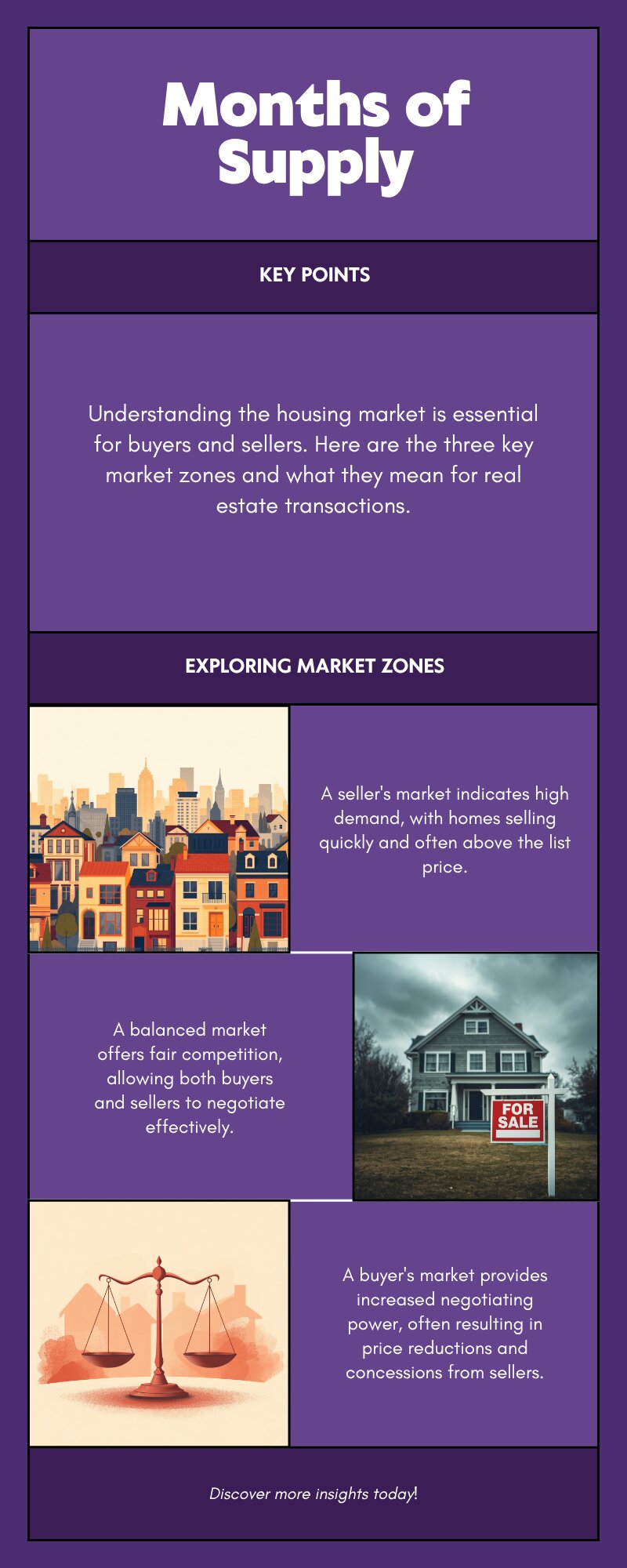
The three market zones defined by months of supply. King County sits at 3.4 months overall — seller-leaning but no longer as extreme as pandemic-era lows.
Under 3 Months: Seller’s Market
This is where most South King County single-family homes have been for years. When supply drops below 3 months, inventory moves fast. Sellers field multiple offers. Buyers often waive contingencies to compete. Homes sell at or above list price, sometimes the same week they go active. In this zone, pricing your home right from day one is critical — but pricing too low can actually cost you money if the market runs it up.
3 to 6 Months: Transitional or Balanced
This is where King County overall sits right now at roughly 3.4 months. The market is neither clearly seller-favored nor clearly buyer-favored. You will see days on market stretch a little longer. Price reductions start to appear, but mostly on overpriced homes. Sellers can still get strong results, but they cannot ignore condition or price. Buyers have a bit more room to negotiate but should not assume every deal has slack in it.
Over 6 Months: Buyer’s Market
When supply climbs above 6 months, buyers hold the cards. Sellers see price reductions, longer days on market, and homes sitting without offers. Sellers may need to offer concessions — rate buydowns, closing cost help, or repair credits — to get deals done. King County has not been in this territory broadly in years, but specific price ranges and property types have crossed into it. King County condos were sitting at roughly 4.2 months of supply in spring 2026, much closer to balanced than the single-family market.
Why King County Does Not Move as One Market
This is where months of supply becomes most useful — and where a lot of buyers and sellers get misled by county-level headlines.
King County’s overall reading of 3.4 months masks enormous variation by city, price range, and property type. Here is what I see from my BPO work:
South King County single-family homes — Renton, Kent, Auburn, Covington, Maple Valley — have consistently run tighter than the county average. Kent’s months of supply was sitting at 2.2 earlier this year, which means homes were moving fast with real competition. If you are a seller pricing a 4-bedroom house in Kent, you are in a different market than a seller pricing a condo in the same zip code.
The condo market countywide has more breathing room. At 4.2 months, King County condos are in that transitional zone where buyers can negotiate but sellers can still get decent results with smart pricing and good presentation.
New construction nationally is an outlier at 10-plus months of supply — that segment is sitting in clear buyer’s market territory. If you are weighing a new build against a resale, that supply dynamic affects your negotiating position directly.
The Eastside — Bellevue, Sammamish, Issaquah — tends to have its own rhythm. Premium pricing supports seller leverage even when supply ticks up, because demand from tech-sector buyers absorbs available homes regardless of inventory levels.

Knowing your sub-market’s months of supply changes the entire conversation with your agent — how aggressive to be on price, whether to push for concessions, and how fast to move.
For context, the national existing-home market sat at 4.5 months of supply in May 2026 — the most balanced it has been in nearly a decade. King County at 3.4 months is still tighter than the national norm. South King County single-family homes are tighter still.
The full picture across King County right now, as I see it on the ground:
King County Sub-Market Snapshot — June 2026
South KC single-family (Renton, Kent, Auburn): Still seller-leaning — under 3 months in most cities
King County condos: Transitional — around 4 months, more buyer room than many realize
Eastside luxury (Bellevue, Sammamish, Issaquah): Seller-favorable despite higher inventory
New construction (national): Buyer-favorable if you know how to negotiate
When I look at how to cross-reference months of supply data with other indicators, I use it alongside days on market and sale-to-list ratios. You can read more about how to interpret a full pricing picture in How to Read a CMA: King County Seller Guide.
What This Means If You Are Selling Right Now
If you are selling a single-family home in South King County today, you are operating in a seller-leaning market. That does not mean you can be sloppy with price or condition, but it does mean a well-prepared, correctly priced home should move.
Here is what months of supply should change about your strategy:
At under 3 months of supply: Price sharp. When inventory is low, the right price creates its own urgency. Overpricing in a low-supply market does not protect you — it just delays your sale until you cut. A home that sits in a tight market is a red flag to buyers, who assume something is wrong with it.
At 3 to 6 months of supply: Condition and presentation matter more. You cannot count on competition to bail out a house that needs work or a price that stretched too far. Budget for pre-listing repairs. Stage. Price based on true comps, not the number you want.
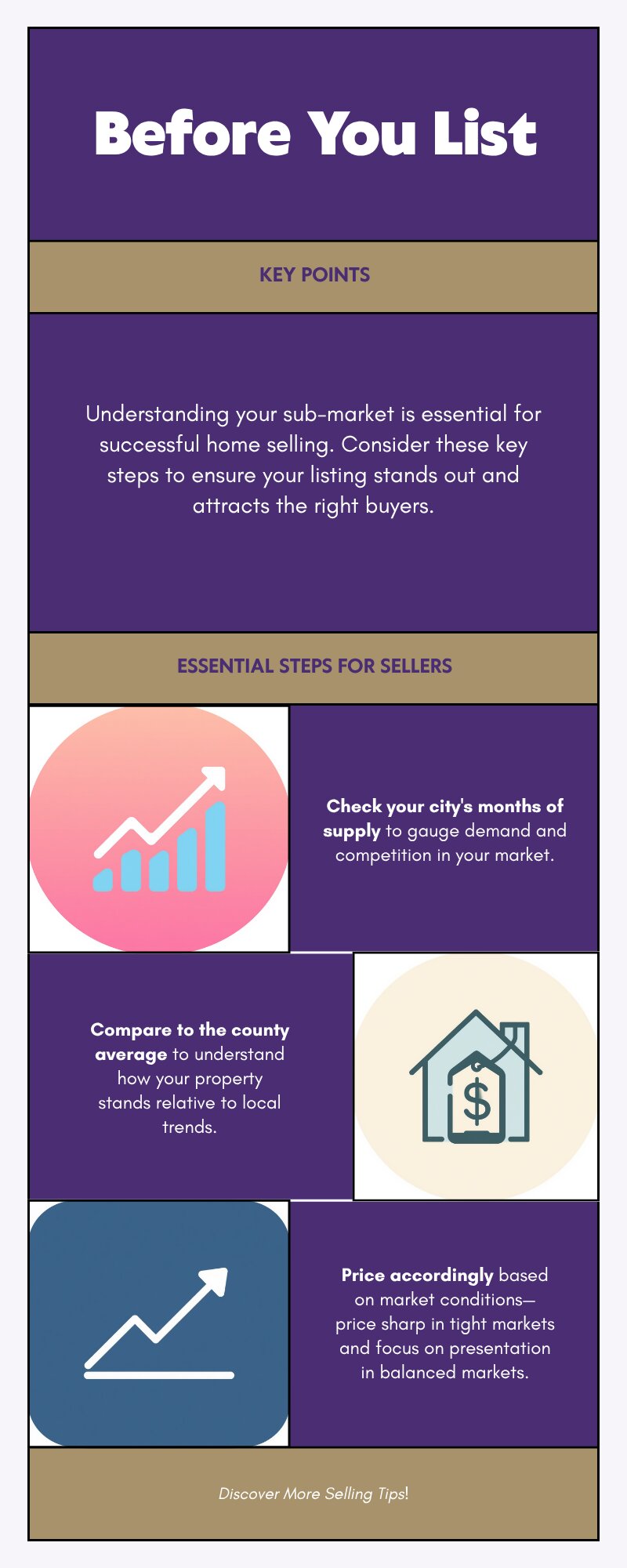
Three steps every seller should take before setting a list price. Your city’s months of supply changes everything about the right strategy.
If you want to see how these market conditions play out in a specific South KC city, the Kent inventory analysis breaks down exactly what 2.2 months of supply meant for sellers there — with real price data.
What This Means If You Are Buying Right Now
Months of supply is the first thing you should check before deciding how aggressive to be in an offer.
In a market under 3 months of supply: Go in clean and close to list price. Escalation clauses can protect you if you are competing. Waiving inspection contingencies is a risk — know what you are giving up before you do it. Waiting for a better deal often means waiting for a deal that never comes, because the next listing goes just as fast.
In a market between 3 and 6 months of supply: You have more room. Ask for closing cost help. Request an inspection without embarrassment. If a home has been on the market for three weeks, there is a real conversation to have on price. The seller knows the market has softened slightly.
If you are considering condos or new construction specifically, the supply numbers give you more leverage right now than most buyers realize. The King County condo buyer leverage guide walks through exactly how to use that supply data at the negotiating table.
The King County Housing Market Forecast for 2026 also puts these supply trends in longer-term context if you are trying to time your purchase decision.
Frequently Asked Questions
What is the difference between months of supply and days on market?
They measure related but different things. Days on market tells you how long individual homes sit before going under contract. Months of supply tells you how much total inventory exists relative to current demand. A city can have a short days on market (homes sell fast) AND a moderate months of supply (there are many homes to choose from). The combination gives you a complete picture. South King County often shows 7 to 14 days on market alongside 2 to 3 months of supply — meaning homes go fast but buyers still have reasonable selection.
Is 4.5 months of supply a buyer’s or seller’s market?
It depends on who you ask and what city you are in. Nationally, most economists call 5 to 6 months a balanced market. At 4.5 months you are near balanced, but still slightly seller-leaning. In King County specifically, 4.5 months would actually feel like significant relief for buyers compared to recent years. What matters most is how your specific sub-market compares to its own historical norms.
Can months of supply differ by price range within the same city?
Yes, and this is something I see constantly in my BPO work. A city can have 2 months of supply in the $600,000 to $800,000 range while sitting at 6 months in homes above $1.2 million. Buyers are more abundant at lower price points. When you hear an overall months-of-supply figure for a city, always ask your agent to break it down by price band for your specific budget.
How quickly can months of supply change?
Fast. A slow month of sales plus a wave of new listings can push a 2-month market to 4 months within 60 days. Seasonality matters too — winter typically adds supply without adding buyers, so months of supply can tick up in November and December even in strong markets. The data I use for BPOs is refreshed monthly, and conditions in one quarter do not guarantee the next.
Does low months of supply mean I should skip the inspection?
No. Low supply increases competition — it does not change what is inside the walls of the house. Waiving an inspection reduces your appeal to sellers, but it also eliminates your ability to negotiate repairs or walk away from a problem. In a tight market you might shorten the inspection period or offer a pre-inspection before submitting an offer. But waiving it entirely is a risk I would want every buyer to fully understand before agreeing to it.
How does King County compare to the rest of Washington State?
King County at 3.4 months of supply is tighter than most of Washington. The statewide Northwest MLS area was near 3.44 months in May 2026. Rural counties and mid-size cities across the state often carry higher supply levels, giving buyers more room. The closer you get to the Seattle metro — especially South King County — the tighter inventory gets.
Your guide to life outside Seattle.
253-350-0045 ·
greg@livingoutsideseattle.com ·
www.livingoutsideseattle.com
Home Inspection Seller Guide | King County WA 2026

Most sellers are nervous about the home inspection. Here’s what actually happens, what buyers are really looking for, and how to handle a repair request without losing your deal.
The call comes in after the inspection. Your agent says the buyer has a repair request. Your stomach drops.
I see this happen all the time. Sellers who have lived in their home for 10 or 15 years think they know every quirk of the place, and they still get surprised by what an inspector puts in a report. That’s not because something was hidden. It’s because most sellers have never seen a home inspection report before. When you see 40 items flagged in a 60-page document, it can feel catastrophic — even when 35 of those items are caulk gaps and light switch covers.
Here’s what the inspection process actually looks like from the seller’s side, what it means when a buyer sends repair requests, and how to respond without blowing up your sale. If you haven’t started prep yet, it’s worth reading our guide to preparing your home for sale in King County alongside this one.
How the Inspection Fits Into Your Sale Timeline
In King County, the buyer typically has a set window after mutual acceptance — often 7 to 10 days — to schedule and complete their inspection, review the report, and submit any requests. That window is spelled out in the purchase and sale agreement.
You don’t attend the inspection. As the seller, your job is to leave the home accessible and get out of the way. The inspection takes two to four hours depending on the size and condition of the property. Smaller condos in Renton or Auburn might be done in under two hours. A larger home in Covington or Maple Valley with a finished basement and detached garage can take closer to four.
After the inspection, the buyer gets a full written report — typically 30 to 60 pages with photos. The report goes to the buyer, not to you. You only see what the buyer chooses to share when they submit their requests.
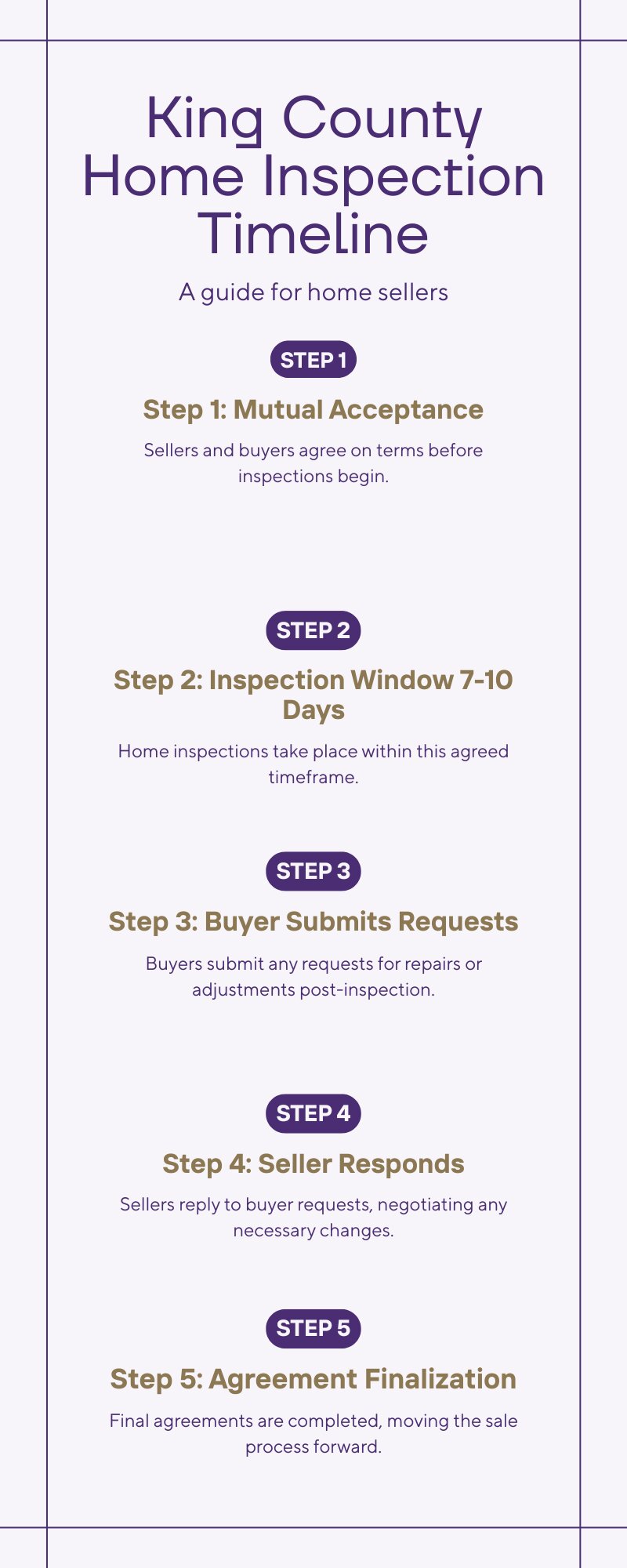
In King County, buyers typically have 7–10 days after mutual acceptance to complete their inspection and submit requests.
What the Inspector Actually Looks At
Home inspectors in Washington are licensed through the state Department of Licensing. They’re looking at the condition of the home’s systems and structure, not its cosmetic appearance. That means they won’t flag your dated kitchen tile, but they will flag a roof that’s near the end of its life.
The main areas every inspector covers are the roof and attic, the foundation and crawl space, the electrical panel and visible wiring, plumbing visible within the walls and under fixtures, the HVAC system including the furnace and any heat pumps, the water heater, windows and doors, and the exterior including drainage and grading.
In the Pacific Northwest, inspectors pay extra attention to moisture. We get a lot of rain here, and the most common serious findings in South and East King County homes come down to water — roof age, gutter condition, crawl space moisture, and signs of past leaks near windows and skylights. A good inspector is going to look hard at anywhere water could get in.
What Shows Up on a Report — and What It Actually Means
This is where sellers tend to panic. You’ll see a long list of items, many flagged with the same urgent-looking language, and it all starts to blur together.
Here’s how to read it: inspectors are trained to note everything they observe, regardless of severity. A missing dryer vent cover and a cracked heat exchanger show up in the same format — but one is a $12 fix from the hardware store and the other is a serious safety issue.
The findings that actually matter fall into a few categories.
Safety Issues
Safety issues are the ones buyers and their lenders care most about. Missing handrails on stairs, double-tapped breakers in the electrical panel, exposed wiring, carbon monoxide detector gaps — these get flagged and buyers expect them to be addressed.
In King County, older homes in Renton and Kent sometimes have Federal Pacific electrical panels, which can be an insurance problem for buyers. That’s a legitimate concern worth addressing before listing if you know about it.
Structural and Water Intrusion Issues
These are the ones that can kill deals or require significant renegotiation. Foundation cracks showing active movement, rot at the mudsill, or evidence of water in the crawl space fall here.
These aren’t always deal killers, but they need to be understood. Is this an old issue that’s been stable for years, or is water still moving? That question matters a lot to how a buyer responds.
Mechanical Systems Nearing End of Life
A furnace that’s 20 years old, a water heater at 12 years, a roof with 3 to 5 years of life left — these often show up in inspection reports. Buyers will sometimes ask for a credit here, especially in a more balanced market like we’re seeing in parts of King County in 2026.
This isn’t surprising news if you’ve owned the home for a while. Knowing the ages of your major systems before you list means you can factor them into your pricing strategy rather than scrambling to respond to them mid-contract.
Deferred Maintenance
This makes up the bulk of most reports. Caulk at tubs and windows, tree branches touching the roof, missing downspout extensions, minor gutter debris — these are normal house items that don’t represent serious problems.
Buyers sometimes include a long deferred maintenance list in their requests. That doesn’t mean you have to fix all of it. Knowing the difference between a genuine concern and a routine maintenance item is where your agent’s experience matters most.
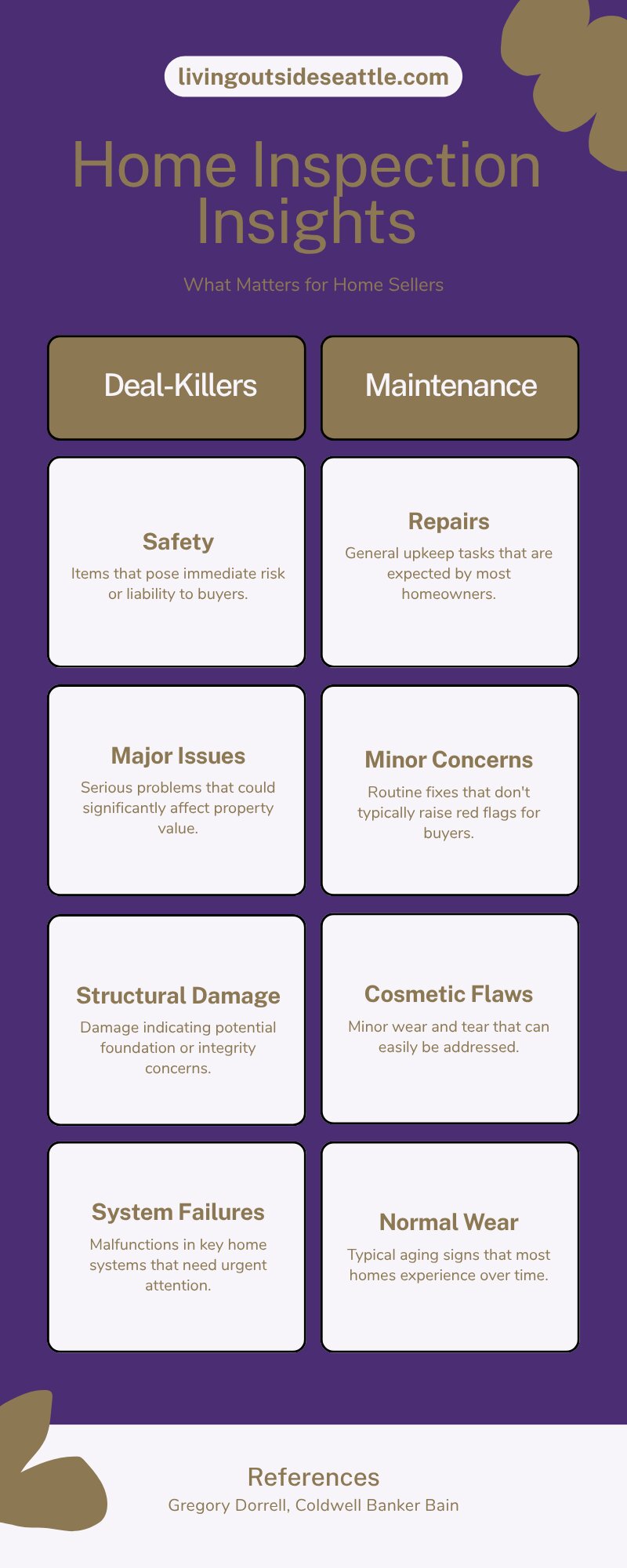
Most inspection reports are long. This is what the findings that actually matter look like compared to routine maintenance items.
Do You Have to Fix What the Buyer Asks For?
No. This surprises a lot of sellers.
Washington State does not require sellers to fix anything a buyer requests in an inspection response. The purchase and sale agreement sets up a negotiation. The buyer submits their requests. You have several options.
You can agree to the repairs and have them completed before closing, typically by licensed contractors. You can offer a dollar credit at closing instead of doing the work yourself, which buyers often prefer because it lets them choose their own contractor. You can agree to some items and decline others. Or you can decline the entire request and let the buyer decide whether to move forward or exercise their right to terminate.
The buyer’s decision has to happen within the inspection contingency window. If the timeline passes without resolution, the contingency typically expires and the sale proceeds as-is.
What you actually have to fix depends on what your contract says, not on any general legal requirement. If you’ve negotiated repairs as a condition of the sale, you’re obligated to complete them. If you respond by declining, the buyer gets to choose their path.
The Case For (and Against) a Pre-Listing Inspection
A pre-listing inspection means you hire an inspector before you go on the market. You find out what’s in the house before the buyer does.
The upside is real. A pre-listing inspection in King County typically costs $350 to 650+ depending on home size. That’s a small price to avoid being blindsided at the negotiating table. You can fix the things that matter on your own timeline and your own budget, rather than scrambling to get licensed contractors in before closing under time pressure. In a competitive market, some sellers share the pre-listing inspection report with buyers to build confidence and reduce the chance of an “inspection for information only” turning into a full renegotiation.
The downside is also real. If the inspection finds something serious, you’re now legally obligated to disclose it to buyers — even if you choose not to fix it. In Washington State, the disclosure requirements are strict. You can’t un-know what the inspector told you.
My general guidance: if the home is older than 15 to 20 years, or if you have any reason to believe there might be deferred maintenance issues in the crawl space, roof, or electrical, the pre-listing inspection is worth it. For newer homes in good condition, it’s less essential but still something that most buyers expect to see in King County.
What Kills Deals vs. What Buyers Overlook
The honest truth is that very few sales fall apart because of a home inspection. When a deal dies over inspection, it’s usually because a major undisclosed issue came to light — not because there were 40 items in the report.
The issues most likely to kill or seriously damage a deal are active roof leaks or significant roof deterioration, foundation problems showing current movement, evidence of water in the crawl space or basement that hasn’t been resolved, major plumbing failures like a failed main sewer line, and serious electrical hazards.
Buyers in King County are used to older housing stock. A 1975 Kent home or a 1985 Renton split-level is going to have some things on an inspection report. Experienced buyers and their agents know the difference between a well-maintained older home with normal findings and a house with real problems.
The things buyers most often overlook or accept as-is: cosmetic items, surface wear, minor roof maintenance items on an otherwise sound roof, single-pane windows in older homes, and deferred exterior maintenance like peeling paint or weathered decks.
What This Means for You as a Seller
Before you list, walk through your home with fresh eyes. Check the gutters. Look at what’s happening around the water heater and under sinks. Know the age of your roof and furnace. These aren’t things to hide — they’re things to understand so you can have an honest conversation with your agent about pricing and preparation.
When the inspection report comes in, read it with your agent before you react. Most items on a typical report are manageable. The ones that aren’t are the ones worth knowing about early. Understanding how pricing works in King County gives you a clearer sense of how to factor known conditions into your list price from the start.
You have more options than you think when repair requests arrive. A credit at closing is often cleaner than trying to coordinate contractors under a time crunch. Declining minor requests is completely legitimate. And pricing the home to reflect known conditions from the start — which is exactly what a BPO-trained pricing approach does — means you’re less likely to end up in a contentious renegotiation to begin with. You can also read our guide on how appraisals work in Washington State to understand the full picture of what happens between contract and closing.
Frequently Asked Questions
Does the seller have to be present during the home inspection?
No. In fact, it’s standard practice for sellers to leave during the inspection. It makes buyers and inspectors more comfortable, and it prevents awkward conversations about every item being noted.
How long does a home inspection take in King County?
Most inspections run two to four hours. A smaller condo or townhome might finish in 90 minutes. A larger single-family home with a crawl space, detached garage, and outbuildings in Covington or Maple Valley could take up to four hours or more.
What happens if I don’t agree to any repairs?
The buyer then has a choice: move forward with the purchase as-is, or exercise their right to terminate within the inspection contingency period. If they terminate, you get your home back on the market. If you’ve priced it correctly, another buyer will come.
What is a right-to-cure clause in Washington?
Washington contracts include a seller’s right to cure, which gives you the opportunity to respond to a repair request. You can agree, counter, or decline. It’s not a requirement to fix — it’s a framework for negotiation.
Should I get a pre-listing inspection in King County?
For homes older than 15 to 20 years, or any home where you have concerns about the crawl space, roof, or electrical system, a pre-listing inspection is usually worth the $350 to $550 cost. It lets you fix things on your terms and removes surprises from the process.
Can a buyer walk away after the inspection for any reason?
During the inspection contingency period, yes. The buyer can terminate for virtually any reason related to the inspection findings. Once that window closes, their options narrow significantly.
The inspection is one step in a process with a clear beginning and end. Most sellers who go through it — even with a long repair list — close. The ones who struggle are usually the ones who weren’t prepared for what they’d see. You can also review our guide to Washington State closing costs to understand the full financial picture before you list.
Your guide to life outside Seattle.
253-350-0045 ·
greg@livingoutsideseattle.com ·
www.livingoutsideseattle.com
This Guide Has Moved

This article has been folded into our maintained guide: How to Prepare Your Home for Sale in King County. You are being taken there now.
Questions to Ask a Real Estate Agent Before Listing

Most sellers interview only one agent. Here’s why that’s a mistake — and exactly what to ask when you do sit down with one.
Choosing a listing agent is one of the most financially significant decisions you’ll make in this process. The difference between an agent who prices your home correctly on day one and one who guesses — or worse, tells you what you want to hear — can easily be $20,000 to $50,000 in South King County’s current market. Sometimes more.
Most sellers pick whoever they already know, or whoever calls first. I get it. But you are about to hand someone the keys to your largest asset. Spending 90 minutes interviewing two or three agents before you sign anything is one of the highest-return things you can do.
Here are the questions that actually matter — and what a strong answer looks like versus a weak one.
Start With Pricing — It’s the Most Important Conversation You’ll Have
The single question that separates good listing agents from the rest is this: “Walk me through how you determined that list price.”
A strong agent should be able to show you exactly which comparable sales they used, why they chose those comps over others, and how they adjusted for differences in lot size, condition, and location. They should be able to tell you what the market is doing right now — not three months ago — in your specific neighborhood.
A weak answer sounds like: “Homes like yours are going for around X.” No specifics. No adjustment explanation. Just a number that landed on the page somehow.
The number itself matters less than the reasoning behind it. I’ve watched sellers get pulled in by agents who pitched an inflated price to win the listing — only to sit on the market for 60 days and end up taking less than they would have gotten with an honest price from the start. In King County, a home that goes stale gets stigmatized. Buyers start wondering what’s wrong with it. The longer it sits, the more negotiating power shifts away from you.
Ask About Their Track Record in Your Market
General experience is fine. Local experience is what moves the needle.
Ask: “How many homes have you listed in my city or price range in the past 12 months?”
Then ask: “What was your average sale-to-list price ratio on those listings?”
In King County, the overall 2026 average is hovering around 101.6% — meaning well-priced homes are still selling slightly above asking. If an agent’s numbers are consistently below 98%, that tells you something. It could mean they’re pricing too high and accepting lower offers to close. It could mean their marketing isn’t generating enough competition. Either way, it’s worth asking why.
Also ask: “What was your average days on market for listings in the past year?” County-wide, homes are sitting about 12 days on average right now. An agent consistently hitting 30+ days on market in a 12-day market has some explaining to do.
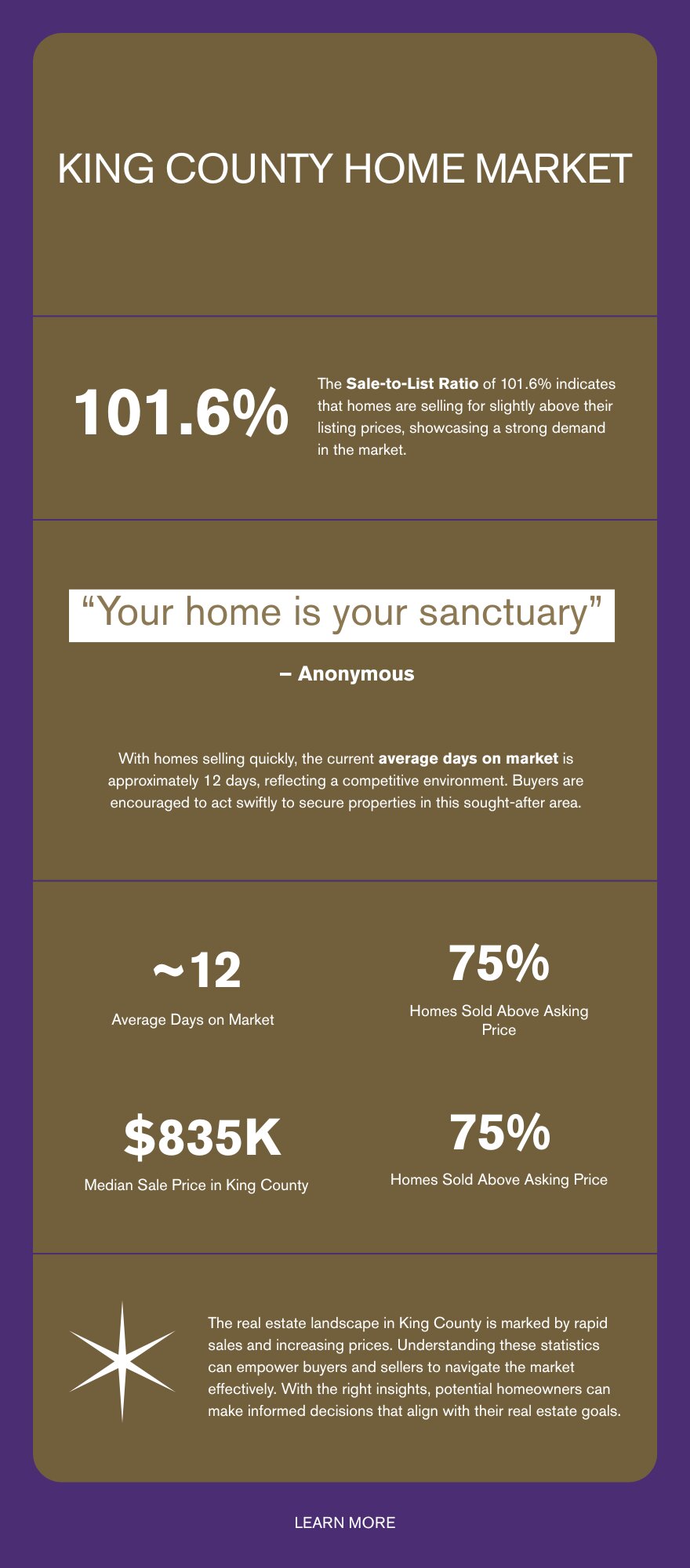
King County’s 2026 market rewards well-priced homes. A listing agent who knows these numbers — and can explain what drives them — is the one worth hiring.
Understand What the Marketing Plan Actually Covers
Ask: “What is your specific marketing plan for my home?”
This is where you’ll hear a wide range of answers. Some agents will say “we list on the MLS and put up a sign.” That’s not a marketing plan — that’s a minimum requirement.
In Washington State, NWMLS rules mean there’s no “coming soon” period — once your home goes live, it goes fully live. That makes your launch day the single most important day of your listing. An agent without a strong pre-launch preparation strategy is leaving money on the ground.
What a Strong 2026 Marketing Plan Includes
Professional photography (not the agent’s phone), a virtual tour or 3D walkthrough, targeted social media promotion, email outreach to buyer agents in your area, and a strategy for the open house weekend. Ask specifically about each of these. Ask who takes the photos. Ask whether they include a professional stager consultation.
If the plan is vague, the execution will be too.
Ask How They Handle Offers and Lowballs
Ask: “How do you manage the offer process, and how do you respond to low offers?”
You want an agent who can hold the line. Not every low offer deserves a counter — sometimes the right move is to decline and wait. But you need an agent who can read the situation and advise you on strategy, not just pass paper between the buyer’s agent and you.
Also ask: “Will you be personally handling my listing, or will it be someone on your team?”
Some high-volume agents hand listings off to junior assistants after the initial meeting. You’re not hiring the team — you’re hiring the person in front of you. Clarify who answers your calls, who shows up to negotiations, and who fields feedback from showing agents.
Ask the Uncomfortable Questions Up Front
Ask: “What’s your commission structure, and what does it cover?”
Since the NAR settlement changes took effect, the buyer’s agent compensation conversation is more upfront than it used to be. You should understand exactly what you’ll pay, what you may be asked to offer toward a buyer’s agent, and whether there are any marketing costs billed separately. Get this in writing before you sign.
Also ask: “What’s your cancellation policy if I’m not happy?”
An agent who is confident in their work will offer a reasonable cancellation clause. An agent who resists this question is telling you something important about how they handle accountability.
The Local Angle: What This Looks Like in South and East King County
Every submarket in King County has different dynamics right now. Renton, Kent, Auburn, and Covington are all behaving differently from each other — and very differently from the Eastside cities like Issaquah and Sammamish.
An agent with genuine local knowledge should be able to tell you: What’s happening with inventory in your specific city right now? Are buyer agents bringing pre-approved clients, or are showings stalling at the financing stage? Is your neighborhood drawing buyers from Seattle, from the Eastside, or primarily from within South King County?
If the agent you’re interviewing is giving you county-wide generalities when you ask about your block — that’s a signal. The agents who consistently outperform in this market know the sub-markets. They know which streets have the highest sale-to-list ratios and why.
Ask: “What’s happening with listings in my neighborhood right now — not countywide, but specifically here?”
A good agent should have an answer that surprises you with its specificity. A general answer tells you how deeply they actually know the market they’re claiming to know.

Every South King County submarket — Renton, Kent, Auburn, Covington — behaves differently. Your listing agent should know your neighborhood, not just the county.
The One Question Most Sellers Forget to Ask
Ask: “What makes your pricing different from what I’d get from another agent?”
This is where you’ll hear a range of vague claims. But it’s also where an agent who does things differently will tell you what that difference actually is.
The standard listing agent approach is a comparative market analysis (CMA) — pulling recent sales, making some adjustments, and landing on a number. That’s the baseline. A CMA is useful. But it’s a snapshot, and it’s only as good as the agent’s judgment about which comps to use. If you want to understand how to read one yourself, this breakdown of how to read a CMA as a King County seller is a good place to start.
What to Do With the Answers
Don’t go into these interviews hoping to like everyone equally. You want contrast. Talk to at least two agents — ideally three. The conversations that feel different from each other are the ones that teach you the most about what you’re actually comparing.
Take notes during each meeting. Pay attention to who asks questions about your situation before launching into their pitch. The agent who listens for the first 15 minutes and then tailors their approach to what you told them is showing you how they’ll handle your listing. The agent who delivers a canned presentation and pivots to commission before you’ve finished your coffee is showing you that too.
Before you list, it’s also worth understanding what goes into pricing your home correctly from day one — that post walks through the data side of what a strong listing agent should be doing. And if you want to get the home itself ready before those conversations even happen, this prep guide for King County sellers covers exactly what moves the needle.
FAQ: Questions to Ask Before You List
How many agents should I interview before listing my home?
Interview at least two — three is better. Most sellers talk to only one, which means they have no basis for comparison. A second or third conversation almost always surfaces something the first one didn’t.
What’s the biggest red flag when interviewing a listing agent?
An agent who quotes you the highest price without being able to explain the specific comps they used is the classic “buying the listing” move. They pitch a number you want to hear, you sign, and then three months later they’re asking you to drop the price. Ask for the CMA in writing before you decide.
Should I ask about commission upfront?
Yes — directly and early. Since the NAR commission changes, the conversation about how buyer’s agent compensation works has shifted. You want to know your total cost, what you might be asked to offer toward the buyer’s side, and what exactly is included in what you’re paying.
What if an agent won’t give me a cancellation clause?
Walk away. Any agent who is confident in their performance should be willing to let you cancel if they’re not delivering. Resistance to this question is resistance to accountability.
How do I know if an agent really knows my neighborhood?
Ask them to tell you what’s happening specifically in your neighborhood — not the county, not the city, your neighborhood. If they can tell you the most recent comparable sale, what it sold for relative to asking, and what drove that result — they know your market. If they answer with generalities, they don’t.
What does a BPO mean for sellers, and why does it matter?
A Broker Price Opinion is the pricing methodology that banks and lenders use to assess property values — more rigorous than a standard CMA. An agent who works as an active BPO field agent does this analysis daily, not just when a new client calls. For sellers, that means a list price grounded in real, current market data rather than a best-guess estimate.
Your guide to life outside Seattle.
253-350-0045 ·
greg@livingoutsideseattle.com ·
www.livingoutsideseattle.com
Property Tax Rates in King County Cities 2026
Buyers ask me all the time: “What are the property taxes going to be on this house?” It’s a fair question, and the answer matters more than most people realize when they’re focused on the purchase price and interest rate. On a $700,000 home, the difference between buying in Auburn and buying in Issaquah works out to roughly $2,500 a year — or about $210 a month that never shows up in a mortgage quote.
This post lays out the 2026 effective property tax rates for the eight cities I work in most across South and East King County. I also cover how the calculation works, why rates differ between cities just a few miles apart, and what this means if you’re running affordability math as a buyer or net-proceeds math as a seller.
Why King County Has No Single Tax Rate
A lot of buyers ask: “What’s the property tax rate in King County?” There isn’t one. Your bill is the sum of every taxing district whose boundary includes your property. That stack typically includes:
The Typical Levy Stack
Washington State levy — applies uniformly statewide
King County general levy — county services and administration
King County library district — public library system
City levy — varies by incorporated city; absent in unincorporated areas like Covington
School district levy — the single biggest variable between nearby cities
Fire district levy — local fire and rescue services
Emergency Medical Services (EMS) levy
Any voter-approved bond measures — school construction, parks, etc.
Two homes a mile apart — one in the Issaquah School District, one in the Kent School District — can carry meaningfully different tax bills even if their market values are identical. School district boundaries are the biggest driver of rate variation across South and East King County.
The 2026 total property tax collection in King County came in at $8.4 billion, up 10% from 2025’s $7.7 billion. That increase flows from rising assessed values, not any single rate change. But the effect on individual monthly payments is real.
2026 Property Tax Rates by City
These are median effective rates — actual tax bills divided by assessed market values — based on King County parcel data. Rates vary by ZIP code within each city, primarily because of school district boundaries. (Source: Ownwell, April 2026.)

2026 effective property tax rates for eight cities in South and East King County. Auburn carries the highest rate; Issaquah and Sammamish sit well below the county median of 0.99%. Source: Ownwell, April 2026.
| City | Effective Rate | Median Home Value | Median Annual Bill |
|---|---|---|---|
| Auburn | 1.19% | $566,000 | $6,477 |
| Maple Valley | 1.11% | $722,000 | $7,963 |
| Renton | 1.03% | $688,000 | $7,145 |
| Covington | 1.03% | $574,000 | $5,862 |
| Kent | 1.01% | $587,000 | $5,919 |
| Federal Way | 1.00% | $542,000 | $5,412 |
| Sammamish | 0.89% | $1,384,000 | $12,054 |
| Issaquah | 0.83% | $1,031,000 | $9,132 |
| King County Avg | 0.99% | $774,000 | $7,644 |
How to Calculate Your King County Tax Bill
King County uses this formula:
(Assessed Value ÷ 1,000) × Levy Rate = Annual Tax Bill
For a home assessed at $650,000 in Renton with a levy rate of approximately $10.30 per $1,000:
$650,000 ÷ 1,000 = $650
$650 × $10.30 = $6,695 per year (~$558/month in escrow)
A few important things to understand about that assessed value:
King County Reassesses Every Year
Washington has no equivalent to California’s Proposition 13. Your assessed value is adjusted annually based on market conditions. If home prices in your neighborhood rose 8% last year, your assessment likely reflects that — and your bill goes up accordingly.
Your 2026 bill is calculated from the value as of January 1, 2025. So the assessment lags the market by about a year — but it catches up.
Buying at a Higher Price Does Not Reset Your Taxes
The assessor determines value independently of your sale price. A sale at market value is data they will consider in future assessments — but it doesn’t trigger an immediate reset the way it does in some other states. So if you buy a house below assessed value, your taxes don’t automatically drop either.
For the most accurate number on any specific parcel, use the King County eReal Property lookup at blue.kingcounty.com. Search by address to see the current assessed value and the levy rate stack broken down by district. It takes about 90 seconds and gives you a far more accurate number than any city average.
Why Issaquah and Sammamish Rates Are Lower
Issaquah (0.83%) and Sammamish (0.89%) sit well below the county average — yet their median tax bills are higher in dollar terms because home values there are much larger. Lower rates in these cities generally reflect two things.
First, fewer overlapping special districts. Some areas carry smaller bond debt loads than South King County cities, which compresses the total levy stack. Second — and this is the counterintuitive part — when the total assessed value base in a school district rises, the rate needed to raise the same budget dollar amount actually falls. High home values spread the levy cost across more dollars, pushing the percentage rate down.
City-by-City: What Buyers and Sellers Should Know

Understanding your property tax rate before you make an offer helps buyers budget accurately and keeps sellers from being surprised at closing.
Auburn (1.19%)
Auburn carries the highest effective rate among the cities we track, with a $6,477 median annual bill on a $566,000 home. Rates vary by ZIP — the 98001 and 98002 ZIP codes trend higher than 98092. Buyers should ask their lender to calculate PITI based on the specific parcel, not a city average.
Maple Valley (1.11%)
Maple Valley’s rate and its growing median home value combine to produce one of the larger median bills in South King County at $7,963 per year. School construction bonds have contributed to the rate here. Strong schools drive demand for the area, and those same schools come with levy costs built into the rate.
Renton (1.03%)
Renton’s 1.03% rate on a $688,000 median home produces a $7,145 median annual bill. Rates vary within Renton by school district boundary — homes in the Issaquah School District portion of eastern Renton trend lower than those in the Renton School District. This surprises a lot of buyers who assume all of “Renton” carries one rate.
Covington (1.03%)
Covington shares Renton’s effective rate but with a lower median home value ($574,000), producing a $5,862 median bill. Covington is unincorporated King County, which means no separate city levy — one reason the total rate stays competitive. For buyers priced out of Maple Valley, Covington often offers similar inventory at lower total monthly carrying costs.
Kent (1.01%)
Kent sits nearly at the county average. The $5,919 median annual bill on a $587,000 home is one of the more affordable in this group in absolute dollar terms. Kent has one of the widest ranges of home types in South King County — condos to large single-family homes — so the actual bill on any specific purchase will vary considerably from the median.
Federal Way (1.00%)
Federal Way sits right at the county median rate and has the lowest median home value on this list at $542,000, producing a $5,412 median annual bill. For first-time buyers working with a tighter budget, Federal Way offers the lowest combined price-and-tax entry point among these eight cities.
Sammamish (0.89%)
Lower rate, but higher everything else. The $1,384,000 median home value produces a $12,054 median annual bill — over $1,000 a month in tax escrow — despite the below-average rate. Sammamish draws buyers who prioritize the Issaquah or Lake Washington school districts, newer construction, and lower density. That demand drives values, which keeps the rate lower but doesn’t lower the bill.
Issaquah (0.83%)
The lowest rate on this list. Issaquah’s 0.83% on a $1,031,000 median home means a $9,132 median annual bill. Part of the reason rates are lower is that the area’s high assessed value base spreads the levy burden across more dollars. School district quality drives demand, and demand drives values — which, counterintuitively, keeps the rate lower than South King County cities.
Important Property Tax Dates in King County
| Date | What Happens |
|---|---|
| January 1 | Assessment date — value is frozen for the year’s calculation |
| February 10 | Tax bills mailed |
| April 30 | First half payment due |
| July 1 | Appeal deadline — do not miss this |
| October 31 | Second half payment due |
The appeal window matters. If you receive your assessment notice and believe the value is too high — based on comparable sales or property condition — you have until July 1 to file with the King County Board of Equalization. Once that deadline passes, your ability to contest that year’s bill is gone.
Exemptions That Can Lower Your Bill
Washington offers several exemption programs worth knowing about, especially if you’re buying for a family member or planning long-term.
Senior/Disabled Exemption. Homeowners 61 or older — or permanently disabled — with household income under the program threshold may qualify for a significant reduction in assessed value and a freeze on future increases. This is one of the most valuable programs in the state and often goes unclaimed by people who don’t know it exists.
Veteran Exemption. Qualifying veterans with a service-connected disability may be eligible for a partial property tax reduction.
All exemptions require the home to be your primary residence. Investment properties and second homes do not qualify. To apply or check eligibility, contact the King County Assessor’s office at assessor.info@kingcounty.gov or (206) 296-7300.
What This Means for Your Buy or Sell Decision
For buyers: Your lender uses your total PITI payment — principal, interest, taxes, and insurance — to calculate affordability. Property taxes are a real monthly cost, not a closing-day item. On a $700,000 home, the difference between a 0.83% rate (Issaquah, ~$484/month) and a 1.19% rate (Auburn, ~$694/month) is $210 per month. Over a 30-year loan, that’s $75,600 in additional tax payments — more than most buyers realize when they’re focused on the interest rate.
For sellers: When a buyer’s lender calculates their debt-to-income ratio, property taxes push more buyers out of qualifying range at the higher end of pricing. In cities with higher effective rates, price sensitivity tends to be greater. Knowing your city’s rate — and being able to show the buyer the actual parcel-level calculation — is a transparency move that builds trust during negotiations.
For a broader look at all the costs of owning a home in King County, this post on total cost of homeownership in King County walks through the full monthly cost picture beyond just taxes. And if you’re a seller thinking about your net proceeds, Washington’s capital gains rules are the other tax conversation worth having before you list.
Run Your Own Numbers in 90 Seconds
To get the exact levy rate for any property you’re considering:
- Go to blue.kingcounty.com/Assessor/eRealProperty
- Search by address
- Find the “Current Year Tax” section — it shows the assessed value and the levy rate stack broken down by district
- Divide the tax bill by the assessed value to get the effective rate
This is the most accurate number you’ll find. I walk buyers and sellers through this lookup regularly — it often changes how they think about two comparable homes in different parts of the county. For where home values are heading in 2026 — which directly affects future assessed values and bills — here’s the King County housing market forecast.
Frequently Asked Questions
What is the property tax rate in King County in 2026?
The countywide median effective rate is 0.99%, but rates vary by city from 0.83% (Issaquah) to over 1.19% (Auburn). The rate for any specific property depends on all the overlapping taxing districts — state, county, city, school district, fire, EMS, and local bond measures.
When are King County property taxes due in 2026?
Half by April 30, and the other half by October 31. Tax bills are mailed in February. If your home has a mortgage, your lender typically collects taxes through escrow and pays on your behalf.
When is the King County property tax appeal deadline?
July 1 each year. If you receive your assessment notice and believe the value is too high, file with the King County Board of Equalization before that date. You’ll need supporting evidence like comparable sales or documentation of property condition issues.
Does buying at a higher price increase your property taxes right away?
Not automatically. King County reassesses independently based on market data. Your sale price is information the assessor will consider, but the assessment may not change until the next annual cycle. That said, sales well above assessed value typically result in higher assessments in subsequent years.
Where can I look up the exact property tax for a specific address?
Use the King County eReal Property portal at blue.kingcounty.com/Assessor/eRealProperty. It shows the current assessed value, each levy in the stack, and the total bill for any parcel in the county.
Are there exemptions that lower property taxes in King County?
Yes. The Senior/Disabled exemption is the most significant — qualifying homeowners 61 or older with income under the program threshold can freeze their assessed value and reduce their bill. Veteran exemptions are also available. All require the home to be your primary residence. Contact the King County Assessor at (206) 296-7300 or assessor.info@kingcounty.gov to check eligibility.
Data sourced from Ownwell (April 2026) and King County Assessor public records. Rates shown are median effective rates and will vary by specific parcel and ZIP code within each city. Verify levy rates for any specific property at blue.kingcounty.com before making financial decisions.
Your guide to life outside Seattle.
253-350-0045 ·
greg@livingoutsideseattle.com ·
www.livingoutsideseattle.com
Washington State Real Estate Excise Tax (REET): Seller Guide

Before you sign anything at closing, you need to know about one tax most sellers don’t think about until it’s too late.
Most sellers in King County spend months thinking about list price, staging, and what to do with the proceeds. REET — Washington’s Real Estate Excise Tax — rarely gets a mention until the closing statement lands in front of them. Then the questions start. What is this number? Why is it so large? Is this the same as capital gains?
The short answer: REET is a transaction tax Washington charges on nearly every home sale. Unlike capital gains, it is calculated on your sale price, not your profit. That distinction matters a lot. On an $800,000 home sale in Renton or Kent, your REET bill could run $13,000 or more before local rates are added. That is real money, and you should know exactly where it comes from before you go to closing.
I see this confusion regularly in my work. Sellers find out about REET at the same time they are signing a stack of documents and trying to remember where they put their ID. This guide is meant to fix that. Read it before you list.
What Is REET and Who Pays It
REET stands for Real Estate Excise Tax. It is Washington State’s tax on the transfer of real property. When you sell your home, you transfer ownership to the buyer. That transfer triggers REET. Washington has charged this tax since 1951, though the graduated rate structure is newer — it replaced the old flat rate in 2020.
The seller pays REET by custom and by statute. In practice, your escrow or title company collects it from your net proceeds at closing and remits it to the county before your deed is recorded. You do not write a separate check. It comes out of what you would otherwise walk away with, which is exactly why it affects your bottom line.
The deed cannot be recorded until REET is paid. That means the sale cannot legally close until the tax is settled. Your title company handles this automatically, but knowing it is happening helps you read your settlement statement correctly.
The 2026 REET Rate Schedule: What You Actually Pay
Washington uses a four-bracket graduated rate structure. Every seller pays the same rate on each bracket — the rate applies to the slice of your sale price within that range, not to the entire sale price. Think of it like income tax brackets: only the amount within each tier gets taxed at that tier’s rate.
Here is how the 2026 state rate schedule breaks down:
2026 Washington State REET Brackets
First $525,000 — state rate of 1.10%
$525,000.01 to $1,525,000 — state rate of 1.28%
$1,525,000.01 to $3,025,000 — state rate of 2.75%
Above $3,025,000 — state rate of 3.00%
King County adds a local REET of 0.50% on top of the state rate. This local portion funds affordable housing and infrastructure programs countywide.
To make the math concrete, here is what three common King County sale prices actually cost in total REET:
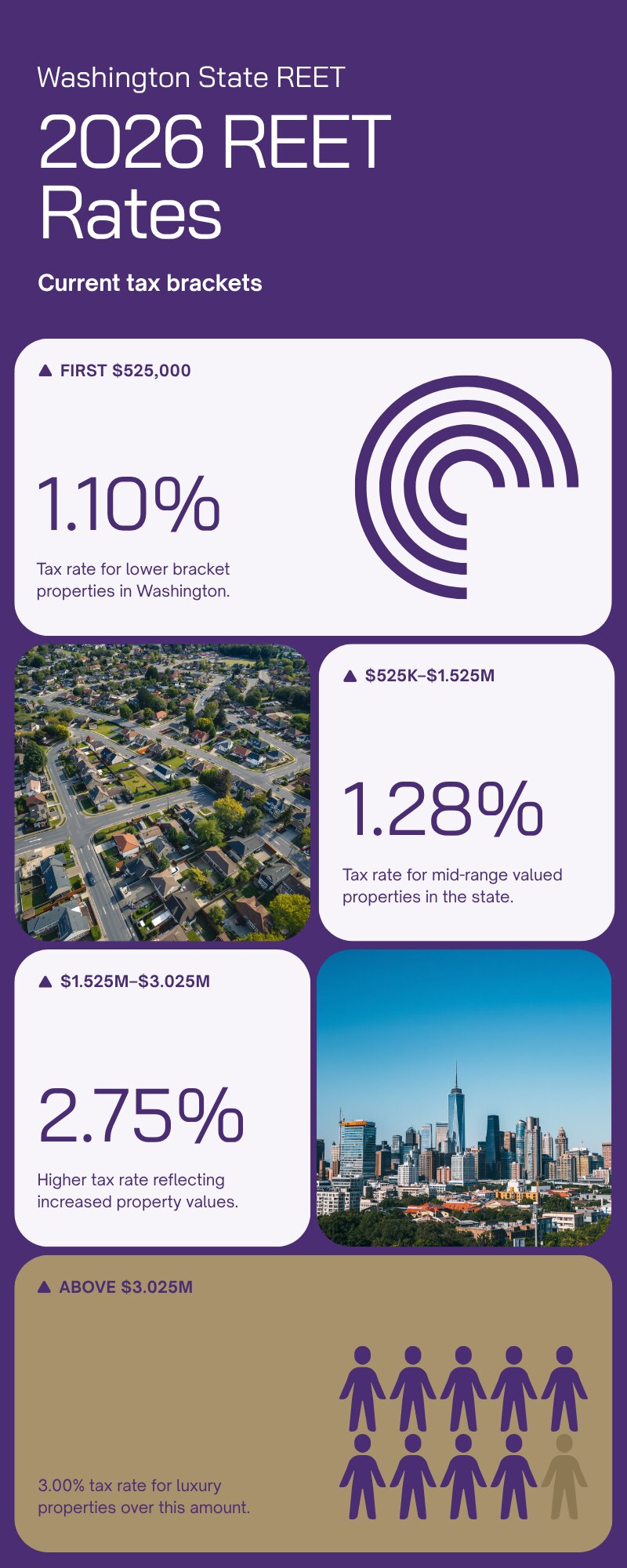
The graduated rate structure means your effective REET rate rises as your sale price climbs — most South King County sellers land between 1.60% and 1.78% combined.
Sale Price $600,000 (typical Kent or Auburn single-family)
State REET on first $525,000: $5,775
State REET on next $75,000 @ 1.28%: $960
King County local REET (0.50%): $3,000
Total REET: $9,735
Sale Price $800,000 (typical Renton or Covington move-up home)
State REET on first $525,000: $5,775
State REET on next $275,000 @ 1.28%: $3,520
King County local REET (0.50%): $4,000
Total REET: $13,295
Sale Price $1,100,000 (Maple Valley or East Renton higher-end)
State REET on first $525,000: $5,775
State REET on next $575,000 @ 1.28%: $7,360
King County local REET (0.50%): $5,500
Total REET: $18,635
These numbers grow quickly on move-up homes. The graduated structure means sellers at the $1.5M threshold pay roughly 2.5 times more as a percentage of their sale price than sellers in the $525K range. For most South King County sellers, the combined state plus local rate lands somewhere between 1.60% and 1.78% of the sale price.
REET Is Not Capital Gains Tax
This is the confusion I hear most often from sellers, and it is worth clearing up completely before anything else.
REET is calculated on your sale price. Capital gains is calculated on your profit — the difference between what you paid for the home and what you sold it for, minus selling costs and qualifying improvements. They are separate obligations. You pay REET at closing regardless of whether you made money on the sale. You deal with capital gains at tax time, and only if your profit exceeds the federal exclusion ($250,000 for single filers, $500,000 for married couples filing jointly).
Washington State does not impose a capital gains tax on real estate sales. The state’s 7% capital gains tax applies to certain financial assets — stocks, bonds, and similar instruments — not to your home. So when it comes to your Washington State tax burden from selling a home, REET is essentially it. Federal taxes are a separate calculation entirely.
I wrote a full breakdown of how capital gains work on Washington home sales if you want to understand the federal piece. The REET and capital gains questions show up together constantly — it helps to understand them separately before you talk to your CPA.
Common REET Exemptions
Not every transfer triggers REET. Washington provides specific statutory exemptions, and knowing them can save you a significant sum if your situation qualifies.
Inheritance and Devise by Will
If you inherited a home and you are selling it to a third party, REET applies on your sale. But the original transfer from the estate to you — moving the property into your name — is exempt from REET. This is why inherited property often shows up in the chain of title without a corresponding excise tax payment. If you recently inherited a King County home and have questions about next steps, I covered this specifically in my inherited home guide for King County sellers.
Divorce and Legal Separation
Transfers between spouses pursuant to a divorce decree or legal separation agreement are exempt. This applies to legally married spouses and state-registered domestic partners. If you are transferring the home to a former partner as part of a settlement, REET likely does not apply — but the exemption must be documented correctly on the REET affidavit.
Gifts
Genuine gifts of real property where no money or other consideration changes hands are exempt. The key word is genuine — the transfer must be a gift, not a below-market sale disguised as one.
Foreclosure and Distressed Transfers
Certain distressed sale scenarios have partial or full exemptions. These situations involve additional complexity and you should work directly with a title company and a real estate attorney to confirm eligibility and documentation requirements.
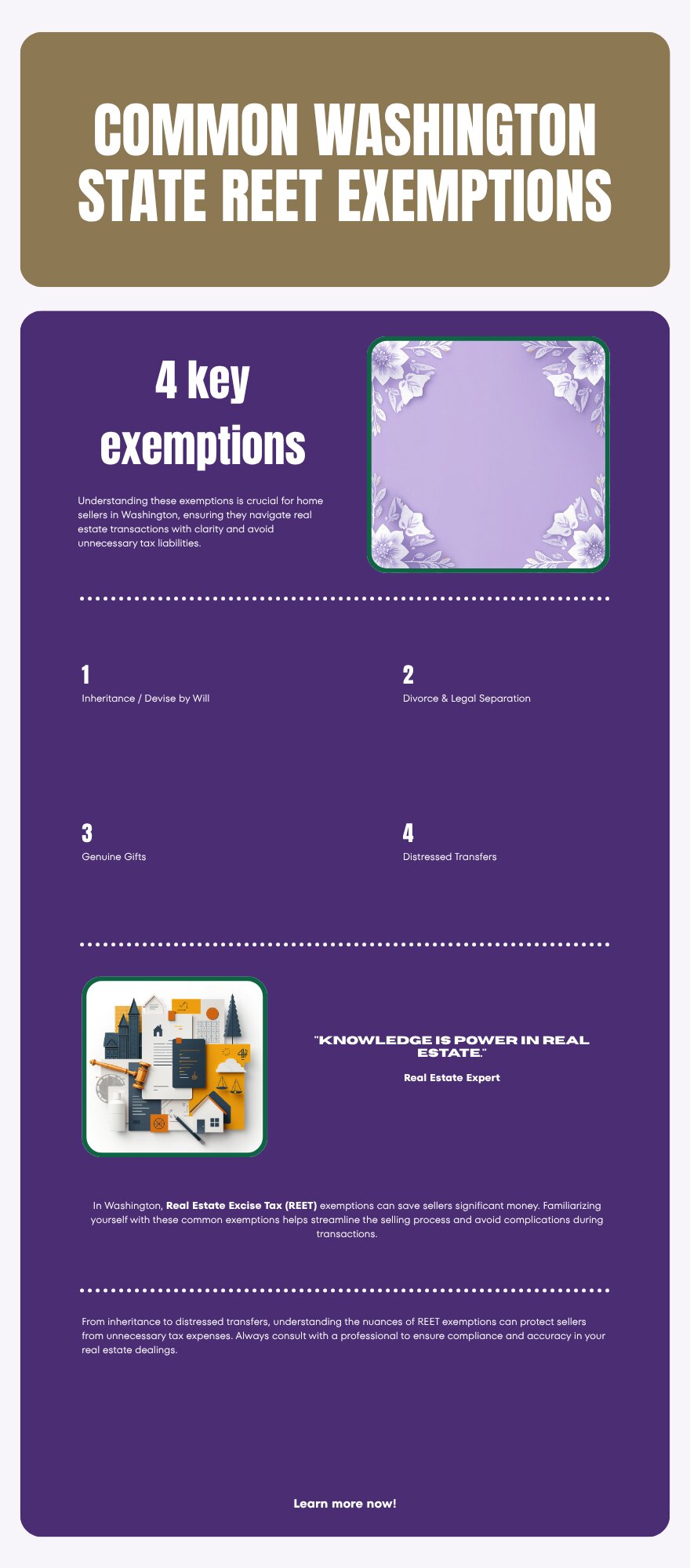
The most common REET exemptions in Washington State — always confirm with your title company before assuming your transfer qualifies.
How REET Fits Into Your Total Closing Costs
REET is typically the largest single tax line on a King County seller’s settlement statement, but it sits alongside other closing costs. When you are running your net proceeds math before you list, here is how REET fits into the picture.
Your title and escrow company will prepare a preliminary settlement statement before closing. That statement breaks out every cost — agent commission, title fees, prorated property taxes, any seller-paid concessions, and REET. Review this before closing day so there are no surprises when you sign.
The REET affidavit gets filed at the county recorder’s office. In King County, that is processed through the King County Recorder’s Office. Your title company handles the filing, but the tax must clear before the deed is recorded. Practically speaking, closing cannot happen until REET is paid and confirmed — it is a mechanical requirement, not a risk you manage yourself.
For more detail on the full picture of seller closing costs in King County, my home preparation guide for King County sellers covers what you can expect to spend before and at closing.
The King County Angle: What Local Sellers Should Know
King County’s 0.50% local REET rate is at the higher end for Washington counties — many rural counties charge just 0.25%. The difference matters on expensive homes. On a $900,000 sale, the extra 0.25% in King County versus a lower-rate county adds $2,250 to your tax bill. That is the cost of selling in a high-demand market.
The local REET revenue in King County is directed toward affordable housing programs and capital projects. Your REET payment at closing funds housing initiatives within the county — that context may or may not make the bill feel better, but it is where the money goes.
South and East King County sellers — Renton, Kent, Auburn, Covington, Maple Valley, Issaquah, Sammamish — all pay the same King County local rate of 0.50%. The baseline applies throughout unincorporated areas and most incorporated cities in the county.
The market in South King County currently sits at roughly $730,000–$870,000 median for single-family homes, depending on city. At that price range, total REET (state plus King County local) typically lands between $11,700 and $14,400. Build that number into your net proceeds calculation before you set your list price.
What This Means for Sellers: Your Pre-Listing Checklist
If you are preparing to sell your King County home, here are the concrete steps that apply to REET:
Run the math before you list
Use your expected sale price and the rate schedule above to estimate your REET liability. This gives you an accurate net proceeds number when you evaluate offers. Your agent can run this for you in minutes.
Tell your agent your target net
If you need to walk away with a specific amount, your agent needs to know that before pricing the home. REET comes off the top along with commission and other costs. Net proceeds math drives the right list price — not gross sale price alone.
Check for exemptions
If your sale involves inheritance, divorce, or a gift transfer, ask your title company whether an exemption applies. Do not assume — the exemptions are specific and require documentation on the REET affidavit.
Ask for a preliminary settlement statement
Before closing day, request this from your escrow company. Review the REET line and confirm it matches your calculations. Surprises on closing day slow things down and add stress to an already complex process.
Talk to a CPA if you have a large gain
REET is your Washington State obligation. Federal capital gains is a separate question. If you have owned your home for many years and have significant appreciation beyond the exclusion amount, discuss that with a tax professional before closing — not after.
Frequently Asked Questions About Washington REET
Is REET paid by the buyer or the seller in Washington?
By statute and by custom, the seller pays REET in Washington. It is deducted from your net proceeds at closing. The buyer does not pay REET on a standard residential sale, though they do pay their own closing costs.
Can the buyer and seller negotiate who pays REET?
The contract governs, not state law. In theory, a seller could negotiate for the buyer to assume REET liability. In practice, this is uncommon in King County residential sales. Most transactions follow the standard custom: seller pays.
Does REET apply to new construction sales?
Yes. New construction sales are subject to REET on the full sale price, including both land and improvements. The builder or developer pays REET at closing.
Is REET deductible on my federal taxes?
REET is generally treated as a selling expense and reduces your capital gain for federal tax purposes. It is not a separately deductible item like mortgage interest. Ask your CPA how to account for it in your cost basis and selling expense calculations.
What if my home sells for less than I paid?
REET still applies to the sale price, even if you are selling at a loss. There is no exemption for a below-basis sale on a residential property. You will owe REET on whatever amount changes hands.
What happens if REET is not paid at closing?
The deed cannot be recorded without REET payment. In practice, your title company will not allow closing to proceed until REET is collected and submitted. This is a mechanical requirement — your title company manages it, not you.
Selling a home involves a lot of moving parts, and REET is one that tends to catch sellers off guard. The graduated rate structure means your tax bill scales significantly as your sale price climbs, and in King County’s current market, most sellers are selling above the first bracket. Know the numbers before you list, not the morning you sign closing documents.
If you have questions about what your specific sale will net after REET and other closing costs, reach out before you commit to a price. I run this math for every client I work with. It takes ten minutes and removes a lot of surprises. You can also review how I approach pricing in my CMA explainer for King County sellers.
Your guide to life outside Seattle.
253-350-0045 ·
greg@livingoutsideseattle.com ·
www.livingoutsideseattle.com
HELOC vs. Cash-Out Refinance: King County Guide 2026
Most King County homeowners are sitting on well over six figures of equity. Here’s how to use it without giving up the mortgage rate you fought for.
If you bought your home in King County more than a few years ago, you’re probably wealthier than you think. The typical American homeowner with a mortgage is holding around $212,000 in equity they could actually borrow against. In King County, where the median home sits near $835,000, plenty of homeowners I work with in Renton, Kent, and Covington are well past that number.
The question I hear all the time: how do I get to that money without wrecking the 3% mortgage I locked in years ago? There are two main answers. A home equity line of credit, or a cash-out refinance. They sound similar. They are not. Pick the wrong one and it can cost you hundreds of dollars a month for decades.
I price homes every day as a BPO field agent, so I see what equity positions actually look like across South and East King County. Let me walk you through how each option works, what each one costs, and the simple math that tells you which one fits your situation.
How a HELOC Works (and What It Costs)
A HELOC is a line of credit secured by your house. Think of it like a credit card with a much lower rate and your home as collateral. The bank approves you for a limit, often up to 80% or 85% of your home’s value minus what you owe. You draw what you need, when you need it, and you only pay interest on what you’ve actually used.
The national average HELOC rate in June 2026 is sitting around 7.25% to 7.4%, not far off the 2026 low of 7.19% from March. HELOC rates are variable. They move with the prime rate, which is currently 6.75%. If the Fed cuts, your rate drops. If the Fed hikes, it climbs. That flexibility cuts both ways, and you need to be honest with yourself about whether your budget can handle a rate that moves.
Costs are the quiet advantage here. Most HELOCs come with low or no closing costs. Compare that to what you’ll see below for a refinance, and the gap is real money.
How a Cash-Out Refinance Works (and What It Costs)
A cash-out refinance replaces your entire existing mortgage with a new, bigger one. You owe $400,000 and want $100,000 in cash? Your new loan is $500,000, and the whole thing carries today’s rate. In 2026 that means roughly 6.8% for most borrowers, with the best-qualified getting closer to 6.25%.
That word “entire” is the trap. You’re not borrowing $100,000 at today’s rate. You’re re-borrowing all $500,000 at today’s rate, including the $400,000 you already had locked at something much lower.
Then come the closing costs. A cash-out refinance typically runs 2% to 5% of the full new loan amount. On a $500,000 loan, that’s $10,000 to $25,000. On a HELOC, you’d often pay close to nothing to open it.
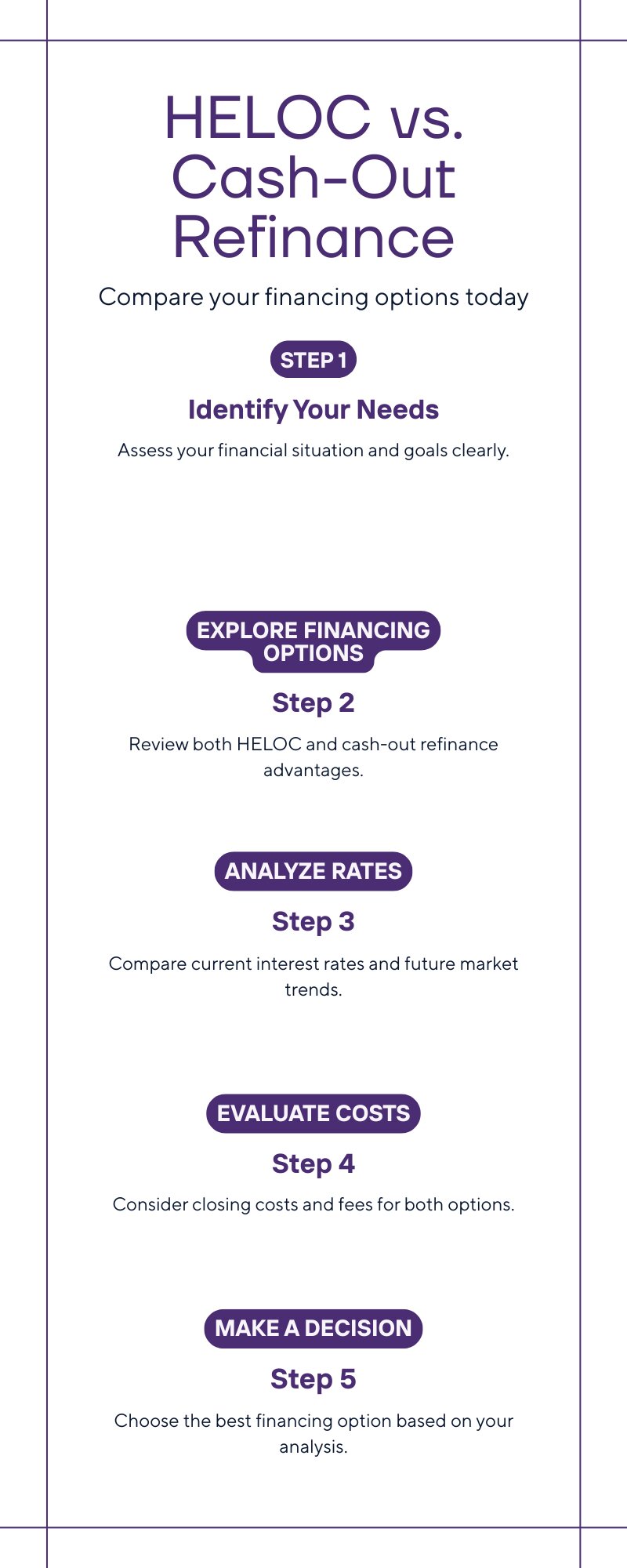
The core difference: a HELOC adds a second loan, a cash-out refinance replaces your entire mortgage at today’s rate.
HELOC vs. Cash-Out Refinance: The Math That Decides It
Here’s a real-world King County example. Say you own a home worth $850,000, you owe $400,000 at 3%, and you want $100,000 for a remodel.
Keep your mortgage and add a HELOC
Your existing payment stays around $1,686 a month in principal and interest. Interest on the full $100,000 HELOC draw at 7.4% runs about $617 a month during the draw period. Total: roughly $2,300 a month.
Cash-out refinance instead
A new $500,000 loan at 6.6% costs about $3,193 a month. That’s nearly $900 more every month than the HELOC route, plus five figures in closing costs, for the exact same $100,000 in your pocket. Over ten years that monthly gap is more than $100,000. The HELOC isn’t just a little better in this scenario. It’s not close.
So when does the refinance win? Two cases. First, if your current rate is already high. Buyers who purchased in late 2023 or 2024 at 7% or above can sometimes refinance today, pull cash out, and barely change their payment. Second, if you need one large fixed sum and you want one predictable fixed payment for 30 years. Some people sleep better with that, and that’s a legitimate reason.
The Tax Rules Most Homeowners Get Wrong
A lot of people still believe HELOC interest is automatically deductible. It isn’t. Under current IRS rules, interest on a HELOC or cash-out refinance is only deductible if the money goes toward buying, building, or substantially improving the home that secures the loan. A kitchen remodel in your Kent home can qualify. Paying off credit cards or buying a car does not.
Two more catches. You have to itemize your deductions to claim it, and most households take the standard deduction instead. And the burden of proof is on you, so keep every contractor invoice and receipt. If you’re borrowing a meaningful amount, a one-hour conversation with a CPA before you sign is worth far more than it costs. I’m a real estate agent, not a tax advisor, and this is exactly the kind of decision where the right professional pays for itself.
The Local Angle: King County Equity in 2026
King County’s median home price has come down about 7.5% from last year. I know that sounds like bad news for equity. Here’s the context that matters: if you bought in Renton or Auburn before 2021, your home is still worth dramatically more than you paid. A pullback from the peak hasn’t erased years of gains. Most long-term owners in South King County are still holding $200,000 to $400,000 or more in usable equity.
What I see in the field is homeowners using that equity three ways. Remodels are the big one, especially kitchens and primary suites in 1980s and 1990s homes in Covington and Maple Valley, where an updated home sells noticeably faster. Second is debt consolidation, which can make sense at 7.4% against credit cards charging 22%, as long as the spending that built the debt stops. Third, and growing fast, is move-up buyers using a HELOC as bridge money to buy their next home before selling their current one. If that’s your situation, I broke down how that strategy works in my contingent offer guide for King County, and I compared the keep-or-sell decision in renting out your King County home vs. selling.
One more local note. Where prices go from here affects how much cushion you have. My King County housing market forecast for 2026 covers the inventory and price trends that matter if you’re deciding whether to tap equity now or wait.
Kitchen and primary suite remodels are the most common use of equity I see across South King County.
What This Means for You
If you’re a King County homeowner with a mortgage rate under 5.5%, start with the HELOC conversation. Keeping your existing rate is worth real money every month, and the rate math above shows how much. Get quotes from at least three lenders, including a local credit union, because HELOC rates and fees vary more than first mortgage rates do.
If your rate is 6.5% or higher, run both options side by side. A cash-out refinance might lower your rate and put cash in your pocket at the same time. Current rate context is in my King County mortgage rates guide.
And before either one, get a real valuation. Every dollar of borrowing power depends on what your home is actually worth, and online estimates in our market routinely miss by tens of thousands. If you’re also weighing what a sale would net you instead, my guide to capital gains on home sales in Washington covers the tax side of that decision.
FAQ
Is a HELOC or cash-out refinance better in 2026?
For most homeowners, a HELOC. The majority of King County mortgage holders have rates between 2.5% and 5%, and a cash-out refinance would replace that low rate with today’s 6.5% to 7% on the entire balance. A HELOC charges a higher rate, but only on the smaller amount you borrow.
How much equity can I borrow against my King County home?
Most lenders let you borrow up to 80% or 85% of your home’s value, minus your current mortgage balance. On an $850,000 home with $400,000 owed, that’s roughly $280,000 to $322,000 in available credit, depending on the lender and your qualifications.
Does opening a HELOC change my current mortgage rate?
No. A HELOC is a separate second loan. Your existing mortgage, its rate, and its payment stay exactly the same. That’s the main reason HELOCs are winning in 2026.
Is HELOC interest tax deductible?
Only if the money is used to buy, build, or substantially improve the home securing the loan, and only if you itemize deductions. Home improvements can qualify. Debt payoff, tuition, and cars don’t. Confirm your situation with a tax professional.
Can I use a HELOC to buy my next house before selling my current one?
Yes, and it’s one of the most common moves I see from move-up sellers in Renton and Kent. You open the HELOC on your current home while you still live there, use the draw for the down payment on the next home, then pay the line off when your old home sells.
What credit score do I need for a HELOC?
Most lenders want 680 or higher, with the best rates going to borrowers above 740. You’ll also generally need to keep at least 15% to 20% equity in the home after the line is opened.
Your home equity is a tool. Used well, it funds the remodel, clears the expensive debt, or bridges you into your next home. Used carelessly, it puts the roof over your head at risk. The right first step is knowing your real number.
Your guide to life outside Seattle.
253-350-0045 ·
greg@livingoutsideseattle.com ·
www.livingoutsideseattle.com
Contingent Offer Guide: King County WA 2026

A step-by-step guide for move-up sellers who need to buy their next home before the current one closes — and how to make a seller say yes.
If you own a home in King County and you need to buy your next place before you sell, you already know the problem. You can’t really afford two mortgages. But sellers don’t love contingent offers. So how do you make this work?
The short answer: contingent offers do get accepted in King County — especially right now. Inventory across South and East King County has grown compared to the peak frenzy years, which means sellers are more flexible than they’ve been in a long time. But “more flexible” doesn’t mean “they’ll accept anything.” The offer still has to be structured the right way.
Here’s what actually goes into a contingent offer that a seller will take seriously, and how the current King County market shapes those decisions.
What a Home Sale Contingency Actually Is
A home sale contingency means your offer to buy a new home depends on selling your current one first. In Washington state, this is typically documented using Form 22B — the Buyer’s Sale of Property Contingency Addendum. This form is used specifically when your home is not yet under contract.
There’s an important difference between that and Form 22Q, which is used when your home is already on the market. Sellers generally prefer 22Q because your sale is actively in motion. With 22B, the seller is essentially betting that you’ll get your home under contract within a set timeframe. That’s a bigger ask.
Form 22B requires you to list your home for sale within a specific number of days stated in the addendum — often 5 to 15 days. If you miss that window without taking action, you can lose all your contingency protections, including inspection and financing. That’s a real risk, and sellers know it.
The kick-out clause (also called the bump clause) is the seller’s main protection tool. It lets the seller keep marketing the property while your contingency is active. If another qualified buyer submits an offer, the seller issues a Form 44 bump notice. You then have a short window — typically 48 to 72 hours — to either remove your contingency and proceed, or step away. You’d use Form 46 to respond.
Understanding these mechanics matters because they shape every decision you make when structuring the offer.
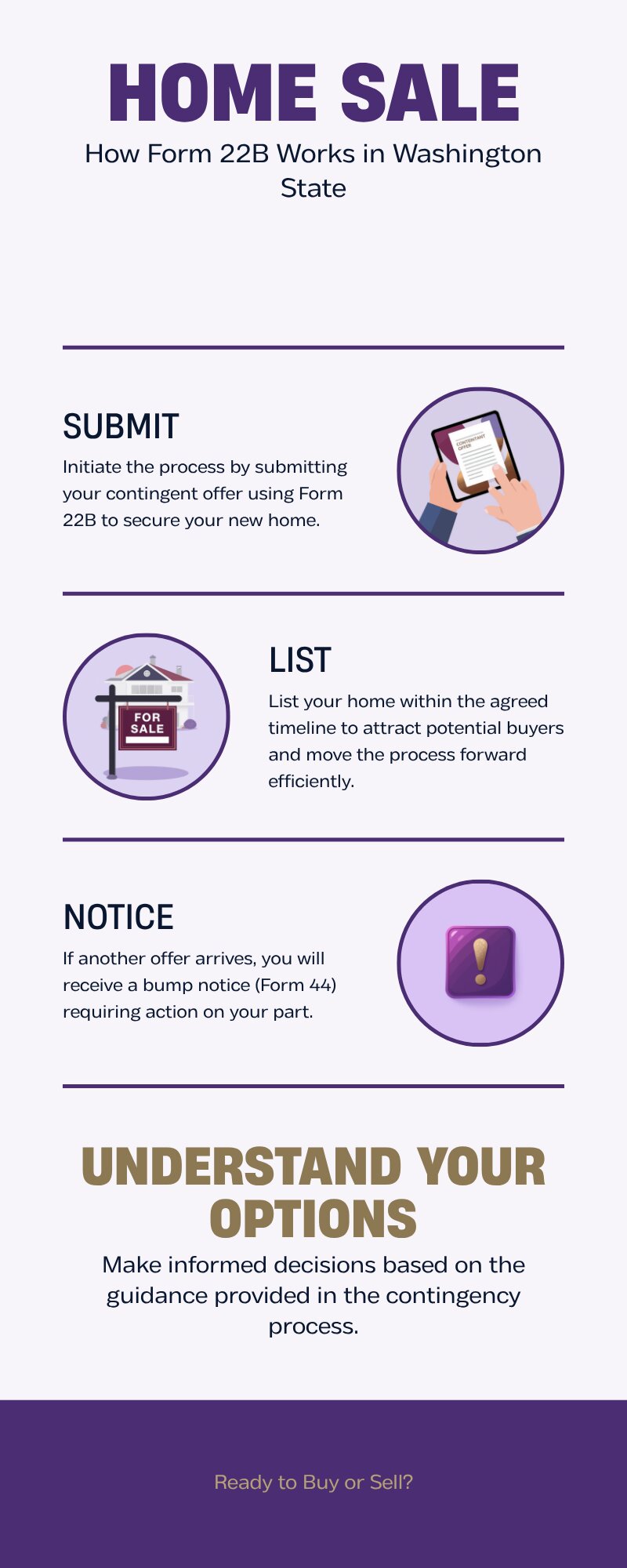
The Form 22B process in Washington state: submit your contingent offer, list your home, respond to any bump notice, and close. Understanding each step helps you structure an offer sellers will accept.
Why Sellers in King County Are More Open Right Now
This matters for timing. In 2021 and 2022, sellers in most King County markets had lines of competing buyers. A contingent offer was almost automatically rejected. That market has shifted.
In South King County — Renton, Kent, Auburn, Covington, Maple Valley — inventory has increased meaningfully. Days on market have stretched out in some price points. Sellers who aren’t priced perfectly are sitting longer than they expected. That means many sellers are now willing to consider a contingency they would have dismissed three years ago.
In East King County — Issaquah, Sammamish, Bellevue — things are still tighter. Demand holds up in those corridors because of proximity to tech employers. Contingent offers face more competition there, and the terms need to be sharper.
The key question isn’t whether a seller will accept a contingency in the abstract. It’s whether your specific offer removes enough risk for this specific seller to feel comfortable saying yes.
How to Structure a Contingent Offer Sellers Will Actually Accept
Start with your own home — before you make an offer
This sounds obvious, but a lot of buyers skip it. Before you make a contingent offer, have your home evaluated for a realistic list price. Not what you hope to get. What you will actually get in the current market.
If your agent gives you a vague range, push back. You need a real number, because their agent are going to ask the same question when reviewing your offer: does this buyer’s home actually sell? If you’re priced at a number that doesn’t clear the debt you need to carry, the contingency is a problem, not a solution. A solid CMA from a local agent is the starting point.
Get fully pre-approved, not just pre-qualified
A pre-qualification letter isn’t worth much in this context. You need a full pre-approval from a trusted lender who has verified your income, assets, and credit. In the cover letter or offer documents, make it clear when your pre-approval was issued and offer to have your lender speak directly with the listing agent.
Pre-approval shows the seller that when your home sells, there’s no question you can close. It’s one less thing for them to worry about.
Offer a tighter contingency timeline
A 90-day contingency window sends a signal: “I’m not sure my house will sell quickly.” A 30-day window sends a different signal: “I’m ready to move and I’ve priced my home to sell.”
In South King County in 2026, well-priced homes in the $600K–$800K range are still moving in under 20 days. If you’re confident in your pricing, a 21- to 30-day contingency period is realistic and reassuring to a seller. If your home has complications that will take longer to sell, be upfront with yourself about whether a contingency is the right structure at all.
Increase your earnest money
Standard earnest money in King County is typically 1% to 3% of the purchase price. In a contingent offer, going to 3% or higher tells the seller you’re serious and financially committed. Your contingency language still protects you if conditions aren’t met — the earnest money isn’t at risk if the deal falls apart because your home doesn’t sell. But the larger amount signals commitment and reduces seller anxiety.
Think of it this way: you’re asking a seller to take their home off the market while you sell yours. A meaningful earnest money deposit is how you compensate them for that risk.
Accept the kick-out clause
Some buyers resist the kick-out clause because it feels threatening. In practice, it’s almost always the right call. Sellers who won’t accept a contingency without a kick-out are simply protecting themselves. Agreeing to it upfront removes that friction entirely and shows you’re a reasonable buyer to work with.
The reality: if a seller receives another offer strong enough to trigger the bump notice, you have 48 to 72 hours to decide. If your home is under contract by then, you can typically remove the contingency and proceed. If it’s not, you can walk with your earnest money intact.
When a Contingent Offer Probably Won’t Work
There are situations where a contingent offer is the wrong tool, and it’s worth being honest about that.
If the home you want to buy is priced under $700K in South King County and has been on the market for less than a week, there may be multiple offers. A contingency puts you at a significant disadvantage. In that case, you need to think about whether you can compete without one.
If your current home is in a slower price range or has condition issues that will complicate a sale, a 30-day contingency window may not be realistic. Overpromising on your timeline and then needing an extension damages your credibility with the seller at exactly the wrong moment.
And in premium Eastside markets like Bellevue proper, Mercer Island, and Medina, contingent offers are still uncommon. If you’re buying in those price ranges and need to sell first, the alternatives below deserve serious consideration.
Alternatives to a Home Sale Contingency

If a contingent offer won’t work in your target market, these three financing strategies let you buy without the contingency. Each has a different cost and risk profile — the right choice depends on your equity and timeline.
If a contingent offer won’t work in the market you’re buying in, there are three realistic alternatives for King County move-up buyers.
HELOC Before You List
If you have equity in your current home, opening a home equity line of credit before you put your home on the market gives you access to cash for a down payment on the new purchase. The critical timing issue: most lenders will freeze or close a HELOC once your home is actively listed. Open it before the sign goes up. This strategy works best when you have at least 25%–30% equity and a clean credit profile.
Bridge Loan
A bridge loan lets you borrow against your current home’s equity to fund the purchase of the new one, giving you a non-contingent offer. Bridge loan rates in 2026 are running 8.5% to 11.5% APR — significantly higher than a standard mortgage — so this is a short-term cost, not a long-term strategy. But if the numbers work and the new home is worth it, a non-contingent offer in a competitive market is a meaningful advantage. You’ll typically carry the bridge loan for 30 to 90 days until your current home closes.
Sell First, Then Rent Back or Short-Term Rent
Accept an offer on your current home and negotiate a 30- to 60-day rent-back period. Use that window to find and close on the next place without the contingency hanging over both deals. This approach takes the financial pressure off both transactions.
You can also explore whether renting your current home rather than selling changes your calculus entirely — though that’s a longer-term decision with its own trade-offs.
Each option has a cost and a risk profile. The right choice depends on your equity position, your risk tolerance, and how competitive the market is where you’re buying. This is worth spending real time on with both your agent and your lender before you make any offer.
The King County Sub-Market Difference
One thing I see buyers get wrong: treating King County as one market when making contingency decisions. It’s not.
In South King County — Renton, Kent, Auburn, Covington, Maple Valley — there’s more room to negotiate on contingency terms right now. Sellers in this range are seeing longer days on market in some price points and are more willing to work with a serious buyer who has structured things correctly.
In East King County near the tech corridors — Issaquah, Sammamish, the Bellevue fringes — demand holds up better and sellers have more leverage. Contingent offers face more competition and need to be tighter on timeline and earnest money.
And in premium Eastside markets like Bellevue proper, Mercer Island, and Medina, contingent offers are still rare. If you’re buying in those price ranges and need to sell first, the alternatives above deserve serious consideration.
Knowing which sub-market you’re in changes how you position every element of the offer.
What Sellers Actually Care About
When a seller reviews a contingent offer, three questions dominate: Will this buyer’s home sell? How fast? And what happens to me if it doesn’t?
Your job is to answer all three convincingly. That means a realistic list price on your current home, a tight timeline, solid pre-approval, meaningful earnest money, and a kick-out clause that gives the seller control if something better comes along.
A contingent offer structured this way isn’t a weakness. It’s a reasonable business arrangement that protects both sides. Sellers who understand that — and who aren’t getting five competing offers — will work with you.
Frequently Asked Questions
Can sellers in King County reject a contingent offer outright?
Yes, and they often do in competitive markets. Sellers are under no obligation to accept any offer. In slower segments — particularly South King County in 2026 — sellers are generally more willing to engage with contingent buyers who have structured their offer thoughtfully.
What is Form 22B in Washington state real estate?
Form 22B is the Buyer’s Sale of Property Contingency Addendum. It’s used when you need to sell your current home before closing on a new one and your home is not yet under contract. It specifies timelines for listing, sets conditions for removing the contingency, and includes kick-out clause provisions.
What is a kick-out clause and should I agree to it?
A kick-out clause (or bump clause) lets the seller keep marketing while your contingency is active. If they get another offer, they notify you and you have 48 to 72 hours to remove the contingency or step away. Agreeing to it is almost always smart — it makes your offer easier to accept and in practice rarely ends deals for well-prepared buyers.
How much earnest money should I offer on a contingent offer?
In King County, 2%–3% of the purchase price is a solid range for a contingent offer. It’s higher than the bare minimum and shows commitment. Your earnest money is still protected if the deal falls apart because your contingency conditions aren’t met.
Is a bridge loan better than a contingent offer?
It depends on your equity and risk tolerance. A bridge loan lets you make a non-contingent offer, which is stronger in competitive markets. But bridge loan rates are high (8.5%–11.5% APR in 2026) and you’re carrying two properties temporarily. A well-structured contingent offer is simpler and lower-risk if the market allows it.
How long should my contingency window be?
Shorter is better for seller confidence. In South King County, where well-priced homes move in 10–20 days, a 21- to 30-day contingency window is realistic. If you genuinely need longer, build that into your pricing strategy on your current home — a faster sale there supports a tighter window on the offer side.
Contingent offers aren’t a long shot in King County right now. They’re a normal part of how move-up buyers navigate this market. The difference between an offer that gets accepted and one that gets ignored comes down to preparation: realistic pricing on your home, tight timelines, strong financials, and terms that give the seller confidence.
Your guide to life outside Seattle.
253-350-0045 ·
greg@livingoutsideseattle.com ·
www.livingoutsideseattle.com
How to Read a CMA: King County Seller Guide
Two agents. Same house. Two completely different prices. Here’s how to tell which one is right.
Most sellers in King County interview two or three agents before listing. They get a CMA from each one. And more often than not, those CMAs land in different places — sometimes by $20,000, sometimes by $80,000. Then comes the question nobody wants to ask out loud: which agent is actually right?
The answer isn’t always the highest number. And it isn’t always the lowest. It comes down to how each CMA was built, which comps were chosen, and whether the agent is telling you what the market says or what you want to hear.
This guide walks you through how to read a CMA the way a pricing analyst does — what to look for, what to question, and why the methodology behind the number matters as much as the number itself.
What a CMA Actually Is
A Comparative Market Analysis is a written report — sometimes a few pages, sometimes a full presentation — that estimates what your home would sell for on the open market today. An agent prepares it using data from the local MLS: recent sales, current active listings, and homes that went under contract but haven’t closed yet.
The CMA is not an appraisal. It doesn’t carry legal weight and isn’t prepared by a licensed appraiser. But a well-done CMA uses the same core methodology: find comparable sales, adjust for differences, and arrive at a defensible price range. The difference is in who does it and how rigorously.
A CMA is also not a Zestimate. Automated valuation tools are algorithmically generated from public records and don’t account for interior condition, recent renovations, or hyperlocal factors that move prices in King County. They’re a starting point for curiosity, not a basis for pricing your home.
What you’re looking for in a CMA is a specific kind of precision: recent sales that are genuinely similar to your home, adjustments that reflect real market behavior, and a price recommendation with logic you can follow.
The Anatomy of a Good CMA
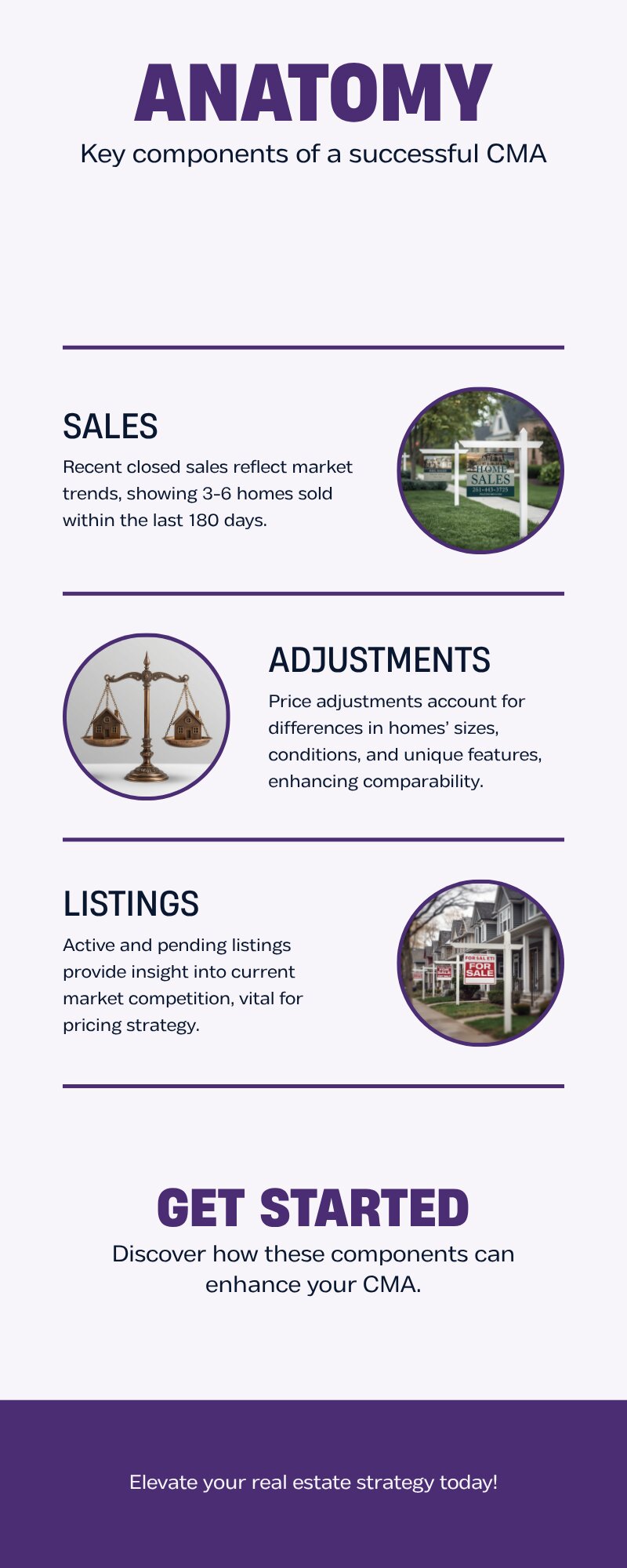
A complete CMA has five parts — recent closed sales, price adjustments, active listings context, a price range, and days-on-market data. Missing any one of these is a yellow flag.
The Comparable Sales Section
This is the heart of the analysis. A solid CMA uses 3–6 closed sales — homes that actually sold and recorded with the county, not just homes that were listed. Active listings show you the competition; they don’t tell you what buyers actually paid.
Strong comps are sold within the past 90–180 days, within roughly half a mile in dense neighborhoods, similar in size (within 20%), similar in age and style, and similar in condition. The more adjustments required to bridge the gap between a comp and your home, the less reliable that comp is as an anchor.
The Adjustment Section
Here’s where CMAs diverge. Every comp is adjusted up or down to match your home. If the comp had a three-car garage and yours has one, the agent reduces that comp’s adjusted value. If your home has a finished basement the comp didn’t, an upward adjustment goes in. These adjustments should reflect what buyers in your market actually pay for those features — not round numbers made up on the spot.
Check: Are the adjustments reasonable in proportion to the sale price? Do the comps include some that are better than your home (requiring downward adjustments), or are all adjustments upward? If every adjustment inflates the comp’s value, the CMA may be padded.
Active, Pending, and the Price Range
A complete CMA includes the current competition — what’s on the market now and what’s pending. If similar homes have been sitting for 45 days at your proposed price, that’s a data point worth knowing before you list.
The final output should be a price range, not a single number. Within that range, your agent recommends a specific list price based on your goals and market conditions — and that recommendation should come with a clear explanation. “We can always come down” is not an explanation.
Why Two Agents Give You Different Numbers
Two agents can produce legitimately different CMAs because pricing involves judgment calls — which comps to use, how much to adjust for condition, whether the market is moving up or flat. Reasonable professionals can disagree within a range.
But the real reason sellers often see large gaps between CMAs has nothing to do with analytical disagreement. It’s called buying the listing — when an agent inflates their CMA to win your business. They know you’ll be more excited about the higher number. They sign you up at that price, the home sits, and three weeks later they start asking for a price reduction.
By then, you’ve already lost the prime marketing window — the first two weeks when a new listing gets the most attention from buyers. Homes that require price reductions consistently sell for less than they would have if priced correctly from day one. Buyers notice price cuts. They wonder what’s wrong with the house.
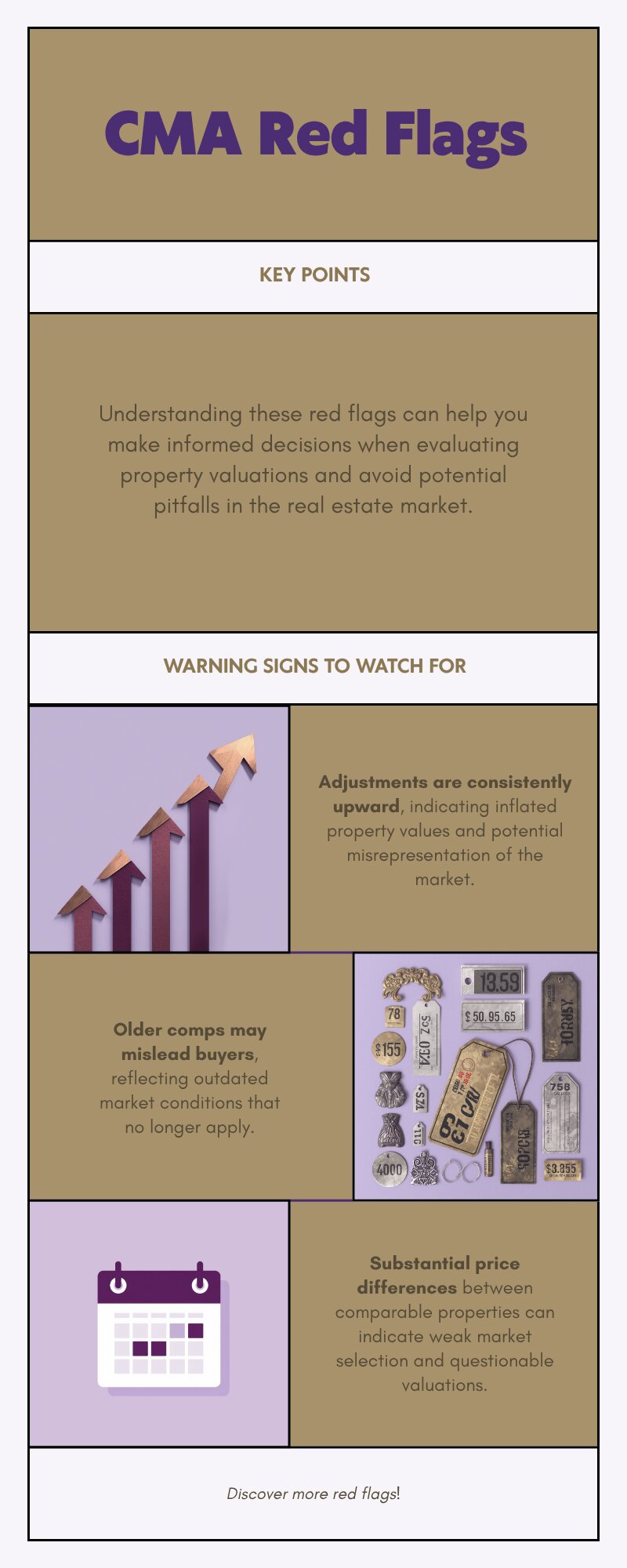
If you see these patterns in a CMA, ask questions before you sign a listing agreement.
The BPO Difference: Why Daily Pricing Work Matters
Most agents prepare CMAs occasionally — when they’re pitching a listing. That means they’re doing this analysis once every few weeks, or less.
My background is different. As an active BPO field agent, I assess property values professionally every single day for banks, lenders, and investment portfolios. That means I’m running the same comp analysis — pulling recent sales, making adjustments, arriving at a reconciled value — on multiple properties every morning. Not when a listing appears on my desk. Every day.
What that produces is calibration. I know what buyers in Renton paid for a renovated kitchen last month because I priced three homes in Renton last month. I know how much a lot size premium is worth in Kent right now because I’ve been tracking it continuously, not revisiting it once a quarter.
When I prepare a CMA for a seller, I’m using the same methodology a lender’s appraiser will use when a buyer’s loan comes through. That alignment matters: a home priced with institutional-grade rigor is much more likely to appraise cleanly at contract price — which means fewer renegotiations and a smoother path to closing. For more on how appraisals interact with your list price, see our guide to how to price your home to sell in King County.
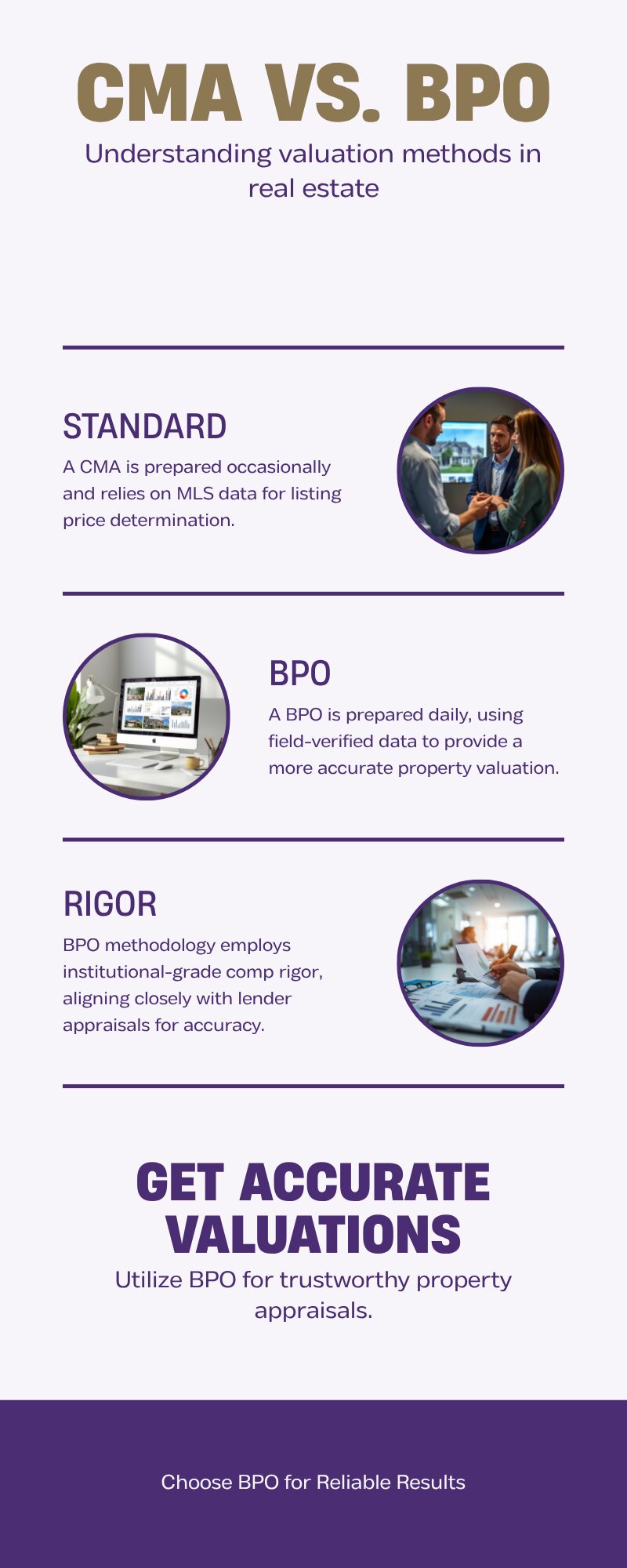
The difference isn’t just credentials — it’s frequency. Daily pricing work produces calibration that occasional CMA preparation can’t match.
What a CMA Can’t Tell You
A CMA is backward-looking. It tells you what buyers paid for comparable homes in the past 90–180 days. It doesn’t tell you what the market will do next month, and it doesn’t account for factors that haven’t shown up in closed sales yet — like a shift in mortgage rates, a wave of new inventory, or a major employer making news in your area.
This is why the agent’s current market knowledge matters as much as the data itself. A CMA prepared by someone who isn’t actively watching the King County market day-to-day will miss signals that a daily practitioner picks up on. Always ask the agent: “Has anything happened in the past 30 days that your comps don’t reflect?” Their answer will tell you whether they’re watching the market or just pulling data.
The King County Specifics Worth Knowing
Sub-market pricing is everything. King County covers an enormous range of price points and market conditions. Renton, Kent, Auburn, Covington, and Maple Valley each behave differently from each other and from the Eastside. A good CMA uses comps from the same sub-market — not comps from a neighborhood three cities over that happens to have similar square footage.
Median prices shifted in early 2026. The April 2026 King County median home sale price came in around $835,000 — down roughly 7.5% year-over-year at the county level, though South King County remained more competitive than average. Comps from 12+ months ago may overstate what your home will actually trade for today. An agent who’s pulling year-old data to support a high price isn’t serving your interests.
Days on market is now a meaningful signal. King County homes are averaging around 12 days on market — up from 7 days a year ago. That shift means the “price it high and wait for the right buyer” strategy is riskier than it was in 2022. Buyers have more options, and a home that sits past 30 days starts raising questions that a price cut can’t fully answer.
School district boundaries move prices. In cities like Newcastle that straddle multiple school district zones, a half-mile difference in location can produce a meaningful price difference. Your agent needs to know which side of those lines your home is on — and make sure the comps are on the same side. For more on what goes into getting your home ready to sell, see our guide on how to prepare your home for sale in King County.
Questions to Ask at Your Listing Appointment
When you sit down with an agent to review their CMA, bring these questions:
On the Comps
Why did you choose these specific sales and not others? How recent are they — and are there more recent sales you considered and rejected? How similar is this comp in size, condition, and location to my home?
On the Adjustments
How did you arrive at the adjustment amounts? Are any of your comps adjusted up by more than 20%? Are there any comps where you made downward adjustments, or are all adjustments upward?
On the Pricing Recommendation
What’s your recommended price range, and where do you suggest we list within it? What happens to our negotiating position if we list at the top of your range and don’t get an offer in two weeks? How does your recommended price compare to what a buyer’s lender will appraise it at?
On the Agent
How many pricing analyses have you done in the past 30 days in this specific sub-market? Have you seen any recent shifts in buyer behavior that your closed comps don’t yet capture?
The agent who answers these questions clearly — without hesitation, without pivoting to their marketing plan — is the agent who did the work.
Frequently Asked Questions
How much does a CMA cost?
A CMA from a real estate agent is free. Agents prepare them as part of their listing pitch. If you want an independent opinion not tied to a listing relationship, a licensed appraiser will charge $600–$900 for a formal appraisal.
Is a CMA the same as an appraisal?
No. A CMA is prepared by a real estate agent and used to set a listing price. An appraisal is prepared by a state-licensed appraiser, required by lenders, and used to determine the maximum loan amount. A home can be listed above its likely appraisal value — which creates problems at closing when the buyer’s lender won’t fund the gap.
How many comps should a good CMA include?
Typically 3–6 closed sales, plus 2–4 active or pending listings for competitive context. Fewer than 3 sold comps is a thin basis for a pricing recommendation. More than 8 often means the agent is padding with weak matches to justify a predetermined number.
What if two CMAs are far apart?
Ask each agent to walk you through their comps side by side. The differences usually come down to which comps were selected and how adjustments were applied. If one agent can’t explain their methodology clearly, that tells you something about how they prepared the analysis.
Should I always list at the top of the CMA range?
Only if your goals and market conditions support it. In a market where homes are selling in 7–12 days, pricing at the midpoint of the range often generates more competing offers than pricing at the top — and can produce a higher net sale price. Your agent should walk you through the trade-offs before you decide.
Getting a CMA is easy. Getting a CMA you can actually trust — one built with the same rigor a lender’s appraiser will apply to the same property in 60 days — takes a different kind of preparation. And knowing how to read one puts you in a position to tell the difference.
Your guide to life outside Seattle.
253-350-0045 ·
greg@livingoutsideseattle.com ·
www.livingoutsideseattle.com
Rent Out vs. Sell Your King County Home: The Real Math
Should you become a landlord or cash out? Here’s the real math King County homeowners need before making this call.
If you’ve been sitting on a home in Renton, Kent, Auburn, or anywhere in South or East King County, you’ve probably had this thought: what if I just rented it out instead of selling? Especially with home values still holding strong — median prices around $859,000 countywide in spring 2026 — the idea of collecting rent every month while your property appreciates sounds appealing.
But the math is more complicated than it looks on paper. And Washington’s landlord-tenant laws changed significantly in 2025, adding rules most homeowners-turned-landlords don’t know about until it’s too late.
This post walks through both sides of the decision — actual rental income projections, net sale proceeds, tax implications, cash flow math, and the real-world landlord responsibilities that don’t show up in the rosy scenarios. By the time you’re done reading, you’ll know which option makes more financial sense for your situation.
The Rental Income Side: What King County Homes Actually Rent For
Let’s start with what you could realistically collect in rent. King County single-family rental rates in 2026 vary a lot by city and home size, but here are realistic ranges for typical South and East King County homes.
Three-bedroom single-family homes in Renton are pulling $2,800 to $3,200 per month. In Kent, the range is closer to $2,400 to $2,800. Auburn runs slightly lower, typically $2,200 to $2,600 for a comparable home. Move east to Issaquah or Sammamish, and a three-bedroom can fetch $3,200 to $3,800 monthly.
Sounds like solid money. But gross rent is not your income. Your net cash flow depends on what you owe and what it costs to run the property.
Here’s a real example. Say you own a three-bedroom home in Renton worth $700,000. You bought it five years ago, your current mortgage balance is $480,000, and your rate is 4.5%. Your monthly carrying costs look something like this:
Monthly Carrying Costs — High Mortgage Scenario
Mortgage P&I at 4.5% on $480K balance: ~$2,430
Property taxes (King County ~1.0% annually): ~$583/month
Landlord insurance (~15% more than owner-occupied): ~$150/month
Maintenance reserve (1% of value per year / 12): ~$583/month
Total carrying costs: ~$3,746/month
At $3,000 rent: -$746/month before vacancy or management fees
If you hired a property manager — which handles tenant screening, rent collection, and maintenance coordination — expect to pay 8% to 10% of gross rent, or another $240 to $300 per month on top of that negative.
That scenario doesn’t cash flow. It costs you money every month to keep it.
Now flip it. Same Renton home, but you paid it down to $300,000 and your rate is 3.0% from a 2021 refinance. Monthly P&I drops to approximately $1,265. Suddenly the same $3,000 rent gives you positive cash flow after all expenses. That’s the home where keeping it as a rental makes financial sense.

Two scenarios, same rent. The only thing that changes the outcome is what you owe. Run your actual numbers before deciding.
The Sale Side: What You Actually Walk Away With
When you sell, you get a lump sum. But net proceeds are not the same as your home’s sale price. Here’s what comes out.
Real Estate Excise Tax (REET) in King County runs approximately 1.78% of the sale price on a home in the $700,000 to $1.5 million range. On a $700,000 sale, that’s $12,460. Agent commissions typically run 5% to 6% total — on $700,000, that’s $35,000 to $42,000. Closing costs — title insurance, escrow, pro-rated taxes — add another $3,000 to $5,000.
So on a $700,000 sale, you might net $635,000 to $649,000 before any mortgage payoff. Subtract the $480,000 balance, and you walk away with roughly $155,000 to $169,000 in cash. That’s a down payment on your next home, a fully funded investment account, or two years of rental losses avoided.
If you’re in a lower-equity position — say $300,000 owed on a $700,000 home — the sale gives you approximately $355,000 to $369,000 cash in hand. Now the math shifts. Holding the property becomes more interesting because you have equity working for you every year.
Tax Implications: Where Things Get Complicated
This is the part most homeowners don’t think through carefully enough.
If you sell your primary residence, Washington’s $500,000 capital gains exclusion (for married couples; $250,000 for single filers) likely protects your gain from federal tax entirely, provided you’ve lived there two of the last five years. Washington state has no income tax, so there’s no state capital gains tax on primary residence sales either. You pay REET at closing and that’s largely it. For a full breakdown of how Washington taxes work on a home sale, see our guide to capital gains on home sales in Washington State.
If you convert to a rental and sell later, the tax picture changes. Once you stop living there as your primary residence, you start losing your exclusion eligibility. Sell after the two-year primary-residence window closes, and your gain becomes a taxable long-term capital gain at the federal level — 15% or 20% depending on your income bracket, plus potentially a 3.8% Net Investment Income Tax if your household income exceeds $250,000.
There’s also depreciation recapture to account for. Once you convert to a rental, the IRS lets you deduct depreciation each year — roughly 1/27.5 of the structure’s value annually. When you eventually sell, the IRS recaptures that depreciation at up to 25%. That can be a meaningful surprise at tax time.
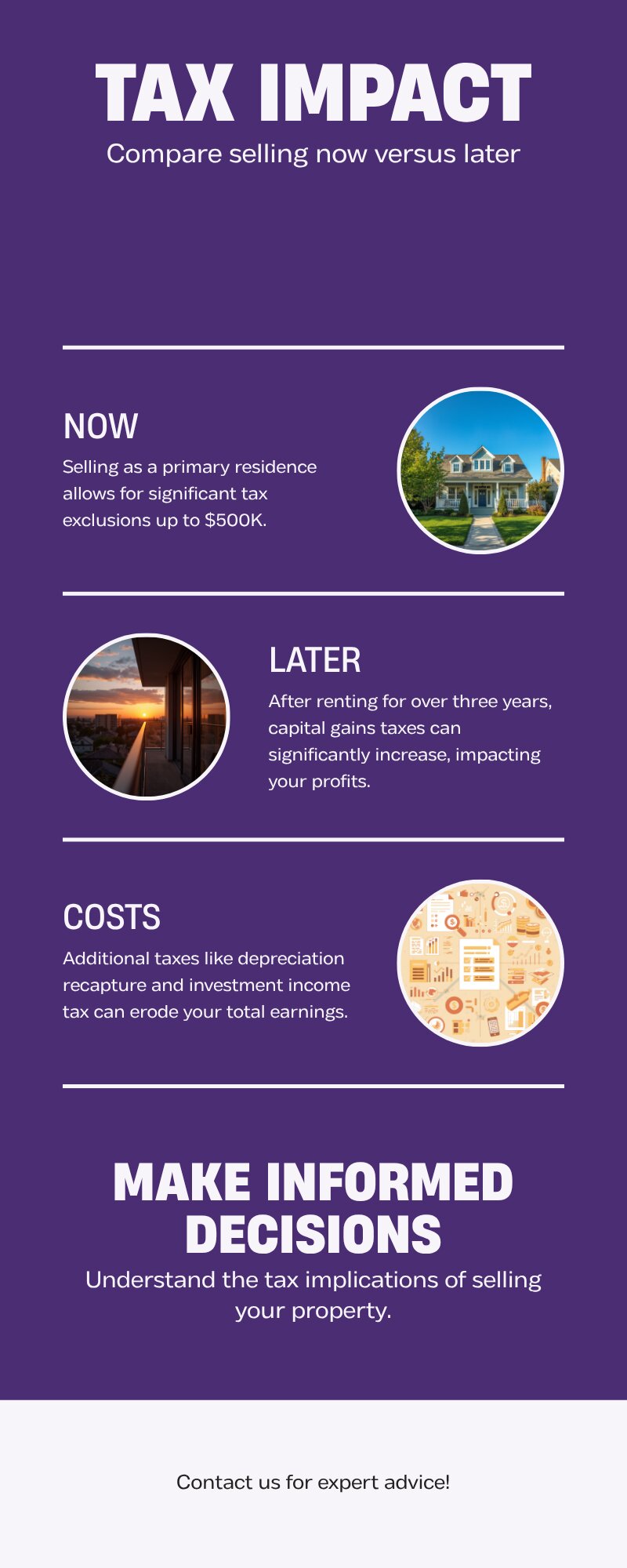
The two-year primary residence window is the biggest tax variable in this decision. Once it closes, your sale proceeds become a taxable event.
Washington Landlord Law in 2026: What Changed
Before you decide to rent, you need to know that Washington’s landlord-tenant laws shifted significantly starting in 2025. These aren’t small tweaks — they meaningfully change what it means to be a landlord here.
Rent Stabilization (HB 1217)
Effective May 2025, annual rent increases are capped at 7% plus CPI, or 10%, whichever is lower. For 2026, the maximum is 9.683%. You cannot raise rent at all during the first 12 months of a tenancy. Any increase requires 90 days written notice using a state-standardized form sent via certified mail.
What this means for you: if rents rise faster than that cap, you can’t keep pace. If a great tenant moves in at below-market rent, you’re limited in how quickly you can adjust.
Just Cause Eviction Requirements
You can’t simply decide not to renew a lease at the end of the term. You need a legally recognized reason — nonpayment, lease violation, owner move-in, or a handful of other specific grounds.
Eviction timelines are not quick. Nonpayment requires a 14-day notice before you can file. Most violations require a 10-day notice to comply. Court processes add weeks or months. Evicting a non-paying tenant in King County can realistically take three to six months — during which you carry all costs with no rent coming in.
The Local Angle: King County Specifics That Change the Math
A few things about King County shift the calculus compared to national averages.
Property taxes here are real. King County’s effective property tax rate runs around 0.93% to 1.1% depending on city and levy district. On a $700,000 home, that’s $6,500 to $7,700 per year — a cost that doesn’t go away when you become a landlord. And unlike a primary residence, you can’t homestead-exempt your way to a lower bill.
Current King County mortgage rates sit around 6.4% in mid-2026. If you bought in the last two to three years at these rates, your P&I is substantially higher than someone who refinanced in 2021. That gap is often what separates a cash-flowing rental from a money-losing one.
The rental market is competitive but not unlimited. Rents have stayed strong in South King County, but they’ve also flattened. Rent growth has run around 4% year over year in the broader Seattle metro, but Washington’s new stabilization caps limit how much future increases can catch up.
Home appreciation is still the strongest long-term argument for the rental side. If your home appreciates 3% to 4% annually from a $700,000 base, that’s $21,000 to $28,000 per year in equity gain. Even if you’re slightly cash-flow negative on rent, appreciation can still make the investment pencil out — if you’re patient and prepared for the landlord role.
South King County in particular — Renton, Kent, Auburn, Covington — remains a strong long-term hold for landlords who are disciplined about tenant selection and maintenance. These are stable demand markets with diverse employment bases. But that’s a different conversation than “I’ll rent it out for a year and see how it goes.”
South King County rents are strong but not unlimited. Your specific city, neighborhood, and home condition determine the real number you’ll collect.
When Renting Makes Financial Sense
Based on the math and the landlord landscape, here’s when keeping the property and renting usually wins.
You have a low-rate mortgage (under 4%) that generates positive monthly cash flow after all expenses. Your principal balance is low relative to value — meaning the equity is working for you as an asset even if rent doesn’t fully cover costs. You’re planning to return and live in the home within three to five years, preserving your primary residence exclusion. Or you’re committed to building a rental portfolio long-term and understand that this first property is an investment, not passive income.
When Selling Makes More Sense
Selling wins when you have a high-rate or high-balance mortgage that won’t cash flow at current rents. When your equity is substantial and a lump sum now serves your goals better than monthly income later. When you want simplicity — no tenant calls, no maintenance surprises, no navigating the 90-day rent increase notice process. Or when you need to deploy that equity into your next home and you can’t do both.
If you decide to sell, you’ll want to prepare your home strategically and price it right from day one — two steps that consistently separate fast, full-price sales from drawn-out ones.
What This Means for You
If you’re weighing this decision right now, here’s a simple three-step filter before you call anyone.
First, run your actual monthly carry cost — mortgage P&I, taxes, insurance, and a 1% annual maintenance reserve divided by 12. Compare that to realistic rent for your specific home and neighborhood, not the top of the range.
Second, calculate your net sale proceeds. Look at your current loan payoff, subtract estimated closing costs and agent fees, and ask yourself whether that lump sum helps you more than the monthly difference between rent and expenses.
Third, get a real conversation with a tax professional about your gain and your exclusion window. If you’ve lived in the home two of the last five years, the clock is ticking on that federal exclusion. Don’t let it expire accidentally while you’re hoping the rental market improves.
I can walk you through the numbers on your specific home — no obligation, no pressure. If renting makes more sense, I’ll tell you that. If selling makes more sense, I’ll tell you that too.
FAQ: Renting Out vs. Selling Your King County Home
Can I rent out my King County home and still avoid capital gains tax when I sell later?
Only if you sell within the IRS’s primary residence window — you must have lived in the home two of the last five years when you sell. If you rent it out for more than three years before selling, you lose the $250,000/$500,000 federal exclusion. Washington state has no capital gains tax, but federal tax on investment property gains runs 15–20% plus potential Net Investment Income Tax.
What can I realistically charge for rent on a King County single-family home in 2026?
A three-bedroom home in South King County (Renton, Kent, Auburn) typically rents for $2,400 to $3,200 per month depending on condition, location, and size. East King County (Issaquah, Sammamish, Bellevue) runs higher, often $3,200 to $3,800 for a comparable home.
Does Washington state have rent control in 2026?
Yes, as of May 2025. Under HB 1217, annual rent increases are capped at 7% plus CPI, or 10%, whichever is lower. For 2026, the cap is 9.683%. You can’t raise rent in the first 12 months of a tenancy, and you must give 90 days written notice — certified mail, state-standardized form — before any increase.
How long does it take to evict a non-paying tenant in King County?
Realistically, three to six months from missed payment to vacant possession. You must issue a 14-day pay-or-vacate notice, file in court if they don’t comply, wait for a hearing, and execute the order. During that entire period you’re carrying costs with no rent. Landlord insurance with loss-of-rent coverage can offset some of this risk.
Should I hire a property manager if I rent out my King County home?
For most first-time landlords, yes. A professional property manager handles tenant screening, lease compliance under Washington’s updated laws, maintenance coordination, and the 90-day rent increase documentation process. Typical fees run 8–10% of gross rent monthly. That cost is real, but so is the protection it provides.
What’s the real estate excise tax (REET) on selling my home in King County?
REET is graduated in Washington. On homes selling between $700,000 and $1.5 million, the effective combined rate runs approximately 1.28% to 2.5% depending on the price tier. For a $700,000 sale, budget roughly $12,000 to $13,000 for REET at closing. It comes out of proceeds automatically at the title company.
The decision between renting and selling isn’t one-size-fits-all. It’s a math problem that looks different for every household depending on what you owe, what you’d net, and what you actually want your life to look like over the next three to five years. Run the numbers honestly — including the ones people usually skip — and the right answer tends to become obvious.
Your guide to life outside Seattle.
253-350-0045 ·
greg@livingoutsideseattle.com ·
www.livingoutsideseattle.com
