

 Facebook
 X
X
 Pinterest
 Copy Link
Property Tax Rates in King County Cities 2026
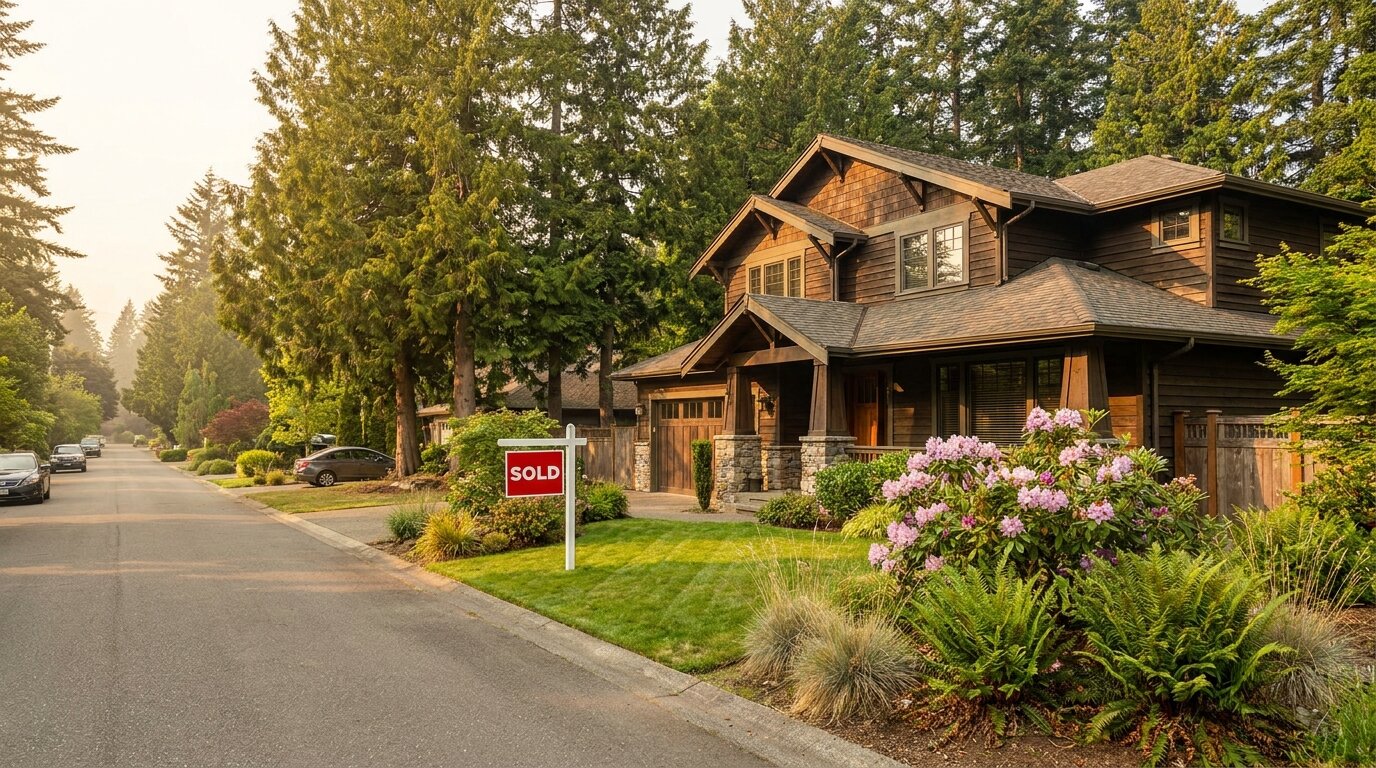
Buyers ask me all the time: “What are the property taxes going to be on this house?” It’s a fair question, and the answer matters more than most people realize when they’re focused on the purchase price and interest rate. On a $700,000 home, the difference between buying in Auburn and buying in Issaquah works out to roughly $2,500 a year — or about $210 a month that never shows up in a mortgage quote.
This post lays out the 2026 effective property tax rates for the eight cities I work in most across South and East King County. I also cover how the calculation works, why rates differ between cities just a few miles apart, and what this means if you’re running affordability math as a buyer or net-proceeds math as a seller.
Why King County Has No Single Tax Rate
A lot of buyers ask: “What’s the property tax rate in King County?” There isn’t one. Your bill is the sum of every taxing district whose boundary includes your property. That stack typically includes:
The Typical Levy Stack
Washington State levy — applies uniformly statewide
King County general levy — county services and administration
King County library district — public library system
City levy — varies by incorporated city; absent in unincorporated areas like Covington
School district levy — the single biggest variable between nearby cities
Fire district levy — local fire and rescue services
Emergency Medical Services (EMS) levy
Any voter-approved bond measures — school construction, parks, etc.
Two homes a mile apart — one in the Issaquah School District, one in the Kent School District — can carry meaningfully different tax bills even if their market values are identical. School district boundaries are the biggest driver of rate variation across South and East King County.
The 2026 total property tax collection in King County came in at $8.4 billion, up 10% from 2025’s $7.7 billion. That increase flows from rising assessed values, not any single rate change. But the effect on individual monthly payments is real.
2026 Property Tax Rates by City
These are median effective rates — actual tax bills divided by assessed market values — based on King County parcel data. Rates vary by ZIP code within each city, primarily because of school district boundaries. (Source: Ownwell, April 2026.)
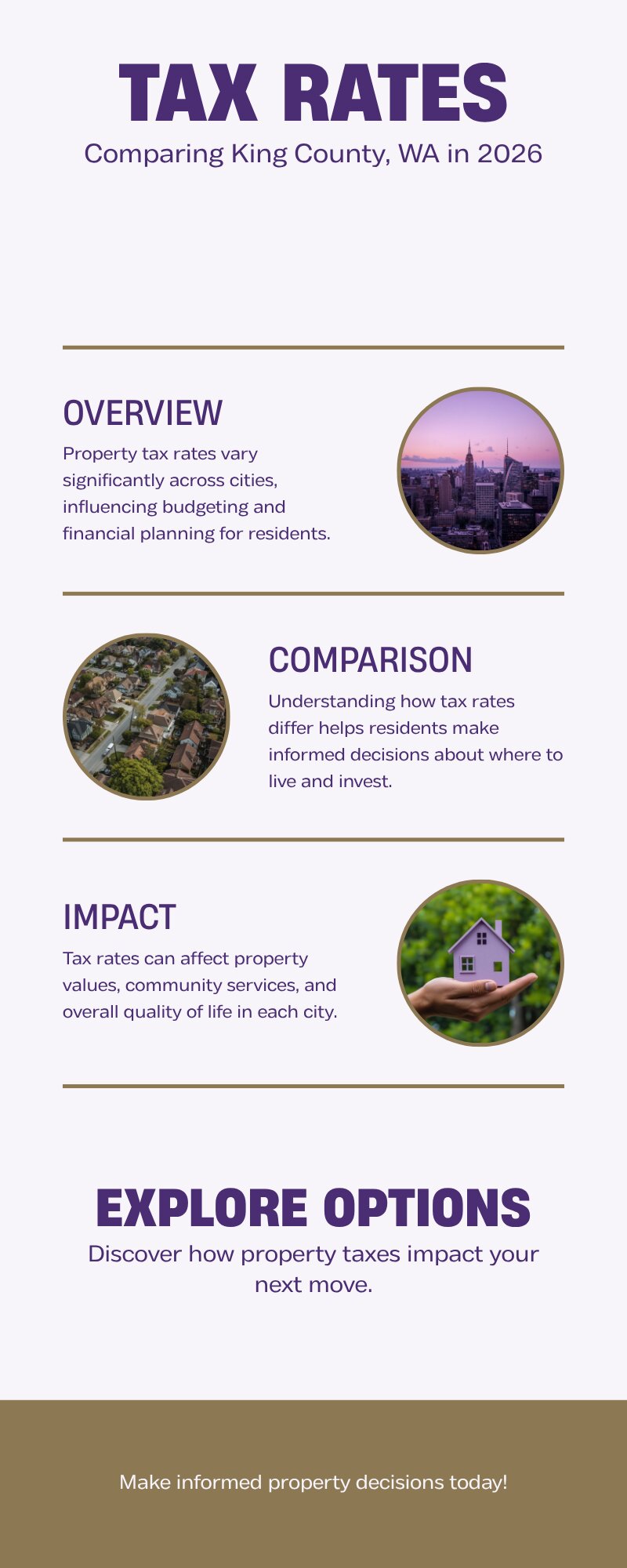
2026 effective property tax rates for eight cities in South and East King County. Auburn carries the highest rate; Issaquah and Sammamish sit well below the county median of 0.99%. Source: Ownwell, April 2026.
| City | Effective Rate | Median Home Value | Median Annual Bill |
|---|---|---|---|
| Auburn | 1.19% | $566,000 | $6,477 |
| Maple Valley | 1.11% | $722,000 | $7,963 |
| Renton | 1.03% | $688,000 | $7,145 |
| Covington | 1.03% | $574,000 | $5,862 |
| Kent | 1.01% | $587,000 | $5,919 |
| Federal Way | 1.00% | $542,000 | $5,412 |
| Sammamish | 0.89% | $1,384,000 | $12,054 |
| Issaquah | 0.83% | $1,031,000 | $9,132 |
| King County Avg | 0.99% | $774,000 | $7,644 |
How to Calculate Your King County Tax Bill
King County uses this formula:
(Assessed Value ÷ 1,000) × Levy Rate = Annual Tax Bill
For a home assessed at $650,000 in Renton with a levy rate of approximately $10.30 per $1,000:
$650,000 ÷ 1,000 = $650
$650 × $10.30 = $6,695 per year (~$558/month in escrow)
A few important things to understand about that assessed value:
King County Reassesses Every Year
Washington has no equivalent to California’s Proposition 13. Your assessed value is adjusted annually based on market conditions. If home prices in your neighborhood rose 8% last year, your assessment likely reflects that — and your bill goes up accordingly.
Your 2026 bill is calculated from the value as of January 1, 2025. So the assessment lags the market by about a year — but it catches up.
Buying at a Higher Price Does Not Reset Your Taxes
The assessor determines value independently of your sale price. A sale at market value is data they will consider in future assessments — but it doesn’t trigger an immediate reset the way it does in some other states. So if you buy a house below assessed value, your taxes don’t automatically drop either.
For the most accurate number on any specific parcel, use the King County eReal Property lookup at blue.kingcounty.com. Search by address to see the current assessed value and the levy rate stack broken down by district. It takes about 90 seconds and gives you a far more accurate number than any city average.
Why Issaquah and Sammamish Rates Are Lower
Issaquah (0.83%) and Sammamish (0.89%) sit well below the county average — yet their median tax bills are higher in dollar terms because home values there are much larger. Lower rates in these cities generally reflect two things.
First, fewer overlapping special districts. Some areas carry smaller bond debt loads than South King County cities, which compresses the total levy stack. Second — and this is the counterintuitive part — when the total assessed value base in a school district rises, the rate needed to raise the same budget dollar amount actually falls. High home values spread the levy cost across more dollars, pushing the percentage rate down.
City-by-City: What Buyers and Sellers Should Know

Understanding your property tax rate before you make an offer helps buyers budget accurately and keeps sellers from being surprised at closing.
Auburn (1.19%)
Auburn carries the highest effective rate among the cities we track, with a $6,477 median annual bill on a $566,000 home. Rates vary by ZIP — the 98001 and 98002 ZIP codes trend higher than 98092. Buyers should ask their lender to calculate PITI based on the specific parcel, not a city average.
Maple Valley (1.11%)
Maple Valley’s rate and its growing median home value combine to produce one of the larger median bills in South King County at $7,963 per year. School construction bonds have contributed to the rate here. Strong schools drive demand for the area, and those same schools come with levy costs built into the rate.
Renton (1.03%)
Renton’s 1.03% rate on a $688,000 median home produces a $7,145 median annual bill. Rates vary within Renton by school district boundary — homes in the Issaquah School District portion of eastern Renton trend lower than those in the Renton School District. This surprises a lot of buyers who assume all of “Renton” carries one rate.
Covington (1.03%)
Covington shares Renton’s effective rate but with a lower median home value ($574,000), producing a $5,862 median bill. Covington is unincorporated King County, which means no separate city levy — one reason the total rate stays competitive. For buyers priced out of Maple Valley, Covington often offers similar inventory at lower total monthly carrying costs.
Kent (1.01%)
Kent sits nearly at the county average. The $5,919 median annual bill on a $587,000 home is one of the more affordable in this group in absolute dollar terms. Kent has one of the widest ranges of home types in South King County — condos to large single-family homes — so the actual bill on any specific purchase will vary considerably from the median.
Federal Way (1.00%)
Federal Way sits right at the county median rate and has the lowest median home value on this list at $542,000, producing a $5,412 median annual bill. For first-time buyers working with a tighter budget, Federal Way offers the lowest combined price-and-tax entry point among these eight cities.
Sammamish (0.89%)
Lower rate, but higher everything else. The $1,384,000 median home value produces a $12,054 median annual bill — over $1,000 a month in tax escrow — despite the below-average rate. Sammamish draws buyers who prioritize the Issaquah or Lake Washington school districts, newer construction, and lower density. That demand drives values, which keeps the rate lower but doesn’t lower the bill.
Issaquah (0.83%)
The lowest rate on this list. Issaquah’s 0.83% on a $1,031,000 median home means a $9,132 median annual bill. Part of the reason rates are lower is that the area’s high assessed value base spreads the levy burden across more dollars. School district quality drives demand, and demand drives values — which, counterintuitively, keeps the rate lower than South King County cities.
Important Property Tax Dates in King County
| Date | What Happens |
|---|---|
| January 1 | Assessment date — value is frozen for the year’s calculation |
| February 10 | Tax bills mailed |
| April 30 | First half payment due |
| July 1 | Appeal deadline — do not miss this |
| October 31 | Second half payment due |
The appeal window matters. If you receive your assessment notice and believe the value is too high — based on comparable sales or property condition — you have until July 1 to file with the King County Board of Equalization. Once that deadline passes, your ability to contest that year’s bill is gone.
Exemptions That Can Lower Your Bill
Washington offers several exemption programs worth knowing about, especially if you’re buying for a family member or planning long-term.
Senior/Disabled Exemption. Homeowners 61 or older — or permanently disabled — with household income under the program threshold may qualify for a significant reduction in assessed value and a freeze on future increases. This is one of the most valuable programs in the state and often goes unclaimed by people who don’t know it exists.
Veteran Exemption. Qualifying veterans with a service-connected disability may be eligible for a partial property tax reduction.
All exemptions require the home to be your primary residence. Investment properties and second homes do not qualify. To apply or check eligibility, contact the King County Assessor’s office at assessor.info@kingcounty.gov or (206) 296-7300.
What This Means for Your Buy or Sell Decision
For buyers: Your lender uses your total PITI payment — principal, interest, taxes, and insurance — to calculate affordability. Property taxes are a real monthly cost, not a closing-day item. On a $700,000 home, the difference between a 0.83% rate (Issaquah, ~$484/month) and a 1.19% rate (Auburn, ~$694/month) is $210 per month. Over a 30-year loan, that’s $75,600 in additional tax payments — more than most buyers realize when they’re focused on the interest rate.
For sellers: When a buyer’s lender calculates their debt-to-income ratio, property taxes push more buyers out of qualifying range at the higher end of pricing. In cities with higher effective rates, price sensitivity tends to be greater. Knowing your city’s rate — and being able to show the buyer the actual parcel-level calculation — is a transparency move that builds trust during negotiations.
For a broader look at all the costs of owning a home in King County, this post on total cost of homeownership in King County walks through the full monthly cost picture beyond just taxes. And if you’re a seller thinking about your net proceeds, Washington’s capital gains rules are the other tax conversation worth having before you list.
Run Your Own Numbers in 90 Seconds
To get the exact levy rate for any property you’re considering:
- Go to blue.kingcounty.com/Assessor/eRealProperty
- Search by address
- Find the “Current Year Tax” section — it shows the assessed value and the levy rate stack broken down by district
- Divide the tax bill by the assessed value to get the effective rate
This is the most accurate number you’ll find. I walk buyers and sellers through this lookup regularly — it often changes how they think about two comparable homes in different parts of the county. For where home values are heading in 2026 — which directly affects future assessed values and bills — here’s the King County housing market forecast.
Frequently Asked Questions
What is the property tax rate in King County in 2026?
The countywide median effective rate is 0.99%, but rates vary by city from 0.83% (Issaquah) to over 1.19% (Auburn). The rate for any specific property depends on all the overlapping taxing districts — state, county, city, school district, fire, EMS, and local bond measures.
When are King County property taxes due in 2026?
Half by April 30, and the other half by October 31. Tax bills are mailed in February. If your home has a mortgage, your lender typically collects taxes through escrow and pays on your behalf.
When is the King County property tax appeal deadline?
July 1 each year. If you receive your assessment notice and believe the value is too high, file with the King County Board of Equalization before that date. You’ll need supporting evidence like comparable sales or documentation of property condition issues.
Does buying at a higher price increase your property taxes right away?
Not automatically. King County reassesses independently based on market data. Your sale price is information the assessor will consider, but the assessment may not change until the next annual cycle. That said, sales well above assessed value typically result in higher assessments in subsequent years.
Where can I look up the exact property tax for a specific address?
Use the King County eReal Property portal at blue.kingcounty.com/Assessor/eRealProperty. It shows the current assessed value, each levy in the stack, and the total bill for any parcel in the county.
Are there exemptions that lower property taxes in King County?
Yes. The Senior/Disabled exemption is the most significant — qualifying homeowners 61 or older with income under the program threshold can freeze their assessed value and reduce their bill. Veteran exemptions are also available. All require the home to be your primary residence. Contact the King County Assessor at (206) 296-7300 or assessor.info@kingcounty.gov to check eligibility.
Data sourced from Ownwell (April 2026) and King County Assessor public records. Rates shown are median effective rates and will vary by specific parcel and ZIP code within each city. Verify levy rates for any specific property at blue.kingcounty.com before making financial decisions.
Your guide to life outside Seattle.
253-350-0045 ·
greg@livingoutsideseattle.com ·
www.livingoutsideseattle.com
Total Cost of Homeownership in King County 2026
Most buyers focus on the mortgage payment. That’s the number that shows up in every rate calculator, every lender pre-approval letter, every Zillow estimate. But in King County, the mortgage is often just 60–70% of what you actually pay each month to own a home. The rest — property taxes, insurance, HOA fees, PMI, and maintenance — adds up fast, and most first-time buyers get surprised by it.
I’ve worked in South and East King County for over 13 years, and I do professional property valuations every single day as a BPO field agent. One pattern I see constantly: buyers who were “pre-approved” for a purchase price they couldn’t actually afford once all the real costs hit their bank account in month two. This guide walks you through the full picture — every cost, with real numbers for King County cities — so you can make a decision you’ll still feel good about a year from now.
What Goes Into Your True Monthly Payment
The mortgage principal and interest (P&I) is the fixed part — it doesn’t change month to month on a 30-year fixed loan. Everything else does, or at least it can. Here’s the full stack of costs to run through before you make an offer.
Principal and Interest (P&I)
The core of your payment, and the number your lender leads with. At current King County rates of around 6.4–6.7% for a 30-year fixed, a $686,000 loan (10% down on a $763,000 Renton home) produces a monthly P&I payment of roughly $4,360. It’s real, but it’s not the whole story.
Property Taxes
Significant in King County — and they just went up. For the 2026 tax year, King County’s total property tax levy is $8.4 billion, a 10% jump from 2025. The average effective rate across the county runs around 0.9%–1.1% of assessed value annually. On a $763,000 home in Renton, that works out to roughly $690–$840 per month ($8,280–$10,080 per year).
Your specific parcel’s levy code determines the exact number — the King County Assessor’s eReal Property search tool will show you the breakdown for any address you’re evaluating. Renton sits on the lower end; Sammamish and Issaquah homeowners typically pay more because of school district levies and city-specific ballot measures.
Homeowners Insurance
Washington State averages $1,474–$1,596 per year — roughly $125–$133 per month. That puts Washington below the national average, which is a piece of good news. Expect to pay more if your home has a wood roof, is older than 30 years, or sits in a wildfire-adjacent zone (relevant in Maple Valley, Enumclaw, or Black Diamond).
PMI (Private Mortgage Insurance)
Applies if you put down less than 20%. PMI typically runs 0.46%–1.5% of the original loan amount annually. On a $686,000 loan at a mid-range rate of 0.7%, that’s about $400 per month.
PMI drops off once you hit 20% equity — either through price appreciation or paying down the principal. Given King County’s 5-year appreciation history of roughly 5–6% annually, some buyers reach that equity threshold in 3–4 years rather than waiting out the full amortization schedule.
HOA Fees
These vary wildly by property type. Condos in King County typically run $300–$700 per month for a mid-range building — downtown Seattle luxury high-rises can exceed $1,000. Townhomes usually fall in the $150–$350 per month range. Single-family homes in planned communities often run $75–$200 per month for landscaping and common areas.
Many single-family homes in South King County have no HOA at all — which reduces monthly cost but means you carry 100% of exterior maintenance yourself.
Maintenance Reserve
The number most first-time buyers skip — and the one that bites hardest. The commonly cited “1% rule” (set aside 1% of your home’s value per year) is a reasonable floor. Studies show the average homeowner actually spends $8,800 per year on maintenance and repairs. For an older King County home (pre-1990), budget closer to 1.5%–2%.
On a $763,000 home, 1% equals $7,630 per year — about $636 per month set aside. You won’t spend it every month. Some months nothing breaks, then your furnace goes in January.
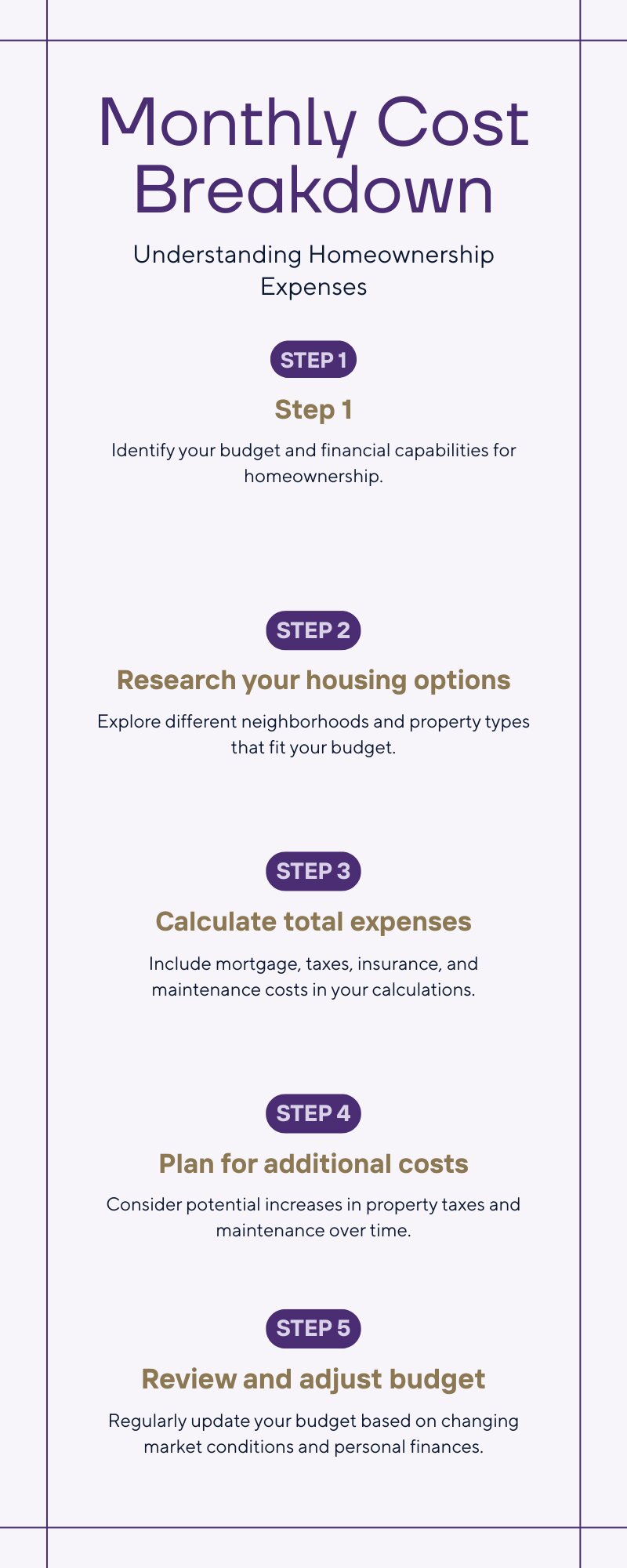
The mortgage payment is just one piece. For a Renton condo at $422K, all-in monthly costs run about $3,642. For a single-family home at $763K, expect closer to $6,224 per month. Source: King County market data, 2026.
Condo vs. Single-Family: How Total Cost Compares
This is one of the most common calculations I walk buyers through. The sticker price on a condo is lower — but the total monthly cost is often closer to a single-family home than buyers expect, once HOA fees are factored in. Here’s a real-numbers comparison using current King County data.
Condo in Southwest King County — $422,000
10% down ($42,200) / Loan: $379,800 / Rate: 6.5%
P&I: ~$2,400 | Taxes: ~$315 | Insurance: ~$80 | HOA: ~$450 | PMI: ~$222 | Maintenance: ~$175
Total: ~$3,642/month
Single-Family Home in Renton — $763,000
10% down ($76,300) / Loan: $686,700 / Rate: 6.5%
P&I: ~$4,342 | Taxes: ~$715 | Insurance: ~$130 | HOA: $0 | PMI: ~$401 | Maintenance: ~$636
Total: ~$6,224/month
The income difference this requires is significant. At a 28% front-end debt-to-income ratio (typical for conventional loan qualification), the condo scenario requires roughly $156,000 in gross household income. The single-family scenario requires roughly $267,000. Those numbers shift with your credit score, debt load, and lender — but they illustrate why the condo-vs-house decision often comes down to math rather than preference.
How King County Cities Compare on Total Cost
Property taxes are the biggest variable after the mortgage itself. Here’s a rough comparison of annual tax cost by city for a home around $700,000–$800,000.
Renton
Effective levy rate approximately 0.9%–1.0%. On an $800,000 home: ~$7,200–$8,000 per year ($600–$667/month). Renton sits on the lower end of King County cities, making it one of the better values in South KC for total monthly cost.
Kent & Auburn
Effective levy rates slightly higher than Renton, typically 1.0%–1.1%. On a $700,000 home: ~$7,000–$7,700 per year ($583–$642/month). School district and fire district renewal levies are a consistent factor in both cities.
Issaquah
Higher rates due to Issaquah School District supplemental levies — one of the highest-rated districts in the state, and that comes with a cost. On a $900,000 home: ~$9,000–$10,800 per year ($750–$900/month).
Sammamish
Among the highest effective rates in South/East King County. On a $1,000,000 home: ~$10,000–$12,000 per year ($833–$1,000/month). School district, city, and specialty district levies stack up quickly in Sammamish.
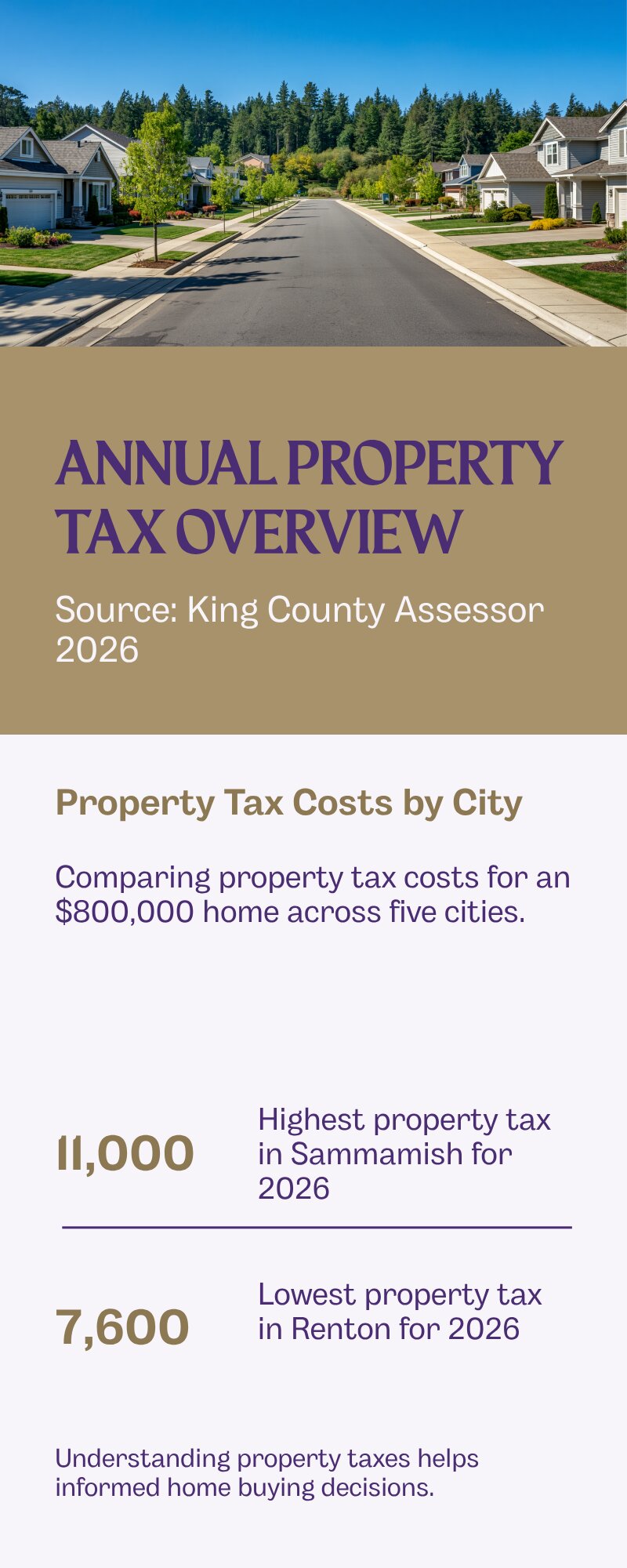
Annual property tax by city for an $800,000 home in King County. Renton and Kent are the most affordable in South KC; Issaquah and Sammamish carry higher levy rates driven by school district and specialty district measures. Source: King County Assessor 2026.
The Costs Most First-Time Buyers Underestimate
Beyond the monthly stack, a few one-time and recurring costs catch buyers off guard in year one.
Closing costs typically run 2%–3% of the purchase price. On a $763,000 home, that’s $15,260–$22,890 due at closing — on top of your down payment. This covers lender fees, title insurance, escrow, and prepaid items like the first year’s homeowners insurance and property tax reserves.
Immediate repair costs are real, especially in South King County where a lot of the housing stock was built in the 1980s and 1990s. Buyers of homes older than 30 years should budget up to $3,200 in unexpected year-one maintenance. A pre-listing inspection won’t catch everything — aging HVAC systems, older water heaters, and deck boards that just barely passed can all become your problem in year one.
HOA move-in fees and reserve contributions are easy to overlook. Some condo and townhome communities charge a one-time move-in fee ($500–$2,000) and require a contribution to the reserve fund at closing. Always request the HOA’s reserve study and financial statements before making an offer. Buildings with reserve deficits have hit some King County buyers with special assessments of $10,000–$30,000 per unit.
Utility cost changes hit harder than people expect when moving from a rental. You’re now paying for water, sewer, garbage, and often gas in addition to electricity. In South King County, expect $300–$500 per month depending on home size and season.
What This Means for Buyers in South and East King County
Running the full cost stack before making an offer is one of the most important steps a first-time buyer can take. The pre-approval letter and the real monthly budget are two different numbers.
My recommendation for buyers in Renton, Kent, and Auburn: run the full stack before falling in love with a specific home. The purchase price is a starting point. The number that actually matters for your quality of life is the total monthly outflow — and whether that leaves you enough runway to build equity, handle surprises, and not feel house-poor by month six.
For condos: the lower sticker price is real, but the HOA fee narrows the gap with single-family more than buyers expect. The King County Condo Buyer’s Guide walks through HOA due diligence in detail — including how to spot a building with a reserve fund problem before you commit.
For buyers still comparing property types, Condo vs. Townhouse vs. Single-Family in King County breaks down the full financial and lifestyle trade-offs side by side.
On the mortgage side: King County Mortgage Rates 2026 has the current rate picture and payment math, and the Mortgage Rate Buydown Guide explains how a seller-paid buydown can reduce your initial monthly cost in a way that pre-approval letters often miss.
Frequently Asked Questions
How much more than the mortgage payment is total homeownership cost in King County?
For most buyers, add $800–$1,500 per month on top of the P&I payment to get the true all-in cost. The biggest additions are property taxes ($600–$900/month on a median-priced home), insurance ($125–$135/month), and a maintenance reserve ($400–$700/month). PMI and HOA apply depending on your situation.
What is the property tax rate in Renton WA in 2026?
Renton’s effective property tax rate is approximately 0.9%–1.0% of assessed value annually, placing it on the lower end of King County cities. For a $763,000 home, expect roughly $6,900–$7,600 per year, or $575–$635 per month.
Do condos have lower total monthly costs than single-family homes in King County?
The purchase price is lower, but HOA fees close the gap. A condo at $422,000 with $450/month HOA ends up with a total monthly cost in the $3,600–$3,900 range. A single-family home at $763,000 (no HOA) runs $5,800–$6,400 per month all-in. The condo is still cheaper — but the difference is smaller than the price tags suggest.
Does PMI go away on a King County home?
Yes. Federal law requires lenders to cancel PMI automatically once your loan balance drops to 78% of the original purchase price. You can also request cancellation at 80%. Given King County’s appreciation history, some buyers hit that equity mark in 3–5 years rather than waiting out the amortization schedule.
What HOA fees should I expect for a King County townhome?
Townhome HOAs in South and East King County typically run $150–$350 per month. Lower-end communities cover exterior maintenance and landscaping only; higher-end communities include water, garbage, roof reserves, and exterior paint schedules.
What maintenance budget should I set for a King County home?
Budget 1%–1.5% of the home’s value per year. On an $800,000 home, that’s $8,000–$12,000 annually ($667–$1,000/month). For homes built before 1990, lean toward the higher end. Major systems — roof, furnace, water heater — can each cost $8,000–$15,000 when they need replacement.
Your guide to life outside Seattle.
253-350-0045 ·
greg@livingoutsideseattle.com ·
www.livingoutsideseattle.com
