

 Facebook
 X
X
 Pinterest
 Copy Link
Buyer Closing Costs in King County: What to Budget
Most first-time buyers plan hard for the down payment. Then closing day shows up with a second bill nobody warned them about. I still see buyers underestimate this number more than almost anything else in the transaction. It isn’t a hidden fee. Nobody talks about it the way they talk about the down payment, so buyers assume it’s small. It usually isn’t.
Here is the honest reality: closing costs in King County typically run 2% to 5% of your purchase price, on top of your down payment. On a $600,000 home in Kent or Auburn, that is $12,000 to $30,000 in cash you need before you get the keys. Buyers who plan for it walk into closing calm. Buyers who don’t scramble for cash in the last two weeks, and sometimes lose the house over it.
What Actually Makes Up Your King County Buyer Closing Costs
Closing costs are not one fee. They’re a stack of smaller costs from different parties in the transaction. Each one shows up on your Loan Estimate, then again on your Closing Disclosure. Here is what you are actually paying for.
Lender Fees
Run 0.5% to 1.5% of your loan amount and cover the origination fee, underwriting, and processing your loan application. This is the cost of the bank doing the work to approve and fund your mortgage. If you’re weighing a rate buydown to lower your monthly payment, that cost shows up here too. I cover the tradeoffs in my mortgage rate buydown guide.
Title Insurance and Escrow Fees
Protect you and the lender against ownership disputes and handle the neutral third party that manages your transaction. In King County, escrow and title together typically run $2,500 to $4,500, depending on your purchase price and which title company you use.
Appraisal and Inspection Fees
Run $300 to $700 each. The appraisal protects the lender by confirming the home is worth what you are paying. The inspection protects you by telling you what you are actually buying.
Prepaid Property Taxes and Insurance
The line item that surprises people most. Your lender collects the first year of insurance and a portion of your property taxes up front, sometimes $1,000 to $4,500 depending on your tax bracket and insurance premium. This isn’t really a fee. It’s money you’d owe anyway. You’re just paying it earlier than you expected.
Recording Fee
What King County charges to officially record your deed. As of the 2025 fee update, recording a deed in King County runs $303 or more depending on the document. This one is small compared to the rest, but it still needs to be in your closing funds.
Buyer Closing Costs in King County: Why the Number Changes by City
King County is not one market. The same 2% to 5% closing cost range means very different dollar amounts depending on where you are buying, and that matters for how you plan your cash to close.
In Auburn, where median prices run closer to $583,000, buyers are typically looking at $11,700 to $29,150 in closing costs (see how long homes are sitting in Auburn right now for negotiating leverage). In Kent, with a median closer to $665,000, that range moves to $13,300 to $33,250. In Renton, where single-family homes often land between $650,000 and $850,000, buyers can see $13,000 to $42,500 depending on the specific property and neighborhood.
This isn’t just a math exercise. A buyer comfortable with the down payment in Auburn might need to rethink their cash reserves entirely if they widen their search into Renton. I walk these neighborhoods for BPO work most weeks. The price gap between South King County starter markets and the closer-in cities is real, and your closing cost budget needs to move with it.
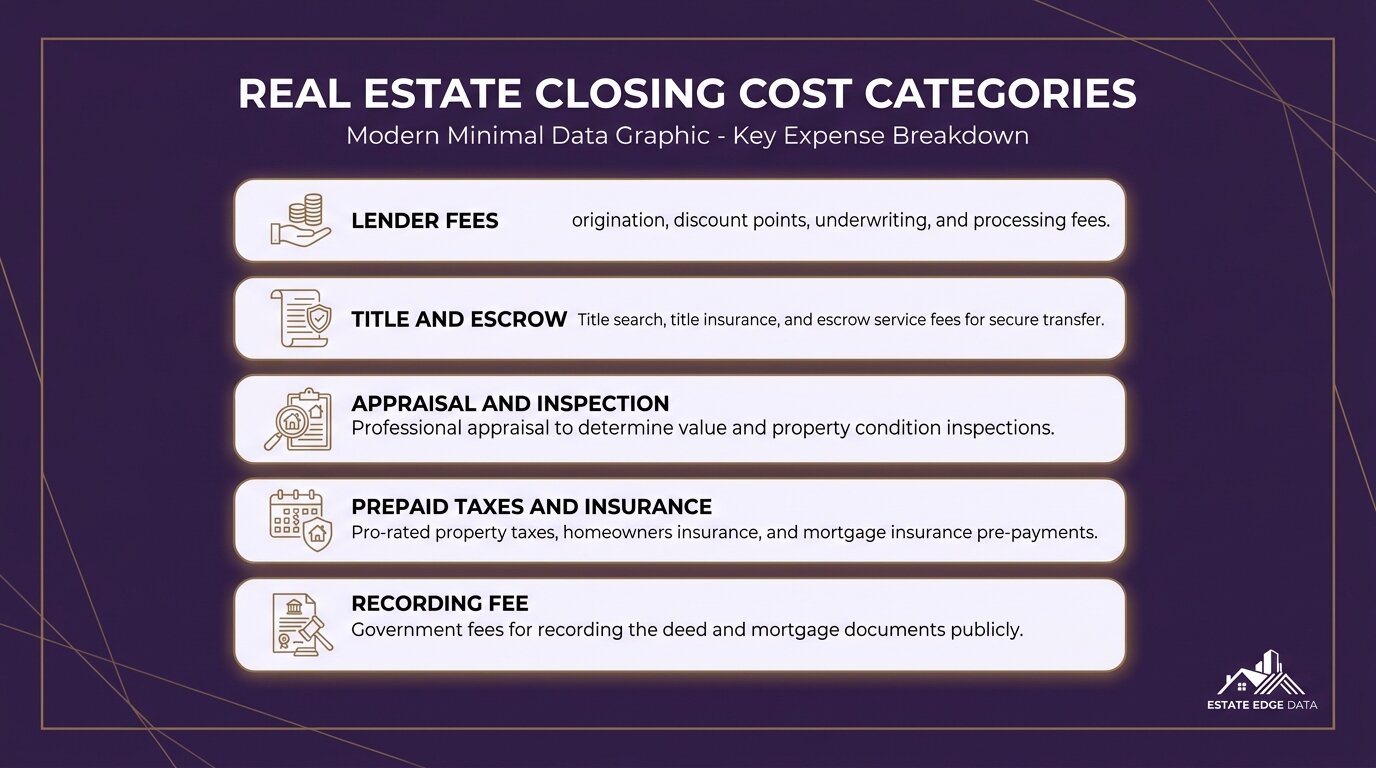
Five categories make up nearly all of your closing costs: lender fees, title and escrow, appraisal and inspection, prepaid taxes and insurance, and the recording fee.
Washington’s Real Estate Excise Tax (REET) is worth knowing about even though it is typically a seller cost, not yours. The state uses a graduated rate starting at 1.10% up to $525,000, plus King County’s local 0.50% addition. I break down the full schedule in my REET guide. Sellers pay this, but it factors into their bottom line and sometimes their willingness to negotiate concessions with you.
What This Means for You as a Buyer
Start budgeting closing costs the same week you start budgeting your down payment. Not after you’re under contract. Ask your lender for a Loan Estimate early, even before you write an offer, so you have a real number instead of a rule of thumb.
Ask about seller concessions when you write your offer. In a market where a seller is motivated, they can often credit some or all of your closing costs as part of the negotiation instead of a straight price reduction. This is common in King County right now, especially outside the tightest inner-ring neighborhoods.
Look into King County down payment assistance programs if your income qualifies. The Washington State Housing Finance Commission runs the Home Advantage program, with income limits up to $180,000 in King County, and House Key Opportunity, which can provide up to $10,000 toward your down payment or closing costs if your income is under roughly $147,400 in King County. These programs exist specifically because this gap catches so many first-time buyers. If Kent fits your budget and search area, my first-time buyer guide for Kent walks through financing options in more depth.
Keep your earnest money separate in your planning. Earnest money in King County typically runs 1% to 5% of your purchase price, with 3% being common in a competitive offer. This money is usually credited back toward your closing costs at the end, but you need it available and liquid the moment you go under contract, days before your other closing funds are due. I broke down exactly how much to set aside in my earnest money guide for King County buyers.
From Kent to Auburn to Covington, the closing cost math looks different in every South King County city.
FAQ
How much are closing costs on a $600,000 home in King County?
Expect roughly $12,000 to $30,000, based on the standard 2% to 5% range. Your actual number depends on your loan type, lender fees, and the title company handling your transaction.
Are closing costs separate from the down payment?
Yes. Your down payment builds equity in the home. Closing costs pay for the services and taxes required to complete the transaction, and they are due in addition to your down payment at closing.
Can a seller pay my closing costs in King County?
Often, yes. Seller concessions toward buyer closing costs are common and negotiable, particularly when a seller is motivated. Your loan type sets a cap on how much a seller can contribute.
Is earnest money part of my closing costs?
Earnest money is a separate deposit due shortly after your offer is accepted, typically 1% to 5% of the purchase price. It is usually applied toward your closing costs at the end, but you need it available well before the rest of your closing funds.
Do first-time buyer programs help with closing costs, or just the down payment?
Both, depending on the program. Washington’s House Key Opportunity and Home Advantage programs can be applied toward down payment or closing costs, which is exactly the gap that catches most first-time buyers off guard.
Your guide to life outside Seattle.
253-350-0045 ·
greg@livingoutsideseattle.com ·
www.livingoutsideseattle.com
Rent vs. Buy in Bellevue WA 2026: The Real Numbers

Is staying a Bellevue renter actually costing you more than a mortgage? The math is more complicated than your landlord thinks — here’s the honest breakdown.
If you’re renting in Bellevue right now, someone has probably told you that you’re throwing money away. And someone else has probably told you that buying a $1.5 million home at 6.5% is financial suicide. Both arguments have merit. Neither one gives you a complete picture.
I work in King County real estate every single day, and the rent vs. buy question in Bellevue is one of the most nuanced I get. The city has some of the highest home prices in Washington — and some of the highest rents too. That changes the math compared to a typical analysis. What I’ll walk you through here is the actual 2026 cost comparison: what you’re paying as a renter, what you’d pay as a buyer, where the break-even point actually sits, and what DPA programs exist for buyers at Bellevue price points.
What Bellevue Renters Are Actually Paying in 2026
Bellevue rents have softened slightly from their peak — but they’re still among the highest in Washington State. Here’s where the market sits right now:
A one-bedroom apartment in Bellevue runs roughly $2,485–$2,889/month depending on the neighborhood and building. A two-bedroom ranges from $3,135 to $4,389/month. The city-wide average across all unit types is around $2,717/month, down about 1.25% from last year.
Downtown Bellevue and the Bel-Red corridor sit at the top of that range. You’ll find more affordable options on the Bellevue-Redmond border or near Factoria, but even those aren’t cheap. Bellevue rents run roughly 54% above the U.S. average.
For a renter in a two-bedroom apartment paying $3,295/month, that’s $39,540 per year going to a landlord. Over five years, that’s $197,700. Over ten years, that’s $395,400 — and rent almost certainly increases at least 2–3% per year, so the real ten-year number is closer to $440,000–$460,000.
That number sounds alarming. But before you run out and make an offer, let’s look at what ownership actually costs.
What Buying in Bellevue Actually Costs in 2026
The median sale price in Bellevue is approximately $1.45–$1.6 million depending on the data source and month. For this comparison, I’ll use $1.5 million as a workable midpoint — which is consistent with recent Redfin data.
Here’s the monthly ownership math on a $1.5M home with 20% down ($300,000):
Monthly Cost Breakdown: Owning a $1.5M Bellevue Home
Loan amount: $1,200,000 (after 20% down)
Principal + Interest at 6.5%: ~$7,585/month
Property taxes (0.75–1.0% effective rate): $937–$1,250/month
Homeowner’s insurance: ~$200–$250/month
Maintenance reserve (1% of value/year): ~$1,250/month
Total estimated monthly cost: $9,972–$10,335/month
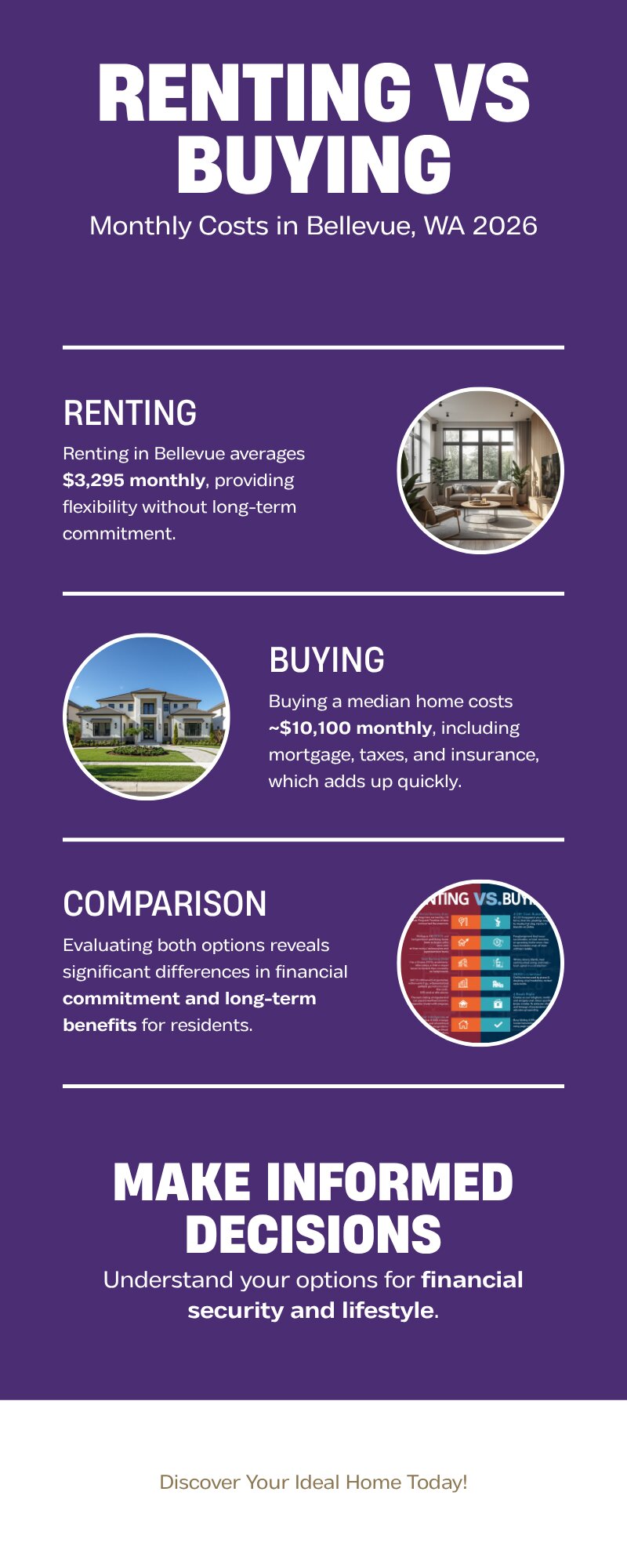
Monthly cost breakdown based on $1.5M median home, 20% down, 6.5% 30-year fixed rate, plus property taxes and maintenance reserve. Source: Redfin, King County Assessor, 2026.
That’s a significant gap from what most two-bedroom Bellevue renters are paying. Even if you’re in a premium $4,400/month two-bedroom, you’re looking at nearly $6,000 less per month than full ownership costs on the median Bellevue home.
What If You Put Less Down?
Most first-time buyers in Bellevue can’t put $300,000 down. If you put 10% down ($150,000) instead, your loan becomes $1,350,000 and your P+I payment climbs to approximately $8,534/month — plus you’d pay PMI (roughly $200–$300/month) until you reach 20% equity. Total monthly cost: $10,200–$10,800+.
The 5% down scenario is even more expensive on a monthly basis, which is why a lot of Bellevue renters who could technically qualify for a mortgage decide to keep renting while they save.
The Break-Even Question: When Does Buying Win?
Here’s the honest answer: at current Bellevue prices and mortgage rates, the break-even horizon is long.
The price-to-rent ratio in Bellevue tells a lot of the story. Take the median home price of $1.5M and divide it by annual rent for a comparable space — say $48,000/year for a two-bedroom. That’s a price-to-rent ratio of about 31. Financial analysts generally say ratios above 25 favor renting. Bellevue is well above that.
Studies of comparable high-cost West Coast markets (Seattle, Portland, Los Angeles) put the typical break-even timeline at 16–23 years when factoring in total costs — mortgage interest, property taxes, maintenance, transaction costs on both ends, and lost investment returns on the down payment. In Bellevue, where prices are higher even than broader Seattle, the honest break-even is likely on the longer end of that range for buyers who aren’t putting at least 20% down.
Down Payment Assistance for Bellevue Buyers
One factor that changes the math: down payment assistance. Bellevue buyers have access to real programs — though at Bellevue price points, most DPA programs hit their purchase price limits quickly.
Here’s what’s available right now:
ARCH East King County DPA
The most Bellevue-specific program available. Provides up to $50,000 in deferred-loan down payment assistance for first-time buyers in East King County — including Bellevue and Kirkland. Income limits are set at 80% of Area Median Income. Given Bellevue’s high AMI, many buyers qualify on income even with solid salaries.
WSHFC Home Advantage
Washington State’s primary DPA program offers up to 4% of the loan amount as a second mortgage for down payment and closing costs. On a $1.2M loan, that’s up to $48,000 — meaningful, but it doesn’t close the gap on a 20% down payment.
WSHFC Opportunity DPA
Up to $15,000 for buyers under the income limits. More targeted toward the $400K–$750K purchase price range; income limits may restrict eligibility at median Bellevue prices.

Down payment assistance programs available to Bellevue-area buyers as of June 2026. Income and purchase price limits apply. Contact a WSHFC-approved lender for current eligibility.
The honest reality: most DPA programs work best in the $400K–$750K purchase price range. Bellevue’s median is double that. But for buyers targeting condos or smaller attached homes in the $650K–$900K range — which do exist in Bellevue — DPA can be a genuine option. Check out our full breakdown of King County down payment assistance programs for current eligibility details.
The King County Angle: Condo Entry Points in Bellevue
If the $1.5M median feels out of reach, Bellevue condos are a different conversation. The King County condo median sits around $550,000–$650,000 citywide, and Bellevue has options in that range — particularly in the Bel-Red corridor and parts of East Bellevue.
At $650,000 with 10% down ($65,000), the monthly P+I at 6.5% is approximately $3,700. Add property taxes (~$406/month), insurance (~$100/month), HOA (varies — budget $400–$700/month for a newer building), and you’re looking at roughly $4,600–$5,000/month total. That compares much more closely to what a two-bedroom apartment costs in Bellevue.
The break-even timeline on a Bellevue condo is shorter — likely in the 6–10 year range depending on appreciation — and DPA programs are more likely to apply at this price point.
Understanding what rates are doing right now is important to this math. If you haven’t looked at current King County mortgage rates, that post walks through what buyers are actually paying in 2026. Before committing to either path, it’s also worth running through the total cost of homeownership breakdown — most buyers underestimate the non-mortgage costs by 20–30%.
What the Right Answer Actually Looks Like
The rent vs. buy decision in Bellevue isn’t one-size-fits-all. Here’s a practical framework based on what I see working for buyers in this market:
Lean Toward Continuing to Rent If:
You expect to move within 5 years. You haven’t saved at least 10% down plus closing costs (3–4% of the purchase price). Your debt-to-income ratio would be stretched at current payment levels. You’re not fully qualified yet — understanding mortgage qualification requirements first is a good use of 20 minutes.
Lean Toward Buying If:
You’re planning to stay 10+ years. You have at least $150K–$300K saved for a down payment (or can qualify with DPA assistance at a lower price point). The monthly payment fits comfortably — no more than 28–30% of gross income. You want stability: a fixed mortgage doesn’t go up every year the way rent tends to.
One variable that tilts the analysis more toward buying than the raw monthly numbers suggest: rent inflation. Bellevue rents have historically increased 3–5% per year over time. A fixed-rate mortgage, by contrast, locks your P+I payment permanently. The gap between renting and owning narrows significantly over 10–15 years when you factor in rent escalation.
FAQ: Rent vs. Buy in Bellevue 2026
How much does it cost to buy a home in Bellevue WA in 2026?
The median sale price is approximately $1.45M–$1.6M. A 20% down payment on a $1.5M home is $300,000. At 6.5% on a 30-year fixed, monthly principal and interest is approximately $7,585. Total monthly costs including taxes, insurance, and maintenance typically run $9,500–$10,500/month for a median Bellevue home.
Is it cheaper to rent or buy in Bellevue right now?
Renting is cheaper on a monthly basis for most buyers at current prices and rates. A two-bedroom Bellevue apartment averages roughly $3,100–$4,400/month, compared to $9,500–$10,500/month to own the median home. The ownership case is built on equity accumulation and rate stability over a long horizon, not short-term payment savings.
How long do you need to stay in Bellevue for buying to make financial sense?
In high-cost markets like Bellevue, the break-even timeline is typically 10–16 years when factoring in transaction costs, maintenance, and the opportunity cost of the down payment. If you’re planning a 5-year stay or less, renting likely wins financially.
Are there down payment assistance programs for Bellevue buyers?
Yes. The ARCH East King County DPA program provides up to $50,000 in deferred-loan assistance for eligible buyers. WSHFC Home Advantage offers up to 4% of the loan amount. These programs work best for buyers targeting the lower end of the Bellevue price range — condos and attached homes in the $600K–$800K range.
What’s the price-to-rent ratio in Bellevue?
Bellevue’s price-to-rent ratio is approximately 30–35 based on current median home prices and average rents. Ratios above 25 generally favor renting over buying from a pure monthly-cost perspective.
Should I buy a condo in Bellevue instead of renting?
Bellevue condos in the $600K–$750K range have a more favorable rent-vs-buy comparison than single-family homes. Total monthly costs can be $4,500–$5,200/month — much closer to what two-bedroom apartments cost. If you’re a first-time buyer in Bellevue, this price point deserves a serious look before ruling out homeownership entirely.
Here’s what I tell Bellevue renters who come to me with this question: run your own numbers, not a national average. The right answer depends on your savings, your timeline, your income stability, and how much the idea of a fixed housing cost for 30 years is worth to you. The financial case isn’t as clean as either side makes it sound.
Your guide to life outside Seattle.
253-350-0045 ·
greg@livingoutsideseattle.com ·
www.livingoutsideseattle.com
King County Down Payment Assistance Programs 2026

How first-time buyers in King County can get up to $45,000 — or more — toward their down payment right now.
The number I hear most from first-time buyers in King County is not the interest rate. It is the down payment. At a $700,000 median price, even a 5% down payment is $35,000 — and that is before closing costs. That is a lot of money to save on top of rent in one of the most expensive metros in the country.
What most buyers do not know is that there are programs specifically designed to close that gap. Some are state programs. Some are regional. A few are city-specific. And in many cases, you can combine them. I work with buyers across South and East King County every week, and the down payment question comes up in almost every first conversation. This guide breaks down every major program available right now, what they actually pay, and how to get the money working for you.
Understanding your financing options is the foundation. If you want to see how King County mortgage rates affect your monthly payment alongside these programs, read King County Mortgage Rates 2026: What Buyers Are Actually Paying first.
What Is Down Payment Assistance and How Does It Work?
Down payment assistance — DPA for short — is money that a government agency, housing authority, or nonprofit makes available to help first-time buyers cover the upfront cash required to purchase a home. It is not a gift in most cases. Most programs are structured as a deferred second mortgage: you borrow the money at zero percent or very low interest, and you do not make payments on it. You repay it when you sell, refinance, or pay off the home.
That structure matters. It means the money costs you almost nothing while you own the home. You are essentially borrowing from your future equity instead of draining your savings account today.
To use DPA, you pair it with a regular first mortgage — FHA, conventional, VA, or USDA. The DPA funds cover part or all of the down payment and sometimes closing costs. Your lender handles the mechanics. You apply through a participating lender, not directly through the DPA program.
The Main Programs Available to King County Buyers
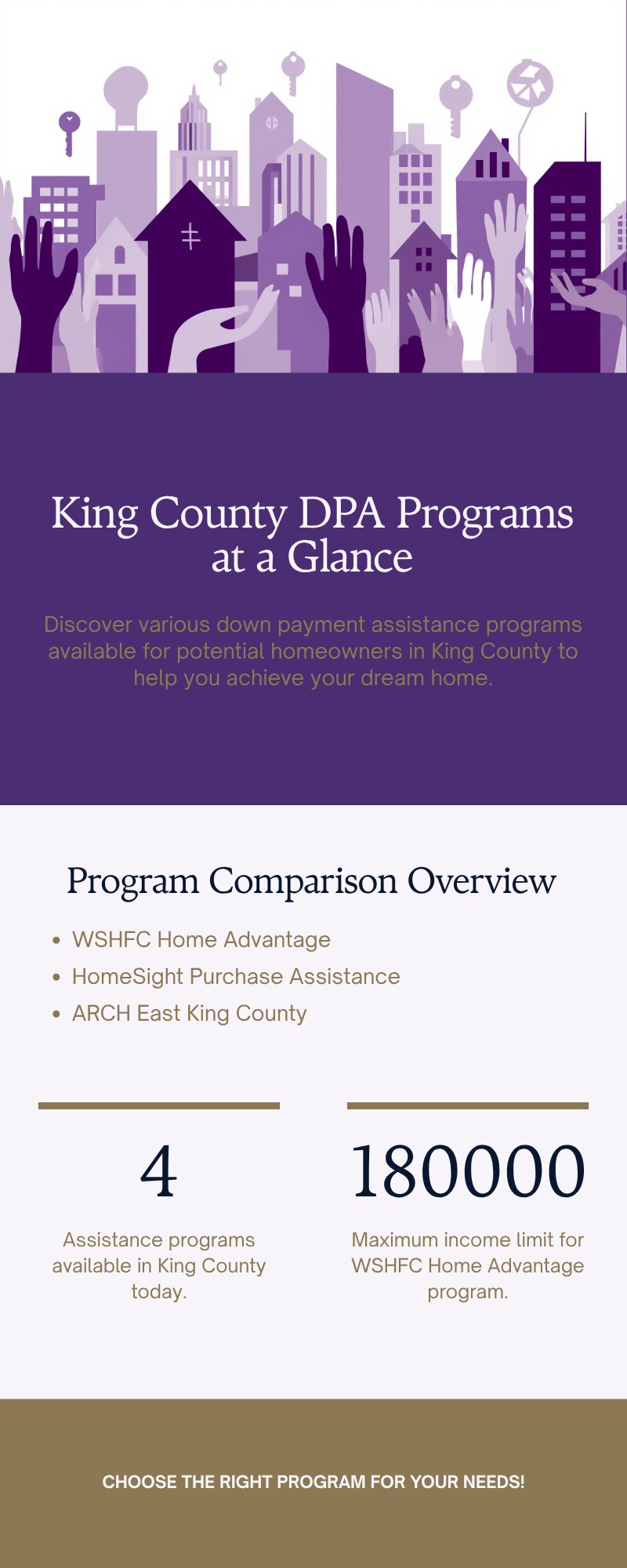
Four programs, four different income and geography profiles. Most buyers qualify for at least one — many qualify for two.
WSHFC Home Advantage
The Washington State Housing Finance Commission’s Home Advantage program is the most widely used DPA program in the state. It has the highest income limit — $180,000 for all household sizes in King County — which means a lot of buyers who assume they earn too much will actually qualify.
Here is how the down payment assistance piece works: you get up to 5% of the first mortgage loan amount as a second mortgage at 0% interest, deferred for 30 years. On a $700,000 home with a $665,000 mortgage, that is up to $33,250 toward your down payment. No monthly payment. No interest accruing. You pay it back when you sell or refinance.
The first mortgage is a 30-year fixed rate through a participating lender. You must have a credit score of at least 620 and complete a five-hour homebuyer education course through Framework or eHome America. The course can be done online in a single afternoon.
HomeSight Purchase Assistance (South King County)
HomeSight is a Seattle-based nonprofit HUD-approved housing counseling agency, and their Purchase Assistance program is the most generous option for buyers in South King County cities. If you are shopping in Auburn, Federal Way, Tukwila, or unincorporated King County, this program can provide up to $45,000 in down payment assistance structured as a 3% deferred loan for 30 years.
The income limit is 80% of Area Median Income. For a family of four in King County, 80% AMI is approximately $112,000 in 2026. That is lower than WSHFC’s ceiling, but the dollar amount is higher — so buyers who fit within the income band can access substantially more cash up front.
HomeSight also offers homebuyer education and one-on-one counseling. Reach them at 206-723-4355 or homesightwa.org. Given that this program serves the exact cities where I work most — Federal Way, Auburn, Kent — it is worth a call early in your search, not after you have found a house.
ARCH East King County Downpayment Assistance
If you are buying in East King County, the ARCH program is what to look at first. ARCH member cities include Bellevue, Issaquah, Kirkland, Redmond, Sammamish, Kenmore, Bothell, Newcastle, Woodinville, and a handful of smaller communities.
The program provides up to $30,000 as a deferred loan at 4% simple interest. The income limits range from about $50,400 for a one-person household to $95,050 for a household of eight. The purchase price limit is $373,000 for the assisted unit, which limits this program to condos and lower-priced homes in the ARCH area rather than single-family houses at current market prices.
That price limit is the honest caution with ARCH: at current East King County prices, this program works best for condo buyers or buyers in specific affordable housing units the program designates. If you are looking at a $650,000 townhouse in Sammamish, WSHFC Home Advantage will likely be more useful.
WSHFC Opportunity Downpayment Assistance
The Opportunity program pairs with WSHFC’s House Key Opportunity first mortgage, targeted to buyers in certain income bands and geographic “targeted areas” — lower-income census tracts where the first-time buyer rule is waived. The DPA here is up to $15,000 at 1% simple interest, deferred for 30 years. It is a solid option for buyers in targeted areas of Kent, Auburn, and Renton who want a slightly larger fixed dollar amount than the Needs-Based program provides.
The King County Angle: Why These Programs Matter More Here
King County median home prices sit above $700,000 as of spring 2026. At that price point, a conventional 5% down payment is $35,000 — and that figure does not include the 2% to 3% in closing costs you will also owe at the table. Combined, a buyer needs $49,000 to $56,000 in cash just to close.
DPA programs cut directly into that number. A buyer using WSHFC Home Advantage on a $665,000 loan gets roughly $33,000 in down payment assistance, which means they need to bring approximately $2,000 to $5,000 of their own cash to close rather than $49,000. That is the difference between buying in 2026 and waiting another three years.
South King County matters particularly here. In cities like Federal Way, Kent, and Auburn, median prices are lower than the county overall — often in the $550,000 to $650,000 range — which means the income limits on programs like HomeSight are more accessible and the purchase prices are within reach. These are the markets where DPA programs do their best work because buyers have realistic targets and the assistance closes the gap meaningfully.
How to Stack Multiple Programs
You can combine certain DPA programs to increase your total assistance. This is called stacking, and it is legal and common when done correctly.
The most practical stack for King County buyers is WSHFC Home Advantage (5% DPA) plus WSHFC Needs-Based assistance ($10,000 fixed) if you qualify for the lower income tier. A participating lender can structure both as simultaneous second mortgages on the same transaction.
Buyers in HomeSight’s service area may be able to combine HomeSight assistance with a first mortgage that has its own DPA feature — ask your lender specifically about this before assuming the programs can be combined, because some programs prohibit layering.
One thing to know: the more DPA you layer, the more important it is to work with a lender who has experience with these specific program combinations. A loan officer who has never done a stacked WSHFC transaction will slow everything down. Ask upfront: “Have you closed stacked WSHFC loans before?”
What Buyers Get Wrong About DPA
The biggest misconception I see is that buyers think these programs are for people in financial trouble. They are not. They are for people who have income, credit, and stable employment but have not had enough years to save a down payment at King County prices. Most DPA recipients are working professionals — nurses, teachers, city employees, tech workers at smaller firms — who earn good incomes but have been renting while prices outran their savings rate.
The second misconception is that applying for DPA slows down the purchase or makes your offer look weak to sellers. It does not affect the timeline in any significant way — DPA is financed through the same closing process as any other transaction. Sellers do not see your financing source, only your terms and your pre-approval letter.
The third thing buyers miss: the homebuyer education requirement is not a hoop to jump through. The five-hour Framework course covers budgeting, loan types, the offer process, and what happens at closing. Every first-time buyer I work with who has taken it says it reduced their stress level. Do it early in the process, before you start touring homes.
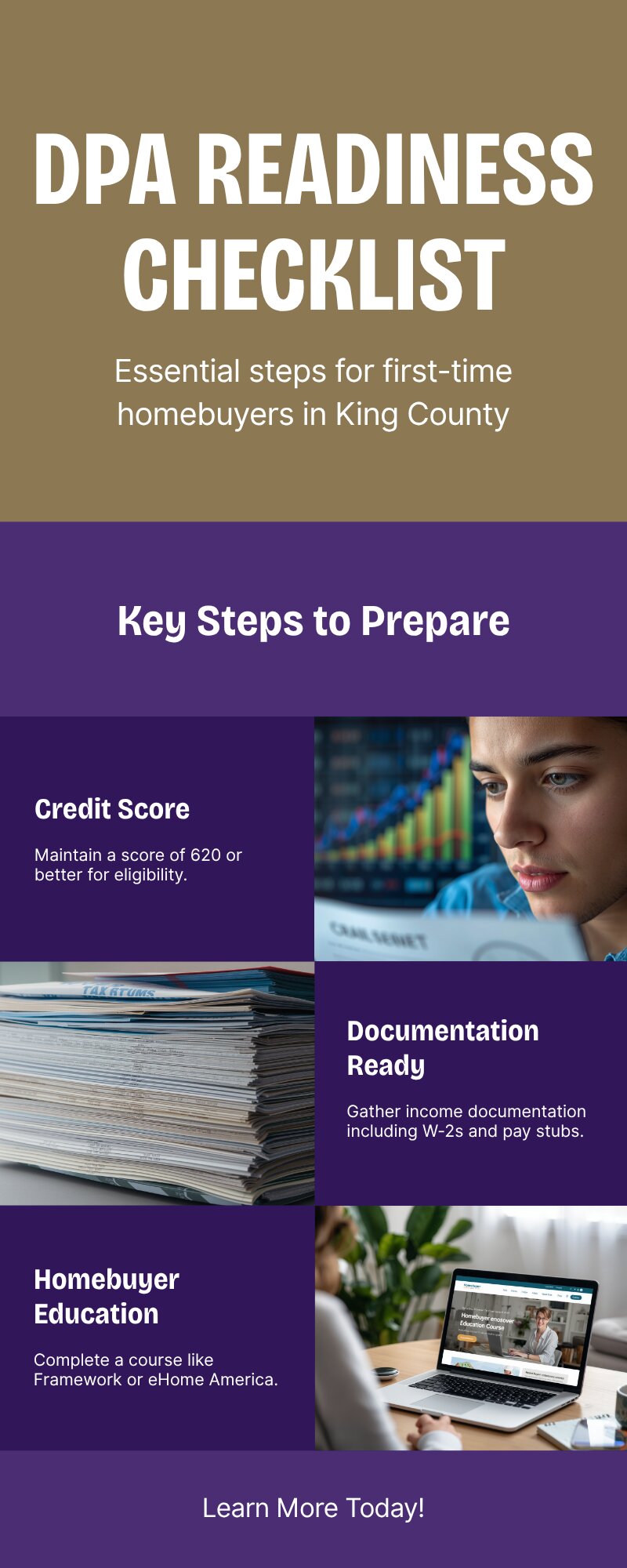
Run through this checklist before contacting a lender. Having these items ready speeds up the pre-approval and DPA approval process.
What This Means for First-Time Buyers in King County
If you are renting right now and thinking about buying in South or East King County, the first practical step is not finding a house. It is finding a WSHFC-approved lender, telling them your income and credit score, and asking which DPA programs you qualify for. That conversation takes 20 minutes and tells you exactly how much assistance you can access.
After that conversation, you will know your real buying budget: not just what you qualify to borrow, but how much cash you actually need to bring to closing. In most cases, that number is much smaller than buyers expect.
Once you know your DPA amount, you will have a much clearer picture of what you can afford and where. If you are still deciding between a condo and a house, check out Should I Buy a Condo or House in King County Right Now? — it breaks down the cost, lifestyle, and financing differences at current prices.
Frequently Asked Questions
Do I have to be a first-time buyer to use these programs?
Most DPA programs define “first-time buyer” as someone who has not owned a home in the past three years. If it has been more than three years since you last owned, you qualify. There are also exceptions for targeted geographic areas where the first-time buyer rule is waived entirely.
Can I use down payment assistance with an FHA loan?
Yes. WSHFC Home Advantage is compatible with FHA loans. FHA requires 3.5% down with a 580+ credit score, and the DPA can cover that amount. The two programs work together through the same lender and close at the same time. If you are deciding between FHA and conventional, see FHA vs. Conventional Loan in King County: Which Is Right for First-Time Buyers? for a side-by-side breakdown.
What happens to the DPA loan if I sell my home?
You repay the deferred second mortgage from your sale proceeds, just like you would repay any other lien on the property. If your home has appreciated, you are repaying a fixed dollar amount from a larger equity pool — most sellers find this is a very manageable part of the transaction.
How long does it take to get approved for a DPA program?
The DPA approval runs in parallel with your first mortgage approval — it does not add extra time as long as you are working with an experienced participating lender. The only real time commitment is the homebuyer education course, which you can complete in a single day online.
Are there income limits I need to know about?
Yes, and they vary by program. WSHFC Home Advantage has the highest limit at $180,000 for King County. HomeSight caps at 80% AMI (roughly $112,000 for a family of four). ARCH has lower limits ranging from $50,400 to $95,050 depending on household size. Your lender will check your income against each program you might qualify for.
Does using DPA affect my interest rate?
The WSHFC Home Advantage first mortgage rate is set by the Commission and is typically very close to market rates — sometimes slightly better because it is a bulk-purchased rate. The DPA second mortgage is at 0%, so it does not affect your monthly payment at all.
Your guide to life outside Seattle.
253-350-0045 ·
greg@livingoutsideseattle.com ·
www.livingoutsideseattle.com
Starter Homes in King County WA: Real 2026 Prices
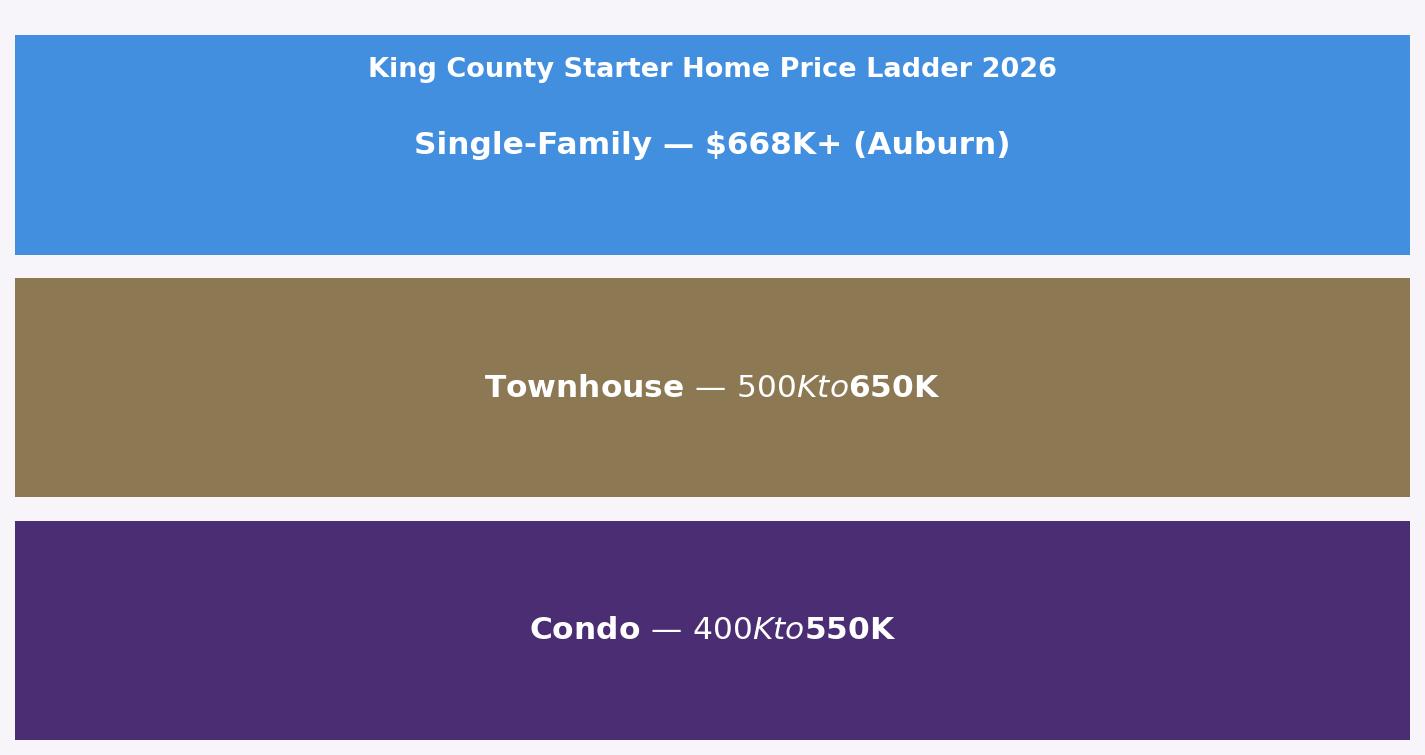
Starter homes in King County are more reachable than most renters think. That’s the first thing I tell people when they call me. It usually surprises them.
The county median sits above $800K. That sounds intimidating. But the median includes Bellevue at $1.7 million and Sammamish at $1.6 million. If you’re targeting South King County, your real entry points look nothing like those numbers.
Here’s what your starter home actually looks like at different price points, using March 2026 data.
King County Condo Prices 2026: Starter Homes from $400K to $550K
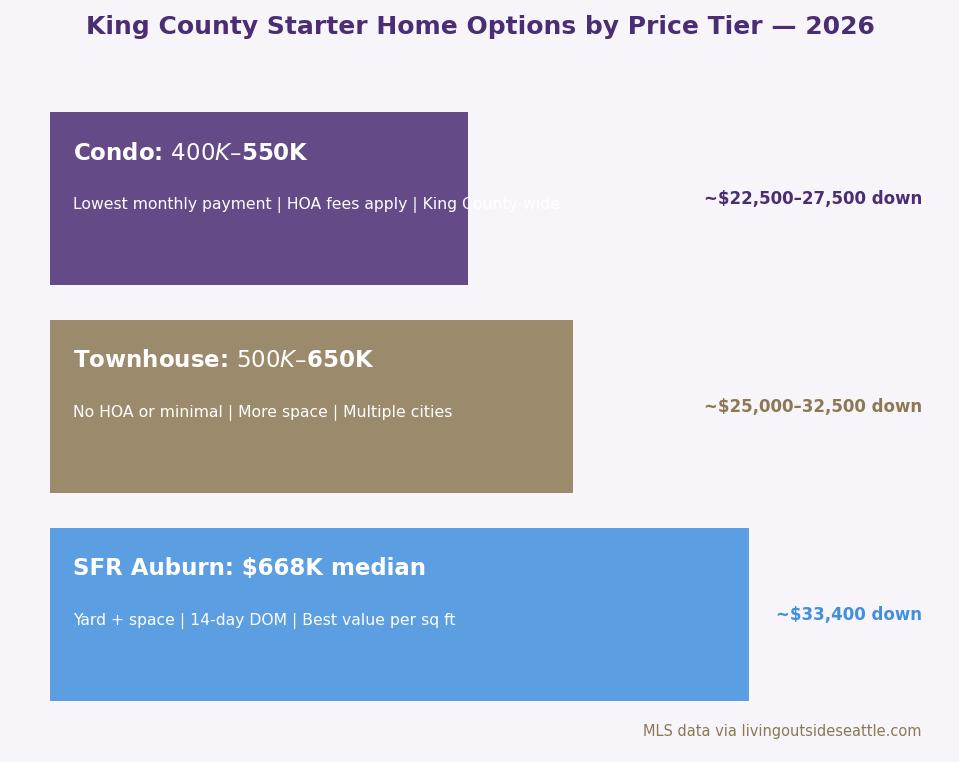
The King County condo median as of March 2026 is $550,000. That’s across the entire county.
At the lower end, $400K to $450K gets you a 1- or 2-bedroom condo, likely built in the 1980s or 1990s, in Auburn, Kent, or Federal Way. Established HOA histories, solid locations near shopping and highways, and they’ve already absorbed the worst of any market corrections.
At $550K, you’re in a better-maintained unit. Possibly newer. Two beds, 1.5 baths, maybe outdoor space, a building with solid reserves. For more on financing options at these price points, see my King County mortgage rates and loan options guide.
The advantages of a condo: low maintenance, no yard work, no roofing or exterior repair costs, shared building insurance. You close the door and you’re done.
The trade-offs: HOA fees in the $300 to $600 per month range, no land ownership, and resale that can be tighter depending on the building.
Townhouse Starter Homes in King County: The $500K to $650K Range
Townhouses occupy good middle ground. They feel like houses. Most have a small yard or patio and a garage. You’re still next to someone, but you own land and have exterior walls without the full maintenance load of a single-family home.
At $500K to $550K, you’re in a 2- to 3-bed townhouse, probably built in the 2000s or newer, in Kent, Auburn, or the southern Eastside.
At $600K to $650K, you’re in a newer, well-maintained townhouse. Possibly 3 beds and 2.5 baths, maybe with a small finished basement.
HOA fees for townhouses typically run $150 to $300 per month. Lighter than condos. You’re responsible for your own exterior but not the roof or foundation on most buildings.
Affordable Single-Family Homes in King County: Auburn as the Entry Point
This is where first-time buyers get real. A single-family home you actually own outright.
Auburn is your strongest entry point. The Auburn median single-family price in March 2026: $668,000. Days on market: 14 days. That’s the softest DOM in the 7-city South King County area, which means you have breathing room as a buyer.
$668K in Auburn buys something real. A 1,500 to 1,800 square foot home built in the 1970s to 1990s, 3 beds, 1.5 to 2 baths, on a quarter-acre lot. Not new. Not fancy. But livable. Foundation solid. Roof not leaking. Systems working.
Move up to $700K and you get better condition, a newer kitchen or bathroom, maybe updated electrical. $750K in Auburn or nearby Kent gets you a newer-built home or a well-renovated older one.
Why Auburn? You get the most square footage per dollar in South King County. The Green River Trail runs through the area. Downtown Auburn has real community investment happening right now. Schools are solid, property taxes are reasonable, and the commute to Seattle via I-5 or 167 is manageable. For a full breakdown of the city, see my Living in Auburn WA: 2026 neighborhood and real estate guide.
This is not a fallback neighborhood. It’s a smart first buy.
Down Payment Assistance for King County First-Time Buyers
King County offers up to $45,000 as a 3% interest, 30-year deferred loan for first-time buyers purchasing in Auburn, Federal Way, Tukwila, or unincorporated areas. The WSHFC Home Advantage program also provides down payment assistance for households earning under $147,400 in King County.
These programs change the upfront math. Here’s what that looks like in practice:
Without assistance: FHA loans allow 3.5% down. On a $550K condo, that’s $19,250 down. Closing costs are another $10K to $15K. Total to move in: roughly $30K to $35K.
On a $668K Auburn home with 5% down conventional, you need $33,400 down. Closing costs another $12K to $18K. Total: roughly $45K to $50K.
For a detailed breakdown of loan types and what you qualify for, see my King County mortgage rates and loan options guide.
What’s the Monthly Payment on a Starter Home in King County?
At today’s 6.38% rate on a $600K loan, 30 years: roughly $3,800 per month including taxes, insurance, and PMI. For a renter paying $2,200 per month for a 1-bedroom, that’s $1,600 more per month for a 3-bedroom house you own and build equity in.
PMI on that $668K Auburn home at 5% down runs about $250 to $300 per month until you hit 20% equity. Real cost. But not a dealbreaker for most first-time buyers.
Key Takeaways
- King County condo median: $550,000. Entry condos start at $400K to $450K in Auburn, Kent, and Federal Way.
- Townhouse sweet spot: $500K to $600K for newer, well-maintained homes.
- Auburn single-family entry point: $668,000 median with a 14-day DOM and the best price-per-square-foot in South King County.
- Down payment plus closing costs on a $668K Auburn home: roughly $45K to $50K with 5% down conventional. Down payment assistance programs can reduce this.
- First-time buyer payment on a $600K loan at 6.38%: roughly $3,800 per month including taxes, insurance, and PMI.
Frequently Asked Questions About Starter Homes in King County WA
What is a realistic starter home price in King County WA?
In King County, starter homes range from $400K to $750K depending on property type and location. Condos and townhouses start around $400K to $550K. Entry-level single-family homes in South King County average $668K in Auburn as of March 2026. The exact price depends on location, condition, and what you qualify for with your income and down payment.
Can I buy a starter home in King County with a small down payment?
Yes. FHA loans allow 3.5% down. On a $550K condo, that’s roughly $19,250 down plus $10K to $15K in closing costs. King County also offers up to $45,000 in deferred down payment assistance for buyers in Auburn, Federal Way, Tukwila, and unincorporated areas. Check with a mortgage lender about which programs you qualify for.
Is Auburn a good city for first-time home buyers in King County?
Yes. Auburn offers the most square footage per dollar in South King County, with a $668K median single-family price and a 14-day average DOM. That extra time on market means less competition and room to negotiate. The Green River Trail, solid schools, and a manageable Seattle commute via I-5 or 167 make it a smart first buy.
What’s the monthly payment on a $668K home in Auburn WA?
At 5% down and a 6.38% 30-year rate, your principal and interest on a $634K loan is roughly $3,960 per month. Add property taxes (around $530/month), insurance ($100 to $130/month), and PMI ($250 to $300/month), and your total monthly housing cost is approximately $4,840 to $4,920. PMI drops once you reach 20% equity.
What down payment assistance is available for King County first-time buyers?
King County offers up to $45,000 as a 3% interest, 30-year deferred loan for buyers purchasing in Auburn, Federal Way, Tukwila, or unincorporated King County. The Washington State Housing Finance Commission’s Home Advantage program offers additional assistance for households earning under $147,400 in King County. A mortgage lender can help you stack programs based on your income and target city.
Your guide to life outside Seattle.
Gregory Dorrell | REALTOR® | Coldwell Banker Bain
East and South King County Specialist
253-350-0045 | greg@livingoutsideseattle.com
Gregory Dorrell is a licensed REALTOR® in Washington State (License #111862) with Coldwell Banker Bain. Market data sourced from NWMLS/MLS InfoSparks, March 2026. This content is for informational purposes and does not constitute financial or mortgage advice. Please consult with a mortgage lender regarding down payment requirements, loan programs, and qualifying rates specific to your situation.
First-Time Home Buyer Guide: Federal Way WA 2026
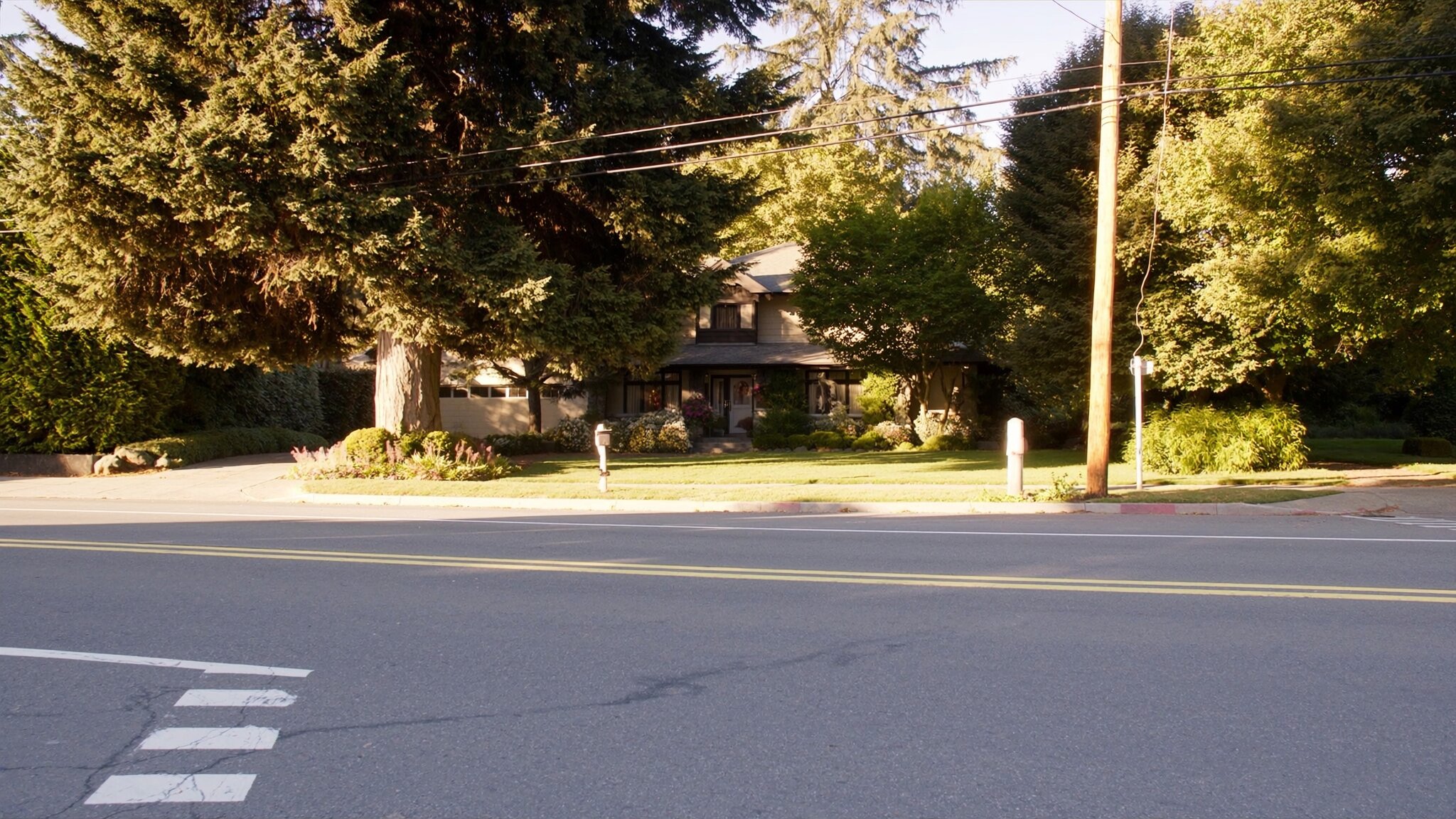
Federal Way just got a lot easier to get to — and a lot more interesting to buy in. Here’s everything you need to know to buy your first home there.
As of December 2025, Federal Way has a Link light rail station. That changed something real for buyers: you can live in a city where the median home price is about $597,000 — roughly 29% below Seattle’s median — and still get to downtown Seattle or SeaTac Airport by train. For first-time buyers who have been priced out further north, that math is worth taking seriously.
This guide walks you through the actual process of buying your first home in Federal Way. Not the national advice you can find anywhere — the specific steps, the specific programs, and the specific neighborhoods that matter here. If you have done the rent-vs-buy math and you are ready to move forward, this is where to start.
What Does It Actually Cost to Buy in Federal Way Right Now?
The first number most buyers want to know is the median price. As of early 2026, it sits around $597,000 to $610,000 for all property types combined. But that number hides some useful range.
Single-family homes have a median closer to $643,750. Townhouses average $351,500. Condos — which include a mix of updated units and older complexes — run from about $200,000 up to $330,000. If you are a first-time buyer whose budget tops out around $500,000, Federal Way gives you real choices: a turnkey townhouse, a move-in-ready condo in a good location, or a single-family home that needs some work.
Compare that to Seattle, where $500,000 buys you a studio condo if you are lucky. Federal Way is not the compromise a lot of buyers expect it to be.
Then there are closing costs. In Washington state, buyers typically pay 2% to 3% of the purchase price to cover lender fees, title insurance, and prepaid items. On a $600,000 home, that is $12,000 to $18,000 out of pocket on top of your down payment. This surprises a lot of first-time buyers. Plan for it early.
The Neighborhood Question: Where to Focus in Federal Way
Federal Way is bigger than most people expect — about 25 square miles, with meaningful price and quality-of-life differences by neighborhood. Getting this right matters more than buyers often realize.
Marine Hills & Twin Lakes — Premium West Side
These neighborhoods sit on the west side of the city with views toward Puget Sound and proximity to Dash Point State Park. They consistently rank highest for schools and safety. Prices here run $650,000 to $850,000 for single-family homes.
Best for: buyers who prioritize top-rated elementary schools and long-term value stability, and can stretch the budget.
Steel Lake — Family-Friendly Middle Ground
Well-regarded schools, a community park around the lake, and prices that are more accessible than the west side. Attracts families who want good schools without paying Marine Hills prices.
Best for: families prioritizing school quality who need room in the budget for a down payment.
Federal Way City Center — Transit-Connected Entry Point
Where the new light rail station is. Walk Score of 83 — the highest in the city. Condos currently near a $285,000 median, one of the lowest price points in King County for a transit-connected location. The city has a phased agreement to add 1,600 homes near the station by 2042.
Best for: commuters, single buyers, or couples who want maximum walkability and transit access at the lowest entry price.
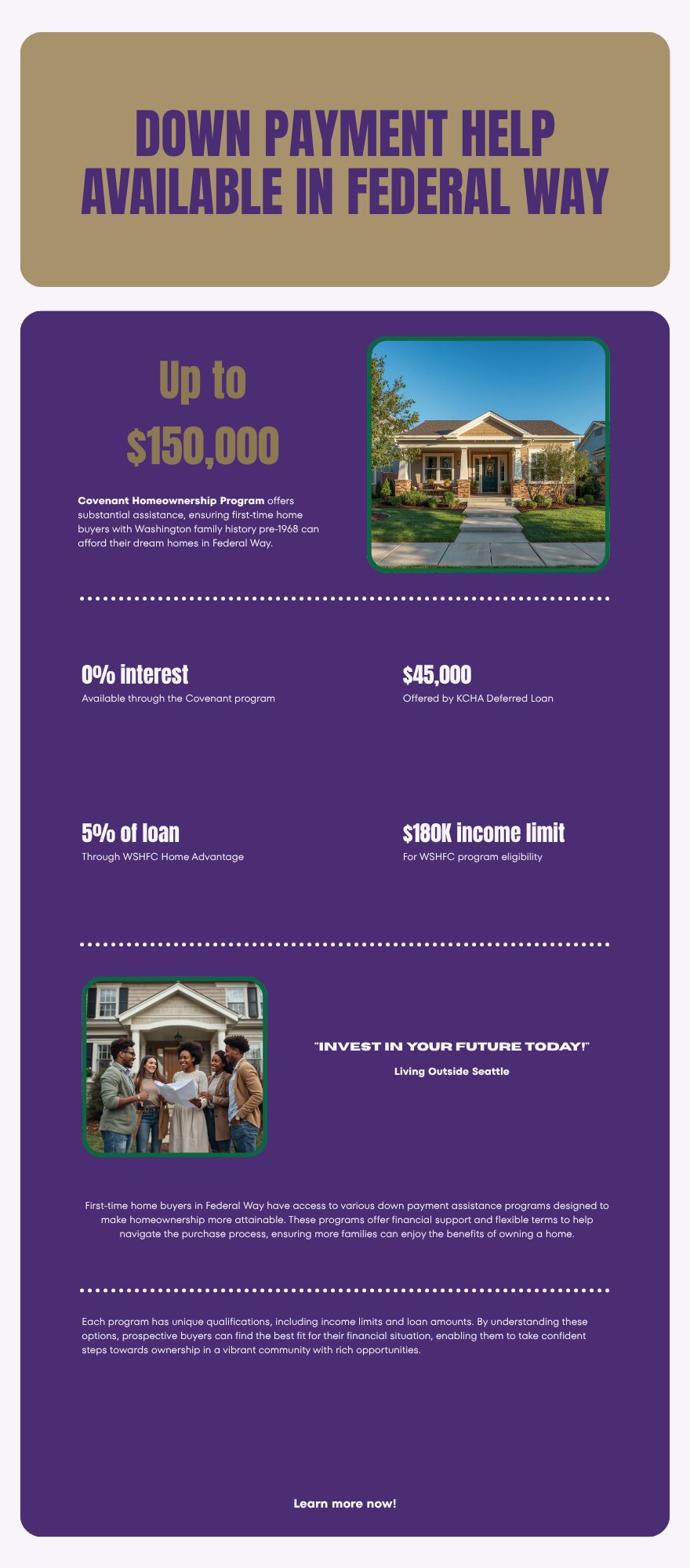
Three programs, potentially stackable — Federal Way buyers have more down payment assistance access than most King County cities.
The School District Picture
Most of Federal Way falls within the Federal Way Public Schools district, which serves over 22,000 students across 47 schools and is one of the most diverse districts in King County, with 123 languages spoken. Top-rated schools cluster in the Marine Hills, Twin Lakes, and Steel Lake neighborhoods.
A small portion of Federal Way’s north end feeds into Highline School District. This matters if you are buying in that zone and have school-age children. Confirm the district boundary before you make an offer on any specific address.
Down Payment Help: What’s Actually Available in Federal Way
This is where Federal Way gets interesting for first-time buyers. There are more programs available here — and more ways to stack them — than most buyers realize. Here is what is active in 2026.
KCHA Deferred Loan — Up to $45,000
Federal Way is one of four cities specifically named in the King County Housing Authority program (along with Auburn, Tukwila, and unincorporated King County). First-time buyers can access up to $45,000 as a 3% interest deferred loan — no monthly payments. The balance comes due when you sell, refinance, or move.
This is one of the most accessible DPA programs in King County, and Federal Way buyers qualify by location alone.
WSHFC Home Advantage — Up to 5% of Loan
Washington’s primary first-time buyer program offers below-market 30-year fixed rates plus down payment assistance of up to 5% of the loan amount as a 0% deferred second mortgage. Income limits for King County run up to $180,000 for all household sizes. You need a 620+ credit score and a free 5-hour homebuyer education course.
If your household income is under $147,400, you may also qualify for an additional $10,000 needs-based DPA at 1% simple interest on top of Home Advantage.
Covenant Homeownership Program — Up to $150,000
This program offers up to $150,000 in down payment assistance at 0% interest for buyers with documented family history in Washington state before 1968. The program expanded in 2025, and as of April 2026 requires most documentation to be gathered before house-hunting.
Buyers who qualify describe this as life-changing. The numbers really are that significant. Contact heretohome.org/covenant or call 1-877-894-4663 to check eligibility before you do anything else.
Programs can often be layered. A buyer using WSHFC Home Advantage as the first mortgage could potentially also use the KCHA $45,000 deferred loan. Talk to a WSHFC-approved lender — not just any lender — to understand exactly which combination works for your income and purchase price.
The Buying Process Step by Step in Federal Way
Here is the actual sequence. Every market has its quirks and Federal Way is no exception.

The Federal Way buying process in seven steps — from credit check to closing keys in hand.
Step 1: Get Your Finances in Shape
You need a minimum 620 credit score for most DPA programs. Pull your credit report before you start house-hunting, not after. If your score is 580 to 619, you have FHA options, but you lose access to most DPA programs until you cross 620.
Step 2: Take the Homebuyer Education Course
WSHFC requires a free 5-hour course before you can use Home Advantage. It is genuinely useful. Do it before you start touring homes — not after you find one you love.
Step 3: Get Pre-Approved (Not Just Pre-Qualified)
Federal Way homes receive an average of 3 offers and sell in about 61 days — not frantic, but sellers still expect a real pre-approval letter. Use a WSHFC-approved lender if you plan to use any state DPA programs. The difference between pre-qualified and pre-approved matters in negotiations.
Step 4: Know Your Loan Type
The FHA loan limit for King County in 2026 is around $977,500 — well above Federal Way’s median, so FHA financing is fully available here. FHA requires 3.5% down with a 580+ score. Conventional loans require 3% to 5% down with a 620+ score.
For most Federal Way first-time buyers, a combination of conventional or FHA financing plus a DPA second mortgage is the path that makes the numbers work. Also worth exploring: rate buydowns that some sellers offer to offset today’s rates.
Step 5: Make an Offer and Negotiate
Federal Way is not the wild bidding-war market you hear about in Bellevue. Homes are sitting an average of 61 days. You have room to negotiate, especially on homes listed more than 30 days. Inspection, financing, and appraisal contingencies are all standard here — do not waive them without a very specific reason.
Step 6: Inspect Thoroughly
General home inspection in Washington runs $400 to $700. Federal Way has significant older housing stock — pay attention to the roof, electrical panels (aluminum wiring was common in 1970s homes), and exterior maintenance.
For pre-1980 homes, a seismic evaluation ($150 to $350) is worth it if the inspector flags anything. Washington is an active seismic zone.
Step 7: Close
Washington closings typically take 30 to 45 days from accepted offer. You will pay 2% to 3% of the purchase price in closing costs on the buyer side. If you are using DPA programs, some of those costs may be covered — confirm with your lender in advance so there are no surprises at the closing table.
The Light Rail Factor: What It Actually Means for First-Time Buyers
Sound Transit’s Federal Way Link Extension opened December 6, 2025, adding three stations: Kent Des Moines, Star Lake, and the Federal Way Transit Center in City Center. From Federal Way, you can now take Link directly to SeaTac Airport and downtown Seattle without sitting in I-5 traffic.
For first-time buyers, this changes the commute math. If you work for a Seattle employer, Federal Way is no longer a two-hour-drive-in-bad-traffic proposition. That matters when you are choosing where to live on a first-home budget.
One thing to be straight about: the research so far shows home prices near the new stations have not spiked the way they did around other Link expansions. Development around the Federal Way station is slower than city officials originally projected. That is actually good news for first-time buyers in 2026 — you can buy near a major transit hub before any significant price premium takes hold, rather than after. That opportunity will not last indefinitely.
What This Means for You as a First-Time Buyer in King County
Federal Way in 2026 is a market where the fundamentals are solid and the buyer advantages are real. You are paying roughly $200,000 to $250,000 less than Seattle for comparable square footage. You have access to more DPA programs than almost anywhere else in King County by name. And you now have a light rail connection that much of South King County does not have.
The things to watch: neighborhood selection matters here more than in uniform suburban markets. Get the school boundaries right before you fall in love with a house. Understand which DPA programs you qualify for before you start touring homes — this changes what you can actually afford. Take the homebuyer education course early so it does not slow your timeline when you find the right place.
If you want to see how Federal Way compares to buying in a nearby city like Kent, that post walks through similar math from a different angle.
For a first-time buyer in the $450,000 to $650,000 range, Federal Way deserves a serious look. I work this market every day, and the value is real.
Frequently Asked Questions
What credit score do I need to buy a home in Federal Way?
Most down payment assistance programs require a minimum 620 credit score. FHA loans allow scores as low as 580 with 3.5% down, but you lose access to most DPA programs below 620. If your score is between 600 and 619, a few months of focused credit improvement can open up a significant amount of additional assistance.
How much down payment do I actually need in Federal Way?
FHA loans require 3.5% down — about $22,000 on a $637,000 home. Conventional loans can go as low as 3% down. But with the KCHA $45,000 deferred loan and WSHFC Home Advantage’s 5% DPA available specifically in Federal Way, many buyers cover the down payment entirely through assistance programs while keeping cash reserves for closing costs and move-in expenses.
Is Federal Way a good place to buy for the first time?
Yes — especially compared to north King County and Seattle. The median is around $597,000–$610,000, which is 29% below Seattle. Homes sit on market an average of 61 days, giving buyers more negotiating room than you find in more competitive King County cities. The new light rail connection opened December 2025 makes commuting significantly more manageable.
Which neighborhoods in Federal Way are best for families?
Marine Hills and Twin Lakes have the highest-rated schools and lowest crime rates. Steel Lake is a strong middle-ground option with good schools and more accessible prices. If transit access matters most, Federal Way City Center near the Link station has a walkability score of 83 and the lowest entry prices in the city near $285,000 for condos.
What DPA programs work specifically in Federal Way?
Federal Way is one of four cities named in the KCHA deferred loan program — up to $45,000 at 3% interest deferred until you sell or refinance. You can potentially layer that with WSHFC Home Advantage (up to 5% of the loan amount as a 0% deferred second) and, if you qualify, the Covenant Homeownership Program (up to $150,000 at 0% interest). Use a WSHFC-approved lender to understand which combination fits your situation.
How long does it take to close on a home in Federal Way?
Most Washington state closings take 30 to 45 days from accepted offer. If you are using DPA programs, add time at the beginning for pre-approval through a WSHFC-approved lender and completion of the required homebuyer education course — both need to happen before you start looking at homes.
Your guide to life outside Seattle.
253-350-0045 ·
greg@livingoutsideseattle.com ·
www.livingoutsideseattle.com
