

 Facebook
 X
X
 Pinterest
 Copy Link
Washington State Real Estate Excise Tax (REET): Seller Guide

Before you sign anything at closing, you need to know about one tax most sellers don’t think about until it’s too late.
Most sellers in King County spend months thinking about list price, staging, and what to do with the proceeds. REET — Washington’s Real Estate Excise Tax — rarely gets a mention until the closing statement lands in front of them. Then the questions start. What is this number? Why is it so large? Is this the same as capital gains?
The short answer: REET is a transaction tax Washington charges on nearly every home sale. Unlike capital gains, it is calculated on your sale price, not your profit. That distinction matters a lot. On an $800,000 home sale in Renton or Kent, your REET bill could run $13,000 or more before local rates are added. That is real money, and you should know exactly where it comes from before you go to closing.
I see this confusion regularly in my work. Sellers find out about REET at the same time they are signing a stack of documents and trying to remember where they put their ID. This guide is meant to fix that. Read it before you list.
What Is REET and Who Pays It
REET stands for Real Estate Excise Tax. It is Washington State’s tax on the transfer of real property. When you sell your home, you transfer ownership to the buyer. That transfer triggers REET. Washington has charged this tax since 1951, though the graduated rate structure is newer — it replaced the old flat rate in 2020.
The seller pays REET by custom and by statute. In practice, your escrow or title company collects it from your net proceeds at closing and remits it to the county before your deed is recorded. You do not write a separate check. It comes out of what you would otherwise walk away with, which is exactly why it affects your bottom line.
The deed cannot be recorded until REET is paid. That means the sale cannot legally close until the tax is settled. Your title company handles this automatically, but knowing it is happening helps you read your settlement statement correctly.
The 2026 REET Rate Schedule: What You Actually Pay
Washington uses a four-bracket graduated rate structure. Every seller pays the same rate on each bracket — the rate applies to the slice of your sale price within that range, not to the entire sale price. Think of it like income tax brackets: only the amount within each tier gets taxed at that tier’s rate.
Here is how the 2026 state rate schedule breaks down:
2026 Washington State REET Brackets
First $525,000 — state rate of 1.10%
$525,000.01 to $1,525,000 — state rate of 1.28%
$1,525,000.01 to $3,025,000 — state rate of 2.75%
Above $3,025,000 — state rate of 3.00%
King County adds a local REET of 0.50% on top of the state rate. This local portion funds affordable housing and infrastructure programs countywide.
To make the math concrete, here is what three common King County sale prices actually cost in total REET:
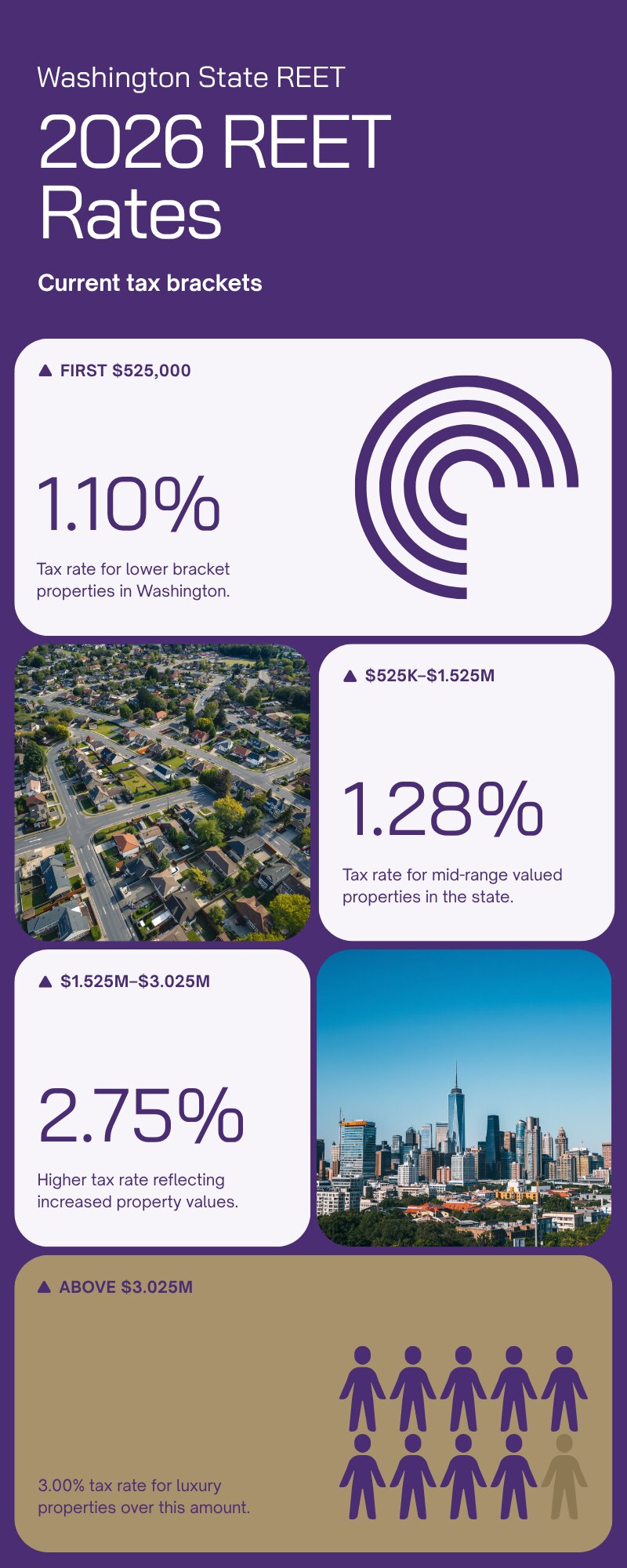
The graduated rate structure means your effective REET rate rises as your sale price climbs — most South King County sellers land between 1.60% and 1.78% combined.
Sale Price $600,000 (typical Kent or Auburn single-family)
State REET on first $525,000: $5,775
State REET on next $75,000 @ 1.28%: $960
King County local REET (0.50%): $3,000
Total REET: $9,735
Sale Price $800,000 (typical Renton or Covington move-up home)
State REET on first $525,000: $5,775
State REET on next $275,000 @ 1.28%: $3,520
King County local REET (0.50%): $4,000
Total REET: $13,295
Sale Price $1,100,000 (Maple Valley or East Renton higher-end)
State REET on first $525,000: $5,775
State REET on next $575,000 @ 1.28%: $7,360
King County local REET (0.50%): $5,500
Total REET: $18,635
These numbers grow quickly on move-up homes. The graduated structure means sellers at the $1.5M threshold pay roughly 2.5 times more as a percentage of their sale price than sellers in the $525K range. For most South King County sellers, the combined state plus local rate lands somewhere between 1.60% and 1.78% of the sale price.
REET Is Not Capital Gains Tax
This is the confusion I hear most often from sellers, and it is worth clearing up completely before anything else.
REET is calculated on your sale price. Capital gains is calculated on your profit — the difference between what you paid for the home and what you sold it for, minus selling costs and qualifying improvements. They are separate obligations. You pay REET at closing regardless of whether you made money on the sale. You deal with capital gains at tax time, and only if your profit exceeds the federal exclusion ($250,000 for single filers, $500,000 for married couples filing jointly).
Washington State does not impose a capital gains tax on real estate sales. The state’s 7% capital gains tax applies to certain financial assets — stocks, bonds, and similar instruments — not to your home. So when it comes to your Washington State tax burden from selling a home, REET is essentially it. Federal taxes are a separate calculation entirely.
I wrote a full breakdown of how capital gains work on Washington home sales if you want to understand the federal piece. The REET and capital gains questions show up together constantly — it helps to understand them separately before you talk to your CPA.
Common REET Exemptions
Not every transfer triggers REET. Washington provides specific statutory exemptions, and knowing them can save you a significant sum if your situation qualifies.
Inheritance and Devise by Will
If you inherited a home and you are selling it to a third party, REET applies on your sale. But the original transfer from the estate to you — moving the property into your name — is exempt from REET. This is why inherited property often shows up in the chain of title without a corresponding excise tax payment. If you recently inherited a King County home and have questions about next steps, I covered this specifically in my inherited home guide for King County sellers.
Divorce and Legal Separation
Transfers between spouses pursuant to a divorce decree or legal separation agreement are exempt. This applies to legally married spouses and state-registered domestic partners. If you are transferring the home to a former partner as part of a settlement, REET likely does not apply — but the exemption must be documented correctly on the REET affidavit.
Gifts
Genuine gifts of real property where no money or other consideration changes hands are exempt. The key word is genuine — the transfer must be a gift, not a below-market sale disguised as one.
Foreclosure and Distressed Transfers
Certain distressed sale scenarios have partial or full exemptions. These situations involve additional complexity and you should work directly with a title company and a real estate attorney to confirm eligibility and documentation requirements.
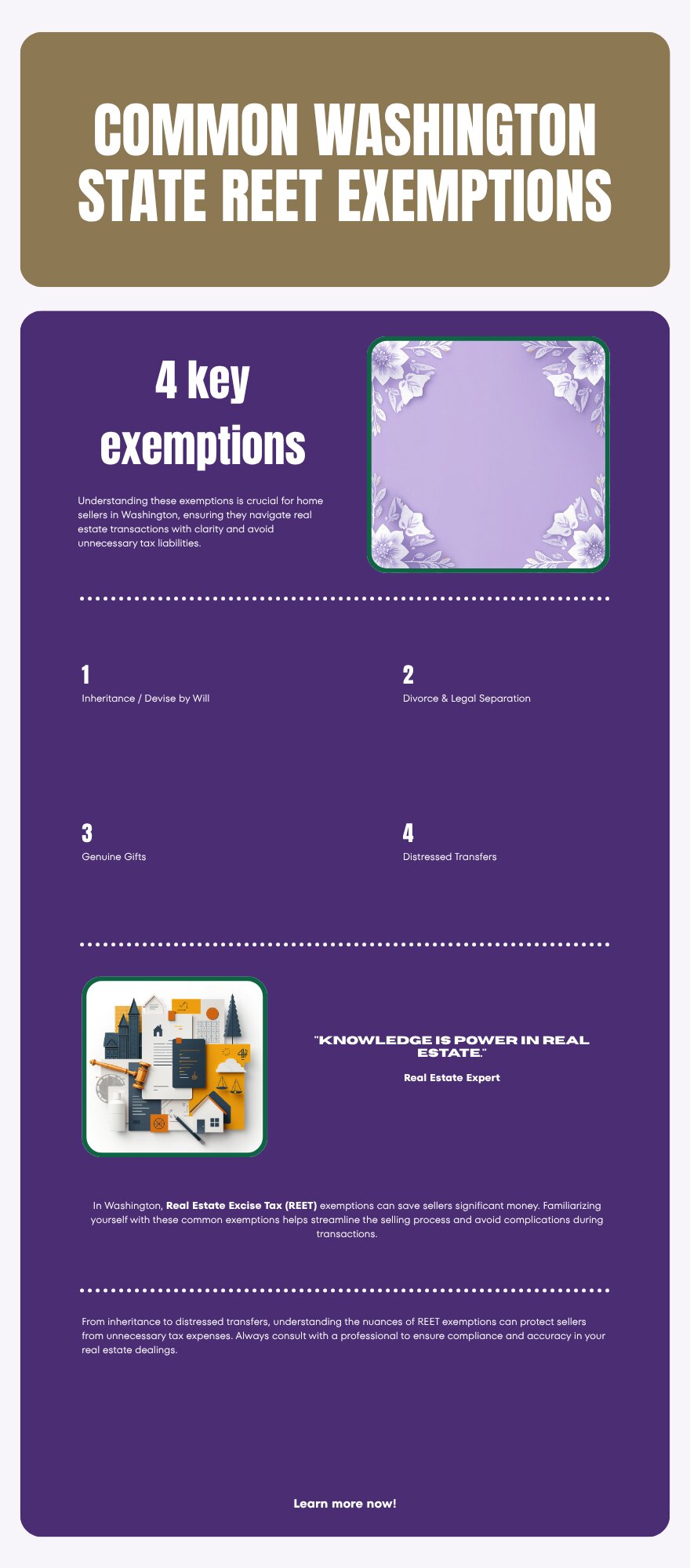
The most common REET exemptions in Washington State — always confirm with your title company before assuming your transfer qualifies.
How REET Fits Into Your Total Closing Costs
REET is typically the largest single tax line on a King County seller’s settlement statement, but it sits alongside other closing costs. When you are running your net proceeds math before you list, here is how REET fits into the picture.
Your title and escrow company will prepare a preliminary settlement statement before closing. That statement breaks out every cost — agent commission, title fees, prorated property taxes, any seller-paid concessions, and REET. Review this before closing day so there are no surprises when you sign.
The REET affidavit gets filed at the county recorder’s office. In King County, that is processed through the King County Recorder’s Office. Your title company handles the filing, but the tax must clear before the deed is recorded. Practically speaking, closing cannot happen until REET is paid and confirmed — it is a mechanical requirement, not a risk you manage yourself.
For more detail on the full picture of seller closing costs in King County, my home preparation guide for King County sellers covers what you can expect to spend before and at closing.
The King County Angle: What Local Sellers Should Know
King County’s 0.50% local REET rate is at the higher end for Washington counties — many rural counties charge just 0.25%. The difference matters on expensive homes. On a $900,000 sale, the extra 0.25% in King County versus a lower-rate county adds $2,250 to your tax bill. That is the cost of selling in a high-demand market.
The local REET revenue in King County is directed toward affordable housing programs and capital projects. Your REET payment at closing funds housing initiatives within the county — that context may or may not make the bill feel better, but it is where the money goes.
South and East King County sellers — Renton, Kent, Auburn, Covington, Maple Valley, Issaquah, Sammamish — all pay the same King County local rate of 0.50%. The baseline applies throughout unincorporated areas and most incorporated cities in the county.
The market in South King County currently sits at roughly $730,000–$870,000 median for single-family homes, depending on city. At that price range, total REET (state plus King County local) typically lands between $11,700 and $14,400. Build that number into your net proceeds calculation before you set your list price.
What This Means for Sellers: Your Pre-Listing Checklist
If you are preparing to sell your King County home, here are the concrete steps that apply to REET:
Run the math before you list
Use your expected sale price and the rate schedule above to estimate your REET liability. This gives you an accurate net proceeds number when you evaluate offers. Your agent can run this for you in minutes.
Tell your agent your target net
If you need to walk away with a specific amount, your agent needs to know that before pricing the home. REET comes off the top along with commission and other costs. Net proceeds math drives the right list price — not gross sale price alone.
Check for exemptions
If your sale involves inheritance, divorce, or a gift transfer, ask your title company whether an exemption applies. Do not assume — the exemptions are specific and require documentation on the REET affidavit.
Ask for a preliminary settlement statement
Before closing day, request this from your escrow company. Review the REET line and confirm it matches your calculations. Surprises on closing day slow things down and add stress to an already complex process.
Talk to a CPA if you have a large gain
REET is your Washington State obligation. Federal capital gains is a separate question. If you have owned your home for many years and have significant appreciation beyond the exclusion amount, discuss that with a tax professional before closing — not after.
Frequently Asked Questions About Washington REET
Is REET paid by the buyer or the seller in Washington?
By statute and by custom, the seller pays REET in Washington. It is deducted from your net proceeds at closing. The buyer does not pay REET on a standard residential sale, though they do pay their own closing costs.
Can the buyer and seller negotiate who pays REET?
The contract governs, not state law. In theory, a seller could negotiate for the buyer to assume REET liability. In practice, this is uncommon in King County residential sales. Most transactions follow the standard custom: seller pays.
Does REET apply to new construction sales?
Yes. New construction sales are subject to REET on the full sale price, including both land and improvements. The builder or developer pays REET at closing.
Is REET deductible on my federal taxes?
REET is generally treated as a selling expense and reduces your capital gain for federal tax purposes. It is not a separately deductible item like mortgage interest. Ask your CPA how to account for it in your cost basis and selling expense calculations.
What if my home sells for less than I paid?
REET still applies to the sale price, even if you are selling at a loss. There is no exemption for a below-basis sale on a residential property. You will owe REET on whatever amount changes hands.
What happens if REET is not paid at closing?
The deed cannot be recorded without REET payment. In practice, your title company will not allow closing to proceed until REET is collected and submitted. This is a mechanical requirement — your title company manages it, not you.
Selling a home involves a lot of moving parts, and REET is one that tends to catch sellers off guard. The graduated rate structure means your tax bill scales significantly as your sale price climbs, and in King County’s current market, most sellers are selling above the first bracket. Know the numbers before you list, not the morning you sign closing documents.
If you have questions about what your specific sale will net after REET and other closing costs, reach out before you commit to a price. I run this math for every client I work with. It takes ten minutes and removes a lot of surprises. You can also review how I approach pricing in my CMA explainer for King County sellers.
Your guide to life outside Seattle.
253-350-0045 ·
greg@livingoutsideseattle.com ·
www.livingoutsideseattle.com
Bridge Loans in Washington State: 2026 Guide for Sellers
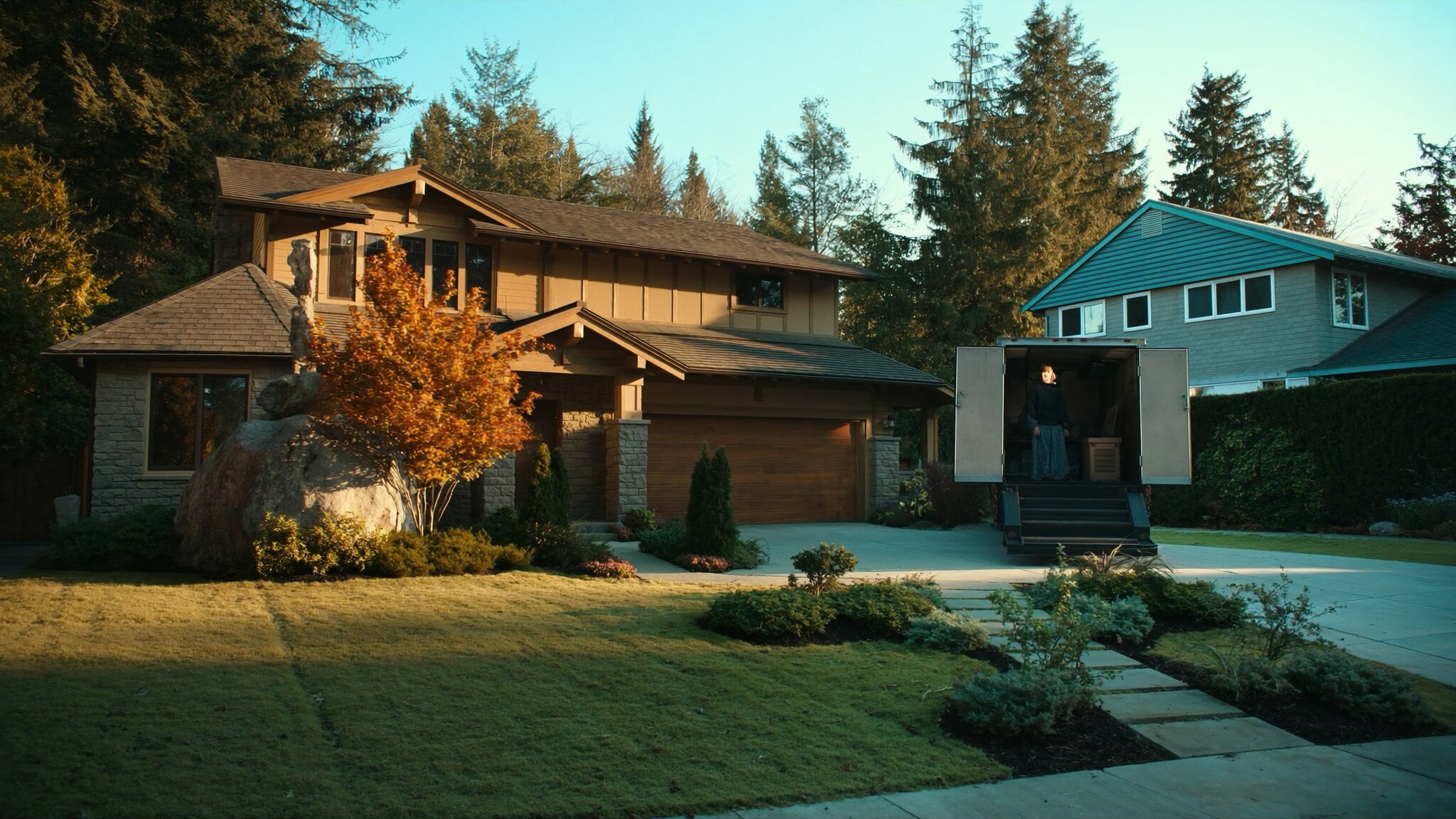
How move-up sellers in King County use bridge loans to buy their next home before selling, and when a HELOC is the smarter play.
You found the next house. Bigger yard, better layout, the right school zone. There’s just one problem: your down payment is locked up in the home you’re still living in. This is the wall almost every move-up seller in King County hits, and a bridge loan is one of the main tools for getting over it.
I work with move-up sellers across Renton, Kent, Auburn, Covington, and Maple Valley, and this question comes up in almost every planning conversation: “How do I buy before I sell?” A bridge loan is often the first answer people hear. It can be a great tool. It can also be an expensive mistake if you use it in the wrong situation. Here’s how bridge loans actually work in Washington State, what they cost in 2026, and how to know if one fits your move.
How a Bridge Loan Works in Washington State
A bridge loan does exactly what the name says. It bridges the gap between buying your next home and selling your current one.
Here’s the typical sequence. You apply with a lender who writes bridge loans. The lender looks at the equity in your current home and approves a short-term loan against it, usually up to 70 to 75 percent of your home’s value minus what you still owe. You use that money as the down payment on your next home. You move once, on your schedule. Then you list your old home, and when it sells, the sale proceeds pay off the bridge loan in full.
Most residential bridge loans in Washington are interest-only. That matters because it keeps your monthly carrying cost down while you hold two properties. You’re not paying down principal. You’re buying time. The loan comes due either when your home sells or at the end of the term, whichever comes first. In my market, that exposure window is usually short. Well-priced homes in South King County have been selling in 6 to 14 days, so most bridge borrowers here are paying interest for two to four months, not a year.
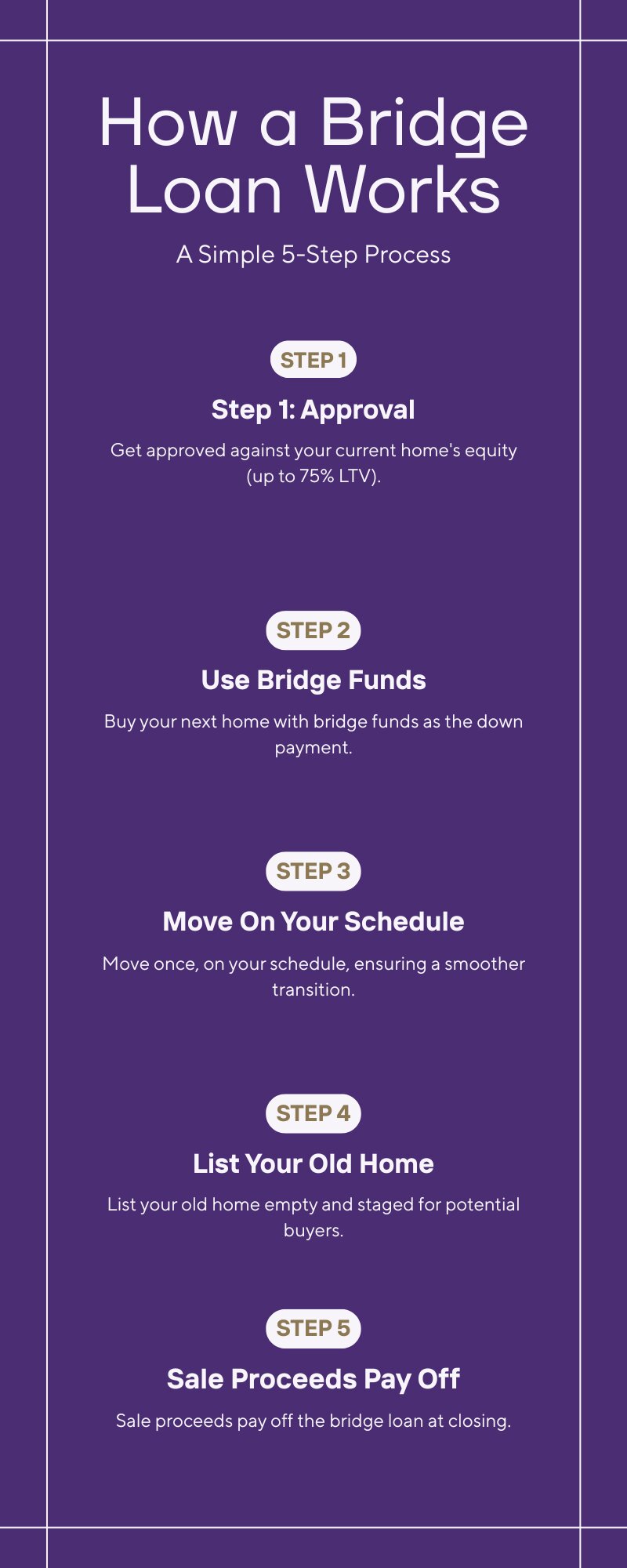
The full bridge loan cycle. In fast South King County segments, most borrowers reach payoff in two to four months.
What a Bridge Loan Costs in 2026
This is where you need to go in with clear eyes. Bridge money is more expensive than mortgage money.
In 2026, standard 30-year mortgage rates have been sitting in the mid-6 percent range. Residential bridge loans from banks and credit unions are typically running about 8 to 10 percent. Private and hard-money bridge lenders charge more, often 9 to 12 percent. On top of the rate, most lenders charge origination points, commonly 1.5 to 2.5 percent of the loan amount, plus normal closing costs.
Let’s make that real. Say you borrow $200,000 against your Kent home to put down on a house in Covington. At 9 percent interest-only, that’s $1,500 a month. If your Kent home sells in three months, you’ve paid $4,500 in interest plus roughly $3,000 to $5,000 in points and fees. Call it $8,000 to $9,500 total for the ability to buy first, move once, and sell an empty, staged home at full strength.
Is that worth it? For a lot of my sellers, yes. An empty home shows better and often sells for more than the cost of the bridge. You also skip the misery of living in a staged house with kids and dogs while strangers tour it. But the math only works if your home actually sells inside the window. That’s the whole game with a bridge loan.
Bridge Loan vs. HELOC: Which One Fits?
A home equity line of credit is the other common way to unlock your equity, and for some sellers it beats a bridge loan outright.
A HELOC is cheaper. Rates in 2026 are generally running a point or two below bridge loan rates, and most HELOCs have little or no closing costs. It’s also flexible. You draw what you need, when you need it, and there’s no balloon date forcing a payoff.
So why doesn’t everyone just use a HELOC? Timing. Here’s the trap I warn sellers about constantly: lenders will not open a HELOC on a home that’s already listed for sale, and many want it seasoned for months before you draw on it. A HELOC is a tool you set up six months to a year before your move, while you’re still just thinking about it. Once the sign is in the yard, that door is closed, and a bridge loan becomes the realistic option.
The other difference is qualification. With either tool, the lender needs to see you can carry the payments. Some bridge lenders will soften the math if your current home is already under contract. If you want to understand exactly how lenders count your income and debts, I broke that down in my guide to how mortgage qualification works in Washington State.
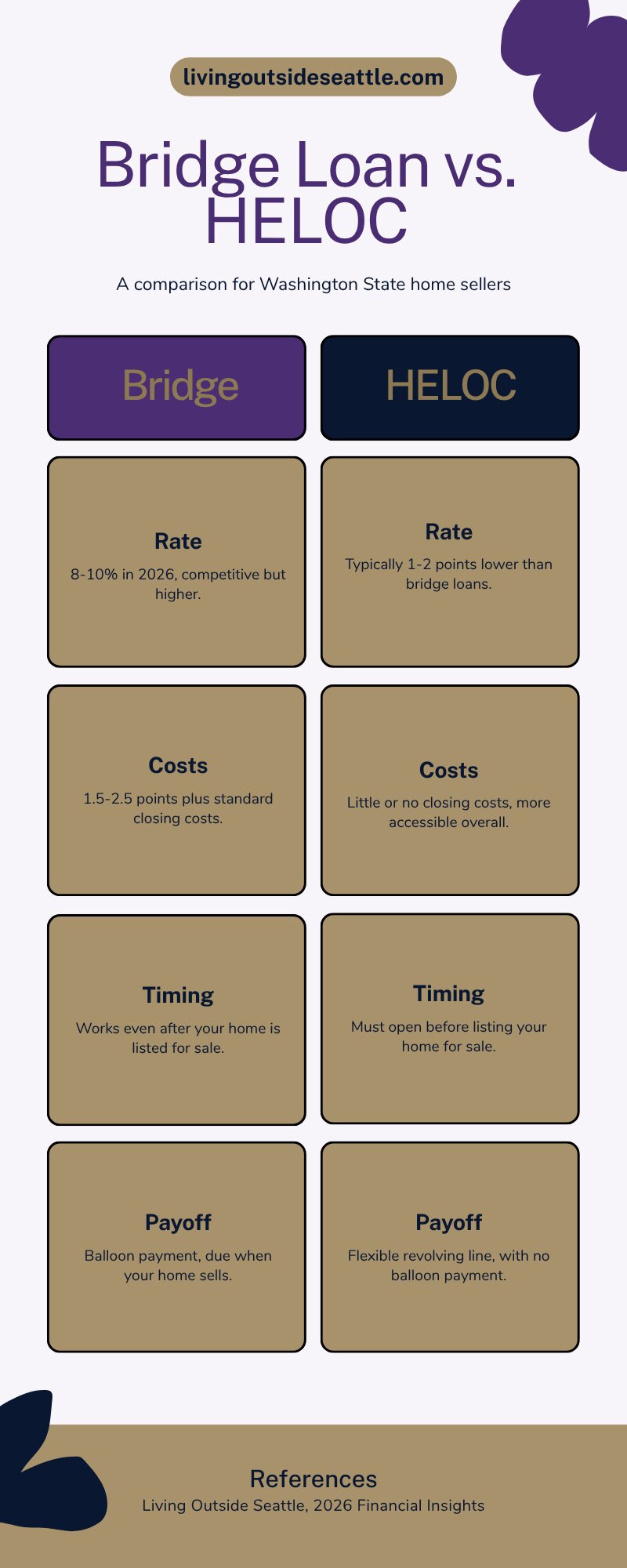
The deciding factor is usually timing: a HELOC must be opened before you list, a bridge loan works after.
Who Offers Bridge Loans in Washington State
Here’s something that surprises people: most big national banks got out of the consumer bridge loan business years ago. You won’t find one at most major retail banks.
In Washington, bridge loans come from three places. First, regional banks and credit unions. Several Washington-based institutions still write true bridge loans for their members, and this is usually the cheapest version of the product. Second, local mortgage companies. A handful of Puget Sound area lenders offer bridge programs designed specifically for buy-before-you-sell moves. Third, the newer “buy before you sell” programs. Seattle-based Flyhomes has rebuilt its whole business around this model, and national players like HomeLight offer versions of it here too. These programs package equity access, a non-contingent offer, and the sale of your old home into one product. Ask your real estate agent if they know a lender that offers this type of program.
Those programs can be slick, but read the fee structure carefully. Between program fees, loan costs, and pricing requirements on your departing home, the all-in cost can run well past what a straight bridge loan from a credit union costs. Convenience has a price tag. Sometimes it’s worth paying. Just know what it is before you sign.
The Local Angle: Why Bridge Loans Work Differently in King County
Bridge loans are unusually well-suited to South King County right now, and the reason is speed plus equity.
Start with equity. Homeowners who bought in Renton, Kent, or Auburn even six or seven years ago are sitting on six-figure equity positions. Kent’s median sale price has been running around $732,500 and Renton’s spring median hit $859,000. If you bought your Kent home for $450,000 in 2019, you likely have $300,000 or more in equity doing nothing. A bridge loan turns that trapped equity into a down payment without forcing you to sell first.
Now speed. The bridge loan’s biggest risk is a slow sale, and well-priced South King County homes simply aren’t selling slowly. Kent has been averaging about 8 days on market and Renton homes have been moving in about 6 days in spring. That means a typical bridge borrower here carries the loan for a couple of months, not a year. Compare that to a slower sub-market, like some Eastside condo segments, where months of supply are higher and a bridge gets riskier. Where your current home sits matters more than any national average.

One move, on your schedule. That convenience is what a bridge loan actually buys.
What This Means for You as a Move-Up Seller
Here’s the decision framework I walk sellers through.
A bridge loan makes sense when three things are true. You have strong equity, ideally enough to borrow your full down payment at 75 percent loan-to-value or less. Your current home sits in a fast-moving segment and will be priced to sell, not priced on hope. And you’ve found, or are about to find, a next home worth moving fast on. When all three line up, paying $8,000 to $12,000 for a clean, one-move transition is often money well spent.
A HELOC makes more sense when your move is six months or more away and you have the discipline to set it up early. Open it while your home is unlisted, let it sit at zero balance, then draw on it when you find the right house. Cheapest equity access there is.
And sometimes the answer is neither. If your equity is thinner or the numbers feel tight, a well-structured contingent offer can still win in the right situation. I wrote a full guide on how to write a contingent offer that sellers will accept in King County, and it pairs with this post. Whichever route you take, the first step is the same: know what your current home is worth and how fast it will sell. That’s a pricing question, and it’s the one I can answer with real data.
FAQ: Bridge Loans in Washington State
How long do you have to pay back a bridge loan?
Most residential bridge loans in Washington run 6 to 12 months, and the loan is paid off automatically from your sale proceeds at closing. In fast markets like Renton and Kent, most borrowers pay theirs off within two to four months. Most lenders charge no penalty for early payoff.
How much does a bridge loan cost in 2026?
Expect interest rates around 8 to 10 percent from banks and credit unions, or 9 to 12 percent from private lenders, plus origination points of roughly 1.5 to 2.5 percent of the loan amount. On a $200,000 bridge held for three months, total cost typically lands between $8,000 and $10,000.
Are bridge loans hard to get?
They’re more specialized than a standard mortgage, not necessarily harder. Lenders generally want a credit score of about 680 or better, combined loan-to-value of 75 percent or less on your current home, and a believable exit plan. The bigger challenge is finding a lender, since most national banks no longer offer them.
Can I get a bridge loan if my house is already on the market?
Usually yes, and this is a key advantage over a HELOC. Lenders won’t open a home equity line on a listed property, but bridge lenders expect your home to be listed or about to be. Some even offer better terms once you’re under contract.
Is a bridge loan better than a contingent offer?
A bridge loan makes your offer stronger because it removes the home-sale contingency, which matters in competitive segments of King County. A contingent offer costs nothing but is easier for a seller to pass over. If the home you want has multiple offers, the bridge-backed offer usually wins.
Bridge loans aren’t exotic anymore. In a market where most move-up sellers are equity-rich and good homes still move in days, buying before you sell is a real strategy, not a luxury. The key is sizing the loan against an honest number for your current home and a realistic timeline for your area.
Your guide to life outside Seattle.
253-350-0045 ·
greg@livingoutsideseattle.com ·
www.livingoutsideseattle.com
How Appraisals Work in Washington State Home Sales

What buyers and sellers in King County need to know — before a low appraisal derails your deal.
The appraisal is one of the quietest steps in a real estate transaction — until it isn’t. Most buyers and sellers go weeks without thinking about it. Then a number comes back lower than the agreed price, and suddenly everyone is scrambling to figure out what happens next.
I’ve seen it go both ways. A clean appraisal that closes without a hiccup. And a deal that almost fell apart because neither the buyer nor the seller understood what options were on the table. Understanding how appraisals work in Washington state — who orders it, what the appraiser is actually measuring, and what you can do when the number doesn’t match — puts you in a much stronger position before you ever get to that moment.
This guide walks through the full process from both sides.
What an Appraisal Actually Is — and Isn’t
A home appraisal is a formal, written opinion of market value prepared by a state-licensed appraiser. It answers one specific question: what would a willing buyer pay a willing seller for this property today, assuming neither party is under pressure and both have full information?
That is not the same as the Zillow estimate. It is not the county assessed value. And it is not what your neighbor’s house sold for last spring, unless that sale is genuinely comparable. Appraisers follow the Uniform Standards of Professional Appraisal Practice (USPAP), a national framework that governs methodology and ethics. The goal is independence — the appraiser works for the lender, not the buyer, not the seller, and not the agent.
This matters because the lender has a direct financial interest in making sure the home is actually worth what they’re about to loan against it. If you borrow $850,000 to buy a house worth $800,000, the lender is immediately underwater. The appraisal is their protection.
As a seller, that means the appraisal isn’t something you control. As a buyer, it means you have a built-in check on whether you’re overpaying — which in competitive markets like South King County, is more useful than it might seem.
How the Appraisal Process Works Step by Step
Who Orders It and When
In a standard financed transaction, the lender orders the appraisal after the purchase agreement is signed and the loan application is underway. They typically assign a licensed appraiser through an Appraisal Management Company (AMC), which keeps the appraiser independent from everyone else in the deal.
You don’t get to choose the appraiser. Your agent doesn’t get to choose the appraiser. This independence is intentional. The appraisal is typically scheduled within one to two weeks of the executed contract, and the full report usually comes back within three to seven business days after the visit.
What Happens During the Visit
The appraiser walks the property, takes measurements, notes the condition of major systems — roof, foundation, HVAC, electrical, plumbing — and documents any updates or upgrades. They’re not doing a home inspection. They’re not looking for problems to flag; they’re forming an objective picture of the property’s physical characteristics and condition relative to the market.
They’ll also photograph the exterior and interior, assess the lot, note the neighborhood, and factor in anything that affects livability or desirability — a busy arterial road that backs up to the property, for example, or a view that doesn’t show up in the tax records.
How Appraisers Determine Value
Most residential appraisals in Washington use the Sales Comparison Approach: the appraiser identifies three to five comparable homes (comps) that sold recently, nearby, and in similar condition. “Recently” means within the past six months. “Nearby” in dense King County markets might mean within half a mile; in rural areas like Black Diamond or Enumclaw, the radius might expand to several miles.
Then comes the adjustment process. If a comp sold with a renovated kitchen your home doesn’t have, the appraiser reduces that comp’s adjusted value. If your home has a finished basement the comp didn’t, an upward adjustment goes in. Square footage, lot size, bedroom count, garage, condition, location factors — all of these get adjusted line by line until the appraiser has a cleaned-up, side-by-side comparison. The final number they land on is the reconciled opinion of value.
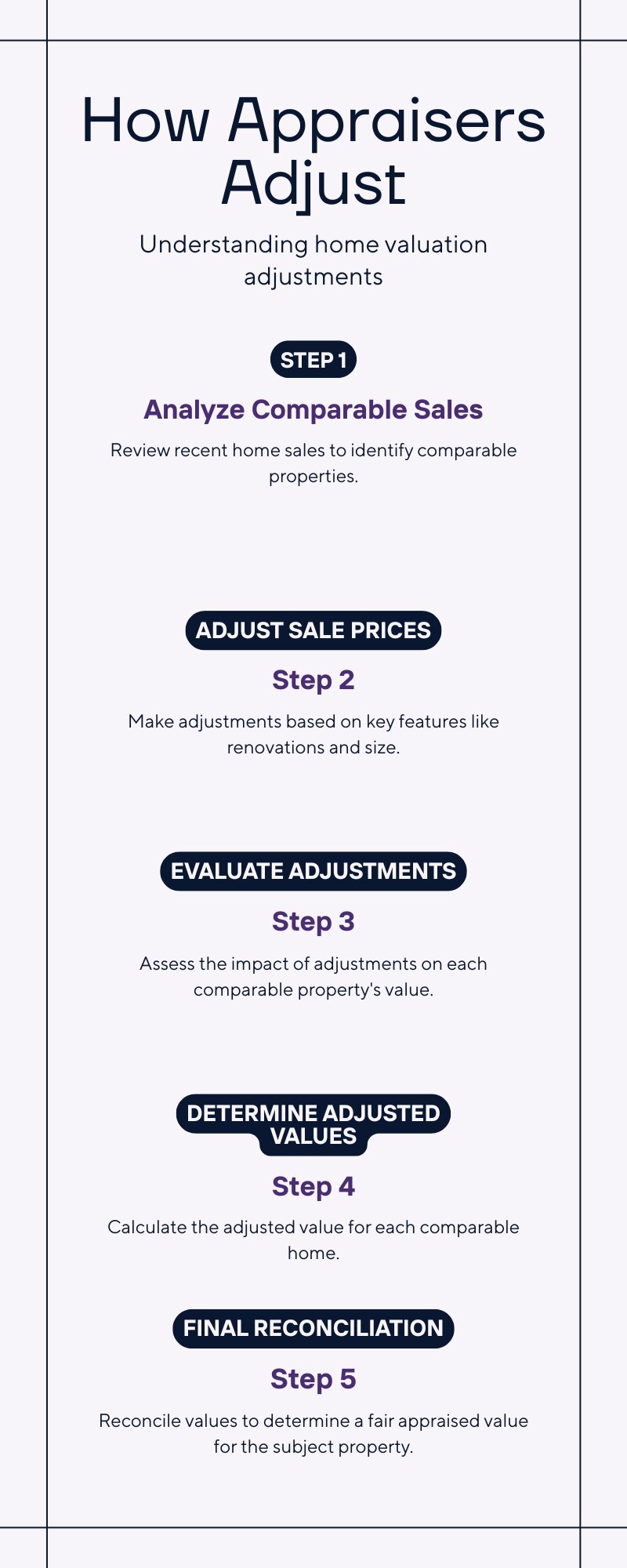
Appraisers adjust each comparable sale up or down based on differences in size, condition, upgrades, and location — then reconcile a final value from the range.
The King County Context: Why Appraisals Get Complicated Here
King County has some specific dynamics that affect how appraisals play out, and if you’re buying or selling in this market, it helps to know them going in.
Price velocity creates gaps. In fast-moving sub-markets like Renton, Kent, and Auburn, homes sometimes go under contract above asking price quickly. The problem: appraisers can only use closed sales as comps, not active listings or pending contracts. If prices have moved up in the past 90 days, the closed comps the appraiser pulls may not reflect where the market actually is right now. That’s one of the most common reasons appraisals come in below contract price in competitive conditions — and it’s worth understanding before you’re in a multiple-offer situation. Check out the current King County mortgage rate environment for broader context on what buyers are navigating right now.
Appraisal waivers are a real offer strategy. In multiple-offer situations, buyers sometimes waive the appraisal contingency entirely, or offer an “appraisal gap guarantee” — a commitment to cover a certain dollar amount above the appraised value in cash. This is common enough in King County that sellers and their agents have come to expect it on competitive listings. If you’re a buyer competing for a home and you can’t or won’t waive the appraisal contingency, your offer may lose to one that does — even if your price is the same.
New Washington law (effective January 1, 2026) added a twist for off-market deals. Under RCW 61.40.010, if a buyer makes an unsolicited offer on a property that isn’t listed and the seller has no agent, the buyer must pay for an appraisal and the unrepresented seller has a four-day window to back out after receiving the results. This was designed to protect homeowners from being pressured into below-market off-market sales — a real pattern in King County’s investor landscape.
Appraised value vs. assessed value. King County assessors set assessed values for property tax purposes, and they often lag market value by six to eighteen months. Don’t confuse the assessed value on your property tax statement with what an appraiser will determine. They’re calculated differently and serve different purposes. A home assessed at $680,000 for tax purposes can absolutely appraise at $850,000 in today’s market. If you want to understand the broader tax picture when selling, see our guide to capital gains on home sales in Washington state.
What Happens When the Appraisal Comes In Low
About 8.5% of appraisals come in below the agreed purchase price nationally. In fast-moving markets, that number is higher. When it happens, the lender will only loan based on the appraised value, not the contract price. So if you agreed to pay $900,000 and the appraisal comes in at $860,000, the lender will only underwrite a loan on $860,000. The $40,000 gap has to go somewhere.
Option 1: Renegotiate the Price
The buyer presents the appraisal to the seller and asks them to reduce the price to the appraised value. In a buyer-friendly market, sellers often agree. In a hot market where the seller has backup offers, they may not budge.
Option 2: Cover the Gap in Cash
The buyer brings an additional $40,000 to closing from their own funds to make up the difference. This is the “appraisal gap guarantee” in action. It requires the buyer to have the liquidity to do it.
Option 3: Challenge the Appraisal (ROV)
If the appraiser used weak comps, missed a recent comparable sale, or made a factual error about the property — wrong square footage, missed an update — the buyer’s agent can formally request a Reconsideration of Value (ROV) through the lender. This is not a guarantee of a different number, but legitimate errors do get corrected. Submit recent sales the appraiser missed, document discrepancies, and let the process work.
Cancel the contract. If the buyer has a standard appraisal contingency in place and the gap can’t be resolved, they can cancel and get their earnest money back. This is the protection the contingency provides — and it’s the only option that ends the deal.
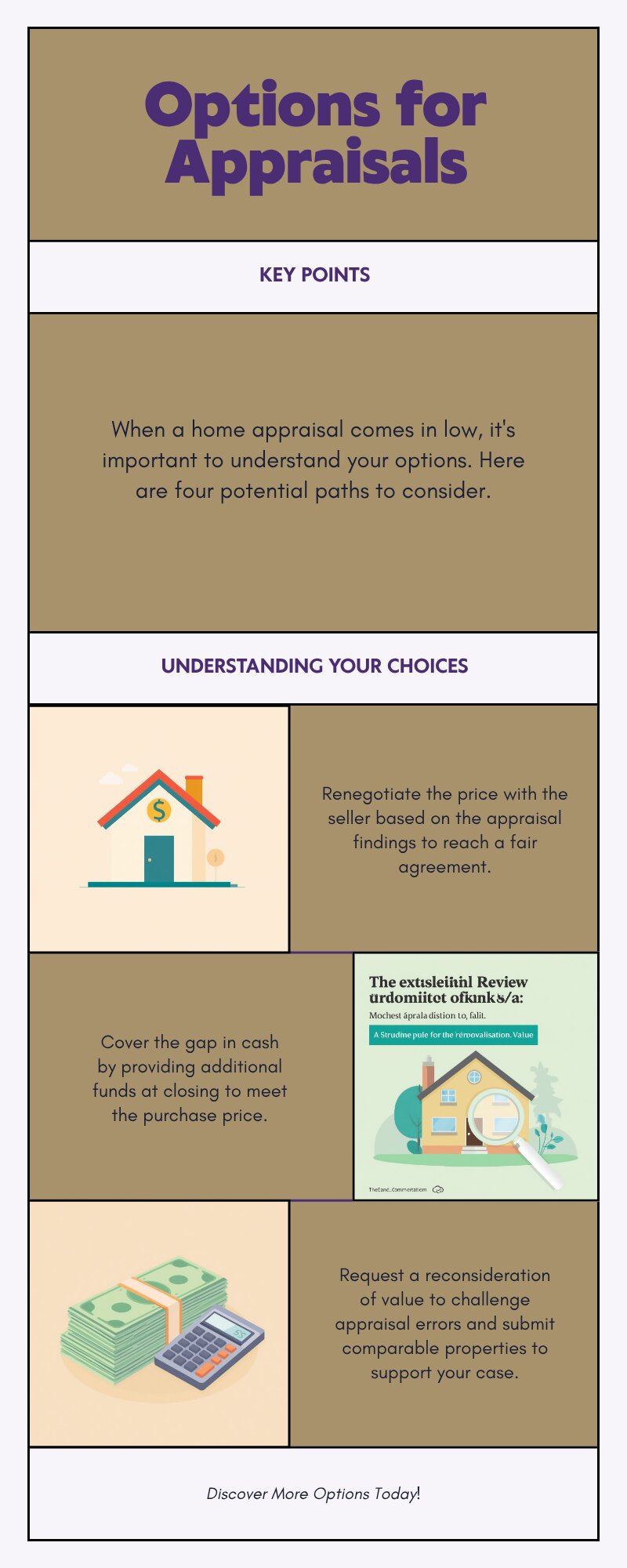
A low appraisal doesn’t have to end the deal. Four paths exist — and only one of them means canceling the contract.
How to Protect Yourself as a Seller
A few things sellers can do before the appraiser even shows up:
Make sure the home is clean and accessible. Appraisers aren’t swayed by staging, but physical condition matters. A cluttered, poorly lit home can look worse than it is. An appraiser who can’t access the attic or crawlspace notes it.
Prepare a comp package. Your agent can pull relevant comparable sales and present them to the appraiser at or before the visit. This doesn’t influence the appraiser’s independence — they’ll do their own research — but it ensures they’re aware of strong comps they might otherwise miss, especially if they’re not hyperlocally familiar with your specific neighborhood. See our guide on how to price your home to sell in King County for more on the comp selection process.
Disclose major updates with documentation. New roof, HVAC, kitchen renovation, ADU added — document the dates and costs. Appraisers make upward adjustments for improvements, but they need to know about them. Don’t assume it’s obvious.
Consider a pre-listing appraisal. For higher-value or unusual properties where standard comps are hard to find, a pre-listing appraisal ($400–$900) gives you an independent data point before you price the home and before a buyer’s lender gets involved. For more on getting your home ready before listing, see how to prepare your home for sale in King County.
How to Protect Yourself as a Buyer
Keep the appraisal contingency in place unless you’re prepared to cover the gap. The contingency exists to protect you. Waiving it means you’re on the hook for the full purchase price no matter what the appraiser says. Only waive it if you’ve done the math on the gap you could realistically face and you’re prepared to cover it.
Understand the difference between appraised value and market value. If ten other buyers are willing to pay $900,000 and the appraisal comes in at $860,000, the market value is arguably closer to $900,000. Appraisals are backward-looking by design — they’re based on what sold, not what competing buyers are currently bidding. In fast-rising neighborhoods, this lag is real and it favors sellers.
Ask your lender about appraisal waivers before you make an offer. Some conventional loan programs (Fannie Mae, Freddie Mac) allow automated valuation models to stand in for a full appraisal under certain conditions — generally when the loan-to-value ratio is low and the data quality is high. If you qualify for a waiver, you avoid the process entirely. Your lender will know whether your specific loan profile qualifies.
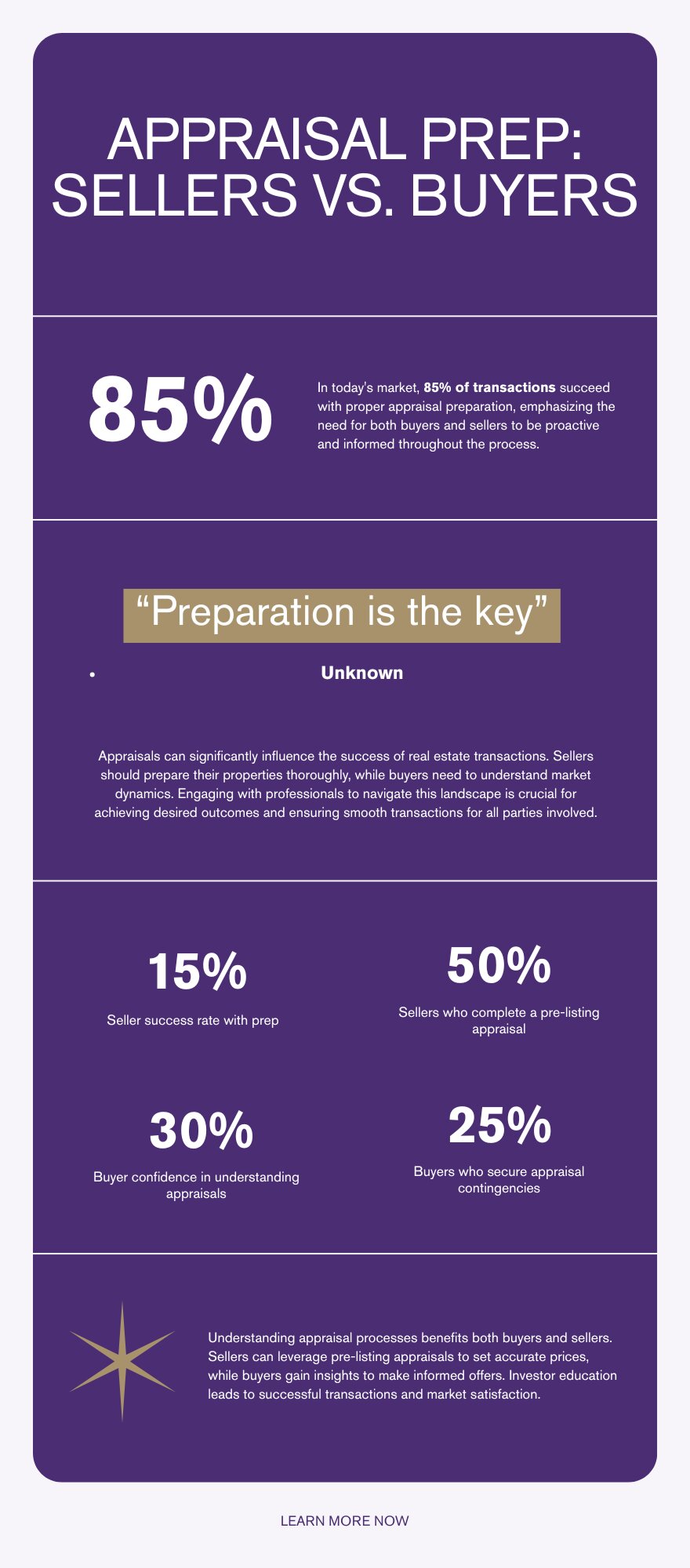
Sellers and buyers face different appraisal risks. A few simple steps before the appraiser visits can make a meaningful difference in how the process goes.
What This Means for You in King County Right Now
The King County market in 2026 is more balanced than it was in 2021 and 2022, but it’s not uniform. South King County sub-markets — Renton, Kent, Auburn, Covington — are still moving faster than the county average, with median days on market well under 30. In those conditions, appraisal gaps remain a real possibility, especially on homes priced above $750,000 where comps thin out.
For sellers in those markets, pricing accuracy matters more than ever. A home priced right at market value has a much better chance of appraising at contract price. A home priced at the high edge of the range, hoping for a bidding war, risks the appraisal gap problem — which puts the deal back in negotiation right when you thought it was done.
Frequently Asked Questions
How much does a home appraisal cost in Washington state?
In King County, expect $400–$900 for a standard single-family appraisal. Complex properties, acreage homes, or homes in more rural areas (Black Diamond, Enumclaw) may run higher. The buyer pays the appraisal fee as part of closing costs.
How long does an appraisal take in Washington state?
The appraiser typically completes the site visit within one to two weeks of the purchase agreement being signed. The written report usually comes back three to seven business days after the visit. Total time from contract to receiving the appraisal: roughly two to three weeks.
Can a seller refuse to let an appraiser in?
Technically yes, but refusing the appraisal kills the buyer’s financing and ends the deal. Under the terms of most purchase agreements, the seller is expected to provide reasonable access. A refusal to cooperate is effectively a decision to blow up the transaction.
What is a Reconsideration of Value (ROV) in Washington?
An ROV is a formal request to the lender asking the appraiser to reconsider the value based on new information — comparable sales the appraiser missed, factual errors in the report, or evidence the adjustments were unreasonable. It does not guarantee a different outcome, but it is a legitimate tool when the original report contains real errors or omissions.
What’s the difference between appraised value and assessed value in King County?
Assessed value is set by the King County Assessor’s office for property tax purposes and typically lags market value by six to eighteen months. Appraised value is determined by a licensed appraiser for a lending transaction, using current comparable sales. They’re calculated differently and serve different purposes. Don’t use your property tax statement to set your list price.
Do appraisals expire?
Yes. Most lenders will only accept an appraisal completed within 120 days (four months) of the loan closing date. If your deal takes longer than expected, the lender may require a reappraisal or an update to the original report.
The appraisal doesn’t have to be the part of the transaction that surprises you. If you’re selling, a solid pricing strategy from the start gives you the best shot at a clean appraisal. If you’re buying, understanding your options before you’re in contract — not after the number comes back low — puts you in control of what happens next.
Your guide to life outside Seattle.
253-350-0045 ·
greg@livingoutsideseattle.com ·
www.livingoutsideseattle.com
Total Cost of Homeownership in King County 2026

Most buyers focus on the mortgage payment. That’s the number that shows up in every rate calculator, every lender pre-approval letter, every Zillow estimate. But in King County, the mortgage is often just 60–70% of what you actually pay each month to own a home. The rest — property taxes, insurance, HOA fees, PMI, and maintenance — adds up fast, and most first-time buyers get surprised by it.
I’ve worked in South and East King County for over 13 years, and I do professional property valuations every single day as a BPO field agent. One pattern I see constantly: buyers who were “pre-approved” for a purchase price they couldn’t actually afford once all the real costs hit their bank account in month two. This guide walks you through the full picture — every cost, with real numbers for King County cities — so you can make a decision you’ll still feel good about a year from now.
What Goes Into Your True Monthly Payment
The mortgage principal and interest (P&I) is the fixed part — it doesn’t change month to month on a 30-year fixed loan. Everything else does, or at least it can. Here’s the full stack of costs to run through before you make an offer.
Principal and Interest (P&I)
The core of your payment, and the number your lender leads with. At current King County rates of around 6.4–6.7% for a 30-year fixed, a $686,000 loan (10% down on a $763,000 Renton home) produces a monthly P&I payment of roughly $4,360. It’s real, but it’s not the whole story.
Property Taxes
Significant in King County — and they just went up. For the 2026 tax year, King County’s total property tax levy is $8.4 billion, a 10% jump from 2025. The average effective rate across the county runs around 0.9%–1.1% of assessed value annually. On a $763,000 home in Renton, that works out to roughly $690–$840 per month ($8,280–$10,080 per year).
Your specific parcel’s levy code determines the exact number — the King County Assessor’s eReal Property search tool will show you the breakdown for any address you’re evaluating. Renton sits on the lower end; Sammamish and Issaquah homeowners typically pay more because of school district levies and city-specific ballot measures.
Homeowners Insurance
Washington State averages $1,474–$1,596 per year — roughly $125–$133 per month. That puts Washington below the national average, which is a piece of good news. Expect to pay more if your home has a wood roof, is older than 30 years, or sits in a wildfire-adjacent zone (relevant in Maple Valley, Enumclaw, or Black Diamond).
PMI (Private Mortgage Insurance)
Applies if you put down less than 20%. PMI typically runs 0.46%–1.5% of the original loan amount annually. On a $686,000 loan at a mid-range rate of 0.7%, that’s about $400 per month.
PMI drops off once you hit 20% equity — either through price appreciation or paying down the principal. Given King County’s 5-year appreciation history of roughly 5–6% annually, some buyers reach that equity threshold in 3–4 years rather than waiting out the full amortization schedule.
HOA Fees
These vary wildly by property type. Condos in King County typically run $300–$700 per month for a mid-range building — downtown Seattle luxury high-rises can exceed $1,000. Townhomes usually fall in the $150–$350 per month range. Single-family homes in planned communities often run $75–$200 per month for landscaping and common areas.
Many single-family homes in South King County have no HOA at all — which reduces monthly cost but means you carry 100% of exterior maintenance yourself.
Maintenance Reserve
The number most first-time buyers skip — and the one that bites hardest. The commonly cited “1% rule” (set aside 1% of your home’s value per year) is a reasonable floor. Studies show the average homeowner actually spends $8,800 per year on maintenance and repairs. For an older King County home (pre-1990), budget closer to 1.5%–2%.
On a $763,000 home, 1% equals $7,630 per year — about $636 per month set aside. You won’t spend it every month. Some months nothing breaks, then your furnace goes in January.
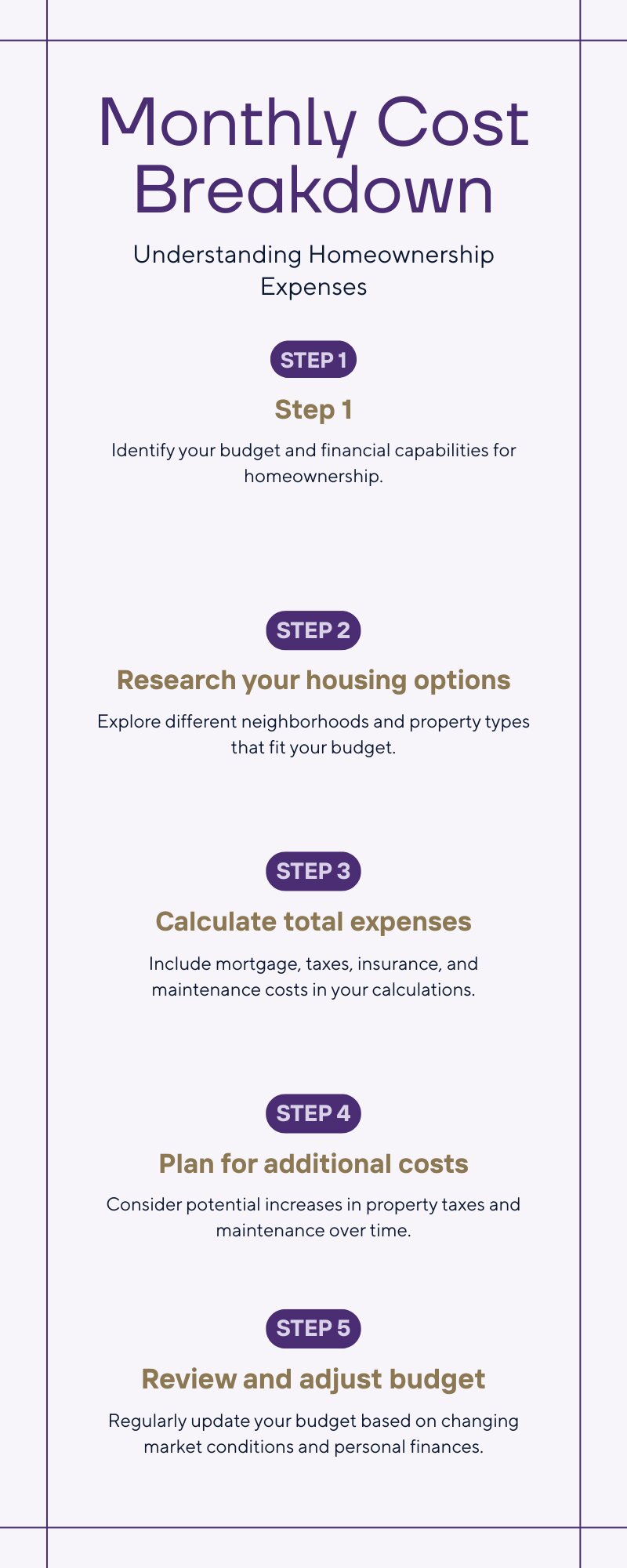
The mortgage payment is just one piece. For a Renton condo at $422K, all-in monthly costs run about $3,642. For a single-family home at $763K, expect closer to $6,224 per month. Source: King County market data, 2026.
Condo vs. Single-Family: How Total Cost Compares
This is one of the most common calculations I walk buyers through. The sticker price on a condo is lower — but the total monthly cost is often closer to a single-family home than buyers expect, once HOA fees are factored in. Here’s a real-numbers comparison using current King County data.
Condo in Southwest King County — $422,000
10% down ($42,200) / Loan: $379,800 / Rate: 6.5%
P&I: ~$2,400 | Taxes: ~$315 | Insurance: ~$80 | HOA: ~$450 | PMI: ~$222 | Maintenance: ~$175
Total: ~$3,642/month
Single-Family Home in Renton — $763,000
10% down ($76,300) / Loan: $686,700 / Rate: 6.5%
P&I: ~$4,342 | Taxes: ~$715 | Insurance: ~$130 | HOA: $0 | PMI: ~$401 | Maintenance: ~$636
Total: ~$6,224/month
The income difference this requires is significant. At a 28% front-end debt-to-income ratio (typical for conventional loan qualification), the condo scenario requires roughly $156,000 in gross household income. The single-family scenario requires roughly $267,000. Those numbers shift with your credit score, debt load, and lender — but they illustrate why the condo-vs-house decision often comes down to math rather than preference.
How King County Cities Compare on Total Cost
Property taxes are the biggest variable after the mortgage itself. Here’s a rough comparison of annual tax cost by city for a home around $700,000–$800,000.
Renton
Effective levy rate approximately 0.9%–1.0%. On an $800,000 home: ~$7,200–$8,000 per year ($600–$667/month). Renton sits on the lower end of King County cities, making it one of the better values in South KC for total monthly cost.
Kent & Auburn
Effective levy rates slightly higher than Renton, typically 1.0%–1.1%. On a $700,000 home: ~$7,000–$7,700 per year ($583–$642/month). School district and fire district renewal levies are a consistent factor in both cities.
Issaquah
Higher rates due to Issaquah School District supplemental levies — one of the highest-rated districts in the state, and that comes with a cost. On a $900,000 home: ~$9,000–$10,800 per year ($750–$900/month).
Sammamish
Among the highest effective rates in South/East King County. On a $1,000,000 home: ~$10,000–$12,000 per year ($833–$1,000/month). School district, city, and specialty district levies stack up quickly in Sammamish.
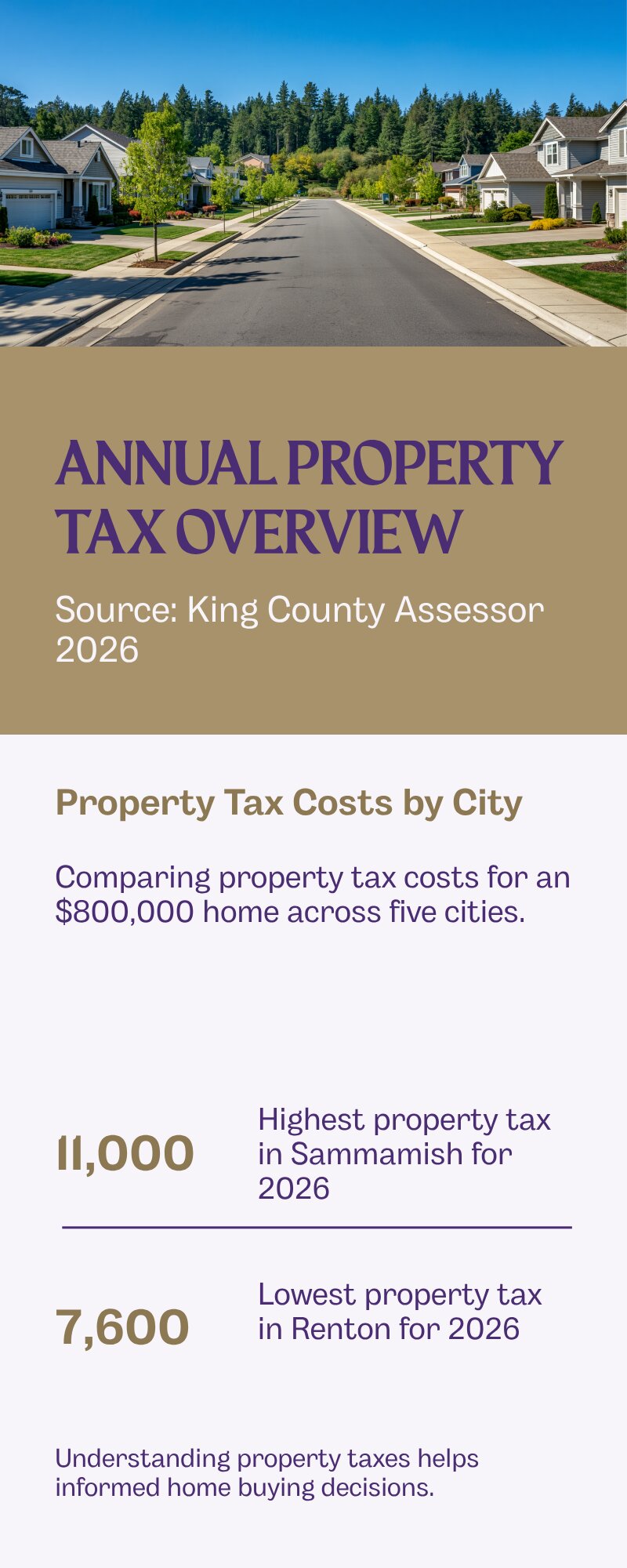
Annual property tax by city for an $800,000 home in King County. Renton and Kent are the most affordable in South KC; Issaquah and Sammamish carry higher levy rates driven by school district and specialty district measures. Source: King County Assessor 2026.
The Costs Most First-Time Buyers Underestimate
Beyond the monthly stack, a few one-time and recurring costs catch buyers off guard in year one.
Closing costs typically run 2%–3% of the purchase price. On a $763,000 home, that’s $15,260–$22,890 due at closing — on top of your down payment. This covers lender fees, title insurance, escrow, and prepaid items like the first year’s homeowners insurance and property tax reserves.
Immediate repair costs are real, especially in South King County where a lot of the housing stock was built in the 1980s and 1990s. Buyers of homes older than 30 years should budget up to $3,200 in unexpected year-one maintenance. A pre-listing inspection won’t catch everything — aging HVAC systems, older water heaters, and deck boards that just barely passed can all become your problem in year one.
HOA move-in fees and reserve contributions are easy to overlook. Some condo and townhome communities charge a one-time move-in fee ($500–$2,000) and require a contribution to the reserve fund at closing. Always request the HOA’s reserve study and financial statements before making an offer. Buildings with reserve deficits have hit some King County buyers with special assessments of $10,000–$30,000 per unit.
Utility cost changes hit harder than people expect when moving from a rental. You’re now paying for water, sewer, garbage, and often gas in addition to electricity. In South King County, expect $300–$500 per month depending on home size and season.
What This Means for Buyers in South and East King County

Running the full cost stack before making an offer is one of the most important steps a first-time buyer can take. The pre-approval letter and the real monthly budget are two different numbers.
My recommendation for buyers in Renton, Kent, and Auburn: run the full stack before falling in love with a specific home. The purchase price is a starting point. The number that actually matters for your quality of life is the total monthly outflow — and whether that leaves you enough runway to build equity, handle surprises, and not feel house-poor by month six.
For condos: the lower sticker price is real, but the HOA fee narrows the gap with single-family more than buyers expect. The King County Condo Buyer’s Guide walks through HOA due diligence in detail — including how to spot a building with a reserve fund problem before you commit.
For buyers still comparing property types, Condo vs. Townhouse vs. Single-Family in King County breaks down the full financial and lifestyle trade-offs side by side.
On the mortgage side: King County Mortgage Rates 2026 has the current rate picture and payment math, and the Mortgage Rate Buydown Guide explains how a seller-paid buydown can reduce your initial monthly cost in a way that pre-approval letters often miss.
Frequently Asked Questions
How much more than the mortgage payment is total homeownership cost in King County?
For most buyers, add $800–$1,500 per month on top of the P&I payment to get the true all-in cost. The biggest additions are property taxes ($600–$900/month on a median-priced home), insurance ($125–$135/month), and a maintenance reserve ($400–$700/month). PMI and HOA apply depending on your situation.
What is the property tax rate in Renton WA in 2026?
Renton’s effective property tax rate is approximately 0.9%–1.0% of assessed value annually, placing it on the lower end of King County cities. For a $763,000 home, expect roughly $6,900–$7,600 per year, or $575–$635 per month.
Do condos have lower total monthly costs than single-family homes in King County?
The purchase price is lower, but HOA fees close the gap. A condo at $422,000 with $450/month HOA ends up with a total monthly cost in the $3,600–$3,900 range. A single-family home at $763,000 (no HOA) runs $5,800–$6,400 per month all-in. The condo is still cheaper — but the difference is smaller than the price tags suggest.
Does PMI go away on a King County home?
Yes. Federal law requires lenders to cancel PMI automatically once your loan balance drops to 78% of the original purchase price. You can also request cancellation at 80%. Given King County’s appreciation history, some buyers hit that equity mark in 3–5 years rather than waiting out the amortization schedule.
What HOA fees should I expect for a King County townhome?
Townhome HOAs in South and East King County typically run $150–$350 per month. Lower-end communities cover exterior maintenance and landscaping only; higher-end communities include water, garbage, roof reserves, and exterior paint schedules.
What maintenance budget should I set for a King County home?
Budget 1%–1.5% of the home’s value per year. On an $800,000 home, that’s $8,000–$12,000 annually ($667–$1,000/month). For homes built before 1990, lean toward the higher end. Major systems — roof, furnace, water heater — can each cost $8,000–$15,000 when they need replacement.
Your guide to life outside Seattle.
253-350-0045 ·
greg@livingoutsideseattle.com ·
www.livingoutsideseattle.com
Rent Out vs. Sell Your King County Home: The Real Math
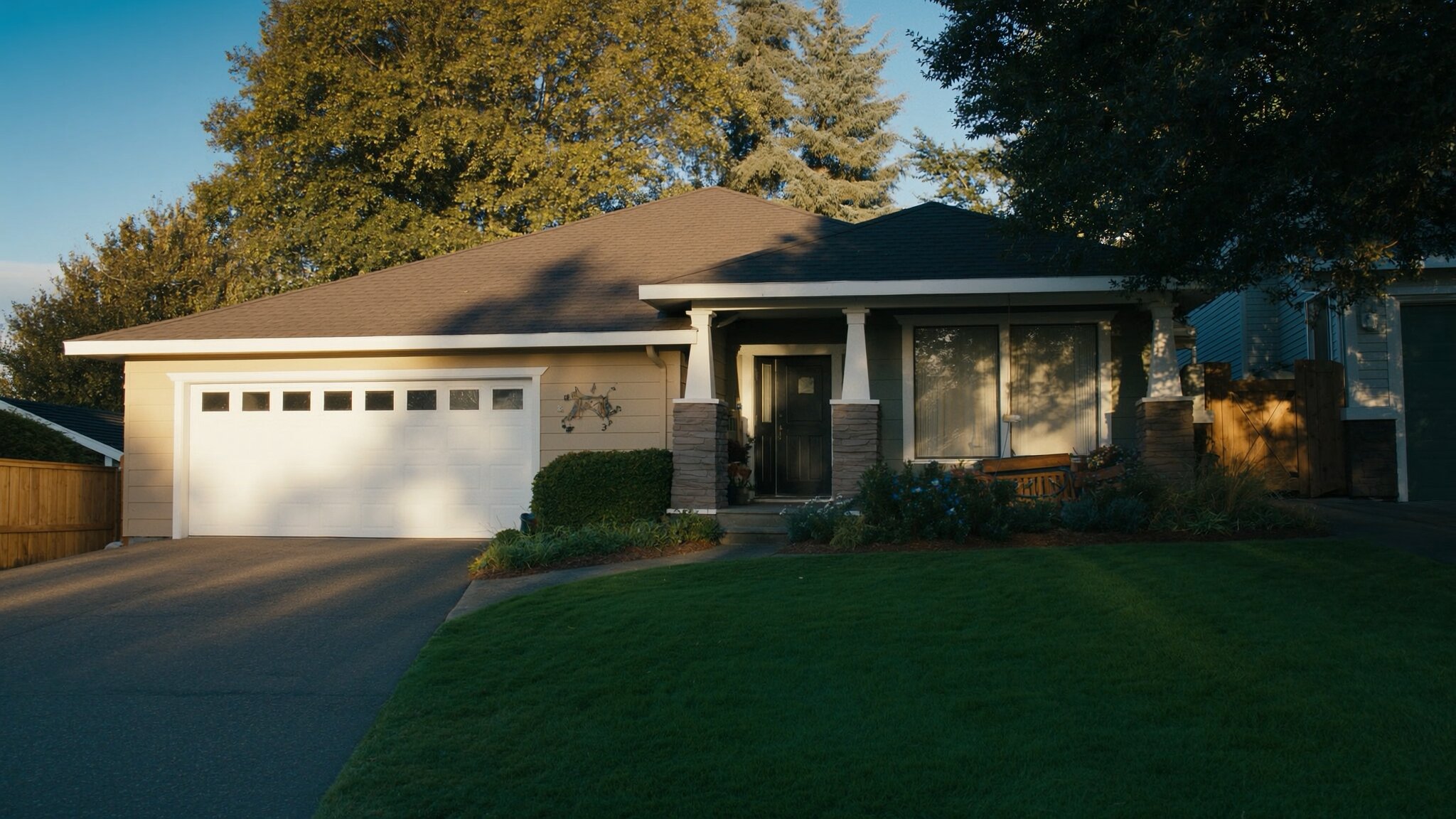
Should you become a landlord or cash out? Here’s the real math King County homeowners need before making this call.
If you’ve been sitting on a home in Renton, Kent, Auburn, or anywhere in South or East King County, you’ve probably had this thought: what if I just rented it out instead of selling? Especially with home values still holding strong — median prices around $859,000 countywide in spring 2026 — the idea of collecting rent every month while your property appreciates sounds appealing.
But the math is more complicated than it looks on paper. And Washington’s landlord-tenant laws changed significantly in 2025, adding rules most homeowners-turned-landlords don’t know about until it’s too late.
This post walks through both sides of the decision — actual rental income projections, net sale proceeds, tax implications, cash flow math, and the real-world landlord responsibilities that don’t show up in the rosy scenarios. By the time you’re done reading, you’ll know which option makes more financial sense for your situation.
The Rental Income Side: What King County Homes Actually Rent For
Let’s start with what you could realistically collect in rent. King County single-family rental rates in 2026 vary a lot by city and home size, but here are realistic ranges for typical South and East King County homes.
Three-bedroom single-family homes in Renton are pulling $2,800 to $3,200 per month. In Kent, the range is closer to $2,400 to $2,800. Auburn runs slightly lower, typically $2,200 to $2,600 for a comparable home. Move east to Issaquah or Sammamish, and a three-bedroom can fetch $3,200 to $3,800 monthly.
Sounds like solid money. But gross rent is not your income. Your net cash flow depends on what you owe and what it costs to run the property.
Here’s a real example. Say you own a three-bedroom home in Renton worth $700,000. You bought it five years ago, your current mortgage balance is $480,000, and your rate is 4.5%. Your monthly carrying costs look something like this:
Monthly Carrying Costs — High Mortgage Scenario
Mortgage P&I at 4.5% on $480K balance: ~$2,430
Property taxes (King County ~1.0% annually): ~$583/month
Landlord insurance (~15% more than owner-occupied): ~$150/month
Maintenance reserve (1% of value per year / 12): ~$583/month
Total carrying costs: ~$3,746/month
At $3,000 rent: -$746/month before vacancy or management fees
If you hired a property manager — which handles tenant screening, rent collection, and maintenance coordination — expect to pay 8% to 10% of gross rent, or another $240 to $300 per month on top of that negative.
That scenario doesn’t cash flow. It costs you money every month to keep it.
Now flip it. Same Renton home, but you paid it down to $300,000 and your rate is 3.0% from a 2021 refinance. Monthly P&I drops to approximately $1,265. Suddenly the same $3,000 rent gives you positive cash flow after all expenses. That’s the home where keeping it as a rental makes financial sense.

Two scenarios, same rent. The only thing that changes the outcome is what you owe. Run your actual numbers before deciding.
The Sale Side: What You Actually Walk Away With
When you sell, you get a lump sum. But net proceeds are not the same as your home’s sale price. Here’s what comes out.
Real Estate Excise Tax (REET) in King County runs approximately 1.78% of the sale price on a home in the $700,000 to $1.5 million range. On a $700,000 sale, that’s $12,460. Agent commissions typically run 5% to 6% total — on $700,000, that’s $35,000 to $42,000. Closing costs — title insurance, escrow, pro-rated taxes — add another $3,000 to $5,000.
So on a $700,000 sale, you might net $635,000 to $649,000 before any mortgage payoff. Subtract the $480,000 balance, and you walk away with roughly $155,000 to $169,000 in cash. That’s a down payment on your next home, a fully funded investment account, or two years of rental losses avoided.
If you’re in a lower-equity position — say $300,000 owed on a $700,000 home — the sale gives you approximately $355,000 to $369,000 cash in hand. Now the math shifts. Holding the property becomes more interesting because you have equity working for you every year.
Tax Implications: Where Things Get Complicated
This is the part most homeowners don’t think through carefully enough.
If you sell your primary residence, Washington’s $500,000 capital gains exclusion (for married couples; $250,000 for single filers) likely protects your gain from federal tax entirely, provided you’ve lived there two of the last five years. Washington state has no income tax, so there’s no state capital gains tax on primary residence sales either. You pay REET at closing and that’s largely it. For a full breakdown of how Washington taxes work on a home sale, see our guide to capital gains on home sales in Washington State.
If you convert to a rental and sell later, the tax picture changes. Once you stop living there as your primary residence, you start losing your exclusion eligibility. Sell after the two-year primary-residence window closes, and your gain becomes a taxable long-term capital gain at the federal level — 15% or 20% depending on your income bracket, plus potentially a 3.8% Net Investment Income Tax if your household income exceeds $250,000.
There’s also depreciation recapture to account for. Once you convert to a rental, the IRS lets you deduct depreciation each year — roughly 1/27.5 of the structure’s value annually. When you eventually sell, the IRS recaptures that depreciation at up to 25%. That can be a meaningful surprise at tax time.
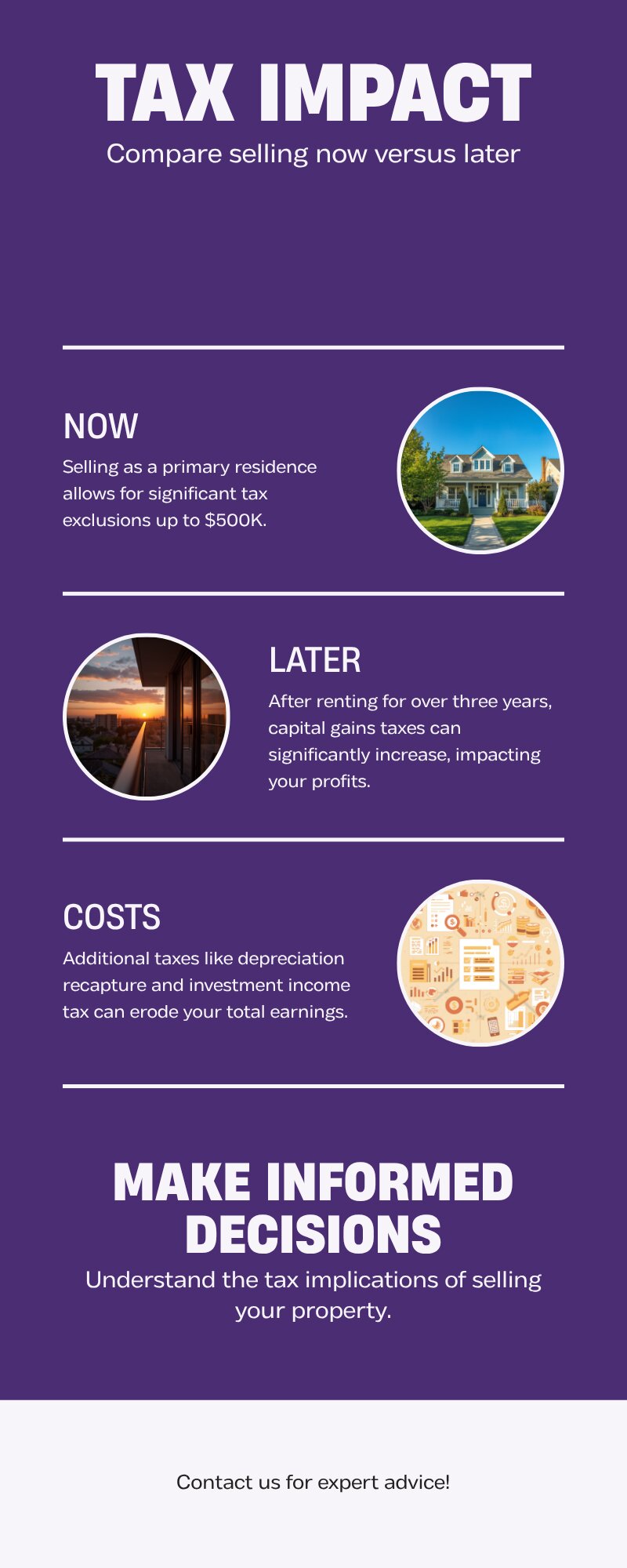
The two-year primary residence window is the biggest tax variable in this decision. Once it closes, your sale proceeds become a taxable event.
Washington Landlord Law in 2026: What Changed
Before you decide to rent, you need to know that Washington’s landlord-tenant laws shifted significantly starting in 2025. These aren’t small tweaks — they meaningfully change what it means to be a landlord here.
Rent Stabilization (HB 1217)
Effective May 2025, annual rent increases are capped at 7% plus CPI, or 10%, whichever is lower. For 2026, the maximum is 9.683%. You cannot raise rent at all during the first 12 months of a tenancy. Any increase requires 90 days written notice using a state-standardized form sent via certified mail.
What this means for you: if rents rise faster than that cap, you can’t keep pace. If a great tenant moves in at below-market rent, you’re limited in how quickly you can adjust.
Just Cause Eviction Requirements
You can’t simply decide not to renew a lease at the end of the term. You need a legally recognized reason — nonpayment, lease violation, owner move-in, or a handful of other specific grounds.
Eviction timelines are not quick. Nonpayment requires a 14-day notice before you can file. Most violations require a 10-day notice to comply. Court processes add weeks or months. Evicting a non-paying tenant in King County can realistically take three to six months — during which you carry all costs with no rent coming in.
The Local Angle: King County Specifics That Change the Math
A few things about King County shift the calculus compared to national averages.
Property taxes here are real. King County’s effective property tax rate runs around 0.93% to 1.1% depending on city and levy district. On a $700,000 home, that’s $6,500 to $7,700 per year — a cost that doesn’t go away when you become a landlord. And unlike a primary residence, you can’t homestead-exempt your way to a lower bill.
Current King County mortgage rates sit around 6.4% in mid-2026. If you bought in the last two to three years at these rates, your P&I is substantially higher than someone who refinanced in 2021. That gap is often what separates a cash-flowing rental from a money-losing one.
The rental market is competitive but not unlimited. Rents have stayed strong in South King County, but they’ve also flattened. Rent growth has run around 4% year over year in the broader Seattle metro, but Washington’s new stabilization caps limit how much future increases can catch up.
Home appreciation is still the strongest long-term argument for the rental side. If your home appreciates 3% to 4% annually from a $700,000 base, that’s $21,000 to $28,000 per year in equity gain. Even if you’re slightly cash-flow negative on rent, appreciation can still make the investment pencil out — if you’re patient and prepared for the landlord role.
South King County in particular — Renton, Kent, Auburn, Covington — remains a strong long-term hold for landlords who are disciplined about tenant selection and maintenance. These are stable demand markets with diverse employment bases. But that’s a different conversation than “I’ll rent it out for a year and see how it goes.”
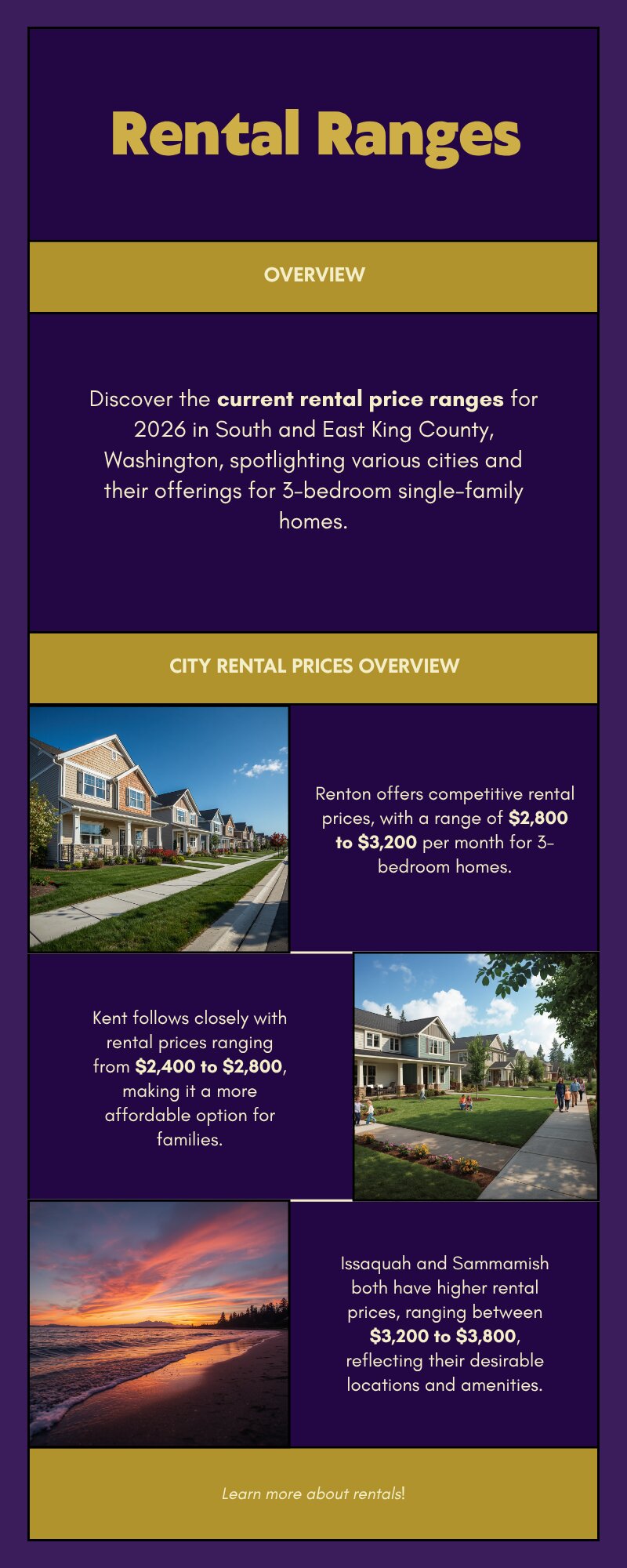
South King County rents are strong but not unlimited. Your specific city, neighborhood, and home condition determine the real number you’ll collect.
When Renting Makes Financial Sense
Based on the math and the landlord landscape, here’s when keeping the property and renting usually wins.
You have a low-rate mortgage (under 4%) that generates positive monthly cash flow after all expenses. Your principal balance is low relative to value — meaning the equity is working for you as an asset even if rent doesn’t fully cover costs. You’re planning to return and live in the home within three to five years, preserving your primary residence exclusion. Or you’re committed to building a rental portfolio long-term and understand that this first property is an investment, not passive income.
When Selling Makes More Sense
Selling wins when you have a high-rate or high-balance mortgage that won’t cash flow at current rents. When your equity is substantial and a lump sum now serves your goals better than monthly income later. When you want simplicity — no tenant calls, no maintenance surprises, no navigating the 90-day rent increase notice process. Or when you need to deploy that equity into your next home and you can’t do both.
If you decide to sell, you’ll want to prepare your home strategically and price it right from day one — two steps that consistently separate fast, full-price sales from drawn-out ones.
What This Means for You
If you’re weighing this decision right now, here’s a simple three-step filter before you call anyone.
First, run your actual monthly carry cost — mortgage P&I, taxes, insurance, and a 1% annual maintenance reserve divided by 12. Compare that to realistic rent for your specific home and neighborhood, not the top of the range.
Second, calculate your net sale proceeds. Look at your current loan payoff, subtract estimated closing costs and agent fees, and ask yourself whether that lump sum helps you more than the monthly difference between rent and expenses.
Third, get a real conversation with a tax professional about your gain and your exclusion window. If you’ve lived in the home two of the last five years, the clock is ticking on that federal exclusion. Don’t let it expire accidentally while you’re hoping the rental market improves.
I can walk you through the numbers on your specific home — no obligation, no pressure. If renting makes more sense, I’ll tell you that. If selling makes more sense, I’ll tell you that too.
FAQ: Renting Out vs. Selling Your King County Home
Can I rent out my King County home and still avoid capital gains tax when I sell later?
Only if you sell within the IRS’s primary residence window — you must have lived in the home two of the last five years when you sell. If you rent it out for more than three years before selling, you lose the $250,000/$500,000 federal exclusion. Washington state has no capital gains tax, but federal tax on investment property gains runs 15–20% plus potential Net Investment Income Tax.
What can I realistically charge for rent on a King County single-family home in 2026?
A three-bedroom home in South King County (Renton, Kent, Auburn) typically rents for $2,400 to $3,200 per month depending on condition, location, and size. East King County (Issaquah, Sammamish, Bellevue) runs higher, often $3,200 to $3,800 for a comparable home.
Does Washington state have rent control in 2026?
Yes, as of May 2025. Under HB 1217, annual rent increases are capped at 7% plus CPI, or 10%, whichever is lower. For 2026, the cap is 9.683%. You can’t raise rent in the first 12 months of a tenancy, and you must give 90 days written notice — certified mail, state-standardized form — before any increase.
How long does it take to evict a non-paying tenant in King County?
Realistically, three to six months from missed payment to vacant possession. You must issue a 14-day pay-or-vacate notice, file in court if they don’t comply, wait for a hearing, and execute the order. During that entire period you’re carrying costs with no rent. Landlord insurance with loss-of-rent coverage can offset some of this risk.
Should I hire a property manager if I rent out my King County home?
For most first-time landlords, yes. A professional property manager handles tenant screening, lease compliance under Washington’s updated laws, maintenance coordination, and the 90-day rent increase documentation process. Typical fees run 8–10% of gross rent monthly. That cost is real, but so is the protection it provides.
What’s the real estate excise tax (REET) on selling my home in King County?
REET is graduated in Washington. On homes selling between $700,000 and $1.5 million, the effective combined rate runs approximately 1.28% to 2.5% depending on the price tier. For a $700,000 sale, budget roughly $12,000 to $13,000 for REET at closing. It comes out of proceeds automatically at the title company.
The decision between renting and selling isn’t one-size-fits-all. It’s a math problem that looks different for every household depending on what you owe, what you’d net, and what you actually want your life to look like over the next three to five years. Run the numbers honestly — including the ones people usually skip — and the right answer tends to become obvious.
Your guide to life outside Seattle.
253-350-0045 ·
greg@livingoutsideseattle.com ·
www.livingoutsideseattle.com
