

 Facebook
 X
X
 Pinterest
 Copy Link
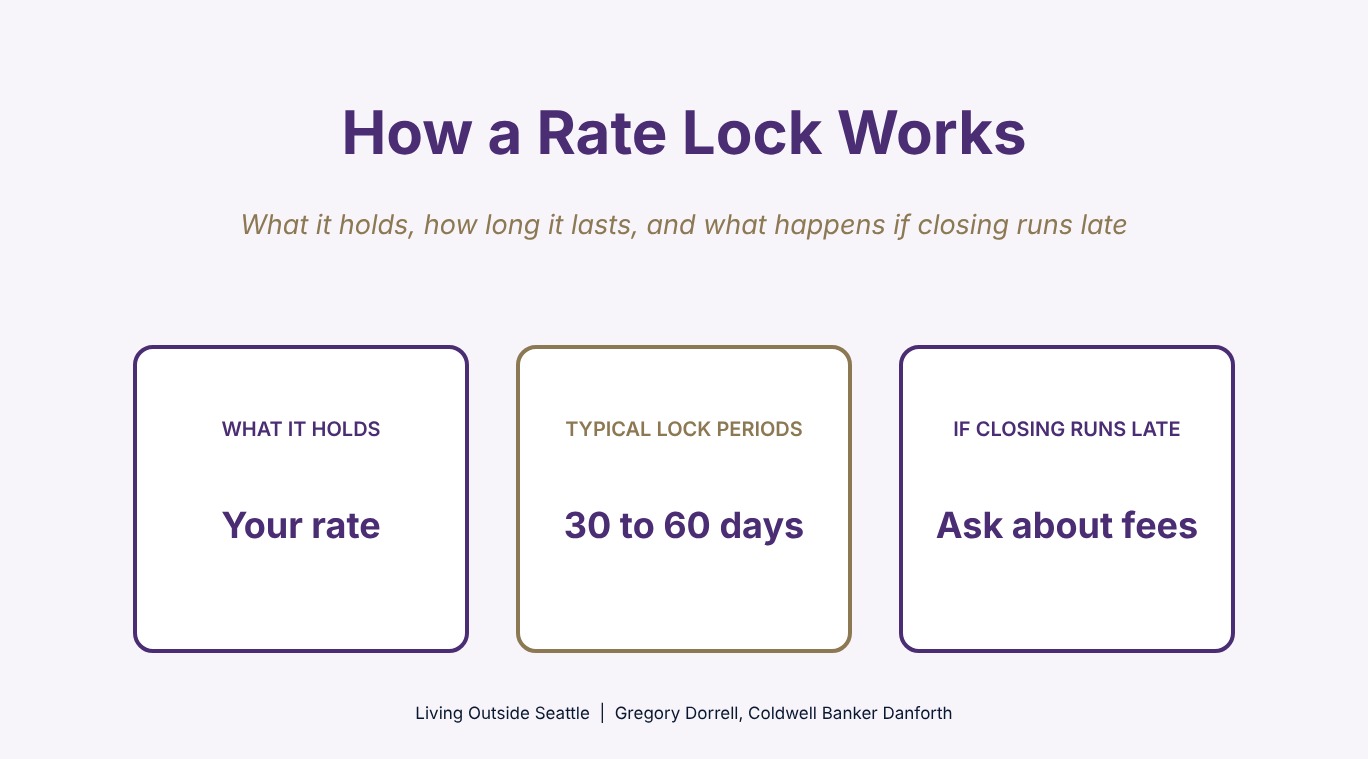
What a Rate Lock Is
A rate lock is a deal between you and your lender. The lender agrees to hold one interest rate for you. You agree to close within a set number of days. That is the whole idea.
Mortgage rates move every day. Sometimes they move a lot in a week. A lock keeps that movement from touching your payment. The Consumer Financial Protection Bureau puts it this way: your rate will not change between the offer and closing, as long as you close on time and your application does not change. You can read their short explainer on the CFPB website.
One thing trips up a lot of buyers. A lock is not the same as a preapproval. A preapproval tells you how much you can borrow. A lock fixes the rate on a specific loan for a specific home. Most lenders want a specific home under contract before they lock. If you want the full picture on how a lender decides what you can borrow, my guide to how mortgage qualification works in Washington covers it.
How Long a Rate Lock Lasts
Standard locks are usually 30, 45, or 60 days. Some lenders offer longer ones, and those cost more. Here is how I think about each one.
| Lock length | Who it fits | What to watch |
|---|---|---|
| 30 days | Quick, simple deals with a short closing window | Tight. Any delay can push you past the lock. |
| 45 days | Most standard purchases | Gives a few days of cushion for appraisal or paperwork. |
| 60 days | Slower deals, new construction, or a shaky timeline | Can come with a higher rate or a fee. Ask. |
General ranges. Every lender sets its own lock options and prices, so confirm yours in writing.
Your purchase contract sets your closing date. Your lock has to reach past that date. I like to see a few days of cushion, not zero. A lock that ends on closing day leaves no room for a small delay.
When to Lock Your Rate
You have two choices. You can lock now, or you can float and hope rates fall. Floating is a bet, and the downside is real. Here is what a small move costs on a $760,000 loan. That is a $950,000 home with 20% down.
| Rate | Monthly payment | Change from 7.00% |
|---|---|---|
| 7.00% | $5,056 | Base |
| 7.25% | $5,185 | +$129 |
| 7.50% | $5,314 | +$258 |
| 7.75% | $5,445 | +$389 |
Illustration only, not a quote. 30-year fixed, principal and interest only, $760,000 loan.
A move of half a point adds about $258 a month. Over a year that is more than $3,000. That is why most buyers lock early. In my experience, buyers usually lock around the time the offer is made. The people who float are usually the ones who feel strongly that rates are about to drop. Nobody can promise that. My cost of waiting guide walks through the math on waiting.
If rates are falling and your budget has room, floating can make sense. If your payment is already tight, lock. Certainty is worth money when there is no cushion.
What a Rate Lock Does Not Cover
A lock holds your rate. It does not hold everything. The CFPB warns that your rate can still change if something in your application changes. A lower credit score, a new debt, a job change, or a different loan amount can all do it. A low appraisal can change your loan, too.
So the best way to keep your lock safe is to keep your finances still. Do not open new credit. Do not finance a car or furniture. Do not move money around without telling your lender. Keep everything the same until you get the keys.
What Happens If Closing Runs Past Your Lock
Delays happen. An appraisal comes back late. An inspection turns up a repair. A condo packet takes longer than expected. If your lock runs out before you close, one of three things usually happens.
You pay a fee to extend the lock. You take the current market rate, which could be higher or lower. Or the lender covers the cost, if the delay was their fault. Extension pricing varies. Some lenders charge a small percent of the loan for every 15 days. On a $760,000 loan, 0.125% is $950 and 0.25% is $1,900. Treat those as examples, not promises.
The CFPB notes that your Loan Estimate will not show extension costs. You have to ask. Ask before you lock, not after the clock is already running. My earnest money guide shows how to protect your deposit while you work through those deadlines.
What Is a Float-Down?
A float-down lets you lock a rate and still get a lower one if the market drops. Not every lender offers it. When one does, it often needs rates to fall by a set amount, often a quarter point or more. It may also cost a fee or a slightly higher starting rate. Ask for the rules in writing.
If you are choosing between a float-down and buying the rate down with points, my mortgage rate buydown guide shows how that choice works.
How a Rate Lock Fits a Washington Purchase
In Washington, you sign a purchase contract with the seller first. That contract sets your closing date and your financing deadlines. The standard financing contingency is NWMLS Form 22A. It protects your earnest money if your loan falls through, as long as you meet its deadlines.
Your lock and your contingency are two separate clocks. Your lock is a deal with your lender. Your contract is a deal with the seller. A lock does not extend your contract deadlines, and your contract does not extend your lock. Put both dates on one calendar the day your offer is accepted.
For the current rate picture, see my King County mortgage rates guide and my breakdown of what 7%+ mortgage rates mean for King County buyers and sellers.
Questions to Ask Your Lender Before You Lock
Bring this short list to the call. First, how many days can I lock, and what does each option cost? Second, what does an extension cost, per day or per 15 days? Third, do you offer a float-down, and what are the rules? Fourth, what could still change my rate after I lock? Fifth, when does my lock end compared with my closing date? Get the answers in writing.
Frequently Asked Questions
What is a mortgage rate lock?
A rate lock is a promise from your lender to hold your interest rate for a set number of days while your loan closes. If you close within that time and your application does not change, your rate stays the same even if market rates rise.
How long can I lock my mortgage rate?
Most lenders offer 30, 45, or 60 day locks. Some offer longer ones, usually at a higher cost. Pick a lock that reaches a few days past your closing date.
Does it cost money to lock a mortgage rate?
Many lenders include a standard lock at no separate fee, but longer locks, extensions, and float-down options can cost extra. Ask your lender for the pricing in writing before you lock.
What happens if my rate lock expires before closing?
You may pay a fee to extend the lock, or you may get the current market rate, which could be higher or lower. If the delay was the lender’s fault, the lender may cover the cost. Ask about extension fees before you need one.
Can my rate change after I lock?
Yes, if something in your application changes. A lower credit score, new debt, a job change, or a different loan amount can change your rate or terms. Keep your finances steady until closing.
When should I lock my mortgage rate in Washington?
Many Washington buyers lock around the time their offer is made or accepted. Your lender can tell you the earliest date you can lock. If your budget is tight, locking early gives you certainty.
Your guide to life outside Seattle.
253-350-0045 · greg@livingoutsideseattle.com · www.livingoutsideseattle.com
Lock basics from the Consumer Financial Protection Bureau. Payment examples are principal and interest only on a $760,000 30-year fixed loan and are not a rate quote. Gregory Dorrell is a licensed real estate broker (WA License #111862) with Coldwell Banker Danforth, not a lender. This post is provided for informational purposes and does not constitute financial or investment advice.
