I get some version of “I’ve never done this, what happens first” from almost every first-time seller I work with. That’s normal. Nobody teaches you this in school. Here’s the honest walkthrough, stage by stage.
Stage 1: Pricing and Prep
This is where sellers either set themselves up to win or lose money before a single buyer walks through the door. Pricing isn’t a guess and it isn’t your Zillow estimate. It’s a comparative analysis against homes that actually sold near you, adjusted for condition, size, and timing. I do BPO-backed pricing assessments for banks and institutional clients every week, which means I see real sale data, not estimates. I walk through exactly how this works in my BPO methodology guide.
Prep comes next: what to fix, what to skip, and how to present the home. King County is sitting at roughly 15.5 weeks of supply right now, which means buyers have options. A home that shows well gets picked over one that doesn’t, even at the same price. I go deep on what’s worth fixing in my room-by-room prep guide.
Stage 2: Going Live
Your home hits the MLS, and within minutes it’s syndicated to Zillow, Redfin, and every other major site. Photos matter more than most first-time sellers expect. So does the listing description, though not for the reasons people think. It’s not marketing copy that sells your home. It’s accurate information that gets the right buyers through the door.
You’ll get a wave of activity in the first week or two. This is normal and doesn’t mean you priced wrong if it slows down after that.
Stage 3: Showings and Offers
Buyers tour, sometimes with their agent alone, sometimes with a home inspector in tow for a quick pre-offer look. Then, if you’re lucky, offers start coming in.
Right now, about 18 percent of King County homes are selling over list price, and roughly 11 percent of new listings are setting a specific date for offer review. That means most homes, including most first-time seller homes, are getting offers on a rolling basis rather than a single big deadline. Read every offer for more than the price. Financing type, contingencies, and closing timeline all matter. A cash offer $10,000 lower than a financed one can be the stronger choice depending on your situation.
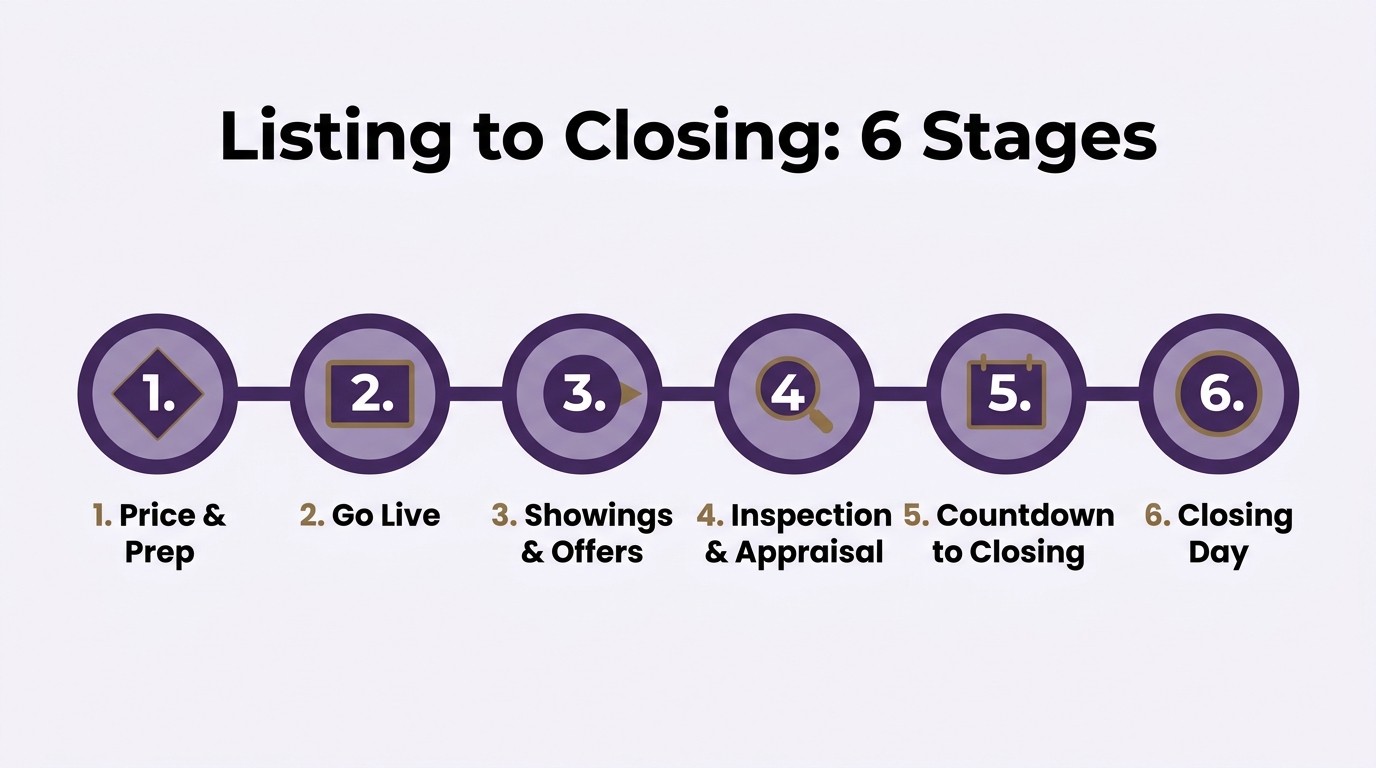
The six stages of a King County home sale, from pricing and prep through closing day.
Stage 4: Under Contract, Inspection, and Appraisal
Once you accept an offer, the clock starts on contingency periods. The buyer’s inspector will find things. Every house has something. The real question is what they ask you to fix or credit, and whether that request is reasonable or a renegotiation in disguise. I walk sellers through this exact moment in my home inspection seller’s guide.
If the buyer is financing, an appraiser will also value the home independently. If it comes in below the sale price, that becomes a financing contingency conversation, not an automatic deal-killer. I cover how appraisals actually work in my Washington State appraisal guide.
Stage 5: The Countdown to Closing
Once contingencies clear, you’re in the home stretch. Final loan approval, title work, and a final walkthrough happen in the days before closing. This is also when you’re coordinating your own move, which is its own logistics puzzle if you’re buying at the same time. If that’s you, I explain the options in my guide to buying and selling simultaneously in King County.
Stage 6: Closing Day
You sign a stack of documents, the buyer’s funds transfer through escrow, and ownership changes hands. In Washington, you typically don’t have to appear in person, escrow handles most of it. Once it records, the sale is final and your proceeds wire to your account, usually the same day or the next business day.
Frequently Asked Questions
How long does it take to sell a home in King County from start to finish?
Most homes go from listing to closing in six to ten weeks right now, factoring in an average marketing period plus a typical 30 to 45 day closing timeline once under contract. Pricing accuracy and current inventory levels in your specific city affect this more than anything else.
What’s the first thing I should do as a first-time home seller?
Get an accurate, data-backed price assessment before you do anything else, including prep work. Your price determines your buyer pool, your timeline, and how much you should spend fixing things up. Everything else follows from getting that number right.
Do I need to be present at closing in Washington State?
No. Washington uses escrow to handle closings, and most sellers sign documents ahead of time or electronically depending ont he rather than appearing in person. Your proceeds transfer once the sale records with the county.
Gregory Dorrell is a REALTOR® with Coldwell Banker Bain (WA License #111862) specializing in East and South King County. Market data from NWMLS, week of August 2, 2026. This article is general information, not legal advice.
I walk through Federal Way homes almost every week doing professional property valuations for banks. And the question I hear most from sellers here isn’t about price. It’s about repairs. Fix the place up first, or just sell it as-is?
The honest answer: it depends on which repairs. Most cosmetic projects won’t pay you back. A few specific fixes almost always will. Here’s how to tell the difference in the current Federal Way market.
What the Federal Way Market Says Right Now
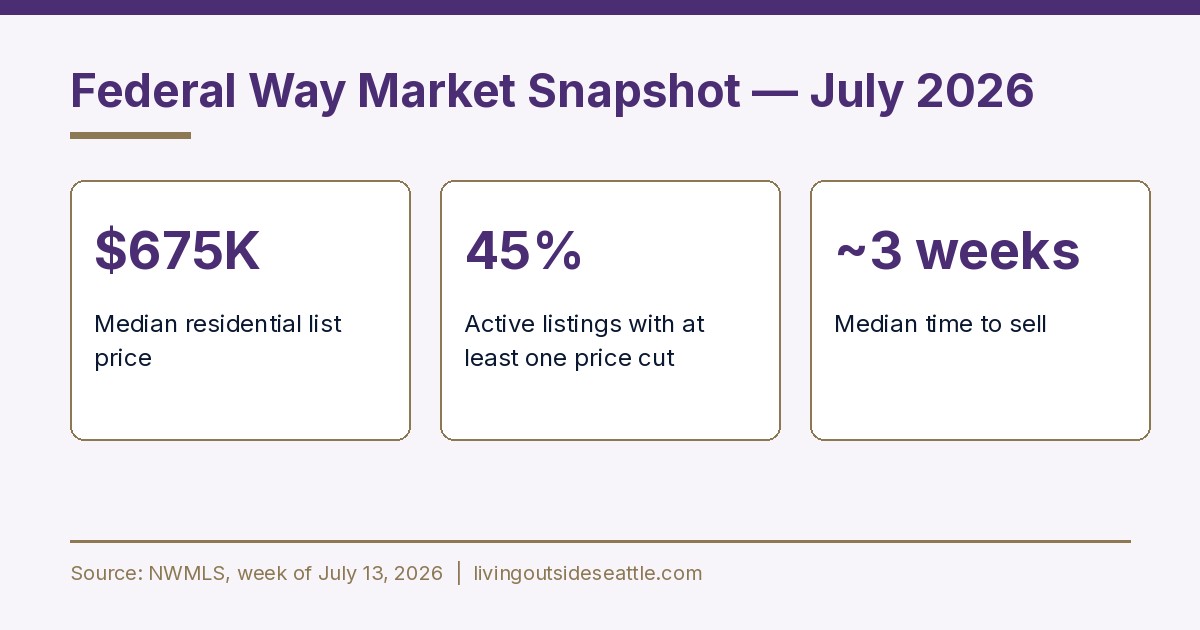
Numbers first. As of mid-July, the median list price for a Federal Way house is running around $675,000. Almost half the active listings in the city, about 45 percent, have already taken at least one price cut. Homes that do sell are going in roughly three weeks. Full market picture in my Living in Federal Way guide.
NWMLS data, week of July 13, 2026: $675K median residential list price, 45% of actives with a price cut, sales closing in roughly three weeks.
What does that mean for your repair decision? Buyers have choices right now. When buyers have choices, condition matters more. A home that shows well sells. A home with visible problems joins the 45 percent taking price cuts.
Repairs That Usually Pay You Back
Water is the big one. Fix any active leak before you list. Roof, plumbing, gutters, all of it. Buyers in the Pacific Northwest are trained to sniff out moisture problems, and one water stain on a ceiling can cost you more in negotiation than the repair ever would.
Same with safety items. Bad electrical. A failing water heater. Broken railings, missing smoke detectors. These are the things a home inspector flags in bold, and they’re cheap to handle now versus expensive to argue about later. I cover what that inspection looks like in my seller’s guide to home inspections.
Then there’s the cheap stuff that’s really about presentation. Deep cleaning, fresh neutral paint in the main rooms, yard cleanup and moss treatment. None of that is technically a repair. It’s still the highest-return money you can spend before listing.
Repairs That Usually Don’t Pay Back
Big remodels rarely return their cost at sale. A $60,000 kitchen renovation doesn’t add $60,000 to your Federal Way sale price. Buyers here shop in a specific price band, and the neighborhood puts a ceiling on what they’ll pay. I price homes in this city every week, and remodeled homes and original homes settle a lot closer together than most sellers expect.
New flooring throughout, full bathroom gut jobs, finishing unfinished spaces. Usually the same story. If the money won’t come back, it’s often smarter to price the home for its condition and let the buyer make those choices.
What Selling As-Is Actually Means in Washington
Here’s where first-time sellers get tripped up. Selling as-is doesn’t let you skip disclosure. Washington still requires the Form 17 seller disclosure statement, and you still have to answer honestly about what you know. As-is tells buyers up front you won’t be making repairs. It doesn’t make problems disappear.
How I Run the Math With Sellers
The question isn’t whether to fix everything. It’s whether a specific repair returns more than it costs, after the time and stress of doing it. Sometimes a $4,000 fix protects $15,000 of price. Sometimes a $30,000 project returns $12,000. You want the first kind. The only way to know which is which is to run real numbers on your house against real Federal Way comps. Pricing it right matters either way, and my guide to pricing your home to sell in King County walks through how that works.
A Simple Decision Checklist
Before you spend a dollar on pre-listing work, run through this list:
Fix anything involving water, active leaks, drainage, or moisture damage
Fix safety items an inspector will flag: electrical, railings, smoke detectors
Budget for cleaning, paint, and yard work before any bigger project
Skip major remodels unless the numbers prove the return
If selling as-is, complete the Form 17 disclosure honestly and price for condition
Ask your agent for an as-is value and an after-repair value before deciding
Frequently Asked Questions
Can I sell my house as-is in Washington state?
Yes. Selling as-is is legal and common in Washington. You still have to complete the Form 17 seller disclosure statement honestly, and buyers can still inspect the home. As-is simply tells buyers up front that you don’t plan to make repairs.
Do I lose money selling a house as-is in Federal Way?
You typically net less than a comparable move-in-clean home, but not always less than the cost of major repairs plus months of project time. The right comparison is your as-is value against your after-repair value minus repair costs. Sometimes as-is wins that math, especially when the needed work is cosmetic or the repairs are large remodels that don’t return their cost.
What repairs are required to sell a house with an FHA or VA buyer?
FHA and VA appraisers flag health and safety items: peeling paint in older homes, missing handrails, broken windows, roof or water damage, and non-working systems. The lender can require those repairs before closing even on an as-is sale, so at Federal Way price points it’s smart to handle obvious safety items before listing.
Gregory Dorrell is a licensed real estate broker (WA License #111862) with Coldwell Banker Bain. Market data from NWMLS, week of July 13, 2026. Statistics are market-wide and not a guarantee of any individual outcome. This post is provided for informational purposes and does not constitute financial or legal advice.
Most sellers are nervous about the home inspection. Here’s what actually happens, what buyers are really looking for, and how to handle a repair request without losing your deal.
The call comes in after the inspection. Your agent says the buyer has a repair request. Your stomach drops.
I see this happen all the time. Sellers who have lived in their home for 10 or 15 years think they know every quirk of the place, and they still get surprised by what an inspector puts in a report. That’s not because something was hidden. It’s because most sellers have never seen a home inspection report before. When you see 40 items flagged in a 60-page document, it can feel catastrophic — even when 35 of those items are caulk gaps and light switch covers.
Here’s what the inspection process actually looks like from the seller’s side, what it means when a buyer sends repair requests, and how to respond without blowing up your sale. If you haven’t started prep yet, it’s worth reading our guide to preparing your home for sale in King County alongside this one.
How the Inspection Fits Into Your Sale Timeline
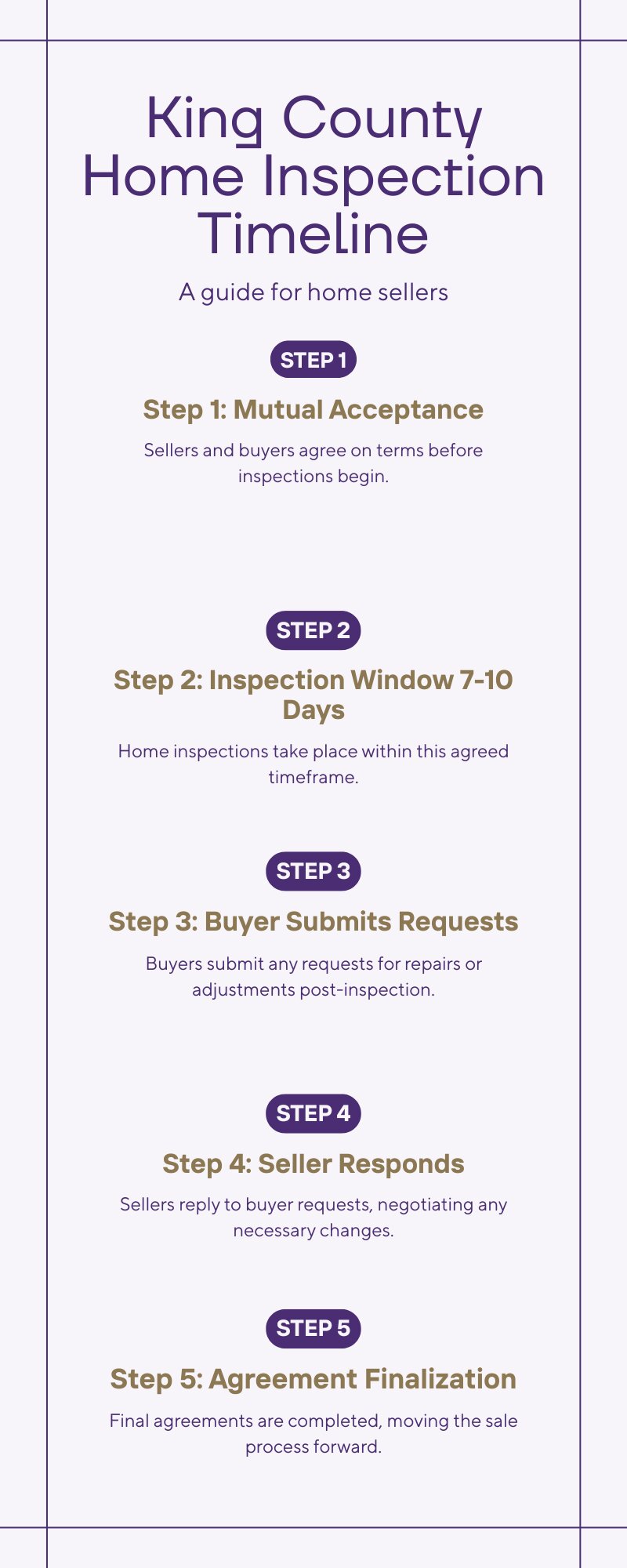
In King County, the buyer typically has a set window after mutual acceptance — often 7 to 10 days — to schedule and complete their inspection, review the report, and submit any requests. That window is spelled out in the purchase and sale agreement.
You don’t attend the inspection. As the seller, your job is to leave the home accessible and get out of the way. The inspection takes two to four hours depending on the size and condition of the property. Smaller condos in Renton or Auburn might be done in under two hours. A larger home in Covington or Maple Valley with a finished basement and detached garage can take closer to four.
After the inspection, the buyer gets a full written report — typically 30 to 60 pages with photos. The report goes to the buyer, not to you. You only see what the buyer chooses to share when they submit their requests.
In King County, buyers typically have 7–10 days after mutual acceptance to complete their inspection and submit requests.
What the Inspector Actually Looks At
Home inspectors in Washington are licensed through the state Department of Licensing. They’re looking at the condition of the home’s systems and structure, not its cosmetic appearance. That means they won’t flag your dated kitchen tile, but they will flag a roof that’s near the end of its life.
The main areas every inspector covers are the roof and attic, the foundation and crawl space, the electrical panel and visible wiring, plumbing visible within the walls and under fixtures, the HVAC system including the furnace and any heat pumps, the water heater, windows and doors, and the exterior including drainage and grading.
In the Pacific Northwest, inspectors pay extra attention to moisture. We get a lot of rain here, and the most common serious findings in South and East King County homes come down to water — roof age, gutter condition, crawl space moisture, and signs of past leaks near windows and skylights. A good inspector is going to look hard at anywhere water could get in.
What Shows Up on a Report — and What It Actually Means
This is where sellers tend to panic. You’ll see a long list of items, many flagged with the same urgent-looking language, and it all starts to blur together.
Here’s how to read it: inspectors are trained to note everything they observe, regardless of severity. A missing dryer vent cover and a cracked heat exchanger show up in the same format — but one is a $12 fix from the hardware store and the other is a serious safety issue.
The findings that actually matter fall into a few categories.
Safety Issues
Safety issues are the ones buyers and their lenders care most about. Missing handrails on stairs, double-tapped breakers in the electrical panel, exposed wiring, carbon monoxide detector gaps — these get flagged and buyers expect them to be addressed.
In King County, older homes in Renton and Kent sometimes have Federal Pacific electrical panels, which can be an insurance problem for buyers. That’s a legitimate concern worth addressing before listing if you know about it.
Structural and Water Intrusion Issues
These are the ones that can kill deals or require significant renegotiation. Foundation cracks showing active movement, rot at the mudsill, or evidence of water in the crawl space fall here.
These aren’t always deal killers, but they need to be understood. Is this an old issue that’s been stable for years, or is water still moving? That question matters a lot to how a buyer responds.
Mechanical Systems Nearing End of Life
A furnace that’s 20 years old, a water heater at 12 years, a roof with 3 to 5 years of life left — these often show up in inspection reports. Buyers will sometimes ask for a credit here, especially in a more balanced market like we’re seeing in parts of King County in 2026.
This isn’t surprising news if you’ve owned the home for a while. Knowing the ages of your major systems before you list means you can factor them into your pricing strategy rather than scrambling to respond to them mid-contract.
Deferred Maintenance
This makes up the bulk of most reports. Caulk at tubs and windows, tree branches touching the roof, missing downspout extensions, minor gutter debris — these are normal house items that don’t represent serious problems.
Buyers sometimes include a long deferred maintenance list in their requests. That doesn’t mean you have to fix all of it. Knowing the difference between a genuine concern and a routine maintenance item is where your agent’s experience matters most.
Most inspection reports are long. This is what the findings that actually matter look like compared to routine maintenance items.
Do You Have to Fix What the Buyer Asks For?
No. This surprises a lot of sellers.
Washington State does not require sellers to fix anything a buyer requests in an inspection response. The purchase and sale agreement sets up a negotiation. The buyer submits their requests. You have several options.
You can agree to the repairs and have them completed before closing, typically by licensed contractors. You can offer a dollar credit at closing instead of doing the work yourself, which buyers often prefer because it lets them choose their own contractor. You can agree to some items and decline others. Or you can decline the entire request and let the buyer decide whether to move forward or exercise their right to terminate.
The buyer’s decision has to happen within the inspection contingency window. If the timeline passes without resolution, the contingency typically expires and the sale proceeds as-is.
What you actually have to fix depends on what your contract says, not on any general legal requirement. If you’ve negotiated repairs as a condition of the sale, you’re obligated to complete them. If you respond by declining, the buyer gets to choose their path.
The Case For (and Against) a Pre-Listing Inspection
A pre-listing inspection means you hire an inspector before you go on the market. You find out what’s in the house before the buyer does.
The upside is real. A pre-listing inspection in King County typically costs $350 to 650+ depending on home size. That’s a small price to avoid being blindsided at the negotiating table. You can fix the things that matter on your own timeline and your own budget, rather than scrambling to get licensed contractors in before closing under time pressure. In a competitive market, some sellers share the pre-listing inspection report with buyers to build confidence and reduce the chance of an “inspection for information only” turning into a full renegotiation.
The downside is also real. If the inspection finds something serious, you’re now legally obligated to disclose it to buyers — even if you choose not to fix it. In Washington State, the disclosure requirements are strict. You can’t un-know what the inspector told you.
My general guidance: if the home is older than 15 to 20 years, or if you have any reason to believe there might be deferred maintenance issues in the crawl space, roof, or electrical, the pre-listing inspection is worth it. For newer homes in good condition, it’s less essential but still something that most buyers expect to see in King County.
What Kills Deals vs. What Buyers Overlook
The honest truth is that very few sales fall apart because of a home inspection. When a deal dies over inspection, it’s usually because a major undisclosed issue came to light — not because there were 40 items in the report.
The issues most likely to kill or seriously damage a deal are active roof leaks or significant roof deterioration, foundation problems showing current movement, evidence of water in the crawl space or basement that hasn’t been resolved, major plumbing failures like a failed main sewer line, and serious electrical hazards.
Buyers in King County are used to older housing stock. A 1975 Kent home or a 1985 Renton split-level is going to have some things on an inspection report. Experienced buyers and their agents know the difference between a well-maintained older home with normal findings and a house with real problems.
The things buyers most often overlook or accept as-is: cosmetic items, surface wear, minor roof maintenance items on an otherwise sound roof, single-pane windows in older homes, and deferred exterior maintenance like peeling paint or weathered decks.
What This Means for You as a Seller
Before you list, walk through your home with fresh eyes. Check the gutters. Look at what’s happening around the water heater and under sinks. Know the age of your roof and furnace. These aren’t things to hide — they’re things to understand so you can have an honest conversation with your agent about pricing and preparation.
When the inspection report comes in, read it with your agent before you react. Most items on a typical report are manageable. The ones that aren’t are the ones worth knowing about early. Understanding how pricing works in King County gives you a clearer sense of how to factor known conditions into your list price from the start.
You have more options than you think when repair requests arrive. A credit at closing is often cleaner than trying to coordinate contractors under a time crunch. Declining minor requests is completely legitimate. And pricing the home to reflect known conditions from the start — which is exactly what a BPO-trained pricing approach does — means you’re less likely to end up in a contentious renegotiation to begin with. You can also read our guide on how appraisals work in Washington State to understand the full picture of what happens between contract and closing.
Frequently Asked Questions
Does the seller have to be present during the home inspection?
No. In fact, it’s standard practice for sellers to leave during the inspection. It makes buyers and inspectors more comfortable, and it prevents awkward conversations about every item being noted.
How long does a home inspection take in King County?
Most inspections run two to four hours. A smaller condo or townhome might finish in 90 minutes. A larger single-family home with a crawl space, detached garage, and outbuildings in Covington or Maple Valley could take up to four hours or more.
What happens if I don’t agree to any repairs?
The buyer then has a choice: move forward with the purchase as-is, or exercise their right to terminate within the inspection contingency period. If they terminate, you get your home back on the market. If you’ve priced it correctly, another buyer will come.
What is a right-to-cure clause in Washington?
Washington contracts include a seller’s right to cure, which gives you the opportunity to respond to a repair request. You can agree, counter, or decline. It’s not a requirement to fix — it’s a framework for negotiation.
Should I get a pre-listing inspection in King County?
For homes older than 15 to 20 years, or any home where you have concerns about the crawl space, roof, or electrical system, a pre-listing inspection is usually worth the $350 to $550 cost. It lets you fix things on your terms and removes surprises from the process.
Can a buyer walk away after the inspection for any reason?
During the inspection contingency period, yes. The buyer can terminate for virtually any reason related to the inspection findings. Once that window closes, their options narrow significantly.
The inspection is one step in a process with a clear beginning and end. Most sellers who go through it — even with a long repair list — close. The ones who struggle are usually the ones who weren’t prepared for what they’d see. You can also review our guide to Washington State closing costs to understand the full financial picture before you list.
Most sellers interview only one agent. Here’s why that’s a mistake — and exactly what to ask when you do sit down with one.
Choosing a listing agent is one of the most financially significant decisions you’ll make in this process. The difference between an agent who prices your home correctly on day one and one who guesses — or worse, tells you what you want to hear — can easily be $20,000 to $50,000 in South King County’s current market. Sometimes more.
Most sellers pick whoever they already know, or whoever calls first. I get it. But you are about to hand someone the keys to your largest asset. Spending 90 minutes interviewing two or three agents before you sign anything is one of the highest-return things you can do.
Here are the questions that actually matter — and what a strong answer looks like versus a weak one.
Start With Pricing — It’s the Most Important Conversation You’ll Have
The single question that separates good listing agents from the rest is this: “Walk me through how you determined that list price.”
A strong agent should be able to show you exactly which comparable sales they used, why they chose those comps over others, and how they adjusted for differences in lot size, condition, and location. They should be able to tell you what the market is doing right now — not three months ago — in your specific neighborhood.
A weak answer sounds like: “Homes like yours are going for around X.” No specifics. No adjustment explanation. Just a number that landed on the page somehow.
The number itself matters less than the reasoning behind it. I’ve watched sellers get pulled in by agents who pitched an inflated price to win the listing — only to sit on the market for 60 days and end up taking less than they would have gotten with an honest price from the start. In King County, a home that goes stale gets stigmatized. Buyers start wondering what’s wrong with it. The longer it sits, the more negotiating power shifts away from you.
Ask About Their Track Record in Your Market
General experience is fine. Local experience is what moves the needle.
Ask: “How many homes have you listed in my city or price range in the past 12 months?”
Then ask: “What was your average sale-to-list price ratio on those listings?”
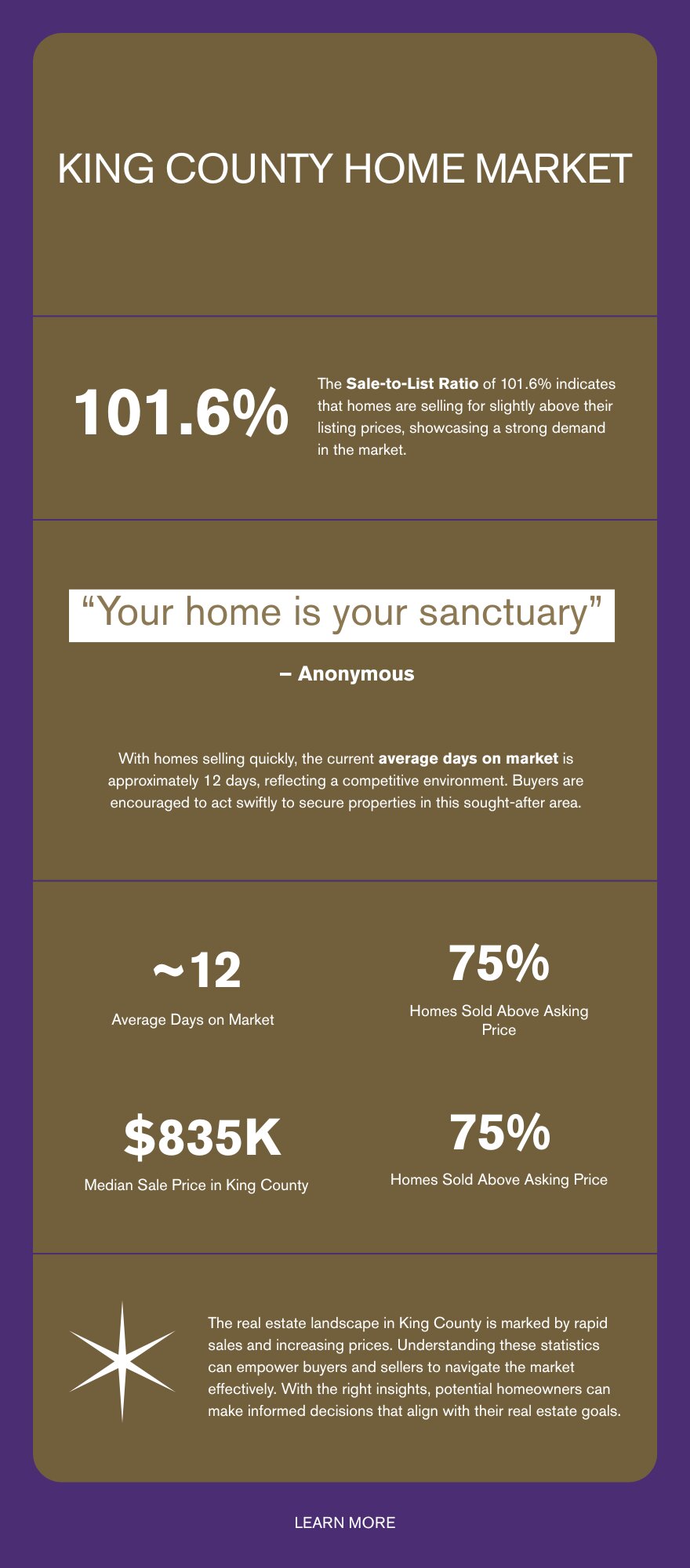
In King County, the overall 2026 average is hovering around 101.6% — meaning well-priced homes are still selling slightly above asking. If an agent’s numbers are consistently below 98%, that tells you something. It could mean they’re pricing too high and accepting lower offers to close. It could mean their marketing isn’t generating enough competition. Either way, it’s worth asking why.
Also ask: “What was your average days on market for listings in the past year?” County-wide, homes are sitting about 12 days on average right now. An agent consistently hitting 30+ days on market in a 12-day market has some explaining to do.
King County’s 2026 market rewards well-priced homes. A listing agent who knows these numbers — and can explain what drives them — is the one worth hiring.
Understand What the Marketing Plan Actually Covers
Ask: “What is your specific marketing plan for my home?”
This is where you’ll hear a wide range of answers. Some agents will say “we list on the MLS and put up a sign.” That’s not a marketing plan — that’s a minimum requirement.
In Washington State, NWMLS rules mean there’s no “coming soon” period — once your home goes live, it goes fully live. That makes your launch day the single most important day of your listing. An agent without a strong pre-launch preparation strategy is leaving money on the ground.
What a Strong 2026 Marketing Plan Includes
Professional photography (not the agent’s phone), a virtual tour or 3D walkthrough, targeted social media promotion, email outreach to buyer agents in your area, and a strategy for the open house weekend. Ask specifically about each of these. Ask who takes the photos. Ask whether they include a professional stager consultation.
If the plan is vague, the execution will be too.
Ask How They Handle Offers and Lowballs
Ask: “How do you manage the offer process, and how do you respond to low offers?”
You want an agent who can hold the line. Not every low offer deserves a counter — sometimes the right move is to decline and wait. But you need an agent who can read the situation and advise you on strategy, not just pass paper between the buyer’s agent and you.
Also ask: “Will you be personally handling my listing, or will it be someone on your team?”
Some high-volume agents hand listings off to junior assistants after the initial meeting. You’re not hiring the team — you’re hiring the person in front of you. Clarify who answers your calls, who shows up to negotiations, and who fields feedback from showing agents.
Ask the Uncomfortable Questions Up Front
Ask: “What’s your commission structure, and what does it cover?”
Since the NAR settlement changes took effect, the buyer’s agent compensation conversation is more upfront than it used to be. You should understand exactly what you’ll pay, what you may be asked to offer toward a buyer’s agent, and whether there are any marketing costs billed separately. Get this in writing before you sign.
Also ask: “What’s your cancellation policy if I’m not happy?”
An agent who is confident in their work will offer a reasonable cancellation clause. An agent who resists this question is telling you something important about how they handle accountability.
The Local Angle: What This Looks Like in South and East King County
Every submarket in King County has different dynamics right now. Renton, Kent, Auburn, and Covington are all behaving differently from each other — and very differently from the Eastside cities like Issaquah and Sammamish.
An agent with genuine local knowledge should be able to tell you: What’s happening with inventory in your specific city right now? Are buyer agents bringing pre-approved clients, or are showings stalling at the financing stage? Is your neighborhood drawing buyers from Seattle, from the Eastside, or primarily from within South King County?
If the agent you’re interviewing is giving you county-wide generalities when you ask about your block — that’s a signal. The agents who consistently outperform in this market know the sub-markets. They know which streets have the highest sale-to-list ratios and why.
Ask: “What’s happening with listings in my neighborhood right now — not countywide, but specifically here?”
A good agent should have an answer that surprises you with its specificity. A general answer tells you how deeply they actually know the market they’re claiming to know.
Every South King County submarket — Renton, Kent, Auburn, Covington — behaves differently. Your listing agent should know your neighborhood, not just the county.
The One Question Most Sellers Forget to Ask
Ask: “What makes your pricing different from what I’d get from another agent?”
This is where you’ll hear a range of vague claims. But it’s also where an agent who does things differently will tell you what that difference actually is.
The standard listing agent approach is a comparative market analysis (CMA) — pulling recent sales, making some adjustments, and landing on a number. That’s the baseline. A CMA is useful. But it’s a snapshot, and it’s only as good as the agent’s judgment about which comps to use. If you want to understand how to read one yourself, this breakdown of how to read a CMA as a King County seller is a good place to start.
What to Do With the Answers
Don’t go into these interviews hoping to like everyone equally. You want contrast. Talk to at least two agents — ideally three. The conversations that feel different from each other are the ones that teach you the most about what you’re actually comparing.
Take notes during each meeting. Pay attention to who asks questions about your situation before launching into their pitch. The agent who listens for the first 15 minutes and then tailors their approach to what you told them is showing you how they’ll handle your listing. The agent who delivers a canned presentation and pivots to commission before you’ve finished your coffee is showing you that too.
Before you list, it’s also worth understanding what goes into pricing your home correctly from day one — that post walks through the data side of what a strong listing agent should be doing. And if you want to get the home itself ready before those conversations even happen, this prep guide for King County sellers covers exactly what moves the needle.
FAQ: Questions to Ask Before You List
How many agents should I interview before listing my home?
Interview at least two — three is better. Most sellers talk to only one, which means they have no basis for comparison. A second or third conversation almost always surfaces something the first one didn’t.
What’s the biggest red flag when interviewing a listing agent?
An agent who quotes you the highest price without being able to explain the specific comps they used is the classic “buying the listing” move. They pitch a number you want to hear, you sign, and then three months later they’re asking you to drop the price. Ask for the CMA in writing before you decide.
Should I ask about commission upfront?
Yes — directly and early. Since the NAR commission changes, the conversation about how buyer’s agent compensation works has shifted. You want to know your total cost, what you might be asked to offer toward the buyer’s side, and what exactly is included in what you’re paying.
What if an agent won’t give me a cancellation clause?
Walk away. Any agent who is confident in their performance should be willing to let you cancel if they’re not delivering. Resistance to this question is resistance to accountability.
How do I know if an agent really knows my neighborhood?
Ask them to tell you what’s happening specifically in your neighborhood — not the county, not the city, your neighborhood. If they can tell you the most recent comparable sale, what it sold for relative to asking, and what drove that result — they know your market. If they answer with generalities, they don’t.
What does a BPO mean for sellers, and why does it matter?
A Broker Price Opinion is the pricing methodology that banks and lenders use to assess property values — more rigorous than a standard CMA. An agent who works as an active BPO field agent does this analysis daily, not just when a new client calls. For sellers, that means a list price grounded in real, current market data rather than a best-guess estimate.
Two agents. Same house. Two completely different prices. Here’s how to tell which one is right.
Most sellers in King County interview two or three agents before listing. They get a CMA from each one. And more often than not, those CMAs land in different places — sometimes by $20,000, sometimes by $80,000. Then comes the question nobody wants to ask out loud: which agent is actually right?
The answer isn’t always the highest number. And it isn’t always the lowest. It comes down to how each CMA was built, which comps were chosen, and whether the agent is telling you what the market says or what you want to hear.
This guide walks you through how to read a CMA the way a pricing analyst does — what to look for, what to question, and why the methodology behind the number matters as much as the number itself.
What a CMA Actually Is
A Comparative Market Analysis is a written report — sometimes a few pages, sometimes a full presentation — that estimates what your home would sell for on the open market today. An agent prepares it using data from the local MLS: recent sales, current active listings, and homes that went under contract but haven’t closed yet.
The CMA is not an appraisal. It doesn’t carry legal weight and isn’t prepared by a licensed appraiser. But a well-done CMA uses the same core methodology: find comparable sales, adjust for differences, and arrive at a defensible price range. The difference is in who does it and how rigorously.
A CMA is also not a Zestimate. Automated valuation tools are algorithmically generated from public records and don’t account for interior condition, recent renovations, or hyperlocal factors that move prices in King County. They’re a starting point for curiosity, not a basis for pricing your home.
What you’re looking for in a CMA is a specific kind of precision: recent sales that are genuinely similar to your home, adjustments that reflect real market behavior, and a price recommendation with logic you can follow.
The Anatomy of a Good CMA
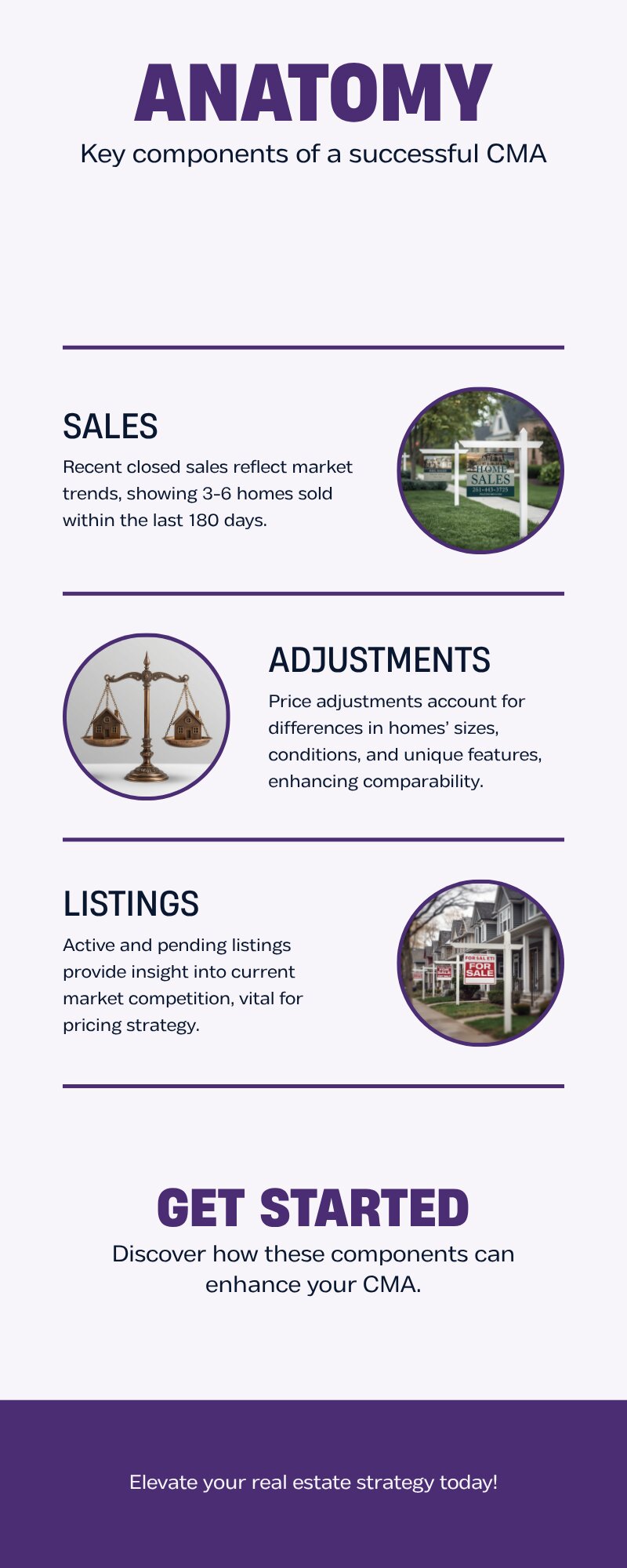
A complete CMA has five parts — recent closed sales, price adjustments, active listings context, a price range, and days-on-market data. Missing any one of these is a yellow flag.
The Comparable Sales Section
This is the heart of the analysis. A solid CMA uses 3–6 closed sales — homes that actually sold and recorded with the county, not just homes that were listed. Active listings show you the competition; they don’t tell you what buyers actually paid.
Strong comps are sold within the past 90–180 days, within roughly half a mile in dense neighborhoods, similar in size (within 20%), similar in age and style, and similar in condition. The more adjustments required to bridge the gap between a comp and your home, the less reliable that comp is as an anchor.
The Adjustment Section
Here’s where CMAs diverge. Every comp is adjusted up or down to match your home. If the comp had a three-car garage and yours has one, the agent reduces that comp’s adjusted value. If your home has a finished basement the comp didn’t, an upward adjustment goes in. These adjustments should reflect what buyers in your market actually pay for those features — not round numbers made up on the spot.
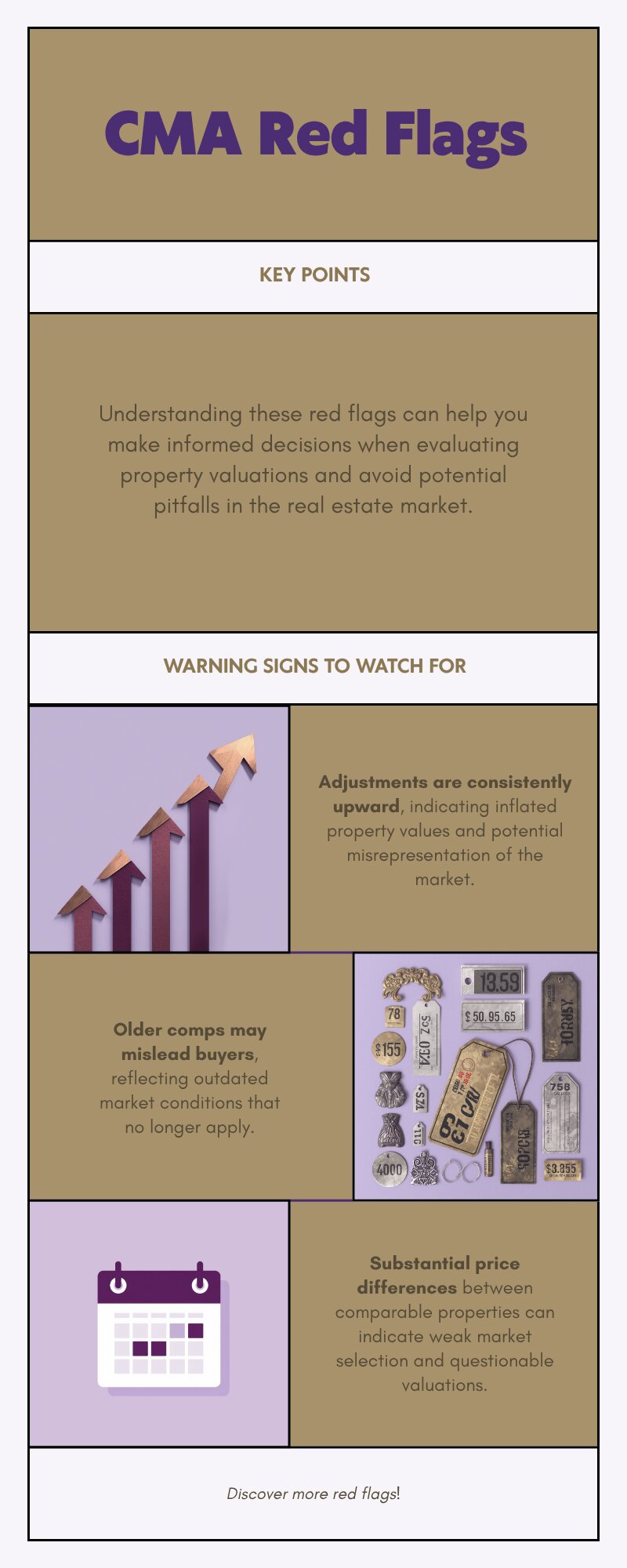
Check: Are the adjustments reasonable in proportion to the sale price? Do the comps include some that are better than your home (requiring downward adjustments), or are all adjustments upward? If every adjustment inflates the comp’s value, the CMA may be padded.
Active, Pending, and the Price Range
A complete CMA includes the current competition — what’s on the market now and what’s pending. If similar homes have been sitting for 45 days at your proposed price, that’s a data point worth knowing before you list.
The final output should be a price range, not a single number. Within that range, your agent recommends a specific list price based on your goals and market conditions — and that recommendation should come with a clear explanation. “We can always come down” is not an explanation.
Why Two Agents Give You Different Numbers
Two agents can produce legitimately different CMAs because pricing involves judgment calls — which comps to use, how much to adjust for condition, whether the market is moving up or flat. Reasonable professionals can disagree within a range.
But the real reason sellers often see large gaps between CMAs has nothing to do with analytical disagreement. It’s called buying the listing — when an agent inflates their CMA to win your business. They know you’ll be more excited about the higher number. They sign you up at that price, the home sits, and three weeks later they start asking for a price reduction.
By then, you’ve already lost the prime marketing window — the first two weeks when a new listing gets the most attention from buyers. Homes that require price reductions consistently sell for less than they would have if priced correctly from day one. Buyers notice price cuts. They wonder what’s wrong with the house.
If you see these patterns in a CMA, ask questions before you sign a listing agreement.
The BPO Difference: Why Daily Pricing Work Matters
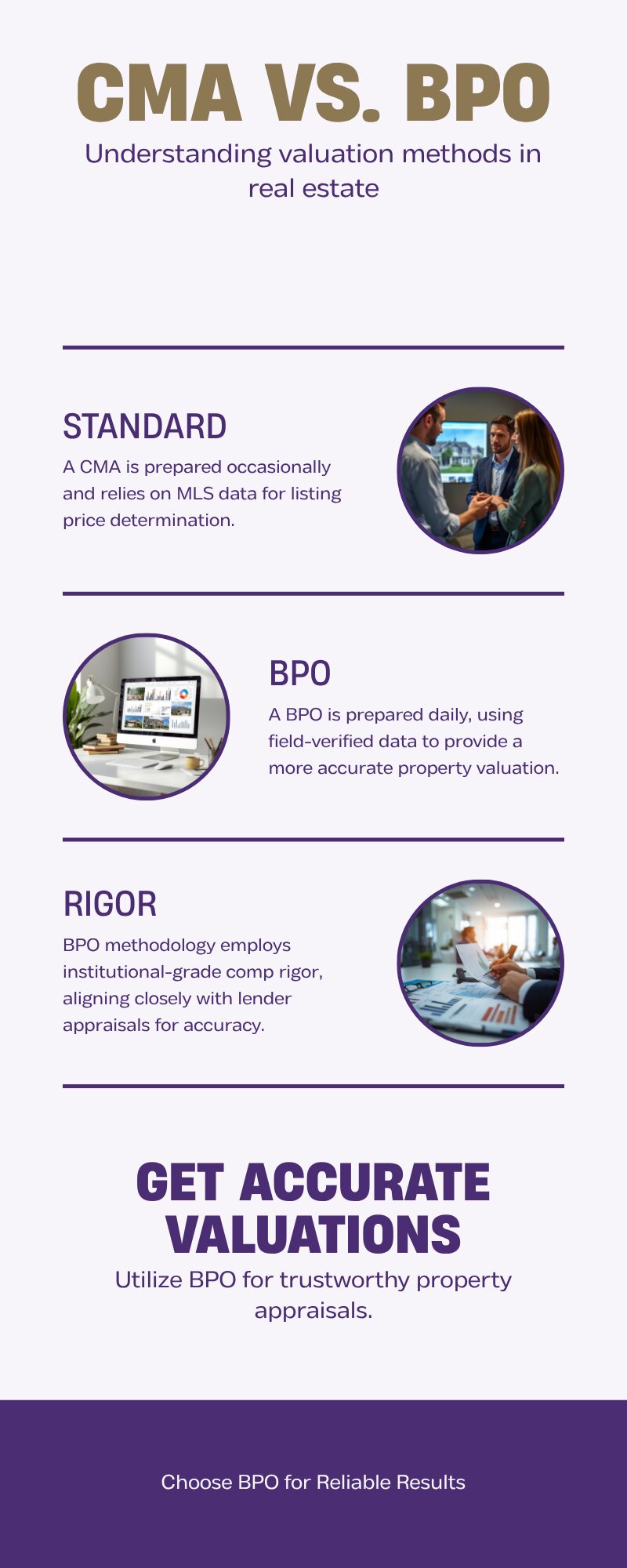
Most agents prepare CMAs occasionally — when they’re pitching a listing. That means they’re doing this analysis once every few weeks, or less.
My background is different. As an active BPO field agent, I assess property values professionally every single day for banks, lenders, and investment portfolios. That means I’m running the same comp analysis — pulling recent sales, making adjustments, arriving at a reconciled value — on multiple properties every morning. Not when a listing appears on my desk. Every day.
What that produces is calibration. I know what buyers in Renton paid for a renovated kitchen last month because I priced three homes in Renton last month. I know how much a lot size premium is worth in Kent right now because I’ve been tracking it continuously, not revisiting it once a quarter.
When I prepare a CMA for a seller, I’m using the same methodology a lender’s appraiser will use when a buyer’s loan comes through. That alignment matters: a home priced with institutional-grade rigor is much more likely to appraise cleanly at contract price — which means fewer renegotiations and a smoother path to closing. For more on how appraisals interact with your list price, see our guide to how to price your home to sell in King County.
The difference isn’t just credentials — it’s frequency. Daily pricing work produces calibration that occasional CMA preparation can’t match.
What a CMA Can’t Tell You
A CMA is backward-looking. It tells you what buyers paid for comparable homes in the past 90–180 days. It doesn’t tell you what the market will do next month, and it doesn’t account for factors that haven’t shown up in closed sales yet — like a shift in mortgage rates, a wave of new inventory, or a major employer making news in your area.
This is why the agent’s current market knowledge matters as much as the data itself. A CMA prepared by someone who isn’t actively watching the King County market day-to-day will miss signals that a daily practitioner picks up on. Always ask the agent: “Has anything happened in the past 30 days that your comps don’t reflect?” Their answer will tell you whether they’re watching the market or just pulling data.
The King County Specifics Worth Knowing
Sub-market pricing is everything. King County covers an enormous range of price points and market conditions. Renton, Kent, Auburn, Covington, and Maple Valley each behave differently from each other and from the Eastside. A good CMA uses comps from the same sub-market — not comps from a neighborhood three cities over that happens to have similar square footage.
Median prices shifted in early 2026. The April 2026 King County median home sale price came in around $835,000 — down roughly 7.5% year-over-year at the county level, though South King County remained more competitive than average. Comps from 12+ months ago may overstate what your home will actually trade for today. An agent who’s pulling year-old data to support a high price isn’t serving your interests.
Days on market is now a meaningful signal. King County homes are averaging around 12 days on market — up from 7 days a year ago. That shift means the “price it high and wait for the right buyer” strategy is riskier than it was in 2022. Buyers have more options, and a home that sits past 30 days starts raising questions that a price cut can’t fully answer.
School district boundaries move prices. In cities like Newcastle that straddle multiple school district zones, a half-mile difference in location can produce a meaningful price difference. Your agent needs to know which side of those lines your home is on — and make sure the comps are on the same side. For more on what goes into getting your home ready to sell, see our guide on how to prepare your home for sale in King County.
Questions to Ask at Your Listing Appointment
When you sit down with an agent to review their CMA, bring these questions:
On the Comps
Why did you choose these specific sales and not others? How recent are they — and are there more recent sales you considered and rejected? How similar is this comp in size, condition, and location to my home?
On the Adjustments
How did you arrive at the adjustment amounts? Are any of your comps adjusted up by more than 20%? Are there any comps where you made downward adjustments, or are all adjustments upward?
On the Pricing Recommendation
What’s your recommended price range, and where do you suggest we list within it? What happens to our negotiating position if we list at the top of your range and don’t get an offer in two weeks? How does your recommended price compare to what a buyer’s lender will appraise it at?
On the Agent
How many pricing analyses have you done in the past 30 days in this specific sub-market? Have you seen any recent shifts in buyer behavior that your closed comps don’t yet capture?
The agent who answers these questions clearly — without hesitation, without pivoting to their marketing plan — is the agent who did the work.
Frequently Asked Questions
How much does a CMA cost?
A CMA from a real estate agent is free. Agents prepare them as part of their listing pitch. If you want an independent opinion not tied to a listing relationship, a licensed appraiser will charge $600–$900 for a formal appraisal.
Is a CMA the same as an appraisal?
No. A CMA is prepared by a real estate agent and used to set a listing price. An appraisal is prepared by a state-licensed appraiser, required by lenders, and used to determine the maximum loan amount. A home can be listed above its likely appraisal value — which creates problems at closing when the buyer’s lender won’t fund the gap.
How many comps should a good CMA include?
Typically 3–6 closed sales, plus 2–4 active or pending listings for competitive context. Fewer than 3 sold comps is a thin basis for a pricing recommendation. More than 8 often means the agent is padding with weak matches to justify a predetermined number.
What if two CMAs are far apart?
Ask each agent to walk you through their comps side by side. The differences usually come down to which comps were selected and how adjustments were applied. If one agent can’t explain their methodology clearly, that tells you something about how they prepared the analysis.
Should I always list at the top of the CMA range?
Only if your goals and market conditions support it. In a market where homes are selling in 7–12 days, pricing at the midpoint of the range often generates more competing offers than pricing at the top — and can produce a higher net sale price. Your agent should walk you through the trade-offs before you decide.
Getting a CMA is easy. Getting a CMA you can actually trust — one built with the same rigor a lender’s appraiser will apply to the same property in 60 days — takes a different kind of preparation. And knowing how to read one puts you in a position to tell the difference.
What buyers and sellers in King County need to know — before a low appraisal derails your deal.
The appraisal is one of the quietest steps in a real estate transaction — until it isn’t. Most buyers and sellers go weeks without thinking about it. Then a number comes back lower than the agreed price, and suddenly everyone is scrambling to figure out what happens next.
I’ve seen it go both ways. A clean appraisal that closes without a hiccup. And a deal that almost fell apart because neither the buyer nor the seller understood what options were on the table. Understanding how appraisals work in Washington state — who orders it, what the appraiser is actually measuring, and what you can do when the number doesn’t match — puts you in a much stronger position before you ever get to that moment.
This guide walks through the full process from both sides.
What an Appraisal Actually Is — and Isn’t
A home appraisal is a formal, written opinion of market value prepared by a state-licensed appraiser. It answers one specific question: what would a willing buyer pay a willing seller for this property today, assuming neither party is under pressure and both have full information?
That is not the same as the Zillow estimate. It is not the county assessed value. And it is not what your neighbor’s house sold for last spring, unless that sale is genuinely comparable. Appraisers follow the Uniform Standards of Professional Appraisal Practice (USPAP), a national framework that governs methodology and ethics. The goal is independence — the appraiser works for the lender, not the buyer, not the seller, and not the agent.
This matters because the lender has a direct financial interest in making sure the home is actually worth what they’re about to loan against it. If you borrow $850,000 to buy a house worth $800,000, the lender is immediately underwater. The appraisal is their protection.
As a seller, that means the appraisal isn’t something you control. As a buyer, it means you have a built-in check on whether you’re overpaying — which in competitive markets like South King County, is more useful than it might seem.
How the Appraisal Process Works Step by Step
Who Orders It and When
In a standard financed transaction, the lender orders the appraisal after the purchase agreement is signed and the loan application is underway. They typically assign a licensed appraiser through an Appraisal Management Company (AMC), which keeps the appraiser independent from everyone else in the deal.
You don’t get to choose the appraiser. Your agent doesn’t get to choose the appraiser. This independence is intentional. The appraisal is typically scheduled within one to two weeks of the executed contract, and the full report usually comes back within three to seven business days after the visit.
What Happens During the Visit
The appraiser walks the property, takes measurements, notes the condition of major systems — roof, foundation, HVAC, electrical, plumbing — and documents any updates or upgrades. They’re not doing a home inspection. They’re not looking for problems to flag; they’re forming an objective picture of the property’s physical characteristics and condition relative to the market.
They’ll also photograph the exterior and interior, assess the lot, note the neighborhood, and factor in anything that affects livability or desirability — a busy arterial road that backs up to the property, for example, or a view that doesn’t show up in the tax records.
How Appraisers Determine Value
Most residential appraisals in Washington use the Sales Comparison Approach: the appraiser identifies three to five comparable homes (comps) that sold recently, nearby, and in similar condition. “Recently” means within the past six months. “Nearby” in dense King County markets might mean within half a mile; in rural areas like Black Diamond or Enumclaw, the radius might expand to several miles.
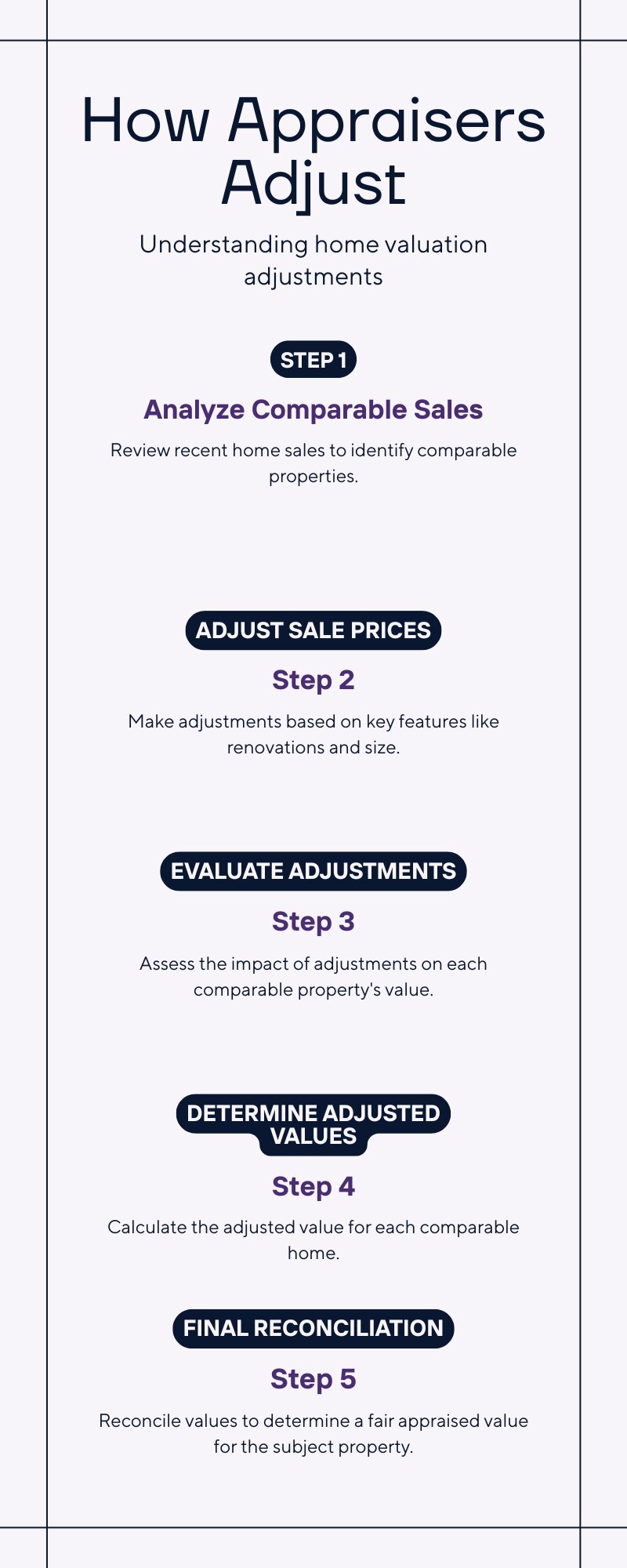
Then comes the adjustment process. If a comp sold with a renovated kitchen your home doesn’t have, the appraiser reduces that comp’s adjusted value. If your home has a finished basement the comp didn’t, an upward adjustment goes in. Square footage, lot size, bedroom count, garage, condition, location factors — all of these get adjusted line by line until the appraiser has a cleaned-up, side-by-side comparison. The final number they land on is the reconciled opinion of value.
Appraisers adjust each comparable sale up or down based on differences in size, condition, upgrades, and location — then reconcile a final value from the range.
The King County Context: Why Appraisals Get Complicated Here
King County has some specific dynamics that affect how appraisals play out, and if you’re buying or selling in this market, it helps to know them going in.
Price velocity creates gaps. In fast-moving sub-markets like Renton, Kent, and Auburn, homes sometimes go under contract above asking price quickly. The problem: appraisers can only use closed sales as comps, not active listings or pending contracts. If prices have moved up in the past 90 days, the closed comps the appraiser pulls may not reflect where the market actually is right now. That’s one of the most common reasons appraisals come in below contract price in competitive conditions — and it’s worth understanding before you’re in a multiple-offer situation. Check out the current King County mortgage rate environment for broader context on what buyers are navigating right now.
Appraisal waivers are a real offer strategy. In multiple-offer situations, buyers sometimes waive the appraisal contingency entirely, or offer an “appraisal gap guarantee” — a commitment to cover a certain dollar amount above the appraised value in cash. This is common enough in King County that sellers and their agents have come to expect it on competitive listings. If you’re a buyer competing for a home and you can’t or won’t waive the appraisal contingency, your offer may lose to one that does — even if your price is the same.
New Washington law (effective January 1, 2026) added a twist for off-market deals. Under RCW 61.40.010, if a buyer makes an unsolicited offer on a property that isn’t listed and the seller has no agent, the buyer must pay for an appraisal and the unrepresented seller has a four-day window to back out after receiving the results. This was designed to protect homeowners from being pressured into below-market off-market sales — a real pattern in King County’s investor landscape.
Appraised value vs. assessed value. King County assessors set assessed values for property tax purposes, and they often lag market value by six to eighteen months. Don’t confuse the assessed value on your property tax statement with what an appraiser will determine. They’re calculated differently and serve different purposes. A home assessed at $680,000 for tax purposes can absolutely appraise at $850,000 in today’s market. If you want to understand the broader tax picture when selling, see our guide to capital gains on home sales in Washington state.
What Happens When the Appraisal Comes In Low
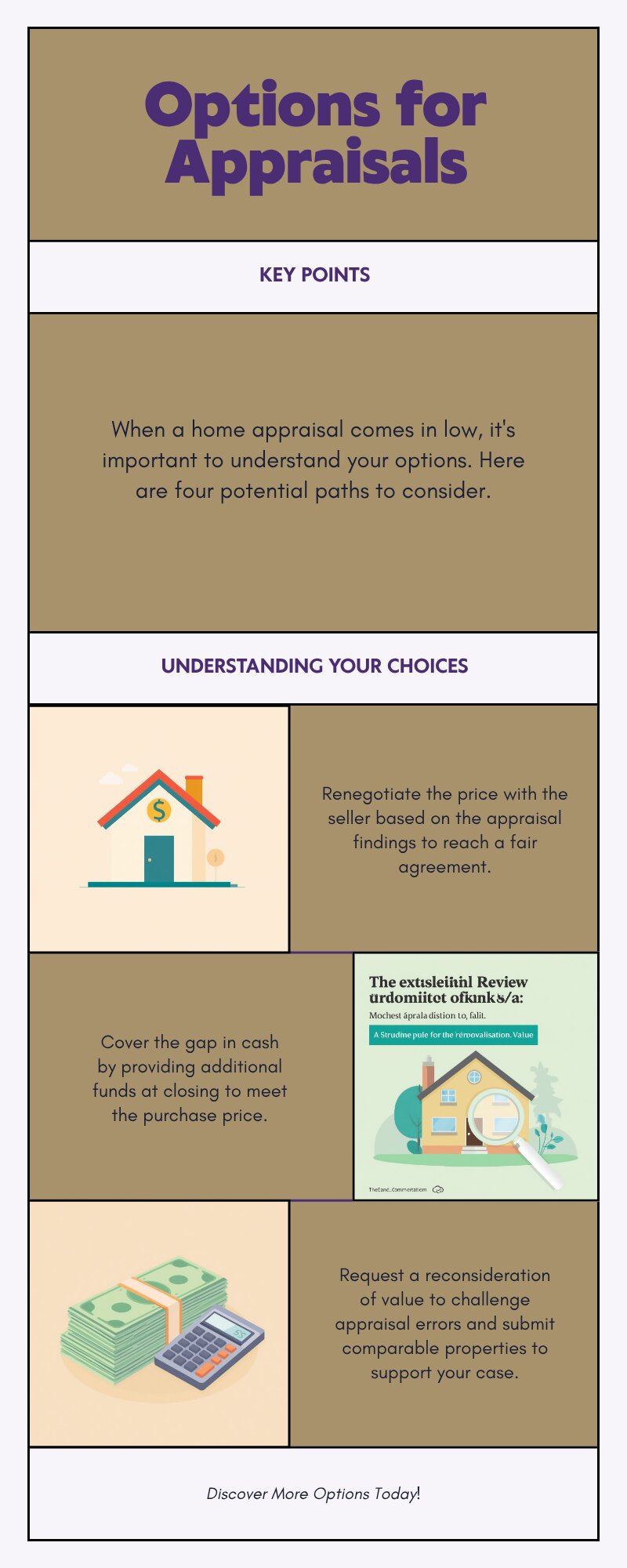
About 8.5% of appraisals come in below the agreed purchase price nationally. In fast-moving markets, that number is higher. When it happens, the lender will only loan based on the appraised value, not the contract price. So if you agreed to pay $900,000 and the appraisal comes in at $860,000, the lender will only underwrite a loan on $860,000. The $40,000 gap has to go somewhere.
Option 1: Renegotiate the Price
The buyer presents the appraisal to the seller and asks them to reduce the price to the appraised value. In a buyer-friendly market, sellers often agree. In a hot market where the seller has backup offers, they may not budge.
Option 2: Cover the Gap in Cash
The buyer brings an additional $40,000 to closing from their own funds to make up the difference. This is the “appraisal gap guarantee” in action. It requires the buyer to have the liquidity to do it.
Option 3: Challenge the Appraisal (ROV)
If the appraiser used weak comps, missed a recent comparable sale, or made a factual error about the property — wrong square footage, missed an update — the buyer’s agent can formally request a Reconsideration of Value (ROV) through the lender. This is not a guarantee of a different number, but legitimate errors do get corrected. Submit recent sales the appraiser missed, document discrepancies, and let the process work.
Option 4: The Last Resort
Cancel the contract. If the buyer has a standard appraisal contingency in place and the gap can’t be resolved, they can cancel and get their earnest money back. This is the protection the contingency provides — and it’s the only option that ends the deal.
A low appraisal doesn’t have to end the deal. Four paths exist — and only one of them means canceling the contract.
How to Protect Yourself as a Seller
A few things sellers can do before the appraiser even shows up:
Make sure the home is clean and accessible. Appraisers aren’t swayed by staging, but physical condition matters. A cluttered, poorly lit home can look worse than it is. An appraiser who can’t access the attic or crawlspace notes it.
Prepare a comp package. Your agent can pull relevant comparable sales and present them to the appraiser at or before the visit. This doesn’t influence the appraiser’s independence — they’ll do their own research — but it ensures they’re aware of strong comps they might otherwise miss, especially if they’re not hyperlocally familiar with your specific neighborhood. See our guide on how to price your home to sell in King County for more on the comp selection process.
Disclose major updates with documentation. New roof, HVAC, kitchen renovation, ADU added — document the dates and costs. Appraisers make upward adjustments for improvements, but they need to know about them. Don’t assume it’s obvious.
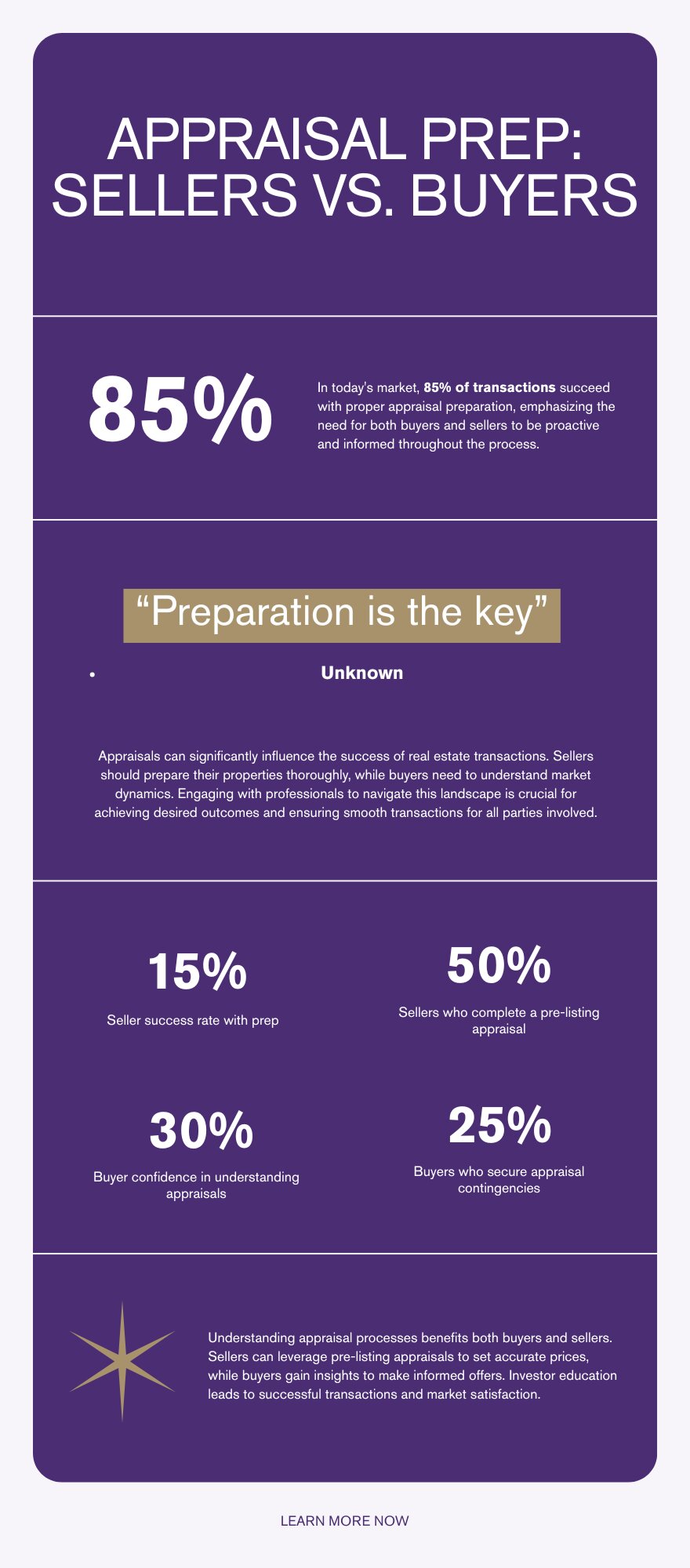
Consider a pre-listing appraisal. For higher-value or unusual properties where standard comps are hard to find, a pre-listing appraisal ($400–$900) gives you an independent data point before you price the home and before a buyer’s lender gets involved. For more on getting your home ready before listing, see how to prepare your home for sale in King County.
How to Protect Yourself as a Buyer
Keep the appraisal contingency in place unless you’re prepared to cover the gap. The contingency exists to protect you. Waiving it means you’re on the hook for the full purchase price no matter what the appraiser says. Only waive it if you’ve done the math on the gap you could realistically face and you’re prepared to cover it.
Understand the difference between appraised value and market value. If ten other buyers are willing to pay $900,000 and the appraisal comes in at $860,000, the market value is arguably closer to $900,000. Appraisals are backward-looking by design — they’re based on what sold, not what competing buyers are currently bidding. In fast-rising neighborhoods, this lag is real and it favors sellers.
Ask your lender about appraisal waivers before you make an offer. Some conventional loan programs (Fannie Mae, Freddie Mac) allow automated valuation models to stand in for a full appraisal under certain conditions — generally when the loan-to-value ratio is low and the data quality is high. If you qualify for a waiver, you avoid the process entirely. Your lender will know whether your specific loan profile qualifies.
Sellers and buyers face different appraisal risks. A few simple steps before the appraiser visits can make a meaningful difference in how the process goes.
What This Means for You in King County Right Now
The King County market in 2026 is more balanced than it was in 2021 and 2022, but it’s not uniform. South King County sub-markets — Renton, Kent, Auburn, Covington — are still moving faster than the county average, with median days on market well under 30. In those conditions, appraisal gaps remain a real possibility, especially on homes priced above $750,000 where comps thin out.
For sellers in those markets, pricing accuracy matters more than ever. A home priced right at market value has a much better chance of appraising at contract price. A home priced at the high edge of the range, hoping for a bidding war, risks the appraisal gap problem — which puts the deal back in negotiation right when you thought it was done.
Frequently Asked Questions
How much does a home appraisal cost in Washington state?
In King County, expect $400–$900 for a standard single-family appraisal. Complex properties, acreage homes, or homes in more rural areas (Black Diamond, Enumclaw) may run higher. The buyer pays the appraisal fee as part of closing costs.
How long does an appraisal take in Washington state?
The appraiser typically completes the site visit within one to two weeks of the purchase agreement being signed. The written report usually comes back three to seven business days after the visit. Total time from contract to receiving the appraisal: roughly two to three weeks.
Can a seller refuse to let an appraiser in?
Technically yes, but refusing the appraisal kills the buyer’s financing and ends the deal. Under the terms of most purchase agreements, the seller is expected to provide reasonable access. A refusal to cooperate is effectively a decision to blow up the transaction.
What is a Reconsideration of Value (ROV) in Washington?
An ROV is a formal request to the lender asking the appraiser to reconsider the value based on new information — comparable sales the appraiser missed, factual errors in the report, or evidence the adjustments were unreasonable. It does not guarantee a different outcome, but it is a legitimate tool when the original report contains real errors or omissions.
What’s the difference between appraised value and assessed value in King County?
Assessed value is set by the King County Assessor’s office for property tax purposes and typically lags market value by six to eighteen months. Appraised value is determined by a licensed appraiser for a lending transaction, using current comparable sales. They’re calculated differently and serve different purposes. Don’t use your property tax statement to set your list price.
Do appraisals expire?
Yes. Most lenders will only accept an appraisal completed within 120 days (four months) of the loan closing date. If your deal takes longer than expected, the lender may require a reappraisal or an update to the original report.
The appraisal doesn’t have to be the part of the transaction that surprises you. If you’re selling, a solid pricing strategy from the start gives you the best shot at a clean appraisal. If you’re buying, understanding your options before you’re in contract — not after the number comes back low — puts you in control of what happens next.


 Facebook
 X
X
 Pinterest
 Copy Link