

 Facebook
 X
X
 Pinterest
 Copy Link
King County Condo Buyer Guide 2026 | What to Know

A step-by-step guide to HOA due diligence, warrantable financing, and what to inspect — written for first-time buyers entering the King County condo market.
If you are thinking about buying a condo in King County, 2026 is an interesting time to do it. Active condo listings on the Eastside are up more than 40% compared to last year. That means more options, more time, and more leverage than buyers had just 12 months ago. But the market shifting in your favor does not mean every condo is a good deal. The wrong one can cost you your financing, your down payment flexibility, and years of headaches tied to a poorly run HOA.
I have been pricing properties in East and South King County every day for over 9 years as a BPO field agent. I walk into condos that look great on Zillow and flag problems that would not show up until after you close. This guide covers everything a first-time condo buyer in King County needs to know before making an offer.
What Makes Condos Different to Buy (and Finance)
A condo is not just a smaller version of a house. When you buy a condo, you own your individual unit — usually defined as the “airspace” inside the walls — plus a fractional share of the common areas. The hallways, the roof, the parking structure, the elevators: you own a piece of all of it, along with every other owner in the building.
That shared ownership is why lenders treat condos differently. They are not just evaluating you as a borrower. They are evaluating the entire building and its homeowners association. A lender can approve your income, your credit score, and your down payment — and still decline your loan because the HOA has financial problems.
This is the part most first-time condo buyers do not expect, and it is why starting with the right questions matters.
Warrantable vs. Non-Warrantable: The Financing Split That Changes Everything
The single most important financing question in any condo purchase is whether the building is warrantable or non-warrantable. Here is what that means in plain terms.
Warrantable condos meet the guidelines set by Fannie Mae and Freddie Mac. These are the government-sponsored enterprises that back most conventional mortgages in the United States. When a building qualifies as warrantable, buyers can use standard conventional loans, FHA loans, and VA loans. Interest rates are standard. Down payments can be as low as 3% with some programs.
Non-warrantable condos do not meet those guidelines. Buyers are pushed into portfolio loans — products held by the lender rather than sold to Fannie or Freddie. These typically require 20–30% down and carry interest rates 1–2 percentage points higher than conventional financing. On a $500,000 condo, that rate difference adds roughly $500–600 per month to your payment.
For 2026, there is a specific rule change worth knowing. By January 2027, HOAs must allocate at least 15% of their annual budgeted assessment income to their reserve fund — up from the longstanding 10% minimum. Buildings that fall short lose warrantable status. When you are shopping for a condo right now, you are evaluating buildings that may be in the middle of adjusting to this change, or ignoring it entirely.
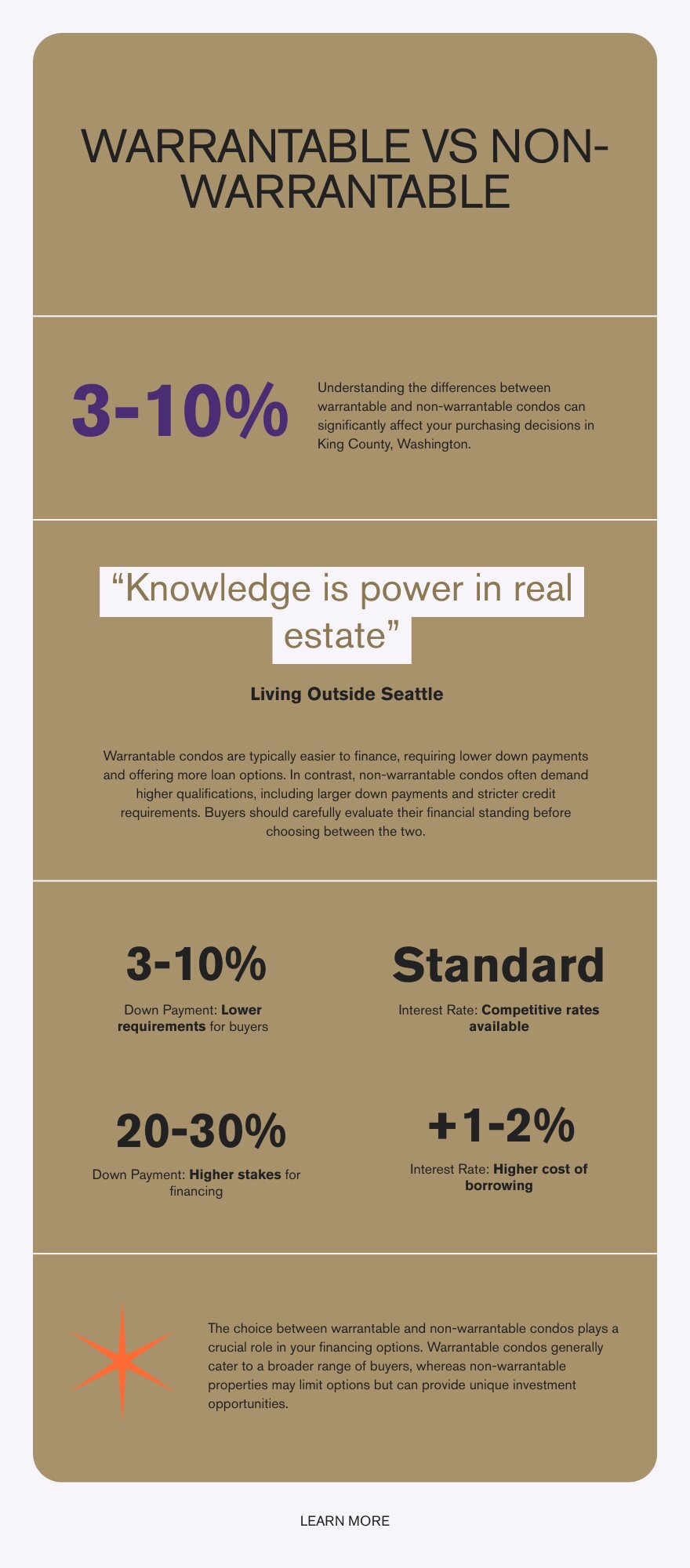
Warrantable condos open the door to conventional and FHA financing — non-warrantable buildings push buyers into portfolio loans with higher rates and larger down payments.
What disqualifies a building from warrantable status? The main triggers include: the HOA reserve fund falling below 10% of the annual budget (now moving to 15%), more than 15% of owners being delinquent on dues, a single investor owning more than 20% of the units, more than 35% of the building being used for commercial purposes, and ongoing or threatened litigation against the HOA.
Ask your agent to request the condo questionnaire — also called the HOA certification or lender questionnaire — before you write an offer. This document discloses the reserve balance, delinquency rate, pending litigation, and owner-occupancy percentage. If a seller or listing agent resists providing it, treat that as a warning sign.
HOA Due Diligence: What to Actually Read
The HOA package — sometimes called the resale certificate, disclosure packet, or condo docs — is a stack of documents you will receive after going under contract. In Washington State, sellers are required to provide it, and you typically have a review period to back out if you find something concerning.
Most buyers skim it. That is a mistake. Here is what actually matters:
The Reserve Fund Study
This is a professional assessment of the building’s major systems — roof, elevators, parking structure, plumbing, windows — and how much money the HOA should have saved to replace them on schedule. A well-run HOA commissions one every three to five years. If the building is 20 years old and there is no reserve study, or if the study shows the fund is significantly underfunded, you are looking at the possibility of special assessments in your future.
Special assessments are one-time charges that all owners must pay when the HOA does not have enough reserves to cover a major repair. These can run $5,000, $15,000, even $30,000 per unit for things like roof replacements and elevator overhauls — and they happen regularly in buildings with underfunded reserves.
Meeting Minutes from the Past Two Years
Board meeting minutes are where you find the real story. Look for repeated complaints about the same issue, deferred maintenance discussions, arguments over raising dues, or mentions of legal action. A building with the same roof leak showing up in 18 consecutive meeting minutes has a problem the financials may not fully capture.
Two years of minutes gives you a solid picture of how the board actually operates — not just what they say in the official documents.
The Budget, Dues, and Rental Rules
Check whether the HOA has raised dues recently, and whether dues cover reserves adequately. Artificially low dues often mean the HOA is avoiding necessary increases — which leads to larger special assessments later. Compare dues to similar buildings in the area. A number that looks suspiciously low usually is.
Also check rental cap rules. Some buildings limit the percentage of units that can be rented at any time. If you ever plan to rent your unit, this matters. FHA loans also require the building to be on HUD’s approved condo list — your lender can check this quickly.
For a deeper dive on what to check in the HOA docs, the King County Condo Due Diligence Checklist goes through this line by line.
What a Condo Inspection Covers (and What It Misses)
A standard home inspection is designed for a single-family house where the inspector can access the roof, crawl space, attic, and all the mechanical systems. A condo inspection is different — and more limited.
Your inspector will cover what is inside your unit: the HVAC (if it is individual to your unit), the electrical panel, plumbing fixtures, windows, doors, and visible water damage. They will typically inspect the balcony and any storage spaces assigned to your unit. What they cannot fully assess: the building’s shared systems, the roof, the structural elements, or common area mechanical equipment.
That is why the HOA documents and the reserve study matter so much. The inspection tells you about your unit. The HOA documents tell you about the building. You need both.
A few things worth flagging during your condo inspection specifically:
Soundproofing between units. This is not a safety issue, but it matters enormously to quality of life. Bring a friend, have them stomp around upstairs while you listen from below.
Water intrusion around windows and exterior walls. Condo buildings in the Pacific Northwest are prone to moisture issues. Look for staining, soft drywall near windows, or any history of water claims in the HOA meeting minutes.
HVAC type. Some older King County condo buildings use central HVAC controlled by the HOA. Others have individual mini-split or forced-air systems in each unit. If it is individual, it is your responsibility to maintain and replace. Know what you are buying before you close.
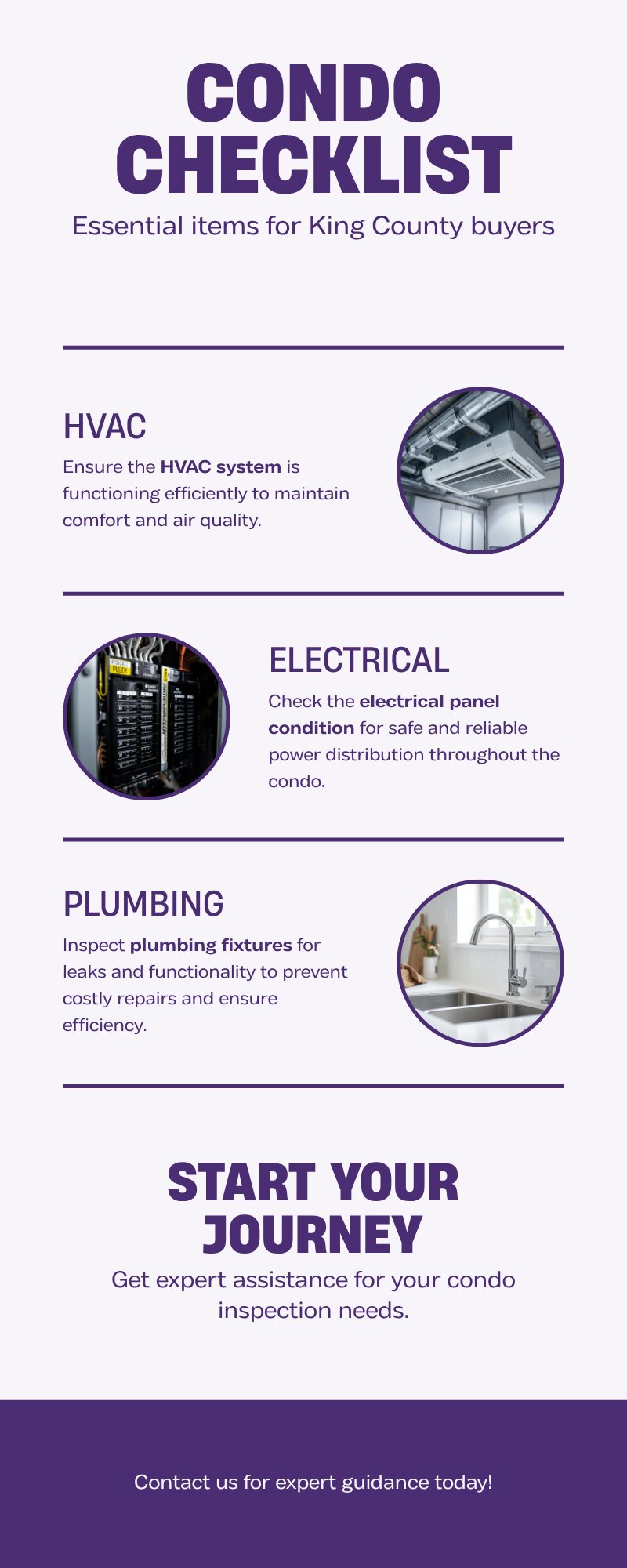
A standard home inspection covers your unit. The HOA documents cover the building. You need both before you close on a King County condo.
The King County Condo Market Right Now
King County condo prices have held more steady than single-family homes in 2026, but the market has shifted toward buyers. Active condo listings on the Eastside are up more than 40% year over year as of spring 2026. More supply means more negotiating room — on price, closing costs, and seller-paid concessions.
In South King County — Kent, Auburn, Renton — condos remain some of the most accessible entry points in the county. Depending on the city, you can find units in the $350,000–$500,000 range, well below the King County median of $835,000 for all residential property types. For buyers using down payment assistance programs, these price points make a real difference in what you can qualify for.
The current rate environment also affects condo buyers differently than house buyers. If you are using conventional financing on a non-warrantable building, your effective rate goes up significantly — which is why building status matters as much as your personal loan qualification. King County’s conforming loan limit for 2026 is $1,063,750, so most condo purchases in South King County fit comfortably within conventional limits.
First-Time Buyer Programs That Work for Condos
If you are a first-time buyer — meaning you have not owned a home in the past three years — several programs in Washington State work for condo purchases.
The WSHFC Home Advantage Program pairs a 30-year fixed-rate mortgage (conventional, FHA, VA, or USDA) with a below-market interest rate. It also offers down payment assistance up to 4% of the first mortgage amount as a 0% interest, 30-year deferred loan — repayable when you sell or refinance. Income limits apply: for King County, the cutoff is $180,000 for 2026. Minimum credit score is 620 (640 for some loan types). You must use a WSHFC-approved lender.
For a side-by-side comparison of condo versus single-family ownership costs — including what HOA dues do to your total monthly payment — the Condo vs. Townhouse vs. Single-Family guide covers the real numbers for King County buyers.
What This Means for You as a King County Condo Buyer
Buying a condo in King County in 2026 is genuinely doable — especially in South King County where price points are accessible and buyer leverage is higher than it has been in years. But it requires a different checklist than buying a house.
Start with the financing question before you fall in love with a unit. Get your agent to pull the condo questionnaire early. If the building is non-warrantable, run the math on what that does to your monthly payment before you invest time in inspections and negotiations.
Read the HOA documents yourself, not just the summary. The meeting minutes are where problems hide. If the reserve fund is below 10% of the annual budget — and especially below the new 15% target — build that risk into your offer price or walk away.
Hire an inspector who has experience with condos specifically. Ask them directly whether they check for water intrusion at the building envelope, not just inside the unit. And use state programs if you qualify — the WSHFC income limit is $180,000 for King County, which is higher than most people assume.
Frequently Asked Questions
What is the difference between a warrantable and non-warrantable condo in King County?
A warrantable condo meets Fannie Mae and Freddie Mac guidelines, which means buyers can use standard conventional or FHA financing with low down payments. A non-warrantable condo does not meet those guidelines — typically because of low HOA reserves, high investor concentration, or pending litigation — and buyers are limited to portfolio loans requiring 20–30% down at higher rates.
How much are condo HOA dues in King County?
HOA dues vary widely by building age, size, and amenities. In South King County, dues commonly run $300–$600 per month for a standard condo. Eastside buildings with more amenities often run $500–$900 or more. Always verify what dues cover — some include water, sewer, and garbage while others cover only exterior maintenance and reserves.
Can I use an FHA loan to buy a condo in King County?
Yes, but the building must be on HUD’s FHA-approved condo list, or you can apply for single-unit (spot) approval. Your lender can check FHA approval status in minutes. Not all King County condos qualify, so this is worth checking early in your search rather than after you find a unit you like.
What is a condo reserve study and why does it matter?
A reserve study is a professional assessment of a building’s major systems and how much the HOA should have saved to replace them on schedule. A well-funded reserve means lower risk of special assessments — unexpected lump-sum charges to all owners when the HOA needs money for a major repair. Ask for the most recent reserve study in the HOA documents.
Do condo buyers in King County qualify for down payment assistance?
Yes. The WSHFC Home Advantage Program works for condo purchases and offers DPA up to 4% of the loan amount as a 0% deferred loan. Income limits are $180,000 for King County buyers in 2026. The building still must meet standard financing requirements for the underlying loan type — DPA does not change warrantable status.
What should I look for in condo HOA meeting minutes?
Look for recurring complaints about the same issue, deferred maintenance discussions, disputes over raising dues, mentions of legal action against the HOA or individual owners, and references to upcoming special assessments. Two years of minutes gives you a solid picture of how the board actually operates versus what the official financials show.
A condo can be a smart first step into King County homeownership — especially in today’s market, where inventory is up and sellers are more willing to negotiate than they were two years ago. The key is knowing what you are actually buying: your unit, your share of the building, and your exposure to how the HOA is run.
Have questions before you make an offer? Reach Greg at greg@livingoutsideseattle.com or 253-350-0045.
Your guide to life outside Seattle.
253-350-0045 ·
greg@livingoutsideseattle.com ·
www.livingoutsideseattle.com
Condo vs Townhouse vs Single-Family in King County
You’ve got three completely different products at three completely different price points. Here’s what actually separates them — and which one fits your situation in King County right now.
When most buyers start looking at homes in King County, they type a budget into Redfin and let the results decide the property type for them. That usually works fine until they’re deep into a transaction and suddenly discover that their condo doesn’t qualify for the loan they planned on, or that the townhouse HOA has a pending special assessment they didn’t know about.
The property type decision matters a lot more than most people realize. It affects what you pay every month, how quickly you can sell when the time comes, what your lender will let you borrow, and what you’re actually responsible for maintaining. I’ve walked buyers through all three, and the ones who end up happiest are almost always the ones who understood the differences before they started shopping — not after.
So here’s the full comparison. Condos, townhouses, and single-family homes. What you own, what you pay for, how they appreciate, how they finance, and who each one is actually right for in the King County market.
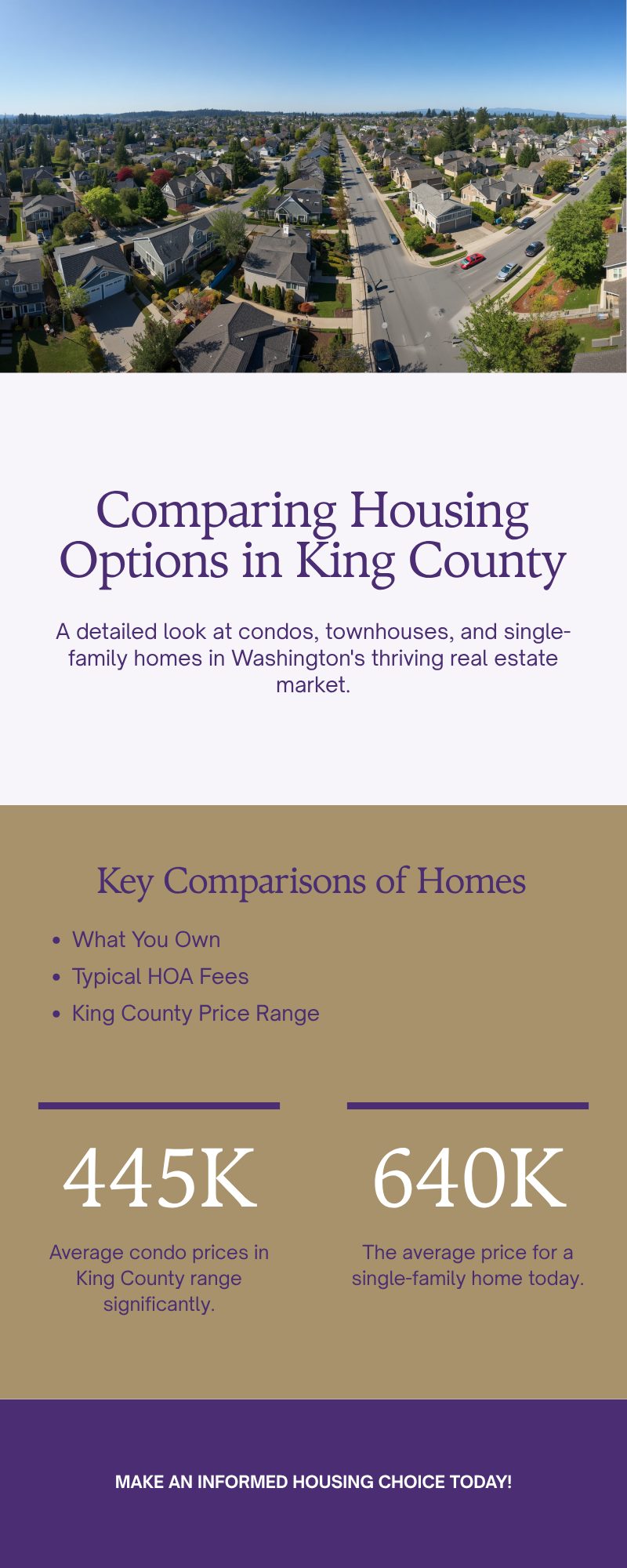
Property type comparison for King County buyers — ownership structure, HOA fees, and who each is right for.
What You Actually Own
This is where most people have fuzzy thinking, and it matters more than any other single factor.
Single-Family Home
When you buy a single-family home, you own the building and the land underneath it. Full stop. No HOA involved in most cases, though some planned neighborhoods do have one for shared amenities. If the roof leaks, that’s on you. If you want to paint the front door a different color, go for it. Your lot is yours to build a deck on or plant a garden in. That full ownership is exactly what makes SFHs appreciate the way they do. Land in King County is genuinely scarce, and land ownership transfers that value directly to you.
Townhouse
When you buy a townhouse, you typically own the structure and the land it sits on. Townhouses in King County are usually fee-simple, meaning you own your unit from the ground up. You share walls with neighbors, and there’s usually an HOA covering the common areas — shared driveways, landscaping, maybe a small courtyard. But the land is yours. That’s a meaningful difference from a condo, and it means townhouse appreciation tends to track closer to single-family than to condo over time.
Condo
When you buy a condo, you own the interior of your unit and a share of common areas. The land, the roof, the exterior walls, the lobby — all of that belongs to the HOA. Maintenance of those shared elements comes out of your monthly dues and out of a reserve fund that the HOA is supposed to be building over time. That arrangement is convenient right up until the roof needs replacing and the reserve fund is underfunded. More on that below.
The Price Gap Is Real in 2026
In King County as of early 2026, you’re looking at roughly these price ranges depending on what you’re buying and where.
Single-family homes in South King County — Renton, Kent, Auburn, Maple Valley — are running between $640,000 and $850,000 for typical resale product. The countywide median is hovering around $880,000. Anything under $600K in the SFH category tends to be smaller footprints or locations where the trade-off is commute time or school district.
Townhouses in those same South King County cities are typically coming in between $450,000 and $650,000. New construction townhomes near light rail corridors or in Kent’s East Hill area have been active in the $500K–$600K range. They’re a real path for buyers who want a two-car garage and a backyard without the $800K price tag.
Condos are the most variable. King County’s condo median dropped sharply — from around $690,000 in early 2025 to closer to $445,000–$577,000 in early 2026, depending on location. That’s a significant decline driven by a real imbalance in supply and demand for condos right now. More inventory, softer buyer demand, and a financing environment that makes condo purchases harder have all contributed. If you want to understand what current mortgage rates mean for your monthly payment across these price ranges, that post walks through the exact math.
How They Finance — This Is the Part That Surprises People
Financing a single-family home is the most straightforward of the three. Conventional loans, FHA, VA — all of these work with minimal restrictions. With strong credit and 3–5% down, you can access the full range of loan products.
Townhouses generally finance similarly to single-family homes, with one caveat. If the townhouse is part of a condo regime — meaning the ownership is structured legally as a condo even though it looks like a townhouse — lender scrutiny increases. Always ask your agent how the title is structured before assuming it finances like an SFH.
Condos are where financing gets genuinely complicated, and buyers often don’t find out until they’re already in contract.
Lenders classify condos as either warrantable or non-warrantable. A warrantable condo meets guidelines set by Fannie Mae and Freddie Mac — the HOA is financially healthy, owner-occupancy is above a certain threshold, no single entity owns too large a percentage of units, and the building isn’t in litigation. Those loans behave pretty normally. The interest rate runs about 0.125–0.375% higher than a comparable SFH purchase, and you can put as little as 3–5% down with good credit.
A non-warrantable condo is a different story. These are condos that don’t meet those standards — maybe the rental occupancy is too high, or the HOA has pending litigation, or the reserve fund is critically underfunded. Lenders who will touch these at all typically require 20–25% down and charge rates 0.5–1.5% higher than the warrantable equivalent. Some lenders won’t touch them at all.
HOA Fees and Hidden Costs: What to Actually Look For
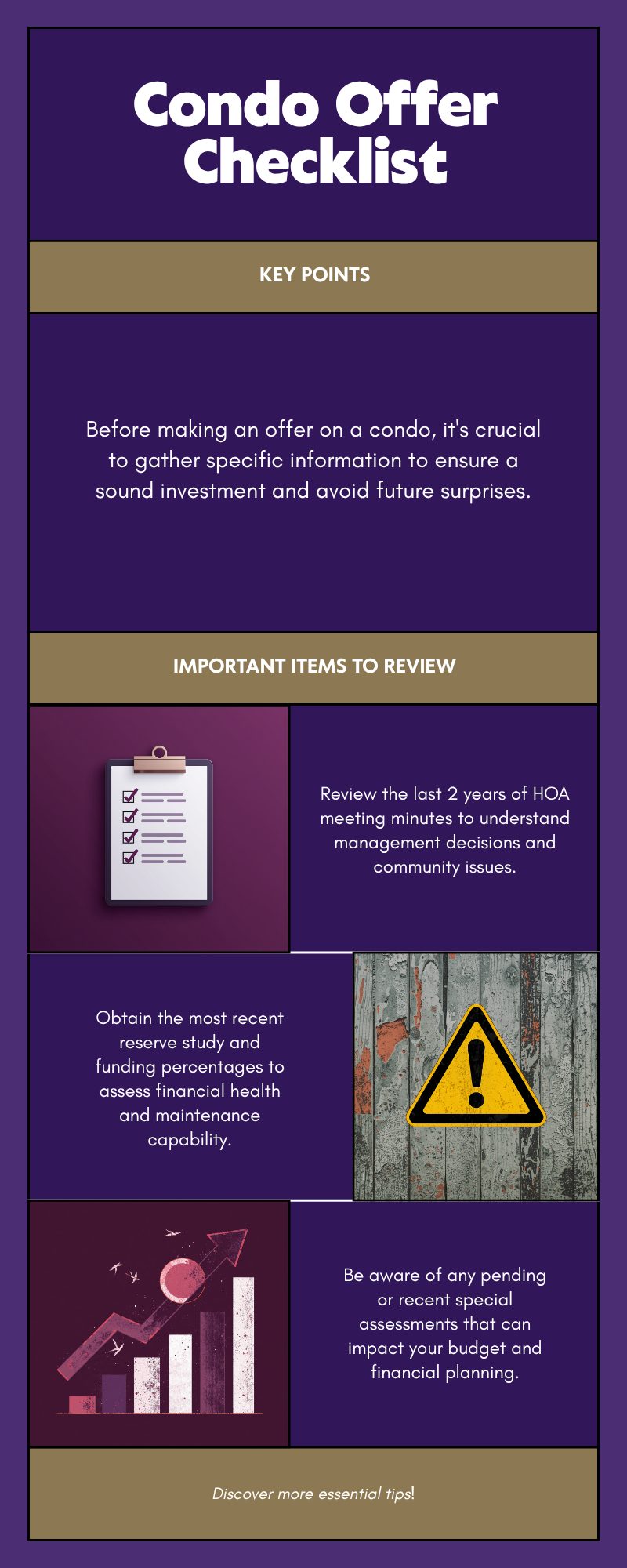
Request these documents before you make an offer on any condo in King County.
Every property type can have an HOA, but the nature and risk of HOA involvement varies considerably.
For single-family homes in planned communities, HOA fees tend to be modest — often $50–$150/month — and cover things like neighborhood common areas or a community pool. These are relatively low-risk from a special assessment standpoint as long as there aren’t major shared structures.
Townhouse HOAs typically run $200–$500/month in King County and cover shared exterior maintenance, landscaping, and common areas. The key question is: what exactly is the HOA responsible for? Some townhouse HOAs cover roof and siding; others leave the exterior entirely to you. Read the CCRs before you make an offer.
Condo HOAs carry the most complexity. Downtown Seattle condos can run $400–$1,000+/month. South King County condos tend to be lower — $250–$550/month — but can spike with age and deferred maintenance. And that brings us to the single biggest risk most condo buyers underestimate: the special assessment.
Washington State law (RCW 64.34.380 for condos) requires HOAs to conduct reserve studies and update them annually. A well-funded HOA sets aside money every month to cover large future expenses — roof replacement, elevator service, parking structure repairs. When an HOA is underfunded, it can’t pay for those repairs out of reserves. The result is a special assessment: a one-time charge to every unit owner, sometimes running $5,000–$30,000+ per unit.
Before you make an offer on a condo, request the last two years of HOA meeting minutes, the most recent reserve study, and the current percent-funded figure. If the reserve study shows less than 70% funding and the minutes mention deferred maintenance or upcoming projects, factor a special assessment into your budget. If they won’t provide these documents, that’s your answer.
Appreciation Patterns: Which One Builds Wealth Faster?
This is the question every buyer wants a clean answer to, and the honest answer is that it depends on time horizon and what you’re comparing.
Single-family homes in King County have the strongest long-term appreciation track record, driven primarily by land scarcity. As the region has grown, land in South King County has become more constrained. Homes in Renton, Maple Valley, and Auburn have all seen substantial appreciation over the last decade. In May 2026, single-family inventory in King County was tight enough at 2.8 months of supply to support pricing stability, with homes selling at 101.9% of list price on average. My East and South King County market update has the current numbers.
Townhouses tend to appreciate in line with or slightly below SFH rates, depending on the product. New construction townhomes near transit corridors have performed well as demand for lower-maintenance, urban-adjacent living has grown. Fee-simple townhouses — where you own the land — typically hold value better than leasehold or condo-regime townhouses.
Condos are the most volatile of the three. The sharp drop in King County condo prices in 2025–2026 illustrates this clearly. Condos have periods of strong appreciation, particularly during high-demand, low-inventory cycles, but they also fall harder when demand softens. The oversupply of condo inventory right now, combined with the financing friction around non-warrantable buildings, has pushed prices down in ways that SFH and townhouse buyers haven’t experienced. That said, the current condo pricing environment does present a genuine opportunity for buyers who do the due diligence. Buying at a cyclical low in a well-run building in a strong location can produce solid returns. The key word is “well-run.”
The King County Local Angle: How Each Property Type Plays Out Here
South King County gives you examples of all three property types at accessible prices, and the differences matter more in this market than national averages suggest.
In Renton, you’ll find a mix of SFH in the $650K–$850K range, townhomes clustered near the Renton Highlands and Landing area in the $450K–$600K range, and condos in the Renton downtown corridor that have come down considerably in price. The light rail connection at the Renton Transit Center has increased buyer interest in Renton townhouses specifically. If you’re buying in Renton and considering a condo, the warrantability question is especially relevant — several Renton condo buildings are older and require careful reserve fund scrutiny. The Living in Renton guide covers the full neighborhood breakdown.
In Kent, townhomes in the $450K–$550K range have been some of the more active product in 2026. The first-time buyer guide for Kent covers the buy-now-vs-wait math that many Kent buyers are working through, and townhomes tend to be the property type that makes that math work at current rates.
In Auburn and Maple Valley, single-family homes still dominate the inventory. Townhouse product exists but is more limited. If you’re drawn to these communities for the school districts and neighborhood feel, the calculus often pushes toward SFH even if it means stretching the budget a bit further.
East King County — Issaquah, Bellevue, Sammamish — has a strong townhouse market particularly in the Issaquah Highlands and Talus communities, where mixed-use development has produced a large supply of attached product. These are generally well-maintained and have active HOAs with healthy reserves, but due diligence still matters.
What This Means for You as a Buyer
If you’re a first-time buyer in South or East King County in 2026, here’s the practical framework I’d use.
Budget Under $500,000
You’re likely looking at condos or newer townhomes. Condos offer the lowest purchase price but require more due diligence. Prioritize buildings with healthy reserves and warrantable financing status. If you can get into a well-run building at today’s discounted prices, you’re buying in at a favorable point in the condo cycle.
Budget $500,000–$700,000
Townhouses become your primary option for getting into ownership with land included. New and newer construction townhomes in Kent, Renton, and Federal Way fit this range. Prioritize fee-simple structures over condo-regime townhouses, and read the HOA docs before you fall in love with a floor plan.
Budget $700,000+
Single-family homes in South King County become realistic. You’ll find the strongest appreciation track record and the simplest financing path. The trade-off is less lock-and-leave convenience and more maintenance responsibility.
Frequently Asked Questions
What is the difference between a condo and a townhouse in King County?
A condo is a unit in a shared building where you own the interior space and a share of common areas. A townhouse is usually a multi-level attached home where you own the structure and the land it sits on. This difference in land ownership typically makes townhouses appreciate more like single-family homes and finance more like them too.
Is it harder to get a loan for a condo than a house in King County?
Yes, generally. Condos face additional lender scrutiny around HOA financial health, owner-occupancy ratios, and reserve fund adequacy. If a condo is classified as non-warrantable, you’ll typically need a larger down payment and accept a higher interest rate. Single-family homes and fee-simple townhouses don’t have this additional layer of review.
Are condos a good investment right now in King County?
Condo prices dropped significantly in 2025–2026, which means buyers who do careful due diligence can potentially buy at a cyclical low. The risk is that you’re buying into a shared financial structure (the HOA), so the quality of the building’s finances matters as much as the unit itself. In a well-run building, current pricing represents a real opportunity. In a poorly funded building, you’re taking on someone else’s deferred maintenance.
How much are HOA fees for condos vs. townhouses in South King County?
Condo HOA fees in South King County typically run $250–$550/month for older and mid-range buildings. Townhouse HOAs tend to be lower — $150–$400/month — and generally cover less exterior maintenance. Downtown Seattle and Eastside condos can run $400–$1,000+/month. Always include HOA dues in your monthly payment calculation when comparing properties.
What is a reserve fund and why does it matter when buying a condo?
A reserve fund is the HOA’s savings account for large future repairs — roof replacement, elevators, structural work. Washington State requires condos to conduct reserve studies and update them annually. If the reserve fund is significantly underfunded (below 70% of what it should hold), the risk of a special assessment increases. Special assessments are one-time charges to all unit owners that can run thousands to tens of thousands of dollars.
Can I use an FHA loan to buy a condo in King County?
Yes, but the condo building must be on the FHA-approved list. FHA imposes strict requirements on owner-occupancy rates, commercial space ratios, and HOA financial health. Search the HUD database to check a specific building’s approval status before getting too far into the transaction.
The property type you choose is one of the first big decisions in the buying process, and it shapes everything that follows — financing, monthly costs, what you maintain, and what you eventually sell. Understanding the differences upfront saves a lot of mid-transaction surprises.
Your guide to life outside Seattle.
253-350-0045 ·
greg@livingoutsideseattle.com ·
www.livingoutsideseattle.com
