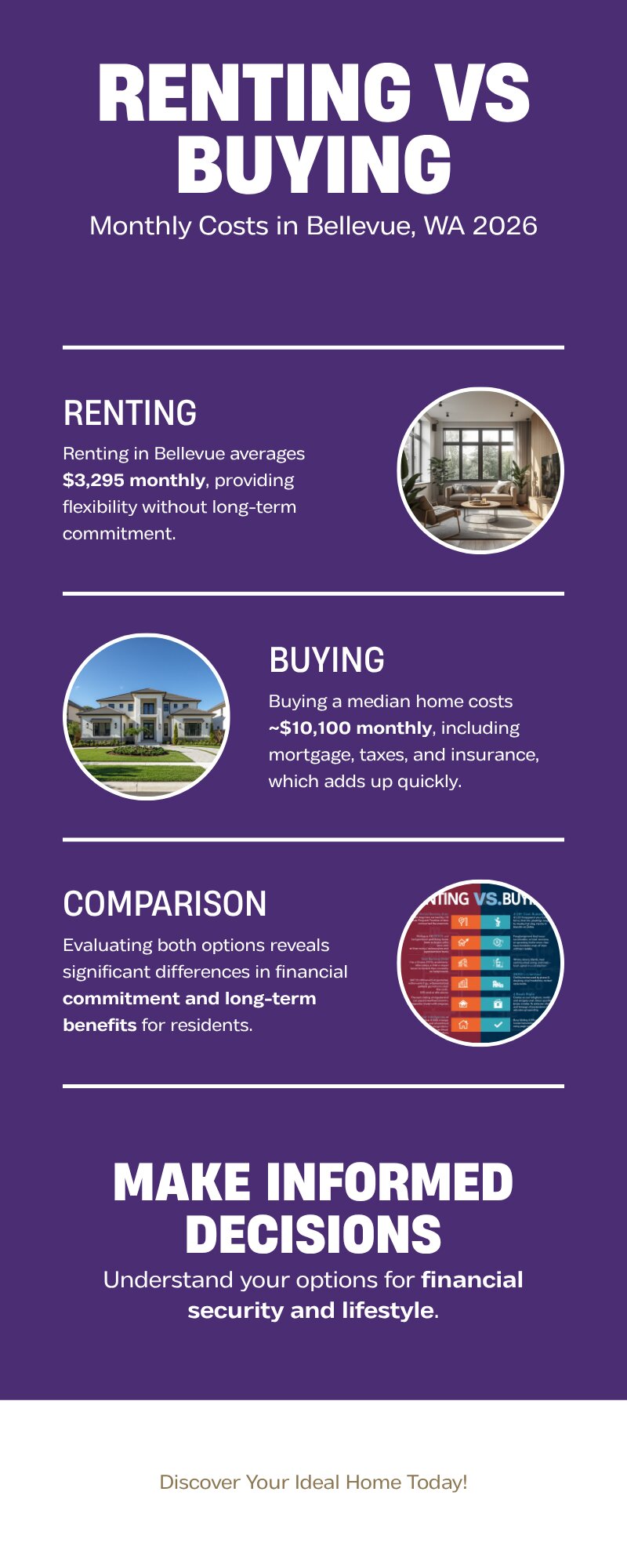
Is staying a Bellevue renter actually costing you more than a mortgage? The math is more complicated than your landlord thinks — here’s the honest breakdown.
If you’re renting in Bellevue right now, someone has probably told you that you’re throwing money away. And someone else has probably told you that buying a $1.5 million home at 6.5% is financial suicide. Both arguments have merit. Neither one gives you a complete picture.
I work in King County real estate every single day, and the rent vs. buy question in Bellevue is one of the most nuanced I get. The city has some of the highest home prices in Washington — and some of the highest rents too. That changes the math compared to a typical analysis. What I’ll walk you through here is the actual 2026 cost comparison: what you’re paying as a renter, what you’d pay as a buyer, where the break-even point actually sits, and what DPA programs exist for buyers at Bellevue price points.
What Bellevue Renters Are Actually Paying in 2026
Bellevue rents have softened slightly from their peak — but they’re still among the highest in Washington State. Here’s where the market sits right now:
A one-bedroom apartment in Bellevue runs roughly $2,485–$2,889/month depending on the neighborhood and building. A two-bedroom ranges from $3,135 to $4,389/month. The city-wide average across all unit types is around $2,717/month, down about 1.25% from last year.
Downtown Bellevue and the Bel-Red corridor sit at the top of that range. You’ll find more affordable options on the Bellevue-Redmond border or near Factoria, but even those aren’t cheap. Bellevue rents run roughly 54% above the U.S. average.
For a renter in a two-bedroom apartment paying $3,295/month, that’s $39,540 per year going to a landlord. Over five years, that’s $197,700. Over ten years, that’s $395,400 — and rent almost certainly increases at least 2–3% per year, so the real ten-year number is closer to $440,000–$460,000.
That number sounds alarming. But before you run out and make an offer, let’s look at what ownership actually costs.
What Buying in Bellevue Actually Costs in 2026
The median sale price in Bellevue is approximately $1.45–$1.6 million depending on the data source and month. For this comparison, I’ll use $1.5 million as a workable midpoint — which is consistent with recent Redfin data.
Here’s the monthly ownership math on a $1.5M home with 20% down ($300,000):
Monthly Cost Breakdown: Owning a $1.5M Bellevue Home
Maintenance reserve (1% of value/year): ~$1,250/month
Total estimated monthly cost: $9,972–$10,335/month
Monthly cost breakdown based on $1.5M median home, 20% down, 6.5% 30-year fixed rate, plus property taxes and maintenance reserve. Source: Redfin, King County Assessor, 2026.
That’s a significant gap from what most two-bedroom Bellevue renters are paying. Even if you’re in a premium $4,400/month two-bedroom, you’re looking at nearly $6,000 less per month than full ownership costs on the median Bellevue home.
What If You Put Less Down?
Most first-time buyers in Bellevue can’t put $300,000 down. If you put 10% down ($150,000) instead, your loan becomes $1,350,000 and your P+I payment climbs to approximately $8,534/month — plus you’d pay PMI (roughly $200–$300/month) until you reach 20% equity. Total monthly cost: $10,200–$10,800+.
The 5% down scenario is even more expensive on a monthly basis, which is why a lot of Bellevue renters who could technically qualify for a mortgage decide to keep renting while they save.
The Break-Even Question: When Does Buying Win?
Here’s the honest answer: at current Bellevue prices and mortgage rates, the break-even horizon is long.
The price-to-rent ratio in Bellevue tells a lot of the story. Take the median home price of $1.5M and divide it by annual rent for a comparable space — say $48,000/year for a two-bedroom. That’s a price-to-rent ratio of about 31. Financial analysts generally say ratios above 25 favor renting. Bellevue is well above that.
Studies of comparable high-cost West Coast markets (Seattle, Portland, Los Angeles) put the typical break-even timeline at 16–23 years when factoring in total costs — mortgage interest, property taxes, maintenance, transaction costs on both ends, and lost investment returns on the down payment. In Bellevue, where prices are higher even than broader Seattle, the honest break-even is likely on the longer end of that range for buyers who aren’t putting at least 20% down.
Down Payment Assistance for Bellevue Buyers
One factor that changes the math: down payment assistance. Bellevue buyers have access to real programs — though at Bellevue price points, most DPA programs hit their purchase price limits quickly.
Here’s what’s available right now:
ARCH East King County DPA
The most Bellevue-specific program available. Provides up to $50,000 in deferred-loan down payment assistance for first-time buyers in East King County — including Bellevue and Kirkland. Income limits are set at 80% of Area Median Income. Given Bellevue’s high AMI, many buyers qualify on income even with solid salaries.
WSHFC Home Advantage
Washington State’s primary DPA program offers up to 4% of the loan amount as a second mortgage for down payment and closing costs. On a $1.2M loan, that’s up to $48,000 — meaningful, but it doesn’t close the gap on a 20% down payment.
WSHFC Opportunity DPA
Up to $15,000 for buyers under the income limits. More targeted toward the $400K–$750K purchase price range; income limits may restrict eligibility at median Bellevue prices.
Down payment assistance programs available to Bellevue-area buyers as of June 2026. Income and purchase price limits apply. Contact a WSHFC-approved lender for current eligibility.
The honest reality: most DPA programs work best in the $400K–$750K purchase price range. Bellevue’s median is double that. But for buyers targeting condos or smaller attached homes in the $650K–$900K range — which do exist in Bellevue — DPA can be a genuine option. Check out our full breakdown of King County down payment assistance programs for current eligibility details.
The King County Angle: Condo Entry Points in Bellevue
If the $1.5M median feels out of reach, Bellevue condos are a different conversation. The King County condo median sits around $550,000–$650,000 citywide, and Bellevue has options in that range — particularly in the Bel-Red corridor and parts of East Bellevue.
At $650,000 with 10% down ($65,000), the monthly P+I at 6.5% is approximately $3,700. Add property taxes (~$406/month), insurance (~$100/month), HOA (varies — budget $400–$700/month for a newer building), and you’re looking at roughly $4,600–$5,000/month total. That compares much more closely to what a two-bedroom apartment costs in Bellevue.
The break-even timeline on a Bellevue condo is shorter — likely in the 6–10 year range depending on appreciation — and DPA programs are more likely to apply at this price point.
Understanding what rates are doing right now is important to this math. If you haven’t looked at current King County mortgage rates, that post walks through what buyers are actually paying in 2026. Before committing to either path, it’s also worth running through the total cost of homeownership breakdown — most buyers underestimate the non-mortgage costs by 20–30%.
What the Right Answer Actually Looks Like
The rent vs. buy decision in Bellevue isn’t one-size-fits-all. Here’s a practical framework based on what I see working for buyers in this market:
Lean Toward Continuing to Rent If:
You expect to move within 5 years. You haven’t saved at least 10% down plus closing costs (3–4% of the purchase price). Your debt-to-income ratio would be stretched at current payment levels. You’re not fully qualified yet — understanding mortgage qualification requirements first is a good use of 20 minutes.
Lean Toward Buying If:
You’re planning to stay 10+ years. You have at least $150K–$300K saved for a down payment (or can qualify with DPA assistance at a lower price point). The monthly payment fits comfortably — no more than 28–30% of gross income. You want stability: a fixed mortgage doesn’t go up every year the way rent tends to.
One variable that tilts the analysis more toward buying than the raw monthly numbers suggest: rent inflation. Bellevue rents have historically increased 3–5% per year over time. A fixed-rate mortgage, by contrast, locks your P+I payment permanently. The gap between renting and owning narrows significantly over 10–15 years when you factor in rent escalation.
FAQ: Rent vs. Buy in Bellevue 2026
How much does it cost to buy a home in Bellevue WA in 2026?
The median sale price is approximately $1.45M–$1.6M. A 20% down payment on a $1.5M home is $300,000. At 6.5% on a 30-year fixed, monthly principal and interest is approximately $7,585. Total monthly costs including taxes, insurance, and maintenance typically run $9,500–$10,500/month for a median Bellevue home.
Is it cheaper to rent or buy in Bellevue right now?
Renting is cheaper on a monthly basis for most buyers at current prices and rates. A two-bedroom Bellevue apartment averages roughly $3,100–$4,400/month, compared to $9,500–$10,500/month to own the median home. The ownership case is built on equity accumulation and rate stability over a long horizon, not short-term payment savings.
How long do you need to stay in Bellevue for buying to make financial sense?
In high-cost markets like Bellevue, the break-even timeline is typically 10–16 years when factoring in transaction costs, maintenance, and the opportunity cost of the down payment. If you’re planning a 5-year stay or less, renting likely wins financially.
Are there down payment assistance programs for Bellevue buyers?
Yes. The ARCH East King County DPA program provides up to $50,000 in deferred-loan assistance for eligible buyers. WSHFC Home Advantage offers up to 4% of the loan amount. These programs work best for buyers targeting the lower end of the Bellevue price range — condos and attached homes in the $600K–$800K range.
What’s the price-to-rent ratio in Bellevue?
Bellevue’s price-to-rent ratio is approximately 30–35 based on current median home prices and average rents. Ratios above 25 generally favor renting over buying from a pure monthly-cost perspective.
Should I buy a condo in Bellevue instead of renting?
Bellevue condos in the $600K–$750K range have a more favorable rent-vs-buy comparison than single-family homes. Total monthly costs can be $4,500–$5,200/month — much closer to what two-bedroom apartments cost. If you’re a first-time buyer in Bellevue, this price point deserves a serious look before ruling out homeownership entirely.
Here’s what I tell Bellevue renters who come to me with this question: run your own numbers, not a national average. The right answer depends on your savings, your timeline, your income stability, and how much the idea of a fixed housing cost for 30 years is worth to you. The financial case isn’t as clean as either side makes it sound.
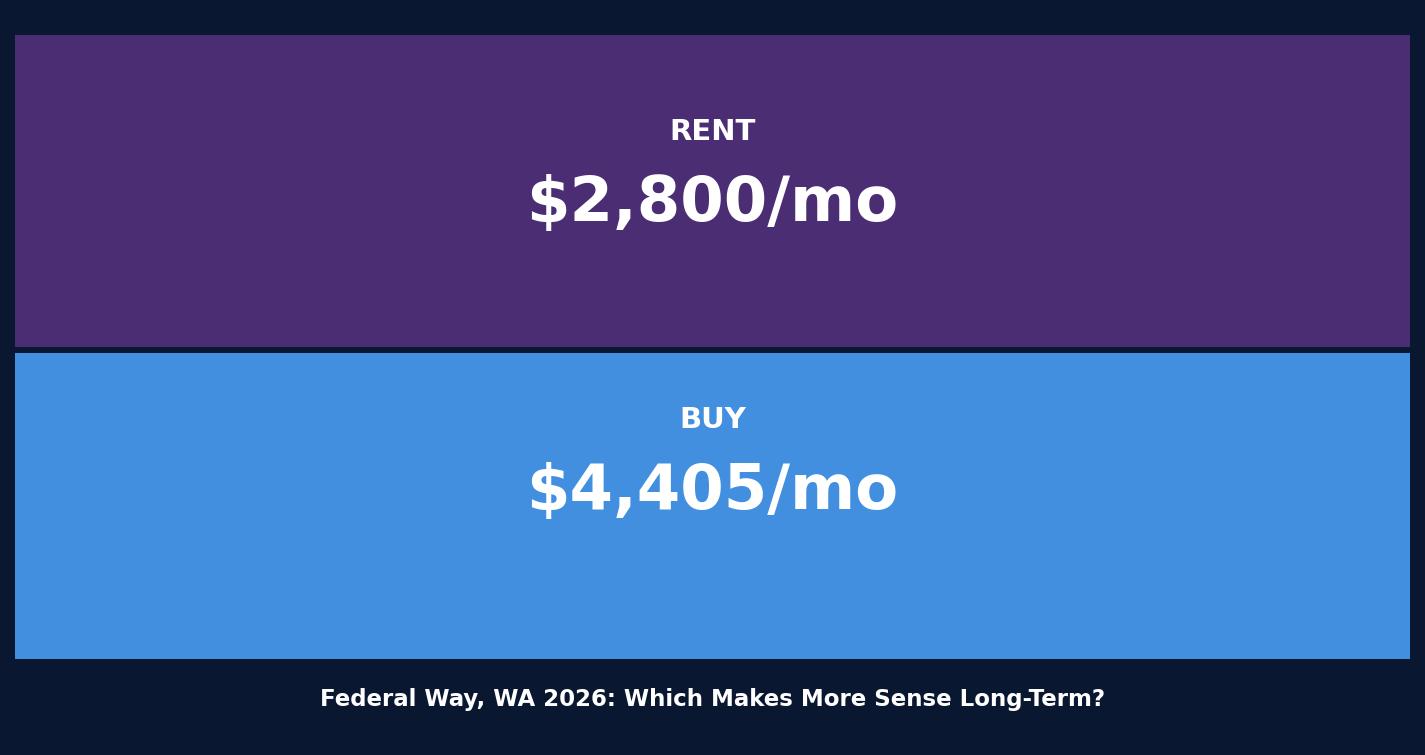
When you’re paying $2,800 a month in rent, the question gets loud: wouldn’t I be better off putting that toward a mortgage in Federal Way?
Rent disappears. A mortgage builds equity. The math should be simple.
It’s not simple. But it’s not complicated either. Here’s what the numbers actually look like, using real Federal Way prices and March 2026 mortgage rates.
Federal Way Home Prices 2026: Condo vs. Mortgage Cost Breakdown
Start with a Federal Way condo. The median price in March 2026: $637,500.
Monthly payment with 10% down, which is realistic for a first-time buyer:
Down payment: $63,750. Loan: $573,750. At 6.38% (the rate as of late March 2026), principal and interest runs roughly $3,580 per month.
That’s not your full housing cost. Add:
Property taxes: King County annual property tax runs roughly 0.94% of value. On a $637,500 condo, that’s about $5,990 per year, or $475 per month.
HOA fees: Federal Way condos typically run $300 to $400 per month. Call it $350.
Homeowners insurance: roughly $100 to $150 per month.
Total: $3,580 (P&I) + $350 (HOA) + $475 (taxes) + $125 (insurance) = approximately $4,530 per month.
Your rent: $2,800.
Month one, you’re spending more as an owner. Noticeably more.
The Common Mistake When Comparing Rent to Buy in Federal Way
Most renters stop at that monthly gap and decide buying is too expensive.
Month one, two, three — you are spending more. That part is true.
But you’re not just spending that money. You’re building something with it.
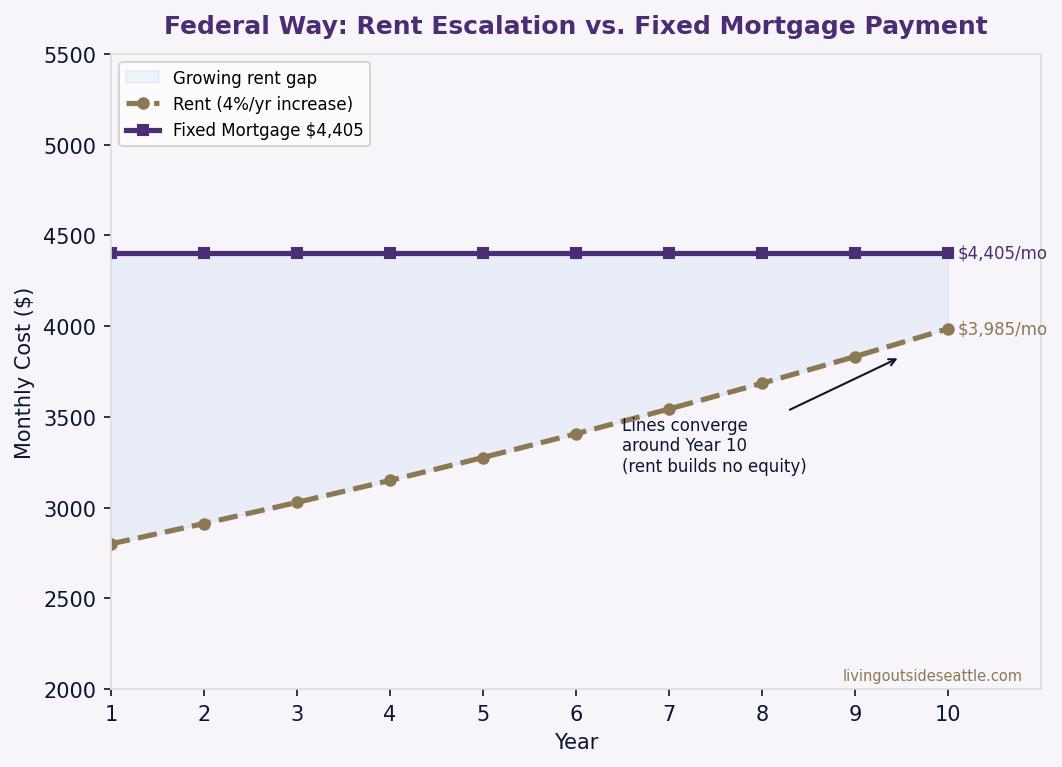
At 4% annual rent growth, a Federal Way renter paying $2,800/month today will pay $4,149/month by year 10 — while the mortgage payment stays fixed.
How Federal Way Home Equity Builds While You Pay Rent
At 6.38% on a $573,750 loan, roughly $814 of your first payment goes toward principal. By end of year one, you’ll have paid down roughly $9,768. That’s money you get back when you sell. A renter gets zero.
Over 30 years, the vast majority of that $3,580 P&I payment becomes equity. Your rent payment? Gone every month. Forever.
Federal Way Rent Increases vs. a Fixed Mortgage Payment
Here’s what actually shifts the math for long-term renters.
Federal Way rent increases 3% to 5% per year. Here’s what that looks like at 4% annually:
By year 10, you could be paying $4,149 in rent with nothing to show for it. A Federal Way homeowner at that same point has paid down roughly $80,000 in principal and owns an asset worth more than $637,500.
Buying a Single-Family Home in Federal Way: A Cheaper Path
What if you buy a house instead of a condo?
The Federal Way single-family median in March 2026: $686,500. Put 20% down to avoid PMI. That’s $137,300 down, leaving a $549,200 loan.
Principal and interest: roughly $3,425 per month. Property taxes: about $490 per month. Insurance: roughly $130 per month. No HOA. No PMI.
Total: $4,045 per month.
Cheaper than the condo path, and you get a single-family home. Still more than $2,800 rent, but the gap is narrower. The trade-off: you need $137,300 down instead of $63,750.
Should You Rent or Buy in Federal Way? Who Should Buy Now
Buying makes sense if you’re planning to stay 5 or more years, have a stable income and sufficient down payment, and want to build equity instead of paying someone else’s mortgage. The monthly gap between renting and owning narrows as rent increases each year.
Renting still makes sense if you’re moving in 3 years or less. Closing costs and transaction fees on both sides of a sale can eat your equity on a short hold.
One more comparison worth making: Seattle one-bedroom apartments in decent neighborhoods run $3,200 to $3,500 per month. Against those numbers, a $4,530 Federal Way mortgage looks a lot closer to what you’d already be paying.
Federal Way Rent vs Buy FAQs
Is it cheaper to rent or buy in Federal Way WA in 2026?
Month-to-month, renting at $2,800 is lower than the $4,045 to $4,530 mortgage payment. But rent typically increases 3% to 5% annually while your mortgage stays fixed. By year 10, Federal Way rent at 4% annual growth reaches $4,149 per month, while your mortgage hasn’t moved. And each mortgage payment builds equity. Rent builds nothing.
What is the typical mortgage payment on a Federal Way home in 2026?
Based on March 2026 rates of 6.38%, a $637,500 Federal Way condo with 10% down runs roughly $4,530 per month including principal, interest, HOA, taxes, and insurance. A single-family home at $686,500 with 20% down costs approximately $4,045 per month with no HOA. Both figures use King County property taxes of roughly 0.94% annually.
How much equity do you build in the first year of a Federal Way mortgage?
In year one, approximately $814 per month of your $3,580 P&I condo payment goes toward principal. By end of year one, you’ve paid down roughly $9,768. Renters get nothing back. Over time, equity compounds as your loan balance shrinks and home value grows.
What are the hidden costs of buying in Federal Way that renters don’t pay?
Beyond your monthly mortgage, expect property taxes (roughly $5,990 per year on a $637,500 condo), homeowners insurance ($1,200 to $1,800 per year), maintenance and repairs (budget 1% of home value annually), HOA fees for condos ($3,600 to $4,800 per year), and PMI if putting down less than 20%. Total annual costs beyond principal and interest can run $15,000 to $25,000. Renters avoid most of these, which is why the 5- to 10-year picture matters more than the monthly comparison.
What’s the median home price in Federal Way WA in 2026?
The median single-family home price in Federal Way as of March 2026 is $686,500. The median condo price is $637,500. Prices are up roughly 6.7% compared to early 2025.
Gregory Dorrell is a REALTOR® with Coldwell Banker Bain specializing in East and South King County. This post is for informational purposes and not an offer of real estate services. All market data as of March 2026.


 Facebook
 X
X
 Pinterest
 Copy Link