

 Facebook
 X
X
 Pinterest
 Copy Link
Income Needed to Buy a Home in Renton WA 2026
Renton is the city I price homes in more than anywhere else. I do BPO work across south and east King County every week, which means I’m pulling comps in the Highlands, Benson Hill, Talbot Hill, and Kennydale constantly. When buyers ask me what income they need to get into Renton, I don’t give them a guess — I give them the payment math.
Here’s what that math looks like in June 2026.
The short version: to buy a median-priced single-family home in Renton, most lenders want to see household income in the $130,000 to $175,000 range — significantly more accessible than Bellevue, Issaquah, or Sammamish, but still a real number that requires planning. The range shifts by $40,000 or more depending on which neighborhood you’re targeting and how much you put down.
Quick Answer
For a median-priced single-family home in Renton — around $657,000 to $700,000 in early 2026 — lenders using a standard 28% housing ratio expect household income of roughly $130,000 to $160,000 with a 20% down payment at current rates. Total monthly costs including taxes, insurance, and maintenance run between $3,800 and $4,500. Down payment assistance through WSHFC can reduce loan amounts and make lower income levels viable for first-time buyers.
The Renton Price Landscape Right Now
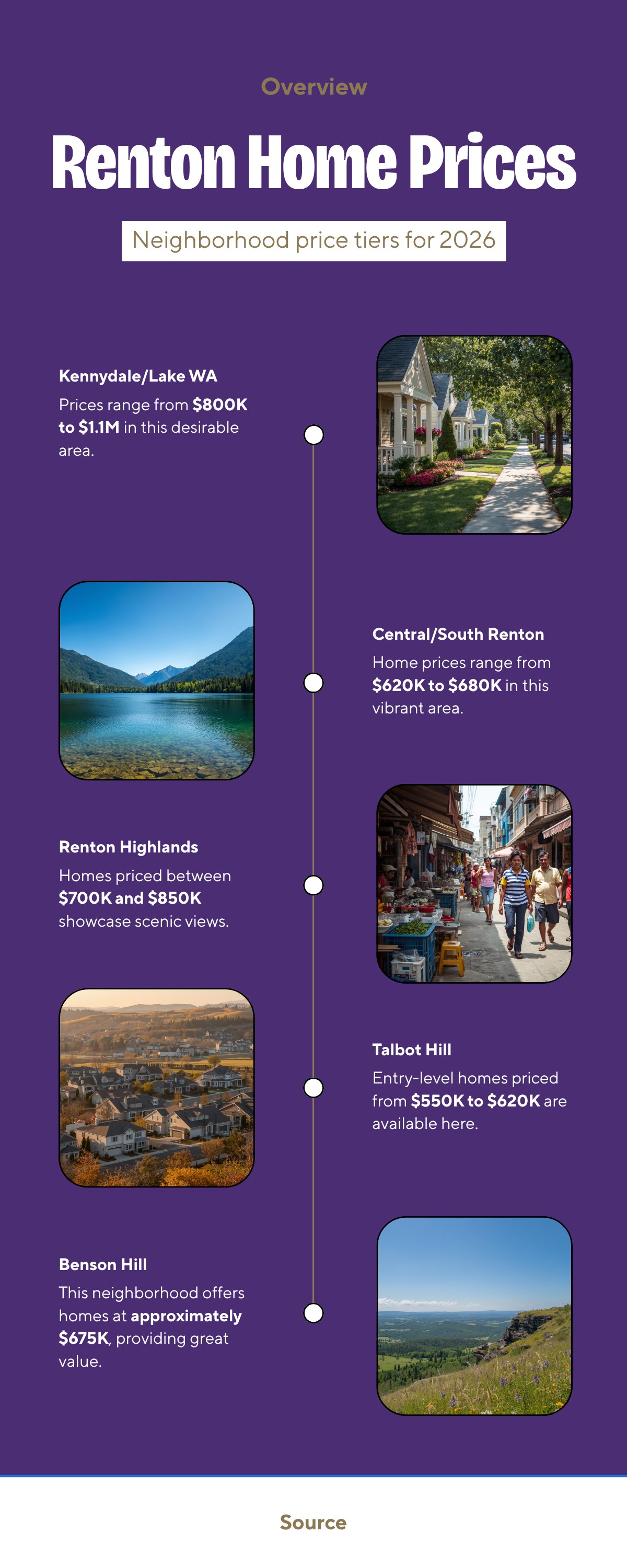
Renton isn’t one market. It runs from sub-$300,000 condos to $850,000-plus single-family homes on the Lake Washington waterfront side, and the income math shifts significantly across that range.
Here’s where the neighborhoods sit as of mid-2026:
Kennydale / Lake Washington
$800K – $1.1M+
Water proximity, views, larger lots. Renton’s premium tier.
Renton Highlands
$700K – $850K
Newer construction, strong school proximity, employment corridor access.
Benson Hill
~$675K avg
Absorbing demand from buyers priced out further north. Rising.
Central / South Renton
$620K – $680K
Near citywide median. Older stock, mixed conditions, price-sensitive buyers.
Talbot Hill / South Entry-Level
$550K – $620K
Most affordable detached homes. Some need work. Best entry point.
Condos (Citywide)
~$270K avg
Completely different income equation. Clearest path for buyers below single-family thresholds.
The Income Math by Price Point
I’m running these numbers at 6.5% on a 30-year fixed — right in the middle of where Washington rates have been sitting in June 2026 — and a 20% down payment. Property taxes use King County’s effective rate of about 0.83%.
$550K
Talbot Hill / entry-level
Down payment: $110,000
P&I: ~$2,781/mo
Taxes: ~$381/mo
Ins + reserve: ~$350/mo
Total monthly
~$3,512
Income needed
~$150K/yr
$660K
Citywide median
Down payment: $132,000
P&I: ~$3,338/mo
Taxes: ~$457/mo
Ins + reserve: ~$390/mo
Total monthly
~$4,185
Income needed
~$179K/yr
$750K
Highlands / Benson Hill upper
Down payment: $150,000
P&I: ~$3,793/mo
Taxes: ~$519/mo
Ins + reserve: ~$430/mo
Total monthly
~$4,742
Income needed
~$203K/yr
These are conventional lender standards using the 28% front-end housing ratio. Many buyers also qualify using a 36% to 43% total debt-to-income ratio, which can allow lower income levels if other debts are minimal.
For a full breakdown of what ownership actually costs beyond the mortgage, the Total Cost of Homeownership in King County 2026 post walks through every line item.
How Renton Compares to Kent and Auburn
Kent sits at a median around $646,000 — close to Renton’s but slightly below. The income math at Kent’s median is nearly identical to Renton’s entry-level single-family range. What Kent has going for it: slightly more inventory and a lower median price on homes in comparable condition. What Renton has: better freeway access to Bellevue and the Eastside tech corridor via I-405.
Auburn runs $450,000 to $650,000 depending heavily on neighborhood, with entry-level homes pulling the average down. For first-time buyers with household income in the $100,000 to $130,000 range, Auburn is where the payment math starts working without assistance. Auburn also has the Sounder South commuter rail, which changes the math for Seattle-bound workers.
Renton sits in the middle on price but typically beats both on commute versatility — you can reach Seattle, Bellevue, and the airport in comparable time. If your budget is tight and commute isn’t a deciding factor, Auburn’s price-per-square-foot is still the best in King County at this level. If you want commute flexibility, Renton is the answer.
Down Payment Assistance: What Renton Buyers Can Access
More Renton buyers qualify for assistance than they think. The income limits are broader than most people assume, and Renton’s price range sits squarely in the eligible zone for Washington’s main programs.
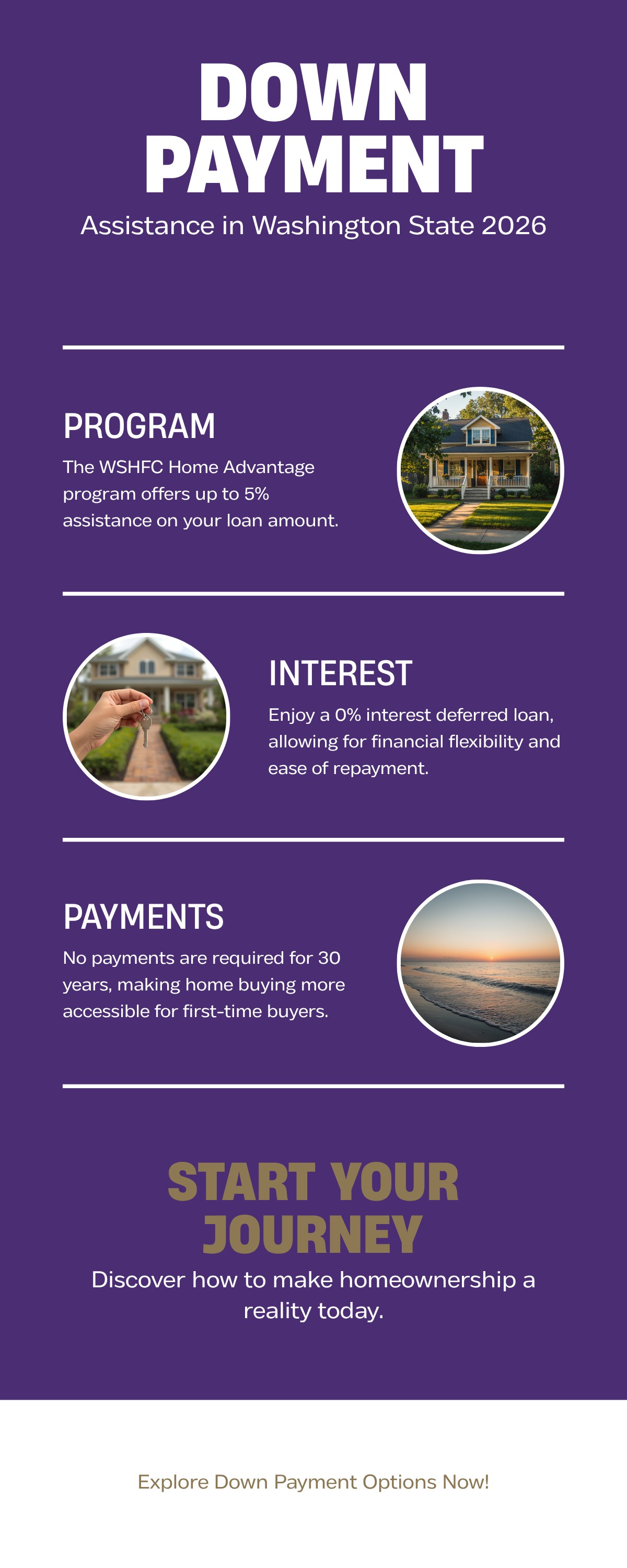
WSHFC Home Advantage is the state’s primary first-time buyer program. It provides a deferred second mortgage covering up to 5% of the loan amount at 0% interest — no payments required for 30 years. The income limit for King County is $145,000 for most household sizes. At Renton’s median price, that makes Home Advantage relevant for buyers in roughly the $100,000 to $145,000 household income band — a large portion of the market.
At the median price of $660,000 with 5% down, 5% assistance equals approximately $31,000 — enough to meaningfully reduce either the down payment burden or the loan amount.
The King County Down Payment Assistance 2026 guide walks through how to combine WSHFC and KCHA programs to maximize what you receive.
What This Means for Renton Buyers
If your household income is in the $100,000 to $130,000 range, Renton’s condo market and the entry-level south Renton single-family pockets are where the math works — especially with down payment assistance reducing the loan amount.
If your income is $130,000 to $160,000, the citywide median single-family market is within reach, though you’ll want minimal other debt to keep your total debt-to-income ratio under 43%, which is the typical conventional loan ceiling.
Above $160,000, you have access to most of Renton including Renton Highlands, Benson Hill upper, and Kennydale’s lower range — and above $200,000 you’re looking at Kennydale and the lakefront streets.
If you’re putting less than 20% down, make sure you understand whether FHA or conventional makes more sense at your credit score. The FHA vs. Conventional Loan in King County post breaks down the PMI difference and loan limit considerations.
From the Field
I price homes in Renton every week. What I see in the BPO work: the buyers who’ve already run the income math before they start shopping close faster and negotiate better. They know exactly which price tier they’re targeting, so they don’t waste time falling in love with a home that’s $80,000 above what their lender will support. In Renton right now, where the $620,000 to $680,000 range is moving in 15 to 30 days on average, that preparation gap matters.
King County Specifics: What Renton Buyers Actually Pay
Property taxes in Renton run an effective rate of about 0.80% to 0.85% — right around the King County average of 0.83%. On a $660,000 home, that’s roughly $5,300 to $5,600 per year, or $440 to $465 per month.
Current 30-year fixed rates in Washington are running 6.31% to 6.63% as of June 2026. That spread changes your payment by about $115 per month on a $528,000 loan — real money over 30 years. Shopping two or three lenders and working with a good mortgage broker typically lands buyers at the lower end of that range.
For current rate movement and what’s driving it, the King County Mortgage Rates 2026 post has the context every buyer needs before locking a rate.
Frequently Asked Questions
What income do you need to buy a home in Renton WA?
For the citywide median around $657,000 to $700,000, conventional lenders typically want household income of $130,000 to $180,000 depending on down payment size and existing debt. At Renton’s entry-level single-family range ($550,000 to $620,000), income requirements drop to $110,000 to $150,000. Down payment assistance through WSHFC can reduce loan amounts and make lower income levels viable for first-time buyers.
Is Renton more affordable than Bellevue and Issaquah?
Yes, significantly. Bellevue’s median runs around $1.45 million and Issaquah’s citywide median is approximately $1.05 million. Renton’s single-family median of $657,000 to $700,000 is roughly half of Bellevue’s price point. The trade-off is school district — Bellevue and Issaquah have consistently top-rated districts. Renton’s schools vary by neighborhood.
How much is a down payment on a home in Renton?
At the citywide median of approximately $660,000, a 20% down payment is $132,000 and a 10% down payment is $66,000. For entry-level homes around $550,000, a 20% down payment is $110,000. With WSHFC Home Advantage, eligible buyers can reduce the down payment to as low as 3% to 5% and receive up to 5% of the loan amount in assistance.
Do down payment assistance programs work in Renton?
Yes — and more buyers qualify than realize it. WSHFC Home Advantage has a $145,000 income limit for King County, which covers a large portion of first-time buyers targeting Renton’s median range. At a $660,000 purchase price with 5% down, the assistance can provide up to approximately $31,000 — a meaningful reduction in what you need to bring to closing.
How does Renton compare to Kent and Auburn for affordability?
Kent’s median is just below Renton’s at roughly $646,000 — similar income math. Auburn has a wider price range with entry-level homes in the $450,000 to $550,000 band, making it more accessible for buyers with household income under $120,000. Renton’s advantage over both is commute versatility — direct I-405 access to the Eastside is harder to replicate from Auburn or Kent.
What is Renton’s property tax rate?
Renton’s effective property tax rate runs about 0.80% to 0.85% of assessed value, close to the King County average. On a $660,000 home, that’s approximately $5,280 to $5,610 per year, or $440 to $468 per month.
Ready to Run the Real Numbers?
If you’re looking at homes in Renton and want an honest read on what you can buy in today’s market — not a calculator estimate — reach out. I can walk you through the payment math, flag which neighborhoods fit your budget, and tell you what I’m seeing in the BPO work I do here every week.
Gregory Dorrell · Coldwell Banker Bain
Renton is my market.
King County Down Payment Assistance Programs 2026

How first-time buyers in King County can get up to $45,000 — or more — toward their down payment right now.
The number I hear most from first-time buyers in King County is not the interest rate. It is the down payment. At a $700,000 median price, even a 5% down payment is $35,000 — and that is before closing costs. That is a lot of money to save on top of rent in one of the most expensive metros in the country.
What most buyers do not know is that there are programs specifically designed to close that gap. Some are state programs. Some are regional. A few are city-specific. And in many cases, you can combine them. I work with buyers across South and East King County every week, and the down payment question comes up in almost every first conversation. This guide breaks down every major program available right now, what they actually pay, and how to get the money working for you.
Understanding your financing options is the foundation. If you want to see how King County mortgage rates affect your monthly payment alongside these programs, read King County Mortgage Rates 2026: What Buyers Are Actually Paying first.
What Is Down Payment Assistance and How Does It Work?
Down payment assistance — DPA for short — is money that a government agency, housing authority, or nonprofit makes available to help first-time buyers cover the upfront cash required to purchase a home. It is not a gift in most cases. Most programs are structured as a deferred second mortgage: you borrow the money at zero percent or very low interest, and you do not make payments on it. You repay it when you sell, refinance, or pay off the home.
That structure matters. It means the money costs you almost nothing while you own the home. You are essentially borrowing from your future equity instead of draining your savings account today.
To use DPA, you pair it with a regular first mortgage — FHA, conventional, VA, or USDA. The DPA funds cover part or all of the down payment and sometimes closing costs. Your lender handles the mechanics. You apply through a participating lender, not directly through the DPA program.
The Main Programs Available to King County Buyers
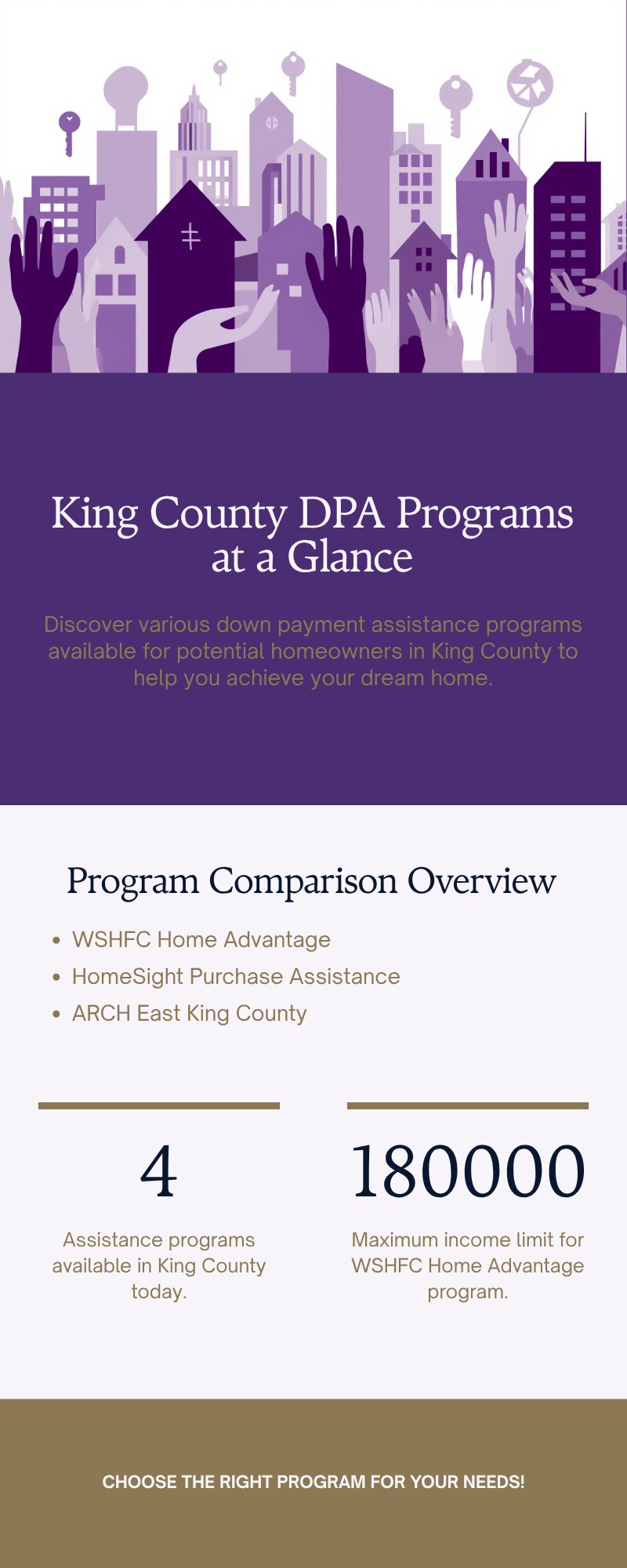
Four programs, four different income and geography profiles. Most buyers qualify for at least one — many qualify for two.
WSHFC Home Advantage
The Washington State Housing Finance Commission’s Home Advantage program is the most widely used DPA program in the state. It has the highest income limit — $180,000 for all household sizes in King County — which means a lot of buyers who assume they earn too much will actually qualify.
Here is how the down payment assistance piece works: you get up to 5% of the first mortgage loan amount as a second mortgage at 0% interest, deferred for 30 years. On a $700,000 home with a $665,000 mortgage, that is up to $33,250 toward your down payment. No monthly payment. No interest accruing. You pay it back when you sell or refinance.
The first mortgage is a 30-year fixed rate through a participating lender. You must have a credit score of at least 620 and complete a five-hour homebuyer education course through Framework or eHome America. The course can be done online in a single afternoon.
HomeSight Purchase Assistance (South King County)
HomeSight is a Seattle-based nonprofit HUD-approved housing counseling agency, and their Purchase Assistance program is the most generous option for buyers in South King County cities. If you are shopping in Auburn, Federal Way, Tukwila, or unincorporated King County, this program can provide up to $45,000 in down payment assistance structured as a 3% deferred loan for 30 years.
The income limit is 80% of Area Median Income. For a family of four in King County, 80% AMI is approximately $112,000 in 2026. That is lower than WSHFC’s ceiling, but the dollar amount is higher — so buyers who fit within the income band can access substantially more cash up front.
HomeSight also offers homebuyer education and one-on-one counseling. Reach them at 206-723-4355 or homesightwa.org. Given that this program serves the exact cities where I work most — Federal Way, Auburn, Kent — it is worth a call early in your search, not after you have found a house.
ARCH East King County Downpayment Assistance
If you are buying in East King County, the ARCH program is what to look at first. ARCH member cities include Bellevue, Issaquah, Kirkland, Redmond, Sammamish, Kenmore, Bothell, Newcastle, Woodinville, and a handful of smaller communities.
The program provides up to $30,000 as a deferred loan at 4% simple interest. The income limits range from about $50,400 for a one-person household to $95,050 for a household of eight. The purchase price limit is $373,000 for the assisted unit, which limits this program to condos and lower-priced homes in the ARCH area rather than single-family houses at current market prices.
That price limit is the honest caution with ARCH: at current East King County prices, this program works best for condo buyers or buyers in specific affordable housing units the program designates. If you are looking at a $650,000 townhouse in Sammamish, WSHFC Home Advantage will likely be more useful.
WSHFC Opportunity Downpayment Assistance
The Opportunity program pairs with WSHFC’s House Key Opportunity first mortgage, targeted to buyers in certain income bands and geographic “targeted areas” — lower-income census tracts where the first-time buyer rule is waived. The DPA here is up to $15,000 at 1% simple interest, deferred for 30 years. It is a solid option for buyers in targeted areas of Kent, Auburn, and Renton who want a slightly larger fixed dollar amount than the Needs-Based program provides.
The King County Angle: Why These Programs Matter More Here
King County median home prices sit above $700,000 as of spring 2026. At that price point, a conventional 5% down payment is $35,000 — and that figure does not include the 2% to 3% in closing costs you will also owe at the table. Combined, a buyer needs $49,000 to $56,000 in cash just to close.
DPA programs cut directly into that number. A buyer using WSHFC Home Advantage on a $665,000 loan gets roughly $33,000 in down payment assistance, which means they need to bring approximately $2,000 to $5,000 of their own cash to close rather than $49,000. That is the difference between buying in 2026 and waiting another three years.
South King County matters particularly here. In cities like Federal Way, Kent, and Auburn, median prices are lower than the county overall — often in the $550,000 to $650,000 range — which means the income limits on programs like HomeSight are more accessible and the purchase prices are within reach. These are the markets where DPA programs do their best work because buyers have realistic targets and the assistance closes the gap meaningfully.
How to Stack Multiple Programs
You can combine certain DPA programs to increase your total assistance. This is called stacking, and it is legal and common when done correctly.
The most practical stack for King County buyers is WSHFC Home Advantage (5% DPA) plus WSHFC Needs-Based assistance ($10,000 fixed) if you qualify for the lower income tier. A participating lender can structure both as simultaneous second mortgages on the same transaction.
Buyers in HomeSight’s service area may be able to combine HomeSight assistance with a first mortgage that has its own DPA feature — ask your lender specifically about this before assuming the programs can be combined, because some programs prohibit layering.
One thing to know: the more DPA you layer, the more important it is to work with a lender who has experience with these specific program combinations. A loan officer who has never done a stacked WSHFC transaction will slow everything down. Ask upfront: “Have you closed stacked WSHFC loans before?”
What Buyers Get Wrong About DPA
The biggest misconception I see is that buyers think these programs are for people in financial trouble. They are not. They are for people who have income, credit, and stable employment but have not had enough years to save a down payment at King County prices. Most DPA recipients are working professionals — nurses, teachers, city employees, tech workers at smaller firms — who earn good incomes but have been renting while prices outran their savings rate.
The second misconception is that applying for DPA slows down the purchase or makes your offer look weak to sellers. It does not affect the timeline in any significant way — DPA is financed through the same closing process as any other transaction. Sellers do not see your financing source, only your terms and your pre-approval letter.
The third thing buyers miss: the homebuyer education requirement is not a hoop to jump through. The five-hour Framework course covers budgeting, loan types, the offer process, and what happens at closing. Every first-time buyer I work with who has taken it says it reduced their stress level. Do it early in the process, before you start touring homes.
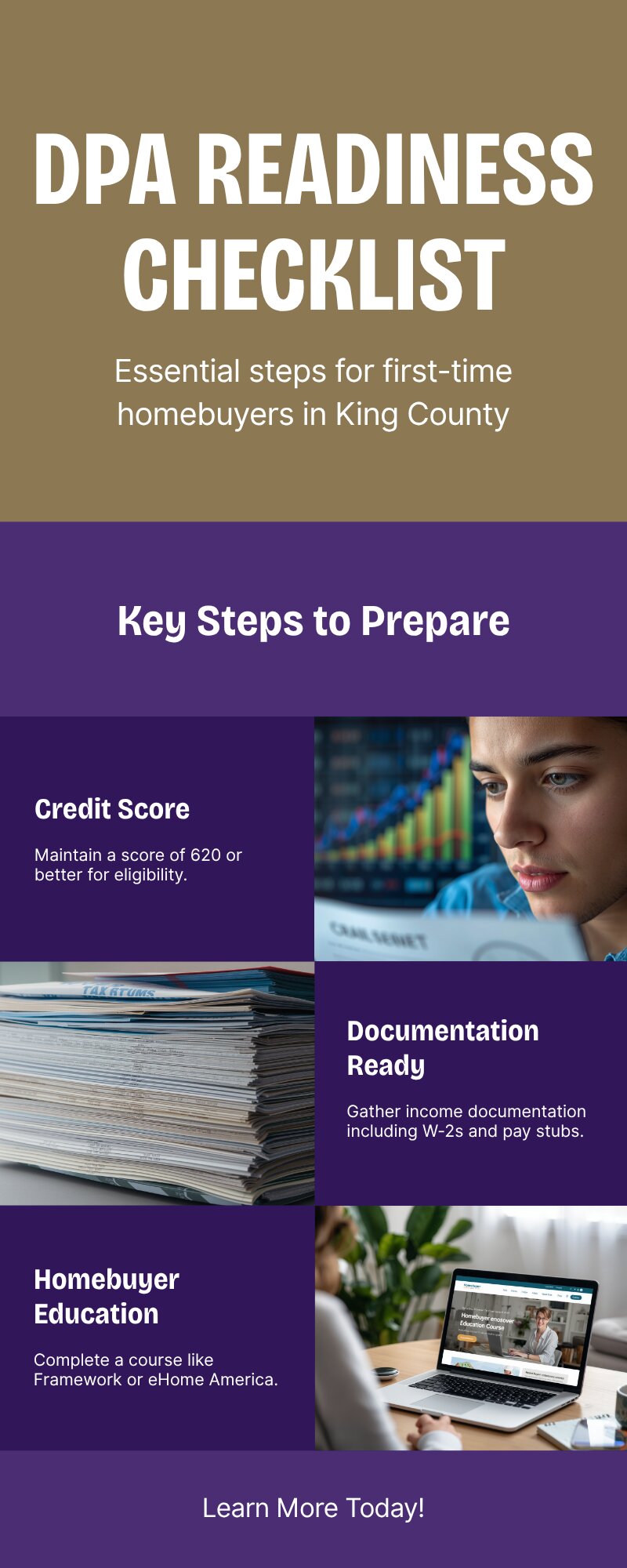
Run through this checklist before contacting a lender. Having these items ready speeds up the pre-approval and DPA approval process.
What This Means for First-Time Buyers in King County
If you are renting right now and thinking about buying in South or East King County, the first practical step is not finding a house. It is finding a WSHFC-approved lender, telling them your income and credit score, and asking which DPA programs you qualify for. That conversation takes 20 minutes and tells you exactly how much assistance you can access.
After that conversation, you will know your real buying budget: not just what you qualify to borrow, but how much cash you actually need to bring to closing. In most cases, that number is much smaller than buyers expect.
Once you know your DPA amount, you will have a much clearer picture of what you can afford and where. If you are still deciding between a condo and a house, check out Should I Buy a Condo or House in King County Right Now? — it breaks down the cost, lifestyle, and financing differences at current prices.
Frequently Asked Questions
Do I have to be a first-time buyer to use these programs?
Most DPA programs define “first-time buyer” as someone who has not owned a home in the past three years. If it has been more than three years since you last owned, you qualify. There are also exceptions for targeted geographic areas where the first-time buyer rule is waived entirely.
Can I use down payment assistance with an FHA loan?
Yes. WSHFC Home Advantage is compatible with FHA loans. FHA requires 3.5% down with a 580+ credit score, and the DPA can cover that amount. The two programs work together through the same lender and close at the same time. If you are deciding between FHA and conventional, see FHA vs. Conventional Loan in King County: Which Is Right for First-Time Buyers? for a side-by-side breakdown.
What happens to the DPA loan if I sell my home?
You repay the deferred second mortgage from your sale proceeds, just like you would repay any other lien on the property. If your home has appreciated, you are repaying a fixed dollar amount from a larger equity pool — most sellers find this is a very manageable part of the transaction.
How long does it take to get approved for a DPA program?
The DPA approval runs in parallel with your first mortgage approval — it does not add extra time as long as you are working with an experienced participating lender. The only real time commitment is the homebuyer education course, which you can complete in a single day online.
Are there income limits I need to know about?
Yes, and they vary by program. WSHFC Home Advantage has the highest limit at $180,000 for King County. HomeSight caps at 80% AMI (roughly $112,000 for a family of four). ARCH has lower limits ranging from $50,400 to $95,050 depending on household size. Your lender will check your income against each program you might qualify for.
Does using DPA affect my interest rate?
The WSHFC Home Advantage first mortgage rate is set by the Commission and is typically very close to market rates — sometimes slightly better because it is a bulk-purchased rate. The DPA second mortgage is at 0%, so it does not affect your monthly payment at all.
Your guide to life outside Seattle.
253-350-0045 ·
greg@livingoutsideseattle.com ·
www.livingoutsideseattle.com
