

 Facebook
 X
X
 Pinterest
 Copy Link
Buyer Closing Costs in King County: What to Budget

Most first-time buyers plan hard for the down payment. Then closing day shows up with a second bill nobody warned them about. I still see buyers underestimate this number more than almost anything else in the transaction. It isn’t a hidden fee. Nobody talks about it the way they talk about the down payment, so buyers assume it’s small. It usually isn’t.
Here is the honest reality: closing costs in King County typically run 2% to 5% of your purchase price, on top of your down payment. On a $600,000 home in Kent or Auburn, that is $12,000 to $30,000 in cash you need before you get the keys. Buyers who plan for it walk into closing calm. Buyers who don’t scramble for cash in the last two weeks, and sometimes lose the house over it.
What Actually Makes Up Your King County Buyer Closing Costs
Closing costs are not one fee. They’re a stack of smaller costs from different parties in the transaction. Each one shows up on your Loan Estimate, then again on your Closing Disclosure. Here is what you are actually paying for.
Lender Fees
Run 0.5% to 1.5% of your loan amount and cover the origination fee, underwriting, and processing your loan application. This is the cost of the bank doing the work to approve and fund your mortgage. If you’re weighing a rate buydown to lower your monthly payment, that cost shows up here too. I cover the tradeoffs in my mortgage rate buydown guide.
Title Insurance and Escrow Fees
Protect you and the lender against ownership disputes and handle the neutral third party that manages your transaction. In King County, escrow and title together typically run $2,500 to $4,500, depending on your purchase price and which title company you use.
Appraisal and Inspection Fees
Run $300 to $700 each. The appraisal protects the lender by confirming the home is worth what you are paying. The inspection protects you by telling you what you are actually buying.
Prepaid Property Taxes and Insurance
The line item that surprises people most. Your lender collects the first year of insurance and a portion of your property taxes up front, sometimes $1,000 to $4,500 depending on your tax bracket and insurance premium. This isn’t really a fee. It’s money you’d owe anyway. You’re just paying it earlier than you expected.
Recording Fee
What King County charges to officially record your deed. As of the 2025 fee update, recording a deed in King County runs $303 or more depending on the document. This one is small compared to the rest, but it still needs to be in your closing funds.
Buyer Closing Costs in King County: Why the Number Changes by City
King County is not one market. The same 2% to 5% closing cost range means very different dollar amounts depending on where you are buying, and that matters for how you plan your cash to close.
In Auburn, where median prices run closer to $583,000, buyers are typically looking at $11,700 to $29,150 in closing costs (see how long homes are sitting in Auburn right now for negotiating leverage). In Kent, with a median closer to $665,000, that range moves to $13,300 to $33,250. In Renton, where single-family homes often land between $650,000 and $850,000, buyers can see $13,000 to $42,500 depending on the specific property and neighborhood.
This isn’t just a math exercise. A buyer comfortable with the down payment in Auburn might need to rethink their cash reserves entirely if they widen their search into Renton. I walk these neighborhoods for BPO work most weeks. The price gap between South King County starter markets and the closer-in cities is real, and your closing cost budget needs to move with it.
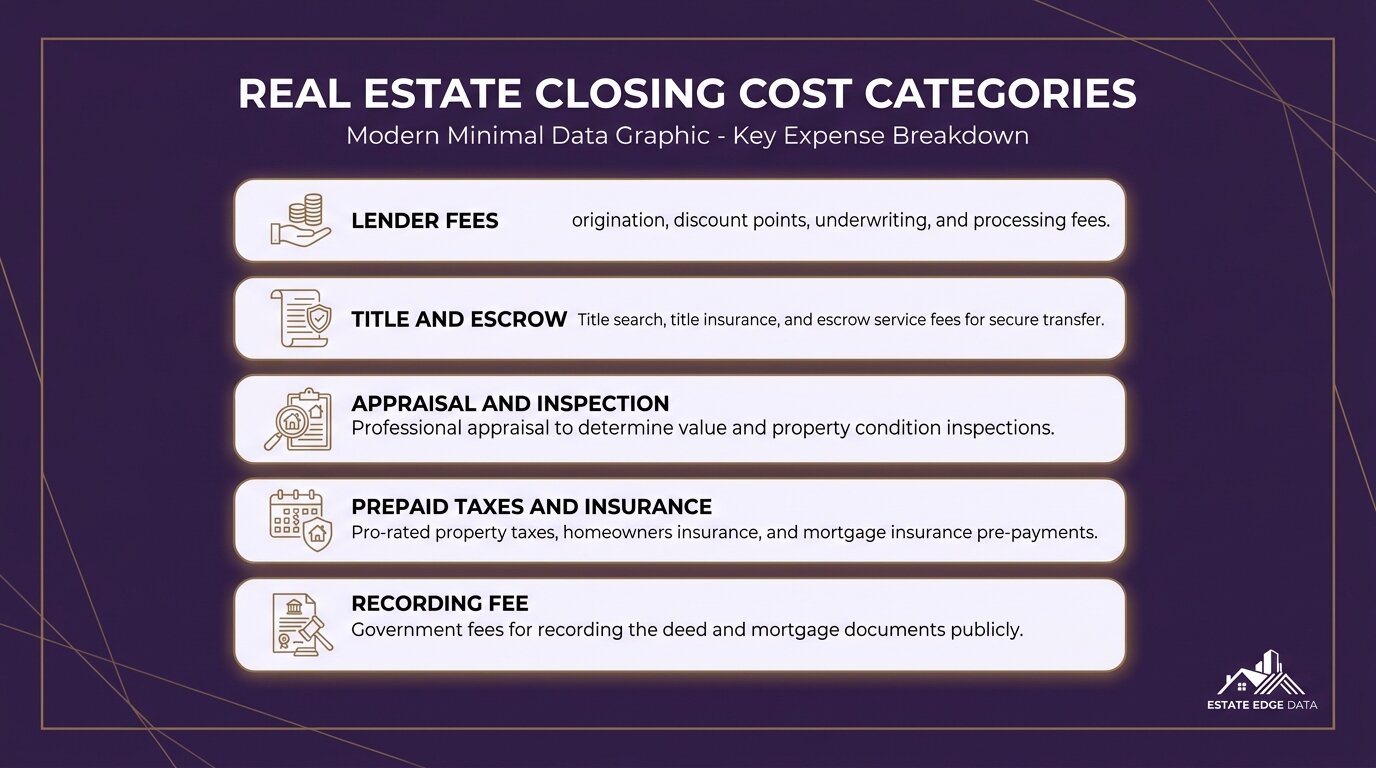
Five categories make up nearly all of your closing costs: lender fees, title and escrow, appraisal and inspection, prepaid taxes and insurance, and the recording fee.
Washington’s Real Estate Excise Tax (REET) is worth knowing about even though it is typically a seller cost, not yours. The state uses a graduated rate starting at 1.10% up to $525,000, plus King County’s local 0.50% addition. I break down the full schedule in my REET guide. Sellers pay this, but it factors into their bottom line and sometimes their willingness to negotiate concessions with you.
What This Means for You as a Buyer
Start budgeting closing costs the same week you start budgeting your down payment. Not after you’re under contract. Ask your lender for a Loan Estimate early, even before you write an offer, so you have a real number instead of a rule of thumb.
Ask about seller concessions when you write your offer. In a market where a seller is motivated, they can often credit some or all of your closing costs as part of the negotiation instead of a straight price reduction. This is common in King County right now, especially outside the tightest inner-ring neighborhoods.
Look into King County down payment assistance programs if your income qualifies. The Washington State Housing Finance Commission runs the Home Advantage program, with income limits up to $180,000 in King County, and House Key Opportunity, which can provide up to $10,000 toward your down payment or closing costs if your income is under roughly $147,400 in King County. These programs exist specifically because this gap catches so many first-time buyers. If Kent fits your budget and search area, my first-time buyer guide for Kent walks through financing options in more depth.
Keep your earnest money separate in your planning. Earnest money in King County typically runs 1% to 5% of your purchase price, with 3% being common in a competitive offer. This money is usually credited back toward your closing costs at the end, but you need it available and liquid the moment you go under contract, days before your other closing funds are due. I broke down exactly how much to set aside in my earnest money guide for King County buyers.
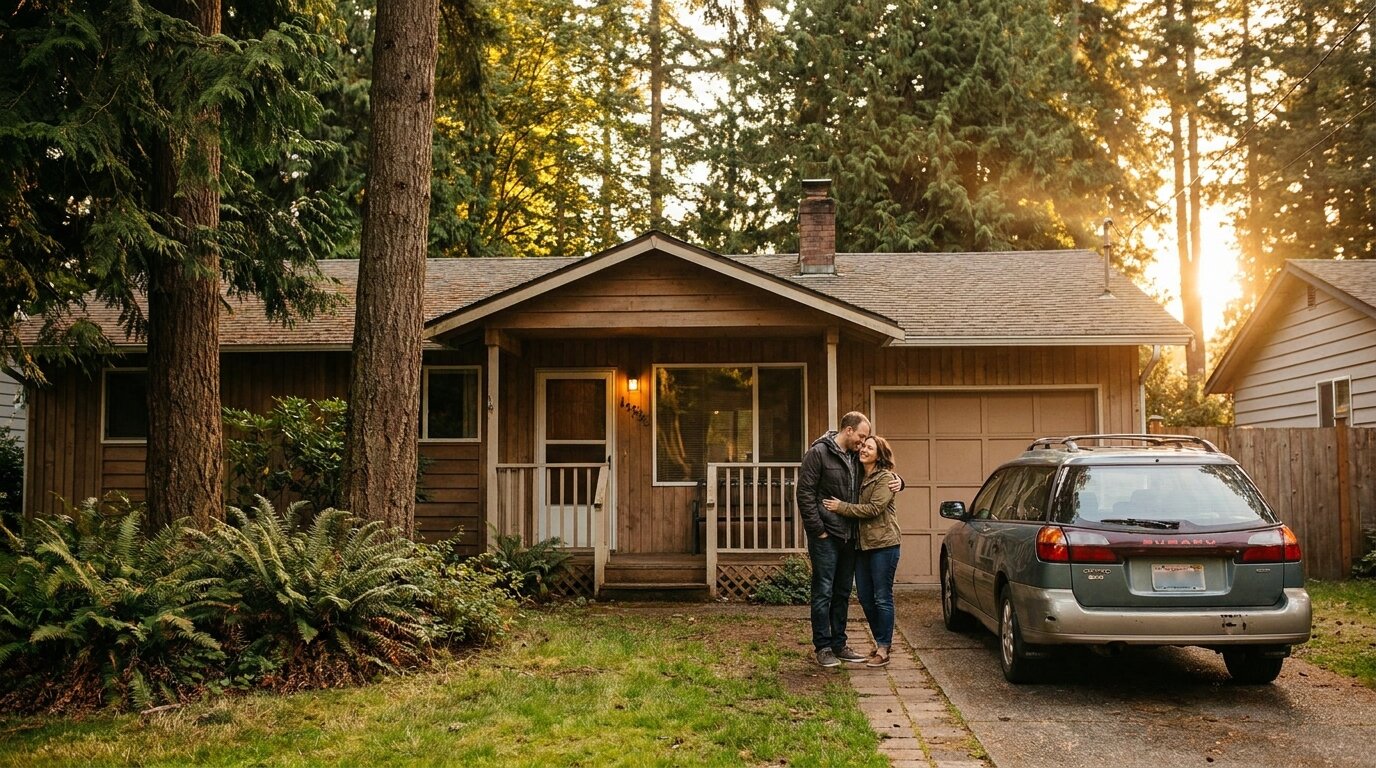
From Kent to Auburn to Covington, the closing cost math looks different in every South King County city.
FAQ
How much are closing costs on a $600,000 home in King County?
Expect roughly $12,000 to $30,000, based on the standard 2% to 5% range. Your actual number depends on your loan type, lender fees, and the title company handling your transaction.
Are closing costs separate from the down payment?
Yes. Your down payment builds equity in the home. Closing costs pay for the services and taxes required to complete the transaction, and they are due in addition to your down payment at closing.
Can a seller pay my closing costs in King County?
Often, yes. Seller concessions toward buyer closing costs are common and negotiable, particularly when a seller is motivated. Your loan type sets a cap on how much a seller can contribute.
Is earnest money part of my closing costs?
Earnest money is a separate deposit due shortly after your offer is accepted, typically 1% to 5% of the purchase price. It is usually applied toward your closing costs at the end, but you need it available well before the rest of your closing funds.
Do first-time buyer programs help with closing costs, or just the down payment?
Both, depending on the program. Washington’s House Key Opportunity and Home Advantage programs can be applied toward down payment or closing costs, which is exactly the gap that catches most first-time buyers off guard.
Your guide to life outside Seattle.
253-350-0045 ·
greg@livingoutsideseattle.com ·
www.livingoutsideseattle.com
Cost to Sell a Home in Washington State: 2026 Breakdown
Most sellers ask me one question before anything else: “How much am I actually going to walk away with?” Not the sale price. The number after everything gets paid.
I do BPO work across east and south King County almost every day, pricing homes for banks and institutional clients. That work puts me in front of real closing statements constantly, and I can tell you the gap between what sellers expect to net and what they actually net is almost always caused by the same handful of costs. None of them are secret. Most sellers just never sat down and added them up.
Here’s the honest breakdown, King County numbers included, so you can run your own math before you decide anything.
The Big Four Costs, In Order of Size
Four costs make up almost all of what comes out of your proceeds at closing. Everything else is smaller line items. Here they are, biggest to smallest.
1. Real Estate Commission
This is the largest line item, almost every time. Washington’s average total commission sits around 5.9% right now, split between the listing agent and the buyer’s agent, though that split is negotiable and varies deal to deal. On the Eastside specifically, a lot of full-service listing agents run 2.5% to 3% on their side.
On a $900,000 sale, a 5.5% total commission is $49,500. That’s real money. It’s also the single biggest reason your net check is smaller than your sale price. It buys you something, though: professional pricing, marketing, negotiation, and someone managing the transaction so an inspection issue or a lowball appraisal doesn’t blindside you. Real estate commission are and have always been negotiable and will vary from transaction to transaction.
2. Real Estate Excise Tax (REET)
Washington charges a graduated excise tax on every home sale, and King County adds its own local portion on top. Here is the state schedule for 2026:
1.10% on the portion of the price up to $525,000
1.28% on the portion between $525,001 and $1,525,000
2.75% on the portion between $1,525,001 and $3,025,000
3.00% on anything above $3,025,000
King County adds a local REET of 0.50% on top of the state rate.
Run it on a $900,000 King County home: roughly 1.10% on the first $525,000 ($5,775) plus 1.28% on the remaining $375,000 ($4,800), for a state total near $10,575. Add the county’s 0.50% ($4,500) and you land around $15,075 in excise tax alone. Most sellers don’t plan for that number. They find out on the closing statement instead. For the full rate schedule and how it’s calculated, see Washington State Real Estate Excise Tax: Complete Guide for Sellers.
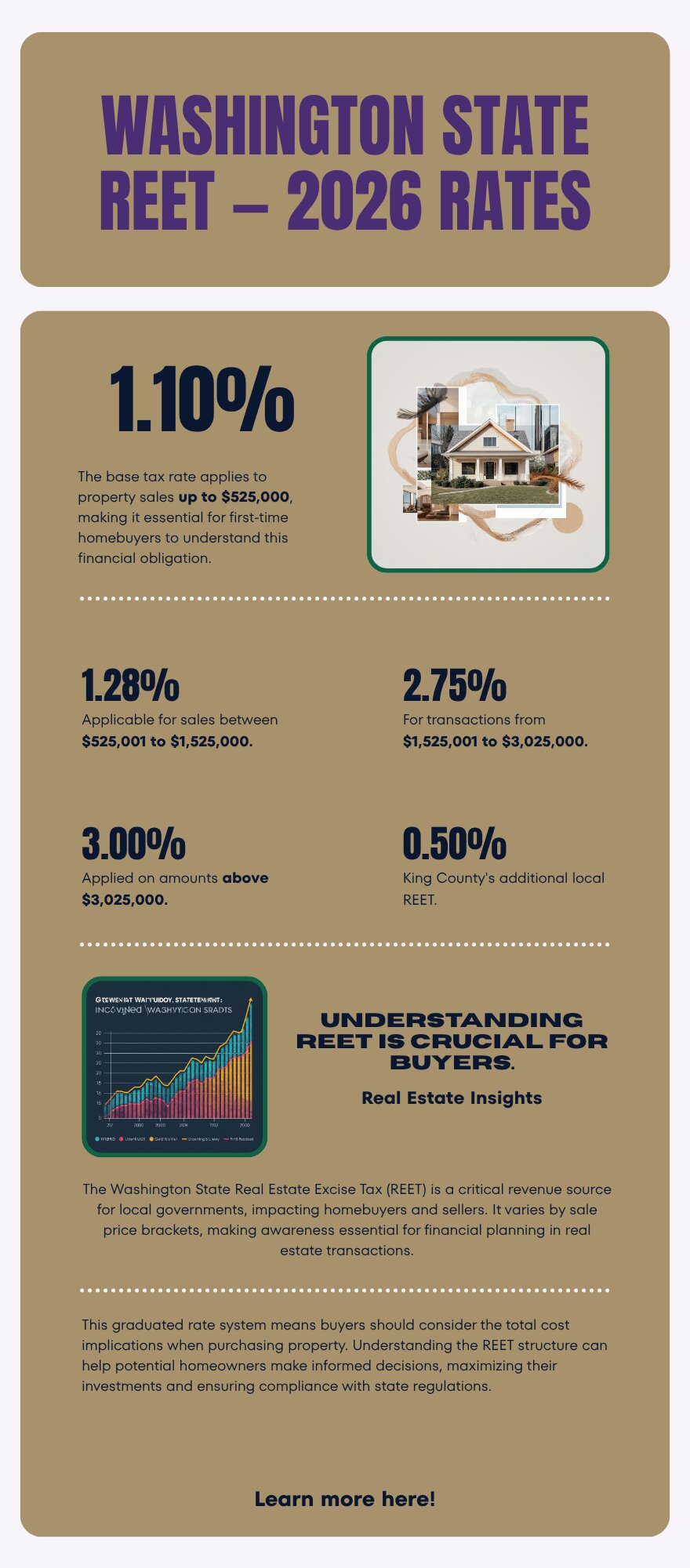
Washington’s REET is graduated. King County adds its own 0.50% on top of the state rate.
3. Title Insurance and Escrow Fees
Sellers in Washington typically pay for the owner’s title insurance policy, which protects the buyer against title defects. Escrow fees are usually split roughly in half between buyer and seller. Together these run a few thousand dollars on a typical King County sale, more on higher-priced homes since title insurance premiums scale with sale price.
Budget $2,500 to $5,000 for title and your share of escrow on a mid-range King County home. Your escrow company will give you exact numbers once you’re under contract. This range holds steady across most listings.
4. Buyer Concessions
This is the cost sellers underestimate the most, and it has become more common. Roughly 19% of recent King County sales included a seller concession, according to NWMLS data from this year. Most concessions land in the 1% to 3% range, and lenders generally cap them at 2% to 6% of the purchase price depending on loan type.
Agree to cover $10,000 to $20,000 in the buyer’s closing costs, or a rate buydown to get the deal done, and that comes straight out of your proceeds. It’s not a hidden fee. It’s a negotiated one. But it needs to be in your math from day one, not something you discover mid-negotiation. Buyers are budgeting their own closing costs at the same time. If you want to understand what they’re weighing against your ask, see Earnest Money in King County: How Much You Need in 2026.
Adding It Up: A Real Example
Here’s the full math on a $900,000 King County home, close to the current county median for single-family homes.
Sale price: $900,000
Commission (5.5%): $49,500
State + King County REET: $15,075
Title insurance + seller’s escrow share: $3,500
Buyer concession (2%): $18,000
Total selling costs: $86,075 (about 9.6% of sale price)
Estimated net before payoff of existing mortgage: $813,925
That 9.6% figure sits right in the middle of the 8% to 10% range most sellers should expect. Yours will move up or down depending on your commission rate, whether you offer a concession, and where your price lands in the excise tax brackets.
Knowing your real number before you list means no surprises at the closing table.
The Local Angle: South and East King County Specifics
Costs shift a little depending on where in King County you are selling.
In South King County cities like Kent, Auburn, Covington, and Maple Valley, home prices run below the county median, which keeps your excise tax bill lower in dollar terms even though the percentage stays close to the same. Sellers here also tend to see fewer aggressive concession requests right now, since inventory in the affordable price bands moves faster.
In East King County, Bellevue, Sammamish, and Issaquah sellers deal with higher price points. That pushes more of the sale into REET’s higher brackets once you cross $1,525,000. Sell above that threshold and your excise tax rate jumps from 1.28% to 2.75% on the portion above it. Run that difference through a calculator before you set your list price expectations.
I price homes across both sides of the county every week through my BPO work. The pattern holds. Sellers who know their real numbers going in negotiate from a position of confidence. Sellers who find out their net at the closing table are the ones who get blindsided. (Curious how that pricing work actually happens? Here’s how I price homes using BPO methodology.)
What This Means for You as a Seller
Before you list, do three things.
Run your own numbers using your actual expected sale price, not a rough guess. A $50,000 difference in price can shift which excise tax bracket you land in.
Ask your agent for a written net sheet before you sign a listing agreement. Any agent worth hiring will walk through commission, REET, title, and a realistic concession estimate with you up front, not after you get an offer.
Decide your concession tolerance before you are in a multiple-offer or slow-market negotiation. Knowing your floor ahead of time keeps you from making an emotional decision at the table.
Getting your home ready to list is its own cost and time decision. If you haven’t mapped that out yet, start with How to Prepare Your Home for Sale in King County.
Selling costs shift depending on where in King County you list. South King County sellers see a different picture than the Eastside.
FAQ
How much does it cost to sell a house in King County, Washington?
Most King County sellers pay between 8% and 10% of their sale price in total selling costs, covering commission, real estate excise tax, title insurance, escrow fees, and any buyer concessions.
What is the real estate excise tax rate in King County?
Washington’s state REET is graduated: 1.10% up to $525,000, 1.28% from $525,001 to $1,525,000, 2.75% from $1,525,001 to $3,025,000, and 3.00% above that. King County adds a local 0.50% on top of the state rate.
Who pays closing costs when you sell a house in Washington State?
Sellers typically pay the real estate commission, the excise tax, the owner’s title insurance policy, and roughly half the escrow fee. Buyers typically pay their own lender fees, their half of escrow, and inspection costs.
Can you negotiate real estate commission in King County?
Yes. Commission is negotiable and varies by agent and by deal. Washington’s average total commission is around 5.9%, but the exact split between listing and buyer’s agent is a conversation you should have before signing a listing agreement.
Do I have to pay excise tax if I sell at a loss?
Yes. Washington’s REET is based on the sale price, not your profit or loss. Even if you sell for less than you paid, you still owe excise tax on the full sale price, with limited exceptions.
How much should I budget for seller concessions in King County?
Plan for 1% to 3% of your sale price if the market conditions or buyer financing call for it. Roughly 19% of recent King County sales included a seller concession, so it is worth building into your net sheet even if you hope not to need it.
Your guide to life outside Seattle.
253-350-0045 ·
greg@livingoutsideseattle.com ·
www.livingoutsideseattle.com
Seller Concessions in King County: A Full Guide
Give a buyer a reason to say yes without cutting your price. Here is how concessions actually work in today’s market.
I do BPO work across east and south King County every day, and lately I am seeing the same request show up in offer after offer: a concession. Not a lower price. A credit, a buydown, a repair allowance. Something that makes the deal pencil out for the buyer without touching the number on the listing.
If you are selling right now, you need to understand what a concession actually is, what it costs you, and when it works better than just dropping your price. This is not the same conversation everywhere in King County. What makes sense in a still-tight Renton starter home market is not what makes sense if you are selling a condo in a building with 3 competing listings.
What a Seller Concession Actually Is
A concession is money you agree to give back to the buyer at closing, structured a specific way in the purchase agreement. It shows up on the closing statement, not as a lower list price. The home still sells for its listed number. You are just contributing part of your proceeds toward the buyer’s costs.
Three types show up most often in King County deals right now.
Closing Cost Credit
The simplest concession. You agree to cover 2% to 3% of the buyer’s closing costs: their lender fees, title insurance, escrow charges. This helps buyers who have the income to qualify for the loan but are short on cash to actually close. First-time buyers in Kent and Auburn run into this constantly. They can afford the payment. They cannot afford to also come up with $18,000 in closing costs on top of a down payment.
Rate Buydown
Instead of paying closing costs, you deposit money into an account that temporarily or permanently lowers the buyer’s interest rate. A temporary 2-1 buydown drops the rate by 2 points in year one and 1 point in year two, then it reverts to the full note rate. A permanent buydown pays discount points at closing to lower the rate for the life of the loan. I wrote a full breakdown of how buydowns work and what they cost in the mortgage rate buydown guide if you want the mechanics. Short version here: buydowns solve a monthly payment problem, not a cash-to-close problem.
Repair Credit
Covers something the inspection turned up that you would rather pay for in cash than fix yourself. Common when you are selling an older home in Auburn or Federal Way and the inspection flags a roof with a few years left, an aging water heater, or electrical panel work. If you want to know what an inspector is actually going to flag before it becomes a negotiation, my home inspection seller guide walks through it. You give the buyer money instead of hiring a contractor and managing the repair on your own timeline.
Home Warranty
The smallest concession and often the easiest yes. A one-year policy runs $500 to $700 and gives the buyer coverage on major systems and appliances. It is a low-cost way to close a deal that is close but not quite there.
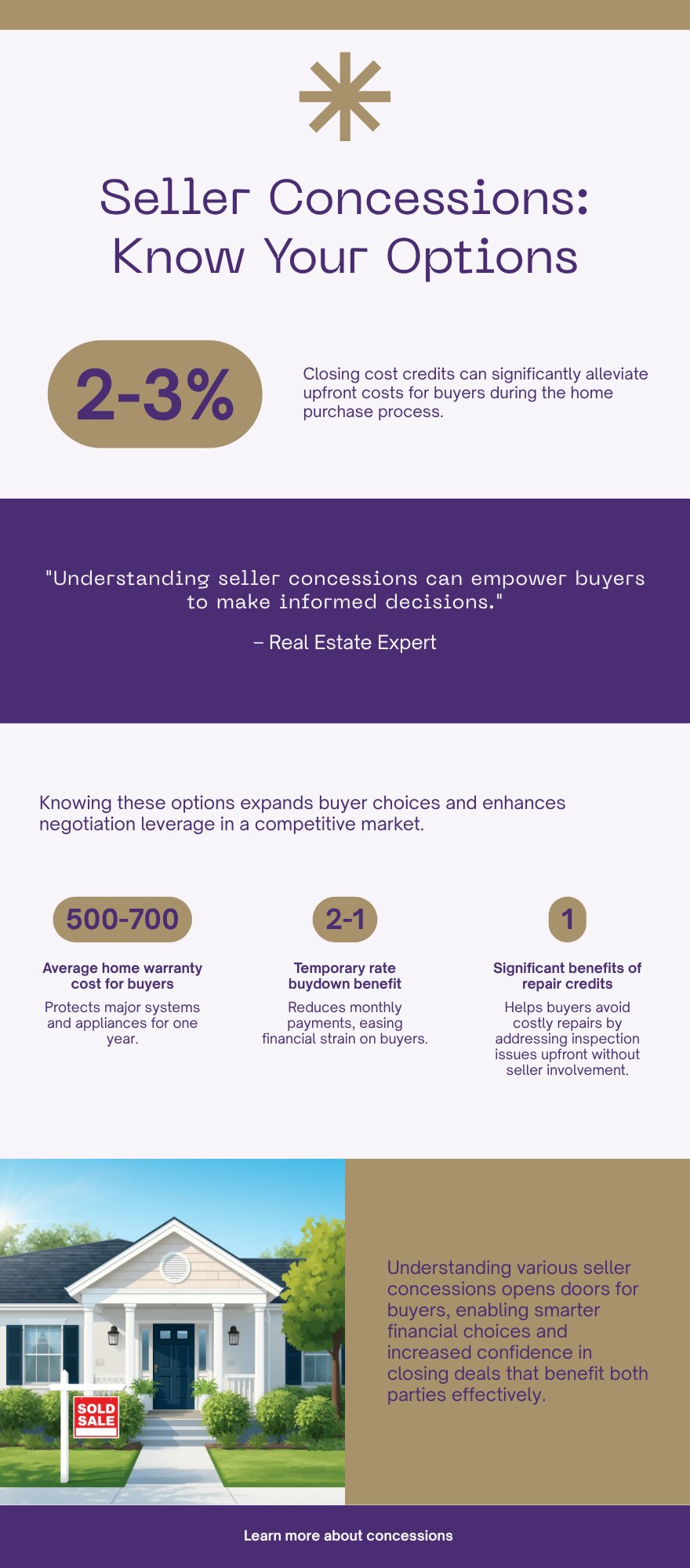
The four concession types King County sellers see most, side by side.
Concessions vs. a Price Reduction: They Solve Different Problems
This is the part sellers get backwards most often. A price reduction and a concession are not interchangeable. They fix different symptoms.
A price reduction fixes a visibility problem. If your home is not showing up in buyer searches, if you are getting almost no traffic, the number is too high for how the market is searching. Buyers filter by price range online before they ever see your listing. Drop the price and you show up to a new set of buyers who never saw the home before. If you want the full picture on getting the number right from the start, I cover that in how to price your home to sell in King County.
A concession fixes a conversion problem. If you are getting showings, even good ones, but no offers, buyers are seeing the home and still walking away. That usually means the home is priced fine but something else is stopping them: they cannot cover cash to close, the payment is a stretch at current rates, or an inspection issue is spooking them. A concession addresses that specific friction without resetting your price in the public record.
The honest reality: if your home has been sitting with almost no showings for three or four weeks, no concession fixes that. You need a price adjustment. If your home is getting showings and going under contract twice only to fall through at inspection or financing, a concession targeted at the actual reason those deals died is usually the smarter move.
How Much Does a Concession Actually Cost You
Run the math before you agree to anything. A $700,000 King County sale with a 3% closing cost credit costs you $21,000 off your net proceeds. That sounds like a lot until you compare it to a straight $21,000 price cut, which also reduces your net by $21,000 but resets the public sale price and can affect appraisal comps for every home that sells near you afterward, including your neighbors’. If you want to see how a concession fits into your full cost-to-sell picture alongside commission and excise tax, I broke down the complete math in what it costs to sell a home in Washington State.
There is a real limit here too. Conventional loans cap seller concessions based on the buyer’s down payment: buyers putting down less than 10% are typically capped around 3% of the sale price, buyers putting 10% to 25% down can usually go up to 6%, and buyers putting 25% or more down can go higher. FHA and VA loans have their own caps, generally more generous on FHA and capped differently on VA. Your agent needs to check the buyer’s loan type before you agree to a number, because a concession that exceeds the cap does not get approved by the lender. It just falls apart at underwriting after you have already accepted the offer.
The Local Angle: King County Specifics
King County is not one market right now, and that matters for this decision specifically.
Single-family inventory in tight submarkets like Renton and parts of Kent is still moving fast enough that concessions are less common. If you are selling a well-priced starter home in a walkable Renton neighborhood, you likely will not need to offer one. Multiple offers are still happening in that segment, and buyers competing against each other are not asking sellers for closing cost help.
Condos and higher price bands are a different story. Inventory has grown across King County through 2026, and condo buyers especially are negotiating harder. If you are selling a condo in Bellevue or a higher-priced single-family home in Sammamish or Issaquah, expect concession requests to be part of most serious offers. Buyers in this segment have more choices, and they know it.
South King County cities like Auburn, Federal Way, and Covington see concessions most often tied to closing cost help for first-time buyers, since that is the dominant buyer profile in those markets. East King County concessions more often show up as rate buydowns, because buyers there are stretching further on payment relative to income and a lower rate does more for their monthly budget than a closing cost credit would.
Know which buyer profile you are selling to before you decide what concession, if any, makes sense.
What This Means for You as a Seller
Do not offer a concession preemptively before you have any offers or real market feedback. Wait until you have data: showing counts, buyer agent feedback, whether offers are coming in and falling through. A concession should respond to a specific, identified problem, not a guess.
When an offer comes in asking for a concession, ask your agent what type and why. A buyer asking for a rate buydown has a monthly payment concern. A buyer asking for a closing cost credit has a cash concern. Those point to different underlying situations and tell you something about how close that buyer actually is to being able to complete the purchase.
Compare the concession cost to your next-best alternative, which is usually sitting on the market longer while carrying your mortgage, taxes, and insurance, or dropping your price instead. Run the real numbers both ways before you say yes or no.

Concessions are negotiated privately and settled at the closing table, never disclosed in public listing history.
Frequently Asked Questions
Do I have to offer a concession to sell my home in King County?
No. Whether a concession makes sense depends on your specific market segment, your showing activity, and buyer feedback. Many single-family sellers in tighter King County submarkets sell without ever offering one.
Is a concession the same as paying the buyer’s agent commission?
No, those are separate line items on the closing statement, though both come out of your net proceeds. A concession specifically covers the buyer’s closing costs, rate buydown, or repairs. Earnest money is a separate deposit entirely, from the buyer’s side — see earnest money in King County if a buyer’s offer has you wondering how that piece works.
How do I know if a buyer’s concession request is within loan limits?
Your agent should confirm the buyer’s loan type and down payment percentage before you counter or accept. Conventional loan concession caps scale with down payment size, and FHA and VA loans each have their own separate limits.
Does offering a concession make my home look desperate?
Not if it is not disclosed publicly and not offered until you have a specific reason to. Concessions are negotiated privately within an accepted offer. They do not appear as a price change in public listing history the way a price reduction does.
Can I offer a concession and still get close to full asking price?
Yes, and that is often the entire point. A concession lets you hold your list price while still closing the gap that is stopping a buyer from moving forward. That is different from a price cut, which lowers the number everyone sees.
Should I offer a concession before listing or wait for an offer?
Wait. Offering one before you have any market feedback means giving away money you might not have needed to. Let the first two to three weeks of activity tell you whether a concession is actually the problem you need to solve.
Your guide to life outside Seattle.
253-350-0045 ·
greg@livingoutsideseattle.com ·
www.livingoutsideseattle.com
Washington State Real Estate Excise Tax (REET): Seller Guide

Before you sign anything at closing, you need to know about one tax most sellers don’t think about until it’s too late.
Most sellers in King County spend months thinking about list price, staging, and what to do with the proceeds. REET — Washington’s Real Estate Excise Tax — rarely gets a mention until the closing statement lands in front of them. Then the questions start. What is this number? Why is it so large? Is this the same as capital gains?
The short answer: REET is a transaction tax Washington charges on nearly every home sale. Unlike capital gains, it is calculated on your sale price, not your profit. That distinction matters a lot. On an $800,000 home sale in Renton or Kent, your REET bill could run $13,000 or more before local rates are added. That is real money, and you should know exactly where it comes from before you go to closing.
I see this confusion regularly in my work. Sellers find out about REET at the same time they are signing a stack of documents and trying to remember where they put their ID. This guide is meant to fix that. Read it before you list.
What Is REET and Who Pays It
REET stands for Real Estate Excise Tax. It is Washington State’s tax on the transfer of real property. When you sell your home, you transfer ownership to the buyer. That transfer triggers REET. Washington has charged this tax since 1951, though the graduated rate structure is newer — it replaced the old flat rate in 2020.
The seller pays REET by custom and by statute. In practice, your escrow or title company collects it from your net proceeds at closing and remits it to the county before your deed is recorded. You do not write a separate check. It comes out of what you would otherwise walk away with, which is exactly why it affects your bottom line.
The deed cannot be recorded until REET is paid. That means the sale cannot legally close until the tax is settled. Your title company handles this automatically, but knowing it is happening helps you read your settlement statement correctly.
The 2026 REET Rate Schedule: What You Actually Pay
Washington uses a four-bracket graduated rate structure. Every seller pays the same rate on each bracket — the rate applies to the slice of your sale price within that range, not to the entire sale price. Think of it like income tax brackets: only the amount within each tier gets taxed at that tier’s rate.
Here is how the 2026 state rate schedule breaks down:
2026 Washington State REET Brackets
First $525,000 — state rate of 1.10%
$525,000.01 to $1,525,000 — state rate of 1.28%
$1,525,000.01 to $3,025,000 — state rate of 2.75%
Above $3,025,000 — state rate of 3.00%
King County adds a local REET of 0.50% on top of the state rate. This local portion funds affordable housing and infrastructure programs countywide.
To make the math concrete, here is what three common King County sale prices actually cost in total REET:
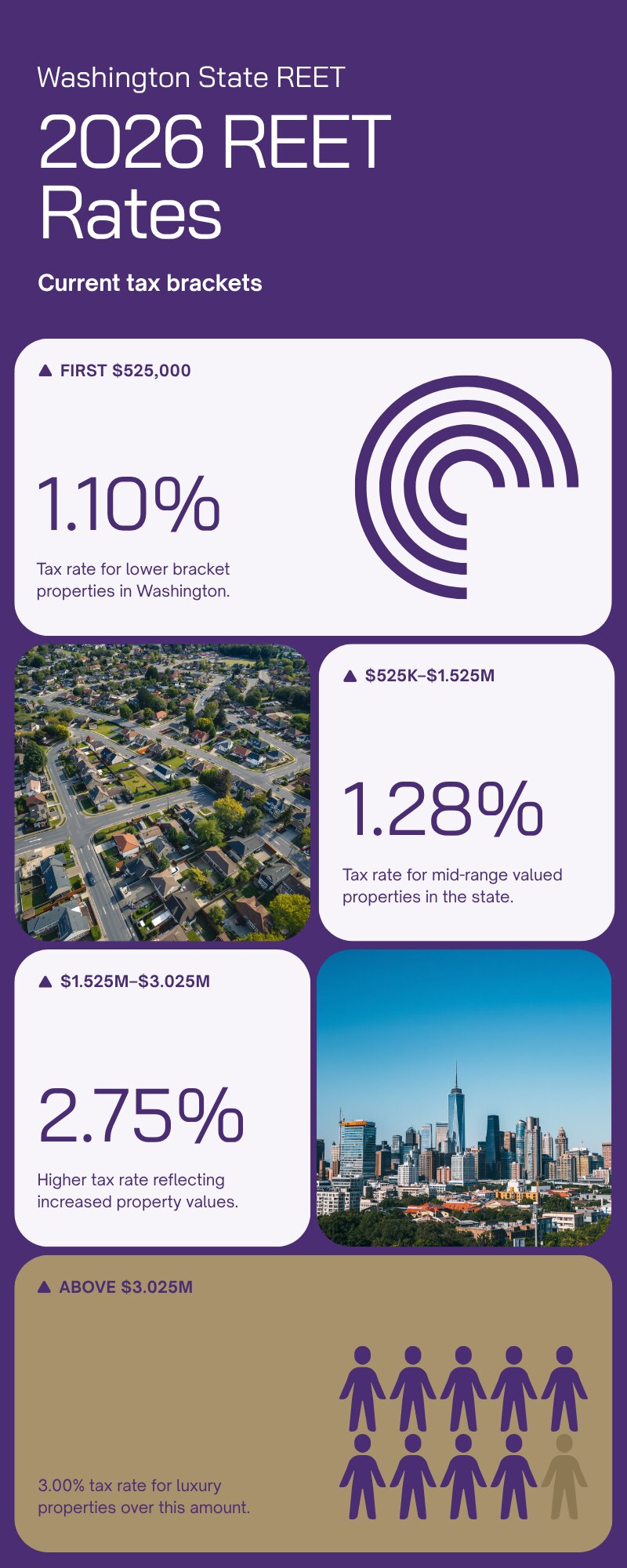
The graduated rate structure means your effective REET rate rises as your sale price climbs — most South King County sellers land between 1.60% and 1.78% combined.
Sale Price $600,000 (typical Kent or Auburn single-family)
State REET on first $525,000: $5,775
State REET on next $75,000 @ 1.28%: $960
King County local REET (0.50%): $3,000
Total REET: $9,735
Sale Price $800,000 (typical Renton or Covington move-up home)
State REET on first $525,000: $5,775
State REET on next $275,000 @ 1.28%: $3,520
King County local REET (0.50%): $4,000
Total REET: $13,295
Sale Price $1,100,000 (Maple Valley or East Renton higher-end)
State REET on first $525,000: $5,775
State REET on next $575,000 @ 1.28%: $7,360
King County local REET (0.50%): $5,500
Total REET: $18,635
These numbers grow quickly on move-up homes. The graduated structure means sellers at the $1.5M threshold pay roughly 2.5 times more as a percentage of their sale price than sellers in the $525K range. For most South King County sellers, the combined state plus local rate lands somewhere between 1.60% and 1.78% of the sale price.
REET Is Not Capital Gains Tax
This is the confusion I hear most often from sellers, and it is worth clearing up completely before anything else.
REET is calculated on your sale price. Capital gains is calculated on your profit — the difference between what you paid for the home and what you sold it for, minus selling costs and qualifying improvements. They are separate obligations. You pay REET at closing regardless of whether you made money on the sale. You deal with capital gains at tax time, and only if your profit exceeds the federal exclusion ($250,000 for single filers, $500,000 for married couples filing jointly).
Washington State does not impose a capital gains tax on real estate sales. The state’s 7% capital gains tax applies to certain financial assets — stocks, bonds, and similar instruments — not to your home. So when it comes to your Washington State tax burden from selling a home, REET is essentially it. Federal taxes are a separate calculation entirely.
I wrote a full breakdown of how capital gains work on Washington home sales if you want to understand the federal piece. The REET and capital gains questions show up together constantly — it helps to understand them separately before you talk to your CPA.
Common REET Exemptions
Not every transfer triggers REET. Washington provides specific statutory exemptions, and knowing them can save you a significant sum if your situation qualifies.
Inheritance and Devise by Will
If you inherited a home and you are selling it to a third party, REET applies on your sale. But the original transfer from the estate to you — moving the property into your name — is exempt from REET. This is why inherited property often shows up in the chain of title without a corresponding excise tax payment. If you recently inherited a King County home and have questions about next steps, I covered this specifically in my inherited home guide for King County sellers.
Divorce and Legal Separation
Transfers between spouses pursuant to a divorce decree or legal separation agreement are exempt. This applies to legally married spouses and state-registered domestic partners. If you are transferring the home to a former partner as part of a settlement, REET likely does not apply — but the exemption must be documented correctly on the REET affidavit.
Gifts
Genuine gifts of real property where no money or other consideration changes hands are exempt. The key word is genuine — the transfer must be a gift, not a below-market sale disguised as one.
Foreclosure and Distressed Transfers
Certain distressed sale scenarios have partial or full exemptions. These situations involve additional complexity and you should work directly with a title company and a real estate attorney to confirm eligibility and documentation requirements.
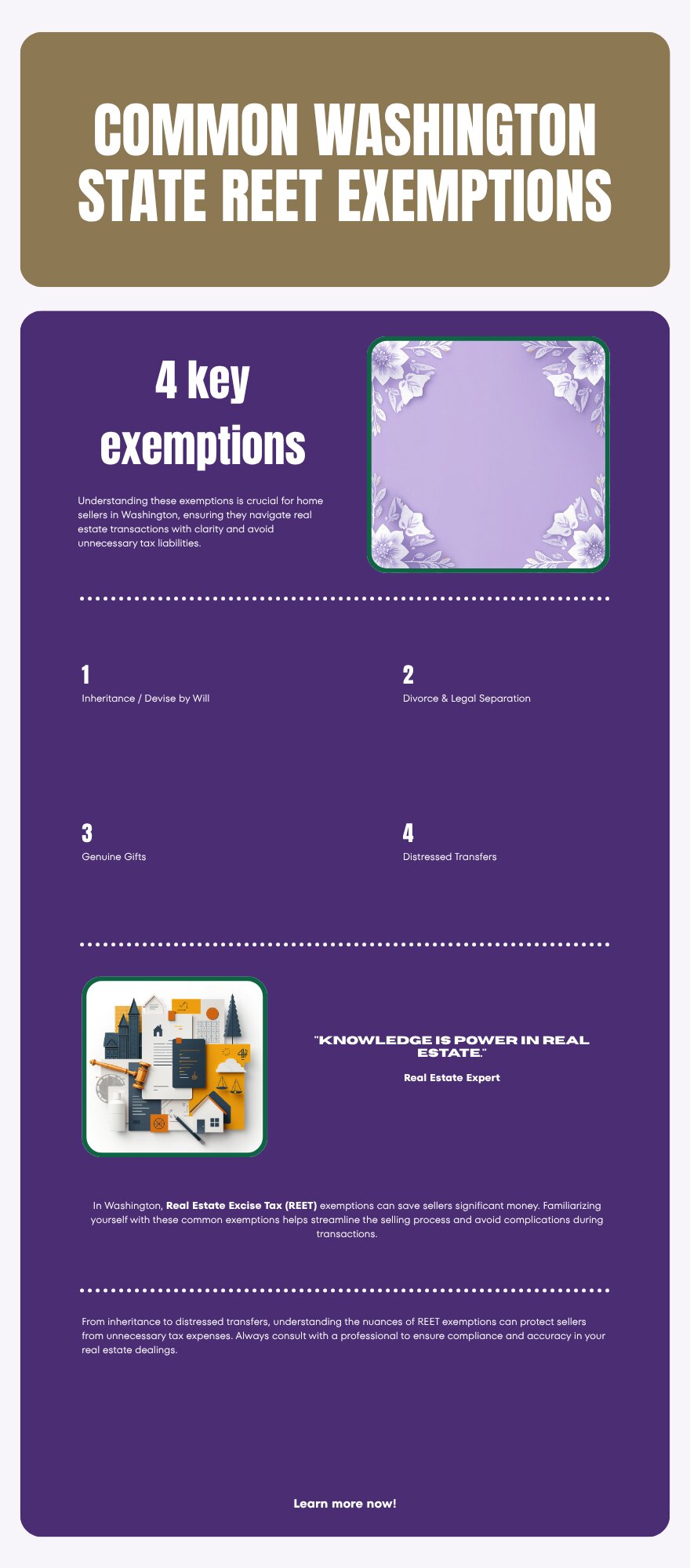
The most common REET exemptions in Washington State — always confirm with your title company before assuming your transfer qualifies.
How REET Fits Into Your Total Closing Costs
REET is typically the largest single tax line on a King County seller’s settlement statement, but it sits alongside other closing costs. When you are running your net proceeds math before you list, here is how REET fits into the picture.
Your title and escrow company will prepare a preliminary settlement statement before closing. That statement breaks out every cost — agent commission, title fees, prorated property taxes, any seller-paid concessions, and REET. Review this before closing day so there are no surprises when you sign.
The REET affidavit gets filed at the county recorder’s office. In King County, that is processed through the King County Recorder’s Office. Your title company handles the filing, but the tax must clear before the deed is recorded. Practically speaking, closing cannot happen until REET is paid and confirmed — it is a mechanical requirement, not a risk you manage yourself.
For more detail on the full picture of seller closing costs in King County, my home preparation guide for King County sellers covers what you can expect to spend before and at closing.
The King County Angle: What Local Sellers Should Know
King County’s 0.50% local REET rate is at the higher end for Washington counties — many rural counties charge just 0.25%. The difference matters on expensive homes. On a $900,000 sale, the extra 0.25% in King County versus a lower-rate county adds $2,250 to your tax bill. That is the cost of selling in a high-demand market.
The local REET revenue in King County is directed toward affordable housing programs and capital projects. Your REET payment at closing funds housing initiatives within the county — that context may or may not make the bill feel better, but it is where the money goes.
South and East King County sellers — Renton, Kent, Auburn, Covington, Maple Valley, Issaquah, Sammamish — all pay the same King County local rate of 0.50%. The baseline applies throughout unincorporated areas and most incorporated cities in the county.
The market in South King County currently sits at roughly $730,000–$870,000 median for single-family homes, depending on city. At that price range, total REET (state plus King County local) typically lands between $11,700 and $14,400. Build that number into your net proceeds calculation before you set your list price.
What This Means for Sellers: Your Pre-Listing Checklist
If you are preparing to sell your King County home, here are the concrete steps that apply to REET:
Run the math before you list
Use your expected sale price and the rate schedule above to estimate your REET liability. This gives you an accurate net proceeds number when you evaluate offers. Your agent can run this for you in minutes.
Tell your agent your target net
If you need to walk away with a specific amount, your agent needs to know that before pricing the home. REET comes off the top along with commission and other costs. Net proceeds math drives the right list price — not gross sale price alone.
Check for exemptions
If your sale involves inheritance, divorce, or a gift transfer, ask your title company whether an exemption applies. Do not assume — the exemptions are specific and require documentation on the REET affidavit.
Ask for a preliminary settlement statement
Before closing day, request this from your escrow company. Review the REET line and confirm it matches your calculations. Surprises on closing day slow things down and add stress to an already complex process.
Talk to a CPA if you have a large gain
REET is your Washington State obligation. Federal capital gains is a separate question. If you have owned your home for many years and have significant appreciation beyond the exclusion amount, discuss that with a tax professional before closing — not after.
Frequently Asked Questions About Washington REET
Is REET paid by the buyer or the seller in Washington?
By statute and by custom, the seller pays REET in Washington. It is deducted from your net proceeds at closing. The buyer does not pay REET on a standard residential sale, though they do pay their own closing costs.
Can the buyer and seller negotiate who pays REET?
The contract governs, not state law. In theory, a seller could negotiate for the buyer to assume REET liability. In practice, this is uncommon in King County residential sales. Most transactions follow the standard custom: seller pays.
Does REET apply to new construction sales?
Yes. New construction sales are subject to REET on the full sale price, including both land and improvements. The builder or developer pays REET at closing.
Is REET deductible on my federal taxes?
REET is generally treated as a selling expense and reduces your capital gain for federal tax purposes. It is not a separately deductible item like mortgage interest. Ask your CPA how to account for it in your cost basis and selling expense calculations.
What if my home sells for less than I paid?
REET still applies to the sale price, even if you are selling at a loss. There is no exemption for a below-basis sale on a residential property. You will owe REET on whatever amount changes hands.
What happens if REET is not paid at closing?
The deed cannot be recorded without REET payment. In practice, your title company will not allow closing to proceed until REET is collected and submitted. This is a mechanical requirement — your title company manages it, not you.
Selling a home involves a lot of moving parts, and REET is one that tends to catch sellers off guard. The graduated rate structure means your tax bill scales significantly as your sale price climbs, and in King County’s current market, most sellers are selling above the first bracket. Know the numbers before you list, not the morning you sign closing documents.
If you have questions about what your specific sale will net after REET and other closing costs, reach out before you commit to a price. I run this math for every client I work with. It takes ten minutes and removes a lot of surprises. You can also review how I approach pricing in my CMA explainer for King County sellers.
Your guide to life outside Seattle.
253-350-0045 ·
greg@livingoutsideseattle.com ·
www.livingoutsideseattle.com
