

 Facebook
 X
X
 Pinterest
 Copy Link

Most sellers walk into a bridge loan or HELOC application with a number in their head. It usually comes from a Zillow search the night before. That number is often wrong. And finding out after a lender pulls your file wastes weeks you don’t have if you’re trying to buy before you sell.
I do BPO work across east and south King County every day. Part of that job is telling banks what a property is actually worth, not what an algorithm guessed. The gap between those two numbers is what trips people up when they try to use their equity to buy their next home before selling the current one.
Here’s how to find out how much home equity you actually have before you talk to a lender.
Why Your Zillow Estimate Isn’t Your Real Equity Number
An online home value estimate is a computer’s best guess based on public records and recent sales nearby. It cannot walk through your house. It doesn’t know you refinished the kitchen last year. It doesn’t know your foundation has a crack the last inspection flagged. In King County, details like a busy road behind the fence or a territorial view can move a price by tens of thousands of dollars, and no algorithm sees either one.
Research on automated valuation models shows they typically miss by 2% on homes that are actively listed and by closer to 7% on homes that aren’t. On an $838,000 home, King County’s current median sold price as of early September 2026, a 7% miss is about $58,000. That’s not a rounding error. That’s the difference between qualifying for a bridge loan and getting turned down.
So what does this mean for you? If you’re using an online estimate to decide whether you have enough equity to buy before you sell, you’re making a real financial decision on a number that could be off by tens of thousands of dollars.
The Actual Equity Formula
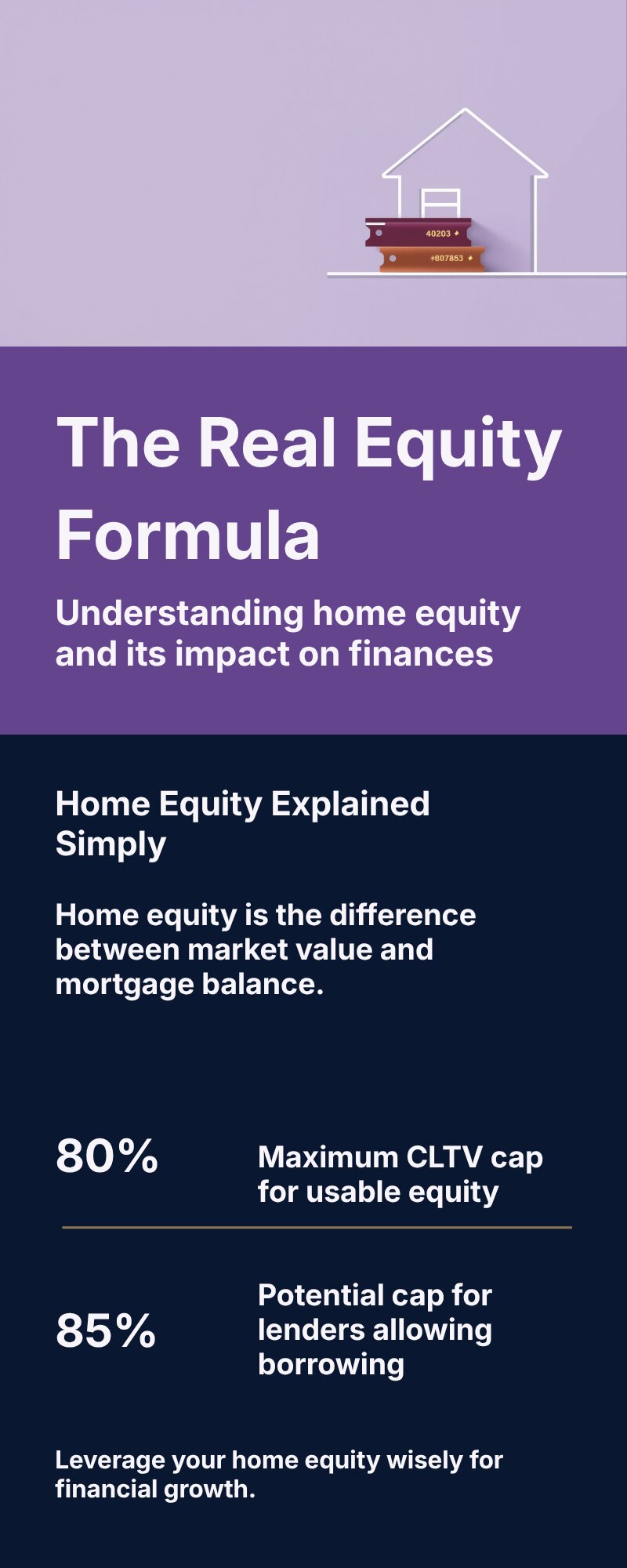
Total equity and usable equity are two different numbers. Lenders care about the second one.
Home equity is simple math on paper. Take your home’s current market value, subtract your outstanding mortgage balance, and that’s your equity.
The part people get wrong is the market value half. Get that number right first, using one of these sources, ranked by accuracy.
A recent professional appraisal, if you’ve had one done in the last six months for a refinance or another reason, is your most reliable starting point. A BPO or CMA from an agent who actually works your neighborhood is next best, and it’s usually free. Pulling comparable sales yourself, what homes like yours actually sold for in the last 90 days, is the minimum bar. An online estimate alone is the least reliable option. It shouldn’t be the number you build a financing decision around.
Once you have a real value, subtract your exact mortgage payoff. Not your last statement balance. Your payoff includes accrued interest since your last payment and any prepayment fees your loan carries. Call your servicer or pull your payoff quote online. It’s usually a few hundred dollars higher than your statement balance, and that gap matters when you’re close to a lender’s cutoff.
What Lenders Will Actually Let You Borrow
Here’s the part that catches sellers off guard. Having equity and being able to borrow against all of it are two different things.
Most HELOC lenders cap you at 80 to 85% combined loan-to-value. That means your existing mortgage plus the new HELOC can’t exceed 80 to 85% of your home’s appraised value. Bridge loan lenders work the same way, typically capping around 80% loan-to-value on the property being used as collateral. Both also want a credit score in the high 600s or better and a debt-to-income ratio under roughly 43%.
Run the real math on a $700,000 home with a $350,000 mortgage balance. On paper, that’s $350,000 in equity. But at an 80% CLTV cap, a lender will only let your combined loans reach $560,000. Subtract your existing $350,000 mortgage and your actual borrowing power lands closer to $210,000. Not the full $350,000 you might have assumed. That’s the number you plan around.
The Local Angle: King County Equity Looks Different by City

Longer ownership on the Eastside means bigger equity cushions, but a cooling market narrows the gap for everyone.
Equity math isn’t the same everywhere in King County right now, and that matters if you’re trying to time a move.
Sellers in Bellevue, Sammamish, and Issaquah usually sit on the largest equity cushions in the county. Home values there have appreciated the most over the years someone’s owned the property. A homeowner who bought in Sammamish eight years ago has a very different equity position than someone who bought in Kent or Auburn three years ago, even if both owe roughly the same amount today. If you’re a South King County owner thinking about rolling that equity into an Eastside upgrade, the math above is your starting point before you run that comparison.
King County’s median sold price sits at $838,000 as of early September 2026, down about 4.2% from a year ago, with 3.8 months of supply on the market. A cooling market doesn’t erase equity for most long-term owners. But it does mean your value today may be lower than it was six or twelve months ago. If your last equity check was done during last year’s peak pricing, don’t assume that number still holds. Run it again.
Sellers in Renton, Kent, Auburn, and Covington who bought more recently should be the most careful here. Thinner equity cushions mean a smaller AVM miss can be the difference between clearing a lender’s CLTV threshold and falling just short of it.
What This Means for You as a Seller
Get a real number before you fill out a single bridge loan or HELOC application. Ask an agent who works your specific neighborhood for a BPO-backed estimate or a full CMA, not just a quick online opinion. Pull your actual mortgage payoff quote from your servicer instead of trusting your last statement. Then run the CLTV math yourself, using 80% as a conservative planning number, so you know your real borrowing power before a lender tells you.
If the number that comes back is lower than you hoped, that’s better to know now. It gives you time to adjust. Wait a few more months. Consider a smaller bridge. Look at a contingent offer instead, or read through how a sell-and-buy-at-the-same-time double move actually gets structured once you know your real number.
FAQ
How do I find out how much equity I have in my home?
Subtract your exact mortgage payoff balance from your home’s current market value, based on a professional CMA, BPO, or recent appraisal rather than an online estimate alone.
What’s the difference between total equity and usable equity?
Total equity is your home’s value minus what you owe. Usable equity is smaller, because most lenders cap combined borrowing at 80 to 85% of your home’s value, not 100%.
Can I use my home’s Zillow estimate to apply for a HELOC?
You can use it as a rough starting point, but lenders will order their own appraisal or valuation, and automated estimates miss by roughly 2% on-market and up to 7% off-market. Don’t build your financing plan around it alone.
How much equity do I need for a bridge loan?
Most bridge loan lenders want to see at least 20% equity in your current home, with the bridge loan itself capped around 80% loan-to-value on that property.
Does a cooling market affect my home equity?
Yes. King County’s median sold price is down about 4.2% year-over-year as of September 2026. If your last equity estimate is more than a few months old, especially from last year’s pricing, check it again before applying for financing.
Should I get an appraisal or a CMA before applying for a HELOC?
A CMA or BPO from an agent who knows your market is usually free and a good first step. Your lender will likely still order its own appraisal once you formally apply, but starting with an accurate number means fewer surprises.
Your guide to life outside Seattle.
253-350-0045 ·
greg@livingoutsideseattle.com ·
www.livingoutsideseattle.com
