

 Facebook
 X
X
 Pinterest
 Copy Link
I’ve done BPO valuation work across South and East King County for over 13 years, so I’m not guessing at what your Kent or Renton home is worth today. Let’s walk through what the move really costs and what it takes to make it work.
Why Kent and Renton Owners Look at Sammamish and Issaquah
The pull is usually one of three things: schools, commute to the Eastside tech corridor, or simply wanting a different kind of neighborhood after years in a starter or mid-size home. Sammamish splits between the Lake Washington and Issaquah school districts, both strong performers, and Issaquah itself has its own well-regarded district and a walkable downtown that Sammamish doesn’t have. Neither city looks or feels like Kent or Renton, and for some buyers that’s exactly the point.
The number that stops most people before they start is the sticker price. It’s a fair reaction. But the sticker price is not the number that matters. What matters is your net cost to move, and that number depends almost entirely on how much equity you’re bringing with you.
The Equity Math, City by City
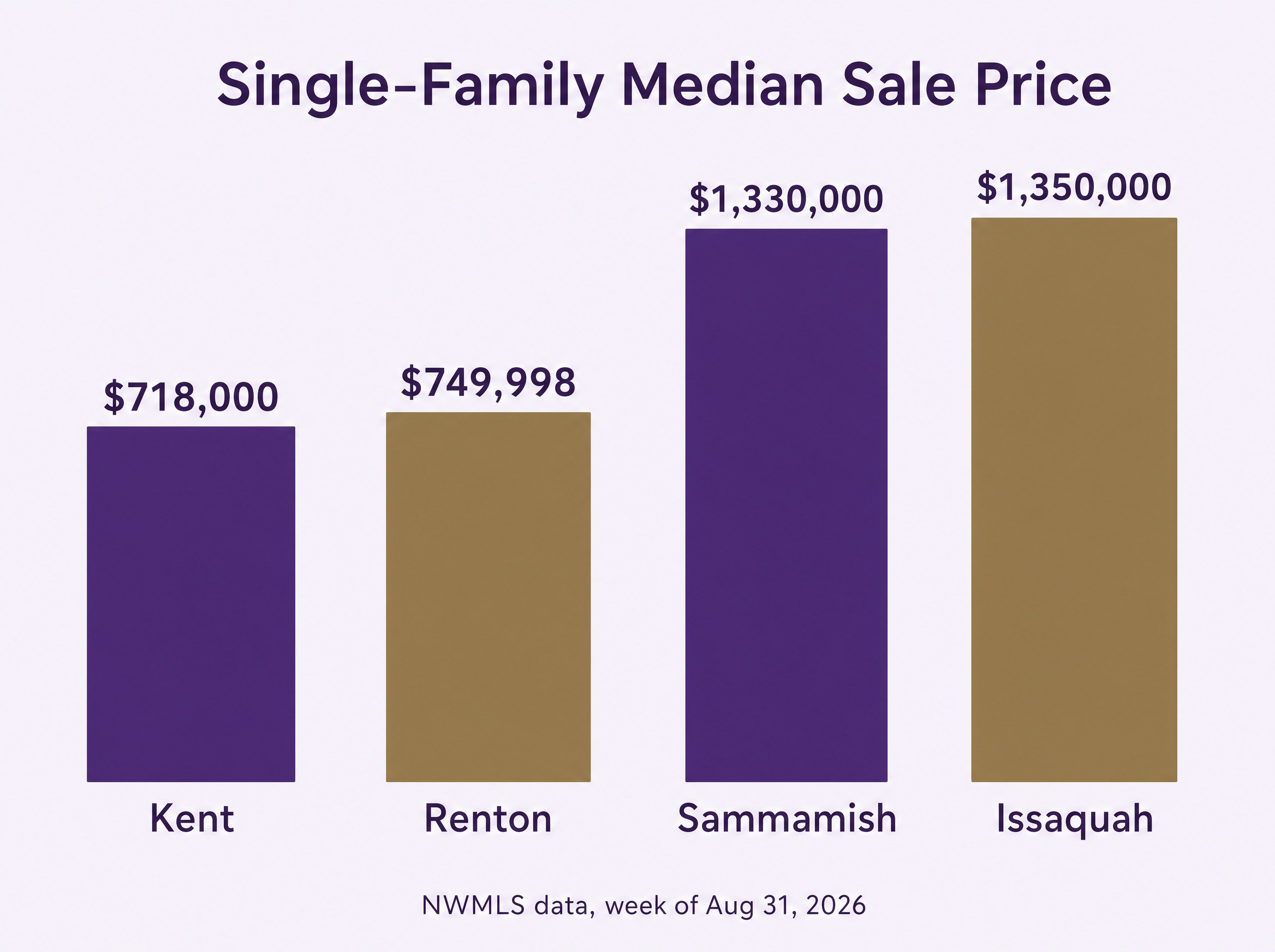
Here’s where the two starting cities and two destination cities actually stand, split between single-family and condo since blending them hides more than it shows.
| City | Single-Family Median | Condo Median | Weeks Supply (SFR) |
|---|---|---|---|
| Kent | $718,000 | $312,500 | 4.33 |
| Renton | $749,998 | $409,975 | 3.88 |
| Sammamish | $1,330,000 | $607,495 | 6.00 |
| Issaquah | $1,350,000 | $543,205 | 3.67 |
Source: NWMLS via the LOS Marketing Hub’s current-market-data workbook, week of August 31, 2026 (sold-price figures reflect a trailing 4-week window).
Put plainly: moving from a Kent single-family home to Sammamish means closing roughly a $612,000 gap. Kent to Issaquah is closer to $632,000. Renton to Sammamish runs about $580,000, and Renton to Issaquah about $600,000. None of those numbers are small, and none of them are the number you’ll actually need to finance, because your equity does most of the work.
How Much of That Gap Your Equity Actually Covers
This is the part most people skip, and it’s the part that changes the decision. If you bought your Kent or Renton home five or more years ago, you’re very likely sitting on substantial equity from both your original down payment and years of appreciation. That equity becomes your down payment on the Eastside home, and it directly reduces the new mortgage you need, not the sale price of the new home.
The honest caveat: if you bought recently or you’re still early in your mortgage, your equity position will be smaller, and the gap you need to finance will be closer to the full sticker difference. Getting a real number on your current equity, not a Zillow estimate, is the first step before you seriously shop the Eastside.
I go deeper on structuring a bridge loan or HELOC to buy before you sell in my guide on financing a move-up purchase before your current home sells.
Should You Sell First or Buy First?
This is the same sequencing question every move-up buyer faces, and it matters more on a Kent-or-Renton-to-Eastside move because the price gap is bigger than a typical same-city move-up. Selling first gives you certainty about exactly how much equity you’re working with before you make an offer on the Eastside. Buying first means smoother logistics and no rental gap, but it usually requires a bridge loan, a HELOC set up before you list, or a contingent offer.
With Sammamish sitting around 6 weeks of supply, contingent offers are more realistic there than in a market where sellers are fielding five competing bids. Issaquah’s tighter supply makes a contingent offer a harder sell, so financing your way in with a HELOC or bridge loan tends to work better if Issaquah is your target.
What Actually Changes Day to Day
Beyond the math, Kent and Renton owners moving to Sammamish or Issaquah are trading a shorter commute to South King County job centers for a longer one, in exchange for proximity to the Eastside tech corridor and, in Sammamish’s case, some of the strongest school ratings in the county. Issaquah keeps a walkable downtown core that neither Kent’s nor Renton’s core quite matches at the same scale, while Sammamish stays almost entirely residential with larger lots and a quieter feel.
I go deeper on neighborhood character and school boundaries in the Sammamish neighborhood guide by lifestyle, a useful companion once you’re weighing specific neighborhoods rather than just the city.
Frequently Asked Questions
How much more expensive is Sammamish or Issaquah than Kent or Renton?
Single-family homes in Sammamish and Issaquah are running $580,000 to $632,000 above Kent’s and Renton’s current medians, roughly 80 to 88 percent higher. That’s the sticker price gap, not your out-of-pocket cost. Most of that difference gets absorbed by the equity you bring from selling your current home, so your actual new mortgage is typically far smaller than the full price gap suggests.
Can I afford to move from Kent to Sammamish if I’ve owned my home for a while?
It depends on your specific equity position, but longer ownership generally means a stronger answer. If you’ve owned five or more years, your equity from both your down payment and appreciation likely covers a meaningful share of the price difference. Get a current, BPO-backed valuation on your home rather than relying on an automated estimate, then run the actual new-mortgage numbers before deciding.
Should I buy in Sammamish or Issaquah before I sell my Kent or Renton home?
It depends on your risk tolerance and financing options. Buying first avoids a rental gap but usually requires a HELOC set up before you list, a bridge loan, or a contingent offer. Sammamish’s looser supply, around 6 weeks, makes contingent offers more realistic there than in Issaquah, which is running under 4 weeks of supply and tends to reward buyers who come in without a sale contingency.
Your guide to life outside Seattle.
253-350-0045 · greg@livingoutsideseattle.com · www.livingoutsideseattle.com
