

 Facebook
 X
X
 Pinterest
 Copy Link

You have three ways to buy your next home before your current one sells. Here’s the real math on each, so you pick the one that fits your equity, your timeline, and your risk tolerance.
I run BPOs on King County homes for banks and institutional clients almost every day. Most of that work is pricing homes that are about to sell, not homes that already have a next home lined up. But the sellers I talk to who are also buying always ask me the same question: how do I get into my next house without selling this one first?
There are three real answers. A bridge loan. A HELOC. Or a formal buy-first program from a company like Knock, Orchard, or HomeLight. Each one solves the same timing problem in a different way, and each one costs you something different. This post walks through what each option actually costs, when each one makes sense, and when none of them are worth it. If you want the bigger picture on structuring a double move, I cover the full framework in Sell and Buy a House at the Same Time in King County.
Most people think this decision is about finding the cheapest option. It is not. It is about matching the option to your specific equity position and your timeline, because the cheapest option on paper can be the wrong one if your current home takes longer to sell than you planned.
The Real Cost of a Bridge Loan
A bridge loan is short-term financing that uses your current home as collateral. The lender gives you cash, usually enough to cover the down payment and closing costs on the new house, and you pay it off in full once your old home sells.
Right now, bridge loan rates run 8.5% to 12%, with most King County borrowers landing around 9.5%. That is roughly prime plus 2 to 4 points. On top of the rate, expect an origination fee of 1% to 3% of the loan amount. Most bridge loans are interest-only, which keeps the monthly payment lower while you are carrying two properties, but you still need to qualify for both that payment and your new mortgage at the same time.
So what does this mean for you? On a $150,000 bridge loan at 9.5% interest-only, you are looking at roughly $1,188 a month just in interest, plus a $3,000 to $4,500 origination fee upfront. If your old home sells in 60 days, that is manageable. If it sits for six months because you priced it wrong or picked a slow season, the math gets a lot less comfortable.
Lenders typically require at least 20% equity in your current home before they will approve a bridge loan. If you bought in 2020 or earlier, most South and East King County sellers clear that bar easily. If you bought in the last two years, run the numbers before you assume this is available to you.
The HELOC Alternative
A home equity line of credit does something similar to a bridge loan, but through a different structure. Instead of a lump-sum bridge loan tied specifically to your purchase, a HELOC gives you a line of credit against your current home’s equity that you can draw on for the down payment.
The advantage is cost. HELOC rates are running around 7.3% nationally as of this month, well below bridge loan rates, and the repayment terms stretch out over 10 to 20 years instead of 6 to 12 months. That gives you breathing room if your home takes longer to sell than expected. You are not racing a short clock.
The tradeoff is timing. A HELOC application, appraisal, and underwriting process usually takes two to four weeks, sometimes longer if your lender is backed up. A bridge loan, especially through a specialty lender, can sometimes close faster because the underwriting is built around exactly this scenario. If you found your next house last week and the sellers want an answer, a HELOC you have not started yet will not save you.
The other catch: once you sell your current home, you are paying off that HELOC balance, which means less net proceeds landing in your pocket at closing. Budget for that the same way you would budget for a bridge loan payoff.

A HELOC costs less than a bridge loan but takes two to four weeks to set up.
Buy-First Programs: Paying for Certainty
The third option skips borrowing against your equity entirely. Companies like Knock, Orchard, and HomeLight will unlock a portion of your home’s equity in cash and, in most versions of these programs, guarantee they will buy your old home if it has not sold on the open market within a set window, usually 90 to 180 days.
Knock charges a fixed 2.25% fee on your new home’s purchase price plus roughly $1,850 in closing costs. Orchard charges around 6% (similar to a normal listing commission) plus a program fee starting near 1.9%. HomeLight charges 2.4% of your sale price, or 1.7% if you also use their in-house lending and closing services.
Here is the honest tradeoff: you are paying 2% to 2.4% of your home’s value, which on a $750,000 King County sale is $15,000 to $18,000, for the certainty that you will not be stuck holding two mortgages. For some sellers, especially those without 20% equity to qualify for a bridge loan or HELOC, that certainty is worth every dollar. For sellers sitting on strong Eastside equity who could clear a bridge loan qualification easily, it is an expensive way to solve a problem you could solve more cheaply.
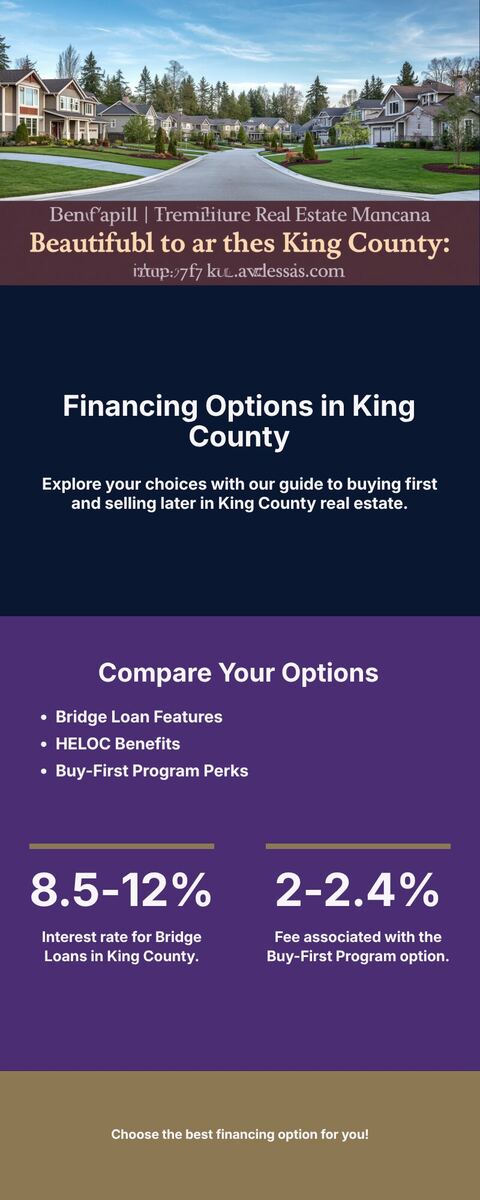
Rates, terms, and equity requirements side by side.
Which Option Fits Your Situation
If you have strong equity, at least 20%, and confidence your home will sell within a normal King County timeline, a bridge loan or HELOC will almost always cost less than a buy-first program’s 2%-plus fee. Between those two, choose the HELOC if you have a few weeks before you need to close, and the bridge loan if you found your next house faster than your equity access can move.
If your equity position is thinner, or if you cannot stomach the idea of two mortgage payments even for two or three months, a buy-first program’s fee buys you real peace of mind. That is not a bad trade. It is just a different trade than the cheapest option on paper.
If none of these fit, a contingent offer, making your purchase dependent on your current home selling, is still the lowest-cost option, though it is the weakest offer in a competitive situation. I cover how to structure a contingent offer sellers will actually accept in a separate guide.
The Local Angle: King County Timing Matters
King County’s market right now sits at 3.9 months of supply, with a median days-on-market of 21 days and homes selling at 99% of list price on average. That is a market where a well-priced home in Renton, Kent, or Auburn typically moves inside a bridge loan’s six-month window without much drama. But “well-priced” is doing a lot of work in that sentence. An overpriced home in this same market can sit two or three times as long, and that gap is exactly what turns an affordable bridge loan into an expensive one.
East King County (Bellevue, Sammamish, Issaquah) sellers generally carry more equity relative to their loan balance, which makes bridge loans and HELOCs more accessible there. South King County sellers (Kent, Auburn, Federal Way, Covington) sometimes have less room, which is where a buy-first program’s lower equity bar can matter more.
One more King County-specific wrinkle: NWMLS Form 22B governs contingent offers here, and lenders reviewing your bridge loan or HELOC application will want to see your current home either listed or under a firm timeline. Get your listing strategy locked down before you start any of these applications, not after.
What This Means for You
Before you pick a financing path, get a real number on your home’s value from someone who prices homes for a living, not an automated estimate. The gap between what a Zestimate says and what your home actually sells for changes every calculation in this post. If your equity estimate is off by $50,000, your options change.
Then talk to a lender about pre-qualifying for a bridge loan or HELOC before you fall in love with a house. Knowing your real number ahead of time means you are not scrambling to compare three financing options in the 48 hours after an offer gets accepted.
FAQ
Do I need 20% equity to qualify for a bridge loan?
Most bridge loan lenders require at least 20% equity in your current home. If you are below that threshold, a HELOC may also be difficult to secure at a meaningful amount, and a buy-first program becomes a more realistic option since those companies typically unlock equity at lower thresholds.
Is a HELOC always cheaper than a bridge loan?
On interest rate alone, usually yes. HELOC rates are running around 7.3% versus 8.5% to 12% for bridge loans. But a HELOC takes longer to set up, typically two to four weeks, so if your timeline is tight, the faster bridge loan process can be worth the higher rate.
How much do buy-first programs actually cost?
Expect 2% to 2.4% of your home’s sale price for programs like Knock or HomeLight, or around 6% plus a 1.9% program fee for Orchard’s Move First option. On a $750,000 King County home, that is $15,000 to $18,000 beyond a typical commission structure.
What happens if my home doesn’t sell within the bridge loan term?
Most bridge loans run six to twelve months. If your home has not sold by the end of the term, you will need to refinance the bridge loan, extend it if your lender allows, or in a worst case, face default since your current home is the collateral. This is exactly why realistic pricing matters more than anything else in this equation.
Can I combine a contingent offer with one of these financing options?
Yes, and some buyers do this as a backup. You can pursue a bridge loan or HELOC as financing while still writing a contingent offer to reduce risk, though in competitive King County listings a financing-backed non-contingent offer is usually the stronger one.
Is a buy-first program worth it if I have plenty of equity?
Usually not on cost alone. If you comfortably qualify for a bridge loan or HELOC, you will almost always pay less than the 2% or more that buy-first programs charge. Their value is in eliminating uncertainty, which matters most to sellers without much equity cushion or without patience for carrying two mortgages.
Whether you are sitting on solid Eastside equity or working with a tighter number in South King County, the right financing path depends on your actual numbers, not a generic rule of thumb. I’m happy to walk through the real numbers with you, including what your home is actually worth right now based on my daily BPO work across the county. No pressure, no sales pitch.
Your guide to life outside Seattle.
253-350-0045 ·
greg@livingoutsideseattle.com ·
www.livingoutsideseattle.com
