Market InsightsSeller Resources July 22, 2026

Seller Concessions in King County: A Full Guide

Give a buyer a reason to say yes without cutting your price. Here is how concessions actually work in today’s market.

I do BPO work across east and south King County every day, and lately I am seeing the same request show up in offer after offer: a concession. Not a lower price. A credit, a buydown, a repair allowance. Something that makes the deal pencil out for the buyer without touching the number on the listing.

If you are selling right now, you need to understand what a concession actually is, what it costs you, and when it works better than just dropping your price. This is not the same conversation everywhere in King County. What makes sense in a still-tight Renton starter home market is not what makes sense if you are selling a condo in a building with 3 competing listings.

What a Seller Concession Actually Is

A concession is money you agree to give back to the buyer at closing, structured a specific way in the purchase agreement. It shows up on the closing statement, not as a lower list price. The home still sells for its listed number. You are just contributing part of your proceeds toward the buyer’s costs.

Three types show up most often in King County deals right now.

Closing Cost Credit

The simplest concession. You agree to cover 2% to 3% of the buyer’s closing costs: their lender fees, title insurance, escrow charges. This helps buyers who have the income to qualify for the loan but are short on cash to actually close. First-time buyers in Kent and Auburn run into this constantly. They can afford the payment. They cannot afford to also come up with $18,000 in closing costs on top of a down payment.

Rate Buydown

Instead of paying closing costs, you deposit money into an account that temporarily or permanently lowers the buyer’s interest rate. A temporary 2-1 buydown drops the rate by 2 points in year one and 1 point in year two, then it reverts to the full note rate. A permanent buydown pays discount points at closing to lower the rate for the life of the loan. I wrote a full breakdown of how buydowns work and what they cost in the mortgage rate buydown guide if you want the mechanics. Short version here: buydowns solve a monthly payment problem, not a cash-to-close problem.

Repair Credit

Covers something the inspection turned up that you would rather pay for in cash than fix yourself. Common when you are selling an older home in Auburn or Federal Way and the inspection flags a roof with a few years left, an aging water heater, or electrical panel work. If you want to know what an inspector is actually going to flag before it becomes a negotiation, my home inspection seller guide walks through it. You give the buyer money instead of hiring a contractor and managing the repair on your own timeline.

Home Warranty

The smallest concession and often the easiest yes. A one-year policy runs $500 to $700 and gives the buyer coverage on major systems and appliances. It is a low-cost way to close a deal that is close but not quite there.

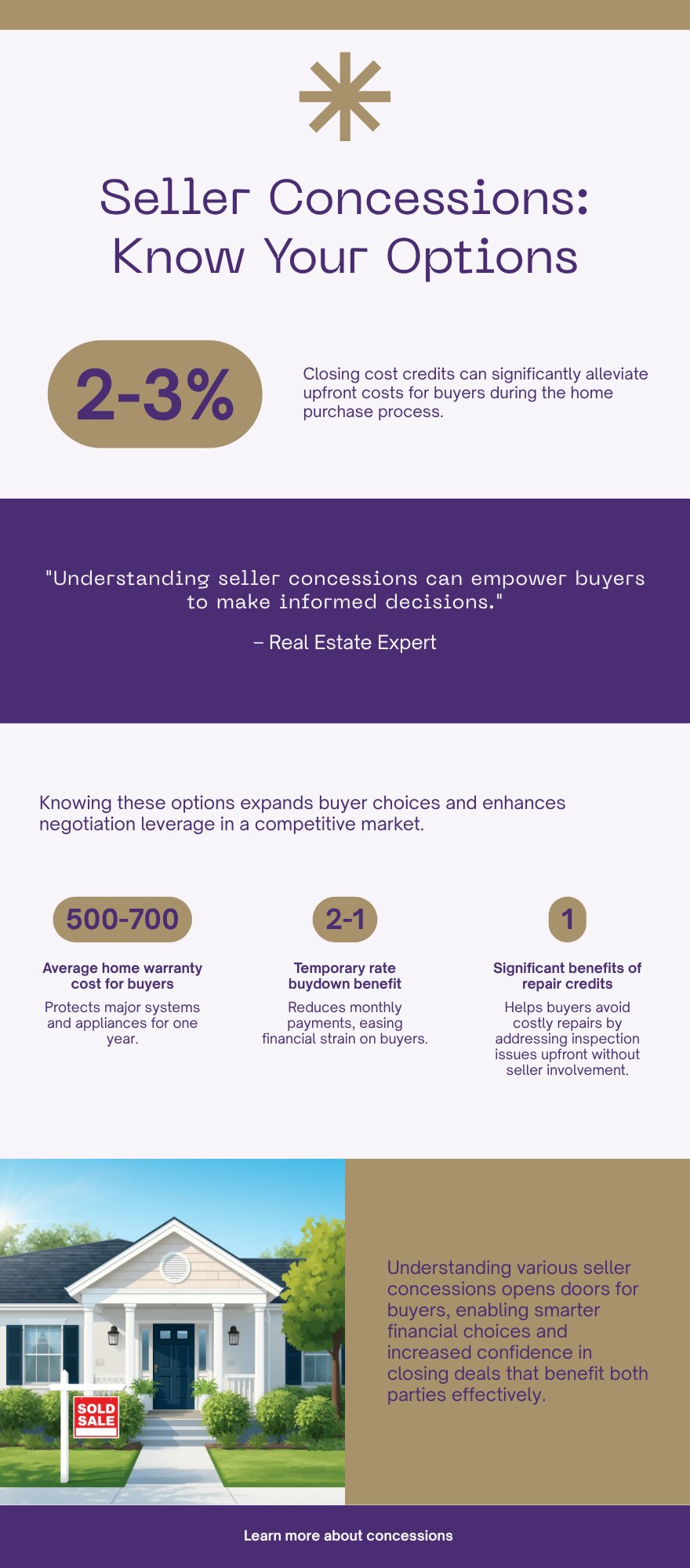
Infographic comparing four types of King County seller concessions: closing cost credit, rate buydown, repair credit, home warranty

The four concession types King County sellers see most, side by side.

Concessions vs. a Price Reduction: They Solve Different Problems

This is the part sellers get backwards most often. A price reduction and a concession are not interchangeable. They fix different symptoms.

A price reduction fixes a visibility problem. If your home is not showing up in buyer searches, if you are getting almost no traffic, the number is too high for how the market is searching. Buyers filter by price range online before they ever see your listing. Drop the price and you show up to a new set of buyers who never saw the home before. If you want the full picture on getting the number right from the start, I cover that in how to price your home to sell in King County.

A concession fixes a conversion problem. If you are getting showings, even good ones, but no offers, buyers are seeing the home and still walking away. That usually means the home is priced fine but something else is stopping them: they cannot cover cash to close, the payment is a stretch at current rates, or an inspection issue is spooking them. A concession addresses that specific friction without resetting your price in the public record.

The honest reality: if your home has been sitting with almost no showings for three or four weeks, no concession fixes that. You need a price adjustment. If your home is getting showings and going under contract twice only to fall through at inspection or financing, a concession targeted at the actual reason those deals died is usually the smarter move.

How Much Does a Concession Actually Cost You

Run the math before you agree to anything. A $700,000 King County sale with a 3% closing cost credit costs you $21,000 off your net proceeds. That sounds like a lot until you compare it to a straight $21,000 price cut, which also reduces your net by $21,000 but resets the public sale price and can affect appraisal comps for every home that sells near you afterward, including your neighbors’. If you want to see how a concession fits into your full cost-to-sell picture alongside commission and excise tax, I broke down the complete math in what it costs to sell a home in Washington State.

There is a real limit here too. Conventional loans cap seller concessions based on the buyer’s down payment: buyers putting down less than 10% are typically capped around 3% of the sale price, buyers putting 10% to 25% down can usually go up to 6%, and buyers putting 25% or more down can go higher. FHA and VA loans have their own caps, generally more generous on FHA and capped differently on VA. Your agent needs to check the buyer’s loan type before you agree to a number, because a concession that exceeds the cap does not get approved by the lender. It just falls apart at underwriting after you have already accepted the offer.

The Local Angle: King County Specifics

King County is not one market right now, and that matters for this decision specifically.

Single-family inventory in tight submarkets like Renton and parts of Kent is still moving fast enough that concessions are less common. If you are selling a well-priced starter home in a walkable Renton neighborhood, you likely will not need to offer one. Multiple offers are still happening in that segment, and buyers competing against each other are not asking sellers for closing cost help.

Condos and higher price bands are a different story. Inventory has grown across King County through 2026, and condo buyers especially are negotiating harder. If you are selling a condo in Bellevue or a higher-priced single-family home in Sammamish or Issaquah, expect concession requests to be part of most serious offers. Buyers in this segment have more choices, and they know it.

South King County cities like Auburn, Federal Way, and Covington see concessions most often tied to closing cost help for first-time buyers, since that is the dominant buyer profile in those markets. East King County concessions more often show up as rate buydowns, because buyers there are stretching further on payment relative to income and a lower rate does more for their monthly budget than a closing cost credit would.

Know which buyer profile you are selling to before you decide what concession, if any, makes sense.

What This Means for You as a Seller

Do not offer a concession preemptively before you have any offers or real market feedback. Wait until you have data: showing counts, buyer agent feedback, whether offers are coming in and falling through. A concession should respond to a specific, identified problem, not a guess.

When an offer comes in asking for a concession, ask your agent what type and why. A buyer asking for a rate buydown has a monthly payment concern. A buyer asking for a closing cost credit has a cash concern. Those point to different underlying situations and tell you something about how close that buyer actually is to being able to complete the purchase.

Compare the concession cost to your next-best alternative, which is usually sitting on the market longer while carrying your mortgage, taxes, and insurance, or dropping your price instead. Run the real numbers both ways before you say yes or no.

Real estate closing table with buyers reviewing paperwork, King County Washington home sale

Concessions are negotiated privately and settled at the closing table, never disclosed in public listing history.

Frequently Asked Questions

Do I have to offer a concession to sell my home in King County?

No. Whether a concession makes sense depends on your specific market segment, your showing activity, and buyer feedback. Many single-family sellers in tighter King County submarkets sell without ever offering one.

Is a concession the same as paying the buyer’s agent commission?

No, those are separate line items on the closing statement, though both come out of your net proceeds. A concession specifically covers the buyer’s closing costs, rate buydown, or repairs. Earnest money is a separate deposit entirely, from the buyer’s side — see earnest money in King County if a buyer’s offer has you wondering how that piece works.

How do I know if a buyer’s concession request is within loan limits?

Your agent should confirm the buyer’s loan type and down payment percentage before you counter or accept. Conventional loan concession caps scale with down payment size, and FHA and VA loans each have their own separate limits.

Does offering a concession make my home look desperate?

Not if it is not disclosed publicly and not offered until you have a specific reason to. Concessions are negotiated privately within an accepted offer. They do not appear as a price change in public listing history the way a price reduction does.

Can I offer a concession and still get close to full asking price?

Yes, and that is often the entire point. A concession lets you hold your list price while still closing the gap that is stopping a buyer from moving forward. That is different from a price cut, which lowers the number everyone sees.

Should I offer a concession before listing or wait for an offer?

Wait. Offering one before you have any market feedback means giving away money you might not have needed to. Let the first two to three weeks of activity tell you whether a concession is actually the problem you need to solve.

Your guide to life outside Seattle.

Gregory Dorrell | Coldwell Banker Bain | WA License #111862
253-350-0045  ·
greg@livingoutsideseattle.com  ·
www.livingoutsideseattle.com

Buyer Resources June 21, 2026

This Guide Has Moved

This article has been folded into our maintained guide: What Is a Mortgage Rate Buydown? A Plain-English Guide for King County Buyers. You are being taken there now.

Buyer Resources May 16, 2026

What Is a Mortgage Rate Buydown? A Plain-English Guide for King County Buyers


body { font-family: -apple-system, BlinkMacSystemFont, ‘Segoe UI’, sans-serif;
margin: 0; padding: 20px; background: #f0f0f0; }
.preview-wrap { max-width: 860px; margin: 0 auto; background: #fff;
border-radius: 8px; overflow: hidden;
box-shadow: 0 2px 12px rgba(0,0,0,0.12); }


You’ve probably seen it in listings: “Seller offering 2-1 rate buydown.” Most buyers scroll past it without fully understanding what it means. That’s a mistake, especially in a King County market where 6.38% is the going rate and every monthly dollar matters.

A rate buydown is one of the most useful negotiating tools available right now. Here’s how it works, what it actually costs, and when you should ask for one.

What a Mortgage Rate Buydown Actually Is

A buydown is a way to reduce your mortgage interest rate, either for a set period or permanently, by paying money upfront. Think of it as prepaying interest now to lower your payment later.

There are two main types.

A temporary buydown reduces your rate for the first one, two, or three years of the loan, then steps back up to the full rate. The most common version is the 2-1 buydown. A permanent buydown, often called paying “points,” reduces your rate for the entire life of the loan in exchange for a lump sum at closing.

Right now in King County, the 2-1 buydown is the version worth understanding because it’s the one sellers are offering.

How the 2-1 Buydown Works: The Real Numbers
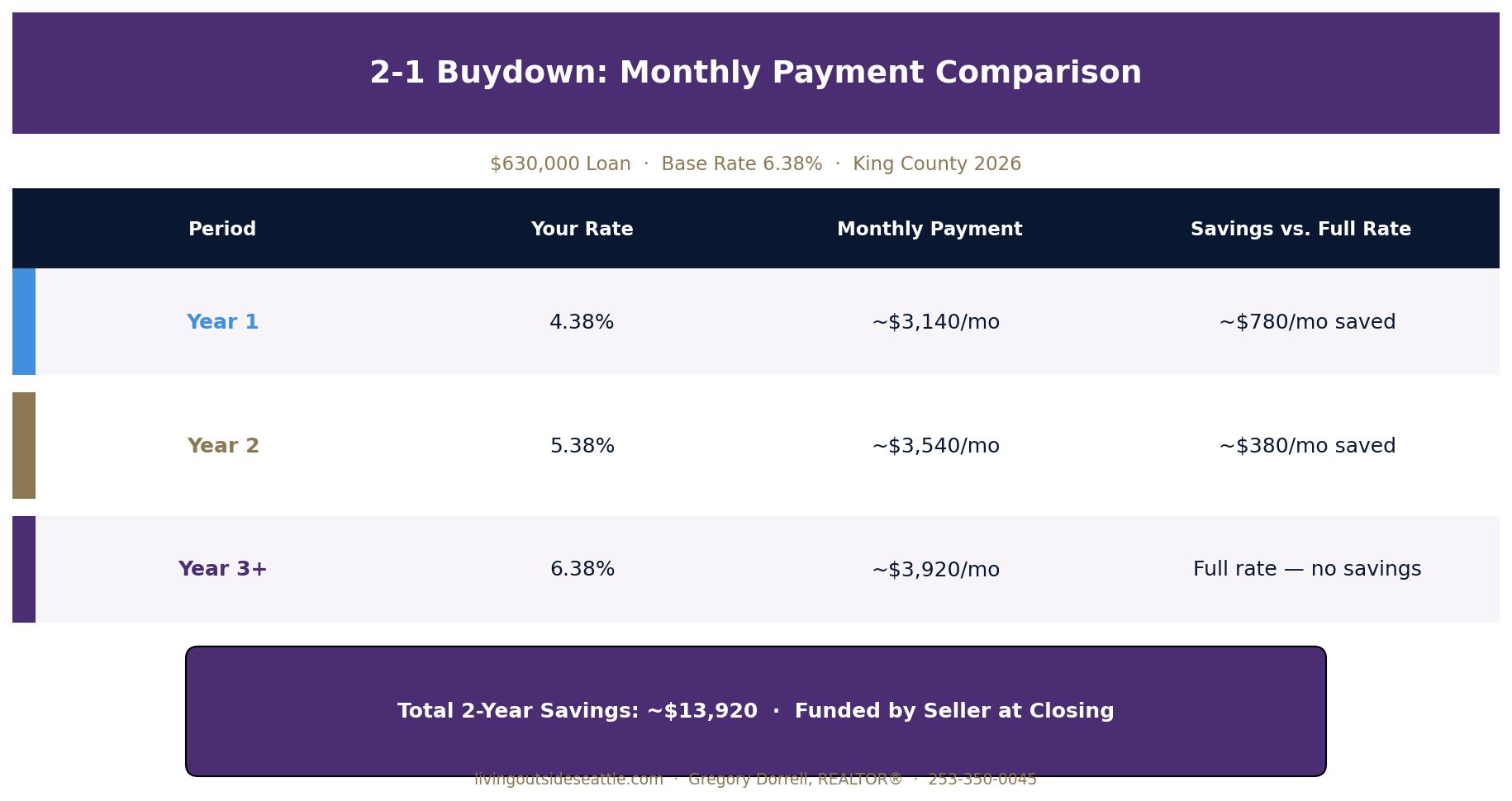
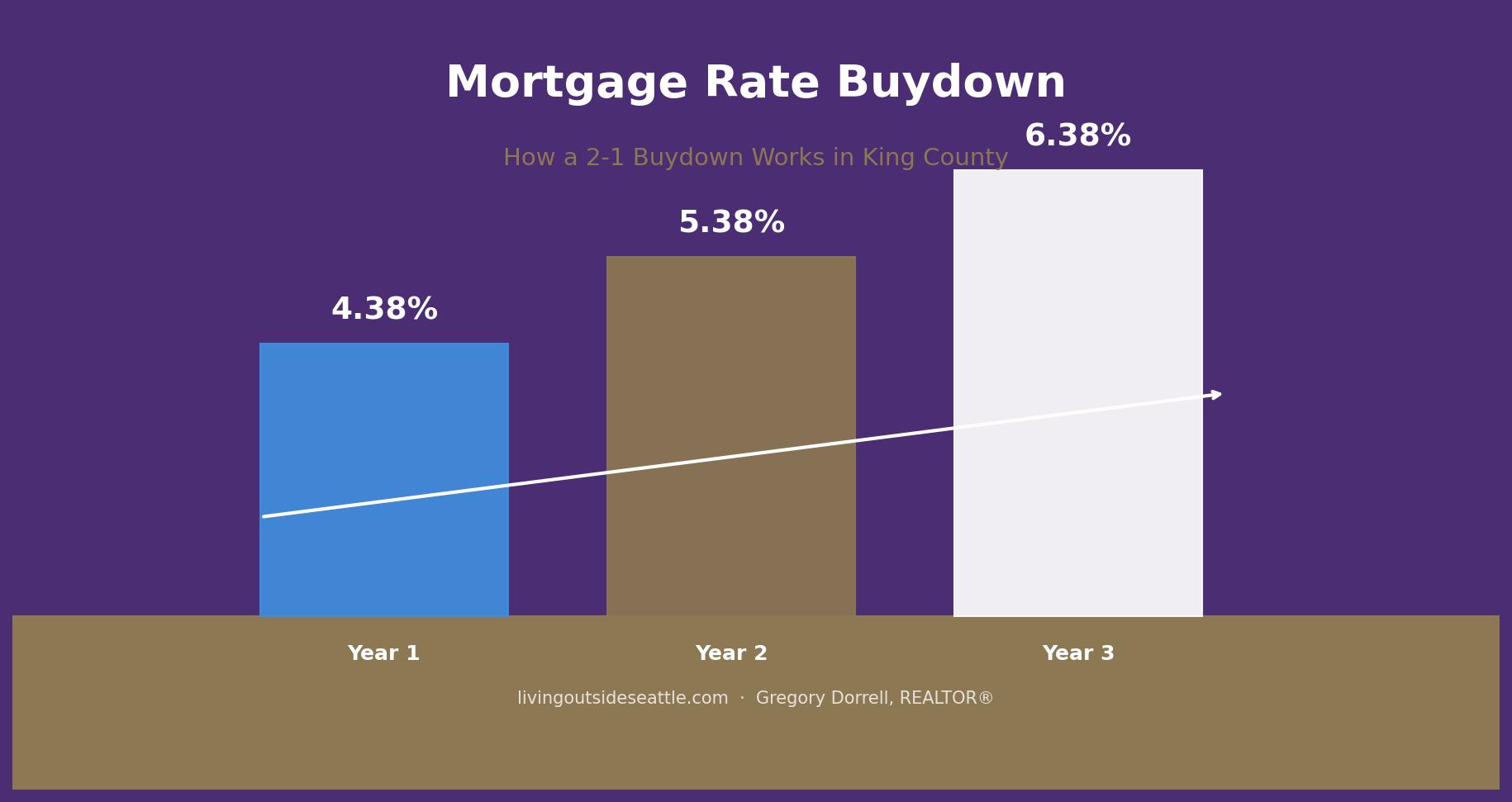
2-1 rate buydown payment schedule King County 2026 — year one 4.38%, year two 5.38%, year three 6.38% on $630K loan

The “2-1” refers to the rate reduction in each year. On a 6.38% base rate:

Year Your Rate Payment on $630K Loan Savings vs. Full Rate
Year 1 4.38% ~$3,140/mo ~$780/mo
Year 2 5.38% ~$3,540/mo ~$380/mo
Year 3+ 6.38% ~$3,920/mo $0

Figures are approximate based on a $630,000 loan (10% down on $700,000 home) at a 6.38% base rate.

Over the first two years, that’s roughly $13,920 in payment savings on a $630,000 loan. The seller funds this difference upfront at closing, usually from their sale proceeds. You get lower payments for two years without doing anything extra.

The cost to the seller to fund a 2-1 buydown on a $630,000 loan is approximately $13,920. That’s what they’re crediting to you. It comes off their bottom line, not yours.

Temporary vs. Permanent Buydown: Which Makes More Sense?

A permanent buydown (paying points) costs roughly 1% of the loan amount per 0.25% rate reduction. On a $630,000 loan, buying your rate down from 6.38% to 6.13% costs about $6,300. To 5.88% costs $12,600. The rate stays lower for 30 years, so if you keep the loan long enough, it pays off.

The break-even math matters here. I run this analysis for clients regularly. If you pay $6,300 to save $95 per month, you break even in about 66 months, just over five years. If you plan to stay longer than that, a permanent buydown pencils out. If you think you’ll refinance when rates drop, a temporary buydown often makes more sense since you get the near-term relief without the permanent cost.

When to Ask for a Seller-Paid Buydown
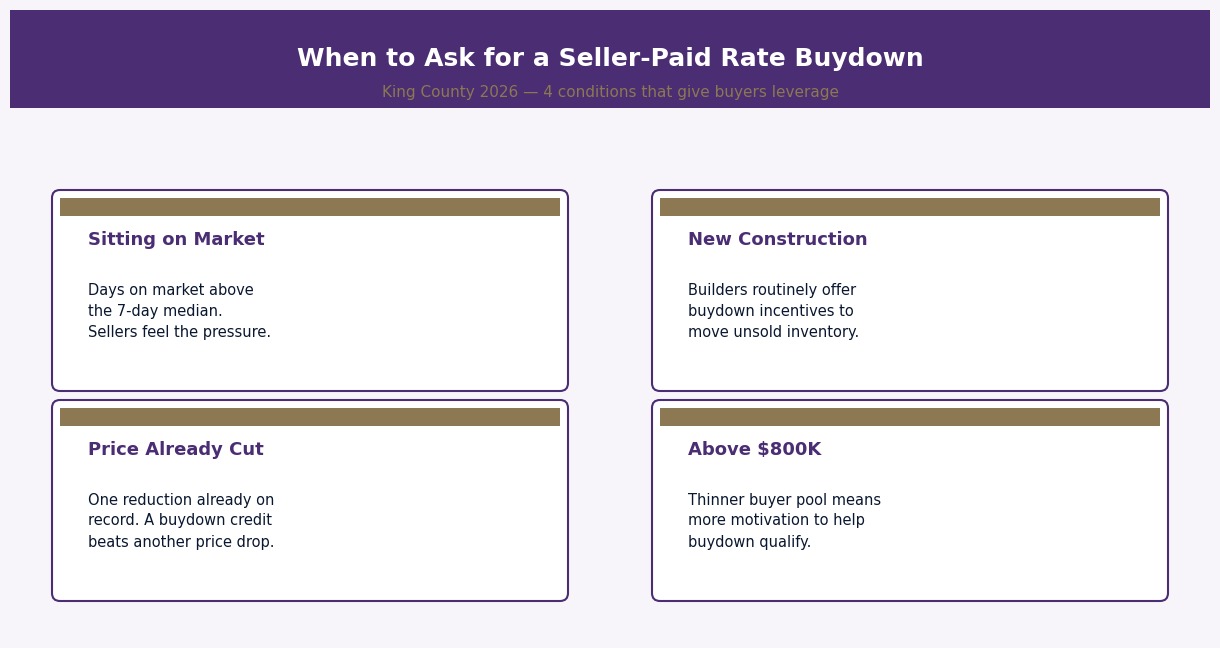
When to ask seller for 2-1 rate buydown King County — inventory rising, days on market increasing, seller negotiating room 2026

Not every seller will offer a buydown, and not every market gives you the leverage to ask. Here’s when the conditions are right.

King County had 5,071 homes for sale in March 2026, up 37.5% year-over-year. Monthly supply sits at 2.2 months for single-family homes. That’s still a seller’s market, but it’s softer than it was. With inventory rising and buyer pools shrinking due to rate pressure, sellers have more motivation to help buyers qualify than they did two years ago.

The best candidates for a seller-paid buydown are homes that have been sitting on market longer than the median 7 days, new construction where builders frequently offer incentives, and price ranges above $800,000 where the buyer pool is thinner. If a seller has reduced their price once already, they may prefer a buydown credit over another price cut since it helps more buyers qualify without lowering the headline sale price.

You can also negotiate a buydown as part of a competitive offer structure. Instead of offering over asking, you offer asking price and request a seller credit toward a buydown. This can be more attractive to certain sellers who care about the sale price on paper.

What a Buydown Cannot Do

A buydown lowers your payment, but it does not change your qualifying rate. Lenders qualify you at the full note rate, 6.38% in this example, not the reduced Year 1 rate. This is an important distinction. If you can barely qualify at 6.38%, a 2-1 buydown makes your first two years more comfortable, but it doesn’t help you get approved. That’s a conversation to have with your lender before you start shopping.

A buydown also does not protect you if rates rise further. If rates climb to 7.5% by Year 3, your payment goes back to the 6.38% note rate regardless. You’re not getting a floating benefit; you’re getting a fixed discount on a fixed rate.

The Bottom Line for King County Buyers

If you’re purchasing in the next 60 days and the seller has any negotiating room, asking for a 2-1 buydown is worth the conversation. The worst they can say is no. The best case is $13,000 to $14,000 in payment savings during your first two years of ownership while you settle in, build equity, and wait for a refinance opportunity.

Frequently Asked Questions: Mortgage Rate Buydowns

Who pays for a 2-1 buydown?

Usually the seller, though buyers can also pay for it out of pocket or roll it into closing costs if the lender allows. In today’s King County market, seller-funded buydowns are the most common scenario. The seller provides a credit at closing that the lender holds in an escrow account and draws from each month to cover the difference between your reduced payment and the full rate payment.

What happens if I refinance during the buydown period?

The unused portion of the buydown funds is typically applied to your loan payoff at refinance. You don’t lose the money, but you do lose the future payment savings. This is why the 2-1 buydown works well in a market where refinancing is likely within a few years. You use the savings in Year 1 and Year 2, then refinance when rates drop rather than reverting to 6.38% in Year 3.

Can I use a buydown with FHA or VA loans?

Yes. Both FHA and VA loans allow temporary buydowns, including the 2-1 structure. The same mechanics apply. FHA and VA borrowers are often in the first-time buyer and lower-down-payment segments where the Year 1 payment relief makes the biggest difference in monthly cash flow.

Is a permanent buydown better than a 2-1 buydown?

It depends on how long you plan to keep the loan. Run the break-even calculation: divide the cost of buying down the rate by the monthly savings. If your break-even is 5 years and you plan to stay for 10+, the permanent buydown wins. If you expect to refinance within 3 years, the 2-1 temporary buydown makes more sense.

How much does a permanent buydown cost in King County?

One point equals 1% of the loan amount. On a $630,000 loan, one point costs $6,300 and typically reduces your rate by about 0.25%. To drop from 6.38% to 5.88% would cost approximately 2 points, or $12,600. Your lender can quote you exact pricing since rates and point costs vary daily.

Your guide to life outside Seattle.

Gregory Dorrell |
Coldwell Banker Bain | WA License #111862
253-350-0045
·

greg@livingoutsideseattle.com

·

www.livingoutsideseattle.com

Gregory Dorrell is a licensed real estate broker (WA License #111862) with
Coldwell Banker Bain. This post is provided for informational purposes and does
not constitute financial or investment advice. Mortgage rates, buydown costs, and
lender policies vary and are subject to change. Consult with a licensed mortgage
lender for current pricing and qualification guidance.