

 Facebook
 X
X
 Pinterest
 Copy Link
This Guide Has Moved

This article has been folded into our maintained guide: Living in Kent, WA | 2026 Real Estate & Lifestyle Guide. You are being taken there now.
Bridge Loans in Washington State: 2026 Guide for Sellers
How move-up sellers in King County use bridge loans to buy their next home before selling, and when a HELOC is the smarter play.
You found the next house. Bigger yard, better layout, the right school zone. There’s just one problem: your down payment is locked up in the home you’re still living in. This is the wall almost every move-up seller in King County hits, and a bridge loan is one of the main tools for getting over it.
I work with move-up sellers across Renton, Kent, Auburn, Covington, and Maple Valley, and this question comes up in almost every planning conversation: “How do I buy before I sell?” A bridge loan is often the first answer people hear. It can be a great tool. It can also be an expensive mistake if you use it in the wrong situation. Here’s how bridge loans actually work in Washington State, what they cost in 2026, and how to know if one fits your move.
How a Bridge Loan Works in Washington State
A bridge loan does exactly what the name says. It bridges the gap between buying your next home and selling your current one.
Here’s the typical sequence. You apply with a lender who writes bridge loans. The lender looks at the equity in your current home and approves a short-term loan against it, usually up to 70 to 75 percent of your home’s value minus what you still owe. You use that money as the down payment on your next home. You move once, on your schedule. Then you list your old home, and when it sells, the sale proceeds pay off the bridge loan in full.
Most residential bridge loans in Washington are interest-only. That matters because it keeps your monthly carrying cost down while you hold two properties. You’re not paying down principal. You’re buying time. The loan comes due either when your home sells or at the end of the term, whichever comes first. In my market, that exposure window is usually short. Well-priced homes in South King County have been selling in 6 to 14 days, so most bridge borrowers here are paying interest for two to four months, not a year.
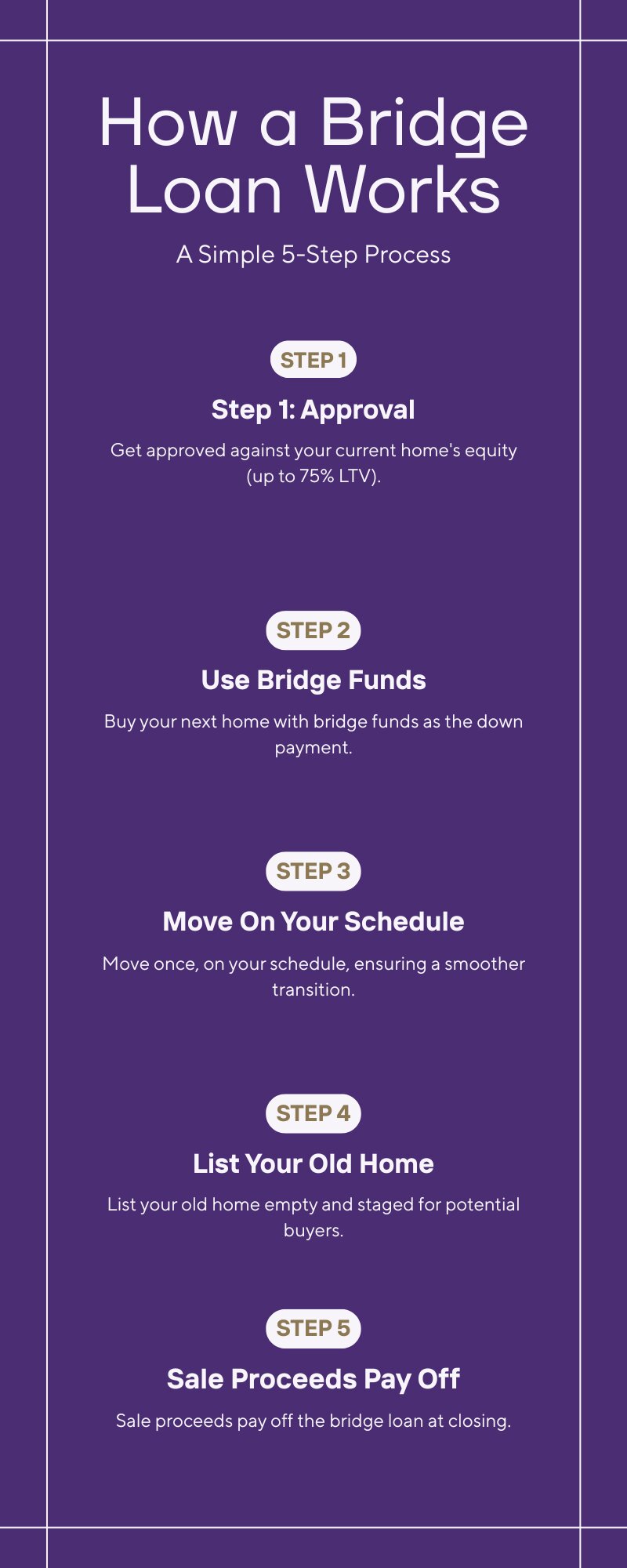
The full bridge loan cycle. In fast South King County segments, most borrowers reach payoff in two to four months.
What a Bridge Loan Costs in 2026
This is where you need to go in with clear eyes. Bridge money is more expensive than mortgage money.
In 2026, standard 30-year mortgage rates have been sitting in the mid-6 percent range. Residential bridge loans from banks and credit unions are typically running about 8 to 10 percent. Private and hard-money bridge lenders charge more, often 9 to 12 percent. On top of the rate, most lenders charge origination points, commonly 1.5 to 2.5 percent of the loan amount, plus normal closing costs.
Let’s make that real. Say you borrow $200,000 against your Kent home to put down on a house in Covington. At 9 percent interest-only, that’s $1,500 a month. If your Kent home sells in three months, you’ve paid $4,500 in interest plus roughly $3,000 to $5,000 in points and fees. Call it $8,000 to $9,500 total for the ability to buy first, move once, and sell an empty, staged home at full strength.
Is that worth it? For a lot of my sellers, yes. An empty home shows better and often sells for more than the cost of the bridge. You also skip the misery of living in a staged house with kids and dogs while strangers tour it. But the math only works if your home actually sells inside the window. That’s the whole game with a bridge loan.
Bridge Loan vs. HELOC: Which One Fits?
A home equity line of credit is the other common way to unlock your equity, and for some sellers it beats a bridge loan outright.
A HELOC is cheaper. Rates in 2026 are generally running a point or two below bridge loan rates, and most HELOCs have little or no closing costs. It’s also flexible. You draw what you need, when you need it, and there’s no balloon date forcing a payoff.
So why doesn’t everyone just use a HELOC? Timing. Here’s the trap I warn sellers about constantly: lenders will not open a HELOC on a home that’s already listed for sale, and many want it seasoned for months before you draw on it. A HELOC is a tool you set up six months to a year before your move, while you’re still just thinking about it. Once the sign is in the yard, that door is closed, and a bridge loan becomes the realistic option.
The other difference is qualification. With either tool, the lender needs to see you can carry the payments. Some bridge lenders will soften the math if your current home is already under contract. If you want to understand exactly how lenders count your income and debts, I broke that down in my guide to how mortgage qualification works in Washington State.
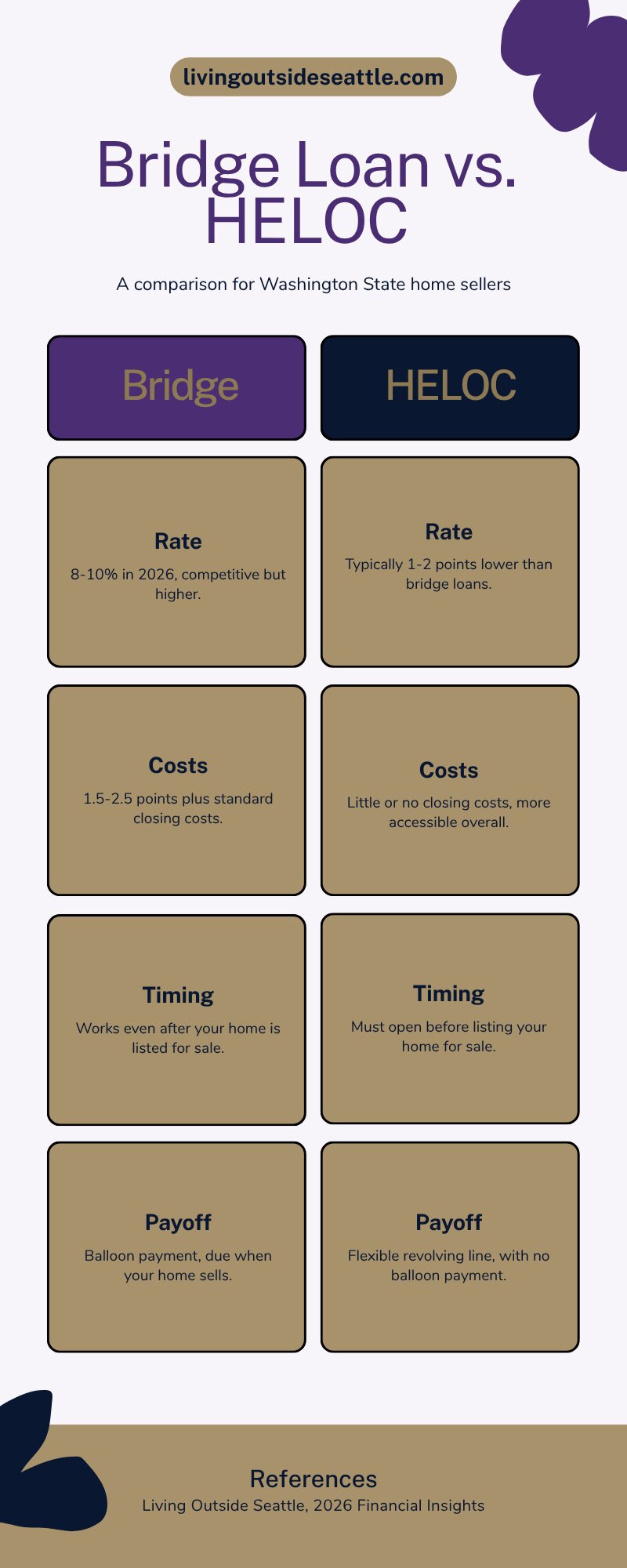
The deciding factor is usually timing: a HELOC must be opened before you list, a bridge loan works after.
Who Offers Bridge Loans in Washington State
Here’s something that surprises people: most big national banks got out of the consumer bridge loan business years ago. You won’t find one at most major retail banks.
In Washington, bridge loans come from three places. First, regional banks and credit unions. Several Washington-based institutions still write true bridge loans for their members, and this is usually the cheapest version of the product. Second, local mortgage companies. A handful of Puget Sound area lenders offer bridge programs designed specifically for buy-before-you-sell moves. Third, the newer “buy before you sell” programs. Seattle-based Flyhomes has rebuilt its whole business around this model, and national players like HomeLight offer versions of it here too. These programs package equity access, a non-contingent offer, and the sale of your old home into one product. Ask your real estate agent if they know a lender that offers this type of program.
Those programs can be slick, but read the fee structure carefully. Between program fees, loan costs, and pricing requirements on your departing home, the all-in cost can run well past what a straight bridge loan from a credit union costs. Convenience has a price tag. Sometimes it’s worth paying. Just know what it is before you sign.
The Local Angle: Why Bridge Loans Work Differently in King County
Bridge loans are unusually well-suited to South King County right now, and the reason is speed plus equity.
Start with equity. Homeowners who bought in Renton, Kent, or Auburn even six or seven years ago are sitting on six-figure equity positions. Kent’s median sale price has been running around $732,500 and Renton’s spring median hit $859,000. If you bought your Kent home for $450,000 in 2019, you likely have $300,000 or more in equity doing nothing. A bridge loan turns that trapped equity into a down payment without forcing you to sell first.
Now speed. The bridge loan’s biggest risk is a slow sale, and well-priced South King County homes simply aren’t selling slowly. Kent has been averaging about 8 days on market and Renton homes have been moving in about 6 days in spring. That means a typical bridge borrower here carries the loan for a couple of months, not a year. Compare that to a slower sub-market, like some Eastside condo segments, where months of supply are higher and a bridge gets riskier. Where your current home sits matters more than any national average.

One move, on your schedule. That convenience is what a bridge loan actually buys.
What This Means for You as a Move-Up Seller
Here’s the decision framework I walk sellers through.
A bridge loan makes sense when three things are true. You have strong equity, ideally enough to borrow your full down payment at 75 percent loan-to-value or less. Your current home sits in a fast-moving segment and will be priced to sell, not priced on hope. And you’ve found, or are about to find, a next home worth moving fast on. When all three line up, paying $8,000 to $12,000 for a clean, one-move transition is often money well spent.
A HELOC makes more sense when your move is six months or more away and you have the discipline to set it up early. Open it while your home is unlisted, let it sit at zero balance, then draw on it when you find the right house. Cheapest equity access there is.
And sometimes the answer is neither. If your equity is thinner or the numbers feel tight, a well-structured contingent offer can still win in the right situation. I wrote a full guide on how to write a contingent offer that sellers will accept in King County, and it pairs with this post. Whichever route you take, the first step is the same: know what your current home is worth and how fast it will sell. That’s a pricing question, and it’s the one I can answer with real data.
FAQ: Bridge Loans in Washington State
How long do you have to pay back a bridge loan?
Most residential bridge loans in Washington run 6 to 12 months, and the loan is paid off automatically from your sale proceeds at closing. In fast markets like Renton and Kent, most borrowers pay theirs off within two to four months. Most lenders charge no penalty for early payoff.
How much does a bridge loan cost in 2026?
Expect interest rates around 8 to 10 percent from banks and credit unions, or 9 to 12 percent from private lenders, plus origination points of roughly 1.5 to 2.5 percent of the loan amount. On a $200,000 bridge held for three months, total cost typically lands between $8,000 and $10,000.
Are bridge loans hard to get?
They’re more specialized than a standard mortgage, not necessarily harder. Lenders generally want a credit score of about 680 or better, combined loan-to-value of 75 percent or less on your current home, and a believable exit plan. The bigger challenge is finding a lender, since most national banks no longer offer them.
Can I get a bridge loan if my house is already on the market?
Usually yes, and this is a key advantage over a HELOC. Lenders won’t open a home equity line on a listed property, but bridge lenders expect your home to be listed or about to be. Some even offer better terms once you’re under contract.
Is a bridge loan better than a contingent offer?
A bridge loan makes your offer stronger because it removes the home-sale contingency, which matters in competitive segments of King County. A contingent offer costs nothing but is easier for a seller to pass over. If the home you want has multiple offers, the bridge-backed offer usually wins.
Bridge loans aren’t exotic anymore. In a market where most move-up sellers are equity-rich and good homes still move in days, buying before you sell is a real strategy, not a luxury. The key is sizing the loan against an honest number for your current home and a realistic timeline for your area.
Your guide to life outside Seattle.
253-350-0045 ·
greg@livingoutsideseattle.com ·
www.livingoutsideseattle.com
Contingent Offer Guide: King County WA 2026

A step-by-step guide for move-up sellers who need to buy their next home before the current one closes — and how to make a seller say yes.
If you own a home in King County and you need to buy your next place before you sell, you already know the problem. You can’t really afford two mortgages. But sellers don’t love contingent offers. So how do you make this work?
The short answer: contingent offers do get accepted in King County — especially right now. Inventory across South and East King County has grown compared to the peak frenzy years, which means sellers are more flexible than they’ve been in a long time. But “more flexible” doesn’t mean “they’ll accept anything.” The offer still has to be structured the right way.
Here’s what actually goes into a contingent offer that a seller will take seriously, and how the current King County market shapes those decisions.
What a Home Sale Contingency Actually Is
A home sale contingency means your offer to buy a new home depends on selling your current one first. In Washington state, this is typically documented using Form 22B — the Buyer’s Sale of Property Contingency Addendum. This form is used specifically when your home is not yet under contract.
There’s an important difference between that and Form 22Q, which is used when your home is already on the market. Sellers generally prefer 22Q because your sale is actively in motion. With 22B, the seller is essentially betting that you’ll get your home under contract within a set timeframe. That’s a bigger ask.
Form 22B requires you to list your home for sale within a specific number of days stated in the addendum — often 5 to 15 days. If you miss that window without taking action, you can lose all your contingency protections, including inspection and financing. That’s a real risk, and sellers know it.
The kick-out clause (also called the bump clause) is the seller’s main protection tool. It lets the seller keep marketing the property while your contingency is active. If another qualified buyer submits an offer, the seller issues a Form 44 bump notice. You then have a short window — typically 48 to 72 hours — to either remove your contingency and proceed, or step away. You’d use Form 46 to respond.
Understanding these mechanics matters because they shape every decision you make when structuring the offer.
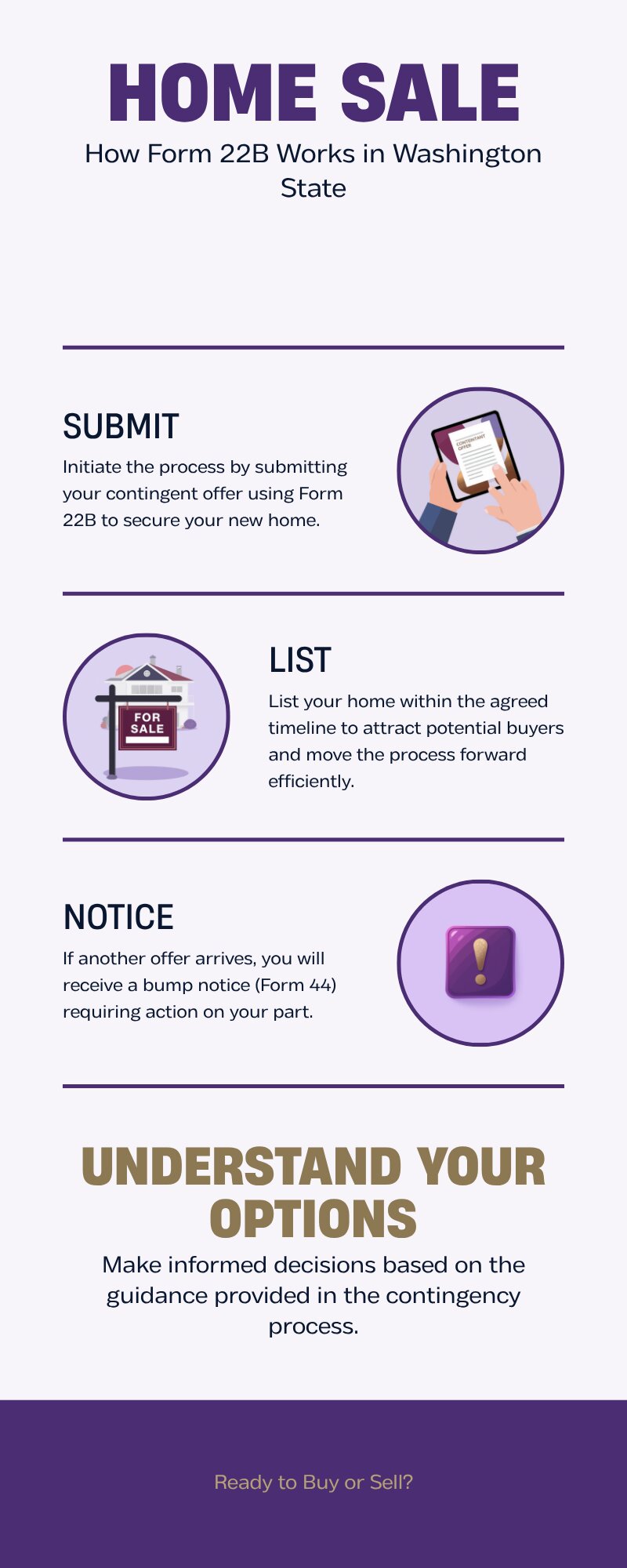
The Form 22B process in Washington state: submit your contingent offer, list your home, respond to any bump notice, and close. Understanding each step helps you structure an offer sellers will accept.
Why Sellers in King County Are More Open Right Now
This matters for timing. In 2021 and 2022, sellers in most King County markets had lines of competing buyers. A contingent offer was almost automatically rejected. That market has shifted.
In South King County — Renton, Kent, Auburn, Covington, Maple Valley — inventory has increased meaningfully. Days on market have stretched out in some price points. Sellers who aren’t priced perfectly are sitting longer than they expected. That means many sellers are now willing to consider a contingency they would have dismissed three years ago.
In East King County — Issaquah, Sammamish, Bellevue — things are still tighter. Demand holds up in those corridors because of proximity to tech employers. Contingent offers face more competition there, and the terms need to be sharper.
The key question isn’t whether a seller will accept a contingency in the abstract. It’s whether your specific offer removes enough risk for this specific seller to feel comfortable saying yes.
How to Structure a Contingent Offer Sellers Will Actually Accept
Start with your own home — before you make an offer
This sounds obvious, but a lot of buyers skip it. Before you make a contingent offer, have your home evaluated for a realistic list price. Not what you hope to get. What you will actually get in the current market.
If your agent gives you a vague range, push back. You need a real number, because their agent are going to ask the same question when reviewing your offer: does this buyer’s home actually sell? If you’re priced at a number that doesn’t clear the debt you need to carry, the contingency is a problem, not a solution. A solid CMA from a local agent is the starting point.
Get fully pre-approved, not just pre-qualified
A pre-qualification letter isn’t worth much in this context. You need a full pre-approval from a trusted lender who has verified your income, assets, and credit. In the cover letter or offer documents, make it clear when your pre-approval was issued and offer to have your lender speak directly with the listing agent.
Pre-approval shows the seller that when your home sells, there’s no question you can close. It’s one less thing for them to worry about.
Offer a tighter contingency timeline
A 90-day contingency window sends a signal: “I’m not sure my house will sell quickly.” A 30-day window sends a different signal: “I’m ready to move and I’ve priced my home to sell.”
In South King County in 2026, well-priced homes in the $600K–$800K range are still moving in under 20 days. If you’re confident in your pricing, a 21- to 30-day contingency period is realistic and reassuring to a seller. If your home has complications that will take longer to sell, be upfront with yourself about whether a contingency is the right structure at all.
Increase your earnest money
Standard earnest money in King County is typically 1% to 3% of the purchase price. In a contingent offer, going to 3% or higher tells the seller you’re serious and financially committed. Your contingency language still protects you if conditions aren’t met — the earnest money isn’t at risk if the deal falls apart because your home doesn’t sell. But the larger amount signals commitment and reduces seller anxiety.
Think of it this way: you’re asking a seller to take their home off the market while you sell yours. A meaningful earnest money deposit is how you compensate them for that risk.
Accept the kick-out clause
Some buyers resist the kick-out clause because it feels threatening. In practice, it’s almost always the right call. Sellers who won’t accept a contingency without a kick-out are simply protecting themselves. Agreeing to it upfront removes that friction entirely and shows you’re a reasonable buyer to work with.
The reality: if a seller receives another offer strong enough to trigger the bump notice, you have 48 to 72 hours to decide. If your home is under contract by then, you can typically remove the contingency and proceed. If it’s not, you can walk with your earnest money intact.
When a Contingent Offer Probably Won’t Work
There are situations where a contingent offer is the wrong tool, and it’s worth being honest about that.
If the home you want to buy is priced under $700K in South King County and has been on the market for less than a week, there may be multiple offers. A contingency puts you at a significant disadvantage. In that case, you need to think about whether you can compete without one.
If your current home is in a slower price range or has condition issues that will complicate a sale, a 30-day contingency window may not be realistic. Overpromising on your timeline and then needing an extension damages your credibility with the seller at exactly the wrong moment.
And in premium Eastside markets like Bellevue proper, Mercer Island, and Medina, contingent offers are still uncommon. If you’re buying in those price ranges and need to sell first, the alternatives below deserve serious consideration.
Alternatives to a Home Sale Contingency
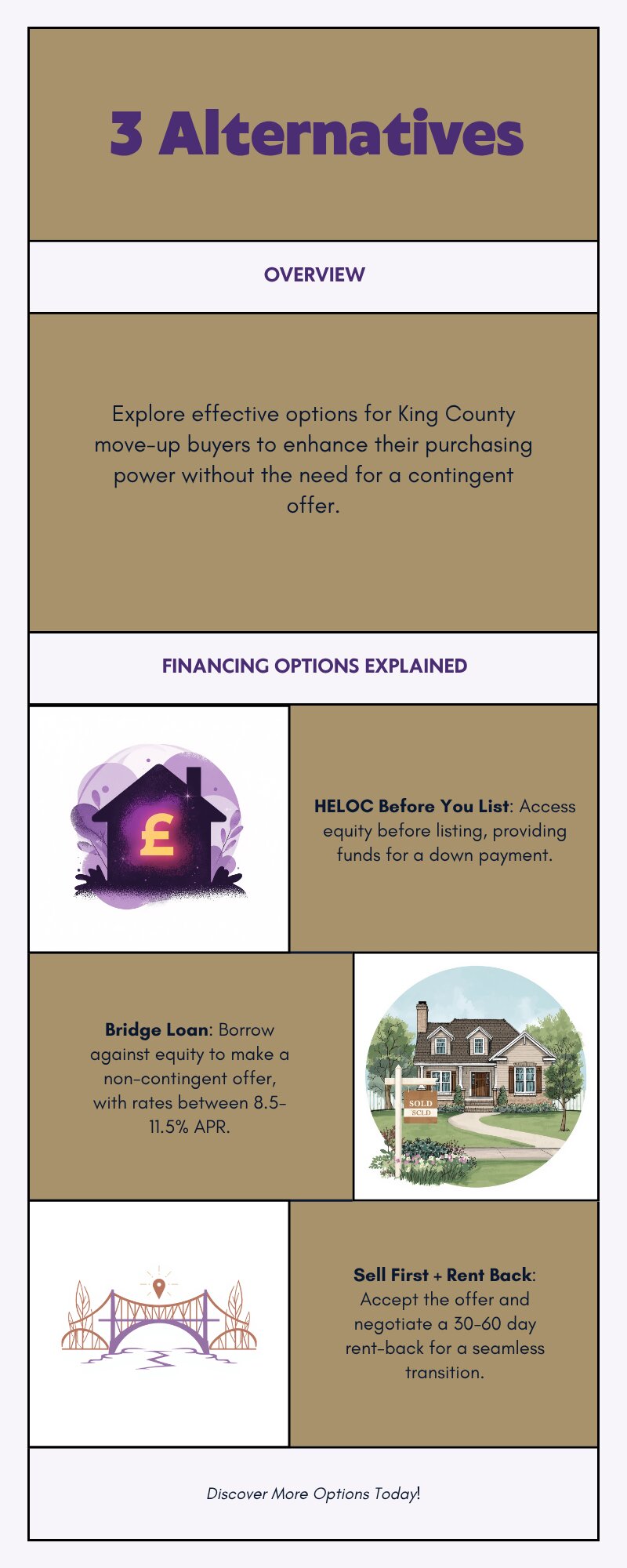
If a contingent offer won’t work in your target market, these three financing strategies let you buy without the contingency. Each has a different cost and risk profile — the right choice depends on your equity and timeline.
If a contingent offer won’t work in the market you’re buying in, there are three realistic alternatives for King County move-up buyers.
HELOC Before You List
If you have equity in your current home, opening a home equity line of credit before you put your home on the market gives you access to cash for a down payment on the new purchase. The critical timing issue: most lenders will freeze or close a HELOC once your home is actively listed. Open it before the sign goes up. This strategy works best when you have at least 25%–30% equity and a clean credit profile.
Bridge Loan
A bridge loan lets you borrow against your current home’s equity to fund the purchase of the new one, giving you a non-contingent offer. Bridge loan rates in 2026 are running 8.5% to 11.5% APR — significantly higher than a standard mortgage — so this is a short-term cost, not a long-term strategy. But if the numbers work and the new home is worth it, a non-contingent offer in a competitive market is a meaningful advantage. You’ll typically carry the bridge loan for 30 to 90 days until your current home closes.
Sell First, Then Rent Back or Short-Term Rent
Accept an offer on your current home and negotiate a 30- to 60-day rent-back period. Use that window to find and close on the next place without the contingency hanging over both deals. This approach takes the financial pressure off both transactions.
You can also explore whether renting your current home rather than selling changes your calculus entirely — though that’s a longer-term decision with its own trade-offs.
Each option has a cost and a risk profile. The right choice depends on your equity position, your risk tolerance, and how competitive the market is where you’re buying. This is worth spending real time on with both your agent and your lender before you make any offer.
The King County Sub-Market Difference
One thing I see buyers get wrong: treating King County as one market when making contingency decisions. It’s not.
In South King County — Renton, Kent, Auburn, Covington, Maple Valley — there’s more room to negotiate on contingency terms right now. Sellers in this range are seeing longer days on market in some price points and are more willing to work with a serious buyer who has structured things correctly.
In East King County near the tech corridors — Issaquah, Sammamish, the Bellevue fringes — demand holds up better and sellers have more leverage. Contingent offers face more competition and need to be tighter on timeline and earnest money.
And in premium Eastside markets like Bellevue proper, Mercer Island, and Medina, contingent offers are still rare. If you’re buying in those price ranges and need to sell first, the alternatives above deserve serious consideration.
Knowing which sub-market you’re in changes how you position every element of the offer.
What Sellers Actually Care About
When a seller reviews a contingent offer, three questions dominate: Will this buyer’s home sell? How fast? And what happens to me if it doesn’t?
Your job is to answer all three convincingly. That means a realistic list price on your current home, a tight timeline, solid pre-approval, meaningful earnest money, and a kick-out clause that gives the seller control if something better comes along.
A contingent offer structured this way isn’t a weakness. It’s a reasonable business arrangement that protects both sides. Sellers who understand that — and who aren’t getting five competing offers — will work with you.
Frequently Asked Questions
Can sellers in King County reject a contingent offer outright?
Yes, and they often do in competitive markets. Sellers are under no obligation to accept any offer. In slower segments — particularly South King County in 2026 — sellers are generally more willing to engage with contingent buyers who have structured their offer thoughtfully.
What is Form 22B in Washington state real estate?
Form 22B is the Buyer’s Sale of Property Contingency Addendum. It’s used when you need to sell your current home before closing on a new one and your home is not yet under contract. It specifies timelines for listing, sets conditions for removing the contingency, and includes kick-out clause provisions.
What is a kick-out clause and should I agree to it?
A kick-out clause (or bump clause) lets the seller keep marketing while your contingency is active. If they get another offer, they notify you and you have 48 to 72 hours to remove the contingency or step away. Agreeing to it is almost always smart — it makes your offer easier to accept and in practice rarely ends deals for well-prepared buyers.
How much earnest money should I offer on a contingent offer?
In King County, 2%–3% of the purchase price is a solid range for a contingent offer. It’s higher than the bare minimum and shows commitment. Your earnest money is still protected if the deal falls apart because your contingency conditions aren’t met.
Is a bridge loan better than a contingent offer?
It depends on your equity and risk tolerance. A bridge loan lets you make a non-contingent offer, which is stronger in competitive markets. But bridge loan rates are high (8.5%–11.5% APR in 2026) and you’re carrying two properties temporarily. A well-structured contingent offer is simpler and lower-risk if the market allows it.
How long should my contingency window be?
Shorter is better for seller confidence. In South King County, where well-priced homes move in 10–20 days, a 21- to 30-day contingency window is realistic. If you genuinely need longer, build that into your pricing strategy on your current home — a faster sale there supports a tighter window on the offer side.
Contingent offers aren’t a long shot in King County right now. They’re a normal part of how move-up buyers navigate this market. The difference between an offer that gets accepted and one that gets ignored comes down to preparation: realistic pricing on your home, tight timelines, strong financials, and terms that give the seller confidence.
Your guide to life outside Seattle.
253-350-0045 ·
greg@livingoutsideseattle.com ·
www.livingoutsideseattle.com
