Buyer ResourcesSeller Resources June 26, 2026

This Guide Has Moved

This article has been folded into our maintained guide: Living in Auburn, WA: 2026 Neighborhood & Real Estate Guide. You are being taken there now.

Buyer Resources June 24, 2026

This Guide Has Moved

This article has been folded into our maintained guide: Living in Auburn, WA: 2026 Neighborhood & Real Estate Guide. You are being taken there now.

AuburnBuyer ResourcesKing County CitiesSouth King County May 31, 2026

Relocating to Auburn Washington: Affordable Homes and What You Actually Get


When people tell me they’re relocating to Auburn Washington, the first thing they ask is whether they’re settling. They’ve heard “South King County” and assumed it means compromise: longer commute, fewer amenities, homes that are affordable because nobody wants them.

That’s not what I see when I’m out there five to six days a week evaluating properties.

Relocating to Auburn or Federal Way means getting more house for less money in a King County market with very few affordable entry points left. Here’s what the March 2026 numbers say.

Auburn Washington Home Prices in 2026: What $668K Gets You
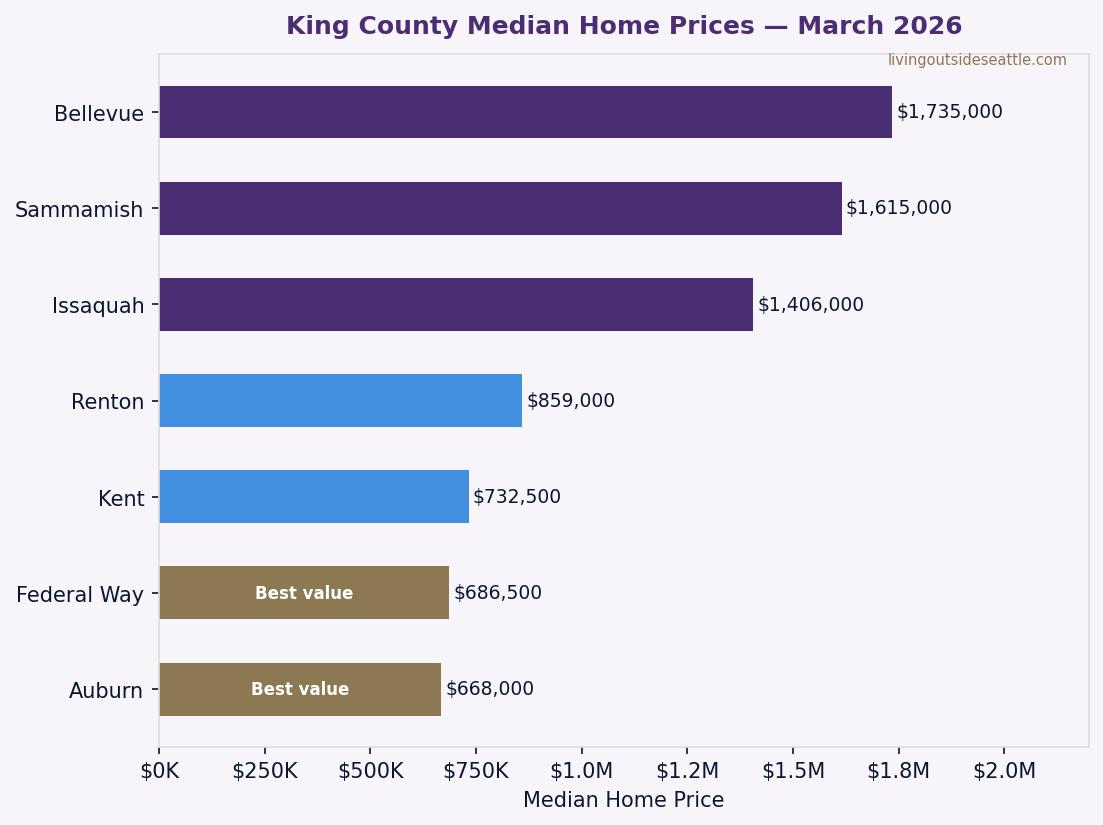
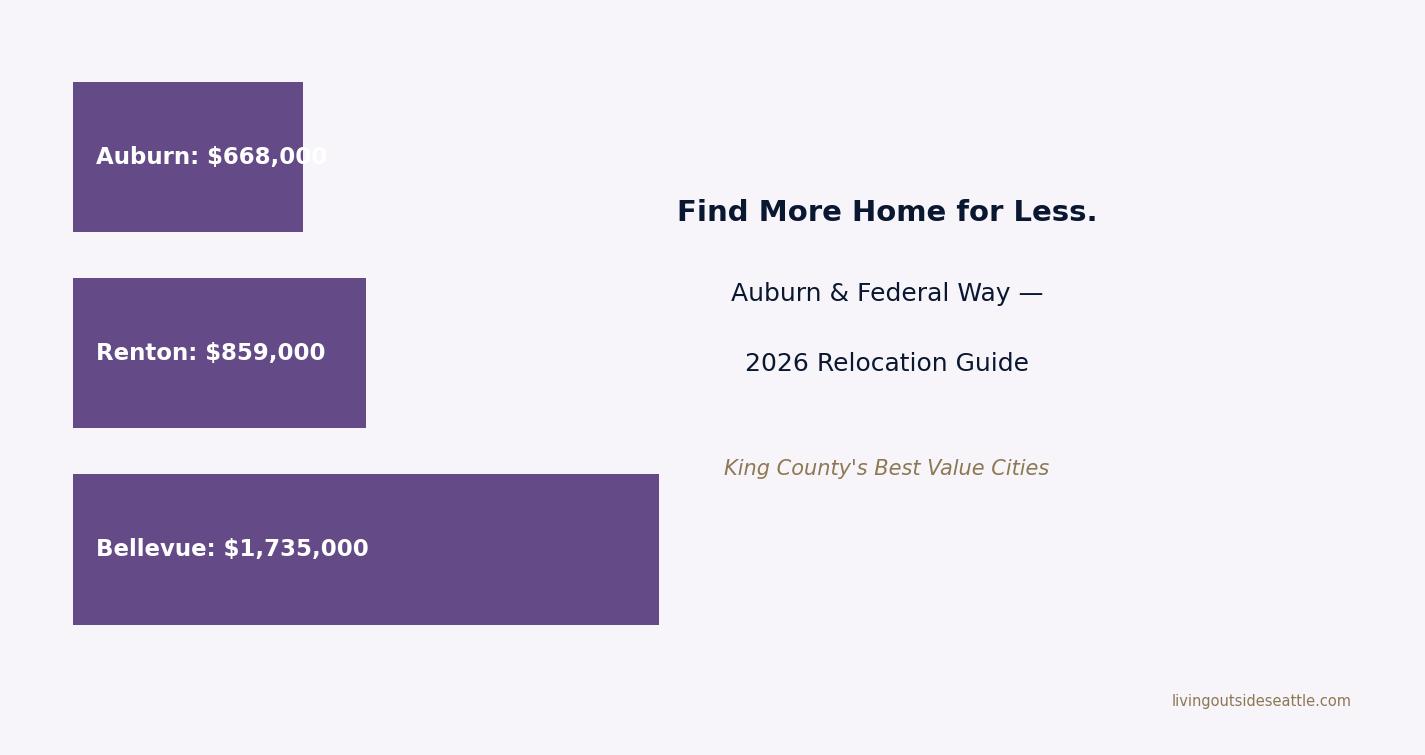
King County median home price comparison all cities March 2026 — Auburn Federal Way Renton Bellevue
Auburn at $668K and Federal Way at $686K are the only King County cities where a family can buy a single-family home with a yard for under $700K.

March 2026 median single-family home prices across King County’s major markets:

Bellevue: $1,735,000. Sammamish: $1,615,000. Issaquah: $1,406,000. Renton: $859,000. Kent: $732,500. Federal Way: $686,500. Auburn: $668,000.

At $668,000, Auburn’s median is roughly $191,000 less than Renton and more than $1 million less than Bellevue. The price difference traces to geography, but what you get for that money is the part worth paying attention to.

A $668,000 budget in Auburn gets you a 3-bedroom, 2-bathroom home on a quarter-acre lot. Typically 1,500 to 1,800 square feet, built in the 1980s to 2000s, with a driveway, a yard, and space to breathe. The same budget in Bellevue: a smaller condo or townhouse, no yard, competing with 20 other buyers in a market where homes sell in 5 days.

Auburn’s market is slightly softer than the county average. Homes sit for 14 days on market versus 7 days for the county. That extra week matters. You have time to inspect, negotiate, and think rather than write an offer under pressure.

Auburn WA Neighborhood and Community Overview

Downtown Auburn has been adding restaurants and shops for several years. The Green River Trail runs through the area, good for families who bike or walk. Schools are solid. Property taxes are lower than the Eastside. The downtown core feels like a town rather than a strip mall corridor.

For a neighborhood-by-neighborhood breakdown, see the Living in Auburn, WA: 2026 Neighborhood & Real Estate Guide.

The Muckleshoot area, the Green River valley, and the downtown core are drawing young families and first-time buyers who want to own a house without paying $1M for the privilege. That’s a legitimate trade.

Moving to Federal Way WA: $686,500 for Puget Sound Views and Sounder Access

Federal Way comes in at $686,500, but offers something Auburn doesn’t at scale: Puget Sound views. In neighborhoods near the water or on elevated ground, you can see the Sound. Some homes have waterfront.

The feel is more suburban than Auburn: wider streets, larger setbacks, quieter blocks. Federal Way also added Link Light Rail in 2024 — the Federal Way Transit Center Station connects directly to SeaTac (about 20 minutes) and downtown Seattle (about 35 minutes) without touching I-5. More planned than Auburn, which comes with modestly higher property taxes.

For a full look at Federal Way neighborhoods and amenities, see the Living in Federal Way, WA: 2026 Real Estate & Lifestyle Guide.

Federal Way also sits between two large employment centers. You’re 15 to 25 minutes from the Renton tech corridor, where Boeing, Valley Medical Center, and aerospace suppliers are concentrated. You’re 15 to 30 minutes south to Joint Base Lewis-McChord, which matters for military families moving into the area.

Commute Times from Auburn and Federal Way to Seattle, Renton, and JBLM

South King County commutes deserve a straight answer.

From Auburn to Seattle: 35 to 45 minutes by car on I-167 to I-5, depending on time of day. The Sounder train takes about 45 minutes and lets you work during the ride.

From Federal Way to Seattle: 35 to 50 minutes by car. Similar Sounder access.

If you work in Renton in tech, aerospace, or healthcare, you’re 15 to 25 minutes from either city. If you’re at JBLM or contracting nearby, you’re 15 to 30 minutes south. For those job centers, South King County isn’t a concession. It’s closer to work than most of the county.

Price Per Square Foot: Auburn vs. Bellevue
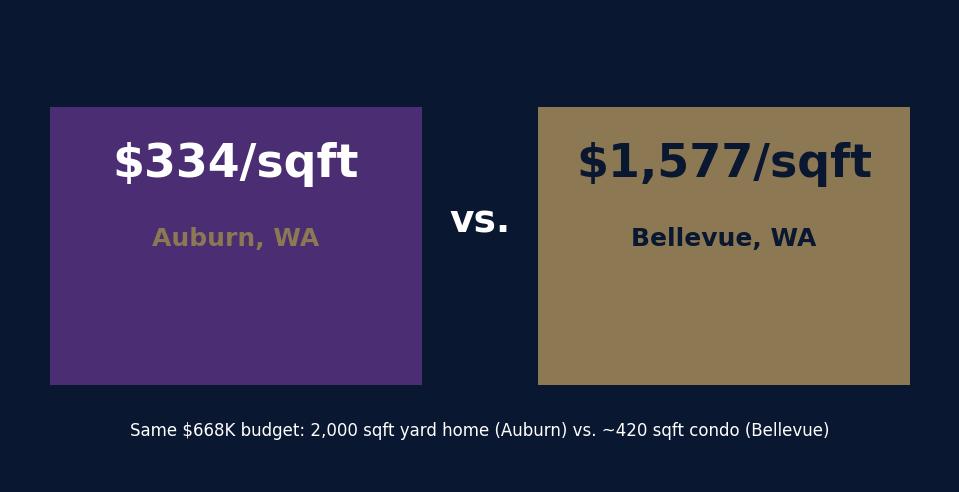
Auburn WA vs Bellevue WA price per square foot comparison 2026 — $334 vs $1,577 per sqft
You’re paying nearly 5x more per square foot in Bellevue than Auburn. For families prioritizing space and equity over address, that math is hard to ignore.

A 2,000 square foot home in Auburn at $668,000 runs roughly $334 per square foot. In Bellevue at $1,735,000, that same budget gets you maybe 1,100 square feet at roughly $1,577 per square foot.

Nearly 5 times more per square foot for the Bellevue address. The Seattle commute from Auburn is longer, yes. You’re trading 15 extra minutes of driving for $400,000 in equity and a yard.

Auburn and Federal Way Market Conditions in 2026

King County overall sits at 2.2 months of supply, still a seller’s market. Auburn’s 14-day DOM and Federal Way’s 7-day DOM suggest more breathing room than Sammamish (4 days) or Bellevue (5 days).

At 6.38% on a $534,400 loan (Auburn median with 20% down), principal and interest runs roughly $3,240 per month before taxes and insurance. That’s real money. It’s also roughly half what you’d carry on a Bellevue home financed at $1.4 million.

For current market conditions across King County, see my East and South King County market update.

Frequently Asked Questions About Relocating to Auburn Washington

What is the median home price in Auburn Washington in 2026?

As of March 2026, the median home price in Auburn is $668,000. That buys a 3-bedroom, 2-bathroom home, typically 1,500 to 1,800 square feet with a yard. Auburn’s 14-day average DOM means less competition than Bellevue or Sammamish, giving you more time to make a clear-headed offer.

Is Auburn WA a good place to relocate for families?

Yes. Auburn has solid schools, the Green River Trail for recreation, a growing downtown, and the lowest single-family home prices in South King County. It’s not flashy, but it’s a working community where families build equity over time. If you work in Renton or south King County, the commute is short.

Is Federal Way or Auburn better for relocating to King County?

Depends on what matters to you. Choose Auburn for the lowest price, a slightly larger lot, and proximity to Renton or south King County jobs. Choose Federal Way for a more polished suburban feel, Puget Sound views, Sounder rail access, or JBLM proximity. Both beat Renton and Bellevue on value by a wide margin.

Can I get a home with a yard in King County for under $700K?

Yes, in Auburn and Federal Way. Both cities have homes under $700K with yards and 1,500 to 1,800 square feet. In Bellevue, Sammamish, or Issaquah, that budget gets a condo or townhouse without outdoor space. The trade-off is a longer Seattle commute, typically 35 to 50 minutes versus 10 to 20 minutes from closer suburbs.

What is the commute like from Auburn to Seattle?

Expect 35 to 45 minutes by car on I-167 to I-5, depending on the time of day. The Sounder commuter train runs to King Street Station in about 45 minutes and lets you work the whole way. If your job is in Renton or the south Eastside, your commute from Auburn may be shorter than from many other King County cities.

Your guide to life outside Seattle.

Gregory Dorrell |
Coldwell Banker Bain | WA License #111862
253-350-0045
·

greg@livingoutsideseattle.com

·

www.livingoutsideseattle.com

Coldwell Banker Bain does not guarantee the accuracy of square footage, lot size, year built, or other property details. All information is based on MLS data and public records as of March 2026. Local market conditions change; please confirm current pricing and inventory with your agent.
 

Buyer Resources May 18, 2026

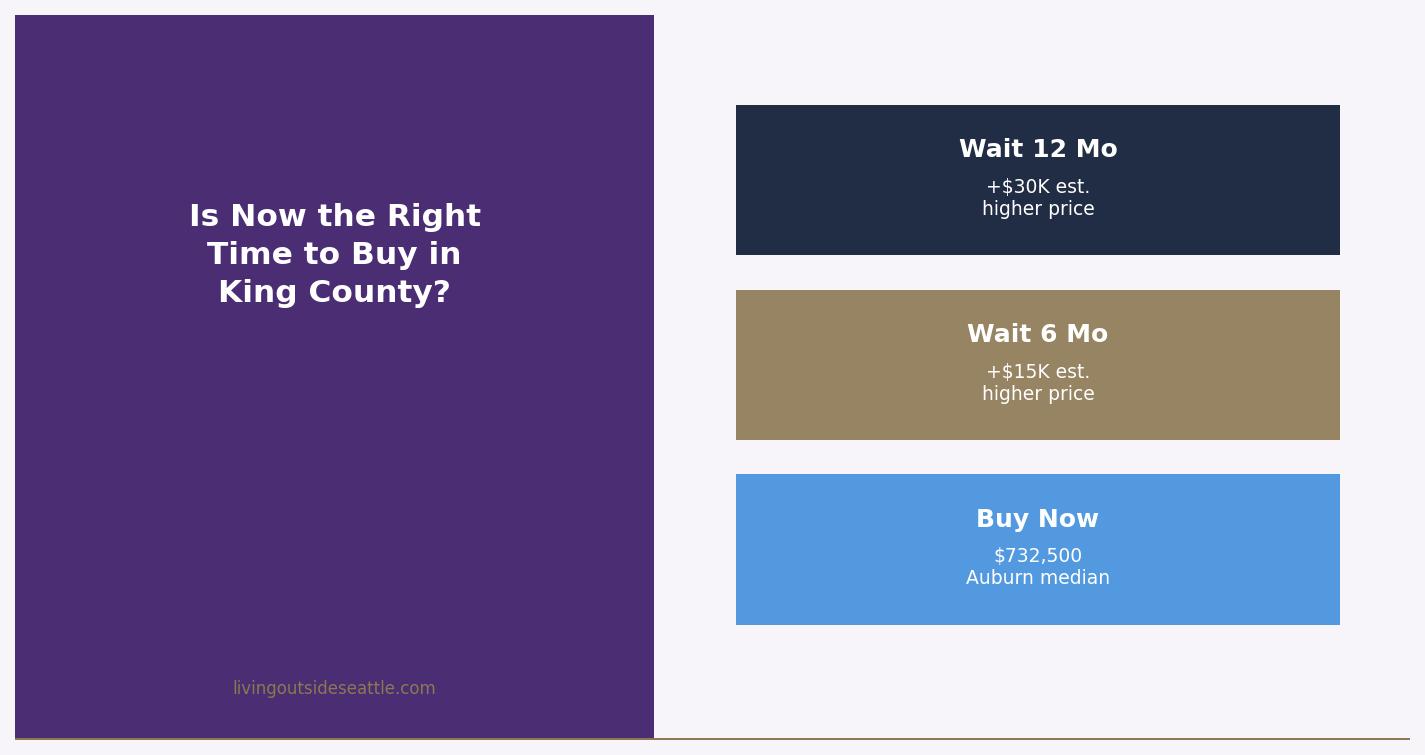
Should I Wait to Buy a Home in Auburn WA? The Real Math.


body { font-family: -apple-system, BlinkMacSystemFont, ‘Segoe UI’, sans-serif; margin: 0; padding: 20px; background: #f0f0f0; }
.preview-wrap { max-width: 860px; margin: 0 auto; background: #fff; border-radius: 8px; overflow: hidden; box-shadow: 0 2px 12px rgba(0,0,0,0.12); }


If you’re asking whether you should wait to buy a home in Auburn, WA, you’re not alone. My inbox right now is full of some version of this question: “If rates drop six months from now, won’t I be better off waiting?” It’s a fair question, and it deserves a real answer, not just reassurance.

Auburn, Washington is where I want to focus this, because at a $668,000 median price for single-family homes, Auburn is the most affordable entry point across the seven major cities I track in King County. For first-time buyers, that matters. And the math here is closer than most people expect.

What Waiting Six Months Really Costs Auburn Home Buyers

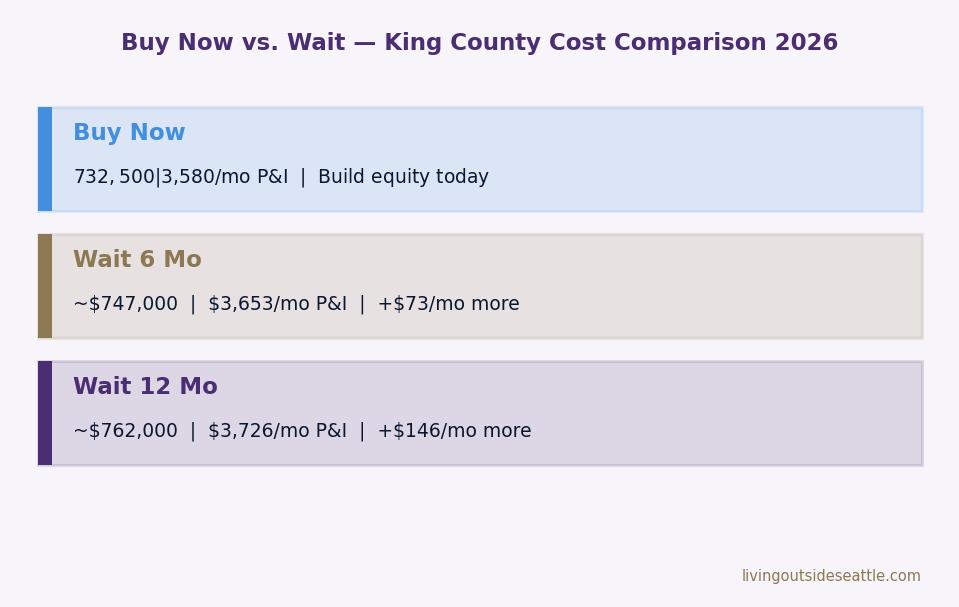
Buy now vs wait 6 months vs wait 12 months — King County home buyer cost comparison 2026

Let me walk you through three scenarios. Check my numbers, because this is too important to just take my word for.

Scenario 1: Buy now in Auburn at $668,000 with 6.38% rate and 10% down.
Loan amount: $601,200. Monthly payment (principal and interest): about $3,840. Down payment: $66,800.

Scenario 2: Wait six months, rates drop to 5.38%, but prices rise 3%.
New price: $688,240. New loan at 10% down: $619,416. Monthly payment at 5.38%: about $3,710. Down payment: $68,824.

You save $130 per month on the payment. But you put $2,024 more upfront and spent six months paying rent or staying in a situation you wanted to leave. Plus you’re six months further from building equity.

Scenario 3: Wait six months, rates drop to 5.38%, but prices rise 5% instead.
New price: $702,400. New loan: $632,160. Monthly payment at 5.38%: about $3,795. Down payment: $70,240.

Now you’re paying $45 more per month than if you’d bought today, even with rates 1% lower. You also put down $3,440 more. You waited six months for that result.

Auburn’s current median days on market is 14 days, softer than the King County average of 7 days. That gives you more breathing room than in faster markets like Sammamish (4 days). You have time to make a thoughtful decision. You just don’t have unlimited time.

Why Lower Rates Don’t Mean Lower Home Prices in Auburn

Here’s what most buyers get wrong about the wait-for-rates strategy. They picture a world where rates fall and nobody buys anything in the meantime, so sellers get desperate and cut prices. That’s not what happens.

When rates drop, demand increases. More buyers qualify. More buyers have monthly payment headroom. That demand pushes prices up. The two forces move in opposite directions, and prices almost always outpace the benefit of the rate drop.

Look at what happened through 2024 and into 2025. Rates eased incrementally, and prices rose. There was no crash followed by a recovery. Steady appreciation as affordability improved. That’s the pattern.

King County’s March 2026 median for single-family homes is $995,000. Auburn’s is $668,000. Both have held steady or moved up despite rate pressure. A significant rate drop would likely push both numbers higher, not lower.

When Waiting to Buy a Home Actually Makes Sense

There are real scenarios where waiting is the smarter move. If rates drop significantly, say 1% or more, and stay there, you have a genuine advantage: you can refinance after buying at today’s rate. But refinancing costs money. Typically $3,000 to $5,000 in closing costs.

If you save $130 per month by refinancing, you need to stay in the home 23 to 38 months just to break even on those refinance costs. The math works if you stay long enough, but it’s not the free win it sounds like.

The better approach is to buy now with the understanding that you’ll refinance when it genuinely makes sense. That only works if you’re building equity in a home you own today. Sitting on the sidelines waiting for the perfect moment rarely produces the perfect moment.

Waiting makes genuine sense if you can’t comfortably afford the current payment, if your job situation is uncertain, or if you’re not planning to stay in the home at least five years. Those are real reasons to wait. Fear of missing a rate drop usually isn’t.

Auburn WA Housing Market: What First-Time Buyers Find Right Now

Auburn’s $668,000 median price is approachable on a South King County household income. The city has solid schools, real job growth, and reasonable commute access to both Seattle and Bellevue. If you’re a first-time buyer looking at King County and you haven’t seriously considered Auburn, run the numbers.

The inventory is there. King County had 5,071 homes for sale in March 2026, up 37.5% from March 2025. Auburn is getting its share. Monthly supply county-wide is 2.2 months, which means buyers have real choices rather than the single-shot bidding wars of late 2024.

New listings jumped 16.5% year-over-year to 3,686 county-wide in March. You’re not racing against 15 other offers on every property in Auburn right now.

How Waiting Affects Your Down Payment Strategy

One cost that doesn’t show up in the rate comparison: opportunity cost on your down payment savings. If you’re waiting for rates to drop and delaying your purchase, home prices likely keep appreciating at 2% to 4% per year in a healthy market. Every month you wait, the down payment required grows with the price.

Start saving now. Get pre-qualified now. And talk to a lender about down payment assistance before assuming you need 10% or 20%. Auburn buyers have access to Washington State Housing Finance Commission programs. Home Advantage offers up to $10,000 in down payment assistance for King County buyers earning up to $147,400. The Covenant Homeownership Program provides 0% interest assistance for qualifying first-timers. first-time buyer programs King County

These programs change the affordability math enough to be worth knowing about before you decide waiting is your only option.

The Scenario Nobody Talks About: What If Rates Go Up?

Here’s the part nobody wants to think about. Rates could go higher. Oil prices are volatile. Geopolitical situations change daily. If rates climb to 7% while you’re waiting for 5.5%, that $668,000 Auburn home costs $4,200 per month instead of $3,840. That’s $360 more. And prices won’t have come down in that environment.

Waiting is a bet on rates falling. It’s not a guaranteed strategy.

First-Time Buyer Advantages in Auburn, Washington

The price point is approachable. Inventory is available. The 14-day median days on market gives you room to think without panic buying. And at $668,000 with 10% down at 6.38%, you’re looking at about $3,840 monthly. That’s achievable on a $120K household income with solid debt-to-income ratios.

If you qualify for WSHFC assistance, the upfront cost gets meaningfully lower. That’s a strong combination for a first-time buyer entry into King County homeownership.

Frequently Asked Questions: Buying a Home in Auburn WA

Will home prices in Auburn WA go down if mortgage rates drop?

Historically, the opposite happens. When rates fall, more buyers qualify and demand increases, which pushes prices up. King County’s March 2026 median is $995,000 county-wide, with Auburn at $668,000 ‚Äî both have held despite rate pressure. A significant rate drop would likely push Auburn prices higher, not lower.

What is the median home price in Auburn, Washington in 2026?

As of March 2026, the median single-family home price in Auburn is $668,000, making it the most affordable SFR entry point among the seven major cities I track in King County. The median days on market is 14 days, which gives buyers more time than in faster markets like Sammamish (4 days).

Are there first-time buyer programs available in Auburn, WA?

Yes. Washington State Housing Finance Commission (WSHFC) offers Home Advantage, which provides up to $10,000 in down payment assistance for King County buyers earning up to $147,400. The Covenant Homeownership Program offers 0% interest down payment loans for qualifying first-timers. FHA loans with 3.5% down are also an option.

How long should I plan to stay in a home before buying makes financial sense?

Most financial advisors suggest at least five years to offset transaction costs and break even on the purchase. In Auburn specifically, if you’re planning to stay five or more years, the buy-now math almost always beats waiting for a rate drop.

What is the best neighborhood in Auburn WA for first-time buyers?

Auburn has a range of neighborhoods from near downtown to the West Hill area with views toward Puget Sound. The best fit depends on your commute patterns, school preferences, and budget. I walk these neighborhoods regularly and can walk you through where comparable homes are moving and at what prices.

Your guide to life outside Seattle.

Gregory Dorrell | Coldwell Banker Bain | WA License #111862
253-350-0045  ·
greg@livingoutsideseattle.com  ·
www.livingoutsideseattle.com

Gregory Dorrell is a licensed real estate broker (WA License #111862) with Coldwell Banker Bain. This post is provided for informational purposes and does not constitute financial or investment advice. Property prices, interest rates, and market conditions are subject to change. Please consult with a mortgage lender for pre-qualification information and a real estate professional for market-specific advice.


South King County May 18, 2026

Living in Auburn, WA: 2026 Neighborhood & Real Estate Guide

Is Auburn, WA a Good Place to Live?

Living in Auburn, WA gives you something that is genuinely hard to find in King County right now: a real house, a real yard, and a real commute to Seattle — all at a price that does not require two tech salaries to pull off. Auburn’s residential median has run between the low $600s and the mid $700s through the first half of 2026, landing at $650,000 in June, well below the King County residential median of $998,000. That gap is real, and it is the reason Auburn is one of the most searched cities in south King County for buyers who want more space without moving to Pierce County.

Auburn is not a city that tries to be trendy. It is practical, diverse, and genuinely livable. The Green River Trail runs right through the city. The Sounder commuter rail connects you to downtown Seattle without fighting I-5. Boeing, the Port of Seattle, and a massive south King County logistics and warehouse sector all sit within 20 miles. For first-time buyers, growing families, and relocators from high-cost states, Auburn consistently shows up as one of the strongest value plays in the Seattle metro.

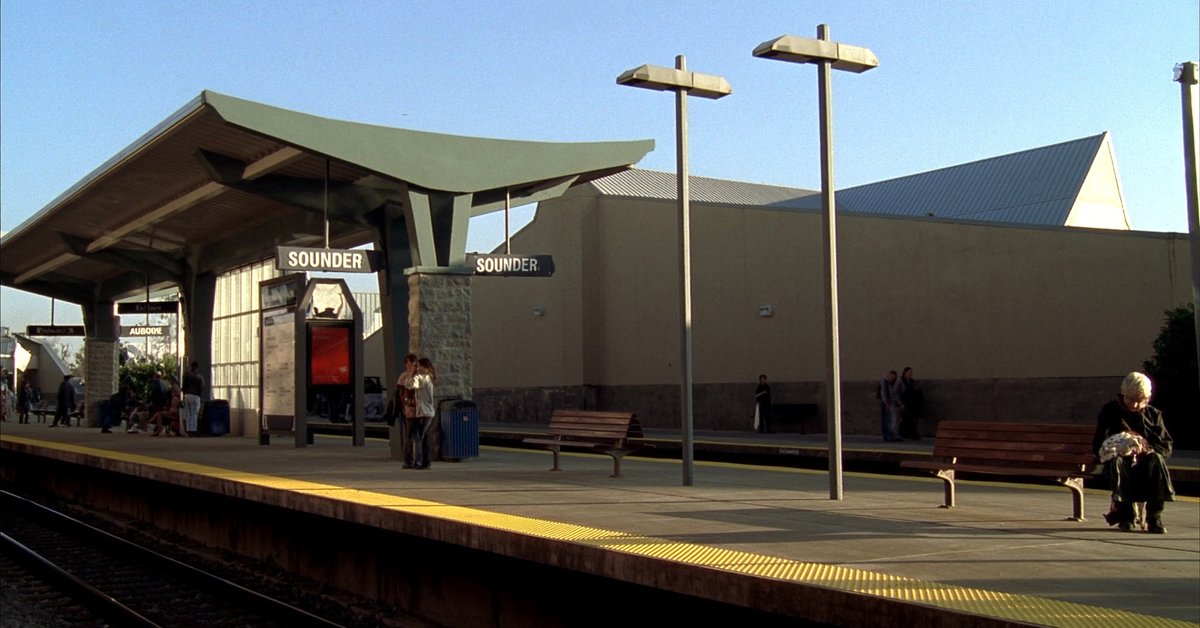
Auburn Washington Sounder commuter train station providing direct rail access to downtown Seattle from King County
Auburn’s Sounder Station connects residents to downtown Seattle in about 50 minutes — no freeway required.

Auburn WA Commute Times to Seattle and Beyond

Moving to Auburn, Washington means living on one of the best-connected transit corridors in south King County. The Auburn Sounder Station is the city’s most underrated asset — it connects you to downtown Seattle without touching I-5, which is a genuine quality-of-life upgrade during rush hour. Sound Transit also runs express bus routes from multiple Auburn park-and-ride locations. Drivers have SR-167 heading north to Renton and Bellevue, and I-5 heading toward Federal Way and Tacoma.

Destination Distance 2026 Peak Commute Transit Option
Downtown Seattle 30 miles 45 to 65 min Sounder Train / I-5
Amazon (South Lake Union) 30 miles 50 to 70 min Sounder + Light Rail Transfer
Microsoft (Redmond) 35 miles 50 to 70 min SR-167 to SR-520 / Drive
Bellevue Tech Corridor 22 miles 35 to 50 min SR-167 North / I-405
SeaTac Airport 15 miles 20 to 30 min SR-167 / Drive

Times reflect honest peak-hour conditions, not best-case scenarios. I drive these routes regularly for BPO inspection work, and the SR-167 corridor can back up significantly between Auburn and Renton during morning rush.

Best Neighborhoods in Auburn, WA

Auburn covers a wide geographic area with distinct neighborhoods — each with its own character, price range, and school assignment. Here is a breakdown of the main areas buyers need to understand before starting their search.

Lea Hill neighborhood in Auburn WA featuring suburban homes on the plateau with Pacific Northwest mountain views
Lea Hill — Auburn’s elevated plateau neighborhood with views, newer construction, and strong school assignments.

Lea Hill

Lea Hill sits on a plateau east of Auburn’s core, overlooking the Green River valley. The vibe is suburban and quiet, with a mix of families and long-term residents who appreciate the views and the breathing room. Homes here are mostly 1990s to 2010s construction, running from 1,800 to 3,200 sq ft on lots between 5,000 and 10,000 sq ft. Median prices run $650,000 to $750,000. Most students attend Lea Hill Elementary and Auburn Mountainview High School. Sunrise Park is the main neighborhood park, and nearby Green River College adds a practical anchor.

Deep Dive: Lea Hill →

Read our full deep-dive on Lea Hill →

West Auburn / Downtown Corridor

This is the historic heart of Auburn, built around the original downtown and the Sounder rail station. The character is urban for Auburn — walkable blocks, older commercial buildings, and a mix of housing types. Single-family homes typically run 1,000 to 1,800 sq ft on compact lots, with prices often starting in the $460,000 to $530,000 range — some of the lowest in the city. Students attend Dick Scobee Elementary and Auburn High School. The Auburn Farmers Market, Game Farm Park, and the White River Amphitheatre are all close by.

Deep Dive: West Auburn →

Lakeland Hills

Lakeland Hills is a master-planned community on the south end of Auburn straddling the King-Pierce County line. The character is clean, organized, and family-forward, with wide streets, consistent landscaping, and a central park with splash pad and sports fields. Homes are mostly 1995 to 2015 construction, ranging from 1,600 to 3,500 sq ft. Parts of Lakeland Hills fall in the Auburn School District and parts fall in the Dieringer School District — school assignment depends on your exact address, so always confirm before you make an offer. Auburn SD students typically attend Lakeland Hills Elementary and Auburn Mountainview High School. Dieringer SD students attend Dieringer Heights Elementary and North Tapps Middle School.

Deep Dive: Lakeland Hills →

Auburn Valley / East Main

The Auburn Valley and East Main Street area runs along Auburn’s eastern edge, where the terrain rises toward the Covington foothills. The character is semi-rural with some suburban pockets — larger lots, older homes, and more breathing room. Homes range from 1970s to early 2000s construction, typically 1,500 to 2,800 sq ft, with lots from a quarter acre to over an acre in some pockets. Most addresses along the Auburn Way South corridor feed Chinook Elementary, Cascade Middle School, and Auburn Senior High School, though the feeder shifts toward Auburn Mountainview High closer to the eastern foothills. Always verify your exact address with the district. The Green River Trail’s eastern sections pass through here, making it popular with cyclists and walkers.

Deep Dive: Auburn Valley →

Terrace View / North Auburn

North Auburn runs between the downtown core and the Kent city line along Auburn Way North. Terrace View is one of the established neighborhoods in this corridor, with homes mostly built from the 1960s through the 1980s. Sizes run 1,200 to 2,200 sq ft on lots from 6,000 to 10,000 sq ft. Prices here are among the lowest in Auburn — a real opportunity for buyers willing to update an older home. Students typically attend Ilalko Elementary and Mt. Baker Middle School, feeding into Auburn High School. Game Farm Wilderness Park is the main neighborhood green space.

Deep Dive: North Auburn →

Cobble Creek / Verdana

Cobble Creek and Verdana are two of Auburn’s newer planned communities near the SR-18 interchange in the southeast corner of the city. These neighborhoods were built mostly between 2005 and 2018, with homes running 2,000 to 3,500 sq ft on lots from 4,000 to 7,000 sq ft — Northwest contemporary style with open floor plans and attached garages. Verdana students typically attend Arthur Jacobsen Elementary and Cascade Middle School, feeding into Auburn Mountainview High. Easy SR-18 access toward Covington and the Outlet Collection Seattle is a practical plus.

Deep Dive: Cobble Creek / Verdana →

The Bridges

The Bridges is Auburn’s most upscale planned community, tucked into the hills on Auburn’s northeast corner near the Kent boundary. The vibe is gated and polished — tree-lined streets, larger lots, and homes running 2,400 to 4,500 sq ft on lots from 7,000 to 14,000 sq ft. Some homes have territorial views. Students typically attend elementary schools in the Lea Hill zone, then Rainier Middle School, and Auburn Mountainview High School. If you want more home for your dollar compared to similar properties in Renton or Kent, The Bridges is consistently at the top of that list.

Deep Dive: The Bridges →

South Auburn / Muckleshoot Area

South Auburn runs along Auburn Way South toward the Muckleshoot Casino and the Pierce County line. The character is more commercial and transitional, but affordable residential pockets exist with solid single-family homes. Most homes are 1960s to 1990s construction, ranging from 1,000 to 2,000 sq ft on lots from 5,000 to 8,500 sq ft. Students attend Chinook Elementary and Cascade Middle School, feeding into Auburn High School. Buyers focused strictly on value and South King County employment proximity find Auburn’s lowest prices per square foot here.

Deep Dive: South Auburn →

Auburn Washington real estate market 2026 -- suburban home with green lawn representing home values and investment opportunity in King County
Auburn’s 2026 market offers real opportunity for buyers — more inventory, more time to inspect, and honest pricing from sellers.

Auburn WA Real Estate Market in 2026

King County’s residential median sits at $998,000 as of June 2026, and Auburn’s June median of $650,000 makes it one of the most affordable cities in the county for single-family homes. Active residential listings across King County have more than doubled since January, which has brought some welcome balance to the market. The typical well-priced Auburn home went pending in about 8 days in June, quick by any standard, but with roughly 3.4 months of supply sitting on the market, buyers finally have real selection and room to negotiate on the homes that linger.

Price ranges vary significantly by neighborhood. Southeast Auburn (zip 98092), which includes Lea Hill and Lakeland Hills, runs $650,000 to $820,000 for move-in-ready homes. Downtown Auburn (zip 98002) starts closer to $460,000 to $530,000. West Auburn and North Auburn (zip 98001) are the most affordable pockets, with single-family homes often starting in the upper $400,000s. No matter which part of Auburn you are shopping in, you are still buying well below the King County average.

The inventory increase across King County has been a real shift for Auburn buyers in 2026. A year ago, a 2,000 sq ft three-bedroom in Lea Hill would go under contract in a weekend with multiple offers. Today, those same homes split fast: the sharp ones still move inside a couple of weeks while anything overpriced sits, and that split is genuinely valuable. Buyers can get a real inspection done, ask for repairs, and negotiate without panic.

For sellers, the message is clear: accurate pricing from day one matters more than it has in years. Homes that launch above where the data says they should be are the ones that sit for two and three months. Homes that were priced correctly in early 2026 are still selling — they just require patience and honest expectations.

Over the last 12 months, Auburn prices have been firming up, with the June median about 3.7% higher than a year earlier. Lakeland Hills and The Bridges have held up the best. Older homes in North Auburn and parts of South Auburn have softened more, which creates real opportunity for buyers willing to do some work.

The Bridges upscale neighborhood in Auburn WA with larger craftsman homes and tree-lined streets in King County
The Bridges — Auburn’s most upscale planned community, with larger homes and territorial views near the Kent border.

Frequently Asked Questions: Living in Auburn, WA

Is Auburn, WA a good place to live?

Auburn is a strong fit for buyers who want affordability, practical highway and transit access, and a real Pacific Northwest lifestyle without paying Eastside prices. It is not the trendiest city in King County, but it offers something more valuable right now: a home you can actually afford, a yard you can use, and a commute you can manage. For first-time buyers, growing families, and relocators from high-cost markets, Auburn consistently ranks as one of the best value cities in the Seattle metro.

What is the average home price in Auburn, WA in 2026?

Auburn’s residential median was $650,000 in June 2026, with monthly medians ranging from the low $600s to the mid $700s this year. That varies significantly by area: Southeast Auburn (Lea Hill, Lakeland Hills) runs $650,000 to $820,000, while Downtown Auburn starts closer to $460,000. Well-priced homes are moving in days, but with more than three months of supply on the market, buyers have real selection and negotiating room.

What are the best neighborhoods in Auburn, WA?

The best neighborhood depends on your priorities. For newer construction and strong schools, Lea Hill and Lakeland Hills lead the pack. For the best Sounder commute access and lowest prices, Downtown Auburn and North Auburn are worth a close look. For more space and a semi-rural feel, Auburn Valley and East Main offer larger lots. For the most upscale finished product in Auburn, The Bridges delivers at a price still well below comparable Renton or Kent options.

How far is Auburn, WA from Seattle?

Auburn is about 30 miles south of downtown Seattle. By Sounder commuter train, the trip takes roughly 50 minutes without any freeway driving. By car on I-5, expect 45 to 65 minutes during AM peak hours. SR-167 to I-5 is the main driving route. For frequent Seattle commuters, the Sounder is one of Auburn’s most practical advantages.

What school district is Auburn, WA in?

Most of Auburn is served by the Auburn School District. Parts of south Auburn (Lakeland Hills) overlap with the Dieringer School District in Pierce County. Always confirm the school district for any specific address before writing an offer — it matters for both school assignment and resale value.

Explore Auburn, WA Yourself

The best way to know if living in Auburn, WA is the right fit is to come out and drive it. Hit the Green River Trail by bike, walk downtown and check out the farmer’s market, then drive out to Lea Hill for the view. The range of this city is bigger than most people expect until they see it in person.

View Auburn on Google Maps

Your guide to life outside Seattle.

Gregory Dorrell | Coldwell Banker Bain | WA License #111862
253-350-0045 ·
greg@livingoutsideseattle.com ·
www.livingoutsideseattle.com