

 Facebook
 X
 Pinterest
 Copy Link
A quick note before we start: I am a real estate broker, not an attorney. This post is general information, not legal advice. Partition is a court process. If anyone in your family is thinking about filing, or has been served with papers, please call a Washington attorney first.
What Is a Partition Action?
A partition action is a lawsuit. One co-owner asks a court to end the shared ownership of a property.
That is all it is. Nobody is in trouble. It is a way out when a group of owners cannot agree.
In Washington, the rules for this are in chapter 7.52 RCW. The first section, RCW 7.52.010, says co-owners who hold property together can bring this kind of action. The court then splits up the property according to each person’s share.
When Does This Come Up With an Inherited Home?
When a person passes away owning a house, ownership can pass to the heirs. Under RCW 11.04.250, title to real estate vests in the heirs or devisees right away, subject to the estate’s debts and costs. A devisee is a person named in a will, and that person counts only after the will is probated.
So three siblings might each own a share of Mom’s house. Now they are co-owners, whether they planned to be or not.
That works fine when everyone wants the same thing. It gets hard when they don’t. Here are the splits I hear about most:
- One heir wants to sell now. Another wants to keep the house.
- One heir lives in the home. The others want their share in cash.
- One heir pays the taxes and repairs. The others pay nothing.
- Heirs live in different states and can’t agree on a price or a plan.
If talking has stopped working, one heir may file for partition. Often the threat of it is enough to get people back to the table.
Two Ways a Court Can Handle It
Washington law gives the court two paths.
Partition in kind means the court divides the property itself. This works for a big piece of land that can be cut into parcels. It almost never works for a single house. You can’t hand one sibling the kitchen and another the garage.
Partition by sale means the court orders the property sold, and the money is divided. Under RCW 7.52.080, the court can order a sale if the property cannot be divided without “great prejudice” to the owners. For a single-family home, that is the usual result. The same idea shows up in RCW 7.52.130, where referees report that a division would harm the owners and the court may then direct a sale.
Referees are people the court appoints to handle the work. The court also decides how the money is split and how the costs are paid.
How Much Time and Money Does It Take?
I can’t give you a number of months or a dollar figure, and I won’t guess. Every case is different. It depends on the court’s calendar, how many heirs there are, whether anyone fights it, and whether a lender or other creditor has a claim on the home.
What I can tell you is the general shape.
It costs money. There are court filing costs, attorney fees, and referee fees. Under RCW 7.52.480, these costs are shared by the owners in proportion to their interests, and the court sets reasonable attorney fees. The costs can become a lien on each person’s share. In plain words, they come out of the family’s money.
It takes time. Court cases move slowly. While the case is open, the house still needs insurance, taxes, and upkeep. Those bills keep coming.
You lose some control. In a family sale, you pick the agent, the price, and the timing. In a court sale, the court sets the terms. Under RCW 7.52.270, referee sales are made by public auction, with the terms set in the notice. An auction can bring less than a normal listing, because the home is not shown to the whole market the usual way.
That last point matters most to me. A well-marketed home usually sells for more than a rushed one. I assess property values professionally every day, and I have seen how much preparation and timing change a result.
Your Options Before It Gets to Court
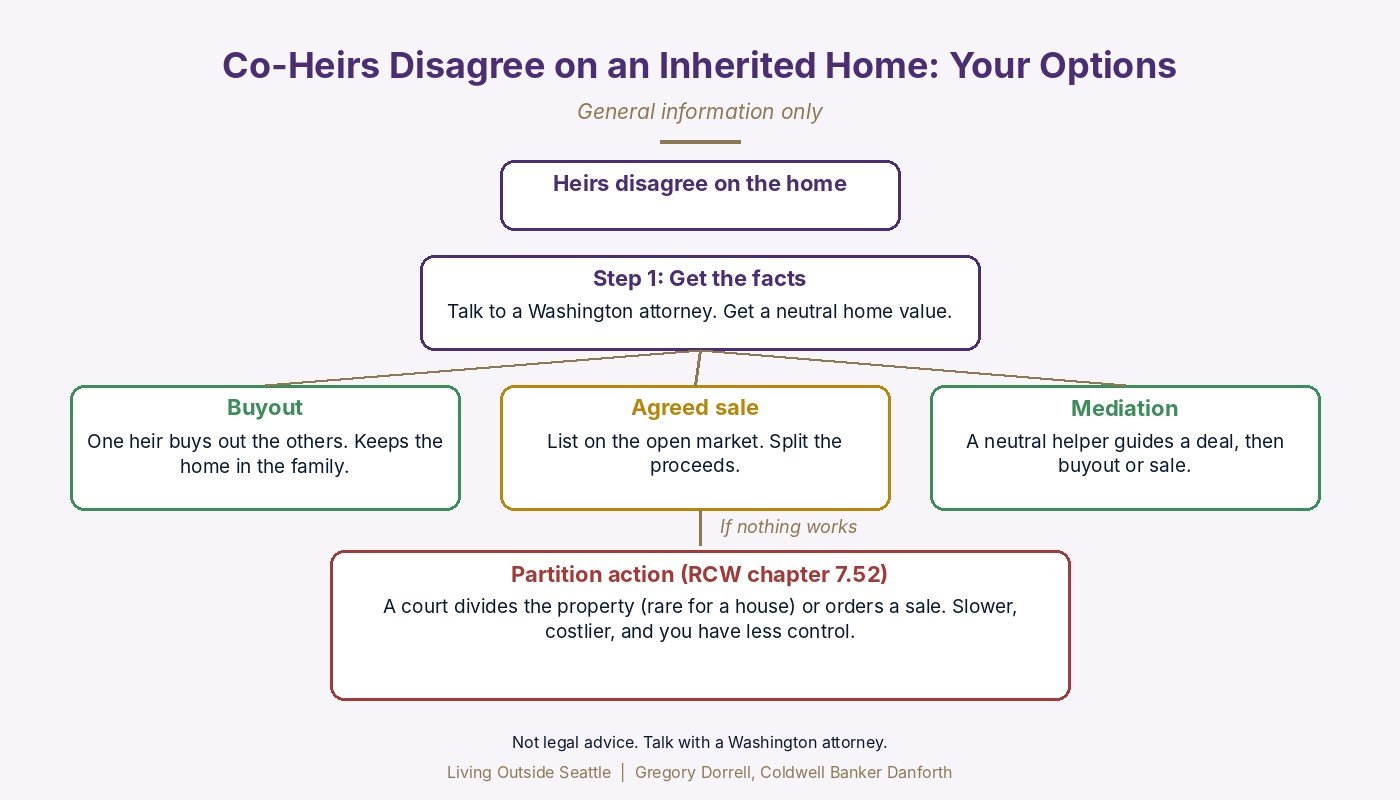
Most families never need a judge. Here are the common paths side by side.
| Option | How it works | Pros | Cons | Typical effort |
|---|---|---|---|---|
| Buyout | One heir buys out the others’ shares, often with a loan or savings | Keeps the home in the family. Everyone gets paid. | The buyer needs money or financing. Heirs must agree on a value. | Medium. Needs an appraisal or price opinion, and legal paperwork. |
| Agreed sale | All heirs agree to list and sell on the open market | Usually the best price. Clean and quiet. | Everyone must agree on the agent, price, and timing. | Low to medium. Needs one decision maker or clear ground rules. |
| Mediation | A neutral person helps the heirs reach a deal | Cheaper and faster than court. Keeps family ties intact. | Voluntary. It only works if everyone shows up willing. | Medium. A few sessions and a signed agreement. |
| Partition action | A court orders the home divided or sold | Gives a way forward when talking has failed. | Slower, public, and costly. Less say in price and timing. | High. Attorneys, a court case, and a court-run sale. |
Source: Chapter 7.52 RCW (app.leg.wa.gov); general planning comparison by Gregory Dorrell, not legal advice.
Steps to Take If You and Your Co-Heirs Disagree
Here is the order I would walk through with a family.
- Get the facts. Find out who owns what share, whether a will exists, and whether probate is open. My probate overview explains how the process works, so I won’t repeat it here.
- Talk to an attorney early. A probate or real estate attorney can tell you who has the legal right to sell, and how an open probate affects your options. This is also the person to ask about partition.
- Get a neutral value. Disagreements often start with price. A current market opinion from an agent, or a formal appraisal, gives everyone the same number to look at.
- Try a buyout. If one heir wants to keep the home, ask what they can afford. Have them talk to a lender, and have an attorney draw up the paperwork.
- Try mediation. If emotions run high, a neutral mediator can help. Many families find it easier to hear a hard truth from a stranger.
- Choose an agreed sale if no one can buy. Pick one point person, write down who decides what, and split the net proceeds. My inherited home first steps guide covers what to do first, and my cost to sell guide shows what comes out of the sale.
- Keep partition as the last step. If nothing else works, ask your attorney whether to file or how to respond.
Why a Family Sale Often Beats a Court Sale
When the family sells together, you pick the agent, the price, and the timing. In a court sale, someone else makes those choices. Sometimes one person simply will not move, and the law gives the others a fair way forward. I just think a calm family agreement is almost always cheaper, quicker, and kinder.
Frequently Asked Questions
Can one heir force the sale of an inherited home in Washington?
Yes, in many cases. A co-owner can ask a court for partition under chapter 7.52 RCW, and for a single house the court may order a sale. The details depend on your facts, so please ask an attorney about your situation.
What is the difference between partition in kind and partition by sale?
Partition in kind divides the property itself, like splitting land into parcels. Partition by sale sells the property and divides the money. A single house usually can’t be divided fairly, so a sale is the common outcome.
Who pays for a partition action?
Under RCW 7.52.480, costs such as referee fees and court-set attorney fees are paid by the owners in proportion to their interests. They can become a lien on each owner’s share. An attorney can explain how that would work for you.
Can we sell the house while probate is still open?
Sometimes, but it depends on who has authority and what the court requires. Please ask your probate attorney first. My probate overview gives the basics.
Your guide to life outside Seattle.
253-350-0045 · greg@livingoutsideseattle.com · www.livingoutsideseattle.com
This post is general information only. I am a real estate broker, not an attorney, and nothing here is legal or tax advice. Sources: Chapter 7.52 RCW (Partition), including RCW 7.52.010, 7.52.080, 7.52.130, 7.52.270, and 7.52.480; RCW 11.04.250 (descent and distribution of real estate), Washington State Legislature, app.leg.wa.gov. Statutes can change, so confirm the current text with an attorney.
