

 Facebook
 X
X
 Pinterest
 Copy Link

When a family member passes away and leaves a home in King County, the questions come fast. Can I sell it now? Do I have to go to court? What if there’s no will? How long is this going to take? Most heirs have never dealt with probate before. The process isn’t complicated once you understand how it works. The gaps in understanding are where costly mistakes happen. Here’s a plain-language breakdown of probate real estate in Washington State.
What Probate Is — and When You Need It
Probate is the legal process through which a deceased person’s estate is settled. In the context of real estate, it’s how the legal right to sell an inherited property gets transferred to the person or people who need to sell it. In Washington State, probate is typically required when the deceased person owned real estate solely in their own name, with no co-owner, beneficiary designation, or trust arrangement. If the property is titled only in their name and there’s no mechanism that automatically transfers ownership, the estate has to go through the court system to establish who has the legal authority to sell. Washington has one of the more streamlined probate processes in the country, which is the good news. It does not require court approval of the sale price in most cases, and it allows the executor to manage and sell property without ongoing court supervision under what’s called the Washington Simplified Probate Procedure.
How to Avoid Probate Entirely
Before going through the probate process, it’s worth understanding the situations where probate can be avoided entirely. Joint tenancy with right of survivorship. If the deceased owned the property with another person as joint tenants, ownership passes automatically to the surviving joint tenant without probate. You’ll need to record an affidavit of survivorship and a copy of the death certificate with the King County Recorder’s Office. Transfer-on-death deed. Washington allows TOD deeds that automatically transfer real property to a named beneficiary upon death, bypassing probate entirely. Living trust. If the property was held in a revocable living trust, it passes to the successor trustee outside of probate. The trustee then manages or sells the property according to the trust terms. Community property with right of survivorship. For married couples who held property as community property with right of survivorship, the same automatic transfer applies. If none of these structures were in place, probate is the path forward.
What Probate Actually Costs in Washington
Legal costs are often the first concern heirs raise, and they vary more than people expect. Court filing fees for a probate petition in King County run approximately $200 to $400 depending on the complexity of the estate. Attorney fees are where costs can vary significantly. Washington does not set statutory attorney fees for probate the way some states do. Most probate attorneys in the Seattle area charge hourly rates ranging from $250 to $450 per hour. A straightforward probate with a single property, clear title, and no disputes can often be completed for $2,000 to $4,000 in attorney fees. A contested estate can cost multiples of that. Personal representative fees. The executor or personal representative is entitled to compensation from the estate under Washington law, calculated as a percentage of the estate value. Whether the personal representative collects those fees is their choice. Many family members waive them. Some heirs try to navigate probate without an attorney for simple estates. Washington does allow this. But real estate title companies and buyers’ lenders will require clean title documentation, and errors in the probate filing can delay or complicate the eventual sale. For most heirs, the cost of a probate attorney is worthwhile protection against those complications.
The Timeline: How Long Does This Take?
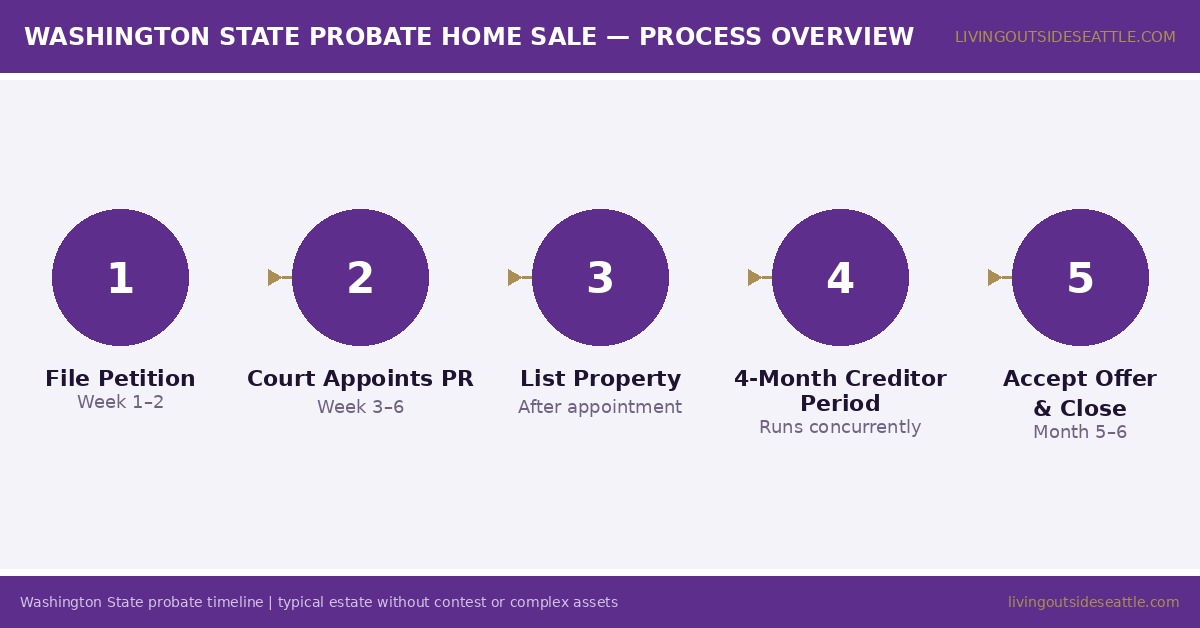
Washington probate for a straightforward estate with a single real property asset typically takes 4 to 6 months from filing to final closing. Here’s the rough sequence. Filing the petition and getting the initial court hearing scheduled takes 3 to 6 weeks. Once the personal representative is formally appointed by the court, they have legal authority to manage the property, including listing it for sale. Washington’s creditor claim period is 4 months from the date the notice to creditors is published. The estate can’t distribute assets to heirs until this period expires. However, you can often list and accept an offer on the property during this window. You just close after the creditor period ends. For heirs who want to sell quickly, the 4 to 6 month realistic timeline is a planning benchmark. Filing the probate petition promptly and ideally having the property assessed and listed while the legal process runs in parallel is the way to minimize total elapsed time.
Can You Sell the Property Before Probate Is Complete?
In many cases, yes. Once the personal representative is appointed by the court, they have authority to list and sell the property in Washington under the Independent Administration of Estates Act. They do not need to return to court for approval of the sale price or terms as long as they are acting in the estate’s best interest. Your escrow and title company will need to work with probate proceedings. Make sure whoever you’re working with has experience with probate sales in King County. It’s not dramatically different from a standard sale, but the documentation requirements are specific.
What About the Property Itself During Probate?
The inherited property doesn’t go into stasis while probate runs. The personal representative has an obligation to maintain it reasonably: keeping utilities on, maintaining insurance, securing it if it’s vacant. Holding costs add up. Property taxes continue to accrue. Insurance on a vacant property often costs more than occupied homeowner’s insurance. Any deferred maintenance issues don’t improve with time. This is one reason I encourage heirs to move through the probate process with reasonable urgency rather than letting it sit for 12 to 18 months. The property is a financial asset generating costs. Getting it listed and sold, or rented if that’s the better strategy, protects the estate’s value.
Frequently Asked Questions
How long does probate take in King County before I can sell the property?
The full probate process typically runs 4 to 6 months in King County from filing to final distribution. However, you can list and accept an offer on the property once the personal representative is appointed (typically 3 to 6 weeks after filing). The closing is timed to occur after the 4-month creditor period ends. King County processes probate cases faster than rural Washington counties due to higher staffing levels.
Do I need a probate attorney to sell an inherited home in Washington State?
You’re not legally required to hire an attorney, but most estate attorneys and title companies strongly recommend it. Errors in the probate filing can delay or complicate the property sale. For a King County home with significant equity, the cost of a probate attorney ($2,000 to $4,000 for a straightforward estate) is usually worthwhile protection.
Can I sell an inherited home in Washington State without going through probate?
Yes, in several scenarios. If the property was held in joint tenancy with right of survivorship, as community property with survivorship rights, in a living trust, or with a transfer-on-death deed, it transfers automatically without probate. If the total estate value is under $100,000 and includes no real property, a Small Estate Affidavit may be available after a 40-day waiting period.
What is a Personal Representative’s Deed in Washington State?
A Personal Representative’s Deed is the specific deed type used to transfer property out of a probate estate. It limits the estate’s liability and is the required deed form for executor-led property transfers in Washington. Your purchase and sale agreement should specify that the transfer will be made pursuant to a Personal Representative’s Deed.
Working Through a Probate Sale in King County
If you’re navigating an inherited property in King County and trying to figure out whether to sell, how to price it, and what condition issues to address before listing, I work with heirs and executors regularly on exactly these situations. I’m not a probate attorney and this isn’t legal advice — get a probate attorney for the legal process. What I can do is help you understand what the property is worth in today’s market, what selling costs to expect, and how to sequence the sale to maximize what the estate walks away with. See also: Inherited Home in King County WA: What to Do Next
Your guide to life outside Seattle.
253-350-0045 · greg@livingoutsideseattle.com · www.livingoutsideseattle.com
Gregory Dorrell is a licensed real estate broker (WA License #111862) with Coldwell Banker Danforth. This post provides general information about probate real estate in Washington State and does not constitute legal advice. Consult a qualified probate attorney for guidance specific to your situation.
