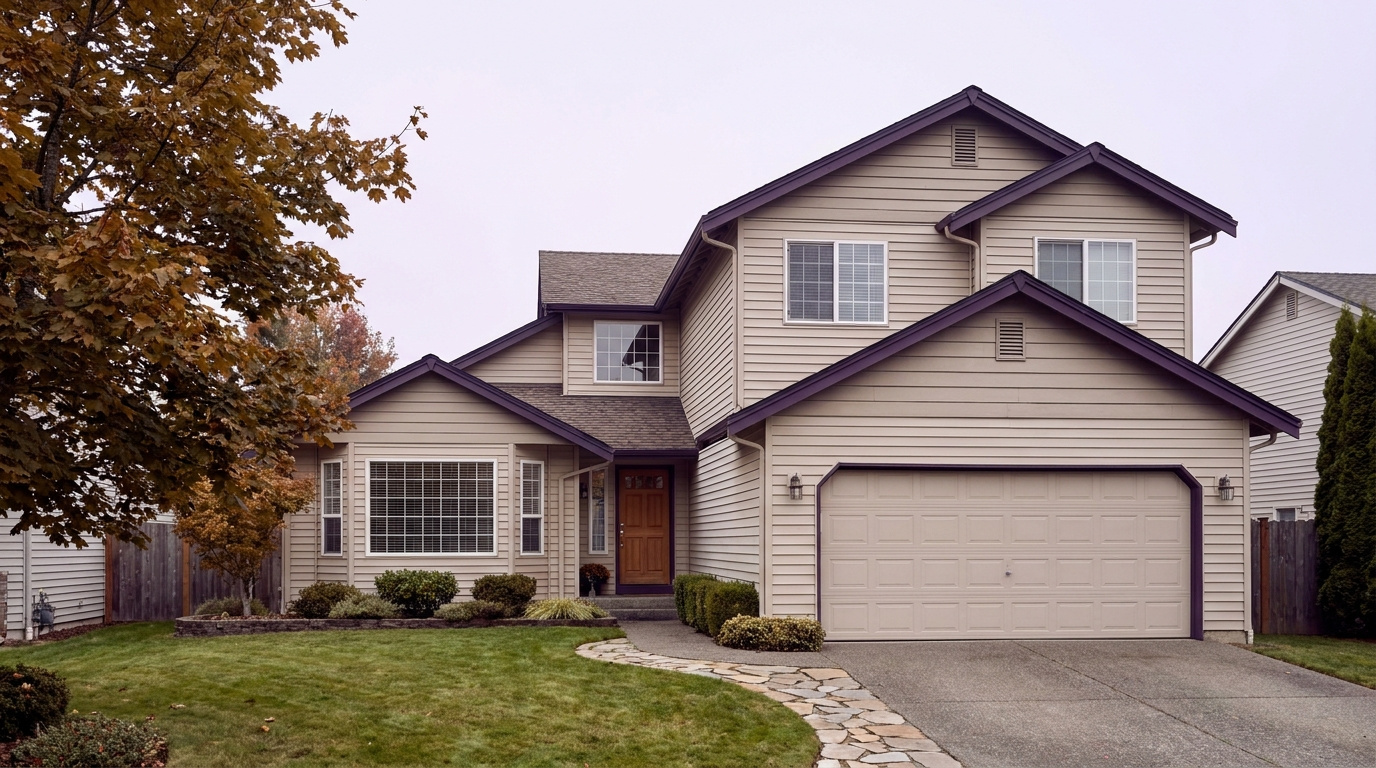
Seller Resources August 19, 2026

First-Time Seller Steps: What Actually Happens From Listing to Closing in King County

I get some version of “I’ve never done this, what happens first” from almost every first-time seller I work with. That’s normal. Nobody teaches you this in school. Here’s the honest walkthrough, stage by stage.

Stage 1: Pricing and Prep

This is where sellers either set themselves up to win or lose money before a single buyer walks through the door. Pricing isn’t a guess and it isn’t your Zillow estimate. It’s a comparative analysis against homes that actually sold near you, adjusted for condition, size, and timing. I do BPO-backed pricing assessments for banks and institutional clients every week, which means I see real sale data, not estimates. I walk through exactly how this works in my BPO methodology guide.

Prep comes next: what to fix, what to skip, and how to present the home. King County is sitting at roughly 15.5 weeks of supply right now, which means buyers have options. A home that shows well gets picked over one that doesn’t, even at the same price. I go deep on what’s worth fixing in my room-by-room prep guide.

Stage 2: Going Live

Your home hits the MLS, and within minutes it’s syndicated to Zillow, Redfin, and every other major site. Photos matter more than most first-time sellers expect. So does the listing description, though not for the reasons people think. It’s not marketing copy that sells your home. It’s accurate information that gets the right buyers through the door.

You’ll get a wave of activity in the first week or two. This is normal and doesn’t mean you priced wrong if it slows down after that.

Stage 3: Showings and Offers

Buyers tour, sometimes with their agent alone, sometimes with a home inspector in tow for a quick pre-offer look. Then, if you’re lucky, offers start coming in.

Right now, about 18 percent of King County homes are selling over list price, and roughly 11 percent of new listings are setting a specific date for offer review. That means most homes, including most first-time seller homes, are getting offers on a rolling basis rather than a single big deadline. Read every offer for more than the price. Financing type, contingencies, and closing timeline all matter. A cash offer $10,000 lower than a financed one can be the stronger choice depending on your situation.

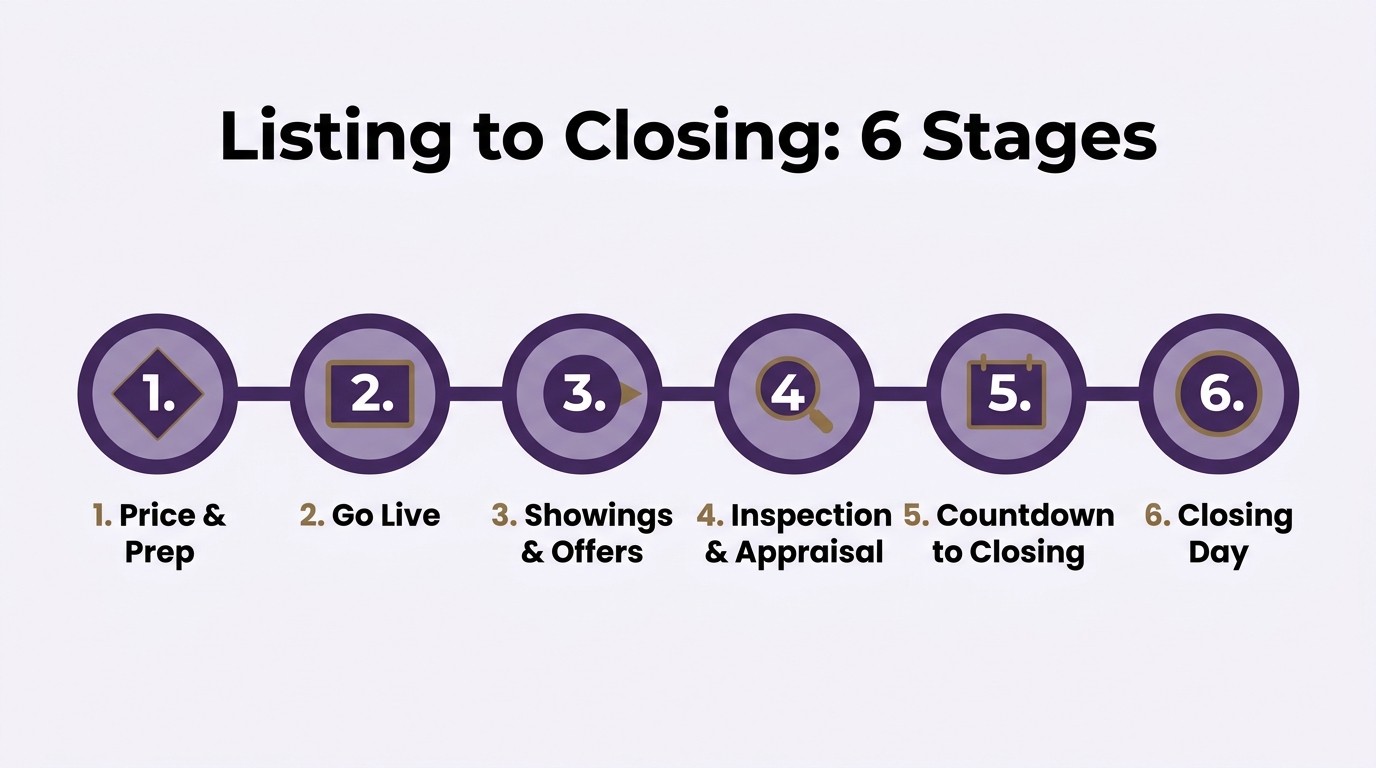
King County home selling timeline listing to closing 2026 six stages

The six stages of a King County home sale, from pricing and prep through closing day.

Stage 4: Under Contract, Inspection, and Appraisal

Once you accept an offer, the clock starts on contingency periods. The buyer’s inspector will find things. Every house has something. The real question is what they ask you to fix or credit, and whether that request is reasonable or a renegotiation in disguise. I walk sellers through this exact moment in my home inspection seller’s guide.

If the buyer is financing, an appraiser will also value the home independently. If it comes in below the sale price, that becomes a financing contingency conversation, not an automatic deal-killer. I cover how appraisals actually work in my Washington State appraisal guide.

Stage 5: The Countdown to Closing

Once contingencies clear, you’re in the home stretch. Final loan approval, title work, and a final walkthrough happen in the days before closing. This is also when you’re coordinating your own move, which is its own logistics puzzle if you’re buying at the same time. If that’s you, I explain the options in my guide to buying and selling simultaneously in King County.

Stage 6: Closing Day

You sign a stack of documents, the buyer’s funds transfer through escrow, and ownership changes hands. In Washington, you typically don’t have to appear in person, escrow handles most of it. Once it records, the sale is final and your proceeds wire to your account, usually the same day or the next business day.

Frequently Asked Questions

How long does it take to sell a home in King County from start to finish?

Most homes go from listing to closing in six to ten weeks right now, factoring in an average marketing period plus a typical 30 to 45 day closing timeline once under contract. Pricing accuracy and current inventory levels in your specific city affect this more than anything else.

What’s the first thing I should do as a first-time home seller?

Get an accurate, data-backed price assessment before you do anything else, including prep work. Your price determines your buyer pool, your timeline, and how much you should spend fixing things up. Everything else follows from getting that number right.

Do I need to be present at closing in Washington State?

No. Washington uses escrow to handle closings, and most sellers sign documents ahead of time or electronically depending ont he rather than appearing in person. Your proceeds transfer once the sale records with the county.

Your guide to life outside Seattle.

Gregory Dorrell |
Coldwell Banker Bain | WA License #111862
253-350-0045
·

greg@livingoutsideseattle.com

·

www.livingoutsideseattle.com

Gregory Dorrell is a REALTOR® with Coldwell Banker Bain (WA License #111862) specializing in East and South King County. Market data from NWMLS, week of August 2, 2026. This article is general information, not legal advice.

EastsideMarket InsightsSeller ResourcesUncategorized August 11, 2026

What It Costs to Sell a Home in Sammamish: Net Proceeds Explained

Sammamish sellers ask me about price more than any other topic. The median list price sitting active right now is around $1,497,000, and recent closed sales in the area are landing closer to $1,686,000. But the number that actually matters isn’t the sale price. It’s what lands in your account after everyone gets paid. Here’s the honest breakdown.

Start With the Sale Price, Not the List Price

Sammamish is a market where list and sale price can diverge in your favor. The homes selling right now are coming in above the median active list price, which tells you serious buyers are still competing for the right properties even with King County sitting at nearly 16 weeks of supply countywide. That’s not true everywhere in my service area. It’s a Sammamish-specific dynamic driven by school district demand and limited inventory in the neighborhoods people actually want.

Run your own net proceeds off your likely sale price, not your Zestimate. I can pull a data-backed number for your specific home in about the time it takes to walk your home once.

Real Estate Commission

Commission is negotiable and I won’t pretend otherwise. Most Sammamish listings run in the 2.5 to 3 percent range for the listing side, with a separate negotiated amount for the buyer’s agent since the NAR settlement changed how that gets structured. On a $1.6 million sale, even a half-percent difference in total commission is $8,000. Ask specifically what you’re paying for and what your agent’s actual marketing plan looks like before you sign anything.

Washington’s Real Estate Excise Tax Hits Harder Here

This is where Sammamish sellers get surprised. Washington’s REET is graduated, meaning higher sale prices get taxed at a higher rate on the portion above certain thresholds. At $1.6 million, you’re paying the top bracket on a meaningful chunk of your sale price, plus King County’s local REET addition on top of the state rate. I’ve walked sellers through this who assumed REET was a flat 1.28 percent like it used to be years ago. It isn’t anymore, and at Sammamish prices, that difference is real money. I break down the full graduated schedule and how to calculate your exact number in my Washington State REET guide.

Prep and Concessions

Sammamish buyers at this price point expect move-in ready. If your home needs work, you’re choosing between paying for repairs now or offering a credit at closing. Either way it comes out of your net. About 18 percent of King County homes are still selling over list price right now, and well-prepped Sammamish homes are disproportionately represented in that group. Money spent on the right prep, not everything, tends to come back at closing.

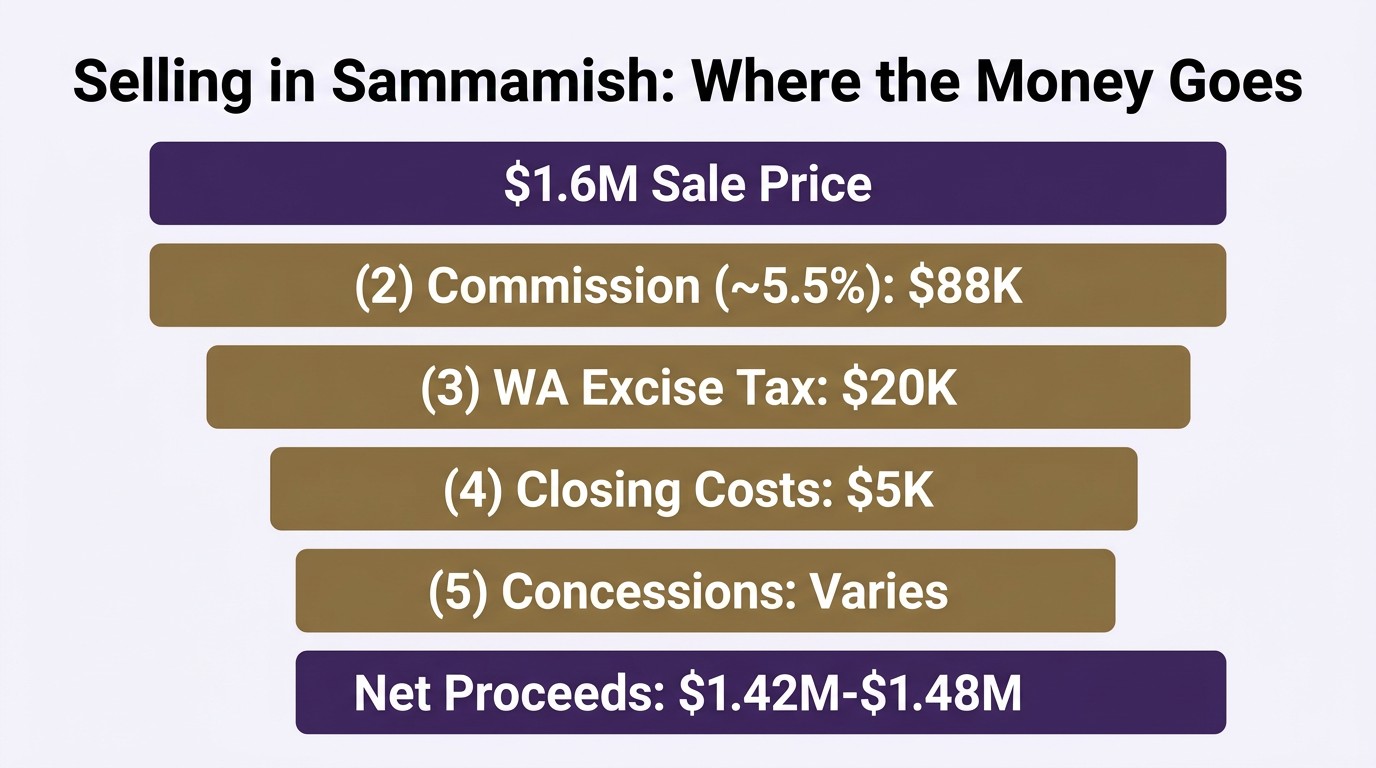
Sammamish home sale net proceeds breakdown chart 2026

On a $1.6M Sammamish sale, commission, excise tax, and closing costs typically bring net proceeds to $1.42M–$1.48M.

What a $1.6 Million Sale Actually Nets

Here’s a realistic range, not a guarantee, for a $1.6 million Sammamish sale in today’s market:

Cost Estimated Range
Commission (~5–5.5% combined) $80,000–$88,000
Real Estate Excise Tax $19,000–$21,000
Title, escrow, closing costs $4,000–$6,000
Negotiated concessions/repair credits $0–$15,000 (variable)

Figures are approximate and based on a $1.6M Sammamish sale price. Verify current NWMLS data and REET brackets for your exact sale price.

Net that out and most Sammamish sellers at this price point walk away with somewhere between $1.42 million and $1.48 million, before whatever you still owe on your mortgage. Your specific number depends on your loan payoff, your exact sale price, and how negotiations go. I run this math with actual numbers for every seller I work with, not a rule of thumb.

Frequently Asked Questions

How much does it cost to sell a home in Sammamish?

Most Sammamish sellers pay somewhere between 6 and 7 percent of their sale price in total costs, combining commission, Washington’s real estate excise tax, and standard closing costs. At a $1.6 million sale price, that’s typically $95,000 to $115,000 before any prep or concessions.

Why is excise tax higher in Sammamish than other King County cities?

It isn’t a different rate for the city. It’s that Washington’s REET is graduated, so higher sale prices push more of the transaction into higher tax brackets. Sammamish’s higher median price means sellers there feel that graduated structure more than sellers in South King County typically do.

What will I actually net from selling my Sammamish home?

It depends on your sale price, your mortgage payoff, commission negotiated, and any closing concessions. As a general range, expect to net roughly 85 to 90 percent of your sale price after standard costs, before subtracting whatever you still owe on the home.

Your guide to life outside Seattle.

Gregory Dorrell |
Coldwell Banker Bain | WA License #111862
253-350-0045
·

greg@livingoutsideseattle.com

·

www.livingoutsideseattle.com

Gregory Dorrell is a licensed real estate broker (WA License #111862) with Coldwell Banker Bain. Market data from NWMLS, week of August 2, 2026. This post is provided for informational purposes and does not constitute financial, tax, or legal advice.

BellevueBuyer ResourcesEastsideKing County Cities August 11, 2026

Living in Bridle Trails, Bellevue | 2026 Guide

What is it actually like to live in Bridle Trails in 2026?

Bridle Trails carries an Equestrian-Leaning feel no other Bellevue neighborhood matches. This is Bellevue’s designated equestrian community, a heavily wooded pocket where nearly two-thirds of the land is still second-growth timber. Large single-family lots dominate, many a half acre or more, with horse pastures tucked behind tree lines a few miles from Microsoft’s front door. It is a real contrast to the dense, glass-tower core of downtown Bellevue, and that contrast is the whole reason buyers seek it out.

On a Tuesday morning, Bridle Trails stays quiet. There is no retail strip humming with foot traffic, just winding, tree-shaded streets and the occasional horse trailer pulling out toward the state park. Most residents commute by car, since the low density and forested layout were never built around transit. The pace here has more in common with a rural county road than a typical Bellevue address.

Weekends bring people out to the trail system. Bridle Trails State Park sees steady use from hikers, dog walkers, and equestrians alike, and it hosts organized horse shows throughout the year. Residents tend to be established professionals and multi-generational families who value privacy and space over walkability, a different draw than the light rail access pulling buyers toward Downtown Bellevue or Crossroads.

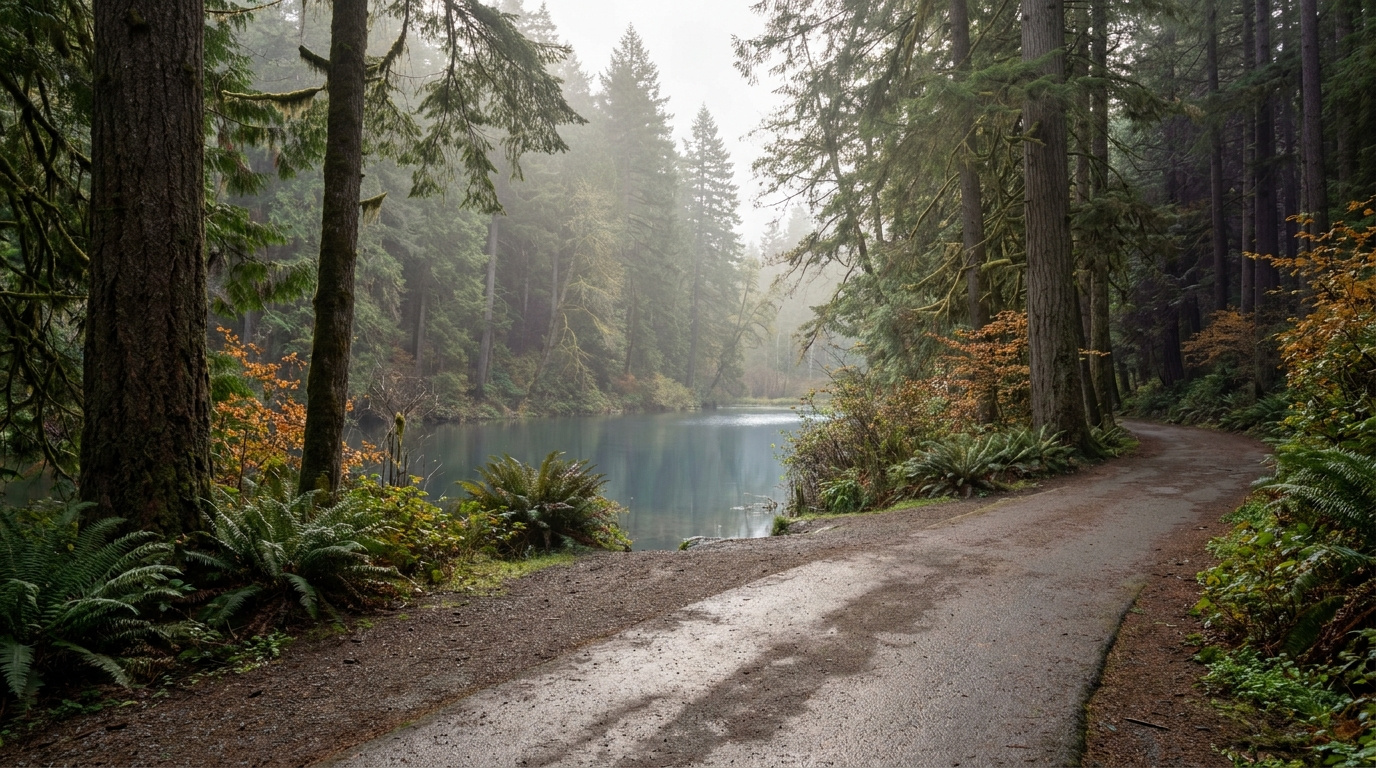
Forested equestrian trail through Bridle Trails State Park in Bellevue, Washington
Bridle Trails State Park gives the neighborhood 28 miles of forested trails shared by hikers, dog walkers, and equestrians.

Homes in Bridle Trails: What the Data Shows

Housing in Bridle Trails is almost entirely detached single-family, with very little condo or townhome inventory in the neighborhood’s core. Lots run large by Bellevue standards, often a half acre or more, and some parcels still accommodate horses under the neighborhood’s semi-rural zoning. Most homes were built from the 1970s through the 1990s, ranging from about 2,500 to 5,000 square feet, though newer construction has filled in some larger subdivided lots along the edges. A narrow strip of apartments and condos sits along 148th Avenue NE across from the Microsoft campus, but that stretch is the exception in an otherwise low-density neighborhood.

Data as of July 2026.

Market Pulse Bellevue (city) King County
Average Sales Price (July 2026) ~$2,131,947 ~$1,000,000 (median)
Median Days on Market ~13 days ~11 days
Active Listings Change (vs. Jan 2026) +215% +144%

Figures reflect city-level Bellevue residential data from the NWMLS-sourced monthly feed (InfoSparks, August 2026 pull, July 2026 data), since Bridle Trails does not have its own separate MLS reporting area. Bellevue’s citywide figure is an average sales price, not median, because that is what the monthly feed reports at the city level. Bridle Trails typically prices at or above the citywide figure given its larger lot sizes. Active listings change measures citywide inventory growth since January 2026, not a Bridle Trails-specific count.

Schools Serving Bridle Trails

The City of Bellevue’s own Bridle Trails Neighborhood Area Profile names Cherry Crest Elementary School as the school serving this area. Cherry Crest sits at 12400 NE 32nd Street and carries a 9 out of 10 rating on GreatSchools, with 94 percent of students proficient in both math and reading. From there, students move into the district’s standard pipeline for this part of the city, running through Chinook Middle School to Interlake High School. Attendance boundaries can shift year to year, so I always confirm the specific assignment with the district before a client writes an offer here.

Interlake High School ranks in the top 5 percent of Washington schools for overall test scores, with a 9 out of 10 GreatSchools rating and a 73 percent AP participation rate. Chinook Middle School carries an 8 out of 10 GreatSchools rating and offers a Gifted and Talented program. Both draw families to Bridle Trails for the academic track record, on top of the acreage and privacy the neighborhood already offers.

In practical terms, most Bridle Trails families drive their kids to Cherry Crest given the neighborhood’s spread-out street pattern. Middle and high schoolers typically bus or drive to Chinook and Interlake, both closer to the center of Bellevue’s school geography than out on Bridle Trails’ wooded edges.

Getting to Work from Bridle Trails

Bridle Trails sits close to the 148th Avenue NE corridor, which feeds directly into SR-520 toward Redmond and Microsoft, or west across the Evergreen Point Floating Bridge into Seattle. There is no light rail station inside the neighborhood, so most residents drive to work or drive first to a 2 Line station in downtown Bellevue.

Destination Distance 2026 Peak Commute Transit Option
Downtown Seattle 10 miles 25-40 min drive SR-520 direct, or drive to 2 Line
Amazon (South Lake Union) 11 miles 25-40 min drive SR-520 direct
Microsoft (Redmond) 4 miles 10-15 min drive SR-520 east, direct
Downtown Bellevue Tech Corridor 4-6 miles 12-20 min drive Drive, then 2 Line if desired
SeaTac Airport 22 miles 40-55 min drive I-405 South via Bellevue

Bridle Trails is a driving neighborhood. If a car-free commute is a priority, Downtown Bellevue or a neighborhood closer to a 2 Line station will serve you better than Bridle Trails’ wooded, low-density streets.

Large-lot single-family home exterior in Bridle Trails, Bellevue, Washington, representing 2026 real estate
Bridle Trails housing runs from 1970s through 1990s single-family homes on large wooded lots to newer custom builds on the neighborhood’s edges.

What I See as a Valuation Expert in Bridle Trails

When I price homes for institutional clients in Bridle Trails, lot size and usable flat acreage tend to drive value more than square footage alone. A half-acre or larger lot with level, buildable ground carries a real premium over a similarly priced home on a smaller or steeply sloped parcel, especially for buyers who want the option of horses or a future addition.

Tree cover and privacy matter here in a way they do not in Bellevue’s denser neighborhoods, but they cut both ways. Mature second-growth timber is part of the appeal, and I factor in how much of it a buyer would actually keep versus clear for usable yard. Homes with updated systems still command more than a comparable property needing work, but the lot itself carries more of the value equation here than in a typical suburban subdivision.

The properties that move first combine a larger, level lot with a confirmed Cherry Crest Elementary assignment and reasonable proximity to SR-520. Homes on smaller or heavily sloped lots, or with deferred maintenance and no path to expanded usable yard, tend to sit longer, since the buyer pool here specifically wants the acreage and privacy that define this neighborhood.

Frequently Asked Questions: Living in Bridle Trails, Bellevue

Q: Is Bridle Trails a good place to live?
A: Yes, especially if you want acreage, privacy, and direct access to a 28-mile trail system without leaving Bellevue. It is the city’s most wooded, semi-rural neighborhood, built around Bridle Trails State Park, with strong Bellevue School District schools throughout.

Q: What are homes like in Bridle Trails?
A: Almost entirely detached single-family homes on half-acre-plus lots, mostly built from the 1970s through the 1990s and ranging from about 2,500 to 5,000 square feet, with some newer construction on the edges. Very little condo or townhome inventory exists in the neighborhood’s core.

Q: What schools serve Bridle Trails?
A: The City of Bellevue names Cherry Crest Elementary School, rated 9/10 on GreatSchools, feeding into Chinook Middle School and then Interlake High School, ranked in the top 5 percent of Washington schools for test scores. Always confirm your specific address with the district.

Q: Is Bridle Trails the same as Rose Hill?
A: No. Rose Hill is a separate neighborhood in Kirkland, just north of Bridle Trails across the Bellevue city line. The two share a border and a state park, but Rose Hill sits in the Lake Washington School District, not the Bellevue School District that serves Bridle Trails.

Q: How far is Bridle Trails from Seattle?
A: About 10 miles. By car via SR-520, expect 25 to 40 minutes depending on traffic. There is no light rail station inside Bridle Trails, so a car-free commute means driving to a 2 Line station in downtown Bellevue first.

Explore Bridle Trails Yourself

Start at Bridle Trails State Park to walk the trail system that gives this neighborhood its name, then drive the surrounding streets to see the lot sizes and tree cover up close. Swing by the Bridle Trails Shopping Center on 116th Avenue NE for a sense of the commercial core, then loop toward 148th Avenue NE to see the SR-520 access connecting this wooded pocket to Seattle and Redmond. One slow drive tells you more than a stack of listing photos.


View Bridle Trails on Google Maps →

Your guide to life outside Seattle.

Gregory Dorrell | Coldwell Banker Bain | WA License #111862
253-350-0045  ·
greg@livingoutsideseattle.com  ·
www.livingoutsideseattle.com

BellevueBuyer ResourcesEastsideKing County Cities August 10, 2026

Living in West Bellevue, WA | 2026 Neighborhood Guide

What is it actually like to live in West Bellevue in 2026?

West Bellevue carries a Gated Luxury feel without the actual gates. This area runs between downtown Bellevue and the shore of Lake Washington, and it covers the towns of Medina, Clyde Hill, and Hunts Point. Some of the most expensive real estate in Washington State sits here, and the character reflects it. Large lots, mature landscaping, and long private driveways are the norm, not the exception. Medina and Hunts Point are technically their own incorporated cities, and Clyde Hill is too, but all three feel like one continuous neighborhood fabric that most locals just call West Bellevue.

On a Tuesday morning, the streets here stay quiet. There is no retail strip or transit crowd, just tree-lined lanes and the occasional dog walker heading toward Medina Beach Park. Commuters heading into downtown Bellevue or across SR-520 into Seattle tend to leave by car, since this area has no light rail station of its own. The pace is unhurried, which is part of the appeal for people who already spend their weekdays in a fast-moving tech job a few miles away.

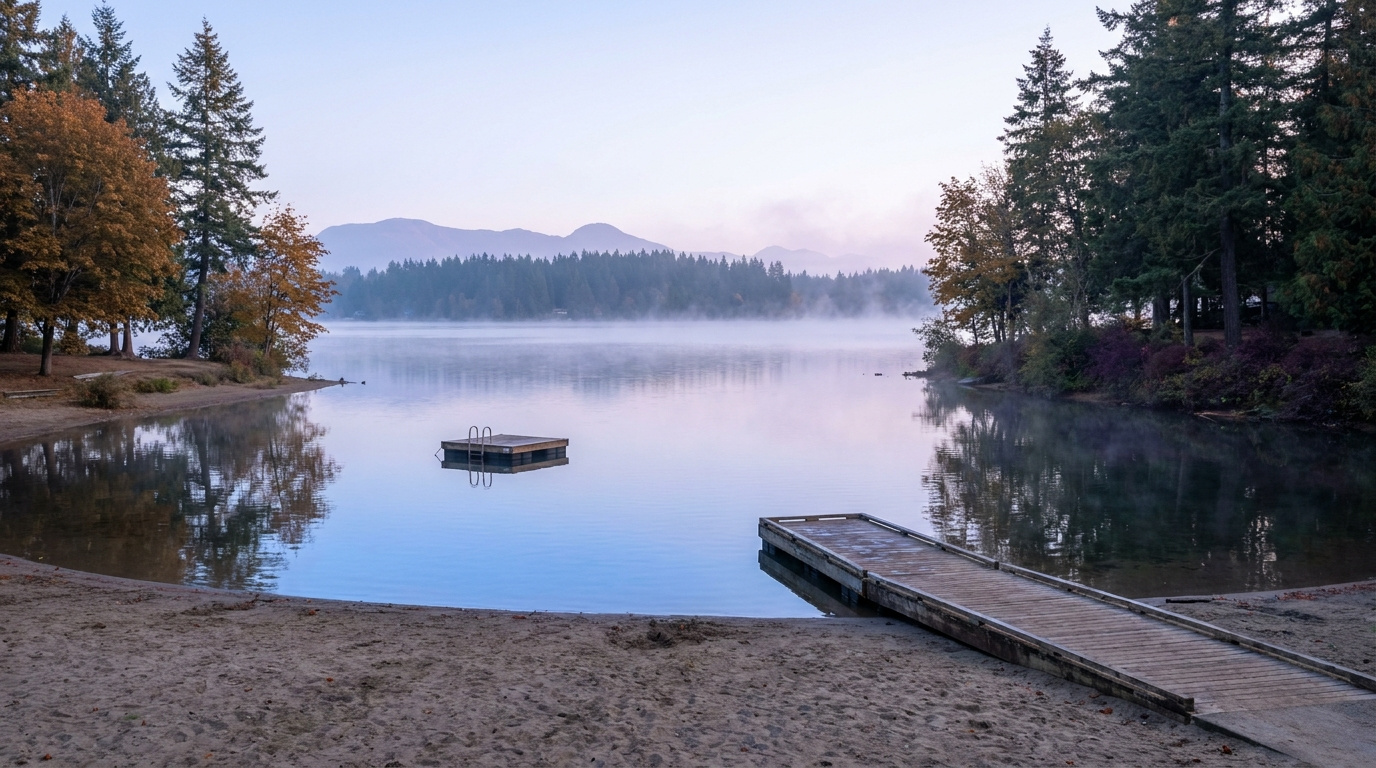
Weekends center on the water and the yard. Medina Beach Park sees steady use for swimming and picnics in summer, and the 17-acre Medina Park draws families for its trails, playground, and ponds. Residents here skew toward established professionals, executives, and multi-generational families who have owned property in the area for decades. That is a different rhythm than Downtown Bellevue’s condo towers a few miles east, where the draw is walkability and a fast rail ride to Seattle rather than acreage and lake frontage.

Medina Beach Park sandy shoreline on Lake Washington in West Bellevue with a dock and swim float
Medina Beach Park gives West Bellevue residents walk-in access to Lake Washington, with a dock, swim float, and views toward Mt. Rainier and the Seattle skyline.

Homes in West Bellevue: What the Data Shows

Housing in West Bellevue is almost entirely detached single-family, with very little condo or townhome inventory anywhere in Medina, Clyde Hill, or Hunts Point. Lots run large by Bellevue standards, often a quarter acre to a full acre or more, and many properties on the water side have direct or near-direct Lake Washington frontage. Homes range from a modest $2 million entry point for an older single-family property up to $10 million or more for a rebuilt lakefront estate. The architectural mix spans mid-century ramblers that have not yet been redeveloped alongside newer custom builds, and teardown-and-rebuild activity has been steady here for years given how little vacant land remains.

Data as of July 2026.

Market Pulse Bellevue (city) King County
Median Sales Price (July 2026) ~$1,830,000 ~$1,000,000
Median Days on Market ~13 days ~11 days
Active Listings Change (vs. Jan 2026) +215% +144%

Figures reflect city-level Bellevue residential data from the NWMLS-sourced monthly feed (InfoSparks, July 2026 pull) since Medina, Clyde Hill, and Hunts Point do not have their own separate MLS reporting areas. West Bellevue’s actual median runs well above the citywide figure shown here, since this table blends in more affordable Bellevue neighborhoods. Active listings change measures citywide inventory growth since January 2026, not a West Bellevue-specific count.

Schools Serving West Bellevue

West Bellevue sits inside the Bellevue School District’s West Zone, which the district defines as covering Medina, Clyde Hill, Hunts Point, Yarrow Point, and Beaux Arts along with the Enatai, Woodridge, and Wilburton areas closer to downtown. Elementary assignment splits by exact address between Medina Elementary School, at 8001 NE 8th Street in Medina, and Clyde Hill Elementary School, at 9601 NE 24th Street in Bellevue. Both are self-contained Advanced Learning schools, one of only four in the district, which is a genuine draw for families here.

From either elementary school, students move on to Chinook Middle School, physically located inside Clyde Hill at 2001 98th Avenue NE, before finishing at Bellevue High School, rated 10/10 on GreatSchools with a 91% graduation rate. The West Zone assignment to Bellevue High is consistent across Medina, Clyde Hill, and Hunts Point, but the elementary split between Medina and Clyde Hill Elementary does vary block by block, so I always confirm the specific elementary with the district before a client makes an offer.

In practical terms, most West Bellevue families drive or bus their kids to elementary school given the spread-out, low-density street pattern here. Middle and high schoolers have a straightforward trip to Chinook and Bellevue High, both sitting closer to the geographic center of the West Zone than out on its edges.

Getting to Work from West Bellevue

There is no direct freeway interchange inside Medina or Hunts Point, so most trips start with local streets before reaching SR-520 at the 92nd Avenue NE half-diamond interchange between Yarrow Point and Clyde Hill. From there, SR-520 carries you west across the Evergreen Point Floating Bridge into Seattle or east into downtown Bellevue in a few minutes. There is no light rail station inside West Bellevue itself, so anyone wanting the 2 Line needs to drive to Bellevue Downtown Station or South Bellevue Station first.

Destination Distance 2026 Peak Commute Transit Option
Downtown Seattle 8 miles 20-35 min drive SR-520 direct, or drive to 2 Line
Amazon (South Lake Union) 9 miles 20-35 min drive SR-520 direct
Microsoft (Redmond) 6 miles 12-20 min drive SR-520 east
Bellevue Tech Corridor 3-5 miles 10-15 min drive Drive, then 2 Line if desired
SeaTac Airport 20 miles 35-50 min drive I-405 South via Bellevue

West Bellevue is a driving neighborhood. If a car-free commute matters to you, Downtown Bellevue or a neighborhood closer to a 2 Line station will serve you better than Medina, Clyde Hill, or Hunts Point.

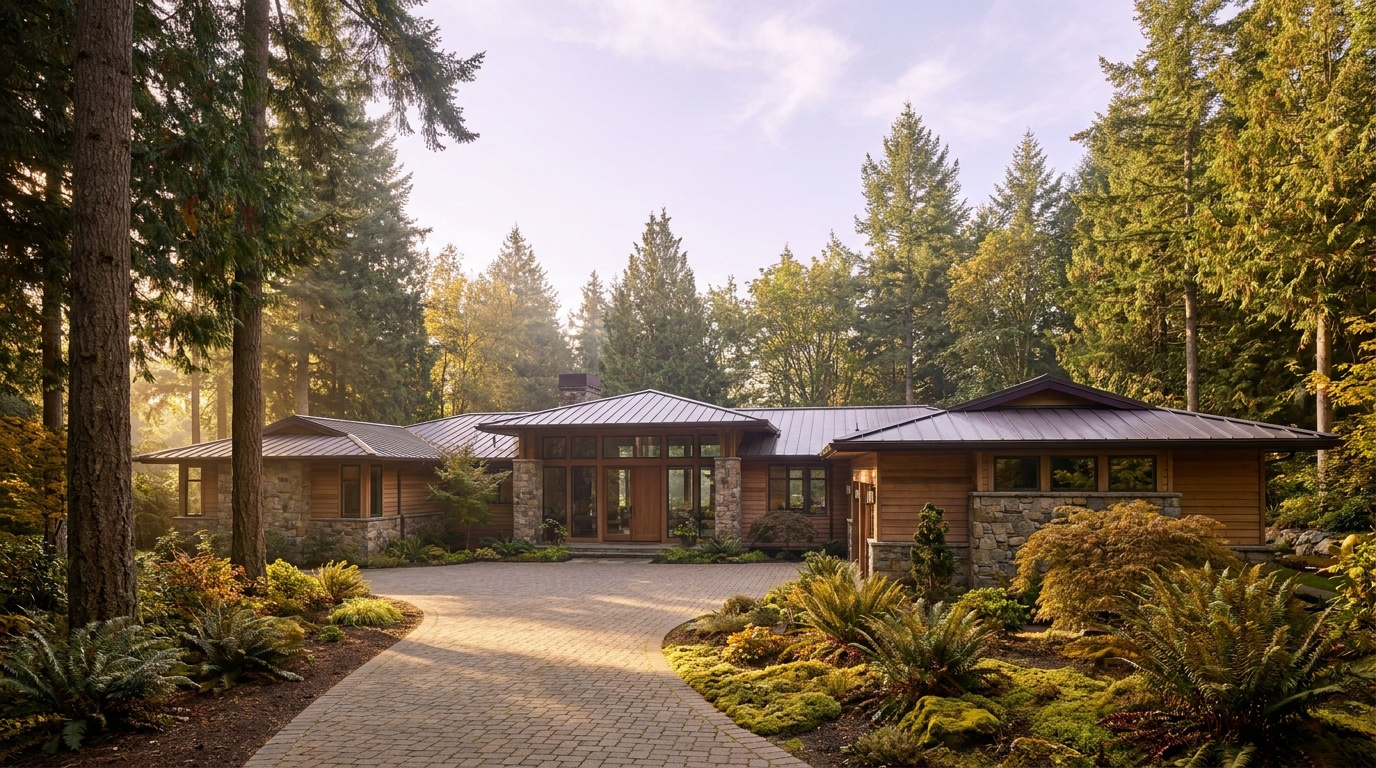
West Bellevue single-family lakefront-area home exterior representing 2026 real estate in Medina and Clyde Hill
West Bellevue’s housing stock runs from established mid-century homes to newer custom rebuilds on large, mature lots.

What I See as a Valuation Expert in West Bellevue

When I price homes for institutional clients in West Bellevue, lot size and lake proximity drive value more than almost any other factor. Direct waterfront and lake view lots command a premium that has little to do with the house sitting on them, since so many buyers here plan to rebuild anyway. Lot shape, southern exposure, and how much usable flat yard exists after accounting for setbacks all factor into how I assess a parcel here.

Condition and systems matter less than in most neighborhoods, simply because a large share of purchases in Medina and Clyde Hill are effectively land value plays with an eventual teardown in mind. Curb appeal still counts, especially for buyers who plan to live in the existing home for a while before rebuilding, but I weight the lot itself heavily when I am assessing what a property is really worth here.

The properties that move first in West Bellevue combine a larger, flatter lot with either lake proximity or a confirmed Medina Elementary or Clyde Hill Elementary assignment. Smaller lots on busier streets, or homes with significant deferred maintenance and no clear rebuild upside, tend to sit longer even at a discounted price, because the buyer pool here is narrower and more selective than in Bellevue’s more typical neighborhoods.

Frequently Asked Questions: Living in West Bellevue, WA

Q: Is West Bellevue a good place to live?
A: Yes, especially if you want privacy, a large lot, and lake proximity within a short drive of downtown Bellevue and Seattle. West Bellevue covers Medina, Clyde Hill, and Hunts Point, three of the most established and expensive residential areas in King County, with top-ranked Bellevue School District schools throughout.

Q: What are homes like in West Bellevue?
A: Almost entirely detached single-family homes on quarter-acre-plus lots, ranging from around $2 million for an older, unrenovated property up to $10 million or more for a rebuilt lakefront estate. There is very little condo or townhome inventory anywhere in Medina, Clyde Hill, or Hunts Point.

Q: What schools serve West Bellevue?
A: The Bellevue School District’s West Zone serves Medina, Clyde Hill, and Hunts Point. Elementary assignment splits between Medina Elementary and Clyde Hill Elementary depending on exact address, both feeding into Chinook Middle School and then Bellevue High School, rated 10/10 on GreatSchools.

Q: How far is West Bellevue from Seattle?
A: About 8 miles. By car via SR-520 across the Evergreen Point Floating Bridge, expect 20 to 35 minutes depending on traffic. There is no light rail station inside West Bellevue itself, so a car-free commute means driving to a 2 Line station in downtown Bellevue first.

Explore West Bellevue Yourself

Start at Medina Beach Park to see the lake access that makes this area what it is, then drive the quiet streets of Clyde Hill to get a feel for the lot sizes and setbacks. Loop past Medina Park for the trails and playground, and finish along Evergreen Point Road to see the SR-520 access that connects this neighborhood to both Seattle and downtown Bellevue. One slow drive tells you more than a stack of listing photos ever will.


View West Bellevue on Google Maps →

Your guide to life outside Seattle.

Gregory Dorrell | Coldwell Banker Bain | WA License #111862
253-350-0045  ·
greg@livingoutsideseattle.com  ·
www.livingoutsideseattle.com

BellevueBuyer ResourcesEastsideKing County Cities August 4, 2026

Living in Downtown Bellevue, WA | 2026 Neighborhood Guide

What is it actually like to live in Downtown Bellevue in 2026?

Downtown Bellevue carries a Walkable Urban Edge feel that is genuinely rare on the Eastside. This is the neighborhood inside Downtown Bellevue, the city’s high-rise core built around Bellevue Way and NE 8th Street, and 2026 has been a turning point for it. The 2 Line light rail opened here in March, connecting the neighborhood to downtown Seattle in about 25 minutes without a car. That single change has pulled in buyers who used to look only at Seattle condos because they wanted transit and gave up on the space and schools that come with the Eastside. Now they do not have to choose.

On a Tuesday morning, the sidewalks along Bellevue Way fill up early. Commuters walk toward the light rail entrance near City Hall, coffee in hand, while others head the opposite direction toward the tech offices that anchor the neighborhood’s daytime population. Bellevue Downtown Park opens half an hour before sunrise and the loop around the promenade gets steady foot traffic before the workday starts. It is a different rhythm than the rest of Bellevue. Nobody is warming up a car in a driveway here. People are walking.

Weekends shift the neighborhood’s center of gravity toward Lincoln Square and Bellevue Square, both a few blocks apart with restaurants, shops, and a movie theater that draw people in from across the Eastside. Downtown Park hosts farmers markets and community events through the summer. The residents here skew toward professionals and empty nesters who have traded a yard for an elevator, plus a growing number of remote and hybrid workers who picked the neighborhood specifically for the light rail option. That is different from Bellevue’s residential neighborhoods like Somerset or Bridle Trails, where the draw is space and schools rather than walkability.

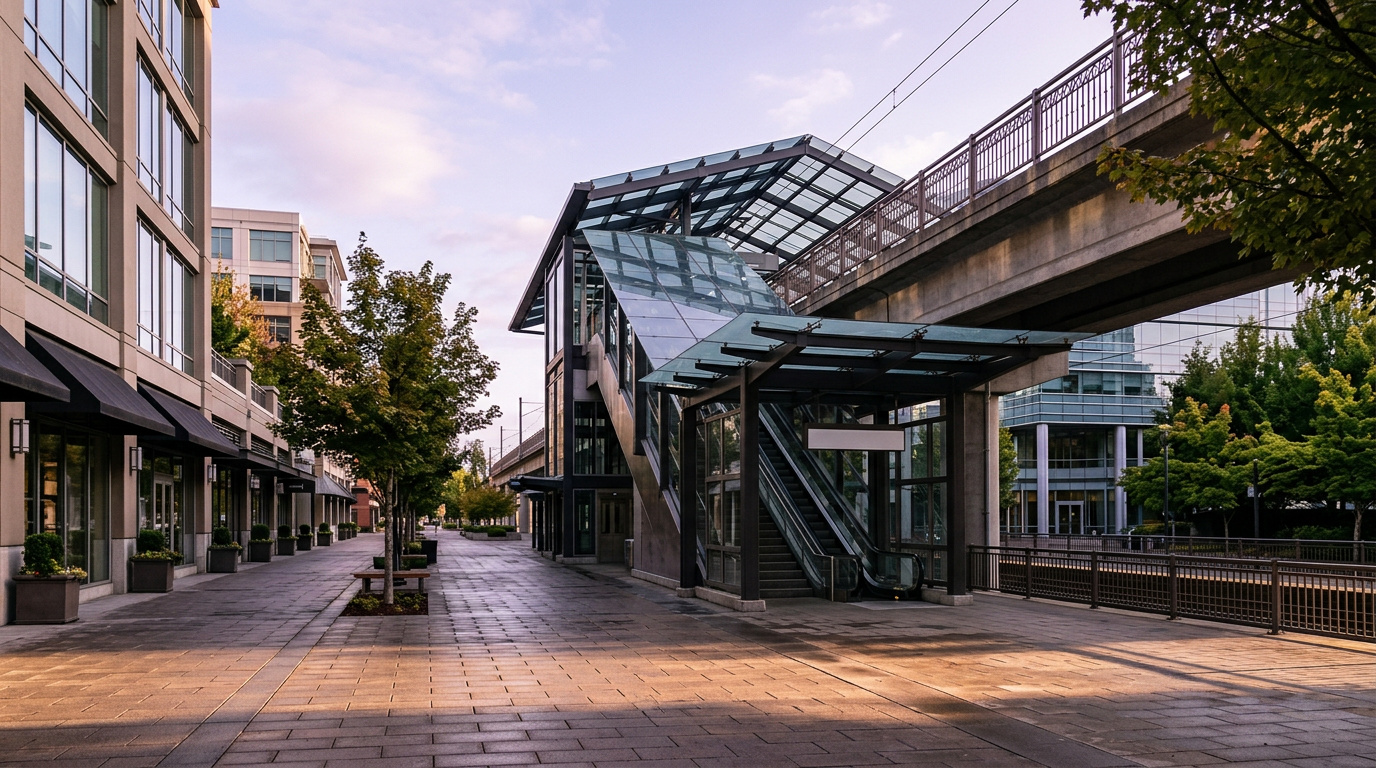
Downtown Bellevue light rail station entrance near Bellevue City Hall with pedestrians walking to the platform
The Bellevue Downtown Station opened in March 2026, putting a 25-minute rail ride to Seattle within walking distance of most Downtown Bellevue addresses.

Homes in Downtown Bellevue: What the Data Shows

Housing in Downtown Bellevue is overwhelmingly condos and high-rise apartments, with a handful of townhomes on the edges near Wilburton. Units range from studio and one-bedroom layouts in the mid-$600,000s up to penthouse-level homes at $3 million and above. Buildings here run from older 1990s and 2000s mid-rises to newer towers built in the last five years with amenity floors, concierge service, and secure parking. Square footage tends to run 700 to 2,000 square feet, smaller than what you would find in Bellevue’s single-family neighborhoods, but the tradeoff is location. This is the only part of Bellevue where you can walk to a light rail platform, a grocery store, and a park all inside ten minutes.

Data as of July 2026.

Market Pulse Bellevue (city) King County
Median Sales Price (July 2026) ~$1,830,000 ~$1,000,000
Median Days on Market ~13 days ~11 days
Active Listings Change (vs. Jan 2026) +215% +144%

Figures reflect city-level Bellevue residential data from the NWMLS-sourced monthly feed (InfoSparks, July 2026 pull) since Downtown Bellevue does not have its own separate MLS reporting area. Condo-specific pricing in the neighborhood itself tends to run below the citywide single-family median shown here. Active listings change measures city inventory growth since January 2026, not a Downtown-specific count.

Schools Serving Downtown Bellevue

Downtown Bellevue sits inside the Bellevue School District, and the middle and high school assignment is consistent across the neighborhood. Students attend Chinook Middle School, then move on to Bellevue High School, rated 10/10 on GreatSchools. The elementary assignment is the one piece that genuinely varies by exact address here. The district has been actively redrawing elementary boundaries around downtown, Wilburton, and the Spring District as new development adds households to the area, so the specific elementary school for a given address can differ block to block and can change again as those boundary lines get finalized.

Chinook Middle School consistently ranks in the top 20% of Washington middle schools and sends the large majority of its students on to Bellevue High, which posts a 91% graduation rate and an average SAT score of 1360. Because the elementary boundary is in motion, I never guess at a specific elementary name for a Downtown Bellevue address. I check the district’s own School Locator tool for every client, every time, because a wrong assumption here is worse than an honest “let’s verify.”

In practical terms, families with elementary-age kids in Downtown Bellevue are typically within a short drive or a district bus ride of their assigned school, whichever one that turns out to be. Middle and high schoolers walk or bike to Chinook and Bellevue High from most Downtown Bellevue addresses, both being a reasonable distance from the neighborhood’s core.

Getting to Work from Downtown Bellevue

Take the 2 Line from Bellevue Downtown Station and Seattle is about 25 minutes away with no traffic to worry about. That is the headline change for this neighborhood in 2026. For anyone not using rail, NE 8th Street and 112th Avenue NE both connect quickly to I-405, putting the rest of the Eastside within easy reach.

Destination Distance 2026 Peak Commute Transit Option
Downtown Seattle 10 miles 25 min rail / 45-60 min drive 2 Line light rail, walk to station
Amazon (South Lake Union) 12 miles 30 min rail / 45-55 min drive 2 Line to Capitol Hill transfer
Microsoft (Redmond) 8 miles 15-25 min drive / 20 min rail SR-520 or 2 Line east
SeaTac Airport 15 miles 25-40 min drive / 45 min rail I-405 South or 2 Line to 1 Line

Trains run every 8 to 10 minutes during peak hours. Downtown Bellevue is the only neighborhood in the city where most addresses are within walking distance of the platform itself, no drive or bus connection needed.

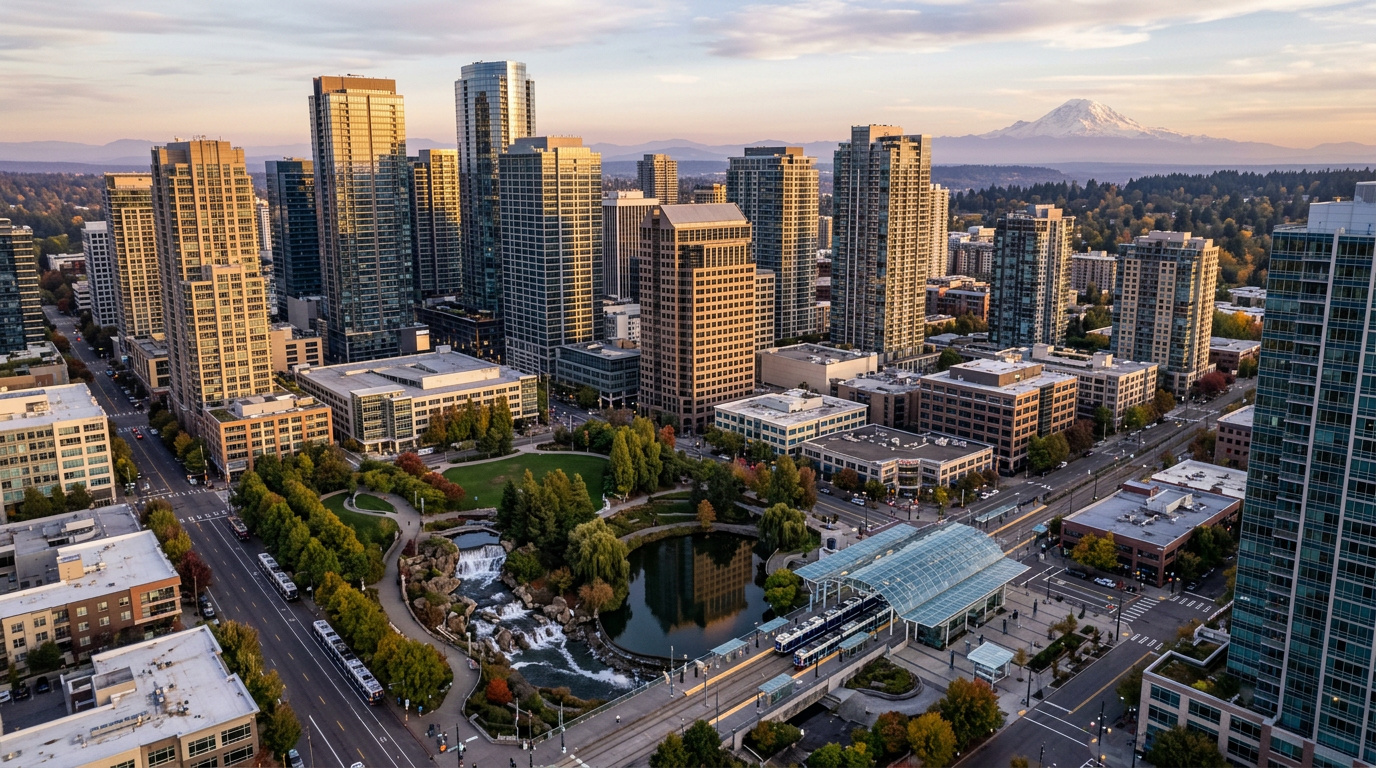
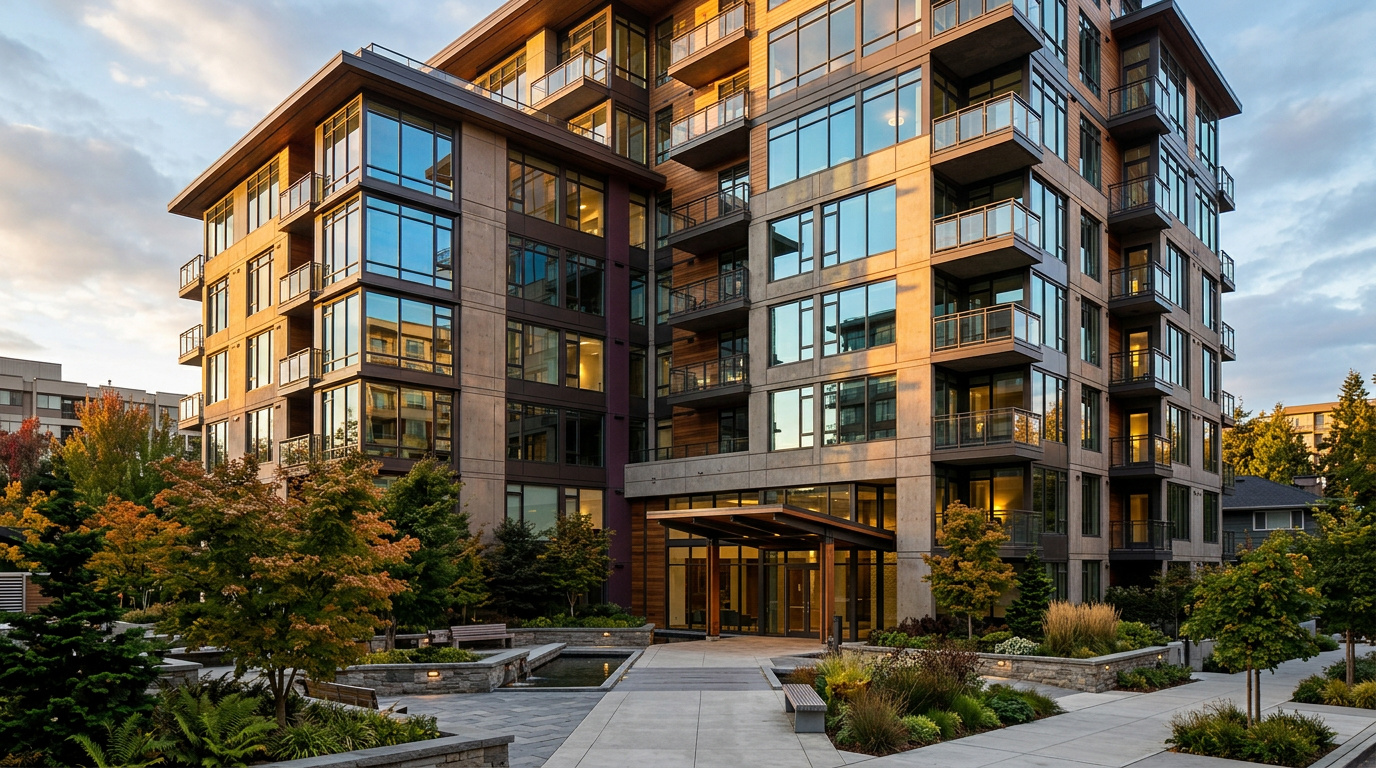
Downtown Bellevue high-rise condominium building exterior representing 2026 real estate in the neighborhood
Downtown Bellevue’s housing stock runs from established mid-rises to newer towers with amenity floors and secure parking.

What I See as a Valuation Expert in Downtown Bellevue

When I assess condos here for institutional lenders, floor level and view corridor drive value more than almost anything else in the building. A unit on floor 12 with an unobstructed view toward the Cascades or Lake Washington typically commands a real premium over an identical floor plan two floors down facing another building. HOA dues and reserve fund health matter just as much as square footage in this neighborhood, since you are buying into a shared building, not just a unit.

Buildings with strong reserve funds and recent capital improvements hold value better through a soft patch in the market than buildings deferring maintenance to keep dues low. I always pull the HOA financials and recent meeting minutes before pricing a unit here. A low monthly due on paper can mean a large special assessment is coming, and that changes the real cost of ownership.

The units that move first in this neighborhood combine a walkable location to the light rail station, a healthy HOA, and updated interior finishes. Older buildings with dated kitchens and baths sit longer, even at a lower price per square foot, because buyers here are often willing to pay more for turnkey rather than take on a renovation inside an HOA-governed building.

Frequently Asked Questions: Living in Downtown Bellevue, WA

Q: Is Downtown Bellevue a good place to live?
A: Yes, especially if you want a walkable urban lifestyle with direct light rail access to Seattle. Downtown Bellevue combines shopping, dining, and a 21-acre park with the fastest transit commute of any Bellevue neighborhood, though homes here are almost all condos rather than single-family houses.

Q: What are homes like in Downtown Bellevue?
A: Mostly condos and high-rise units ranging from 700 to 2,000 square feet, priced from the mid-$600,000s to $3 million and up for penthouse-level units. Buildings range from established 1990s and 2000s mid-rises to newer towers with amenity floors and concierge service.

Q: What schools serve Downtown Bellevue?
A: The Bellevue School District serves this neighborhood. Middle and high school assignment is consistent (Chinook Middle School, then Bellevue High School), but elementary assignment varies by exact address as the district redraws boundaries around downtown and the Spring District. Always verify with the district’s School Locator tool.

Q: How far is Downtown Bellevue from Seattle?
A: About 10 miles. By car on I-90 during peak hours, expect 45 to 60 minutes. By the 2 Line from Bellevue Downtown Station, the ride to Seattle’s Westlake Station takes about 25 minutes, consistently faster than driving at rush hour.

Explore Downtown Bellevue Yourself

Walk Bellevue Way from Lincoln Square to Bellevue Square, then cut through Downtown Park to see the waterfall and the promenade. Finish at the Bellevue Downtown Station to see the platform that changed this neighborhood’s commute story in 2026. One walk covers most of what makes this area different from the rest of the city.


View Downtown Bellevue on Google Maps →

Your guide to life outside Seattle.

Gregory Dorrell | Coldwell Banker Bain | WA License #111862
253-350-0045  ·
greg@livingoutsideseattle.com  ·
www.livingoutsideseattle.com

Buyer ResourcesFederal WayKing County CitiesSouth King County August 2, 2026

Living in Brittany Lane, Federal Way | 2026 Guide

Brittany Lane sits in the far south end of Federal Way, just north of the Milton city line, in the pocket of streets around 1st Ave S and S 330th St. Local listings sometimes group this pocket with the broader “Villages” naming used by nearby developments, though Brittany Lane itself is the neighborhood with an active HOA and a name residents actually use. Homes here went in mostly from the mid 1990s through the 2000s, and the streets have that settled, established feel: mature trees, consistent setbacks, and an HOA that keeps the common areas looking the same from block to block. It is not flashy. It is the kind of neighborhood people buy into because it works, day after day, without much drama.

What is it actually like to live in Brittany Lane in 2026?

On a weekday morning, Brittany Lane moves at the pace of a working residential street. Garage doors open early, cars head north toward Military Road or west toward I-5, and the neighborhood settles into a quiet stretch by mid morning that holds through most of the day. The HOA keeps the shared landscaping consistent, so the streets look the same in February as they do in August, which is part of the appeal for buyers who want predictability over flash.

Weekends bring more visible activity. Families load up for Celebration Park a short drive north, where the sports fields stay busy most of the year with youth leagues and pickup games. Others stick closer to home, since Brittany Lane’s own streets are wide enough and quiet enough for an easy walk or bike ride without leaving the neighborhood. Being this close to the Milton border also means residents cross freely between the two cities for errands, since the practical boundary on the ground barely registers day to day.

Who lives here tends to be buyers priced out of the tighter Eastside markets but unwilling to give up an established, HOA-managed street. Brittany Lane draws a mix of first move-up buyers and longer-tenured owners who bought when prices were lower and have stayed because the neighborhood has held its character. It is a different crowd than the newer-construction pockets closer to downtown Federal Way. This is an older, settled street pattern, not a builder-fresh subdivision.
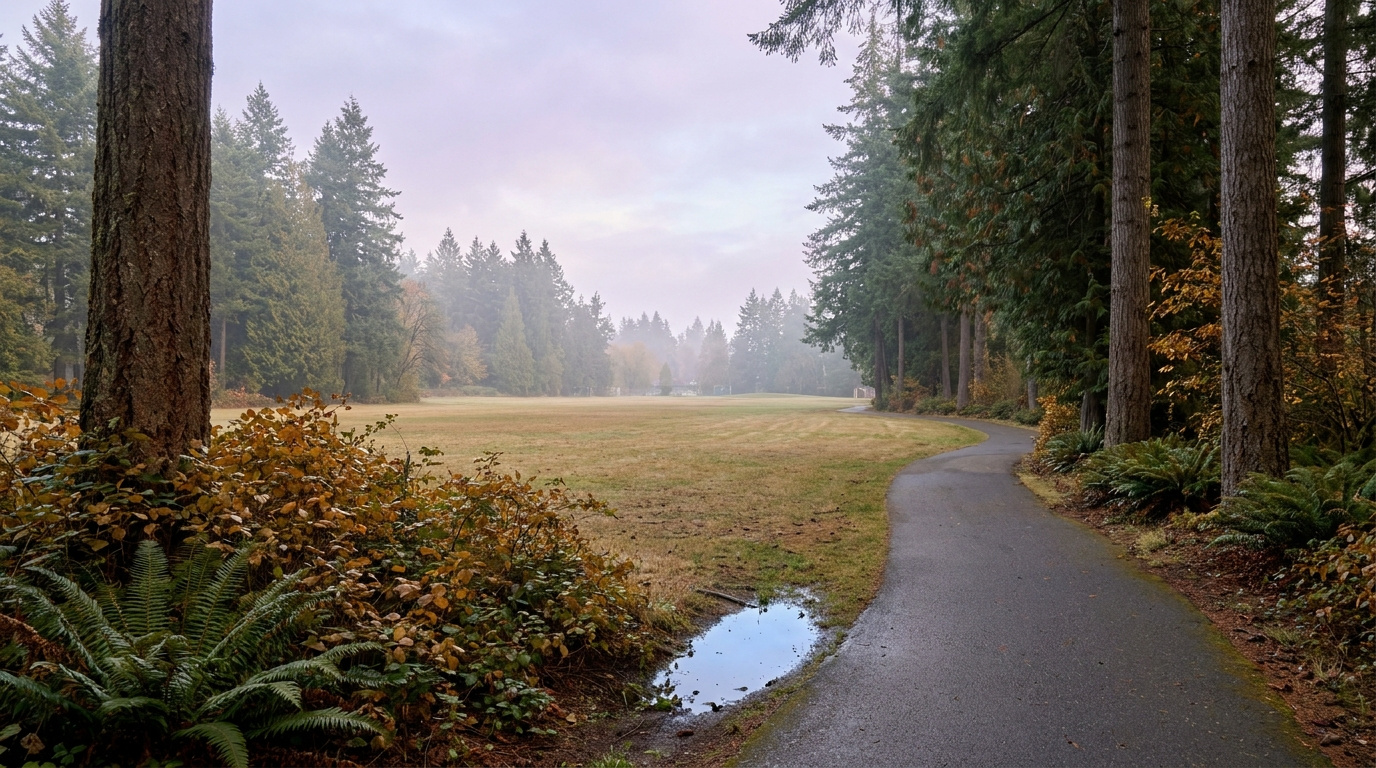
Celebration Park sports fields and trails near the Brittany Lane neighborhood of Federal Way, Washington
Celebration Park’s 83 acres of fields and trails give Brittany Lane residents a short drive to organized sports and open green space.

Homes in Brittany Lane: What the Data Shows

Brittany Lane’s homes were mostly built from the mid 1990s through the 2000s, running roughly 1,600 to 2,800 square feet on lots between 4,500 and 7,500 square feet. Construction is standard Northwest suburban: two-story floor plans, attached two-car garages, a mix of vinyl and lap siding, and modest yards the HOA keeps consistent block to block. Prices generally track Federal Way’s citywide median, with some variation depending on lot size and how recently a given home has been updated. Buyers looking for move-in-ready construction without paying for brand-new-build premiums tend to find this stretch of Federal Way an easy fit.

Data as of June 2026.

Market Pulse Federal Way (City) King County
Median Sales Price (June 2026) ~$675,000 ~$998,000
Median Days on Market ~11 days ~10 days
Active Listings Change (vs. Jan 2026) Federal Way inventory more than doubled from January to June 2026 County-wide inventory is up sharply year to date

Figures are Federal Way city-level NWMLS data for June 2026, since Brittany Lane is not tracked as a standalone MLS reporting zone. Treat these as directional for this specific pocket of south Federal Way.

Schools Serving Brittany Lane

Brittany Lane sits inside the Federal Way School District, but this pocket of the city, tucked right against the Milton border, is close enough to a boundary edge that the exact feeder school can vary from one street to the next. Panther Lake Elementary sits close by on 1st Ave S, but confirming your specific address with the district before writing an offer matters more here than in most Federal Way neighborhoods, since south-end boundary lines don’t always follow the pattern buyers expect from the rest of the city.

Federal Way Public Schools runs a district-wide Gifted and Talented program and Project Lead the Way STEM curriculum across its elementary and middle schools, so families moving into this corner of the city still have access to those tracks regardless of which specific building their address lands in. The district’s high schools, including Decatur and Federal Way High, both carry established fine arts and career-technical programs that draw students from across the south end.

For families here, the day-in-the-life pipeline runs by bus for most students, since this pocket sits far enough from the district’s core that walking to school isn’t typically practical. The safest approach for any buyer is the same one Gregory recommends everywhere near a boundary line: confirm the address before assuming a specific school, then plan the daily routine around the real answer, not the closest-sounding one.

Getting to Work from Brittany Lane

From Brittany Lane, the fastest route north to I-5 or Federal Way’s core runs up Military Road S or 1st Ave S, connecting to Pacific Highway S within a few minutes. Pierce Transit Route 501 links this corner of the city directly to Milton for residents without a car, while King County Metro service picks up further north along Pacific Highway for connections into the Federal Way Transit Center and its Link Light Rail station.

Destination Distance 2026 Drive Time (Peak AM) Transit Option
Downtown Seattle 30 miles 40 to 60 min 1 Line Light Rail / I-5
Bellevue / Amazon 28 miles 45 to 60 min I-5 to I-405 / Drive
Microsoft (Redmond) 38 miles 55 to 75 min Drive / SR-99 to I-405
SeaTac Airport 15 miles 18 to 28 min 1 Line Light Rail / Drive

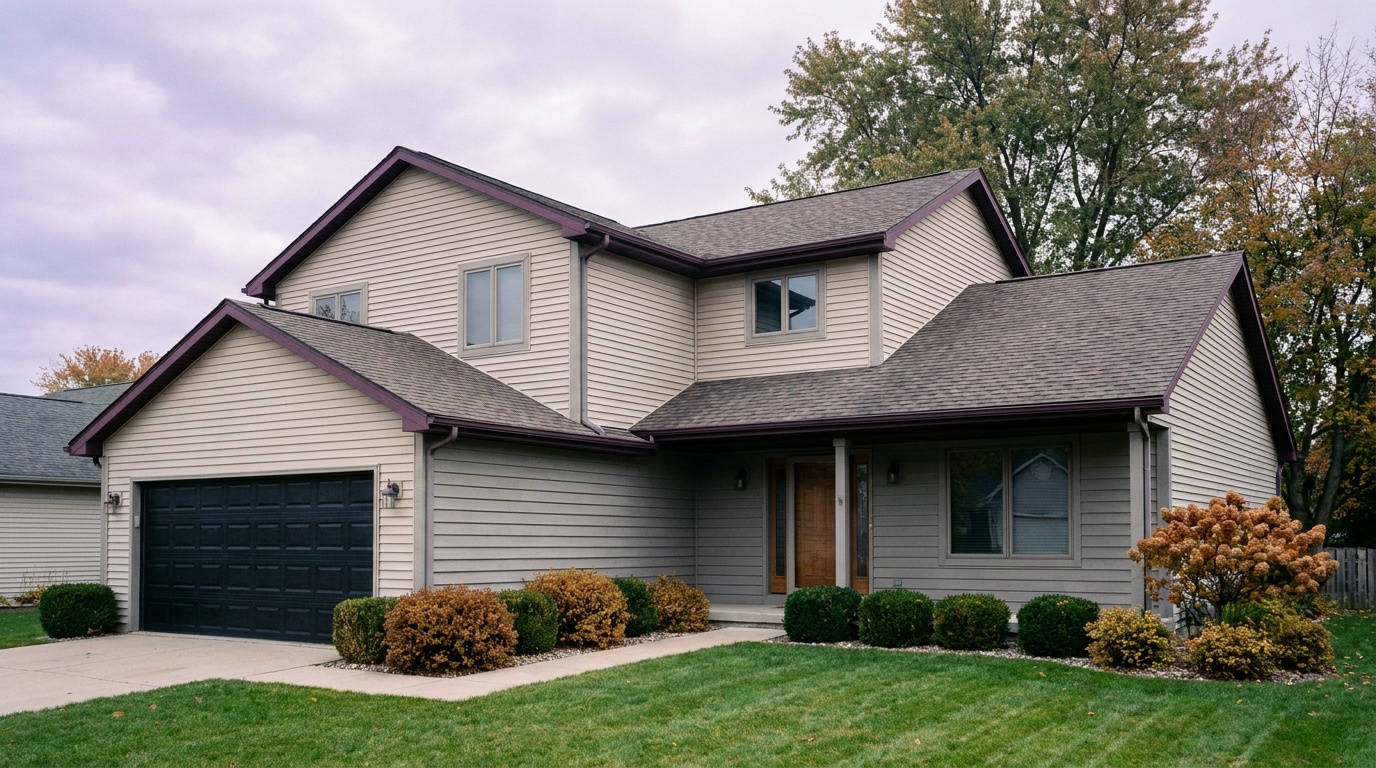
Two-story home exterior typical of the Brittany Lane neighborhood of Federal Way, Washington, built in the 1990s and 2000s
Brittany Lane’s HOA-managed streets carry a consistent look across homes built mostly from the mid 1990s through the 2000s.

What I See as a Valuation Expert in Brittany Lane

When I price homes for institutional clients, HOA condition tends to drive value in a neighborhood like Brittany Lane more than any single interior upgrade. A well-maintained HOA that keeps landscaping and exterior standards consistent holds the whole street’s value ceiling higher than a neighborhood with no oversight, because buyers are pricing the block, not just the one listing in front of them. Roof age, furnace condition, and how recently a kitchen or bath has been touched matter the way they do anywhere, but in an HOA neighborhood, the shared upkeep shows up in comps in ways buyers often miss until they compare two nearly identical homes on different streets.

Curb appeal carries real weight here too. Because Brittany Lane’s lots run smaller, from roughly 4,500 to 7,500 square feet, exterior condition and landscaping do more of the visual work than lot size alone. A home with a fresh coat of paint and a tidy front yard competes well against a larger but neglected property nearby, since buyers in this price range are often choosing between move-in-ready and a project, not between big and small.

Interior streets away from Military Road S traffic noise, and homes closer to Celebration Park, tend to move first and hold value best. Proximity to a well-maintained park amenity typically commands a premium over homes several blocks further from that kind of green space, a pattern that holds across most Federal Way neighborhoods with a comparable park anchor.

Frequently Asked Questions: Living in Brittany Lane

Q: Is Brittany Lane a good place to live in Federal Way?

A: Brittany Lane works well for buyers who want an established, HOA-managed neighborhood with a settled street pattern and easy access to Celebration Park. It sits at Federal Way prices, generally in line with the citywide median, while offering a quieter feel than neighborhoods closer to the downtown core.

Q: Is “The Villages” the same neighborhood as Brittany Lane?

A: Local listings sometimes group nearby south Federal Way development under a “Villages” label, but Brittany Lane is the name residents and the active HOA actually use for this specific neighborhood. If you see “The Villages” referenced for this area, confirm the exact address and HOA before assuming it matches Brittany Lane.

Q: What schools serve Brittany Lane?

A: Brittany Lane falls inside the Federal Way School District, but this pocket sits close enough to the Milton border and a district boundary edge that the exact feeder school can vary by address. Always confirm your specific address with the district’s boundary lookup tool before writing an offer.

Q: How far is Brittany Lane from Seattle?

A: Downtown Seattle runs about 30 miles and 40 to 60 minutes by car during peak hours, or a Link Light Rail ride from the Federal Way Transit Center a short drive north of the neighborhood.

View Brittany Lane on Google Maps

Your guide to life outside Seattle.

Gregory Dorrell | Coldwell Banker Bain | WA License #111862
253-350-0045  ·
greg@livingoutsideseattle.com  ·
www.livingoutsideseattle.com
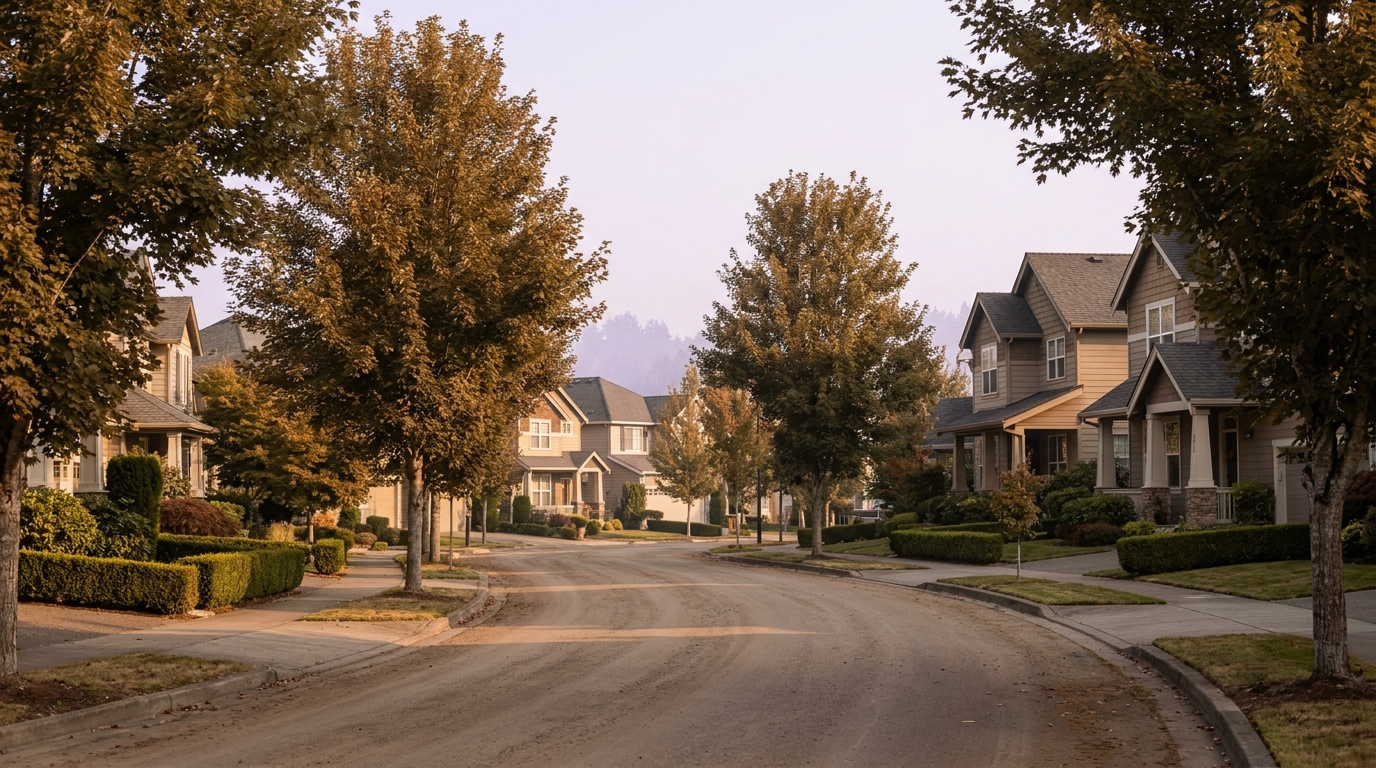

55+ NeighborhoodBuyer ResourcesFederal WayKing County CitiesSouth King County August 1, 2026

Living in Wynstone, Federal Way | 2026 Guide

Wynstone sits in the eastern part of Federal Way, in the S 320th to S 324th Street corridor near Weyerhaeuser Way S. Lennar built most of the neighborhood in the 1990s and 2000s, and it still reads that way today: consistent rooflines, maintained landscaping, and an HOA that keeps things looking the same from one end of the neighborhood to the other. Right next door sits Belmor Park, a different kind of community entirely. Belmor Park is a 55 and over manufactured home community built in the late 1960s, with its own nine-hole golf course and a clubhouse that has hosted the same card games and potlucks for decades. Two very different housing types share the same corner of Federal Way, and that mix is exactly what makes this part of the city worth a closer look in 2026.

What is it actually like to live in Wynstone and Belmor Park in 2026?

On a weekday morning in Wynstone, the streets have the rhythm of a working neighborhood. Garage doors open around 7, cars head toward I-5 or Pacific Highway, and the HOA-maintained lawns stay green even in late summer because someone is paying attention to the shared standards. It is quiet in a managed way, not an accidental way. Over at Belmor Park, mornings move slower. Golf carts head out to the nine-hole course before the day gets warm, and the clubhouse parking lot starts filling for a morning swim or an exercise class well before most of Federal Way is awake.

Weekends split along similar lines. Wynstone families spend Saturday mornings on yard work or errands at the Safeway on S 320th, then head out to Panther Lake Trail or one of Federal Way’s larger parks in the afternoon. Belmor Park residents are more likely to stay close to home, since the community was built around the idea that everything you need, golf, a pool, a clubhouse, social clubs, is already on site. Sunday evenings in both places are quiet. This is not a nightlife corner of Federal Way, and nobody who lives here is looking for one.

Who lives here depends entirely on which side of the boundary you are talking about. Wynstone draws buyers who want newer construction and predictable HOA upkeep without paying Bellevue or Kent prices for it. Belmor Park draws people 55 and over who want to downsize into a manufactured home without giving up amenities, in a community where neighbors have often known each other for twenty or thirty years. Both groups end up in the same corner of Federal Way for related reasons: consistency, value, and a slower pace than the I-5 corridor a few miles west.

Panther Lake Trail near the Wynstone and Belmor Park area of Federal Way, Washington, a flat wooded walking loop
Panther Lake Trail’s flat, dog-friendly loop gives residents on both sides of this neighborhood an easy walk close to home.

Homes in Wynstone and Belmor Park: What the Data Shows

Wynstone’s single-family homes were mostly built between the 1990s and 2000s, running 1,800 to 3,000 square feet on lots from 5,000 to 8,000 square feet. Prices typically land between $525,000 and $650,000, which puts Wynstone right in line with Federal Way’s citywide median. Construction is standard Northwest suburban: two-story floor plans, attached two-car garages, vinyl and lap siding, and small to moderate yards that the HOA keeps looking consistent block to block. Belmor Park is a completely different product. Homes there are manufactured or mobile homes on leased or owned lots inside the 55 and over community, generally single-level and modest in size, priced well under Wynstone’s range and valued more on lot lease terms, home condition, and community amenities than on square footage alone. Anyone comparing the two needs to understand they are pricing two different housing types, not two versions of the same thing.

Data as of June 2026.

Market Pulse Federal Way (City) King County
Median Sales Price (June 2026) ~$675,000 ~$998,000
Median Days on Market ~11 days ~10 days
Active Listings Change (vs. Jan 2026) County-wide inventory is up roughly 30% year over year +30%

Figures are Federal Way city-level NWMLS data for June 2026, since Wynstone and Belmor Park are not tracked as standalone MLS reporting zones. Belmor Park manufactured homes trade on a separate basis (home value plus lot lease terms) and are not reflected in the residential median above.

Schools Serving Wynstone (and District Context for Belmor Park)

Wynstone falls inside the Federal Way School District, and students here typically attend Valhalla Elementary and Illahee Middle School before feeding into Thomas Jefferson High School. Worth knowing before you assume anything from the names alone: both Valhalla Elementary and Thomas Jefferson High School are physically located across the border in Auburn, even though they are Federal Way Public Schools facilities serving this attendance area. Illahee Middle School sits inside Federal Way proper. As always, confirm your specific address with the district before writing an offer, since boundary lines can run through a neighborhood in ways that surprise buyers.

Thomas Jefferson has a well-known fine arts program and a close-knit community feel that families in this part of Federal Way often mention. Illahee offers a Gifted and Talented program alongside Project Lead the Way, giving families an early STEM track option. None of these schools carry a Belmor Park boundary distinction, since Belmor Park is a 55 and over community and does not enroll school-age children as a matter of its age restriction. For buyers evaluating Belmor Park purely on resale and community context, the relevant fact is simply that it sits inside the Federal Way School District’s broader service area, which supports property values in the surrounding corridor even for age-restricted housing that never uses the schools directly.

For Wynstone families, the day-in-the-life pipeline usually runs by bus. Younger kids are bused to Valhalla, middle schoolers transition to Illahee, and high schoolers make the longer ride out to Thomas Jefferson in Auburn. It is a longer bus pipeline than some Federal Way neighborhoods because two of the three schools sit outside city limits, so families cross-shopping Wynstone against neighborhoods with in-city schools should factor that into their daily routine expectations.

Getting to Work from Wynstone

From Wynstone, the fastest route to I-5 runs west along S 320th St, putting you on the freeway in under ten minutes most mornings. Pacific Highway S offers a slower but reliable surface-street alternative when I-5 backs up. The Federal Way Transit Center and its Link Light Rail station sit a short drive or a longer walk away, and King County Metro routes 402 and 181 both stop at Pacific Hwy S and S 324th St, giving residents without a car a direct path into the regional transit network.

Destination Distance 2026 Drive Time (Peak AM) Transit Option
Downtown Seattle 27 miles 35 to 55 min 1 Line Light Rail / I-5
Bellevue / Amazon 25 miles 40 to 55 min I-5 to I-405 / Drive
Microsoft (Redmond) 35 miles 50 to 70 min Drive / SR-99 to I-405
SeaTac Airport 12 miles 15 to 25 min 1 Line Light Rail (direct) / Drive

For Belmor Park residents, the more relevant destination is often St. Francis Hospital in Federal Way, about 4 miles and a 10 to 15 minute drive, rather than a downtown commute, since the community skews toward retirees who are no longer commuting daily.

Two-story home exterior typical of the Wynstone neighborhood of Federal Way, Washington, built in the 1990s and 2000s
Wynstone’s HOA-managed streets keep a consistent look across homes built mostly in the 1990s and 2000s.

What I See as a Valuation Expert in Wynstone and Belmor Park

When I price homes for institutional clients, HOA condition and consistency tend to drive value more than any single upgrade inside a Wynstone home. A well-run HOA that enforces landscaping and exterior standards holds a neighborhood’s overall value ceiling higher than one that lets things slide, because buyers are pricing the whole street, not just the one listing. Roof age, furnace age, and whether a kitchen has been touched since the original build all matter here the way they do anywhere, but the HOA’s track record shows up in comps in a way a lot of buyers underestimate until they compare two nearly identical homes on different streets.

Belmor Park works on a fundamentally different valuation model. Because it involves manufactured housing inside a land-lease or age-restricted ownership structure, value depends heavily on the lot arrangement, the age and condition of the specific unit, and the health of the community’s shared amenities like the golf course and clubhouse. Curb appeal still matters, but it competes with lot terms as the primary driver of what a Belmor Park home is actually worth on resale.

In Wynstone, homes on the interior loops away from S 320th and S 324th traffic noise tend to move first and hold value best. In Belmor Park, units closest to the clubhouse and golf course frontage typically command a premium over units on the community’s outer edges, following the same logic that applies to golf-course-adjacent housing everywhere.

Frequently Asked Questions: Living in Wynstone and Belmor Park

Q: Is Wynstone a good place to live in Federal Way?

A: Wynstone works well for buyers who want newer construction, from the 1990s and 2000s, and an HOA that keeps the neighborhood looking consistent. It sits at Federal Way prices, generally $525,000 to $650,000, while offering easier freeway and transit access than more remote parts of the city.

Q: What is Belmor Park and who can live there?

A: Belmor Park is a manufactured home community built in the late 1960s for residents 55 and over. It includes a nine-hole golf course, a clubhouse, and an indoor pool, and it operates under federal HOPA rules that allow the community to restrict residency by age.

Q: What schools serve Wynstone?

A: Wynstone students typically attend Valhalla Elementary and Illahee Middle School, feeding into Thomas Jefferson High School, all part of the Federal Way School District. Valhalla and Thomas Jefferson are physically located in Auburn despite being Federal Way Public Schools facilities.

Q: How far is this part of Federal Way from Seattle?

A: Downtown Seattle runs about 27 miles and 35 to 55 minutes by car during peak hours, or a Link Light Rail ride from the Federal Way Transit Center a short drive from either community.

View Wynstone and Belmor Park on Google Maps

Your guide to life outside Seattle.

Gregory Dorrell | Coldwell Banker Bain | WA License #111862
253-350-0045  ·
greg@livingoutsideseattle.com  ·
www.livingoutsideseattle.com