

 Facebook
 X
X
 Pinterest
 Copy Link
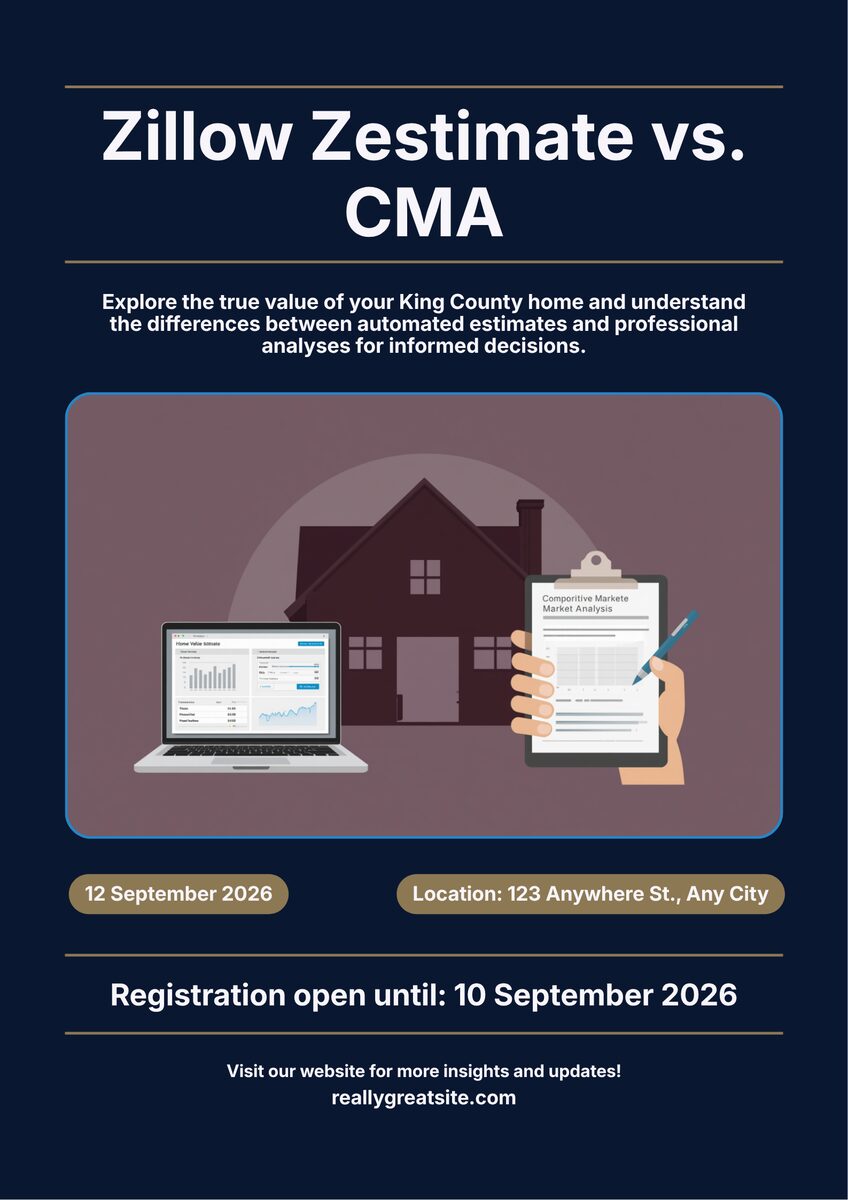
Zillow Zestimate vs. CMA: What Your King County Home Is Really Worth
Every King County homeowner has checked their Zestimate at least once. Most check it a lot more than that. It is free, instant, and sitting right there at the top of every Zillow listing, so it is easy to treat that number as a real answer instead of what it actually is: an educated guess built entirely from a spreadsheet, with no one having ever walked through your front door.
Zillow is more upfront about this than most people realize. The company’s own numbers show the Zestimate misses by a wide margin once a home is off the market, and King County’s mix of older housing stock, view premiums, and wildly different micro-markets from one zip code to the next makes that gap even more likely to matter here than in a lot of the country.
What a Zestimate Actually Is
Zillow is upfront about this, even if the giant number on every listing does not make it obvious: a Zestimate is an automated valuation model, not an appraisal. Zillow’s own help documentation describes it as an estimate built from public and user-submitted data, and states plainly that it is “not equivalent to an appraisal.”
Under the hood, it is a neural network, what Zillow calls the Neural Zestimate, mapping hundreds of millions of data points nationwide. For any single home, it pulls from county and tax assessor records, prior sale history, direct data feeds from MLS systems and brokerages (NWMLS included here in King County), basic home characteristics like square footage and bed and bath count, and for on-market homes, the current listing price and days on market.
That is a genuinely large amount of data. It is also entirely data the algorithm can read from a spreadsheet, nothing it can see, smell, or stand inside.
The Real Numbers Behind “Accurate”
Zillow reports two different accuracy figures, and the gap between them tells you most of what you need to know.
Zestimate Median Error Rate
On-market homes: about 1.9–2%
Off-market homes: about 7%
The gap is not a coincidence. Once a home is listed, the Zestimate leans heavily on the actual list price a human being set, an agent’s professional judgment gets folded back into the “estimate,” which makes it look more accurate without the algorithm actually getting smarter. Off-market, there is no such anchor. The Zestimate is working from stale data and statistical inference alone, and the error rate roughly quadruples.
A 7% error rate sounds small until you attach a real King County number to it. At the county’s current median sold price of $838,842, that is a swing of roughly $58,700, enough to change whether a seller is pricing competitively or leaving real money on the table, and enough to make a buyer’s “the Zestimate says it’s worth less” negotiating line something worth pushing back on with actual comps.
Why the Gap Runs Wider in King County
Automated valuation models struggle everywhere, but a few things about King County widen the miss specifically.
Huge price dispersion over short distances. A county that spans Sammamish and Auburn, Mercer Island and South Park, does not have one housing market, it has dozens of overlapping micro-markets, sometimes a few blocks apart, with very different price ceilings.
An older, heavily renovated housing stock. A large share of King County homes were built in the 1970s through 1990s and have since been updated, sometimes with permits that update county records, sometimes without. A fully remodeled kitchen and a 1988 original kitchen can sit in homes with identical tax records and wildly different Zestimates.
View and lot premiums the algorithm cannot price. Lake Washington, Puget Sound, and Mount Rainier views add real value that shows up in comparable sales but not in any structured data field. Two homes with identical square footage a block apart can differ by six figures because one has a filtered territorial view and the other looks at a fence.
Legal versus livable square footage. Basement conversions, ADUs, and finished spaces that were never permitted often are not reflected, or are reflected incorrectly, in county records, which throws off a model that leans on those records for its baseline.
Five Things the Algorithm Can’t See
1. Views — a Lake Washington or Puget Sound glimpse a neighboring roofline blocks or doesn’t
2. Renovation quality and recency — tasteful, recent updates versus original finishes from decades ago
3. Deferred maintenance — roof age, furnace condition, foundation issues an appraiser or inspector would flag immediately
4. Micro-location — a quiet cul-de-sac versus a home backing a busy arterial, even within the same zip code
5. Legal square footage — whether a finished basement or bonus room actually counts, permit-wise
Zestimate vs. County Assessed Value vs. an Agent’s CMA
These three numbers get confused constantly, and they’re answering three different questions.
Zestimate (Zillow AVM)
What it is: An algorithm’s daily-updated estimate from public records and market data
Who sets it: No one, it’s computer-generated
Best used for: Casual tracking of your home’s value over time
County Assessed Value
What it is: Washington State requires assessors to value property at “100% of true and fair value,” which courts have interpreted as fair market value. King County’s accredited appraisers reassess property each year using the market, cost, or income approach.
Who sets it: Licensed government appraisers, without necessarily setting foot inside your home
Best used for: Calculating your property tax bill, not for pricing a sale
Agent CMA (Comparative Market Analysis)
What it is: A report built from truly comparable recent sales, pending sales, and active competition, pulled from the MLS and adjusted for condition, updates, lot, and location by someone who has usually seen the inside of the home
Who sets it: A real estate agent with local market knowledge
Best used for: Setting a list price or evaluating whether an offer is fair

Three numbers, three different jobs. Only one of them is built to set a list price.
Zillow’s own guidance agrees with this ranking: for serious pricing decisions, a CMA from an agent is the more reliable number, precisely because it incorporates local MLS detail and professional judgment that public data alone cannot capture. For the full mechanics of how a CMA is actually built and how to read one, see how to read a CMA in King County.
What This Means for You
If you’re selling: Use your Zestimate as a rough starting point at most. Before you set a list price, get a CMA, most agents, including me, will run one at no cost and no obligation. Off-market accuracy is roughly a coin flip on being within a meaningful margin; don’t price a six- or seven-figure asset off it.
If you’re buying: Don’t anchor an offer to a seller’s Zestimate, and don’t let a low Zestimate talk you out of a fair offer on a home you actually want. Ask your agent to run comps on the specific home, not the algorithm’s version of it.
If you’re just curious: A Zestimate is fine for casually watching your equity trend over months or years. It’s not the number to make a five- or six-figure decision on.
Frequently Asked Questions
Is Zestimate accuracy improving over time?
Zillow has invested heavily in the model, the shift to a neural-network-based Zestimate in 2021 was a real accuracy improvement over the prior version. But the fundamental limitation hasn’t changed: it still can’t see inside your home, and off-market accuracy still trails on-market accuracy by several multiples.
Why did my Zestimate jump or drop overnight?
Zestimates update as new data becomes available. A neighbor’s home selling, a new listing coming on the market with different pricing, or updated tax records can all move the number without anything changing about your own home.
Does “claiming” my home on Zillow improve my Zestimate’s accuracy?
It can help at the margins. Adding accurate details, updated square footage, a finished basement, recent renovations, gives the algorithm more to work with. It still won’t account for quality, condition, or views the way a human evaluation would.
Is Redfin’s Estimate more accurate than Zillow’s Zestimate?
Both are automated valuation models with similar structural limitations, neither can inspect a home. Redfin has reported comparable or slightly better error rates in some markets, but the same on-market versus off-market accuracy gap shows up in both tools, for the same underlying reason: neither one has been inside your house.
Can I get a CMA if I’m not ready to sell yet?
Yes, a CMA costs you nothing and doesn’t commit you to anything. If you’re a few years out from selling and just want a realistic number to plan around, that’s exactly the right time to ask for one.
A Zestimate is a fine place to start a conversation about your home’s value. It is a poor place to end one. If you are within a year or two of buying or selling in King County, the fastest way to close the gap between the algorithm’s guess and reality is still the same one it has always been: get someone who actually knows the neighborhood to look at the actual house.
Reach me at greg@livingoutsideseattle.com or 253-350-0045 whenever you want a real number instead of an estimated one.
Your guide to life outside Seattle.
253-350-0045 ·
greg@livingoutsideseattle.com ·
www.livingoutsideseattle.com
