AuburnBuyer ResourcesKing County CitiesSouth King County May 31, 2026

Relocating to Auburn Washington: Affordable Homes and What You Actually Get


When people tell me they’re relocating to Auburn Washington, the first thing they ask is whether they’re settling. They’ve heard “South King County” and assumed it means compromise: longer commute, fewer amenities, homes that are affordable because nobody wants them.

That’s not what I see when I’m out there five to six days a week evaluating properties.

Relocating to Auburn or Federal Way means getting more house for less money in a King County market with very few affordable entry points left. Here’s what the March 2026 numbers say.

Auburn Washington Home Prices in 2026: What $668K Gets You
King County median home price comparison all cities March 2026 — Auburn Federal Way Renton Bellevue
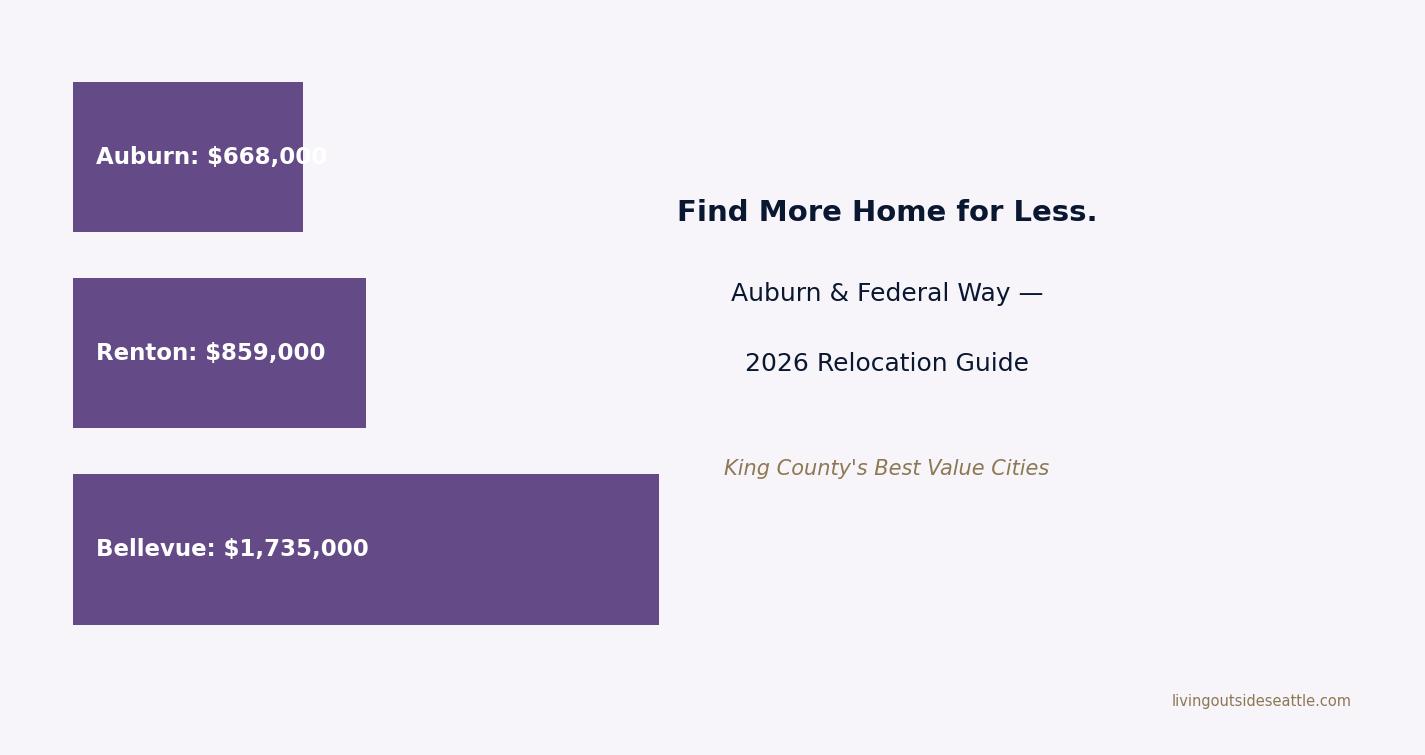
Auburn at $668K and Federal Way at $686K are the only King County cities where a family can buy a single-family home with a yard for under $700K.

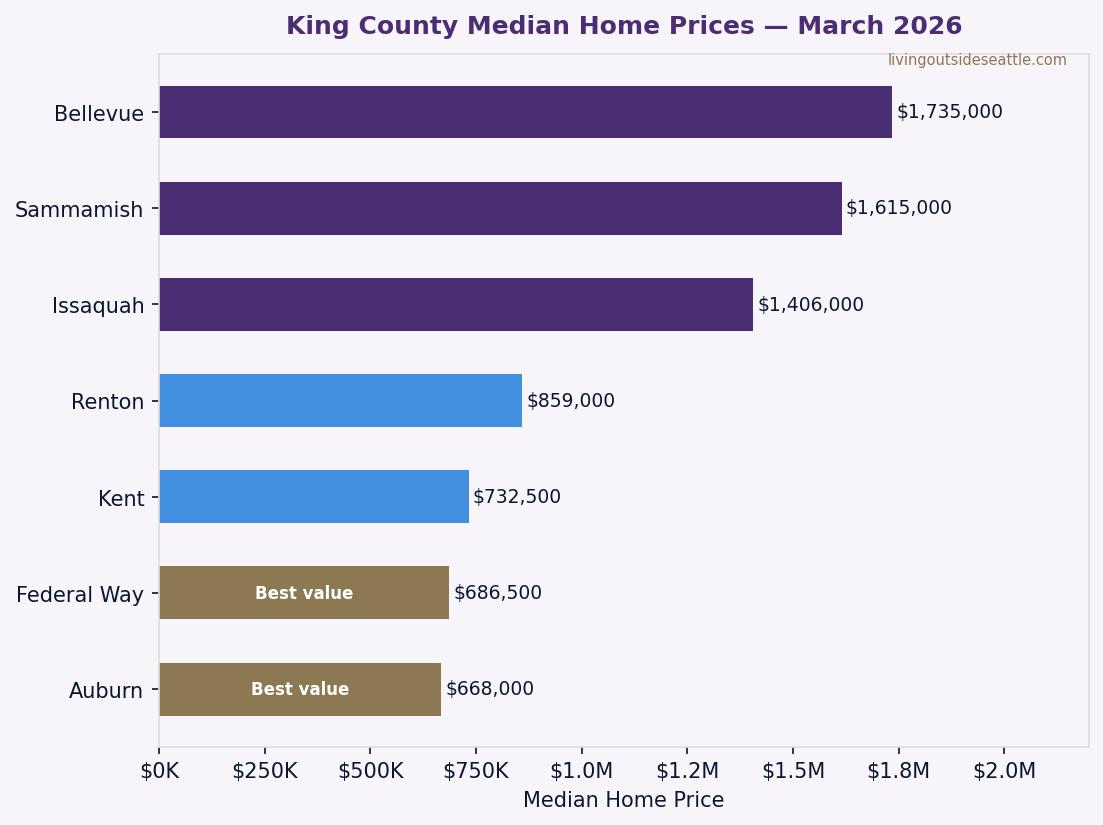
March 2026 median single-family home prices across King County’s major markets:

Bellevue: $1,735,000. Sammamish: $1,615,000. Issaquah: $1,406,000. Renton: $859,000. Kent: $732,500. Federal Way: $686,500. Auburn: $668,000.

At $668,000, Auburn’s median is roughly $191,000 less than Renton and more than $1 million less than Bellevue. The price difference traces to geography, but what you get for that money is the part worth paying attention to.

A $668,000 budget in Auburn gets you a 3-bedroom, 2-bathroom home on a quarter-acre lot. Typically 1,500 to 1,800 square feet, built in the 1980s to 2000s, with a driveway, a yard, and space to breathe. The same budget in Bellevue: a smaller condo or townhouse, no yard, competing with 20 other buyers in a market where homes sell in 5 days.

Auburn’s market is slightly softer than the county average. Homes sit for 14 days on market versus 7 days for the county. That extra week matters. You have time to inspect, negotiate, and think rather than write an offer under pressure.

Auburn WA Neighborhood and Community Overview

Downtown Auburn has been adding restaurants and shops for several years. The Green River Trail runs through the area, good for families who bike or walk. Schools are solid. Property taxes are lower than the Eastside. The downtown core feels like a town rather than a strip mall corridor.

For a neighborhood-by-neighborhood breakdown, see the Living in Auburn, WA: 2026 Neighborhood & Real Estate Guide.

The Muckleshoot area, the Green River valley, and the downtown core are drawing young families and first-time buyers who want to own a house without paying $1M for the privilege. That’s a legitimate trade.

Moving to Federal Way WA: $686,500 for Puget Sound Views and Sounder Access

Federal Way comes in at $686,500, but offers something Auburn doesn’t at scale: Puget Sound views. In neighborhoods near the water or on elevated ground, you can see the Sound. Some homes have waterfront.

The feel is more suburban than Auburn: wider streets, larger setbacks, quieter blocks. Federal Way also added Link Light Rail in 2024 — the Federal Way Transit Center Station connects directly to SeaTac (about 20 minutes) and downtown Seattle (about 35 minutes) without touching I-5. More planned than Auburn, which comes with modestly higher property taxes.

For a full look at Federal Way neighborhoods and amenities, see the Living in Federal Way, WA: 2026 Real Estate & Lifestyle Guide.

Federal Way also sits between two large employment centers. You’re 15 to 25 minutes from the Renton tech corridor, where Boeing, Valley Medical Center, and aerospace suppliers are concentrated. You’re 15 to 30 minutes south to Joint Base Lewis-McChord, which matters for military families moving into the area.

Commute Times from Auburn and Federal Way to Seattle, Renton, and JBLM

South King County commutes deserve a straight answer.

From Auburn to Seattle: 35 to 45 minutes by car on I-167 to I-5, depending on time of day. The Sounder train takes about 45 minutes and lets you work during the ride.

From Federal Way to Seattle: 35 to 50 minutes by car. Similar Sounder access.

If you work in Renton in tech, aerospace, or healthcare, you’re 15 to 25 minutes from either city. If you’re at JBLM or contracting nearby, you’re 15 to 30 minutes south. For those job centers, South King County isn’t a concession. It’s closer to work than most of the county.

Price Per Square Foot: Auburn vs. Bellevue
Auburn WA vs Bellevue WA price per square foot comparison 2026 — $334 vs $1,577 per sqft
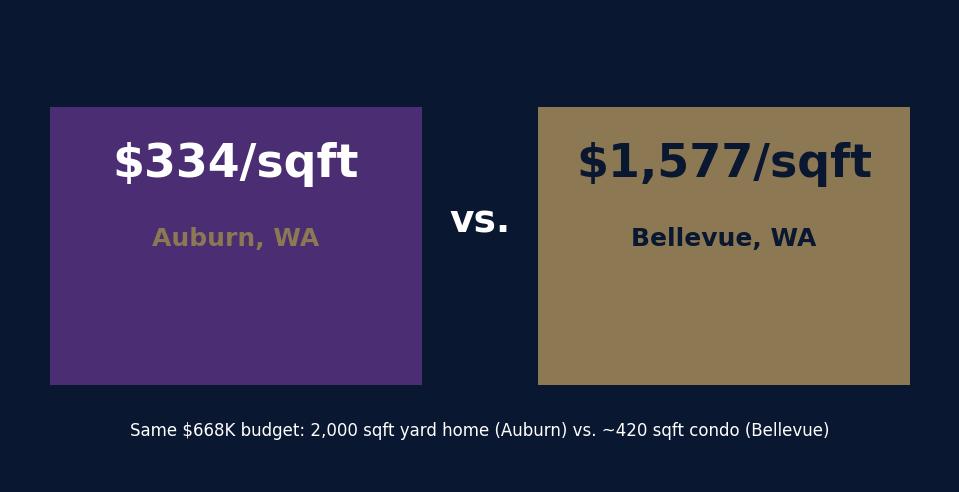
You’re paying nearly 5x more per square foot in Bellevue than Auburn. For families prioritizing space and equity over address, that math is hard to ignore.

A 2,000 square foot home in Auburn at $668,000 runs roughly $334 per square foot. In Bellevue at $1,735,000, that same budget gets you maybe 1,100 square feet at roughly $1,577 per square foot.

Nearly 5 times more per square foot for the Bellevue address. The Seattle commute from Auburn is longer, yes. You’re trading 15 extra minutes of driving for $400,000 in equity and a yard.

Auburn and Federal Way Market Conditions in 2026

King County overall sits at 2.2 months of supply, still a seller’s market. Auburn’s 14-day DOM and Federal Way’s 7-day DOM suggest more breathing room than Sammamish (4 days) or Bellevue (5 days).

At 6.38% on a $534,400 loan (Auburn median with 20% down), principal and interest runs roughly $3,240 per month before taxes and insurance. That’s real money. It’s also roughly half what you’d carry on a Bellevue home financed at $1.4 million.

For current market conditions across King County, see my East and South King County market update.

Frequently Asked Questions About Relocating to Auburn Washington

What is the median home price in Auburn Washington in 2026?

As of March 2026, the median home price in Auburn is $668,000. That buys a 3-bedroom, 2-bathroom home, typically 1,500 to 1,800 square feet with a yard. Auburn’s 14-day average DOM means less competition than Bellevue or Sammamish, giving you more time to make a clear-headed offer.

Is Auburn WA a good place to relocate for families?

Yes. Auburn has solid schools, the Green River Trail for recreation, a growing downtown, and the lowest single-family home prices in South King County. It’s not flashy, but it’s a working community where families build equity over time. If you work in Renton or south King County, the commute is short.

Is Federal Way or Auburn better for relocating to King County?

Depends on what matters to you. Choose Auburn for the lowest price, a slightly larger lot, and proximity to Renton or south King County jobs. Choose Federal Way for a more polished suburban feel, Puget Sound views, Sounder rail access, or JBLM proximity. Both beat Renton and Bellevue on value by a wide margin.

Can I get a home with a yard in King County for under $700K?

Yes, in Auburn and Federal Way. Both cities have homes under $700K with yards and 1,500 to 1,800 square feet. In Bellevue, Sammamish, or Issaquah, that budget gets a condo or townhouse without outdoor space. The trade-off is a longer Seattle commute, typically 35 to 50 minutes versus 10 to 20 minutes from closer suburbs.

What is the commute like from Auburn to Seattle?

Expect 35 to 45 minutes by car on I-167 to I-5, depending on the time of day. The Sounder commuter train runs to King Street Station in about 45 minutes and lets you work the whole way. If your job is in Renton or the south Eastside, your commute from Auburn may be shorter than from many other King County cities.

Your guide to life outside Seattle.

Gregory Dorrell |
Coldwell Banker Bain | WA License #111862
253-350-0045
·

greg@livingoutsideseattle.com

·

www.livingoutsideseattle.com

Coldwell Banker Bain does not guarantee the accuracy of square footage, lot size, year built, or other property details. All information is based on MLS data and public records as of March 2026. Local market conditions change; please confirm current pricing and inventory with your agent.
 

Buyer Resources May 16, 2026

What Is a Mortgage Rate Buydown? A Plain-English Guide for King County Buyers


body { font-family: -apple-system, BlinkMacSystemFont, ‘Segoe UI’, sans-serif;
margin: 0; padding: 20px; background: #f0f0f0; }
.preview-wrap { max-width: 860px; margin: 0 auto; background: #fff;
border-radius: 8px; overflow: hidden;
box-shadow: 0 2px 12px rgba(0,0,0,0.12); }


You’ve probably seen it in listings: “Seller offering 2-1 rate buydown.” Most buyers scroll past it without fully understanding what it means. That’s a mistake, especially in a King County market where 6.38% is the going rate and every monthly dollar matters.

A rate buydown is one of the most useful negotiating tools available right now. Here’s how it works, what it actually costs, and when you should ask for one.

What a Mortgage Rate Buydown Actually Is

A buydown is a way to reduce your mortgage interest rate, either for a set period or permanently, by paying money upfront. Think of it as prepaying interest now to lower your payment later.

There are two main types.

A temporary buydown reduces your rate for the first one, two, or three years of the loan, then steps back up to the full rate. The most common version is the 2-1 buydown. A permanent buydown, often called paying “points,” reduces your rate for the entire life of the loan in exchange for a lump sum at closing.

Right now in King County, the 2-1 buydown is the version worth understanding because it’s the one sellers are offering.

How the 2-1 Buydown Works: The Real Numbers

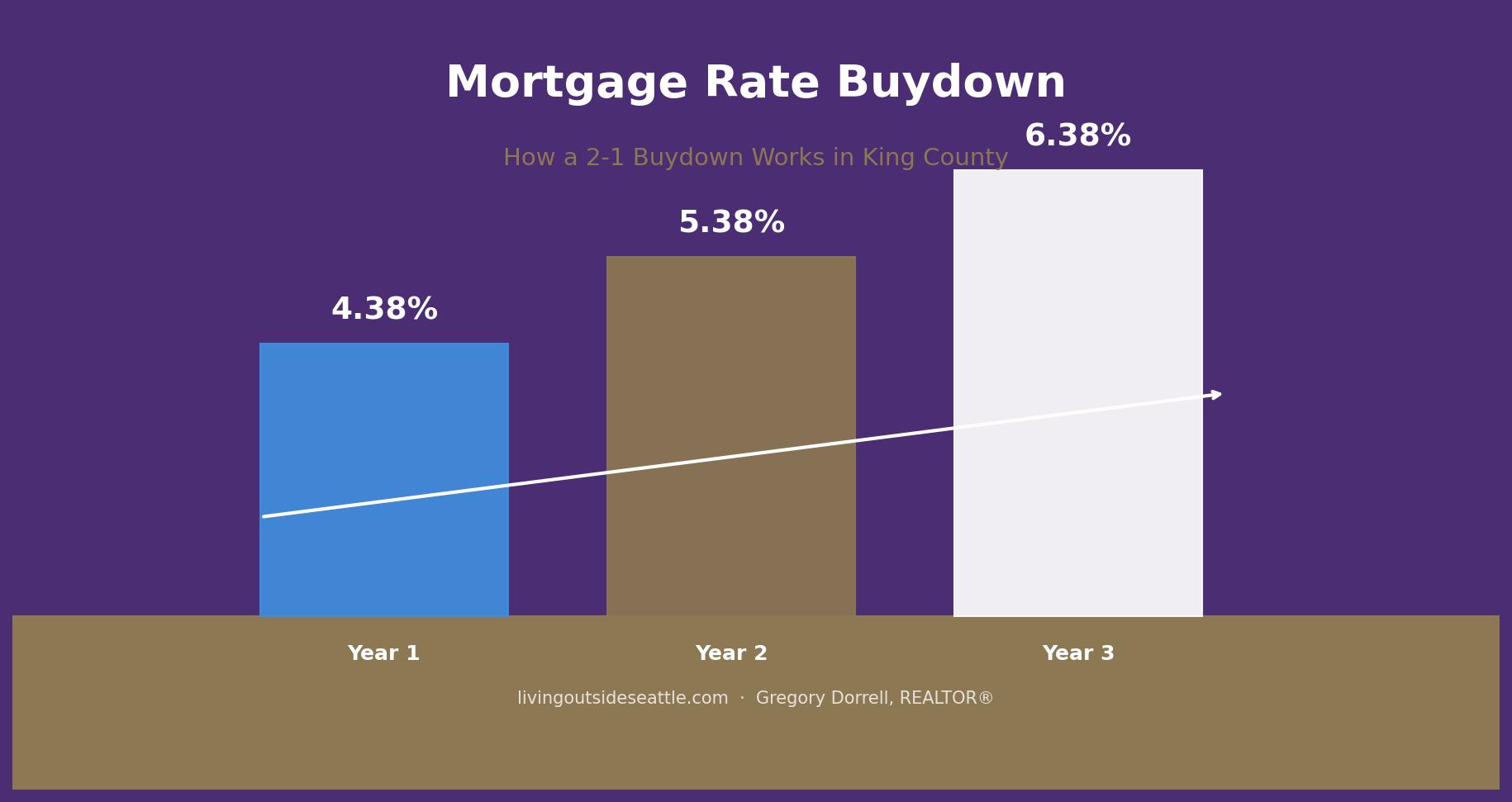
2-1 rate buydown payment schedule King County 2026 — year one 4.38%, year two 5.38%, year three 6.38% on $630K loan

The “2-1” refers to the rate reduction in each year. On a 6.38% base rate:

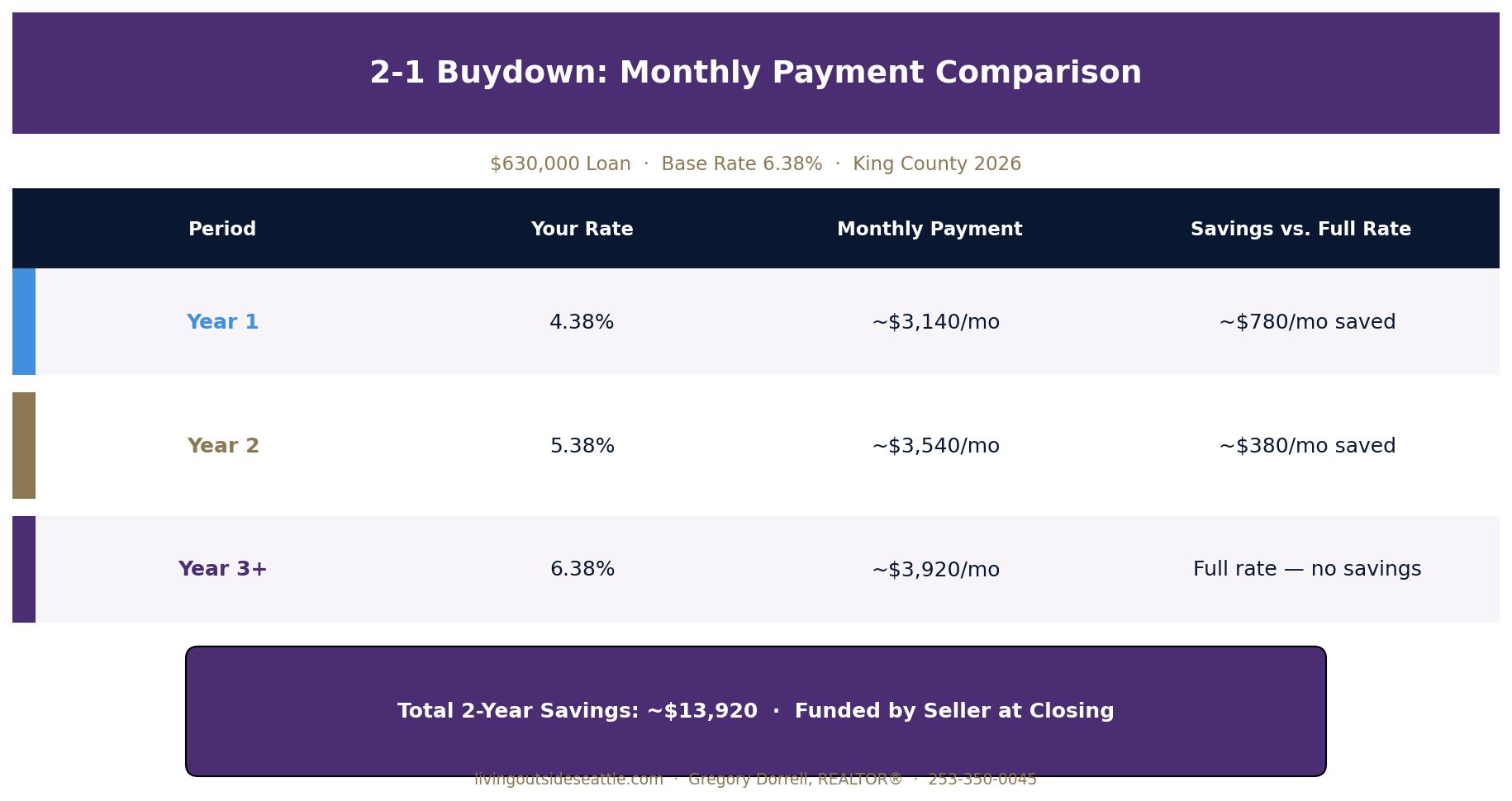
Year Your Rate Payment on $630K Loan Savings vs. Full Rate
Year 1 4.38% ~$3,140/mo ~$780/mo
Year 2 5.38% ~$3,540/mo ~$380/mo
Year 3+ 6.38% ~$3,920/mo $0

Figures are approximate based on a $630,000 loan (10% down on $700,000 home) at a 6.38% base rate.

Over the first two years, that’s roughly $13,920 in payment savings on a $630,000 loan. The seller funds this difference upfront at closing, usually from their sale proceeds. You get lower payments for two years without doing anything extra.

The cost to the seller to fund a 2-1 buydown on a $630,000 loan is approximately $13,920. That’s what they’re crediting to you. It comes off their bottom line, not yours.

Temporary vs. Permanent Buydown: Which Makes More Sense?

A permanent buydown (paying points) costs roughly 1% of the loan amount per 0.25% rate reduction. On a $630,000 loan, buying your rate down from 6.38% to 6.13% costs about $6,300. To 5.88% costs $12,600. The rate stays lower for 30 years, so if you keep the loan long enough, it pays off.

The break-even math matters here. I run this analysis for clients regularly. If you pay $6,300 to save $95 per month, you break even in about 66 months, just over five years. If you plan to stay longer than that, a permanent buydown pencils out. If you think you’ll refinance when rates drop, a temporary buydown often makes more sense since you get the near-term relief without the permanent cost.

When to Ask for a Seller-Paid Buydown

When to ask seller for 2-1 rate buydown King County — inventory rising, days on market increasing, seller negotiating room 2026

Not every seller will offer a buydown, and not every market gives you the leverage to ask. Here’s when the conditions are right.

King County had 5,071 homes for sale in March 2026, up 37.5% year-over-year. Monthly supply sits at 2.2 months for single-family homes. That’s still a seller’s market, but it’s softer than it was. With inventory rising and buyer pools shrinking due to rate pressure, sellers have more motivation to help buyers qualify than they did two years ago.

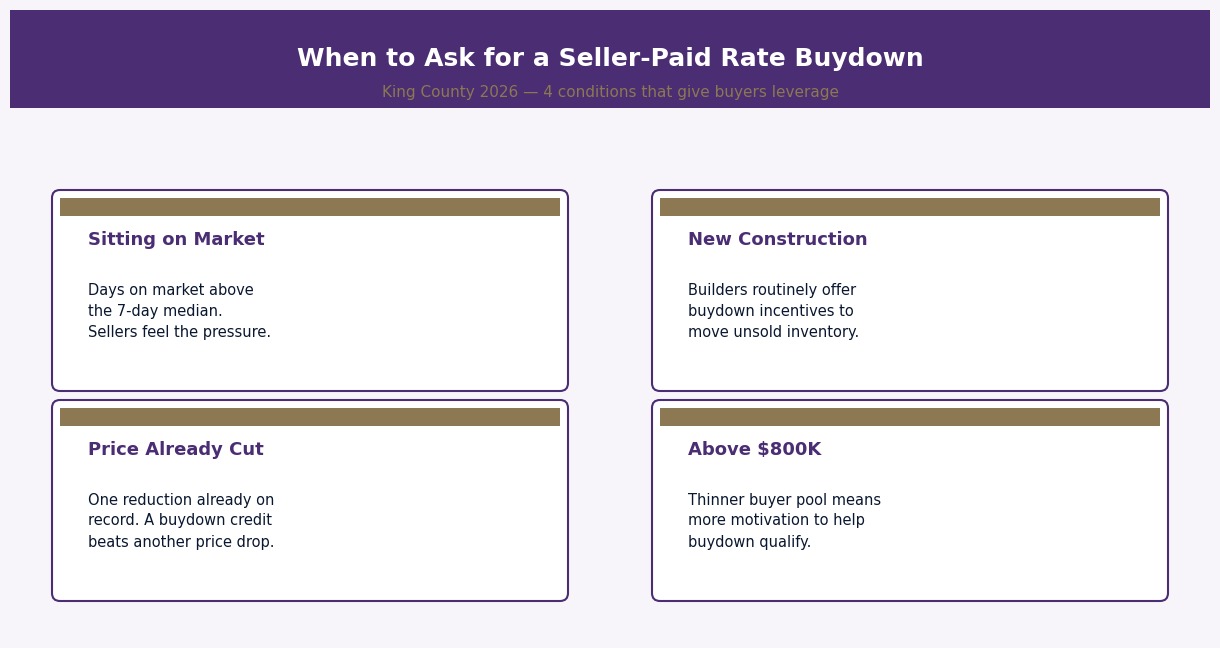
The best candidates for a seller-paid buydown are homes that have been sitting on market longer than the median 7 days, new construction where builders frequently offer incentives, and price ranges above $800,000 where the buyer pool is thinner. If a seller has reduced their price once already, they may prefer a buydown credit over another price cut since it helps more buyers qualify without lowering the headline sale price.

You can also negotiate a buydown as part of a competitive offer structure. Instead of offering over asking, you offer asking price and request a seller credit toward a buydown. This can be more attractive to certain sellers who care about the sale price on paper.

What a Buydown Cannot Do

A buydown lowers your payment, but it does not change your qualifying rate. Lenders qualify you at the full note rate, 6.38% in this example, not the reduced Year 1 rate. This is an important distinction. If you can barely qualify at 6.38%, a 2-1 buydown makes your first two years more comfortable, but it doesn’t help you get approved. That’s a conversation to have with your lender before you start shopping.

A buydown also does not protect you if rates rise further. If rates climb to 7.5% by Year 3, your payment goes back to the 6.38% note rate regardless. You’re not getting a floating benefit; you’re getting a fixed discount on a fixed rate.

The Bottom Line for King County Buyers

If you’re purchasing in the next 60 days and the seller has any negotiating room, asking for a 2-1 buydown is worth the conversation. The worst they can say is no. The best case is $13,000 to $14,000 in payment savings during your first two years of ownership while you settle in, build equity, and wait for a refinance opportunity.

Frequently Asked Questions: Mortgage Rate Buydowns

Who pays for a 2-1 buydown?

Usually the seller, though buyers can also pay for it out of pocket or roll it into closing costs if the lender allows. In today’s King County market, seller-funded buydowns are the most common scenario. The seller provides a credit at closing that the lender holds in an escrow account and draws from each month to cover the difference between your reduced payment and the full rate payment.

What happens if I refinance during the buydown period?

The unused portion of the buydown funds is typically applied to your loan payoff at refinance. You don’t lose the money, but you do lose the future payment savings. This is why the 2-1 buydown works well in a market where refinancing is likely within a few years. You use the savings in Year 1 and Year 2, then refinance when rates drop rather than reverting to 6.38% in Year 3.

Can I use a buydown with FHA or VA loans?

Yes. Both FHA and VA loans allow temporary buydowns, including the 2-1 structure. The same mechanics apply. FHA and VA borrowers are often in the first-time buyer and lower-down-payment segments where the Year 1 payment relief makes the biggest difference in monthly cash flow.

Is a permanent buydown better than a 2-1 buydown?

It depends on how long you plan to keep the loan. Run the break-even calculation: divide the cost of buying down the rate by the monthly savings. If your break-even is 5 years and you plan to stay for 10+, the permanent buydown wins. If you expect to refinance within 3 years, the 2-1 temporary buydown makes more sense.

How much does a permanent buydown cost in King County?

One point equals 1% of the loan amount. On a $630,000 loan, one point costs $6,300 and typically reduces your rate by about 0.25%. To drop from 6.38% to 5.88% would cost approximately 2 points, or $12,600. Your lender can quote you exact pricing since rates and point costs vary daily.

Your guide to life outside Seattle.

Gregory Dorrell |
Coldwell Banker Bain | WA License #111862
253-350-0045
·

greg@livingoutsideseattle.com

·

www.livingoutsideseattle.com

Gregory Dorrell is a licensed real estate broker (WA License #111862) with
Coldwell Banker Bain. This post is provided for informational purposes and does
not constitute financial or investment advice. Mortgage rates, buydown costs, and
lender policies vary and are subject to change. Consult with a licensed mortgage
lender for current pricing and qualification guidance.