

 Facebook
 X
X
 Pinterest
 Copy Link

Before you sign anything at closing, you need to know about one tax most sellers don’t think about until it’s too late.
Most sellers in King County spend months thinking about list price, staging, and what to do with the proceeds. REET — Washington’s Real Estate Excise Tax — rarely gets a mention until the closing statement lands in front of them. Then the questions start. What is this number? Why is it so large? Is this the same as capital gains?
The short answer: REET is a transaction tax Washington charges on nearly every home sale. Unlike capital gains, it is calculated on your sale price, not your profit. That distinction matters a lot. On an $800,000 home sale in Renton or Kent, your REET bill could run $13,000 or more before local rates are added. That is real money, and you should know exactly where it comes from before you go to closing.
I see this confusion regularly in my work. Sellers find out about REET at the same time they are signing a stack of documents and trying to remember where they put their ID. This guide is meant to fix that. Read it before you list.
What Is REET and Who Pays It
REET stands for Real Estate Excise Tax. It is Washington State’s tax on the transfer of real property. When you sell your home, you transfer ownership to the buyer. That transfer triggers REET. Washington has charged this tax since 1951, though the graduated rate structure is newer — it replaced the old flat rate in 2020.
The seller pays REET by custom and by statute. In practice, your escrow or title company collects it from your net proceeds at closing and remits it to the county before your deed is recorded. You do not write a separate check. It comes out of what you would otherwise walk away with, which is exactly why it affects your bottom line.
The deed cannot be recorded until REET is paid. That means the sale cannot legally close until the tax is settled. Your title company handles this automatically, but knowing it is happening helps you read your settlement statement correctly.
The 2026 REET Rate Schedule: What You Actually Pay
Washington uses a four-bracket graduated rate structure. Every seller pays the same rate on each bracket — the rate applies to the slice of your sale price within that range, not to the entire sale price. Think of it like income tax brackets: only the amount within each tier gets taxed at that tier’s rate.
Here is how the 2026 state rate schedule breaks down:
2026 Washington State REET Brackets
First $525,000 — state rate of 1.10%
$525,000.01 to $1,525,000 — state rate of 1.28%
$1,525,000.01 to $3,025,000 — state rate of 2.75%
Above $3,025,000 — state rate of 3.00%
King County adds a local REET of 0.50% on top of the state rate. This local portion funds affordable housing and infrastructure programs countywide.
To make the math concrete, here is what three common King County sale prices actually cost in total REET:
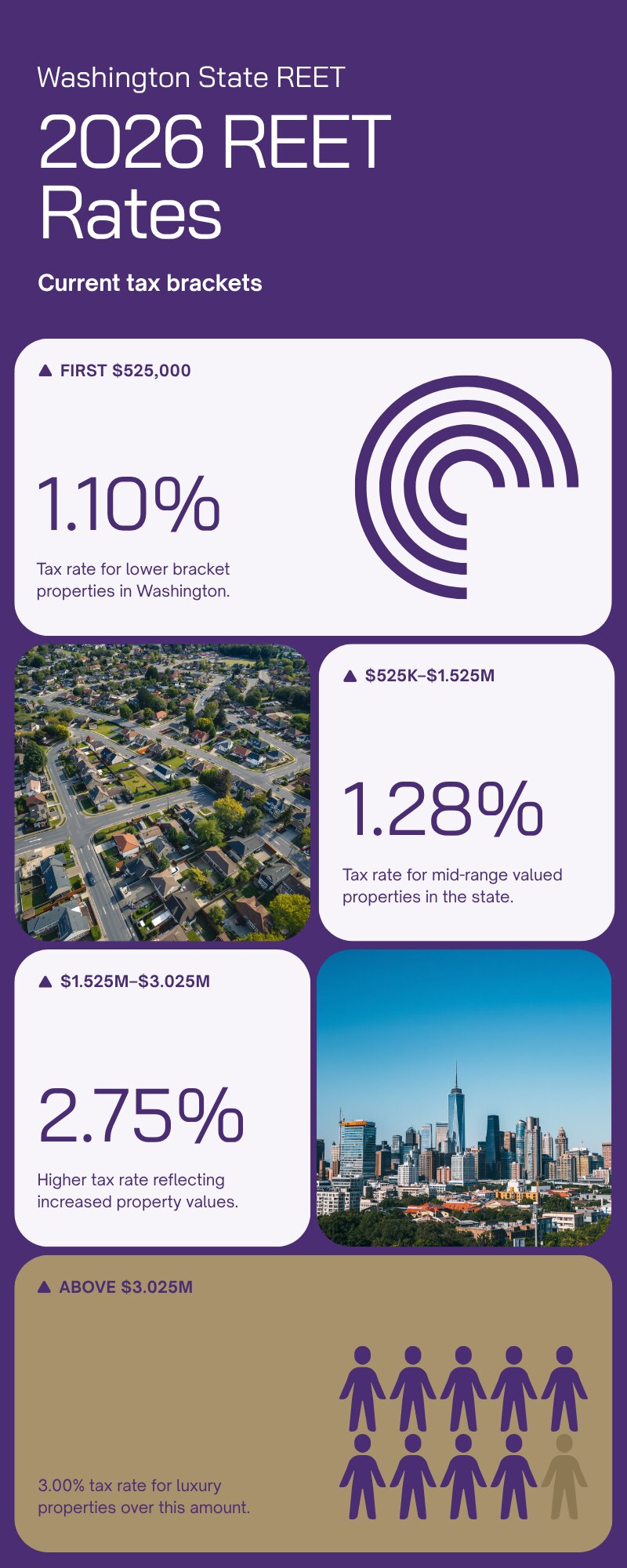
The graduated rate structure means your effective REET rate rises as your sale price climbs — most South King County sellers land between 1.60% and 1.78% combined.
Sale Price $600,000 (typical Kent or Auburn single-family)
State REET on first $525,000: $5,775
State REET on next $75,000 @ 1.28%: $960
King County local REET (0.50%): $3,000
Total REET: $9,735
Sale Price $800,000 (typical Renton or Covington move-up home)
State REET on first $525,000: $5,775
State REET on next $275,000 @ 1.28%: $3,520
King County local REET (0.50%): $4,000
Total REET: $13,295
Sale Price $1,100,000 (Maple Valley or East Renton higher-end)
State REET on first $525,000: $5,775
State REET on next $575,000 @ 1.28%: $7,360
King County local REET (0.50%): $5,500
Total REET: $18,635
These numbers grow quickly on move-up homes. The graduated structure means sellers at the $1.5M threshold pay roughly 2.5 times more as a percentage of their sale price than sellers in the $525K range. For most South King County sellers, the combined state plus local rate lands somewhere between 1.60% and 1.78% of the sale price.
REET Is Not Capital Gains Tax
This is the confusion I hear most often from sellers, and it is worth clearing up completely before anything else.
REET is calculated on your sale price. Capital gains is calculated on your profit — the difference between what you paid for the home and what you sold it for, minus selling costs and qualifying improvements. They are separate obligations. You pay REET at closing regardless of whether you made money on the sale. You deal with capital gains at tax time, and only if your profit exceeds the federal exclusion ($250,000 for single filers, $500,000 for married couples filing jointly).
Washington State does not impose a capital gains tax on real estate sales. The state’s 7% capital gains tax applies to certain financial assets — stocks, bonds, and similar instruments — not to your home. So when it comes to your Washington State tax burden from selling a home, REET is essentially it. Federal taxes are a separate calculation entirely.
I wrote a full breakdown of how capital gains work on Washington home sales if you want to understand the federal piece. The REET and capital gains questions show up together constantly — it helps to understand them separately before you talk to your CPA.
Common REET Exemptions
Not every transfer triggers REET. Washington provides specific statutory exemptions, and knowing them can save you a significant sum if your situation qualifies.
Inheritance and Devise by Will
If you inherited a home and you are selling it to a third party, REET applies on your sale. But the original transfer from the estate to you — moving the property into your name — is exempt from REET. This is why inherited property often shows up in the chain of title without a corresponding excise tax payment. If you recently inherited a King County home and have questions about next steps, I covered this specifically in my inherited home guide for King County sellers.
Divorce and Legal Separation
Transfers between spouses pursuant to a divorce decree or legal separation agreement are exempt. This applies to legally married spouses and state-registered domestic partners. If you are transferring the home to a former partner as part of a settlement, REET likely does not apply — but the exemption must be documented correctly on the REET affidavit.
Gifts
Genuine gifts of real property where no money or other consideration changes hands are exempt. The key word is genuine — the transfer must be a gift, not a below-market sale disguised as one.
Foreclosure and Distressed Transfers
Certain distressed sale scenarios have partial or full exemptions. These situations involve additional complexity and you should work directly with a title company and a real estate attorney to confirm eligibility and documentation requirements.
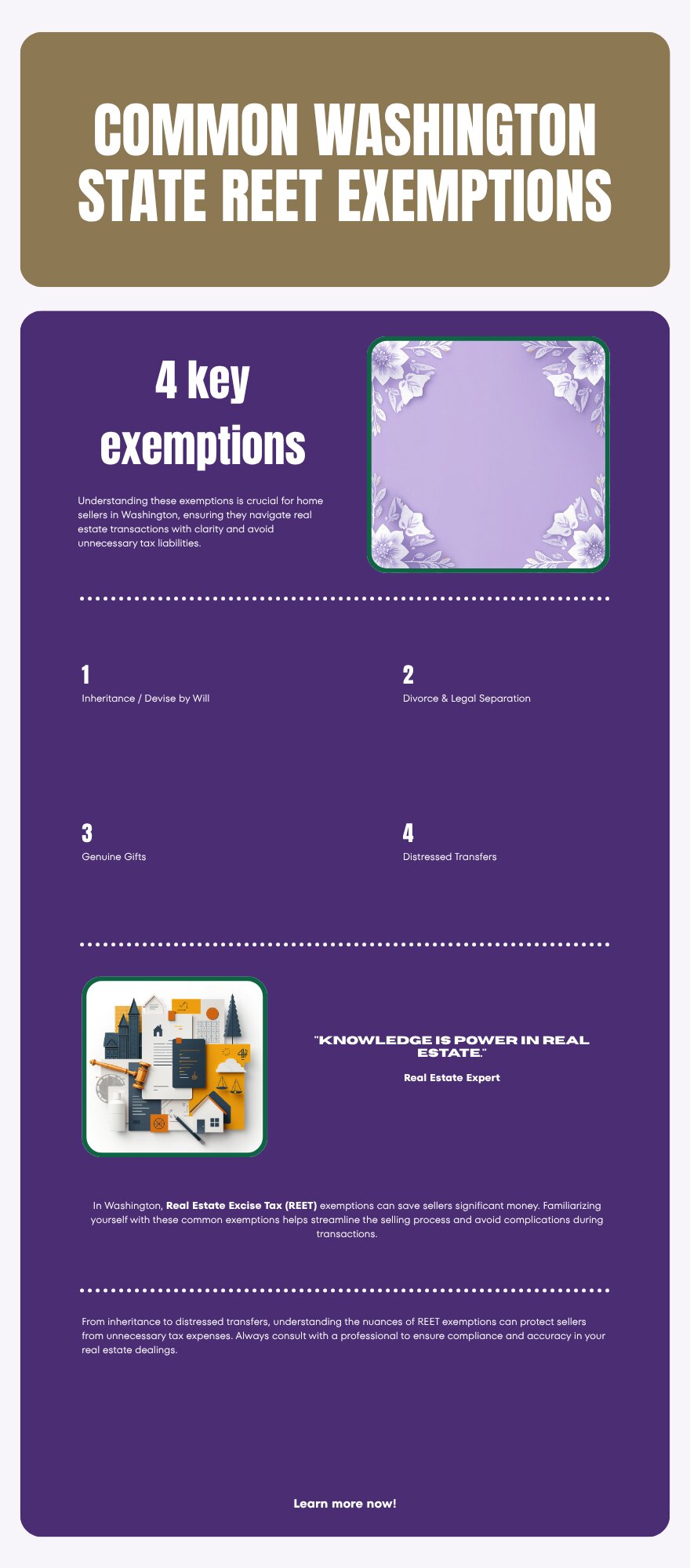
The most common REET exemptions in Washington State — always confirm with your title company before assuming your transfer qualifies.
How REET Fits Into Your Total Closing Costs
REET is typically the largest single tax line on a King County seller’s settlement statement, but it sits alongside other closing costs. When you are running your net proceeds math before you list, here is how REET fits into the picture.
Your title and escrow company will prepare a preliminary settlement statement before closing. That statement breaks out every cost — agent commission, title fees, prorated property taxes, any seller-paid concessions, and REET. Review this before closing day so there are no surprises when you sign.
The REET affidavit gets filed at the county recorder’s office. In King County, that is processed through the King County Recorder’s Office. Your title company handles the filing, but the tax must clear before the deed is recorded. Practically speaking, closing cannot happen until REET is paid and confirmed — it is a mechanical requirement, not a risk you manage yourself.
For more detail on the full picture of seller closing costs in King County, my home preparation guide for King County sellers covers what you can expect to spend before and at closing.
The King County Angle: What Local Sellers Should Know
King County’s 0.50% local REET rate is at the higher end for Washington counties — many rural counties charge just 0.25%. The difference matters on expensive homes. On a $900,000 sale, the extra 0.25% in King County versus a lower-rate county adds $2,250 to your tax bill. That is the cost of selling in a high-demand market.
The local REET revenue in King County is directed toward affordable housing programs and capital projects. Your REET payment at closing funds housing initiatives within the county — that context may or may not make the bill feel better, but it is where the money goes.
South and East King County sellers — Renton, Kent, Auburn, Covington, Maple Valley, Issaquah, Sammamish — all pay the same King County local rate of 0.50%. The baseline applies throughout unincorporated areas and most incorporated cities in the county.
The market in South King County currently sits at roughly $730,000–$870,000 median for single-family homes, depending on city. At that price range, total REET (state plus King County local) typically lands between $11,700 and $14,400. Build that number into your net proceeds calculation before you set your list price.
What This Means for Sellers: Your Pre-Listing Checklist
If you are preparing to sell your King County home, here are the concrete steps that apply to REET:
Run the math before you list
Use your expected sale price and the rate schedule above to estimate your REET liability. This gives you an accurate net proceeds number when you evaluate offers. Your agent can run this for you in minutes.
Tell your agent your target net
If you need to walk away with a specific amount, your agent needs to know that before pricing the home. REET comes off the top along with commission and other costs. Net proceeds math drives the right list price — not gross sale price alone.
Check for exemptions
If your sale involves inheritance, divorce, or a gift transfer, ask your title company whether an exemption applies. Do not assume — the exemptions are specific and require documentation on the REET affidavit.
Ask for a preliminary settlement statement
Before closing day, request this from your escrow company. Review the REET line and confirm it matches your calculations. Surprises on closing day slow things down and add stress to an already complex process.
Talk to a CPA if you have a large gain
REET is your Washington State obligation. Federal capital gains is a separate question. If you have owned your home for many years and have significant appreciation beyond the exclusion amount, discuss that with a tax professional before closing — not after.
Frequently Asked Questions About Washington REET
Is REET paid by the buyer or the seller in Washington?
By statute and by custom, the seller pays REET in Washington. It is deducted from your net proceeds at closing. The buyer does not pay REET on a standard residential sale, though they do pay their own closing costs.
Can the buyer and seller negotiate who pays REET?
The contract governs, not state law. In theory, a seller could negotiate for the buyer to assume REET liability. In practice, this is uncommon in King County residential sales. Most transactions follow the standard custom: seller pays.
Does REET apply to new construction sales?
Yes. New construction sales are subject to REET on the full sale price, including both land and improvements. The builder or developer pays REET at closing.
Is REET deductible on my federal taxes?
REET is generally treated as a selling expense and reduces your capital gain for federal tax purposes. It is not a separately deductible item like mortgage interest. Ask your CPA how to account for it in your cost basis and selling expense calculations.
What if my home sells for less than I paid?
REET still applies to the sale price, even if you are selling at a loss. There is no exemption for a below-basis sale on a residential property. You will owe REET on whatever amount changes hands.
What happens if REET is not paid at closing?
The deed cannot be recorded without REET payment. In practice, your title company will not allow closing to proceed until REET is collected and submitted. This is a mechanical requirement — your title company manages it, not you.
Selling a home involves a lot of moving parts, and REET is one that tends to catch sellers off guard. The graduated rate structure means your tax bill scales significantly as your sale price climbs, and in King County’s current market, most sellers are selling above the first bracket. Know the numbers before you list, not the morning you sign closing documents.
If you have questions about what your specific sale will net after REET and other closing costs, reach out before you commit to a price. I run this math for every client I work with. It takes ten minutes and removes a lot of surprises. You can also review how I approach pricing in my CMA explainer for King County sellers.
Your guide to life outside Seattle.
253-350-0045 · greg@livingoutsideseattle.com · www.livingoutsideseattle.com
