

 Facebook
 X
X
 Pinterest
 Copy Link

You’ll see this number in every market update, and here’s what it actually tells you and why it matters more than list price trends alone.
I look at months of supply data every single day. As a BPO field agent, I professionally price homes across east and south King County. Months of supply is one of the first numbers I pull before I put a value on a property. It tells me how much competition a seller is actually facing, how much patience a buyer needs right now, and whether the street-level conditions match what the headline market numbers suggest.
Most buyers and sellers hear this term in market update videos or agent reports and nod along without really knowing what it means in practice. That is frustrating, because this single number explains almost everything about what you can expect — whether you should push hard on price or stay patient, whether you should brace for multiple offers or expect negotiating room.
Here is the plain-English version, anchored to what is actually happening in King County right now.
How Months of Supply Is Actually Calculated
The formula is straightforward: divide the total number of active listings by the number of homes sold in the past month. The result tells you — if every house currently for sale kept selling at today’s rate and no new listings came on — how many months it would take to clear the market.
So if your city has 150 active listings and sold 50 homes last month, that is 3 months of supply. If it sold only 25 homes last month, that is 6 months of supply. Same number of homes, completely different market feel.
That math matters because it captures two things at once: how many homes are available and how fast buyers are absorbing them. List price trends can hide a lot. Months of supply does not.
The Three Zones: What Months of Supply Numbers Actually Mean
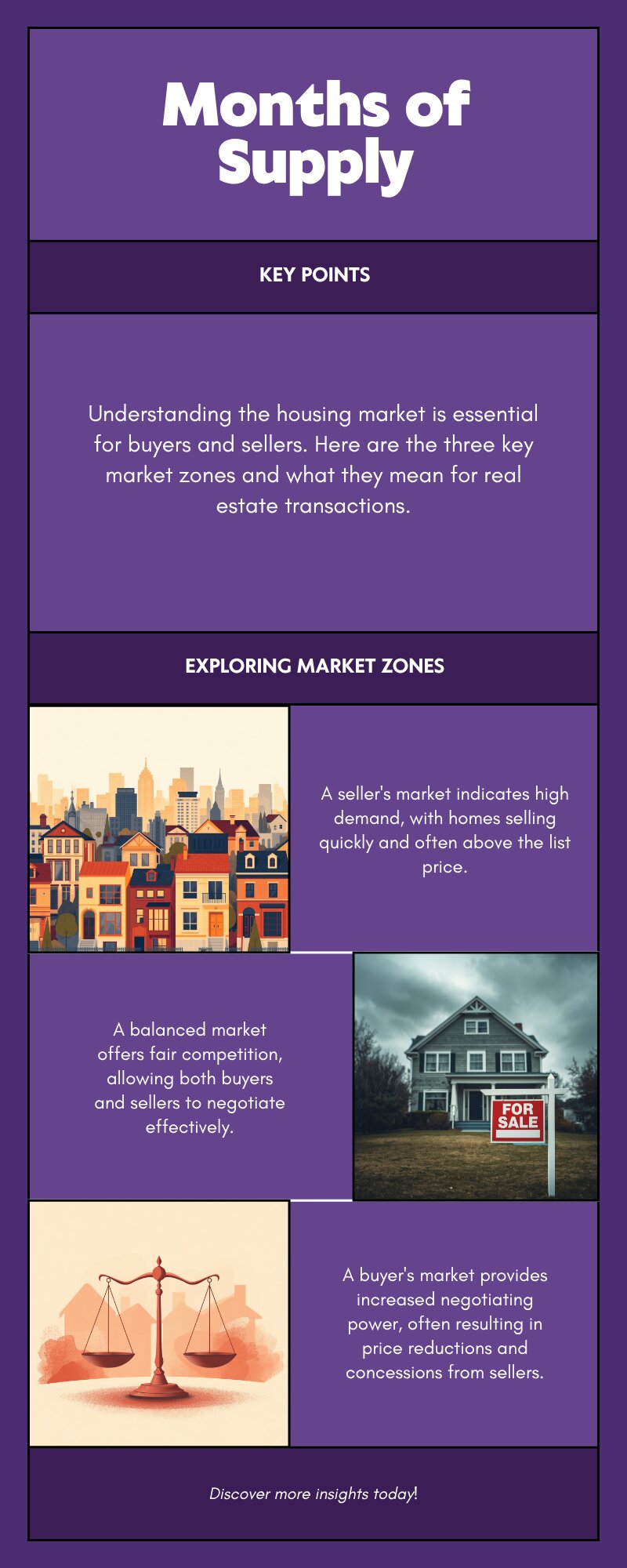
The three market zones defined by months of supply. King County sits at 3.4 months overall — seller-leaning but no longer as extreme as pandemic-era lows.
Under 3 Months: Seller’s Market
This is where most South King County single-family homes have been for years. When supply drops below 3 months, inventory moves fast. Sellers field multiple offers. Buyers often waive contingencies to compete. Homes sell at or above list price, sometimes the same week they go active. In this zone, pricing your home right from day one is critical — but pricing too low can actually cost you money if the market runs it up.
3 to 6 Months: Transitional or Balanced
This is where King County overall sits right now at roughly 3.4 months. The market is neither clearly seller-favored nor clearly buyer-favored. You will see days on market stretch a little longer. Price reductions start to appear, but mostly on overpriced homes. Sellers can still get strong results, but they cannot ignore condition or price. Buyers have a bit more room to negotiate but should not assume every deal has slack in it.
Over 6 Months: Buyer’s Market
When supply climbs above 6 months, buyers hold the cards. Sellers see price reductions, longer days on market, and homes sitting without offers. Sellers may need to offer concessions — rate buydowns, closing cost help, or repair credits — to get deals done. King County has not been in this territory broadly in years, but specific price ranges and property types have crossed into it. King County condos were sitting at roughly 4.2 months of supply in spring 2026, much closer to balanced than the single-family market.
Why King County Does Not Move as One Market
This is where months of supply becomes most useful — and where a lot of buyers and sellers get misled by county-level headlines.
King County’s overall reading of 3.4 months masks enormous variation by city, price range, and property type. Here is what I see from my BPO work:
South King County single-family homes — Renton, Kent, Auburn, Covington, Maple Valley — have consistently run tighter than the county average. Kent’s months of supply was sitting at 2.2 earlier this year, which means homes were moving fast with real competition. If you are a seller pricing a 4-bedroom house in Kent, you are in a different market than a seller pricing a condo in the same zip code.
The condo market countywide has more breathing room. At 4.2 months, King County condos are in that transitional zone where buyers can negotiate but sellers can still get decent results with smart pricing and good presentation.
New construction nationally is an outlier at 10-plus months of supply — that segment is sitting in clear buyer’s market territory. If you are weighing a new build against a resale, that supply dynamic affects your negotiating position directly.
The Eastside — Bellevue, Sammamish, Issaquah — tends to have its own rhythm. Premium pricing supports seller leverage even when supply ticks up, because demand from tech-sector buyers absorbs available homes regardless of inventory levels.

Knowing your sub-market’s months of supply changes the entire conversation with your agent — how aggressive to be on price, whether to push for concessions, and how fast to move.
For context, the national existing-home market sat at 4.5 months of supply in May 2026 — the most balanced it has been in nearly a decade. King County at 3.4 months is still tighter than the national norm. South King County single-family homes are tighter still.
The full picture across King County right now, as I see it on the ground:
King County Sub-Market Snapshot — June 2026
South KC single-family (Renton, Kent, Auburn): Still seller-leaning — under 3 months in most cities
King County condos: Transitional — around 4 months, more buyer room than many realize
Eastside luxury (Bellevue, Sammamish, Issaquah): Seller-favorable despite higher inventory
New construction (national): Buyer-favorable if you know how to negotiate
When I look at how to cross-reference months of supply data with other indicators, I use it alongside days on market and sale-to-list ratios. You can read more about how to interpret a full pricing picture in How to Read a CMA: King County Seller Guide.
What This Means If You Are Selling Right Now
If you are selling a single-family home in South King County today, you are operating in a seller-leaning market. That does not mean you can be sloppy with price or condition, but it does mean a well-prepared, correctly priced home should move.
Here is what months of supply should change about your strategy:
At under 3 months of supply: Price sharp. When inventory is low, the right price creates its own urgency. Overpricing in a low-supply market does not protect you — it just delays your sale until you cut. A home that sits in a tight market is a red flag to buyers, who assume something is wrong with it.
At 3 to 6 months of supply: Condition and presentation matter more. You cannot count on competition to bail out a house that needs work or a price that stretched too far. Budget for pre-listing repairs. Stage. Price based on true comps, not the number you want.
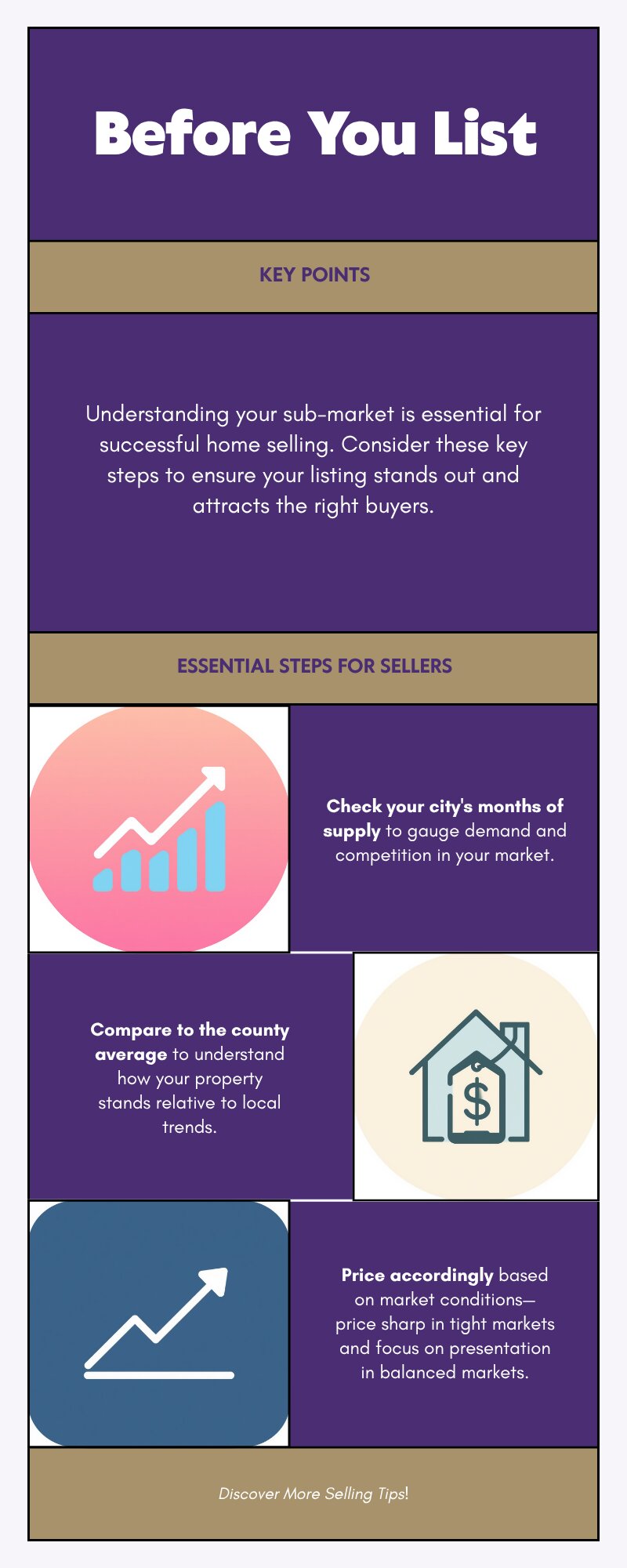
Three steps every seller should take before setting a list price. Your city’s months of supply changes everything about the right strategy.
If you want to see how these market conditions play out in a specific South KC city, the Kent inventory analysis breaks down exactly what 2.2 months of supply meant for sellers there — with real price data.
What This Means If You Are Buying Right Now
Months of supply is the first thing you should check before deciding how aggressive to be in an offer.
In a market under 3 months of supply: Go in clean and close to list price. Escalation clauses can protect you if you are competing. Waiving inspection contingencies is a risk — know what you are giving up before you do it. Waiting for a better deal often means waiting for a deal that never comes, because the next listing goes just as fast.
In a market between 3 and 6 months of supply: You have more room. Ask for closing cost help. Request an inspection without embarrassment. If a home has been on the market for three weeks, there is a real conversation to have on price. The seller knows the market has softened slightly.
If you are considering condos or new construction specifically, the supply numbers give you more leverage right now than most buyers realize. The King County condo buyer leverage guide walks through exactly how to use that supply data at the negotiating table.
The King County Housing Market Forecast for 2026 also puts these supply trends in longer-term context if you are trying to time your purchase decision.
Frequently Asked Questions
What is the difference between months of supply and days on market?
They measure related but different things. Days on market tells you how long individual homes sit before going under contract. Months of supply tells you how much total inventory exists relative to current demand. A city can have a short days on market (homes sell fast) AND a moderate months of supply (there are many homes to choose from). The combination gives you a complete picture. South King County often shows 7 to 14 days on market alongside 2 to 3 months of supply — meaning homes go fast but buyers still have reasonable selection.
Is 4.5 months of supply a buyer’s or seller’s market?
It depends on who you ask and what city you are in. Nationally, most economists call 5 to 6 months a balanced market. At 4.5 months you are near balanced, but still slightly seller-leaning. In King County specifically, 4.5 months would actually feel like significant relief for buyers compared to recent years. What matters most is how your specific sub-market compares to its own historical norms.
Can months of supply differ by price range within the same city?
Yes, and this is something I see constantly in my BPO work. A city can have 2 months of supply in the $600,000 to $800,000 range while sitting at 6 months in homes above $1.2 million. Buyers are more abundant at lower price points. When you hear an overall months-of-supply figure for a city, always ask your agent to break it down by price band for your specific budget.
How quickly can months of supply change?
Fast. A slow month of sales plus a wave of new listings can push a 2-month market to 4 months within 60 days. Seasonality matters too — winter typically adds supply without adding buyers, so months of supply can tick up in November and December even in strong markets. The data I use for BPOs is refreshed monthly, and conditions in one quarter do not guarantee the next.
Does low months of supply mean I should skip the inspection?
No. Low supply increases competition — it does not change what is inside the walls of the house. Waiving an inspection reduces your appeal to sellers, but it also eliminates your ability to negotiate repairs or walk away from a problem. In a tight market you might shorten the inspection period or offer a pre-inspection before submitting an offer. But waiving it entirely is a risk I would want every buyer to fully understand before agreeing to it.
How does King County compare to the rest of Washington State?
King County at 3.4 months of supply is tighter than most of Washington. The statewide Northwest MLS area was near 3.44 months in May 2026. Rural counties and mid-size cities across the state often carry higher supply levels, giving buyers more room. The closer you get to the Seattle metro — especially South King County — the tighter inventory gets.
Your guide to life outside Seattle.
253-350-0045 · greg@livingoutsideseattle.com · www.livingoutsideseattle.com
