

 Facebook
 X
X
 Pinterest
 Copy Link
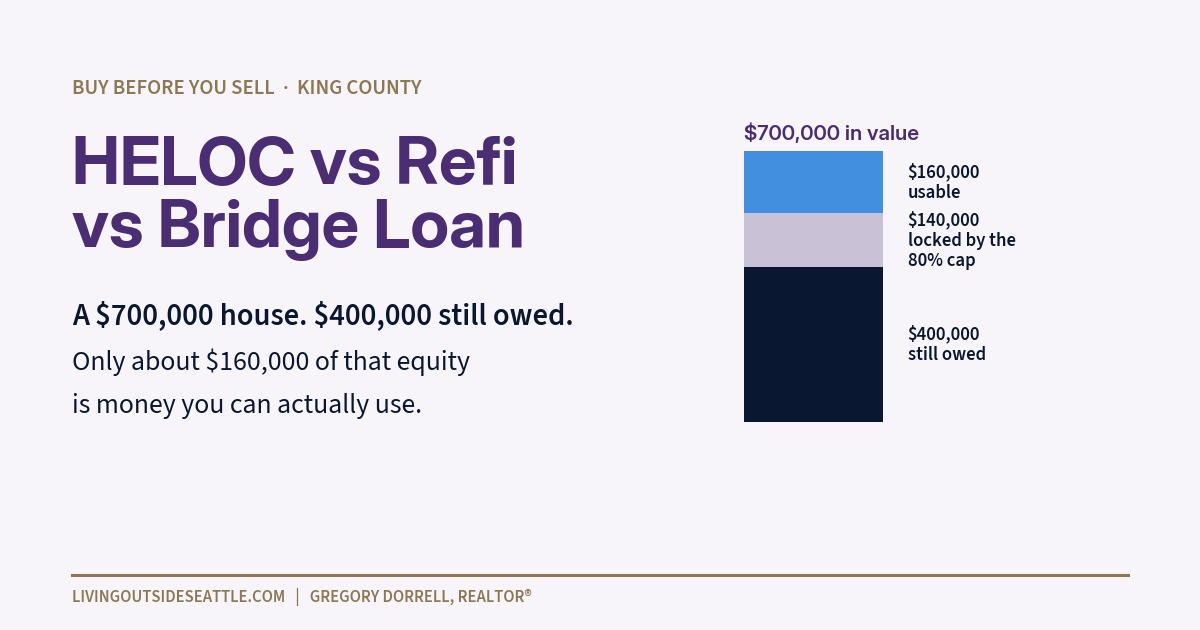
You own a $700,000 house in Renton and you still owe $400,000 on it. On paper that’s $300,000 in equity, and you want to use some of it to buy the next place before you sell this one. Three tools can do that job. A HELOC, a cash-out refinance, or a bridge loan. They cost wildly different amounts, and picking the wrong one is a five-figure mistake.
Your $300,000 in equity is really about $160,000
Lenders don’t let you borrow against all of it. Almost every one of them caps your combined loan-to-value at 80 percent of what the house is worth. Eighty percent of $700,000 is $560,000. You already owe $400,000. That leaves $160,000 you can actually get your hands on.
A few lenders will stretch to 85 percent, which gets you to about $195,000. You pay for that with a higher rate and a pickier approval. Plan around the $160,000 number and treat anything above it as a bonus. If you want to run this on your own house, I walk through the math in how much home equity you actually have.
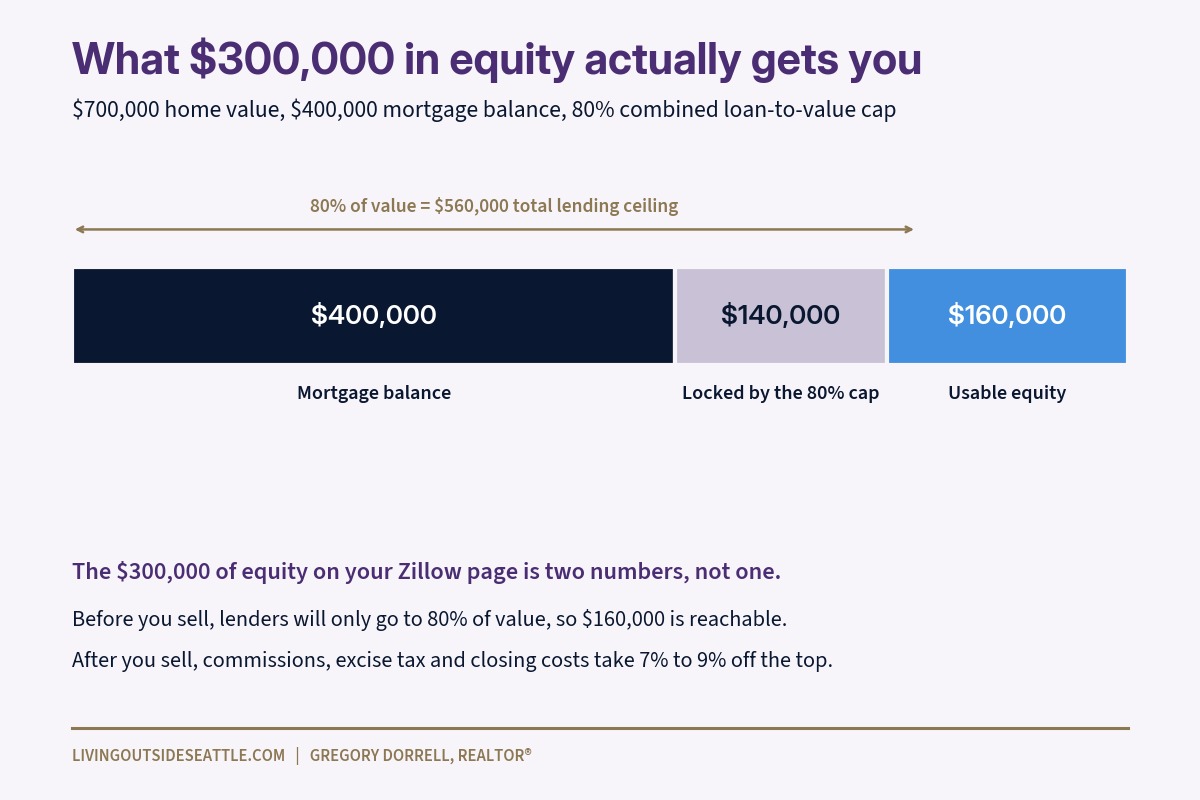
There’s a second haircut waiting at the closing table. When you do sell, commissions, state excise tax, title, and escrow take a real bite. In Washington that usually lands somewhere in the 7 to 9 percent range of the sale price. So the $300,000 you see on Zillow is closer to $240,000 in your pocket after the sale, and only about $160,000 of it is reachable before the sale. Both numbers matter when you’re deciding how much house you can go buy.
Option 1: the HELOC, cheap money with a door that closes
A home equity line of credit is a second loan that sits behind your first mortgage. Your existing loan doesn’t move. Your rate doesn’t change. You draw what you need and pay interest only on what you drew.
The national average HELOC rate was 7.11 percent as of mid-September 2026 (Bankrate’s national HELOC survey). On a $150,000 draw that’s about $889 a month, interest only. Most lenders charge little or nothing to open the line, and funding takes roughly three to six weeks.
Now the catch, and it’s the one that burns people. You have to open the HELOC before you list. Once your house hits the MLS, lenders freeze new lines and many will shut down an existing one. They don’t want a second lien on a property that’s about to change hands. If you’re even thinking about buying first, start the HELOC application before you start decluttering.
One more thing to read in the paperwork. A lot of HELOCs carry an early termination fee if you close the line in the first two or three years. You’re going to close it in about four months when your house sells, so ask about that fee up front. It’s usually a few hundred dollars, not a deal breaker, but you should know it’s coming.
Option 2: the cash-out refinance, the one that costs you your old rate
A cash-out refi replaces your current mortgage with a bigger one and hands you the difference. Same 80 percent ceiling applies. You’d write a new $560,000 loan, pay off the $400,000, and walk away with roughly $145,000 after closing costs of 2 to 3 percent.
Here’s the problem. The new rate applies to the whole $560,000, not just the $160,000 you pulled out. Freddie Mac put the 30-year fixed at 6.95 percent on September 17, 2026 (Freddie Mac Primary Mortgage Market Survey). If your current loan is a 3.5 percent from the refi boom, your principal and interest payment goes from about $2,175 a month to about $3,707. That’s $1,532 more every month, forever, and most of it buys you nothing.
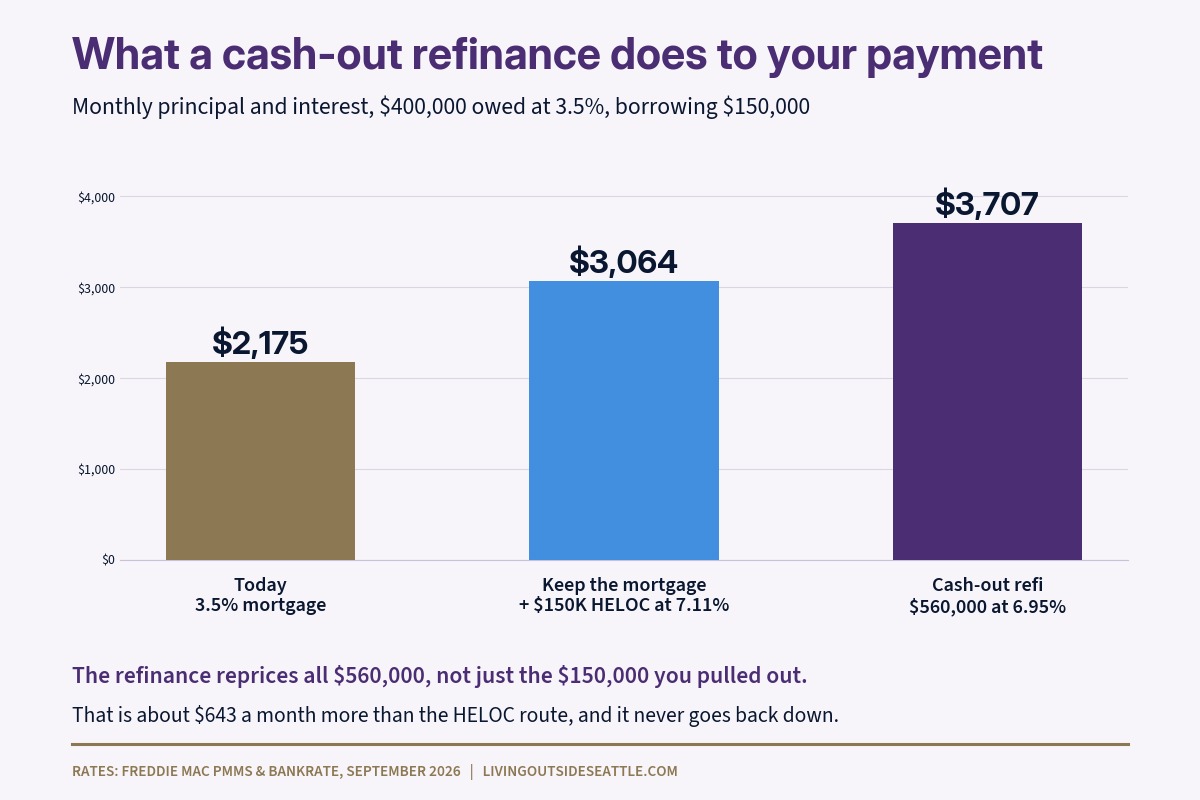
Put it another way. Moving $400,000 from 3.5 percent to 6.95 percent costs you about $13,800 a year in extra interest on money you’d already borrowed. You’re paying that just for the privilege of touching the rest.
So when does a refi make sense? When you’re keeping the house. If you’re turning the Renton place into a rental instead of selling it, a refi is permanent financing for a permanent plan, and that math changes completely. It also makes sense if your current rate is already north of 6.5 percent, because then there’s nothing left to protect. Ask your lender to price both. If the gap is small, the refi gets interesting.
Option 3: the bridge loan, speed you pay for
A bridge loan is short-term money secured by the house you’re about to sell. Interest only, usually six to twelve months, paid off in full at closing when your old house sells.
Residential bridge rates run roughly 8 to 12 percent right now, with most borrowers around 9.5 percent, plus one and a half to three points of origination. Run $150,000 for four months at 9.5 percent and you’re looking at about $4,750 in interest, another $3,000 for two points, and roughly $1,750 in other fees. Call it $9,500 all in.
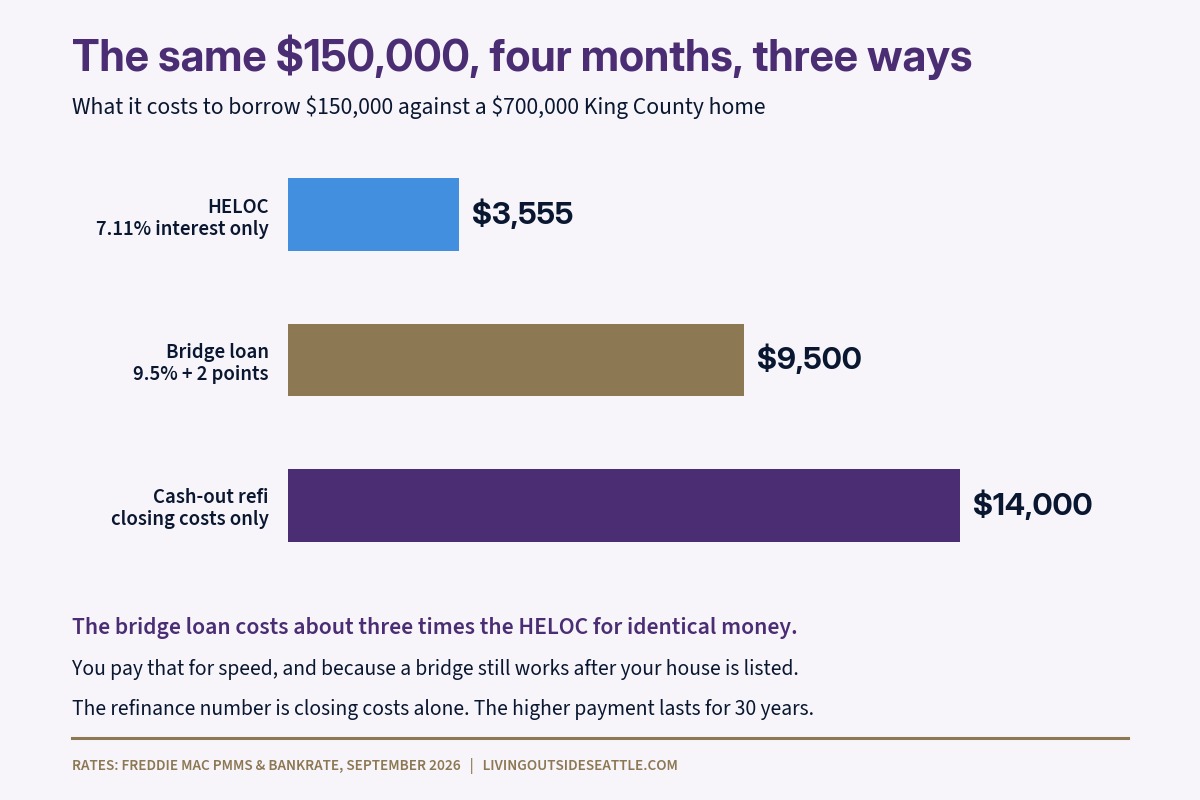
The same $150,000 on a HELOC for those four months costs about $3,555. So the bridge is nearly three times as expensive for identical money over identical time.
You pay that premium for two things. Speed, because a bridge can fund in ten to fourteen days when a HELOC takes a month or more. And timing, because a bridge lender will still work with you after your house is listed or even pending. When the HELOC door has already closed, this is the door that’s still open. It also lets you write an offer with no home sale contingency, and in a multiple offer situation on the Eastside that’s often the difference between winning and writing another offer next weekend.
The same $150,000, three ways
| HELOC | Cash-out refi | Bridge loan | |
|---|---|---|---|
| Typical rate | 7.11% | 6.95% on the full new loan | 8% to 12% |
| Upfront cost | $0 to $1,000 | 2% to 3% of $560,000 | 1.5 to 3 points plus fees |
| Cost over 4 months | about $3,555 | closing costs plus a permanent payment jump | about $9,500 |
| Time to fund | 3 to 6 weeks | 4 to 6 weeks | 10 to 14 days |
| Available after you list? | No | No | Yes |
| Touches your current mortgage? | No | Replaces it | No |
Which one fits your situation
- You haven’t listed yet and you have a month. Open a HELOC. It’s the cheapest money on the board and it leaves your low first mortgage alone.
- You already listed, or you found the house and need to close in two weeks. Bridge loan. It costs more, and it’s the only one that still works. A rent-back agreement can sometimes get you the same result for free, so ask about that first.
- You’re keeping the current house as a rental. Run the cash-out refi. Permanent money for a permanent plan.
- Your current mortgage is already above 6.5 percent. Price all three. The refi penalty you’ve been trying to avoid mostly isn’t there anymore.
What I’d tell you if this were my file
I’ve inspected more than 10,000 properties in King County for banks and institutional clients, and the thing that decides this question isn’t the rate sheet. It’s how fast your current house actually sells.
A clean, well-priced $700,000 house in Renton or Kent moves. Four months of bridge interest is a worst case, not a plan, and the real number is usually shorter. A $1.4 million house in Sammamish with a dated kitchen is a different animal, and borrowing expensive short-term money against it makes me nervous. Bridge interest that looked like $9,500 turns into $25,000 when the sale takes nine months instead of three.
So before you pick the financing, get honest about the exit. What does your house actually sell for, how fast, and in what condition. I broke that down in Zillow Zestimate vs. CMA: what your King County home is really worth. That answer picks your loan for you. Then call a lender and get all three priced in writing, side by side, with the fees included. Any lender who won’t do that is telling you something.
Common questions
Can I get a HELOC after my house is listed?
Usually no. Most lenders won’t open a new line on a property that’s actively for sale, and some will freeze or close an existing line when they find out. Start the application before you list.
Does a bridge loan mean I have to qualify for two mortgages?
Often yes. Many bridge lenders will underwrite you carrying both payments, though some count a portion of your expected sale proceeds. Ask the lender exactly how they treat the departing residence before you make an offer.
Is a cash-out refinance a bad idea if I’m selling in six months?
Usually, yes. You’d pay 2 to 3 percent in closing costs on a $560,000 loan and give up your old rate, then unwind the whole thing half a year later. A HELOC or a bridge does the same job without the permanent damage.
How much equity do I need to buy before I sell?
Enough to cover the down payment and closing costs on the new house from the 80 percent ceiling on the old one. On a $700,000 house with $400,000 owed, that’s about $160,000, which covers 20 percent down on a home up to roughly $700,000 with closing costs left over. If you want to check your own numbers first, start with how much home equity you actually have.
Key takeaways
- Your usable equity is 80 percent of value minus what you owe, not your full equity.
- A HELOC is the cheapest option, but only if you open it before you list.
- A cash-out refi reprices your entire mortgage, so it only fits if you’re keeping the house.
- A bridge loan costs about three times a HELOC and is worth it for speed and for offers with no sale contingency.
- How fast your current house sells matters more than the rate you’re quoted.
Ready to run your numbers?
Before you call a lender, you need a real number for what your house will sell for and how long it will take. That’s the input every one of these options depends on, and it’s the part I do for a living. Send me the address and I’ll give you a straight answer, no pitch.
Gregory Dorrell | Coldwell Banker Danforth | 253-350-0045
greg@livingoutsideseattle.com | livingoutsideseattle.com
Your guide to life outside Seattle.
I’m a REALTOR®, not a lender, tax advisor, or financial planner. Rates in this post are national averages published in September 2026 and change constantly. Your actual terms depend on your credit, your lender, and your property. Get quotes in writing.
Gregory Dorrell is a REALTOR® with Coldwell Banker Danforth serving Bellevue, Sammamish, Issaquah, Renton, Kent, Auburn, and Federal Way. WA License #111862.
