AuburnProbate ResourcesSeller Resources August 24, 2026

Probate Sale vs. Rental: An Auburn Example (2026)

I’ve walked several probate clients through this exact decision, often multiple heirs with different opinions about what to do with a family home. The emotional pull toward keeping it is real. The financial case usually points the other way, but not always, and it depends on your specific situation.

The Case for Selling

Selling through probate is the cleaner path in almost every practical sense. You get one transaction, one closing, and a defined end point. If there are multiple heirs, this also avoids the ongoing complexity of shared ownership and shared decision-making on a rental property, which is where family disagreements often surface years down the road, not at the time of inheritance.

Financially, stepped-up basis usually means minimal capital gains tax if you sell reasonably soon after inheriting. I cover exactly how that works in my inherited home tax math guide, though that piece focuses on higher-value Eastside homes specifically. The same stepped-up basis principle applies at Auburn’s price point too; the dollar amounts are just smaller.

The Case for Renting

Renting makes sense when you want ongoing income, when the local rental market strongly favors landlords, or when one or more heirs specifically want to hold real estate as a long-term investment rather than cash out. Auburn’s rental market is generally healthy given the city’s affordability and proximity to employment centers, so this isn’t a bad rental market by any means.

But renting means ongoing responsibility. Tenant management, maintenance, vacancy risk, and the accounting complexity of shared ownership among multiple heirs all continue indefinitely. If even one heir wants to sell and the others want to hold, you’re now negotiating a buyout or dealing with a forced sale down the road, a more complicated version of the decision you’re facing right now.

Probate sell vs rent comparison chart Auburn WA 2026

Selling delivers a lump sum fast; renting ties you to ongoing management and a longer path to the same value.

Running the Actual Numbers

At Auburn’s median sale price around $592,500, selling nets you that amount minus commission, REET, and closing costs, typically landing in the 90 to 92 percent range of sale price after standard costs. That’s a defined number you can act on immediately.

Renting requires estimating monthly rental income against mortgage payoff status (many inherited homes are owned free and clear, which changes this math significantly), property taxes, insurance, maintenance reserves, and property management if you’re not doing it yourself. If the home is free and clear, rental income minus expenses can generate a reasonable annual return, but it takes years to approach what an immediate sale delivers in a lump sum, and that’s before accounting for the time value of money and the risk of unexpected repairs or vacancy.

Questions to Ask Before Deciding

How many heirs are involved, and do they agree on the decision? Is the home free and clear or still carrying a mortgage? Do any heirs want to occupy the home themselves rather than sell or rent it out? What’s the home’s actual condition, and what would it need before it’s rent-ready or sale-ready? I walk through the repair-versus-sell-as-is decision specifically in my Federal Way sell-as-is guide, which applies to any inherited home regardless of city.

Frequently Asked Questions

Should I sell or rent an inherited home in Auburn?

It depends on your goals and whether all heirs agree. Selling delivers a defined lump sum faster and avoids ongoing management responsibilities. Renting can work well if the home is free and clear, the local rental market is healthy, and heirs specifically want long-term real estate exposure rather than cash.

What happens if heirs disagree about selling versus renting an inherited home?

This is one of the most common probate complications. Some heirs may want to sell for cash now, while others want to hold for rental income. Resolving this usually requires either a buyout of one party’s interest or a broader family agreement, ideally with guidance from an estate attorney rather than an informal understanding.

Is renting out an inherited home in King County a good investment?

It depends heavily on whether the home carries a mortgage, the local rental market, and your tolerance for ongoing management. A mortgage-free inherited home in a healthy rental market can generate reasonable returns, but it takes years to match what an immediate sale delivers as a lump sum.

Your guide to life outside Seattle.

Gregory Dorrell | Coldwell Banker Danforth | WA License #111862
253-350-0045  ·  greg@livingoutsideseattle.com  ·  www.livingoutsideseattle.com

Gregory Dorrell is a licensed real estate broker (WA License #111862) with Coldwell Banker Danforth. Market data from NWMLS, week of August 2, 2026. This post is provided for informational purposes and does not constitute legal or financial advice. Consult an estate attorney and CPA for your specific situation.

Probate Resources August 20, 2026

Inherited a High-Value Eastside Home? The Tax Math Before You Sell

I’ve walked several families through this exact situation on Eastside inherited homes, and the tax questions are almost always the first and biggest source of anxiety. Here’s the honest breakdown.

Stepped-Up Basis: The Part That Helps You Most

When you inherit a home, your cost basis isn’t what the original owner paid decades ago. It resets to the home’s fair market value on the date they died. This is called stepped-up basis, and it’s the single biggest tax advantage in inheriting real estate.

Say a Sammamish home was purchased in 1995 for $280,000 and is worth $1.6 million today. If the original owner had sold it themselves, they’d face capital gains tax on roughly $1.3 million of appreciation. But if you inherit it and sell shortly after at close to that same $1.6 million value, your taxable gain is close to zero, because your basis is the $1.6 million value at inheritance, not the original 1995 purchase price.

This is why executors and heirs should get a qualified appraisal at or near the date of death. That appraisal becomes your basis documentation, and it matters more than almost anything else in this process.

Federal Capital Gains: Usually Minimal If You Sell Promptly

Because of stepped-up basis, federal capital gains tax on an inherited home you sell within a reasonable window after death is often minimal. Your gain is calculated from the stepped-up value forward, not from what the deceased originally paid. The longer you hold the property before selling, and the more it appreciates after the date of death, the more federal gain you’ll owe tax on. This is one more reason inherited home sales often move faster than a typical sale.

Washington’s Capital Gains Excise Tax: The Part People Miss

Washington has a state-level capital gains excise tax, but it’s important to know real estate has broad exemptions here. Real property, including inherited homes, is generally exempt from Washington’s capital gains excise tax specifically. Where people get confused is conflating this state capital gains tax with the real estate excise tax, REET, which is a separate transfer tax due at closing regardless of gain or loss. I break down REET’s graduated brackets in my Washington State REET guide.

At Eastside price points, REET matters more than most sellers expect specifically because the tax brackets are graduated by sale price. A $1.6 million inherited Sammamish home sale lands in a meaningfully higher REET bracket than a $700,000 South King County sale. This is a real cost of selling, not a gain-based tax, and it applies whether you’re an original owner or an heir.

The “Millionaires’ Tax” Question

Washington’s recent high-value tax changes have generated a lot of questions from Eastside families specifically, since Sammamish and Issaquah routinely clear the price thresholds where these provisions start to matter. The details are evolving and genuinely require a conversation with a tax professional who’s current on Washington’s latest rules, not a blog post. What I can tell you from the field: don’t assume a high sale price automatically triggers the worst-case scenario, and don’t assume it doesn’t. Get a real answer from a CPA before you list, not after.

Stepped-up basis inherited home tax timeline King County 2026

How stepped-up basis resets your cost basis to the date-of-death value, and why that matters at Eastside price points.

What This Means for Your Sale Timeline

Because federal exposure is usually low right after inheriting and tends to grow the longer you hold and the more the home appreciates, many heirs choose to sell relatively soon after settling the estate rather than holding the property as a rental or second home. That’s not universal advice. If you want to keep the home or rent it out, the tax picture changes and deserves its own analysis. I cover that specific comparison in my probate sale versus rental guide.

Frequently Asked Questions

Do I owe capital gains tax on an inherited home in Washington State?

Usually minimal federal capital gains if you sell within a reasonable time after inheriting, because your cost basis steps up to the home’s value at the date of death. Washington’s state capital gains excise tax generally exempts real property, including inherited homes, though you should confirm your specific situation with a CPA given how often these rules get refined.

What is stepped-up basis and why does it matter for inherited homes?

It means your cost basis for tax purposes becomes the home’s fair market value on the date the previous owner died, not what they originally paid for it. This usually erases most of the capital gain that would otherwise be taxable, especially on a home that appreciated significantly over decades of ownership.

Does Washington’s real estate excise tax apply to inherited home sales?

Yes. REET applies to the sale itself regardless of whether there’s a taxable gain, and it’s calculated on graduated brackets based on the sale price. At Eastside price points, this often lands in a higher bracket than sales in more affordable parts of King County.

Your guide to life outside Seattle.

Gregory Dorrell | Coldwell Banker Danforth | WA License #111862
253-350-0045  ·  greg@livingoutsideseattle.com  ·  www.livingoutsideseattle.com

Gregory Dorrell is a REALTOR® with Coldwell Banker Danforth (WA License #111862) specializing in East and South King County. This article is general information, not tax or legal advice. Washington’s tax rules on high-value transactions are subject to change; consult a qualified CPA or estate attorney for your specific situation.

Financial PlanningMarket InsightsProbate and Inheritance June 1, 2026

Inherited Home in King County WA: What to Do Next


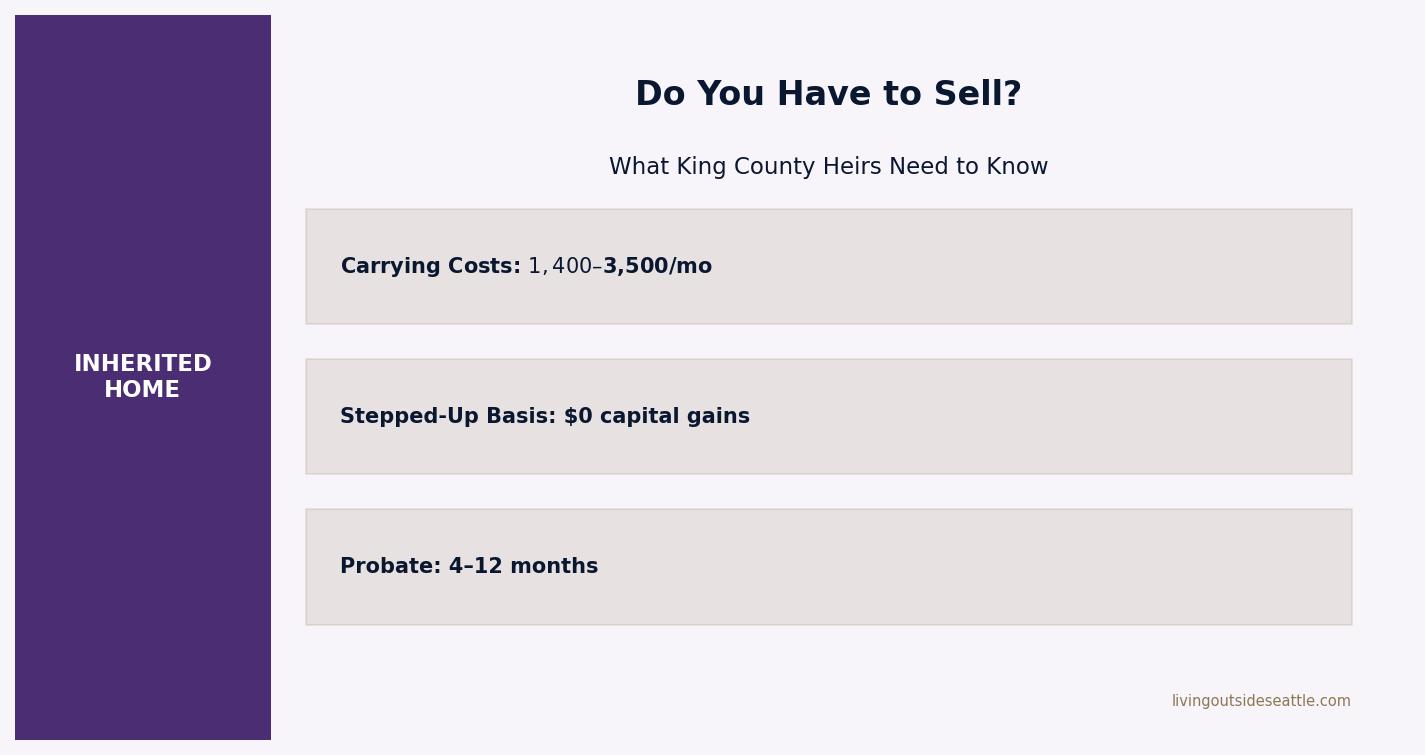
If you’ve inherited a home in King County WA and you’re not sure what to do next, you’re not alone. The question I hear most often: “Do I need to sell this quickly?” No — but there are real financial reasons not to wait too long either. Here’s what you’re actually facing: the legal timeline, the tax advantages, the carrying costs, and what the current King County market means for your decision.

Washington State Probate Timeline for Inherited Homes

Start with the legal side. Washington state probate typically takes 4 to 12 months, depending on the complexity of the estate. A straightforward will with no disputes and clear assets puts you at the shorter end. Multiple heirs, contested claims, or tax issues can push it longer. The important part: you don’t have to sell while probate is happening. In Washington, heirs can rent the property while probate proceeds, sell during probate with court approval from a personal representative, or wait until probate closes and then sell. You have options. The pressure to sell quickly isn’t legal. It’s financial.

Stepped-Up Basis on Inherited Property: Your Tax Advantage Explained

Stepped-up basis explained for inherited home — zero capital gains vs taxable gain comparison King County
Without the stepped-up basis, a home bought for $300K and now worth $850K would generate $550K in taxable capital gains. With it, your gain resets to zero on the date of inheritance.

This is one of the most significant financial benefits available to heirs, and most people don’t fully understand it until they talk to a tax advisor. When someone inherits property in the United States, their cost basis is “stepped up” to the fair market value on the date of the original owner’s death. In most cases, this means you’ll pay little or no capital gains tax if you sell at or close to fair market value. A real example: your parent bought a home 25 years ago for $300,000. It’s now worth $850,000. If they had sold it, they would have owed capital gains tax on $550,000 of appreciation. Because you inherited it, your cost basis resets to $850,000. Sell it tomorrow for $850,000 — your capital gain is zero. That’s a real advantage. It also has a time dimension. Wait five years and the home appreciates to $950,000 before you sell. Now you have a $100,000 capital gain to report. The stepped-up basis advantage erodes slightly each year you hold the property while values increase. This is one of the financial reasons not to wait indefinitely. One Washington-specific note: if the property was community property owned by a married couple, the entire value gets a full step-up in basis at death, not just the deceased spouse’s half. Confirm the specifics of your situation with a tax advisor — and for a broader look at how capital gains work on Washington home sales, see our guide to capital gains on home sales.

Carrying Costs for Inherited Homes in King County: The Monthly Math
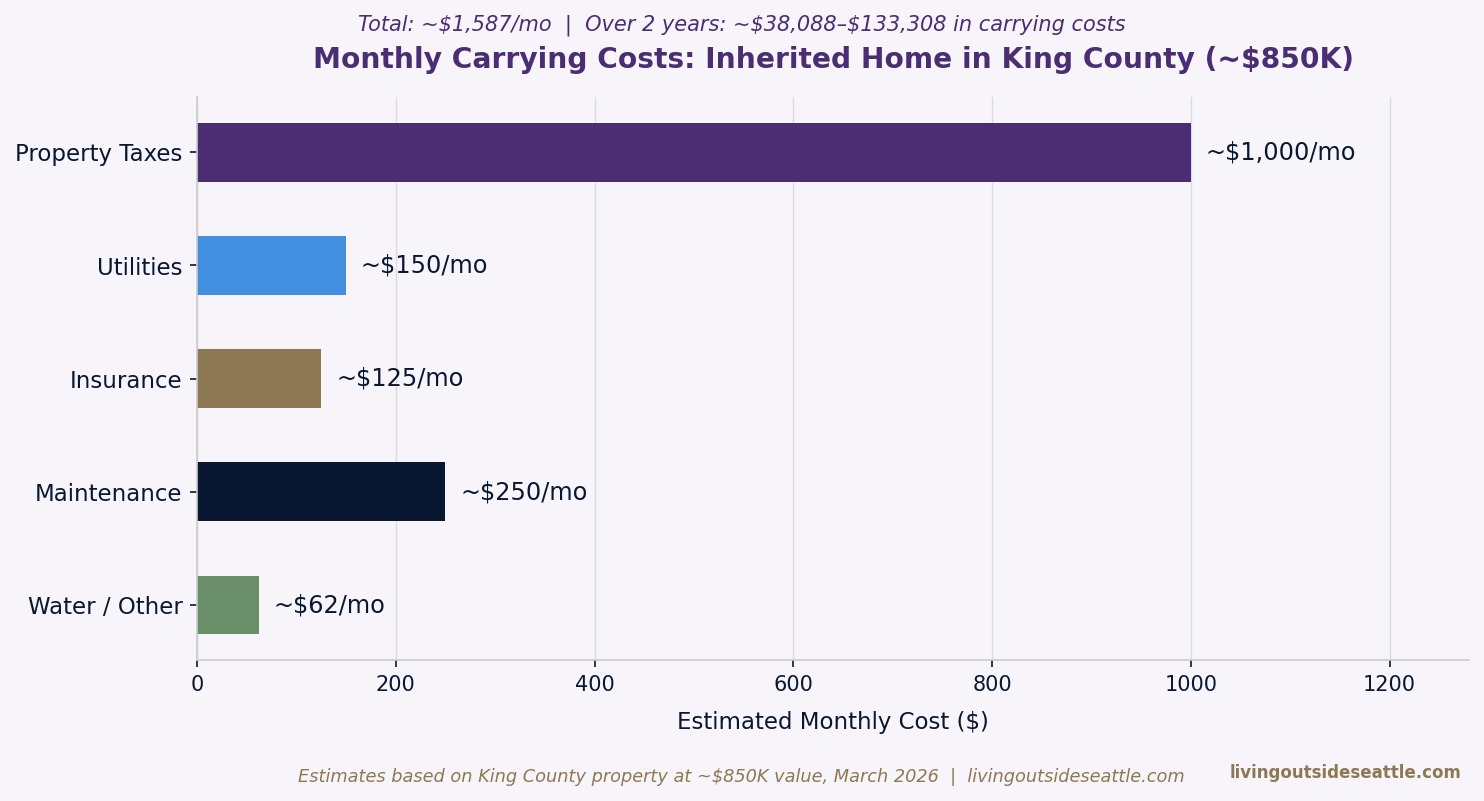
King County inherited home monthly carrying costs breakdown — property taxes insurance utilities maintenance 2026
On an $850K King County home, carrying costs run $1,400 to $2,000 per month at minimum. Over two years, that’s $33,600 to $48,000 — before factoring in deferred maintenance.

An inherited home in King County costs money every month whether you sell it or not. The property taxes still come due. The utilities still run. The roof still needs attention. On a King County home in the $850,000 range, here’s what you’re looking at monthly:

Cost Monthly Amount
Property taxes $900 to $1,100/month
Homeowners insurance $100 to $200/month
Utilities $50 to $250/month (vacant vs. occupied)
Basic maintenance $200 to $500/month
Water and sewer $50 to $75/month

Estimates based on a King County home valued at approximately $850,000 as of 2026.

That’s roughly $1,400 to $2,000 per month at minimum. In most inherited-home situations I’ve seen, carrying costs run $2,000 to $3,500 per month depending on condition and property type. Over two years of holding, that’s $48,000 to $84,000 in carrying costs alone. Money that could be in your pocket, invested, or used elsewhere. If you rent the home out, you can offset some or all of that. If the home sits vacant, you’re spending with nothing to show for it.

King County Market Conditions in 2026: Is Now a Good Time to Sell an Inherited Home?

The King County real estate market is a seller’s market. Median days on market: 7 days county-wide. Homes selling at 100% of list price. Months of supply: 2.2, which is still tight. For a full picture of what’s happening across the county right now, see current King County market conditions. For an inherited home, those conditions are favorable. You don’t need to wait for a better market. Waiting risks the opposite: conditions could soften, rates could shift, and you’d be making the same decision under less favorable circumstances. This doesn’t mean you need to sell in the next 30 days. You have time to make a thoughtful decision. But thoughtful is different from waiting years.

3 Steps to Take After Inheriting a Home in King County

First: work with a probate attorney on the legal side. They’ll walk you through the probate timeline, what court authorization is needed for a sale, and any tax filings required. Washington estates above $2.193 million may owe state estate tax — confirm the current threshold with your attorney, as it adjusts annually. This is not my area, and it matters. Second: talk to a CPA or tax advisor about your specific stepped-up basis situation. If your parent made significant improvements to the property before death, those details matter. If you’re inheriting with multiple heirs, the basis calculation involves everyone. Don’t guess on this. Third: call me about the real estate side. What is the home actually worth in today’s market? What condition is it in? Are there repairs that would meaningfully increase the sale price? What would it cost to list and sell? If you wanted to rent it out, what would market rent be and would cash flow work? I can show you current comparable sales and what you could expect if you put it on the market in the next 30 to 60 days. Once you decide to move forward, our guide to preparing an inherited home for sale walks through the specific steps.

Handling Grief While Managing an Inherited Property

Selling a parent’s home is emotional. There’s grief involved, history, nostalgia. Some people hold inherited homes for years because they’re not ready to let go. That’s valid. But if you’re holding primarily for emotional reasons, be honest with yourself about the carrying costs and what that money could do elsewhere. If you’re keeping the home because you genuinely want your family to have it, that’s a different conversation. If you’re holding because you’re waiting for the “right time” or uncertain about the market, that’s where the financial analysis matters. I’m not going to tell you what to do. That’s your call. But I will tell you what it costs, what the market looks like, and what your options are.

When Is the Right Time to Sell an Inherited Home in King County?

That decision might be to sell now. It might be to rent for a year. It might be to do minor repairs and then sell. It might even be to keep it as a family property. Whatever you decide, it will be based on real information.

Frequently Asked Questions About Inherited Homes in King County WA

Do I have to sell an inherited home in King County?

No. You have full control over whether to sell, rent, or keep the property. Washington probate law does not require a sale. The decision depends on your financial situation, whether other heirs are involved, and your long-term goals. Many heirs choose to rent the property for income while they decide. Others sell to settle the estate or simplify their finances.

What is the stepped-up basis and how does it help with an inherited home in Washington state?

The stepped-up basis resets your property’s tax cost basis to its fair market value on the date of the original owner’s death. If the home was worth $850,000 when you inherited it and you sell it for $850,000, you owe zero capital gains tax. You only pay capital gains on appreciation that occurs after you inherit. This is one of the most significant tax advantages available to heirs and it’s especially valuable in a high-appreciation market like King County.

How long does Washington state probate take, and can I sell during it?

Washington probate typically takes 4 to 12 months depending on estate complexity. You can sell during probate once the Personal Representative receives court authorization. Sale proceeds remain in the estate account until probate closes and distributions are made to heirs. This allows you to avoid years of carrying costs without waiting for probate to fully close.

What are typical carrying costs for an inherited home in King County?

Monthly carrying costs range from $1,400 to $3,500 depending on the property, including property taxes ($900 to $1,100 per month on an $850K home), homeowners insurance ($100 to $200 per month), utilities ($50 to $250 per month depending on vacancy), and maintenance ($200 to $500 per month). Over one to two years, these costs can total $16,800 to $84,000 — real money that could be in your pocket or invested elsewhere.

Is now a good time to sell an inherited home in King County WA?

Yes, the current King County market is favorable for sellers: 7-day median days-on-market, 2.2 months of supply, and homes selling at list price. Waiting for a “better” market is a risk, not a strategy. That said, you don’t need to rush. Take the time to get legal and tax advice in place, then make a decision based on actual numbers.

Your guide to life outside Seattle.

Gregory Dorrell | Coldwell Banker Danforth | WA License #111862
253-350-0045 · greg@livingoutsideseattle.com · www.livingoutsideseattle.com

Coldwell Banker Danforth does not provide legal or tax advice. Please consult with a probate attorney and tax advisor for questions about your specific situation. Washington state probate timelines and estate tax thresholds can change. Confirm current information with qualified professionals. All property valuations are estimates based on market data as of May 2026.