

 Facebook
 X
X
 Pinterest
 Copy Link

NWMLS Form 22B: How Contingent Offers Actually Work in King County
A contingent offer used to be a hard sell in King County. For years, sellers here could count on multiple offers with no strings attached, so an offer that depended on the buyer selling their own home first went straight to the bottom of the pile. That has changed. With inventory up and the market cooling in 2026, more sellers are willing to look at a contingent offer, and more buyers need one to make their next move work. If you are on either side of that conversation, you need to understand NWMLS Form 22B.
I covered the broader strategy of writing and evaluating contingent offers in an earlier guide. This post goes one level deeper: the actual mechanics of Form 22B itself, what it does and does not protect, and where buyers get caught off guard.
What Form 22B Actually Is
Form 22B is the NWMLS addendum called the Buyer’s Sale of Property Contingency. It attaches to the standard Purchase and Sale Agreement, Form 21, and it becomes part of a binding contract the moment both sides sign it. In plain terms, it tells the seller: I want to buy your house, but my ability to close depends on selling the home I already own.
That is a real risk for a seller. Without protections built into the form, a seller could take their home off the market, wait weeks, and find out the buyer’s home sale fell through. Form 22B exists to manage that risk while still letting a genuinely qualified buyer make a competitive offer.
Two things typically get spelled out in the form: a deadline for the buyer to get their current home listed for sale, and in some versions, a requirement that it be under contract by a certain date. Miss either deadline and the seller usually gets the right to terminate.
The Bump Clause: The Part That Actually Protects Sellers
The single most important mechanic in a Form 22B contract is what agents call the bump or kick-out clause. This is what makes a contingent offer something a seller can actually live with.
Here is how it plays out. The seller accepts the contingent offer but keeps the home actively marketed, usually listed as “active, contingent” or something similar in the MLS. If another buyer comes along with a clean, non-contingent offer the seller likes better, the seller does not have to just wait around. They issue what is called a Bump Notice, NWMLS Form 44, to the original contingent buyer.
That notice starts the clock. The contingent buyer gets a short window, spelled out in the contract, to respond using the Bump Reply, Form 46. At that point, the buyer has three real options:
The Buyer’s Three Options After a Bump Notice
1. Remove the contingency. The buyer proves they can close without selling their current home first, usually by showing proof of funds or alternative financing, and moves forward with the purchase on the original terms.
2. Waive the contingency without proof. The buyer simply agrees to remove the protection and commit to closing, even if their home has not sold. This is the risky option, because if their sale falls through and they cannot close, they are on the hook and can lose their earnest money.
3. Walk away. The buyer declines to remove the contingency, the contract terminates, and in most cases their earnest money is returned since they followed the contract terms.
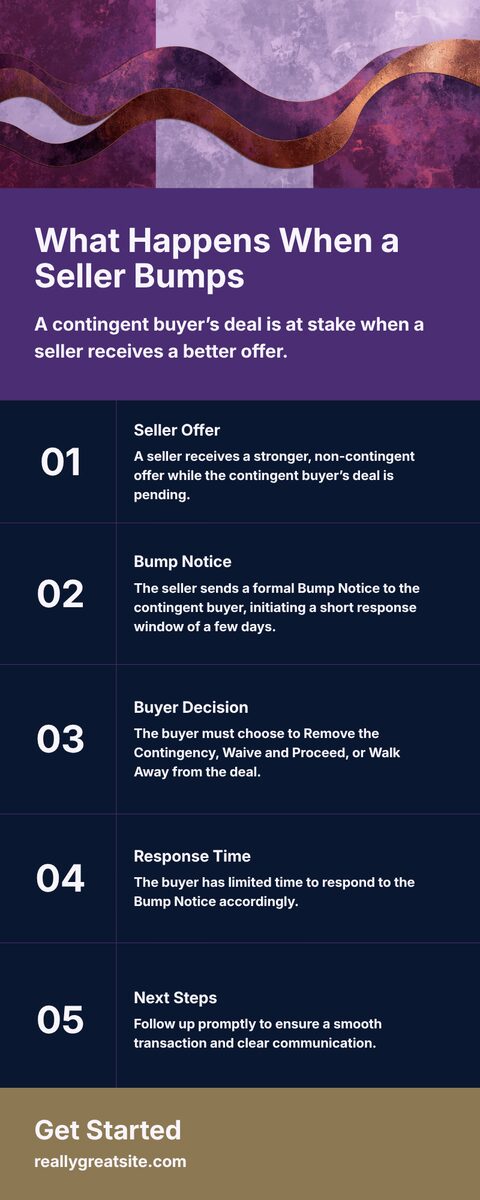
When a better offer arrives, the clock starts the moment the bump notice goes out.
That window to respond is usually short, often just a few days. If you are the contingent buyer, this is not a moment to be caught off guard by a phone call. Your agent should already have a plan for what you will do if a bump notice arrives, before it ever does.
Just as Important: What Form 22B Does Not Cover
I see buyers assume Form 22B protects them the way an inspection or financing contingency does. It does not. Form 22B is specifically about the sale of your current home. It does nothing to protect you if your loan falls through on the new purchase. That is what Form 22A, the financing contingency, is for, and if you are using a Form 22B offer, you generally want that financing contingency running alongside it, not instead of it.
I have seen buyers waive their financing contingency to make a contingent offer look stronger, thinking the home sale contingency alone covers them. It does not. Those are two completely separate protections, and dropping one to compete does not make the other one do double duty.
The Local Angle: Why This Form Matters More in King County Right Now
King County’s market has shifted. Inventory has climbed through 2026 and homes are sitting longer than they did a couple years ago, especially across South King County cities like Kent, Auburn, and Federal Way. That shift changes the calculus for both sides of a Form 22B negotiation.
For sellers, it means a contingent offer is worth a serious look instead of an automatic pass. In a market where your home might otherwise sit for three or four weeks anyway, a well-structured contingent offer with the bump clause intact costs you very little real risk. You keep the right to accept a better offer the entire time the contingency is active.
For buyers, it means you have more leverage to ask for a Form 22B structure than you did during the multiple-offer years, but you still need to write a clean offer. A strong earnest money deposit, a realistic listing timeline for your current home, and being upfront with your agent about your true equity position all make a contingent offer more attractive to a seller who is weighing it against a clean offer from someone else.
Renton and Kent sellers in particular are seeing more move-up buyers structure offers this way, since so many South King County move-up buyers need their current equity to make the Eastside or a larger South King County home work. If you want the broader playbook on writing or evaluating a contingent offer beyond just the Form 22B mechanics, I put together a full strategy guide covering that side of it.
What This Means for You
If you are a seller looking at a contingent offer, do not dismiss it automatically. Look at how realistic the buyer’s timeline is, how much equity they actually have in their current home, and whether the listing deadline in the contract gives you real protection. A well-structured Form 22B offer with the bump clause intact rarely costs you anything, since you keep the right to accept a better offer the whole time it is active.
If you are a buyer who needs to sell before you can buy, talk to your agent early about whether a Form 22B offer makes sense for the specific home you want, and make sure your financing contingency stays in place alongside it. Know your bump-notice game plan before you ever submit the offer, not after the notice shows up.
Either way, this is not a form to handle casually. The deadlines are specific, the consequences of missing one are real, and the difference between a contingent offer that protects you and one that exposes you often comes down to details most people never read closely.
Frequently Asked Questions
What is NWMLS Form 22B?
Form 22B is the Buyer’s Sale of Property Contingency addendum used in Washington State real estate contracts. It lets a buyer make an offer contingent on selling their current home, while giving the seller protections like a listing deadline and the right to keep marketing the property.
What is a bump notice?
A bump notice, NWMLS Form 44, is what a seller sends to a contingent buyer when a better offer comes in. It starts a short response window, during which the buyer must remove their contingency, agree to close without it, or let the contract terminate.
Does Form 22B protect my financing too?
No. Form 22B only protects you around selling your current home. Financing protection comes from a separate contingency, NWMLS Form 22A. If you are making a contingent offer, you generally want both running together, not one in place of the other.
What happens to my earnest money if I can’t remove the contingency after a bump?
If you follow the contract terms and choose to terminate rather than remove the contingency, your earnest money is typically returned. If you waived the contingency to compete for the home and then cannot close, you risk losing your earnest money. Read your specific contract language and talk to your agent before you waive anything.
Are sellers actually accepting contingent offers in King County right now?
More than they were a couple years ago. With inventory up and homes taking longer to sell across much of King County in 2026, a well-structured contingent offer with the bump clause intact is a much more reasonable option for sellers than it used to be, since it costs the seller very little real risk.
What happens if I miss the listing deadline in my Form 22B contract?
Missing the deadline to list your current home can put you in a difficult position, potentially waiving other protections in the contract and requiring you to close on the original timeline regardless. Mark that date the day you sign the contract, not when it is about to arrive.
Contingent offers are not the deal-killer they used to be in this market, but they only work when both sides understand exactly what Form 22B protects and what it does not. Whether you are the one making the offer or the one deciding whether to accept it, get the timeline right, keep your other contingencies in place, and do not let the bump clause catch you by surprise.
Reach me at greg@livingoutsideseattle.com or 253-350-0045 if you are weighing a contingent offer on either side of the table.
Your guide to life outside Seattle.
253-350-0045 ·
greg@livingoutsideseattle.com ·
www.livingoutsideseattle.com
