

 Facebook
 X
X
 Pinterest
 Copy Link

If you have owned your home in Bellevue, Sammamish, or anywhere else in King County for more than a few years, there is a good chance you are sitting on more equity than you think. That is a good problem to have, until tax season shows up and you start wondering how much of that gain the IRS is going to want.
Here is the short version: most sellers pay nothing. The federal government lets you exclude up to $250,000 of profit if you are single, or $500,000 if you are married and filing jointly, as long as you meet two simple tests. This is called the Section 121 exclusion, and it is the single biggest reason most King County homeowners sell without writing a capital gains check at all.
But “most” is not “all.” Across King County, the median single-family home sold for about $967,000 over the twelve months through August 2026. On the Eastside, the single-family median runs past $1.7 million in both Bellevue and Sammamish. More sellers are bumping into that ceiling than you might expect. Here is exactly how the exemption works, who it covers, how to figure the cost basis that decides your actual gain, and what happens when that gain runs past the limit.
One note on the numbers in this post: every median I use is single-family only. I never blend condos into a city median, because in a couple of these cities that distorts the picture badly. More on why in the local section below.
What the Section 121 Exclusion Actually Does
Section 121 is a provision in the federal tax code that lets you exclude a chunk of the profit from selling your primary home from your taxable income. Profit here is not the difference between what you paid and what you sold for. It is your net sale price, after commission and closing costs come off, minus your adjusted basis, which is what you paid plus the capital improvements you have put into the house over the years. Getting that basis number right is the biggest lever most King County sellers have, and it is the part people guess at. I walk through how to build it a few sections down.
Say you bought a single-family home in Renton in 2016 for $430,000, right at that year’s single-family median, and you are selling it today for $785,000, right at the current one. Before any adjustments that looks like a $355,000 gain. If you are single, the first $250,000 is excluded and you owe federal capital gains tax on the remaining $105,000. If you are married and filing jointly, the whole $355,000 falls under the $500,000 exclusion and you owe nothing. Adjust for selling costs and improvements and the taxable number usually drops further, which is the whole point of the basis section below.
That is the entire mechanism. There is no application to file in advance and no special form your accountant needs to submit to claim it, though the sale does get reported and the exclusion gets claimed on your tax return for that year.
The Two Tests You Have to Pass
To qualify for the exclusion, you need to clear two separate tests, both measured against the five years right before your sale date.
The Ownership Test
You have to have owned the home for at least 24 months out of the last 60. That is it. Those 24 months do not need to be continuous, and they do not need to be the most recent 24 months, as long as they fall somewhere inside that five-year window.
The Use Test
You have to have lived in the home as your primary residence for at least 24 months out of the same five-year window. Again, those months do not have to run back to back. If you lived in the house for a year, rented it out for two years while you were relocated for work, then moved back in for a year before selling, you would still meet the use test, as long as the total adds up to 24 months within the five-year period.
For married couples filing jointly, only one spouse needs to meet the ownership test, but both spouses need to meet the use test to get the full $500,000 exclusion.
You Can Only Use This Every Two Years
The exclusion is not a one-time-in-your-life benefit, but you generally cannot claim it again if you used it on a different home sale within the past two years. If you are selling one primary residence and buying another, this rarely comes up. It matters more for people who have moved more than once in a short window, like a job relocation that got reversed.
If that describes your situation, it is worth a conversation with a tax professional before you list, not after.
What Happens If You Do Not Meet Both Tests
Life does not always line up with a tax code’s tidy 24-month rule. If you are selling because of a job change, a health issue, or another qualifying unforeseen circumstance, and you have not hit the full two years, you may still qualify for a partial exclusion. The IRS prorates the amount based on how much of the 24-month period you actually met. If you lived in the home for 12 months instead of 24 because your employer relocated you, you could potentially claim about half of the usual exclusion.
There are also special rules that pause the five-year clock for active-duty military, Foreign Service, and intelligence community members serving away from home, extending the window up to 10 years. If that applies to you, this is a case where getting your CPA involved early is worth the fee.
How to Figure Your Cost Basis (Where Remodels Change the Math)
Here is where a lot of King County sellers leave money on the table. Your basis is not just what you paid. It is what you paid plus every capital improvement you have made since, and a huge share of the housing stock in Bellevue, Renton, Kent, and Sammamish was built between the 1960s and the 1990s and has had serious money put into it since. I see it every week in the field. A 1978 split-level in Newcastle with a studs-out kitchen, a 1994 two-story in Sammamish with a new roof, windows, and heat pump. That work raised the value of the house. It also raised the basis, which lowers the taxable gain, but only if you can document it.
The Basis Formula
Adjusted basis = original purchase price + closing costs from when you bought (title, escrow, recording, transfer fees, some legal) + capital improvements, minus any depreciation you claimed, casualty loss deductions, or energy credits and subsidies that reduced basis.
Amount realized = contract sale price minus selling costs (commission, real estate excise tax, escrow and title, and any concessions you credited the buyer).
Your gain = amount realized minus adjusted basis. The exclusion then comes off that gain, not off your sale price.
Notice that selling costs come off the top. Sellers routinely forget this and overestimate their own gain by six figures on an Eastside sale, because commission and excise tax alone can run 7% of the price.
What Counts as an Improvement, and What Does Not
The IRS test is whether the work adds to the value of the home, prolongs its useful life, or adapts it to a new use. Kitchen and bathroom remodels count. So does an addition, a finished basement, a permitted ADU or DADU, a new roof, new windows, new siding, a furnace or heat pump, an electrical panel upgrade, a whole-house repipe, a new deck, fencing, a paved driveway, a sewer connection or septic system, a well, and permanent landscaping like retaining walls and hardscape.
Repairs do not count. Repainting a room, replacing a cracked window pane, fixing a leak, servicing the furnace, routine yard work: that is maintenance, and it stays out of your basis no matter what it cost you. The honest line between the two is condition versus capability. If it put the house back the way it was, it is a repair. If it made the house better or different, it is an improvement.
One nuance worth raising with your CPA: work that would be a repair on its own generally does count when it is done as part of a larger remodel. The drywall patching and painting inside a full kitchen gut are part of the kitchen project, not separate maintenance.
The Rule People Get Wrong: Replaced Improvements Come Back Out
You count what is still in the house, not everything you ever spent on it. If you remodeled the kitchen in 2004 and remodeled it again in 2019, the 2004 kitchen generally comes out of your basis when the new one goes in. Same with a roof you have replaced twice, or windows you upgraded and then upgraded again. This is the single most common basis error I hear about from sellers who have owned a home for twenty-plus years, and it usually runs in the seller’s favor to fix, because the current improvements are typically the expensive ones.
What to Keep, and What to Do If You Did Not Keep It
The records that hold up are contractor invoices, paid receipts, cancelled checks or card statements, permits with final inspections, and the settlement statement from when you bought the house. Keep them for as long as you own the home plus at least three years after you sell.
If the receipts are long gone, you are not necessarily out of luck. Permit history through King County or your city’s permit portal can establish that the work happened and when, and most of the big-ticket items on that list above required a permit. Be straight with yourself about the limit, though: a permit proves the work, not the cost. It supports a reconstruction of your basis, it does not replace the records, and your CPA is the one who decides what is defensible on a return.
Worked Example: What the Records Are Worth
A married couple bought a Bellevue single-family home in 2006 for $625,000, with about $6,000 in closing costs. Over twenty years they documented a kitchen and two baths at $180,000, a roof and windows at $45,000, a heat pump and panel upgrade at $30,000, and a deck and fencing at $20,000. That is $275,000 in improvements, for an adjusted basis of $906,000.
They sell at $1,800,000. Commission, excise tax, escrow and title, and a modest concession run roughly 8%, or $144,000, so the amount realized is $1,656,000. Their gain is $750,000. Subtract the $500,000 married exclusion and $250,000 is taxable.
Run the same sale with no improvement records and the basis is $631,000, the gain is $1,025,000, and $525,000 is taxable. Those receipts were worth $275,000 of gain, which is roughly $41,000 of federal tax at the 15% rate. That is what a shoebox of invoices is worth.
Gain Above the Exclusion: What You Actually Owe
If your profit runs past your exclusion limit, the excess is taxed at long-term capital gains rates, assuming you owned the home for more than a year, which almost every seller reading this has. For 2026, the federal long-term capital gains brackets work like this:
2026 Long-Term Capital Gains Brackets
Single filers: 0% up to $49,450 in taxable income, 15% from $49,451 to $545,500, 20% above that.
Married filing jointly: 0% up to $98,900 in taxable income, 15% from $98,901 to $613,700, 20% above that.
Most sellers with gain above the exclusion land in the 15% bracket, not the 20% one. Take the Bellevue couple from the basis section: $250,000 of taxable gain, mostly at 15%, is about $37,500 in federal capital gains tax. Run the same sale without their improvement records and $525,000 is taxable, which pushes part of the gain into the 20% bracket for a lot of households. That gap is not rounding.
There is one more line item that catches high-equity sellers off guard. Gain above the exclusion counts as net investment income, so the 3.8% net investment income tax generally applies on top of the capital gains rate once modified adjusted gross income passes $250,000 for a married couple or $200,000 for a single filer. On $250,000 of taxable gain that is another $9,500 or so. Your CPA will size it exactly, but plan on it rather than being surprised by it at filing time.

Knowing your real net number before you list changes how you negotiate.
Washington Has No State Capital Gains Tax on Real Estate. Here Is What It Does Have.
This trips people up constantly, so it is worth saying plainly: Washington State does not tax the sale of your home under its capital gains tax law. That state-level capital gains tax exists and applies to certain investment assets like stocks and bonds, but real estate is explicitly carved out.
What Washington does charge is the Real Estate Excise Tax, or REET, and it is a completely different animal. REET is not based on your profit. It is based on your sale price, and every seller pays it regardless of gain or loss. As of 2026, the state’s graduated REET structure runs 1.10% on the first $500,000 of the sale price, 1.28% on the portion between $500,000 and $1.5 million, 2.75% between $1.5 million and $3 million, and 3.00% above that. King County and most cities within it add a local REET on top, typically in the 0.25% to 0.50% range.
So on that same $1.8 million Bellevue sale, REET runs about $26,550 to the state plus roughly $9,000 in local excise tax, call it $35,500 total, and you pay it on the full sale price no matter what your gain was. That is separate from, and on top of, any federal capital gains tax on the profit above your exclusion. These are two entirely different tax lines, and mixing them up is one of the most common mistakes I see sellers make when they are estimating their net proceeds. I wrote a full breakdown of Washington’s REET rates and how they stack by price tier if you want the complete picture on that side of the ledger, and a broader total cost-to-sell breakdown covering commission and concessions too.
The Local Angle: Why This Matters More on the Eastside
Here is where being a BPO field agent shapes how I look at this. I price King County homes for banks and institutional clients every week, and on any Bellevue assignment the first thing I do is separate the houses from the condos. Blend them and the number you get describes neither one.
Over the twelve months through August 2026, the median single-family home in Bellevue sold for about $1.8 million. In Sammamish it was about $1.69 million. Issaquah ran about $1.42 million. Down south, single-family medians came in near $784,000 in Renton, $698,000 in Kent, $664,000 in Auburn, and $646,000 in Federal Way. Single-family only, every one of those.
If you have seen a chart that puts Bellevue below Sammamish, you were looking at a blended median. About 32% of Bellevue’s closed sales over that same stretch were condominiums, at a median around $681,000. In Sammamish, condos were about 9% of sales. Fold that many sub-$700,000 sales into one city’s median and not the other’s, and Bellevue comes out looking cheaper than Sammamish. It is not. That is a mix difference, not a value difference, and it is exactly the kind of thing that leads a seller to price a Bellevue house off the wrong number.
Why Blended Medians Make Bellevue Look Cheap
Bellevue: single-family median about $1.8 million. Condo median about $681,000. Condos are roughly 32% of closed sales.
Sammamish: single-family median about $1.69 million. Condo median about $600,000. Condos are roughly 9% of closed sales.
The same effect shows up countywide. King County’s single-family median is about $967,000, but the all-property-types median is about $859,000. If you are selling a house, the second number is not your number. Figures are 12-month medians through August 2026, Northwest MLS.
For the tax question, the single-family number is the one that matters, because that is what a single-family seller actually closes at. At a $1.8 million Bellevue sale, after selling costs come off, a married couple needs roughly $1.15 million of adjusted basis to stay entirely inside the $500,000 exclusion. If you bought before about 2015, you almost certainly do not have that. Which is why the basis work above is not optional on the Eastside.
South King County sellers are less likely to hit the ceiling on a primary home sale. At Renton’s $784,000 single-family median, a married couple would need an adjusted basis under about $221,000 before any of the gain becomes taxable, which generally means a purchase in the 1990s or earlier with little documented work since. It happens, especially with long-held family homes and inherited property, but it is not the common case in Kent, Auburn, or Federal Way either. The two tests and the exclusion amounts are identical no matter which city you are in. What changes is how likely you are to need the excess math at all.
If tapping into that equity before you sell is part of your plan, whether to fund a move-up purchase or bridge two closings, I covered how HELOCs and cash-out refinances compare for King County homeowners, and what that means for move-up buyers specifically in my Bellevue move-up buyer guide.
One Honest Caution: Rental History Complicates This
If your home was ever a rental property, even for part of the time you owned it, the math gets more complicated. Any depreciation you claimed while it was a rental generally has to be “recaptured” and taxed separately when you sell, and that portion does not qualify for the Section 121 exclusion no matter how long you lived in the home afterward. This comes up often with people who bought a house, rented it out for a few years, then moved in before selling. If that describes your situation, do not estimate this one yourself. Get a CPA to run the actual numbers before you set a listing price, because the gap between what you think you will net and what you will actually net can be significant.
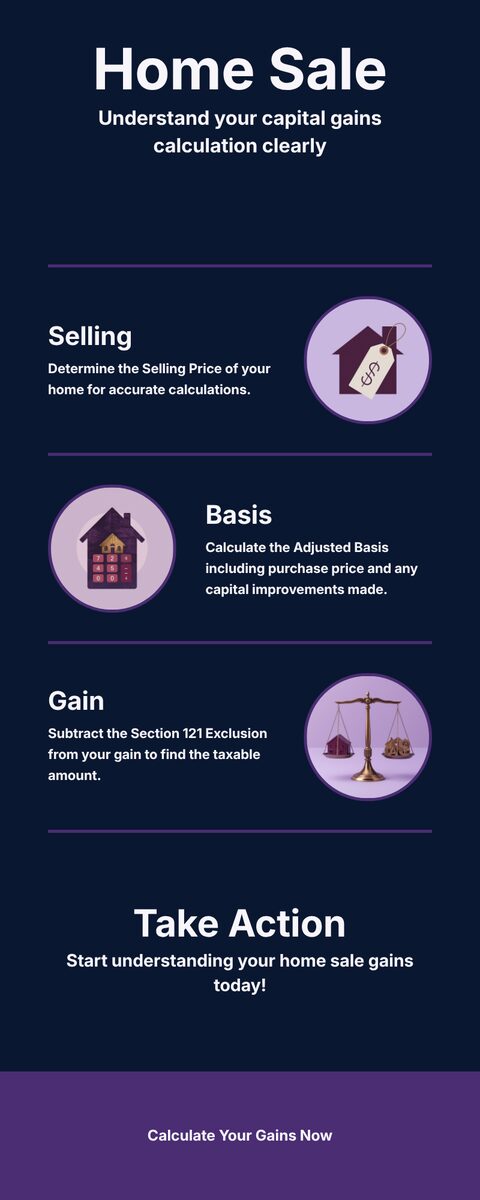
Selling price minus adjusted basis equals gain. Gain minus your exclusion equals what’s actually taxable.
What This Means for You As a Seller
Pull together your original purchase price, the settlement statement from that purchase, and every record you have for major improvements: invoices, cancelled checks, permits, final inspections. Add them up the way the basis section above lays out, and take out anything you later replaced. That is your adjusted basis, and it is the number that determines your actual gain, not the difference between what you paid and what you are selling for today. If you have remodeled this house at any point, this step is worth a weekend of digging through files.
If your gain looks like it might land anywhere near $250,000 as a single filer or $500,000 as a married couple, loop in a CPA before you set your listing price. Knowing your real net number in advance changes how you think about timing the sale, whether you negotiate on price versus concessions, and whether there is any benefit to waiting or accelerating your timeline around the two-year use test.
And if you are not sure where your numbers stand, that is exactly the kind of question I help sellers work through every week using real comparable data, not a guess. Reach out and we can run the actual math for your specific home before you make any decisions.
Frequently Asked Questions
Do I have to buy another home to avoid capital gains tax on my house sale?
No. That was the rule decades ago under the old “rollover” provision, but it was replaced by the Section 121 exclusion in 1997. You do not need to reinvest in another home at all. You can rent afterward, downsize, or do anything else with the proceeds and still keep the exclusion, as long as you meet the ownership and use tests.
Does Washington State tax the profit from selling my home?
No. Washington’s state capital gains tax specifically excludes real estate. You will still pay the Real Estate Excise Tax (REET) on the sale price, but that is a separate tax from capital gains and applies regardless of whether you had a profit.
Can I use the Section 121 exclusion more than once?
Yes, but generally not more than once every two years. As long as at least two years have passed since you last used the exclusion on a different home sale, and you meet the ownership and use tests on the current sale, you can claim it again.
What counts toward my home’s adjusted basis?
Your original purchase price, plus most closing costs from when you bought, plus capital improvements like a new roof, an addition, a remodeled kitchen, a finished basement, a heat pump, or a permitted ADU. Routine repairs and maintenance, like repainting a room or fixing a broken appliance, do not count. One rule people miss: an improvement you later tore out and replaced comes back out of your basis, so you count what is in the house today, not everything you ever spent. Keep your receipts.
What if I only lived in my King County home for one year before I have to sell?
You may still qualify for a partial exclusion if the sale is due to a job change, health issue, or another IRS-recognized unforeseen circumstance. The exclusion amount gets prorated based on how much of the required 24 months you actually met. Talk to a CPA about your specific circumstances before assuming you get nothing.
Do I need to report the sale to the IRS if my entire gain is excluded?
In most cases where your full gain qualifies for the exclusion and you did not receive a Form 1099-S, you do not need to report the sale. If you did receive a 1099-S or your gain exceeds the exclusion, you will need to report it on your tax return even if part or all of it is excluded. Your tax preparer can confirm which applies to you.
Does a kitchen remodel reduce the capital gains tax when I sell?
Indirectly, yes. A remodel is a capital improvement, so it adds to your adjusted basis, and a higher basis means a smaller taxable gain. A $180,000 kitchen and bath remodel removes $180,000 of gain from the calculation. If your gain is already inside the $250,000 or $500,000 exclusion it changes nothing on your tax return, but on a high-equity Eastside sale it can be worth tens of thousands of dollars in federal tax.
What if I do not have receipts for improvements I made years ago?
Start with permit history. King County and each city keep permit records, and most major work (additions, roofs, electrical panels, repipes, decks, ADUs, sewer and septic) required one. A permit establishes that the work happened and when, which supports reconstructing your basis. Be clear on the limit, though: a permit proves the work, not the cost. Contractor invoices, cancelled checks, and card statements are what actually document the dollars, and your CPA decides what is defensible on a return.
Why do Bellevue median home prices sometimes look lower than Sammamish?
Property mix. Roughly 32% of Bellevue closed sales are condominiums, against about 9% in Sammamish, so a blended median that mixes condos with houses pulls Bellevue down much harder. Compare single-family to single-family and Bellevue is the more expensive market: about $1.8 million versus about $1.69 million over the twelve months through August 2026. If you are selling a house, use the single-family number.
Selling a longtime home in King County is not just an emotional milestone, it is a financial one, and the tax side of that equation deserves the same attention as your listing price. Most sellers walk away from the Section 121 exclusion without owing the IRS a dime. A growing number of Eastside sellers are finding their equity has quietly outgrown that exclusion, and the sooner you know which camp you are in, the better decisions you can make about timing, pricing, and what you actually walk away with.
Reach me at greg@livingoutsideseattle.com or 253-350-0045 if you want to run your specific numbers before you list.
Your guide to life outside Seattle.
253-350-0045 ·
greg@livingoutsideseattle.com ·
www.livingoutsideseattle.com
