

 Facebook
 X
X
 Pinterest
 Copy Link
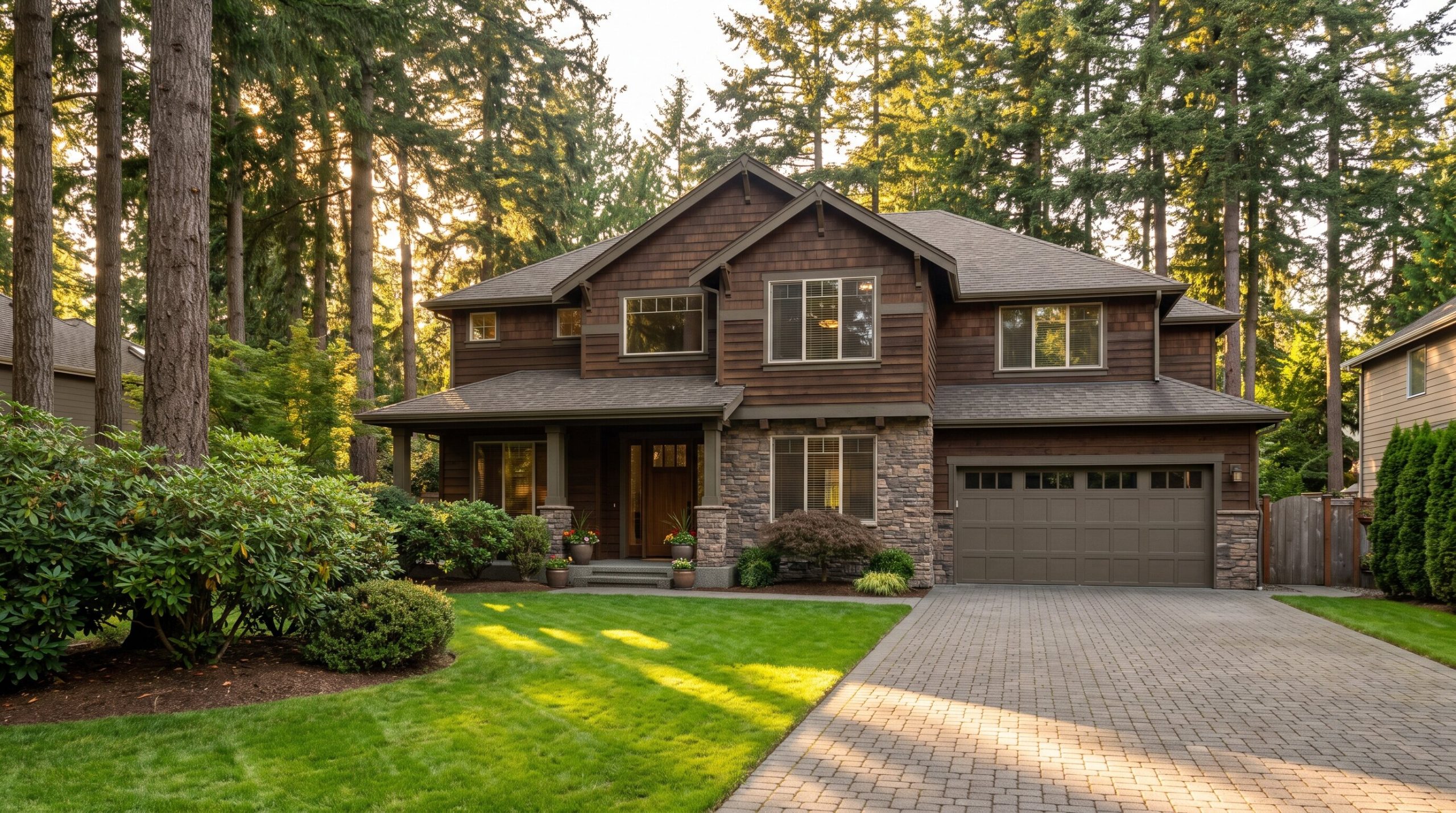
If you bought your Bellevue or Sammamish home ten, fifteen, or twenty years ago, you are likely sitting on more equity than you think. Bellevue’s median home price is running close to $1.4 to $1.5 million right now. Sammamish is close behind at around $1.6 million. If your mortgage is small or paid off, that gap between what you owe and what your home is worth could be enough to buy your next home in cash.
I do BPO work across King County every single day, and the Eastside is where I see this scenario the most. Long-time owners in Bellevue and Sammamish built enormous equity just by staying put through two decades of appreciation. Most of them never sat down and ran the actual math on what that equity could do for their next move.
This guide walks through that math, plus what it takes to structure a downsizing sale into a cash purchase without getting squeezed by timing, taxes, or a rushed decision.
The Equity Math: What Your Eastside Home Is Actually Worth to You
Here is the calculation most Bellevue and Sammamish sellers skip until they are already talking to an agent: what do you actually walk away with, and what does that buy you.
Start with your home’s current value. If you bought in Bellevue before 2015, you likely paid somewhere between $500,000 and $800,000 for a home that would sell today in the $1.3 to $1.6 million range depending on the neighborhood and condition. In Sammamish, that same era of purchase often lands buyers in the $1.5 to $1.8 million range today. Subtract your remaining mortgage balance, if any. For owners who have been in their home 15 or more years, that balance is often small relative to the total value, sometimes zero.
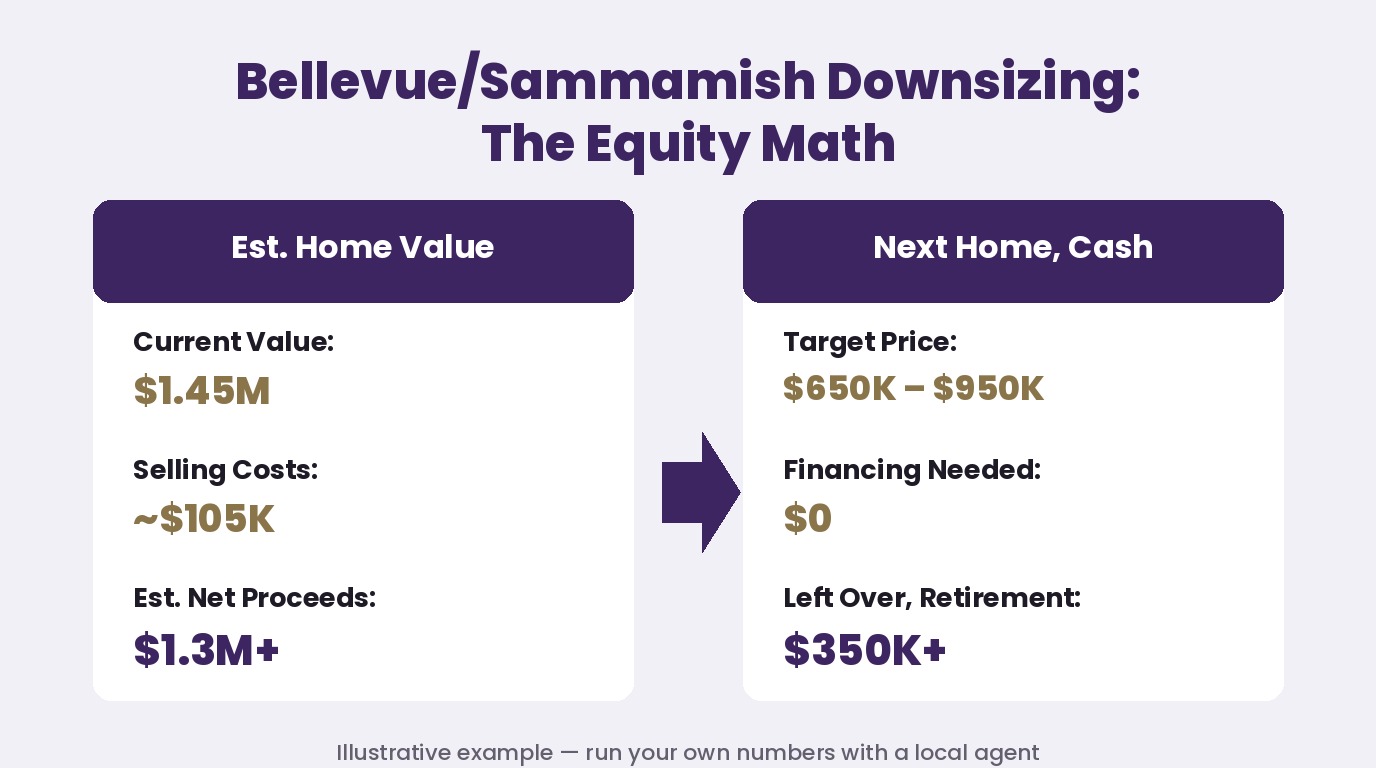
A sample equity walk from current value to net proceeds after selling costs and REET.
From there, subtract selling costs. Budget roughly 6 to 7% of your sale price for agent commission, and add Washington’s Real Estate Excise Tax, which runs graduated rates starting around 1.28% and climbing on the portion of your sale price above $3.025 million. On a $1.5 million Bellevue sale, plan for something in the range of $95,000 to $115,000 in combined commission and REET, before any repair credits or concessions. Your net proceeds are what is left after that math, not your sale price. I break down a full worked example on a comparable Eastside sale in my Sammamish net proceeds guide, if you want to see the numbers laid out line by line.
Here is the part that matters most: Washington does not tax real estate capital gains at the state level. At the federal level, if you have lived in the home as your primary residence for at least two of the last five years, married couples can exclude up to $500,000 in gain, and single filers up to $250,000. For most longtime Eastside owners, that exclusion covers most or all of the taxable gain. Talk to a CPA to confirm your specific number, but for most people in this situation, the tax bill is smaller than they expect.
The result for a lot of Bellevue and Sammamish sellers: net proceeds well north of $1 million, sometimes $1.5 million or more, depending on how long you have owned and what you paid. That is enough to buy a smaller home, a townhome, or a condo in many parts of King County without touching a mortgage at all.
Why Buy in Cash? The Real Advantages
A cash purchase is not just about skipping a mortgage payment. It changes how competitive your offer looks and how much control you have over your own timeline.
Your offer gets taken more seriously
In a market where sellers still worry about financing falling through, a cash offer with no loan contingency is a cleaner, faster deal. That matters most on well-priced homes in tight neighborhoods where you may still see competition, even with King County inventory up from where it was two years ago.
If you are weighing the reverse move, trading up rather than down, the same equity math shows up in my Bellevue move-up buyer’s guide.
You skip the interest cost entirely
At today’s rates, financing even a $700,000 purchase means real interest paid over the life of the loan. Paying cash means that money stays with you instead of a lender. It also means no appraisal contingency tied to a loan, which removes one more point where a deal can fall apart.
Your monthly cost drops dramatically
No mortgage payment on the next home means your fixed monthly cost becomes property tax, insurance, and maintenance or HOA dues. For a lot of people downsizing specifically to reduce their monthly financial pressure in retirement, this is the entire point.
You have more flexibility on timing
Cash buyers are not tied to a lender’s underwriting timeline. You can often close faster, which gives you more leverage to negotiate price or close on your own schedule rather than a bank’s.
None of this means a cash purchase is automatically the right move for everyone. If keeping some funds liquid for retirement, healthcare, or helping family matters more to you than owning outright, a smaller mortgage on the next home might make more sense even with strong equity. Run both scenarios before you commit to either one.
Sell First or Buy First? Structuring the Timing
This is where most downsizing sellers in Bellevue and Sammamish get stuck. You need your equity to buy in cash, but you do not want to sell your current home and end up homeless between closings, or worse, rushed into a purchase you did not fully vet.
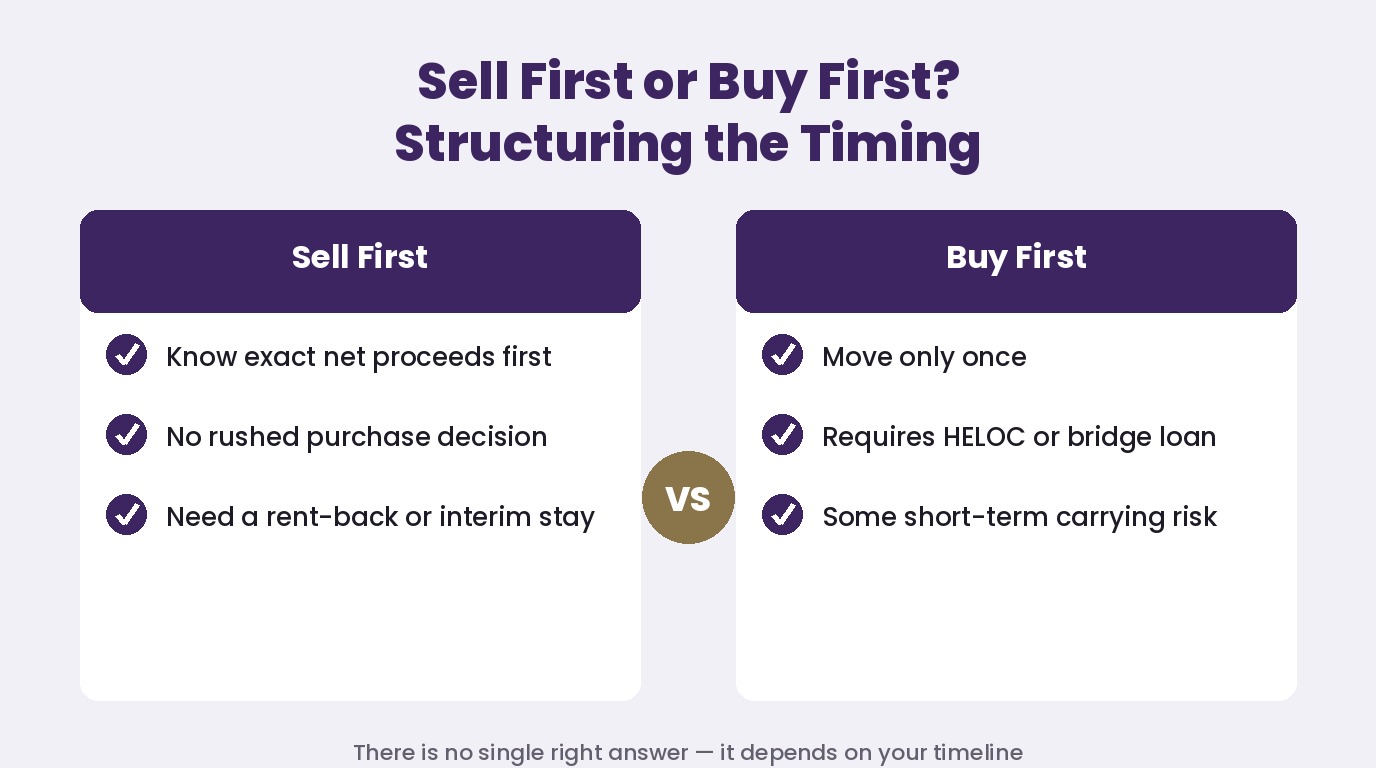
Sell first for certainty on your proceeds. Buy first with a bridge loan or HELOC to move only once.
Selling first is the cleanest path if your timeline allows it. You know your exact net proceeds before you make an offer on anything, which means you can shop with real numbers instead of estimates. The tradeoff is you need somewhere to land in the gap, whether that is a rent-back agreement on your sale, a short-term rental, or staying with family while you find the right next home.
Buying first works if you have the equity to bridge the gap. Some Eastside sellers use a HELOC or bridge loan against their current home’s equity to fund the next purchase before their sale closes, then pay it off with sale proceeds. This lets you move once instead of twice, but it requires qualifying for bridge financing and carrying some short-term risk if your home takes longer to sell than expected. For the full comparison of financing tools that can bridge this gap, see my HELOC vs. cash-out refinance guide.
A rent-back agreement is often the simplest bridge. If you sell first but need a few extra weeks to find and close on the next home, a rent-back lets you stay in your current house as the buyer’s tenant for a short period after closing. It is one of the most common tools I use with Eastside sellers navigating exactly this kind of transition, and Washington’s standard rent-back form caps the period at three months, which is usually plenty of runway.
The right structure depends on how firm your timeline is and how much liquidity you want to carry during the transition. There is no universally correct answer here. What matters is deciding on purpose instead of defaulting into whichever option feels least stressful in the moment.

Deciding how to structure the sale and purchase timeline is the hardest part of downsizing, not the math.
Where the Equity Actually Goes: Landing Spots on the Eastside and Beyond
Once you know your net proceeds, the next question is where that money buys you a comfortable next chapter without a mortgage.
Staying in Bellevue or Sammamish, smaller footprint. A well-maintained condo or townhome on the Eastside can run anywhere from $600,000 to $1 million depending on the building, HOA amenities, and proximity to downtown Bellevue or the Sammamish plateau. If staying close to your current community, doctors, and social circle matters most, this keeps you local while still freeing up substantial cash.
Moving to South King County. Cities like Renton, Kent, Covington, and Maple Valley offer smaller single-family homes and townhomes typically in the $500,000 to $700,000 range, a meaningful step down from Eastside pricing. This route often leaves the largest amount of leftover cash for retirement, travel, or helping the next generation, while still keeping you within a reasonable drive of the Eastside.
A 55+ community. Communities like Providence Point in Issaquah combine low-maintenance living with built-in social connection, which appeals to a lot of Bellevue and Sammamish sellers who want less upkeep without losing the neighborhood feel they are used to.
Whichever direction you land, the math usually works in your favor if you have owned on the Eastside for more than a decade. The harder decision is rarely financial. It is deciding what kind of life you actually want in the next home before you start touring listings.
What This Means for You as a Move-Down Seller
If you own in Bellevue or Sammamish and the house has more space than you use, the math is almost certainly in your favor right now. Get an accurate current valuation first, not a guess. Run your actual net proceeds after commission, REET, and your federal exclusion. Then decide, deliberately, whether selling first or bridging the gap with a HELOC or rent-back fits your situation better.
The goal is not just to downsize. It is to walk into your next home without a mortgage payment hanging over retirement, using equity you already earned by staying put on the Eastside this long. For the broader framework on deciding whether downsizing makes sense in the first place, my King County empty nester downsizing guide covers the full decision, from timing to what to do with decades of accumulated belongings.
FAQ
How much equity do Bellevue and Sammamish homeowners typically have?
It depends heavily on purchase date. Owners who bought before 2015 in Bellevue or Sammamish often have $700,000 to $1.2 million or more in equity today, since median prices in both cities have roughly doubled or more over that period. The only way to know your real number is a professional valuation, not an automated estimate.
Can I really buy my next home in cash after selling in Bellevue or Sammamish?
For many longtime owners, yes. If your net proceeds after commission, REET, and taxes exceed the price of your target home, a cash purchase is realistic. This is most common when downsizing to a smaller home, condo, or a lower-cost area like South King County.
Do I owe capital gains tax when I sell my Eastside home?
Washington state does not tax real estate capital gains. At the federal level, married couples can exclude up to $500,000 in gain, and single filers up to $250,000, if the home was your primary residence for at least two of the last five years. Most longtime Eastside owners fall within or close to this exclusion, but confirm your specific situation with a CPA.
Should I sell my current home before buying the next one?
Selling first gives you certainty on your exact net proceeds before you shop. If you need to avoid a housing gap, a rent-back agreement or a bridge loan against your current equity can let you buy first or bridge the timing without a double move.
Is a cash offer really an advantage in the current Bellevue and Sammamish market?
Yes, though the advantage varies by property. Well-priced Eastside homes still draw competitive interest even with more inventory available than a few years ago. A cash offer with no financing contingency is typically viewed as lower risk by sellers and can help you win in a competitive situation.
What if I want to keep some of my equity invested instead of paying all cash?
That is a reasonable choice, not a compromise. Some sellers use part of their proceeds for a cash purchase and keep the rest liquid, or take a small mortgage on the next home specifically to preserve cash for retirement or healthcare needs. Run both scenarios with your financial advisor before deciding.
Your guide to life outside Seattle.
253-350-0045 ·
greg@livingoutsideseattle.com ·
www.livingoutsideseattle.com
